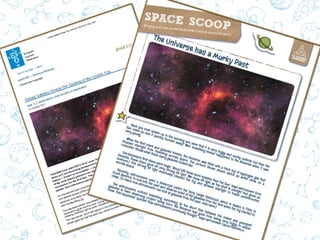
Space Scoop
Sarah Eve Roberts
Pedro Russo, Sarah Reed, Edward Gomez, Erik Arends, Natalie Fischer, Wouter Schrier,
UNAWE translators
www.unawe.org/kids

roberts@strw.leidenuniv.nl
Dishing Out the Latest Astronomy News!

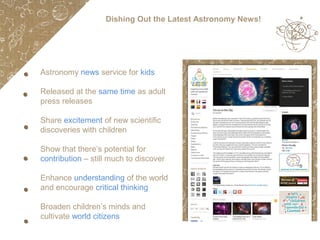
Astronomy news service for kids
Released at the same time as adult
press releases
Share excitement of new scientific
discoveries with children
Show that there’s potential for
contribution – still much to discover
Enhance understanding of the world
and encourage critical thinking
Broaden children’s minds and
cultivate world citizens
Writing for Kids
Standards of adult press releases:

Side Info

Short sentences
Avoid technical jargon where possible
Relate the science to real life
Stick to one or two new concepts
Pop-culture references
Don’t shy away from complex topics
It’s OK not to know everything! That
just means there are still mysteries to
solve!

Writing a Space Scoop in Seven
Steps
by Sarah Reed
CAPjournal Issue 13 (April 2013)
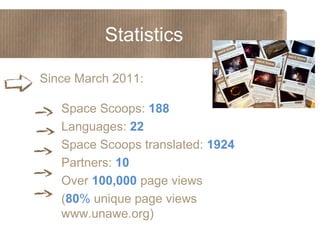
Statistics
Since March 2011:
Space Scoops: 188
Languages: 22
Space Scoops translated: 1924
Partners: 10
Over 100,000 page views
(80% unique page views
www.unawe.org)
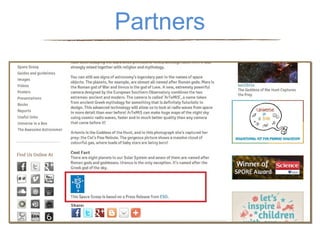
Partners
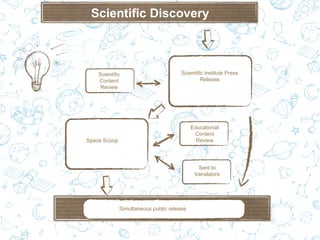
Scientific Discovery

Scientific
Content
Review

Scientific Institute Press
Release

Educational
Content
Review

Space Scoop

Sent to
translators

Simultaneous public release
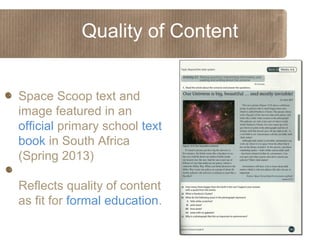
Quality of Content
Space Scoop text and
image featured in an
official primary school text
book in South Africa
(Spring 2013)
Reflects quality of content
as fit for formal education.
What now?
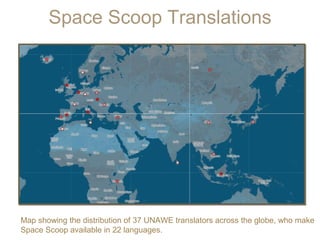
Space Scoop Translations

Map showing the distribution of 37 UNAWE translators across the globe, who make
Space Scoop available in 22 languages.
Children’s Media
Medium depends on audience and goal.
Video is passive; reaches large audience and feelings
are remembered. Suitable for inspiration.
Print is engaging; reaches a smaller audience with
more intensity. Suitable for imparting facts.
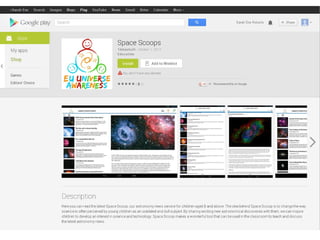
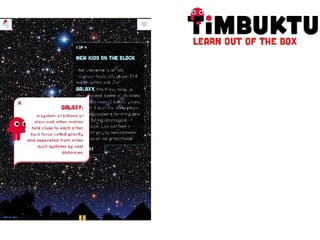
Digital is accessible; reaches a mainstream audience
of tech-savvy young generation, can even attract
‘reluctant’ readers.
Dissemination
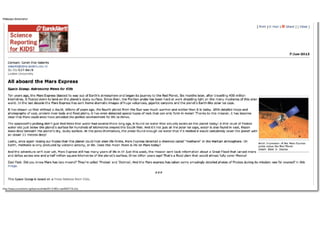
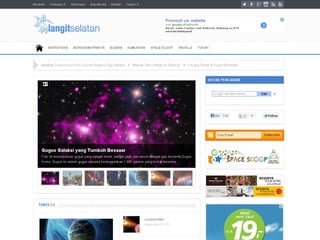
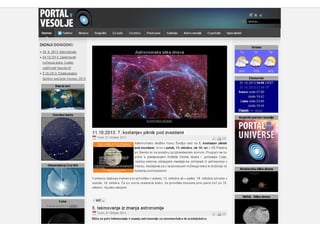
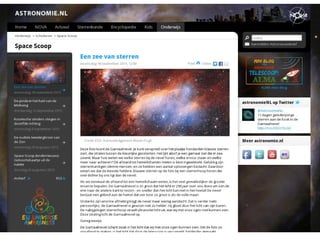
Space Scoop is versatile, can be converted to a wide
range of mediums, to reach a broad audience: different
ages, visually-impaired, illiterate, no internet access, etc.

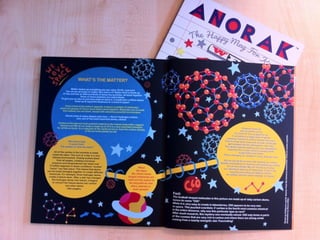
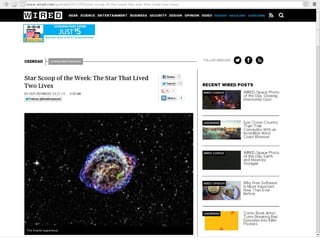
PRINT (magazines, web articles, etc.) - Scientific
facts
ORAL (podcast, etc. ) - Informal, friendly style
VISUAL (video podcast, etc. ) - Stunning, high-quality
visuals
Open Source
Creative Commons
Attribution
Free to share, remix, copy
Just attribute to UNAWE
Available for commercial use:
publications

Side Info
Print
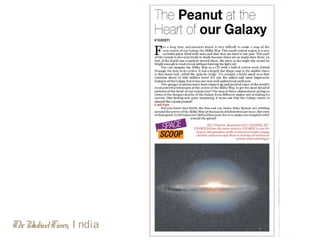
Th N indTimes, I ndia
e avh
Web
Digital
Audio-Visual
Podcasts
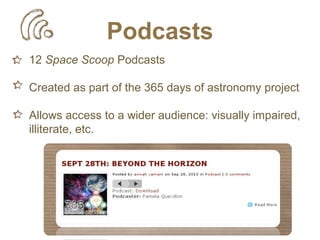
12 Space Scoop Podcasts
Created as part of the 365 days of astronomy project
Allows access to a wider audience: visually impaired,
illiterate, etc.
Podcast Stats
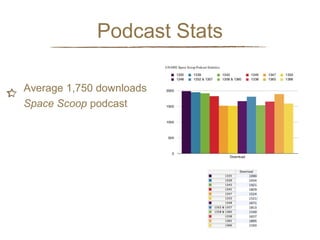
Average 1,750 downloads per
Space Scoop podcast
Video Podcasts
NASA Chandra X-ray Observatory
10 Space Scoop video podcasts
Latest Space Scoop video podcast
over 1000 downloads in less than 2 weeks!
What else can be
done with Space
Scoop?
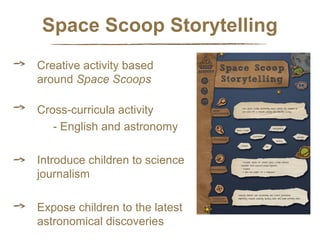
Space Scoop Storytelling
Creative activity based
around Space Scoops
Cross-curricula activity
- English and astronomy
Introduce children to science
journalism
Expose children to the latest
astronomical discoveries
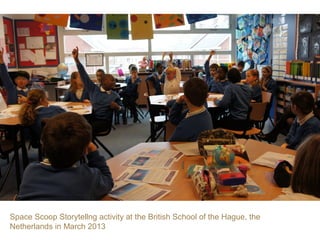
Space Scoop Storytellng activity at the British School of the Hague, the
Netherlands in March 2013
Future
Project might come to an end in
December 2013:
Not much support needed
thanks to 10 partner institutes
and reliable voluntary network.

Applying for funding grants
Partners contribute to resource?
Sponsors?
Thanks for listening!

www.unawe.org/kids
roberts@strw.leidenuniv.nl

CAP 2013 Space Scoop

  • 1.
    Space Scoop Sarah EveRoberts Pedro Russo, Sarah Reed, Edward Gomez, Erik Arends, Natalie Fischer, Wouter Schrier, UNAWE translators www.unawe.org/kids roberts@strw.leidenuniv.nl
  • 2.
    Dishing Out theLatest Astronomy News! Astronomy news service for kids Released at the same time as adult press releases Share excitement of new scientific discoveries with children Show that there’s potential for contribution – still much to discover Enhance understanding of the world and encourage critical thinking Broaden children’s minds and cultivate world citizens
  • 3.
    Writing for Kids Standardsof adult press releases: Side Info Short sentences Avoid technical jargon where possible Relate the science to real life Stick to one or two new concepts Pop-culture references Don’t shy away from complex topics It’s OK not to know everything! That just means there are still mysteries to solve! Writing a Space Scoop in Seven Steps by Sarah Reed CAPjournal Issue 13 (April 2013)
  • 4.
    Statistics Since March 2011: SpaceScoops: 188 Languages: 22 Space Scoops translated: 1924 Partners: 10 Over 100,000 page views (80% unique page views www.unawe.org)
  • 6.
  • 7.
    Scientific Discovery Scientific Content Review Scientific InstitutePress Release Educational Content Review Space Scoop Sent to translators Simultaneous public release
  • 9.
    Quality of Content SpaceScoop text and image featured in an official primary school text book in South Africa (Spring 2013) Reflects quality of content as fit for formal education.
  • 10.
  • 11.
    Space Scoop Translations Mapshowing the distribution of 37 UNAWE translators across the globe, who make Space Scoop available in 22 languages.
  • 13.
    Children’s Media Medium dependson audience and goal. Video is passive; reaches large audience and feelings are remembered. Suitable for inspiration. Print is engaging; reaches a smaller audience with more intensity. Suitable for imparting facts. Digital is accessible; reaches a mainstream audience of tech-savvy young generation, can even attract ‘reluctant’ readers.
  • 14.
    Dissemination Space Scoop isversatile, can be converted to a wide range of mediums, to reach a broad audience: different ages, visually-impaired, illiterate, no internet access, etc. PRINT (magazines, web articles, etc.) - Scientific facts ORAL (podcast, etc. ) - Informal, friendly style VISUAL (video podcast, etc. ) - Stunning, high-quality visuals
  • 15.
    Open Source Creative Commons Attribution Freeto share, remix, copy Just attribute to UNAWE Available for commercial use: publications Side Info
  • 16.
  • 18.
    Th N indTimes,I ndia e avh
  • 19.
  • 25.
  • 28.
  • 29.
    Podcasts 12 Space ScoopPodcasts Created as part of the 365 days of astronomy project Allows access to a wider audience: visually impaired, illiterate, etc.
  • 30.
    Podcast Stats Average 1,750downloads per Space Scoop podcast
  • 31.
    Video Podcasts NASA ChandraX-ray Observatory 10 Space Scoop video podcasts Latest Space Scoop video podcast over 1000 downloads in less than 2 weeks!
  • 33.
    What else canbe done with Space Scoop?
  • 34.
    Space Scoop Storytelling Creativeactivity based around Space Scoops Cross-curricula activity - English and astronomy Introduce children to science journalism Expose children to the latest astronomical discoveries
  • 35.
    Space Scoop Storytellngactivity at the British School of the Hague, the Netherlands in March 2013
  • 36.
  • 37.
    Project might cometo an end in December 2013: Not much support needed thanks to 10 partner institutes and reliable voluntary network. Applying for funding grants Partners contribute to resource? Sponsors?
  • 38.

Editor's Notes