•
•
Space Robotics
CONTENTS
1-Introduction
2-Space Robots Importance
3-what technology is needed?
4-Examples of Space Robots
5-Fundamental research challenges
6-International efforts in Space Robotics
7-Future scope of Space Robotics
INTRODUCTION
Space Robotics is the development of machines for
the space environment that perform Exploration, or to
Assemble/Construct, Maintain, or Service other
hardware in Space.
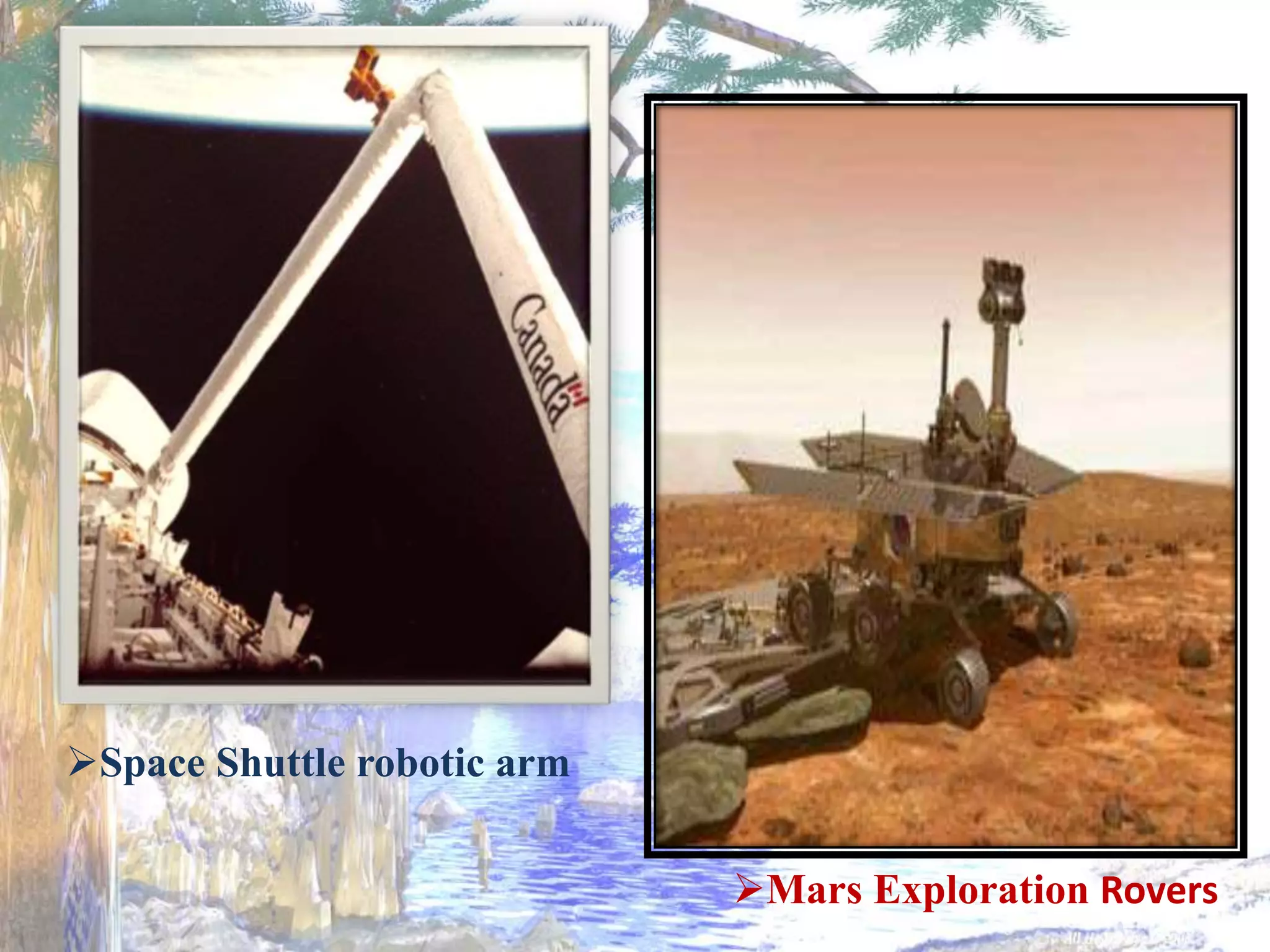
Humans generally control space robots locally (e.g.
Space Shuttle robotic arm) or from a great distance
(e.g. Mars Exploration Rovers)
Space Shuttle robotic arm
Mars Exploration Rovers
Space Robots Importance
Perform tasks less expensively, sooner, and with less
risk or more delicate "touch" than with human
astronauts
Go where people can’t go (within reason), and for
long durations
Space is a hazardous environment & Access to
space is expensive
Robots don't need to return to Earth (which can be
very costly)
NASA JPL,USA NASA JSC,USA WTEC Robotics
What technology is needed?
Mobility:
Need to plan paths that move quickly and accurately from A to B without
collisions or putting robot or worksite elements at risk.
Manipulation:
Need to contact worksite elements safely, quickly and accurately without
imparting excessive forces beyond those needed for the task.
Time Delay:
The speed-of-light delay between humans on Earth and the robot is
seconds in the Earth-moon vicinity and ~30 minutes to Mars.
Extreme Environments:
Radiation, temperature, very fine dust, etc.
Power, communications:
difficult.
Example of Space Robots
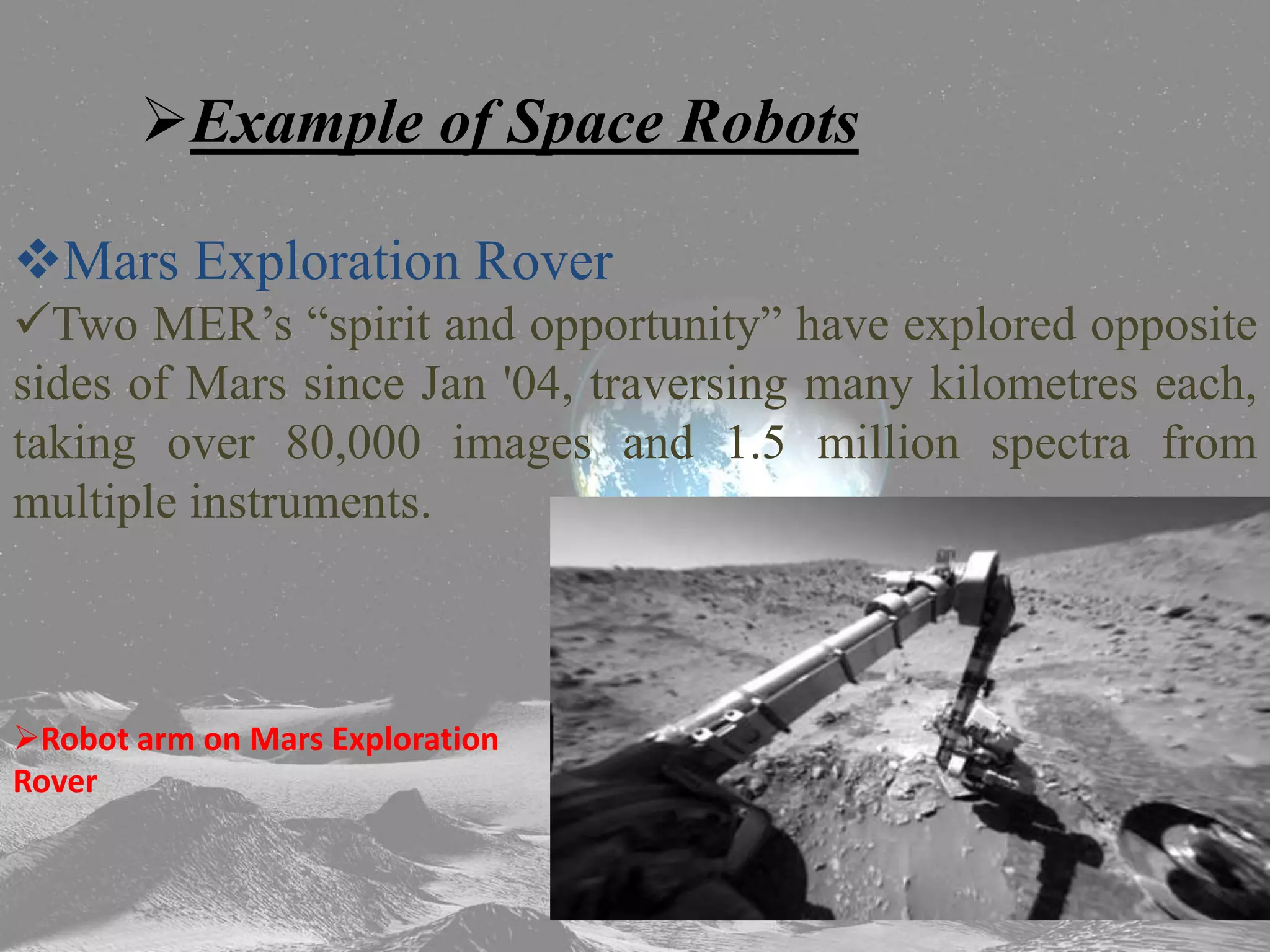
Mars Exploration Rover
Two MER’s “spirit and opportunity” have explored opposite
sides of Mars since Jan '04, traversing many kilometres each,
taking over 80,000 images and 1.5 million spectra from
multiple instruments.
Robot arm on Mars Exploration
Rover
Example of Space Robots(conti....)
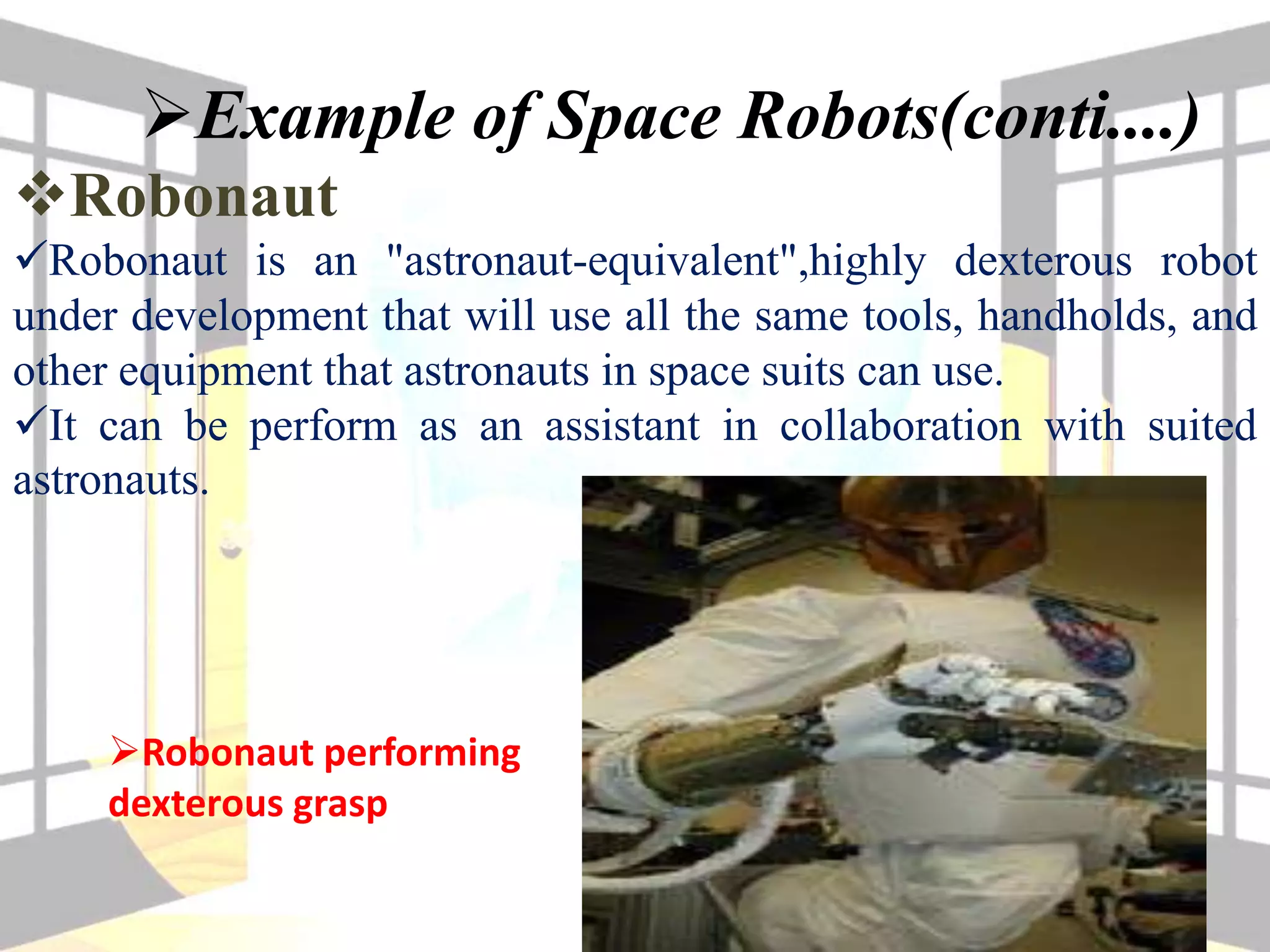
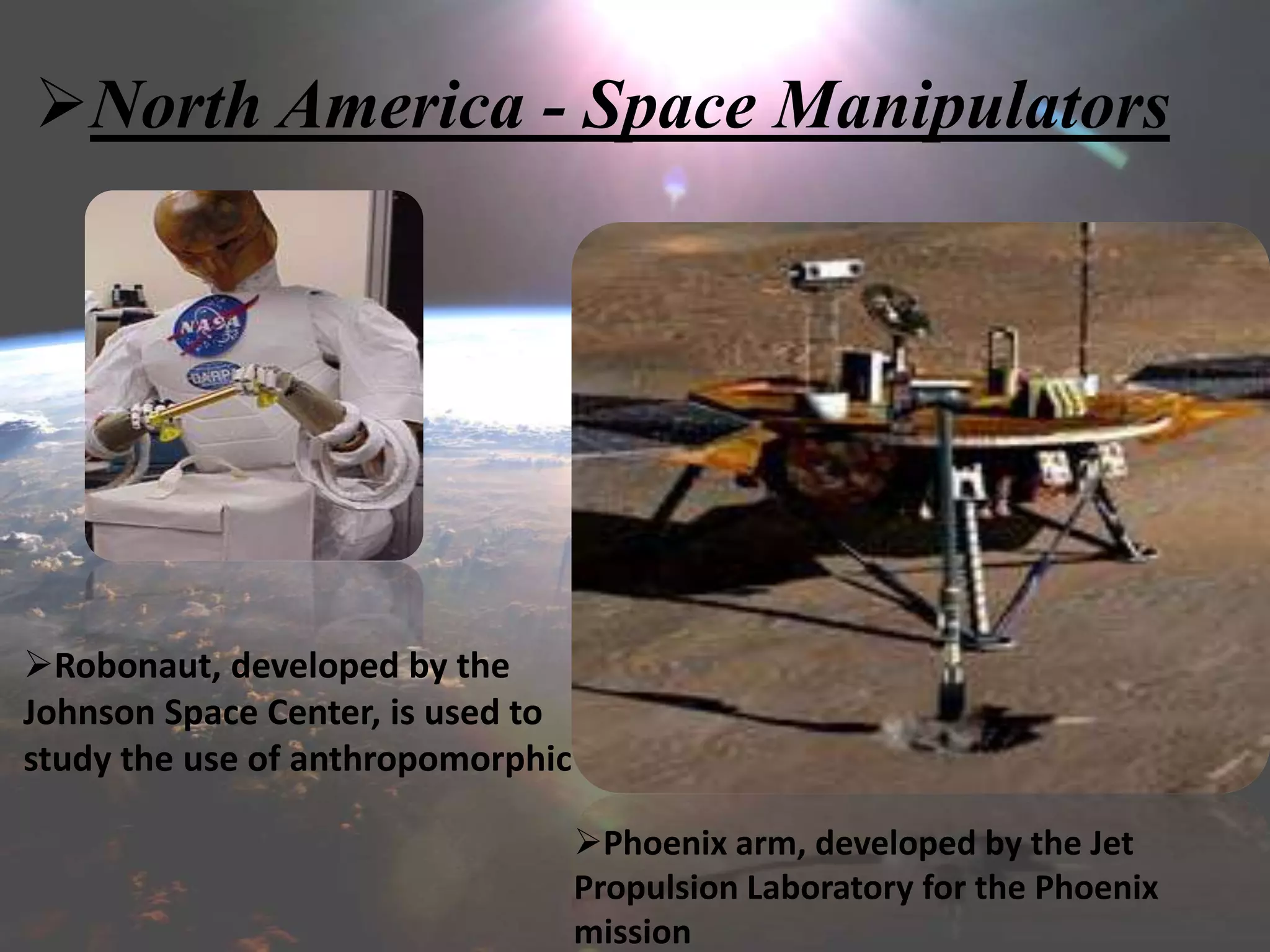
Robonaut
Robonaut is an "astronaut-equivalent",highly dexterous robot
under development that will use all the same tools, handholds, and
other equipment that astronauts in space suits can use.
It can be perform as an assistant in collaboration with suited
astronauts.
Robonaut performing
dexterous grasp
Fundamental Research Challenges
Mobility:
Finding accurate answers to the questions:
 Where am I ?
 Where is the current “goal” Point?
 Where are any obstacles or hazards, including
hazards that may not be visible (e.g. Soft sand)
 How can I know where I am relative to everything
else as I move?
Fundamental Research Challenges (Cont....)
Manipulation:
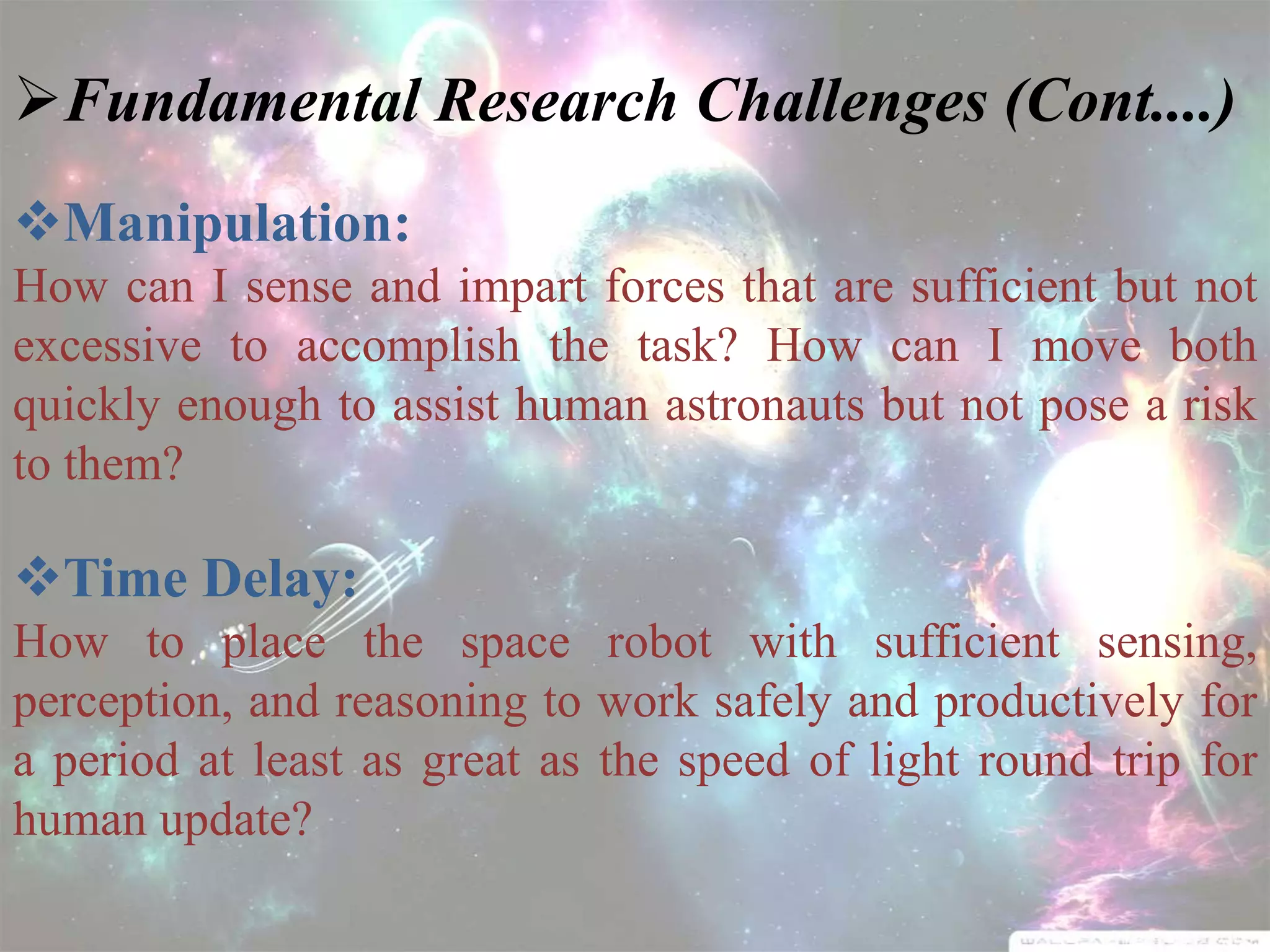
How can I sense and impart forces that are sufficient but not
excessive to accomplish the task? How can I move both
quickly enough to assist human astronauts but not pose a risk
to them?
Time Delay:
How to place the space robot with sufficient sensing,
perception, and reasoning to work safely and productively for
a period at least as great as the speed of light round trip for
human update?
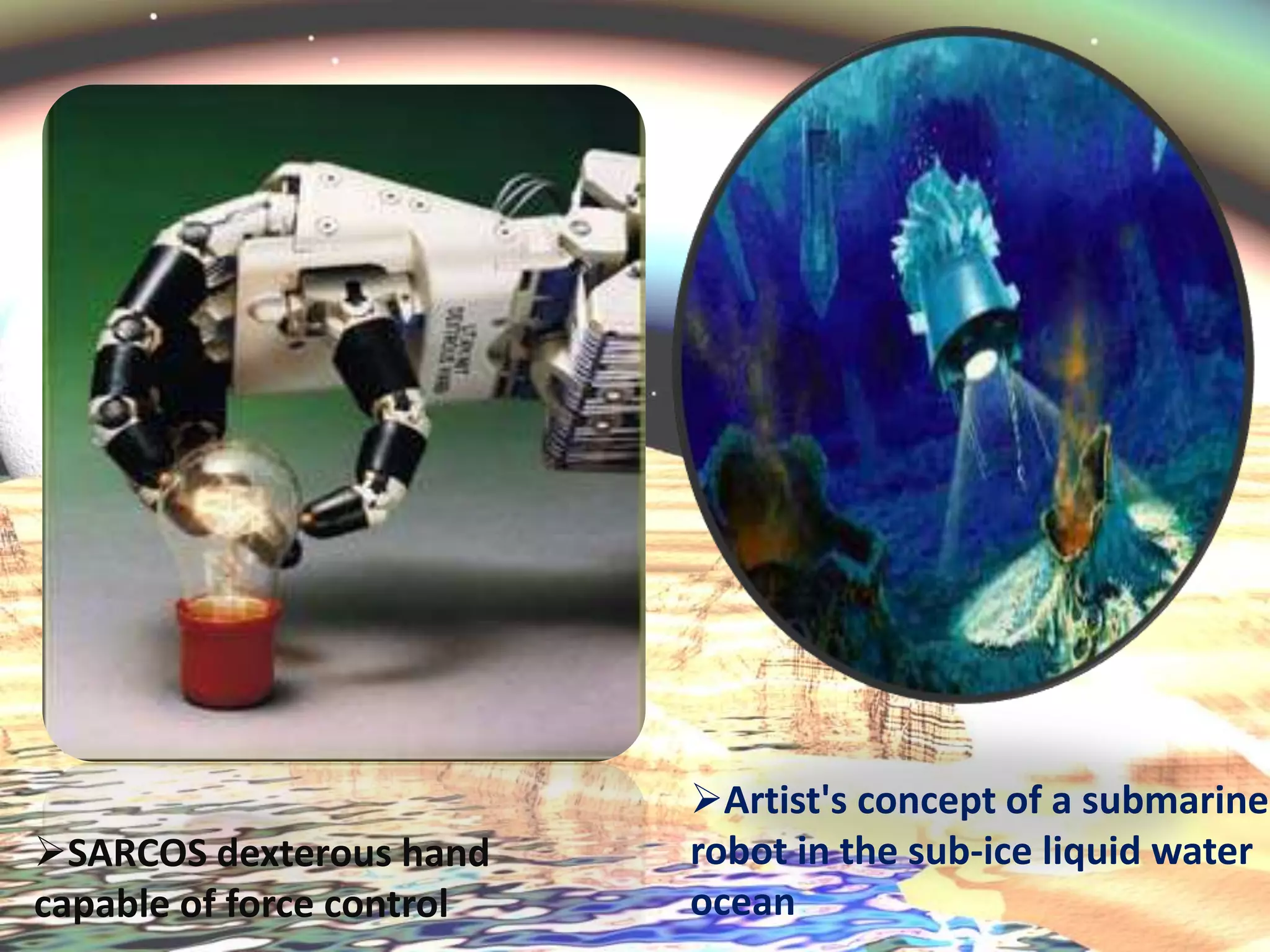
SARCOS dexterous hand
capable of force control
Artist's concept of a submarine
robot in the sub-ice liquid water
ocean
U.S. Space Robots - Rovers
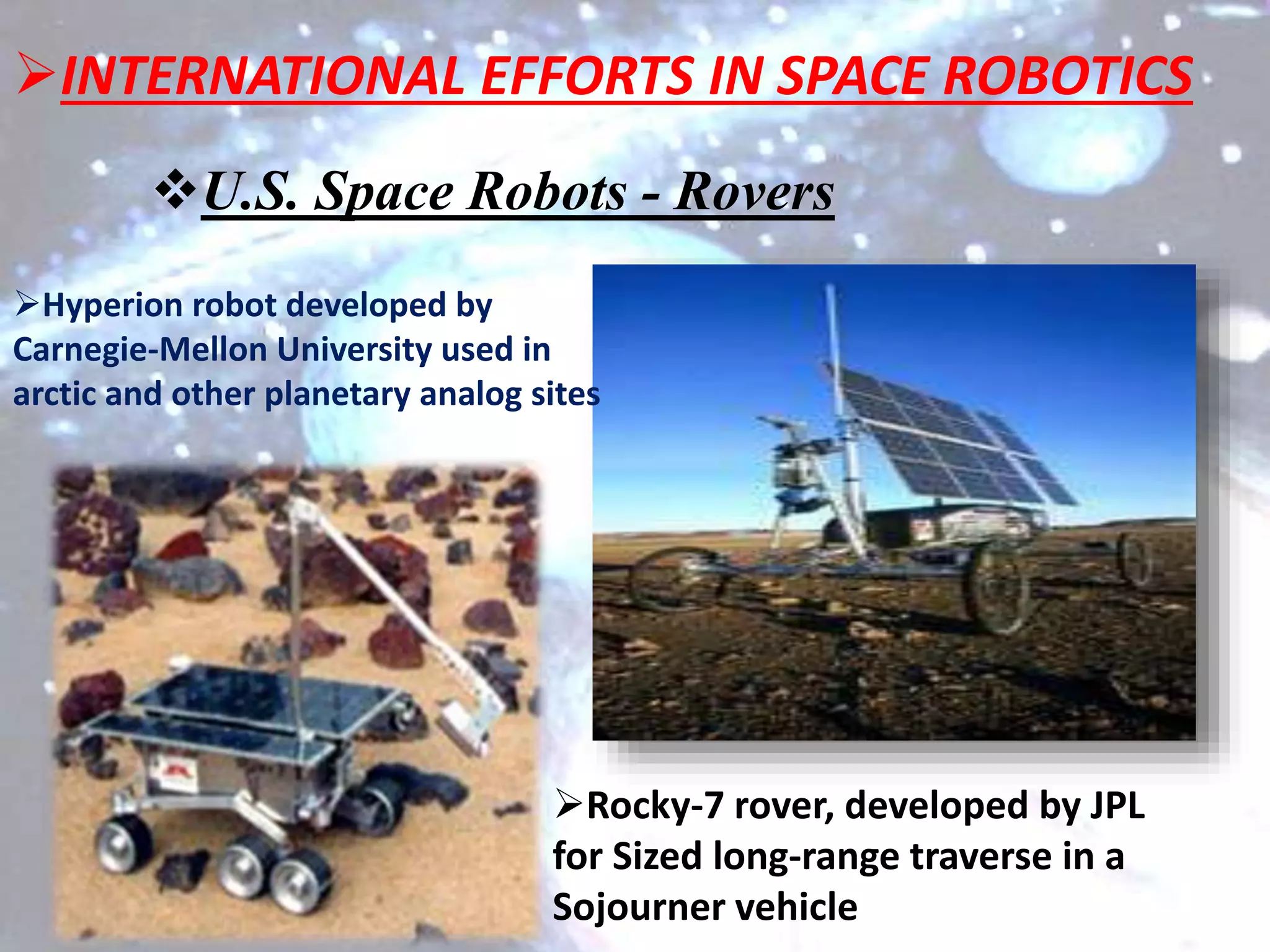
Hyperion robot developed by
Carnegie-Mellon University used in
arctic and other planetary analog sites
Rocky-7 rover, developed by JPL
for Sized long-range traverse in a
Sojourner vehicle
INTERNATIONAL EFFORTS IN SPACE ROBOTICS
North America - Space Manipulators
Robonaut, developed by the
Johnson Space Center, is used to
study the use of anthropomorphic
Phoenix arm, developed by the Jet
Propulsion Laboratory for the Phoenix
mission
Japan Space Robots
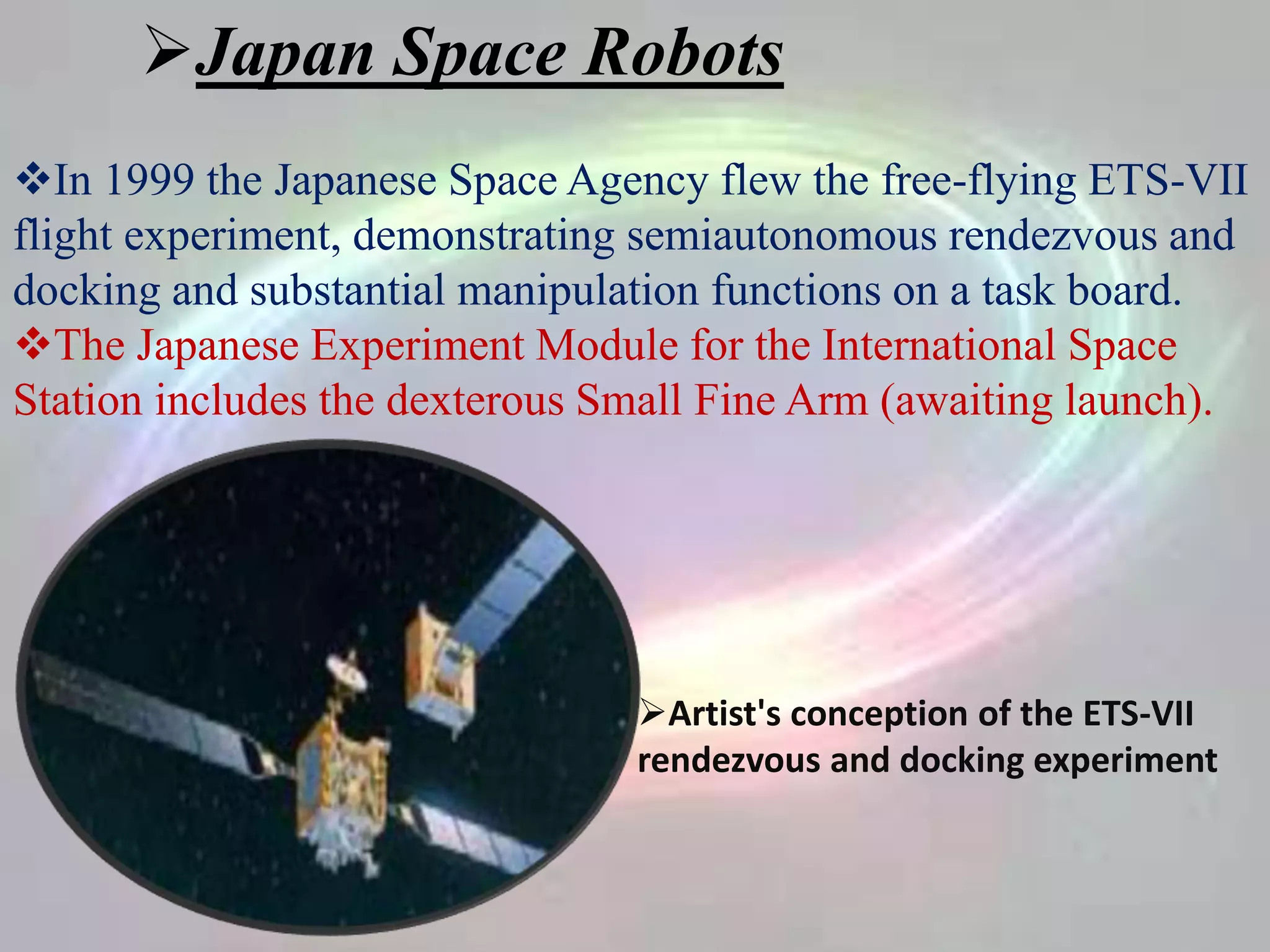
In 1999 the Japanese Space Agency flew the free-flying ETS-VII
flight experiment, demonstrating semiautonomous rendezvous and
docking and substantial manipulation functions on a task board.
The Japanese Experiment Module for the International Space
Station includes the dexterous Small Fine Arm (awaiting launch).
Artist's conception of the ETS-VII
rendezvous and docking experiment
Europe - U.K. and France
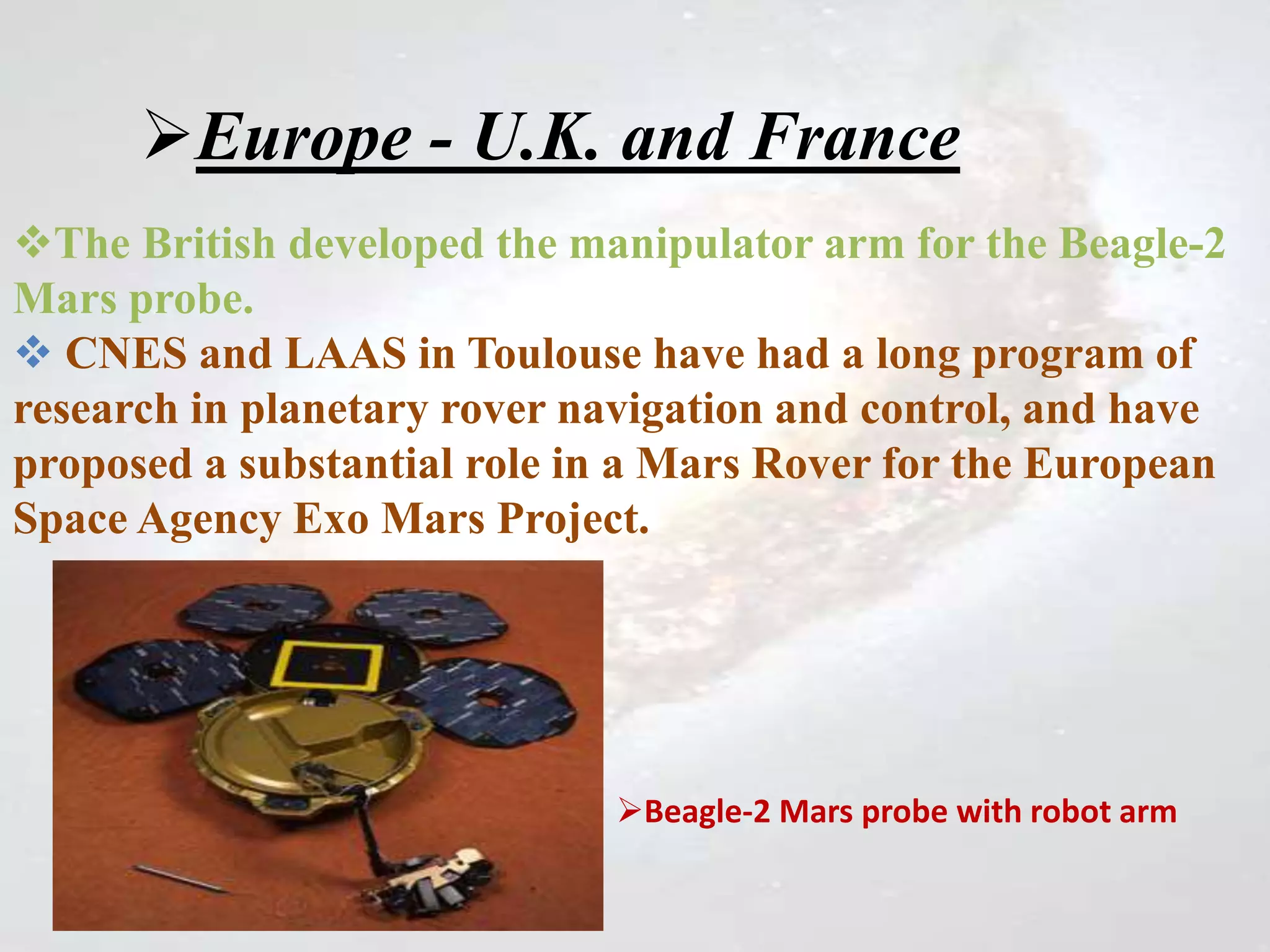
The British developed the manipulator arm for the Beagle-2
Mars probe.
 CNES and LAAS in Toulouse have had a long program of
research in planetary rover navigation and control, and have
proposed a substantial role in a Mars Rover for the European
Space Agency Exo Mars Project.
Beagle-2 Mars probe with robot arm
FUTURE SCOPE OF SPASE ROBOTICS
Future trends in Space Robotics are expected to
lead to planetary rovers that can operate many days
without commands, and can approach and analyze
science targets from a substantial distance with only
a single command.
robots that can assemble/construct, maintain,
and service space hardware using very precise
force control, dexterous hands, despite multi-
second time delay.
For giving your attention.

Space robotics(my seminor) final

  • 2.
  • 3.
    CONTENTS 1-Introduction 2-Space Robots Importance 3-whattechnology is needed? 4-Examples of Space Robots 5-Fundamental research challenges 6-International efforts in Space Robotics 7-Future scope of Space Robotics
  • 4.
    INTRODUCTION Space Robotics isthe development of machines for the space environment that perform Exploration, or to Assemble/Construct, Maintain, or Service other hardware in Space. Humans generally control space robots locally (e.g. Space Shuttle robotic arm) or from a great distance (e.g. Mars Exploration Rovers)
  • 5.
    Space Shuttle roboticarm Mars Exploration Rovers
  • 6.
    Space Robots Importance Performtasks less expensively, sooner, and with less risk or more delicate "touch" than with human astronauts Go where people can’t go (within reason), and for long durations Space is a hazardous environment & Access to space is expensive Robots don't need to return to Earth (which can be very costly) NASA JPL,USA NASA JSC,USA WTEC Robotics
  • 7.
    What technology isneeded? Mobility: Need to plan paths that move quickly and accurately from A to B without collisions or putting robot or worksite elements at risk. Manipulation: Need to contact worksite elements safely, quickly and accurately without imparting excessive forces beyond those needed for the task. Time Delay: The speed-of-light delay between humans on Earth and the robot is seconds in the Earth-moon vicinity and ~30 minutes to Mars. Extreme Environments: Radiation, temperature, very fine dust, etc. Power, communications: difficult.
  • 8.
    Example of SpaceRobots Mars Exploration Rover Two MER’s “spirit and opportunity” have explored opposite sides of Mars since Jan '04, traversing many kilometres each, taking over 80,000 images and 1.5 million spectra from multiple instruments. Robot arm on Mars Exploration Rover
  • 9.
    Example of SpaceRobots(conti....) Robonaut Robonaut is an "astronaut-equivalent",highly dexterous robot under development that will use all the same tools, handholds, and other equipment that astronauts in space suits can use. It can be perform as an assistant in collaboration with suited astronauts. Robonaut performing dexterous grasp
  • 10.
    Fundamental Research Challenges Mobility: Findingaccurate answers to the questions:  Where am I ?  Where is the current “goal” Point?  Where are any obstacles or hazards, including hazards that may not be visible (e.g. Soft sand)  How can I know where I am relative to everything else as I move?
  • 11.
    Fundamental Research Challenges(Cont....) Manipulation: How can I sense and impart forces that are sufficient but not excessive to accomplish the task? How can I move both quickly enough to assist human astronauts but not pose a risk to them? Time Delay: How to place the space robot with sufficient sensing, perception, and reasoning to work safely and productively for a period at least as great as the speed of light round trip for human update?
  • 12.
    SARCOS dexterous hand capableof force control Artist's concept of a submarine robot in the sub-ice liquid water ocean
  • 13.
    U.S. Space Robots- Rovers Hyperion robot developed by Carnegie-Mellon University used in arctic and other planetary analog sites Rocky-7 rover, developed by JPL for Sized long-range traverse in a Sojourner vehicle INTERNATIONAL EFFORTS IN SPACE ROBOTICS
  • 14.
    North America -Space Manipulators Robonaut, developed by the Johnson Space Center, is used to study the use of anthropomorphic Phoenix arm, developed by the Jet Propulsion Laboratory for the Phoenix mission
  • 15.
    Japan Space Robots In1999 the Japanese Space Agency flew the free-flying ETS-VII flight experiment, demonstrating semiautonomous rendezvous and docking and substantial manipulation functions on a task board. The Japanese Experiment Module for the International Space Station includes the dexterous Small Fine Arm (awaiting launch). Artist's conception of the ETS-VII rendezvous and docking experiment
  • 16.
    Europe - U.K.and France The British developed the manipulator arm for the Beagle-2 Mars probe.  CNES and LAAS in Toulouse have had a long program of research in planetary rover navigation and control, and have proposed a substantial role in a Mars Rover for the European Space Agency Exo Mars Project. Beagle-2 Mars probe with robot arm
  • 17.
    FUTURE SCOPE OFSPASE ROBOTICS Future trends in Space Robotics are expected to lead to planetary rovers that can operate many days without commands, and can approach and analyze science targets from a substantial distance with only a single command. robots that can assemble/construct, maintain, and service space hardware using very precise force control, dexterous hands, despite multi- second time delay.
  • 19.
    For giving yourattention.