
Presented by:-
S. Salim Malik &
P. Siva prasad reddy
KSRM COLLEGE OF ENGINEERING
KADAPA
Presentation on
SPACE ROBOTICS
INTRODUCTION :-
 Space robot is a system with a mechanical body, using computer as its
brain. Integrating the sensors and actuators built into the mechanical
body, the motions are realised with the computer software to execute
the desired task.
 Robots are more flexible in terms of ability to perform new tasks or to
carry out complex sequence of motion than other categories of
automated manufacturing equipment.
 Today there is lot of interest in this field and a separate branch of
technology ‘robotics’ has emerged. It is concerned with all problems of
robot design, development and applications.
What is Space Robotics?
Space robotics is the development of general
purpose machines that are capable of surviving in the
space environment, performing exploration ,
construction, maintenance, servicing or other tasks.
Humans control space robots from either a
“local” control console or “remotely” controlled from
human operators on Earth. Space robots are generally
designed to do multiple tasks.
Why Robots?
 They can work efficiently in a hostile, non-terrestrial
environment.
 Planetary surfaces can be explored more cheaply and
quickly.
 Expensive and dangerous extra vehicular activities can
be reduced.
Areas of Application:
In-orbit positioning and assembly: For deployment of
satellite and for assembly of modules to satellite/space
station.
Maintenance: For removal and replacement of faulty
modules/packages.
Resupply: For supply of equipment, materials for
experimentation in space lab and for the resupply of fuel.
Types of Space Robots
There are 4 basic types of robots in space and all the
robots sent to space come under these types only.
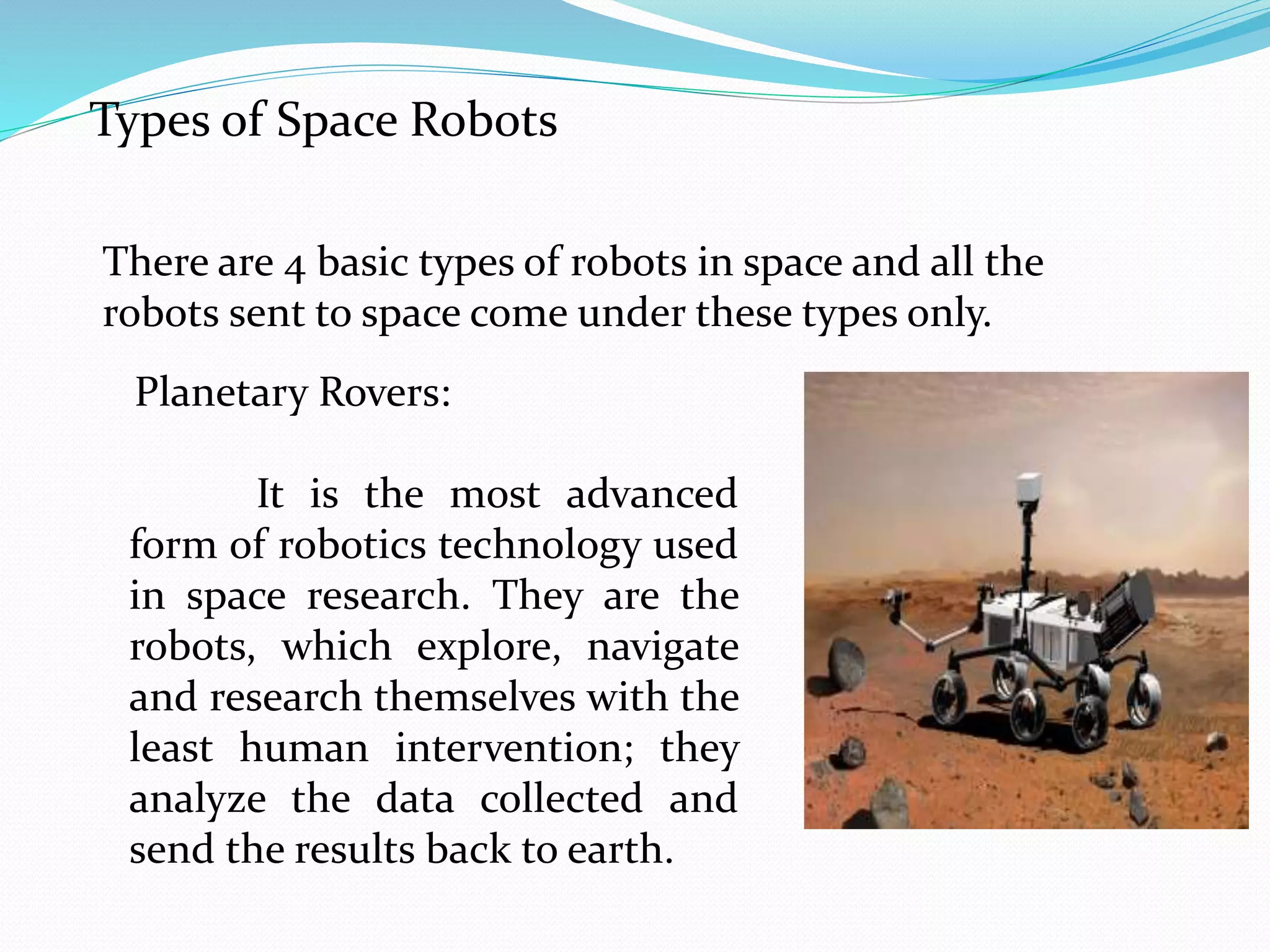
Planetary Rovers:
It is the most advanced
form of robotics technology used
in space research. They are the
robots, which explore, navigate
and research themselves with the
least human intervention; they
analyze the data collected and
send the results back to earth.
IN-Orbit Operators:
They are the robots,
which assist an astronaut
during his space mission.
For example a robot can be
designed specially to refuel
a shuttle thus helping the
astronaut to remain in his
shuttle and accomplish
various tasks without any
risk to their lives
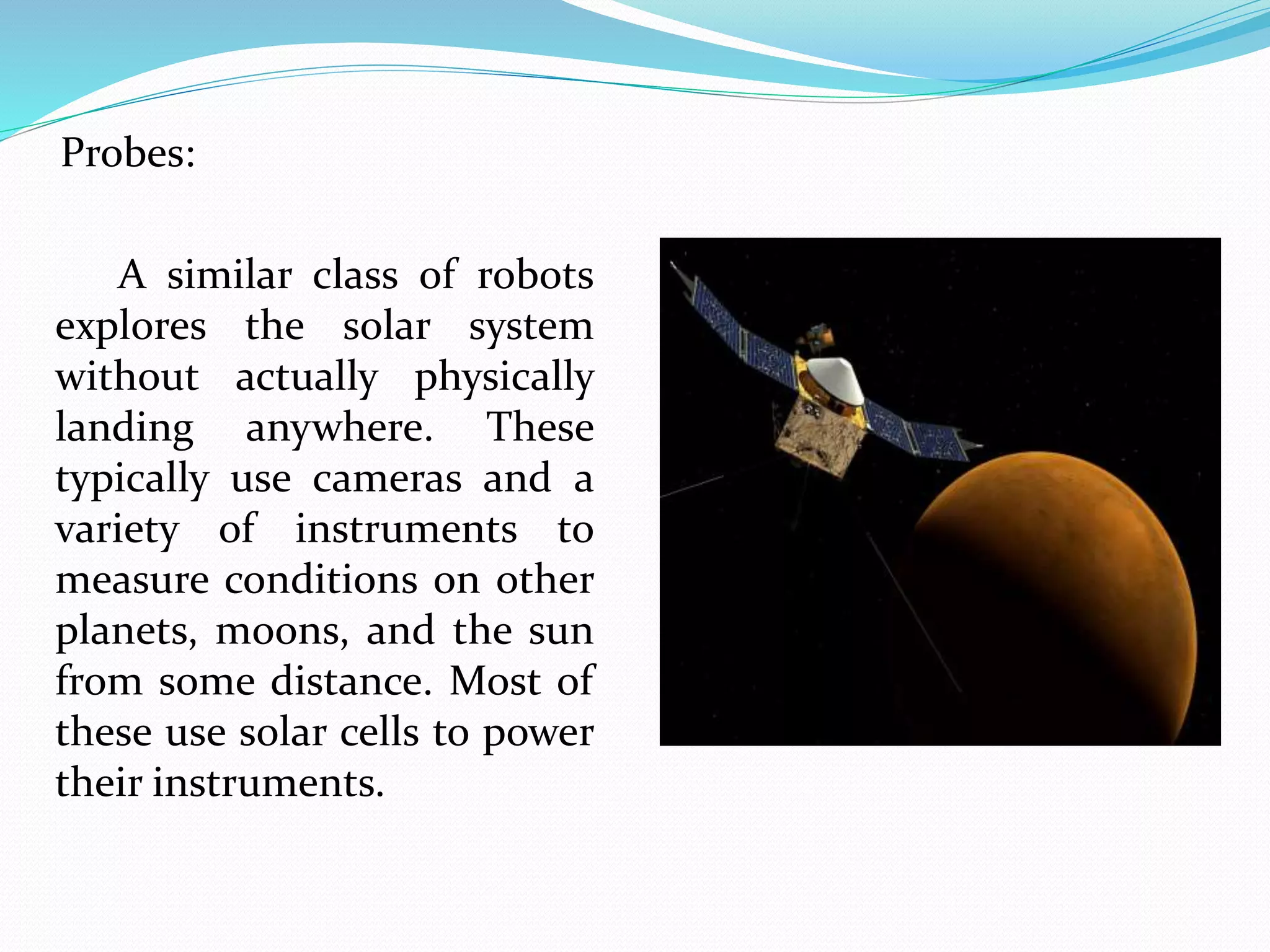
Probes:
A similar class of robots
explores the solar system
without actually physically
landing anywhere. These
typically use cameras and a
variety of instruments to
measure conditions on other
planets, moons, and the sun
from some distance. Most of
these use solar cells to power
their instruments.
Astronaut Assistance:
Besides acting as
explorers, space robots can also
assist astronauts in manned
spaceflight. One of the most
notable examples is a device
known as the Canadarm.
Developed with funding from
the Canadian Space Agency,
the Candarm became a
permanent fixture on many
American space shuttles and
the international space station.
CHALLENGES IN DESIGNING
 ZERO “g” EFFECT ON DESIGN
 VACUUM THERMAL EFFECT
 OTHERFACTORS
 SPACE MODULAR MANIPULATORS
ZERO “g” EFFECT
 Arm will be light in mass
 Manipulator arm -stiffness based
 Joint actuators -selected based on dynamic
torque (i.e.; based on the acceleration of the arm).
 Lack of inertial frame
VACUUM & THERMAL EFFECT
 Total mass loss (TML) <1%
 Collected volatile condensable matter (CVCM)
<0.1%.
 Low temperature -embrittlement of the material,
weaken adhesive bonding and increase friction in
bearings.
 Large thermal gradients -distortion in structural
elements and jamming of the mechanism
OTHER FACTORS
 Prime requirements of space systems is
lightweight and compactness.
 Dynamic loads during launch-sinusoidal
vibrations, random vibrations, acoustic noise and
separation shock spectra.
SPACE MODULAR MANIPULATORS
 The unique thermal, vacuum and gravitational
conditions of space drive different from the
typical laboratory robot
 Four main design drivers were
 Extreme Thermal Conditions;
 High Reliability Requirements;
 Dynamic Performance; and
 Modular Design.
SYSTEM VERIFICATION&TESTING
The commonly used simulations for zero ‘g’
are
 Flat floor test facility
 Water immersion
 Compensation system
ROBOT PERFORMANCE ASSESSMENT
 To identify the main source of error which
perturb the accuracy of the arm.
 To decide if the arm or the work cell must be
calibrated.
 To compare the expected improvement in
accuracy in calibration.
ROBOT CALIBRATION
 Error sources are identified by a bottom up
analysis
 Error sources are identified and are sorted into
three categories
 Systematic error
 Pseudo systematic error
 Random errors
STRUCTURE SPACE ROBOTS
A. JOINTS
B. ARM
C. WRIST
D. GRIPPER
JOINTS
Two types of joints are
Roll joint
Pitch joint
Each joint consists of
Electro optical angular encoders
Pancake type DC torque motors
Harmonic gear
Electromagnetically actuated friction brakes
ARM
 pick and place type
 Fit tem to clamp or fixture
 High accuracy attainable
OPERATION
SPACE SHUTTLE ROBOT ARM
Uses
 Survey the outside of the Space Shuttle
 Transport an EVA crew member at the end of the
arm
 Satellite deployment and retrieval
 Construction of International Space Station
FREE FLYING SPACE ROBOTS
In a free flying space robot a robot arm is
attached to the satellite base
The satellite may start rotating in an
uncontrollable way.
The antenna communication link may be
interrupted
Free flying space robots
SPACE ROBOT TELEOPERATION
 Develop a completely autonomous robot.
 Teleoperation of space robots from the ground
in the future space missions.
 Teleoperation technologies for the robots with
high levels of autonomy become very
important.
Advantages
 Space robots do not need to eat, drink or sleep and they can do tasks
that have a risk.
 The robot was built to replace the human work is done.
 The robot used in space because there are no conditions for human
life.
 Space robot technology is very advanced.
Disadvantages
 A robot can brake down or you could loss control of it.
 Refueling is not that easy.
 Maintenance of Space Robots gets very difficult.
 Cost is a big deal for maintenance and repairing of space robots.
CONCLUSION
In the future, robotics will makes it possible for billions
of people to have lives of leisure instead of the current
preoccupation with material needs.
There are hundreds of millions who are now fascinated
by space but do not have the means to explore it.
 For them space robotics will throw open the door to
explore and experience the universe.
Thank you
The end

Space robotics

  • 1.
    Presented by:- S. SalimMalik & P. Siva prasad reddy KSRM COLLEGE OF ENGINEERING KADAPA Presentation on SPACE ROBOTICS
  • 2.
    INTRODUCTION :-  Spacerobot is a system with a mechanical body, using computer as its brain. Integrating the sensors and actuators built into the mechanical body, the motions are realised with the computer software to execute the desired task.  Robots are more flexible in terms of ability to perform new tasks or to carry out complex sequence of motion than other categories of automated manufacturing equipment.  Today there is lot of interest in this field and a separate branch of technology ‘robotics’ has emerged. It is concerned with all problems of robot design, development and applications.
  • 3.
    What is SpaceRobotics? Space robotics is the development of general purpose machines that are capable of surviving in the space environment, performing exploration , construction, maintenance, servicing or other tasks. Humans control space robots from either a “local” control console or “remotely” controlled from human operators on Earth. Space robots are generally designed to do multiple tasks.
  • 4.
    Why Robots?  Theycan work efficiently in a hostile, non-terrestrial environment.  Planetary surfaces can be explored more cheaply and quickly.  Expensive and dangerous extra vehicular activities can be reduced.
  • 5.
    Areas of Application: In-orbitpositioning and assembly: For deployment of satellite and for assembly of modules to satellite/space station. Maintenance: For removal and replacement of faulty modules/packages. Resupply: For supply of equipment, materials for experimentation in space lab and for the resupply of fuel.
  • 6.
    Types of SpaceRobots There are 4 basic types of robots in space and all the robots sent to space come under these types only. Planetary Rovers: It is the most advanced form of robotics technology used in space research. They are the robots, which explore, navigate and research themselves with the least human intervention; they analyze the data collected and send the results back to earth.
  • 7.
    IN-Orbit Operators: They arethe robots, which assist an astronaut during his space mission. For example a robot can be designed specially to refuel a shuttle thus helping the astronaut to remain in his shuttle and accomplish various tasks without any risk to their lives
  • 8.
    Probes: A similar classof robots explores the solar system without actually physically landing anywhere. These typically use cameras and a variety of instruments to measure conditions on other planets, moons, and the sun from some distance. Most of these use solar cells to power their instruments.
  • 9.
    Astronaut Assistance: Besides actingas explorers, space robots can also assist astronauts in manned spaceflight. One of the most notable examples is a device known as the Canadarm. Developed with funding from the Canadian Space Agency, the Candarm became a permanent fixture on many American space shuttles and the international space station.
  • 10.
    CHALLENGES IN DESIGNING ZERO “g” EFFECT ON DESIGN  VACUUM THERMAL EFFECT  OTHERFACTORS  SPACE MODULAR MANIPULATORS
  • 11.
    ZERO “g” EFFECT Arm will be light in mass  Manipulator arm -stiffness based  Joint actuators -selected based on dynamic torque (i.e.; based on the acceleration of the arm).  Lack of inertial frame
  • 12.
    VACUUM & THERMALEFFECT  Total mass loss (TML) <1%  Collected volatile condensable matter (CVCM) <0.1%.  Low temperature -embrittlement of the material, weaken adhesive bonding and increase friction in bearings.  Large thermal gradients -distortion in structural elements and jamming of the mechanism
  • 13.
    OTHER FACTORS  Primerequirements of space systems is lightweight and compactness.  Dynamic loads during launch-sinusoidal vibrations, random vibrations, acoustic noise and separation shock spectra.
  • 14.
    SPACE MODULAR MANIPULATORS The unique thermal, vacuum and gravitational conditions of space drive different from the typical laboratory robot  Four main design drivers were  Extreme Thermal Conditions;  High Reliability Requirements;  Dynamic Performance; and  Modular Design.
  • 15.
    SYSTEM VERIFICATION&TESTING The commonlyused simulations for zero ‘g’ are  Flat floor test facility  Water immersion  Compensation system
  • 16.
    ROBOT PERFORMANCE ASSESSMENT To identify the main source of error which perturb the accuracy of the arm.  To decide if the arm or the work cell must be calibrated.  To compare the expected improvement in accuracy in calibration.
  • 17.
    ROBOT CALIBRATION  Errorsources are identified by a bottom up analysis  Error sources are identified and are sorted into three categories  Systematic error  Pseudo systematic error  Random errors
  • 18.
    STRUCTURE SPACE ROBOTS A.JOINTS B. ARM C. WRIST D. GRIPPER
  • 19.
    JOINTS Two types ofjoints are Roll joint Pitch joint Each joint consists of Electro optical angular encoders Pancake type DC torque motors Harmonic gear Electromagnetically actuated friction brakes
  • 20.
    ARM  pick andplace type  Fit tem to clamp or fixture  High accuracy attainable
  • 21.
    OPERATION SPACE SHUTTLE ROBOTARM Uses  Survey the outside of the Space Shuttle  Transport an EVA crew member at the end of the arm  Satellite deployment and retrieval  Construction of International Space Station
  • 22.
    FREE FLYING SPACEROBOTS In a free flying space robot a robot arm is attached to the satellite base The satellite may start rotating in an uncontrollable way. The antenna communication link may be interrupted
  • 23.
  • 24.
    SPACE ROBOT TELEOPERATION Develop a completely autonomous robot.  Teleoperation of space robots from the ground in the future space missions.  Teleoperation technologies for the robots with high levels of autonomy become very important.
  • 25.
    Advantages  Space robotsdo not need to eat, drink or sleep and they can do tasks that have a risk.  The robot was built to replace the human work is done.  The robot used in space because there are no conditions for human life.  Space robot technology is very advanced. Disadvantages  A robot can brake down or you could loss control of it.  Refueling is not that easy.  Maintenance of Space Robots gets very difficult.  Cost is a big deal for maintenance and repairing of space robots.
  • 26.
    CONCLUSION In the future,robotics will makes it possible for billions of people to have lives of leisure instead of the current preoccupation with material needs. There are hundreds of millions who are now fascinated by space but do not have the means to explore it.  For them space robotics will throw open the door to explore and experience the universe.
  • 27.
  • 28.