SPACE ROBOTICS
Chapter 1
INTRODUCTION
Robot is a system with a mechanical body, using computer as its brain.
Integrating the sensors and actuators built into the mechanical body, the motions
are realised with the computer software to execute the desired task. Robots are
more flexible in terms of ability to perform new tasks or to carry out complex
sequence of motion than other categories of automated manufacturing equipment.
Today there is lot of interest in this field and a separate branch of technology
‘robotics’ has emerged. It is concerned with all problems of robot design,
development and applications. The technology to substitute or subsidise the
manned activities in space is called space robotics. Various applications of space
robots are the inspection of a defective satellite, its repair, or the construction of a
space station and supply goods to this station and its retrieval etc. With the over
lap of knowledge of kinematics, dynamics and control and progress in fundamental
technologies it is about to become possible to design and develop the advanced
robotics systems. And this will throw open the doors to explore and experience the
universe and bring countless changes for the better in the ways we live.
1.1 AREAS OF APPLICATION
The space robot applications can be classified into the following four
categories
1 In-orbit positioning and assembly: For deployment of satellite and for assembly
of modules to satellite/space station.
2 Operation: For conducting experiments in space lab.
3 Maintenance: For removal and replacement of faulty modules/packages.
4 Resupply: For supply of equipment, materials for experimentation in space lab
and for the resupply of fuel.
Dept. of ECE, SKIT Page 1
SPACE ROBOTICS
The following examples give specific applications under the above categories
Scientific experimentation:
Conduct experimentation in space labs that may include
• Metallurgical experiments which may be hazardous.
• Astronomical observations.
• Biological experiments.
Assist crew in space station assembly
• Assist in deployment and assembly outside the station.
• Assist crew inside the space station: Routine crew functions inside the
space station and maintaining life support system.
Space servicing functions
• Refueling.
• Replacement of faulty modules.
• Assist jammed mechanism say a solar panel, antenna etc.
Space craft enhancements
• Replace payloads by an upgraded module.
• Attach extra modules in space.
Space tug
Dept. of ECE, SKIT Page 2
SPACE ROBOTICS
• Grab a satellite and effect orbital transfer.
• Efficient transfer of satellites from low earth orbit to geostationary orbit.
1.2 SPACE SHUTTLE TILE REWATERPROOFING ROBOT
TESSELLATOR
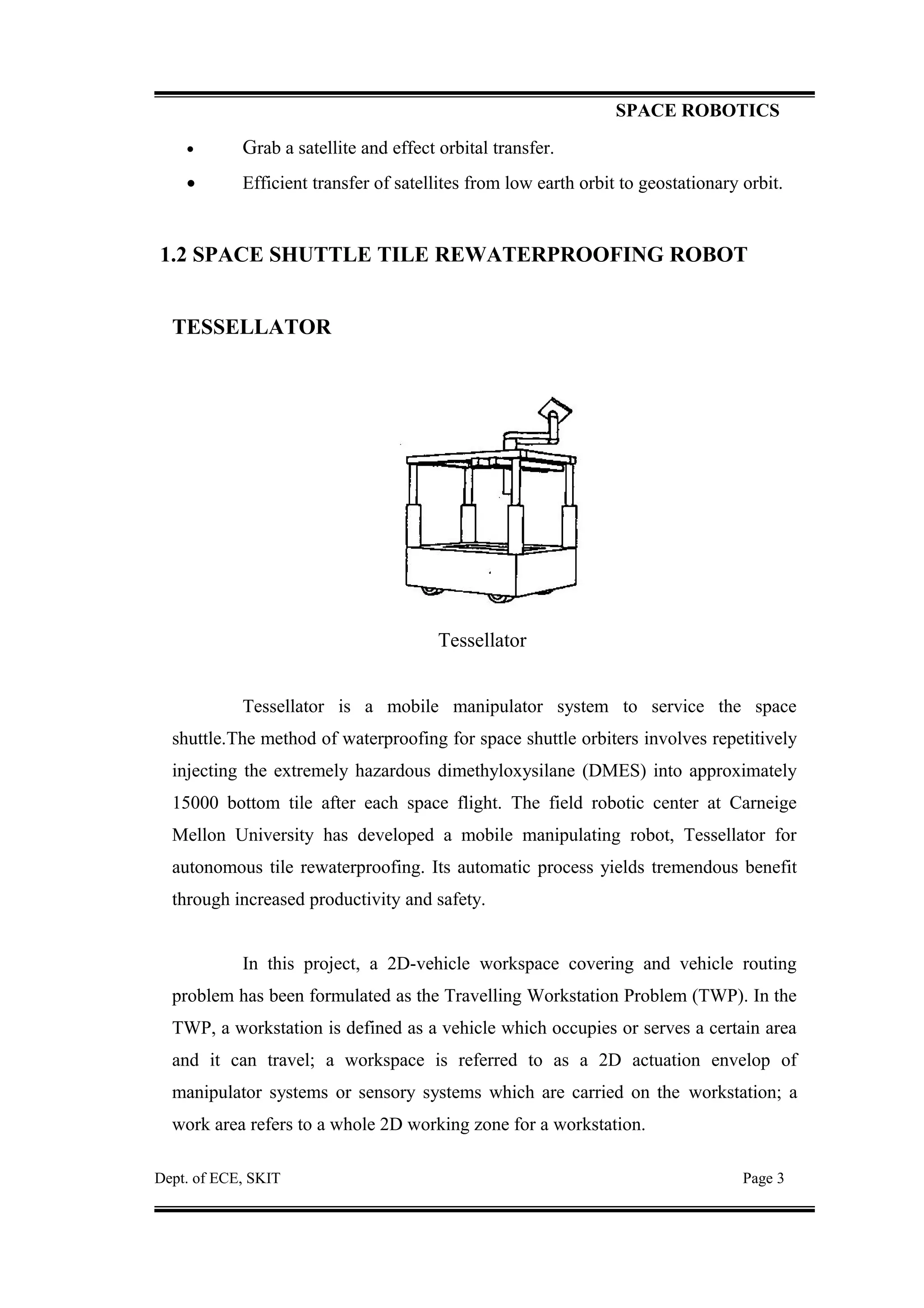
Tessellator
Tessellator is a mobile manipulator system to service the space
shuttle.The method of waterproofing for space shuttle orbiters involves repetitively
injecting the extremely hazardous dimethyloxysilane (DMES) into approximately
15000 bottom tile after each space flight. The field robotic center at Carneige
Mellon University has developed a mobile manipulating robot, Tessellator for
autonomous tile rewaterproofing. Its automatic process yields tremendous benefit
through increased productivity and safety.
In this project, a 2D-vehicle workspace covering and vehicle routing
problem has been formulated as the Travelling Workstation Problem (TWP). In the
TWP, a workstation is defined as a vehicle which occupies or serves a certain area
and it can travel; a workspace is referred to as a 2D actuation envelop of
manipulator systems or sensory systems which are carried on the workstation; a
work area refers to a whole 2D working zone for a workstation.
Dept. of ECE, SKIT Page 3
SPACE ROBOTICS
The objective of the TWP is
1 To determine the minimum number of workspaces and their layout, in which, we
should minimize the overlapping among the workspaces and avoid conflict with
obstacles.
2 To determine the optimal route of the workstation movement, in which the
workstation travels over all workspaces within a lowest cost (i.e. routing time).
The constraints of the problem are
1) The workstation should serve or cover all workareas.
2) The patterns or dimensions of each workspace are the same and
3) There some geographical obstacles or restricted areas.
In the study, heuristic solutions for the TWP, and a case study of
Tessellator has been conducted. It is concluded that the covering strategies, e.g.
decomposition and other layout strategies yield satisfactory solution for workspace
covering, and the cost-saving heuristics can near-optimally solve the routing
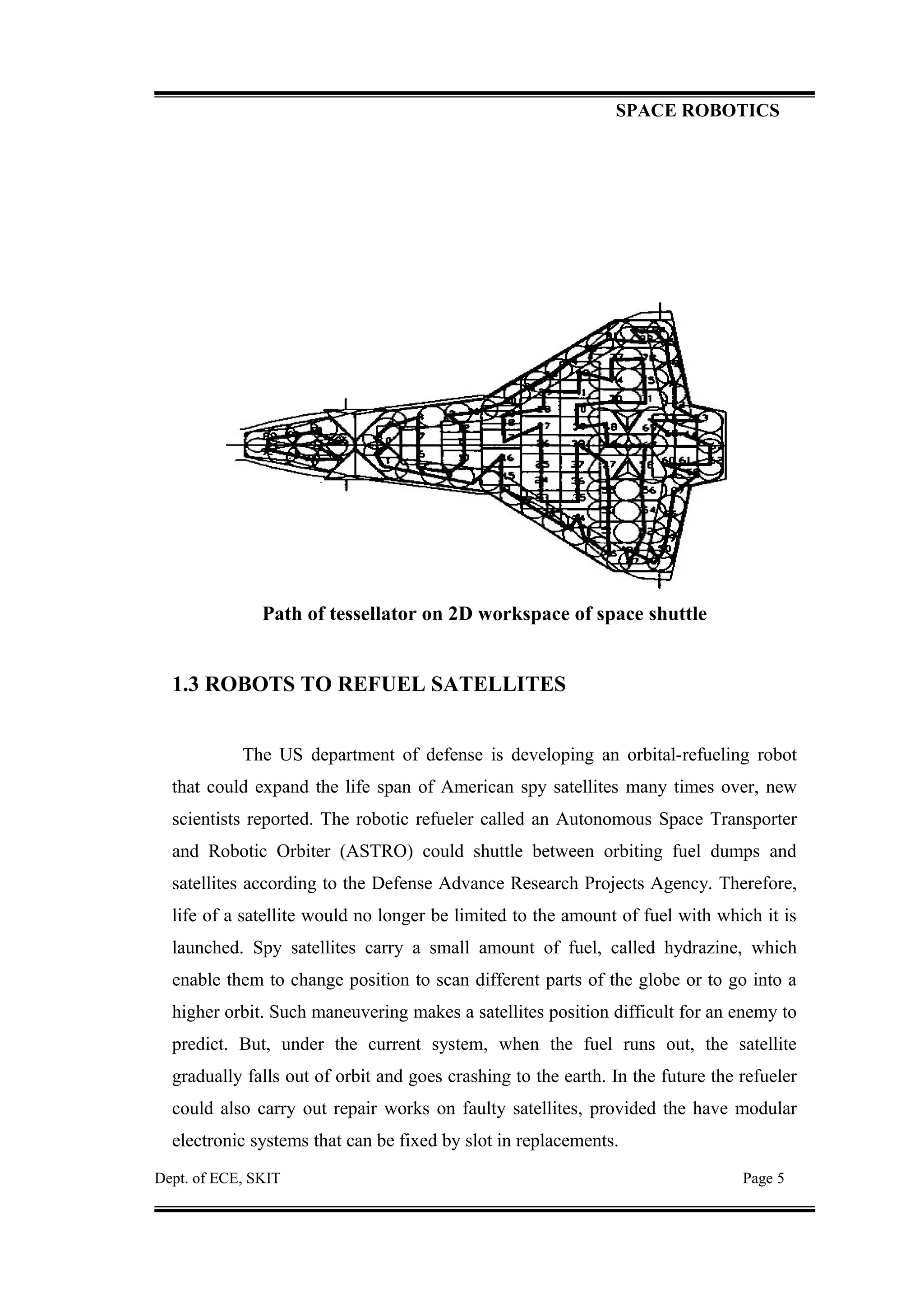
problem. The following figure shows a sample solution of TWP for Tessellator.
Dept. of ECE, SKIT Page 4
SPACE ROBOTICS
Path of tessellator on 2D workspace of space shuttle
1.3 ROBOTS TO REFUEL SATELLITES
The US department of defense is developing an orbital-refueling robot
that could expand the life span of American spy satellites many times over, new
scientists reported. The robotic refueler called an Autonomous Space Transporter
and Robotic Orbiter (ASTRO) could shuttle between orbiting fuel dumps and
satellites according to the Defense Advance Research Projects Agency. Therefore,
life of a satellite would no longer be limited to the amount of fuel with which it is
launched. Spy satellites carry a small amount of fuel, called hydrazine, which
enable them to change position to scan different parts of the globe or to go into a
higher orbit. Such maneuvering makes a satellites position difficult for an enemy to
predict. But, under the current system, when the fuel runs out, the satellite
gradually falls out of orbit and goes crashing to the earth. In the future the refueler
could also carry out repair works on faulty satellites, provided the have modular
electronic systems that can be fixed by slot in replacements.
Dept. of ECE, SKIT Page 5
SPACE ROBOTICS
Chapter 2
SPACE ROBOT—CHALLENGES IN DESIGN AND TESTING
Robots developed for space applications will be significantly different
from their counterpart in ground. Space robots have to satisfy unique requirements
to operate in zero ‘g’ conditions (lack of gravity), in vacuum and in high thermal
gradients, and far away from earth. The phenomenon of zero gravity effects
physical action and mechanism performance. The vacuum and thermal conditions
of space influence material and sensor performance. The degree of remoteness of
the operator may vary from a few meters to millions of kilometers. The principle
effect of distance is the time delay in command communication and its
repercussions on the action of the arms. The details are discussed below
2.1 ZERO ‘g’ EFFECT ON DESIGN
Dept. of ECE, SKIT Page 6
SPACE ROBOTICS
The gravity free environment in which the space robot operates possesses
both advantages and disadvantages. The mass to be handled by the manipulator
arm is not a constraint in the zero ‘g’ environment. Hence, the arm and the joints of
the space robot need not withstand the forces and the moment loads due to gravity.
This will result in an arm which will be light in mass. The design of the
manipulator arm will be stiffness based and the joint actuators will be selected
based on dynamic torque (i.e.; based on the acceleration of the arm). The main
disadvantage of this type of environment is the lack of inertial frame. Any motion
of the manipulator arm will induce reaction forces and moment at the base which in
turn will disturb the position and the altitude. The problem of dynamics, control
and motion planning for the space robot is considering the dynamic interactions
between the robot and the base (space shuttle, space station and satellite). Due to
the dynamic interaction, the motion of the space robot can alter the base trajectory
and the robot and the robot end effector can miss the desired target due to the
motion of the base. The mutual dependence severely affects the performance of
both the base, especially, when the mass and moment of inertia of the robot and the
payload are not negligible in comparison to the base. Moreover, inefficiency in
planning and control can considerably risk the success of space missions. The
components in space do not stay in position. They freely float and are a problem to
be picked up. Hence, the components will have to be properly secured. Also the
joints in space do not sag as on earth. Unlike on earth the position of the arm can be
within the band of the backlash at each joint.
2.2 VACUUM EFFECT AND THERMAL EFFECT
The vacuum in space can create heat transfer problems and mass loss of
the material through evaporation or sublimation. This is to be taken care by proper
selection of materials, lubricants etc., so as to meet the total mass loss (TML) of
<1% and collected volatile condensable matter (CVCM) of <0.1%. The use of
conventional lubricants in bearings is not possible in this environment. The
Dept. of ECE, SKIT Page 7
SPACE ROBOTICS
preferred lubricants are dry lubricants like bonded/sputtered/ion plated
molybdenum disulphide, lead, gold etc. Cold welding of molecularly similar metal
in contact with each other is a possibility, which is to be avoided by proper
selection of materials and dry lubricants. Some of the subsystem that cannot be
exposed to vacuum will need hermetical sealing. The thermal cycles and large
thermal variations will have to be taken care in design of robot elements. Low
temperature can lead to embrittlement of the material, weaken adhesive bonding
and increase friction in bearings. Large thermal gradients can lead to distortion in
structural elements and jamming of the mechanism. This calls for the proper
selection of the materials whose properties are acceptable in the above temperature
ranges and the selection of suitable protective coatings and insulation to ensure that
the temperature of the system is within allowable limits.
2.3 OTHER FACTORS
One of the prime requirements of space systems is lightweight and
compactness. The structural material to be used must have high specific strength and
high specific stiffness, to ensure compactness, minimum mass and high stiffness.
The other critical environment to which the space robot will be subjected to are the
dynamic loads during launch. These dynamic loads are composed of sinusoidal
vibrations, random vibrations, acoustic noise and separation shock spectra.
The electrical and electronic subsystems will have to be space qualified
to take care of the above environmental conditions during launch and in orbit. The
components must be protected against radiation to ensure proper performance
throughout its life in orbit.
The space robots will have to possess a very high degree of reliability and
this is to be achieved right from the design phase of the system. A failure mode
effect and critical analysis (FMECA) is to be carried out to identify the different
failure modes effects and these should be addressed in the design by
• Choosing proven/reliable designs.
• Having good design margins.
Dept. of ECE, SKIT Page 8
SPACE ROBOTICS
• Have design with redundancy.
2.4 SPACE MODULAR MANIPULATORS
The unique thermal, vacuum and gravitational conditions of space drive
the robot design process towards solutions that are much different from the typical
laboratory robot. JSC's A&R Division is at the forefront of this design effort with
the prototypes being built for the Space Modular Manipulators (SMM) project. The
first SMM joint prototype has completed its thermal-mechanical-electrical design
phase, is now under construction in the JSC shops, and is scheduled for thermal-
vac chamber tests in FY94.
FY93 was the SMM project's first year, initiating the effort with a MITRE
Corporation review of the existing space manipulator design efforts (RMS and FTS)
and interaction with ongoing development teams (RANGER, JEM, SPDM, STAR
and SAT). Below this system level, custom component vendors for motors,
amplifiers, sensors and cables were investigated to capture the state-of-the-art in
space robot design. Four main design drivers were identified as critical to the
development process:
1. Extreme Thermal Conditions;
2. High Reliability Requirements;
3. Dynamic Performance; and
4. Modular Design.
While these design issues are strongly coupled, most robot design teams
have handled them independently, resulting in an iterative process as each solution
impacts the other problems. The SMM design team has sought a system level
approach that will be demonstrated as prototypes, which will be tested in the JSC
thermal-vacuum facilities.
Dept. of ECE, SKIT Page 9
SPACE ROBOTICS
The thermal-vacuum conditions of space are the most dramatic difference
between typical laboratory robot and space manipulator design requirements.
Manufacturing robots operate in climate controlled, |O(+,-)2K factory
environments, where space manipulators must be designed for |O(+,) 75K
temperature variations with 1500 W/m2 of solar flux. Despite these environmental
extremes, the technology to model and control robot precision over a wide
temperature range can be applied to terrestrial robotic operations where the extreme
precision requirements demand total thermal control, such as in semiconductor
manufacturing and medical robot applications.
Thermal conditions impact reliability by cycling materials and
components, adding to the dynamic loading that causes typical robot fatigue and
inaccuracy. MITRE built a customised thermal analysis model, a failure analysis
model using FEAT, and applied the fault tolerance research funded by JSC at the
University of Texas. The strategy is to layer low level redundancy in the
jointmodules with a high level, redundant kinematic system design, where minor
joint failures can be masked and serious failures result in reconfigured arm
operation. In this approach, all four design drivers were addressed in the selection of
the appropriate level of modular design as a 2-DOF joint module.
The major technical accomplishments for the FY93 SMM project are:
1 Conceptual and detailed design of first joint prototype;
2 Detailed design and fabrication of thermal-vacuum test facility;
3 Custom design of thermal-vac rated motors, bearings, sensors and cables; and
4 Published two technical papers (R. Ambrose & R. Berka) on robot thermal
design.
Dept. of ECE, SKIT Page 10
SPACE ROBOTICS
Chapter-3
SYSTEM VERIFICATION AND TESTING
The reliability is to be demonstrated by a number of tests enveloping all
the environmental conditions (thermal and vacuum) that the system will be
subjected to. Verification of functions and tests will be conducted on subsystems,
subassemblies and final qualification and acceptance tests will be done on complete
system. The most difficult and the nearly impossible simulation during testing will
be zero ‘g’ simulation.
Dept. of ECE, SKIT Page 11
SPACE ROBOTICS
The commonly used simulations for zero ‘g’ are
1. Flat floor test facility: It simulates zero ‘g’ environments in the horizontal
plane. In this system flat floor concept is based on air bearing sliding over a
large slab of polished granite.
2. Water immersion: Reduced gravity is simulated by totally submerging the
robot under water and testing. This system provides multi degree of freedom
for testing. However, the model has to be water-resistant and have an overall
specific gravity of one. This method is used by astronauts for extra vehicular
activities with robot.
3. Compensation system: Gravitational force is compensated by a passive
and vertical counter system and actively controlled horizontal system. The
vertical system comprises the counter mechanism and a series of pulleys and
cables that provide a constant upward force to balance the weight of the robot.
However, the counter mechanism increases the inertia and the friction of
joints of rotating mechanism.
3.1PERFORMANCE ASSESSMENT AND CALIBRATION
STRATEGIES FOR SPACE ROBOTS
Predictable safe and cost efficient operation of a robotic device for
space applications can best be achieved by programming it offline during the
preparation for the mission. Computer aided design techniques are used to assure
that the movement of the robot are predictable. A software model of the robot and
its work cell is made and this must be compatible with the model of the environment
in which the robot must perform. Cost efficiency requirements dictate that a robot
be calibrated, after which its performance must be checked against specified
requirements.
Proper use of miniaturized sensing technology is needed to produce a
robot of minimum size, power requirement and consumption and mass. This often
requires minimizing the number and the type of sensors needed, and maximizing
Dept. of ECE, SKIT Page 12
SPACE ROBOTICS
the information (such as position, velocity, and acceleration) which is gained from
each sensor.
The study of methods of assessing the performance of a robot, choosing
its sensors and performing calibration and test, ESA passed a contract with industry.
Results of this work are applicable to any robot whose kinematics chain needs
accurate geometrical modeling.
3.1.1 ROBOT PERFORMANCE ASSESSMENT
The objectives of robot performance assessment are
• To identify the main source of error which perturb the accuracy of the
arm.
• To decide if the arm or the work cell must be calibrated.
• To compare the expected improvement in accuracy in calibration.
The performance of the robot is assessed by making mathematical model
of the characteristics of the error source in each of its sub system such as the joint,
the robot link or its gripper. From these the effects of errors on the positioning
accuracy of end effector (the functioning tip of the robot arm) can be evaluated.
Error sources are identified by a bottom up analysis, which tale account of
the capabilities of state of the art production technology. For each robot subsystem
error sources are identified and are sorted into three categories.
• Systematic error which do not vary with time, such as parallelism,
concentricity and link length.
• Pseudo systematic error, which are time variant yet predictable such as
temperature induced effects.
• Random errors, which vary with time and cannot be, predicted such as
encoded noise.
Dept. of ECE, SKIT Page 13
SPACE ROBOTICS
Once the error source have been classified and its magnitude defined,
various statistical methods may be used to evaluate its effects when they work in
combination. Simply adding all the errors, take no account of their statistical nature
and gives an estimate which is safe but unduly pessimistic; misapplication of
statistics can produce an estimate, which is too optimistic.
Accuracy of some painting mechanism is frequently estimated by
separately eliminating the root mean square value of each of the three error types
identified above and adding them. In the case of AMTS project, all error sources
were considered as statistical variables and a single root mean square error at the
end effector was of interest. The bottom up approach used to establish the
contribution of each power source error source was validated taking the case of
manipulator for which a worst case accuracy of 2.7mm was predicted. This was
very close to its average accuracy of 2mm.
3.1.2 ROBOT CALIBRATION
If the performance prediction has shown that calibration is needed to
compensate for errors, a proper calibration approach is required.
Ideally, all calibration must be done on ground. In orbit calibration
procedures should be limited to crosschecking the validity of model developed on
ground and if necessary correcting for errors such as microslip page or pressure
gradient.
To keep the flight hardware simple, the in orbit calibration should be
achieved using sensors already available in the robot.
Calibration is performed in five steps:
Dept. of ECE, SKIT Page 14
SPACE ROBOTICS
• Modeling, in which a parametric description of the robot is developed,
introducing geometric parameters such as link length and non geometric
parameters such as control parameters.
• Measurement, in which a set of robot poses (position and orientation) and
encoder data are measured using real robot to provide inputs to the identification
test step.
• Identification, which uses the parametric model and the measured data to
determine the optimal set of error parameters.
• Model implementation, which may be done either by updating the root
controller data or by correcting the robot pose with expected standard deviation
of the error.
• Verification, that the improvement in the positioning accuracy of the robot in all
three axes have been achieved.
A method for calibrating each axes independently has been successfully
developed in the frame of the contract. This method uses independent
measurements of motions along each of the three axes. Advantage of this approach
compared to others such as those requiring all robot joints move simultaneously is
that it subdivides the general problem of robot calibration into a set of problems of
lower complexity, thus achieving good stability and numerical precession. The
calibration software is parametric and is suitable for calibrating any open robot
kinematics chain.
3.1.3 PERFORMANCE EVALUATION
As part of a verification procedure, specific performance tests were carried
out on a robot by Krypton under contract to ESA. The first was an accuracy test in
which the robot had to adapt a specified pose and aim at a point, key characteristics
Dept. of ECE, SKIT Page 15
SPACE ROBOTICS
for predictable offline programming. The second test evaluated the repeatability
with which the robot could reach a pose it had been taught to adopt. This is essential
for performing repetitive and routine tasks.
Finally, the multidirectional pose accuracy was tested to establish the
effect of random errors and to establish the limits of calibration procedure. The
performance of the robot was measured before and after calibration.
Procedures for calibrating robots on ground and in orbit have been
developed, and the performance of the robotic devices has been successfully tested.
The robot calibration procedure proved to work well resulting in an improvement in
performance by a factor of ten in some cases. The calibration software is versatile
and it can be used to calibrate and evaluate most kinematics chains ranging from a
simple two axes antenna gimbals mechanism to a ten axes manipulator. These
software procedures are now used by Krypton for applications in most motor
industry and elsewhere.
Chapter-4
STRUCTURE OF SPACE ROBOTS
4.1 DESCRIPTION OF STRUCTURE OF SPACE ROBOT
The proposed robot is of articulated type with 6 degrees of freedom
(DOF). The reason for 6 DOF system rather than one with lesser number of DOF is
Dept. of ECE, SKIT Page 16
SPACE ROBOTICS
that it is not possible to freeze all the information about possible operations of the
payload/racks in 3D space to exclude some DOF of the robot. Hence, a versatile
robot is preferred, as this will not impose any constraints on the design of the
laboratory payload/racks and provide flexibility in the operation of the robot. A
system with more than six DOF can be provided redundancies and can be used to
overcome obstacles. However, the complexities in analysis and control for this
configuration become multifold.
The robot consists of two arms i.e. an upper arm and a lower arm. The
upper arm is fixed to the base and has rotational DOF about pitch and yaw axis.
The lower arm is connected to the upper arm by a rotary joint about the pitch axis.
These 3 DOF enable positioning of the end effector at any required point in the
work space. A three-roll wrist mechanism at the end of the lower arm is used to
orient the end effector about any axis. An end effector connected to the wrist
performs the required functions of the hand. Motors through a drive circuit drive
the joint of the arm and wrist. Angular encoders at each joint control the motion
about each axis. The end effector is driven by a motor and a pressure sensor/strain
gauges on the fingers are used to control the grasping force on the job.
4.2 DISCRIPTION OF SUBSYSTEMS
The main subsystems in the development of the manipulator arm are
• Joints
• Arm
• Wrist
• Gripper
Dept. of ECE, SKIT Page 17
SPACE ROBOTICS
4.2.1 JOINTS
A joint permits relative motion between two links of a robot. Two types
of joints are
1 Roll joint – rotational axis is identical with the axis of the fully extended arm.
2 Pitch joint – rotational axis is perpendicular to the axis of the extended arm and
hence rotation angle is limited.
The main requirements for the joints are to have near zero backlash, high
stiffness and low friction. In view of the limitations on the volume to be occupied
by the arm within the workspace, the joints are to be highly compact and hence
they are integrated to the arm structure. To ensure a high stiffness of the joint the
actuator, reduction gear unit and angular encoders are integrated into the joint.
Each joint consists of
• Pancake type DC torque motors (rare earth magnet type) which have
advantage over other types of motors with respect to size, weight, response
time and high torque to inertia ratio.
• Harmonic gear drive used for torque amplification/speed reduction. These
gear drives have near zero backlash, can obtain high gear ratios in one
stage only and have high efficiency.
• Electromagnetically actuated friction brakes, which prevent unintentional
movements to the arms. This is specifically required when the gear drive is
not self-locking. In space environment, where the gravity loads are absent
(zero ‘g’ environment) brakes will help to improve the stability of the joint
actuator control system. i.e. the brake can be applied as soon as the joint
velocity is less than the threshold value.
• Electro optical angular encoders at each axis to sense the position of the
end of the arm. Space qualified lubricants like molybdenum disulphide
Dept. of ECE, SKIT Page 18
SPACE ROBOTICS
(bonded film/sputtered), lead, gold etc. will be used for the gear drives and
for the ball bearings.
4.2.2 ROBOT ARMS
The simplest arm is the pick and place type. These may be used to
assemble parts or fit them into clamp or fixture. This is possible due to high
accuracy attainable in robot arm. It is possible to hold the part securely after
picking up and in such a way that the position and the orientation remains
accurately known with respect to the arm. Robot arms can manipulate objects
having complicated shapes and fragile in nature.
4.2.3 WRIST
Robot arm comprises of grippers and wrist. Wrist is attached to the robot
arm and has three DOF (pitch, yaw, and roll). Wrist possesses the ability to deform
in response to the forces and the torques and return to equilibrium position after the
deflecting forces are removed.
4.2.4 GRIPPER
Gripper is attached to the wrist of the manipulator to accomplish the
desired task. Its design depends on the shape and size of the part to be held.
Chapter-5
OPERATION
Dept. of ECE, SKIT Page 19
SPACE ROBOTICS
5.1 SPACE SHUTTLE ROBOT ARM (SHUTTLE REMOTE
MANIPULATOR SYSTEM)
5.1.1 USE OF SHUTTLE ROBOT ARM
The Shuttle's robot arm is used for various purposes.
• Satellite deployment and retrieval
• Construction of International Space Station
• Transport an EVA crew member at the end of the arm and provide a scaffold
to him or her. (An EVA crew member moves inside the cargo bay in co-
operation with the support crew inside the Shuttle.)
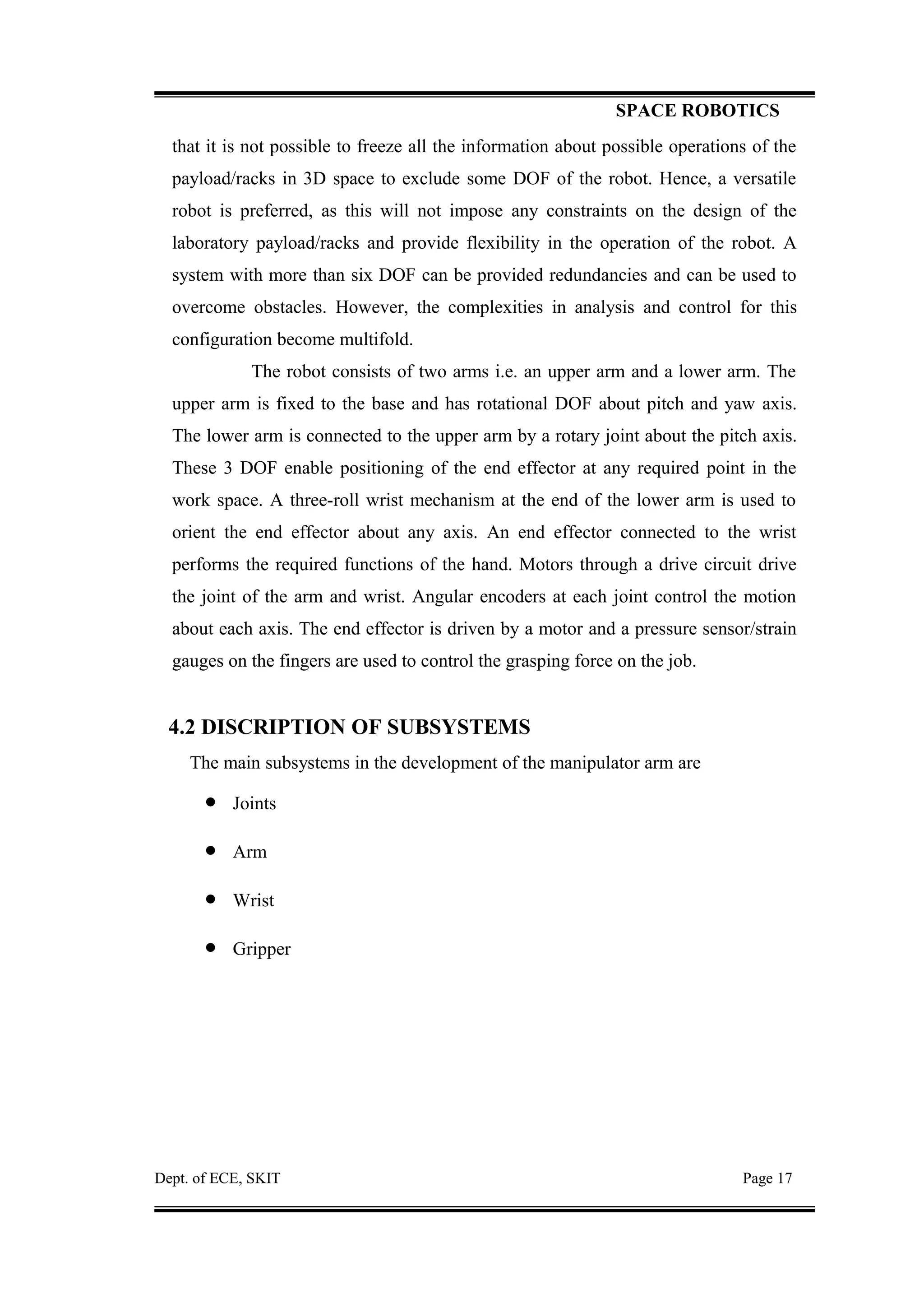
• Survey the outside of the Space Shuttle with a TV camera attached to the
elbow or the wrist of the robot arm.
Shuttle robot arm observed from the deck
5.1.2 ROBOT ARM OPERATION MODE
SRMS is operated inside the Space Shuttle cabin. The operation is
performed from the aft flight deck (AFD), right behind the cockpit; either through
the window or by watching two TV monitors. To control the SRMS, the operator
uses the translational hand controller (THC) with his or her left hand and
manipulates the rotational hand controller (RHC) with his or her right hand.
Dept. of ECE, SKIT Page 20
SPACE ROBOTICS
THC RHC
5.1.3 HOW SPACE SHUTTLE ROBOT ARM GRASPS OBJECT?
How does the Space Shuttle robot arm grasp objects? Many people might
think of human hand or magic hand, but its mechanism is as follows.
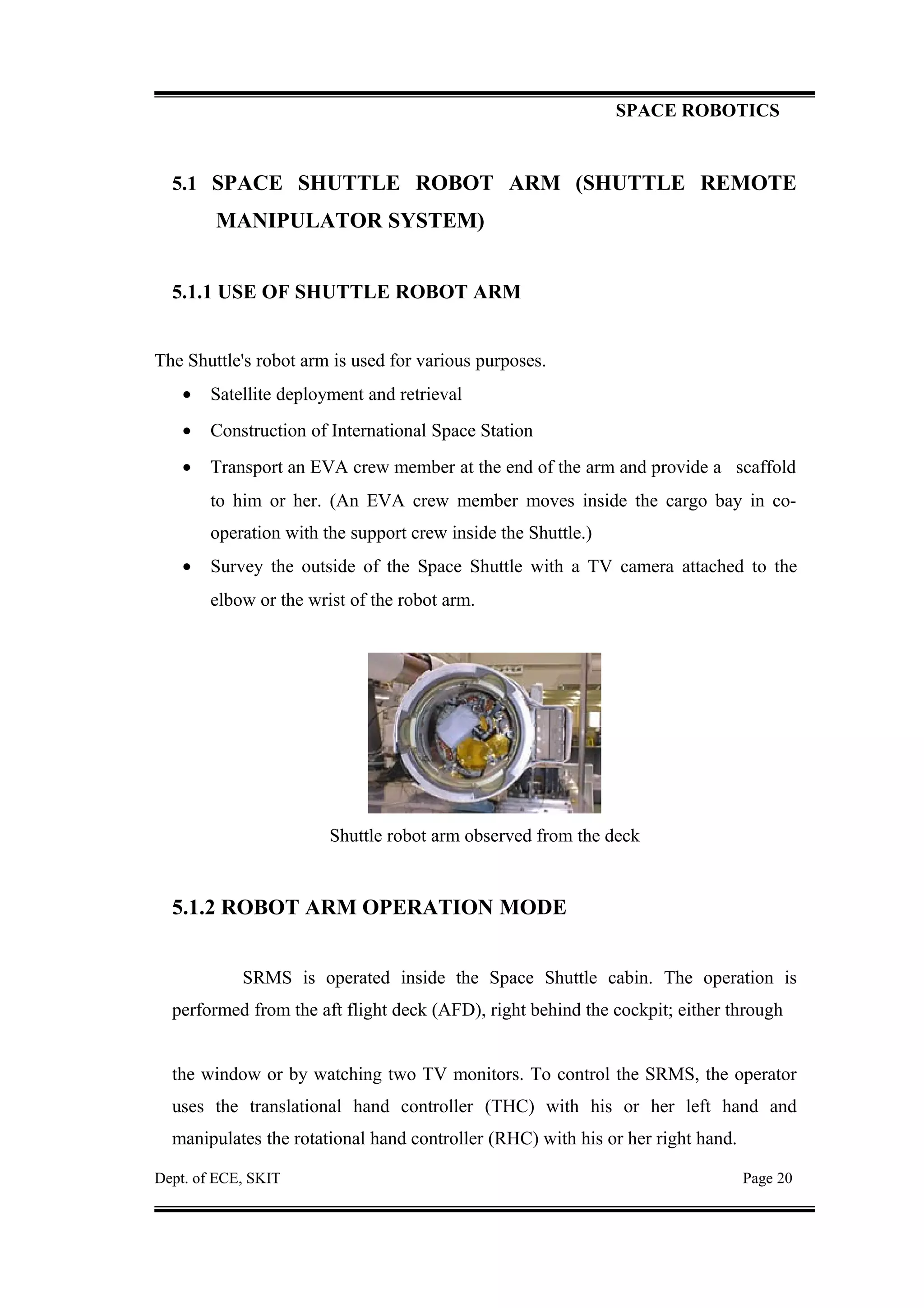
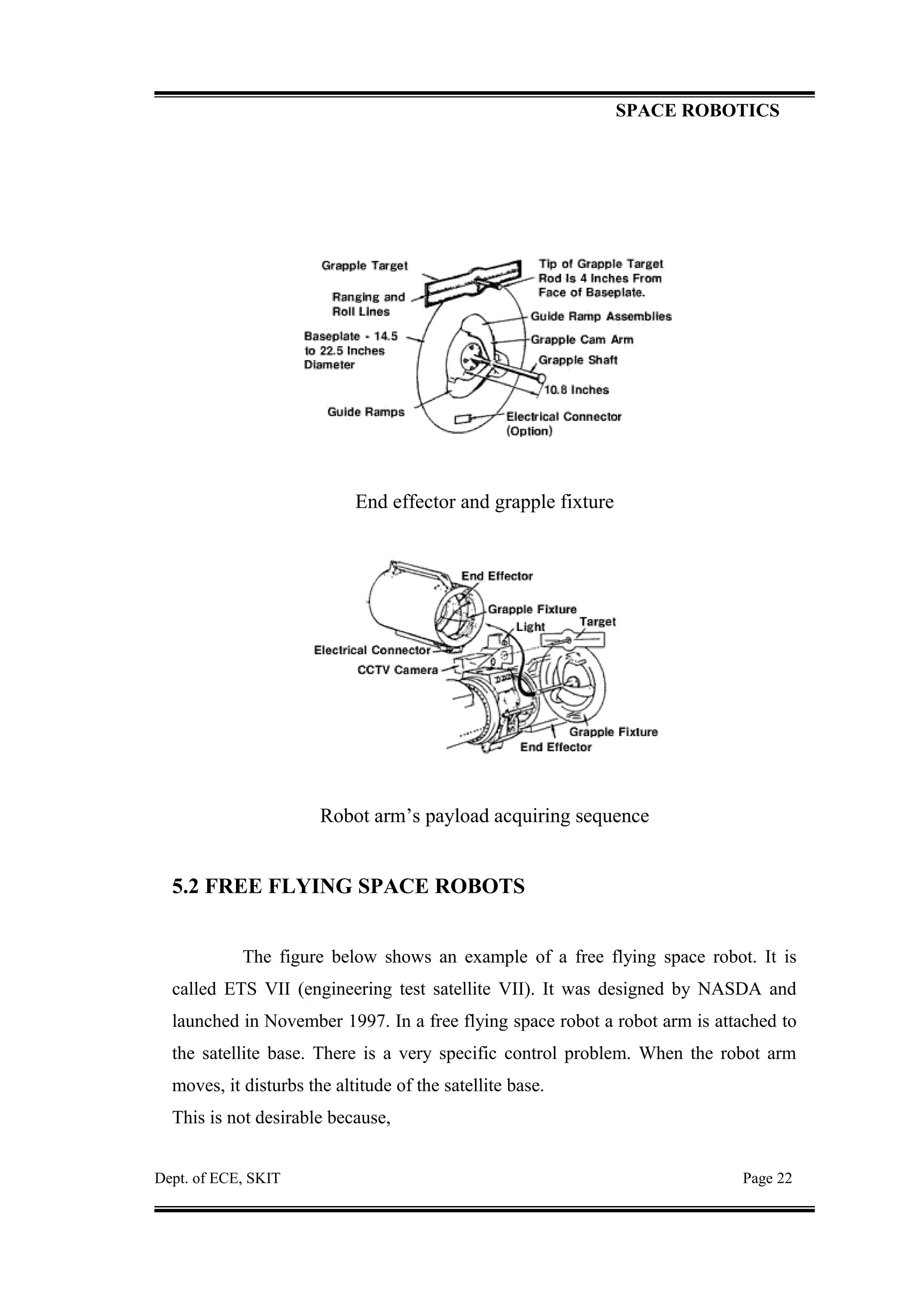
At the end of the robot arm is a cylinder called the end effector. Inside this cylinder
equipped three wires that are used to grasp objects. The object to be grasped needs
to have a stick-shaped projection called a grapple fixture. The three wires in the
cylinder fix this grapple fixture at the centre of the cylinder.
However, a sight is needed to acquire the grapple fixture while manipulating a
robot arm as long as 45 feet. The grapple fixture has a target mark, and a rod is
mounted vertically on this mark. The robot arm operator monitors the TV image of
the mark and the rod, and operates the robot arm to approach the target while
keeping the rod standing upright to the robot arm. If the angular balance between
the rod and the robot arm is lost, that can immediately be detected through the TV
image.
Dept. of ECE, SKIT Page 21
SPACE ROBOTICS
End effector and grapple fixture
Robot arm’s payload acquiring sequence
5.2 FREE FLYING SPACE ROBOTS
The figure below shows an example of a free flying space robot. It is
called ETS VII (engineering test satellite VII). It was designed by NASDA and
launched in November 1997. In a free flying space robot a robot arm is attached to
the satellite base. There is a very specific control problem. When the robot arm
moves, it disturbs the altitude of the satellite base.
This is not desirable because,
Dept. of ECE, SKIT Page 22
SPACE ROBOTICS
• The satellite may start rotating in an uncontrollable way.
• The antenna communication link may be interrupted.
One of the research objectives is to design robot arm trajectories and to
control the arm motion in such a way that the satellite base remains undisturbed or
that the disturbance will be minimum.
Dept. of ECE, SKIT Page 23
SPACE ROBOTICS
Free flying space robots
5.3 SPACE STATION MOUNTED ROBOTS
The international space station (ISS) is a sophisticated structural
assembly. There will be several robot arms which will help astronauts in
performing a variety of tasks.
Dept. of ECE, SKIT Page 24
SPACE ROBOTICS
JEMRMS
The figure shows a part of ISS including the Japanese Experimental
Module (JEM). A long manipulator arm can be seen. The arm is called JEMRMS
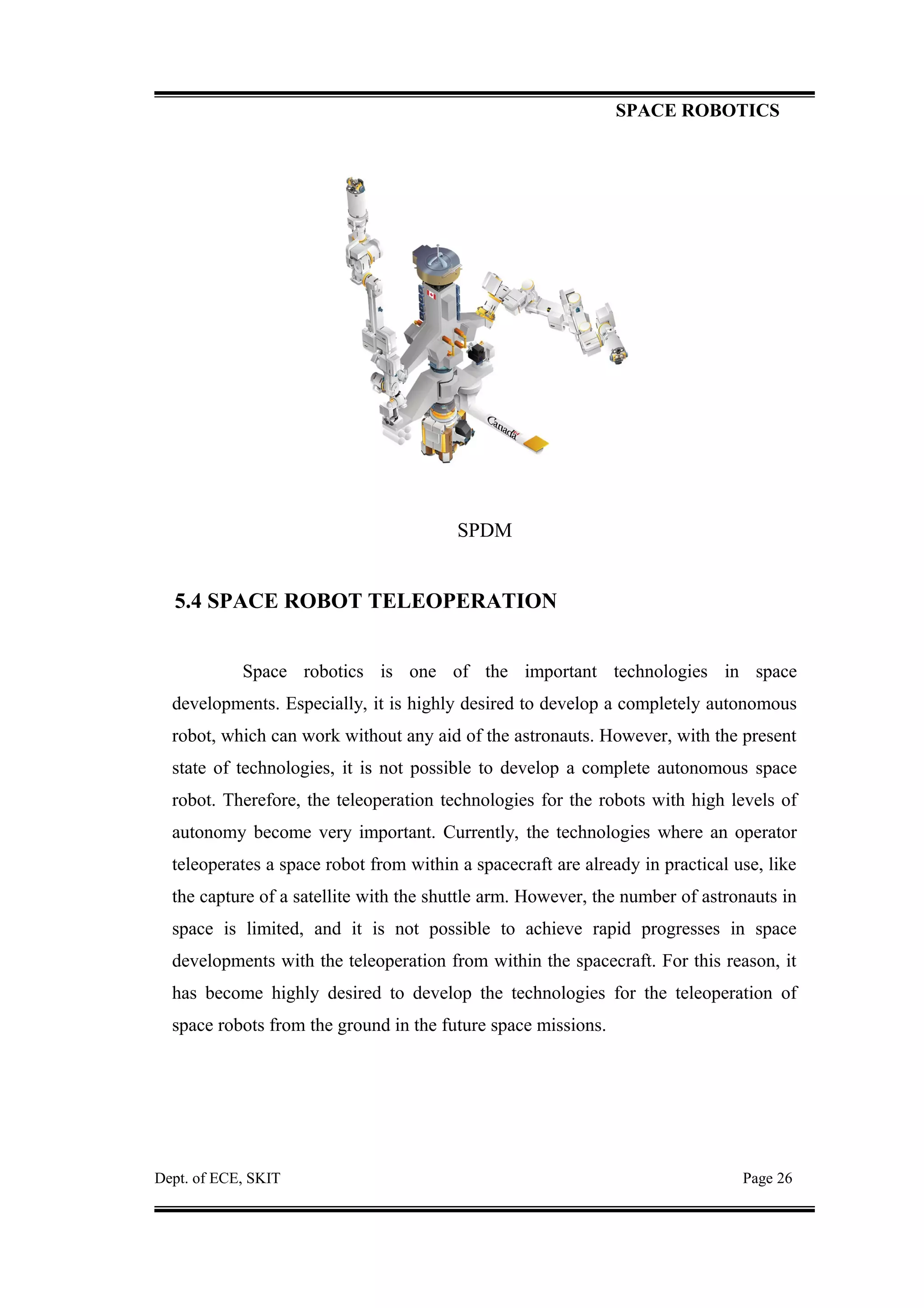
(JEM Remote Manipulating System). A small manipulator arm called SPDM
(Special purpose dexterous Manipulator) can be attached to JEMRMS to improve
the accuracy of operation.
Dept. of ECE, SKIT Page 25
SPACE ROBOTICS
SPDM
5.4 SPACE ROBOT TELEOPERATION
Space robotics is one of the important technologies in space
developments. Especially, it is highly desired to develop a completely autonomous
robot, which can work without any aid of the astronauts. However, with the present
state of technologies, it is not possible to develop a complete autonomous space
robot. Therefore, the teleoperation technologies for the robots with high levels of
autonomy become very important. Currently, the technologies where an operator
teleoperates a space robot from within a spacecraft are already in practical use, like
the capture of a satellite with the shuttle arm. However, the number of astronauts in
space is limited, and it is not possible to achieve rapid progresses in space
developments with the teleoperation from within the spacecraft. For this reason, it
has become highly desired to develop the technologies for the teleoperation of
space robots from the ground in the future space missions.
Dept. of ECE, SKIT Page 26
SPACE ROBOTICS
CONCLUSION
In the future, robotics will make it possible for billions of people to have
lives of leisure instead of the current preoccupation with material needs. There are
hundreds of millions who are now fascinated by space but do not have the means to
explore it. For them space robotics will throw open the door to explore and
experience the universe.
Dept. of ECE, SKIT Page 27
SPACE ROBOTICS
REFERENCES
1. www.andrew.cmu.edu/~ycia/robot.html
2. www.space.mech.tohoku.ac.jp/research/overview/overview.html
3. www.nanier.hq.nasa.gov/telerobotics-page/technologies/0524.html
4. www.jem.tksc.nasda.go.jp/iss/3a/orb_rms_e.html
5. PRODUCTION TECHNOLOGY by R. K. JAIN
6. INTRODUCTION TO SPACE ROBOTICS by ALEX ELLERY
Dept. of ECE, SKIT Page 28
SPACE ROBOTICS
Dept. of ECE, SKIT Page 29

Space robotics

  • 1.
    SPACE ROBOTICS Chapter 1 INTRODUCTION Robotis a system with a mechanical body, using computer as its brain. Integrating the sensors and actuators built into the mechanical body, the motions are realised with the computer software to execute the desired task. Robots are more flexible in terms of ability to perform new tasks or to carry out complex sequence of motion than other categories of automated manufacturing equipment. Today there is lot of interest in this field and a separate branch of technology ‘robotics’ has emerged. It is concerned with all problems of robot design, development and applications. The technology to substitute or subsidise the manned activities in space is called space robotics. Various applications of space robots are the inspection of a defective satellite, its repair, or the construction of a space station and supply goods to this station and its retrieval etc. With the over lap of knowledge of kinematics, dynamics and control and progress in fundamental technologies it is about to become possible to design and develop the advanced robotics systems. And this will throw open the doors to explore and experience the universe and bring countless changes for the better in the ways we live. 1.1 AREAS OF APPLICATION The space robot applications can be classified into the following four categories 1 In-orbit positioning and assembly: For deployment of satellite and for assembly of modules to satellite/space station. 2 Operation: For conducting experiments in space lab. 3 Maintenance: For removal and replacement of faulty modules/packages. 4 Resupply: For supply of equipment, materials for experimentation in space lab and for the resupply of fuel. Dept. of ECE, SKIT Page 1
  • 2.
    SPACE ROBOTICS The followingexamples give specific applications under the above categories Scientific experimentation: Conduct experimentation in space labs that may include • Metallurgical experiments which may be hazardous. • Astronomical observations. • Biological experiments. Assist crew in space station assembly • Assist in deployment and assembly outside the station. • Assist crew inside the space station: Routine crew functions inside the space station and maintaining life support system. Space servicing functions • Refueling. • Replacement of faulty modules. • Assist jammed mechanism say a solar panel, antenna etc. Space craft enhancements • Replace payloads by an upgraded module. • Attach extra modules in space. Space tug Dept. of ECE, SKIT Page 2
  • 3.
    SPACE ROBOTICS • Graba satellite and effect orbital transfer. • Efficient transfer of satellites from low earth orbit to geostationary orbit. 1.2 SPACE SHUTTLE TILE REWATERPROOFING ROBOT TESSELLATOR Tessellator Tessellator is a mobile manipulator system to service the space shuttle.The method of waterproofing for space shuttle orbiters involves repetitively injecting the extremely hazardous dimethyloxysilane (DMES) into approximately 15000 bottom tile after each space flight. The field robotic center at Carneige Mellon University has developed a mobile manipulating robot, Tessellator for autonomous tile rewaterproofing. Its automatic process yields tremendous benefit through increased productivity and safety. In this project, a 2D-vehicle workspace covering and vehicle routing problem has been formulated as the Travelling Workstation Problem (TWP). In the TWP, a workstation is defined as a vehicle which occupies or serves a certain area and it can travel; a workspace is referred to as a 2D actuation envelop of manipulator systems or sensory systems which are carried on the workstation; a work area refers to a whole 2D working zone for a workstation. Dept. of ECE, SKIT Page 3
  • 4.
    SPACE ROBOTICS The objectiveof the TWP is 1 To determine the minimum number of workspaces and their layout, in which, we should minimize the overlapping among the workspaces and avoid conflict with obstacles. 2 To determine the optimal route of the workstation movement, in which the workstation travels over all workspaces within a lowest cost (i.e. routing time). The constraints of the problem are 1) The workstation should serve or cover all workareas. 2) The patterns or dimensions of each workspace are the same and 3) There some geographical obstacles or restricted areas. In the study, heuristic solutions for the TWP, and a case study of Tessellator has been conducted. It is concluded that the covering strategies, e.g. decomposition and other layout strategies yield satisfactory solution for workspace covering, and the cost-saving heuristics can near-optimally solve the routing problem. The following figure shows a sample solution of TWP for Tessellator. Dept. of ECE, SKIT Page 4
  • 5.
    SPACE ROBOTICS Path oftessellator on 2D workspace of space shuttle 1.3 ROBOTS TO REFUEL SATELLITES The US department of defense is developing an orbital-refueling robot that could expand the life span of American spy satellites many times over, new scientists reported. The robotic refueler called an Autonomous Space Transporter and Robotic Orbiter (ASTRO) could shuttle between orbiting fuel dumps and satellites according to the Defense Advance Research Projects Agency. Therefore, life of a satellite would no longer be limited to the amount of fuel with which it is launched. Spy satellites carry a small amount of fuel, called hydrazine, which enable them to change position to scan different parts of the globe or to go into a higher orbit. Such maneuvering makes a satellites position difficult for an enemy to predict. But, under the current system, when the fuel runs out, the satellite gradually falls out of orbit and goes crashing to the earth. In the future the refueler could also carry out repair works on faulty satellites, provided the have modular electronic systems that can be fixed by slot in replacements. Dept. of ECE, SKIT Page 5
  • 6.
    SPACE ROBOTICS Chapter 2 SPACEROBOT—CHALLENGES IN DESIGN AND TESTING Robots developed for space applications will be significantly different from their counterpart in ground. Space robots have to satisfy unique requirements to operate in zero ‘g’ conditions (lack of gravity), in vacuum and in high thermal gradients, and far away from earth. The phenomenon of zero gravity effects physical action and mechanism performance. The vacuum and thermal conditions of space influence material and sensor performance. The degree of remoteness of the operator may vary from a few meters to millions of kilometers. The principle effect of distance is the time delay in command communication and its repercussions on the action of the arms. The details are discussed below 2.1 ZERO ‘g’ EFFECT ON DESIGN Dept. of ECE, SKIT Page 6
  • 7.
    SPACE ROBOTICS The gravityfree environment in which the space robot operates possesses both advantages and disadvantages. The mass to be handled by the manipulator arm is not a constraint in the zero ‘g’ environment. Hence, the arm and the joints of the space robot need not withstand the forces and the moment loads due to gravity. This will result in an arm which will be light in mass. The design of the manipulator arm will be stiffness based and the joint actuators will be selected based on dynamic torque (i.e.; based on the acceleration of the arm). The main disadvantage of this type of environment is the lack of inertial frame. Any motion of the manipulator arm will induce reaction forces and moment at the base which in turn will disturb the position and the altitude. The problem of dynamics, control and motion planning for the space robot is considering the dynamic interactions between the robot and the base (space shuttle, space station and satellite). Due to the dynamic interaction, the motion of the space robot can alter the base trajectory and the robot and the robot end effector can miss the desired target due to the motion of the base. The mutual dependence severely affects the performance of both the base, especially, when the mass and moment of inertia of the robot and the payload are not negligible in comparison to the base. Moreover, inefficiency in planning and control can considerably risk the success of space missions. The components in space do not stay in position. They freely float and are a problem to be picked up. Hence, the components will have to be properly secured. Also the joints in space do not sag as on earth. Unlike on earth the position of the arm can be within the band of the backlash at each joint. 2.2 VACUUM EFFECT AND THERMAL EFFECT The vacuum in space can create heat transfer problems and mass loss of the material through evaporation or sublimation. This is to be taken care by proper selection of materials, lubricants etc., so as to meet the total mass loss (TML) of <1% and collected volatile condensable matter (CVCM) of <0.1%. The use of conventional lubricants in bearings is not possible in this environment. The Dept. of ECE, SKIT Page 7
  • 8.
    SPACE ROBOTICS preferred lubricantsare dry lubricants like bonded/sputtered/ion plated molybdenum disulphide, lead, gold etc. Cold welding of molecularly similar metal in contact with each other is a possibility, which is to be avoided by proper selection of materials and dry lubricants. Some of the subsystem that cannot be exposed to vacuum will need hermetical sealing. The thermal cycles and large thermal variations will have to be taken care in design of robot elements. Low temperature can lead to embrittlement of the material, weaken adhesive bonding and increase friction in bearings. Large thermal gradients can lead to distortion in structural elements and jamming of the mechanism. This calls for the proper selection of the materials whose properties are acceptable in the above temperature ranges and the selection of suitable protective coatings and insulation to ensure that the temperature of the system is within allowable limits. 2.3 OTHER FACTORS One of the prime requirements of space systems is lightweight and compactness. The structural material to be used must have high specific strength and high specific stiffness, to ensure compactness, minimum mass and high stiffness. The other critical environment to which the space robot will be subjected to are the dynamic loads during launch. These dynamic loads are composed of sinusoidal vibrations, random vibrations, acoustic noise and separation shock spectra. The electrical and electronic subsystems will have to be space qualified to take care of the above environmental conditions during launch and in orbit. The components must be protected against radiation to ensure proper performance throughout its life in orbit. The space robots will have to possess a very high degree of reliability and this is to be achieved right from the design phase of the system. A failure mode effect and critical analysis (FMECA) is to be carried out to identify the different failure modes effects and these should be addressed in the design by • Choosing proven/reliable designs. • Having good design margins. Dept. of ECE, SKIT Page 8
  • 9.
    SPACE ROBOTICS • Havedesign with redundancy. 2.4 SPACE MODULAR MANIPULATORS The unique thermal, vacuum and gravitational conditions of space drive the robot design process towards solutions that are much different from the typical laboratory robot. JSC's A&R Division is at the forefront of this design effort with the prototypes being built for the Space Modular Manipulators (SMM) project. The first SMM joint prototype has completed its thermal-mechanical-electrical design phase, is now under construction in the JSC shops, and is scheduled for thermal- vac chamber tests in FY94. FY93 was the SMM project's first year, initiating the effort with a MITRE Corporation review of the existing space manipulator design efforts (RMS and FTS) and interaction with ongoing development teams (RANGER, JEM, SPDM, STAR and SAT). Below this system level, custom component vendors for motors, amplifiers, sensors and cables were investigated to capture the state-of-the-art in space robot design. Four main design drivers were identified as critical to the development process: 1. Extreme Thermal Conditions; 2. High Reliability Requirements; 3. Dynamic Performance; and 4. Modular Design. While these design issues are strongly coupled, most robot design teams have handled them independently, resulting in an iterative process as each solution impacts the other problems. The SMM design team has sought a system level approach that will be demonstrated as prototypes, which will be tested in the JSC thermal-vacuum facilities. Dept. of ECE, SKIT Page 9
  • 10.
    SPACE ROBOTICS The thermal-vacuumconditions of space are the most dramatic difference between typical laboratory robot and space manipulator design requirements. Manufacturing robots operate in climate controlled, |O(+,-)2K factory environments, where space manipulators must be designed for |O(+,) 75K temperature variations with 1500 W/m2 of solar flux. Despite these environmental extremes, the technology to model and control robot precision over a wide temperature range can be applied to terrestrial robotic operations where the extreme precision requirements demand total thermal control, such as in semiconductor manufacturing and medical robot applications. Thermal conditions impact reliability by cycling materials and components, adding to the dynamic loading that causes typical robot fatigue and inaccuracy. MITRE built a customised thermal analysis model, a failure analysis model using FEAT, and applied the fault tolerance research funded by JSC at the University of Texas. The strategy is to layer low level redundancy in the jointmodules with a high level, redundant kinematic system design, where minor joint failures can be masked and serious failures result in reconfigured arm operation. In this approach, all four design drivers were addressed in the selection of the appropriate level of modular design as a 2-DOF joint module. The major technical accomplishments for the FY93 SMM project are: 1 Conceptual and detailed design of first joint prototype; 2 Detailed design and fabrication of thermal-vacuum test facility; 3 Custom design of thermal-vac rated motors, bearings, sensors and cables; and 4 Published two technical papers (R. Ambrose & R. Berka) on robot thermal design. Dept. of ECE, SKIT Page 10
  • 11.
    SPACE ROBOTICS Chapter-3 SYSTEM VERIFICATIONAND TESTING The reliability is to be demonstrated by a number of tests enveloping all the environmental conditions (thermal and vacuum) that the system will be subjected to. Verification of functions and tests will be conducted on subsystems, subassemblies and final qualification and acceptance tests will be done on complete system. The most difficult and the nearly impossible simulation during testing will be zero ‘g’ simulation. Dept. of ECE, SKIT Page 11
  • 12.
    SPACE ROBOTICS The commonlyused simulations for zero ‘g’ are 1. Flat floor test facility: It simulates zero ‘g’ environments in the horizontal plane. In this system flat floor concept is based on air bearing sliding over a large slab of polished granite. 2. Water immersion: Reduced gravity is simulated by totally submerging the robot under water and testing. This system provides multi degree of freedom for testing. However, the model has to be water-resistant and have an overall specific gravity of one. This method is used by astronauts for extra vehicular activities with robot. 3. Compensation system: Gravitational force is compensated by a passive and vertical counter system and actively controlled horizontal system. The vertical system comprises the counter mechanism and a series of pulleys and cables that provide a constant upward force to balance the weight of the robot. However, the counter mechanism increases the inertia and the friction of joints of rotating mechanism. 3.1PERFORMANCE ASSESSMENT AND CALIBRATION STRATEGIES FOR SPACE ROBOTS Predictable safe and cost efficient operation of a robotic device for space applications can best be achieved by programming it offline during the preparation for the mission. Computer aided design techniques are used to assure that the movement of the robot are predictable. A software model of the robot and its work cell is made and this must be compatible with the model of the environment in which the robot must perform. Cost efficiency requirements dictate that a robot be calibrated, after which its performance must be checked against specified requirements. Proper use of miniaturized sensing technology is needed to produce a robot of minimum size, power requirement and consumption and mass. This often requires minimizing the number and the type of sensors needed, and maximizing Dept. of ECE, SKIT Page 12
  • 13.
    SPACE ROBOTICS the information(such as position, velocity, and acceleration) which is gained from each sensor. The study of methods of assessing the performance of a robot, choosing its sensors and performing calibration and test, ESA passed a contract with industry. Results of this work are applicable to any robot whose kinematics chain needs accurate geometrical modeling. 3.1.1 ROBOT PERFORMANCE ASSESSMENT The objectives of robot performance assessment are • To identify the main source of error which perturb the accuracy of the arm. • To decide if the arm or the work cell must be calibrated. • To compare the expected improvement in accuracy in calibration. The performance of the robot is assessed by making mathematical model of the characteristics of the error source in each of its sub system such as the joint, the robot link or its gripper. From these the effects of errors on the positioning accuracy of end effector (the functioning tip of the robot arm) can be evaluated. Error sources are identified by a bottom up analysis, which tale account of the capabilities of state of the art production technology. For each robot subsystem error sources are identified and are sorted into three categories. • Systematic error which do not vary with time, such as parallelism, concentricity and link length. • Pseudo systematic error, which are time variant yet predictable such as temperature induced effects. • Random errors, which vary with time and cannot be, predicted such as encoded noise. Dept. of ECE, SKIT Page 13
  • 14.
    SPACE ROBOTICS Once theerror source have been classified and its magnitude defined, various statistical methods may be used to evaluate its effects when they work in combination. Simply adding all the errors, take no account of their statistical nature and gives an estimate which is safe but unduly pessimistic; misapplication of statistics can produce an estimate, which is too optimistic. Accuracy of some painting mechanism is frequently estimated by separately eliminating the root mean square value of each of the three error types identified above and adding them. In the case of AMTS project, all error sources were considered as statistical variables and a single root mean square error at the end effector was of interest. The bottom up approach used to establish the contribution of each power source error source was validated taking the case of manipulator for which a worst case accuracy of 2.7mm was predicted. This was very close to its average accuracy of 2mm. 3.1.2 ROBOT CALIBRATION If the performance prediction has shown that calibration is needed to compensate for errors, a proper calibration approach is required. Ideally, all calibration must be done on ground. In orbit calibration procedures should be limited to crosschecking the validity of model developed on ground and if necessary correcting for errors such as microslip page or pressure gradient. To keep the flight hardware simple, the in orbit calibration should be achieved using sensors already available in the robot. Calibration is performed in five steps: Dept. of ECE, SKIT Page 14
  • 15.
    SPACE ROBOTICS • Modeling,in which a parametric description of the robot is developed, introducing geometric parameters such as link length and non geometric parameters such as control parameters. • Measurement, in which a set of robot poses (position and orientation) and encoder data are measured using real robot to provide inputs to the identification test step. • Identification, which uses the parametric model and the measured data to determine the optimal set of error parameters. • Model implementation, which may be done either by updating the root controller data or by correcting the robot pose with expected standard deviation of the error. • Verification, that the improvement in the positioning accuracy of the robot in all three axes have been achieved. A method for calibrating each axes independently has been successfully developed in the frame of the contract. This method uses independent measurements of motions along each of the three axes. Advantage of this approach compared to others such as those requiring all robot joints move simultaneously is that it subdivides the general problem of robot calibration into a set of problems of lower complexity, thus achieving good stability and numerical precession. The calibration software is parametric and is suitable for calibrating any open robot kinematics chain. 3.1.3 PERFORMANCE EVALUATION As part of a verification procedure, specific performance tests were carried out on a robot by Krypton under contract to ESA. The first was an accuracy test in which the robot had to adapt a specified pose and aim at a point, key characteristics Dept. of ECE, SKIT Page 15
  • 16.
    SPACE ROBOTICS for predictableoffline programming. The second test evaluated the repeatability with which the robot could reach a pose it had been taught to adopt. This is essential for performing repetitive and routine tasks. Finally, the multidirectional pose accuracy was tested to establish the effect of random errors and to establish the limits of calibration procedure. The performance of the robot was measured before and after calibration. Procedures for calibrating robots on ground and in orbit have been developed, and the performance of the robotic devices has been successfully tested. The robot calibration procedure proved to work well resulting in an improvement in performance by a factor of ten in some cases. The calibration software is versatile and it can be used to calibrate and evaluate most kinematics chains ranging from a simple two axes antenna gimbals mechanism to a ten axes manipulator. These software procedures are now used by Krypton for applications in most motor industry and elsewhere. Chapter-4 STRUCTURE OF SPACE ROBOTS 4.1 DESCRIPTION OF STRUCTURE OF SPACE ROBOT The proposed robot is of articulated type with 6 degrees of freedom (DOF). The reason for 6 DOF system rather than one with lesser number of DOF is Dept. of ECE, SKIT Page 16
  • 17.
    SPACE ROBOTICS that itis not possible to freeze all the information about possible operations of the payload/racks in 3D space to exclude some DOF of the robot. Hence, a versatile robot is preferred, as this will not impose any constraints on the design of the laboratory payload/racks and provide flexibility in the operation of the robot. A system with more than six DOF can be provided redundancies and can be used to overcome obstacles. However, the complexities in analysis and control for this configuration become multifold. The robot consists of two arms i.e. an upper arm and a lower arm. The upper arm is fixed to the base and has rotational DOF about pitch and yaw axis. The lower arm is connected to the upper arm by a rotary joint about the pitch axis. These 3 DOF enable positioning of the end effector at any required point in the work space. A three-roll wrist mechanism at the end of the lower arm is used to orient the end effector about any axis. An end effector connected to the wrist performs the required functions of the hand. Motors through a drive circuit drive the joint of the arm and wrist. Angular encoders at each joint control the motion about each axis. The end effector is driven by a motor and a pressure sensor/strain gauges on the fingers are used to control the grasping force on the job. 4.2 DISCRIPTION OF SUBSYSTEMS The main subsystems in the development of the manipulator arm are • Joints • Arm • Wrist • Gripper Dept. of ECE, SKIT Page 17
  • 18.
    SPACE ROBOTICS 4.2.1 JOINTS Ajoint permits relative motion between two links of a robot. Two types of joints are 1 Roll joint – rotational axis is identical with the axis of the fully extended arm. 2 Pitch joint – rotational axis is perpendicular to the axis of the extended arm and hence rotation angle is limited. The main requirements for the joints are to have near zero backlash, high stiffness and low friction. In view of the limitations on the volume to be occupied by the arm within the workspace, the joints are to be highly compact and hence they are integrated to the arm structure. To ensure a high stiffness of the joint the actuator, reduction gear unit and angular encoders are integrated into the joint. Each joint consists of • Pancake type DC torque motors (rare earth magnet type) which have advantage over other types of motors with respect to size, weight, response time and high torque to inertia ratio. • Harmonic gear drive used for torque amplification/speed reduction. These gear drives have near zero backlash, can obtain high gear ratios in one stage only and have high efficiency. • Electromagnetically actuated friction brakes, which prevent unintentional movements to the arms. This is specifically required when the gear drive is not self-locking. In space environment, where the gravity loads are absent (zero ‘g’ environment) brakes will help to improve the stability of the joint actuator control system. i.e. the brake can be applied as soon as the joint velocity is less than the threshold value. • Electro optical angular encoders at each axis to sense the position of the end of the arm. Space qualified lubricants like molybdenum disulphide Dept. of ECE, SKIT Page 18
  • 19.
    SPACE ROBOTICS (bonded film/sputtered),lead, gold etc. will be used for the gear drives and for the ball bearings. 4.2.2 ROBOT ARMS The simplest arm is the pick and place type. These may be used to assemble parts or fit them into clamp or fixture. This is possible due to high accuracy attainable in robot arm. It is possible to hold the part securely after picking up and in such a way that the position and the orientation remains accurately known with respect to the arm. Robot arms can manipulate objects having complicated shapes and fragile in nature. 4.2.3 WRIST Robot arm comprises of grippers and wrist. Wrist is attached to the robot arm and has three DOF (pitch, yaw, and roll). Wrist possesses the ability to deform in response to the forces and the torques and return to equilibrium position after the deflecting forces are removed. 4.2.4 GRIPPER Gripper is attached to the wrist of the manipulator to accomplish the desired task. Its design depends on the shape and size of the part to be held. Chapter-5 OPERATION Dept. of ECE, SKIT Page 19
  • 20.
    SPACE ROBOTICS 5.1 SPACESHUTTLE ROBOT ARM (SHUTTLE REMOTE MANIPULATOR SYSTEM) 5.1.1 USE OF SHUTTLE ROBOT ARM The Shuttle's robot arm is used for various purposes. • Satellite deployment and retrieval • Construction of International Space Station • Transport an EVA crew member at the end of the arm and provide a scaffold to him or her. (An EVA crew member moves inside the cargo bay in co- operation with the support crew inside the Shuttle.) • Survey the outside of the Space Shuttle with a TV camera attached to the elbow or the wrist of the robot arm. Shuttle robot arm observed from the deck 5.1.2 ROBOT ARM OPERATION MODE SRMS is operated inside the Space Shuttle cabin. The operation is performed from the aft flight deck (AFD), right behind the cockpit; either through the window or by watching two TV monitors. To control the SRMS, the operator uses the translational hand controller (THC) with his or her left hand and manipulates the rotational hand controller (RHC) with his or her right hand. Dept. of ECE, SKIT Page 20
  • 21.
    SPACE ROBOTICS THC RHC 5.1.3HOW SPACE SHUTTLE ROBOT ARM GRASPS OBJECT? How does the Space Shuttle robot arm grasp objects? Many people might think of human hand or magic hand, but its mechanism is as follows. At the end of the robot arm is a cylinder called the end effector. Inside this cylinder equipped three wires that are used to grasp objects. The object to be grasped needs to have a stick-shaped projection called a grapple fixture. The three wires in the cylinder fix this grapple fixture at the centre of the cylinder. However, a sight is needed to acquire the grapple fixture while manipulating a robot arm as long as 45 feet. The grapple fixture has a target mark, and a rod is mounted vertically on this mark. The robot arm operator monitors the TV image of the mark and the rod, and operates the robot arm to approach the target while keeping the rod standing upright to the robot arm. If the angular balance between the rod and the robot arm is lost, that can immediately be detected through the TV image. Dept. of ECE, SKIT Page 21
  • 22.
    SPACE ROBOTICS End effectorand grapple fixture Robot arm’s payload acquiring sequence 5.2 FREE FLYING SPACE ROBOTS The figure below shows an example of a free flying space robot. It is called ETS VII (engineering test satellite VII). It was designed by NASDA and launched in November 1997. In a free flying space robot a robot arm is attached to the satellite base. There is a very specific control problem. When the robot arm moves, it disturbs the altitude of the satellite base. This is not desirable because, Dept. of ECE, SKIT Page 22
  • 23.
    SPACE ROBOTICS • Thesatellite may start rotating in an uncontrollable way. • The antenna communication link may be interrupted. One of the research objectives is to design robot arm trajectories and to control the arm motion in such a way that the satellite base remains undisturbed or that the disturbance will be minimum. Dept. of ECE, SKIT Page 23
  • 24.
    SPACE ROBOTICS Free flyingspace robots 5.3 SPACE STATION MOUNTED ROBOTS The international space station (ISS) is a sophisticated structural assembly. There will be several robot arms which will help astronauts in performing a variety of tasks. Dept. of ECE, SKIT Page 24
  • 25.
    SPACE ROBOTICS JEMRMS The figureshows a part of ISS including the Japanese Experimental Module (JEM). A long manipulator arm can be seen. The arm is called JEMRMS (JEM Remote Manipulating System). A small manipulator arm called SPDM (Special purpose dexterous Manipulator) can be attached to JEMRMS to improve the accuracy of operation. Dept. of ECE, SKIT Page 25
  • 26.
    SPACE ROBOTICS SPDM 5.4 SPACEROBOT TELEOPERATION Space robotics is one of the important technologies in space developments. Especially, it is highly desired to develop a completely autonomous robot, which can work without any aid of the astronauts. However, with the present state of technologies, it is not possible to develop a complete autonomous space robot. Therefore, the teleoperation technologies for the robots with high levels of autonomy become very important. Currently, the technologies where an operator teleoperates a space robot from within a spacecraft are already in practical use, like the capture of a satellite with the shuttle arm. However, the number of astronauts in space is limited, and it is not possible to achieve rapid progresses in space developments with the teleoperation from within the spacecraft. For this reason, it has become highly desired to develop the technologies for the teleoperation of space robots from the ground in the future space missions. Dept. of ECE, SKIT Page 26
  • 27.
    SPACE ROBOTICS CONCLUSION In thefuture, robotics will make it possible for billions of people to have lives of leisure instead of the current preoccupation with material needs. There are hundreds of millions who are now fascinated by space but do not have the means to explore it. For them space robotics will throw open the door to explore and experience the universe. Dept. of ECE, SKIT Page 27
  • 28.
    SPACE ROBOTICS REFERENCES 1. www.andrew.cmu.edu/~ycia/robot.html 2.www.space.mech.tohoku.ac.jp/research/overview/overview.html 3. www.nanier.hq.nasa.gov/telerobotics-page/technologies/0524.html 4. www.jem.tksc.nasda.go.jp/iss/3a/orb_rms_e.html 5. PRODUCTION TECHNOLOGY by R. K. JAIN 6. INTRODUCTION TO SPACE ROBOTICS by ALEX ELLERY Dept. of ECE, SKIT Page 28
  • 29.
    SPACE ROBOTICS Dept. ofECE, SKIT Page 29