Space A Visual Encyclopedia 1st Edition Dk
download
https://ebookbell.com/product/space-a-visual-encyclopedia-1st-
edition-dk-2503274
Explore and download more ebooks at ebookbell.com
Here are some recommended products that we believe you will be
interested in. You can click the link to download.
Space A Visual Encyclopedia Wendy Horobin Eds
https://ebookbell.com/product/space-a-visual-encyclopedia-wendy-
horobin-eds-5405864
Space A Visual Encyclopedia Dorling Kindersley
https://ebookbell.com/product/space-a-visual-encyclopedia-dorling-
kindersley-11454798
Love Your Creative Space A Visual Guide To Creating An Inspiring
Organized Studio Without Breaking The Bank Lilo Bowman
https://ebookbell.com/product/love-your-creative-space-a-visual-guide-
to-creating-an-inspiring-organized-studio-without-breaking-the-bank-
lilo-bowman-11213118
A Visual Guide To Space Exploration Alberto Hernndez Pamplona
https://ebookbell.com/product/a-visual-guide-to-space-exploration-
alberto-hernndez-pamplona-11762314
Picturing The Cosmos A Visual History Of Early Soviet Space Endeavor
Iina Kohonen
https://ebookbell.com/product/picturing-the-cosmos-a-visual-history-
of-early-soviet-space-endeavor-iina-kohonen-7037556
Science Year By Year A Visual History From Stone Tools To Space Travel
Dorling Kindersley Publishing Staff
https://ebookbell.com/product/science-year-by-year-a-visual-history-
from-stone-tools-to-space-travel-dorling-kindersley-publishing-
staff-43523196
Visual Astronomy Under Dark Skies A New Approach To Observing Deep
Space The Patrick Moore Practical Astronomy Series 2005th Edition
Cooke
https://ebookbell.com/product/visual-astronomy-under-dark-skies-a-new-
approach-to-observing-deep-space-the-patrick-moore-practical-
astronomy-series-2005th-edition-cooke-56376382
Visual Astronomy Under Dark Skies A New Approach To Observing Deep
Space 1st Edition Antony Cooke
https://ebookbell.com/product/visual-astronomy-under-dark-skies-a-new-
approach-to-observing-deep-space-1st-edition-antony-cooke-1137076
Public Space Democracy Performative Visual And Normative Dimensions Of
Politics In A Global Age Nilfer Gle Editor
https://ebookbell.com/product/public-space-democracy-performative-
visual-and-normative-dimensions-of-politics-in-a-global-age-nilfer-
gle-editor-42601736
featuring the latest imagery from nasa
SPACE
a visual encyclopedia
DK PUBLISHING
Space:
A Visual
Encyclopedia
Contents
INTRODUCTION
OBSERVING THE UNIVERSE
What is space?
Our place in space
A circle of stars
Early ideas
Telescopes
Giant telescopes
Seeing light
Infrared astronomy
Messages from the stars
Invisible rays
Hubble Space Telescope
Witches and giants
Observatories in space
Unusual observatories
THE VIOLENT UNIVERSE
What is the universe?
Birth of the universe
100 billion galaxies
Galaxy formation
A sombrero in space
The Milky Way
The Magellanic Clouds
The Local Group
The heart of the Milky Way
When galaxies collide…
Active galaxies
Dark matter
LIFTOFF!
How rockets work
3, 2, 1…
The space shuttle
Launch centers
Launching Ariane 5
Artificial satellites
Satellites in orbit
Satellite shot
Space probes
Space debris
4
6
8
10
12
14
16
18
20
22
24
26
28
30
32
34
36
38
40
44
46
48
50
52
54
56
58
60
62
64
66
68
70
72
74
76
78
80
82
84
LONDON, NEW YORK,
MELBOURNE, MUNICH, and DELHI
Consultant Peter Bond
Project editor Wendy Horobin
Project designer Pamela Shiels
Editors Fleur Star, Holly Beaumont,
Lee Wilson, and Susan Malyan
Designers Rachael Grady, Lauren Rosier,
Gemma Fletcher, Karen Hood, Clare Marshall,
Mary Sandberg, and Sadie Thomas
US editor Margaret Parrish
Indexer Chris Bernstein
Picture researchers Ria Jones, Harriet Mills,
and Rebecca Sodergren
Production editor Sean Daly
Jacket designer Natalie Godwin
Jacket editor Matilda Gollon
Publishing manager Bridget Giles
Art director Martin Wilson
Packaging services supplied by Bookwork
First published in the United States in 2010 by
DK Publishing
375 Hudson Street, New York, New York 10014
Copyright © 2010 Dorling Kindersley Limited
10 11 12 13 14 10 9 8 7 6 5 4 3 2 1
175938—05/10
All rights reserved under International and Pan-American
Copyright Conventions. No part of this publication may be
reproduced, stored in a retrieval system, or transmitted
in any form or by any means, electronic, mechanical,
photocopying, recording, or otherwise, without the prior
written permission of the copyright owner. Published
in Great Britain by Dorling Kindersley Limited.
A catalog record for this book
is available from the Library of Congress.
ISBN: 978-0-7566-6277-6
Color reproduction by Media Development
and Printing Limited, United Kingdom
Printed and bound by Toppan, China
Discover more at
www.dk.com
Space nations
Super spacecraft
HUMANS IN SPACE
Space pioneers
Becoming an astronaut
Space walking
Living in space
Animals in space
Extending the house
The first space stations
The International Space Station
Science in space
Space tourism
Future flyers
Reaching for the stars
SOLAR SYSTEM
Birth of the solar system
The Sun’s family
Mercury
Venus
Views of Venus
Mars
Missions to Mars
Martian sand art
Asteroids
Jupiter
Jupiter’s moons
Voyager 1 & 2
Saturn
Saturn’s moons
Saturn by sunlight
Uranus
Neptune
Pluto and beyond
Comets
Comet missions
Meteors
Meteorites
Life on other worlds
EARTH
The unique Earth
The perfect planet
Earth’s seasons
On the surface
Up in the sky
Life on Earth
86
88
90
92
94
96
98
100
102
104
106
108
110
112
114
116
118
120
122
124
126
128
130
132
134
136
138
140
142
144
146
148
150
152
154
156
158
160
162
164
166
168
170
172
174
176
THE MOON
Earth’s companion
Eclipses
The lunar surface
Destination Moon
Man on the Moon
Splashdown!
Return to the Moon
THE SUN
The Sun
Inside the Sun
The Sun’s atmosphere
Solar storms
Amazing aurora
Solar cycle
Observing the Sun
STARS AND STARGAZING
What are stars?
Birth of a star
A flash of brilliance
The death of a star
Interstellar space
Multiple stars
Globular clusters
Other solar systems
Extreme stars
Black holes
Be a skygazer
The night sky
The northern sky
The southern sky
Space in time
Glossary
Index
Acknowledgments
178
180
182
184
186
188
190
192
194
196
198
200
202
204
206
208
210
212
214
216
218
220
222
224
226
228
230
232
234
236
238
240
244
248
254
Introduction
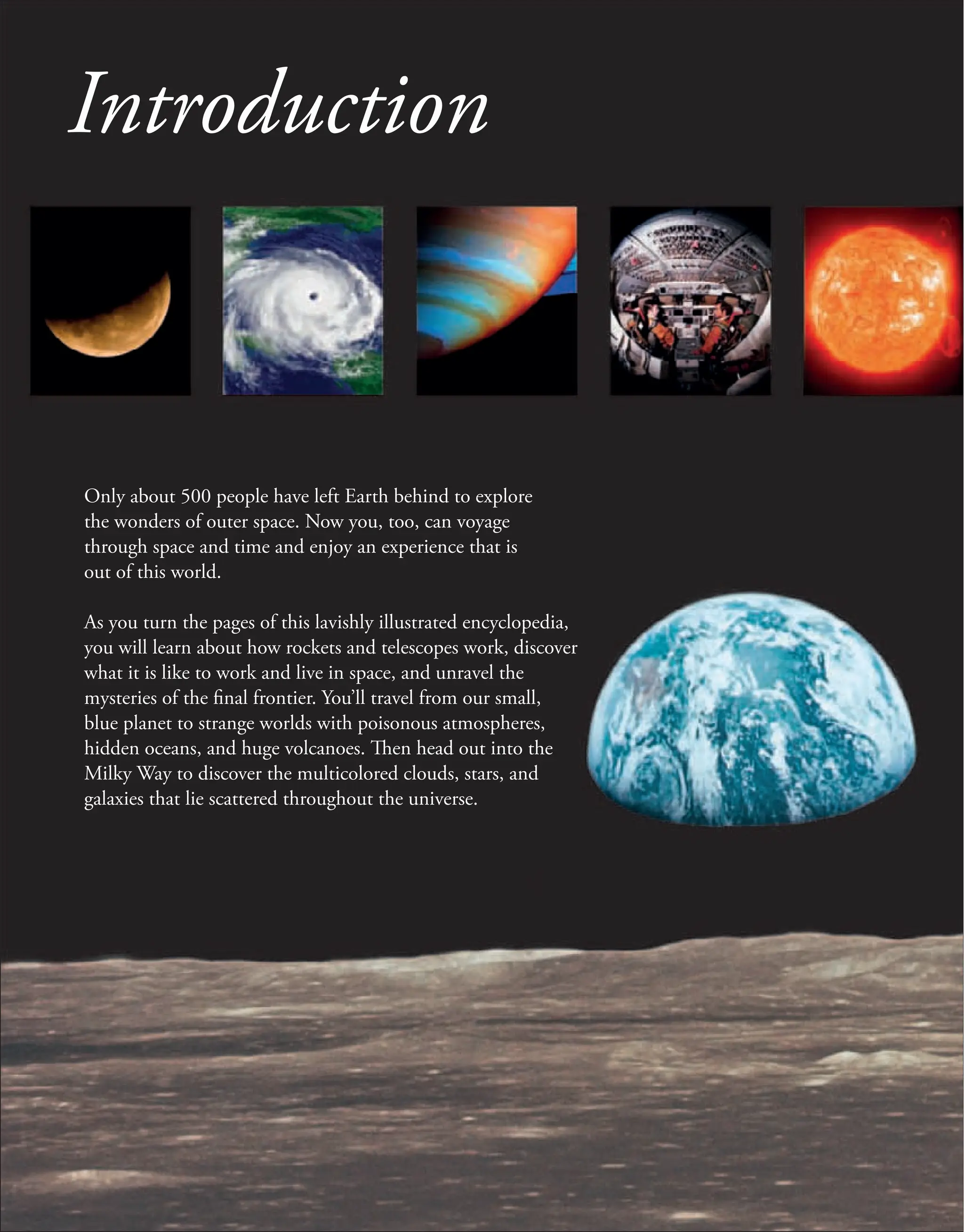
Only about 500 people have left Earth behind to explore
the wonders of outer space. Now you, too, can voyage
through space and time and enjoy an experience that is
out of this world.
As you turn the pages of this lavishly illustrated encyclopedia,
you will learn about how rockets and telescopes work, discover
what it is like to work and live in space, and unravel the
mysteries of the final frontier. You’ll travel from our small,
blue planet to strange worlds with poisonous atmospheres,
hidden oceans, and huge volcanoes. Then head out into the
Milky Way to discover the multicolored clouds, stars, and
galaxies that lie scattered throughout the universe.
5
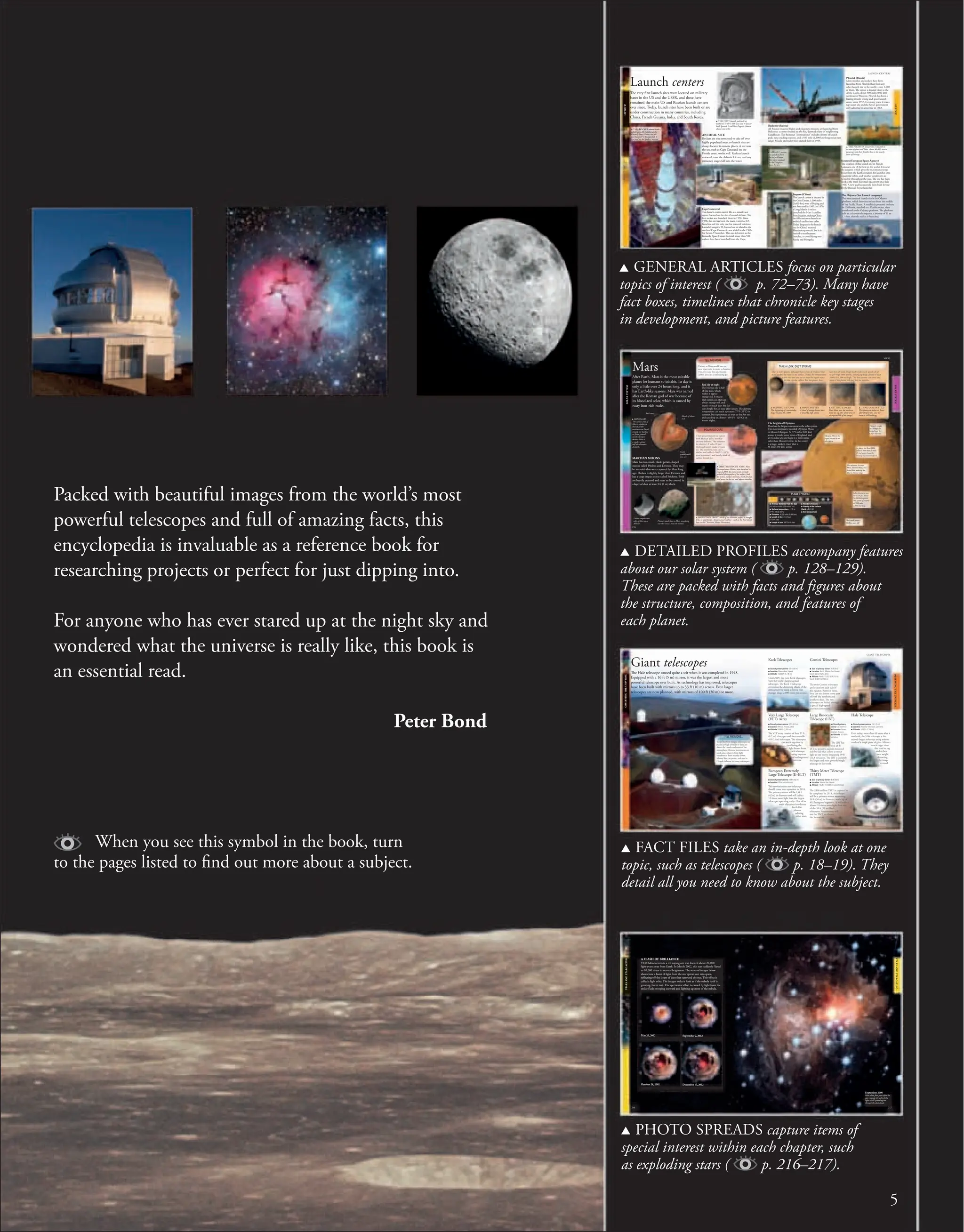
u FACT FILES take an in-depth look at one
topic, such as telescopes ( p. 18–19). They
detail all you need to know about the subject.
u DETAILED PROFILES accompany features
about our solar system ( p. 128–129).
These are packed with facts and figures about
the structure, composition, and features of
each planet.
u GENERAL ARTICLES focus on particular
topics of interest ( p. 72–73). Many have
fact boxes, timelines that chronicle key stages
in development, and picture features.
u PHOTO SPREADS capture items of
special interest within each chapter, such
as exploding stars ( p. 216–217).
128
MARS
Mars
After Earth, Mars is the most suitable
planet for humans to inhabit. Its day is
only a little over 24 hours long, and it
has Earth-like seasons. Mars was named
after the Roman god of war because of
its blood-red color, which is caused by
rusty iron-rich rocks.
SOLAR
SYSTEM
SOLAR
SYSTEM
Small,
probably solid
iron core
Rock crust
Mantle of silicate
rock
Deimos completes one
orbit of Mars every
30 hours.
Red sky at night
The Martian sky is full
of fine dust, which
makes it appear
orange-red. It means
that sunsets on Mars are
always orange-red, and
there’s so much dust the sky
stays bright for an hour after sunset. The daytime
temperature can reach a pleasant 77°F (25°C) in
summer, but it plummets as soon as the Sun sets
and can drop to a bitter −195°F (−125°C) on
winter nights.
. MINI MARS
The surface area of
Mars is similar to
that of all the
continents on Earth.
Details are hard to
see from ground-
based telescopes
because Mars is
o small—about
half the diameter
of Earth.
MARTIAN MOONS
Mars has two small, black, potato-shaped
moons called Phobos and Deimos. They may
be asteroids that were captured by Mars long
ago. Phobos is slightly larger than Deimos and
has a large impact crater called Stickney. Both
are heavily cratered and seem to be covered in
a layer of dust at least 3 ft (1 m) thick.
The volcanoes Ascraeus
Mons, Pavonis Mons, and
Arsia Mons make up the
Tharsis Montes range.
Olympus Mons is the
largest volcano in the
solar system.
The Lowell crater is
4 billion years old.
Valles Marineris runs
like a scar just below
the Martian equator.
This system of canyons
is 2,500 miles
(4,000 km) long.
In places, the Kasei Vallis
valley is more than 2 miles
(3 km) deep. It was the
result of a devastating flood.
Viking 1 Lander
and Pathfinder
landed near the
Chryse Planitia.
■ Average distance from the Sun
142 million miles (228 million km)
■ Surface temperature −195 to
77°F (−125 to 25°C)
■ Diameter 4,200 miles (6,800 km)
■ Length of day 24.5 hours
(1 Earth day)
■ Length of year 687 Earth days
■ Number of moons 2
■ Gravity at the surface
(Earth = 1) 0.38
■ Size comparison
PLANET PROFILE
TAKE A LOOK: DUST STORMS
Mars is a dry planet, although there is lots of evidence that
there used to be water on its surface. Today, the temperature
is too cold and the air too thin for liquid water
to exist on the surface. But the planet does
have lots of wind. High-level winds reach speeds of up
to 250 mph (400 km/h), kicking up huge clouds of dust
3,000 ft (1,000 m) high. The dust storms can cover vast
areas of the planet and may last for months.
POLAR ICE CAPS
There are permanent ice caps at
both Martian poles, but they
are very different. The northern
ice sheet is 1.8 miles (3 km)
thick and mainly made of water
ice. The southern polar cap is
thicker and colder (−166°F/−110°C,
even in summer) and mostly made of
carbon dioxide ice.
u MOUNTAIN FROST Much of the Martian surface is thought
to be in deep freeze—known as permafrost—such as the frost shown
here in the Charitum Montes Mountains.
, ORBITER REPORT NASA’s Mars
Reconnaissance Orbiter was launched in
August 2005. Its instruments can take
detailed photographs of the surface, look
for water, analyze minerals, check for dust
and water in the air, and observe weather.
The heights of Olympus
Mars has the largest volcanoes in the solar system.
The most impressive is called Olympus Mons,
or Mount Olympus. At 375 miles (600 km)
across, it would cover most of England, and
at 16 miles (26 km) high it is three times
taller than Mount Everest. In the center
is a huge, sunken crater that is
56 miles (90 km) across.
Phobos is much closer to Mars, completing
one orbit every 7 hours 40 minutes.
u BREWING A STORM
The beginning of a storm takes
shape on June 30, 1999.
u SHAPE SHIFTER
A cloud of orange-brown dust
is raised by high winds.
u GETTING LARGER
Dust blows over the northern
polar ice cap (the white area in
the top middle of the image).
u ... AND LARGER STILL
This photo was taken six hours
after the first one, and the
storm is still building.
TELL ME MORE...
Visitors to Mars would have to
wear space suits in order to breathe.
The air is very thin and mainly
carbon dioxide, a suffocating gas.
Launch centers
The very first launch sites were located on military
bases in the US and the USSR, and these have
remained the main US and Russian launch centers
ever since. Today, launch sites have been built or are
under construction in many countries, including
China, French Guiana, India, and South Korea.
u THE FIRST launch pad built at
Baikonur in the USSR was used to launch
both Sputnik 1 and Yuri Gagarin (shown
above) into orbit.
AN IDEAL SITE
Rockets are not permitted to take off over
highly populated areas, so launch sites are
always located in remote places. A site near
the sea, such as Cape Canaveral on the
Florida coast, works well. Rockets launch
eastward, over the Atlantic Ocean, and any
jettisoned stages fall into the water.
Plesetsk (Russia)
More missiles and rockets have been
launched from Plesetsk than from any
other launch site in the world—over 1,500
of them. The center is located close to the
Arctic Circle, about 500 miles (800 km)
northeast of Moscow. Plesetsk has been a
leading missile testing and space launch
center since 1957. For many years, it was a
top-secret site and the Soviet government
only admitted its existence in 1983.
u THE PLESETSK launch site is situated in
an area of forest and lakes. About 40,000 service
personnel and their families live in the nearby
town of Mirnyy.
LIFTOFF!
LIFTOFF!
. ARIANE 5 rockets
are launched from
the site at Kourou.
They carry payloads
for the European
Space Agency.
d THIS ROCKET, shown in the
vehicle assembly building at the
Kennedy Space Center, was the
first Saturn V to be launched. It
was used on the Apollo 4 mission.
Kourou (European Space Agency)
The location of this launch site in French
Guiana is one of the best in the world. It is near
the equator, which gives the maximum energy
boost from the Earth’s rotation for launches into
equatorial orbits, and weather conditions are
favorable throughout the year. The site has been
used as the main European spaceport since July
1966. A new pad has recently been built for use
by the Russian Soyuz launcher.
Jiuquan (China)
This launch center is situated in
the Gobi Desert, 1,000 miles
(1,600 km) west of Beijing and
was first used in 1960. In 1970,
a Long March-1 rocket
launched the Mao-1 satellite
from Jiuquan, making China
the fifth nation to launch an
artificial satellite into orbit.
Today, Jiuquan is the launch
site for China’s manned
Shenzhou spacecraft, but it is
limited to southeastern
launches, to avoid flying over
Russia and Mongolia.
The Odyssey (Sea Launch company)
The most unusual launch site is the Odyssey
platform, which launches rockets from the middle
of the Pacific Ocean. A satellite is prepared onshore
in California, attached to a Zenith rocket, then
transferred to the Odyssey platform. The platform
sails to a site near the equator, a journey of 11 to
12 days, then the rocket is launched.
Cape Canaveral
This launch center started life as a missile test
center, located on the site of an old air base. The
first rocket was launched there in 1950. Since
1958, the site has been the main center for US
launches and the only one for manned missions.
Launch Complex 39, located on an island to the
north of Cape Canaveral, was added in the 1960s
for Saturn V launches. This area is known as the
Kennedy Space Center. In total, more than 500
rockets have been launched from the Cape.
Baikonur (Russia)
All Russian manned flights and planetary missions are launched from
Baikonur, a center situated on the flat, deserted plains of neighboring
Kazakhstan. The Baikonur “cosmodrome” includes dozens of launch
pads, nine tracking stations, and a 930 mile (1,500 km) long rocket test
range. Missile and rocket tests started there in 1955.
LAUNCH CENTERS
GIANT TELESCOPES
Giant telescopes
The Hale telescope caused quite a stir when it was completed in 1948.
Equipped with a 16 ft (5 m) mirror, it was the largest and most
powerful telescope ever built. As technology has improved, telescopes
have been built with mirrors up to 33 ft (10 m) across. Even larger
telescopes are now planned, with mirrors of 100 ft (30 m) or more.
■ Size of primary mirror 16 ft (5 m)
■ Location Palomar Mountain, California
■ Altitude 5,580 ft (1,700 m)
Even today, more than 60 years after it
was built, the Hale telescope is the
second-largest telescope using mirrors
made of a single piece of glass. Mirrors
much larger than
this tend to sag
under their
own weight,
distorting
the image
received.
Hale Telescope
■ Size of primary mirror 33 ft (10 m)
■ Location Mauna Kea, Hawaii
■ Altitude 13,600 ft (4,145 m)
Until 2009, the twin Keck telescopes
were the world’s largest optical
telescopes. The Keck II telescope
overcomes the distorting effects of the
atmosphere by using a mirror that
changes shape 2,000 times per second.
Keck Telescopes
■ Size of primary mirror 27 ft (8.2 m)
■ Location Mount Paranal, Chile
■ Altitude 8,645 ft (2,635 m)
The VLT array consists of four 27 ft
(8.2 m) telescopes and four movable
4 ft (1.8m) telescopes. The telescopes
can work together by
combining the
light beams from
each telescope
using a system
of underground
mirrors.
Very Large Telescope
(VLT) Array
■ Size of primary
mirror 28 ft (8.4 m)
■ Location Mount
Graham, Arizona
■ Altitude 10,700 ft
(3,260 m)
The LBT has
two 28 ft
(8.4 m) primary mirrors mounted
side-by-side that collect as much
light as one mirror measuring 39 ft
(11.8 m) across. The LBT is currently
the largest and most powerful single
telescope in the world.
Large Binocular
Telescope (LBT)
■ Size of primary mirror 26 ft (8 m)
■ Location North: Mauna Kea, Hawaii.
South: Cerro Pacho, Chile
■ Altitude North: 13,822 ft (4,213 m).
South: 8,930 ft (2,722 m)
The twin Gemini telescopes
are located on each side of
the equator. Between them,
they can see almost every part
of both the northern and
southern skies. The two
telescopes are linked through
a special high-speed
internet connection.
Gemini Telescopes
■ Size of primary mirror 138 ft (42 m)
■ Location Chile (unconfirmed)
This revolutionary new telescope
should come into operation in 2018.
The primary mirror will be 138 ft
(42 m) in diameter and will collect
15 times more light than the largest
telescopes operating today. One of its
main objectives is to locate
Earth-like
planets
orbiting
other stars.
European Extremely
Large Telescope (E–ELT)
■ Size of primary mirror 98 ft (30 m)
■ Location Mauna Kea, Hawaii
■ Altitude 13,287 ft (4,050 m) (unconfirmed)
The $300 million TMT is expected to
be completed in 2018. At its heart
will be a primary mirror measuring
98 ft (30 m) in diameter, made up of
492 hexagonal segments. It will collect
almost 10 times more light than one
of the 33 ft (10 m) Keck
telescopes. Astronomers will
use the TMT to observe
the formation
Thirty Meter Telescope
(TMT)
TELL ME MORE...
To get the best images, telescopes are
placed at high altitude so they are
above the clouds and most of the
atmosphere. Remote mountains are
ideal, since there is little light
interference from nearby towns.
Mauna Kea, an extinct volcano in
Hawaii, is home to many telescopes.
OBSERVING
THE
UNIVERSE
OBSERVING
THE
UNIVERSE
216 217
A FLASH OF BRILLIANCE
V838 Monocerotis is a red supergiant star, located about 20,000
light-years away from Earth. In March 2002, this star suddenly flared
to 10,000 times its normal brightness. The series of images below
shows how a burst of light from the star spread out into space,
reflecting off the layers of dust that surround the star. This effect is
called a light echo. The images make it look as if the nebula itself is
growing, but it isn’t. The spectacular effect is caused by light from the
stellar flash sweeping outward and lighting up more of the nebula.
May 20, 2002 September 2, 2002
October 28, 2002 December 17, 2002
September 2006
More than four years after the
star erupted, the echo of the
light is still spreading out
through the dust cloud.
STARS
AND
STARGAZING
STARS
AND
STARGAZING
Packed with beautiful images from the world’s most
powerful telescopes and full of amazing facts, this
encyclopedia is invaluable as a reference book for
researching projects or perfect for just dipping into.
For anyone who has ever stared up at the night sky and
wondered what the universe is really like, this book is
an essential read.
Peter Bond
When you see this symbol in the book, turn
to the pages listed to find out more about a subject.
OBSERVING
THE UNIVERSE
OBSERVING
THE
UNIVERSE
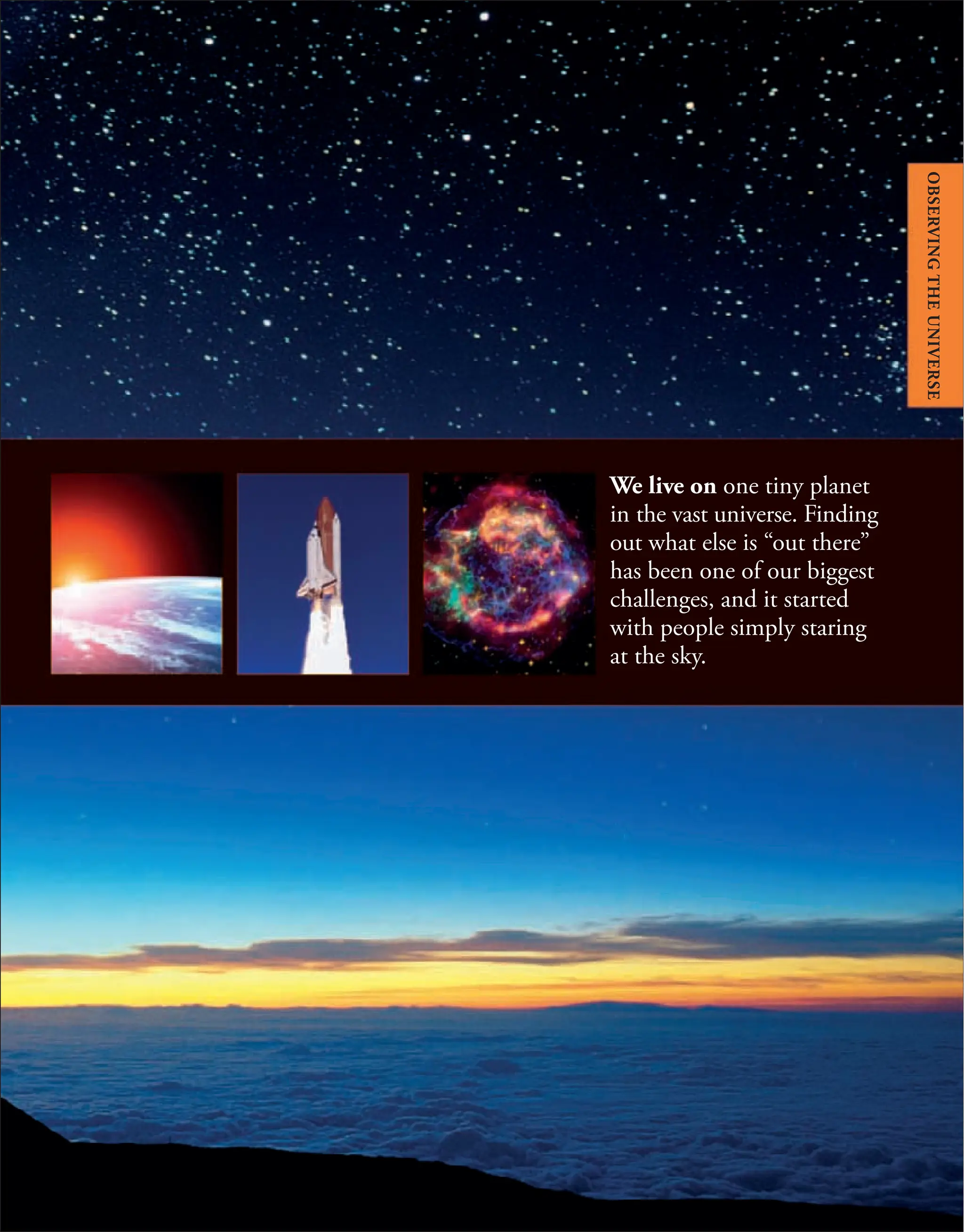
We live on one tiny planet
in the vast universe. Finding
out what else is “out there”
has been one of our biggest
challenges, and it started
with people simply staring
at the sky.
OBSERVING
THE
UNIVERSE
8
What is space?
We live on a small, blue planet called Earth.
It has a surface of liquid water and rock and
is surrounded by a blanket of air called the
atmosphere. Space begins at the top of the
atmosphere. It is an unimaginably vast,
silent, and largely empty place, but it has
many amazing properties.
Blacker than black
In photos taken from space, our planet is
surrounded by blackness. This shows how
empty outer space is. Planets like Earth shine
because they reflect light from the Sun. Stars
shine because they produce huge amounts of
energy by burning fuel. Most of space looks
black because there is nothing there to
produce or reflect light.
THE EDGE OF SPACE
Earth’s atmosphere does not end
suddenly—it gets gradually thinner
and thinner as you travel up from the
ground. Most experts agree that outer
space starts at a height of 60 miles
(100 km). Yet even above this height,
there is a layer of very thin air called
the exosphere. Hydrogen and other
light gases are slowly escaping into
space from this outermost part
of Earth’s atmosphere.
FACT FILE
■ In the US, anyone who flies above an
altitude of 60 miles (100 km) in a rocket or
spacecraft gets a special badge called
“astronaut wings.”
■ Our most common name for people who
travel into space is “astronauts,” meaning
star travelers. The Russians call them
“cosmonauts,” meaning travelers through
the universe, and the Chinese name is
“taikonauts,” from their word for space.
■ A person who stepped out into space
without a protective suit would quickly die.
He or she would be unable to breathe, but
would still have around 10 seconds to
reach safety before losing consciousness.
, THE ATMOSPHERE protects
Earth’s surface from harmful radiation
and the full heat of the Sun. At night,
it stops heat from escaping into space.
6,000
miles
60
miles
OUTER
SPACE…
, OUTER SPACE Even in places far from
stars and planets, space contains scattered
particles of dust or a few hydrogen atoms.
, EXOSPHERE This top layer of the
atmosphere extends up to 6,000 miles
(10,000 km) above Earth.
OBSERVING
THE
UNIVERSE
9
H
o
t
C
o
l
d
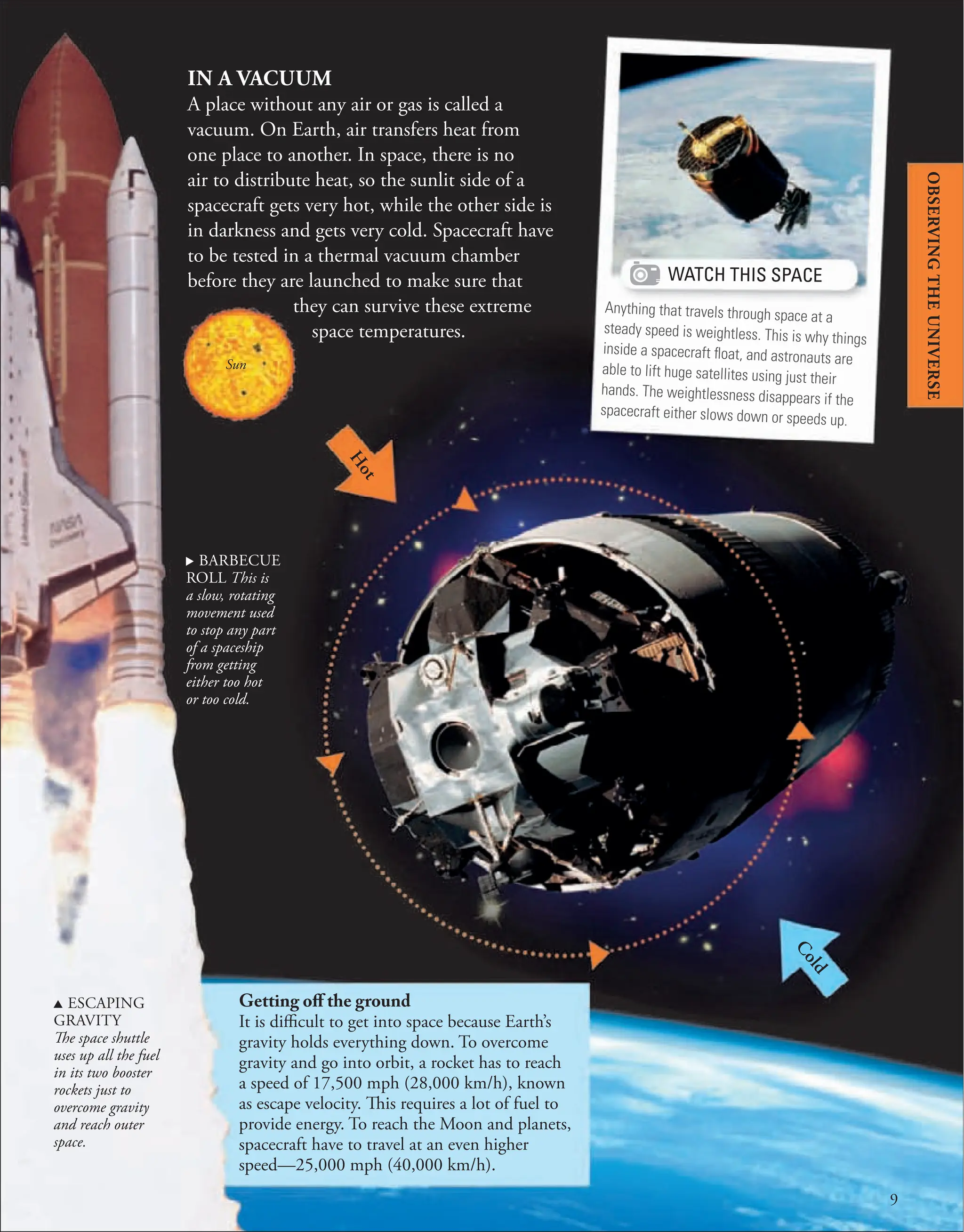
. BARBECUE
ROLL This is
a slow, rotating
movement used
to stop any part
of a spaceship
from getting
either too hot
or too cold.
IN A VACUUM
A place without any air or gas is called a
vacuum. On Earth, air transfers heat from
one place to another. In space, there is no
air to distribute heat, so the sunlit side of a
spacecraft gets very hot, while the other side is
in darkness and gets very cold. Spacecraft have
to be tested in a thermal vacuum chamber
before they are launched to make sure that
they can survive these extreme
space temperatures.
Sun
u ESCAPING
GRAVITY
The space shuttle
uses up all the fuel
in its two booster
rockets just to
overcome gravity
and reach outer
space.
Getting off the ground
It is difficult to get into space because Earth’s
gravity holds everything down. To overcome
gravity and go into orbit, a rocket has to reach
a speed of 17,500 mph (28,000 km/h), known
as escape velocity. This requires a lot of fuel to
provide energy. To reach the Moon and planets,
spacecraft have to travel at an even higher
speed—25,000 mph (40,000 km/h).
WATCH THIS SPACE
Anything that travels through space at a
steady speed is weightless. This is why things
inside a spacecraft float, and astronauts are
able to lift huge satellites using just their
hands. The weightlessness disappears if the
spacecraft either slows down or speeds up.
OBSERVING
THE
UNIVERSE
10
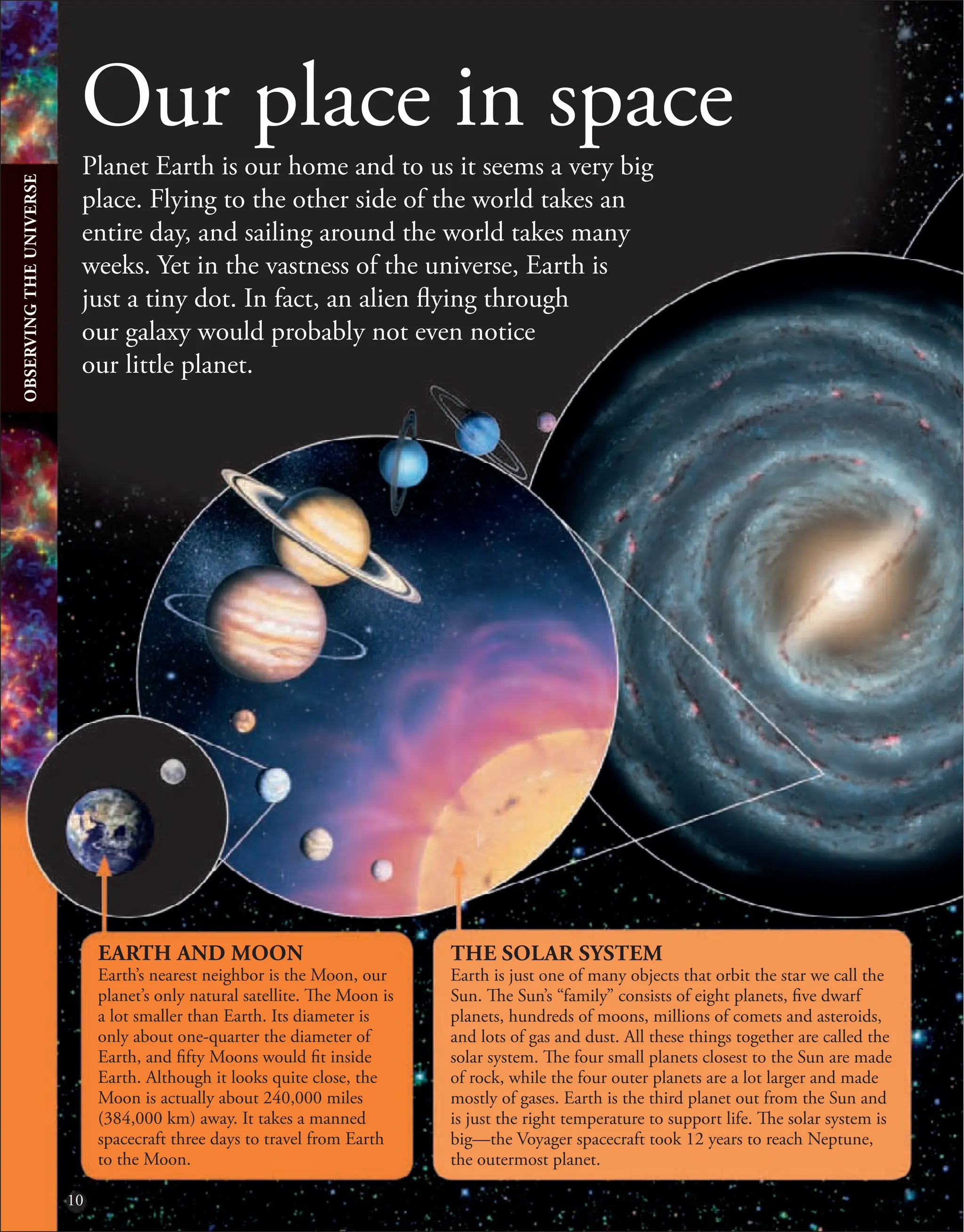
Our place in space
Planet Earth is our home and to us it seems a very big
place. Flying to the other side of the world takes an
entire day, and sailing around the world takes many
weeks. Yet in the vastness of the universe, Earth is
just a tiny dot. In fact, an alien flying through
our galaxy would probably not even notice
our little planet.
EARTH AND MOON
Earth’s nearest neighbor is the Moon, our
planet’s only natural satellite. The Moon is
a lot smaller than Earth. Its diameter is
only about one-quarter the diameter of
Earth, and fifty Moons would fit inside
Earth. Although it looks quite close, the
Moon is actually about 240,000 miles
(384,000 km) away. It takes a manned
spacecraft three days to travel from Earth
to the Moon.
THE SOLAR SYSTEM
Earth is just one of many objects that orbit the star we call the
Sun. The Sun’s “family” consists of eight planets, five dwarf
planets, hundreds of moons, millions of comets and asteroids,
and lots of gas and dust. All these things together are called the
solar system. The four small planets closest to the Sun are made
of rock, while the four outer planets are a lot larger and made
mostly of gases. Earth is the third planet out from the Sun and
is just the right temperature to support life. The solar system is
big—the Voyager spacecraft took 12 years to reach Neptune,
the outermost planet.
OBSERVING
THE
UNIVERSE
11
THE MILKY WAY
The solar system is located in a large spiral-shaped galaxy called
the Milky Way and lies about 30,000 light-years from the center
of the galaxy. The Sun is just one of at least 100 billion stars in
this galaxy. The Milky Way is vast—it measures about 100,000
light-years across. That means that a spaceship traveling at the
speed of light (186,000 miles or 300,000 km per second) would
take 100,000 years to fly from one side of the galaxy to the
other. The Milky Way is so big that the stars in it are usually
a long way apart. The nearest star to our Sun is more than
4 light-years away.
THE LOCAL GROUP
The Milky Way is one of the largest galaxies in a cluster
of about 45 galaxies, known as the Local Group. Most
of these galaxies have no particular shape and are much
smaller than the Milky Way. The two closest galaxies to the
Milky Way are called the Large and the Small Magellanic
Clouds. They lie about 200,000 light-years away and are
easily visible with the naked eye from Earth’s southern
hemisphere. The biggest galaxy in the Local Group is the
Andromeda Galaxy—a great spiral galaxy, much like the
Milky Way. It lies about 3 million light-years away, in
the constellation of Andromeda.
THE UNIVERSE
The universe is everything that
exists—all the stars, planets,
galaxies, and the space between
them. There are millions of
galaxy clusters in the universe:
in fact, wherever we look with
telescopes, the sky is full of
galaxies. And scientists estimate
that there must be about 10
thousand billion billion stars in
the universe—more than the
number of grains of sand on all
the beaches on Earth.
■ It would take a modern jet fighter more
than a million years to reach the nearest
star.
■ A light-year is the distance that
light travels in one year. It is about
5.9 trillion, or 5.9 million million miles,
(9 trillion km).
■ How big is the universe? No one knows,
because we cannot see the edge of it—if
there is one. All we do know is that the
visible universe is at least 93 billion
light-years across.
FAST FACTS
OBSERVING
THE
UNIVERSE
OBSERVING
THE
UNIVERSE
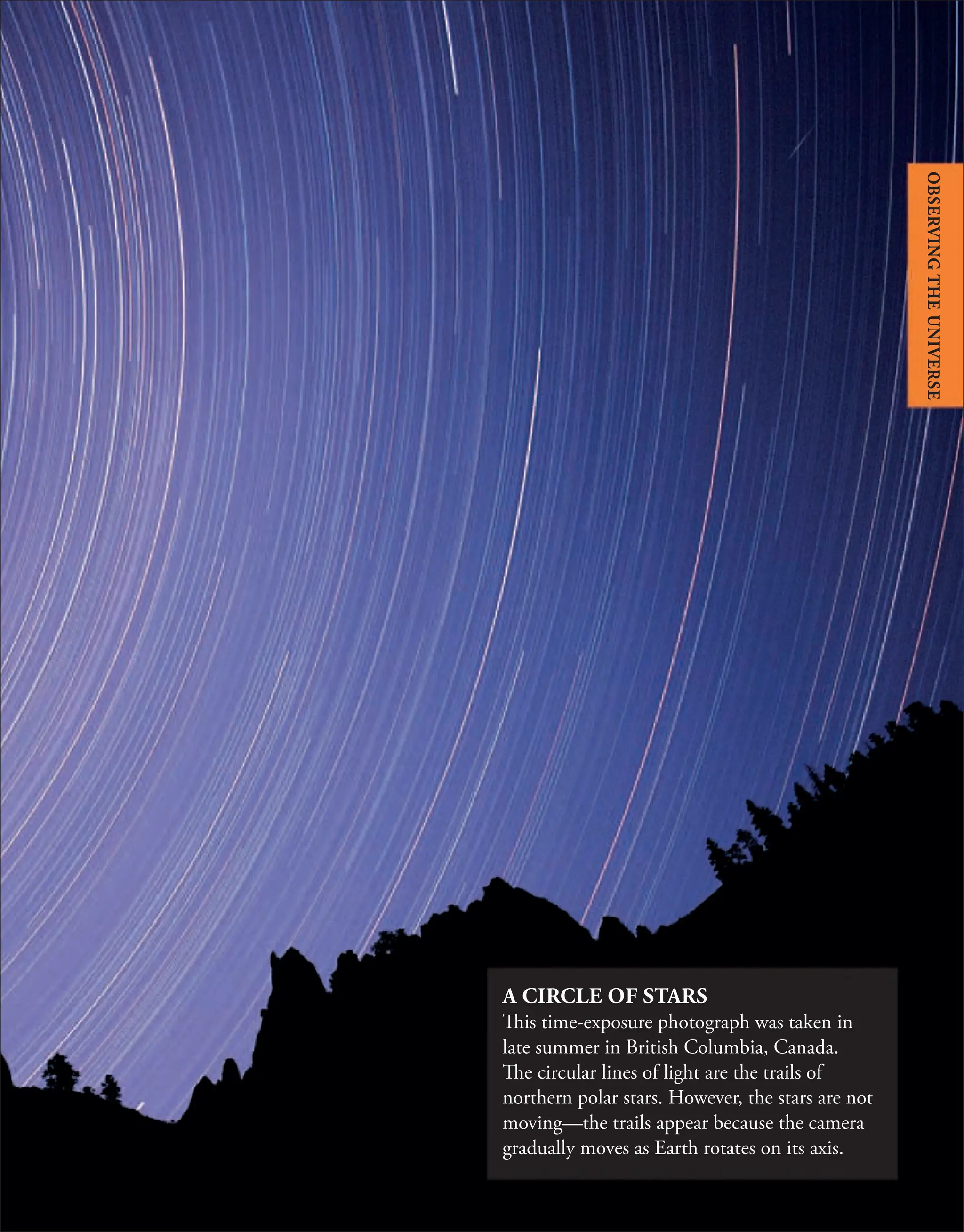
A CIRCLE OF STARS
This time-exposure photograph was taken in
late summer in British Columbia, Canada.
The circular lines of light are the trails of
northern polar stars. However, the stars are not
moving—the trails appear because the camera
gradually moves as Earth rotates on its axis.
OBSERVING
THE
UNIVERSE
14
Early ideas
Compared with everything else around us, Earth seems incredibly large.
Ancient peoples believed it was the biggest and most important place in the
universe and that everything revolved around it. These ideas only began to
change very slowly after the introduction of the telescope in the early 1600s.
Curving surface
of Earth
Line of sight
d LAND AHOY! As the boat gets closer to the island, the
sailor sees the tops of the mountains first. Then, as the boat
moves over the curve, lower land comes into view.
Ancient peoples watched the Sun, Moon,
and stars very carefully. They saw that
all of them traveled from east to
west across the sky. Clearly, they
were all going around a stationary
Earth. For several thousand years,
almost everyone believed that the Earth
was at the center of the universe. The
main problem with this idea was that
it did not explain the movements of
some of the planets—sometimes Mars
or Jupiter appeared to stand still or
even move backward.
EARTH-CENTERED UNIVERSE
Earth
Sun
FLAT EARTH OR ROUND EARTH?
Stand on the seashore and look at the horizon. It
seems to be flat. For a long time, people thought
that Earth was flat and that if you went too far you
would fall off the edge. However, it was gradually
realized that Earth was round, like a giant ball.
Nature provided several clues:
■ The shadow that the Earth casts on the Moon
during a lunar eclipse is curved, not straight.
■ A sailor traveling due north or south sees stars
appear and disappear over the horizon. On a flat
Earth, he would always see the same stars.
■ A ship sailing over the horizon should simply get
smaller and smaller if Earth is flat. In fact, the hull
disappears first and the top of the sails last.
OBSERVING
THE
UNIVERSE
u ELLIPSES We know today that most planets orbit
the Sun in a path that is not quite circular. Pluto’s
orbit is a very stretched circle known as an ellipse.
. Johannes
Kepler
. HE SAW IT COMING
Hipparchus was the first person to
develop a way of predicting solar
and lunar eclipses.
, A lunar eclipse
u PYRAMID OF KUKULCAN This temple is built in
honor of Kukulcan, the serpent god. When the Sun is in
the right place it creates a shadow in the shape of a serpent.
The ancient Greeks taught that the circle was the
perfect shape. So it seemed logical to believe that
all of the planets traveled in circles. Unfortunately,
measurements showed that this did not fit their
movements across the sky. One way around this
was to add small circles to the larger circles, but
even this did not work. The mystery was solved in
1609 when a German mathematician, Johannes
Kepler, realized that the planets move along
elliptical (oval) orbits.
ORBITS
Astounding astronomer
One of the greatest early Greek astronomers was Hipparchus of Nicaea
(190–120 bce). He discovered many things, including that Earth rotated on a tilted
axis, which caused the seasons. He figured out the distance from Earth to the Moon
by comparing views of a partial and total solar eclipse. He found that the Moon had
an elliptical orbit and that its speed varied. He also cataloged all the stars in order of
brightness and plotted their positions in the sky on the first star chart.
Planet
Sun
WHAT A STAR!
Polish astronomer Nicolaus Copernicus
(1473–1543) was the first person of more
modern times to realize that the Sun, not
Earth, is at the center of the solar system.
His ideas were extremely unpopular.
THE CALENDAR
Although ancient civilizations did not have telescopes,
they did have instruments to measure angles and
could measure the positions of the Sun and the
stars. They used the movement of the Sun
as their calendar and built monuments
and temples that reflected the
calendar. The Toltecs of Central
America built the Pyramid of
Kukulcan with 365 steps, one
for each day of the year.
OBSERVING
THE
UNIVERSE
Telescopes
Telescopes are instruments for looking
at things that are far away. Almost
everything we know about space has
been discovered by looking through
telescopes. Optical telescopes can
capture light from the deepest parts
of space, but are limited by the size
of their mirrors and lenses.
. THE YERKES
OBSERVATORY was
funded by business tycoon
Charles T. Yerkes, who had
made his fortune developing
Chicago's mass-transit system.
REFRACTING TELESCOPE
The first telescopes were refracting telescopes, which
used lenses to bend and focus light. The biggest
refracting telescope is at Yerkes Observatory
in Wisconsin. Built in 1897, it is
still used for looking at stars
and tracking their
movements through
space.
d THE YERKES TELESCOPE
Built in 1897, the Yerkes telescope has
a lens diameter of 40 in (100 cm) and
weighs 6 tons (5.5 metric tons)—as
much as an adult African elephant.
OBSERVING
THE
UNIVERSE
17
TAKE A LOOK: EARLY TELESCOPES
. GALILEO'S DRAWINGS
By 1610, Galileo had
developed a much more
powerful telescope. He used this
to study the Sun ( p. 208),
recording his observations in a
series of drawings.
, NEWTON'S TELESCOPE
Isaac Newton made the first working
reflector telescope in 1668.
The first telescopes were made by Dutch spectacle-maker
Hans Lippershey, in 1608. These were simple refracting
telescopes made from a pair of glass lenses set into a tube.
When the Italian astronomer Galileo Galilei heard about
Lippershey's invention he quickly set about building an
improved telescope with a greater magnification.
u HANS LIPPERSHEY is said to have come up with his
invention while watching two young boys playing with lenses.
Mirror, mirror…
Not all telescopes use
glass mirrors—some use
liquid metal instead. A shallow
bowl of mercury or silver is
spun at high speed until it
forms a thin reflective surface.
Liquid mirrors can only be
used to look straight up. If
they are tilted the liquid
will fall out!
EVEN BIGGER TELESCOPES
Although reflecting telescopes can be built much
bigger than refracting telescopes, they too will have
problems if the mirror is more than 27 ft (8 m)
across. Astronomers solve this problem by
using a number of smaller mirrors that can
be fitted together to make one big mirror.
Each mirror section is controlled by a
computer that can adjust its position by
less than the width of a human hair.
Refracting
telescopes
A refracting telescope uses a
convex (outward curving) glass
lens to collect and focus incoming
light. An eyepiece is used to
magnify the image. One problem
with using lenses is that they are
heavy. If they are too big they will
start to sag, distorting the image.
This limits the size and power of
the refracting telescope.
Reflecting
telescopes
A concave (inward
curving) mirror focuses
light toward a smaller mirror.
This sends the beam of light
to an eyepiece, which magnifies
the image. Because mirrors are
lighter than lenses, reflecting
telescopes can be much bigger
and more powerful than
refracting telescopes.
Lenses
magnify
the image
Eyepiece
Objective
mirror
Eyepiece
Objective lens
Small mirror
OBSERVING
THE
UNIVERSE
Giant telescopes
The Hale telescope caused quite a stir when it was completed in 1948.
Equipped with a 16 ft (5 m) mirror, it was the largest and most
powerful telescope ever built. As technology has improved, telescopes
have been built with mirrors up to 33 ft (10 m) across. Even larger
telescopes are now planned, with mirrors of 100 ft (30 m) or more.
TELL ME MORE...
To get the best images, telescopes are
placed at high altitude so they are
above the clouds and most of the
atmosphere. Remote mountains are
ideal, since there is little light
interference from nearby towns.
Mauna Kea, an extinct volcano in
Hawaii, is home to many telescopes.
OBSERVING
THE
UNIVERSE
GIANT TELESCOPES
■ Size of primary mirror 16 ft (5 m)
■ Location Palomar Mountain, California
■ Altitude 5,580 ft (1,700 m)
Even today, more than 60 years after
it was built, the Hale telescope is the
second-largest telescope using mirrors
made of a single piece of glass. Mirrors
much larger than
this tend to sag
under their
own weight,
distorting
the image
received.
Hale Telescope
■ Size of primary mirror 33 ft (10 m)
■ Location Mauna Kea, Hawaii
■ Altitude 13,600 ft (4,145 m)
Until 2009, the twin Keck telescopes
were the world’s largest optical
telescopes. The Keck II telescope
overcomes the distorting effects of
the atmosphere by using a mirror that
changes shape 2,000 times per second.
Keck Telescopes
■ Size of primary mirror 27 ft (8.2 m)
■ Location Mount Paranal, Chile
■ Altitude 8,645 ft (2,635 m)
The VLT array consists of four 27 ft
(8.2 m) telescopes and four movable
4 ft (1.8 m) telescopes. The telescopes
can work together by
combining the
light beams from
each telescope
using a system
of underground
mirrors.
Very Large Telescope
(VLT) Array
■ Size of primary
mirror 28 ft (8.4 m)
■ Location Mount
Graham, Arizona
■ Altitude 10,700 ft
(3,260 m)
The LBT has
two 28 ft
(8.4 m) primary mirrors mounted
side-by-side that collect as much
light as one mirror measuring 39 ft
(11.8 m) across. The LBT is currently
the largest and most powerful single
telescope in the world.
Large Binocular
Telescope (LBT)
■ Size of primary mirror 26 ft (8 m)
■ Location North: Mauna Kea, Hawaii.
South: Cerro Pacho, Chile
■ Altitude North: 13,822 ft (4,213 m).
South: 8,930 ft (2,722 m)
The twin Gemini telescopes
are located on each side of
the equator. Between them,
they can see almost every part
of both the northern and
southern skies. The two
telescopes are linked through
a special high-speed
internet connection.
Gemini Telescopes
■ Size of primary mirror 138 ft (42 m)
■ Location Chile (unconfirmed)
This revolutionary new telescope
should come into operation in 2018.
The primary mirror will be 138 ft
(42 m) in diameter and will collect
15 times more light than the largest
telescopes operating today. One of its
main objectives is to locate
Earth-like
planets
orbiting
other stars.
European Extremely
Large Telescope (E–ELT)
■ Size of primary mirror 98 ft (30 m)
■ Location Mauna Kea, Hawaii
■ Altitude 13,287 ft (4,050 m) (unconfirmed)
The $300 million TMT is expected to be
completed in 2018. At its heart will be a
primary mirror measuring 98 ft (30 m)
in diameter, made up of 492 hexagonal
segments. It will collect almost 10 times
more light than one of the 33 ft (10 m)
Keck telescopes. Astronomers will
use the TMT to observe the
formation of new
galaxies.
Thirty Meter Telescope
(TMT)
OBSERVING
THE
UNIVERSE
20
ULTRAVIOLET (UV)
X-RAYS
GAMMA RAYS
u Gamma rays have the
shortest wavelengths. They are
released in an intense burst
when a massive star collapses
and explodes in a supernova.
u The bright white areas
around the rim of the
Cartwheel Galaxy are thought
to be neutron stars and black
holes emitting powerful X-rays.
u The blue areas in this image
of the NGC 300 galaxy are
regions of star formation.
New stars give off mainly
ultraviolet light.
Seeing light
Light, the fastest thing in the universe, is an
energy wave moving at about 670 million
mph (just under a billion km/h). That
means it can travel from New York
to London in just two-hundredths
of a second—faster than the
blink of an eye!
WAVES OF ENERGY
There are many types of
energy wave. Scientists
arrange them according to
their wavelength. This is the
distance between the peak
of one wave and the next.
The higher the energy of
the wave, the shorter the
distance between its peaks.
The complete range of
waves is known as the
electromagnetic spectrum.
u WHITE LIGHT
contains a mixture of all
the wavelengths of light
in the visible spectrum.
u WHEN A BEAM of white light strikes the
surface of a prism, it is bent. But each different
wavelength is bent by a slightly different amount,
and this splits the light into its spectrum of colors.
Now you see it
If you look at a beam of
light, it appears to be white.
However, when white light hits
a shaped piece of glass, called a
prism, it splits into a rainbow.
We call these colors, or
wavelengths, of light the visible
spectrum, because our eyes
can see them.
OBSERVING
THE
UNIVERSE
21
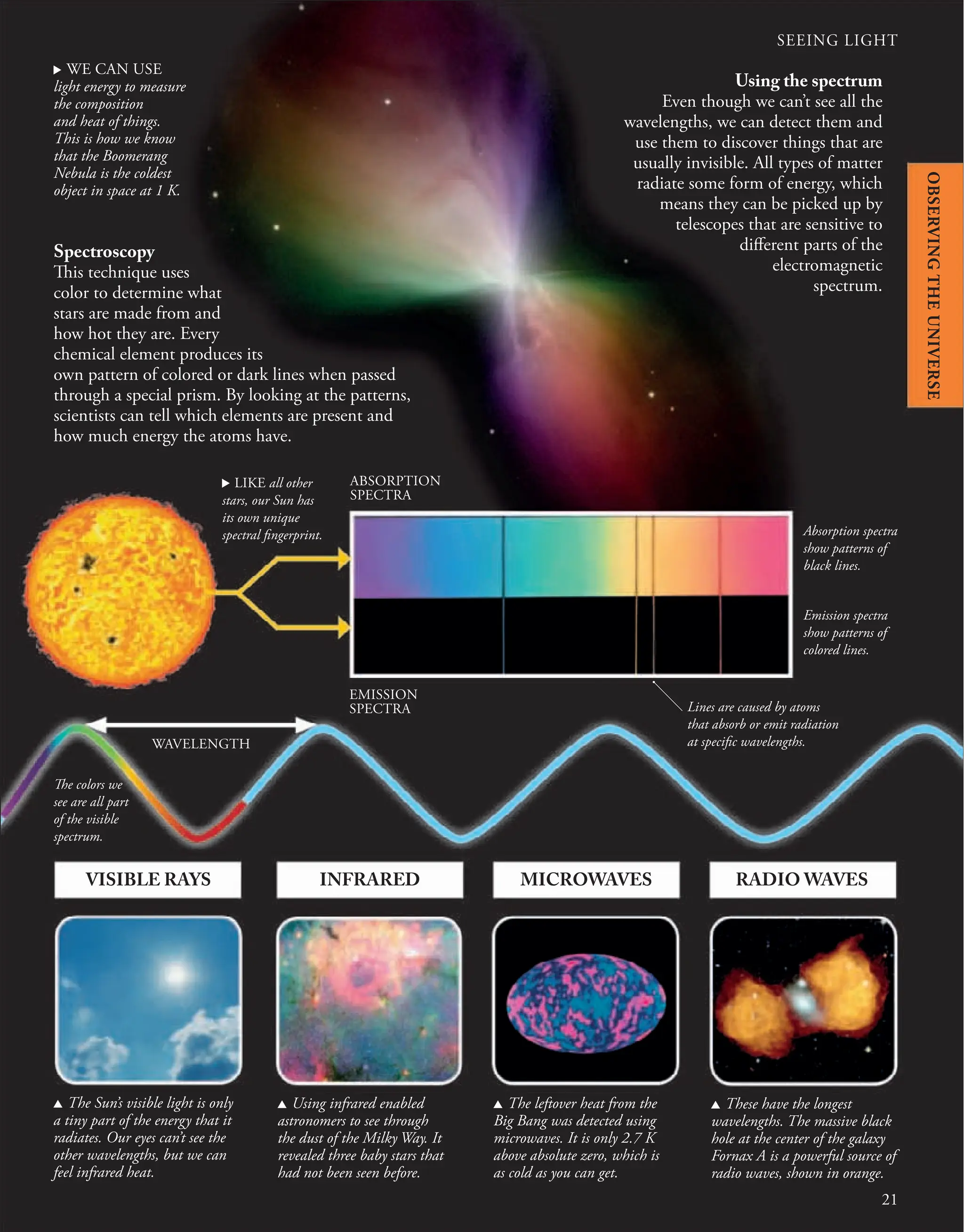
SEEING LIGHT
VISIBLE RAYS INFRARED MICROWAVES RADIO WAVES
u The Sun’s visible light is only
a tiny part of the energy that it
radiates. Our eyes can’t see the
other wavelengths, but we can
feel infrared heat.
u Using infrared enabled
astronomers to see through
the dust of the Milky Way. It
revealed three baby stars that
had not been seen before.
u The leftover heat from the
Big Bang was detected using
microwaves. It is only 2.7 K
above absolute zero, which is
as cold as you can get.
u These have the longest
wavelengths. The massive black
hole at the center of the galaxy
Fornax A is a powerful source of
radio waves, shown in orange.
WAVELENGTH
Using the spectrum
Even though we can’t see all the
wavelengths, we can detect them and
use them to discover things that are
usually invisible. All types of matter
radiate some form of energy, which
means they can be picked up by
telescopes that are sensitive to
different parts of the
electromagnetic
spectrum.
Spectroscopy
This technique uses
color to determine what
stars are made from and
how hot they are. Every
chemical element produces its
own pattern of colored or dark lines when passed
through a special prism. By looking at the patterns,
scientists can tell which elements are present and
how much energy the atoms have.
. WE CAN USE
light energy to measure
the composition
and heat of things.
This is how we know
that the Boomerang
Nebula is the coldest
object in space at 1 K.
The colors we
see are all part
of the visible
spectrum.
Absorption spectra
show patterns of
black lines.
Emission spectra
show patterns of
colored lines.
ABSORPTION
SPECTRA
EMISSION
SPECTRA
. LIKE all other
stars, our Sun has
its own unique
spectral fingerprint.
Lines are caused by atoms
that absorb or emit radiation
at specific wavelengths.
OBSERVING
THE
UNIVERSE
Infrared astronomy
We are all familiar with the colors of the rainbow—red, orange,
yellow, green, blue, indigo, and violet. These colors are part of what
is known as the visible spectrum. Beyond the red end of the spectrum
is infrared light, which we call heat. Although we cannot see infrared
light, we can detect it using special telescopes, which reveal things
usually hidden by clouds of dust.
, Infrared image
of Saturn. The
paler areas show
where Saturn is
warmest.
22
A GALAXY FAR, FAR AWAY...
Messier 81 is a spiral galaxy located in
the northern constellation of Ursa
Major (the Great Bear). Messier 81,
or “Bode’s Galaxy” as it is also known,
is about 12 million light-years from
Earth. M81 is easily visible through
binoculars or small telescopes. In
infrared light the spiral arms are very
noticeable because they contain dust
that has been heated by hot, massive,
newly born stars.
SATURN’S HOT SPOT
Infrared images of Saturn reveal
that it has a “hot spot”—the first
warm polar cap to be discovered.
This is the hottest part of Saturn
and is 8–10 degrees warmer than
at the equator. A huge storm,
thousands of miles across,
constantly rages over Saturn’s
south pole.
OBSERVING
THE
UNIVERSE
INFRARED ASTRONOMY
23
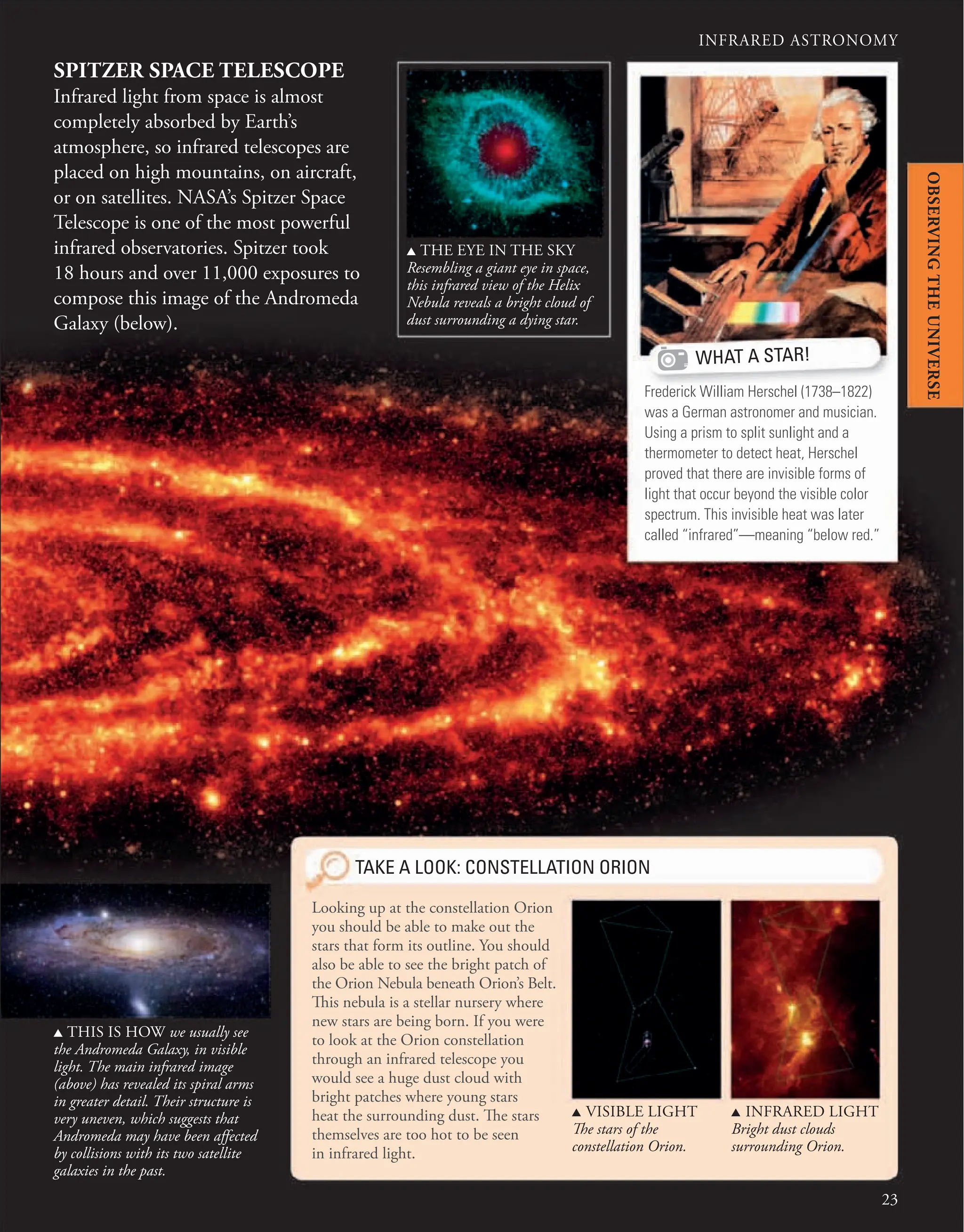
TAKE A LOOK: CONSTELLATION ORION
u VISIBLE LIGHT
The stars of the
constellation Orion.
u INFRARED LIGHT
Bright dust clouds
surrounding Orion.
Looking up at the constellation Orion
you should be able to make out the
stars that form its outline. You should
also be able to see the bright patch of
the Orion Nebula beneath Orion’s Belt.
This nebula is a stellar nursery where
new stars are being born. If you were
to look at the Orion constellation
through an infrared telescope you
would see a huge dust cloud with
bright patches where young stars
heat the surrounding dust. The stars
themselves are too hot to be seen
in infrared light.
u THIS IS HOW we usually see
the Andromeda Galaxy, in visible
light. The main infrared image
(above) has revealed its spiral arms
in greater detail. Their structure is
very uneven, which suggests that
Andromeda may have been affected
by collisions with its two satellite
galaxies in the past.
Frederick William Herschel (1738–1822)
was a German astronomer and musician.
Using a prism to split sunlight and a
thermometer to detect heat, Herschel
proved that there are invisible forms of
light that occur beyond the visible color
spectrum. This invisible heat was later
called “infrared”—meaning “below red.”
WHAT A STAR!
SPITZER SPACE TELESCOPE
Infrared light from space is almost
completely absorbed by Earth’s
atmosphere, so infrared telescopes are
placed on high mountains, on aircraft,
or on satellites. NASA’s Spitzer Space
Telescope is one of the most powerful
infrared observatories. Spitzer took
18 hours and over 11,000 exposures to
compose this image of the Andromeda
Galaxy (below).
u THE EYE IN THE SKY
Resembling a giant eye in space,
this infrared view of the Helix
Nebula reveals a bright cloud of
dust surrounding a dying star.
OBSERVING
THE
UNIVERSE
24
Messages from the stars
American engineer Karl Jansky was the
first to discover radio waves coming from
space, using a homemade antenna in 1931.
Today, scientists use radio waves to learn
about all kinds of objects in space and
have even attempted to contact alien life.
Arecibo
The largest single radio telescope in the world
is Arecibo, on the Caribbean island of Puerto
Rico. The telescope measures 1,000 ft
(305 m) across and its dish is built into a dip
in the hillside, with the radio receiver suspended
450 ft (137 m) above like a giant steel spider.
Although Arecibo’s dish doesn’t move, its location
near the equator means it can see a wide region
of the sky.
RADIO ASTRONOMY
Radio astronomy is the study of objects in space that
produce radio waves. Radio waves are like waves of
light but are beyond the visible end of the spectrum.
Invisible radio waves are detected by radio telescopes
and can then be converted into images for us to see.
Numbers, from
one to 10,
showing how
we count.
Symbols
representing
important
chemicals
found in life
on Earth.
The DNA
molecule—the
blueprint for
life on Earth.
A human
form and the
population
of Earth.
Earth’s position
in the solar
system.
A symbol
representing
the Arecibo
telescope.
The Arecibo telescope
has featured in Contact, a
movie about first contact with
extraterrestrial life, and the
James Bond film
Goldeneye.
u IS THERE ANYBODY THERE?
Arecibo was used to transmit this coded
message into space in 1974. So far, we
haven’t had a reply.
Movie star
OBSERVING
THE
UNIVERSE
MESSAGES FROM THE STARS
25
TELESCOPE NETWORKS
Very Large Array
One of the most important radio astronomy
observatories in the world is the Very Large
Array (VLA) in New Mexico. The VLA has
27 dishes arranged in a Y shape. Each arm
of the Y is almost 13 miles (21 km) long. When
the radio signals from each dish are combined,
the whole array is equal to a giant antenna
22 miles (36 km) wide.
■ Dish various sizes
■ Location various sites, UK
MERLIN is a network
of seven dishes across
the UK. Operated from
Jodrell Bank, it includes the
250 ft (76.2 m) Lovell telescope. Altogether, the
network forms a telescope equal to a single dish
135 miles (217 km) wide. It is so powerful it can
detect a coin up to 60 miles (100 km) away.
MERLIN
■ Dish 82 ft (25 m)
■ Location Hawaii, Mainland
United States, West Indies
The Very Long Baseline
Array (VLBA) is a system of
10 radio telescope antennas. The combined effect is
equal to that of a single dish more than 5,000 miles
(8,000 km) wide. The VLBA can see things in such
fine detail that it is equivalent to a person standing
in New York reading a newspaper in Los Angeles!
VLBA
The parabolic dish reflects
the signal to the subreflector.
The subreflector focuses the
signal into the receiver.
The 82 ft (25 m)
wide dishes can be
moved along
tracks to change
their positions.
In this radio image, Jupiter
is shown to be encircled by
a belt of radiation.
Jupiter calling Earth…
The first radio signals from a
distant planet were detected
from Jupiter in 1955. Since
then, all of the giant gas
planets have been shown to
produce radio waves. Radio
signals can also be bounced
off the rocky planets and
asteroids.
OBSERVING
THE
UNIVERSE
26
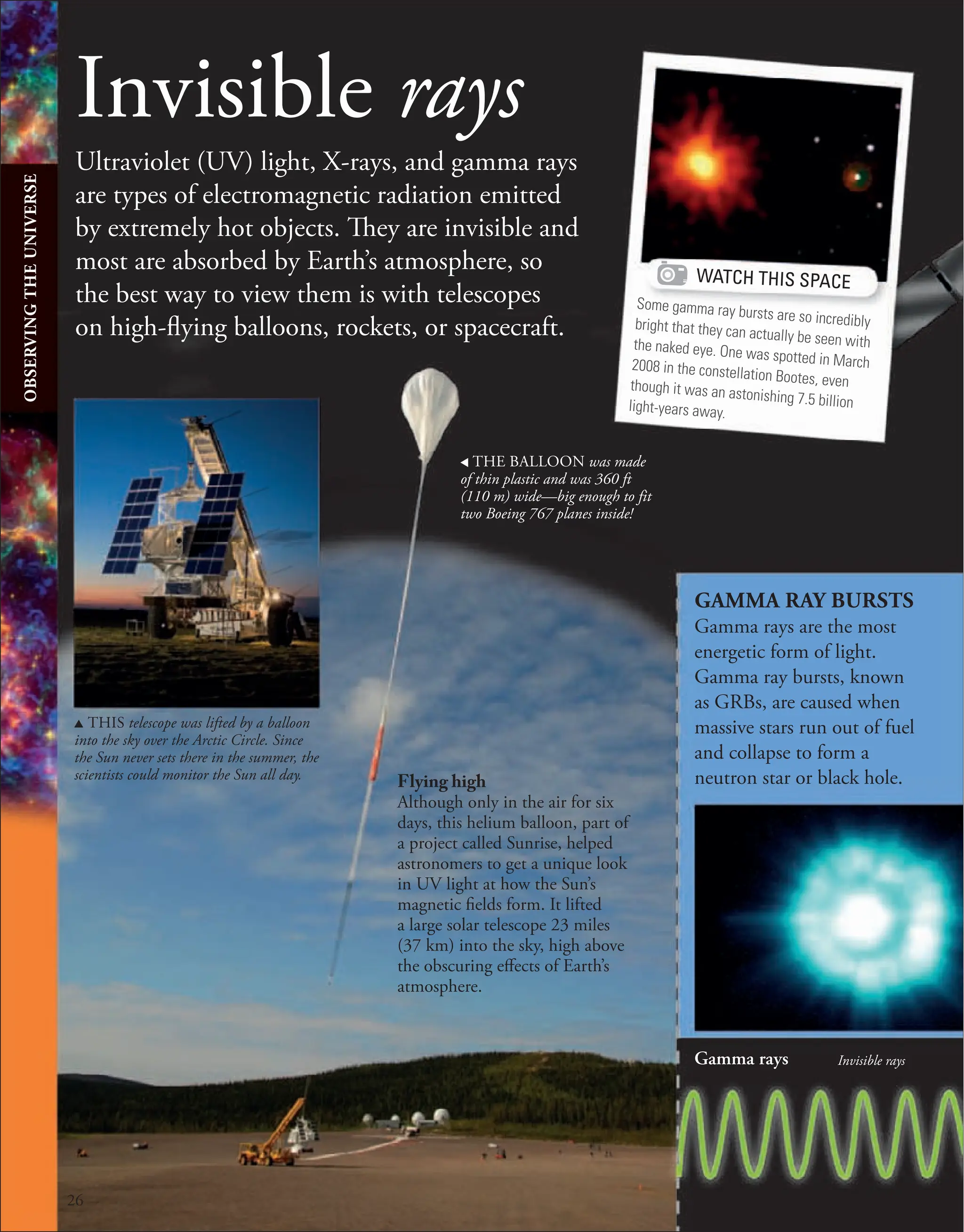
Invisible rays
Ultraviolet (UV) light, X-rays, and gamma rays
are types of electromagnetic radiation emitted
by extremely hot objects. They are invisible and
most are absorbed by Earth’s atmosphere, so
the best way to view them is with telescopes
on high-flying balloons, rockets, or spacecraft.
GAMMA RAY BURSTS
Gamma rays are the most
energetic form of light.
Gamma ray bursts, known
as GRBs, are caused when
massive stars run out of fuel
and collapse to form a
neutron star or black hole.
u THIS telescope was lifted by a balloon
into the sky over the Arctic Circle. Since
the Sun never sets there in the summer, the
scientists could monitor the Sun all day. Flying high
Although only in the air for six
days, this helium balloon, part of
a project called Sunrise, helped
astronomers to get a unique look
in UV light at how the Sun’s
magnetic fields form. It lifted
a large solar telescope 23 miles
(37 km) into the sky, high above
the obscuring effects of Earth’s
atmosphere.
WATCH THIS SPACE
Some gamma ray bursts are so incredibly
bright that they can actually be seen with
the naked eye. One was spotted in March
2008 in the constellation Bootes, even
though it was an astonishing 7.5 billion
light-years away.
, THE BALLOON was made
of thin plastic and was 360 ft
(110 m) wide—big enough to fit
two Boeing 767 planes inside!
Gamma rays Invisible rays
OBSERVING
THE
UNIVERSE
INVISIBLE RAYS
THE SUN
With an optical telescope, we just see
a scattering of dark sunspots on the
Sun. When these spots are viewed
with an ultraviolet-light telescope,
hot, explosive solar flares can be seen.
THE X-RAY MOON
Scientists were surprised when they found that
even fairly cold objects, like the Moon, can give
off weak X-rays. Here, the visible Moon is
compared with an X-ray image of the same area.
The X-rays are produced when solar X-rays from
the Sun bombard the Moon’s surface and excite
the atoms in the rocks.
Optical
Optical
Ultraviolet
Extreme
ultraviolet
X-ray
INTEGRAL
The INTEGRAL space observatory is
equipped with highly sensitive detectors that
can view objects in X-rays, gamma rays, and
visible light all at the same time. Sent into
space in 2002, it circles Earth every three
days on the lookout for explosive GRBs,
supernova explosions, and black holes.
SDO
The Solar Dynamics Observatory
(SDO) studies the Sun at many
different wavelengths, particularly
those at the extreme end of UV.
Scientists use the data that it collects
from its continuous observations to
learn more about how solar activity
affects life on Earth.
27
X-rays Ultraviolet (UV) rays Visible
rays
. USING EARTH as a shield
to block emissions from
distant black holes,
INTEGRAL has
discovered both
strong and faint
gamma ray and
X-ray signals
coming from our
galaxy, possibly
signals from neutron
stars and black holes.
OBSERVING
THE
UNIVERSE
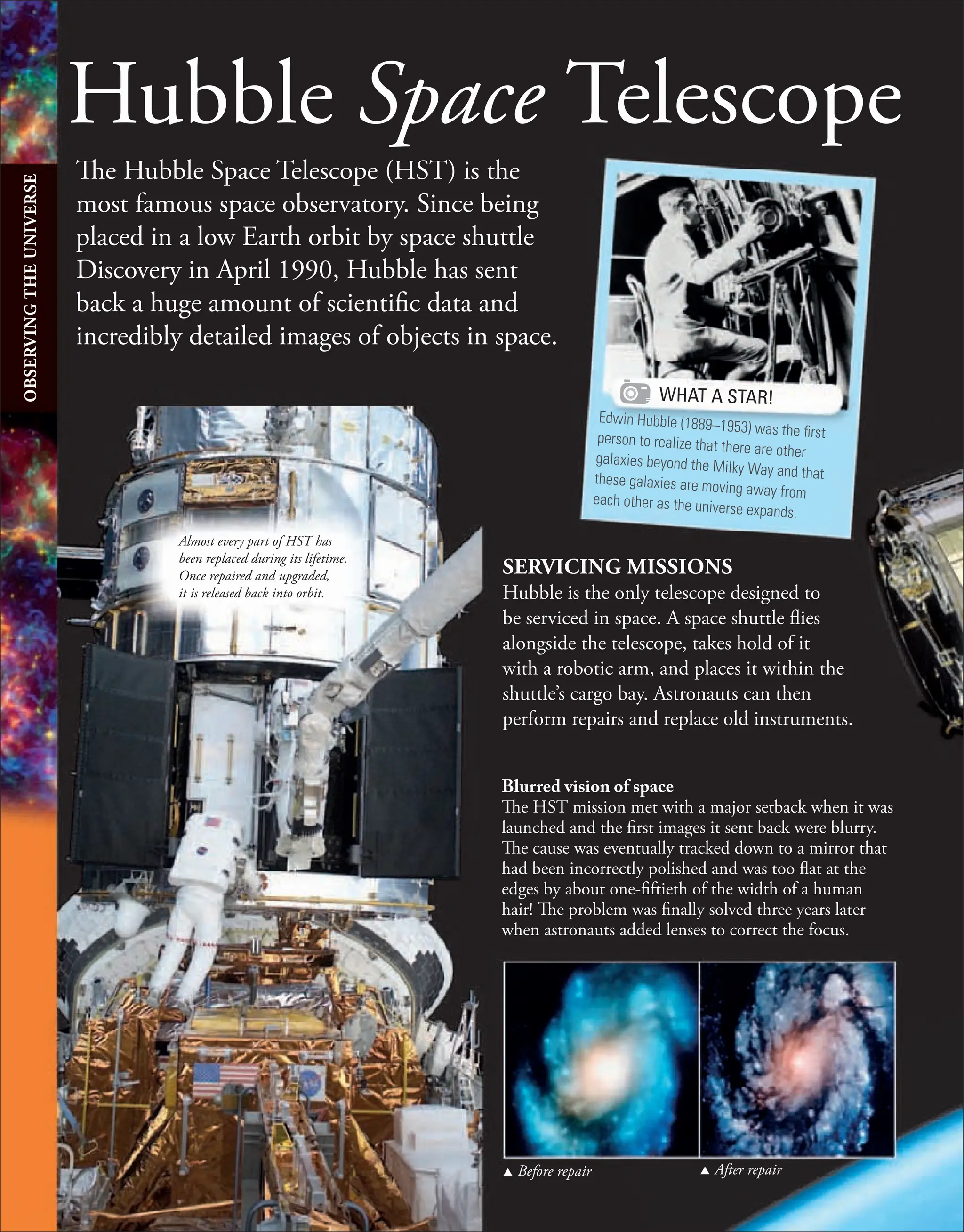
Hubble Space Telescope
The Hubble Space Telescope (HST) is the
most famous space observatory. Since being
placed in a low Earth orbit by space shuttle
Discovery in April 1990, Hubble has sent
back a huge amount of scientific data and
incredibly detailed images of objects in space.
SERVICING MISSIONS
Hubble is the only telescope designed to
be serviced in space. A space shuttle flies
alongside the telescope, takes hold of it
with a robotic arm, and places it within the
shuttle’s cargo bay. Astronauts can then
perform repairs and replace old instruments.
Blurred vision of space
The HST mission met with a major setback when it was
launched and the first images it sent back were blurry.
The cause was eventually tracked down to a mirror that
had been incorrectly polished and was too flat at the
edges by about one-fiftieth of the width of a human
hair! The problem was finally solved three years later
when astronauts added lenses to correct the focus.
WHAT A STAR!
Edwin Hubble (1889–1953) was the first
person to realize that there are other
galaxies beyond the Milky Way and that
these galaxies are moving away from
each other as the universe expands.
Almost every part of HST has
been replaced during its lifetime.
Once repaired and upgraded,
it is released back into orbit.
u Before repair u After repair
OBSERVING
THE
UNIVERSE
HUBBLE SPACE TELESCOPE
29
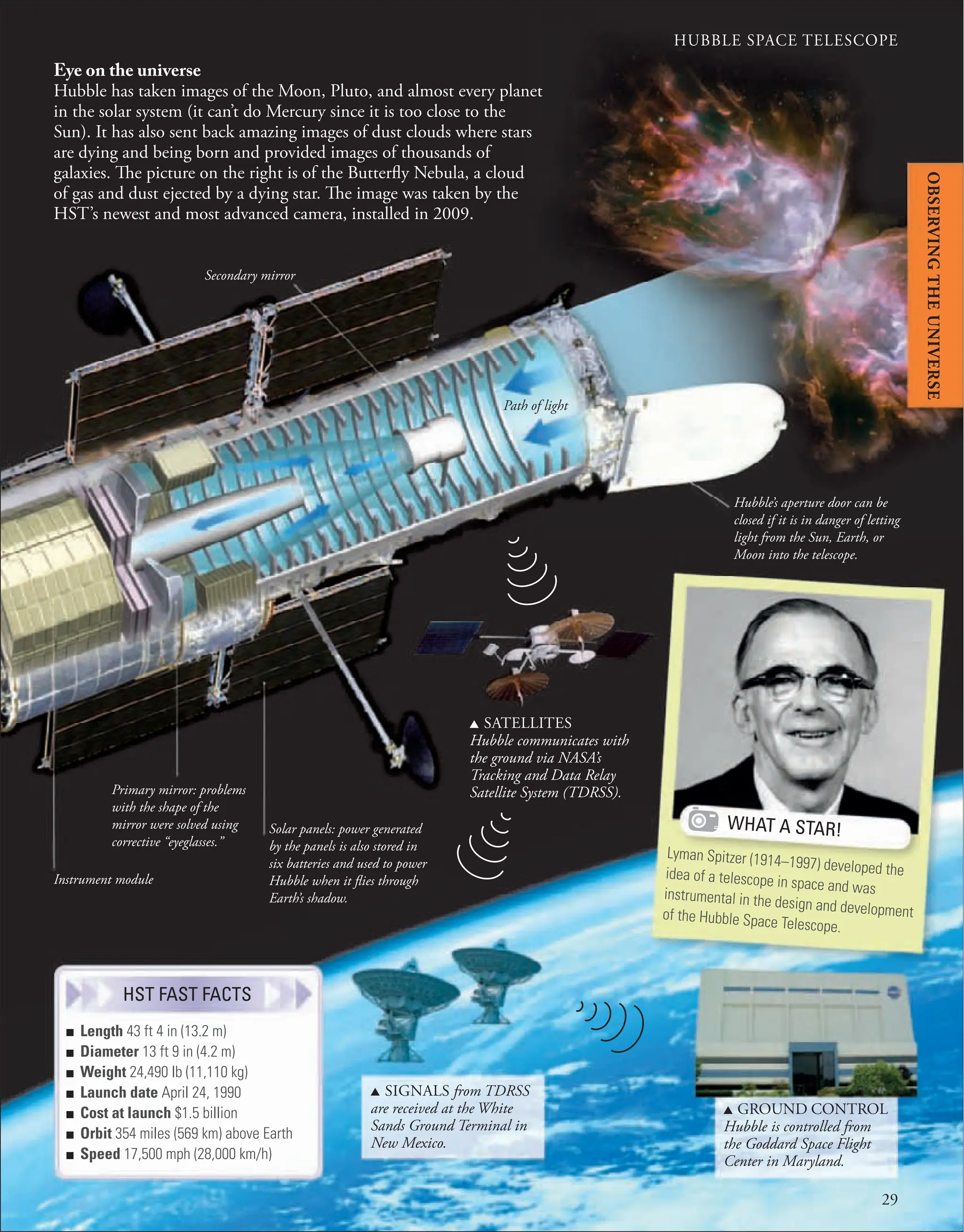
Eye on the universe
Hubble has taken images of the Moon, Pluto, and almost every planet
in the solar system (it can’t do Mercury since it is too close to the
Sun). It has also sent back amazing images of dust clouds where stars
are dying and being born and provided images of thousands of
galaxies. The picture on the right is of the Butterfly Nebula, a cloud
of gas and dust ejected by a dying star. The image was taken by the
HST’s newest and most advanced camera, installed in 2009.
■ Length 43 ft 4 in (13.2 m)
■ Diameter 13 ft 9 in (4.2 m)
■ Weight 24,490 lb (11,110 kg)
■ Launch date April 24, 1990
■ Cost at launch $1.5 billion
■ Orbit 354 miles (569 km) above Earth
■ Speed 17,500 mph (28,000 km/h)
HST FAST FACTS
u GROUND CONTROL
Hubble is controlled from
the Goddard Space Flight
Center in Maryland.
u SIGNALS from TDRSS
are received at the White
Sands Ground Terminal in
New Mexico.
u SATELLITES
Hubble communicates with
the ground via NASA’s
Tracking and Data Relay
Satellite System (TDRSS).
Hubble’s aperture door can be
closed if it is in danger of letting
light from the Sun, Earth, or
Moon into the telescope.
Solar panels: power generated
by the panels is also stored in
six batteries and used to power
Hubble when it flies through
Earth’s shadow.
Secondary mirror
Path of light
Lyman Spitzer (1914–1997) developed the
idea of a telescope in space and was
instrumental in the design and development
of the Hubble Space Telescope.
WHAT A STAR!
Instrument module
Primary mirror: problems
with the shape of the
mirror were solved using
corrective “eyeglasses.”
OBSERVING
THE
UNIVERSE
WITCHES AND GIANTS
The man in the Moon may be fiction, but there is
a witch in space! The Witch Head Nebula is in the
constellation Eridanus, a safe distance of 900 light-
years from Earth. With her hooked nose and pointed
chin, she glows blue in the reflected light of Rigel,
a bright supergiant star (not seen in this picture).
OBSERVING
THE
UNIVERSE
31
u STAR LIGHT Pismis 24 is an open
cluster of stars. It contains three of the most
massive stars ever observed. Stars are still
forming in the glowing nebula (bottom).
u EYE SEE YOU Shown in infrared
light, the center of spiral galaxy NGC
1097 looks like an eye. A small companion
galaxy is caught up in its arms on the left.
u BUBBLE BLOWER Young star HH
46/47 blows out two jets of warm gas.
The jets have crashed into the dust and
gas around the star, forming huge bubbles.
u F-ANT-ASTIC The “body” of the Ant
Nebula is actually two lobes of fiery gas
ejected from a dying star at speeds of up to
600 miles (1,000 km) per second.
u JUMBO JET Looking like a tornado in
space, HH 49/50 is a jet of churned up dust
and gas ejected from a young star (off the top
of the picture). It is 0.3 light-years long.
u SQUARE-EYED The Retina Nebula
has an unusual cylinder shape, appearing
square from the side. Hot gas escapes from
each end, and dust darkens the walls.
OBSERVING
THE
UNIVERSE
32
Observatories in space
Most of the high-energy particles and radiation emitted
from objects in space are filtered out by the blanket
of air around Earth. The moving
atmosphere also causes shimmering
or twinkling, making it hard to
obtain sharp images. To study these
objects it is much easier to observe
them from space observatories.
■ Named in honor of the famous US scientist,
astrophysicist Lyman Spitzer
■ What is it? Infrared telescope
■ Launched August 2003
■ Equipped with 33 in (85 cm) wide main mirror
and three supercooled science instruments.
■ Orbit Spitzer is in an unusual Earth-trailing orbit.
As time goes by, it gradually drifts farther away
from our planet. This allows uninterrupted viewing
of a large part of the sky.
This telescope takes images and
studies the infrared light coming from
some of the coolest objects in the
universe, including dust clouds
around stars where stars and planets
are forming, and dusty galaxies.
Spitzer Space Telescope
NASA
u Spitzer’s solar shield
protects it from the Sun’s heat
and Earth’s infrared radiation.
■ Named in honor of the Nobel Prize-winning
scientist Subrahmanyan Chandrasekhar
■ What is it? X-ray observatory
■ Launched July 1999
■ Equipped with four cylindrical mirrors nested
inside each other.
■ Orbit Circles Earth every 65 hours in an elliptical
orbit 6,200–86,500 miles (10,000–139,000 km) high.
Chandra can detect X-rays from
hot regions of the universe, such as
exploded stars, galaxy clusters, and
the edges of black holes. It can even
observe X-rays from particles just
before they fall into a black hole.
The first X-ray emission it saw was
from the supermassive black hole at
the center of the Milky Way.
Chandra
NASA
u Chandra flies 200 times higher than Hubble.
■ Named in honor of the famous 17th-century
scientist Sir Isaac Newton. XMM stands for X-ray
Multi-Mirror.
■ What is it? X-ray observatory
■ Launched December 1999
■ Equipped with three X-ray telescopes, each
containing 58 concentric mirrors that are nested
inside each other.
■ Orbit Circles Earth every 48 hours in an
elliptical orbit between 4,350 miles (7,000 km)
and 70,800 miles (114,000 km) high.
Since X-rays pass through ordinary
mirrors, X-ray telescopes are equipped
with curved mirrors fitted inside each
other. The X-rays glance off these
mirrors and reach the detectors.
XMM-Newton
European Space Agency—ESA
u Starburst galaxy M82, the Cigar Galaxy.
XMM-Newton can pick up
faint X-rays that Chandra
can not detect.
OBSERVING
THE
UNIVERSE
SPACE OBSERVATORIES
33
■ Named in honor of William Herschel, the
German-British astronomer who discovered infrared
light and the planet Uranus
■ What is it? Infrared telescope
■ Launched May 2009
■ Equipped with 11 ft (3.5 m) wide main mirror
and three supercooled science instruments.
■ Orbit Herschel operates from an area in space
located 930,000 miles (1.5 million km) from the
Earth in the direction opposite from the Sun.
Able to detect a wide range of
wavelengths, Herschel will investigate
how the first galaxies were formed and
evolved and be able to probe cold,
dense clouds of dust in more detail
than ever before.
Herschel Telescope
European Space Agency—ESA
u Instruments are supercooled using helium.
■ Named in honor of NASA’s former chief
■ What is it? An optical and infrared space
telescope. Considered to be the successor to
the Hubble Space Telescope.
■ Launch date 2014
■ Equipped with 21¼ ft (6.5 m) primary mirror,
the largest mirror ever flown in space.
■ Orbit 932 million miles (1.5 million km) away
on the night side of Earth.
The US, Europe, and Canada are
currently building the telescope.
Once launched, it will be able to
study the farthest and faintest
objects in the universe.
James Webb Space
Telescope
NASA
TAKE A LOOK: A CLOUD OF MANY COLORS
u X-RAY IMAGE FROM
CHANDRA The ever-
expanding cloud of hot gas
from the explosion is clearly
visible—in fact, it is 10
light-years in diameter!
u MULTICOLORED
Combining images from
Hubble (yellow), Spitzer
(red), and Chandra (green
and blue) can help explain
how supernovas evolve.
u INFRARED IMAGE
FROM SPITZER Hot gas
(green and blue) and cool
dust (red) combine in the
yellow areas, showing both
were created in the explosion.
u OPTICAL IMAGE
FROM HUBBLE The
visible light image shows
huge swirls of debris glowing
with the heat generated by a
shockwave from the blast.
Each space observatory highlights different aspects of
celestial objects, such as Cassiopeia A, the youngest known
supernova remnant in our Milky Way galaxy. It lies about
10,000 light-years away. The rapidly expanding cloud is
thought to be the remains of a massive star that exploded
as a supernova around 1680.
■ Named in honor of the Nobel Prize-winning
Italian scientist, Enrico Fermi, a pioneer in
high-energy physics
■ What is it? Gamma-ray observatory
■ Launched June 2008
■ Equipped with Large Area Telescope (LAT)
and a Gamma-ray Burst Monitor (GBM).
■ Orbit Circles Earth every 95 minutes, 340 miles
(550 km) high.
This telescope was developed by the
US, France, Germany, Italy, Japan,
and Sweden. The satellite can turn
to observe new gamma rays without
commands from the ground.
Fermi Gamma-ray Space
Telescope
NASA
. This telescope has
discovered many
new pulsars
( p. 228).
u The sunshield is the size of a tennis court.
Sunshield
OBSERVING
THE
UNIVERSE
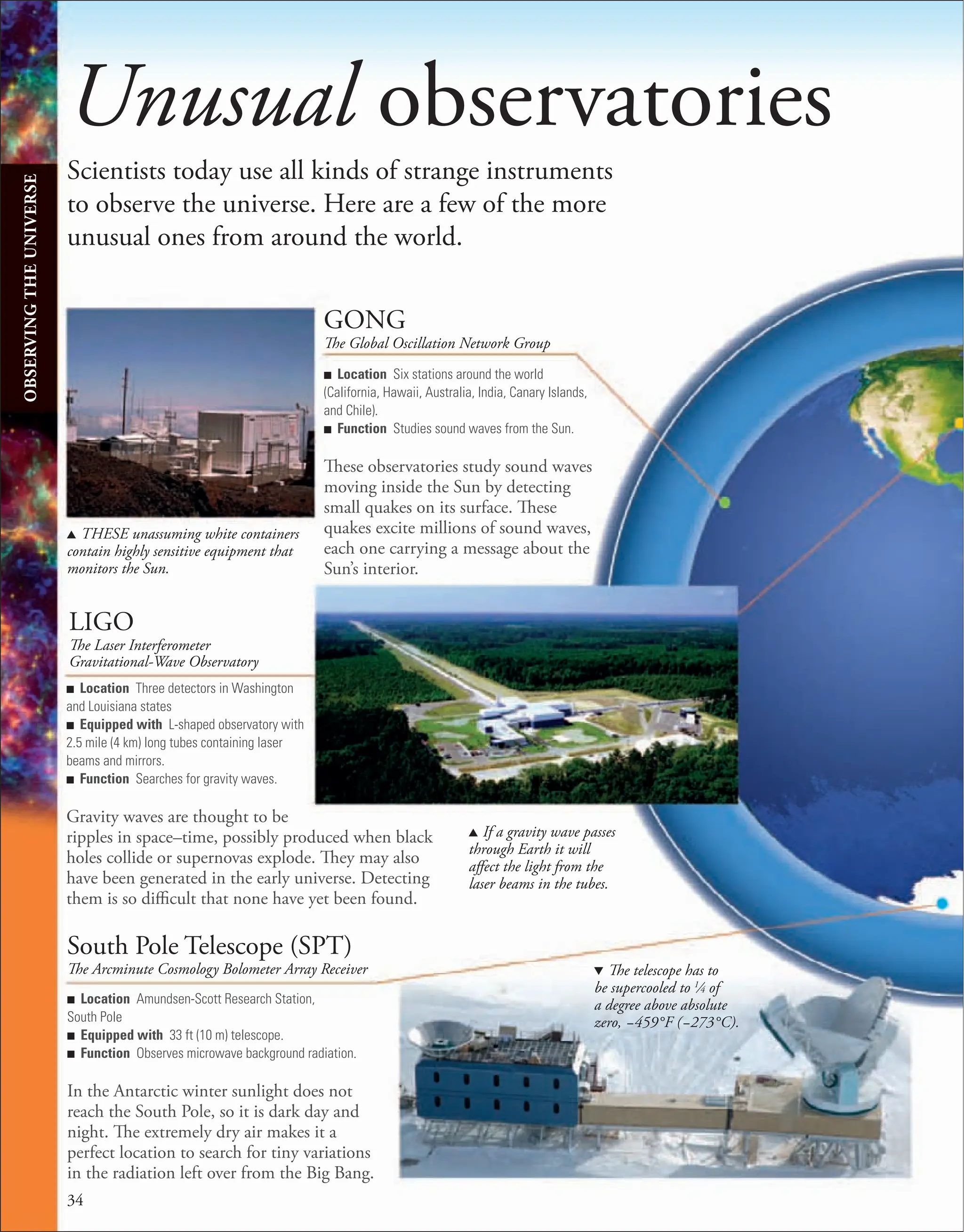
Unusual observatories
Scientists today use all kinds of strange instruments
to observe the universe. Here are a few of the more
unusual ones from around the world.
■ Location Six stations around the world
(California, Hawaii, Australia, India, Canary Islands,
and Chile).
■ Function Studies sound waves from the Sun.
These observatories study sound waves
moving inside the Sun by detecting
small quakes on its surface. These
quakes excite millions of sound waves,
each one carrying a message about the
Sun’s interior.
■ Location Amundsen-Scott Research Station,
South Pole
■ Equipped with 33 ft (10 m) telescope.
■ Function Observes microwave background radiation.
In the Antarctic winter sunlight does not
reach the South Pole, so it is dark day and
night. The extremely dry air makes it a
perfect location to search for tiny variations
in the radiation left over from the Big Bang.
South Pole Telescope (SPT)
The Arcminute Cosmology Bolometer Array Receiver
GONG
The Global Oscillation Network Group
■ Location Three detectors in Washington
and Louisiana states
■ Equipped with L-shaped observatory with
2.5 mile (4 km) long tubes containing laser
beams and mirrors.
■ Function Searches for gravity waves.
Gravity waves are thought to be
ripples in space–time, possibly produced when black
holes collide or supernovas explode. They may also
have been generated in the early universe. Detecting
them is so difficult that none have yet been found.
LIGO
The Laser Interferometer
Gravitational-Wave Observatory
d The telescope has to
be supercooled to 1
⁄4 of
a degree above absolute
zero, −459°F (−273°C).
u THESE unassuming white containers
contain highly sensitive equipment that
monitors the Sun.
34
u If a gravity wave passes
through Earth it will
affect the light from the
laser beams in the tubes.
OBSERVING
THE
UNIVERSE
■ Location The left-hand side of the fuselage of a modified Boeing 747SP
■ Equipped with A 100 in (2.5 m) diameter reflecting telescope.
■ Function To observe the sky in visible and infrared light.
The aircraft will fly above the clouds and most of the atmosphere
at altitudes of between 7 and 9 miles (11 and 14 km) for up to
eight hours at a time. It is hoped that SOFIA’s observations will
answer questions about the creation of the universe. It is
expected to be in use for 20 years.
■ Location 6,800 ft (2 km)
underground in a working nickel mine,
Sudbury, Ontario, Canada
■ Equipped with “Heavy” water in a
39 ft (12 m) diameter tank, surrounded
by 9,600 sensors.
■ Function To study high-energy
particles (neutrinos) from the Sun’s core
and exploding stars.
Neutrinos usually pass
undetected through Earth,
but when they collide with
the heavy water atoms they
produce light flashes, which
are picked up by the sensors
surrounding the tank.
SOFIA
The Stratospheric Observatory for Infrared Astronomy
■ Location A 16,500 ft (5,000 m) high plateau in the Atacama desert, Chile
■ Equipped with At least 66 antennas across 200 pads over 12 miles (18.5 km).
■ Function To observe the gas and dust of the cool universe.
ALMA is a collection of 66 dishes up to 39 ft (12 m) across, that can
operate together as a single, giant telescope. The dry climate, together
with the thin atmosphere at such a high altitude, is perfect for clear
views of infrared and microwave radiation from space.
ALMA
Atacama Large Millimeter/submillimeter Array
SNO
Sudbury Neutrino Observatory
. SOFIA 747SP
is able to keep its
telescope pointing
steadily at an object
in space even if the
aircraft is struck
by turbulence.
d The rock shields the detectors
from cosmic rays.
u TRANSPORTERS are used to move the
giant antenna dishes to different positions.
UNUSUAL OBSERVATORIES
35
OBSERVING
THE
UNIVERSE
THE VIOLENT
UNIVERSE
THE
VIOLENT
UNIVERSE
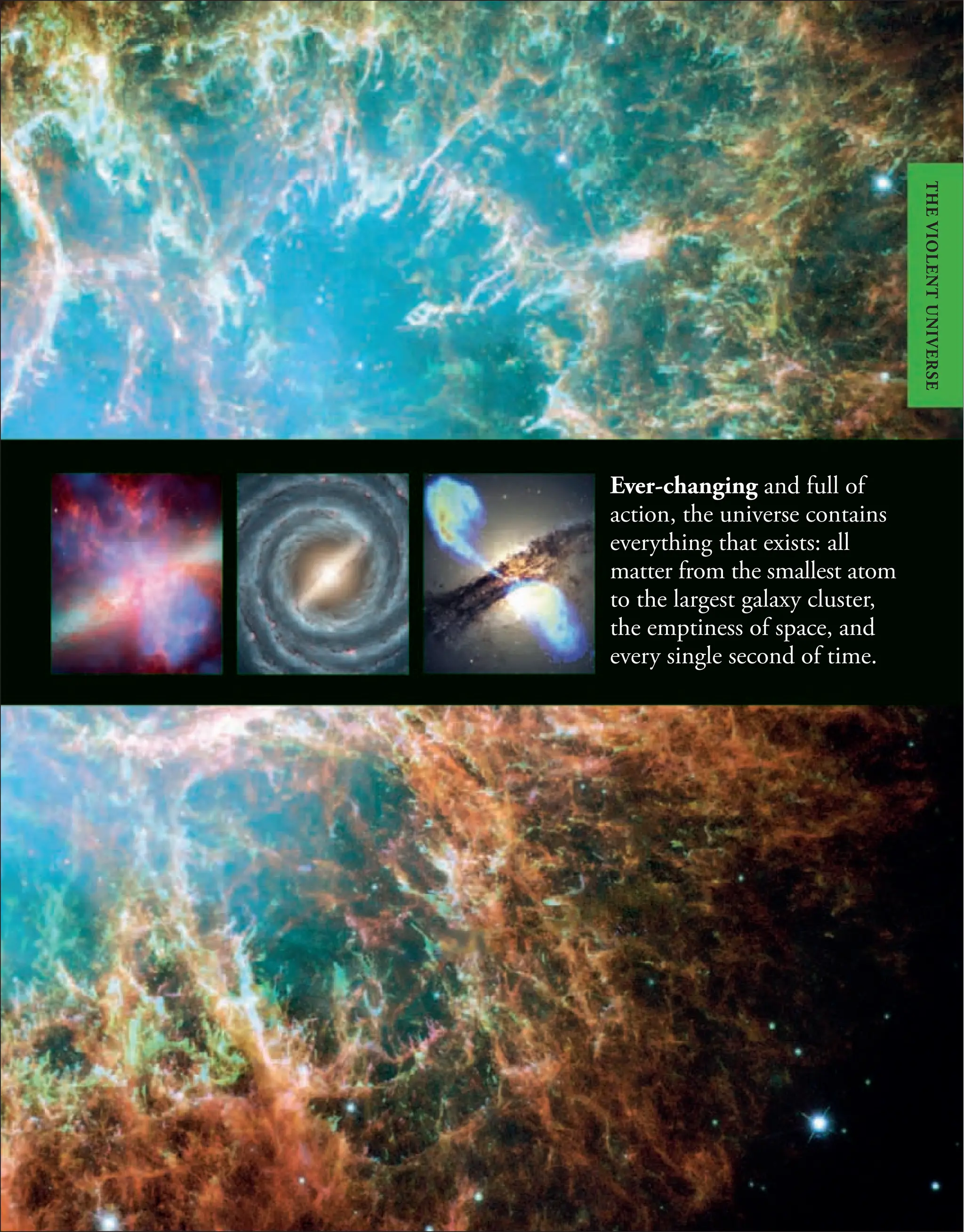
Ever-changing and full of
action, the universe contains
everything that exists: all
matter from the smallest atom
to the largest galaxy cluster,
the emptiness of space, and
every single second of time.
THE
VIOLENT
UNIVERSE
38
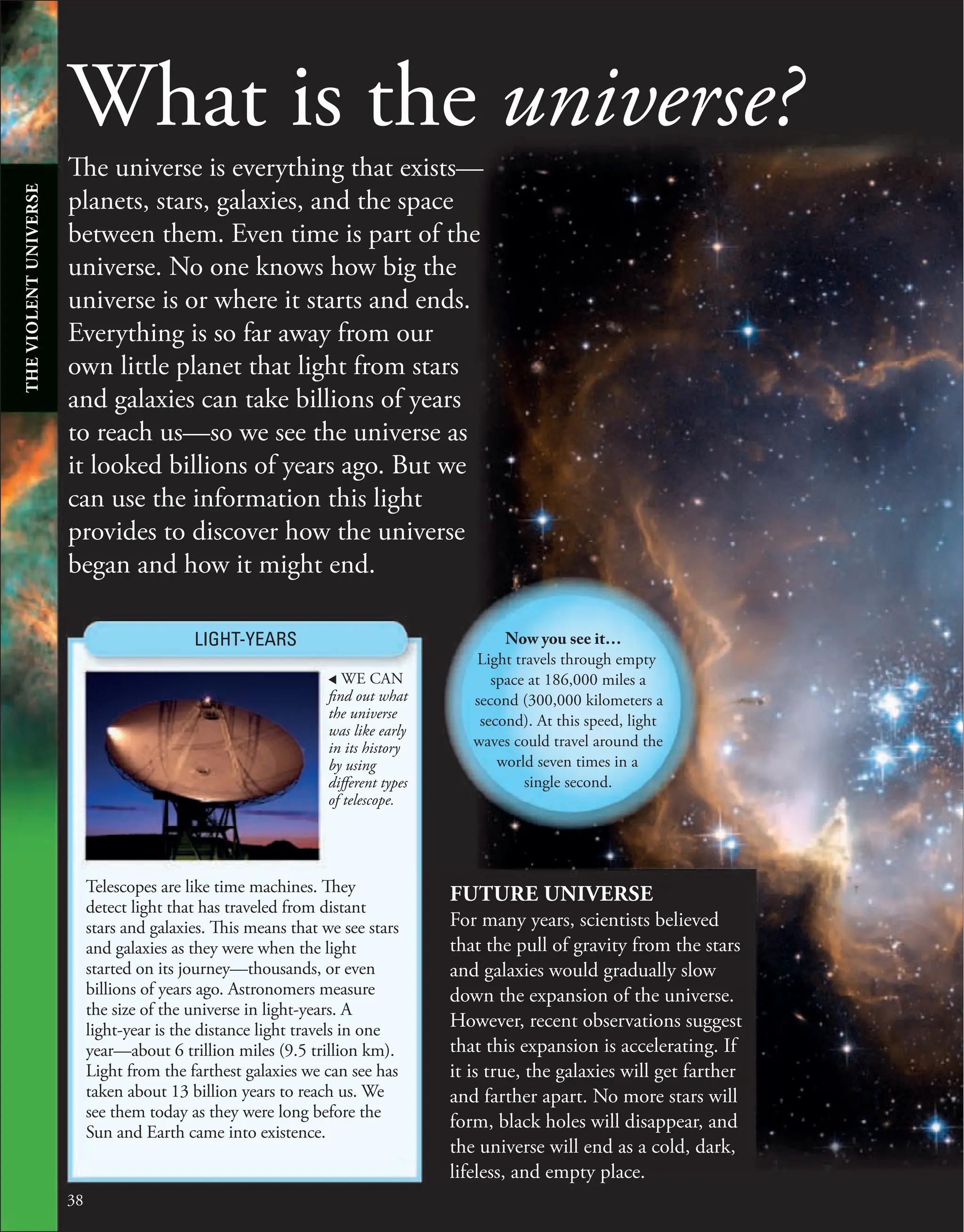
What is the universe?
The universe is everything that exists—
planets, stars, galaxies, and the space
between them. Even time is part of the
universe. No one knows how big the
universe is or where it starts and ends.
Everything is so far away from our
own little planet that light from stars
and galaxies can take billions of years
to reach us—so we see the universe as
it looked billions of years ago. But we
can use the information this light
provides to discover how the universe
began and how it might end.
FUTURE UNIVERSE
For many years, scientists believed
that the pull of gravity from the stars
and galaxies would gradually slow
down the expansion of the universe.
However, recent observations suggest
that this expansion is accelerating. If
it is true, the galaxies will get farther
and farther apart. No more stars will
form, black holes will disappear, and
the universe will end as a cold, dark,
lifeless, and empty place.
, WE CAN
find out what
the universe
was like early
in its history
by using
different types
of telescope.
LIGHT-YEARS
Telescopes are like time machines. They
detect light that has traveled from distant
stars and galaxies. This means that we see stars
and galaxies as they were when the light
started on its journey—thousands, or even
billions of years ago. Astronomers measure
the size of the universe in light-years. A
light-year is the distance light travels in one
year—about 6 trillion miles (9.5 trillion km).
Light from the farthest galaxies we can see has
taken about 13 billion years to reach us. We
see them today as they were long before the
Sun and Earth came into existence.
Now you see it…
Light travels through empty
space at 186,000 miles a
second (300,000 kilometers a
second). At this speed, light
waves could travel around the
world seven times in a
single second.
THE
VIOLENT
UNIVERSE
WHAT IS THE UNIVERSE?
39
Measuring distances
Measuring distances in the universe
is tricky. Many galaxies are so far
away, the only thing we can use
is light. Because the universe is
expanding and stretching space, the
wavelengths of light from an object
also become stretched. Any dark
lines in its spectrum move toward
the red end, which astronomers call
a “redshift.” By measuring the size
of this redshift, astronomers can
calculate the distances of the galaxies
and how fast they are moving away
from us. The oldest and fastest-
moving galaxies are those with the
biggest redshifts.
Is our universe alone or are there other universes that
we cannot see? No one knows, but some scientists
believe that there might be many other universes. This
structure may resemble an enormous bubbly foam in
which some universes have not yet inflated. Some may
have different physical laws and dimensions from ours.
In theory, it may even be possible to connect one
universe to another through a spinning black hole.
However, no other universes can affect anything in our
universe, so it is impossible to prove that they exist.
Shape of the universe
Since we live inside the universe it is hard to
imagine that space has a shape. Scientists,
however, think that it does have a shape and
that this depends on the density of its matter.
If it is greater than a critical amount then the
universe is said to be closed. If it is less, then it
is described as open (saddle-shaped). However,
spacecraft observations have shown that
the universe is very close
to the critical density, so
scientists describe it as flat.
A completely flat universe
has no edge and will go on
expanding forever.
u AS OBJECTS move away from
us their light spectrum changes. By
measuring the change we can work
out how fast they are moving.
, ALL the stars, dust, and gas we can
see in the sky make up only a small part
of the universe. Most of the universe is
made of mysterious, invisible dark matter
and dark energy ( p. 62–63).
MULTIPLE UNIVERSES?
TELL ME MORE...
We can see and measure three
dimensions of space—height, width,
and depth. Time is a fourth dimension.
Scientists believe the universe may have
at least six other, hidden, dimensions.
These are all curled up on each other
and are infinitely tiny.
Earth
Open
Closed
Flat
Star
THE
VIOLENT
UNIVERSE
40
Birth of the universe
Scientists believe that the universe was born in a huge fireball about
13.7 billion years ago. This “Big Bang” was the beginning of everything:
time and space, as well as all the matter and energy in the universe.
INFLATION
At the instant it began, the newborn universe was
incredibly small and unimaginably hot and dense.
Inside the fireball, energy was being turned into
matter and antimatter. Then it began to expand
and cool. For a tiny fraction of a second the
expansion was quite slow, but then the
universe shot outward. It has been
expanding steadily ever since and
might even be speeding up.
Matter and antimatter
Immediately after the Big Bang, huge amounts
of energy were turned into particles of matter and
mirror-image particles of antimatter. When the
two types meet they destroy each other in a flash
of radiation. If equal numbers of both had been
created they would have wiped each other out.
However, everything we can see in the universe
today consists mainly of matter. The only explanation
seems to be that, for some unknown reason, the Big
Bang created slightly more matter than antimatter.
BIG BANG
Time 1. 0 seconds
Fireball
Temperature
Quarks Electrons
d THE BLUE AND PURPLE
colors show X-rays being given off
by matter and antimatter
collisions as high-energy particles
stream away from the white
pulsar at the center of the image.
u THE MOST COMMON
particles in the universe today
include quarks and electrons.
They are the building blocks
of all atoms.
1
The universe begins to expand
from infinitely tiny
to the size of a grapefruit. The
huge amount of energy this
releases kick-starts the formation
of matter and antimatter.
THE
VIOLENT
UNIVERSE
41
By now the universe
is the size of a football
field. Huge numbers of
matter and antimatter
particles collide and destroy each
other, creating more energy.
The universe
suddenly inflates
and starts to cool.
A new range of exotic
particles form, including
quarks and electrons.
The universe is still
too hot to form
atoms, but quarks
begin to group
together and form heavier
particles, particularly protons
and neutrons.
Protons and neutrons are particles that each contain three quarks.
Once the expanding universe had enough protons and neutrons,
they began to form very simple atomic nuclei, the basis of
hydrogen and helium atoms. Most stars are made of these two types
of atoms. Within three minutes of the Big Bang, almost all of the
hydrogen and helium nuclei in the universe had been created.
Helium
nucleus
10 K 10 K 10 K
2. 10 seconds 4. 10 seconds 3 minutes
32 14 8
−43 −7
Neutron
Proton
BUILDING UP TO ATOMS
2 3 4
Which came first?
There was no “before” the Big
Bang because time and space
did not exist. After the Big Bang,
space began to expand and time
began to flow. But neither could
start until the other one began.
It took scientists years to figure
out this mind-boggling
fact!
FIRST THREE MINUTES
During the first three minutes
the universe cooled from being
unbelievably hot to less than one
billion degrees Kelvin. In the same
period, it expanded from an area
billions of times smaller than an atom
to the size of our Milky Way galaxy.
3. 10 seconds
10 K
27
−35
u K stands for Kelvin, a temperature scale used by
astronomers. 0 K equals −459°F (−273°C). It is the lowest
possible temperature anything in the universe can reach.
THE
VIOLENT
UNIVERSE
42
It took hundreds of millions of years for stars,
galaxies, and planets to start filling the universe.
If the universe hadn’t begun to cool, the atoms
they are made from would never have formed.
THE FOGGY UNIVERSE
Around 300,000 years passed before the first atoms started
to form. This process began when the temperature of the
universe dropped to about 3,000 K. In this cooler universe,
protons and atomic nuclei were able to capture extremely
tiny particles called electrons and become atoms. Until this
point, the universe was very foggy—light could not travel
far because it was constantly bouncing off atomic particles.
This fog is why we cannot see anything that was happening
at that time—even with the most powerful telescopes.
3,000 K
300,000 years
An atom is the smallest piece of matter that can exist on
its own. Atoms have a central core (the nucleus) made
up of protons and neutrons. Circling the nucleus are
electrons. The number of protons, neutrons, and
electrons an atom has determines which element it is.
When the first stars exploded as supernovas, the energy
they released created new, heavier elements, such as
carbon, oxygen, and iron. This process continues today.
WHAT IS AN ATOM?
43
Glowing embers of the Big Bang
We cannot see any light from the Big Bang.
However, we can detect a faint glow of
radiation—known as the Cosmic Microwave
Background (CMB)—that still covers the sky.
This leftover radiation shows what the universe
was like 300,000 years after it began. The map
shows slightly warmer and cooler ripples. The
first galaxies probably grew from the slightly
cooler and denser (blue) patches of gas.
FIRST STARLIGHT
About 200 million years
after the Big Bang, huge
clouds of hydrogen and
helium gas began to build
up. The pull of gravity
made the clouds collapse
into dense clumps of
atoms. As the clouds
shrank and became hotter
they ignited and formed
the first stars. These stars
didn’t last long before
they exploded and helped
produce new stars.
BEGINNINGS OF
GALAXIES
Galaxies also began to
form fairly soon after the
first stars. Dense clouds
of gas and young stars
were pulled together by
gravity and dark matter
to form small galaxies
and new stars. Gradually,
these galaxies began
colliding with each other
to make larger galaxies.
The Moon is held in orbit around
Earth by the pull of gravity.
The Big Bang also created four
fundamental forces that affect the
universe. These are gravity, the
electromagnetic force, the weak
nuclear force, and the strong
nuclear force. Gravity is what keeps
planets in orbit around stars.
Electromagnetism is linked to
electricity and magnetism. The
weak force governs how stars shine,
while the strong force holds
together the protons and neutrons
in the nuclei of atoms.
Present day
100 K 10 K
200 million years 500 million years
u THE CMB provides the best
evidence for the Big Bang. It marks
the point at which the temperature
dropped enough for atoms to form.
Scientists cannot see
what the universe
was like
immediately after
the Big Bang. But
they are trying to
learn more by
building huge
machines on Earth.
The latest and most
advanced of these
is the Large
Hadron Collider
in Switzerland.
This $4 billion
instrument will attempt to re-create the Big Bang by
crashing beams of protons together 800 million times a
second. The beams that collide are expected to create
many new particles and possibly provide a reconstruction
of the universe in its very first moments.
FUNDAMENTAL FORCES
THE BIG BANG MACHINE
2.7 K
THE
VIOLENT
UNIVERSE
100 billion galaxies
Wherever we look in the sky, the universe is full
of galaxies—huge star systems that are tied together
by gravity. The first galaxies were born less than
one billion years after the birth of the universe
in the Big Bang.
44
GIANTS AND DWARFS
There are at least 100 billion galaxies in the universe. Some
are enormous, containing hundreds of billions of stars.
Others are much smaller, sometimes containing fewer than
a million stars. There are many more small galaxies than
giant galaxies, even though the dwarf galaxies tend to be
swallowed by their larger neighbors over time. We live in
a galaxy of about 100 billion stars called the Milky Way.
THE
VIOLENT
UNIVERSE
M51 GALAXY
100 BILLION GALAXIES
45
HUBBLE DEEP FIELD For 10 days
in October 1998, the Hubble Space
Telescope stared at a tiny region of space,
revealing a view never seen before—
thousands of galaxies up to 12 billion
light-years away. It features many spiral
galaxies like our Milky Way, as well as
elliptical galaxies and peculiar-shaped
galaxies that are involved in collisions.
TAKE A LOOK: WHIRLPOOL
By the mid-19th
century, astronomers
had discovered many fuzzy patches in
the night sky, which they called nebulas.
To find out more about them, Lord
Rosse built what was then the world’s
largest telescope—the 72 in (1.8 m)
Birr telescope. With it, he made the first
observation of what is now known as
the Whirlpool Galaxy (M51). His
drawing of the galaxy is dated 1845.
GAS GALAXIES
Some galaxies are very large, yet contain
very few stars. These faint galaxies are
made almost entirely of gas, so in photos
they appear as a smudge in the sky. One
example, Malin 1, contains enough gas to
make 1,000 galaxies like the Milky Way. It
seems to have just begun to make stars. Its
vast, but faint, disk is six times bigger than
the Milky Way. A much closer, normal galaxy
can be seen at the bottom of the picture.
The arrow points to
Malin 1.
It can be seen better in
this treated image.
Seeing the light
There are many features of galaxies
that do not show up in visible light.
To find out the true nature of a
galaxy, you have to look at it at
different wavelengths with different
instruments. The above image of
M51 combines images taken by four
space telescopes. One showed up
X-rays given off by black holes,
neutron stars, and the glow from hot
gas between the stars (shown
in purple). Infrared and optical
instruments revealed stars, gas, and
dust in the spiral arms (in red and
green). Young, hot stars that produce
lots of ultraviolet light are blue.
This Hubble Space
Telescope image is
of Zwicky 18, a
dwarf galaxy
about 60 million
light-years away.
M51, the Whirlpool Galaxy,
is about 30 million light-years
from Earth.
ZWICKY 18
THE
VIOLENT
UNIVERSE
Galaxy formation
Galaxies have existed for many billions
of years—but where did they come from?
Astronomers today use observatories to
look back to the very early universe.
These distant views show fuzzy galaxies
involved in violent collisions. Could
this be how the first galaxies formed?
46
46
u YOUNG SPIRAL NGC 300 is a young
spiral galaxy with lots of star formation.
u TEENAGE TRANSITION As the galaxy
grows older, there is less star formation.
u OLD ELLIPTICAL Large, gas-poor
elliptical galaxies contain old stars.
u THEORY TEST This computer model shows
matter clumping into strands under the influence of
gravity. The first galaxies form inside these strands.
WHAT
HAPPENS?
There are two main
theories of how galaxies
form. In one version, huge
clouds of gas and dust
collapse to form galaxies. In
the other version, stars form
into small groups and then
merge to form larger groups,
then galaxies, and finally
clusters of galaxies.
Changing shape
Many galaxies begin life as small spirals before becoming larger ellipticals, often
as the result of a collision. This doesn’t mean that the galaxies crash into each
other—the gaps between the stars in a galaxy are large enough for the galaxies
to pass through each other. However, it does change the galaxy’s shape.
THE
VIOLENT
UNIVERSE
, SMOKIN’! The Cigar Galaxy is
an irregular galaxy with a lot of star
formation. More stars are formed in
young galaxies than in older ones.
u BLUE RING Clusters of hot blue stars
dominate the ring. They may be the remains
of another galaxy that came too close.
u IRREGULAR These
galaxies sometimes have the
beginnings of spiral arms.
u ELLIPTICAL There is
no gas in an elliptical galaxy
so no new stars can form.
u SPIRAL Spirals rotate
very slowly, about once every
few hundred million years.
TYPES OF GALAXY
There are three main types of galaxy. These are classified according to their shape and the
arrangement of stars inside them.
■ Irregular galaxies contain a lot of gas, dust, and hot blue stars, but have no particular
shape. They are often the result of a collision between two galaxies.
■ Elliptical galaxies are round, oval, or cigar-shaped collections of stars. They usually
contain very old red and yellow stars with little dust or gas between them.
■ Spiral galaxies are huge, flattened disks of gas and dust that have trailing arms.
Odd one out
Hoag’s Object is a very unusual
galaxy. It does not look like other
irregular, spiral, or elliptical
galaxies. Instead, it has a circle of
young blue stars surrounding its
yellow nucleus (core) of older stars.
GALAXY FORMATION
47
STARTING A SPIRAL
Most scientists believe that the
early universe was filled with
hydrogen and helium. Some
suggest that clouds of gas and
dust, collapsing and rotating
under the influence of gravity,
formed spiral galaxies.
u COME TOGETHER Clouds of
dust, gas, and stars are pulled together
by gravity.
u TURN AROUND Gravity makes the
collapsed clouds rotate. New stars form and
rotate around the center of the mass.
u SHRINK DOWN The spinning
action flattens the cloud, forming a
galactic disk of dust, gas, and stars.
u TAKING UP ARMS The disk
continues to rotate, causing spiral
arms to form.
THE
VIOLENT
UNIVERSE
A SOMBRERO IN SPACE
Around 28 million light-years from Earth,
in the constellation Virgo, lies a spiral galaxy
with a very bright nucleus. It has an unusually
large central bulge and is surrounded by a
dark, inclined lane of dust (shown here in
a side-on view). Named for its hatlike
appearance, this is the Sombrero Galaxy.
THE
VIOLENT
UNIVERSE
Other documents randomly have
different content
back
back
back
back
back
back
Welcome to our website – the perfect destination for book lovers and
knowledge seekers. We believe that every book holds a new world,
offering opportunities for learning, discovery, and personal growth.
That’s why we are dedicated to bringing you a diverse collection of
books, ranging from classic literature and specialized publications to
self-development guides and children's books.
More than just a book-buying platform, we strive to be a bridge
connecting you with timeless cultural and intellectual values. With an
elegant, user-friendly interface and a smart search system, you can
quickly find the books that best suit your interests. Additionally,
our special promotions and home delivery services help you save time
and fully enjoy the joy of reading.
Join us on a journey of knowledge exploration, passion nurturing, and
personal growth every day!
ebookbell.com


Space A Visual Encyclopedia 1st Edition Dk

  • 1.
    Space A VisualEncyclopedia 1st Edition Dk download https://ebookbell.com/product/space-a-visual-encyclopedia-1st- edition-dk-2503274 Explore and download more ebooks at ebookbell.com
  • 2.
    Here are somerecommended products that we believe you will be interested in. You can click the link to download. Space A Visual Encyclopedia Wendy Horobin Eds https://ebookbell.com/product/space-a-visual-encyclopedia-wendy- horobin-eds-5405864 Space A Visual Encyclopedia Dorling Kindersley https://ebookbell.com/product/space-a-visual-encyclopedia-dorling- kindersley-11454798 Love Your Creative Space A Visual Guide To Creating An Inspiring Organized Studio Without Breaking The Bank Lilo Bowman https://ebookbell.com/product/love-your-creative-space-a-visual-guide- to-creating-an-inspiring-organized-studio-without-breaking-the-bank- lilo-bowman-11213118 A Visual Guide To Space Exploration Alberto Hernndez Pamplona https://ebookbell.com/product/a-visual-guide-to-space-exploration- alberto-hernndez-pamplona-11762314
  • 3.
    Picturing The CosmosA Visual History Of Early Soviet Space Endeavor Iina Kohonen https://ebookbell.com/product/picturing-the-cosmos-a-visual-history- of-early-soviet-space-endeavor-iina-kohonen-7037556 Science Year By Year A Visual History From Stone Tools To Space Travel Dorling Kindersley Publishing Staff https://ebookbell.com/product/science-year-by-year-a-visual-history- from-stone-tools-to-space-travel-dorling-kindersley-publishing- staff-43523196 Visual Astronomy Under Dark Skies A New Approach To Observing Deep Space The Patrick Moore Practical Astronomy Series 2005th Edition Cooke https://ebookbell.com/product/visual-astronomy-under-dark-skies-a-new- approach-to-observing-deep-space-the-patrick-moore-practical- astronomy-series-2005th-edition-cooke-56376382 Visual Astronomy Under Dark Skies A New Approach To Observing Deep Space 1st Edition Antony Cooke https://ebookbell.com/product/visual-astronomy-under-dark-skies-a-new- approach-to-observing-deep-space-1st-edition-antony-cooke-1137076 Public Space Democracy Performative Visual And Normative Dimensions Of Politics In A Global Age Nilfer Gle Editor https://ebookbell.com/product/public-space-democracy-performative- visual-and-normative-dimensions-of-politics-in-a-global-age-nilfer- gle-editor-42601736
  • 5.
    featuring the latestimagery from nasa SPACE a visual encyclopedia
  • 7.
  • 8.
    Contents INTRODUCTION OBSERVING THE UNIVERSE Whatis space? Our place in space A circle of stars Early ideas Telescopes Giant telescopes Seeing light Infrared astronomy Messages from the stars Invisible rays Hubble Space Telescope Witches and giants Observatories in space Unusual observatories THE VIOLENT UNIVERSE What is the universe? Birth of the universe 100 billion galaxies Galaxy formation A sombrero in space The Milky Way The Magellanic Clouds The Local Group The heart of the Milky Way When galaxies collide… Active galaxies Dark matter LIFTOFF! How rockets work 3, 2, 1… The space shuttle Launch centers Launching Ariane 5 Artificial satellites Satellites in orbit Satellite shot Space probes Space debris 4 6 8 10 12 14 16 18 20 22 24 26 28 30 32 34 36 38 40 44 46 48 50 52 54 56 58 60 62 64 66 68 70 72 74 76 78 80 82 84 LONDON, NEW YORK, MELBOURNE, MUNICH, and DELHI Consultant Peter Bond Project editor Wendy Horobin Project designer Pamela Shiels Editors Fleur Star, Holly Beaumont, Lee Wilson, and Susan Malyan Designers Rachael Grady, Lauren Rosier, Gemma Fletcher, Karen Hood, Clare Marshall, Mary Sandberg, and Sadie Thomas US editor Margaret Parrish Indexer Chris Bernstein Picture researchers Ria Jones, Harriet Mills, and Rebecca Sodergren Production editor Sean Daly Jacket designer Natalie Godwin Jacket editor Matilda Gollon Publishing manager Bridget Giles Art director Martin Wilson Packaging services supplied by Bookwork First published in the United States in 2010 by DK Publishing 375 Hudson Street, New York, New York 10014 Copyright © 2010 Dorling Kindersley Limited 10 11 12 13 14 10 9 8 7 6 5 4 3 2 1 175938—05/10 All rights reserved under International and Pan-American Copyright Conventions. No part of this publication may be reproduced, stored in a retrieval system, or transmitted in any form or by any means, electronic, mechanical, photocopying, recording, or otherwise, without the prior written permission of the copyright owner. Published in Great Britain by Dorling Kindersley Limited. A catalog record for this book is available from the Library of Congress. ISBN: 978-0-7566-6277-6 Color reproduction by Media Development and Printing Limited, United Kingdom Printed and bound by Toppan, China Discover more at www.dk.com
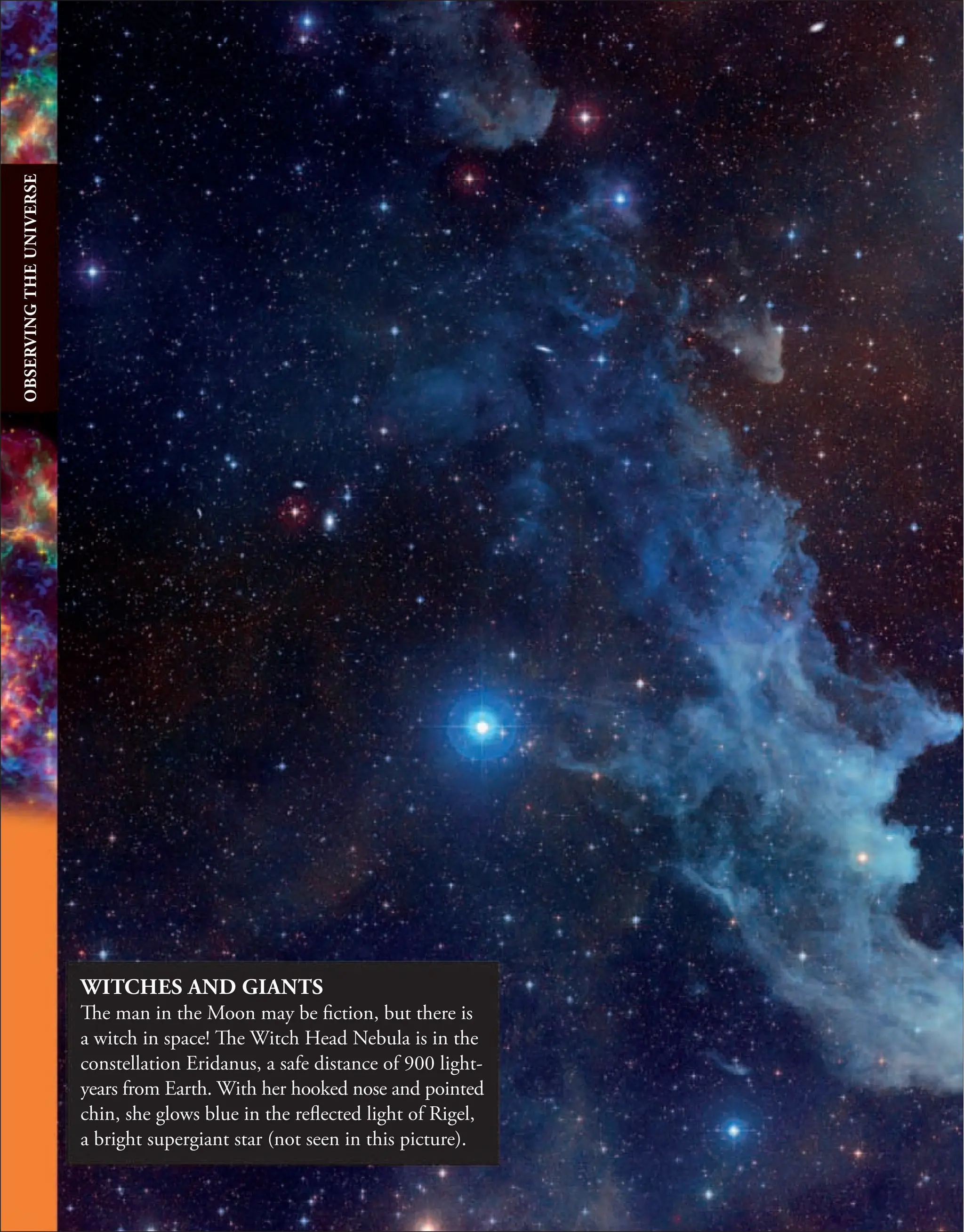
  • 9.
    Space nations Super spacecraft HUMANSIN SPACE Space pioneers Becoming an astronaut Space walking Living in space Animals in space Extending the house The first space stations The International Space Station Science in space Space tourism Future flyers Reaching for the stars SOLAR SYSTEM Birth of the solar system The Sun’s family Mercury Venus Views of Venus Mars Missions to Mars Martian sand art Asteroids Jupiter Jupiter’s moons Voyager 1 & 2 Saturn Saturn’s moons Saturn by sunlight Uranus Neptune Pluto and beyond Comets Comet missions Meteors Meteorites Life on other worlds EARTH The unique Earth The perfect planet Earth’s seasons On the surface Up in the sky Life on Earth 86 88 90 92 94 96 98 100 102 104 106 108 110 112 114 116 118 120 122 124 126 128 130 132 134 136 138 140 142 144 146 148 150 152 154 156 158 160 162 164 166 168 170 172 174 176 THE MOON Earth’s companion Eclipses The lunar surface Destination Moon Man on the Moon Splashdown! Return to the Moon THE SUN The Sun Inside the Sun The Sun’s atmosphere Solar storms Amazing aurora Solar cycle Observing the Sun STARS AND STARGAZING What are stars? Birth of a star A flash of brilliance The death of a star Interstellar space Multiple stars Globular clusters Other solar systems Extreme stars Black holes Be a skygazer The night sky The northern sky The southern sky Space in time Glossary Index Acknowledgments 178 180 182 184 186 188 190 192 194 196 198 200 202 204 206 208 210 212 214 216 218 220 222 224 226 228 230 232 234 236 238 240 244 248 254
  • 10.
    Introduction Only about 500people have left Earth behind to explore the wonders of outer space. Now you, too, can voyage through space and time and enjoy an experience that is out of this world. As you turn the pages of this lavishly illustrated encyclopedia, you will learn about how rockets and telescopes work, discover what it is like to work and live in space, and unravel the mysteries of the final frontier. You’ll travel from our small, blue planet to strange worlds with poisonous atmospheres, hidden oceans, and huge volcanoes. Then head out into the Milky Way to discover the multicolored clouds, stars, and galaxies that lie scattered throughout the universe.
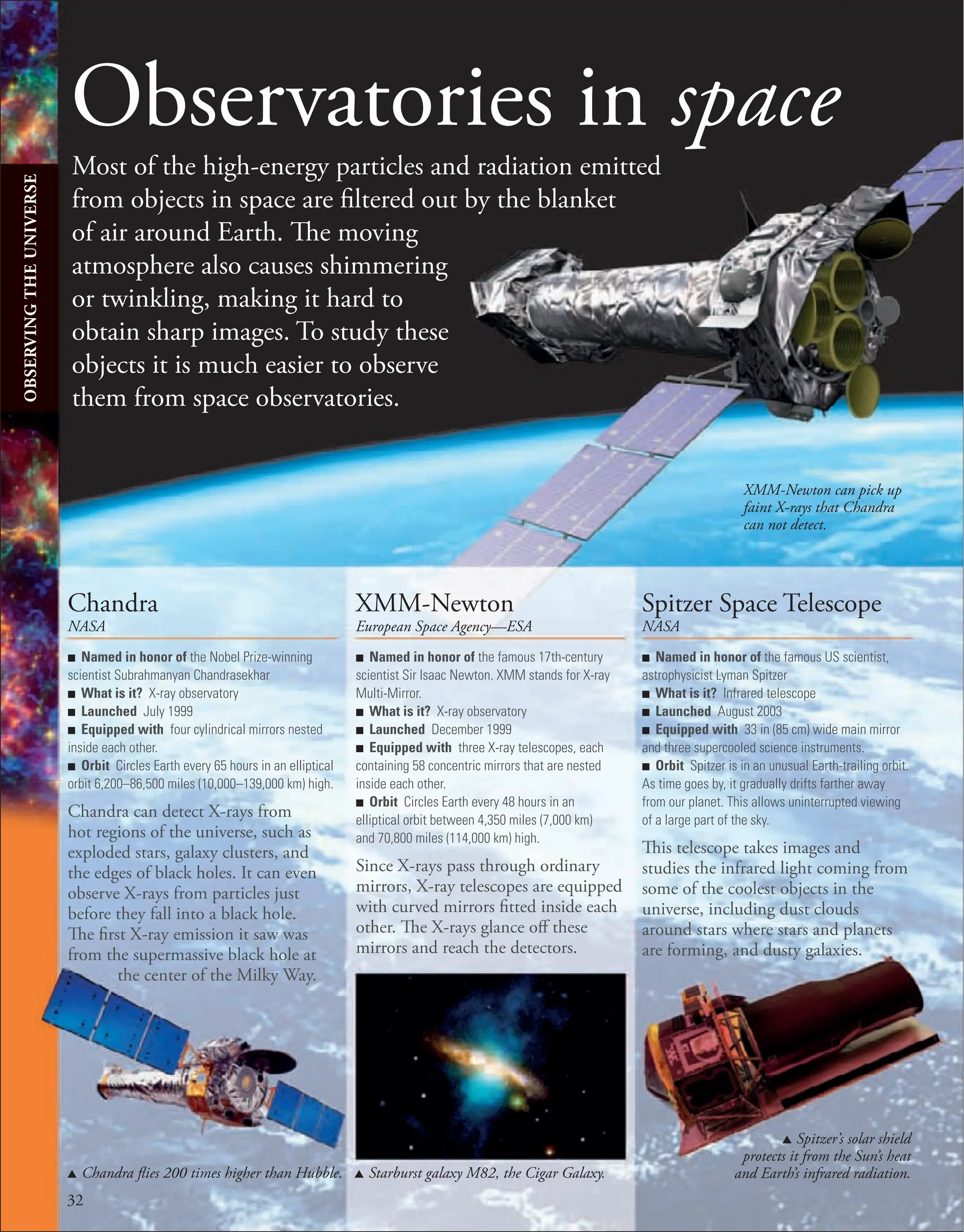
  • 11.
    5 u FACT FILEStake an in-depth look at one topic, such as telescopes ( p. 18–19). They detail all you need to know about the subject. u DETAILED PROFILES accompany features about our solar system ( p. 128–129). These are packed with facts and figures about the structure, composition, and features of each planet. u GENERAL ARTICLES focus on particular topics of interest ( p. 72–73). Many have fact boxes, timelines that chronicle key stages in development, and picture features. u PHOTO SPREADS capture items of special interest within each chapter, such as exploding stars ( p. 216–217). 128 MARS Mars After Earth, Mars is the most suitable planet for humans to inhabit. Its day is only a little over 24 hours long, and it has Earth-like seasons. Mars was named after the Roman god of war because of its blood-red color, which is caused by rusty iron-rich rocks. SOLAR SYSTEM SOLAR SYSTEM Small, probably solid iron core Rock crust Mantle of silicate rock Deimos completes one orbit of Mars every 30 hours. Red sky at night The Martian sky is full of fine dust, which makes it appear orange-red. It means that sunsets on Mars are always orange-red, and there’s so much dust the sky stays bright for an hour after sunset. The daytime temperature can reach a pleasant 77°F (25°C) in summer, but it plummets as soon as the Sun sets and can drop to a bitter −195°F (−125°C) on winter nights. . MINI MARS The surface area of Mars is similar to that of all the continents on Earth. Details are hard to see from ground- based telescopes because Mars is o small—about half the diameter of Earth. MARTIAN MOONS Mars has two small, black, potato-shaped moons called Phobos and Deimos. They may be asteroids that were captured by Mars long ago. Phobos is slightly larger than Deimos and has a large impact crater called Stickney. Both are heavily cratered and seem to be covered in a layer of dust at least 3 ft (1 m) thick. The volcanoes Ascraeus Mons, Pavonis Mons, and Arsia Mons make up the Tharsis Montes range. Olympus Mons is the largest volcano in the solar system. The Lowell crater is 4 billion years old. Valles Marineris runs like a scar just below the Martian equator. This system of canyons is 2,500 miles (4,000 km) long. In places, the Kasei Vallis valley is more than 2 miles (3 km) deep. It was the result of a devastating flood. Viking 1 Lander and Pathfinder landed near the Chryse Planitia. ■ Average distance from the Sun 142 million miles (228 million km) ■ Surface temperature −195 to 77°F (−125 to 25°C) ■ Diameter 4,200 miles (6,800 km) ■ Length of day 24.5 hours (1 Earth day) ■ Length of year 687 Earth days ■ Number of moons 2 ■ Gravity at the surface (Earth = 1) 0.38 ■ Size comparison PLANET PROFILE TAKE A LOOK: DUST STORMS Mars is a dry planet, although there is lots of evidence that there used to be water on its surface. Today, the temperature is too cold and the air too thin for liquid water to exist on the surface. But the planet does have lots of wind. High-level winds reach speeds of up to 250 mph (400 km/h), kicking up huge clouds of dust 3,000 ft (1,000 m) high. The dust storms can cover vast areas of the planet and may last for months. POLAR ICE CAPS There are permanent ice caps at both Martian poles, but they are very different. The northern ice sheet is 1.8 miles (3 km) thick and mainly made of water ice. The southern polar cap is thicker and colder (−166°F/−110°C, even in summer) and mostly made of carbon dioxide ice. u MOUNTAIN FROST Much of the Martian surface is thought to be in deep freeze—known as permafrost—such as the frost shown here in the Charitum Montes Mountains. , ORBITER REPORT NASA’s Mars Reconnaissance Orbiter was launched in August 2005. Its instruments can take detailed photographs of the surface, look for water, analyze minerals, check for dust and water in the air, and observe weather. The heights of Olympus Mars has the largest volcanoes in the solar system. The most impressive is called Olympus Mons, or Mount Olympus. At 375 miles (600 km) across, it would cover most of England, and at 16 miles (26 km) high it is three times taller than Mount Everest. In the center is a huge, sunken crater that is 56 miles (90 km) across. Phobos is much closer to Mars, completing one orbit every 7 hours 40 minutes. u BREWING A STORM The beginning of a storm takes shape on June 30, 1999. u SHAPE SHIFTER A cloud of orange-brown dust is raised by high winds. u GETTING LARGER Dust blows over the northern polar ice cap (the white area in the top middle of the image). u ... AND LARGER STILL This photo was taken six hours after the first one, and the storm is still building. TELL ME MORE... Visitors to Mars would have to wear space suits in order to breathe. The air is very thin and mainly carbon dioxide, a suffocating gas. Launch centers The very first launch sites were located on military bases in the US and the USSR, and these have remained the main US and Russian launch centers ever since. Today, launch sites have been built or are under construction in many countries, including China, French Guiana, India, and South Korea. u THE FIRST launch pad built at Baikonur in the USSR was used to launch both Sputnik 1 and Yuri Gagarin (shown above) into orbit. AN IDEAL SITE Rockets are not permitted to take off over highly populated areas, so launch sites are always located in remote places. A site near the sea, such as Cape Canaveral on the Florida coast, works well. Rockets launch eastward, over the Atlantic Ocean, and any jettisoned stages fall into the water. Plesetsk (Russia) More missiles and rockets have been launched from Plesetsk than from any other launch site in the world—over 1,500 of them. The center is located close to the Arctic Circle, about 500 miles (800 km) northeast of Moscow. Plesetsk has been a leading missile testing and space launch center since 1957. For many years, it was a top-secret site and the Soviet government only admitted its existence in 1983. u THE PLESETSK launch site is situated in an area of forest and lakes. About 40,000 service personnel and their families live in the nearby town of Mirnyy. LIFTOFF! LIFTOFF! . ARIANE 5 rockets are launched from the site at Kourou. They carry payloads for the European Space Agency. d THIS ROCKET, shown in the vehicle assembly building at the Kennedy Space Center, was the first Saturn V to be launched. It was used on the Apollo 4 mission. Kourou (European Space Agency) The location of this launch site in French Guiana is one of the best in the world. It is near the equator, which gives the maximum energy boost from the Earth’s rotation for launches into equatorial orbits, and weather conditions are favorable throughout the year. The site has been used as the main European spaceport since July 1966. A new pad has recently been built for use by the Russian Soyuz launcher. Jiuquan (China) This launch center is situated in the Gobi Desert, 1,000 miles (1,600 km) west of Beijing and was first used in 1960. In 1970, a Long March-1 rocket launched the Mao-1 satellite from Jiuquan, making China the fifth nation to launch an artificial satellite into orbit. Today, Jiuquan is the launch site for China’s manned Shenzhou spacecraft, but it is limited to southeastern launches, to avoid flying over Russia and Mongolia. The Odyssey (Sea Launch company) The most unusual launch site is the Odyssey platform, which launches rockets from the middle of the Pacific Ocean. A satellite is prepared onshore in California, attached to a Zenith rocket, then transferred to the Odyssey platform. The platform sails to a site near the equator, a journey of 11 to 12 days, then the rocket is launched. Cape Canaveral This launch center started life as a missile test center, located on the site of an old air base. The first rocket was launched there in 1950. Since 1958, the site has been the main center for US launches and the only one for manned missions. Launch Complex 39, located on an island to the north of Cape Canaveral, was added in the 1960s for Saturn V launches. This area is known as the Kennedy Space Center. In total, more than 500 rockets have been launched from the Cape. Baikonur (Russia) All Russian manned flights and planetary missions are launched from Baikonur, a center situated on the flat, deserted plains of neighboring Kazakhstan. The Baikonur “cosmodrome” includes dozens of launch pads, nine tracking stations, and a 930 mile (1,500 km) long rocket test range. Missile and rocket tests started there in 1955. LAUNCH CENTERS GIANT TELESCOPES Giant telescopes The Hale telescope caused quite a stir when it was completed in 1948. Equipped with a 16 ft (5 m) mirror, it was the largest and most powerful telescope ever built. As technology has improved, telescopes have been built with mirrors up to 33 ft (10 m) across. Even larger telescopes are now planned, with mirrors of 100 ft (30 m) or more. ■ Size of primary mirror 16 ft (5 m) ■ Location Palomar Mountain, California ■ Altitude 5,580 ft (1,700 m) Even today, more than 60 years after it was built, the Hale telescope is the second-largest telescope using mirrors made of a single piece of glass. Mirrors much larger than this tend to sag under their own weight, distorting the image received. Hale Telescope ■ Size of primary mirror 33 ft (10 m) ■ Location Mauna Kea, Hawaii ■ Altitude 13,600 ft (4,145 m) Until 2009, the twin Keck telescopes were the world’s largest optical telescopes. The Keck II telescope overcomes the distorting effects of the atmosphere by using a mirror that changes shape 2,000 times per second. Keck Telescopes ■ Size of primary mirror 27 ft (8.2 m) ■ Location Mount Paranal, Chile ■ Altitude 8,645 ft (2,635 m) The VLT array consists of four 27 ft (8.2 m) telescopes and four movable 4 ft (1.8m) telescopes. The telescopes can work together by combining the light beams from each telescope using a system of underground mirrors. Very Large Telescope (VLT) Array ■ Size of primary mirror 28 ft (8.4 m) ■ Location Mount Graham, Arizona ■ Altitude 10,700 ft (3,260 m) The LBT has two 28 ft (8.4 m) primary mirrors mounted side-by-side that collect as much light as one mirror measuring 39 ft (11.8 m) across. The LBT is currently the largest and most powerful single telescope in the world. Large Binocular Telescope (LBT) ■ Size of primary mirror 26 ft (8 m) ■ Location North: Mauna Kea, Hawaii. South: Cerro Pacho, Chile ■ Altitude North: 13,822 ft (4,213 m). South: 8,930 ft (2,722 m) The twin Gemini telescopes are located on each side of the equator. Between them, they can see almost every part of both the northern and southern skies. The two telescopes are linked through a special high-speed internet connection. Gemini Telescopes ■ Size of primary mirror 138 ft (42 m) ■ Location Chile (unconfirmed) This revolutionary new telescope should come into operation in 2018. The primary mirror will be 138 ft (42 m) in diameter and will collect 15 times more light than the largest telescopes operating today. One of its main objectives is to locate Earth-like planets orbiting other stars. European Extremely Large Telescope (E–ELT) ■ Size of primary mirror 98 ft (30 m) ■ Location Mauna Kea, Hawaii ■ Altitude 13,287 ft (4,050 m) (unconfirmed) The $300 million TMT is expected to be completed in 2018. At its heart will be a primary mirror measuring 98 ft (30 m) in diameter, made up of 492 hexagonal segments. It will collect almost 10 times more light than one of the 33 ft (10 m) Keck telescopes. Astronomers will use the TMT to observe the formation Thirty Meter Telescope (TMT) TELL ME MORE... To get the best images, telescopes are placed at high altitude so they are above the clouds and most of the atmosphere. Remote mountains are ideal, since there is little light interference from nearby towns. Mauna Kea, an extinct volcano in Hawaii, is home to many telescopes. OBSERVING THE UNIVERSE OBSERVING THE UNIVERSE 216 217 A FLASH OF BRILLIANCE V838 Monocerotis is a red supergiant star, located about 20,000 light-years away from Earth. In March 2002, this star suddenly flared to 10,000 times its normal brightness. The series of images below shows how a burst of light from the star spread out into space, reflecting off the layers of dust that surround the star. This effect is called a light echo. The images make it look as if the nebula itself is growing, but it isn’t. The spectacular effect is caused by light from the stellar flash sweeping outward and lighting up more of the nebula. May 20, 2002 September 2, 2002 October 28, 2002 December 17, 2002 September 2006 More than four years after the star erupted, the echo of the light is still spreading out through the dust cloud. STARS AND STARGAZING STARS AND STARGAZING Packed with beautiful images from the world’s most powerful telescopes and full of amazing facts, this encyclopedia is invaluable as a reference book for researching projects or perfect for just dipping into. For anyone who has ever stared up at the night sky and wondered what the universe is really like, this book is an essential read. Peter Bond When you see this symbol in the book, turn to the pages listed to find out more about a subject.
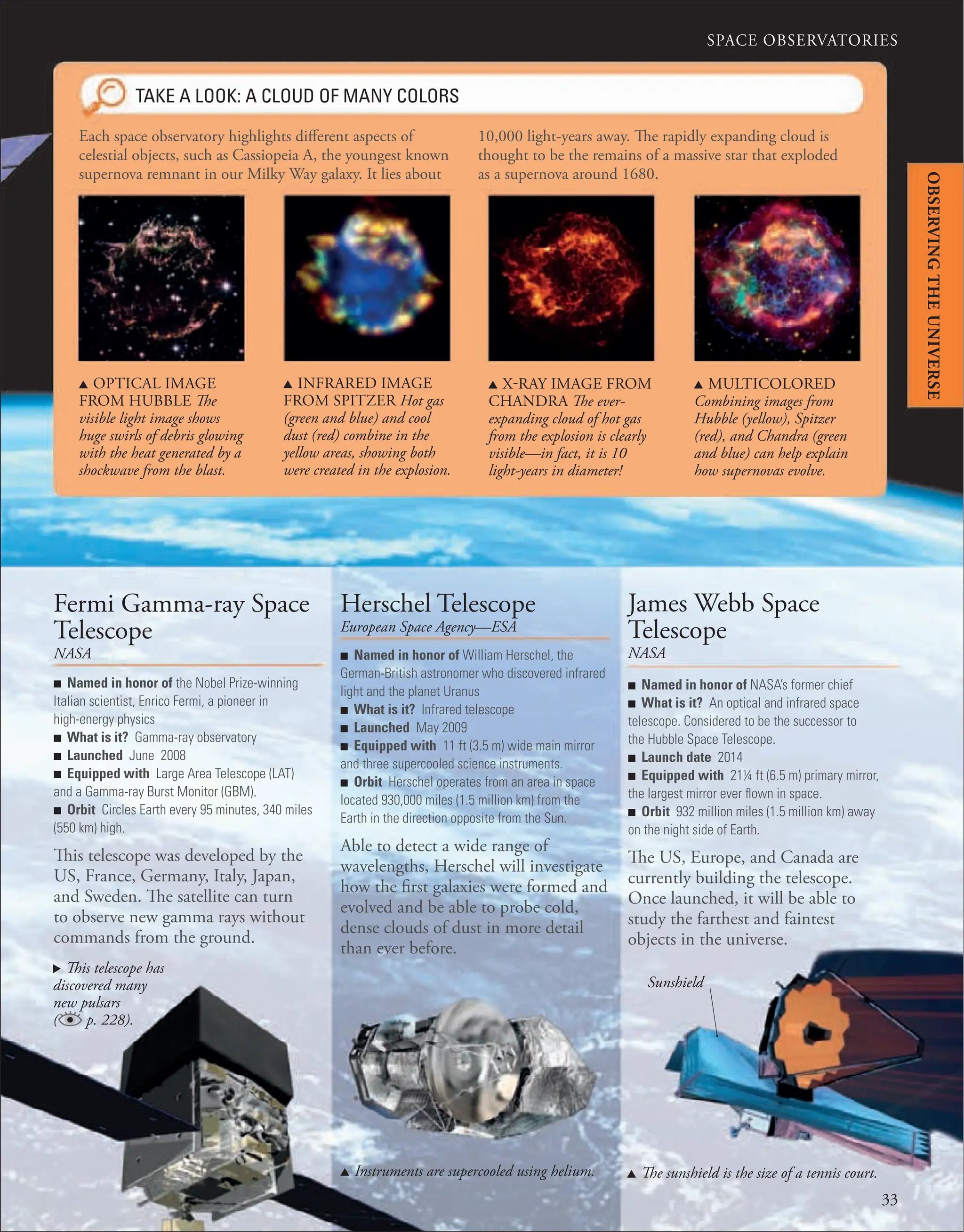
  • 12.
  • 13.
    We live onone tiny planet in the vast universe. Finding out what else is “out there” has been one of our biggest challenges, and it started with people simply staring at the sky. OBSERVING THE UNIVERSE
  • 14.
    8 What is space? Welive on a small, blue planet called Earth. It has a surface of liquid water and rock and is surrounded by a blanket of air called the atmosphere. Space begins at the top of the atmosphere. It is an unimaginably vast, silent, and largely empty place, but it has many amazing properties. Blacker than black In photos taken from space, our planet is surrounded by blackness. This shows how empty outer space is. Planets like Earth shine because they reflect light from the Sun. Stars shine because they produce huge amounts of energy by burning fuel. Most of space looks black because there is nothing there to produce or reflect light. THE EDGE OF SPACE Earth’s atmosphere does not end suddenly—it gets gradually thinner and thinner as you travel up from the ground. Most experts agree that outer space starts at a height of 60 miles (100 km). Yet even above this height, there is a layer of very thin air called the exosphere. Hydrogen and other light gases are slowly escaping into space from this outermost part of Earth’s atmosphere. FACT FILE ■ In the US, anyone who flies above an altitude of 60 miles (100 km) in a rocket or spacecraft gets a special badge called “astronaut wings.” ■ Our most common name for people who travel into space is “astronauts,” meaning star travelers. The Russians call them “cosmonauts,” meaning travelers through the universe, and the Chinese name is “taikonauts,” from their word for space. ■ A person who stepped out into space without a protective suit would quickly die. He or she would be unable to breathe, but would still have around 10 seconds to reach safety before losing consciousness. , THE ATMOSPHERE protects Earth’s surface from harmful radiation and the full heat of the Sun. At night, it stops heat from escaping into space. 6,000 miles 60 miles OUTER SPACE… , OUTER SPACE Even in places far from stars and planets, space contains scattered particles of dust or a few hydrogen atoms. , EXOSPHERE This top layer of the atmosphere extends up to 6,000 miles (10,000 km) above Earth. OBSERVING THE UNIVERSE
  • 15.
    9 H o t C o l d . BARBECUE ROLL Thisis a slow, rotating movement used to stop any part of a spaceship from getting either too hot or too cold. IN A VACUUM A place without any air or gas is called a vacuum. On Earth, air transfers heat from one place to another. In space, there is no air to distribute heat, so the sunlit side of a spacecraft gets very hot, while the other side is in darkness and gets very cold. Spacecraft have to be tested in a thermal vacuum chamber before they are launched to make sure that they can survive these extreme space temperatures. Sun u ESCAPING GRAVITY The space shuttle uses up all the fuel in its two booster rockets just to overcome gravity and reach outer space. Getting off the ground It is difficult to get into space because Earth’s gravity holds everything down. To overcome gravity and go into orbit, a rocket has to reach a speed of 17,500 mph (28,000 km/h), known as escape velocity. This requires a lot of fuel to provide energy. To reach the Moon and planets, spacecraft have to travel at an even higher speed—25,000 mph (40,000 km/h). WATCH THIS SPACE Anything that travels through space at a steady speed is weightless. This is why things inside a spacecraft float, and astronauts are able to lift huge satellites using just their hands. The weightlessness disappears if the spacecraft either slows down or speeds up. OBSERVING THE UNIVERSE
  • 16.
    10 Our place inspace Planet Earth is our home and to us it seems a very big place. Flying to the other side of the world takes an entire day, and sailing around the world takes many weeks. Yet in the vastness of the universe, Earth is just a tiny dot. In fact, an alien flying through our galaxy would probably not even notice our little planet. EARTH AND MOON Earth’s nearest neighbor is the Moon, our planet’s only natural satellite. The Moon is a lot smaller than Earth. Its diameter is only about one-quarter the diameter of Earth, and fifty Moons would fit inside Earth. Although it looks quite close, the Moon is actually about 240,000 miles (384,000 km) away. It takes a manned spacecraft three days to travel from Earth to the Moon. THE SOLAR SYSTEM Earth is just one of many objects that orbit the star we call the Sun. The Sun’s “family” consists of eight planets, five dwarf planets, hundreds of moons, millions of comets and asteroids, and lots of gas and dust. All these things together are called the solar system. The four small planets closest to the Sun are made of rock, while the four outer planets are a lot larger and made mostly of gases. Earth is the third planet out from the Sun and is just the right temperature to support life. The solar system is big—the Voyager spacecraft took 12 years to reach Neptune, the outermost planet. OBSERVING THE UNIVERSE
  • 17.
    11 THE MILKY WAY Thesolar system is located in a large spiral-shaped galaxy called the Milky Way and lies about 30,000 light-years from the center of the galaxy. The Sun is just one of at least 100 billion stars in this galaxy. The Milky Way is vast—it measures about 100,000 light-years across. That means that a spaceship traveling at the speed of light (186,000 miles or 300,000 km per second) would take 100,000 years to fly from one side of the galaxy to the other. The Milky Way is so big that the stars in it are usually a long way apart. The nearest star to our Sun is more than 4 light-years away. THE LOCAL GROUP The Milky Way is one of the largest galaxies in a cluster of about 45 galaxies, known as the Local Group. Most of these galaxies have no particular shape and are much smaller than the Milky Way. The two closest galaxies to the Milky Way are called the Large and the Small Magellanic Clouds. They lie about 200,000 light-years away and are easily visible with the naked eye from Earth’s southern hemisphere. The biggest galaxy in the Local Group is the Andromeda Galaxy—a great spiral galaxy, much like the Milky Way. It lies about 3 million light-years away, in the constellation of Andromeda. THE UNIVERSE The universe is everything that exists—all the stars, planets, galaxies, and the space between them. There are millions of galaxy clusters in the universe: in fact, wherever we look with telescopes, the sky is full of galaxies. And scientists estimate that there must be about 10 thousand billion billion stars in the universe—more than the number of grains of sand on all the beaches on Earth. ■ It would take a modern jet fighter more than a million years to reach the nearest star. ■ A light-year is the distance that light travels in one year. It is about 5.9 trillion, or 5.9 million million miles, (9 trillion km). ■ How big is the universe? No one knows, because we cannot see the edge of it—if there is one. All we do know is that the visible universe is at least 93 billion light-years across. FAST FACTS OBSERVING THE UNIVERSE
  • 18.
  • 19.
    A CIRCLE OFSTARS This time-exposure photograph was taken in late summer in British Columbia, Canada. The circular lines of light are the trails of northern polar stars. However, the stars are not moving—the trails appear because the camera gradually moves as Earth rotates on its axis. OBSERVING THE UNIVERSE
  • 20.
    14 Early ideas Compared witheverything else around us, Earth seems incredibly large. Ancient peoples believed it was the biggest and most important place in the universe and that everything revolved around it. These ideas only began to change very slowly after the introduction of the telescope in the early 1600s. Curving surface of Earth Line of sight d LAND AHOY! As the boat gets closer to the island, the sailor sees the tops of the mountains first. Then, as the boat moves over the curve, lower land comes into view. Ancient peoples watched the Sun, Moon, and stars very carefully. They saw that all of them traveled from east to west across the sky. Clearly, they were all going around a stationary Earth. For several thousand years, almost everyone believed that the Earth was at the center of the universe. The main problem with this idea was that it did not explain the movements of some of the planets—sometimes Mars or Jupiter appeared to stand still or even move backward. EARTH-CENTERED UNIVERSE Earth Sun FLAT EARTH OR ROUND EARTH? Stand on the seashore and look at the horizon. It seems to be flat. For a long time, people thought that Earth was flat and that if you went too far you would fall off the edge. However, it was gradually realized that Earth was round, like a giant ball. Nature provided several clues: ■ The shadow that the Earth casts on the Moon during a lunar eclipse is curved, not straight. ■ A sailor traveling due north or south sees stars appear and disappear over the horizon. On a flat Earth, he would always see the same stars. ■ A ship sailing over the horizon should simply get smaller and smaller if Earth is flat. In fact, the hull disappears first and the top of the sails last. OBSERVING THE UNIVERSE
  • 21.
    u ELLIPSES Weknow today that most planets orbit the Sun in a path that is not quite circular. Pluto’s orbit is a very stretched circle known as an ellipse. . Johannes Kepler . HE SAW IT COMING Hipparchus was the first person to develop a way of predicting solar and lunar eclipses. , A lunar eclipse u PYRAMID OF KUKULCAN This temple is built in honor of Kukulcan, the serpent god. When the Sun is in the right place it creates a shadow in the shape of a serpent. The ancient Greeks taught that the circle was the perfect shape. So it seemed logical to believe that all of the planets traveled in circles. Unfortunately, measurements showed that this did not fit their movements across the sky. One way around this was to add small circles to the larger circles, but even this did not work. The mystery was solved in 1609 when a German mathematician, Johannes Kepler, realized that the planets move along elliptical (oval) orbits. ORBITS Astounding astronomer One of the greatest early Greek astronomers was Hipparchus of Nicaea (190–120 bce). He discovered many things, including that Earth rotated on a tilted axis, which caused the seasons. He figured out the distance from Earth to the Moon by comparing views of a partial and total solar eclipse. He found that the Moon had an elliptical orbit and that its speed varied. He also cataloged all the stars in order of brightness and plotted their positions in the sky on the first star chart. Planet Sun WHAT A STAR! Polish astronomer Nicolaus Copernicus (1473–1543) was the first person of more modern times to realize that the Sun, not Earth, is at the center of the solar system. His ideas were extremely unpopular. THE CALENDAR Although ancient civilizations did not have telescopes, they did have instruments to measure angles and could measure the positions of the Sun and the stars. They used the movement of the Sun as their calendar and built monuments and temples that reflected the calendar. The Toltecs of Central America built the Pyramid of Kukulcan with 365 steps, one for each day of the year. OBSERVING THE UNIVERSE
  • 22.
    Telescopes Telescopes are instrumentsfor looking at things that are far away. Almost everything we know about space has been discovered by looking through telescopes. Optical telescopes can capture light from the deepest parts of space, but are limited by the size of their mirrors and lenses. . THE YERKES OBSERVATORY was funded by business tycoon Charles T. Yerkes, who had made his fortune developing Chicago's mass-transit system. REFRACTING TELESCOPE The first telescopes were refracting telescopes, which used lenses to bend and focus light. The biggest refracting telescope is at Yerkes Observatory in Wisconsin. Built in 1897, it is still used for looking at stars and tracking their movements through space. d THE YERKES TELESCOPE Built in 1897, the Yerkes telescope has a lens diameter of 40 in (100 cm) and weighs 6 tons (5.5 metric tons)—as much as an adult African elephant. OBSERVING THE UNIVERSE
  • 23.
    17 TAKE A LOOK:EARLY TELESCOPES . GALILEO'S DRAWINGS By 1610, Galileo had developed a much more powerful telescope. He used this to study the Sun ( p. 208), recording his observations in a series of drawings. , NEWTON'S TELESCOPE Isaac Newton made the first working reflector telescope in 1668. The first telescopes were made by Dutch spectacle-maker Hans Lippershey, in 1608. These were simple refracting telescopes made from a pair of glass lenses set into a tube. When the Italian astronomer Galileo Galilei heard about Lippershey's invention he quickly set about building an improved telescope with a greater magnification. u HANS LIPPERSHEY is said to have come up with his invention while watching two young boys playing with lenses. Mirror, mirror… Not all telescopes use glass mirrors—some use liquid metal instead. A shallow bowl of mercury or silver is spun at high speed until it forms a thin reflective surface. Liquid mirrors can only be used to look straight up. If they are tilted the liquid will fall out! EVEN BIGGER TELESCOPES Although reflecting telescopes can be built much bigger than refracting telescopes, they too will have problems if the mirror is more than 27 ft (8 m) across. Astronomers solve this problem by using a number of smaller mirrors that can be fitted together to make one big mirror. Each mirror section is controlled by a computer that can adjust its position by less than the width of a human hair. Refracting telescopes A refracting telescope uses a convex (outward curving) glass lens to collect and focus incoming light. An eyepiece is used to magnify the image. One problem with using lenses is that they are heavy. If they are too big they will start to sag, distorting the image. This limits the size and power of the refracting telescope. Reflecting telescopes A concave (inward curving) mirror focuses light toward a smaller mirror. This sends the beam of light to an eyepiece, which magnifies the image. Because mirrors are lighter than lenses, reflecting telescopes can be much bigger and more powerful than refracting telescopes. Lenses magnify the image Eyepiece Objective mirror Eyepiece Objective lens Small mirror OBSERVING THE UNIVERSE
  • 24.
    Giant telescopes The Haletelescope caused quite a stir when it was completed in 1948. Equipped with a 16 ft (5 m) mirror, it was the largest and most powerful telescope ever built. As technology has improved, telescopes have been built with mirrors up to 33 ft (10 m) across. Even larger telescopes are now planned, with mirrors of 100 ft (30 m) or more. TELL ME MORE... To get the best images, telescopes are placed at high altitude so they are above the clouds and most of the atmosphere. Remote mountains are ideal, since there is little light interference from nearby towns. Mauna Kea, an extinct volcano in Hawaii, is home to many telescopes. OBSERVING THE UNIVERSE
  • 25.
    GIANT TELESCOPES ■ Sizeof primary mirror 16 ft (5 m) ■ Location Palomar Mountain, California ■ Altitude 5,580 ft (1,700 m) Even today, more than 60 years after it was built, the Hale telescope is the second-largest telescope using mirrors made of a single piece of glass. Mirrors much larger than this tend to sag under their own weight, distorting the image received. Hale Telescope ■ Size of primary mirror 33 ft (10 m) ■ Location Mauna Kea, Hawaii ■ Altitude 13,600 ft (4,145 m) Until 2009, the twin Keck telescopes were the world’s largest optical telescopes. The Keck II telescope overcomes the distorting effects of the atmosphere by using a mirror that changes shape 2,000 times per second. Keck Telescopes ■ Size of primary mirror 27 ft (8.2 m) ■ Location Mount Paranal, Chile ■ Altitude 8,645 ft (2,635 m) The VLT array consists of four 27 ft (8.2 m) telescopes and four movable 4 ft (1.8 m) telescopes. The telescopes can work together by combining the light beams from each telescope using a system of underground mirrors. Very Large Telescope (VLT) Array ■ Size of primary mirror 28 ft (8.4 m) ■ Location Mount Graham, Arizona ■ Altitude 10,700 ft (3,260 m) The LBT has two 28 ft (8.4 m) primary mirrors mounted side-by-side that collect as much light as one mirror measuring 39 ft (11.8 m) across. The LBT is currently the largest and most powerful single telescope in the world. Large Binocular Telescope (LBT) ■ Size of primary mirror 26 ft (8 m) ■ Location North: Mauna Kea, Hawaii. South: Cerro Pacho, Chile ■ Altitude North: 13,822 ft (4,213 m). South: 8,930 ft (2,722 m) The twin Gemini telescopes are located on each side of the equator. Between them, they can see almost every part of both the northern and southern skies. The two telescopes are linked through a special high-speed internet connection. Gemini Telescopes ■ Size of primary mirror 138 ft (42 m) ■ Location Chile (unconfirmed) This revolutionary new telescope should come into operation in 2018. The primary mirror will be 138 ft (42 m) in diameter and will collect 15 times more light than the largest telescopes operating today. One of its main objectives is to locate Earth-like planets orbiting other stars. European Extremely Large Telescope (E–ELT) ■ Size of primary mirror 98 ft (30 m) ■ Location Mauna Kea, Hawaii ■ Altitude 13,287 ft (4,050 m) (unconfirmed) The $300 million TMT is expected to be completed in 2018. At its heart will be a primary mirror measuring 98 ft (30 m) in diameter, made up of 492 hexagonal segments. It will collect almost 10 times more light than one of the 33 ft (10 m) Keck telescopes. Astronomers will use the TMT to observe the formation of new galaxies. Thirty Meter Telescope (TMT) OBSERVING THE UNIVERSE
  • 26.
    20 ULTRAVIOLET (UV) X-RAYS GAMMA RAYS uGamma rays have the shortest wavelengths. They are released in an intense burst when a massive star collapses and explodes in a supernova. u The bright white areas around the rim of the Cartwheel Galaxy are thought to be neutron stars and black holes emitting powerful X-rays. u The blue areas in this image of the NGC 300 galaxy are regions of star formation. New stars give off mainly ultraviolet light. Seeing light Light, the fastest thing in the universe, is an energy wave moving at about 670 million mph (just under a billion km/h). That means it can travel from New York to London in just two-hundredths of a second—faster than the blink of an eye! WAVES OF ENERGY There are many types of energy wave. Scientists arrange them according to their wavelength. This is the distance between the peak of one wave and the next. The higher the energy of the wave, the shorter the distance between its peaks. The complete range of waves is known as the electromagnetic spectrum. u WHITE LIGHT contains a mixture of all the wavelengths of light in the visible spectrum. u WHEN A BEAM of white light strikes the surface of a prism, it is bent. But each different wavelength is bent by a slightly different amount, and this splits the light into its spectrum of colors. Now you see it If you look at a beam of light, it appears to be white. However, when white light hits a shaped piece of glass, called a prism, it splits into a rainbow. We call these colors, or wavelengths, of light the visible spectrum, because our eyes can see them. OBSERVING THE UNIVERSE
  • 27.
    21 SEEING LIGHT VISIBLE RAYSINFRARED MICROWAVES RADIO WAVES u The Sun’s visible light is only a tiny part of the energy that it radiates. Our eyes can’t see the other wavelengths, but we can feel infrared heat. u Using infrared enabled astronomers to see through the dust of the Milky Way. It revealed three baby stars that had not been seen before. u The leftover heat from the Big Bang was detected using microwaves. It is only 2.7 K above absolute zero, which is as cold as you can get. u These have the longest wavelengths. The massive black hole at the center of the galaxy Fornax A is a powerful source of radio waves, shown in orange. WAVELENGTH Using the spectrum Even though we can’t see all the wavelengths, we can detect them and use them to discover things that are usually invisible. All types of matter radiate some form of energy, which means they can be picked up by telescopes that are sensitive to different parts of the electromagnetic spectrum. Spectroscopy This technique uses color to determine what stars are made from and how hot they are. Every chemical element produces its own pattern of colored or dark lines when passed through a special prism. By looking at the patterns, scientists can tell which elements are present and how much energy the atoms have. . WE CAN USE light energy to measure the composition and heat of things. This is how we know that the Boomerang Nebula is the coldest object in space at 1 K. The colors we see are all part of the visible spectrum. Absorption spectra show patterns of black lines. Emission spectra show patterns of colored lines. ABSORPTION SPECTRA EMISSION SPECTRA . LIKE all other stars, our Sun has its own unique spectral fingerprint. Lines are caused by atoms that absorb or emit radiation at specific wavelengths. OBSERVING THE UNIVERSE
  • 28.
    Infrared astronomy We areall familiar with the colors of the rainbow—red, orange, yellow, green, blue, indigo, and violet. These colors are part of what is known as the visible spectrum. Beyond the red end of the spectrum is infrared light, which we call heat. Although we cannot see infrared light, we can detect it using special telescopes, which reveal things usually hidden by clouds of dust. , Infrared image of Saturn. The paler areas show where Saturn is warmest. 22 A GALAXY FAR, FAR AWAY... Messier 81 is a spiral galaxy located in the northern constellation of Ursa Major (the Great Bear). Messier 81, or “Bode’s Galaxy” as it is also known, is about 12 million light-years from Earth. M81 is easily visible through binoculars or small telescopes. In infrared light the spiral arms are very noticeable because they contain dust that has been heated by hot, massive, newly born stars. SATURN’S HOT SPOT Infrared images of Saturn reveal that it has a “hot spot”—the first warm polar cap to be discovered. This is the hottest part of Saturn and is 8–10 degrees warmer than at the equator. A huge storm, thousands of miles across, constantly rages over Saturn’s south pole. OBSERVING THE UNIVERSE
  • 29.
    INFRARED ASTRONOMY 23 TAKE ALOOK: CONSTELLATION ORION u VISIBLE LIGHT The stars of the constellation Orion. u INFRARED LIGHT Bright dust clouds surrounding Orion. Looking up at the constellation Orion you should be able to make out the stars that form its outline. You should also be able to see the bright patch of the Orion Nebula beneath Orion’s Belt. This nebula is a stellar nursery where new stars are being born. If you were to look at the Orion constellation through an infrared telescope you would see a huge dust cloud with bright patches where young stars heat the surrounding dust. The stars themselves are too hot to be seen in infrared light. u THIS IS HOW we usually see the Andromeda Galaxy, in visible light. The main infrared image (above) has revealed its spiral arms in greater detail. Their structure is very uneven, which suggests that Andromeda may have been affected by collisions with its two satellite galaxies in the past. Frederick William Herschel (1738–1822) was a German astronomer and musician. Using a prism to split sunlight and a thermometer to detect heat, Herschel proved that there are invisible forms of light that occur beyond the visible color spectrum. This invisible heat was later called “infrared”—meaning “below red.” WHAT A STAR! SPITZER SPACE TELESCOPE Infrared light from space is almost completely absorbed by Earth’s atmosphere, so infrared telescopes are placed on high mountains, on aircraft, or on satellites. NASA’s Spitzer Space Telescope is one of the most powerful infrared observatories. Spitzer took 18 hours and over 11,000 exposures to compose this image of the Andromeda Galaxy (below). u THE EYE IN THE SKY Resembling a giant eye in space, this infrared view of the Helix Nebula reveals a bright cloud of dust surrounding a dying star. OBSERVING THE UNIVERSE
  • 30.
    24 Messages from thestars American engineer Karl Jansky was the first to discover radio waves coming from space, using a homemade antenna in 1931. Today, scientists use radio waves to learn about all kinds of objects in space and have even attempted to contact alien life. Arecibo The largest single radio telescope in the world is Arecibo, on the Caribbean island of Puerto Rico. The telescope measures 1,000 ft (305 m) across and its dish is built into a dip in the hillside, with the radio receiver suspended 450 ft (137 m) above like a giant steel spider. Although Arecibo’s dish doesn’t move, its location near the equator means it can see a wide region of the sky. RADIO ASTRONOMY Radio astronomy is the study of objects in space that produce radio waves. Radio waves are like waves of light but are beyond the visible end of the spectrum. Invisible radio waves are detected by radio telescopes and can then be converted into images for us to see. Numbers, from one to 10, showing how we count. Symbols representing important chemicals found in life on Earth. The DNA molecule—the blueprint for life on Earth. A human form and the population of Earth. Earth’s position in the solar system. A symbol representing the Arecibo telescope. The Arecibo telescope has featured in Contact, a movie about first contact with extraterrestrial life, and the James Bond film Goldeneye. u IS THERE ANYBODY THERE? Arecibo was used to transmit this coded message into space in 1974. So far, we haven’t had a reply. Movie star OBSERVING THE UNIVERSE
  • 31.
    MESSAGES FROM THESTARS 25 TELESCOPE NETWORKS Very Large Array One of the most important radio astronomy observatories in the world is the Very Large Array (VLA) in New Mexico. The VLA has 27 dishes arranged in a Y shape. Each arm of the Y is almost 13 miles (21 km) long. When the radio signals from each dish are combined, the whole array is equal to a giant antenna 22 miles (36 km) wide. ■ Dish various sizes ■ Location various sites, UK MERLIN is a network of seven dishes across the UK. Operated from Jodrell Bank, it includes the 250 ft (76.2 m) Lovell telescope. Altogether, the network forms a telescope equal to a single dish 135 miles (217 km) wide. It is so powerful it can detect a coin up to 60 miles (100 km) away. MERLIN ■ Dish 82 ft (25 m) ■ Location Hawaii, Mainland United States, West Indies The Very Long Baseline Array (VLBA) is a system of 10 radio telescope antennas. The combined effect is equal to that of a single dish more than 5,000 miles (8,000 km) wide. The VLBA can see things in such fine detail that it is equivalent to a person standing in New York reading a newspaper in Los Angeles! VLBA The parabolic dish reflects the signal to the subreflector. The subreflector focuses the signal into the receiver. The 82 ft (25 m) wide dishes can be moved along tracks to change their positions. In this radio image, Jupiter is shown to be encircled by a belt of radiation. Jupiter calling Earth… The first radio signals from a distant planet were detected from Jupiter in 1955. Since then, all of the giant gas planets have been shown to produce radio waves. Radio signals can also be bounced off the rocky planets and asteroids. OBSERVING THE UNIVERSE
  • 32.
    26 Invisible rays Ultraviolet (UV)light, X-rays, and gamma rays are types of electromagnetic radiation emitted by extremely hot objects. They are invisible and most are absorbed by Earth’s atmosphere, so the best way to view them is with telescopes on high-flying balloons, rockets, or spacecraft. GAMMA RAY BURSTS Gamma rays are the most energetic form of light. Gamma ray bursts, known as GRBs, are caused when massive stars run out of fuel and collapse to form a neutron star or black hole. u THIS telescope was lifted by a balloon into the sky over the Arctic Circle. Since the Sun never sets there in the summer, the scientists could monitor the Sun all day. Flying high Although only in the air for six days, this helium balloon, part of a project called Sunrise, helped astronomers to get a unique look in UV light at how the Sun’s magnetic fields form. It lifted a large solar telescope 23 miles (37 km) into the sky, high above the obscuring effects of Earth’s atmosphere. WATCH THIS SPACE Some gamma ray bursts are so incredibly bright that they can actually be seen with the naked eye. One was spotted in March 2008 in the constellation Bootes, even though it was an astonishing 7.5 billion light-years away. , THE BALLOON was made of thin plastic and was 360 ft (110 m) wide—big enough to fit two Boeing 767 planes inside! Gamma rays Invisible rays OBSERVING THE UNIVERSE
  • 33.
    INVISIBLE RAYS THE SUN Withan optical telescope, we just see a scattering of dark sunspots on the Sun. When these spots are viewed with an ultraviolet-light telescope, hot, explosive solar flares can be seen. THE X-RAY MOON Scientists were surprised when they found that even fairly cold objects, like the Moon, can give off weak X-rays. Here, the visible Moon is compared with an X-ray image of the same area. The X-rays are produced when solar X-rays from the Sun bombard the Moon’s surface and excite the atoms in the rocks. Optical Optical Ultraviolet Extreme ultraviolet X-ray INTEGRAL The INTEGRAL space observatory is equipped with highly sensitive detectors that can view objects in X-rays, gamma rays, and visible light all at the same time. Sent into space in 2002, it circles Earth every three days on the lookout for explosive GRBs, supernova explosions, and black holes. SDO The Solar Dynamics Observatory (SDO) studies the Sun at many different wavelengths, particularly those at the extreme end of UV. Scientists use the data that it collects from its continuous observations to learn more about how solar activity affects life on Earth. 27 X-rays Ultraviolet (UV) rays Visible rays . USING EARTH as a shield to block emissions from distant black holes, INTEGRAL has discovered both strong and faint gamma ray and X-ray signals coming from our galaxy, possibly signals from neutron stars and black holes. OBSERVING THE UNIVERSE
  • 34.
    Hubble Space Telescope TheHubble Space Telescope (HST) is the most famous space observatory. Since being placed in a low Earth orbit by space shuttle Discovery in April 1990, Hubble has sent back a huge amount of scientific data and incredibly detailed images of objects in space. SERVICING MISSIONS Hubble is the only telescope designed to be serviced in space. A space shuttle flies alongside the telescope, takes hold of it with a robotic arm, and places it within the shuttle’s cargo bay. Astronauts can then perform repairs and replace old instruments. Blurred vision of space The HST mission met with a major setback when it was launched and the first images it sent back were blurry. The cause was eventually tracked down to a mirror that had been incorrectly polished and was too flat at the edges by about one-fiftieth of the width of a human hair! The problem was finally solved three years later when astronauts added lenses to correct the focus. WHAT A STAR! Edwin Hubble (1889–1953) was the first person to realize that there are other galaxies beyond the Milky Way and that these galaxies are moving away from each other as the universe expands. Almost every part of HST has been replaced during its lifetime. Once repaired and upgraded, it is released back into orbit. u Before repair u After repair OBSERVING THE UNIVERSE
  • 35.
    HUBBLE SPACE TELESCOPE 29 Eyeon the universe Hubble has taken images of the Moon, Pluto, and almost every planet in the solar system (it can’t do Mercury since it is too close to the Sun). It has also sent back amazing images of dust clouds where stars are dying and being born and provided images of thousands of galaxies. The picture on the right is of the Butterfly Nebula, a cloud of gas and dust ejected by a dying star. The image was taken by the HST’s newest and most advanced camera, installed in 2009. ■ Length 43 ft 4 in (13.2 m) ■ Diameter 13 ft 9 in (4.2 m) ■ Weight 24,490 lb (11,110 kg) ■ Launch date April 24, 1990 ■ Cost at launch $1.5 billion ■ Orbit 354 miles (569 km) above Earth ■ Speed 17,500 mph (28,000 km/h) HST FAST FACTS u GROUND CONTROL Hubble is controlled from the Goddard Space Flight Center in Maryland. u SIGNALS from TDRSS are received at the White Sands Ground Terminal in New Mexico. u SATELLITES Hubble communicates with the ground via NASA’s Tracking and Data Relay Satellite System (TDRSS). Hubble’s aperture door can be closed if it is in danger of letting light from the Sun, Earth, or Moon into the telescope. Solar panels: power generated by the panels is also stored in six batteries and used to power Hubble when it flies through Earth’s shadow. Secondary mirror Path of light Lyman Spitzer (1914–1997) developed the idea of a telescope in space and was instrumental in the design and development of the Hubble Space Telescope. WHAT A STAR! Instrument module Primary mirror: problems with the shape of the mirror were solved using corrective “eyeglasses.” OBSERVING THE UNIVERSE
  • 36.
    WITCHES AND GIANTS Theman in the Moon may be fiction, but there is a witch in space! The Witch Head Nebula is in the constellation Eridanus, a safe distance of 900 light- years from Earth. With her hooked nose and pointed chin, she glows blue in the reflected light of Rigel, a bright supergiant star (not seen in this picture). OBSERVING THE UNIVERSE
  • 37.
    31 u STAR LIGHTPismis 24 is an open cluster of stars. It contains three of the most massive stars ever observed. Stars are still forming in the glowing nebula (bottom). u EYE SEE YOU Shown in infrared light, the center of spiral galaxy NGC 1097 looks like an eye. A small companion galaxy is caught up in its arms on the left. u BUBBLE BLOWER Young star HH 46/47 blows out two jets of warm gas. The jets have crashed into the dust and gas around the star, forming huge bubbles. u F-ANT-ASTIC The “body” of the Ant Nebula is actually two lobes of fiery gas ejected from a dying star at speeds of up to 600 miles (1,000 km) per second. u JUMBO JET Looking like a tornado in space, HH 49/50 is a jet of churned up dust and gas ejected from a young star (off the top of the picture). It is 0.3 light-years long. u SQUARE-EYED The Retina Nebula has an unusual cylinder shape, appearing square from the side. Hot gas escapes from each end, and dust darkens the walls. OBSERVING THE UNIVERSE
  • 38.
    32 Observatories in space Mostof the high-energy particles and radiation emitted from objects in space are filtered out by the blanket of air around Earth. The moving atmosphere also causes shimmering or twinkling, making it hard to obtain sharp images. To study these objects it is much easier to observe them from space observatories. ■ Named in honor of the famous US scientist, astrophysicist Lyman Spitzer ■ What is it? Infrared telescope ■ Launched August 2003 ■ Equipped with 33 in (85 cm) wide main mirror and three supercooled science instruments. ■ Orbit Spitzer is in an unusual Earth-trailing orbit. As time goes by, it gradually drifts farther away from our planet. This allows uninterrupted viewing of a large part of the sky. This telescope takes images and studies the infrared light coming from some of the coolest objects in the universe, including dust clouds around stars where stars and planets are forming, and dusty galaxies. Spitzer Space Telescope NASA u Spitzer’s solar shield protects it from the Sun’s heat and Earth’s infrared radiation. ■ Named in honor of the Nobel Prize-winning scientist Subrahmanyan Chandrasekhar ■ What is it? X-ray observatory ■ Launched July 1999 ■ Equipped with four cylindrical mirrors nested inside each other. ■ Orbit Circles Earth every 65 hours in an elliptical orbit 6,200–86,500 miles (10,000–139,000 km) high. Chandra can detect X-rays from hot regions of the universe, such as exploded stars, galaxy clusters, and the edges of black holes. It can even observe X-rays from particles just before they fall into a black hole. The first X-ray emission it saw was from the supermassive black hole at the center of the Milky Way. Chandra NASA u Chandra flies 200 times higher than Hubble. ■ Named in honor of the famous 17th-century scientist Sir Isaac Newton. XMM stands for X-ray Multi-Mirror. ■ What is it? X-ray observatory ■ Launched December 1999 ■ Equipped with three X-ray telescopes, each containing 58 concentric mirrors that are nested inside each other. ■ Orbit Circles Earth every 48 hours in an elliptical orbit between 4,350 miles (7,000 km) and 70,800 miles (114,000 km) high. Since X-rays pass through ordinary mirrors, X-ray telescopes are equipped with curved mirrors fitted inside each other. The X-rays glance off these mirrors and reach the detectors. XMM-Newton European Space Agency—ESA u Starburst galaxy M82, the Cigar Galaxy. XMM-Newton can pick up faint X-rays that Chandra can not detect. OBSERVING THE UNIVERSE
  • 39.
    SPACE OBSERVATORIES 33 ■ Namedin honor of William Herschel, the German-British astronomer who discovered infrared light and the planet Uranus ■ What is it? Infrared telescope ■ Launched May 2009 ■ Equipped with 11 ft (3.5 m) wide main mirror and three supercooled science instruments. ■ Orbit Herschel operates from an area in space located 930,000 miles (1.5 million km) from the Earth in the direction opposite from the Sun. Able to detect a wide range of wavelengths, Herschel will investigate how the first galaxies were formed and evolved and be able to probe cold, dense clouds of dust in more detail than ever before. Herschel Telescope European Space Agency—ESA u Instruments are supercooled using helium. ■ Named in honor of NASA’s former chief ■ What is it? An optical and infrared space telescope. Considered to be the successor to the Hubble Space Telescope. ■ Launch date 2014 ■ Equipped with 21¼ ft (6.5 m) primary mirror, the largest mirror ever flown in space. ■ Orbit 932 million miles (1.5 million km) away on the night side of Earth. The US, Europe, and Canada are currently building the telescope. Once launched, it will be able to study the farthest and faintest objects in the universe. James Webb Space Telescope NASA TAKE A LOOK: A CLOUD OF MANY COLORS u X-RAY IMAGE FROM CHANDRA The ever- expanding cloud of hot gas from the explosion is clearly visible—in fact, it is 10 light-years in diameter! u MULTICOLORED Combining images from Hubble (yellow), Spitzer (red), and Chandra (green and blue) can help explain how supernovas evolve. u INFRARED IMAGE FROM SPITZER Hot gas (green and blue) and cool dust (red) combine in the yellow areas, showing both were created in the explosion. u OPTICAL IMAGE FROM HUBBLE The visible light image shows huge swirls of debris glowing with the heat generated by a shockwave from the blast. Each space observatory highlights different aspects of celestial objects, such as Cassiopeia A, the youngest known supernova remnant in our Milky Way galaxy. It lies about 10,000 light-years away. The rapidly expanding cloud is thought to be the remains of a massive star that exploded as a supernova around 1680. ■ Named in honor of the Nobel Prize-winning Italian scientist, Enrico Fermi, a pioneer in high-energy physics ■ What is it? Gamma-ray observatory ■ Launched June 2008 ■ Equipped with Large Area Telescope (LAT) and a Gamma-ray Burst Monitor (GBM). ■ Orbit Circles Earth every 95 minutes, 340 miles (550 km) high. This telescope was developed by the US, France, Germany, Italy, Japan, and Sweden. The satellite can turn to observe new gamma rays without commands from the ground. Fermi Gamma-ray Space Telescope NASA . This telescope has discovered many new pulsars ( p. 228). u The sunshield is the size of a tennis court. Sunshield OBSERVING THE UNIVERSE
  • 40.
    Unusual observatories Scientists todayuse all kinds of strange instruments to observe the universe. Here are a few of the more unusual ones from around the world. ■ Location Six stations around the world (California, Hawaii, Australia, India, Canary Islands, and Chile). ■ Function Studies sound waves from the Sun. These observatories study sound waves moving inside the Sun by detecting small quakes on its surface. These quakes excite millions of sound waves, each one carrying a message about the Sun’s interior. ■ Location Amundsen-Scott Research Station, South Pole ■ Equipped with 33 ft (10 m) telescope. ■ Function Observes microwave background radiation. In the Antarctic winter sunlight does not reach the South Pole, so it is dark day and night. The extremely dry air makes it a perfect location to search for tiny variations in the radiation left over from the Big Bang. South Pole Telescope (SPT) The Arcminute Cosmology Bolometer Array Receiver GONG The Global Oscillation Network Group ■ Location Three detectors in Washington and Louisiana states ■ Equipped with L-shaped observatory with 2.5 mile (4 km) long tubes containing laser beams and mirrors. ■ Function Searches for gravity waves. Gravity waves are thought to be ripples in space–time, possibly produced when black holes collide or supernovas explode. They may also have been generated in the early universe. Detecting them is so difficult that none have yet been found. LIGO The Laser Interferometer Gravitational-Wave Observatory d The telescope has to be supercooled to 1 ⁄4 of a degree above absolute zero, −459°F (−273°C). u THESE unassuming white containers contain highly sensitive equipment that monitors the Sun. 34 u If a gravity wave passes through Earth it will affect the light from the laser beams in the tubes. OBSERVING THE UNIVERSE
  • 41.
    ■ Location Theleft-hand side of the fuselage of a modified Boeing 747SP ■ Equipped with A 100 in (2.5 m) diameter reflecting telescope. ■ Function To observe the sky in visible and infrared light. The aircraft will fly above the clouds and most of the atmosphere at altitudes of between 7 and 9 miles (11 and 14 km) for up to eight hours at a time. It is hoped that SOFIA’s observations will answer questions about the creation of the universe. It is expected to be in use for 20 years. ■ Location 6,800 ft (2 km) underground in a working nickel mine, Sudbury, Ontario, Canada ■ Equipped with “Heavy” water in a 39 ft (12 m) diameter tank, surrounded by 9,600 sensors. ■ Function To study high-energy particles (neutrinos) from the Sun’s core and exploding stars. Neutrinos usually pass undetected through Earth, but when they collide with the heavy water atoms they produce light flashes, which are picked up by the sensors surrounding the tank. SOFIA The Stratospheric Observatory for Infrared Astronomy ■ Location A 16,500 ft (5,000 m) high plateau in the Atacama desert, Chile ■ Equipped with At least 66 antennas across 200 pads over 12 miles (18.5 km). ■ Function To observe the gas and dust of the cool universe. ALMA is a collection of 66 dishes up to 39 ft (12 m) across, that can operate together as a single, giant telescope. The dry climate, together with the thin atmosphere at such a high altitude, is perfect for clear views of infrared and microwave radiation from space. ALMA Atacama Large Millimeter/submillimeter Array SNO Sudbury Neutrino Observatory . SOFIA 747SP is able to keep its telescope pointing steadily at an object in space even if the aircraft is struck by turbulence. d The rock shields the detectors from cosmic rays. u TRANSPORTERS are used to move the giant antenna dishes to different positions. UNUSUAL OBSERVATORIES 35 OBSERVING THE UNIVERSE
  • 42.
  • 43.
    Ever-changing and fullof action, the universe contains everything that exists: all matter from the smallest atom to the largest galaxy cluster, the emptiness of space, and every single second of time. THE VIOLENT UNIVERSE
  • 44.
    38 What is theuniverse? The universe is everything that exists— planets, stars, galaxies, and the space between them. Even time is part of the universe. No one knows how big the universe is or where it starts and ends. Everything is so far away from our own little planet that light from stars and galaxies can take billions of years to reach us—so we see the universe as it looked billions of years ago. But we can use the information this light provides to discover how the universe began and how it might end. FUTURE UNIVERSE For many years, scientists believed that the pull of gravity from the stars and galaxies would gradually slow down the expansion of the universe. However, recent observations suggest that this expansion is accelerating. If it is true, the galaxies will get farther and farther apart. No more stars will form, black holes will disappear, and the universe will end as a cold, dark, lifeless, and empty place. , WE CAN find out what the universe was like early in its history by using different types of telescope. LIGHT-YEARS Telescopes are like time machines. They detect light that has traveled from distant stars and galaxies. This means that we see stars and galaxies as they were when the light started on its journey—thousands, or even billions of years ago. Astronomers measure the size of the universe in light-years. A light-year is the distance light travels in one year—about 6 trillion miles (9.5 trillion km). Light from the farthest galaxies we can see has taken about 13 billion years to reach us. We see them today as they were long before the Sun and Earth came into existence. Now you see it… Light travels through empty space at 186,000 miles a second (300,000 kilometers a second). At this speed, light waves could travel around the world seven times in a single second. THE VIOLENT UNIVERSE
  • 45.
    WHAT IS THEUNIVERSE? 39 Measuring distances Measuring distances in the universe is tricky. Many galaxies are so far away, the only thing we can use is light. Because the universe is expanding and stretching space, the wavelengths of light from an object also become stretched. Any dark lines in its spectrum move toward the red end, which astronomers call a “redshift.” By measuring the size of this redshift, astronomers can calculate the distances of the galaxies and how fast they are moving away from us. The oldest and fastest- moving galaxies are those with the biggest redshifts. Is our universe alone or are there other universes that we cannot see? No one knows, but some scientists believe that there might be many other universes. This structure may resemble an enormous bubbly foam in which some universes have not yet inflated. Some may have different physical laws and dimensions from ours. In theory, it may even be possible to connect one universe to another through a spinning black hole. However, no other universes can affect anything in our universe, so it is impossible to prove that they exist. Shape of the universe Since we live inside the universe it is hard to imagine that space has a shape. Scientists, however, think that it does have a shape and that this depends on the density of its matter. If it is greater than a critical amount then the universe is said to be closed. If it is less, then it is described as open (saddle-shaped). However, spacecraft observations have shown that the universe is very close to the critical density, so scientists describe it as flat. A completely flat universe has no edge and will go on expanding forever. u AS OBJECTS move away from us their light spectrum changes. By measuring the change we can work out how fast they are moving. , ALL the stars, dust, and gas we can see in the sky make up only a small part of the universe. Most of the universe is made of mysterious, invisible dark matter and dark energy ( p. 62–63). MULTIPLE UNIVERSES? TELL ME MORE... We can see and measure three dimensions of space—height, width, and depth. Time is a fourth dimension. Scientists believe the universe may have at least six other, hidden, dimensions. These are all curled up on each other and are infinitely tiny. Earth Open Closed Flat Star THE VIOLENT UNIVERSE
  • 46.
    40 Birth of theuniverse Scientists believe that the universe was born in a huge fireball about 13.7 billion years ago. This “Big Bang” was the beginning of everything: time and space, as well as all the matter and energy in the universe. INFLATION At the instant it began, the newborn universe was incredibly small and unimaginably hot and dense. Inside the fireball, energy was being turned into matter and antimatter. Then it began to expand and cool. For a tiny fraction of a second the expansion was quite slow, but then the universe shot outward. It has been expanding steadily ever since and might even be speeding up. Matter and antimatter Immediately after the Big Bang, huge amounts of energy were turned into particles of matter and mirror-image particles of antimatter. When the two types meet they destroy each other in a flash of radiation. If equal numbers of both had been created they would have wiped each other out. However, everything we can see in the universe today consists mainly of matter. The only explanation seems to be that, for some unknown reason, the Big Bang created slightly more matter than antimatter. BIG BANG Time 1. 0 seconds Fireball Temperature Quarks Electrons d THE BLUE AND PURPLE colors show X-rays being given off by matter and antimatter collisions as high-energy particles stream away from the white pulsar at the center of the image. u THE MOST COMMON particles in the universe today include quarks and electrons. They are the building blocks of all atoms. 1 The universe begins to expand from infinitely tiny to the size of a grapefruit. The huge amount of energy this releases kick-starts the formation of matter and antimatter. THE VIOLENT UNIVERSE
  • 47.
    41 By now theuniverse is the size of a football field. Huge numbers of matter and antimatter particles collide and destroy each other, creating more energy. The universe suddenly inflates and starts to cool. A new range of exotic particles form, including quarks and electrons. The universe is still too hot to form atoms, but quarks begin to group together and form heavier particles, particularly protons and neutrons. Protons and neutrons are particles that each contain three quarks. Once the expanding universe had enough protons and neutrons, they began to form very simple atomic nuclei, the basis of hydrogen and helium atoms. Most stars are made of these two types of atoms. Within three minutes of the Big Bang, almost all of the hydrogen and helium nuclei in the universe had been created. Helium nucleus 10 K 10 K 10 K 2. 10 seconds 4. 10 seconds 3 minutes 32 14 8 −43 −7 Neutron Proton BUILDING UP TO ATOMS 2 3 4 Which came first? There was no “before” the Big Bang because time and space did not exist. After the Big Bang, space began to expand and time began to flow. But neither could start until the other one began. It took scientists years to figure out this mind-boggling fact! FIRST THREE MINUTES During the first three minutes the universe cooled from being unbelievably hot to less than one billion degrees Kelvin. In the same period, it expanded from an area billions of times smaller than an atom to the size of our Milky Way galaxy. 3. 10 seconds 10 K 27 −35 u K stands for Kelvin, a temperature scale used by astronomers. 0 K equals −459°F (−273°C). It is the lowest possible temperature anything in the universe can reach. THE VIOLENT UNIVERSE
  • 48.
    42 It took hundredsof millions of years for stars, galaxies, and planets to start filling the universe. If the universe hadn’t begun to cool, the atoms they are made from would never have formed. THE FOGGY UNIVERSE Around 300,000 years passed before the first atoms started to form. This process began when the temperature of the universe dropped to about 3,000 K. In this cooler universe, protons and atomic nuclei were able to capture extremely tiny particles called electrons and become atoms. Until this point, the universe was very foggy—light could not travel far because it was constantly bouncing off atomic particles. This fog is why we cannot see anything that was happening at that time—even with the most powerful telescopes. 3,000 K 300,000 years An atom is the smallest piece of matter that can exist on its own. Atoms have a central core (the nucleus) made up of protons and neutrons. Circling the nucleus are electrons. The number of protons, neutrons, and electrons an atom has determines which element it is. When the first stars exploded as supernovas, the energy they released created new, heavier elements, such as carbon, oxygen, and iron. This process continues today. WHAT IS AN ATOM?
  • 49.
    43 Glowing embers ofthe Big Bang We cannot see any light from the Big Bang. However, we can detect a faint glow of radiation—known as the Cosmic Microwave Background (CMB)—that still covers the sky. This leftover radiation shows what the universe was like 300,000 years after it began. The map shows slightly warmer and cooler ripples. The first galaxies probably grew from the slightly cooler and denser (blue) patches of gas. FIRST STARLIGHT About 200 million years after the Big Bang, huge clouds of hydrogen and helium gas began to build up. The pull of gravity made the clouds collapse into dense clumps of atoms. As the clouds shrank and became hotter they ignited and formed the first stars. These stars didn’t last long before they exploded and helped produce new stars. BEGINNINGS OF GALAXIES Galaxies also began to form fairly soon after the first stars. Dense clouds of gas and young stars were pulled together by gravity and dark matter to form small galaxies and new stars. Gradually, these galaxies began colliding with each other to make larger galaxies. The Moon is held in orbit around Earth by the pull of gravity. The Big Bang also created four fundamental forces that affect the universe. These are gravity, the electromagnetic force, the weak nuclear force, and the strong nuclear force. Gravity is what keeps planets in orbit around stars. Electromagnetism is linked to electricity and magnetism. The weak force governs how stars shine, while the strong force holds together the protons and neutrons in the nuclei of atoms. Present day 100 K 10 K 200 million years 500 million years u THE CMB provides the best evidence for the Big Bang. It marks the point at which the temperature dropped enough for atoms to form. Scientists cannot see what the universe was like immediately after the Big Bang. But they are trying to learn more by building huge machines on Earth. The latest and most advanced of these is the Large Hadron Collider in Switzerland. This $4 billion instrument will attempt to re-create the Big Bang by crashing beams of protons together 800 million times a second. The beams that collide are expected to create many new particles and possibly provide a reconstruction of the universe in its very first moments. FUNDAMENTAL FORCES THE BIG BANG MACHINE 2.7 K THE VIOLENT UNIVERSE
  • 50.
    100 billion galaxies Whereverwe look in the sky, the universe is full of galaxies—huge star systems that are tied together by gravity. The first galaxies were born less than one billion years after the birth of the universe in the Big Bang. 44 GIANTS AND DWARFS There are at least 100 billion galaxies in the universe. Some are enormous, containing hundreds of billions of stars. Others are much smaller, sometimes containing fewer than a million stars. There are many more small galaxies than giant galaxies, even though the dwarf galaxies tend to be swallowed by their larger neighbors over time. We live in a galaxy of about 100 billion stars called the Milky Way. THE VIOLENT UNIVERSE
  • 51.
    M51 GALAXY 100 BILLIONGALAXIES 45 HUBBLE DEEP FIELD For 10 days in October 1998, the Hubble Space Telescope stared at a tiny region of space, revealing a view never seen before— thousands of galaxies up to 12 billion light-years away. It features many spiral galaxies like our Milky Way, as well as elliptical galaxies and peculiar-shaped galaxies that are involved in collisions. TAKE A LOOK: WHIRLPOOL By the mid-19th century, astronomers had discovered many fuzzy patches in the night sky, which they called nebulas. To find out more about them, Lord Rosse built what was then the world’s largest telescope—the 72 in (1.8 m) Birr telescope. With it, he made the first observation of what is now known as the Whirlpool Galaxy (M51). His drawing of the galaxy is dated 1845. GAS GALAXIES Some galaxies are very large, yet contain very few stars. These faint galaxies are made almost entirely of gas, so in photos they appear as a smudge in the sky. One example, Malin 1, contains enough gas to make 1,000 galaxies like the Milky Way. It seems to have just begun to make stars. Its vast, but faint, disk is six times bigger than the Milky Way. A much closer, normal galaxy can be seen at the bottom of the picture. The arrow points to Malin 1. It can be seen better in this treated image. Seeing the light There are many features of galaxies that do not show up in visible light. To find out the true nature of a galaxy, you have to look at it at different wavelengths with different instruments. The above image of M51 combines images taken by four space telescopes. One showed up X-rays given off by black holes, neutron stars, and the glow from hot gas between the stars (shown in purple). Infrared and optical instruments revealed stars, gas, and dust in the spiral arms (in red and green). Young, hot stars that produce lots of ultraviolet light are blue. This Hubble Space Telescope image is of Zwicky 18, a dwarf galaxy about 60 million light-years away. M51, the Whirlpool Galaxy, is about 30 million light-years from Earth. ZWICKY 18 THE VIOLENT UNIVERSE
  • 52.
    Galaxy formation Galaxies haveexisted for many billions of years—but where did they come from? Astronomers today use observatories to look back to the very early universe. These distant views show fuzzy galaxies involved in violent collisions. Could this be how the first galaxies formed? 46 46 u YOUNG SPIRAL NGC 300 is a young spiral galaxy with lots of star formation. u TEENAGE TRANSITION As the galaxy grows older, there is less star formation. u OLD ELLIPTICAL Large, gas-poor elliptical galaxies contain old stars. u THEORY TEST This computer model shows matter clumping into strands under the influence of gravity. The first galaxies form inside these strands. WHAT HAPPENS? There are two main theories of how galaxies form. In one version, huge clouds of gas and dust collapse to form galaxies. In the other version, stars form into small groups and then merge to form larger groups, then galaxies, and finally clusters of galaxies. Changing shape Many galaxies begin life as small spirals before becoming larger ellipticals, often as the result of a collision. This doesn’t mean that the galaxies crash into each other—the gaps between the stars in a galaxy are large enough for the galaxies to pass through each other. However, it does change the galaxy’s shape. THE VIOLENT UNIVERSE
  • 53.
    , SMOKIN’! TheCigar Galaxy is an irregular galaxy with a lot of star formation. More stars are formed in young galaxies than in older ones. u BLUE RING Clusters of hot blue stars dominate the ring. They may be the remains of another galaxy that came too close. u IRREGULAR These galaxies sometimes have the beginnings of spiral arms. u ELLIPTICAL There is no gas in an elliptical galaxy so no new stars can form. u SPIRAL Spirals rotate very slowly, about once every few hundred million years. TYPES OF GALAXY There are three main types of galaxy. These are classified according to their shape and the arrangement of stars inside them. ■ Irregular galaxies contain a lot of gas, dust, and hot blue stars, but have no particular shape. They are often the result of a collision between two galaxies. ■ Elliptical galaxies are round, oval, or cigar-shaped collections of stars. They usually contain very old red and yellow stars with little dust or gas between them. ■ Spiral galaxies are huge, flattened disks of gas and dust that have trailing arms. Odd one out Hoag’s Object is a very unusual galaxy. It does not look like other irregular, spiral, or elliptical galaxies. Instead, it has a circle of young blue stars surrounding its yellow nucleus (core) of older stars. GALAXY FORMATION 47 STARTING A SPIRAL Most scientists believe that the early universe was filled with hydrogen and helium. Some suggest that clouds of gas and dust, collapsing and rotating under the influence of gravity, formed spiral galaxies. u COME TOGETHER Clouds of dust, gas, and stars are pulled together by gravity. u TURN AROUND Gravity makes the collapsed clouds rotate. New stars form and rotate around the center of the mass. u SHRINK DOWN The spinning action flattens the cloud, forming a galactic disk of dust, gas, and stars. u TAKING UP ARMS The disk continues to rotate, causing spiral arms to form. THE VIOLENT UNIVERSE
  • 54.
    A SOMBRERO INSPACE Around 28 million light-years from Earth, in the constellation Virgo, lies a spiral galaxy with a very bright nucleus. It has an unusually large central bulge and is surrounded by a dark, inclined lane of dust (shown here in a side-on view). Named for its hatlike appearance, this is the Sombrero Galaxy. THE VIOLENT UNIVERSE
  • 55.
    Other documents randomlyhave different content
  • 57.
  • 59.
  • 61.
  • 63.
  • 65.
  • 67.
  • 68.
    Welcome to ourwebsite – the perfect destination for book lovers and knowledge seekers. We believe that every book holds a new world, offering opportunities for learning, discovery, and personal growth. That’s why we are dedicated to bringing you a diverse collection of books, ranging from classic literature and specialized publications to self-development guides and children's books. More than just a book-buying platform, we strive to be a bridge connecting you with timeless cultural and intellectual values. With an elegant, user-friendly interface and a smart search system, you can quickly find the books that best suit your interests. Additionally, our special promotions and home delivery services help you save time and fully enjoy the joy of reading. Join us on a journey of knowledge exploration, passion nurturing, and personal growth every day! ebookbell.com