2
Motivation
• Why arestructural loads important?
– Structural loads are needed to estimate stresses on structural
elements
– Stress analyses tell us whether or not an element would fail in
service
• Since many sources of sounding rocket structural loading are
statistical, it’s necessary to think in terms of the probability that an
element would fail in service
• Keep in mind that it’s often necessary to iterate a design to obtain
adequate strength and stiffness without excessive weight
3.
3
Loading Conditions
• Loadingconditions are associated with a trajectory state and event
at which maximum loading on a(n) element(s) might occur
– Selected using engineering judgment
• For our 10 k rocket, these conditions might include
– Burnout/maximum dynamic pressure/maximum Mach number
(these events happen more or less simultaneously)
– Drogue parachute deployment
– Maximum pressure difference …(internal – external) pressure
– Ground impact
• The first three are amenable to analysis; the fourth must be
addressed empirically
– BENDIT (the focus of these charts) addresses only the first two
– BLOWDOWN computes pressure difference
4.
4
Burnout Flight Loads
•Flight experience suggests that this condition is the most important
one for most structural elements
• Rocket behaves like a rigid
second order mass, spring &
dash pot system
• Damping (the dash pot) is
positive, but negligibly small
• Therefore, rocket is
dynamically stable
• All perturbations will cause the
rocket to oscillate in angle of
attack as though there were an
axle through the C.G.
• Maximum air loading occurs at
the peak of the angle of attack
oscillation
Mass
Dash Pot
Spring
CG
CP
(mass
centroid)
(lift
centroid)
5.
5
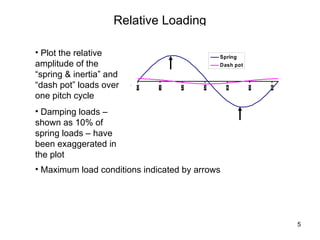
Relative Loading
Relative Loading
01 2 3 4 5 6
Phase
Amplitude
Spring
Dash pot
• Plot the relative
amplitude of the
“spring & inertia” and
“dash pot” loads over
one pitch cycle
• Damping loads –
shown as 10% of
spring loads – have
been exaggerated in
the plot
• Maximum load conditions indicated by arrows
6.
6
Body Elements
• Considerthe body to be composed of a sequence of body elements
– Element boundaries often are located at bulkhead stations
• A free body diagram for the ith
element looks like
+
z
+z
+x
+Mi
+Mi+1
+Si+1
xi
CNiq Sref
xCPi
xCGi
+Si
• Notation
• xi = Forward body station of the element
• xCGi = Element CG body station
• xCPi = Element CP body station
• Si = Shear force acting at body station xi
• Mi = Bending moment acting at body station xi
• CNi q Sref = Aerodynamic normal force acting on the element
7.
7
Body Elements, cont’d
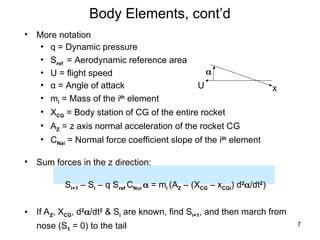
•More notation
• q = Dynamic pressure
• Sref = Aerodynamic reference area
• U = flight speed
• α = Angle of attack
• mi = Mass of the ith
element
• XCG = Body station of CG of the entire rocket
• AZ = z axis normal acceleration of the rocket CG
• CNai = Normal force coefficient slope of the ith
element
• Sum forces in the z direction:
Si+1 – Si – q Sref CNi = mi (AZ – (XCG – xCGi) d2
/dt2
)
• If AZ, XCG, d2
/dt2
& Si are known, find Si+1, and then march from
nose (S1 = 0) to the tail
U x
8.
8
Body Elements, cont’d
•Rocket CG:
XCG = ∑ mi xCGi / ∑ mi
• Normal acceleration:
AZ = – q Sref ∑ CNi / ∑ mi
• Sum the torques about the element CG:
Mi – Mi+1 + Si (xCGi – xi) + Si+1 (xi+1 – xCGi) + q Sref CNi (xCGi – xCPi)
= Ji d
dt
• More notation:
• Ji = Pitch moment of inertia of the ith element about its CG
• IYY = Pitch moment of inertia of the entire rocket
• Find IYY from parallel axis theorem:
IYY = ∑ Ji + mi ( XCG – xCGi)2
9.
9
Body Elements, cont’d
•Last equation needed is that for the rigid body pitch motion
IYY d2
/dt2
= q Sref ∑ CNi (XCG – xCPi)
• Finally, regard as the key driving variable
• If the shear force and bending moment vanish at the nose tip
S1 = M1 = 0,
• Then given a marching solution is easy to construct in BENDIT
• Start by computing XCG, IYY, AZ and d2
/dt2
• Then find S2 and M2, then S3 and M3, etc.
• Don’t forget to check that S and M vanish at the aft end!
10.
10
Fin Loading
• Estimateloading normal to the
plane of a fin with strip theory
• Local angle of attack of a strip of
fin (with body upwash) is
Airfoil
U
R
local
local = (1(R/y)2
) + F – R y/U
• Aerodynamic normal force NF acting on a strip
NF = q c(y) y CNF local
• More notation
• F = Fin cant angle
• R = Roll rate
• y = Distance from rocket centerline to the strip
• R = Body radius
• c(y) = Chord of the strip at spanwise station y
• y = Span of the strip
• CNF = Fin panel normal force coefficient slope (without
NF
11.
11
A Statistics Mini-Tutorial
•Cause & Effect
• When an effect (an event) is
due to the sum of many
small causes, the effect’s
probability distribution is
often normal or gaussian (a
bell curve)
• This is the famous Central
Limit Theorem
f(x) =
Normal Probability Distribution
0
0.05
0.1
0.15
0.2
0.25
0.3
0.35
0.4
0.45
-3 -2 -1 0 1 2 3
(x-mu)/sigma
sigma*f(x)
σ
f(x)
Normal Probability Distribution
(x – μ)/σ
σ√2π
1 exp( – ((x – μ)/σ)2
)
• More notation
• f(x)dx = Probability that event x lies between x and x + dx
• μ = Mean value of x
• σ = Standard deviation of x
12.
12
Angle of Attack
•Nearly all of the angle of attack is due two just two causes
• Wind gusts
• Alpha is due to gusts encountered at many levels
• Thrust misalignment
• Alpha is due to many structural misalignments
• Gusts and thrust misalignment are statistically independent
• Neither gusts nor thrust misalignment cause a significant mean angle of
attack
• However the standard deviation of their combined angle of attack is the
familiar RSS of independent variables:
σα
2
= σαG
2
+ σαT
2
• More notation
• σα = Standard deviation in angle of attack
• σαG = Standard deviation in gust angle of attack
• σαT = Standard deviation in thrust misalignment angle of attack
13.
13
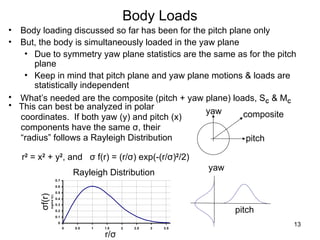
Rayleigh Distribution
0
0.1
0.2
0.3
0.4
0.5
0.6
0.7
0 0.51 1.5 2 2.5 3 3.5 4
r/sigma
sigm
a*f(r)
Body Loads
• Body loading discussed so far has been for the pitch plane only
• But, the body is simultaneously loaded in the yaw plane
• Due to symmetry yaw plane statistics are the same as for the pitch
plane
• Keep in mind that pitch plane and yaw plane motions & loads are
statistically independent
• What’s needed are the composite (pitch + yaw plane) loads, SC & MC
yaw
pitch
composite
• This can best be analyzed in polar
coordinates. If both yaw (y) and pitch (x)
components have the same σ, their
“radius” follows a Rayleigh Distribution
Rayleigh Distribution
r/σ
σf(r)
r2
= x2
+ y2
, and σ f(r) = (r/σ) exp(-(r/σ)2
/2)
pitch
yaw
14.
14
Body Loads, cont’d
•If our marching solutions for shear force and bending moment were
based on σα then the result will be the pitch plane standard deviations in
shear force and bending moment as a function of body station
• More notation
• σSP(xi) = standard deviation in pitch plane shear force at station xi
• σMP(xi) = standard deviation in pitch plane bending moment at
station xi
• CDL (xi)= Composite design load (shear force or bending moment)
at body station xi
• Pr = Probability that CDL loads will not be exceeded in flight
• Since both pitch and yaw loading standard deviations are the same, the
Rayleigh distribution can be integrated and solved for the probability
CDL(xi) = (σSP(xi) or σMP(xi)) √ - 2 log (1 – Pr)
15.
15
Fin Loads
• Finsare loaded in one plane only
• But, a mean cant angle causes a mean roll rate that induces mean
loading on fins
• And, because fin load statistics are one-dimensional gaussian, there
is no simple formula that relates mean and standard deviation to the
probability that a load will be exceeded
• A relationship does exist, but is numerical in nature
• Implemented in BENDIT
16.
16
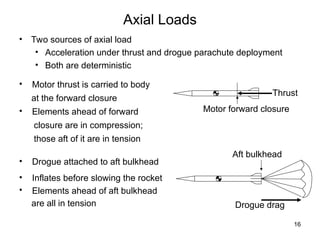
Axial Loads
• Twosources of axial load
• Acceleration under thrust and drogue parachute deployment
• Both are deterministic
Thrust
Motor forward closure
• Motor thrust is carried to body
at the forward closure
• Elements ahead of forward
closure are in compression;
those aft of it are in tension
• Drogue attached to aft bulkhead
• Inflates before slowing the rocket
• Elements ahead of aft bulkhead
are all in tension Drogue drag
Aft bulkhead
17.
17
Summary
• Don’t beafraid to ask your questions or to seek further
understanding
• Home phone (with answering machine) (310) 839-6956
• Email houltight@aol.com
• Address 4363 Motor Ave., Culver City, CA 90232
• The only dumb question is the one you were too scared to ask