Open-Ended Lab-2
MEASUREMENT OF NOISE
LEVEL IN ENVIRONMENT:
JAIL ROAD
Group-3
SEE-503 Fundamentals of Environmental Engineering
Objective:
To measure the pollution produce
due to sound and its effect on
surroundings specially on humans.
Introduction:
An ecological imbalance among the
constituents of the environment causes
environmental pollution. When sound
level increases beyond the permissible
limits, it causes noise pollution and traffic
is one of the sources of noise pollution. An
increase in traffic density at the roads
enhances the noise level, and adds to the
noise pollution.
MATERIALAND METHODS:
Jail Road Faisalabad is selected as site
to check noise level.
A sound level application “sound
meter” downloaded by app store set is
used to measure the noise level.
The noise was measured at a distance
of 25 feet from the center of the road.
Results:
Figure 1: Value Calculated at Monday Figure 2: Value Calculated at Tuesday
Figure 3: Value Calculated at Wednesday Figure 4: Value Calculated at Thursday
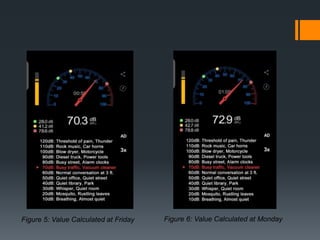
Figure 5: Value Calculated at Friday Figure 6: Value Calculated at Monday
Figure 7: Value Calculated at Tuesday
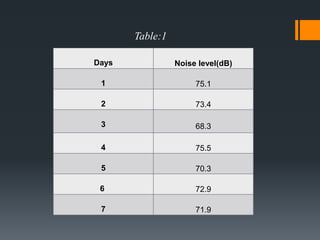
Days Noise level(dB)
1 75.1
2 73.4
3 68.3
4 75.5
5 70.3
6 72.9
7 71.9
Table:1
Highest and Lowest Values:
We note highest value on Thursday
which is 75.5 dB while lowest value
on Wednesday which is 68.3 dB
Effect on Health:
The health effect of noise is auditory
damage, which includes in hearing loss.
This is frequently caused by heavy
traffic noise. In this way, noise pollution
also causes sleeplessness, vegetative
hormonal reaction and damage of
hearing organs.
Conclusions:
 We performed this experiment at jail road
and found out that the sound quality was very
disturbing there.
 According to the local survey there were
1,044,837 vehicles registered in eight months
in Pakistan. In Faisalabad 84,674 vehicle
were registered. Such heavy traffic causes
enormous noise pollution, which results in
annoyance, discomfort and trouble and even
fear or limitation in the behavior.

Sound pollution.pptx

  • 1.
    Open-Ended Lab-2 MEASUREMENT OFNOISE LEVEL IN ENVIRONMENT: JAIL ROAD Group-3 SEE-503 Fundamentals of Environmental Engineering
  • 2.
    Objective: To measure thepollution produce due to sound and its effect on surroundings specially on humans.
  • 3.
    Introduction: An ecological imbalanceamong the constituents of the environment causes environmental pollution. When sound level increases beyond the permissible limits, it causes noise pollution and traffic is one of the sources of noise pollution. An increase in traffic density at the roads enhances the noise level, and adds to the noise pollution.
  • 4.
    MATERIALAND METHODS: Jail RoadFaisalabad is selected as site to check noise level. A sound level application “sound meter” downloaded by app store set is used to measure the noise level. The noise was measured at a distance of 25 feet from the center of the road.
  • 5.
    Results: Figure 1: ValueCalculated at Monday Figure 2: Value Calculated at Tuesday
  • 6.
    Figure 3: ValueCalculated at Wednesday Figure 4: Value Calculated at Thursday
  • 7.
    Figure 5: ValueCalculated at Friday Figure 6: Value Calculated at Monday
  • 8.
    Figure 7: ValueCalculated at Tuesday
  • 9.
    Days Noise level(dB) 175.1 2 73.4 3 68.3 4 75.5 5 70.3 6 72.9 7 71.9 Table:1
  • 10.
    Highest and LowestValues: We note highest value on Thursday which is 75.5 dB while lowest value on Wednesday which is 68.3 dB
  • 11.
    Effect on Health: Thehealth effect of noise is auditory damage, which includes in hearing loss. This is frequently caused by heavy traffic noise. In this way, noise pollution also causes sleeplessness, vegetative hormonal reaction and damage of hearing organs.
  • 12.
    Conclusions:  We performedthis experiment at jail road and found out that the sound quality was very disturbing there.  According to the local survey there were 1,044,837 vehicles registered in eight months in Pakistan. In Faisalabad 84,674 vehicle were registered. Such heavy traffic causes enormous noise pollution, which results in annoyance, discomfort and trouble and even fear or limitation in the behavior.