ENGLISH 6 QUARTER 1
WEEK 1, DAY 1
Analyze sound devices
( onomatopoeia, alliteration, assonance,
consonance)
Introduce yourself
Name:
Age:
Where are you from:
Favorite color, food and animals:
SOUND DEVICES
PERFORMANCE STANDARD
• Demonstrate understanding of
various linguistics nodes to
comprehend various texts.
CONTENT STANDARD
• Uses linguistic cues to
appropriately construct
meaning from variety of texts
for a variety of purposes.
SOUND DEVICES ENGRC-Ia-2.3.1
ENGRC-Ia-2.3.2
ENGRC-Ia-2.3.3
Let’s Study This
Poems are pieces of writing
written in separate lines that usually
have figurative language, repeated
and irregular rhythm, rhyme. They
convey experiences, ideas, or
emotions in a vivid and imaginative
way.
Let’s Study This
Poems also have sound
devices. Sound devices are tools
used by poets to convey and
reinforce the meaning or experience
of poetry through the skillful use of
sound.
SOUND DEVICES
6
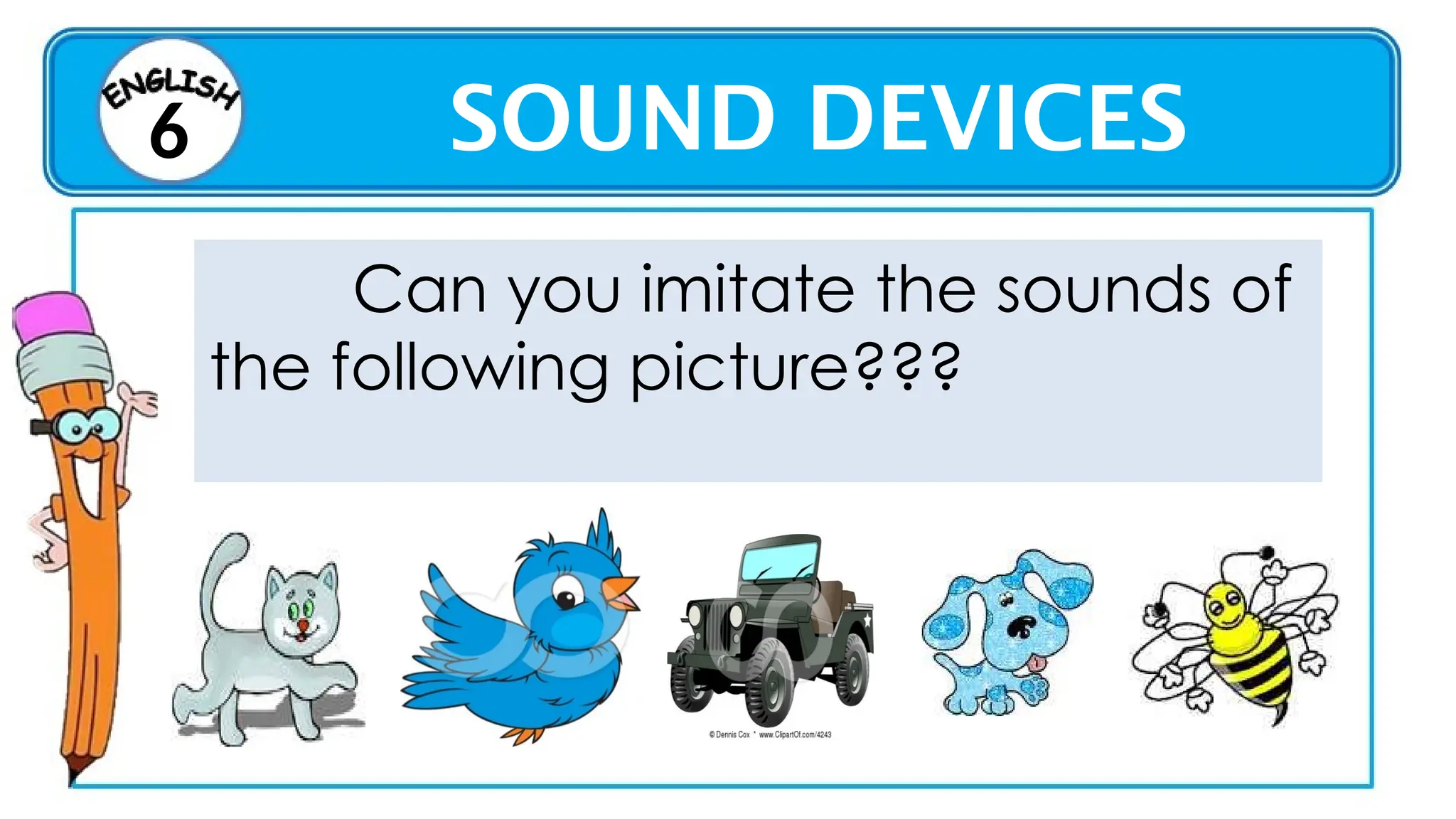
Can you imitate the sounds of
the following picture???
Types of Sound Devices
Onomatopoeia - This is a sound device
which refers to the use of words with their
meaning
Examples: The bang of a gun
The buzz of a bee
The hiss of a snake
The pop of a firecracker
Types of Sound Devices
Alliteration - This is the repetition of the
same initial consonant sounds of at least
two words in a line of poetry.
Example: the frog frolicked frivolously on the
forest floor.
Little skinny shoulder blades sticking
through your clothes
…struck out by a steed flying fearless and
fleet
Types of Sound Devices
Assonance - This is the repetition of
vowel sounds at the beginning,
middle or end of at least two words
in a line of poetry.
Example: “The cat sat on the mat’’
Types of Sound Devices
Consonance - This is the repetition of
consonant sounds at the middle or end
of at least two words in a line of poetry.
Example:
Mammals named Sam are clammy
What is alliteration?
Onomatopoeia?
Assonance?
Consonance?
SOUND DEVICES
SOUND DEVICES
ALLITERATION
ONOMATOPOEIA
ASSONANCE
CONSONANCE
Let’s Do This
TITLE OF THE POEM : “THE BELLS” by Edgar Allan Poe
ALLITERATION ASSONANCE CONSONANCE
Task 1. Fill Out the Table!
Listen as your teacher reads a poem. As you listen, take down
the words from the poem that exemplify the following sound
devices: ALLITERATION, ASSONANCE and CONSONANCE. Write
your answers in each column.
Read, Analyze, Pick Out!
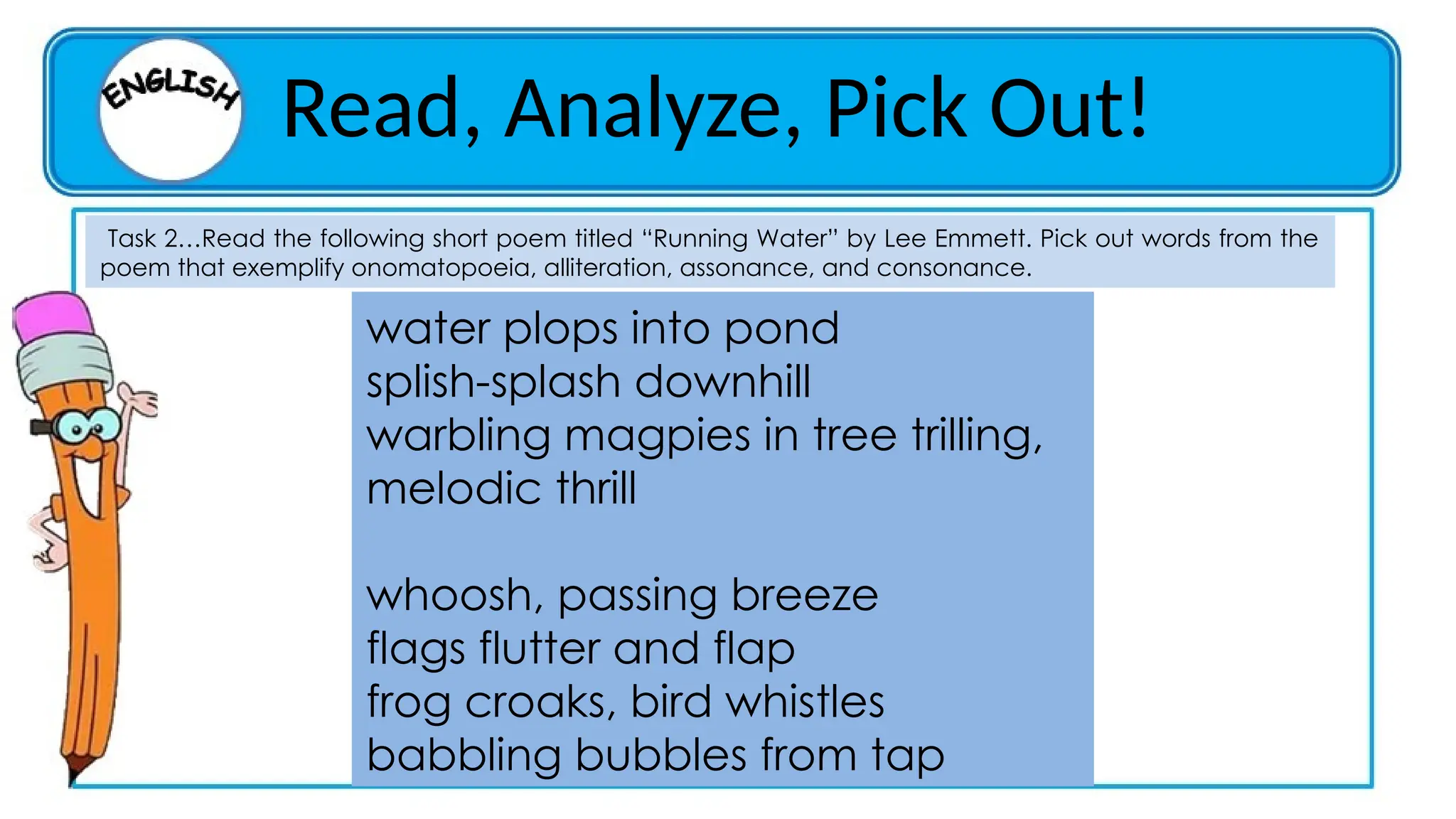
Task 2…Read the following short poem titled “Running Water” by Lee Emmett. Pick out words from the
poem that exemplify onomatopoeia, alliteration, assonance, and consonance.
water plops into pond
splish-splash downhill
warbling magpies in tree trilling,
melodic thrill
whoosh, passing breeze
flags flutter and flap
frog croaks, bird whistles
babbling bubbles from tap
EVALUATING
LEARNING
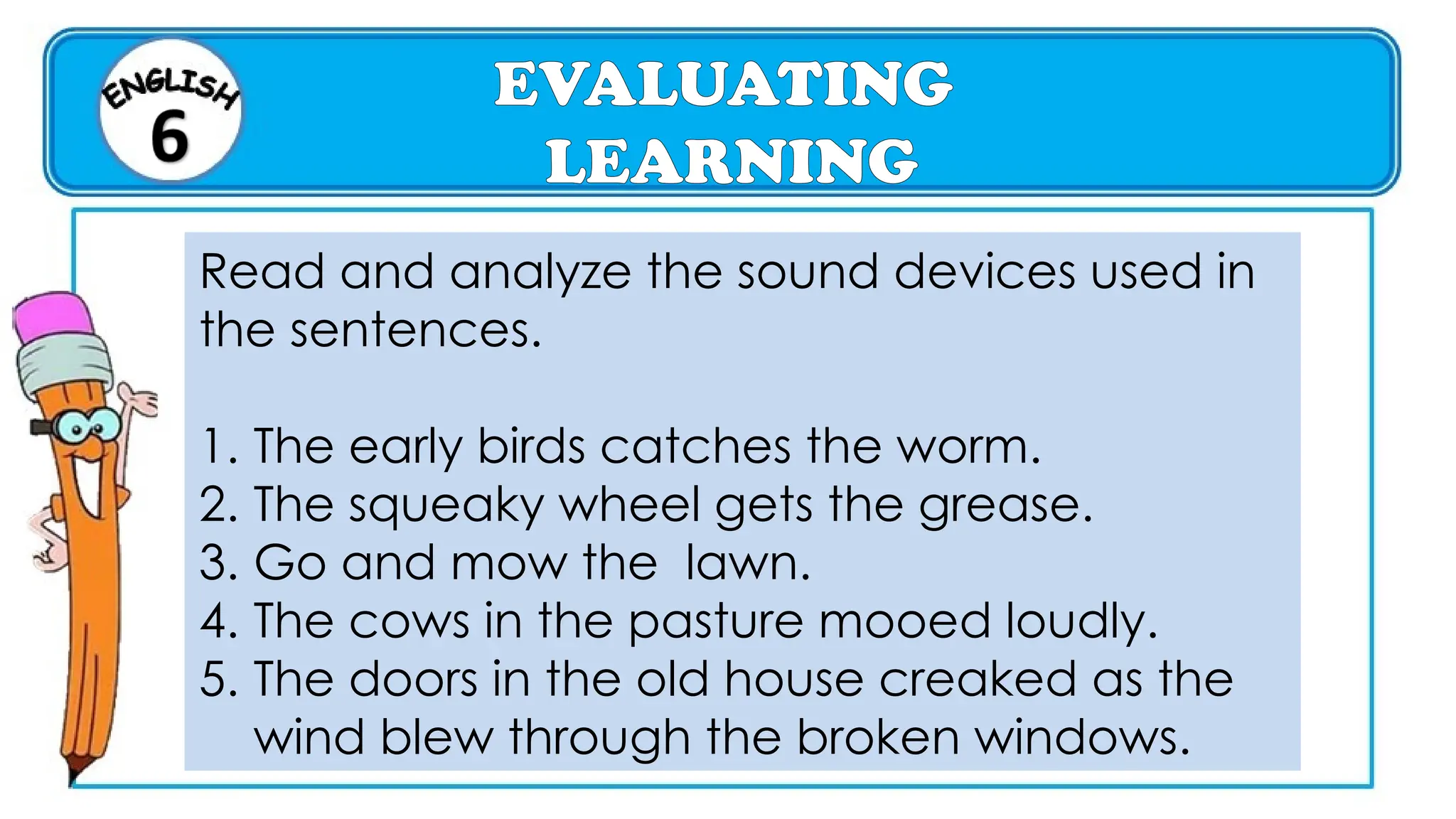
Read and analyze the sound devices used in
the sentences.
1. The early birds catches the worm.
2. The squeaky wheel gets the grease.
3. Go and mow the lawn.
4. The cows in the pasture mooed loudly.
5. The doors in the old house creaked as the
wind blew through the broken windows.
“Let’s Enrich Ourselves”
List down sentences with sound
devices
(onomatopoeia, alliteration ,
assonance and consonance)
ENGLISH 6 QUARTER 1
WEEK 1, DAY 2
Analyze sound devices
( onomatopoeia, alliteration, assonance,
personification, irony, and hyperbole) in a
text heard
FIGURATIVE LANGUAGE
PERFORMANCE STANDARD
• Analyses text types to
effectively understand
information/messages(s)
CONTENT STANDARD
• Demonstrate understanding of
various linguistics nodes to
comprehend various texts
FIGURES OF SPEECH ENGLC-Ia-2.3.1
ENGLC-Ia-2.3.8
FIGURATIVE LANGUAGE
6
What makes a poem different
from other literary piece?
Clouds all like silver lambs
on low green hills,
Feeding on blue meadows
Watered by rills.
Clouds are like snowy dawn
Playing with winds;
Clouds are small, willfull clues With playful
minds
CLOUDS
Clouds are huge butterflies
Radiant with rays;
Clouds are beasts of the wilds
On stormy days.
Clouds are the sky giants
Their tears are rain
Dropping on leafy plants
Down on the plain.
Guide Questions:
1. What are clouds being compared in the
poem?
2. What characteristics of clouds make them
silver lambs? like snowy dawn?
3. What characteristics make them small, willful
clues with playful minds? huge butterflies/
beast of the wild/ crying sky giants?
What are the figurative language
used in the poem?
What is a figurative
language?
Figurative language is language that uses
words or expressions with a meaning that is
different from the literal interpretation.
DIFFERENT TYPES OF FIGURATIVE LANGUAGE
Personification
Simile Metaphor
Irony Hyperbole
What is a simile? metaphor?
Personification? Irony?
Hyperbole?
Let’s Do This
Task 1- Identify what figure of speech is
used in each of the following sentences.
1. The English language is like a account
of a million words.
a. simile
b. metaphor
c. personification
Let’s Do This
Identify what figure of speech is used in
each of the following sentences.
2 .The dictionary is the bankbook that helps us
use the words.
a. simile b. metaphor c. personification
Let’s Do This
Identify what figure of speech is used in
each of the following sentences.
3. The city’s voice itself is soft like solitudes.
a. hyperbole
b. metaphor
c. irony
Let’s Do This
Identify what figure of speech is used in
each of the following sentences.
4. The flowers danced happily in the wind.
a. onomatopoeia
b. Personification
c. simile
Let’s Do This
Identify what figure of speech is used in
each of the following sentences.
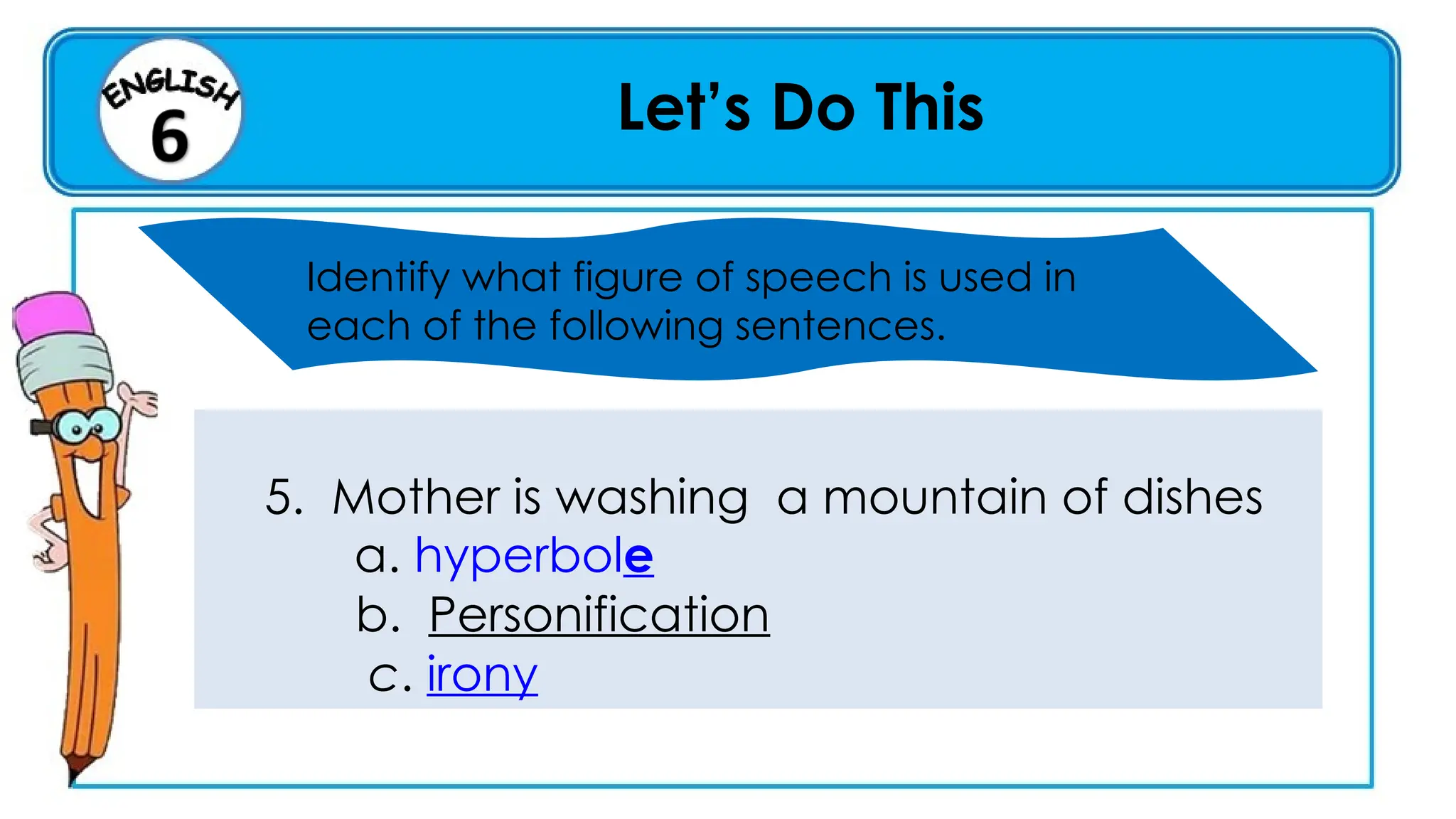
5. Mother is washing a mountain of dishes
a. hyperbole
b. Personification
c. irony
What’s the Sound? What’s the Figure?
Task 2- Identify the sound device or the figurative
language exemplified by each of the following
sentences. SIMILE. METAPHOR, HYPERBOLE,
PERSONIFICATION, IRONY
__________ 1. A wicked whisper came and changed my life.
__________ 2. The fire station burned down last night.
__________ 3. The leaves danced in the wind on the cold
October afternoon.
__________ 4. She was as smart as an owl.
__________ 5. Her brain is the size of a pea
What’s the Sound? What’s the Figure?
Task 2- Identify the sound device or the figurative
language exemplified by each of the following
sentences. SIMILE. METAPHOR, HYPERBOLE,
PERSONIFICATION, IRONY
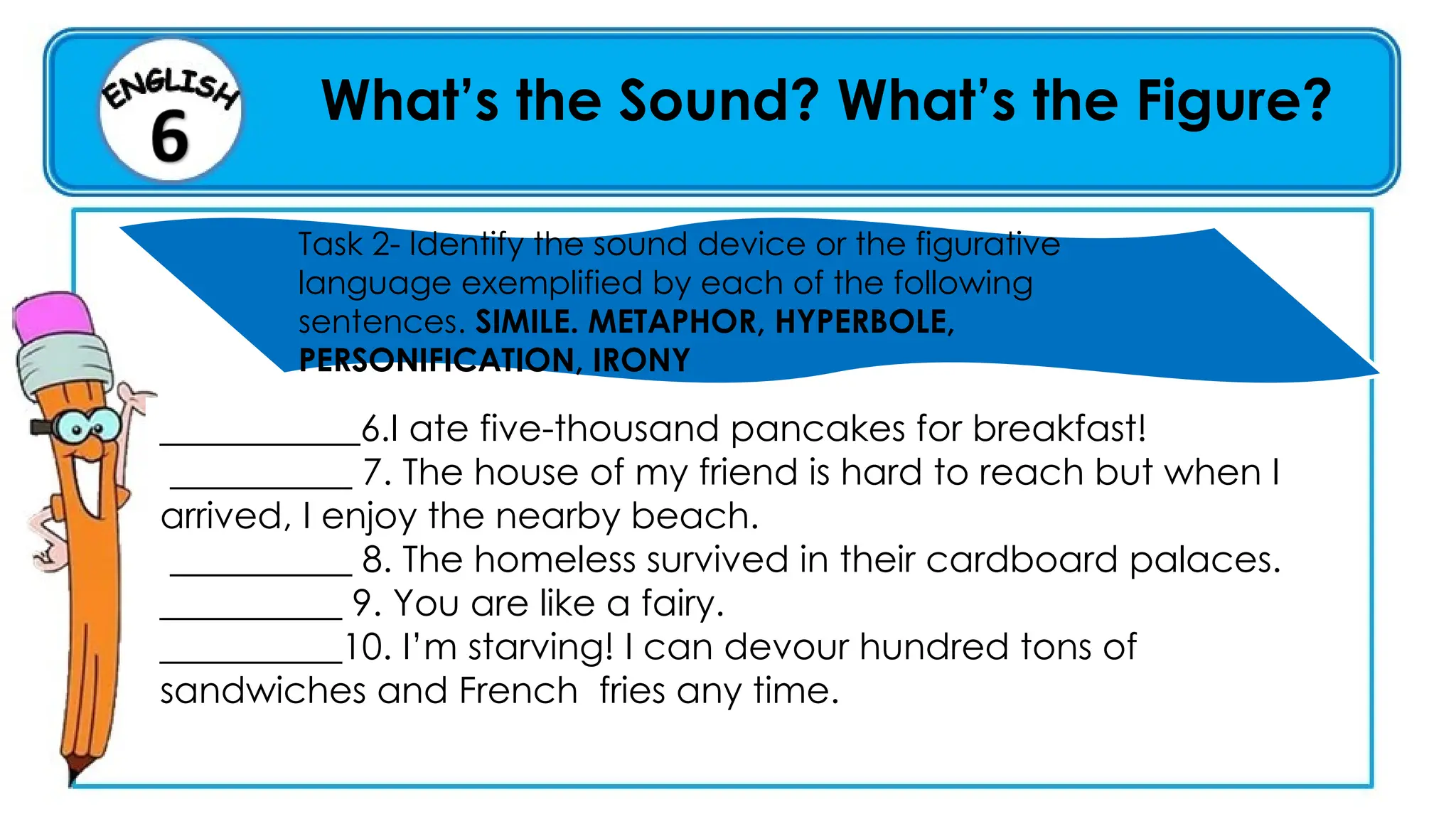
___________6.I ate five-thousand pancakes for breakfast!
__________ 7. The house of my friend is hard to reach but when I
arrived, I enjoy the nearby beach.
__________ 8. The homeless survived in their cardboard palaces.
__________ 9. You are like a fairy.
__________10. I’m starving! I can devour hundred tons of
sandwiches and French fries any time.
EVALUATING
LEARNING
Tell what figurative language is used in the following
sentences.
1. The brain is like a gigantic government office.
2. Even if you spray it with all the perfume in the world, it
will still smell.
3. The wrinkled sea beneath him crawls.
4. You are the wind beneath my wings.
5. The wind tapped like a tired man.
“Let’s Enrich Ourselves”
Make your own simile , metaphor, personification,
hyperbole, assonance, and alliteration using the
following topics.
1. Rainbow
2. Forest
3. Sun
4. Birds
5. Ocean
ENGLISH 6 QUARTER 1
WEEK 1, DAY 3
Inferring meaning of idiomatic
expression
MEANING OF IDIOMATIC
EXPRESSION USING CONTEXT
CLUES
6 Let’s Study This
IDIOMATIC EXPRESSION
PERFORMANCE STANDARD
Infer meaning of idiomatic
expression using context clues
CONTENT STANDARD
Relate an experience
appropriate to the occasion.
ENGV-Ia-12.3.1
ENGV-Ia-2.3.1
Let’s Try This
The underlined group of words is an
idiom. Choose the best meaning.
1. Whenever Rene is under the
weather, he gets plenty of rest and
takes vitamins.
a. out in the rain b. ill c. exercising
Let’s Try This
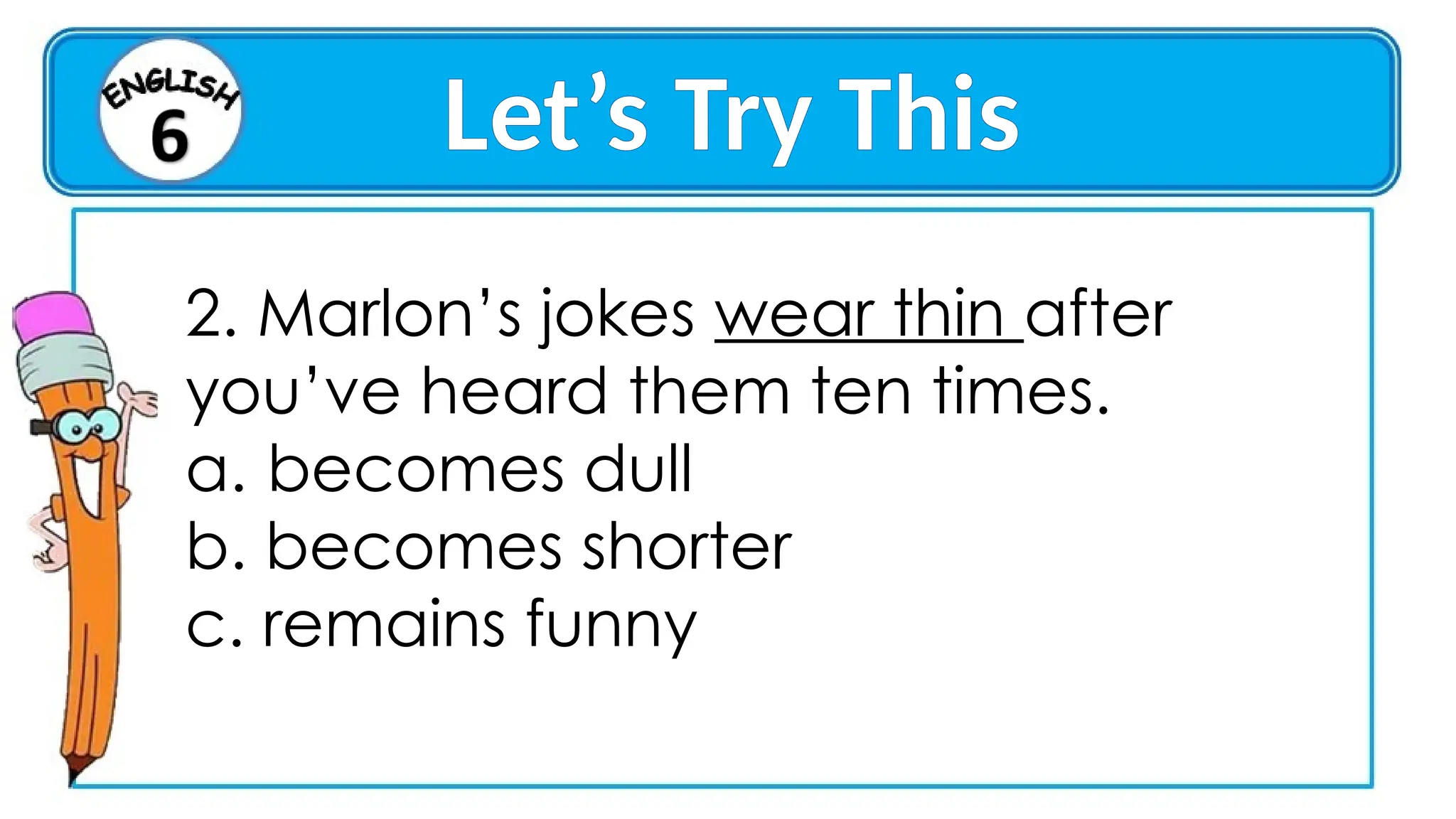
2. Marlon’s jokes wear thin after
you’ve heard them ten times.
a. becomes dull
b. becomes shorter
c. remains funny
Let’s Try This
3. We like our neighborhood to look
clean, so it burns up when we see
someone littering in the streets.
a. makes us feel hot
b. makes us angry
c. starts fire
Let’s Try This
4. Although Ester did well in the
spelling quiz, she tripped up when
she came to the word giraffe.
a. fell on the floor
b. made a mistake
c. spoke quietly
Let’s Try This
5. The movie was so funny; it really
had us in stitches.
a. sewing
b. laughing hard
c. watching eagerly
Let’s Study This
* An idiomatic expression conveys
a meaning different from its
individual words. Neither can the
idiom be readily analyzed from its
grammatical construction.
Let’s Study This
* Although idioms cannot be
explained by the strict rules of
grammar, their long-continued,
general use has given them
recognition.
Let’s Study This
* Idiomatic expressions give force,
color and vividness to our
language. We use idiomatic
expressions to make our speech
and writing more interesting. Often,
we can get the meaning of an
idiomatic expression from context.
SPEAK GENTLY
-DAVID BATES
Speak gently ; it is better far
To rule by love than fear,
Speak gently ; let no harsh word mark
The good we may do here.
Speak gently to the little child;
It’s love be sure to gain
Teach it in accent soft and mild,
It may not long remain.
Read the
poem.
SPEAK GENTLY
-DAVID BATES
Speak gently to the aged one;
Grieve not the care-worn heart,
Whose sands of life are nearly run;
Let such in peace depart.
Speak gently; it’s a little thing
Dropped in the heart’s deep well
The good the joy that it may bring
Eternity shall tell.
a. What is the poem all about?
b. What do the following phrases
mean?
- ‘Tis a little thing dropped in
the hearts deep well.
Let’s Discuss…
_ Rule by love ;rule by fear
- It’s love be sure to gain
- Teach in accents soft and mild
- Care-worn heart
- Sands of life are nearly run
Let’s Discuss…
- Let such in peace depart
- Heart’s deep well
- Eternity shall tell
c. How do we learn the meaning of each
phrase?
What help us understand it?
d. What are the importance of idioms?
Let’s Discuss…
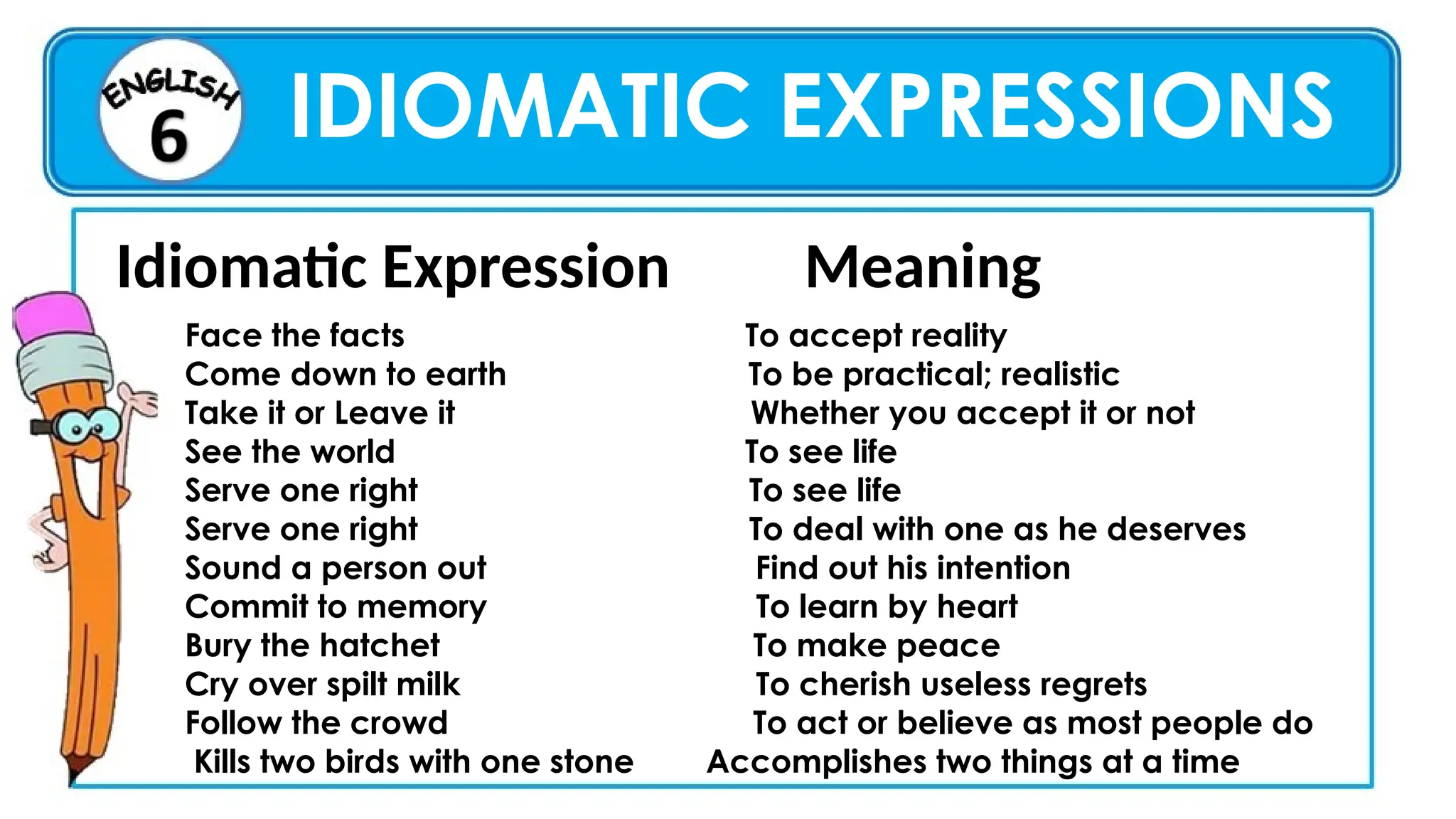
IDIOMATIC EXPRESSIONS
Face the facts To accept reality
Come down to earth To be practical; realistic
Take it or Leave it Whether you accept it or not
See the world To see life
Serve one right To see life
Serve one right To deal with one as he deserves
Sound a person out Find out his intention
Commit to memory To learn by heart
Bury the hatchet To make peace
Cry over spilt milk To cherish useless regrets
Follow the crowd To act or believe as most people do
Kills two birds with one stone Accomplishes two things at a time
Meaning
Idiomatic Expression
Let’s Practice
Read and analyze the sentences. Choose the idioms
used in each.
1. The foreigner can easily get along with the
native.
2. The sampaguita in your car gives off a sweet
smell.
3. Eden has a very attractive get up.
4. My mother looks forward to the coming of my
sister from Hawaii
5. We have to look up to our parents.
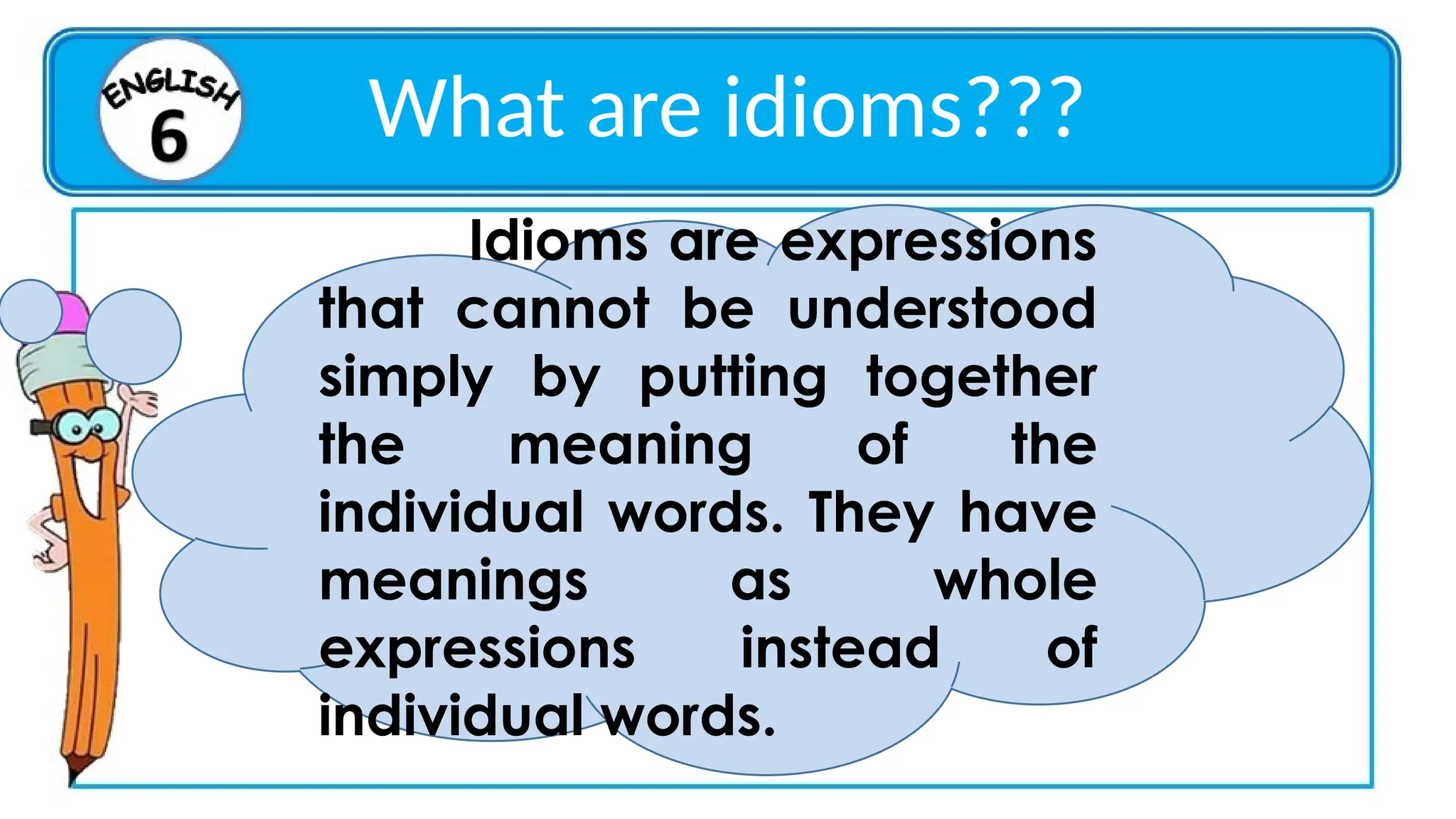
What are idioms???
Idioms are expressions
that cannot be understood
simply by putting together
the meaning of the
individual words. They have
meanings as whole
expressions instead of
individual words.
Let’s Do This!!!
Get the meaning of italicized
idiomatic expressions below
through context clues.
1. She knew the poem by heart.
2. By the end of the month , she had a change of heart.
1 2 3 4 5
3. This gift is given with all my heart.
4. He is a student after my own heart.
5. She lost her heart to the white dress in the display window of the store
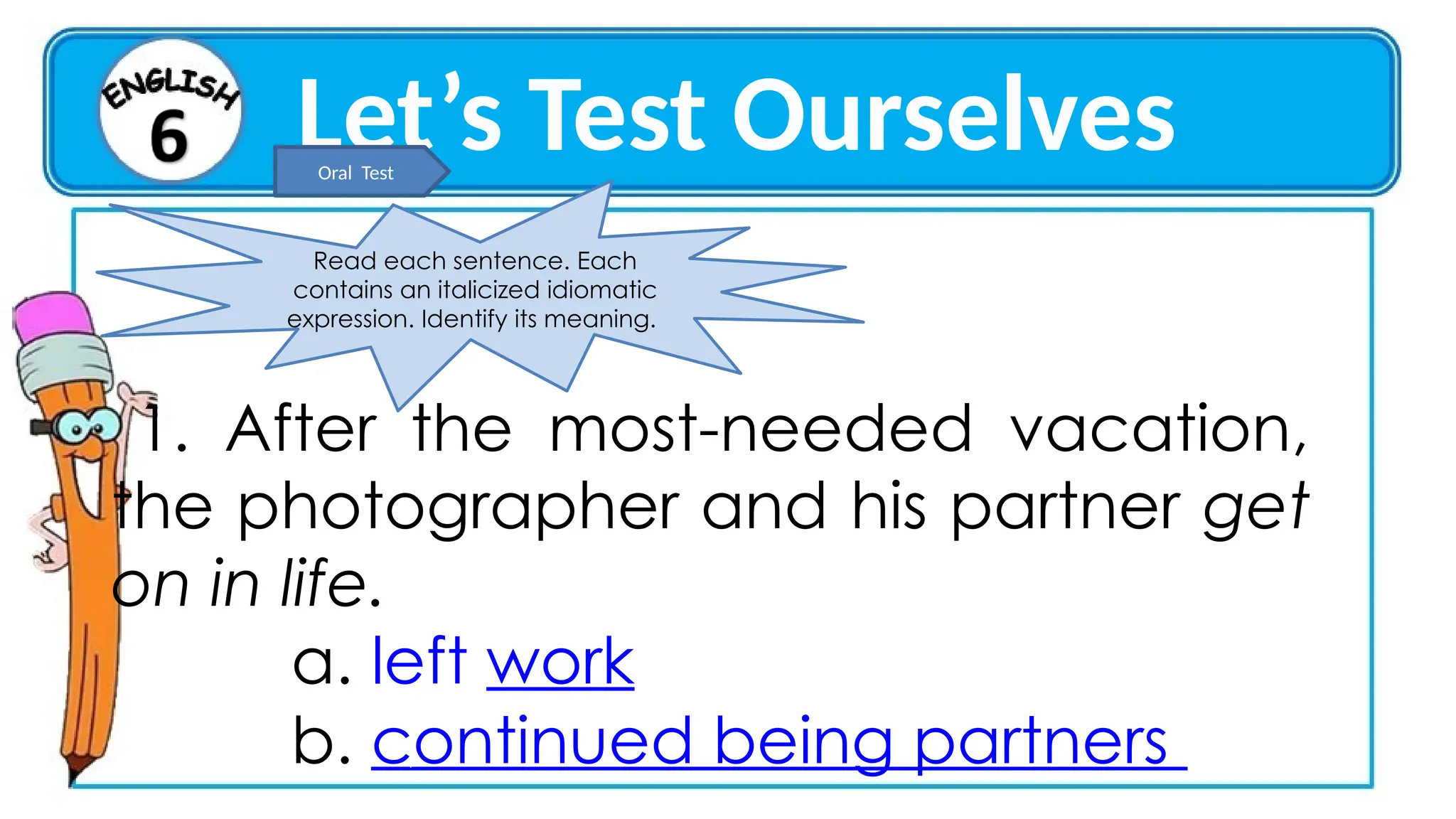
Let’s Test Ourselves
Read each sentence. Each
contains an italicized idiomatic
expression. Identify its meaning.
1. After the most-needed vacation,
the photographer and his partner get
on in life.
a. left work
b. continued being partners
2 3 4 5
Oral Test
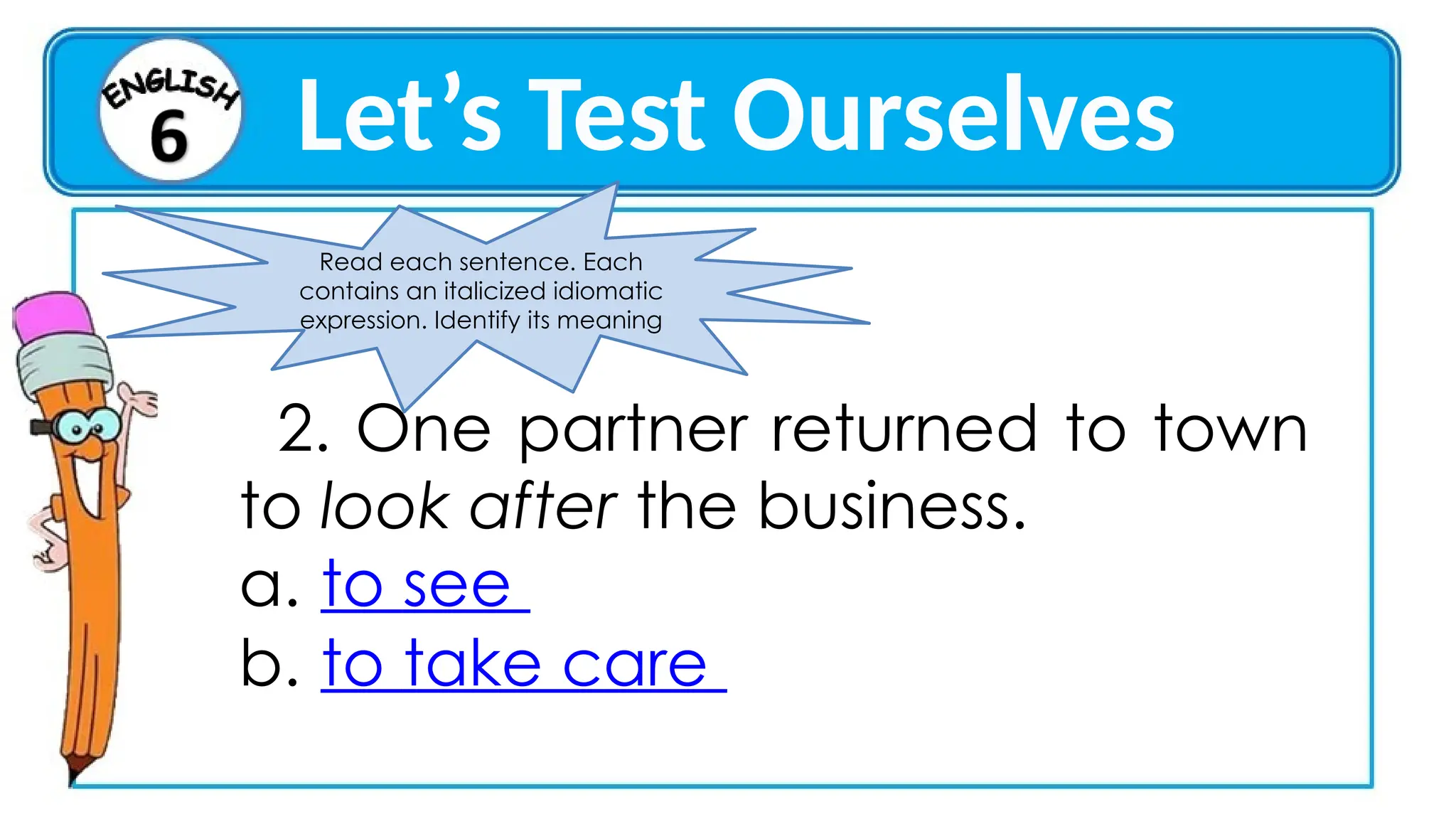
Let’s Test Ourselves
Read each sentence. Each
contains an italicized idiomatic
expression. Identify its meaning
2. One partner returned to town
to look after the business.
a. to see
b. to take care
2 3 4 5
Let’s Test Ourselves
Read each sentence. Each
contains an italicized idiomatic
expression. Identify its meaning
3. When the partner returned, he
saw the philosopher highly
spirited.
a. energetic and enthusiasm
b. proud and arrogant
2 3 4 5
Let’s Test Ourselves
Read each sentence. Each
contains an italicized idiomatic
expression. Identify its meaning
4. The reddish-brown color of the
water was no good according to
the philosopher.
a.improper
b. of no use
2 3 4 5
Let’s Test Ourselves
Read each sentence. Each
contains an italicized idiomatic
expression. Identify its meaning
5. After a short stay in her rest
house,certain changes took place
in the philosopher’s life.
a.exchange places
b. came about
2 3 4 5
Let’s Test Ourselves
Choose the right idiom below to complete the sentences.
1. It takes one with an _______ to accept other’s opinion calmly.
2. Matthew is a very bright boy . In fact , he belongs to the _____
in his school .
3. Even if it raining, the class will _______ with their exposure trip.
4. Mother will go to the market, so I’ll stay to ______ my baby
sister.
5. If you want to _________ in the class, you have to study hard.
open mind be a star
look after
push through
cream of the crop
Written Test
Let’s Enrich Ourselves
Give the meaning of idioms in each sentence and use it in
a sentence.
1. The fatal blow of kid Kidlat killed his opponent.
2. The cold war between the girls was reported by the
boys to their teacher.
3. Our teacher put an end to the negative relationship of
the girls.
4. Her beauty made her stand out in the crowd.
5. My allowance was cut down by my mother because I
overspent my pocket money.
ENGLISH 6 QUARTER 1
WEEK 5, DAY 4
Compose clear and coherent
sentences using appropriate
grammatical structures: -Modals
MODALS
PERFORMANCE STANDARD
• Demonstrates command of
the conventions of standard
English grammar and usage
when writing or speaking
CONTENT STANDARD
• Speaks and writes using good
command of the convention
of standard English
MODALS
EN6G-Ie-3.6
Let’s Recall
What are the
uses of modals?
May I used them in sentences?
Can __________________________
Could ________________________
May __________________________
Might _________________________
Let’s Try This
Answer the following questions:
1.Now that you are in Grade Six, what
are the things that you must do?
2. Now that you are the big sisters and
big brothers of the Kinder to Grade Five
pupils, what should you show them as
a role model?
Think-Pair- Share
Let’s Study This
Modals are verbs that cannot be used without
another verb.
Here again are the general characteristics of
modals you should remember.
1. A modal does not change whether the subject
is singular or plural.
Examples: He must learn. I must learn.
You must learn. They must learn.
We must learn.
Let’s Study This
2. A modal is always used with the
basic form of the verb.
Examples: I must run. I should run.
3. Modals can be used alone to
answer a question.
Examples: Must you come? I must.
Might it happen? It
Let’s Study This
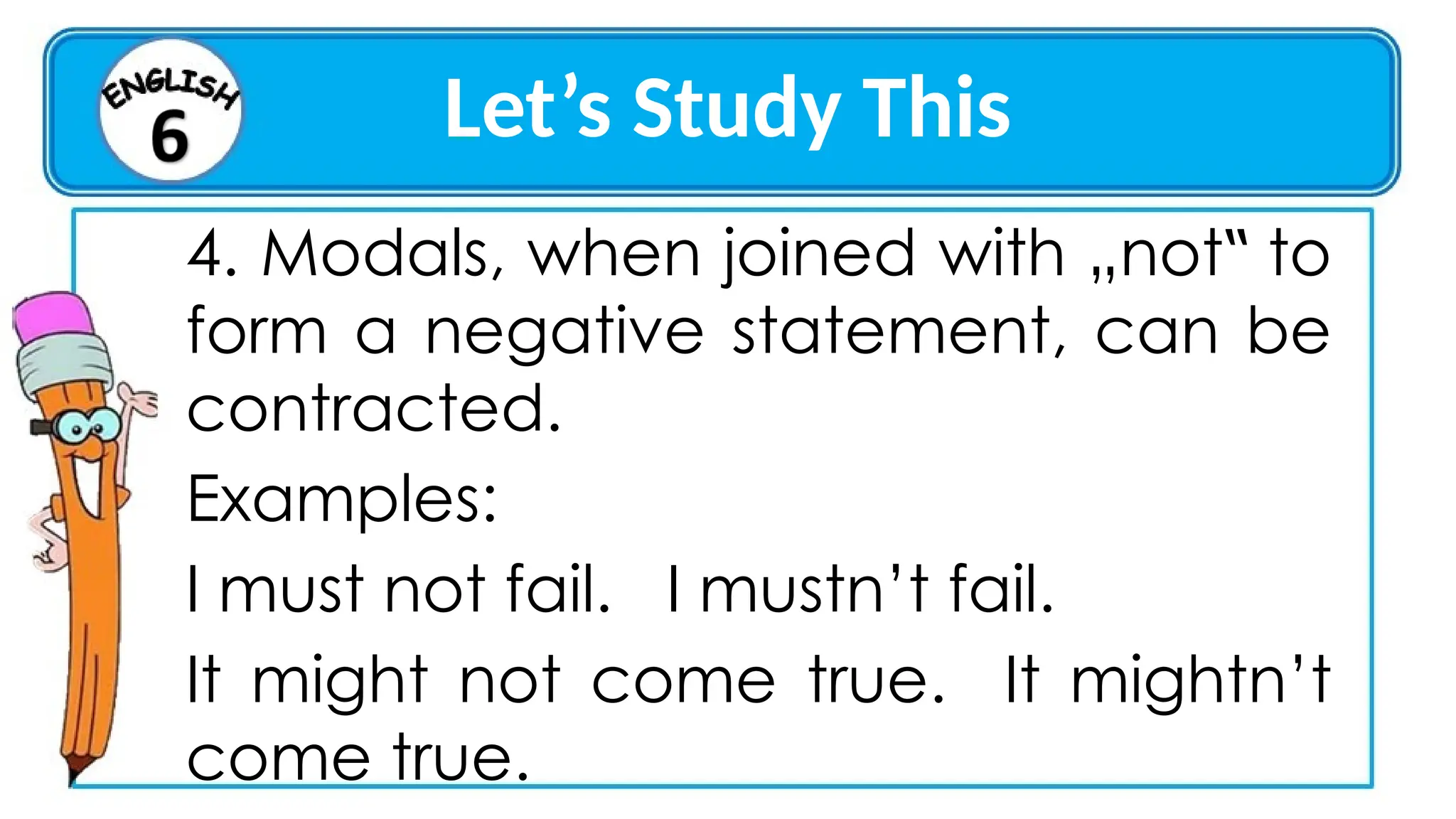
4. Modals, when joined with „not to
‟
form a negative statement, can be
contracted.
Examples:
I must not fail. I mustn’t fail.
It might not come true. It mightn’t
come true.
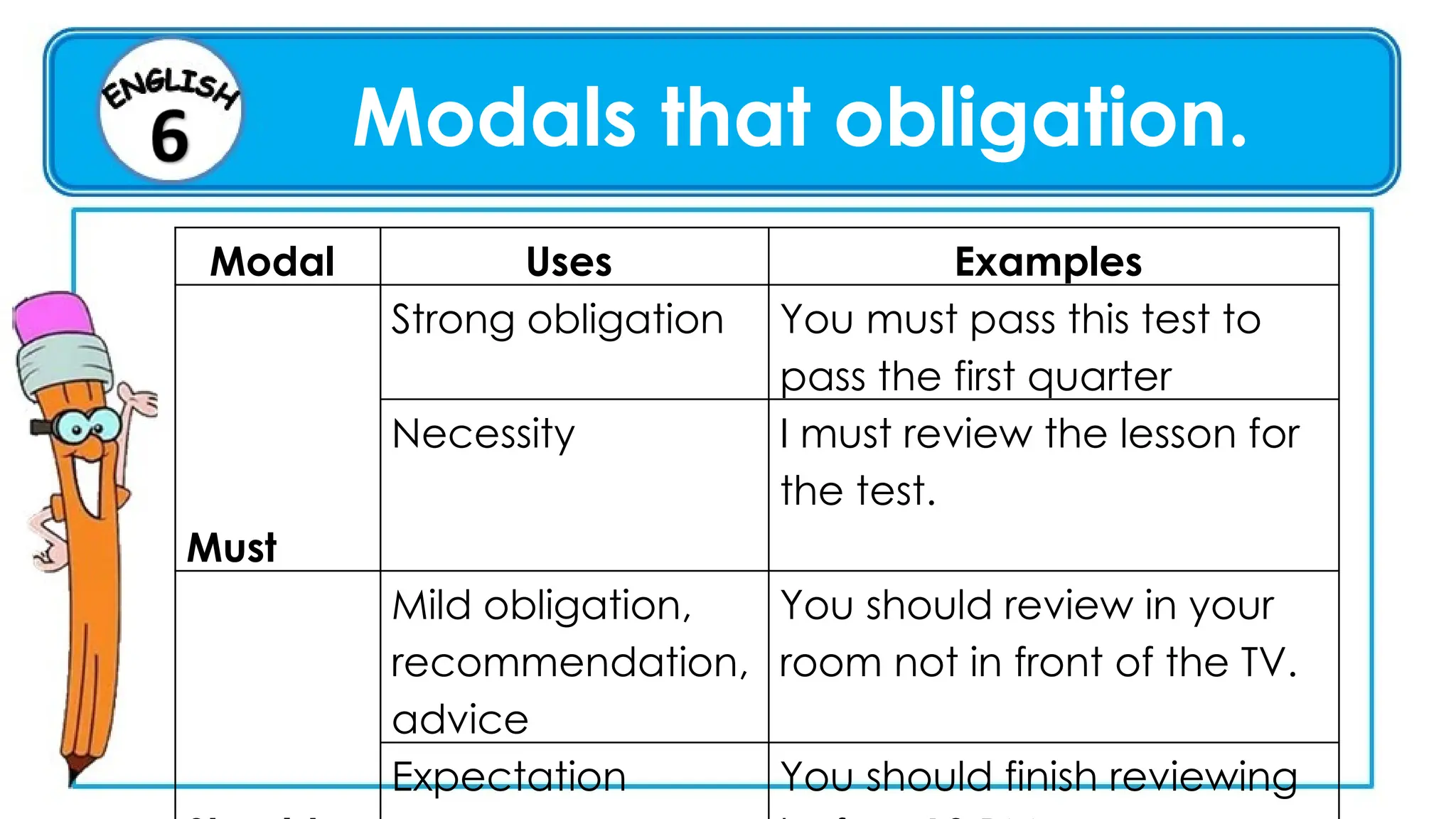
Modal Uses Examples
Must
Strong obligation You must pass this test to
pass the first quarter
Necessity I must review the lesson for
the test.
Mild obligation,
recommendation,
advice
You should review in your
room not in front of the TV.
Expectation You should finish reviewing
Modals that obligation.
Let’s Do This
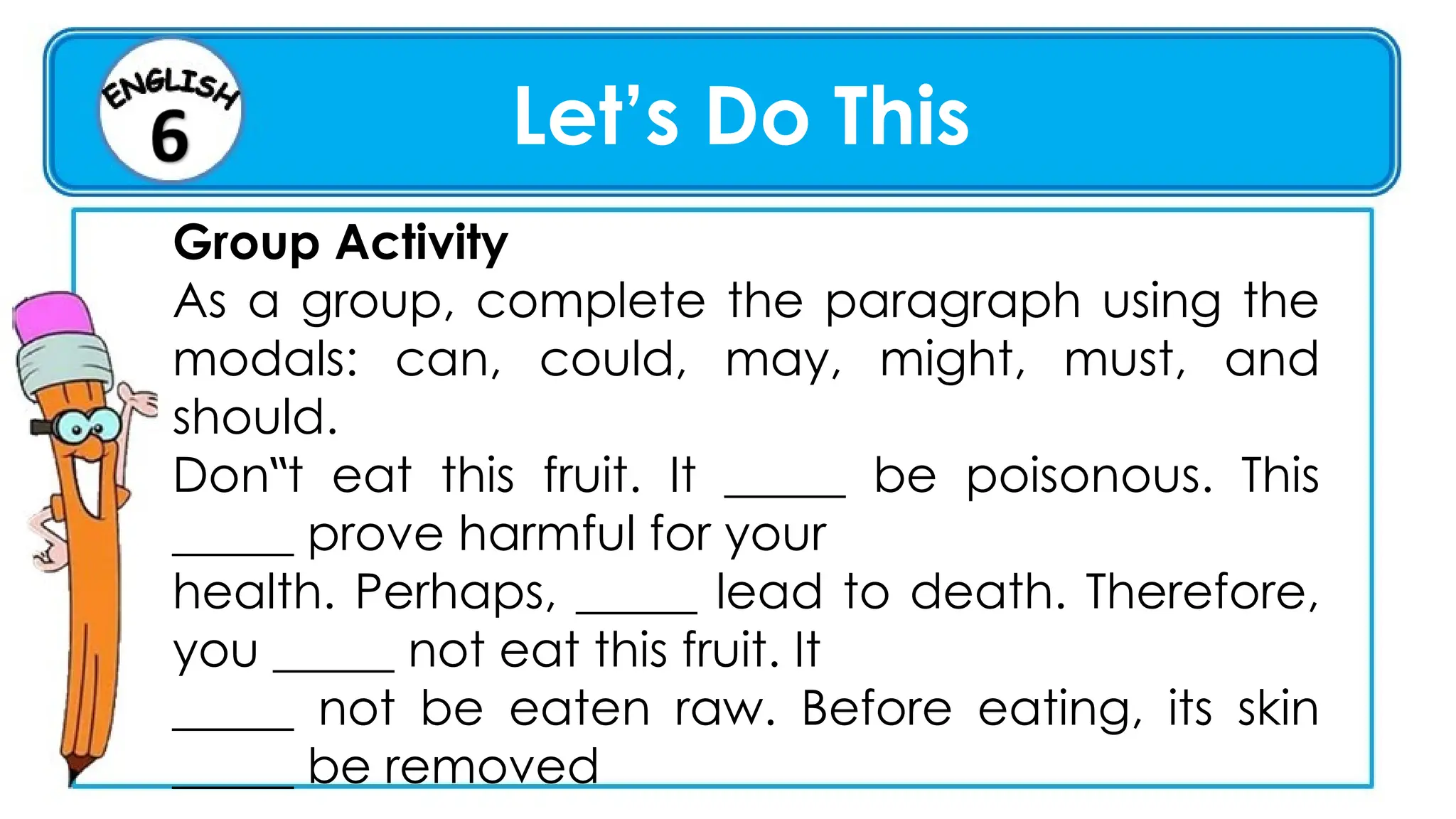
Group Activity
As a group, complete the paragraph using the
modals: can, could, may, might, must, and
should.
Don t eat this fruit. It _____ be poisonous. This
‟
_____ prove harmful for your
health. Perhaps, _____ lead to death. Therefore,
you _____ not eat this fruit. It
_____ not be eaten raw. Before eating, its skin
_____ be removed
Let’s Do More
Complete the paragraph using the modals: can,
could, may, might, must, and should.
Milk is a complete food, full of vitamins and proteins.
Children _____ drink it regularly otherwise they _____
suffer from undernourishment. Elders _____ also
take it but those who _____ not afford it _____ take
pulses, fruits and vegetables as an alternative. We
_____ purchase milk of good quality from milk booths
opened by the Government.
What are the
modals that tell oblig
ation
Let’s Test Ourselves
A Letter of Advice
Write a letter of advice to your
friend using must and should.
ENGLISH 6 QUARTER 1
WEEK 5, DAY 5
Describe different forms and
conventions of film and moving
pictures (acting)
ELEMENTS IN
ACTING
PERFORMACE
PERFORMANCE STANDARD
• Demonstrates understanding
of the forms and conventions
of print, and digital materials
to understand various viewing
texts
CONTENT STANDARD
• Applies knowledge of the
various forms of print , non-
print, and digital materials to
appropriately comprehend
print, non-print, film and
moving texts
MODALS
EN6VC-Ie5.1.1
What are the
elements in acting
performance?
• Emotions are feelings.
• One way of expressing our feelings is
through facial expressions.
• Facial expressions are seen through
the movement of our eyebrows, eyes,
lips and even our nostrils.
How are You Feeling?
Pair Up
With your seatmate/partner,
match the emotion with the
correct emoji.
How are You Feeling?
happy scared worried sad
confused joyful angry silly
embarrassed surprised
ACTING PERFORMANCE
• Acting performance affects the
way an audience responds.
• One of the elements of acting
performance is facial expressions.
Let’s Study This
FACIAL EXPRESSIONS
Happiness (laughing, smiling)
A smile or laughter is the most recognized emotion
from a distance.
When smiling or laughing, cheeks are pulled up
and out. The mouth sides are pulled backwards as
well as slightly upwards. This slight upper movement
pushes the upper eyelids and produces wrinkles
around the eyes. Also, the mouth seems to get
closer to the nose.
FACIAL EXPRESSIONS
When laughing, the jaw drops and the upper
teeth and gum appear. The upper lip appears
to be straight and the lower teeth are also
exposed in a big laugh.
For smiling, the lips push flat against each other.
A true smile is symmetrical. It forms evenly and
disappears gradually. It rarely takes more than a
couple of seconds. Also, it does not precede or
lag the idea of a happy situation in concern.
FACIAL EXPRESSIONS
Sadness
In sadness, the eyebrows are raised from
the inner sides and brought nearer. The
cheek may be pulled slightly upwards, the
mouth ends pulled downwards and the
chin is raised.
If the mouth opens for crying, it looks
square.
FACIAL EXPRESSIONS
Anger
Anger may not be good for health,
but it's good for movies.
An angry person has his/her
eyebrows pulled downwards towards
the inner sides and drawn together.
FACIAL EXPRESSIONS
The upper and lower eyelids are raised,
the nostrils dilate, the face reddens and
veins show in the head.
The lips are either tightened together
and the jaw is clenched, or the mouth
becomes square to expose the
clenched teeth, or is open if talking.
FACIAL EXPRESSIONS
Fear
The eyebrows are raised, drawn together
and appear straight. The upper and lower
eyelids are raised. The mouth is opened
and pulled outwards.
The fear expression freezes the face and
usually lasts some time.
FACIAL EXPRESSIONS
Surprise
Whenever someone is surprised,
his/her eyebrows are raised up and
arched, the eyelids may be raised,
the lower jaw drops and the lips are
parted.
FACIAL EXPRESSIONS
Pain
In extreme pain, the eyes are tightly
closed, cheeks are raised, and
eyebrows pulled together and
downwards.
The mouth may be wide open, with
square lips, preparing for screaming or
yelling.
FACIAL EXPRESSIONS
Excitement
An excited person draws a smile
upon his face.
However, the eyes are not wrinkled
like with smiling; they are wide open
and the eyebrows may pull from the
sides.
FACIAL EXPRESSIONS
Worry
Worry is expressed by drawing the
eyebrows slightly downwards and
together, and the lips tightened
together and pulled slightly upwards
and backwards.
Let’s Do This
Let’s Have a Commercial Break
A. Watch a series of heartfelt commercials.
TV Commercials
Sources:1. "Don't judge people you don't know ( you will cry after watching )."
YouTube. August 29, 2015. Accessed May 17, 2017.
https://www.youtube.com/watch?v=GENxFiRBiBA.
2."My Dad is a Liar!" YouTube. February 03, 2015. Accessed May 17,
2017. https://www.youtube.com/watch?v=_0iR6KFCxkQ.
Let’s Answer This
1. What did you learn from the TV commercials?
2. What is the message of the TV commercials? Do
you agree or disagree with it?
3. What did you like best/least about it? Why?
4. Who was your most/least favorite character in
the TV commercials? Why?
5. Did anything that happened in the TV
commercials remind you of something about your
own life or about others’?
Let’s Answer This
6. What were you thinking as you finished watching
the TV commercials?
7. What would you say to a friend who asked you
about them?
8. Would you recommend these to a friend? Explain
your reasons.
9. What part of the TV commercials would you
change? Why?
10. If you had a chance to ask a character in these
commercials a question, what would it be?
Let’s Do More
Group Activity
As a group, accomplish the table below. Be
ready for a group reporting afterwards.
TV Commercial #1
TV Commercial #2
Character Emotion/ facial Expression
Let’s Remember
Acting is the work of an actor or
actress, who is a person in theater,
television, film, or any other
storytelling medium and tells the story
by portraying a character usually by
speaking or singing a written text or
play.
Lights! Camera! Action!
Do the facial expression acting with your
seatmate/partner. Show the facial expressions
one at a time and let him/her guess. Check the
emotions if your seatmate/partner is able to act
the facial expression correctly and another
check if your seatmate/partner is able to guess
the emotions correctly.
Let’s Test Ourselves

Sound devices power point presentationnn

  • 1.
    ENGLISH 6 QUARTER1 WEEK 1, DAY 1 Analyze sound devices ( onomatopoeia, alliteration, assonance, consonance)
  • 2.
    Introduce yourself Name: Age: Where areyou from: Favorite color, food and animals:
  • 3.
  • 4.
    PERFORMANCE STANDARD • Demonstrateunderstanding of various linguistics nodes to comprehend various texts. CONTENT STANDARD • Uses linguistic cues to appropriately construct meaning from variety of texts for a variety of purposes. SOUND DEVICES ENGRC-Ia-2.3.1 ENGRC-Ia-2.3.2 ENGRC-Ia-2.3.3
  • 5.
    Let’s Study This Poemsare pieces of writing written in separate lines that usually have figurative language, repeated and irregular rhythm, rhyme. They convey experiences, ideas, or emotions in a vivid and imaginative way.
  • 6.
    Let’s Study This Poemsalso have sound devices. Sound devices are tools used by poets to convey and reinforce the meaning or experience of poetry through the skillful use of sound.
  • 7.
    SOUND DEVICES 6 Can youimitate the sounds of the following picture???
  • 8.
    Types of SoundDevices Onomatopoeia - This is a sound device which refers to the use of words with their meaning Examples: The bang of a gun The buzz of a bee The hiss of a snake The pop of a firecracker
  • 9.
    Types of SoundDevices Alliteration - This is the repetition of the same initial consonant sounds of at least two words in a line of poetry. Example: the frog frolicked frivolously on the forest floor. Little skinny shoulder blades sticking through your clothes …struck out by a steed flying fearless and fleet
  • 10.
    Types of SoundDevices Assonance - This is the repetition of vowel sounds at the beginning, middle or end of at least two words in a line of poetry. Example: “The cat sat on the mat’’
  • 11.
    Types of SoundDevices Consonance - This is the repetition of consonant sounds at the middle or end of at least two words in a line of poetry. Example: Mammals named Sam are clammy
  • 12.
  • 13.
  • 14.
    Let’s Do This TITLEOF THE POEM : “THE BELLS” by Edgar Allan Poe ALLITERATION ASSONANCE CONSONANCE Task 1. Fill Out the Table! Listen as your teacher reads a poem. As you listen, take down the words from the poem that exemplify the following sound devices: ALLITERATION, ASSONANCE and CONSONANCE. Write your answers in each column.
  • 15.
    Read, Analyze, PickOut! Task 2…Read the following short poem titled “Running Water” by Lee Emmett. Pick out words from the poem that exemplify onomatopoeia, alliteration, assonance, and consonance. water plops into pond splish-splash downhill warbling magpies in tree trilling, melodic thrill whoosh, passing breeze flags flutter and flap frog croaks, bird whistles babbling bubbles from tap
  • 16.
    EVALUATING LEARNING Read and analyzethe sound devices used in the sentences. 1. The early birds catches the worm. 2. The squeaky wheel gets the grease. 3. Go and mow the lawn. 4. The cows in the pasture mooed loudly. 5. The doors in the old house creaked as the wind blew through the broken windows.
  • 17.
    “Let’s Enrich Ourselves” Listdown sentences with sound devices (onomatopoeia, alliteration , assonance and consonance)
  • 18.
    ENGLISH 6 QUARTER1 WEEK 1, DAY 2 Analyze sound devices ( onomatopoeia, alliteration, assonance, personification, irony, and hyperbole) in a text heard
  • 19.
  • 20.
    PERFORMANCE STANDARD • Analysestext types to effectively understand information/messages(s) CONTENT STANDARD • Demonstrate understanding of various linguistics nodes to comprehend various texts FIGURES OF SPEECH ENGLC-Ia-2.3.1 ENGLC-Ia-2.3.8
  • 21.
    FIGURATIVE LANGUAGE 6 What makesa poem different from other literary piece?
  • 22.
    Clouds all likesilver lambs on low green hills, Feeding on blue meadows Watered by rills. Clouds are like snowy dawn Playing with winds; Clouds are small, willfull clues With playful minds CLOUDS
  • 23.
    Clouds are hugebutterflies Radiant with rays; Clouds are beasts of the wilds On stormy days. Clouds are the sky giants Their tears are rain Dropping on leafy plants Down on the plain.
  • 24.
    Guide Questions: 1. Whatare clouds being compared in the poem? 2. What characteristics of clouds make them silver lambs? like snowy dawn? 3. What characteristics make them small, willful clues with playful minds? huge butterflies/ beast of the wild/ crying sky giants?
  • 25.
    What are thefigurative language used in the poem?
  • 26.
    What is afigurative language? Figurative language is language that uses words or expressions with a meaning that is different from the literal interpretation. DIFFERENT TYPES OF FIGURATIVE LANGUAGE Personification Simile Metaphor Irony Hyperbole
  • 27.
    What is asimile? metaphor? Personification? Irony? Hyperbole?
  • 28.
    Let’s Do This Task1- Identify what figure of speech is used in each of the following sentences. 1. The English language is like a account of a million words. a. simile b. metaphor c. personification
  • 29.
    Let’s Do This Identifywhat figure of speech is used in each of the following sentences. 2 .The dictionary is the bankbook that helps us use the words. a. simile b. metaphor c. personification
  • 30.
    Let’s Do This Identifywhat figure of speech is used in each of the following sentences. 3. The city’s voice itself is soft like solitudes. a. hyperbole b. metaphor c. irony
  • 31.
    Let’s Do This Identifywhat figure of speech is used in each of the following sentences. 4. The flowers danced happily in the wind. a. onomatopoeia b. Personification c. simile
  • 32.
    Let’s Do This Identifywhat figure of speech is used in each of the following sentences. 5. Mother is washing a mountain of dishes a. hyperbole b. Personification c. irony
  • 33.
    What’s the Sound?What’s the Figure? Task 2- Identify the sound device or the figurative language exemplified by each of the following sentences. SIMILE. METAPHOR, HYPERBOLE, PERSONIFICATION, IRONY __________ 1. A wicked whisper came and changed my life. __________ 2. The fire station burned down last night. __________ 3. The leaves danced in the wind on the cold October afternoon. __________ 4. She was as smart as an owl. __________ 5. Her brain is the size of a pea
  • 34.
    What’s the Sound?What’s the Figure? Task 2- Identify the sound device or the figurative language exemplified by each of the following sentences. SIMILE. METAPHOR, HYPERBOLE, PERSONIFICATION, IRONY ___________6.I ate five-thousand pancakes for breakfast! __________ 7. The house of my friend is hard to reach but when I arrived, I enjoy the nearby beach. __________ 8. The homeless survived in their cardboard palaces. __________ 9. You are like a fairy. __________10. I’m starving! I can devour hundred tons of sandwiches and French fries any time.
  • 35.
    EVALUATING LEARNING Tell what figurativelanguage is used in the following sentences. 1. The brain is like a gigantic government office. 2. Even if you spray it with all the perfume in the world, it will still smell. 3. The wrinkled sea beneath him crawls. 4. You are the wind beneath my wings. 5. The wind tapped like a tired man.
  • 36.
    “Let’s Enrich Ourselves” Makeyour own simile , metaphor, personification, hyperbole, assonance, and alliteration using the following topics. 1. Rainbow 2. Forest 3. Sun 4. Birds 5. Ocean
  • 37.
    ENGLISH 6 QUARTER1 WEEK 1, DAY 3 Inferring meaning of idiomatic expression
  • 38.
    MEANING OF IDIOMATIC EXPRESSIONUSING CONTEXT CLUES 6 Let’s Study This
  • 39.
    IDIOMATIC EXPRESSION PERFORMANCE STANDARD Infermeaning of idiomatic expression using context clues CONTENT STANDARD Relate an experience appropriate to the occasion. ENGV-Ia-12.3.1 ENGV-Ia-2.3.1
  • 40.
    Let’s Try This Theunderlined group of words is an idiom. Choose the best meaning. 1. Whenever Rene is under the weather, he gets plenty of rest and takes vitamins. a. out in the rain b. ill c. exercising
  • 41.
    Let’s Try This 2.Marlon’s jokes wear thin after you’ve heard them ten times. a. becomes dull b. becomes shorter c. remains funny
  • 42.
    Let’s Try This 3.We like our neighborhood to look clean, so it burns up when we see someone littering in the streets. a. makes us feel hot b. makes us angry c. starts fire
  • 43.
    Let’s Try This 4.Although Ester did well in the spelling quiz, she tripped up when she came to the word giraffe. a. fell on the floor b. made a mistake c. spoke quietly
  • 44.
    Let’s Try This 5.The movie was so funny; it really had us in stitches. a. sewing b. laughing hard c. watching eagerly
  • 45.
    Let’s Study This *An idiomatic expression conveys a meaning different from its individual words. Neither can the idiom be readily analyzed from its grammatical construction.
  • 46.
    Let’s Study This *Although idioms cannot be explained by the strict rules of grammar, their long-continued, general use has given them recognition.
  • 47.
    Let’s Study This *Idiomatic expressions give force, color and vividness to our language. We use idiomatic expressions to make our speech and writing more interesting. Often, we can get the meaning of an idiomatic expression from context.
  • 48.
    SPEAK GENTLY -DAVID BATES Speakgently ; it is better far To rule by love than fear, Speak gently ; let no harsh word mark The good we may do here. Speak gently to the little child; It’s love be sure to gain Teach it in accent soft and mild, It may not long remain. Read the poem.
  • 49.
    SPEAK GENTLY -DAVID BATES Speakgently to the aged one; Grieve not the care-worn heart, Whose sands of life are nearly run; Let such in peace depart. Speak gently; it’s a little thing Dropped in the heart’s deep well The good the joy that it may bring Eternity shall tell.
  • 50.
    a. What isthe poem all about? b. What do the following phrases mean? - ‘Tis a little thing dropped in the hearts deep well. Let’s Discuss…
  • 51.
    _ Rule bylove ;rule by fear - It’s love be sure to gain - Teach in accents soft and mild - Care-worn heart - Sands of life are nearly run Let’s Discuss…
  • 52.
    - Let suchin peace depart - Heart’s deep well - Eternity shall tell c. How do we learn the meaning of each phrase? What help us understand it? d. What are the importance of idioms? Let’s Discuss…
  • 53.
    IDIOMATIC EXPRESSIONS Face thefacts To accept reality Come down to earth To be practical; realistic Take it or Leave it Whether you accept it or not See the world To see life Serve one right To see life Serve one right To deal with one as he deserves Sound a person out Find out his intention Commit to memory To learn by heart Bury the hatchet To make peace Cry over spilt milk To cherish useless regrets Follow the crowd To act or believe as most people do Kills two birds with one stone Accomplishes two things at a time Meaning Idiomatic Expression
  • 54.
    Let’s Practice Read andanalyze the sentences. Choose the idioms used in each. 1. The foreigner can easily get along with the native. 2. The sampaguita in your car gives off a sweet smell. 3. Eden has a very attractive get up. 4. My mother looks forward to the coming of my sister from Hawaii 5. We have to look up to our parents.
  • 55.
    What are idioms??? Idiomsare expressions that cannot be understood simply by putting together the meaning of the individual words. They have meanings as whole expressions instead of individual words.
  • 56.
    Let’s Do This!!! Getthe meaning of italicized idiomatic expressions below through context clues. 1. She knew the poem by heart. 2. By the end of the month , she had a change of heart. 1 2 3 4 5 3. This gift is given with all my heart. 4. He is a student after my own heart. 5. She lost her heart to the white dress in the display window of the store
  • 57.
    Let’s Test Ourselves Readeach sentence. Each contains an italicized idiomatic expression. Identify its meaning. 1. After the most-needed vacation, the photographer and his partner get on in life. a. left work b. continued being partners 2 3 4 5 Oral Test
  • 58.
    Let’s Test Ourselves Readeach sentence. Each contains an italicized idiomatic expression. Identify its meaning 2. One partner returned to town to look after the business. a. to see b. to take care 2 3 4 5
  • 59.
    Let’s Test Ourselves Readeach sentence. Each contains an italicized idiomatic expression. Identify its meaning 3. When the partner returned, he saw the philosopher highly spirited. a. energetic and enthusiasm b. proud and arrogant 2 3 4 5
  • 60.
    Let’s Test Ourselves Readeach sentence. Each contains an italicized idiomatic expression. Identify its meaning 4. The reddish-brown color of the water was no good according to the philosopher. a.improper b. of no use 2 3 4 5
  • 61.
    Let’s Test Ourselves Readeach sentence. Each contains an italicized idiomatic expression. Identify its meaning 5. After a short stay in her rest house,certain changes took place in the philosopher’s life. a.exchange places b. came about 2 3 4 5
  • 62.
    Let’s Test Ourselves Choosethe right idiom below to complete the sentences. 1. It takes one with an _______ to accept other’s opinion calmly. 2. Matthew is a very bright boy . In fact , he belongs to the _____ in his school . 3. Even if it raining, the class will _______ with their exposure trip. 4. Mother will go to the market, so I’ll stay to ______ my baby sister. 5. If you want to _________ in the class, you have to study hard. open mind be a star look after push through cream of the crop Written Test
  • 63.
    Let’s Enrich Ourselves Givethe meaning of idioms in each sentence and use it in a sentence. 1. The fatal blow of kid Kidlat killed his opponent. 2. The cold war between the girls was reported by the boys to their teacher. 3. Our teacher put an end to the negative relationship of the girls. 4. Her beauty made her stand out in the crowd. 5. My allowance was cut down by my mother because I overspent my pocket money.
  • 64.
    ENGLISH 6 QUARTER1 WEEK 5, DAY 4 Compose clear and coherent sentences using appropriate grammatical structures: -Modals
  • 65.
  • 66.
    PERFORMANCE STANDARD • Demonstratescommand of the conventions of standard English grammar and usage when writing or speaking CONTENT STANDARD • Speaks and writes using good command of the convention of standard English MODALS EN6G-Ie-3.6
  • 67.
    Let’s Recall What arethe uses of modals?
  • 68.
    May I usedthem in sentences? Can __________________________ Could ________________________ May __________________________ Might _________________________
  • 69.
    Let’s Try This Answerthe following questions: 1.Now that you are in Grade Six, what are the things that you must do? 2. Now that you are the big sisters and big brothers of the Kinder to Grade Five pupils, what should you show them as a role model? Think-Pair- Share
  • 70.
    Let’s Study This Modalsare verbs that cannot be used without another verb. Here again are the general characteristics of modals you should remember. 1. A modal does not change whether the subject is singular or plural. Examples: He must learn. I must learn. You must learn. They must learn. We must learn.
  • 71.
    Let’s Study This 2.A modal is always used with the basic form of the verb. Examples: I must run. I should run. 3. Modals can be used alone to answer a question. Examples: Must you come? I must. Might it happen? It
  • 72.
    Let’s Study This 4.Modals, when joined with „not to ‟ form a negative statement, can be contracted. Examples: I must not fail. I mustn’t fail. It might not come true. It mightn’t come true.
  • 73.
    Modal Uses Examples Must Strongobligation You must pass this test to pass the first quarter Necessity I must review the lesson for the test. Mild obligation, recommendation, advice You should review in your room not in front of the TV. Expectation You should finish reviewing Modals that obligation.
  • 74.
    Let’s Do This GroupActivity As a group, complete the paragraph using the modals: can, could, may, might, must, and should. Don t eat this fruit. It _____ be poisonous. This ‟ _____ prove harmful for your health. Perhaps, _____ lead to death. Therefore, you _____ not eat this fruit. It _____ not be eaten raw. Before eating, its skin _____ be removed
  • 75.
    Let’s Do More Completethe paragraph using the modals: can, could, may, might, must, and should. Milk is a complete food, full of vitamins and proteins. Children _____ drink it regularly otherwise they _____ suffer from undernourishment. Elders _____ also take it but those who _____ not afford it _____ take pulses, fruits and vegetables as an alternative. We _____ purchase milk of good quality from milk booths opened by the Government.
  • 76.
    What are the modalsthat tell oblig ation
  • 77.
    Let’s Test Ourselves ALetter of Advice Write a letter of advice to your friend using must and should.
  • 78.
    ENGLISH 6 QUARTER1 WEEK 5, DAY 5 Describe different forms and conventions of film and moving pictures (acting)
  • 79.
  • 80.
    PERFORMANCE STANDARD • Demonstratesunderstanding of the forms and conventions of print, and digital materials to understand various viewing texts CONTENT STANDARD • Applies knowledge of the various forms of print , non- print, and digital materials to appropriately comprehend print, non-print, film and moving texts MODALS EN6VC-Ie5.1.1
  • 81.
    What are the elementsin acting performance?
  • 82.
    • Emotions arefeelings. • One way of expressing our feelings is through facial expressions. • Facial expressions are seen through the movement of our eyebrows, eyes, lips and even our nostrils.
  • 83.
    How are YouFeeling? Pair Up With your seatmate/partner, match the emotion with the correct emoji.
  • 84.
    How are YouFeeling? happy scared worried sad confused joyful angry silly embarrassed surprised
  • 85.
    ACTING PERFORMANCE • Actingperformance affects the way an audience responds. • One of the elements of acting performance is facial expressions. Let’s Study This
  • 86.
    FACIAL EXPRESSIONS Happiness (laughing,smiling) A smile or laughter is the most recognized emotion from a distance. When smiling or laughing, cheeks are pulled up and out. The mouth sides are pulled backwards as well as slightly upwards. This slight upper movement pushes the upper eyelids and produces wrinkles around the eyes. Also, the mouth seems to get closer to the nose.
  • 87.
    FACIAL EXPRESSIONS When laughing,the jaw drops and the upper teeth and gum appear. The upper lip appears to be straight and the lower teeth are also exposed in a big laugh. For smiling, the lips push flat against each other. A true smile is symmetrical. It forms evenly and disappears gradually. It rarely takes more than a couple of seconds. Also, it does not precede or lag the idea of a happy situation in concern.
  • 88.
    FACIAL EXPRESSIONS Sadness In sadness,the eyebrows are raised from the inner sides and brought nearer. The cheek may be pulled slightly upwards, the mouth ends pulled downwards and the chin is raised. If the mouth opens for crying, it looks square.
  • 89.
    FACIAL EXPRESSIONS Anger Anger maynot be good for health, but it's good for movies. An angry person has his/her eyebrows pulled downwards towards the inner sides and drawn together.
  • 90.
    FACIAL EXPRESSIONS The upperand lower eyelids are raised, the nostrils dilate, the face reddens and veins show in the head. The lips are either tightened together and the jaw is clenched, or the mouth becomes square to expose the clenched teeth, or is open if talking.
  • 91.
    FACIAL EXPRESSIONS Fear The eyebrowsare raised, drawn together and appear straight. The upper and lower eyelids are raised. The mouth is opened and pulled outwards. The fear expression freezes the face and usually lasts some time.
  • 92.
    FACIAL EXPRESSIONS Surprise Whenever someoneis surprised, his/her eyebrows are raised up and arched, the eyelids may be raised, the lower jaw drops and the lips are parted.
  • 93.
    FACIAL EXPRESSIONS Pain In extremepain, the eyes are tightly closed, cheeks are raised, and eyebrows pulled together and downwards. The mouth may be wide open, with square lips, preparing for screaming or yelling.
  • 94.
    FACIAL EXPRESSIONS Excitement An excitedperson draws a smile upon his face. However, the eyes are not wrinkled like with smiling; they are wide open and the eyebrows may pull from the sides.
  • 95.
    FACIAL EXPRESSIONS Worry Worry isexpressed by drawing the eyebrows slightly downwards and together, and the lips tightened together and pulled slightly upwards and backwards.
  • 96.
    Let’s Do This Let’sHave a Commercial Break A. Watch a series of heartfelt commercials. TV Commercials Sources:1. "Don't judge people you don't know ( you will cry after watching )." YouTube. August 29, 2015. Accessed May 17, 2017. https://www.youtube.com/watch?v=GENxFiRBiBA. 2."My Dad is a Liar!" YouTube. February 03, 2015. Accessed May 17, 2017. https://www.youtube.com/watch?v=_0iR6KFCxkQ.
  • 97.
    Let’s Answer This 1.What did you learn from the TV commercials? 2. What is the message of the TV commercials? Do you agree or disagree with it? 3. What did you like best/least about it? Why? 4. Who was your most/least favorite character in the TV commercials? Why? 5. Did anything that happened in the TV commercials remind you of something about your own life or about others’?
  • 98.
    Let’s Answer This 6.What were you thinking as you finished watching the TV commercials? 7. What would you say to a friend who asked you about them? 8. Would you recommend these to a friend? Explain your reasons. 9. What part of the TV commercials would you change? Why? 10. If you had a chance to ask a character in these commercials a question, what would it be?
  • 99.
    Let’s Do More GroupActivity As a group, accomplish the table below. Be ready for a group reporting afterwards. TV Commercial #1 TV Commercial #2 Character Emotion/ facial Expression
  • 100.
    Let’s Remember Acting isthe work of an actor or actress, who is a person in theater, television, film, or any other storytelling medium and tells the story by portraying a character usually by speaking or singing a written text or play.
  • 101.
    Lights! Camera! Action! Dothe facial expression acting with your seatmate/partner. Show the facial expressions one at a time and let him/her guess. Check the emotions if your seatmate/partner is able to act the facial expression correctly and another check if your seatmate/partner is able to guess the emotions correctly. Let’s Test Ourselves

Editor's Notes

  • #7 Click the picture one by one
  • #18 See the activity sheet p.8 for the correct answer.
  • #19 Onomatopoeia whoosh, passing breeze ; Alliteration splish-splash downhill trilling, melodic thrill flags flutter and flap ; Assonance trilling, melodic thrill flags flutter and flap ; Consonance splish-splash downhill frog croaks, bird whistles
  • #30 Click the hyperlink
  • #35 Click the hyperlink to know if the answer is correct or not.
  • #40 Answers;1. alliteration 2.irony 3.personification 4.alliteration 5. hyperbole
  • #41 Answers; 6. consonance 7.assonance 8. irony 9.onomatopoeia 10. hyperbole
  • #72 Answers: 1. open mind 2. cream of the crop 3. push through 4. look after 5. be a star
  • #80 The teacher will read first the words then the learners will follow
  • #81 Ask: When do we use must and should?
  • #82 Click one by one
  • #86 Answers: could, may, could, should, must, should
  • #87 Click the hyperlink for the answer
  • #88 Click the hyperlink
  • #99 Show some facial expression.( role model)
  • #100 Let the pupils show their perfect smile.
  • #101 Let the pupils show how they laugh.
  • #102 Let the pupils show their sadness facial expression.
  • #103 Let the pupils show anger facial expression.
  • #105 The teacher will show the fear facial expression.
  • #106 The teacher will show the surprise facial expression.
  • #107 The teacher will show the pain facial expression.
  • #108 Let the pupils show how they are excited of something.
  • #109 The teacher will show the surprise facial expression.
  • #110 Click the hyperlink to watch the videos.
  • #111 After film viewing ask the questions.
  • #113 Answers: could, may, could, should, must, should
  • #114 Click the hyperlink for the answer
  • #115 Click the hyperlink