Sound Control Solutions in Floor/Ceiling
Assemblies
Controlling sound becomes more important every
day. At SAMfloors, it is our mission to provide
elegant, functional sound control solutions to meet
the rapidly growing need for personal health,
welfare and privacy.
SF Products
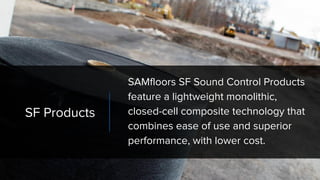
SAMfloors SF Sound Control Products
feature a lightweight monolithic,
closed-cell composite technology that
combines ease of use and superior
performance, with lower cost.
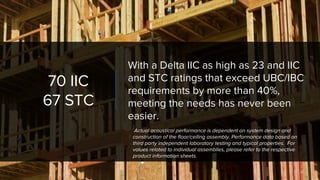
70 IIC
67 STC
With a Delta IIC as high as 23 and IIC
and STC ratings that exceed UBC/IBC
requirements by more than 40%,
meeting the needs has never been
easier.
Actual acoustical performance is dependent on system design and
construction of the floor/ceiling assembly. Performance data based on
third party independent laboratory testing and typical properties. For
values related to individual assemblies, please refer to the respective
product information sheets.
Sound Control Basics
How is sound transmitted in floor/ceiling
assemblies?
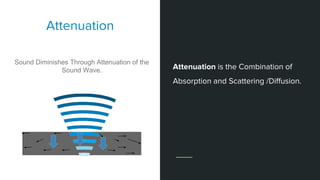
Attenuation
Sound Diminishes Through Attenuation of the
Sound Wave. Attenuation is the Combination of
Absorption and Scattering /Diffusion.
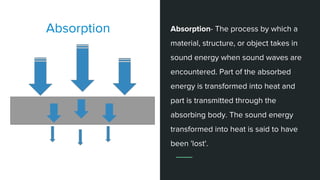
Absorption Absorption- The process by which a
material, structure, or object takes in
sound energy when sound waves are
encountered. Part of the absorbed
energy is transformed into heat and
part is transmitted through the
absorbing body. The sound energy
transformed into heat is said to have
been 'lost'.
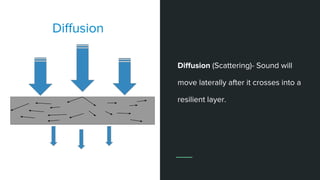
Diffusion
Diffusion (Scattering)- Sound will
move laterally after it crosses into a
resilient layer.
Sound Control Basics
How is sound measured in floor/ceiling
assemblies?
STC tests the ability of a specific construction assembly to reduce airborne sounds,
such as voices, stereo systems, and TV (ASTM E 90). It should be noted that this test
takes all components of a floor / ceiling assembly into consideration, such as framing
type, insulation, ceiling components, etc. A rating of 50 STC or above will satisfy the
International Building Code.
Sound Transmission Class (STC)
IIC tests the ability to block impact sound by measuring the resistance to transmission
of impact noise or structure-borne noise (simulating footfalls, objects dropped on the
floor, etc.) (ASTM E 492/E 989). Similar to STC, the IIC performance values include all
components, not just sound underlayment, in their calculation. A rating of 50 IIC or
above will satisfy the International Building Code.
Impact Insulation Class (IIC)
Another test that more directly evaluates impact sound of underlayment materials is
ASTM E-2179, also known as the “Delta” test. This test consists of two IIC tests
conducted over the same 6” concrete slab. One test is over the bare concrete slab (no
flooring materials) and the other is over the concrete slab with floor covering and sound
underlayment included. The measured IIC values are compared to the reference floor
levels defined in the standard and adjusted to provide the IIC the covering would
produce on the reference concrete floor. This test is important as it does not take any
other components (insulation, ceiling, etc) of a floor / ceiling assembly into
consideration, but instead, only measures the effect of the sound underlayment.
Understanding IIC & STC Sound Testing Retrieved from http://nalfa.com/wp-content/uploads/2012/08/sound_testing_white_paper.pdf
Delta Impact Insulation Class (Delta IIC)
“The Delta IIC is the only true standard for comparing the performance of competitive
sound underlayment materials.”
Sound Control Basics
Traditionally, what materials have been used to
control sound?
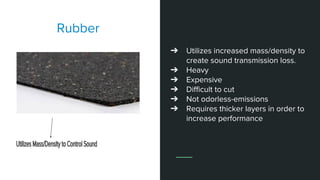
Rubber
➔ Utilizes increased mass/density to
create sound transmission loss.
➔ Heavy
➔ Expensive
➔ Difficult to cut
➔ Not odorless-emissions
➔ Requires thicker layers in order to
increase performance
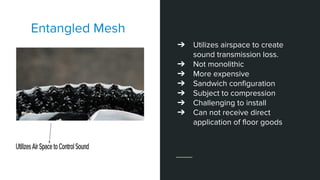
Entangled Mesh
➔ Utilizes airspace to create
sound transmission loss.
➔ Not monolithic
➔ More expensive
➔ Sandwich configuration
➔ Subject to compression
➔ Challenging to install
➔ Can not receive direct
application of floor goods
Sound Control Basics
What is the new technology for controlling sound?
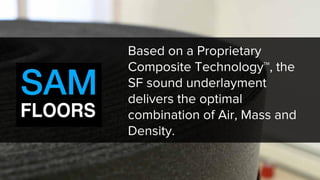
Based on a Proprietary
Composite Technology™, the
SF sound underlayment
delivers the optimal
combination of Air, Mass and
Density.
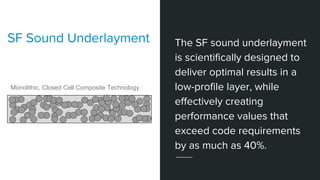
The SF sound underlayment
is scientifically designed to
deliver optimal results in a
low-profile layer, while
effectively creating
performance values that
exceed code requirements
by as much as 40%.
SF Sound Underlayment
Monolithic, Closed Cell Composite Technology.
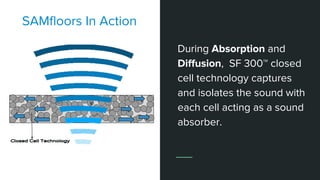
During Absorption and
Diffusion, SF 300™ closed
cell technology captures
and isolates the sound with
each cell acting as a sound
absorber.
v
SAMfloors In Action
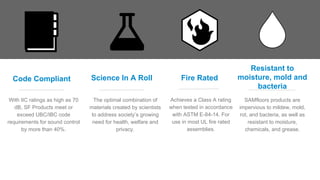
Code Compliant
With IIC ratings as high as 70
dB, SF Products meet or
exceed UBC/IBC code
requirements for sound control
by more than 40%.
Science In A Roll
The optimal combination of
materials created by scientists
to address society’s growing
need for health, welfare and
privacy.
Fire Rated
Achieves a Class A rating
when tested in accordance
with ASTM E-84-14. For
use in most UL fire rated
assemblies.
Resistant to
moisture, mold and
bacteria
SAMfloors products are
impervious to mildew, mold,
rot, and bacteria, as well as
resistant to moisture,
chemicals, and grease.
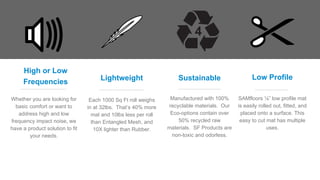
High or Low
Frequencies
Whether you are looking for
basic comfort or want to
address high and low
frequency impact noise, we
have a product solution to fit
your needs.
Lightweight
Each 1000 Sq Ft roll weighs
in at 32lbs. That’s 40% more
mat and 10lbs less per roll
than Entangled Mesh, and
10X lighter than Rubber.
Sustainable
Manufactured with 100%
recyclable materials. Our
Eco-options contain over
50% recycled raw
materials. SF Products are
non-toxic and odorless.
Low Profile
SAMfloors ⅛” low profile mat
is easily rolled out, fitted, and
placed onto a surface. This
easy to cut mat has multiple
uses.
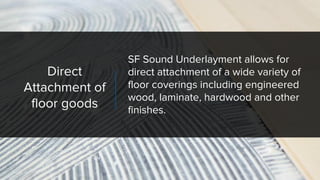
Direct
Attachment of
floor goods
SF Sound Underlayment allows for
direct attachment of a wide variety of
floor coverings including engineered
wood, laminate, hardwood and other
finishes.
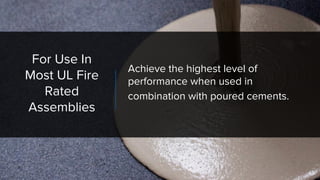
For Use In
Most UL Fire
Rated
Assemblies
Achieve the highest level of
performance when used in
combination with poured cements.
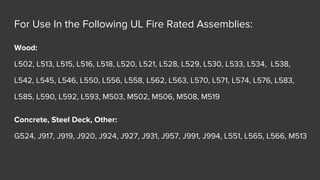
For Use In the Following UL Fire Rated Assemblies:
Wood:
L502, L513, L515, L516, L518, L520, L521, L528, L529, L530, L533, L534, L538,
L542, L545, L546, L550, L556, L558, L562, L563, L570, L571, L574, L576, L583,
L585, L590, L592, L593, M503, M502, M506, M508, M519
Concrete, Steel Deck, Other:
G524, J917, J919, J920, J924, J927, J931, J957, J991, J994, L551, L565, L566, M513
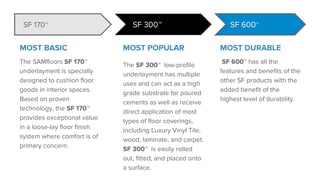
MOST BASIC
The SAMfloors SF 170™
underlayment is specially
designed to cushion floor
goods in interior spaces.
Based on proven
technology, the SF 170™
provides exceptional value
in a loose-lay floor finish
system where comfort is of
primary concern.
MOST POPULAR
The SF 300™ low-profile
underlayment has multiple
uses and can act as a high
grade substrate for poured
cements as well as receive
direct application of most
types of floor coverings,
including Luxury Vinyl Tile,
wood, laminate, and carpet.
SF 300™ is easily rolled
out, fitted, and placed onto
a surface.
SF 600™
MOST DURABLE
SF 600™ has all the
features and benefits of the
other SF products with the
added benefit of the
highest level of durability.
SF 300™SF 170™
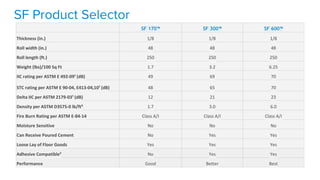
SF Product Selector
SF 170™ SF 300™ SF 600™
Thickness (in.) 1/8 1/8 1/8
Roll width (in.) 48 48 48
Roll length (ft.) 250 250 250
Weight (lbs)/100 Sq Ft 1.7 3.2 6.25
IIC rating per ASTM E 492-09¹ (dB) 49 69 70
STC rating per ASTM E 90-04, E413-04,10¹ (dB) 48 65 70
Delta IIC per ASTM 2179-03¹ (dB) 12 21 23
Density per ASTM D3575-0 lb/ft³ 1.7 3.0 6.0
Fire Burn Rating per ASTM E-84-14 Class A/I Class A/I Class A/I
Moisture Sensitive No No No
Can Receive Poured Cement No Yes Yes
Loose Lay of Floor Goods Yes Yes Yes
Adhesive Compatible² No Yes Yes
Performance Good Better Best
Performance/Weight/Value
How do we stack up against the competition?
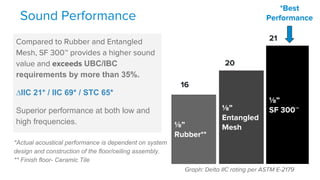
Sound Performance
Compared to Rubber and Entangled
Mesh, SF 300™ provides a higher sound
value and exceeds UBC/IBC
requirements by more than 35%.
∆IIC 21* / IIC 69* / STC 65*
Superior performance at both low and
high frequencies.
16
⅛”
Rubber**
20
⅛”
Entangled
Mesh
21
⅛”
SF 300™
Graph: Delta IIC rating per ASTM E-2179
*Best
Performance
*Actual acoustical performance is dependent on system
design and construction of the floor/ceiling assembly.
** Finish floor- Ceramic Tile
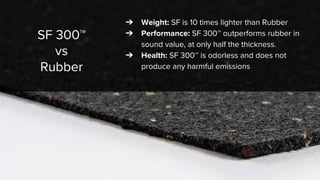
SF 300™
vs
Rubber
➔ Weight: SF is 10 times lighter than Rubber
➔ Performance: SF 300™ outperforms rubber in
sound value, at only half the thickness.
➔ Health: SF 300™ is odorless and does not
produce any harmful emissions
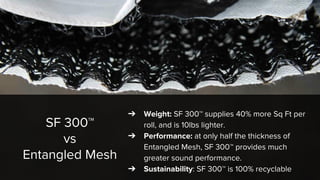
SF 300™
vs
Entangled Mesh
➔ Weight: SF 300™ supplies 40% more Sq Ft per
roll, and is 10lbs lighter.
➔ Performance: at only half the thickness of
Entangled Mesh, SF 300™ provides much
greater sound performance.
➔ Sustainability: SF 300™ is 100% recyclable
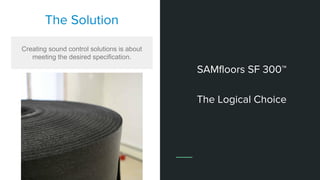
The Solution
Creating sound control solutions is about
meeting the desired specification.
SAMfloors SF 300™
The Logical Choice

Sound Control becomes more important every day.

  • 1.
    Sound Control Solutionsin Floor/Ceiling Assemblies
  • 2.
    Controlling sound becomesmore important every day. At SAMfloors, it is our mission to provide elegant, functional sound control solutions to meet the rapidly growing need for personal health, welfare and privacy.
  • 3.
    SF Products SAMfloors SFSound Control Products feature a lightweight monolithic, closed-cell composite technology that combines ease of use and superior performance, with lower cost.
  • 4.
    70 IIC 67 STC Witha Delta IIC as high as 23 and IIC and STC ratings that exceed UBC/IBC requirements by more than 40%, meeting the needs has never been easier. Actual acoustical performance is dependent on system design and construction of the floor/ceiling assembly. Performance data based on third party independent laboratory testing and typical properties. For values related to individual assemblies, please refer to the respective product information sheets.
  • 5.
    Sound Control Basics Howis sound transmitted in floor/ceiling assemblies?
  • 6.
    Attenuation Sound Diminishes ThroughAttenuation of the Sound Wave. Attenuation is the Combination of Absorption and Scattering /Diffusion.
  • 7.
    Absorption Absorption- Theprocess by which a material, structure, or object takes in sound energy when sound waves are encountered. Part of the absorbed energy is transformed into heat and part is transmitted through the absorbing body. The sound energy transformed into heat is said to have been 'lost'.
  • 8.
    Diffusion Diffusion (Scattering)- Soundwill move laterally after it crosses into a resilient layer.
  • 9.
    Sound Control Basics Howis sound measured in floor/ceiling assemblies?
  • 10.
    STC tests theability of a specific construction assembly to reduce airborne sounds, such as voices, stereo systems, and TV (ASTM E 90). It should be noted that this test takes all components of a floor / ceiling assembly into consideration, such as framing type, insulation, ceiling components, etc. A rating of 50 STC or above will satisfy the International Building Code. Sound Transmission Class (STC)
  • 11.
    IIC tests theability to block impact sound by measuring the resistance to transmission of impact noise or structure-borne noise (simulating footfalls, objects dropped on the floor, etc.) (ASTM E 492/E 989). Similar to STC, the IIC performance values include all components, not just sound underlayment, in their calculation. A rating of 50 IIC or above will satisfy the International Building Code. Impact Insulation Class (IIC)
  • 12.
    Another test thatmore directly evaluates impact sound of underlayment materials is ASTM E-2179, also known as the “Delta” test. This test consists of two IIC tests conducted over the same 6” concrete slab. One test is over the bare concrete slab (no flooring materials) and the other is over the concrete slab with floor covering and sound underlayment included. The measured IIC values are compared to the reference floor levels defined in the standard and adjusted to provide the IIC the covering would produce on the reference concrete floor. This test is important as it does not take any other components (insulation, ceiling, etc) of a floor / ceiling assembly into consideration, but instead, only measures the effect of the sound underlayment. Understanding IIC & STC Sound Testing Retrieved from http://nalfa.com/wp-content/uploads/2012/08/sound_testing_white_paper.pdf Delta Impact Insulation Class (Delta IIC) “The Delta IIC is the only true standard for comparing the performance of competitive sound underlayment materials.”
  • 13.
    Sound Control Basics Traditionally,what materials have been used to control sound?
  • 14.
    Rubber ➔ Utilizes increasedmass/density to create sound transmission loss. ➔ Heavy ➔ Expensive ➔ Difficult to cut ➔ Not odorless-emissions ➔ Requires thicker layers in order to increase performance
  • 15.
    Entangled Mesh ➔ Utilizesairspace to create sound transmission loss. ➔ Not monolithic ➔ More expensive ➔ Sandwich configuration ➔ Subject to compression ➔ Challenging to install ➔ Can not receive direct application of floor goods
  • 16.
    Sound Control Basics Whatis the new technology for controlling sound?
  • 17.
    Based on aProprietary Composite Technology™, the SF sound underlayment delivers the optimal combination of Air, Mass and Density.
  • 18.
    The SF soundunderlayment is scientifically designed to deliver optimal results in a low-profile layer, while effectively creating performance values that exceed code requirements by as much as 40%. SF Sound Underlayment Monolithic, Closed Cell Composite Technology.
  • 19.
    During Absorption and Diffusion,SF 300™ closed cell technology captures and isolates the sound with each cell acting as a sound absorber. v SAMfloors In Action
  • 20.
    Code Compliant With IICratings as high as 70 dB, SF Products meet or exceed UBC/IBC code requirements for sound control by more than 40%. Science In A Roll The optimal combination of materials created by scientists to address society’s growing need for health, welfare and privacy. Fire Rated Achieves a Class A rating when tested in accordance with ASTM E-84-14. For use in most UL fire rated assemblies. Resistant to moisture, mold and bacteria SAMfloors products are impervious to mildew, mold, rot, and bacteria, as well as resistant to moisture, chemicals, and grease.
  • 21.
    High or Low Frequencies Whetheryou are looking for basic comfort or want to address high and low frequency impact noise, we have a product solution to fit your needs. Lightweight Each 1000 Sq Ft roll weighs in at 32lbs. That’s 40% more mat and 10lbs less per roll than Entangled Mesh, and 10X lighter than Rubber. Sustainable Manufactured with 100% recyclable materials. Our Eco-options contain over 50% recycled raw materials. SF Products are non-toxic and odorless. Low Profile SAMfloors ⅛” low profile mat is easily rolled out, fitted, and placed onto a surface. This easy to cut mat has multiple uses.
  • 22.
    Direct Attachment of floor goods SFSound Underlayment allows for direct attachment of a wide variety of floor coverings including engineered wood, laminate, hardwood and other finishes.
  • 23.
    For Use In MostUL Fire Rated Assemblies Achieve the highest level of performance when used in combination with poured cements.
  • 24.
    For Use Inthe Following UL Fire Rated Assemblies: Wood: L502, L513, L515, L516, L518, L520, L521, L528, L529, L530, L533, L534, L538, L542, L545, L546, L550, L556, L558, L562, L563, L570, L571, L574, L576, L583, L585, L590, L592, L593, M503, M502, M506, M508, M519 Concrete, Steel Deck, Other: G524, J917, J919, J920, J924, J927, J931, J957, J991, J994, L551, L565, L566, M513
  • 25.
    MOST BASIC The SAMfloorsSF 170™ underlayment is specially designed to cushion floor goods in interior spaces. Based on proven technology, the SF 170™ provides exceptional value in a loose-lay floor finish system where comfort is of primary concern. MOST POPULAR The SF 300™ low-profile underlayment has multiple uses and can act as a high grade substrate for poured cements as well as receive direct application of most types of floor coverings, including Luxury Vinyl Tile, wood, laminate, and carpet. SF 300™ is easily rolled out, fitted, and placed onto a surface. SF 600™ MOST DURABLE SF 600™ has all the features and benefits of the other SF products with the added benefit of the highest level of durability. SF 300™SF 170™
  • 26.
    SF Product Selector SF170™ SF 300™ SF 600™ Thickness (in.) 1/8 1/8 1/8 Roll width (in.) 48 48 48 Roll length (ft.) 250 250 250 Weight (lbs)/100 Sq Ft 1.7 3.2 6.25 IIC rating per ASTM E 492-09¹ (dB) 49 69 70 STC rating per ASTM E 90-04, E413-04,10¹ (dB) 48 65 70 Delta IIC per ASTM 2179-03¹ (dB) 12 21 23 Density per ASTM D3575-0 lb/ft³ 1.7 3.0 6.0 Fire Burn Rating per ASTM E-84-14 Class A/I Class A/I Class A/I Moisture Sensitive No No No Can Receive Poured Cement No Yes Yes Loose Lay of Floor Goods Yes Yes Yes Adhesive Compatible² No Yes Yes Performance Good Better Best
  • 27.
    Performance/Weight/Value How do westack up against the competition?
  • 28.
    Sound Performance Compared toRubber and Entangled Mesh, SF 300™ provides a higher sound value and exceeds UBC/IBC requirements by more than 35%. ∆IIC 21* / IIC 69* / STC 65* Superior performance at both low and high frequencies. 16 ⅛” Rubber** 20 ⅛” Entangled Mesh 21 ⅛” SF 300™ Graph: Delta IIC rating per ASTM E-2179 *Best Performance *Actual acoustical performance is dependent on system design and construction of the floor/ceiling assembly. ** Finish floor- Ceramic Tile
  • 29.
    SF 300™ vs Rubber ➔ Weight:SF is 10 times lighter than Rubber ➔ Performance: SF 300™ outperforms rubber in sound value, at only half the thickness. ➔ Health: SF 300™ is odorless and does not produce any harmful emissions
  • 30.
    SF 300™ vs Entangled Mesh ➔Weight: SF 300™ supplies 40% more Sq Ft per roll, and is 10lbs lighter. ➔ Performance: at only half the thickness of Entangled Mesh, SF 300™ provides much greater sound performance. ➔ Sustainability: SF 300™ is 100% recyclable
  • 31.
    The Solution Creating soundcontrol solutions is about meeting the desired specification. SAMfloors SF 300™ The Logical Choice