P.O. Box 26893
Manama, Bahrain
Telephone: +973 17 533570
tarek.fadlallah@bh.nomura.com
1
Sunday 22nd
January, 2006
Souk of Fortune
The Land of Golden Shares
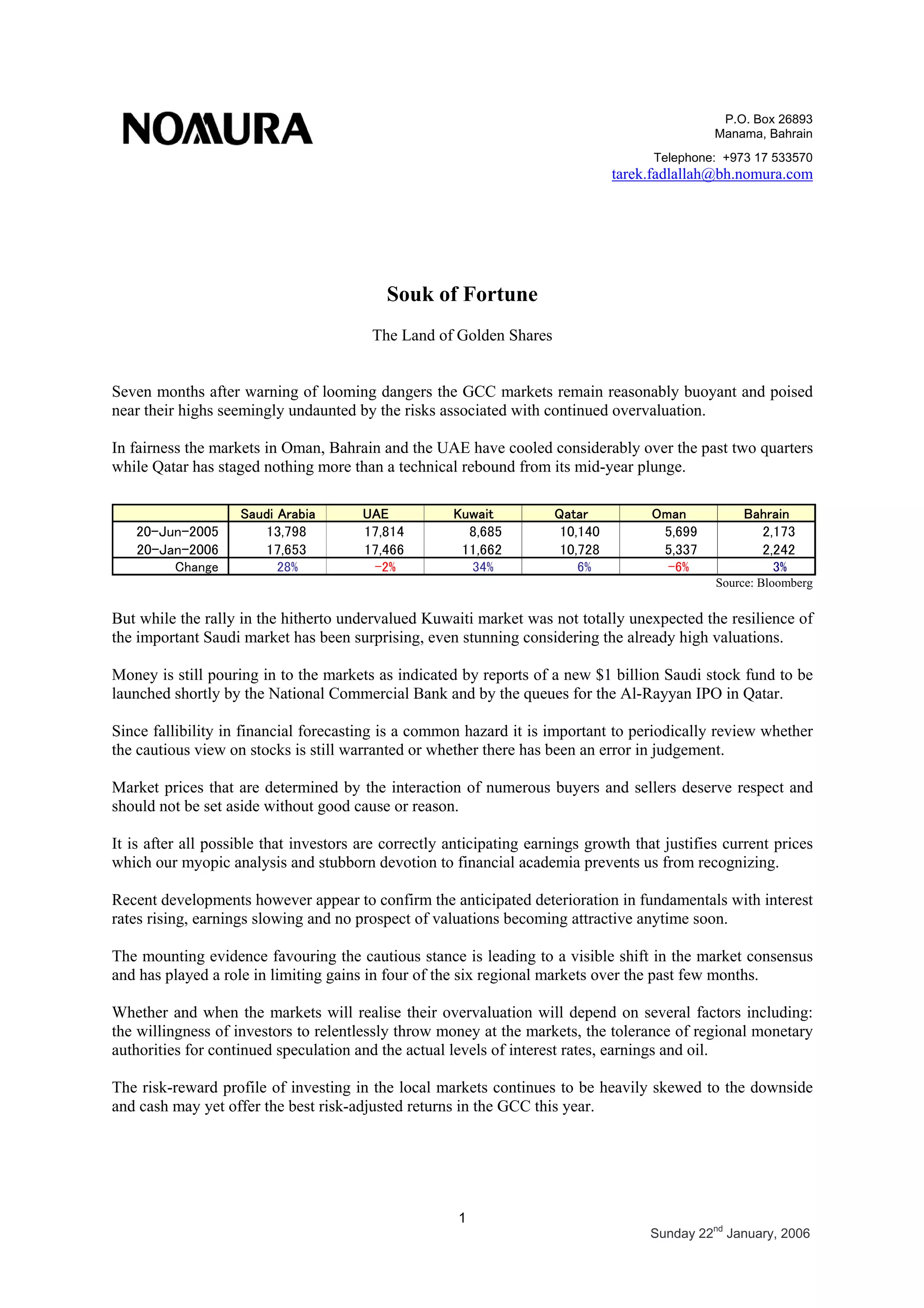
Seven months after warning of looming dangers the GCC markets remain reasonably buoyant and poised
near their highs seemingly undaunted by the risks associated with continued overvaluation.
In fairness the markets in Oman, Bahrain and the UAE have cooled considerably over the past two quarters
while Qatar has staged nothing more than a technical rebound from its mid-year plunge.
Saudi Arabia UAE Kuwait Qatar Oman Bahrain
20-Jun-2005 13,798 17,814 8,685 10,140 5,699 2,173
20-Jan-2006 17,653 17,466 11,662 10,728 5,337 2,242
Change 28% -2% 34% 6% -6% 3%
Source: Bloomberg
But while the rally in the hitherto undervalued Kuwaiti market was not totally unexpected the resilience of
the important Saudi market has been surprising, even stunning considering the already high valuations.
Money is still pouring in to the markets as indicated by reports of a new $1 billion Saudi stock fund to be
launched shortly by the National Commercial Bank and by the queues for the Al-Rayyan IPO in Qatar.
Since fallibility in financial forecasting is a common hazard it is important to periodically review whether
the cautious view on stocks is still warranted or whether there has been an error in judgement.
Market prices that are determined by the interaction of numerous buyers and sellers deserve respect and
should not be set aside without good cause or reason.
It is after all possible that investors are correctly anticipating earnings growth that justifies current prices
which our myopic analysis and stubborn devotion to financial academia prevents us from recognizing.
Recent developments however appear to confirm the anticipated deterioration in fundamentals with interest
rates rising, earnings slowing and no prospect of valuations becoming attractive anytime soon.
The mounting evidence favouring the cautious stance is leading to a visible shift in the market consensus
and has played a role in limiting gains in four of the six regional markets over the past few months.
Whether and when the markets will realise their overvaluation will depend on several factors including:
the willingness of investors to relentlessly throw money at the markets, the tolerance of regional monetary
authorities for continued speculation and the actual levels of interest rates, earnings and oil.
The risk-reward profile of investing in the local markets continues to be heavily skewed to the downside
and cash may yet offer the best risk-adjusted returns in the GCC this year.
P.O. Box 26893
Manama, Bahrain
Telephone: +973 17 533570
tarek.fadlallah@bh.nomura.com
2
Sunday 22nd
January, 2006
Diminishing Returns
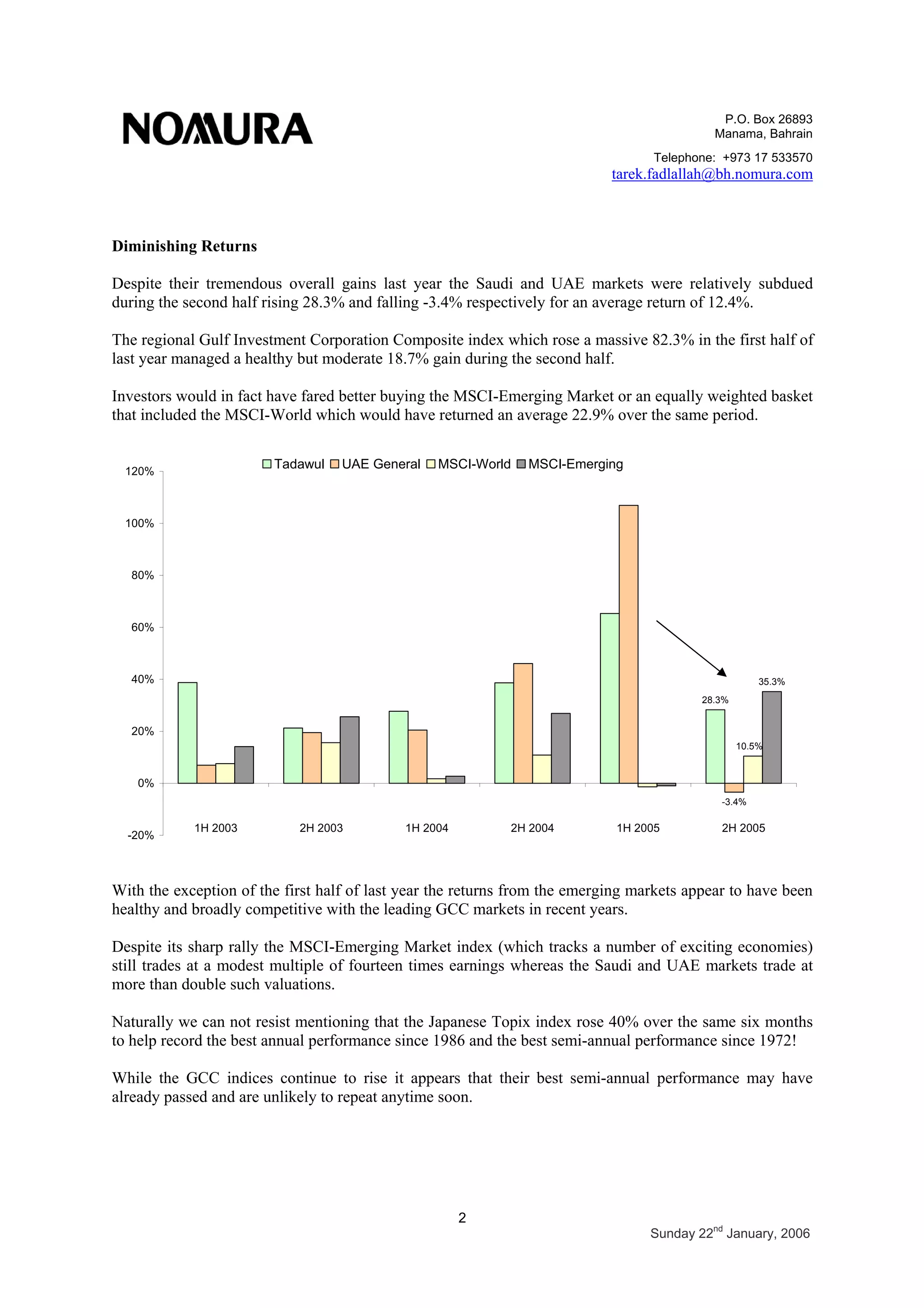
Despite their tremendous overall gains last year the Saudi and UAE markets were relatively subdued
during the second half rising 28.3% and falling -3.4% respectively for an average return of 12.4%.
The regional Gulf Investment Corporation Composite index which rose a massive 82.3% in the first half of
last year managed a healthy but moderate 18.7% gain during the second half.
Investors would in fact have fared better buying the MSCI-Emerging Market or an equally weighted basket
that included the MSCI-World which would have returned an average 22.9% over the same period.
28.3%
-3.4%
35.3%
10.5%
-20%
0%
20%
40%
60%
80%
100%
120%
1H 2003 2H 2003 1H 2004 2H 2004 1H 2005 2H 2005
Tadawul UAE General MSCI-World MSCI-Emerging
With the exception of the first half of last year the returns from the emerging markets appear to have been
healthy and broadly competitive with the leading GCC markets in recent years.
Despite its sharp rally the MSCI-Emerging Market index (which tracks a number of exciting economies)
still trades at a modest multiple of fourteen times earnings whereas the Saudi and UAE markets trade at
more than double such valuations.
Naturally we can not resist mentioning that the Japanese Topix index rose 40% over the same six months
to help record the best annual performance since 1986 and the best semi-annual performance since 1972!
While the GCC indices continue to rise it appears that their best semi-annual performance may have
already passed and are unlikely to repeat anytime soon.
P.O. Box 26893
Manama, Bahrain
Telephone: +973 17 533570
tarek.fadlallah@bh.nomura.com
3
Sunday 22nd
January, 2006
Economic Strains
The economic news is overwhelmingly positive but the streets are not yet paved with gold and there are
signs of stresses as rising property prices, higher inflation and increasing interest rates exact their toll.
In usually friendly Bahrain for example a minority of populist legislators have called for a ban on land
purchases by other GCC nationals to prevent escalating values from pricing out the local citizens.
Meanwhile in Kuwait some MPs are questioning the wisdom of the country’s currency peg as higher
borrowing costs hit business margins and hurt the economy.
But perhaps the most pressing economic problems at the moment are to be found in Dubai where asset and
consumer price inflation is wreaking havoc with budgetary planning and business strategies.
The National Bank of Dubai estimates that the cost of living may have risen by up to 20% last year due to
a surge in rent and fuel prices compared with official Central Bank inflation estimates of 6%.
The rampant inflationary environment amid runaway money supply growth and negative real interest rates
is eroding the value of income and savings, encouraging speculation and making life awkward for all.
In the absence of a fixed exchange regime the Dirham would likely have been a strong candidate for
devaluation but the peg is causing costs to spiral and leading to a loss of competitive advantage instead.
While Dubai exhibits the most acute symptoms of excessive growth, the rising cost in the main factors of
production (land, labour and capital) is undermining the long term economic prospects of the whole region.
Unbalanced economic conditions present serious challenges for the regional authorities and the jury is out
as to whether they have done enough to avoid chronic indigestion after the current feast.
Cooling Earnings
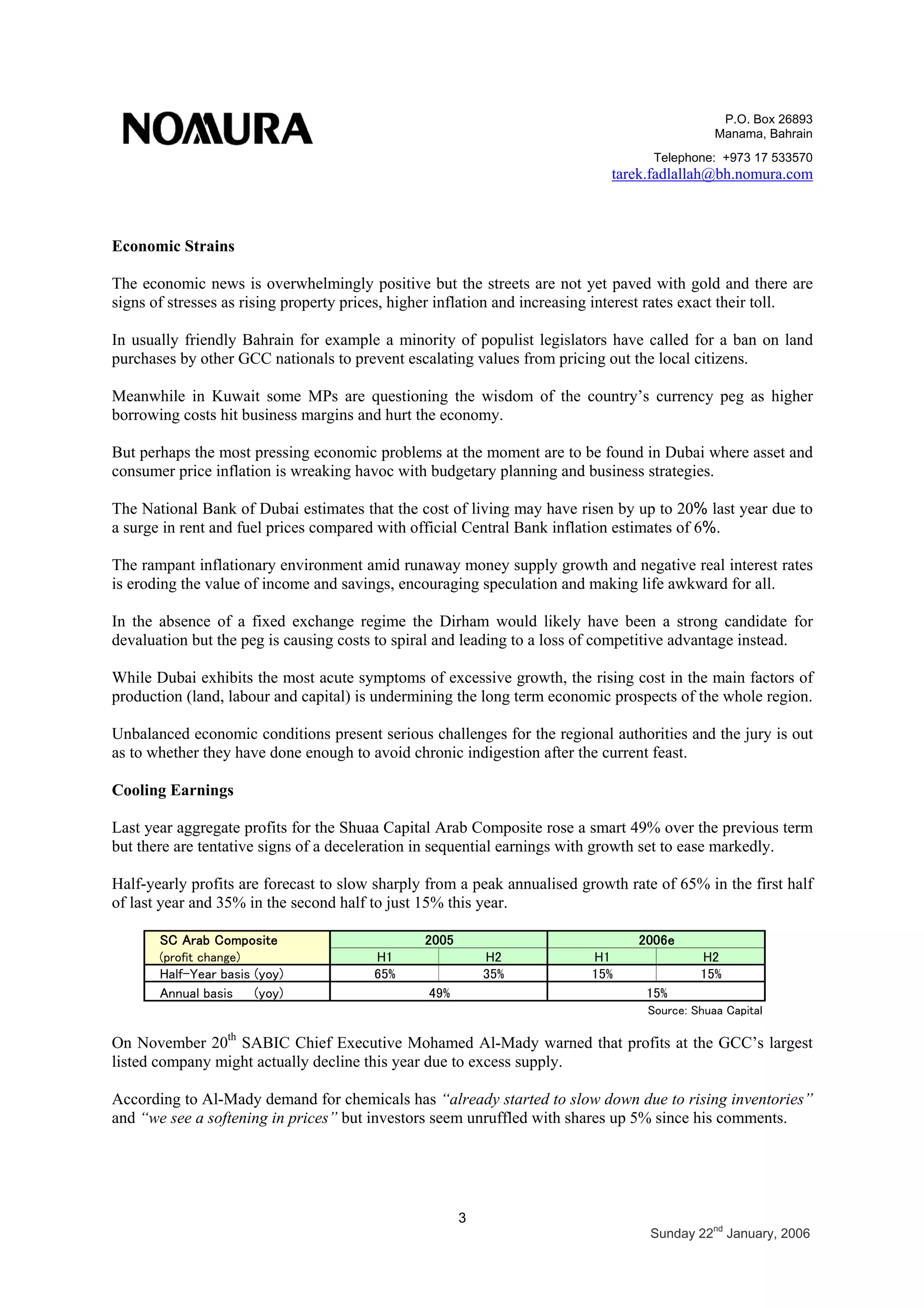
Last year aggregate profits for the Shuaa Capital Arab Composite rose a smart 49% over the previous term
but there are tentative signs of a deceleration in sequential earnings with growth set to ease markedly.
Half-yearly profits are forecast to slow sharply from a peak annualised growth rate of 65% in the first half
of last year and 35% in the second half to just 15% this year.
SC Arab Composite
(profit change) H1 H2 H1 H2
Half-Year basis (yoy) 65% 35% 15% 15%
Annual basis (yoy)
2005 2006e
Source: Shuaa Capital
49% 15%
On November 20th
SABIC Chief Executive Mohamed Al-Mady warned that profits at the GCC’s largest
listed company might actually decline this year due to excess supply.
According to Al-Mady demand for chemicals has “already started to slow down due to rising inventories”
and “we see a softening in prices” but investors seem unruffled with shares up 5% since his comments.
P.O. Box 26893
Manama, Bahrain
Telephone: +973 17 533570
tarek.fadlallah@bh.nomura.com
4
Sunday 22nd
January, 2006
Extraordinary and Non-Recurring
A considerable proportion of the corporate earnings across the GCC over the past eighteen months have
been a function of asset prices that have doubled and even tripled.
Wealth Effect
Rising asset prices have been a key factor feeding consumer confidence which has spurred increased
borrowing and stimulated higher household spending.
It is exceedingly difficult to evaluate the extent to which this wealth effect has stirred the private sector
consumption boom but it doubtlessly contributed significantly to the growth in corporate profits last year.
Whether the scale of increase in private consumption can be maintained going forward remains to be seen
but given the sharp rise in household debt it seems likely that consumer credit growth will slow.
Income Effect
According to the National Bank of Kuwait about a quarter of current earnings in Kuwait are derived from
non-operating profits such as gains from the sale of land or the revaluation of listed shareholdings.
These extraordinary items have padded earnings and cushioned valuations providing a distorted view of
the underlying growth in commercial operating income.
In Japan during the eighties such extraordinary earnings were referred to as zaitech (financial engineering)
with companies using cheap funding to embellish their profits by trading stocks and other assets.
The inflated earnings phenomenon is prevalent throughout the region but there are unfortunately few
reliable estimates of their aggregated contribution to declared earnings due to relatively lax reporting
requirements in some jurisdictions.
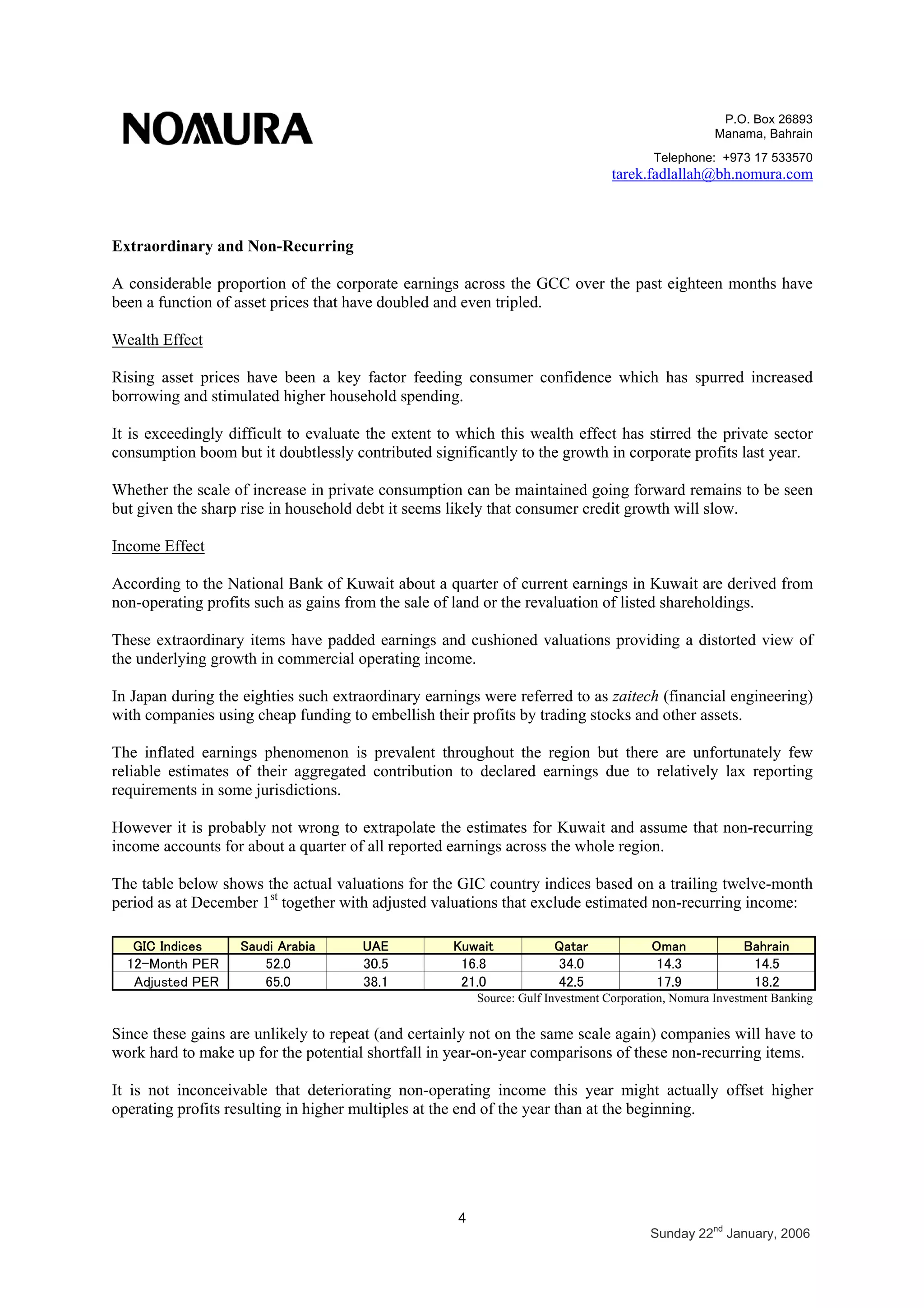
However it is probably not wrong to extrapolate the estimates for Kuwait and assume that non-recurring
income accounts for about a quarter of all reported earnings across the whole region.
The table below shows the actual valuations for the GIC country indices based on a trailing twelve-month
period as at December 1st
together with adjusted valuations that exclude estimated non-recurring income:
GIC Indices Saudi Arabia UAE Kuwait Qatar Oman Bahrain
12-Month PER 52.0 30.5 16.8 34.0 14.3 14.5
Adjusted PER 65.0 38.1 21.0 42.5 17.9 18.2
Source: Gulf Investment Corporation, Nomura Investment Banking
Since these gains are unlikely to repeat (and certainly not on the same scale again) companies will have to
work hard to make up for the potential shortfall in year-on-year comparisons of these non-recurring items.
It is not inconceivable that deteriorating non-operating income this year might actually offset higher
operating profits resulting in higher multiples at the end of the year than at the beginning.
P.O. Box 26893
Manama, Bahrain
Telephone: +973 17 533570
tarek.fadlallah@bh.nomura.com
5
Sunday 22nd
January, 2006
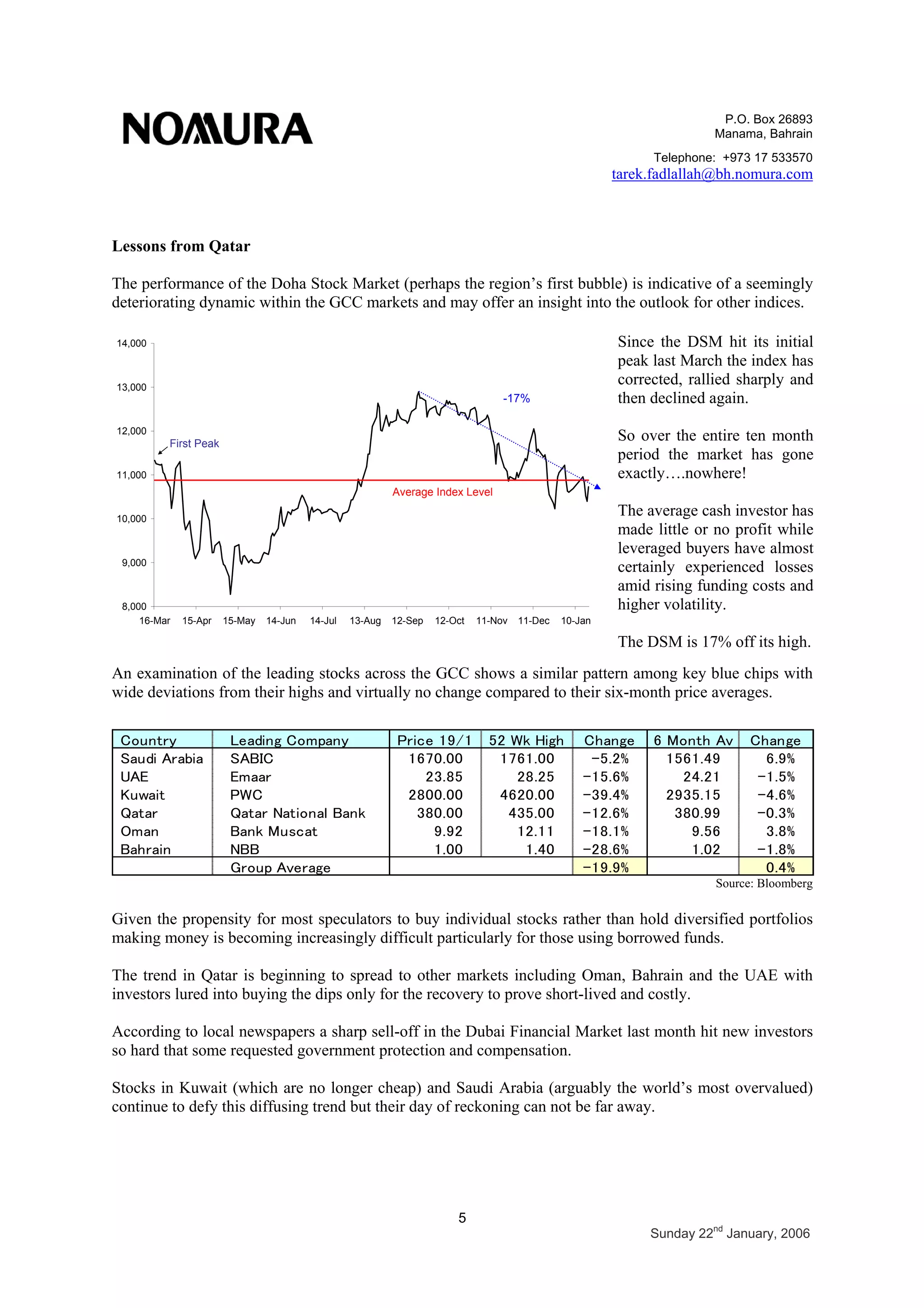
Since the DSM hit its initial
peak last March the index has
corrected, rallied sharply and
then declined again.
So over the entire ten month
period the market has gone
exactly….nowhere!
The average cash investor has
made little or no profit while
leveraged buyers have almost
certainly experienced losses
amid rising funding costs and
higher volatility.
The DSM is 17% off its high.
-17%
Lessons from Qatar
The performance of the Doha Stock Market (perhaps the region’s first bubble) is indicative of a seemingly
deteriorating dynamic within the GCC markets and may offer an insight into the outlook for other indices.
8,000
9,000
10,000
11,000
12,000
13,000
14,000
16-Mar 15-Apr 15-May 14-Jun 14-Jul 13-Aug 12-Sep 12-Oct 11-Nov 11-Dec 10-Jan
Average Index Level
First Peak
An examination of the leading stocks across the GCC shows a similar pattern among key blue chips with
wide deviations from their highs and virtually no change compared to their six-month price averages.
Source: Bloomberg
Given the propensity for most speculators to buy individual stocks rather than hold diversified portfolios
making money is becoming increasingly difficult particularly for those using borrowed funds.
The trend in Qatar is beginning to spread to other markets including Oman, Bahrain and the UAE with
investors lured into buying the dips only for the recovery to prove short-lived and costly.
According to local newspapers a sharp sell-off in the Dubai Financial Market last month hit new investors
so hard that some requested government protection and compensation.
Stocks in Kuwait (which are no longer cheap) and Saudi Arabia (arguably the world’s most overvalued)
continue to defy this diffusing trend but their day of reckoning can not be far away.
Country Leading Company Price 19/1 52 Wk High Change 6 Month Av Change
Saudi Arabia SABIC 1670.00 1761.00 -5.2% 1561.49 6.9%
UAE Emaar 23.85 28.25 -15.6% 24.21 -1.5%
Kuwait PWC 2800.00 4620.00 -39.4% 2935.15 -4.6%
Qatar Qatar National Bank 380.00 435.00 -12.6% 380.99 -0.3%
Oman Bank Muscat 9.92 12.11 -18.1% 9.56 3.8%
Bahrain NBB 1.00 1.40 -28.6% 1.02 -1.8%
Group Average -19.9% 0.4%
P.O. Box 26893
Manama, Bahrain
Telephone: +973 17 533570
tarek.fadlallah@bh.nomura.com
6
Sunday 22nd
January, 2006
Rising Opportunity Cost
The performance of the DSM and UAE stock markets suggests that the economic strains and decelerating
corporate profitability are beginning to weigh on the high valuations.
Moreover price stagnation is not limited to stocks and can be observed across the regional property
markets which have also cooled after a huge upward adjustment last year.
The longer that the markets stagnate and fail to deliver high returns the more likely it is that investors –
particularly those employing leverage – will lose interest and seek alternative investments.
The most optimistic scenario is that investor indifference to the opportunity cost of capital may prolong the
dip buying mentality and sustain prices near current levels as long as the liquidity tap remains open.
The Story of Telecoms
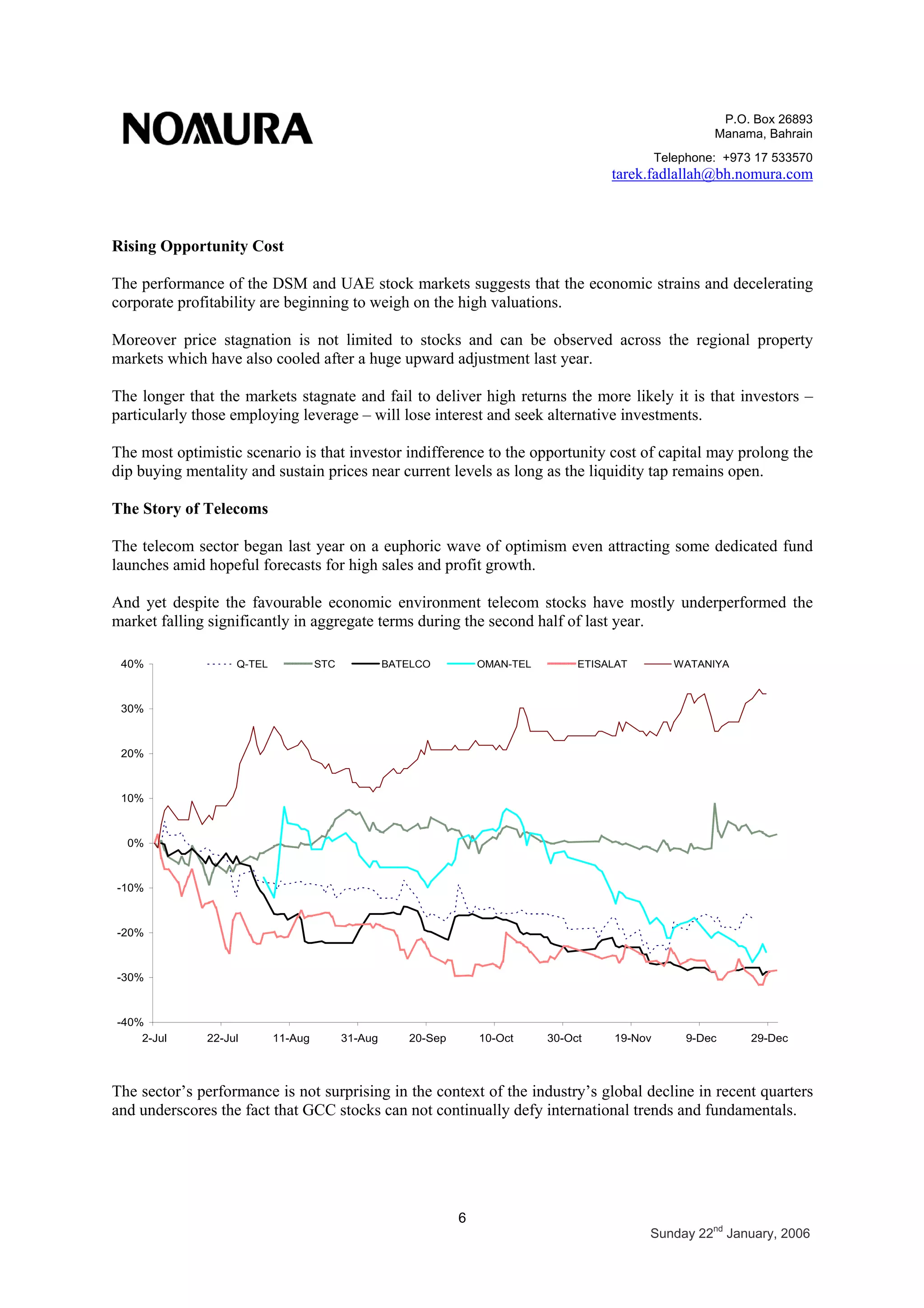
The telecom sector began last year on a euphoric wave of optimism even attracting some dedicated fund
launches amid hopeful forecasts for high sales and profit growth.
And yet despite the favourable economic environment telecom stocks have mostly underperformed the
market falling significantly in aggregate terms during the second half of last year.
-40%
-30%
-20%
-10%
0%
10%
20%
30%
40%
2-Jul 22-Jul 11-Aug 31-Aug 20-Sep 10-Oct 30-Oct 19-Nov 9-Dec 29-Dec
Q-TEL STC BATELCO OMAN-TEL ETISALAT WATANIYA
The sector’s performance is not surprising in the context of the industry’s global decline in recent quarters
and underscores the fact that GCC stocks can not continually defy international trends and fundamentals.
P.O. Box 26893
Manama, Bahrain
Telephone: +973 17 533570
tarek.fadlallah@bh.nomura.com
7
Sunday 22nd
January, 2006
0.0
1.0
2.0
3.0
4.0
5.0
6.0
7.0
8.0
1.0 1.5 2.0 2.5 3.0 3.5 4.0 4.5 5.0
Interest Rate
EarningsYield
Undervalued
Overvalued
Japan
Germany
US
UK
UAE
Saudi Arabia
Global Valuation Comparison
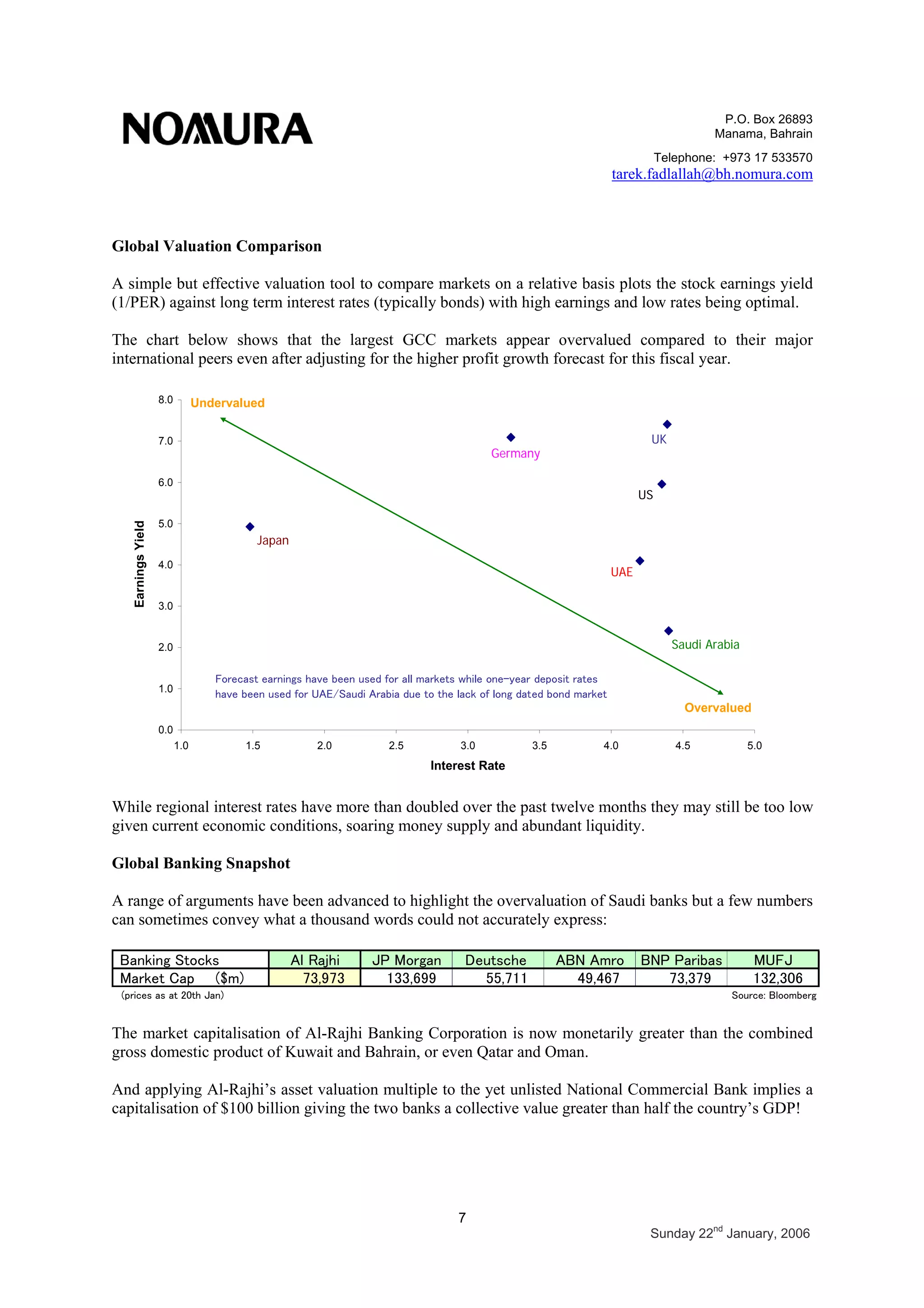
A simple but effective valuation tool to compare markets on a relative basis plots the stock earnings yield
(1/PER) against long term interest rates (typically bonds) with high earnings and low rates being optimal.
The chart below shows that the largest GCC markets appear overvalued compared to their major
international peers even after adjusting for the higher profit growth forecast for this fiscal year.
While regional interest rates have more than doubled over the past twelve months they may still be too low
given current economic conditions, soaring money supply and abundant liquidity.
Global Banking Snapshot
A range of arguments have been advanced to highlight the overvaluation of Saudi banks but a few numbers
can sometimes convey what a thousand words could not accurately express:
Banking Stocks Al Rajhi JP Morgan Deutsche ABN Amro BNP Paribas MUFJ
Market Cap ($m) 73,973 133,699 55,711 49,467 73,379 132,306
Source: Bloomberg(prices as at 20th Jan)
The market capitalisation of Al-Rajhi Banking Corporation is now monetarily greater than the combined
gross domestic product of Kuwait and Bahrain, or even Qatar and Oman.
And applying Al-Rajhi’s asset valuation multiple to the yet unlisted National Commercial Bank implies a
capitalisation of $100 billion giving the two banks a collective value greater than half the country’s GDP!
Forecast earnings have been used for all markets while one-year deposit rates
have been used for UAE/Saudi Arabia due to the lack of long dated bond market
P.O. Box 26893
Manama, Bahrain
Telephone: +973 17 533570
tarek.fadlallah@bh.nomura.com
8
Sunday 22nd
January, 2006
The Money Trail
With attractive valuations increasingly difficult to find within the regional markets sophisticated money is
drifting towards higher yielding investments overseas.
Dubai’s Istithmar acquired the Helmsley Building in New York in November for $705 million and
bought out the remaining shares in the London Eye that it did not own from British Airways.
British newspapers reported that Abu Dhabi's royal family had won a bidding war for one of the
largest blocks of real estate ever sold in London's West End at Thirty-Three Cavendish Square.
According to the Financial Times the KIO and ADIA are negotiating to take a $1 billion stake in the
Industrial and Commercial Bank of China to strengthen economic ties with the Asian giant.
Last month the Saudi General Retirement Foundation announced plans to invest 27% of its assets –
equivalent to about $2½ billion – in international bonds and stocks abroad to diversify its portfolio.
Although international asset prices are not particularly cheap at this point the scale of liquidity within the
GCC necessitates diversification strategies that need not sacrifice risk adjusted returns.
GCC Symposium
Last month’s conference on the GCC Equity Markets sponsored by the National Bank of Kuwait provided
a terrific opportunity for investors to examine the outlook for the regional stock markets.
Though challenged to discuss the markets in the context of “Boom or Bubble?” neither word was explicitly
used with most presenters preferring to express short term caution and long term optimism.
Interestingly the unbounded confidence of last summer has moderated to reflect a greater recognition of
the extant overvaluations and a more mature assessment of the market prospects.
The growing consensus however is restricted to investment professional and appears not have afflicted
retail investors who remain consumed by gossip and momentum rather than academic irrelevancies.
To be sure there is still a good story to tell and as the elder George Bush remarked in his key note speech
“the strategic importance of the Middle East will grow” and economic prospects should improve.
Specifically, demand for energy, housing and financial services will drive economic growth for years to
come but it is the monetary appraisal of such promise which has stirred so much debate and controversy.
Sharing the economic optimism does not conflict with holding a negative view of current stock prices – a
distinction that many investors do not make in their hasty pursuit of headlines rather than dividends.
Indeed applying international valuation benchmarks to the GCC markets suggests that the regional bourses
may be overvalued by over $300 billion much of which can be attributed to the Saudi market.
That’s enough money to buy everyone in the GCC a Big Mac meal every day for more than five years!
P.O. Box 26893
Manama, Bahrain
Telephone: +973 17 533570
tarek.fadlallah@bh.nomura.com
9
Sunday 22nd
January, 2006
Conclusion
The term “bubble” is typically assigned to any asset whose price increases significantly within a short
period of time but more accurately it is a market condition rather than a specific pricing point.
Over the past few years the GCC markets have risen sevenfold so calling the precise highs was always
going to be difficult especially since, by definition, irrational markets do not respond to rhyme or reason.
The suspicion is that the discounting mechanism in some of the local markets is relatively immature and
hampered by the lack of reliable forecasts and weak dissemination of fundamental analysis.
Moreover analysis will invariably fall on deaf ears when it conflicts with vested interests and goes against
a profitable trend in a market with no recent memories of significant losses.
However there is absolutely no value-added in being last or in simply reflecting a consensus especially
when the passage of time has only confirmed the expected economic and financial developments.
Still and despite the conviction in maintaining the bearish call, this author will not be too proud to alter his
opinion if circumstances change or events invalidate this controversial stance.
Best wishes for a happy and healthy New Year.
Tarek Fadlallah, CFA
WARNING AND DISCLAIMER: PLEASE NOTE THAT THE PERSONAL OPINIONS EXPRESSED IN THIS NOTE ARE SOLEY THOSE
OF THE AUTHOR AND DO NOT REFLECT ANY RECOMMENDATIONS OR ATTEMPT TO SOLICIT BUSINESS. THIS PUBLICATION
HAS BEEN ISSUED BY THE SALES/TRADING DEPARTMENT OF NOMURA INVESTMENT BANKING (MIDDLE EAST) B.S.C. (c)
AND IS PROVIDED WITHOUT COMPENSATION. THIS DOCUMENT IS NOT INTENDED FOR PRIVATE CUSTOMERS WITHIN THE
RULES OF THE UK FINANCIAL SERVICES AUTHORITY (FSA) OR THE BAHRAIN MONETARY AGENCY (BMA) AND IS NOT TO
BE DISTRIUBTED WITHOUT PRIOR AUTHORISATION AND IS NOT INTENDED FOR PRIVATE INDIVIDUALS AND SHOULD NOT
BE DISTRIBUTED AS SUCH NOR SHOULD IT BE COPIED TO ANY OTHER PERSON WITHOUT OUR EXPRESS CONSENT. THIS
DOCUMENT SHOULD NOT BE CONSIDERED AN OFFER TO BUY OR SELL INVESTMENTS. WE ARE NOT YOUR INVESTMENT
ADVISER AND THIS INFORMATION IS PROVIDED ON THE BASIS THAT YOU HAVE SUCH KNOWLEDGE AND EXPERIENCE TO
EVALUATE ITS MERITS AND RISKS AND ARE CAPABLE OF UNDERTAKING YOUR OWN OBJECTIVE ANALYSIS OF THE
INVESTMENT AND ITS SUITABILITY TO MEET YOUR REQUIREMENTS. THE INFORMATION IS BASED ON SOURCES WE
BELIEVE TO BE RELIABLE BUT WE DO NOT REPRESENT THAT IT IS ACCURATE OR COMPLETE. ANY VALUATIONS
CONTAINED HEREIN ARE SUBJECT TO CHANGE WITHOUT NOTICE. NOMURA INVESTMENT BANKING (MIDDLE EAST) B.S.C.
(c) AND/OR CONNECTED PERSONS DO NOT ACCEPT ANY LIABILITY WHATSOEVER FOR ANY DIRECT, INDIRECT,
INCORRECT OR INCONSEQUENTIAL LOSS ARISING FOM ANY USE OF THE INFORMATION OR ITS CONTENT. NOMURA
INVESTMENT BANKING (MIDDLE EAST) B.S.C. (c) IS AUTHORISED AND REGULATED BY THE BMA.

Souk of Fortune (January 2006)

  • 1.
    P.O. Box 26893 Manama,Bahrain Telephone: +973 17 533570 tarek.fadlallah@bh.nomura.com 1 Sunday 22nd January, 2006 Souk of Fortune The Land of Golden Shares Seven months after warning of looming dangers the GCC markets remain reasonably buoyant and poised near their highs seemingly undaunted by the risks associated with continued overvaluation. In fairness the markets in Oman, Bahrain and the UAE have cooled considerably over the past two quarters while Qatar has staged nothing more than a technical rebound from its mid-year plunge. Saudi Arabia UAE Kuwait Qatar Oman Bahrain 20-Jun-2005 13,798 17,814 8,685 10,140 5,699 2,173 20-Jan-2006 17,653 17,466 11,662 10,728 5,337 2,242 Change 28% -2% 34% 6% -6% 3% Source: Bloomberg But while the rally in the hitherto undervalued Kuwaiti market was not totally unexpected the resilience of the important Saudi market has been surprising, even stunning considering the already high valuations. Money is still pouring in to the markets as indicated by reports of a new $1 billion Saudi stock fund to be launched shortly by the National Commercial Bank and by the queues for the Al-Rayyan IPO in Qatar. Since fallibility in financial forecasting is a common hazard it is important to periodically review whether the cautious view on stocks is still warranted or whether there has been an error in judgement. Market prices that are determined by the interaction of numerous buyers and sellers deserve respect and should not be set aside without good cause or reason. It is after all possible that investors are correctly anticipating earnings growth that justifies current prices which our myopic analysis and stubborn devotion to financial academia prevents us from recognizing. Recent developments however appear to confirm the anticipated deterioration in fundamentals with interest rates rising, earnings slowing and no prospect of valuations becoming attractive anytime soon. The mounting evidence favouring the cautious stance is leading to a visible shift in the market consensus and has played a role in limiting gains in four of the six regional markets over the past few months. Whether and when the markets will realise their overvaluation will depend on several factors including: the willingness of investors to relentlessly throw money at the markets, the tolerance of regional monetary authorities for continued speculation and the actual levels of interest rates, earnings and oil. The risk-reward profile of investing in the local markets continues to be heavily skewed to the downside and cash may yet offer the best risk-adjusted returns in the GCC this year.
  • 2.
    P.O. Box 26893 Manama,Bahrain Telephone: +973 17 533570 tarek.fadlallah@bh.nomura.com 2 Sunday 22nd January, 2006 Diminishing Returns Despite their tremendous overall gains last year the Saudi and UAE markets were relatively subdued during the second half rising 28.3% and falling -3.4% respectively for an average return of 12.4%. The regional Gulf Investment Corporation Composite index which rose a massive 82.3% in the first half of last year managed a healthy but moderate 18.7% gain during the second half. Investors would in fact have fared better buying the MSCI-Emerging Market or an equally weighted basket that included the MSCI-World which would have returned an average 22.9% over the same period. 28.3% -3.4% 35.3% 10.5% -20% 0% 20% 40% 60% 80% 100% 120% 1H 2003 2H 2003 1H 2004 2H 2004 1H 2005 2H 2005 Tadawul UAE General MSCI-World MSCI-Emerging With the exception of the first half of last year the returns from the emerging markets appear to have been healthy and broadly competitive with the leading GCC markets in recent years. Despite its sharp rally the MSCI-Emerging Market index (which tracks a number of exciting economies) still trades at a modest multiple of fourteen times earnings whereas the Saudi and UAE markets trade at more than double such valuations. Naturally we can not resist mentioning that the Japanese Topix index rose 40% over the same six months to help record the best annual performance since 1986 and the best semi-annual performance since 1972! While the GCC indices continue to rise it appears that their best semi-annual performance may have already passed and are unlikely to repeat anytime soon.
  • 3.
    P.O. Box 26893 Manama,Bahrain Telephone: +973 17 533570 tarek.fadlallah@bh.nomura.com 3 Sunday 22nd January, 2006 Economic Strains The economic news is overwhelmingly positive but the streets are not yet paved with gold and there are signs of stresses as rising property prices, higher inflation and increasing interest rates exact their toll. In usually friendly Bahrain for example a minority of populist legislators have called for a ban on land purchases by other GCC nationals to prevent escalating values from pricing out the local citizens. Meanwhile in Kuwait some MPs are questioning the wisdom of the country’s currency peg as higher borrowing costs hit business margins and hurt the economy. But perhaps the most pressing economic problems at the moment are to be found in Dubai where asset and consumer price inflation is wreaking havoc with budgetary planning and business strategies. The National Bank of Dubai estimates that the cost of living may have risen by up to 20% last year due to a surge in rent and fuel prices compared with official Central Bank inflation estimates of 6%. The rampant inflationary environment amid runaway money supply growth and negative real interest rates is eroding the value of income and savings, encouraging speculation and making life awkward for all. In the absence of a fixed exchange regime the Dirham would likely have been a strong candidate for devaluation but the peg is causing costs to spiral and leading to a loss of competitive advantage instead. While Dubai exhibits the most acute symptoms of excessive growth, the rising cost in the main factors of production (land, labour and capital) is undermining the long term economic prospects of the whole region. Unbalanced economic conditions present serious challenges for the regional authorities and the jury is out as to whether they have done enough to avoid chronic indigestion after the current feast. Cooling Earnings Last year aggregate profits for the Shuaa Capital Arab Composite rose a smart 49% over the previous term but there are tentative signs of a deceleration in sequential earnings with growth set to ease markedly. Half-yearly profits are forecast to slow sharply from a peak annualised growth rate of 65% in the first half of last year and 35% in the second half to just 15% this year. SC Arab Composite (profit change) H1 H2 H1 H2 Half-Year basis (yoy) 65% 35% 15% 15% Annual basis (yoy) 2005 2006e Source: Shuaa Capital 49% 15% On November 20th SABIC Chief Executive Mohamed Al-Mady warned that profits at the GCC’s largest listed company might actually decline this year due to excess supply. According to Al-Mady demand for chemicals has “already started to slow down due to rising inventories” and “we see a softening in prices” but investors seem unruffled with shares up 5% since his comments.
  • 4.
    P.O. Box 26893 Manama,Bahrain Telephone: +973 17 533570 tarek.fadlallah@bh.nomura.com 4 Sunday 22nd January, 2006 Extraordinary and Non-Recurring A considerable proportion of the corporate earnings across the GCC over the past eighteen months have been a function of asset prices that have doubled and even tripled. Wealth Effect Rising asset prices have been a key factor feeding consumer confidence which has spurred increased borrowing and stimulated higher household spending. It is exceedingly difficult to evaluate the extent to which this wealth effect has stirred the private sector consumption boom but it doubtlessly contributed significantly to the growth in corporate profits last year. Whether the scale of increase in private consumption can be maintained going forward remains to be seen but given the sharp rise in household debt it seems likely that consumer credit growth will slow. Income Effect According to the National Bank of Kuwait about a quarter of current earnings in Kuwait are derived from non-operating profits such as gains from the sale of land or the revaluation of listed shareholdings. These extraordinary items have padded earnings and cushioned valuations providing a distorted view of the underlying growth in commercial operating income. In Japan during the eighties such extraordinary earnings were referred to as zaitech (financial engineering) with companies using cheap funding to embellish their profits by trading stocks and other assets. The inflated earnings phenomenon is prevalent throughout the region but there are unfortunately few reliable estimates of their aggregated contribution to declared earnings due to relatively lax reporting requirements in some jurisdictions. However it is probably not wrong to extrapolate the estimates for Kuwait and assume that non-recurring income accounts for about a quarter of all reported earnings across the whole region. The table below shows the actual valuations for the GIC country indices based on a trailing twelve-month period as at December 1st together with adjusted valuations that exclude estimated non-recurring income: GIC Indices Saudi Arabia UAE Kuwait Qatar Oman Bahrain 12-Month PER 52.0 30.5 16.8 34.0 14.3 14.5 Adjusted PER 65.0 38.1 21.0 42.5 17.9 18.2 Source: Gulf Investment Corporation, Nomura Investment Banking Since these gains are unlikely to repeat (and certainly not on the same scale again) companies will have to work hard to make up for the potential shortfall in year-on-year comparisons of these non-recurring items. It is not inconceivable that deteriorating non-operating income this year might actually offset higher operating profits resulting in higher multiples at the end of the year than at the beginning.
  • 5.
    P.O. Box 26893 Manama,Bahrain Telephone: +973 17 533570 tarek.fadlallah@bh.nomura.com 5 Sunday 22nd January, 2006 Since the DSM hit its initial peak last March the index has corrected, rallied sharply and then declined again. So over the entire ten month period the market has gone exactly….nowhere! The average cash investor has made little or no profit while leveraged buyers have almost certainly experienced losses amid rising funding costs and higher volatility. The DSM is 17% off its high. -17% Lessons from Qatar The performance of the Doha Stock Market (perhaps the region’s first bubble) is indicative of a seemingly deteriorating dynamic within the GCC markets and may offer an insight into the outlook for other indices. 8,000 9,000 10,000 11,000 12,000 13,000 14,000 16-Mar 15-Apr 15-May 14-Jun 14-Jul 13-Aug 12-Sep 12-Oct 11-Nov 11-Dec 10-Jan Average Index Level First Peak An examination of the leading stocks across the GCC shows a similar pattern among key blue chips with wide deviations from their highs and virtually no change compared to their six-month price averages. Source: Bloomberg Given the propensity for most speculators to buy individual stocks rather than hold diversified portfolios making money is becoming increasingly difficult particularly for those using borrowed funds. The trend in Qatar is beginning to spread to other markets including Oman, Bahrain and the UAE with investors lured into buying the dips only for the recovery to prove short-lived and costly. According to local newspapers a sharp sell-off in the Dubai Financial Market last month hit new investors so hard that some requested government protection and compensation. Stocks in Kuwait (which are no longer cheap) and Saudi Arabia (arguably the world’s most overvalued) continue to defy this diffusing trend but their day of reckoning can not be far away. Country Leading Company Price 19/1 52 Wk High Change 6 Month Av Change Saudi Arabia SABIC 1670.00 1761.00 -5.2% 1561.49 6.9% UAE Emaar 23.85 28.25 -15.6% 24.21 -1.5% Kuwait PWC 2800.00 4620.00 -39.4% 2935.15 -4.6% Qatar Qatar National Bank 380.00 435.00 -12.6% 380.99 -0.3% Oman Bank Muscat 9.92 12.11 -18.1% 9.56 3.8% Bahrain NBB 1.00 1.40 -28.6% 1.02 -1.8% Group Average -19.9% 0.4%
  • 6.
    P.O. Box 26893 Manama,Bahrain Telephone: +973 17 533570 tarek.fadlallah@bh.nomura.com 6 Sunday 22nd January, 2006 Rising Opportunity Cost The performance of the DSM and UAE stock markets suggests that the economic strains and decelerating corporate profitability are beginning to weigh on the high valuations. Moreover price stagnation is not limited to stocks and can be observed across the regional property markets which have also cooled after a huge upward adjustment last year. The longer that the markets stagnate and fail to deliver high returns the more likely it is that investors – particularly those employing leverage – will lose interest and seek alternative investments. The most optimistic scenario is that investor indifference to the opportunity cost of capital may prolong the dip buying mentality and sustain prices near current levels as long as the liquidity tap remains open. The Story of Telecoms The telecom sector began last year on a euphoric wave of optimism even attracting some dedicated fund launches amid hopeful forecasts for high sales and profit growth. And yet despite the favourable economic environment telecom stocks have mostly underperformed the market falling significantly in aggregate terms during the second half of last year. -40% -30% -20% -10% 0% 10% 20% 30% 40% 2-Jul 22-Jul 11-Aug 31-Aug 20-Sep 10-Oct 30-Oct 19-Nov 9-Dec 29-Dec Q-TEL STC BATELCO OMAN-TEL ETISALAT WATANIYA The sector’s performance is not surprising in the context of the industry’s global decline in recent quarters and underscores the fact that GCC stocks can not continually defy international trends and fundamentals.
  • 7.
    P.O. Box 26893 Manama,Bahrain Telephone: +973 17 533570 tarek.fadlallah@bh.nomura.com 7 Sunday 22nd January, 2006 0.0 1.0 2.0 3.0 4.0 5.0 6.0 7.0 8.0 1.0 1.5 2.0 2.5 3.0 3.5 4.0 4.5 5.0 Interest Rate EarningsYield Undervalued Overvalued Japan Germany US UK UAE Saudi Arabia Global Valuation Comparison A simple but effective valuation tool to compare markets on a relative basis plots the stock earnings yield (1/PER) against long term interest rates (typically bonds) with high earnings and low rates being optimal. The chart below shows that the largest GCC markets appear overvalued compared to their major international peers even after adjusting for the higher profit growth forecast for this fiscal year. While regional interest rates have more than doubled over the past twelve months they may still be too low given current economic conditions, soaring money supply and abundant liquidity. Global Banking Snapshot A range of arguments have been advanced to highlight the overvaluation of Saudi banks but a few numbers can sometimes convey what a thousand words could not accurately express: Banking Stocks Al Rajhi JP Morgan Deutsche ABN Amro BNP Paribas MUFJ Market Cap ($m) 73,973 133,699 55,711 49,467 73,379 132,306 Source: Bloomberg(prices as at 20th Jan) The market capitalisation of Al-Rajhi Banking Corporation is now monetarily greater than the combined gross domestic product of Kuwait and Bahrain, or even Qatar and Oman. And applying Al-Rajhi’s asset valuation multiple to the yet unlisted National Commercial Bank implies a capitalisation of $100 billion giving the two banks a collective value greater than half the country’s GDP! Forecast earnings have been used for all markets while one-year deposit rates have been used for UAE/Saudi Arabia due to the lack of long dated bond market
  • 8.
    P.O. Box 26893 Manama,Bahrain Telephone: +973 17 533570 tarek.fadlallah@bh.nomura.com 8 Sunday 22nd January, 2006 The Money Trail With attractive valuations increasingly difficult to find within the regional markets sophisticated money is drifting towards higher yielding investments overseas. Dubai’s Istithmar acquired the Helmsley Building in New York in November for $705 million and bought out the remaining shares in the London Eye that it did not own from British Airways. British newspapers reported that Abu Dhabi's royal family had won a bidding war for one of the largest blocks of real estate ever sold in London's West End at Thirty-Three Cavendish Square. According to the Financial Times the KIO and ADIA are negotiating to take a $1 billion stake in the Industrial and Commercial Bank of China to strengthen economic ties with the Asian giant. Last month the Saudi General Retirement Foundation announced plans to invest 27% of its assets – equivalent to about $2½ billion – in international bonds and stocks abroad to diversify its portfolio. Although international asset prices are not particularly cheap at this point the scale of liquidity within the GCC necessitates diversification strategies that need not sacrifice risk adjusted returns. GCC Symposium Last month’s conference on the GCC Equity Markets sponsored by the National Bank of Kuwait provided a terrific opportunity for investors to examine the outlook for the regional stock markets. Though challenged to discuss the markets in the context of “Boom or Bubble?” neither word was explicitly used with most presenters preferring to express short term caution and long term optimism. Interestingly the unbounded confidence of last summer has moderated to reflect a greater recognition of the extant overvaluations and a more mature assessment of the market prospects. The growing consensus however is restricted to investment professional and appears not have afflicted retail investors who remain consumed by gossip and momentum rather than academic irrelevancies. To be sure there is still a good story to tell and as the elder George Bush remarked in his key note speech “the strategic importance of the Middle East will grow” and economic prospects should improve. Specifically, demand for energy, housing and financial services will drive economic growth for years to come but it is the monetary appraisal of such promise which has stirred so much debate and controversy. Sharing the economic optimism does not conflict with holding a negative view of current stock prices – a distinction that many investors do not make in their hasty pursuit of headlines rather than dividends. Indeed applying international valuation benchmarks to the GCC markets suggests that the regional bourses may be overvalued by over $300 billion much of which can be attributed to the Saudi market. That’s enough money to buy everyone in the GCC a Big Mac meal every day for more than five years!
  • 9.
    P.O. Box 26893 Manama,Bahrain Telephone: +973 17 533570 tarek.fadlallah@bh.nomura.com 9 Sunday 22nd January, 2006 Conclusion The term “bubble” is typically assigned to any asset whose price increases significantly within a short period of time but more accurately it is a market condition rather than a specific pricing point. Over the past few years the GCC markets have risen sevenfold so calling the precise highs was always going to be difficult especially since, by definition, irrational markets do not respond to rhyme or reason. The suspicion is that the discounting mechanism in some of the local markets is relatively immature and hampered by the lack of reliable forecasts and weak dissemination of fundamental analysis. Moreover analysis will invariably fall on deaf ears when it conflicts with vested interests and goes against a profitable trend in a market with no recent memories of significant losses. However there is absolutely no value-added in being last or in simply reflecting a consensus especially when the passage of time has only confirmed the expected economic and financial developments. Still and despite the conviction in maintaining the bearish call, this author will not be too proud to alter his opinion if circumstances change or events invalidate this controversial stance. Best wishes for a happy and healthy New Year. Tarek Fadlallah, CFA WARNING AND DISCLAIMER: PLEASE NOTE THAT THE PERSONAL OPINIONS EXPRESSED IN THIS NOTE ARE SOLEY THOSE OF THE AUTHOR AND DO NOT REFLECT ANY RECOMMENDATIONS OR ATTEMPT TO SOLICIT BUSINESS. THIS PUBLICATION HAS BEEN ISSUED BY THE SALES/TRADING DEPARTMENT OF NOMURA INVESTMENT BANKING (MIDDLE EAST) B.S.C. (c) AND IS PROVIDED WITHOUT COMPENSATION. THIS DOCUMENT IS NOT INTENDED FOR PRIVATE CUSTOMERS WITHIN THE RULES OF THE UK FINANCIAL SERVICES AUTHORITY (FSA) OR THE BAHRAIN MONETARY AGENCY (BMA) AND IS NOT TO BE DISTRIUBTED WITHOUT PRIOR AUTHORISATION AND IS NOT INTENDED FOR PRIVATE INDIVIDUALS AND SHOULD NOT BE DISTRIBUTED AS SUCH NOR SHOULD IT BE COPIED TO ANY OTHER PERSON WITHOUT OUR EXPRESS CONSENT. THIS DOCUMENT SHOULD NOT BE CONSIDERED AN OFFER TO BUY OR SELL INVESTMENTS. WE ARE NOT YOUR INVESTMENT ADVISER AND THIS INFORMATION IS PROVIDED ON THE BASIS THAT YOU HAVE SUCH KNOWLEDGE AND EXPERIENCE TO EVALUATE ITS MERITS AND RISKS AND ARE CAPABLE OF UNDERTAKING YOUR OWN OBJECTIVE ANALYSIS OF THE INVESTMENT AND ITS SUITABILITY TO MEET YOUR REQUIREMENTS. THE INFORMATION IS BASED ON SOURCES WE BELIEVE TO BE RELIABLE BUT WE DO NOT REPRESENT THAT IT IS ACCURATE OR COMPLETE. ANY VALUATIONS CONTAINED HEREIN ARE SUBJECT TO CHANGE WITHOUT NOTICE. NOMURA INVESTMENT BANKING (MIDDLE EAST) B.S.C. (c) AND/OR CONNECTED PERSONS DO NOT ACCEPT ANY LIABILITY WHATSOEVER FOR ANY DIRECT, INDIRECT, INCORRECT OR INCONSEQUENTIAL LOSS ARISING FOM ANY USE OF THE INFORMATION OR ITS CONTENT. NOMURA INVESTMENT BANKING (MIDDLE EAST) B.S.C. (c) IS AUTHORISED AND REGULATED BY THE BMA.