Mental Health Status &
Access to Mental Health
Care in LGBT College
Students
Presented by Victoria Martin, West Chester University ‘15
Research conducted by Victoria Martin and Dr. Tanya Gatenby
West Chester University of Pennsylvania
The Society for
Public Health
Education
Annual Meeting
April 24, 2015
Portland, OR
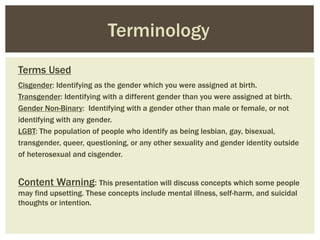
Terms Used
Cisgender: Identifying as the gender which you were assigned at birth.
Transgender: Identifying with a different gender than you were assigned at birth.
Gender Non-Binary: Identifying with a gender other than male or female, or not
identifying with any gender.
LGBT: The population of people who identify as being lesbian, gay, bisexual,
transgender, queer, questioning, or any other sexuality and gender identity outside
of heterosexual and cisgender.
Content Warning: This presentation will discuss concepts which some people
may find upsetting. These concepts include mental illness, self-harm, and suicidal
thoughts or intention.
Terminology
 We know that LGBT individuals experience health disparities compared
to their heterosexual & cisgender peers1 .
 Comprehensive health data is not available on the LGBT population.
 Healthy People 2020 Objective:
LGBT-1.1 Increase the number of population-based data systems
used to monitor Healthy People 2020 objectives which collect data
on (or for) lesbian, gay and bisexual populations.
1 Center for Disease Control. (2014). Lesbian, Gay, Bisexual, Transgender Health. Available at
[www.cdc.gov/lgbthealth].
Why Look at LGBT Health?
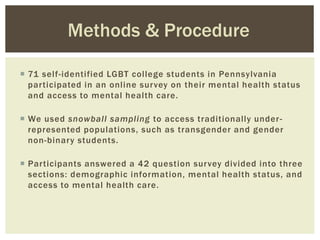
 71 self-identified LGBT college students in Pennsylvania
participated in an online survey on their mental health status
and access to mental health care.
 We used snowball sampling to access traditionally under-
represented populations, such as transgender and gender
non-binary students.
 Participants answered a 42 question survey divided into three
sections: demographic information, mental health status, and
access to mental health care.
Methods & Procedure
Results
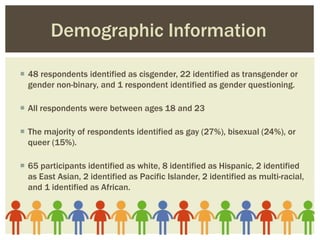
 48 respondents identified as cisgender, 22 identified as transgender or
gender non-binary, and 1 respondent identified as gender questioning.
 All respondents were between ages 18 and 23
 The majority of respondents identified as gay (27%), bisexual (24%), or
queer (15%).
 65 participants identified as white, 8 identified as Hispanic, 2 identified
as East Asian, 2 identified as Pacific Islander, 2 identified as multi-racial,
and 1 identified as African.
Demographic Information
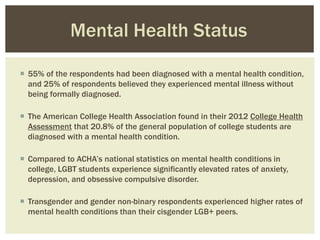
 55% of the respondents had been diagnosed with a mental health condition,
and 25% of respondents believed they experienced mental illness without
being formally diagnosed.
 The American College Health Association found in their 2012 College Health
Assessment that 20.8% of the general population of college students are
diagnosed with a mental health condition.
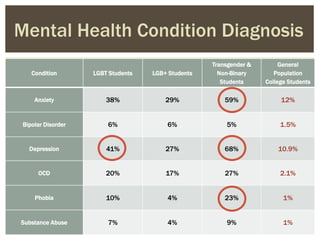
 Compared to ACHA’s national statistics on mental health conditions in
college, LGBT students experience significantly elevated rates of anxiety,
depression, and obsessive compulsive disorder.
 Transgender and gender non-binary respondents experienced higher rates of
mental health conditions than their cisgender LGB+ peers.
Mental Health Status
Condition LGBT Students LGB+ Students
Transgender &
Non-Binary
Students
General
Population
College Students
Anxiety 38% 29% 59% 12%
Bipolar Disorder 6% 6% 5% 1.5%
Depression 41% 27% 68% 10.9%
OCD 20% 17% 27% 2.1%
Phobia 10% 4% 23% 1%
Substance Abuse 7% 4% 9% 1%
Mental Health Condition Diagnosis
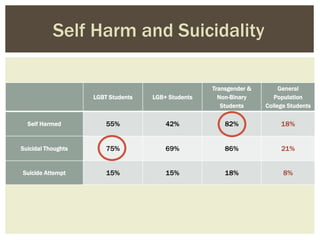
LGBT Students LGB+ Students
Transgender &
Non-Binary
Students
General
Population
College Students
Self Harmed 55% 42% 82% 18%
Suicidal Thoughts 75% 69% 86% 21%
Suicide Attempt 15% 15% 18% 8%
Self Harm and Suicidality
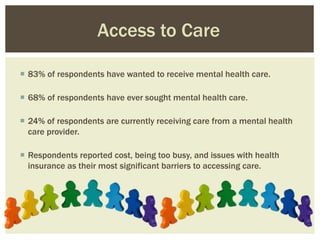
 83% of respondents have wanted to receive mental health care.
 68% of respondents have ever sought mental health care.
 24% of respondents are currently receiving care from a mental health
care provider.
 Respondents reported cost, being too busy, and issues with health
insurance as their most significant barriers to accessing care.
Access to Care
Conclusions
 LGBT college students in Pennsylvania experience mental health
conditions, self harm, and suicidality at significantly higher rates than
the general population.
 Most LGBT college students who want to access mental health care
ultimately do not remain in care.
 Cost, busy schedules, and health insurance concerns prevent students
from accessing care.
Summary of Findings
 Impact of minority stress contributes to mental illness 2
 More research is necessary to explore intersections of oppression for LGBT
people of color, low income LGBT people, etc.
 Rejection and discrimination by family members and peers
 Internalized homophobia and transphobia contributes to mental health
distress and self-harming behaviors 3
2 Meyer, I. H. (2003). Prejudice, Social Stress, and Mental Health in Lesbian, Gay, and Bisexual Populations:
Conceptual Issues and Research Evidence. Psychological Bulletin, 129(5), 674–697. doi:10.1037/0033-
2909.129.5.674
3 Herek, G. M., Gillis, J. R., & Cogan, J. C. (1999). Psychological sequelae of hate-crime victimization among
lesbian, gay, bisexual and transgender adults. Journal of Consulting and Clinical Psychology, 67, 945-951.
Why do LGBT Students Experience
Poor Mental Health?
 Educate mental healthcare providers on best practices and sensitivity
with LGBT patients.
 Develop mental health outreach programs tailored towards LGBT
students
 Work in partnership with LGBT student groups to develop and promote
mental health interventions targeted at LGBT students
What Health Promotion Solutions Exist?
 Data may have been skewed by large number of students who took the
survey specifically because they have experienced mental health issues
 Lack of racial diversity- snowball sampling can be used to access some
minority population, but does not reach others
 Small sample size- future research should survey a larger population
Considerations for Future Research
 West Chester University Summer Undergraduate Research Institute
 The Pennsylvania Student Equality Coalition
 Turner Stulting, Bucknell University Gender & Sexuality Alliance
 Rodrick Cook, University of Pennsylvania Penn Non-Cis
Acknowledgements
Victoria Martin
v.j.martin@live.com
Development Coordinator
The Pennsylvania
Student Equality Coalition
Public Health: Health
Promotion Major
West Chester University
of Pennsylvania ‘15
Contact
Dr. Tanya Gatenby
tgatenby@wcupa.edu
Professor of Health Sciences
West Chester University of
Pennsylvania

SOPHE 2015 Victoria Martin

  • 1.
    Mental Health Status& Access to Mental Health Care in LGBT College Students Presented by Victoria Martin, West Chester University ‘15 Research conducted by Victoria Martin and Dr. Tanya Gatenby West Chester University of Pennsylvania The Society for Public Health Education Annual Meeting April 24, 2015 Portland, OR
  • 2.
    Terms Used Cisgender: Identifyingas the gender which you were assigned at birth. Transgender: Identifying with a different gender than you were assigned at birth. Gender Non-Binary: Identifying with a gender other than male or female, or not identifying with any gender. LGBT: The population of people who identify as being lesbian, gay, bisexual, transgender, queer, questioning, or any other sexuality and gender identity outside of heterosexual and cisgender. Content Warning: This presentation will discuss concepts which some people may find upsetting. These concepts include mental illness, self-harm, and suicidal thoughts or intention. Terminology
  • 3.
     We knowthat LGBT individuals experience health disparities compared to their heterosexual & cisgender peers1 .  Comprehensive health data is not available on the LGBT population.  Healthy People 2020 Objective: LGBT-1.1 Increase the number of population-based data systems used to monitor Healthy People 2020 objectives which collect data on (or for) lesbian, gay and bisexual populations. 1 Center for Disease Control. (2014). Lesbian, Gay, Bisexual, Transgender Health. Available at [www.cdc.gov/lgbthealth]. Why Look at LGBT Health?
  • 4.
     71 self-identifiedLGBT college students in Pennsylvania participated in an online survey on their mental health status and access to mental health care.  We used snowball sampling to access traditionally under- represented populations, such as transgender and gender non-binary students.  Participants answered a 42 question survey divided into three sections: demographic information, mental health status, and access to mental health care. Methods & Procedure
  • 5.
  • 6.
     48 respondentsidentified as cisgender, 22 identified as transgender or gender non-binary, and 1 respondent identified as gender questioning.  All respondents were between ages 18 and 23  The majority of respondents identified as gay (27%), bisexual (24%), or queer (15%).  65 participants identified as white, 8 identified as Hispanic, 2 identified as East Asian, 2 identified as Pacific Islander, 2 identified as multi-racial, and 1 identified as African. Demographic Information
  • 7.
     55% ofthe respondents had been diagnosed with a mental health condition, and 25% of respondents believed they experienced mental illness without being formally diagnosed.  The American College Health Association found in their 2012 College Health Assessment that 20.8% of the general population of college students are diagnosed with a mental health condition.  Compared to ACHA’s national statistics on mental health conditions in college, LGBT students experience significantly elevated rates of anxiety, depression, and obsessive compulsive disorder.  Transgender and gender non-binary respondents experienced higher rates of mental health conditions than their cisgender LGB+ peers. Mental Health Status
  • 8.
    Condition LGBT StudentsLGB+ Students Transgender & Non-Binary Students General Population College Students Anxiety 38% 29% 59% 12% Bipolar Disorder 6% 6% 5% 1.5% Depression 41% 27% 68% 10.9% OCD 20% 17% 27% 2.1% Phobia 10% 4% 23% 1% Substance Abuse 7% 4% 9% 1% Mental Health Condition Diagnosis
  • 9.
    LGBT Students LGB+Students Transgender & Non-Binary Students General Population College Students Self Harmed 55% 42% 82% 18% Suicidal Thoughts 75% 69% 86% 21% Suicide Attempt 15% 15% 18% 8% Self Harm and Suicidality
  • 10.
     83% ofrespondents have wanted to receive mental health care.  68% of respondents have ever sought mental health care.  24% of respondents are currently receiving care from a mental health care provider.  Respondents reported cost, being too busy, and issues with health insurance as their most significant barriers to accessing care. Access to Care
  • 11.
  • 12.
     LGBT collegestudents in Pennsylvania experience mental health conditions, self harm, and suicidality at significantly higher rates than the general population.  Most LGBT college students who want to access mental health care ultimately do not remain in care.  Cost, busy schedules, and health insurance concerns prevent students from accessing care. Summary of Findings
  • 13.
     Impact ofminority stress contributes to mental illness 2  More research is necessary to explore intersections of oppression for LGBT people of color, low income LGBT people, etc.  Rejection and discrimination by family members and peers  Internalized homophobia and transphobia contributes to mental health distress and self-harming behaviors 3 2 Meyer, I. H. (2003). Prejudice, Social Stress, and Mental Health in Lesbian, Gay, and Bisexual Populations: Conceptual Issues and Research Evidence. Psychological Bulletin, 129(5), 674–697. doi:10.1037/0033- 2909.129.5.674 3 Herek, G. M., Gillis, J. R., & Cogan, J. C. (1999). Psychological sequelae of hate-crime victimization among lesbian, gay, bisexual and transgender adults. Journal of Consulting and Clinical Psychology, 67, 945-951. Why do LGBT Students Experience Poor Mental Health?
  • 14.
     Educate mentalhealthcare providers on best practices and sensitivity with LGBT patients.  Develop mental health outreach programs tailored towards LGBT students  Work in partnership with LGBT student groups to develop and promote mental health interventions targeted at LGBT students What Health Promotion Solutions Exist?
  • 15.
     Data mayhave been skewed by large number of students who took the survey specifically because they have experienced mental health issues  Lack of racial diversity- snowball sampling can be used to access some minority population, but does not reach others  Small sample size- future research should survey a larger population Considerations for Future Research
  • 16.
     West ChesterUniversity Summer Undergraduate Research Institute  The Pennsylvania Student Equality Coalition  Turner Stulting, Bucknell University Gender & Sexuality Alliance  Rodrick Cook, University of Pennsylvania Penn Non-Cis Acknowledgements
  • 17.
    Victoria Martin v.j.martin@live.com Development Coordinator ThePennsylvania Student Equality Coalition Public Health: Health Promotion Major West Chester University of Pennsylvania ‘15 Contact Dr. Tanya Gatenby tgatenby@wcupa.edu Professor of Health Sciences West Chester University of Pennsylvania