Sonnet 29: FromDespair to Exultation
A Paraphrase and In-Depth Analysis of William Shakespeare's Masterpiece
1. Introduction: A Journey of the Soul
William Shakespeare's Sonnet 29 is one of the most celebrated poems in the English language, a
powerful testament to the redemptive power of love. It charts a dramatic emotional journey, beginning
in a state of profound despair, self-pity, and social alienation, and culminating in a transcendent joy that
makes the speaker feel richer than a king. The poem's genius lies in its psychological realism and the
masterful way it uses the rigid sonnet form to structure this profound transformation. This analysis will
dissect the sonnet's structure, language, and themes to reveal how it achieves its enduring emotional
impact.
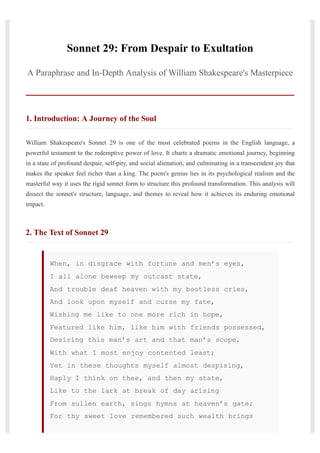
2. The Text of Sonnet 29
When, in disgrace with fortune and men’s eyes,
I all alone beweep my outcast state,
And trouble deaf heaven with my bootless cries,
And look upon myself and curse my fate,
Wishing me like to one more rich in hope,
Featured like him, like him with friends possessed,
Desiring this man’s art and that man’s scope,
With what I most enjoy contented least;
Yet in these thoughts myself almost despising,
Haply I think on thee, and then my state,
Like to the lark at break of day arising
From sullen earth, sings hymns at heaven’s gate;
For thy sweet love remembered such wealth brings
2.
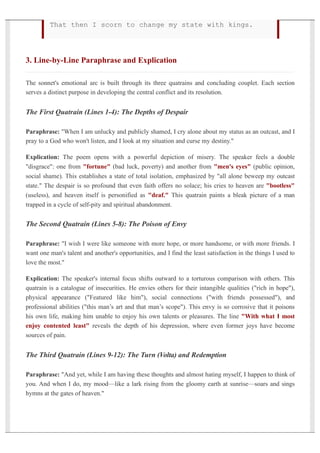
That then Iscorn to change my state with kings.
3. Line-by-Line Paraphrase and Explication
The sonnet's emotional arc is built through its three quatrains and concluding couplet. Each section
serves a distinct purpose in developing the central conflict and its resolution.
The First Quatrain (Lines 1-4): The Depths of Despair
Paraphrase: "When I am unlucky and publicly shamed, I cry alone about my status as an outcast, and I
pray to a God who won't listen, and I look at my situation and curse my destiny."
Explication: The poem opens with a powerful depiction of misery. The speaker feels a double
"disgrace": one from "fortune" (bad luck, poverty) and another from "men's eyes" (public opinion,
social shame). This establishes a state of total isolation, emphasized by "all alone beweep my outcast
state." The despair is so profound that even faith offers no solace; his cries to heaven are "bootless"
(useless), and heaven itself is personified as "deaf." This quatrain paints a bleak picture of a man
trapped in a cycle of self-pity and spiritual abandonment.
The Second Quatrain (Lines 5-8): The Poison of Envy
Paraphrase: "I wish I were like someone with more hope, or more handsome, or with more friends. I
want one man's talent and another's opportunities, and I find the least satisfaction in the things I used to
love the most."
Explication: The speaker's internal focus shifts outward to a torturous comparison with others. This
quatrain is a catalogue of insecurities. He envies others for their intangible qualities ("rich in hope"),
physical appearance ("Featured like him"), social connections ("with friends possessed"), and
professional abilities ("this man’s art and that man’s scope"). This envy is so corrosive that it poisons
his own life, making him unable to enjoy his own talents or pleasures. The line "With what I most
enjoy contented least" reveals the depth of his depression, where even former joys have become
sources of pain.
The Third Quatrain (Lines 9-12): The Turn (Volta) and Redemption
Paraphrase: "And yet, while I am having these thoughts and almost hating myself, I happen to think of
you. And when I do, my mood—like a lark rising from the gloomy earth at sunrise—soars and sings
hymns at the gates of heaven."
3.
Explication: This quatraincontains the poem's crucial turning point, or volta. The shift begins with the
word "Yet." The catalyst for change is not an act of will but a moment of chance or grace: "Haply I
think on thee." The memory of the beloved is all it takes to reverse the speaker's downward spiral.
This transformation is captured in one of Shakespeare's most beautiful similes: the speaker's spirit
becomes "like to the lark at break of day arising." This image directly contrasts with the earlier
gloom. The "sullen earth" is the speaker's despair, and the lark's flight represents his soul's sudden,
joyful ascent. Crucially, where heaven was once "deaf," the speaker's soul now "sings hymns at
heaven's gate," signifying a complete spiritual restoration.
The Concluding Couplet (Lines 13-14): A New Definition of Wealth
Paraphrase: "Because remembering your sweet love brings a kind of wealth so great that I would
refuse to trade my situation even with kings."
Explication: The final couplet provides a powerful, conclusive summary of the poem's argument. It
explains *why* the memory of the beloved is so transformative. The word "wealth" is key. In the first
half of the poem, the speaker lamented his lack of fortune and envied the "scope" and possessions of
others. Now, he redefines wealth entirely. The "sweet love remembered" is a spiritual and emotional
treasure that far surpasses any material or social status. The final hyperbolic statement, "I scorn to
change my state with kings," is a triumphant declaration of self-worth, rooted not in public approval
or material goods, but in the private, internal richness of love.
4. Thematic Analysis
Despair, Alienation, and Self-Pity
Sonnet 29 provides a masterful psychological portrait of despair. The speaker's misery is not a simple
sadness but a profound crisis of identity. He feels alienated from society ("outcast state"), from God
("deaf heaven"), and ultimately from himself ("look upon myself and curse my fate"). This internal state
is fueled by envy, a destructive emotion that prevents him from appreciating his own life. The poem
validates these dark feelings by exploring them in detail before offering a path to resolution.
The Redemptive Power of Love and Memory
The central theme is the power of love to redeem a person from despair. It is not the physical presence
of the beloved but the memory of their "sweet love" that acts as the catalyst. This suggests that love
provides an internal, unshakeable foundation of self-worth that is immune to external circumstances
like "disgrace with fortune and men's eyes." The transformation is instantaneous and total, lifting the
speaker from the "sullen earth" of his misery to the spiritual ecstasy of "heaven's gate."
4.
Spiritual Wealth vs.Material Fortune
The sonnet constructs a powerful dichotomy between two kinds of value. Initially, the speaker measures
his worth by external, material standards: fortune, public opinion, friends, and talents. He feels
impoverished by this measure. However, the memory of love introduces a new, spiritual economy. In
this economy, the emotional richness brought by love is the ultimate "wealth." The final couplet
resolves this conflict decisively: the speaker, who began by lamenting his poor "state," now scorns to
change his "state with kings." This re-evaluation of what constitutes a rich life is the poem's core
philosophical message.
5. Structural and Poetic Devices
The Shakespearean Sonnet Form
Sonnet 29 is a perfect example of the English or Shakespearean sonnet form, which consists of three
quatrains and a final couplet, with a rhyme scheme of ABAB CDCD EFEF GG. Shakespeare uses this
structure to build a logical and emotional argument:
Quatrains 1 & 2 (The Problem): The first eight lines (octave) establish the speaker's problem:
his deep-seated despair and envy.
Quatrain 3 (The Turn): The ninth line introduces the volta, or turn in thought, shifting from the
problem to the solution.
The Couplet (The Resolution): The final two rhyming lines provide a concise and powerful
conclusion, summarizing the new understanding the speaker has reached.
The poem's metrical pattern is iambic pentameter (ten syllables per line with an alternating unstressed-
stressed pattern), which gives it a natural, rhythmic flow that carries the reader through the emotional
progression.
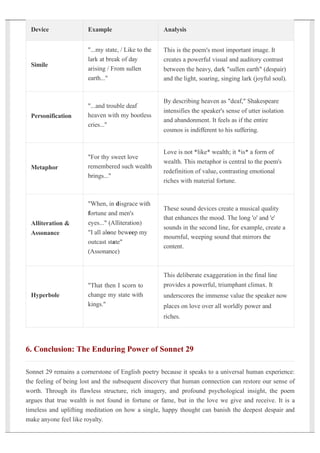
Figurative Language and Imagery
Shakespeare employs a range of devices to give the poem its vividness and power.
5.
Device Example Analysis
Simile
"...mystate, / Like to the
lark at break of day
arising / From sullen
earth..."
This is the poem's most important image. It
creates a powerful visual and auditory contrast
between the heavy, dark "sullen earth" (despair)
and the light, soaring, singing lark (joyful soul).
Personification
"...and trouble deaf
heaven with my bootless
cries..."
By describing heaven as "deaf," Shakespeare
intensifies the speaker's sense of utter isolation
and abandonment. It feels as if the entire
cosmos is indifferent to his suffering.
Metaphor
"For thy sweet love
remembered such wealth
brings..."
Love is not *like* wealth; it *is* a form of
wealth. This metaphor is central to the poem's
redefinition of value, contrasting emotional
riches with material fortune.
Alliteration &
Assonance
"When, in disgrace with
fortune and men's
eyes..." (Alliteration)
"I all alone beweep my
outcast state"
(Assonance)
These sound devices create a musical quality
that enhances the mood. The long 'o' and 'e'
sounds in the second line, for example, create a
mournful, weeping sound that mirrors the
content.
Hyperbole
"That then I scorn to
change my state with
kings."
This deliberate exaggeration in the final line
provides a powerful, triumphant climax. It
underscores the immense value the speaker now
places on love over all worldly power and
riches.
6. Conclusion: The Enduring Power of Sonnet 29
Sonnet 29 remains a cornerstone of English poetry because it speaks to a universal human experience:
the feeling of being lost and the subsequent discovery that human connection can restore our sense of
worth. Through its flawless structure, rich imagery, and profound psychological insight, the poem
argues that true wealth is not found in fortune or fame, but in the love we give and receive. It is a
timeless and uplifting meditation on how a single, happy thought can banish the deepest despair and
make anyone feel like royalty.
6.
Analysis based onthe text of William Shakespeare's Sonnet 29. Current Date: 2025-10-04.