BITS Pilani
Pilani Campus
BITS Pilani
Pilani Campus
Marketing Management(BA ZC 411/ MBA ZC 411)
Atul Kr. Arora
Lecture -1
Instructor profile
Atul Kr Arora
• Experience:
• Corporate Experience- 13 yrs
(Telecom, Banking & Wealth Management, FMCG)
• Academic Experience- 6.5 yrs (B-School PG)
• Education:
• PhD- Management (IIM Ksp)
• PGDM(Full-Time)- Marketing (IMT, Ghaziabad)
• B.Tech. (Chem. Tech.)- HBTI, Kanpur
Contact details:
• atul.k@wilp.bits-pilani.ac.in
• Mob: 9810264434
BITS Pilani, Pilani Campus
No Course Objectives
CO1
To understand the fundamental marketing concepts and the
processes that influence the market orientation of a firm
CO2 To understand the role of marketing within the organization
CO3
To recognize the importance of marketing in the competitive
world
CO4
To analyze critically the marketing process and its relationship with
the environment within which it operates.
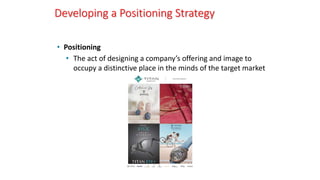
Course Objectives
Course Structure
• Introduction to Marketing
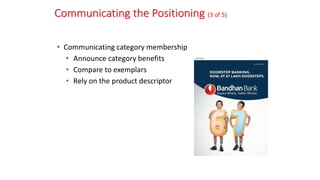
• Marketing Strategies and Plans
• Consumer Behaviour
• Segmentation, Targeting and Positioning
• Brand Positioning
• Product Management
• Pricing
• Distribution and Logistics
• Promotion
The course aims to make you familiar with the various concepts of marketing,
Today’s Sessions Contents
• Value and Scope of Marketing
• Core marketing concepts
• Needs, Wants and Demands
• Segmentation, Targeting and Positioning
• Marketing Channels etc.
• 4 Ps of Marketing and 7 Ps of Services
• 4 concepts of marketing
• Course Outline
Chapter-1
Defining marketing for new realities
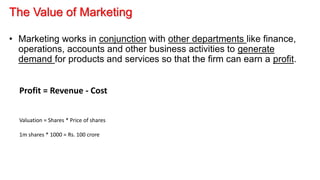
The Value of Marketing
• Marketing works in conjunction with other departments like finance,
operations, accounts and other business activities to generate
demand for products and services so that the firm can earn a profit.
Profit = Revenue - Cost
Valuation = Shares * Price of shares
1m shares * 1000 = Rs. 100 crore
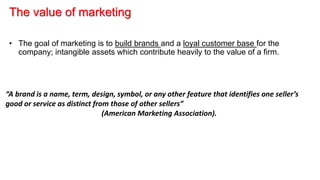
The value of marketing
• The goal of marketing is to build brands and a loyal customer base for the
company; intangible assets which contribute heavily to the value of a firm.
“A brand is a name, term, design, symbol, or any other feature that identifies one seller’s
good or service as distinct from those of other sellers”
(American Marketing Association).
The value of marketing
• Skilled marketing is a never ending pursuit.
• It involves the art of adaptability as companies and organizations need
to navigate their ways through changing customer needs, technology
and environmental factors among other things.
The scope of marketing what is marketing?
• Marketing is about identifying and meeting human and social needs in a profitable
manner for the firm.
• Edu-tech firms
• Electrical Vehicles
• Human need : Affordable, noise free transport
• Social need : Less pollution
The scope of marketing what is marketing?
• Marketing is the activity, set of institutions and processes for creating,
communicating, delivering and exchanging offerings that have value
for customers, clients, partners and society at large.
• Activity: Advertising, Selling, Product Management (product/package design),
Pricing etc.
• Set of institutions: Marketing departments, Ad Agencies, Modelling Agencies,
Market Research Firms, Event Management Companies, Transport Companies,
Retailers
• Processes: Research Inputs – Product Design – Product launch – Response
Measurement etc.
Scope of marketing
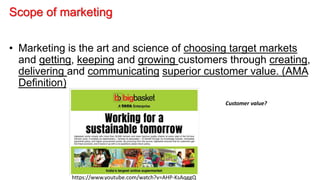
• Marketing is the art and science of choosing target markets
and getting, keeping and growing customers through creating,
delivering and communicating superior customer value. (AMA
Definition)
https://www.youtube.com/watch?v=AHP-KsAqggQ
Customer value?
Scope of marketing
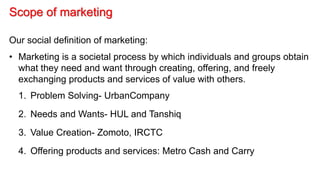
Our social definition of marketing:
• Marketing is a societal process by which individuals and groups obtain
what they need and want through creating, offering, and freely
exchanging products and services of value with others.
1. Problem Solving- UrbanCompany
2. Needs and Wants- HUL and Tanshiq
3. Value Creation- Zomoto, IRCTC
4. Offering products and services: Metro Cash and Carry
marketing and selling
• A common management misconception.
• Selling at best is an activity associated with marketing. We shall visit this in greater
detail later.
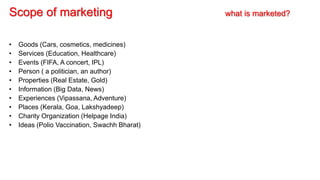
Scope of marketing what is marketed?
• Goods (Cars, cosmetics, medicines)
• Services (Education, Healthcare)
• Events (FIFA, A concert, IPL)
• Person ( a politician, an author)
• Properties (Real Estate, Gold)
• Information (Big Data, News)
• Experiences (Vipassana, Adventure)
• Places (Kerala, Goa, Lakshyadeep)
• Charity Organization (Helpage India)
• Ideas (Polio Vaccination, Swachh Bharat)
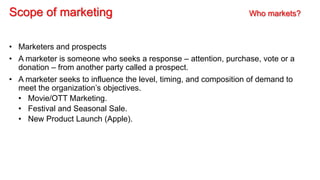
Scope of marketing Who markets?
• Marketers and prospects
• A marketer is someone who seeks a response – attention, purchase, vote or a
donation – from another party called a prospect.
• A marketer seeks to influence the level, timing, and composition of demand to
meet the organization’s objectives.
• Movie/OTT Marketing.
• Festival and Seasonal Sale.
• New Product Launch (Apple).
Scope of marketing Demand States
• Negative Demand
• Petrol during Covid lock down. Gulf states were willing to pay U$ 40/barrel to “buyers” of crude.
• Non-existent demand
• Audio Systems
• Latent Demand
• Unbiased news, Wireless devices/charging (20 years ago)
• Declining Demand
• Dongles for net connection, TV Sets, CD Players
• Irregular Demand
• Face Masks, Air Conditioners
• Full Demand
• Demand = Supply
• Excessive Demand
• Demand > Supply (Face Masks, sanitizers during initial days of Covid)
• Unwholesome demand (demand consumer badly wants the product but shouldn’t desire or take
the decision)
Scope of marketing what is a market?
• The word market traditionally refers to the market place – the location or area
where buyers and sellers meet.
• In economics, a market is described as a collection of buyers and sellers who
negotiate and transact over a particular product or product class (such as the
housing market or the grain market).
• In marketing the word “market” is used to describe various grouping of customers.
For example when referring to the automobile market we mean the set of people
interested in buying an automobile.
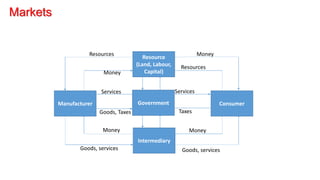
Markets
Government
Manufacturer Consumer
Resource
(Land, Labour,
Capital)
Intermediary
Money
Resources
Services
Goods, Taxes
Services
Taxes
Resources
Money
Goods, services
Money
Goods, services
Money
Scope of marketing key customer markets
• Consumer
• Buyer is the end customer
• Business to Business Market (B2B Markets)
• Business 1 sells to Business 2 which uses the product to meet the demands of
its customers,
• Global
• Challenges of customisation, localization.
• Cars for the Indian market need high ground clearance.
• No market for beef burgers in India.
• Non-profit and Govt. Markets (tenders)
• NGOs (CRY, Helpage)
Core marketing concepts
• Needs , Wants and Demands
• Target Markets, Positioning and
Segmentation
• Offerings and Brands
• Marketing Channels
• Paid, Owned, Earned Media
• Impressions and Engagement
• Values and Satisfaction
• Supply Chain
• Competition
• Marketing Environment
Needs, wants and demands
• Needs
• Basic Requirements e.g. “ I need food.”
• Wants
• Desire e.g. “I would like to have biryani.”
• Demands
• What I actually buy. “ Please get me two rotis.
Types of needs
• Stated Needs (I need an inexpensive car.)
• Unstated Needs ( I need good service.)
• The customer has missed out on the point, by oversight.
• Real Needs (I need a car which is low on operating costs, i.e. fuel costs,
maintenance costs.)
• Here the customer does not know how to express. The seller would understand that to mean a
cheap car.
• Delight needs (Hey! Is that audio system complimentary.)
• The customer is not expecting this.
• Secret Needs (Am I getting a good deal? Am I buying the right car? Man, I am not
an engineer, hopefully I got the specs right?)
• The customer does not want to talk about this for personal, social reason.
• Mental Health stigma
Core marketing
• Segmentation, Targeting, Positioning (STP)
• Segmentation
• Grouping of customers – demographic, psychographic etc.
• Target
• Market Offers
• Positioning
• Volvo – safe cars
• BMW – driving pleasure
Levis launches five pocket jeans. (Market Offer).
High income, mid income, low income / Young, Middle Aged, Seniors/ Men,Women (segment)
High Income, young men (Target)
Macho (Positioning)
Core marketing concepts Offerings and brands
• Value proposition
• A set of benefits that satisfy needs of the customer
• Quality, multi-specialty, and hygienic medical service
• State-of-the Art, innovative and high-quality consumer electronics items with after-sales service
• Offering
• A combination of products, services, information and experiences
• Offering gives a ‘physical shape’ to the value proposition
• Clean premises, experienced doctors, managers and staff equipment
• Televisions, Mobile phones
• Brand
• Brand is an offering from a known (identified) source.
• “Apollo” Hospitals
• SONY
Core marketing concepts Value and satisfaction
• Value of a product (as perceived by customer) is a combination of features,
quality, service and price. (FQSP)
• Satisfaction reflects a person’s judgment of a product’s perceived performance in
relationship to expectation.
Developing a Value Proposition (1 of 5)
• Create value across three domains:
• Functional value
• Psychological value
• Monetary value
Developing a Value Proposition (2 of 5)
• Total customer benefit
• The perceived value of the bundle of functional, psychological, and monetary
benefits customers expect from a given market offering because of the product,
service, and image
Developing a Value Proposition (3 of 5)
• Total customer cost
• The perceived bundle of functional, psychological, and monetary costs customers
will incur in evaluating, obtaining, using, and disposing of the given market
offering
Developing a Value Proposition (4 of 5)
• Customer value proposition
• Based on the difference between benefits the customer gets and the costs he or
she assumes for different choices
Developing a Value Proposition (5 of 5)
• Customer value analysis
• Reveals the company’s strengths and weaknesses relative to those of various
competitors
Developing a Positioning Strategy
• Positioning
• The act of designing a company’s offering and image to
occupy a distinctive place in the minds of the target market
Communicating the Positioning (1 of 5)
• Positioning statement
• Communicating an offering’s category membership along with points of parity
and points of difference, and developing a narrative to convey the offering’s
positioning
Communicating the Positioning (2 of 5)
• Crafting a positioning statement
• Attributes that describe the offering versus benefits delivered by the attributes
Communicating the Positioning (3 of 5)
• Communicating category membership
• Announce category benefits
• Compare to exemplars
• Rely on the product descriptor
Consider your college or university’s positioning statement.
• How does your college or university describe its attributes and the
benefits it provides to the buyer (in this case the student)?
• How would you describe your college or university’s competitive
advantage?
Core marketing concepts Marketing Channels
• Channel of Distribution
• Dealers, Distributors, Retailers, e-commerce
• Help display, sell, and deliver physical goods and services
• Channel of Service
• Warehouses, Transportation companies. Banks, insurance companies
• Channel of communication
• Deliver and Receive messages to/from customers
• Print media, electronic media, digital media, stores
POP / POS = Point of Purchase / Point of Sale
Classification of Media (POE M)
• Paid Media
• Advertisements
• Owned media
• Company’s brochures, web site
• Earned media
• Word of Mouth
Core marketing concepts
Impression and Engagement
• Four ways to reach the customer
• TV, Internet, Mobile, (Print),Outdoor
• An impression occurs when a consumer views a communication.
• Engagement is the extent of a customer’s attention and action involvement in a
communication.
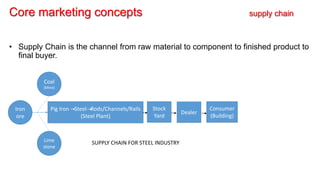
Core marketing concepts supply chain
• Supply Chain is the channel from raw material to component to finished product to
final buyer.
Pig Iron Steel Rods/Channels/Rails
(Steel Plant)
Coal
(Mine)
Iron
ore
Lime
stone
Dealer
Consumer
(Building)
Stock
Yard
SUPPLY CHAIN FOR STEEL INDUSTRY
CORE Marketing concept competition
• All actual and potential rival offerings or substitutes a buyer might consider.
• Toyota is a rival of Honda.
• Tesla is a potential rival of Honda in India.
• Metro/High-Speed Rail is a substitute for both. The internet is a potential
substitute.
Four P’s of Marketing
1. Product
• Product Variety, Quality, Design, Features, Brand Name, Packaging, Sizes, Services,
Warranties, Returns
2. Price
• List Price, Discounts, Allowances, Payment Period, Credit Terms
3. Place
• Channels, Coverage, Assortment, Location, Inventory, Transport
4. Promotion
• Sales Promotion, Advertising, Sales Force, Public Relations, Direct Marketing
5. People
6. Processes Service Marketing
7. Physical Evidence
Four Concepts of Marketing
• Production Concept
• Consumer prefer the most inexpensive and widely available product.
• Such companies focus on high production efficiency, low costs, mass distribution
• Steel Industry, Chinese Companies
• Product Concept
• Consumer prefers quality and variety
• Apple
• Selling Concept
• Consumers need hard selling to buy a product
• Insurance sector
• Marketing Concept
• Right product for the customer
• Creating, communicating and delivering a superior value to a customer

Some basic introduction to marketing in a easy way

  • 1.
    BITS Pilani Pilani Campus BITSPilani Pilani Campus Marketing Management(BA ZC 411/ MBA ZC 411) Atul Kr. Arora Lecture -1
  • 2.
    Instructor profile Atul KrArora • Experience: • Corporate Experience- 13 yrs (Telecom, Banking & Wealth Management, FMCG) • Academic Experience- 6.5 yrs (B-School PG) • Education: • PhD- Management (IIM Ksp) • PGDM(Full-Time)- Marketing (IMT, Ghaziabad) • B.Tech. (Chem. Tech.)- HBTI, Kanpur Contact details: • atul.k@wilp.bits-pilani.ac.in • Mob: 9810264434
  • 3.
    BITS Pilani, PilaniCampus No Course Objectives CO1 To understand the fundamental marketing concepts and the processes that influence the market orientation of a firm CO2 To understand the role of marketing within the organization CO3 To recognize the importance of marketing in the competitive world CO4 To analyze critically the marketing process and its relationship with the environment within which it operates. Course Objectives
  • 4.
    Course Structure • Introductionto Marketing • Marketing Strategies and Plans • Consumer Behaviour • Segmentation, Targeting and Positioning • Brand Positioning • Product Management • Pricing • Distribution and Logistics • Promotion The course aims to make you familiar with the various concepts of marketing,
  • 5.
    Today’s Sessions Contents •Value and Scope of Marketing • Core marketing concepts • Needs, Wants and Demands • Segmentation, Targeting and Positioning • Marketing Channels etc. • 4 Ps of Marketing and 7 Ps of Services • 4 concepts of marketing • Course Outline
  • 6.
  • 7.
    The Value ofMarketing • Marketing works in conjunction with other departments like finance, operations, accounts and other business activities to generate demand for products and services so that the firm can earn a profit. Profit = Revenue - Cost Valuation = Shares * Price of shares 1m shares * 1000 = Rs. 100 crore
  • 8.
    The value ofmarketing • The goal of marketing is to build brands and a loyal customer base for the company; intangible assets which contribute heavily to the value of a firm. “A brand is a name, term, design, symbol, or any other feature that identifies one seller’s good or service as distinct from those of other sellers” (American Marketing Association).
  • 9.
    The value ofmarketing • Skilled marketing is a never ending pursuit. • It involves the art of adaptability as companies and organizations need to navigate their ways through changing customer needs, technology and environmental factors among other things.
  • 10.
    The scope ofmarketing what is marketing? • Marketing is about identifying and meeting human and social needs in a profitable manner for the firm. • Edu-tech firms • Electrical Vehicles • Human need : Affordable, noise free transport • Social need : Less pollution
  • 11.
    The scope ofmarketing what is marketing? • Marketing is the activity, set of institutions and processes for creating, communicating, delivering and exchanging offerings that have value for customers, clients, partners and society at large. • Activity: Advertising, Selling, Product Management (product/package design), Pricing etc. • Set of institutions: Marketing departments, Ad Agencies, Modelling Agencies, Market Research Firms, Event Management Companies, Transport Companies, Retailers • Processes: Research Inputs – Product Design – Product launch – Response Measurement etc.
  • 12.
    Scope of marketing •Marketing is the art and science of choosing target markets and getting, keeping and growing customers through creating, delivering and communicating superior customer value. (AMA Definition) https://www.youtube.com/watch?v=AHP-KsAqggQ Customer value?
  • 13.
    Scope of marketing Oursocial definition of marketing: • Marketing is a societal process by which individuals and groups obtain what they need and want through creating, offering, and freely exchanging products and services of value with others. 1. Problem Solving- UrbanCompany 2. Needs and Wants- HUL and Tanshiq 3. Value Creation- Zomoto, IRCTC 4. Offering products and services: Metro Cash and Carry
  • 14.
    marketing and selling •A common management misconception. • Selling at best is an activity associated with marketing. We shall visit this in greater detail later.
  • 15.
    Scope of marketingwhat is marketed? • Goods (Cars, cosmetics, medicines) • Services (Education, Healthcare) • Events (FIFA, A concert, IPL) • Person ( a politician, an author) • Properties (Real Estate, Gold) • Information (Big Data, News) • Experiences (Vipassana, Adventure) • Places (Kerala, Goa, Lakshyadeep) • Charity Organization (Helpage India) • Ideas (Polio Vaccination, Swachh Bharat)
  • 16.
    Scope of marketingWho markets? • Marketers and prospects • A marketer is someone who seeks a response – attention, purchase, vote or a donation – from another party called a prospect. • A marketer seeks to influence the level, timing, and composition of demand to meet the organization’s objectives. • Movie/OTT Marketing. • Festival and Seasonal Sale. • New Product Launch (Apple).
  • 17.
    Scope of marketingDemand States • Negative Demand • Petrol during Covid lock down. Gulf states were willing to pay U$ 40/barrel to “buyers” of crude. • Non-existent demand • Audio Systems • Latent Demand • Unbiased news, Wireless devices/charging (20 years ago) • Declining Demand • Dongles for net connection, TV Sets, CD Players • Irregular Demand • Face Masks, Air Conditioners • Full Demand • Demand = Supply • Excessive Demand • Demand > Supply (Face Masks, sanitizers during initial days of Covid) • Unwholesome demand (demand consumer badly wants the product but shouldn’t desire or take the decision)
  • 18.
    Scope of marketingwhat is a market? • The word market traditionally refers to the market place – the location or area where buyers and sellers meet. • In economics, a market is described as a collection of buyers and sellers who negotiate and transact over a particular product or product class (such as the housing market or the grain market). • In marketing the word “market” is used to describe various grouping of customers. For example when referring to the automobile market we mean the set of people interested in buying an automobile.
  • 19.
    Markets Government Manufacturer Consumer Resource (Land, Labour, Capital) Intermediary Money Resources Services Goods,Taxes Services Taxes Resources Money Goods, services Money Goods, services Money
  • 20.
    Scope of marketingkey customer markets • Consumer • Buyer is the end customer • Business to Business Market (B2B Markets) • Business 1 sells to Business 2 which uses the product to meet the demands of its customers, • Global • Challenges of customisation, localization. • Cars for the Indian market need high ground clearance. • No market for beef burgers in India. • Non-profit and Govt. Markets (tenders) • NGOs (CRY, Helpage)
  • 21.
    Core marketing concepts •Needs , Wants and Demands • Target Markets, Positioning and Segmentation • Offerings and Brands • Marketing Channels • Paid, Owned, Earned Media • Impressions and Engagement • Values and Satisfaction • Supply Chain • Competition • Marketing Environment
  • 22.
    Needs, wants anddemands • Needs • Basic Requirements e.g. “ I need food.” • Wants • Desire e.g. “I would like to have biryani.” • Demands • What I actually buy. “ Please get me two rotis.
  • 23.
    Types of needs •Stated Needs (I need an inexpensive car.) • Unstated Needs ( I need good service.) • The customer has missed out on the point, by oversight. • Real Needs (I need a car which is low on operating costs, i.e. fuel costs, maintenance costs.) • Here the customer does not know how to express. The seller would understand that to mean a cheap car. • Delight needs (Hey! Is that audio system complimentary.) • The customer is not expecting this. • Secret Needs (Am I getting a good deal? Am I buying the right car? Man, I am not an engineer, hopefully I got the specs right?) • The customer does not want to talk about this for personal, social reason. • Mental Health stigma
  • 24.
    Core marketing • Segmentation,Targeting, Positioning (STP) • Segmentation • Grouping of customers – demographic, psychographic etc. • Target • Market Offers • Positioning • Volvo – safe cars • BMW – driving pleasure Levis launches five pocket jeans. (Market Offer). High income, mid income, low income / Young, Middle Aged, Seniors/ Men,Women (segment) High Income, young men (Target) Macho (Positioning)
  • 25.
    Core marketing conceptsOfferings and brands • Value proposition • A set of benefits that satisfy needs of the customer • Quality, multi-specialty, and hygienic medical service • State-of-the Art, innovative and high-quality consumer electronics items with after-sales service • Offering • A combination of products, services, information and experiences • Offering gives a ‘physical shape’ to the value proposition • Clean premises, experienced doctors, managers and staff equipment • Televisions, Mobile phones • Brand • Brand is an offering from a known (identified) source. • “Apollo” Hospitals • SONY
  • 26.
    Core marketing conceptsValue and satisfaction • Value of a product (as perceived by customer) is a combination of features, quality, service and price. (FQSP) • Satisfaction reflects a person’s judgment of a product’s perceived performance in relationship to expectation.
  • 27.
    Developing a ValueProposition (1 of 5) • Create value across three domains: • Functional value • Psychological value • Monetary value
  • 28.
    Developing a ValueProposition (2 of 5) • Total customer benefit • The perceived value of the bundle of functional, psychological, and monetary benefits customers expect from a given market offering because of the product, service, and image
  • 29.
    Developing a ValueProposition (3 of 5) • Total customer cost • The perceived bundle of functional, psychological, and monetary costs customers will incur in evaluating, obtaining, using, and disposing of the given market offering
  • 30.
    Developing a ValueProposition (4 of 5) • Customer value proposition • Based on the difference between benefits the customer gets and the costs he or she assumes for different choices
  • 31.
    Developing a ValueProposition (5 of 5) • Customer value analysis • Reveals the company’s strengths and weaknesses relative to those of various competitors
  • 32.
    Developing a PositioningStrategy • Positioning • The act of designing a company’s offering and image to occupy a distinctive place in the minds of the target market
  • 33.
    Communicating the Positioning(1 of 5) • Positioning statement • Communicating an offering’s category membership along with points of parity and points of difference, and developing a narrative to convey the offering’s positioning
  • 34.
    Communicating the Positioning(2 of 5) • Crafting a positioning statement • Attributes that describe the offering versus benefits delivered by the attributes
  • 35.
    Communicating the Positioning(3 of 5) • Communicating category membership • Announce category benefits • Compare to exemplars • Rely on the product descriptor
  • 36.
    Consider your collegeor university’s positioning statement. • How does your college or university describe its attributes and the benefits it provides to the buyer (in this case the student)? • How would you describe your college or university’s competitive advantage?
  • 37.
    Core marketing conceptsMarketing Channels • Channel of Distribution • Dealers, Distributors, Retailers, e-commerce • Help display, sell, and deliver physical goods and services • Channel of Service • Warehouses, Transportation companies. Banks, insurance companies • Channel of communication • Deliver and Receive messages to/from customers • Print media, electronic media, digital media, stores POP / POS = Point of Purchase / Point of Sale
  • 38.
    Classification of Media(POE M) • Paid Media • Advertisements • Owned media • Company’s brochures, web site • Earned media • Word of Mouth
  • 39.
    Core marketing concepts Impressionand Engagement • Four ways to reach the customer • TV, Internet, Mobile, (Print),Outdoor • An impression occurs when a consumer views a communication. • Engagement is the extent of a customer’s attention and action involvement in a communication.
  • 40.
    Core marketing conceptssupply chain • Supply Chain is the channel from raw material to component to finished product to final buyer. Pig Iron Steel Rods/Channels/Rails (Steel Plant) Coal (Mine) Iron ore Lime stone Dealer Consumer (Building) Stock Yard SUPPLY CHAIN FOR STEEL INDUSTRY
  • 41.
    CORE Marketing conceptcompetition • All actual and potential rival offerings or substitutes a buyer might consider. • Toyota is a rival of Honda. • Tesla is a potential rival of Honda in India. • Metro/High-Speed Rail is a substitute for both. The internet is a potential substitute.
  • 42.
    Four P’s ofMarketing 1. Product • Product Variety, Quality, Design, Features, Brand Name, Packaging, Sizes, Services, Warranties, Returns 2. Price • List Price, Discounts, Allowances, Payment Period, Credit Terms 3. Place • Channels, Coverage, Assortment, Location, Inventory, Transport 4. Promotion • Sales Promotion, Advertising, Sales Force, Public Relations, Direct Marketing 5. People 6. Processes Service Marketing 7. Physical Evidence
  • 43.
    Four Concepts ofMarketing • Production Concept • Consumer prefer the most inexpensive and widely available product. • Such companies focus on high production efficiency, low costs, mass distribution • Steel Industry, Chinese Companies • Product Concept • Consumer prefers quality and variety • Apple • Selling Concept • Consumers need hard selling to buy a product • Insurance sector • Marketing Concept • Right product for the customer • Creating, communicating and delivering a superior value to a customer

Editor's Notes

  • #14 Marketing management takes place when at least one party to a potential exchange thinks about the means of achieving desired responses from other parties.
  • #20 Five basic markets and their connecting flows are shown in Figure 1.1. Manufacturers go to resource markets (raw material markets, labor markets, money markets), buy resources and turn them into goods and services, and sell finished products to intermediaries, who sell them to consumers. Consumers sell their labor and receive money with which they pay for goods and services. The government collects tax revenues to buy goods from resource, manufacturer, and intermediary markets and uses these goods and services to provide public services. Each nation’s economy, and the global economy, consists of interacting sets of markets linked through exchange processes. In the illustration, a box at the center labeled Government markets is connected to four boxes on four sides via arrows. The box at the top is labeled Resource markets. The box on the right is labeled Consumer markets. The box at the bottom is labeled Intermediary markets, and the box on the left is labeled Manufacturer markets. The clockwise flow from the top is as follows: Money from Resource markets moves to Consumer markets, then to Intermediary markets, then to Manufacturer markets, and finally back to Resource markets. The anti-clockwise flow from the top is as follows. Resources from Resource markets move to Manufacturer markets. Goods and services from Manufacturer markets move to Intermediary markets, then Goods and Services from Intermediary markets move to Consumer markets, and Resources from Consumer markets move to Resource markets. The upward arrow from Government markets to Resource markets is labeled Services, money, and the downward arrow from Resource markets to Government markets is labeled Taxes, goods. The downward arrow from Government markets to Intermediary markets is labeled Services, money, and the upward arrow from Intermediary markets to Government markets is labeled Taxes, goods. The leftward arrow from Government markets to Manufacturer markets is labeled Services, money, and the rightward arrow from Manufacturer markets to Government markets is labeled Taxes, goods. The rightward arrow from Government markets to Consumer markets is labeled Services, and the leftward arrow from Consumer markets to Government markets is labeled Taxes.
  • #28 How do customers ultimately make choices? They tend to be value maximizers, within the bounds of search costs and limited knowledge, mobility, and income. Customers choose—for whatever reason—the offer they believe will deliver the highest value and act on it. Depending on the needs of customers, an offering can create value across three domains: functional, psychological, and monetary. Functional value reflects the benefits and costs that are directly related to an offering’s performance. Psychological value encompasses the psychological benefits and costs associated with the offering. Psychological value extends beyond the functional benefits to create emotional benefits for target customers. Monetary value includes the financial benefits and costs associated with the offering.
  • #29 Across all three dimensions—functional, psychological, and monetary—customer value is the difference between the prospective customer’s evaluation of all the benefits and costs of an offering and her or his evaluation of the costs and benefits of the perceived alternatives.
  • #30 Across all three dimensions—functional, psychological, and monetary—customer value is the difference between the prospective customer’s evaluation of all the benefits and costs of an offering and her or his evaluation of the costs and benefits of the perceived alternatives.
  • #31 The customer value proposition is based on the difference between benefits the customer gets and the costs he or she assumes for different choices. The marketer can increase the value of the offering by raising functional, psychological, and monetary benefits and/or reducing the corresponding costs
  • #32 Very often, managers conduct a customer value analysis to reveal the company’s strengths and weaknesses relative to those of various competitors.
  • #33 The goal is to instill the brand in the minds of consumers to maximize the potential benefit to the firm. Effective positioning helps guide marketing strategy by clarifying the brand’s essence, identifying the goals it helps the consumer achieve, and showing how it does so in a unique way. Everyone in the organization should understand the brand positioning and use it as the context for making decisions.
  • #34 Once they have fashioned the brand positioning strategy, marketers should communicate it to everyone in the organization so that it will guide their words and actions. This is usually achieved by developing a positioning statement. The key aspects of crafting an effective positioning statement—communicating an offering’s category membership along with points of parity and points of difference, and developing a narrative to convey the offering’s positioning.
  • #35 A positioning statement clearly articulates the offering’s target customers and the key benefit that will provide customers with a reason to choose the company’s offering. Multiple attributes may support a certain benefit, and they may change over time. Attributes provide “reasons to believe” or “proof points” for why a brand can credibly claim it offers certain benefits.
  • #36 Category membership may be obvious. Target customers are aware that Maybelline is a leading brand of cosmetics, Cheerios is a leading brand of cereal, McKinsey is a leading consulting firm, and so on. But when a product is new, marketers must inform consumers of the brand’s category membership. Sometimes consumers may know the category membership but not be convinced that the brand is a valid member of the category. They may be aware that HP produces digital cameras, but they may not be certain whether HP cameras are in the same class as those made by Canon, Nikon, and Sony. In this instance, HP might find it useful to reinforce category membership. The typical approach to positioning is to inform consumers of a brand’s membership before stating its point of difference. Presumably, consumers need to know what a product is and what function it serves before deciding whether it is superior to the brands against which it competes. For new products, initial advertising often concentrates on creating brand awareness, and subsequent advertising attempts to create the brand image.