QUESTION 1
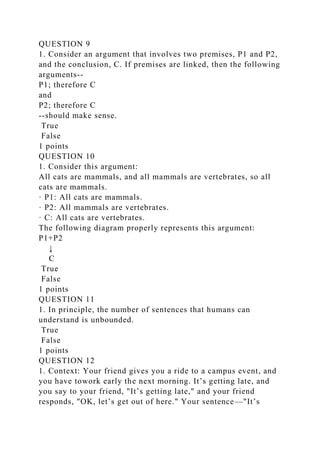
1. In argument analysis, the remarks and comments that
accompany but are not integral to an argument is known as
________.
noise
buzz
music
accompaniment
1 points
QUESTION 2
1. Convergent premises support a conclusion only when they are
conjoined.
True
False
1 points
QUESTION 3
1. Consider the argument below. Based on the legend below,
which of the following is true?
· Either the butler or the gardner committed the murder. The
Butler didn't commit the murder, so the gardner did.
P1 and P2 link to support C
P1 and P2 converge to support C.
1 points
QUESTION 4
1. Consider the following argument:
· Smoking should be subjected to increased state taxes because,
first, such a tax would decrease smoking, and second, such a tax
would increase state revenue.
The premises in this argument are linked.
True
False
1 points
QUESTION 5
1. Consider the argument below. Based on the legend below,
which of the following is true?
· P1: If something could be its own cause, it would have to exist
prior to itself.
· P2: This is impossible.
· C: Nothing can be the cause of itself.
P1 and P2 link to support C.
P2 and C link to support P1.
P1 and C converge to support P2.
P1 and P2 converge to support C.
1 points
QUESTION 6
1. Based on the following passage, identify the error(s) in the
diagram below.
Affirmative action in higher education is morally justifiable
because it compensates for past discrimination, provides
valuable role models for women and minorities, and promotes
multicultural understanding.
Diagram:
· P1: Affirmative action compensates for past discrimination.
· P2: Affirmative action provides valuable role models for
women and minorities.
· P3: Affirmative action promotes multicultural understanding.
· C: Affirmative action in higher education is morally
justifiable.
P1+P2+P3
↓
C
The premises should be convergent, not linked.
P1 should be a sub-conclusion from P2 and P3.
1 points
QUESTION 7
1. Based on the following passage, identify the error(s) in the
diagram below.
If a right to euthanasia is grounded in self-determination, it
cannot reasonably be limited to the terminally ill. If people have
a right to die, why must they wait until they are actually dying
before they are permitted to exercise that right?
Diagram:
· P1: The right to euthanasia is grounded in self-determination.
· SC: If people have a right to die, why must they wait until
they are actually dyingbefore they are permitted to exercise that
right?
· C: The right to euthanasia cannot reasonably be limited to the
terminally ill.
P1
↓
SC
↓
C
Nothing—The diagram is correct.
The sub-conclusion—It is not a statement.
P1 should be the main conclusion.
SC should be the main conclusion.
both B and C
1 points
QUESTION 8
1. Based on the legend below, which of the following is true?
· P1: Any person who can do logic is sane.
· P2: Your sons are not sane.
· SC: Your sons can’t do logic.
· P3: Anyone fit to serve on a jury must be able to do logic.
· C: Your sons are not fit to serve on a jury.
P1 and P2 converge to support SC, and SC and P3 converge to
support C.
P1 and P2 converge to support SC, and SC and P3 link to
support C.
P1 and P2 link to support SC, and SC and P3 link to support C.
1 points
QUESTION 9
1. Consider an argument that involves two premises, P1 and P2,
and the conclusion, C. If premises are linked, then the following
arguments--
P1; therefore C
and
P2; therefore C
--should make sense.
True
False
1 points
QUESTION 10
1. Consider this argument:
All cats are mammals, and all mammals are vertebrates, so all
cats are mammals.
· P1: All cats are mammals.
· P2: All mammals are vertebrates.
· C: All cats are vertebrates.
The following diagram properly represents this argument:
P1+P2
↓
C
True
False
1 points
QUESTION 11
1. In principle, the number of sentences that humans can
understand is unbounded.
True
False
1 points
QUESTION 12
1. Context: Your friend gives you a ride to a campus event, and
you have towork early the next morning. It’s getting late, and
you say to your friend, "It’s getting late," and your friend
responds, "OK, let’s get out of here." Your sentence—"It’s
getting late"—literally means that you want to leave the event.
True
False
1 points
QUESTION 13
1. Pick the best hidden premise(s) and/or hidden conclusion(s)
to complete this argument.
If today is Thursday, then Zoe is either at work or on the golf
course. Therefore, Zoe is at work.
Hidden premise: Zoe is on the golf course.
Hidden premise: Today is not Thursday.
Hidden premise: Today is Thursday and Zoe is not on the golf
course.
Hidden conclusion: Zoe is a dedicated employee.
1 points
QUESTION 14
1. Which of the following is NOT a principle of
communication?
Assume that every gesture is a speech act.
Assume that a speech act is intelligible.
Interpret a speech act in a way that is in keeping with the
meaning of its explicit elements.
Interpret a speech act in a way that fits the context in which it
occurs.
1 points
QUESTION 15
1. Arguments are always fully explicitly expressed.
True
False
1 points
QUESTION 16
1. Consider the following:
I think there is enough evidence to justify a reasonable
conclusion. In the vast majority of cases that have been
examined, wearing seat-belts has prevented injuries that would
have resulted from automobile accidents. And these cases
appear to vastly outnumber the relatively few case in which
people have avoided injury because they were not wearing seat-
belts and were thrown clear of a vehicle.
A reasonable sub-conclusion is the following: It is reasonable to
believe that wearing a seatbelt is a good way to avoid injuries in
automobile accidents.
True
False
1 points
QUESTION 17
1. When diagramming an argument, if there appears to be a
hidden premise that would need to be expressed as a
controversial claim, it is best to leave it out of the diagram.
True
False
1 points
QUESTION 18
1. Argument flags are part of the premises.
True
False
1 points
QUESTION 19
1. Consider the following argument:
· We shouldn't legalize gay marriage because homosexuality is
unnatural.
A reasonable hidden premise might be: What is unnatural is
wrong.
True
False
1 points
QUESTION 20
1. Side-by-side before-and-after photographs showing the
results of a weight-loss program may serve directly as evidence
for the effectiveness of that program.
True
False
1 points
QUESTION 21
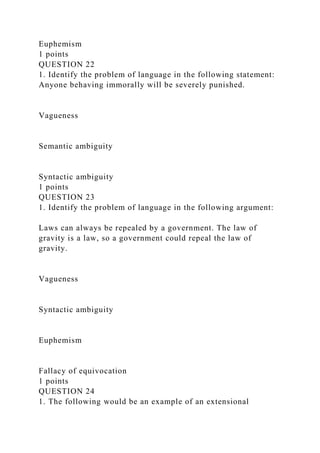
1. Identify the problem of language in the following statement:
Jones killed the man with a gun.
Vagueness
Semantic ambiguity
Syntactic ambiguity
Emotional language
Euphemism
1 points
QUESTION 22
1. Identify the problem of language in the following statement:
Anyone behaving immorally will be severely punished.
Vagueness
Semantic ambiguity
Syntactic ambiguity
1 points
QUESTION 23
1. Identify the problem of language in the following argument:
Laws can always be repealed by a government. The law of
gravity is a law, so a government could repeal the law of
gravity.
Vagueness
Syntactic ambiguity
Euphemism
Fallacy of equivocation
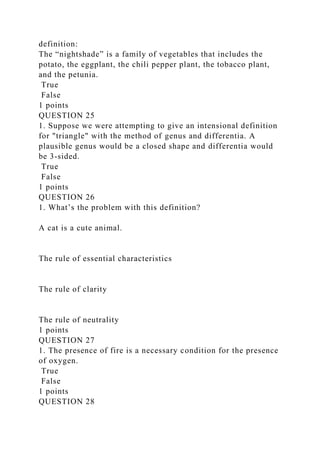
1 points
QUESTION 24
1. The following would be an example of an extensional
definition:
The “nightshade” is a family of vegetables that includes the
potato, the eggplant, the chili pepper plant, the tobacco plant,
and the petunia.
True
False
1 points
QUESTION 25
1. Suppose we were attempting to give an intensional definition
for "triangle" with the method of genus and differentia. A
plausible genus would be a closed shape and differentia would
be 3-sided.
True
False
1 points
QUESTION 26
1. What’s the problem with this definition?
A cat is a cute animal.
The rule of essential characteristics
The rule of clarity
The rule of neutrality
1 points
QUESTION 27
1. The presence of fire is a necessary condition for the presence
of oxygen.
True
False
1 points
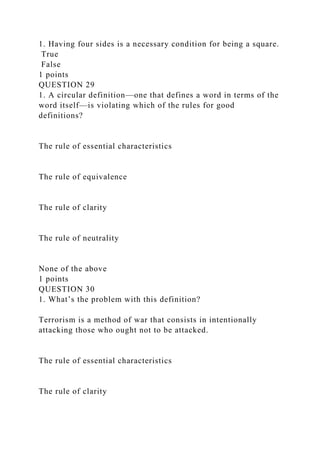
QUESTION 28
1. Having four sides is a necessary condition for being a square.
True
False
1 points
QUESTION 29
1. A circular definition—one that defines a word in terms of the
word itself—is violating which of the rules for good
definitions?
The rule of essential characteristics
The rule of equivalence
The rule of clarity
The rule of neutrality
None of the above
1 points
QUESTION 30
1. What’s the problem with this definition?
Terrorism is a method of war that consists in intentionally
attacking those who ought not to be attacked.
The rule of essential characteristics
The rule of clarity
The rule of neutrality
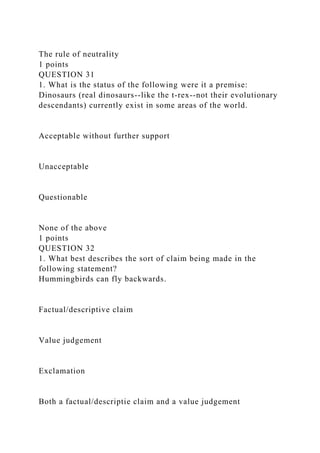
1 points
QUESTION 31
1. What is the status of the following were it a premise:
Dinosaurs (real dinosaurs--like the t-rex--not their evolutionary
descendants) currently exist in some areas of the world.
Acceptable without further support
Unacceptable
Questionable
None of the above
1 points
QUESTION 32
1. What best describes the sort of claim being made in the
following statement?
Hummingbirds can fly backwards.
Factual/descriptive claim
Value judgement
Exclamation
Both a factual/descriptie claim and a value judgement
None of the above
1 points
QUESTION 33
1. Which of the following could count as an authority for an
appeal to authority?
Professionals who are renowned in their fields
Objective consumer advocacy groups
Documentaries
Reference books
All of the above
1 points
QUESTION 34
1. Premises we have judged acceptable are not necessarily
relevant.
True
False
1 points
QUESTION 35
1. What is the problem with the following argument?
Abortion is wrong because abortion is murder.
The premises are inconsistent
There is irresolvable ambiguity
The argument begs the question
Nothing, it's a strong argument
1 points
QUESTION 36
1. Washing D.C. is the capital of the US. Were this a premise, it
would be:
Acceptable because it's self evident
Acceptable because it's common knowledge
Acceptable because it's true by definition
Acceptable because of expert testimony
1 points
QUESTION 37
1. The premise "The bill will soon be introduced to the House"
is not relevant, in our sense, to the conclusion "The bill will
become law."
True
False
1 points
QUESTION 38
1. The Bible must be the word of God because the Bible says
that it is the word of God. This is a good example of the fallacy
of equivocation.
True
False
1 points
QUESTION 39
1. Consider the following:
1. Smoking probably causes cancer
2. Smoking certainly causes cancer
The sufficiency conditions is easier to satisfy for 1 than 2.
True
False
1 points
QUESTION 40
1. If an inductive argument is strong--that is, if its premises are
acceptable and if both the internal relevance and sufficiency
conditions are satisfied--then the conclusion of that argument is
established with absolute certainty.
True
False

QUESTION 11. In argument analysis, the remarks and comments that.docx

  • 1.
    QUESTION 1 1. Inargument analysis, the remarks and comments that accompany but are not integral to an argument is known as ________. noise buzz music accompaniment 1 points QUESTION 2 1. Convergent premises support a conclusion only when they are conjoined. True False 1 points QUESTION 3 1. Consider the argument below. Based on the legend below, which of the following is true? · Either the butler or the gardner committed the murder. The Butler didn't commit the murder, so the gardner did. P1 and P2 link to support C P1 and P2 converge to support C.
  • 2.
    1 points QUESTION 4 1.Consider the following argument: · Smoking should be subjected to increased state taxes because, first, such a tax would decrease smoking, and second, such a tax would increase state revenue. The premises in this argument are linked. True False 1 points QUESTION 5 1. Consider the argument below. Based on the legend below, which of the following is true? · P1: If something could be its own cause, it would have to exist prior to itself. · P2: This is impossible. · C: Nothing can be the cause of itself. P1 and P2 link to support C. P2 and C link to support P1. P1 and C converge to support P2. P1 and P2 converge to support C. 1 points QUESTION 6 1. Based on the following passage, identify the error(s) in the diagram below. Affirmative action in higher education is morally justifiable because it compensates for past discrimination, provides valuable role models for women and minorities, and promotes
  • 3.
    multicultural understanding. Diagram: · P1:Affirmative action compensates for past discrimination. · P2: Affirmative action provides valuable role models for women and minorities. · P3: Affirmative action promotes multicultural understanding. · C: Affirmative action in higher education is morally justifiable. P1+P2+P3 ↓ C The premises should be convergent, not linked. P1 should be a sub-conclusion from P2 and P3. 1 points QUESTION 7 1. Based on the following passage, identify the error(s) in the diagram below. If a right to euthanasia is grounded in self-determination, it cannot reasonably be limited to the terminally ill. If people have a right to die, why must they wait until they are actually dying before they are permitted to exercise that right? Diagram: · P1: The right to euthanasia is grounded in self-determination. · SC: If people have a right to die, why must they wait until they are actually dyingbefore they are permitted to exercise that right? · C: The right to euthanasia cannot reasonably be limited to the terminally ill. P1 ↓ SC ↓
  • 4.
    C Nothing—The diagram iscorrect. The sub-conclusion—It is not a statement. P1 should be the main conclusion. SC should be the main conclusion. both B and C 1 points QUESTION 8 1. Based on the legend below, which of the following is true? · P1: Any person who can do logic is sane. · P2: Your sons are not sane. · SC: Your sons can’t do logic. · P3: Anyone fit to serve on a jury must be able to do logic. · C: Your sons are not fit to serve on a jury. P1 and P2 converge to support SC, and SC and P3 converge to support C. P1 and P2 converge to support SC, and SC and P3 link to support C. P1 and P2 link to support SC, and SC and P3 link to support C. 1 points
  • 5.
    QUESTION 9 1. Consideran argument that involves two premises, P1 and P2, and the conclusion, C. If premises are linked, then the following arguments-- P1; therefore C and P2; therefore C --should make sense. True False 1 points QUESTION 10 1. Consider this argument: All cats are mammals, and all mammals are vertebrates, so all cats are mammals. · P1: All cats are mammals. · P2: All mammals are vertebrates. · C: All cats are vertebrates. The following diagram properly represents this argument: P1+P2 ↓ C True False 1 points QUESTION 11 1. In principle, the number of sentences that humans can understand is unbounded. True False 1 points QUESTION 12 1. Context: Your friend gives you a ride to a campus event, and you have towork early the next morning. It’s getting late, and you say to your friend, "It’s getting late," and your friend responds, "OK, let’s get out of here." Your sentence—"It’s
  • 6.
    getting late"—literally meansthat you want to leave the event. True False 1 points QUESTION 13 1. Pick the best hidden premise(s) and/or hidden conclusion(s) to complete this argument. If today is Thursday, then Zoe is either at work or on the golf course. Therefore, Zoe is at work. Hidden premise: Zoe is on the golf course. Hidden premise: Today is not Thursday. Hidden premise: Today is Thursday and Zoe is not on the golf course. Hidden conclusion: Zoe is a dedicated employee. 1 points QUESTION 14 1. Which of the following is NOT a principle of communication? Assume that every gesture is a speech act. Assume that a speech act is intelligible. Interpret a speech act in a way that is in keeping with the
  • 7.
    meaning of itsexplicit elements. Interpret a speech act in a way that fits the context in which it occurs. 1 points QUESTION 15 1. Arguments are always fully explicitly expressed. True False 1 points QUESTION 16 1. Consider the following: I think there is enough evidence to justify a reasonable conclusion. In the vast majority of cases that have been examined, wearing seat-belts has prevented injuries that would have resulted from automobile accidents. And these cases appear to vastly outnumber the relatively few case in which people have avoided injury because they were not wearing seat- belts and were thrown clear of a vehicle. A reasonable sub-conclusion is the following: It is reasonable to believe that wearing a seatbelt is a good way to avoid injuries in automobile accidents. True False 1 points QUESTION 17 1. When diagramming an argument, if there appears to be a hidden premise that would need to be expressed as a controversial claim, it is best to leave it out of the diagram. True False 1 points QUESTION 18 1. Argument flags are part of the premises. True
  • 8.
    False 1 points QUESTION 19 1.Consider the following argument: · We shouldn't legalize gay marriage because homosexuality is unnatural. A reasonable hidden premise might be: What is unnatural is wrong. True False 1 points QUESTION 20 1. Side-by-side before-and-after photographs showing the results of a weight-loss program may serve directly as evidence for the effectiveness of that program. True False 1 points QUESTION 21 1. Identify the problem of language in the following statement: Jones killed the man with a gun. Vagueness Semantic ambiguity Syntactic ambiguity Emotional language
  • 9.
    Euphemism 1 points QUESTION 22 1.Identify the problem of language in the following statement: Anyone behaving immorally will be severely punished. Vagueness Semantic ambiguity Syntactic ambiguity 1 points QUESTION 23 1. Identify the problem of language in the following argument: Laws can always be repealed by a government. The law of gravity is a law, so a government could repeal the law of gravity. Vagueness Syntactic ambiguity Euphemism Fallacy of equivocation 1 points QUESTION 24 1. The following would be an example of an extensional
  • 10.
    definition: The “nightshade” isa family of vegetables that includes the potato, the eggplant, the chili pepper plant, the tobacco plant, and the petunia. True False 1 points QUESTION 25 1. Suppose we were attempting to give an intensional definition for "triangle" with the method of genus and differentia. A plausible genus would be a closed shape and differentia would be 3-sided. True False 1 points QUESTION 26 1. What’s the problem with this definition? A cat is a cute animal. The rule of essential characteristics The rule of clarity The rule of neutrality 1 points QUESTION 27 1. The presence of fire is a necessary condition for the presence of oxygen. True False 1 points QUESTION 28
  • 11.
    1. Having foursides is a necessary condition for being a square. True False 1 points QUESTION 29 1. A circular definition—one that defines a word in terms of the word itself—is violating which of the rules for good definitions? The rule of essential characteristics The rule of equivalence The rule of clarity The rule of neutrality None of the above 1 points QUESTION 30 1. What’s the problem with this definition? Terrorism is a method of war that consists in intentionally attacking those who ought not to be attacked. The rule of essential characteristics The rule of clarity
  • 12.
    The rule ofneutrality 1 points QUESTION 31 1. What is the status of the following were it a premise: Dinosaurs (real dinosaurs--like the t-rex--not their evolutionary descendants) currently exist in some areas of the world. Acceptable without further support Unacceptable Questionable None of the above 1 points QUESTION 32 1. What best describes the sort of claim being made in the following statement? Hummingbirds can fly backwards. Factual/descriptive claim Value judgement Exclamation Both a factual/descriptie claim and a value judgement
  • 13.
    None of theabove 1 points QUESTION 33 1. Which of the following could count as an authority for an appeal to authority? Professionals who are renowned in their fields Objective consumer advocacy groups Documentaries Reference books All of the above 1 points QUESTION 34 1. Premises we have judged acceptable are not necessarily relevant. True False 1 points QUESTION 35 1. What is the problem with the following argument? Abortion is wrong because abortion is murder. The premises are inconsistent
  • 14.
    There is irresolvableambiguity The argument begs the question Nothing, it's a strong argument 1 points QUESTION 36 1. Washing D.C. is the capital of the US. Were this a premise, it would be: Acceptable because it's self evident Acceptable because it's common knowledge Acceptable because it's true by definition Acceptable because of expert testimony 1 points QUESTION 37 1. The premise "The bill will soon be introduced to the House" is not relevant, in our sense, to the conclusion "The bill will become law." True False 1 points QUESTION 38 1. The Bible must be the word of God because the Bible says that it is the word of God. This is a good example of the fallacy
  • 15.
    of equivocation. True False 1 points QUESTION39 1. Consider the following: 1. Smoking probably causes cancer 2. Smoking certainly causes cancer The sufficiency conditions is easier to satisfy for 1 than 2. True False 1 points QUESTION 40 1. If an inductive argument is strong--that is, if its premises are acceptable and if both the internal relevance and sufficiency conditions are satisfied--then the conclusion of that argument is established with absolute certainty. True False