Solution Manual for Auditing and Assurance Services 17th by Arens
Solution Manual for Auditing and Assurance Services 17th by Arens
Solution Manual for Auditing and Assurance Services 17th by Arens
Solution Manual for Auditing and Assurance Services 17th by Arens
Solution Manual for Auditing and Assurance Services 17th by Arens
1.
Download the fullversion and explore a variety of test banks
or solution manuals at https://testbankbell.com
Solution Manual for Auditing and Assurance
Services 17th by Arens
_____ Tap the link below to start your download _____
http://testbankbell.com/product/solution-manual-for-
auditing-and-assurance-services-17th-by-arens/
Find test banks or solution manuals at testbankbell.com today!
2.
Here are somerecommended products for you. Click the link to
download, or explore more at testbankbell.com
Test Bank for Auditing and Assurance Services 17th by
Arens
http://testbankbell.com/product/test-bank-for-auditing-and-assurance-
services-17th-by-arens/
Auditing and Assurance Services 16th Edition Arens
Solutions Manual
http://testbankbell.com/product/auditing-and-assurance-services-16th-
edition-arens-solutions-manual/
Solution manual for Auditing and Assurance Services Arens
Elder Beasley 15th edition
http://testbankbell.com/product/solution-manual-for-auditing-and-
assurance-services-arens-elder-beasley-15th-edition/
Test Bank for Contemporary Advertising and Integrated
Marketing Communications, 14th Edition : Arens
http://testbankbell.com/product/test-bank-for-contemporary-
advertising-and-integrated-marketing-communications-14th-edition-
arens/
3.
Human Resource ManagementNoe 8th Edition Solutions Manual
http://testbankbell.com/product/human-resource-management-noe-8th-
edition-solutions-manual/
Test Bank for Principles of Auditing and Other Assurance
Services, 21st Edition, Whittington
http://testbankbell.com/product/test-bank-for-principles-of-auditing-
and-other-assurance-services-21st-edition-whittington/
Test Bank for Precalculus: Concepts Through Functions, A
Unit Circle Approach to Trigonometry 4th Edition by
Sullivan
http://testbankbell.com/product/test-bank-for-precalculus-concepts-
through-functions-a-unit-circle-approach-to-trigonometry-4th-edition-
by-sullivan/
Test Bank for Business Essentials 9th Edition by Ebert
http://testbankbell.com/product/test-bank-for-business-essentials-9th-
edition-by-ebert/
Test Bank for C++ Programming: From Problem Analysis to
Program Design, 6th Edition – D.S. Malik
http://testbankbell.com/product/test-bank-for-c-programming-from-
problem-analysis-to-program-design-6th-edition-d-s-malik/
4.
Solution Manual forTerrorism and Homeland Security, 9th
Edition
http://testbankbell.com/product/solution-manual-for-terrorism-and-
homeland-security-9th-edition/
5.
1-1
Solution Manual forAuditing and Assurance
Services 17th by Arens
Full download link at: https://testbankbell.com/product/solution-
manual-for-auditing-and-assurance-services-17th-by-arens/
Chapter 1
The Demand for Audit and Other Assurance Services
Concept Checks
P. 8
1. To do an audit, there must be information in a verifiable form and some
standards (criteria) by which the auditor can evaluate the information.
Determining the degree of correspondence between information and
established criteria is determining whether a given set of information is in
accordance with the established criteria. For an audit of a company’s financial
statements the criteria are U.S. generally accepted accounting principles or
International Financial Reporting Standards.
2. The four primary causes of information risk are remoteness of information,
biases and motives of the provider, voluminous data, and the existence of complex
exchange transactions.
The three main ways to reduce information risk are:
1. User verifies the information.
2. User shares the information risk with management.
3. Audited financial statements are provided.
P. 16
1. The three main types of audits are operational audits, compliance audits, and
financial statement audits. The table below summarizes the purposes and
nature of each type of audit.
OPERATIONAL
AUDITS
COMPLIANCE
AUDITS
AUDITS OF
FINANCIAL
STATEMENTS
6.
1-2
PURPOSE To evaluate
whether
operating
proceduresare
efficient and
effective
To determine
whether the client is
following specific
procedures set by a
higher authority
To determine
whether the
overall financial
statements are
presented in
accordance with
specified criteria
(usually GAAP)
7.
1-3
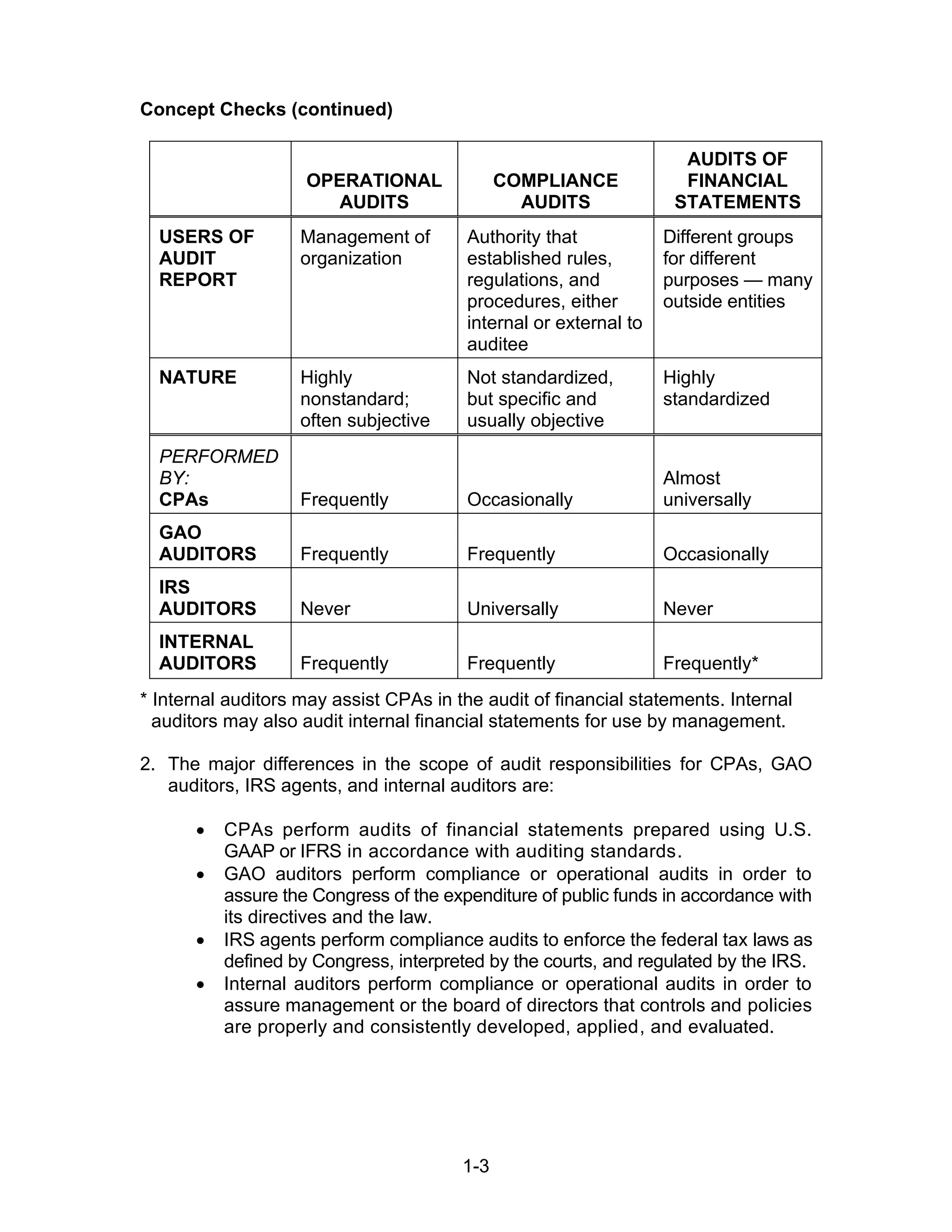
Concept Checks (continued)
OPERATIONAL
AUDITS
COMPLIANCE
AUDITS
AUDITSOF
FINANCIAL
STATEMENTS
USERS OF
AUDIT
REPORT
Management of
organization
Authority that
established rules,
regulations, and
procedures, either
internal or external to
auditee
Different groups
for different
purposes — many
outside entities
NATURE Highly
nonstandard;
often subjective
Not standardized,
but specific and
usually objective
Highly
standardized
PERFORMED
BY:
CPAs Frequently Occasionally
Almost
universally
GAO
AUDITORS Frequently Frequently Occasionally
IRS
AUDITORS Never Universally Never
INTERNAL
AUDITORS Frequently Frequently Frequently*
* Internal auditors may assist CPAs in the audit of financial statements. Internal
auditors may also audit internal financial statements for use by management.
2. The major differences in the scope of audit responsibilities for CPAs, GAO
auditors, IRS agents, and internal auditors are:
• CPAs perform audits of financial statements prepared using U.S.
GAAP or IFRS in accordance with auditing standards.
• GAO auditors perform compliance or operational audits in order to
assure the Congress of the expenditure of public funds in accordance with
its directives and the law.
• IRS agents perform compliance audits to enforce the federal tax laws as
defined by Congress, interpreted by the courts, and regulated by the IRS.
• Internal auditors perform compliance or operational audits in order to
assure management or the board of directors that controls and policies
are properly and consistently developed, applied, and evaluated.
8.
1-4
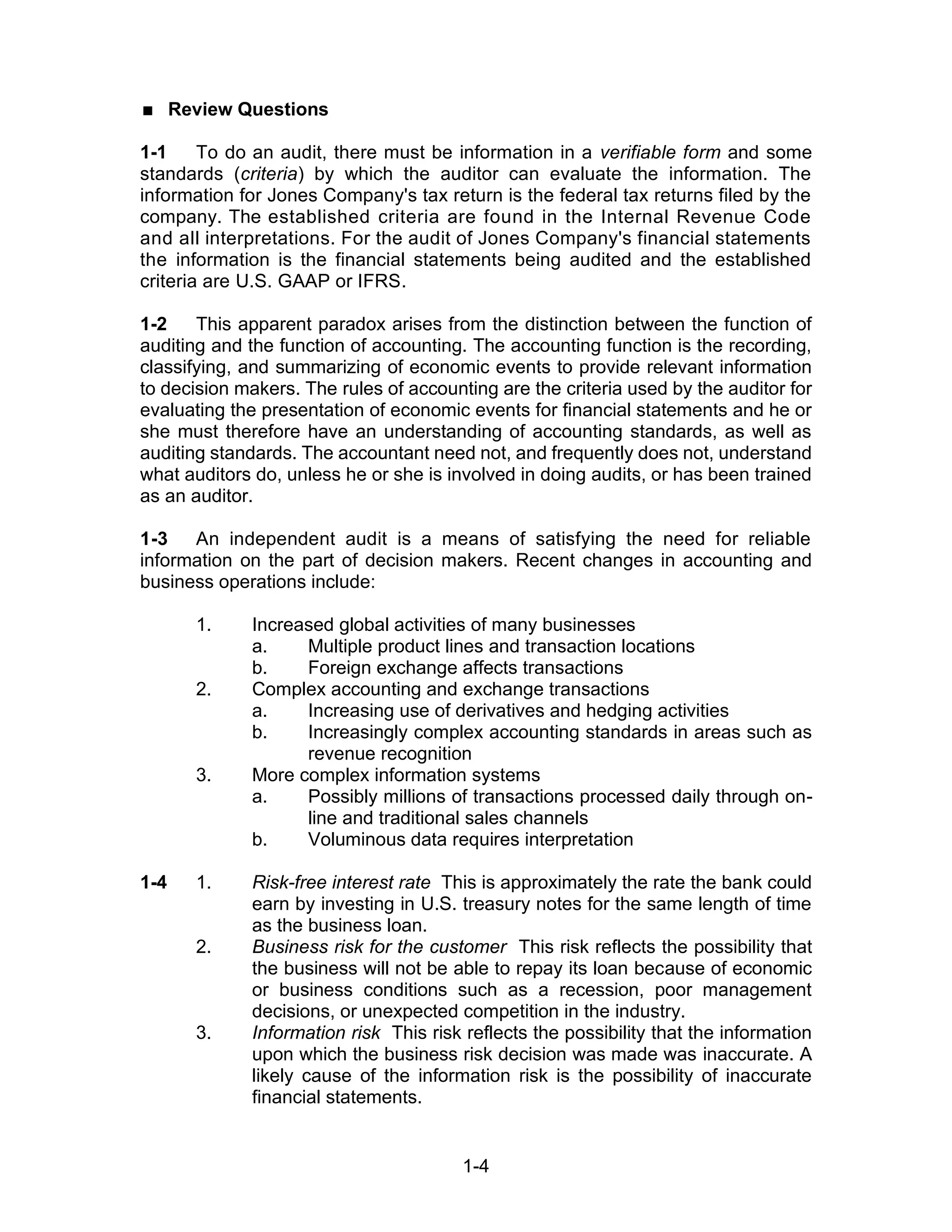
Review Questions
1-1To do an audit, there must be information in a verifiable form and some
standards (criteria) by which the auditor can evaluate the information. The
information for Jones Company's tax return is the federal tax returns filed by the
company. The established criteria are found in the Internal Revenue Code
and all interpretations. For the audit of Jones Company's financial statements
the information is the financial statements being audited and the established
criteria are U.S. GAAP or IFRS.
1-2 This apparent paradox arises from the distinction between the function of
auditing and the function of accounting. The accounting function is the recording,
classifying, and summarizing of economic events to provide relevant information
to decision makers. The rules of accounting are the criteria used by the auditor for
evaluating the presentation of economic events for financial statements and he or
she must therefore have an understanding of accounting standards, as well as
auditing standards. The accountant need not, and frequently does not, understand
what auditors do, unless he or she is involved in doing audits, or has been trained
as an auditor.
1-3 An independent audit is a means of satisfying the need for reliable
information on the part of decision makers. Recent changes in accounting and
business operations include:
1. Increased global activities of many businesses
a. Multiple product lines and transaction locations
b. Foreign exchange affects transactions
2. Complex accounting and exchange transactions
a. Increasing use of derivatives and hedging activities
b. Increasingly complex accounting standards in areas such as
revenue recognition
3. More complex information systems
a. Possibly millions of transactions processed daily through on-
line and traditional sales channels
b. Voluminous data requires interpretation
1-4 1. Risk-free interest rate This is approximately the rate the bank could
earn by investing in U.S. treasury notes for the same length of time
as the business loan.
2. Business risk for the customer This risk reflects the possibility that
the business will not be able to repay its loan because of economic
or business conditions such as a recession, poor management
decisions, or unexpected competition in the industry.
3. Information risk This risk reflects the possibility that the information
upon which the business risk decision was made was inaccurate. A
likely cause of the information risk is the possibility of inaccurate
financial statements.
9.
1-5
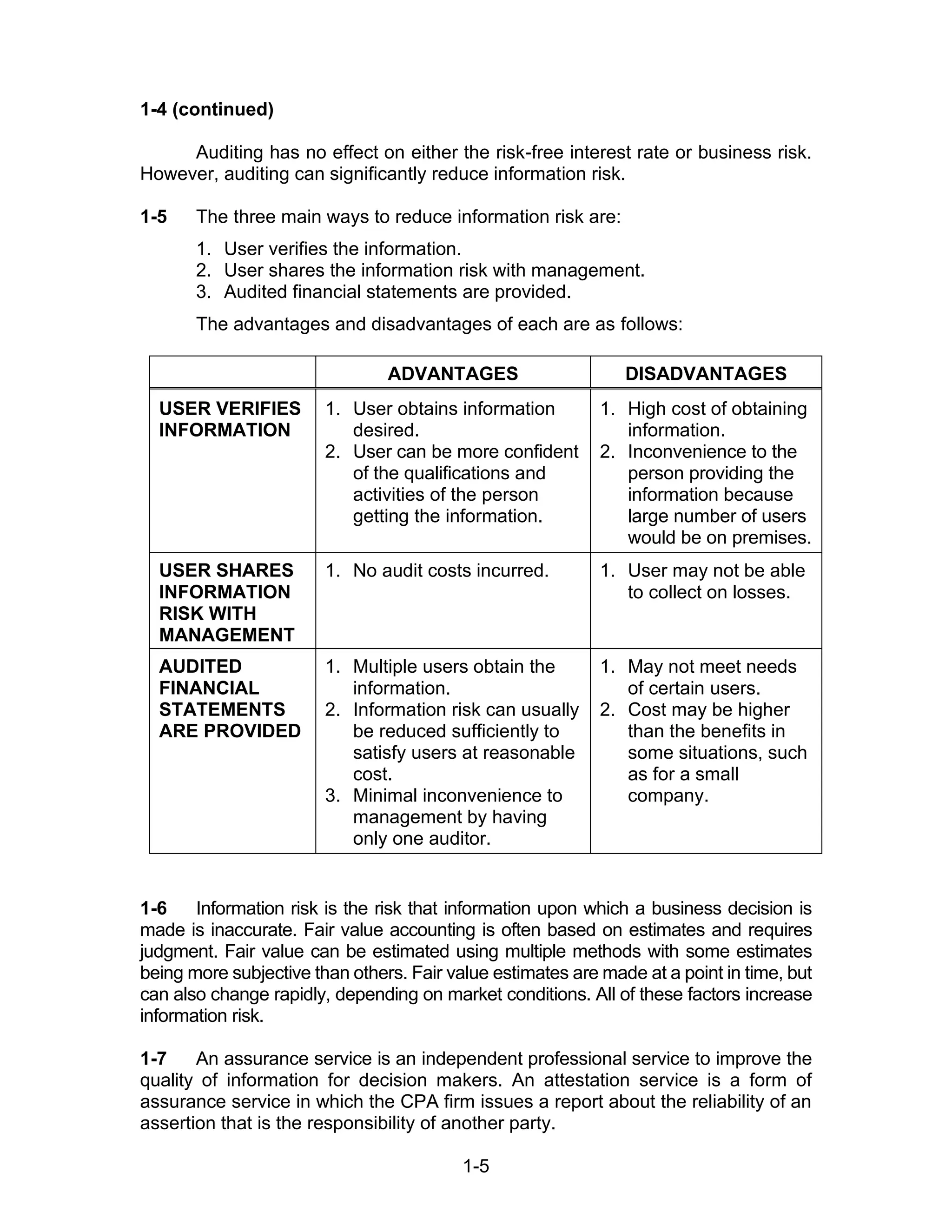
1-4 (continued)
Auditing hasno effect on either the risk-free interest rate or business risk.
However, auditing can significantly reduce information risk.
1-5 The three main ways to reduce information risk are:
1. User verifies the information.
2. User shares the information risk with management.
3. Audited financial statements are provided.
The advantages and disadvantages of each are as follows:
ADVANTAGES DISADVANTAGES
USER VERIFIES
INFORMATION
1. User obtains information
desired.
2. User can be more confident
of the qualifications and
activities of the person
getting the information.
1. High cost of obtaining
information.
2. Inconvenience to the
person providing the
information because
large number of users
would be on premises.
USER SHARES
INFORMATION
RISK WITH
MANAGEMENT
1. No audit costs incurred. 1. User may not be able
to collect on losses.
AUDITED
FINANCIAL
STATEMENTS
ARE PROVIDED
1. Multiple users obtain the
information.
2. Information risk can usually
be reduced sufficiently to
satisfy users at reasonable
cost.
3. Minimal inconvenience to
management by having
only one auditor.
1. May not meet needs
of certain users.
2. Cost may be higher
than the benefits in
some situations, such
as for a small
company.
1-6 Information risk is the risk that information upon which a business decision is
made is inaccurate. Fair value accounting is often based on estimates and requires
judgment. Fair value can be estimated using multiple methods with some estimates
being more subjective than others. Fair value estimates are made at a point in time, but
can also change rapidly, depending on market conditions. All of these factors increase
information risk.
1-7 An assurance service is an independent professional service to improve the
quality of information for decision makers. An attestation service is a form of
assurance service in which the CPA firm issues a report about the reliability of an
assertion that is the responsibility of another party.
10.
1-6
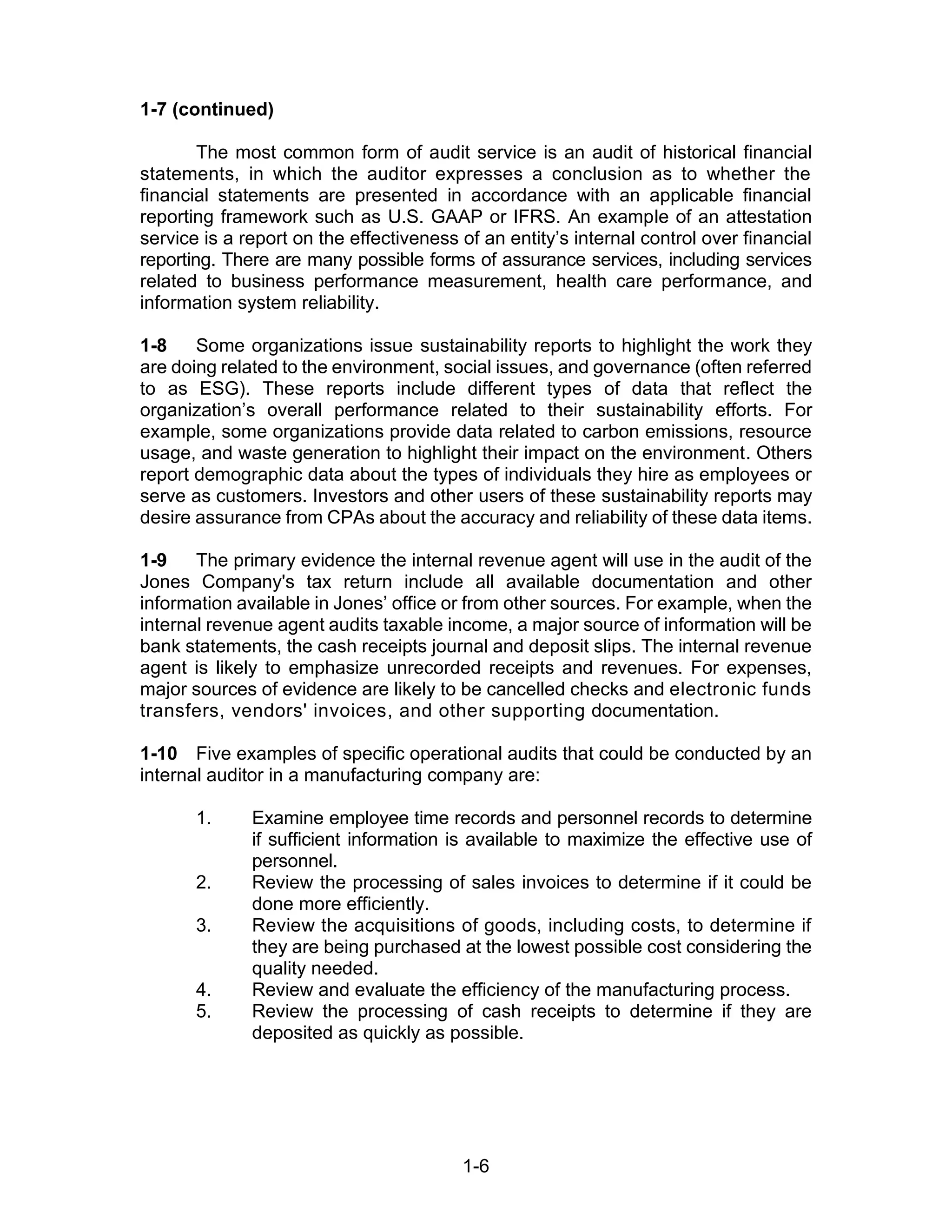
1-7 (continued)
The mostcommon form of audit service is an audit of historical financial
statements, in which the auditor expresses a conclusion as to whether the
financial statements are presented in accordance with an applicable financial
reporting framework such as U.S. GAAP or IFRS. An example of an attestation
service is a report on the effectiveness of an entity’s internal control over financial
reporting. There are many possible forms of assurance services, including services
related to business performance measurement, health care performance, and
information system reliability.
1-8 Some organizations issue sustainability reports to highlight the work they
are doing related to the environment, social issues, and governance (often referred
to as ESG). These reports include different types of data that reflect the
organization’s overall performance related to their sustainability efforts. For
example, some organizations provide data related to carbon emissions, resource
usage, and waste generation to highlight their impact on the environment. Others
report demographic data about the types of individuals they hire as employees or
serve as customers. Investors and other users of these sustainability reports may
desire assurance from CPAs about the accuracy and reliability of these data items.
1-9 The primary evidence the internal revenue agent will use in the audit of the
Jones Company's tax return include all available documentation and other
information available in Jones’ office or from other sources. For example, when the
internal revenue agent audits taxable income, a major source of information will be
bank statements, the cash receipts journal and deposit slips. The internal revenue
agent is likely to emphasize unrecorded receipts and revenues. For expenses,
major sources of evidence are likely to be cancelled checks and electronic funds
transfers, vendors' invoices, and other supporting documentation.
1-10 Five examples of specific operational audits that could be conducted by an
internal auditor in a manufacturing company are:
1. Examine employee time records and personnel records to determine
if sufficient information is available to maximize the effective use of
personnel.
2. Review the processing of sales invoices to determine if it could be
done more efficiently.
3. Review the acquisitions of goods, including costs, to determine if
they are being purchased at the lowest possible cost considering the
quality needed.
4. Review and evaluate the efficiency of the manufacturing process.
5. Review the processing of cash receipts to determine if they are
deposited as quickly as possible.
11.
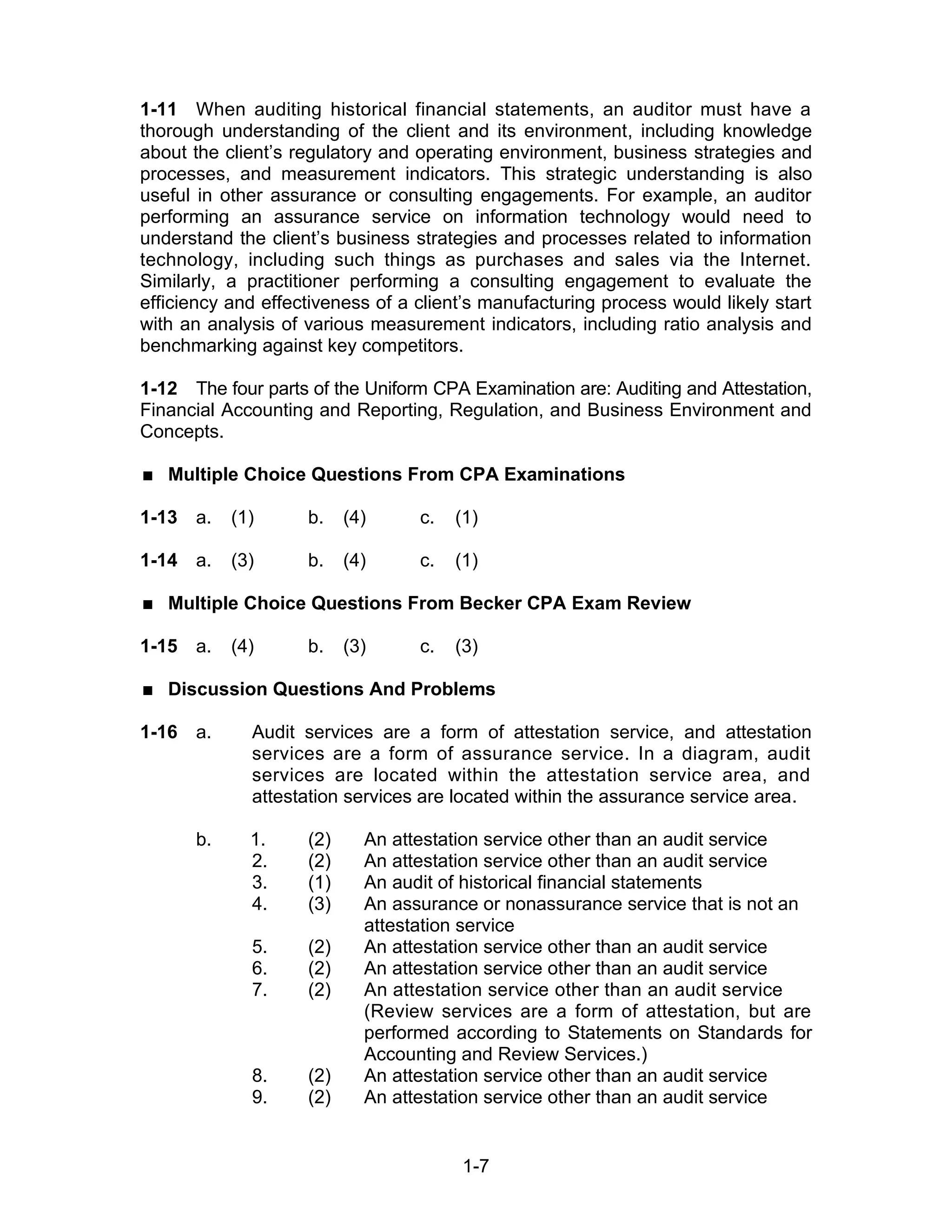
1-7
1-11 When auditinghistorical financial statements, an auditor must have a
thorough understanding of the client and its environment, including knowledge
about the client’s regulatory and operating environment, business strategies and
processes, and measurement indicators. This strategic understanding is also
useful in other assurance or consulting engagements. For example, an auditor
performing an assurance service on information technology would need to
understand the client’s business strategies and processes related to information
technology, including such things as purchases and sales via the Internet.
Similarly, a practitioner performing a consulting engagement to evaluate the
efficiency and effectiveness of a client’s manufacturing process would likely start
with an analysis of various measurement indicators, including ratio analysis and
benchmarking against key competitors.
1-12 The four parts of the Uniform CPA Examination are: Auditing and Attestation,
Financial Accounting and Reporting, Regulation, and Business Environment and
Concepts.
Multiple Choice Questions From CPA Examinations
1-13 a. (1) b. (4) c. (1)
1-14 a. (3) b. (4) c. (1)
Multiple Choice Questions From Becker CPA Exam Review
1-15 a. (4) b. (3) c. (3)
Discussion Questions And Problems
1-16 a. Audit services are a form of attestation service, and attestation
services are a form of assurance service. In a diagram, audit
services are located within the attestation service area, and
attestation services are located within the assurance service area.
b. 1. (2) An attestation service other than an audit service
2. (2) An attestation service other than an audit service
3. (1) An audit of historical financial statements
4. (3) An assurance or nonassurance service that is not an
attestation service
5. (2) An attestation service other than an audit service
6. (2) An attestation service other than an audit service
7. (2) An attestation service other than an audit service
(Review services are a form of attestation, but are
performed according to Statements on Standards for
Accounting and Review Services.)
8. (2) An attestation service other than an audit service
9. (2) An attestation service other than an audit service
12.
1-8
11-16 (continued)
10. (2)An attestation service other than an audit service
11. (3) An assurance or nonassurance service that is not an
attestation service
1-17 a. The interest rate for the loan that requires a review report is lower
than the loan that did not require a review because of lower
information risk. A review report provides moderate assurance to
financial statement users, which lowers information risk. An audit
report provides further assurance and lower information risk. As a
result of reduced information risk, the interest rate is lowest for the
loan with the audit report.
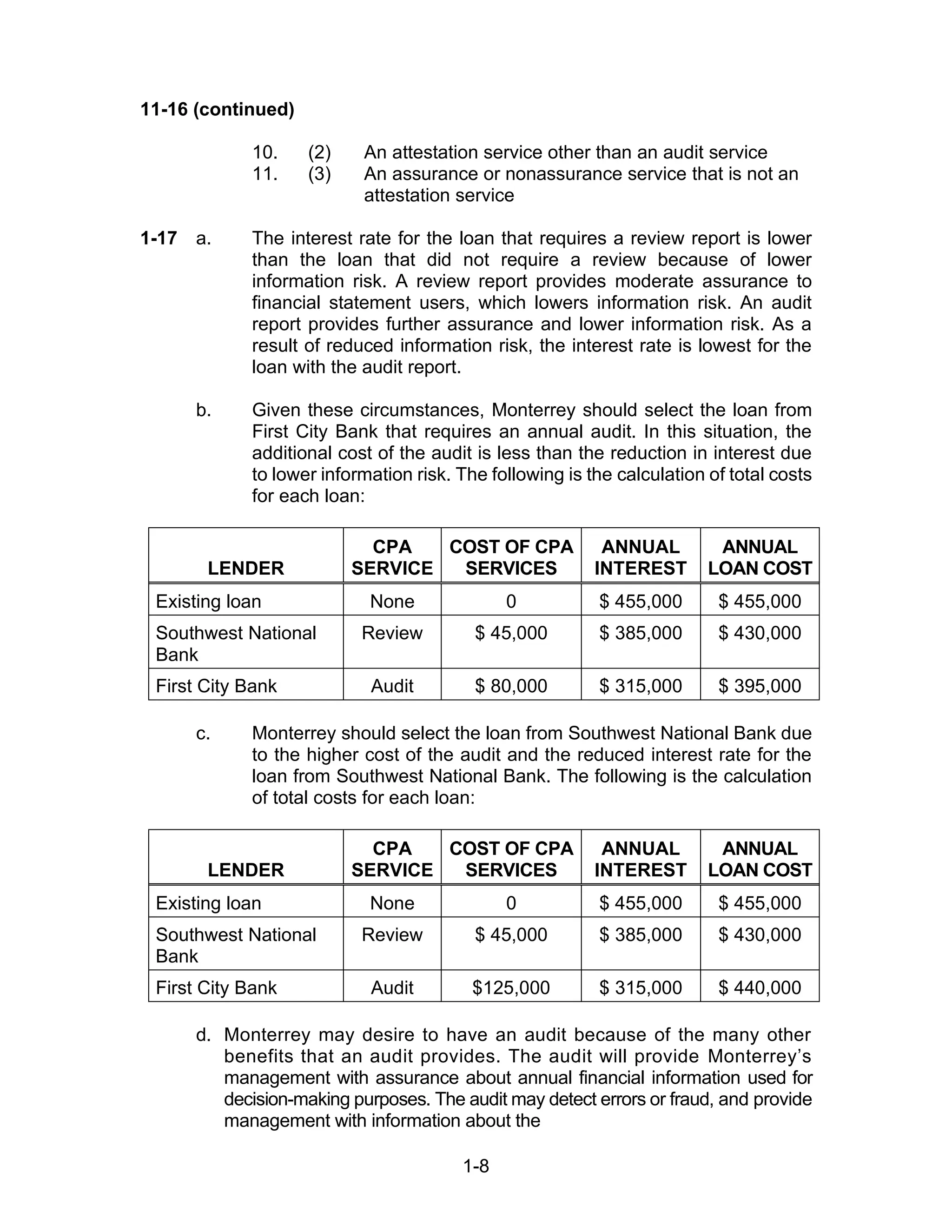
b. Given these circumstances, Monterrey should select the loan from
First City Bank that requires an annual audit. In this situation, the
additional cost of the audit is less than the reduction in interest due
to lower information risk. The following is the calculation of total costs
for each loan:
LENDER
CPA
SERVICE
COST OF CPA
SERVICES
ANNUAL
INTEREST
ANNUAL
LOAN COST
Existing loan None 0 $ 455,000 $ 455,000
Southwest National
Bank
Review $ 45,000 $ 385,000 $ 430,000
First City Bank Audit $ 80,000 $ 315,000 $ 395,000
c. Monterrey should select the loan from Southwest National Bank due
to the higher cost of the audit and the reduced interest rate for the
loan from Southwest National Bank. The following is the calculation
of total costs for each loan:
LENDER
CPA
SERVICE
COST OF CPA
SERVICES
ANNUAL
INTEREST
ANNUAL
LOAN COST
Existing loan None 0 $ 455,000 $ 455,000
Southwest National
Bank
Review $ 45,000 $ 385,000 $ 430,000
First City Bank Audit $125,000 $ 315,000 $ 440,000
d. Monterrey may desire to have an audit because of the many other
benefits that an audit provides. The audit will provide Monterrey’s
management with assurance about annual financial information used for
decision-making purposes. The audit may detect errors or fraud, and provide
management with information about the
13.
1-9
1-17 (continued)
effectiveness ofcontrols. In addition, the audit may result in
recommendations to management that will improve efficiency or
effectiveness.
e. The auditor must have a thorough understanding of the client and its
environment, including the client’s e-commerce technologies, industry,
regulatory and operating environment, suppliers, customers, creditors,
and business strategies and processes. This thorough analysis helps
the auditor identify risks associated with the client’s strategies that
may affect whether the financial statements are fairly stated. This
strategic knowledge of the client’s business often helps the auditor
identify ways to help the client improve business operations, thereby
providing added value to the audit function.
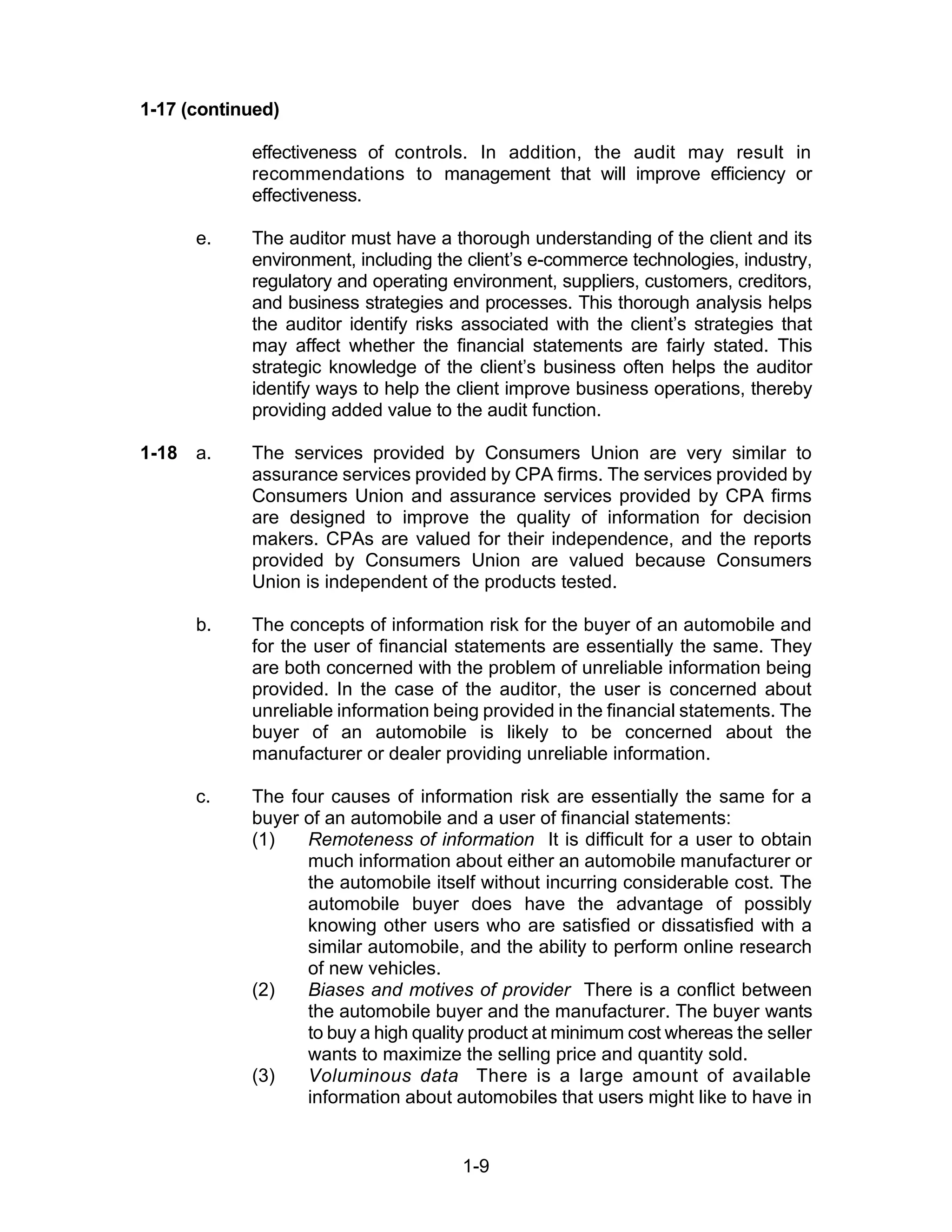
1-18 a. The services provided by Consumers Union are very similar to
assurance services provided by CPA firms. The services provided by
Consumers Union and assurance services provided by CPA firms
are designed to improve the quality of information for decision
makers. CPAs are valued for their independence, and the reports
provided by Consumers Union are valued because Consumers
Union is independent of the products tested.
b. The concepts of information risk for the buyer of an automobile and
for the user of financial statements are essentially the same. They
are both concerned with the problem of unreliable information being
provided. In the case of the auditor, the user is concerned about
unreliable information being provided in the financial statements. The
buyer of an automobile is likely to be concerned about the
manufacturer or dealer providing unreliable information.
c. The four causes of information risk are essentially the same for a
buyer of an automobile and a user of financial statements:
(1) Remoteness of information It is difficult for a user to obtain
much information about either an automobile manufacturer or
the automobile itself without incurring considerable cost. The
automobile buyer does have the advantage of possibly
knowing other users who are satisfied or dissatisfied with a
similar automobile, and the ability to perform online research
of new vehicles.
(2) Biases and motives of provider There is a conflict between
the automobile buyer and the manufacturer. The buyer wants
to buy a high quality product at minimum cost whereas the seller
wants to maximize the selling price and quantity sold.
(3) Voluminous data There is a large amount of available
information about automobiles that users might like to have in
14.
1-10
1-18 (continued)
order toevaluate an automobile. Either that information is not
available or too costly to obtain.
(4) Complex exchange transactions The acquisition of an
automobile is expensive and certainly a complex decision
because of all the components that go into making a good
automobile and choosing between a large number of
alternatives.
d. The three ways users of financial statements and buyers of
automobiles reduce information risk are also similar:
(1) User verifies information him or herself That can be obtained by
driving different automobiles, examining the specifications of the
automobiles, talking to other users and doing research in
various magazines.
(2) User shares information risk with management The
manufacturer of a product has a responsibility to meet its
warranties and to provide a reasonable product. The buyer of
an automobile can return the automobile for correction of
defects. In some cases a refund may be obtained.
(3) Examine the information prepared by Consumer Reports
This is similar to an audit in the sense that independent
information is provided by an independent party. The
information provided by Consumer Reports is comparable to
that provided by a CPA firm in an audit of financial statements.
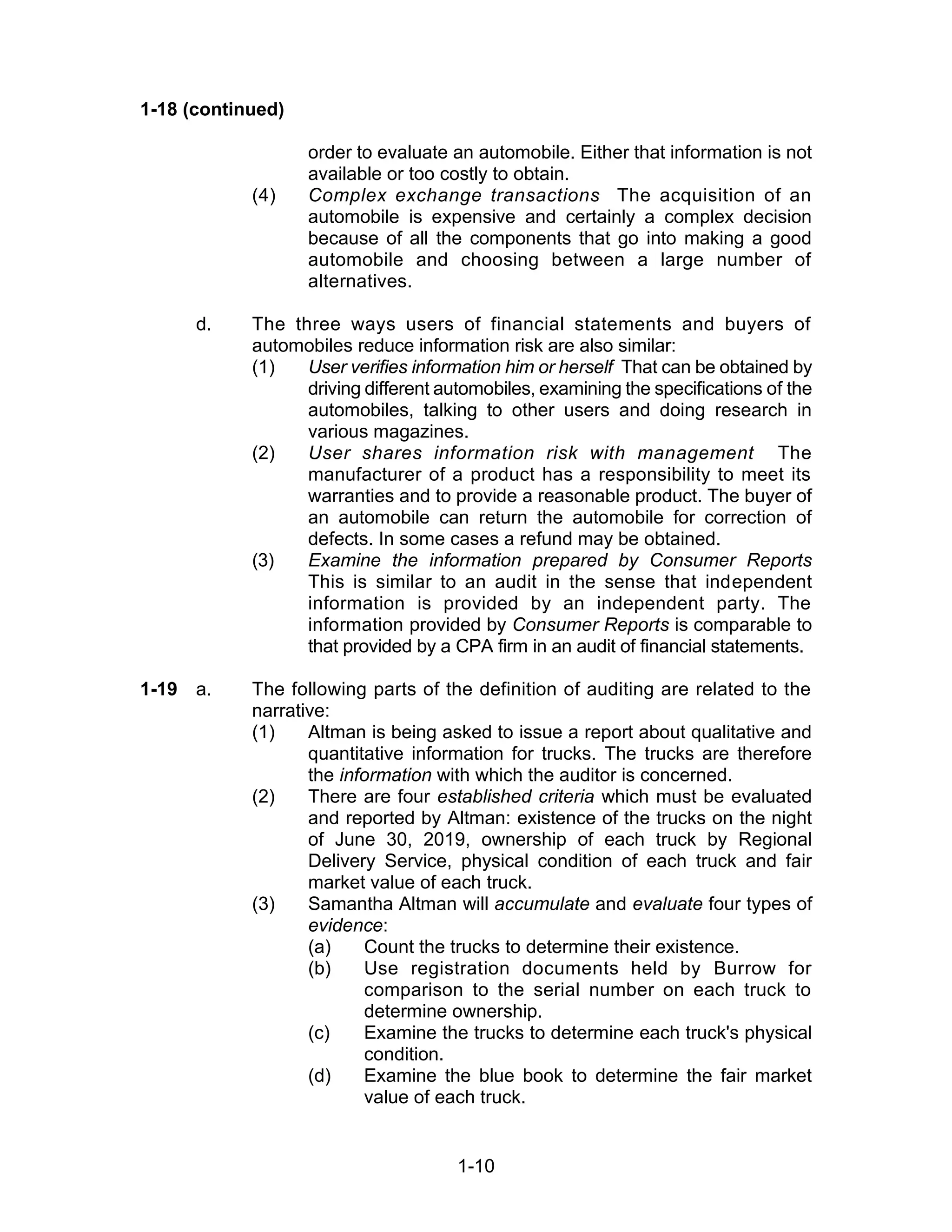
1-19 a. The following parts of the definition of auditing are related to the
narrative:
(1) Altman is being asked to issue a report about qualitative and
quantitative information for trucks. The trucks are therefore
the information with which the auditor is concerned.
(2) There are four established criteria which must be evaluated
and reported by Altman: existence of the trucks on the night
of June 30, 2019, ownership of each truck by Regional
Delivery Service, physical condition of each truck and fair
market value of each truck.
(3) Samantha Altman will accumulate and evaluate four types of
evidence:
(a) Count the trucks to determine their existence.
(b) Use registration documents held by Burrow for
comparison to the serial number on each truck to
determine ownership.
(c) Examine the trucks to determine each truck's physical
condition.
(d) Examine the blue book to determine the fair market
value of each truck.
15.
1-11
1-19 (continued)
(4) SamanthaAltman, CPA, appears qualified, as a competent,
independent person. She is a CPA, and she spends most of
her time auditing used automobile and truck dealerships and
has extensive specialized knowledge about used trucks that
is consistent with the nature of the engagement.
(5) The report results are to include:
(a) which of the 25 trucks are parked in Regional's
parking lot the night of June 30.
(b) whether all of the trucks are owned by Regional
Delivery Service.
(c) the condition of each truck, using established
guidelines.
(d) fair market value of each truck using the current blue
book for trucks.
b. The only parts of the audit that will be difficult for Altman are:
(1) Evaluating the condition, using the guidelines of poor, good,
and excellent. It is highly subjective to do so. If she uses a
different criterion than the "blue book," the fair market value
will not be meaningful. Her experience will be essential in
using this guideline.
(2) Determining the fair market value, unless it is clearly defined
in the blue book for each condition.
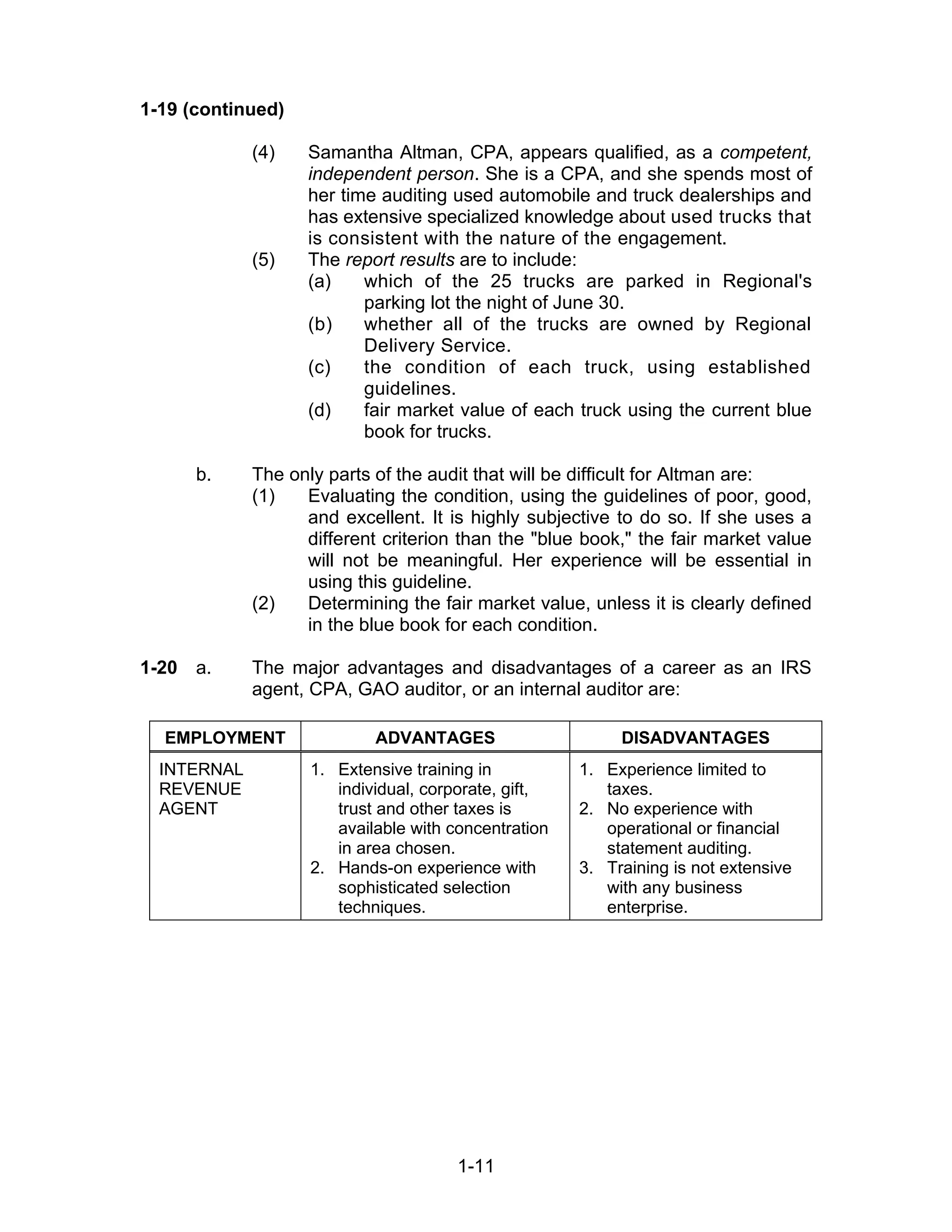
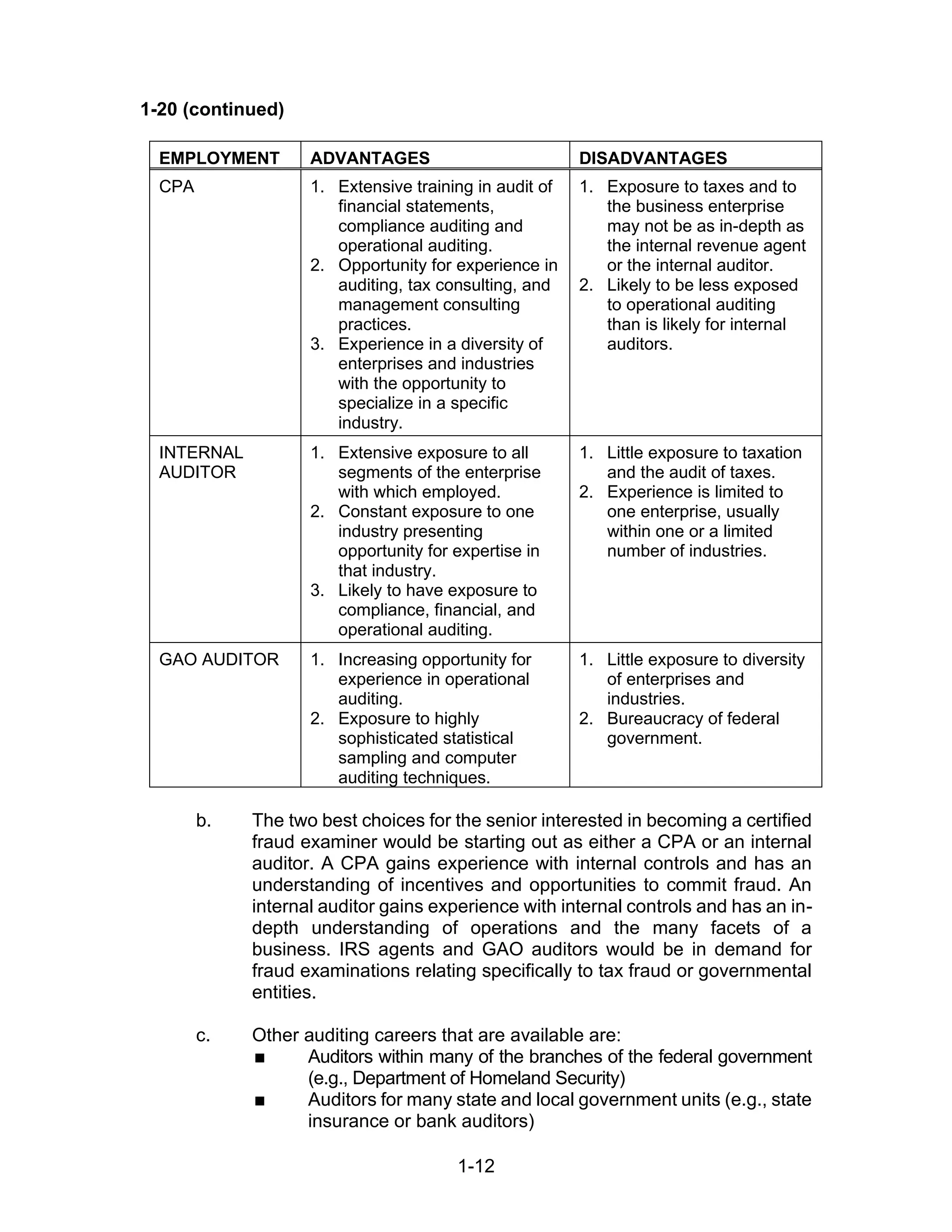
1-20 a. The major advantages and disadvantages of a career as an IRS
agent, CPA, GAO auditor, or an internal auditor are:
EMPLOYMENT ADVANTAGES DISADVANTAGES
INTERNAL
REVENUE
AGENT
1. Extensive training in
individual, corporate, gift,
trust and other taxes is
available with concentration
in area chosen.
2. Hands-on experience with
sophisticated selection
techniques.
1. Experience limited to
taxes.
2. No experience with
operational or financial
statement auditing.
3. Training is not extensive
with any business
enterprise.
16.
1-12
1-20 (continued)
EMPLOYMENT ADVANTAGESDISADVANTAGES
CPA 1. Extensive training in audit of
financial statements,
compliance auditing and
operational auditing.
2. Opportunity for experience in
auditing, tax consulting, and
management consulting
practices.
3. Experience in a diversity of
enterprises and industries
with the opportunity to
specialize in a specific
industry.
1. Exposure to taxes and to
the business enterprise
may not be as in-depth as
the internal revenue agent
or the internal auditor.
2. Likely to be less exposed
to operational auditing
than is likely for internal
auditors.
INTERNAL
AUDITOR
1. Extensive exposure to all
segments of the enterprise
with which employed.
2. Constant exposure to one
industry presenting
opportunity for expertise in
that industry.
3. Likely to have exposure to
compliance, financial, and
operational auditing.
1. Little exposure to taxation
and the audit of taxes.
2. Experience is limited to
one enterprise, usually
within one or a limited
number of industries.
GAO AUDITOR 1. Increasing opportunity for
experience in operational
auditing.
2. Exposure to highly
sophisticated statistical
sampling and computer
auditing techniques.
1. Little exposure to diversity
of enterprises and
industries.
2. Bureaucracy of federal
government.
b. The two best choices for the senior interested in becoming a certified
fraud examiner would be starting out as either a CPA or an internal
auditor. A CPA gains experience with internal controls and has an
understanding of incentives and opportunities to commit fraud. An
internal auditor gains experience with internal controls and has an in-
depth understanding of operations and the many facets of a
business. IRS agents and GAO auditors would be in demand for
fraud examinations relating specifically to tax fraud or governmental
entities.
c. Other auditing careers that are available are:
Auditors within many of the branches of the federal government
(e.g., Department of Homeland Security)
Auditors for many state and local government units (e.g., state
insurance or bank auditors)
17.
1-13
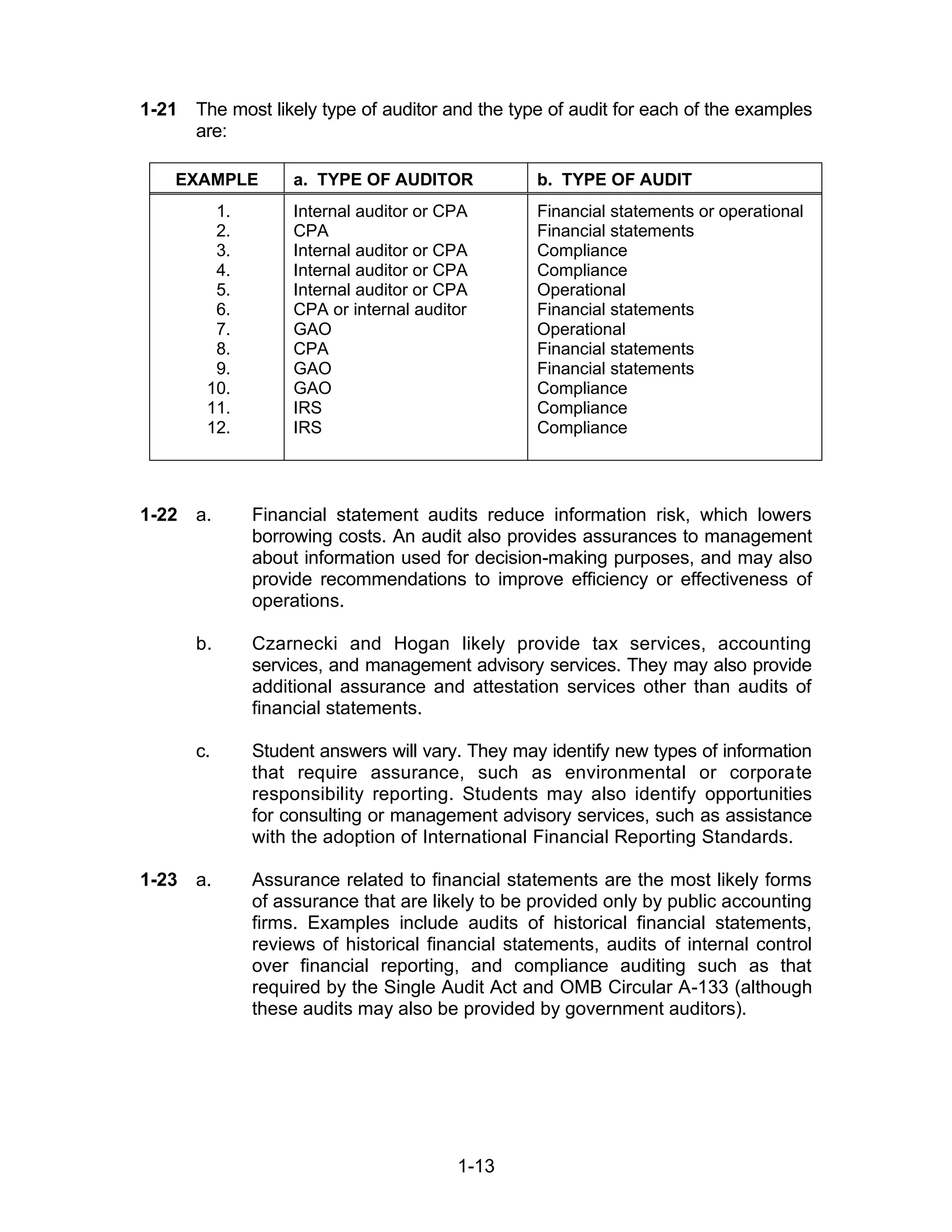
1-21 The mostlikely type of auditor and the type of audit for each of the examples
are:
EXAMPLE a. TYPE OF AUDITOR b. TYPE OF AUDIT
1.
2.
3.
4.
5.
6.
7.
8.
9.
10.
11.
12.
Internal auditor or CPA
CPA
Internal auditor or CPA
Internal auditor or CPA
Internal auditor or CPA
CPA or internal auditor
GAO
CPA
GAO
GAO
IRS
IRS
Financial statements or operational
Financial statements
Compliance
Compliance
Operational
Financial statements
Operational
Financial statements
Financial statements
Compliance
Compliance
Compliance
1-22 a. Financial statement audits reduce information risk, which lowers
borrowing costs. An audit also provides assurances to management
about information used for decision-making purposes, and may also
provide recommendations to improve efficiency or effectiveness of
operations.
b. Czarnecki and Hogan likely provide tax services, accounting
services, and management advisory services. They may also provide
additional assurance and attestation services other than audits of
financial statements.
c. Student answers will vary. They may identify new types of information
that require assurance, such as environmental or corporate
responsibility reporting. Students may also identify opportunities
for consulting or management advisory services, such as assistance
with the adoption of International Financial Reporting Standards.
1-23 a. Assurance related to financial statements are the most likely forms
of assurance that are likely to be provided only by public accounting
firms. Examples include audits of historical financial statements,
reviews of historical financial statements, audits of internal control
over financial reporting, and compliance auditing such as that
required by the Single Audit Act and OMB Circular A-133 (although
these audits may also be provided by government auditors).
18.
1-14
1-23 (continued)
b. Thereare many types of information that are assured by providers
other than public accounting firms. Some of these assurances are
provided by government entities, such as food inspections, elevator
inspections, and pumps at gasoline stations. Other assurances are
provided by nonprofit and for-profit assurance providers, such as ISO
9000 certifications.
c. Table 1-1 on p. 11 includes some examples of assurance that may
be provided by public accounting firms or other assurance providers.
For example, assurance on corporate responsibility and
sustainability may be provided by public accounting firms or other
assurance providers. Other examples included assurance on
website controls, and information such as website traffic or
newspaper circulation.
1-24 a. The vision of the Global Reporting Initiative (GRI) is a sustainable
global economy where organizations manage their economic,
environmental, social and governance performance and impacts
responsibly, and report transparently. Its mission is to make
sustainability reporting standard practice by providing guidance and
support to organizations.
b. According to the GRI “A sustainability report is a report published by
a company or organization about the economic, environmental, and
social impacts caused by its everyday activities. A sustainability
report also presents the organization's values and governance
model, and demonstrates the link between its strategy and its
commitment to a sustainable global economy.”
In an integrated report, sustainability information is included
along with financial information. These reports emphasize the links
between financial and non-financial performance. An integrated
report also presents the risks and opportunities the company faces,
integrated with disclosure of environmental, social, and governance
issues.
c. GRI offers two “in accordance” reporting options, Core and
Comprehensive. For each option, there is a corresponding claim, or
statement of use, that the organization is required to include in the
report. The Core report provides the essential elements of a
sustainability report. The Comprehensive report includes additional
disclosures of the organization’s strategy and analysis, governance,
and ethics and integrity. The GRI recommends external assurance,
but it is not required for either type of “in accordance” report.
19.
1-15
1-25 a. Answerswill vary by state. Most states require 150 hours of
education, with specific requirements for number of accounting hours
and credit hours in other subject areas.
b. Answers will vary by state. Many states require one or two years of
work experience gained in public practice, or possibly government,
academia or industry, depending on the state. In many states,
experience in industry or internal audit is sufficient, depending on the
type of work performed.
c. Most states have frequently addressed questions. Many of these
address education requirements, as well as information on how to
prepare for the exam, as well as information on applying for licensure.
d. The Elijah Watt Sells award program was established in 1923 by
the American Institute of Certified Public Accountants (AICPA)
to recognize outstanding performance on the Uniform CPA
Examination. The award is presented to candidates who obtained a
cumulative average score above 95.50 across all four sections of the
Uniform CPA Examination, completed testing during the previous
calendar year, and passed all four sections of the Examination on
their first attempt.
e. Passing information is available on the CPA Examination portion of
the AICPA web site. Recent passing rates have ranged from
approximately 42% to 60% across the four sections.
This pamphlet wasnot published until 1646 but seems to have been
composed about the year 1606[579]. The writer is a converted
highwayman who is anxious for the reformation of his fellow-sinners.
He states "that Beggerie and Theeverie did never more abound,"
and he complains that the branding and whipping parts of the
statutes are put in execution long before any place is provided
where the poor could have work. He thought that this was most
unfair to the vagrants for many of them would work if they could
and go voluntarily to workhouses if they were in existence. He
therefore urges the establishment of places where men could have
work in all the larger parishes of the kingdom[580].
Another pamphlet complaining of the bad execution of the law was
entitled "Greevous Grones for the Poore" and was published in 1622.
The writer of this states that "though the number of the Poore do
dailie increase all things worketh for the worst in their behalfe. For
there hath beene no collection for them, no not these seven yeares
in many parishes of this land especiallie in countrie townes; but
many of those parishes turneth forth their Poore, yea and their lustie
labourers that will not worke or for any misdemeenor want worke, to
begge, filtch, and steale, for their maintenance so that the country is
pittifully pestered with them[581]."
Another document of 1624 gives precisely the same information.
This is a letter from a Mr Williamson to Sir Julius Caesar, the Master
of the Rolls, who was one of the most charitably disposed gentlemen
of the time. The writer thinks the neglect of the overseers to
apprentice children is the true cause of vagrancy. He tells us that the
seventeenth century vagrant like the modern tramp was very seldom
a man who knew a trade[582]. The existence of these untrained men
was due to the fault of the administrators of the Poor Law. For these
"intollerable offences haue originally growen from the Ou(er)seers of
the poore who heretofore and att this day haue and doe so
ou(er)see as though they did not see at all[583]."
These writings would therefore lead us to believe that justices soon
grew careless; the poor were not relieved and in many places there
22.
was very littleexecution of the law at all. All these statements are
made by writers who are vigorously supporting only one side of the
case but the official evidence of the period confirms their view of the
matter. The reasons given for the appointment of the commission
suggested in 1619/20 show that the unofficial writers had not
exaggerated the existing neglect in the administration of the poor
laws. Good laws have been made but they are not executed because
the justices are negligent and the judges of Assize have not time to
fully investigate the matter. The laws in consequence "are in many
partes of our Realme laid aside or little regarded as lawes not in
force or of small consequence, whereas in some other counties and
partes of this kingdome in wch
by the diligence and industrye of
sume justices of the peace and other magistrates the said lawes
haue bine dulye putt in execucon there hath evidentlye appeared
much good and benefitt to haue redowned to the Comon welth by
the same[584]." At this time therefore there was a real likelihood that
the poor law would become obsolete.
However the season of scarcity in 1622-3 was accompanied by a
crisis in the cloth trade and the Privy Council was active in enforcing
measures of relief. A great improvement was consequently then
effected in the execution of temporary measures of corn relief, and
some reports indicate that this was accompanied by a better
administration of the ordinary poor law also.
Thus from Burnham in Buckinghamshire the justices report, "We
have alsoe looked into and have caused the poore to bee well
provided for in every parrish within this diuision both by stocks to
sett them on worke as alsoe by weekely contributions[585]." From
several of the hundreds of Suffolk there are similar reports. Thus in
every "towne" of Lackford and Exning the rates had been
augmented and the "poorer sorte of people within the seurall townes
and places are ordered to be sett on worke[586]." From other
districts in both East and West we have like accounts[587].
Between the years 1605 and 1629 therefore the administration of
poor relief was on the whole negligent and in many districts the poor
23.
6. Action ofthe
Privy Council and
administration
between 1629 and
1644.
6. a. State of affairs
in 1631.
law was already considered to be of little importance. The
government was however still anxious to secure its enforcement and
the measures taken to relieve distress in 1622-3 effected an
improvement in a few districts.
But from 1629 to 1644 we have a different state
of things. We know already that during this period
the action of the Privy Council was continuous and
constant, and it is in this period therefore that we
shall be able to see how far it was effective. The
justices' reports, to which we have already often referred are the
main sources of our information.
We will endeavour to see how far the evidence of the early part of
the period confirms the view we have already formed as to the
administration of the law at the beginning of the time, and we will
secondly try to estimate the evidence as to improvement during this
period.
The condition of affairs before 1631 is indicated by
the preamble to the commission of Jan. 1631/2
and by some of the earlier reports of 1631. The
reasons given for the appointment of the commission of 1631/2 are
almost exactly the same as those given in the draft of 1619/20. The
justices are said as before to be negligent so that the laws were
almost obsolete in some parts of the country, and this alone shows
that there had been little permanent improvement since 1620. The
preamble also refers to an earlier time "vpon the present making of
the said lawes," when they were duly executed and thus confirms
the evidence as to the good execution of the laws after 1597[588].
The justices' reports of 1631 give us more detailed information of
the same kind. One of these was sent from three of the hundreds of
Hampshire, Fawley, Bountisborough and Mainsborough. The justices
say that they sent an abstract of the act to the officials concerned
and ordered constables, tithingmen, and overseers to bring
presentments to them. But they "for the most parte" replied, "that
they haue noe poore that wanted worke or releife, that they had noe
24.
rogues but sucheas were punished." The justices thought this state
of things too good to be true; they made further enquiries and found
that the highways were out of repair, that no monthly meetings had
been held by the overseers and that there were no stocks for setting
the poor to work. They also heard that some of the poor were "in
noe small want" but did not complain because of ignorance or fear.
They hoped to effect improvement by exacting fines for negligence,
by publishing the particulars of their monthly meetings, and by
sending a series of definite questions to the overseers as to the
names of the poor relieved or set to work and of the children over
ten years of age who were not bound apprentice[589]. In this way
they tried to obtain detailed statements so that there could be no
evasion of the law. There is a later report from Fawley concerning
corn and apprentices, and the part of the law relating to apprentices
was certainly then carried out[590].
But there are other districts in which the justices do not tell us of
negligent officials, but rather seem proud of their vigour and yet
seem to imply that it was only recently the law had come into force.
This is particularly the case in Radnorshire and Cheshire. In two
divisions of Radnor the justices say they have appointed overseers,
and have given particular directions as to the provision of stocks and
return of the names of the poor relieved[591]. The reports suggest
that the justices were now energetic, but that little had been done
before; the mention of the appointment of overseers is
unaccompanied by the word new or by any statement as to the
rendering of the accounts of the old overseers, so that it is possible
that these were the first overseers appointed in that district.
In two of the divisions of Cheshire the same state of things is
implied more definitely. The justices say that they have ordered the
collection of a stock for the setting the poor to work and for the
relief of the impotent, but they find the people poor and averse to
paying money for any purpose of the kind. They fear some time will
elapse before these orders can be properly executed. At present
these divisions have not got a House of Correction, and the justices
wish to have one in the Castle in order that they may be able to
25.
6. b. Improvement
effectedin 1631
and 1632.
subdue the people to subjection[592]. These reports seem to reveal a
very primitive state of things, and recall the difficulties in the West
Riding of Yorkshire in 1597, when poor relief seems to have been
first enforced there, and the people greatly objected to the
imposition of rates.
Other reports show that the Book of Orders strengthened the hands
of reformers; thus in the town of Wells, charities had been
negligently administered, but after the issue of the orders the
Recorder was able to procure information formerly withheld, and
hoped to effect farther improvement by obtaining a commission of
charitable uses[593].
It is thus fairly clear that before 1631 the law had not been well
administered. We will now examine the evidence as to the
improvement between 1631 and 1640.
The greater number of the reports of 1631 and
1632 point to some execution of the law before
1631 and suggest improvement rather than entire
innovation. The justices generally state they have "raised rates" or
have bound many more children apprentices or that stocks had been
provided in the parishes where there were none before. Two reports
enable us to trace the process of improvement in detail, and seem to
throw considerable light on the general statements of other
documents of the kind. They do not however present so favourable a
view as to the execution of the law as most of the other returns.
These reports relate to the district of Braughing in Hertfordshire. The
overseers of thirteen places in the half hundred of Braughing made
returns to the justices at six successive monthly meetings held in
accordance with the provisions of the Book of Orders, between Feb.
7th and June 27, 1631. Abstracts of these returns were sent in by
the justices in two documents, one of which was forwarded in April
and the other in July 1631[594]. We can thus see exactly when the
improvement was effected. At the first meeting four parishes
provided corn at reduced rates for the poor. The Book of Orders
relating to scarcity had been issued since September, and we should
26.
expect some improvementwould already have been made. Six sets
of overseers had already placed some children apprentices, but not
very many, and only two of the largest places had stocks for setting
the poor to work. At the last meeting on June 27th relief was much
more extensively administered. Two other places provided corn at
reduced rates: the six parishes which formerly had placed a few
apprentices now bound many more, while five other townships also
provided for the children in this manner. A much better provision for
the employment of the poor was also made. In five places instead of
two there were now stocks for this purpose and most of the others
give reasons for the want of one. In three cases we are told there is
plenty of employment, at Eastwick the inhabitants set the poor to
work, and at Westmill the general statement only is made that the
poor are relieved according to their necessities. Three places do not
provide stocks or give any reason for not doing so. We can also see
that these funds might often have disappeared, for the ten pounds
stock at Hunsdon had "decayed" to only five pounds at the end of
the period. In the district of Braughing therefore the law was
executed in the larger places before 1630 but negligently even there.
Immediately however after the receipt of the Book of Orders the
justices set themselves to work, held the monthly meetings,
stimulated the overseers, and in five months succeeded in effecting
a very considerable improvement.
This was only typical of what was going on all over the country. It is
of course impossible to quote all the reports of the period; it is only
possible to give particular cases, and to state that they are not
isolated instances, but are typical of the documents of that time.
Thus in April, 1631, we hear that meetings had been rapidly held
and that they had been partially successful, but that the justices
were still in the midst of their activity; they had done a good deal to
make matters better and were still doing more. For example in the
account sent from the New Forest the justices write "the rates for
the poore where neede most requireth wee haue caused to be rised
for reliefe of the poore people wth
in that part, and haue given strict
order to the ouerseers for providing necessary releife for such as are
27.
6. c. Improvement
maintainedbetween
1631 and 1640.
ympotent and such as are able to sett them to worke, and haue
alreadie placed many poore children apprentizes and doe proceede
in placinge of more[595]."
In the returns sent later in the year the organisation appears to be
more settled and we hear that not only the rates are raised but that
they have had a good effect. Thus in Monslow in Shropshire the
justices state "and as for the late booke of orders for the reliefe of
the poore and the punishing of rogues and vagabonds wee have had
severalle monthlye meetings in the said hundred and wee have long
since worked such effect thereby as they have not any rogues or
vagabonds appeared amongst vs or walked abroade as wee can
heare of since our first meetings, and the impotent poore are
relieved in such sort by their parishoners as wee have noe
complaints and there are stocks in all parishes more or lesse as the
charge of the parishes require to set the able poore on worke[596]."
Not all the reports are as favourable as this, but on the whole they
indicate that improved order followed the execution of the Book of
Orders. It thus is clear that the Orders of 1631 had a very
considerable immediate effect both in bringing the law into operation
in places where it had been almost or altogether neglected and still
more in improving the administration in those districts in which the
system was already to some extent administered though not yet
effectually.
We have now to see whether this improved
administration was maintained. The reports are
certainly less frequent after 1631 but those that
remain shew that the efficiency is preserved and there is much to
indicate a farther improvement.
We will first examine a few documents which seem to indicate that
the area of administration was extending into backward districts, we
will then investigate a few cases in which we have reports both in
1631 and in 1638 or 1639, and we will lastly consider a special
department of the poor law system, namely the placing of
apprentices.
28.
We have alreadynoted the fact that in the earlier years of the period
there were few reports from Westmoreland and Lancashire.
But in 1638 there are a series of documents from Westmoreland[597]
and several reports from Lancashire. In 1638 some of the Lancashire
parishes adopted the system of billeting the poor in need of relief on
the richer inhabitants. This plan does not seem to have long
continued as an exclusive system of relief, and the facts that it was
still employed and that these are the earliest reports from
Westmoreland seem to indicate that a compulsory system of poor
relief had only lately been established in the northern counties.
Moreover in 1637 we are told that at the meeting of the justices in
Rochdale in Sept. 1637, the churchwardens of Middleton confessed
that they had never before levied a tax for the relief of the poor
there; they now however proceeded to levy one, and in March in the
following year the tax provided the necessary relief[598]. All this
seems to show that the area of the administration of the poor law
was extending and that in 1638 there was little danger of the system
of poor relief becoming obsolete but that it was obtaining a firmer
hold over the country.
We will now examine a few of the cases in which we have reports
from the same district both in 1631 and 1638 or 1639. We have
already noted the detailed returns from Braughing. It happens that
one of the latest documents of the series returned in August 1639
comes from the hundreds of Hertford and Braughing. The justices
tell us that our "ympotent poore are weekelie releiued by a certein
pencon and the rates increased as necessitie requires. And those of
able bodies are plentifullie stored with work for the maynteynance of
their families"; five apprentices had also lately been bound[599].
From this we see that the improved administration there lasted
throughout the period.
We have several other places from which we have similar reports.
Skenfreth, one of the hundreds of Monmouth, often sent accounts of
the proceedings of the justices. One belongs to May, 1631. The
justices state some of the things they did both before the
29.
Commission and afterwards.Before the Commission they provided
weekly stipends for all the aged and impotent people, "sithence the
said commission" they "have taken order that the same stipends
shalbe contineually paied soe that none of any such poore people
have made any complaint unto us for any mainetenance." Both
before and after the commission they had punished rogues and
since they had also placed apprentices and suppressed alehouses.
Moreover the highways had been last year in better condition than
for twenty years before[600].
Thus the immediate improvement effected by the commission was
that the pensions were paid as well as ordered, apprentices were
bound and alehouses suppressed.
In May, 1637, we have a report from the same district together with
the hundreds of Ragland and Trellech. At that time apprentices were
bound, rogues punished and efforts made to secure the observance
of fasting days. The justices have also "taken course for provision of
stock to sett the poore on worke," and have "caused to be
sufficiently relieved all the aged lame and ympotent people[601]."
Thus if these documents are to be believed the improvement
effected in 1631 was maintained and even increased in this hundred
of Skenfreth.
There are many other cases in which reports are sent in several
times from the same place and all show that the improvement made
in 1631 was continued in 1637, 1638 or 1639[602].
We will now examine a few of the reports which relate especially to
the placing of apprentices. Before May 1635 the Privy Council or the
commissioners seem to have urged the justices to see especially that
this part of the law was carried out, and to have asked them to
report the names of the apprentices and those of their masters[603].
The reports sent in 1634 and 1635 therefore relate especially to the
placing of apprentices and the monthly meetings of the justices.
Reports from twenty-one places were sent in between July 17th and
July 31st, 1634. In almost every case the justices expressly state
30.
that they holdmonthly meetings and bind poor children
apprentice[604]. In the year 1635 the statements are more detailed.
Between May 20th and May 30th replies were sent from ten places
in eight of which the names of both apprentices and masters were
given[605]. Sometimes these were numerous; thus at Blandford in
Dorset one hundred and nineteen apprentices were bound in the
course of two years[606]; in one district of Somerset the names of
one hundred and sixty-six are returned[607], while in all ten districts
a fair amount of work was done. Thus in 1634 and 1635
apprenticeship was more insisted upon than other methods of poor
relief and it seems to have been very generally well administered.
We hear of some complaints but not many in proportion to the
number of reports.
We thus see that during the years 1630 to 1639 we have a large
amount of information concerning the administration of the Poor
Law. We find that a great improvement was effected in 1631. We
also find that the area of administration continued to extend into the
Northern counties after 1631: the difference is indicated by the fact
that in 1638 it is exceptional to find a place without a poor rate,
whereas in 1631 the Government spoke of the laws as being almost
obsolete in many places. We see further that sometimes the later
reports come from the same places as the earlier, and that then the
administration continues to be reported as good. Lastly, in regard to
apprentices we are told that the Privy Council made special efforts to
enforce the law, and that all over the country there is evidence that
it was enforced though occasionally without favourable results.
There is thus reason to believe that the efforts made by the central
government to enforce the law were at last successful, and that the
period to which we owe the survival of our English system of poor
relief is that of the personal government of Charles I.
But we have already noticed that not only is this period the critical
time in the history of the poor relief that survived, but in one respect
the poor relief of this period was unique. Many efforts were made to
find work for the unemployed. Relief of this kind was so much a part
31.
7. The improvement
effectedin 1631
especially
concerned the
unemployed.
of the general system of the time that we have already examined
many instances in which it was administered.
We will first investigate a few more of the reports of 1631, and we
shall find that the improvement effected in all parts of the
administration of poor relief especially concerned the relief of the
ablebodied; we will then examine a detailed report in order to see
what light it throws on the interpretation of the general statements
of other justices, and we will lastly try to find out if relief of this kind
was confined to a few districts, or was administered all over the
country, and also in what parts of the country there was the greatest
need of employment.
To begin with cases in which improvement was
reported in April 1631. From a large district of
Hertfordshire we hear "we haue already raysed a
stocke in some parishes, and are raysing stocks
for the rest to sett all the poore on worke in this
division[608]." In Essex, Richmond, Bedford and Beverley fresh taxes
for this purpose had just been raised, and at Agbrigg they were still
"setlinge such a course for raysinge of stocke to sett ye
people of
able bodies on work[609]."
At Winchester the same thing is implied: the stock has been put in a
clothier's hands, so that now the poor do not want work[610].
Twenty-eight reports relating not only to measures for corn, but also
for the poor were sent in between April 21st and April 30th 1631. In
seventeen of these the poor were set to work, and in many cases we
can see that the measures have been taken since the receipt of the
Book of Orders of January 1631/2[611].
In the answers sent in May we have the same kind of information. In
Brixton and Wallington we have a report similar to that from
Hertfordshire; "stockes of mony," we are told, "are raised in moste of
the parishes wth
in the said hundrede and burrow and the reste not
yet raised are wth
as much expedicon as may bee to bee raised for
buyinge of flax, hempe and other materialls to set the poore to
32.
8. The detailed
reportfrom
Bassetlaw throws
light upon the more
general statements
of the justices.
worke[612]." From Arundel there is a like account, "we haue caused
the taxations for the releefe of the poor to be raised in euery parish
in this time of scarsitye, and haue likewise caused stocks of mony to
be raised in euery parish to buy materialls to sett the poor a warke,
and we haue caused the Statute of Laborors to be inquired after and
to be putt in execution[613]."
We can thus see that in 1631 the justices were busy raising stocks to
provide work for the poor, and that in seventeen documents, or
more than half of the reports of the last ten days of April 1631, we
are informed that measures had been taken with this object.
We will now examine a more detailed report
relating to sixty parishes of Bassetlaw in County
Nottingham and sent in during March 1636/7[614].
In most cases information is given under four
headings, first we are told how many of the
impotent poor are relieved, secondly the amount
of the town stock, thirdly how many rogues have been punished,
and lastly how many apprentices have been bound. This document is
important because it seems to indicate the number of parochial
officials who provided work for the unemployed in the district of
Bassetlaw. This is not directly stated in the report, but the overseers
return the amount of the town stock of their parish whenever a town
stock existed. From the method in which the return is made it seems
that this town stock was always used for finding employment for the
able-bodied poor[615]. Other methods of dealing with those out of
work are also noted, so that it appears that in forty-five out of sixty
parishes the parochial authorities provided employment for those
poor who could work. The amount of the stock was often quite
small; in one case only sixteen shillings, but it is very possible that in
this instance the parish also was small; in another place the stock
consisted of a sum of about thirty pounds, and the average amount
was about three pounds. This document from Bassetlaw only states
in detail what many of the other reports imply, but the detail is much
more convincing, and it is confirmed by the overseers' accounts from
Barnet and Elstree which we have already examined[616]. It is
33.
9. Local variations
inthe provision for
the unemployed.
a. Not so extensive
in the parts North of
the Humber and in
the extreme West.
9 b. Provision of
work more
necessary in the
towns than in the
country.
perhaps worth while to notice that as early as 1623 the justices
wrote from Bassetlaw that work for the poor was wanting, and they
even then ordered that the labourers should be set to work by the
town's stock and the impotent relieved by the public
contribution[617].
We have now to try to find out if
it was only in a few counties
that work was found for the
unemployed, or if it was all over England. We have
already noted that in the counties north of the Humber, and in the
three western counties of Devonshire, Cornwall, and Wiltshire the
poor law was apparently less well administered than in other parts of
the country. In these counties with the exception of Yorkshire
therefore there are few instances in which stocks are found for
providing work for the unemployed. We hear however that in
Ashton-under-Line there existed a "small stocke of money which is
disposed on for the setting of poore to worke[618]". Moreover, in two
Yorkshire reports of 1635 it is stated that the justices have been
"verie carefull to raise stockes for setting our
poore on worke[619]."
There are other Yorkshire returns containing information of the same
kind, but still the plan of finding work for the unemployed of the
North seems to be comparatively unusual.[620]
But with regard to the rest of England this is not the case. In every
county except Northampton some justices state that they have
found employment for the poor. As we might expect this was done
most frequently in the towns and in the manufacturing counties,
both because in these places there were more rich people and
because there were also more unemployed owing to the greater
fluctuations of trade.
A report from Reading and Theale illustrates this:
"Wee finde that the able poore in boddy to worke
and wch
are in country villages and hambletts
haue theire ymploymt in husbondrie and by that
meanes are mayntayned; other lyen in such
34.
countrie townes, populer,incorporate, where heretofore multitudes
of such able persons haue lived by worke from the clothier, now
through the defect and decaye of that trade and soe consequently of
the clothier, thousands of these poore formerlie relieved by worke
liue in much want and could hardlie subsist this deere yeare did not
many extend theire charity even beyond their meanes[621]."
Newbury and Abingdon were also towns in the same neighbourhood
subject to similar conditions, and we know already that workhouses
were founded in both these places and in Reading itself also[622].
Shrewsbury and Hereford are fair examples of more westernly
towns. At Shrewsbury the justices report in June 1631 that they "are
aboute a course to sett all the poore on worke within our Towne and
Libertyes[623]," and in 1638 an order was made for regulating a
workhouse there[624]. About the same time the Mayor of Hereford
records that "there is a colleccon made in euerie severall parish wth
in
the said Cyttie, and competent somes raysed for to releive the
impotent and needy, and a stocke for the setting of poore able
people to worke and for the placeing of youth apprentices[625]."
Other magistrates report in like manner: thus in the rape of Hastings
they have caused the officers "as much as in them lyeth to see the
said poore inhabitants bee duely kept to worke and haue fitting
materialls provided for them[626]." In the hundred of Hertford the
justices state in 1631 that the more populous places have already
raised stocks of money to set the poor to work, and that they are
still trying to induce all the others to do so though a few are not rich
enough to bear the necessary taxation[627]. From St Albans, Reigate,
Ipswich, Maidstone, Lynn, and Norwich, as well as from more inland
towns we have similar information: the magistrates of Bedford write
that "we haue raysed divers extraordenary taxes for the reliefe of
our poore and settinge them on worke and therby they are set to
worke[628]." But perhaps the Buckingham report indicates the most
thorough organisation. There the poor had been visited apparently
in the same way as at Norwich. Five hundred people were examined;
the age and occupation of each were noted, and whether they had
work or not. Afterwards employment was provided for those who
35.
(d) Provision of
workin many
districts in most
counties of the
east.
needed it and we are told that the poor "of good disposicon are glad
they are thus settled wth
out begging and settle themselves seriouslie
to their labor
." This good result however was not obtained without
complaints from the ratepayers[629].
In the country districts also employment seems to have been
provided as well as in the towns whenever the poor suffered much
from the want of work. In the western counties, however, there were
few complaints of lack of employment, except from the cloth-
workers when the trade in cloth was slack. Some justices expressly
state that there is no want of work in their part of the country. Thus
from a large district of Somerset we hear that there are "none lefte
unplaced but such as doe mainetaine their charge by their
labor[630]." Therefore, as we should expect, in many reports from
the West nothing is said about finding employment for the able-
bodied poor. There are, however, also a fair number of cases in
which work is said to be provided. This is especially the case in the
counties of Shropshire and Stafford; thus from Staffordshire three
reports were sent in 1634, and in all three we are told that the poor
were set to work[631]. Moreover, the Worcester justices write that
"wee are carefull ... that the able poore bee well provided of
worke[632]" and in almost all[633] the other western counties, at
least one instance of the kind is reported[634].
But in the east and south-east there was at any
rate sometimes a chronic want of employment,
and consequently numerous efforts to provide for
the able-bodied poor. In the country round
Hitchen we are told, as in the Reading district,
that it is the poor in the town that are distressed, but in the hamlets
the farmers find work for the inhabitants. The justices say they have
no manufacture, and they do not know how to find a remedy for the
people in the town. At one time they make the richer people employ
the poor, but they do not find the experiment successful[635]. We
have also an account of a permanent want of employment in a large
district of Norfolk. In the hundreds of South Greenhoe, Wayland, and
36.
10. Summary.
Grimshoe provisionhad been made by raising a stock to set the
able-bodied poor to work, and besides the magistrates write, "Wee
have manie young people wch
live out of service by reason of the
multitude of them, there not being services for them, but worke is
provided for them in their seuerall parishes[636]."
There are very many reports of stocks for the provision of work in
other country districts of the east. In Hertfordshire, Suffolk, Norfolk,
and Cambridge there is much to make us think the system was
nearly general[637], and in each of the other eastern counties there
are many cases of the kind.
In a district of Middlesex the unemployed were sent to fight for
Gustavus Adolphus[638], but in most parishes materials were
provided for them to work up. Thus in several hundreds in Kent
"stocks of materialls" were provided in every parish[639]; in
Nottinghamshire those out of service and able to work were set to
work "on the towne stock[640]," while at Horncastle sessions, in
Lincolnshire, the justices take "special care ... that the abler sort bee
constantly sett on worke by the stocke of the parishe[641]."
Sometimes the sum expended was very considerable if we take into
account the great difference in the value of money. Thus in
Wallington, Surrey, more than £120 was used for providing work,
while nearly fifty pounds remained in hand[642]. On the whole
therefore in the eastern counties, between 1631 and 1640, it seems
that considerable sums of money were raised and employed in most
districts[643] with the object of setting to work the able-bodied poor.
We have thus seen that in 1631 the improvement
in the administration of poor relief concerned
especially the relief of the able-bodied poor, and we have noted
many instances in which taxes were raised for this purpose at that
time. We have also examined a detailed report from a particular
district in the county of Nottingham in which in forty-five out of sixty
parishes some provision seems to have been made for finding
employment for the poor. Moreover, we find that the plan of
providing work for the unemployed was reported from some district
37.
of every countysouth of the Humber except Cornwall, Northampton,
Devon, and Wilts; and in Devon and Wilts also the same plan was
tried, although no report of the justices has been preserved. This
form of poor relief thus seems to have been frequently in use in the
towns of both east and west, and in the country districts of the
eastern counties also. It was not quite so general in the country
districts of the west, but still was not infrequent even there.
We may, therefore, say that from 1631 to 1640 we had more poor
relief in England than we ever had before or since. We shall try to
estimate later how far this system was successful. But we will now
see what happened to the organisation of English poor relief during
the Civil War. We will also trace the history of poor relief in France
and Scotland during the sixteenth and seventeenth centuries, in
order that we may see that the history of poor relief in England is
unique.
39.
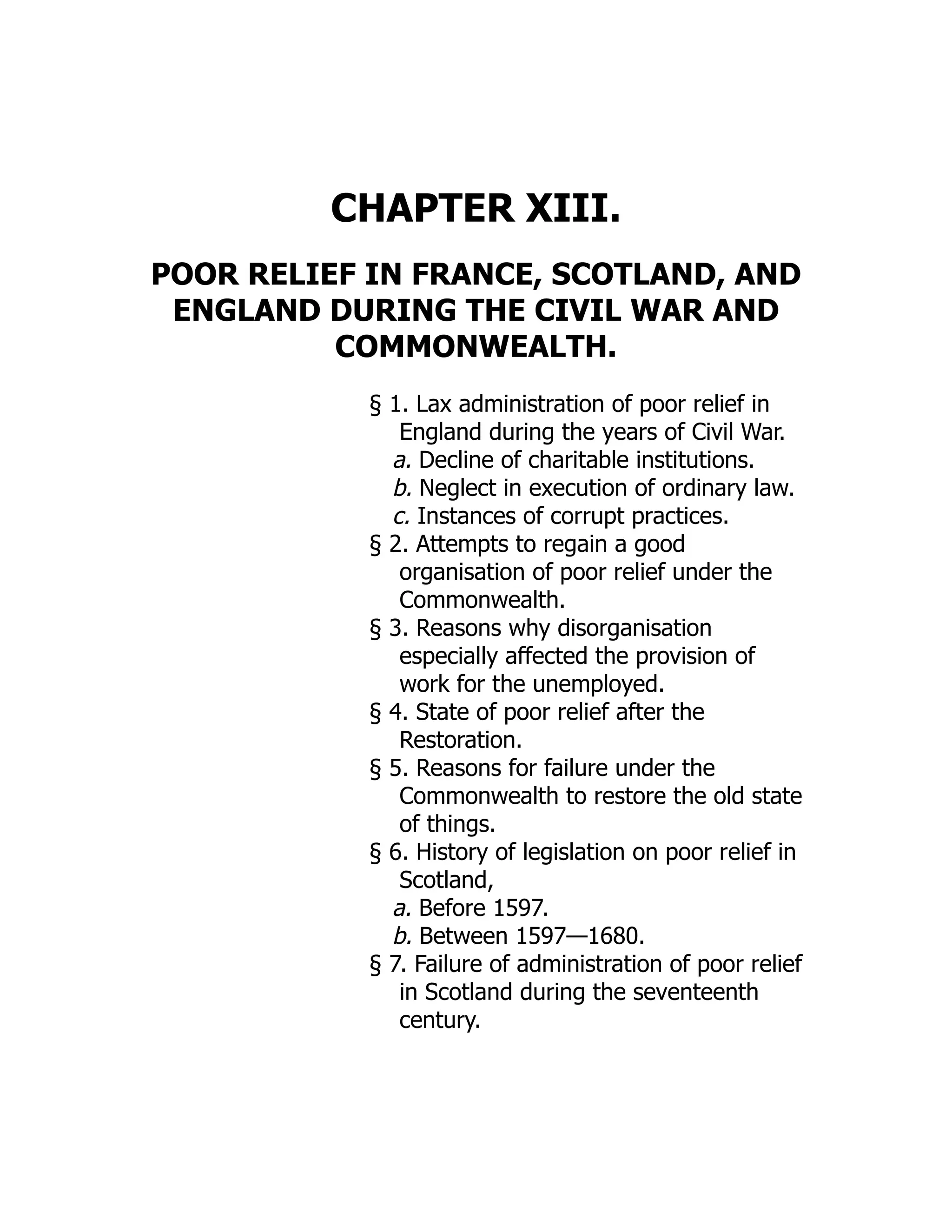
CHAPTER XIII.
POOR RELIEFIN FRANCE, SCOTLAND, AND
ENGLAND DURING THE CIVIL WAR AND
COMMONWEALTH.
§ 1. Lax administration of poor relief in
England during the years of Civil War.
a. Decline of charitable institutions.
b. Neglect in execution of ordinary law.
c. Instances of corrupt practices.
§ 2. Attempts to regain a good
organisation of poor relief under the
Commonwealth.
§ 3. Reasons why disorganisation
especially affected the provision of
work for the unemployed.
§ 4. State of poor relief after the
Restoration.
§ 5. Reasons for failure under the
Commonwealth to restore the old state
of things.
§ 6. History of legislation on poor relief in
Scotland,
a. Before 1597.
b. Between 1597—1680.
§ 7. Failure of administration of poor relief
in Scotland during the seventeenth
century.
40.
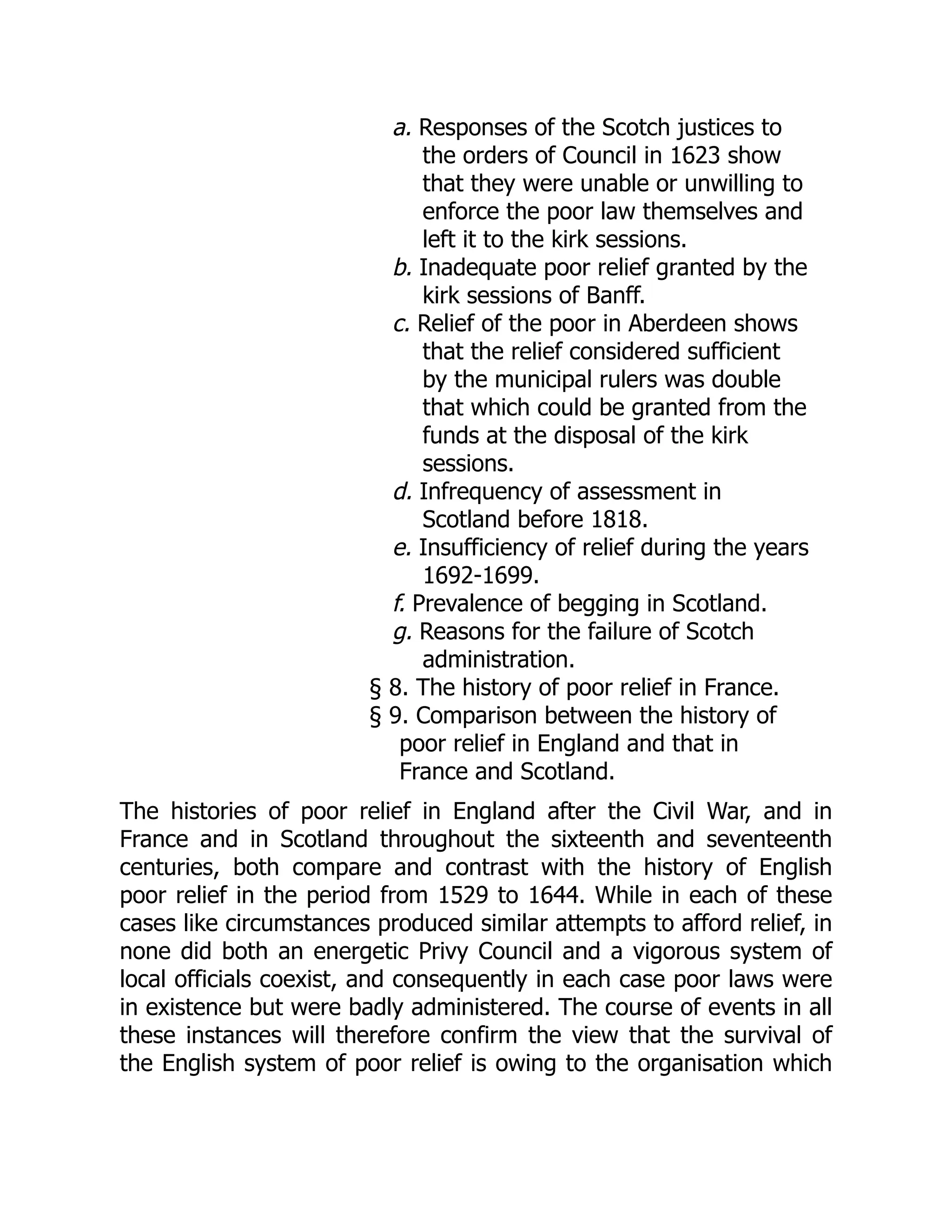
a. Responses ofthe Scotch justices to
the orders of Council in 1623 show
that they were unable or unwilling to
enforce the poor law themselves and
left it to the kirk sessions.
b. Inadequate poor relief granted by the
kirk sessions of Banff.
c. Relief of the poor in Aberdeen shows
that the relief considered sufficient
by the municipal rulers was double
that which could be granted from the
funds at the disposal of the kirk
sessions.
d. Infrequency of assessment in
Scotland before 1818.
e. Insufficiency of relief during the years
1692-1699.
f. Prevalence of begging in Scotland.
g. Reasons for the failure of Scotch
administration.
§ 8. The history of poor relief in France.
§ 9. Comparison between the history of
poor relief in England and that in
France and Scotland.
The histories of poor relief in England after the Civil War, and in
France and in Scotland throughout the sixteenth and seventeenth
centuries, both compare and contrast with the history of English
poor relief in the period from 1529 to 1644. While in each of these
cases like circumstances produced similar attempts to afford relief, in
none did both an energetic Privy Council and a vigorous system of
local officials coexist, and consequently in each case poor laws were
in existence but were badly administered. The course of events in all
these instances will therefore confirm the view that the survival of
the English system of poor relief is owing to the organisation which
41.
Welcome to ourwebsite – the perfect destination for book lovers and
knowledge seekers. We believe that every book holds a new world,
offering opportunities for learning, discovery, and personal growth.
That’s why we are dedicated to bringing you a diverse collection of
books, ranging from classic literature and specialized publications to
self-development guides and children's books.
More than just a book-buying platform, we strive to be a bridge
connecting you with timeless cultural and intellectual values. With an
elegant, user-friendly interface and a smart search system, you can
quickly find the books that best suit your interests. Additionally,
our special promotions and home delivery services help you save time
and fully enjoy the joy of reading.
Join us on a journey of knowledge exploration, passion nurturing, and
personal growth every day!
testbankbell.com








![This pamphlet was not published until 1646 but seems to have been
composed about the year 1606[579]. The writer is a converted
highwayman who is anxious for the reformation of his fellow-sinners.
He states "that Beggerie and Theeverie did never more abound,"
and he complains that the branding and whipping parts of the
statutes are put in execution long before any place is provided
where the poor could have work. He thought that this was most
unfair to the vagrants for many of them would work if they could
and go voluntarily to workhouses if they were in existence. He
therefore urges the establishment of places where men could have
work in all the larger parishes of the kingdom[580].
Another pamphlet complaining of the bad execution of the law was
entitled "Greevous Grones for the Poore" and was published in 1622.
The writer of this states that "though the number of the Poore do
dailie increase all things worketh for the worst in their behalfe. For
there hath beene no collection for them, no not these seven yeares
in many parishes of this land especiallie in countrie townes; but
many of those parishes turneth forth their Poore, yea and their lustie
labourers that will not worke or for any misdemeenor want worke, to
begge, filtch, and steale, for their maintenance so that the country is
pittifully pestered with them[581]."
Another document of 1624 gives precisely the same information.
This is a letter from a Mr Williamson to Sir Julius Caesar, the Master
of the Rolls, who was one of the most charitably disposed gentlemen
of the time. The writer thinks the neglect of the overseers to
apprentice children is the true cause of vagrancy. He tells us that the
seventeenth century vagrant like the modern tramp was very seldom
a man who knew a trade[582]. The existence of these untrained men
was due to the fault of the administrators of the Poor Law. For these
"intollerable offences haue originally growen from the Ou(er)seers of
the poore who heretofore and att this day haue and doe so
ou(er)see as though they did not see at all[583]."
These writings would therefore lead us to believe that justices soon
grew careless; the poor were not relieved and in many places there](https://image.slidesharecdn.com/14682-250314224553-bbd3d30d/75/Solution-Manual-for-Auditing-and-Assurance-Services-17th-by-Arens-21-2048.jpg)
![was very little execution of the law at all. All these statements are
made by writers who are vigorously supporting only one side of the
case but the official evidence of the period confirms their view of the
matter. The reasons given for the appointment of the commission
suggested in 1619/20 show that the unofficial writers had not
exaggerated the existing neglect in the administration of the poor
laws. Good laws have been made but they are not executed because
the justices are negligent and the judges of Assize have not time to
fully investigate the matter. The laws in consequence "are in many
partes of our Realme laid aside or little regarded as lawes not in
force or of small consequence, whereas in some other counties and
partes of this kingdome in wch
by the diligence and industrye of
sume justices of the peace and other magistrates the said lawes
haue bine dulye putt in execucon there hath evidentlye appeared
much good and benefitt to haue redowned to the Comon welth by
the same[584]." At this time therefore there was a real likelihood that
the poor law would become obsolete.
However the season of scarcity in 1622-3 was accompanied by a
crisis in the cloth trade and the Privy Council was active in enforcing
measures of relief. A great improvement was consequently then
effected in the execution of temporary measures of corn relief, and
some reports indicate that this was accompanied by a better
administration of the ordinary poor law also.
Thus from Burnham in Buckinghamshire the justices report, "We
have alsoe looked into and have caused the poore to bee well
provided for in every parrish within this diuision both by stocks to
sett them on worke as alsoe by weekely contributions[585]." From
several of the hundreds of Suffolk there are similar reports. Thus in
every "towne" of Lackford and Exning the rates had been
augmented and the "poorer sorte of people within the seurall townes
and places are ordered to be sett on worke[586]." From other
districts in both East and West we have like accounts[587].
Between the years 1605 and 1629 therefore the administration of
poor relief was on the whole negligent and in many districts the poor](https://image.slidesharecdn.com/14682-250314224553-bbd3d30d/75/Solution-Manual-for-Auditing-and-Assurance-Services-17th-by-Arens-22-2048.jpg)
![6. Action of the
Privy Council and
administration
between 1629 and
1644.
6. a. State of affairs
in 1631.
law was already considered to be of little importance. The
government was however still anxious to secure its enforcement and
the measures taken to relieve distress in 1622-3 effected an
improvement in a few districts.
But from 1629 to 1644 we have a different state
of things. We know already that during this period
the action of the Privy Council was continuous and
constant, and it is in this period therefore that we
shall be able to see how far it was effective. The
justices' reports, to which we have already often referred are the
main sources of our information.
We will endeavour to see how far the evidence of the early part of
the period confirms the view we have already formed as to the
administration of the law at the beginning of the time, and we will
secondly try to estimate the evidence as to improvement during this
period.
The condition of affairs before 1631 is indicated by
the preamble to the commission of Jan. 1631/2
and by some of the earlier reports of 1631. The
reasons given for the appointment of the commission of 1631/2 are
almost exactly the same as those given in the draft of 1619/20. The
justices are said as before to be negligent so that the laws were
almost obsolete in some parts of the country, and this alone shows
that there had been little permanent improvement since 1620. The
preamble also refers to an earlier time "vpon the present making of
the said lawes," when they were duly executed and thus confirms
the evidence as to the good execution of the laws after 1597[588].
The justices' reports of 1631 give us more detailed information of
the same kind. One of these was sent from three of the hundreds of
Hampshire, Fawley, Bountisborough and Mainsborough. The justices
say that they sent an abstract of the act to the officials concerned
and ordered constables, tithingmen, and overseers to bring
presentments to them. But they "for the most parte" replied, "that
they haue noe poore that wanted worke or releife, that they had noe](https://image.slidesharecdn.com/14682-250314224553-bbd3d30d/75/Solution-Manual-for-Auditing-and-Assurance-Services-17th-by-Arens-23-2048.jpg)
![rogues but suche as were punished." The justices thought this state
of things too good to be true; they made further enquiries and found
that the highways were out of repair, that no monthly meetings had
been held by the overseers and that there were no stocks for setting
the poor to work. They also heard that some of the poor were "in
noe small want" but did not complain because of ignorance or fear.
They hoped to effect improvement by exacting fines for negligence,
by publishing the particulars of their monthly meetings, and by
sending a series of definite questions to the overseers as to the
names of the poor relieved or set to work and of the children over
ten years of age who were not bound apprentice[589]. In this way
they tried to obtain detailed statements so that there could be no
evasion of the law. There is a later report from Fawley concerning
corn and apprentices, and the part of the law relating to apprentices
was certainly then carried out[590].
But there are other districts in which the justices do not tell us of
negligent officials, but rather seem proud of their vigour and yet
seem to imply that it was only recently the law had come into force.
This is particularly the case in Radnorshire and Cheshire. In two
divisions of Radnor the justices say they have appointed overseers,
and have given particular directions as to the provision of stocks and
return of the names of the poor relieved[591]. The reports suggest
that the justices were now energetic, but that little had been done
before; the mention of the appointment of overseers is
unaccompanied by the word new or by any statement as to the
rendering of the accounts of the old overseers, so that it is possible
that these were the first overseers appointed in that district.
In two of the divisions of Cheshire the same state of things is
implied more definitely. The justices say that they have ordered the
collection of a stock for the setting the poor to work and for the
relief of the impotent, but they find the people poor and averse to
paying money for any purpose of the kind. They fear some time will
elapse before these orders can be properly executed. At present
these divisions have not got a House of Correction, and the justices
wish to have one in the Castle in order that they may be able to](https://image.slidesharecdn.com/14682-250314224553-bbd3d30d/75/Solution-Manual-for-Auditing-and-Assurance-Services-17th-by-Arens-24-2048.jpg)
![6. b. Improvement
effected in 1631
and 1632.
subdue the people to subjection[592]. These reports seem to reveal a
very primitive state of things, and recall the difficulties in the West
Riding of Yorkshire in 1597, when poor relief seems to have been
first enforced there, and the people greatly objected to the
imposition of rates.
Other reports show that the Book of Orders strengthened the hands
of reformers; thus in the town of Wells, charities had been
negligently administered, but after the issue of the orders the
Recorder was able to procure information formerly withheld, and
hoped to effect farther improvement by obtaining a commission of
charitable uses[593].
It is thus fairly clear that before 1631 the law had not been well
administered. We will now examine the evidence as to the
improvement between 1631 and 1640.
The greater number of the reports of 1631 and
1632 point to some execution of the law before
1631 and suggest improvement rather than entire
innovation. The justices generally state they have "raised rates" or
have bound many more children apprentices or that stocks had been
provided in the parishes where there were none before. Two reports
enable us to trace the process of improvement in detail, and seem to
throw considerable light on the general statements of other
documents of the kind. They do not however present so favourable a
view as to the execution of the law as most of the other returns.
These reports relate to the district of Braughing in Hertfordshire. The
overseers of thirteen places in the half hundred of Braughing made
returns to the justices at six successive monthly meetings held in
accordance with the provisions of the Book of Orders, between Feb.
7th and June 27, 1631. Abstracts of these returns were sent in by
the justices in two documents, one of which was forwarded in April
and the other in July 1631[594]. We can thus see exactly when the
improvement was effected. At the first meeting four parishes
provided corn at reduced rates for the poor. The Book of Orders
relating to scarcity had been issued since September, and we should](https://image.slidesharecdn.com/14682-250314224553-bbd3d30d/75/Solution-Manual-for-Auditing-and-Assurance-Services-17th-by-Arens-25-2048.jpg)
![6. c. Improvement
maintained between
1631 and 1640.
ympotent and such as are able to sett them to worke, and haue
alreadie placed many poore children apprentizes and doe proceede
in placinge of more[595]."
In the returns sent later in the year the organisation appears to be
more settled and we hear that not only the rates are raised but that
they have had a good effect. Thus in Monslow in Shropshire the
justices state "and as for the late booke of orders for the reliefe of
the poore and the punishing of rogues and vagabonds wee have had
severalle monthlye meetings in the said hundred and wee have long
since worked such effect thereby as they have not any rogues or
vagabonds appeared amongst vs or walked abroade as wee can
heare of since our first meetings, and the impotent poore are
relieved in such sort by their parishoners as wee have noe
complaints and there are stocks in all parishes more or lesse as the
charge of the parishes require to set the able poore on worke[596]."
Not all the reports are as favourable as this, but on the whole they
indicate that improved order followed the execution of the Book of
Orders. It thus is clear that the Orders of 1631 had a very
considerable immediate effect both in bringing the law into operation
in places where it had been almost or altogether neglected and still
more in improving the administration in those districts in which the
system was already to some extent administered though not yet
effectually.
We have now to see whether this improved
administration was maintained. The reports are
certainly less frequent after 1631 but those that
remain shew that the efficiency is preserved and there is much to
indicate a farther improvement.
We will first examine a few documents which seem to indicate that
the area of administration was extending into backward districts, we
will then investigate a few cases in which we have reports both in
1631 and in 1638 or 1639, and we will lastly consider a special
department of the poor law system, namely the placing of
apprentices.](https://image.slidesharecdn.com/14682-250314224553-bbd3d30d/75/Solution-Manual-for-Auditing-and-Assurance-Services-17th-by-Arens-27-2048.jpg)
![We have already noted the fact that in the earlier years of the period
there were few reports from Westmoreland and Lancashire.
But in 1638 there are a series of documents from Westmoreland[597]
and several reports from Lancashire. In 1638 some of the Lancashire
parishes adopted the system of billeting the poor in need of relief on
the richer inhabitants. This plan does not seem to have long
continued as an exclusive system of relief, and the facts that it was
still employed and that these are the earliest reports from
Westmoreland seem to indicate that a compulsory system of poor
relief had only lately been established in the northern counties.
Moreover in 1637 we are told that at the meeting of the justices in
Rochdale in Sept. 1637, the churchwardens of Middleton confessed
that they had never before levied a tax for the relief of the poor
there; they now however proceeded to levy one, and in March in the
following year the tax provided the necessary relief[598]. All this
seems to show that the area of the administration of the poor law
was extending and that in 1638 there was little danger of the system
of poor relief becoming obsolete but that it was obtaining a firmer
hold over the country.
We will now examine a few of the cases in which we have reports
from the same district both in 1631 and 1638 or 1639. We have
already noted the detailed returns from Braughing. It happens that
one of the latest documents of the series returned in August 1639
comes from the hundreds of Hertford and Braughing. The justices
tell us that our "ympotent poore are weekelie releiued by a certein
pencon and the rates increased as necessitie requires. And those of
able bodies are plentifullie stored with work for the maynteynance of
their families"; five apprentices had also lately been bound[599].
From this we see that the improved administration there lasted
throughout the period.
We have several other places from which we have similar reports.
Skenfreth, one of the hundreds of Monmouth, often sent accounts of
the proceedings of the justices. One belongs to May, 1631. The
justices state some of the things they did both before the](https://image.slidesharecdn.com/14682-250314224553-bbd3d30d/75/Solution-Manual-for-Auditing-and-Assurance-Services-17th-by-Arens-28-2048.jpg)
![Commission and afterwards. Before the Commission they provided
weekly stipends for all the aged and impotent people, "sithence the
said commission" they "have taken order that the same stipends
shalbe contineually paied soe that none of any such poore people
have made any complaint unto us for any mainetenance." Both
before and after the commission they had punished rogues and
since they had also placed apprentices and suppressed alehouses.
Moreover the highways had been last year in better condition than
for twenty years before[600].
Thus the immediate improvement effected by the commission was
that the pensions were paid as well as ordered, apprentices were
bound and alehouses suppressed.
In May, 1637, we have a report from the same district together with
the hundreds of Ragland and Trellech. At that time apprentices were
bound, rogues punished and efforts made to secure the observance
of fasting days. The justices have also "taken course for provision of
stock to sett the poore on worke," and have "caused to be
sufficiently relieved all the aged lame and ympotent people[601]."
Thus if these documents are to be believed the improvement
effected in 1631 was maintained and even increased in this hundred
of Skenfreth.
There are many other cases in which reports are sent in several
times from the same place and all show that the improvement made
in 1631 was continued in 1637, 1638 or 1639[602].
We will now examine a few of the reports which relate especially to
the placing of apprentices. Before May 1635 the Privy Council or the
commissioners seem to have urged the justices to see especially that
this part of the law was carried out, and to have asked them to
report the names of the apprentices and those of their masters[603].
The reports sent in 1634 and 1635 therefore relate especially to the
placing of apprentices and the monthly meetings of the justices.
Reports from twenty-one places were sent in between July 17th and
July 31st, 1634. In almost every case the justices expressly state](https://image.slidesharecdn.com/14682-250314224553-bbd3d30d/75/Solution-Manual-for-Auditing-and-Assurance-Services-17th-by-Arens-29-2048.jpg)
![that they hold monthly meetings and bind poor children
apprentice[604]. In the year 1635 the statements are more detailed.
Between May 20th and May 30th replies were sent from ten places
in eight of which the names of both apprentices and masters were
given[605]. Sometimes these were numerous; thus at Blandford in
Dorset one hundred and nineteen apprentices were bound in the
course of two years[606]; in one district of Somerset the names of
one hundred and sixty-six are returned[607], while in all ten districts
a fair amount of work was done. Thus in 1634 and 1635
apprenticeship was more insisted upon than other methods of poor
relief and it seems to have been very generally well administered.
We hear of some complaints but not many in proportion to the
number of reports.
We thus see that during the years 1630 to 1639 we have a large
amount of information concerning the administration of the Poor
Law. We find that a great improvement was effected in 1631. We
also find that the area of administration continued to extend into the
Northern counties after 1631: the difference is indicated by the fact
that in 1638 it is exceptional to find a place without a poor rate,
whereas in 1631 the Government spoke of the laws as being almost
obsolete in many places. We see further that sometimes the later
reports come from the same places as the earlier, and that then the
administration continues to be reported as good. Lastly, in regard to
apprentices we are told that the Privy Council made special efforts to
enforce the law, and that all over the country there is evidence that
it was enforced though occasionally without favourable results.
There is thus reason to believe that the efforts made by the central
government to enforce the law were at last successful, and that the
period to which we owe the survival of our English system of poor
relief is that of the personal government of Charles I.
But we have already noticed that not only is this period the critical
time in the history of the poor relief that survived, but in one respect
the poor relief of this period was unique. Many efforts were made to
find work for the unemployed. Relief of this kind was so much a part](https://image.slidesharecdn.com/14682-250314224553-bbd3d30d/75/Solution-Manual-for-Auditing-and-Assurance-Services-17th-by-Arens-30-2048.jpg)
![7. The improvement
effected in 1631
especially
concerned the
unemployed.
of the general system of the time that we have already examined
many instances in which it was administered.
We will first investigate a few more of the reports of 1631, and we
shall find that the improvement effected in all parts of the
administration of poor relief especially concerned the relief of the
ablebodied; we will then examine a detailed report in order to see
what light it throws on the interpretation of the general statements
of other justices, and we will lastly try to find out if relief of this kind
was confined to a few districts, or was administered all over the
country, and also in what parts of the country there was the greatest
need of employment.
To begin with cases in which improvement was
reported in April 1631. From a large district of
Hertfordshire we hear "we haue already raysed a
stocke in some parishes, and are raysing stocks
for the rest to sett all the poore on worke in this
division[608]." In Essex, Richmond, Bedford and Beverley fresh taxes
for this purpose had just been raised, and at Agbrigg they were still
"setlinge such a course for raysinge of stocke to sett ye
people of
able bodies on work[609]."
At Winchester the same thing is implied: the stock has been put in a
clothier's hands, so that now the poor do not want work[610].
Twenty-eight reports relating not only to measures for corn, but also
for the poor were sent in between April 21st and April 30th 1631. In
seventeen of these the poor were set to work, and in many cases we
can see that the measures have been taken since the receipt of the
Book of Orders of January 1631/2[611].
In the answers sent in May we have the same kind of information. In
Brixton and Wallington we have a report similar to that from
Hertfordshire; "stockes of mony," we are told, "are raised in moste of
the parishes wth
in the said hundrede and burrow and the reste not
yet raised are wth
as much expedicon as may bee to bee raised for
buyinge of flax, hempe and other materialls to set the poore to](https://image.slidesharecdn.com/14682-250314224553-bbd3d30d/75/Solution-Manual-for-Auditing-and-Assurance-Services-17th-by-Arens-31-2048.jpg)
![8. The detailed
report from
Bassetlaw throws
light upon the more
general statements
of the justices.
worke[612]." From Arundel there is a like account, "we haue caused
the taxations for the releefe of the poor to be raised in euery parish
in this time of scarsitye, and haue likewise caused stocks of mony to
be raised in euery parish to buy materialls to sett the poor a warke,
and we haue caused the Statute of Laborors to be inquired after and
to be putt in execution[613]."
We can thus see that in 1631 the justices were busy raising stocks to
provide work for the poor, and that in seventeen documents, or
more than half of the reports of the last ten days of April 1631, we
are informed that measures had been taken with this object.
We will now examine a more detailed report
relating to sixty parishes of Bassetlaw in County
Nottingham and sent in during March 1636/7[614].
In most cases information is given under four
headings, first we are told how many of the
impotent poor are relieved, secondly the amount
of the town stock, thirdly how many rogues have been punished,
and lastly how many apprentices have been bound. This document is
important because it seems to indicate the number of parochial
officials who provided work for the unemployed in the district of
Bassetlaw. This is not directly stated in the report, but the overseers
return the amount of the town stock of their parish whenever a town
stock existed. From the method in which the return is made it seems
that this town stock was always used for finding employment for the
able-bodied poor[615]. Other methods of dealing with those out of
work are also noted, so that it appears that in forty-five out of sixty
parishes the parochial authorities provided employment for those
poor who could work. The amount of the stock was often quite
small; in one case only sixteen shillings, but it is very possible that in
this instance the parish also was small; in another place the stock
consisted of a sum of about thirty pounds, and the average amount
was about three pounds. This document from Bassetlaw only states
in detail what many of the other reports imply, but the detail is much
more convincing, and it is confirmed by the overseers' accounts from
Barnet and Elstree which we have already examined[616]. It is](https://image.slidesharecdn.com/14682-250314224553-bbd3d30d/75/Solution-Manual-for-Auditing-and-Assurance-Services-17th-by-Arens-32-2048.jpg)
![9. Local variations
in the provision for
the unemployed.
a. Not so extensive
in the parts North of
the Humber and in
the extreme West.
9 b. Provision of
work more
necessary in the
towns than in the
country.
perhaps worth while to notice that as early as 1623 the justices
wrote from Bassetlaw that work for the poor was wanting, and they
even then ordered that the labourers should be set to work by the
town's stock and the impotent relieved by the public
contribution[617].
We have now to try to find out if
it was only in a few counties
that work was found for the
unemployed, or if it was all over England. We have
already noted that in the counties north of the Humber, and in the
three western counties of Devonshire, Cornwall, and Wiltshire the
poor law was apparently less well administered than in other parts of
the country. In these counties with the exception of Yorkshire
therefore there are few instances in which stocks are found for
providing work for the unemployed. We hear however that in
Ashton-under-Line there existed a "small stocke of money which is
disposed on for the setting of poore to worke[618]". Moreover, in two
Yorkshire reports of 1635 it is stated that the justices have been
"verie carefull to raise stockes for setting our
poore on worke[619]."
There are other Yorkshire returns containing information of the same
kind, but still the plan of finding work for the unemployed of the
North seems to be comparatively unusual.[620]
But with regard to the rest of England this is not the case. In every
county except Northampton some justices state that they have
found employment for the poor. As we might expect this was done
most frequently in the towns and in the manufacturing counties,
both because in these places there were more rich people and
because there were also more unemployed owing to the greater
fluctuations of trade.
A report from Reading and Theale illustrates this:
"Wee finde that the able poore in boddy to worke
and wch
are in country villages and hambletts
haue theire ymploymt in husbondrie and by that
meanes are mayntayned; other lyen in such](https://image.slidesharecdn.com/14682-250314224553-bbd3d30d/75/Solution-Manual-for-Auditing-and-Assurance-Services-17th-by-Arens-33-2048.jpg)
![countrie townes, populer, incorporate, where heretofore multitudes
of such able persons haue lived by worke from the clothier, now
through the defect and decaye of that trade and soe consequently of
the clothier, thousands of these poore formerlie relieved by worke
liue in much want and could hardlie subsist this deere yeare did not
many extend theire charity even beyond their meanes[621]."
Newbury and Abingdon were also towns in the same neighbourhood
subject to similar conditions, and we know already that workhouses
were founded in both these places and in Reading itself also[622].
Shrewsbury and Hereford are fair examples of more westernly
towns. At Shrewsbury the justices report in June 1631 that they "are
aboute a course to sett all the poore on worke within our Towne and
Libertyes[623]," and in 1638 an order was made for regulating a
workhouse there[624]. About the same time the Mayor of Hereford
records that "there is a colleccon made in euerie severall parish wth
in
the said Cyttie, and competent somes raysed for to releive the
impotent and needy, and a stocke for the setting of poore able
people to worke and for the placeing of youth apprentices[625]."
Other magistrates report in like manner: thus in the rape of Hastings
they have caused the officers "as much as in them lyeth to see the
said poore inhabitants bee duely kept to worke and haue fitting
materialls provided for them[626]." In the hundred of Hertford the
justices state in 1631 that the more populous places have already
raised stocks of money to set the poor to work, and that they are
still trying to induce all the others to do so though a few are not rich
enough to bear the necessary taxation[627]. From St Albans, Reigate,
Ipswich, Maidstone, Lynn, and Norwich, as well as from more inland
towns we have similar information: the magistrates of Bedford write
that "we haue raysed divers extraordenary taxes for the reliefe of
our poore and settinge them on worke and therby they are set to
worke[628]." But perhaps the Buckingham report indicates the most
thorough organisation. There the poor had been visited apparently
in the same way as at Norwich. Five hundred people were examined;
the age and occupation of each were noted, and whether they had
work or not. Afterwards employment was provided for those who](https://image.slidesharecdn.com/14682-250314224553-bbd3d30d/75/Solution-Manual-for-Auditing-and-Assurance-Services-17th-by-Arens-34-2048.jpg)
![(d) Provision of
work in many
districts in most
counties of the
east.
needed it and we are told that the poor "of good disposicon are glad
they are thus settled wth
out begging and settle themselves seriouslie
to their labor
." This good result however was not obtained without
complaints from the ratepayers[629].
In the country districts also employment seems to have been
provided as well as in the towns whenever the poor suffered much
from the want of work. In the western counties, however, there were
few complaints of lack of employment, except from the cloth-
workers when the trade in cloth was slack. Some justices expressly
state that there is no want of work in their part of the country. Thus
from a large district of Somerset we hear that there are "none lefte
unplaced but such as doe mainetaine their charge by their
labor[630]." Therefore, as we should expect, in many reports from
the West nothing is said about finding employment for the able-
bodied poor. There are, however, also a fair number of cases in
which work is said to be provided. This is especially the case in the
counties of Shropshire and Stafford; thus from Staffordshire three
reports were sent in 1634, and in all three we are told that the poor
were set to work[631]. Moreover, the Worcester justices write that
"wee are carefull ... that the able poore bee well provided of
worke[632]" and in almost all[633] the other western counties, at
least one instance of the kind is reported[634].
But in the east and south-east there was at any
rate sometimes a chronic want of employment,
and consequently numerous efforts to provide for
the able-bodied poor. In the country round
Hitchen we are told, as in the Reading district,
that it is the poor in the town that are distressed, but in the hamlets
the farmers find work for the inhabitants. The justices say they have
no manufacture, and they do not know how to find a remedy for the
people in the town. At one time they make the richer people employ
the poor, but they do not find the experiment successful[635]. We
have also an account of a permanent want of employment in a large
district of Norfolk. In the hundreds of South Greenhoe, Wayland, and](https://image.slidesharecdn.com/14682-250314224553-bbd3d30d/75/Solution-Manual-for-Auditing-and-Assurance-Services-17th-by-Arens-35-2048.jpg)
![10. Summary.
Grimshoe provision had been made by raising a stock to set the
able-bodied poor to work, and besides the magistrates write, "Wee
have manie young people wch
live out of service by reason of the
multitude of them, there not being services for them, but worke is
provided for them in their seuerall parishes[636]."
There are very many reports of stocks for the provision of work in
other country districts of the east. In Hertfordshire, Suffolk, Norfolk,
and Cambridge there is much to make us think the system was
nearly general[637], and in each of the other eastern counties there
are many cases of the kind.
In a district of Middlesex the unemployed were sent to fight for
Gustavus Adolphus[638], but in most parishes materials were
provided for them to work up. Thus in several hundreds in Kent
"stocks of materialls" were provided in every parish[639]; in
Nottinghamshire those out of service and able to work were set to
work "on the towne stock[640]," while at Horncastle sessions, in
Lincolnshire, the justices take "special care ... that the abler sort bee
constantly sett on worke by the stocke of the parishe[641]."
Sometimes the sum expended was very considerable if we take into
account the great difference in the value of money. Thus in
Wallington, Surrey, more than £120 was used for providing work,
while nearly fifty pounds remained in hand[642]. On the whole
therefore in the eastern counties, between 1631 and 1640, it seems
that considerable sums of money were raised and employed in most
districts[643] with the object of setting to work the able-bodied poor.
We have thus seen that in 1631 the improvement
in the administration of poor relief concerned
especially the relief of the able-bodied poor, and we have noted
many instances in which taxes were raised for this purpose at that
time. We have also examined a detailed report from a particular
district in the county of Nottingham in which in forty-five out of sixty
parishes some provision seems to have been made for finding
employment for the poor. Moreover, we find that the plan of
providing work for the unemployed was reported from some district](https://image.slidesharecdn.com/14682-250314224553-bbd3d30d/75/Solution-Manual-for-Auditing-and-Assurance-Services-17th-by-Arens-36-2048.jpg)