Effect of Solow Variable
to the Economic Growth
in Southeast Asia
Solow-Swan Model
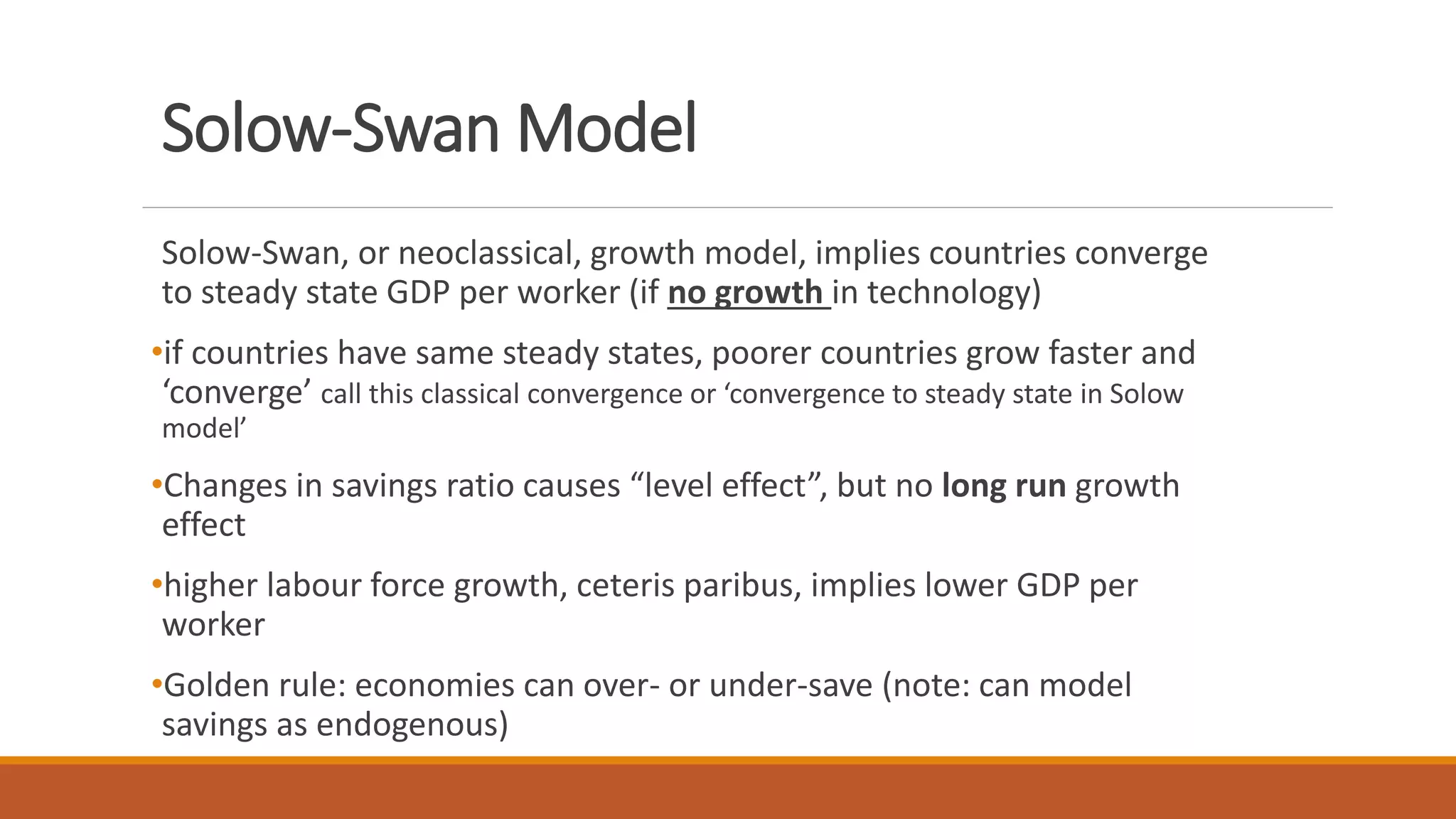
Solow-Swan, or neoclassical, growth model, implies countries converge
to steady state GDP per worker (if no growth in technology)
•if countries have same steady states, poorer countries grow faster and
‘converge’ call this classical convergence or ‘convergence to steady state in Solow
model’
•Changes in savings ratio causes “level effect”, but no long run growth
effect
•higher labour force growth, ceteris paribus, implies lower GDP per
worker
•Golden rule: economies can over- or under-save (note: can model
savings as endogenous)
Equation Representation
Y = A f (L,K,H,N)
where
-f ( ) the function that shows how the inputs are combined to produce output
-A is a variable that indicates the availability of production technology
-L is the amount of labor
-K is the amount of physical capital
-H is the amount of human capital
-N is the number of natural resources
Growth and Development of the
Indonesian Economy
• Indonesia is the world’s fourth most populous nation and 10th largest economy in terms
of purchasing power parity.
•Indonesia’s economic planning follows a 20-year development plan, spanning from 2005
to 2025 segmented into 5-year medium-term development plans called the RPJMN
(Rencana Pembangunan Jangka Menengah Nasional), each with different development
priorities
•The current medium-term development plan is the last phase of the 20-year plan. It aims
to further strengthen Indonesia’s economy by improving the country’s human capital and
competitiveness in the global market.
In recent years, Indonesia has seen consistently strong domestic demand growth
despite the large shocks to external demand associated with the global
economic downturn
This resilience of domestic demand to external influences sets Indonesia apart
from its ASEAN peers; with over the past 10 years the correlation between
domestic final demand and exports was considerably lower in Indonesia than in
Malaysia, Thailand and the Philippines.
Domestic Demand
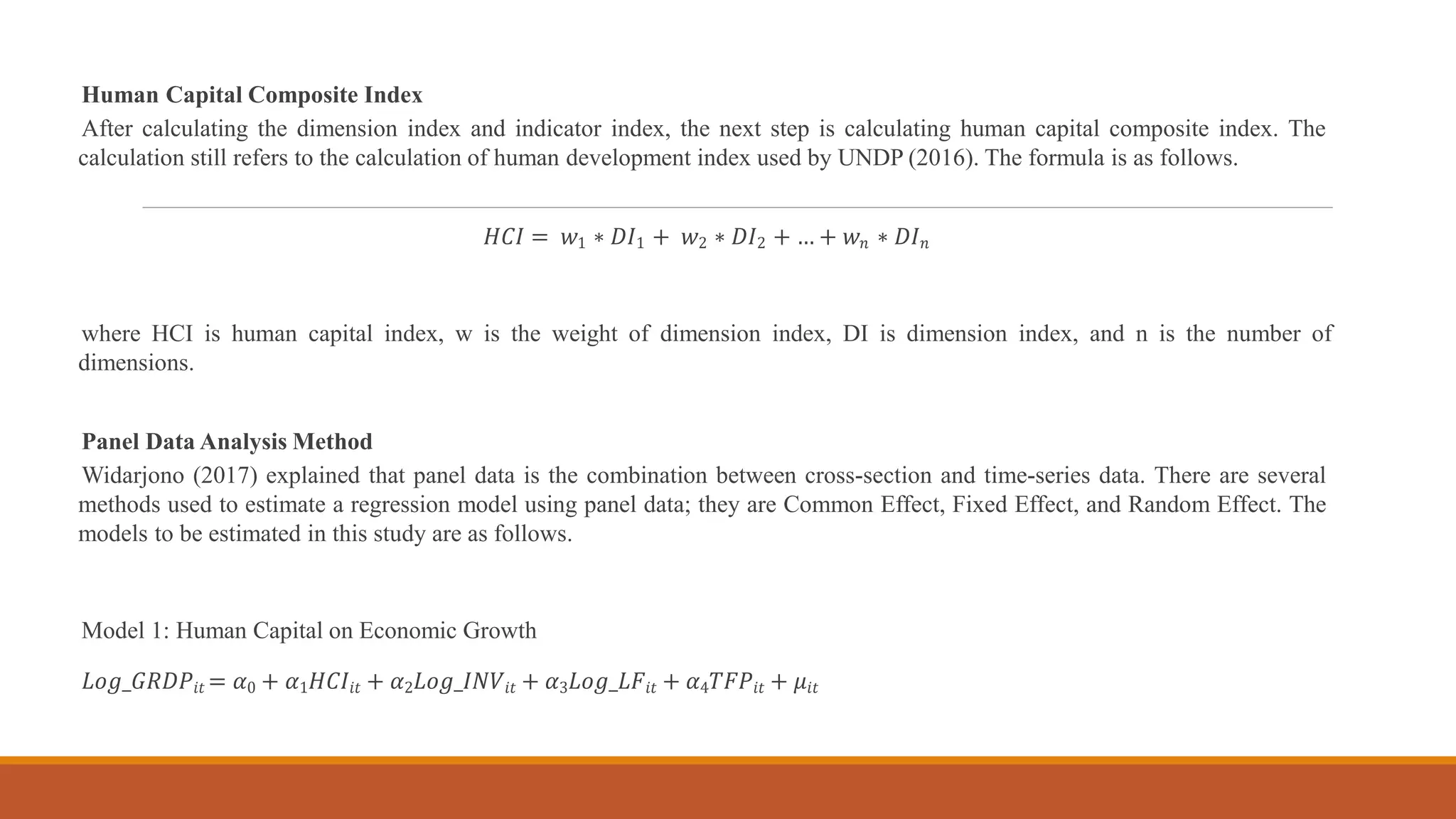
Human Capital Composite Index
After calculating the dimension index and indicator index, the next step is calculating human capital composite index. The
calculation still refers to the calculation of human development index used by UNDP (2016). The formula is as follows.
𝐻𝐶𝐼 = 𝑤1 ∗ 𝐷𝐼1 + 𝑤2 ∗ 𝐷𝐼2 + … + 𝑤𝑛 ∗ 𝐷𝐼𝑛
where HCI is human capital index, w is the weight of dimension index, DI is dimension index, and n is the number of
dimensions.
Panel Data Analysis Method
Widarjono (2017) explained that panel data is the combination between cross-section and time-series data. There are several
methods used to estimate a regression model using panel data; they are Common Effect, Fixed Effect, and Random Effect. The
models to be estimated in this study are as follows.
Model 1: Human Capital on Economic Growth
𝐿𝑜𝑔_𝐺𝑅𝐷𝑃𝑖𝑡 = 𝛼0 + 𝛼1𝐻𝐶𝐼𝑖𝑡 + 𝛼2𝐿𝑜𝑔_𝐼𝑁𝑉𝑖𝑡 + 𝛼3𝐿𝑜𝑔_𝐿𝐹𝑖𝑡 + 𝛼4𝑇𝐹𝑃𝑖𝑡 + 𝜇𝑖𝑡
RESULTS
The results are the projection of GNP, population, technological progress, consumption,
savings and capital stock Indonesia for the period of 2011-2035, presented in Figure 3.
It can be seen that the output of the economy, consumption, investment and population
of Indonesia was respectively Rp.907,138 billion, Rp.340,938 billion, Rp.566,200 billion
and 151,9 million people in 1980.
It is respectively projected to be Rp.7,746,732 billion, Rp.3,778,170 billion, Rp.2,968,562
billion and 345,2 million people in 2035.
CONCLUSIONS
The designed model shows that in the future Indonesia’s economy will grow positively. This
growth is a long-run economic growth regardless economic shock.
The results of projection show that output, consumption,
investment and population will be, respectively,
Rp.7,746,732 billion, Rp.3,778,170 billion, Rp.2,968,562 billion and
345,2 million people in 2035.

Solow Model (Final PPT).pdf

  • 1.
    Effect of SolowVariable to the Economic Growth in Southeast Asia
  • 2.
    Solow-Swan Model Solow-Swan, orneoclassical, growth model, implies countries converge to steady state GDP per worker (if no growth in technology) •if countries have same steady states, poorer countries grow faster and ‘converge’ call this classical convergence or ‘convergence to steady state in Solow model’ •Changes in savings ratio causes “level effect”, but no long run growth effect •higher labour force growth, ceteris paribus, implies lower GDP per worker •Golden rule: economies can over- or under-save (note: can model savings as endogenous)
  • 3.
    Equation Representation Y =A f (L,K,H,N) where -f ( ) the function that shows how the inputs are combined to produce output -A is a variable that indicates the availability of production technology -L is the amount of labor -K is the amount of physical capital -H is the amount of human capital -N is the number of natural resources
  • 4.
    Growth and Developmentof the Indonesian Economy • Indonesia is the world’s fourth most populous nation and 10th largest economy in terms of purchasing power parity. •Indonesia’s economic planning follows a 20-year development plan, spanning from 2005 to 2025 segmented into 5-year medium-term development plans called the RPJMN (Rencana Pembangunan Jangka Menengah Nasional), each with different development priorities •The current medium-term development plan is the last phase of the 20-year plan. It aims to further strengthen Indonesia’s economy by improving the country’s human capital and competitiveness in the global market.
  • 5.
    In recent years,Indonesia has seen consistently strong domestic demand growth despite the large shocks to external demand associated with the global economic downturn This resilience of domestic demand to external influences sets Indonesia apart from its ASEAN peers; with over the past 10 years the correlation between domestic final demand and exports was considerably lower in Indonesia than in Malaysia, Thailand and the Philippines. Domestic Demand
  • 10.
    Human Capital CompositeIndex After calculating the dimension index and indicator index, the next step is calculating human capital composite index. The calculation still refers to the calculation of human development index used by UNDP (2016). The formula is as follows. 𝐻𝐶𝐼 = 𝑤1 ∗ 𝐷𝐼1 + 𝑤2 ∗ 𝐷𝐼2 + … + 𝑤𝑛 ∗ 𝐷𝐼𝑛 where HCI is human capital index, w is the weight of dimension index, DI is dimension index, and n is the number of dimensions. Panel Data Analysis Method Widarjono (2017) explained that panel data is the combination between cross-section and time-series data. There are several methods used to estimate a regression model using panel data; they are Common Effect, Fixed Effect, and Random Effect. The models to be estimated in this study are as follows. Model 1: Human Capital on Economic Growth 𝐿𝑜𝑔_𝐺𝑅𝐷𝑃𝑖𝑡 = 𝛼0 + 𝛼1𝐻𝐶𝐼𝑖𝑡 + 𝛼2𝐿𝑜𝑔_𝐼𝑁𝑉𝑖𝑡 + 𝛼3𝐿𝑜𝑔_𝐿𝐹𝑖𝑡 + 𝛼4𝑇𝐹𝑃𝑖𝑡 + 𝜇𝑖𝑡
  • 17.
    RESULTS The results arethe projection of GNP, population, technological progress, consumption, savings and capital stock Indonesia for the period of 2011-2035, presented in Figure 3. It can be seen that the output of the economy, consumption, investment and population of Indonesia was respectively Rp.907,138 billion, Rp.340,938 billion, Rp.566,200 billion and 151,9 million people in 1980. It is respectively projected to be Rp.7,746,732 billion, Rp.3,778,170 billion, Rp.2,968,562 billion and 345,2 million people in 2035.
  • 18.
    CONCLUSIONS The designed modelshows that in the future Indonesia’s economy will grow positively. This growth is a long-run economic growth regardless economic shock. The results of projection show that output, consumption, investment and population will be, respectively, Rp.7,746,732 billion, Rp.3,778,170 billion, Rp.2,968,562 billion and 345,2 million people in 2035.