ENERGI MATAHARI
• Merupakan energi dari pembakaran gas (Helium
& )
• Temperatur inti matahari mencapai 24 juta Kelvin
• Energi panas ditransmisikan dalam bentuk radiasi
• Intensitas radiasi matahari yang dapat
dimanfaatkan bergantung kepada :
– Obliquity : sudut yang dibentuk oleh permukaan
terhadap arah radiasi matahari
– Panjang lintasan massa udara yang dilalui
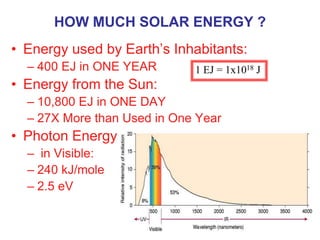
HOW MUCH SOLAR ENERGY ?
• Energy used by Earth’s Inhabitants:
– 400 EJ in ONE YEAR
• Energy from the Sun:
– 10,800 EJ in ONE DAY
– 27X More than Used in One Year
• Photon Energy
– in Visible:
– 240 kJ/mole
– 2.5 eV
1 EJ = 1x10¹⁸ J
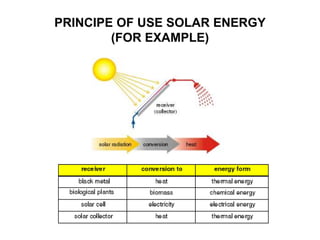
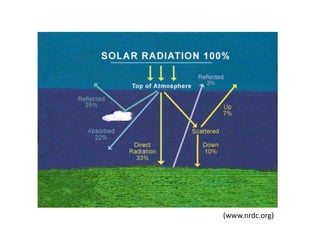
PRINCIPE OF USE SOLAR ENERGY
(FOR EXAMPLE)
(www.nrdc.org)
METODE PEMANFAATAN ENERGI
SURYA
• SOLAR THERMAL POWER PLANT
• SOLAR HEATING
• PHOTOVOLTAIC
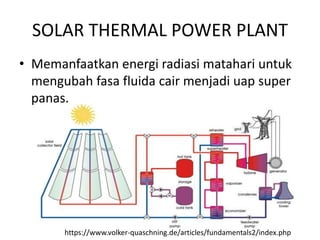
SOLAR THERMAL POWER PLANT
• Memanfaatkan energi radiasi matahari untuk
mengubah fasa fluida cair menjadi uap super
panas.
https://www.volker-quaschning.de/articles/fundamentals2/index.php
PARABOLIC THROUGH
• These troughs, also known as line focus collectors, are
composed of a long, parabolic shaped reflector that
concentrates incident sunlight on a pipe that runs down the
trough. The collectors sometimes utilize a single-axis Solar
tracking system to track the Sun across the sky as it moves
from east to west to ensure that there is always maximum
solar energy incident on the mirrors. The receiver pipe in the
center can reach temperatures upward of 400°C as the trough
focuses Sun at 30-100 times its normal intensity.[2]
• These troughs are lined up in rows on a solar field. A heat
transfer fluid is heated as it is run through the pipes in the
parabolic trough. This fluid then returns to heat exchangers at
a central location where the heat is transferred to water,
generating high-pressure superheated steam. This steam then
moves a turbine to power a generator and produce electricity.
The heat transfer fluid is then cooled and run back through
the solar field.[2]
PARABOLIC DISHES
• These are large parabolic dishes that
use motors to track the Sun. This ensures
that they always receive the highest
possible amount of incoming solar
radiation that they then concentrate at the
focal point of the dish. These dishes can
concentrate sunlight much better than
parabolic troughs and the fluid run through
them can reach temperatures upwards of
750°C.[2]
• In these systems, a Stirling engine coverts
heat to mechanical energy by compressing
working fluid when cold and allowing the
heated fluid to expand outward in a piston
or move through a turbine. A generator
then converts this mechanical energy to
electricity.[2]
SOLAR TOWERS
• Solar power towers are large towers that act as a central receiver for solar
energy. They stand in the middle of a large array of mirrors that all
concentrate sunlight on a point in the tower. These large number of flat,
sun tracking mirrors are known as heliostats. In the tower, there is a
mounted heat exchanger where the heat exchange fluid is warmed. The
heat concentrated to this point can be 1500 times as intense as incident
sunlight.[2] The hot fluid is then used to create steam to run a turbine and
generator, producing electricity. One drawback with these towers is they
must be very large to be economical.
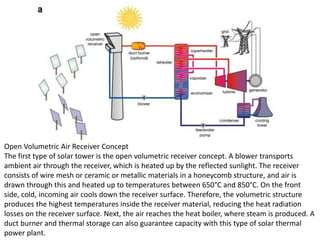
Open Volumetric Air Receiver Concept
The first type of solar tower is the open volumetric receiver concept. A blower transports
ambient air through the receiver, which is heated up by the reflected sunlight. The receiver
consists of wire mesh or ceramic or metallic materials in a honeycomb structure, and air is
drawn through this and heated up to temperatures between 650°C and 850°C. On the front
side, cold, incoming air cools down the receiver surface. Therefore, the volumetric structure
produces the highest temperatures inside the receiver material, reducing the heat radiation
losses on the receiver surface. Next, the air reaches the heat boiler, where steam is produced. A
duct burner and thermal storage can also guarantee capacity with this type of solar thermal
power plant.
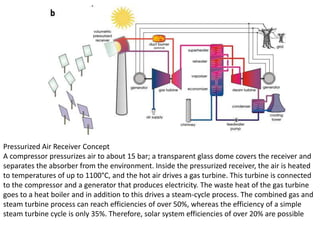
Pressurized Air Receiver Concept
A compressor pressurizes air to about 15 bar; a transparent glass dome covers the receiver and
separates the absorber from the environment. Inside the pressurized receiver, the air is heated
to temperatures of up to 1100°C, and the hot air drives a gas turbine. This turbine is connected
to the compressor and a generator that produces electricity. The waste heat of the gas turbine
goes to a heat boiler and in addition to this drives a steam-cycle process. The combined gas and
steam turbine process can reach efficiencies of over 50%, whereas the efficiency of a simple
steam turbine cycle is only 35%. Therefore, solar system efficiencies of over 20% are possible
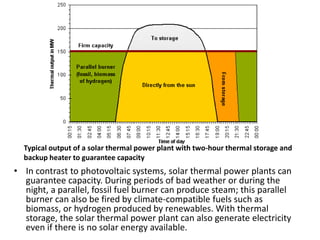
• In contrast to photovoltaic systems, solar thermal power plants can
guarantee capacity. During periods of bad weather or during the
night, a parallel, fossil fuel burner can produce steam; this parallel
burner can also be fired by climate-compatible fuels such as
biomass, or hydrogen produced by renewables. With thermal
storage, the solar thermal power plant can also generate electricity
even if there is no solar energy available.
Typical output of a solar thermal power plant with two-hour thermal storage and
backup heater to guarantee capacity
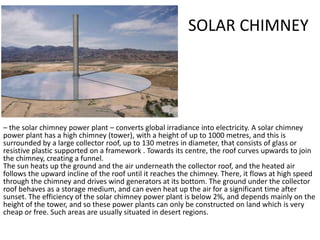
SOLAR CHIMNEY
– the solar chimney power plant – converts global irradiance into electricity. A solar chimney
power plant has a high chimney (tower), with a height of up to 1000 metres, and this is
surrounded by a large collector roof, up to 130 metres in diameter, that consists of glass or
resistive plastic supported on a framework . Towards its centre, the roof curves upwards to join
the chimney, creating a funnel.
The sun heats up the ground and the air underneath the collector roof, and the heated air
follows the upward incline of the roof until it reaches the chimney. There, it flows at high speed
through the chimney and drives wind generators at its bottom. The ground under the collector
roof behaves as a storage medium, and can even heat up the air for a significant time after
sunset. The efficiency of the solar chimney power plant is below 2%, and depends mainly on the
height of the tower, and so these power plants can only be constructed on land which is very
cheap or free. Such areas are usually situated in desert regions.

SOLAR ENERGY-solar thermal.pptx

  • 2.
    ENERGI MATAHARI • Merupakanenergi dari pembakaran gas (Helium & ) • Temperatur inti matahari mencapai 24 juta Kelvin • Energi panas ditransmisikan dalam bentuk radiasi • Intensitas radiasi matahari yang dapat dimanfaatkan bergantung kepada : – Obliquity : sudut yang dibentuk oleh permukaan terhadap arah radiasi matahari – Panjang lintasan massa udara yang dilalui
  • 3.
    HOW MUCH SOLARENERGY ? • Energy used by Earth’s Inhabitants: – 400 EJ in ONE YEAR • Energy from the Sun: – 10,800 EJ in ONE DAY – 27X More than Used in One Year • Photon Energy – in Visible: – 240 kJ/mole – 2.5 eV 1 EJ = 1x10¹⁸ J
  • 4.
    PRINCIPE OF USESOLAR ENERGY (FOR EXAMPLE)
  • 5.
  • 6.
    METODE PEMANFAATAN ENERGI SURYA •SOLAR THERMAL POWER PLANT • SOLAR HEATING • PHOTOVOLTAIC
  • 7.
    SOLAR THERMAL POWERPLANT • Memanfaatkan energi radiasi matahari untuk mengubah fasa fluida cair menjadi uap super panas. https://www.volker-quaschning.de/articles/fundamentals2/index.php
  • 8.
    PARABOLIC THROUGH • Thesetroughs, also known as line focus collectors, are composed of a long, parabolic shaped reflector that concentrates incident sunlight on a pipe that runs down the trough. The collectors sometimes utilize a single-axis Solar tracking system to track the Sun across the sky as it moves from east to west to ensure that there is always maximum solar energy incident on the mirrors. The receiver pipe in the center can reach temperatures upward of 400°C as the trough focuses Sun at 30-100 times its normal intensity.[2] • These troughs are lined up in rows on a solar field. A heat transfer fluid is heated as it is run through the pipes in the parabolic trough. This fluid then returns to heat exchangers at a central location where the heat is transferred to water, generating high-pressure superheated steam. This steam then moves a turbine to power a generator and produce electricity. The heat transfer fluid is then cooled and run back through the solar field.[2]
  • 9.
    PARABOLIC DISHES • Theseare large parabolic dishes that use motors to track the Sun. This ensures that they always receive the highest possible amount of incoming solar radiation that they then concentrate at the focal point of the dish. These dishes can concentrate sunlight much better than parabolic troughs and the fluid run through them can reach temperatures upwards of 750°C.[2] • In these systems, a Stirling engine coverts heat to mechanical energy by compressing working fluid when cold and allowing the heated fluid to expand outward in a piston or move through a turbine. A generator then converts this mechanical energy to electricity.[2]
  • 10.
    SOLAR TOWERS • Solarpower towers are large towers that act as a central receiver for solar energy. They stand in the middle of a large array of mirrors that all concentrate sunlight on a point in the tower. These large number of flat, sun tracking mirrors are known as heliostats. In the tower, there is a mounted heat exchanger where the heat exchange fluid is warmed. The heat concentrated to this point can be 1500 times as intense as incident sunlight.[2] The hot fluid is then used to create steam to run a turbine and generator, producing electricity. One drawback with these towers is they must be very large to be economical.
  • 11.
    Open Volumetric AirReceiver Concept The first type of solar tower is the open volumetric receiver concept. A blower transports ambient air through the receiver, which is heated up by the reflected sunlight. The receiver consists of wire mesh or ceramic or metallic materials in a honeycomb structure, and air is drawn through this and heated up to temperatures between 650°C and 850°C. On the front side, cold, incoming air cools down the receiver surface. Therefore, the volumetric structure produces the highest temperatures inside the receiver material, reducing the heat radiation losses on the receiver surface. Next, the air reaches the heat boiler, where steam is produced. A duct burner and thermal storage can also guarantee capacity with this type of solar thermal power plant.
  • 12.
    Pressurized Air ReceiverConcept A compressor pressurizes air to about 15 bar; a transparent glass dome covers the receiver and separates the absorber from the environment. Inside the pressurized receiver, the air is heated to temperatures of up to 1100°C, and the hot air drives a gas turbine. This turbine is connected to the compressor and a generator that produces electricity. The waste heat of the gas turbine goes to a heat boiler and in addition to this drives a steam-cycle process. The combined gas and steam turbine process can reach efficiencies of over 50%, whereas the efficiency of a simple steam turbine cycle is only 35%. Therefore, solar system efficiencies of over 20% are possible
  • 13.
    • In contrastto photovoltaic systems, solar thermal power plants can guarantee capacity. During periods of bad weather or during the night, a parallel, fossil fuel burner can produce steam; this parallel burner can also be fired by climate-compatible fuels such as biomass, or hydrogen produced by renewables. With thermal storage, the solar thermal power plant can also generate electricity even if there is no solar energy available. Typical output of a solar thermal power plant with two-hour thermal storage and backup heater to guarantee capacity
  • 14.
    SOLAR CHIMNEY – thesolar chimney power plant – converts global irradiance into electricity. A solar chimney power plant has a high chimney (tower), with a height of up to 1000 metres, and this is surrounded by a large collector roof, up to 130 metres in diameter, that consists of glass or resistive plastic supported on a framework . Towards its centre, the roof curves upwards to join the chimney, creating a funnel. The sun heats up the ground and the air underneath the collector roof, and the heated air follows the upward incline of the roof until it reaches the chimney. There, it flows at high speed through the chimney and drives wind generators at its bottom. The ground under the collector roof behaves as a storage medium, and can even heat up the air for a significant time after sunset. The efficiency of the solar chimney power plant is below 2%, and depends mainly on the height of the tower, and so these power plants can only be constructed on land which is very cheap or free. Such areas are usually situated in desert regions.