Soil water content in soils
Rafael Muñoz-Carpena
Outline
 Soil Hydrology
 A soil and water “refresher”
 Capillarity theory
 Field capacity
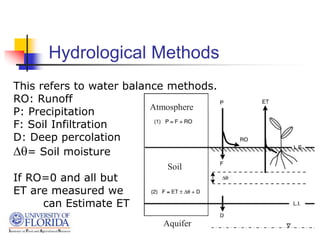
Hydrological Methods
This refers to water balance methods.
RO: Runoff
P: Precipitation
F: Soil Infiltration
D: Deep percolation
Dq= Soil moisture
If RO=0 and all but
ET are measured we
can Estimate ET
Atmosphere
Soil
Aquifer
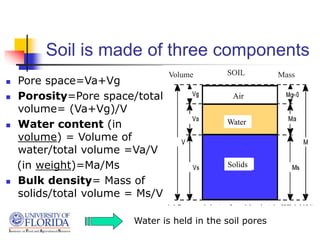
Soil is made of three components
 Pore space=Va+Vg
 Porosity=Pore space/total
volume= (Va+Vg)/V
 Water content (in
volume) = Volume of
water/total volume =Va/V
(in weight)=Ma/Ms
 Bulk density= Mass of
solids/total volume = Ms/V
Air
Water
Solids
SOIL Mass
Volume
Water is held in the soil pores
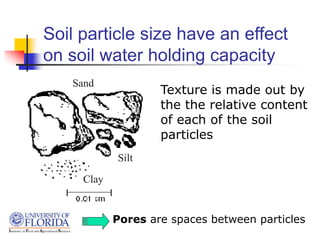
Soil particle size have an effect
on soil water holding capacity
Clay
Silt
Sand
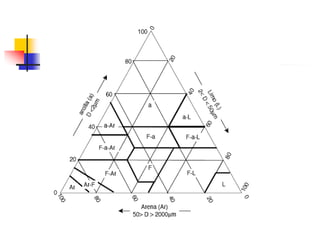
Texture is made out by
the the relative content
of each of the soil
particles
Pores are spaces between particles
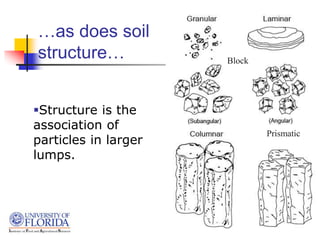
…as does soil
structure… Block
Prismatic
Structure is the
association of
particles in larger
lumps.
A paradox?
The coarser the soil the less water it contains
- The coarser the particles the larger the pores but the
total amount of pores is small
On the other hand…
-The finer the particles the smaller the pores but the
total amount of pores is large.
Also water flows slower in fine soils…
Does love make the world go
around?
 Energy, or rather differences in energy do…
 The universe tends spontaneously to lower
energy stages: “chaos” or “disorder”
 Soil water movement follows the same
pattern
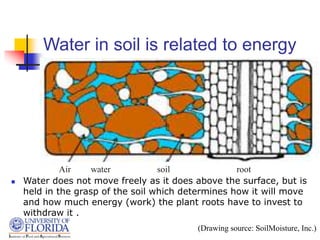
Water in soil is related to energy
 Water does not move freely as it does above the surface, but is
held in the grasp of the soil which determines how it will move
and how much energy (work) the plant roots have to invest to
withdraw it .
(Drawing source: SoilMoisture, Inc.)
Air water soil root
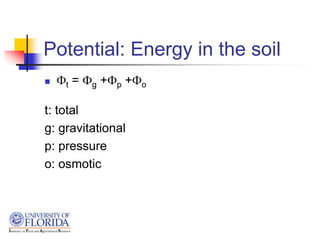
Potential: Energy in the soil
 t = g +p +o
t: total
g: gravitational
p: pressure
o: osmotic
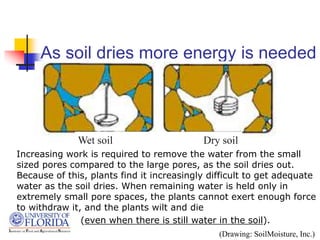
As soil dries more energy is needed
Increasing work is required to remove the water from the small
sized pores compared to the large pores, as the soil dries out.
Because of this, plants find it increasingly difficult to get adequate
water as the soil dries. When remaining water is held only in
extremely small pore spaces, the plants cannot exert enough force
to withdraw it, and the plants wilt and die
(even when there is still water in the soil).
(Drawing: SoilMoisture, Inc.)
Wet soil Dry soil
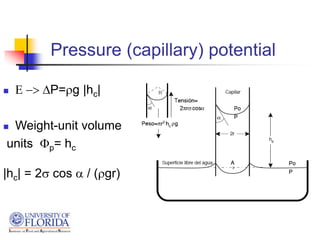
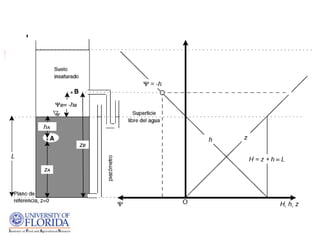
Pressure (capillary) potential
 DP=g |hc|
 Weight-unit volume
units p= hc
|hc| = 2 cos  / (gr)
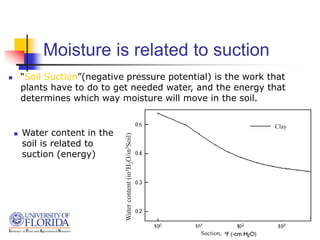
Moisture is related to suction
 “Soil Suction”(negative pressure potential) is the work that
plants have to do to get needed water, and the energy that
determines which way moisture will move in the soil.
Clay
Sand
Suction,
Water
content
(in
3
H
2
O/in
3
Soil)
 Water content in the
soil is related to
suction (energy)
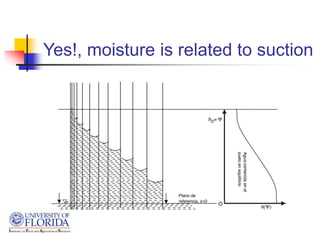
Yes!, moisture is related to suction
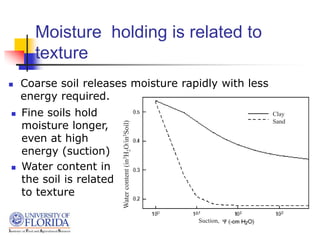
Moisture holding is related to
texture
 Coarse soil releases moisture rapidly with less
energy required.
Clay
Sand
Suction,
Water
content
(in
3
H
2
O/in
3
Soil)
 Fine soils hold
moisture longer,
even at high
energy (suction)
 Water content in
the soil is related
to texture
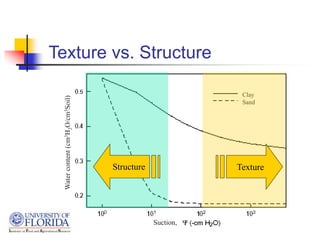
Texture vs. Structure
Clay
Sand
Suction,
Water
content
(cm
3
H
2
O/cm
3
Soil)
Texture
Structure
Field capacity: Hydrology or Agronomy?
 In 1949 Veihmeyer and Hendrickson “in 2-3 days
after rain or irrigation in soils of uniform texture and
structure soils”
 When gravitational and capillary forces equilibrate
after a water application event, the soil stops
draining freely.
 It is a static concept, while the system is dynamic
(redistribution does not stop after FC). In sandy
soils the concept is closer to reality (why?)
 Ways to estimate it: 1/3 bar with Richards plate,
centrifugue at 1000 rpm
 Factors affecting FC?
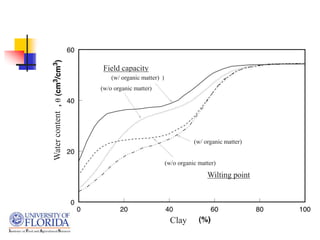
Wilting point
Field capacity
Water
content
Clay
(w/ organic matter)
(w/o organic matter)
(w/ organic matter)
(w/o organic matter)
Questions?

SoilWaterContentInSoils.ppt

  • 1.
    Soil water contentin soils Rafael Muñoz-Carpena
  • 2.
    Outline  Soil Hydrology A soil and water “refresher”  Capillarity theory  Field capacity
  • 3.
    Hydrological Methods This refersto water balance methods. RO: Runoff P: Precipitation F: Soil Infiltration D: Deep percolation Dq= Soil moisture If RO=0 and all but ET are measured we can Estimate ET Atmosphere Soil Aquifer
  • 4.
    Soil is madeof three components  Pore space=Va+Vg  Porosity=Pore space/total volume= (Va+Vg)/V  Water content (in volume) = Volume of water/total volume =Va/V (in weight)=Ma/Ms  Bulk density= Mass of solids/total volume = Ms/V Air Water Solids SOIL Mass Volume Water is held in the soil pores
  • 5.
    Soil particle sizehave an effect on soil water holding capacity Clay Silt Sand Texture is made out by the the relative content of each of the soil particles Pores are spaces between particles
  • 7.
    …as does soil structure…Block Prismatic Structure is the association of particles in larger lumps.
  • 8.
    A paradox? The coarserthe soil the less water it contains - The coarser the particles the larger the pores but the total amount of pores is small On the other hand… -The finer the particles the smaller the pores but the total amount of pores is large. Also water flows slower in fine soils…
  • 9.
    Does love makethe world go around?  Energy, or rather differences in energy do…  The universe tends spontaneously to lower energy stages: “chaos” or “disorder”  Soil water movement follows the same pattern
  • 10.
    Water in soilis related to energy  Water does not move freely as it does above the surface, but is held in the grasp of the soil which determines how it will move and how much energy (work) the plant roots have to invest to withdraw it . (Drawing source: SoilMoisture, Inc.) Air water soil root
  • 11.
    Potential: Energy inthe soil  t = g +p +o t: total g: gravitational p: pressure o: osmotic
  • 12.
    As soil driesmore energy is needed Increasing work is required to remove the water from the small sized pores compared to the large pores, as the soil dries out. Because of this, plants find it increasingly difficult to get adequate water as the soil dries. When remaining water is held only in extremely small pore spaces, the plants cannot exert enough force to withdraw it, and the plants wilt and die (even when there is still water in the soil). (Drawing: SoilMoisture, Inc.) Wet soil Dry soil
  • 13.
    Pressure (capillary) potential DP=g |hc|  Weight-unit volume units p= hc |hc| = 2 cos  / (gr)
  • 14.
    Moisture is relatedto suction  “Soil Suction”(negative pressure potential) is the work that plants have to do to get needed water, and the energy that determines which way moisture will move in the soil. Clay Sand Suction, Water content (in 3 H 2 O/in 3 Soil)  Water content in the soil is related to suction (energy)
  • 15.
    Yes!, moisture isrelated to suction
  • 16.
    Moisture holding isrelated to texture  Coarse soil releases moisture rapidly with less energy required. Clay Sand Suction, Water content (in 3 H 2 O/in 3 Soil)  Fine soils hold moisture longer, even at high energy (suction)  Water content in the soil is related to texture
  • 17.
  • 18.
    Field capacity: Hydrologyor Agronomy?  In 1949 Veihmeyer and Hendrickson “in 2-3 days after rain or irrigation in soils of uniform texture and structure soils”  When gravitational and capillary forces equilibrate after a water application event, the soil stops draining freely.
  • 19.
     It isa static concept, while the system is dynamic (redistribution does not stop after FC). In sandy soils the concept is closer to reality (why?)  Ways to estimate it: 1/3 bar with Richards plate, centrifugue at 1000 rpm  Factors affecting FC?
  • 20.
    Wilting point Field capacity Water content Clay (w/organic matter) (w/o organic matter) (w/ organic matter) (w/o organic matter)
  • 23.