Scaling Solute Transport during the
Soil-Water Redistribution Process

Morteza Sadeghi and Scott B. Jones
Dept. Plants, Soils and Climate,
Utah State University
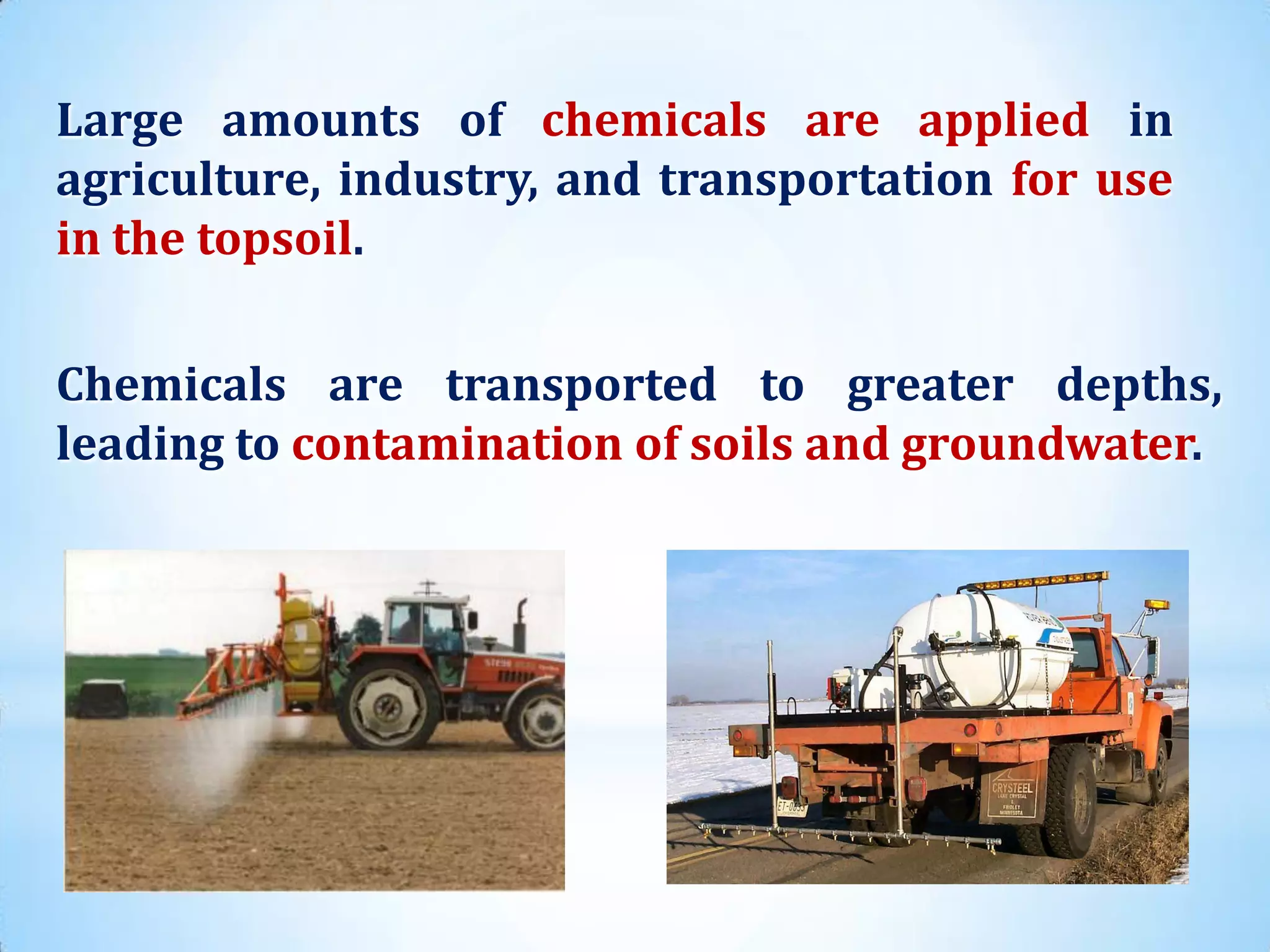
Large amounts of chemicals are applied in
agriculture, industry, and transportation for use
in the topsoil.
Chemicals are transported to greater depths,
leading to contamination of soils and groundwater.
Fertilizers & Pesticides

*
Accidental chemical spills

*
Leakage from corroded tanks

Hanford Site
Road Deicing
Fertilizers are a main source of Nitrate contamination

Nitrate risk in shallow groundwater
USGS: high arsenic concentration in
groundwater associated with landfills and
arsenical pesticides is common.

Arsenic concentration in groundwater
To Manage,
Quantifying Solute Transport in soil is of
paramount importance for a wide range of
environmental and agricultural issues.

Solute Transport is one of the most
complex phenomena in vadose zone!!!
The System is highly highly nonlinear
( s   r )
  r 
[1  (h) n ]m


R  1


  cR 
t

{1  (h) n1[1  (h) n ] m }2
K  Ks
[1  (h) n ]m / 2

VG models

h
q  K
K
z


q

t
z

D  DL



j
z

Solute flux

c
j   D
 qc
z

c: solute concentration (mass-per-solvent volume)

q



 7/3
w  2
s

 Dw w


There are analytical solutions only for simplified

cases (simple hydraulic models, neglecting the
dispersion/diffusion process or solute reaction).

 Tedious numerical calculations have to be
repeated for any soils and any initial/boundary
conditions separately.

 TO overcome this complexity,
We introduce a method for scaling different

soils into a unique non-dimensional
medium so that one numerical solution of any
soil can be used for many other soils.
One scenario of interest

concentration

 Solutes are incorporated in
irrigation water
 an initial wetted zone is created
 Irrigation water is redistributed
carrying solutes to deeper
depths.

depth

Solution to this case is important
to manage solutes movement to
avoid moving beyond the root
zone for use only by plant roots.
Initial and Boundary Conditions:
q=0
θfi

θi

zfi

j=0

qfi

ci

θ

zfi

θ = θi

z

cfi

c = ci

z
Water Flow

Solute Transport

c
We propose scaling variables as follows:

Scaled water content:

Scaled depth:

Scaled water flux:

  i
 
 fi   i
*

z
z 
z fi
*

q
q 
q fi

where: q fi 

*



h fi

hi

Scaled concentration:

Scaled time:

Scaled solute flux:

Kdh / z fi  K fi

c  ci
c 
c fi  ci
*

t t
*



q fi

fi

 i  z fi

J
J
J 

J fi q fi
*
A scale-invariant system is obtained:




q
 *
*
t
z
*



 c*  *   

J *
 
t *
z*

*

q* (0, t * )  0

J * (0, t * )  0

 * ( , t * )  0

c * ( , t * )  0

1, 0<z < 1
 ( z ,0)   *
0, z > 1
*

*

*

1, 0<z* < 1
c* ( z* , 0)  
0, z* > 1


The only remaining soil-dependent variable is φ
(normalized retardation/exclusion) :

  i

 fi  i

ε: Solute reaction coefficient
θi: Initial water content at dry zone
θfi: Initial water content at wet zone
Summary & Conclusions
 A new method is proposed for scaling coupled
water flow and solute transport during soil water
redistribution.
 The scaled solutions are invariant for a wide range
of soils and initial conditions when the scaled
exclusion/retardation term, φ, is identical for all the
cases.
 The invariance of the scaled solutions provides an
insight to the factors influencing solute transport.
 The new method provides opportunities to easily
obtain approximate solutions of the highly nonlinear governing equations.
Future Studies
The new scaling method considers a single irrigation
event. It is worthwhile to apply such a method to
frequent applications of irrigation water to track the
solute front in long run.

So far, we have not been able to do so.
For more Details read:

Soil-Water Flow and Solute Transport during Redistribution

  • 1.
    Scaling Solute Transportduring the Soil-Water Redistribution Process Morteza Sadeghi and Scott B. Jones Dept. Plants, Soils and Climate, Utah State University
  • 2.
    Large amounts ofchemicals are applied in agriculture, industry, and transportation for use in the topsoil. Chemicals are transported to greater depths, leading to contamination of soils and groundwater.
  • 3.
  • 4.
  • 5.
    Leakage from corrodedtanks Hanford Site
  • 6.
  • 7.
    Fertilizers are amain source of Nitrate contamination Nitrate risk in shallow groundwater
  • 8.
    USGS: high arsenicconcentration in groundwater associated with landfills and arsenical pesticides is common. Arsenic concentration in groundwater
  • 9.
    To Manage, Quantifying SoluteTransport in soil is of paramount importance for a wide range of environmental and agricultural issues. Solute Transport is one of the most complex phenomena in vadose zone!!!
  • 10.
    The System ishighly highly nonlinear ( s   r )   r  [1  (h) n ]m  R  1    cR  t {1  (h) n1[1  (h) n ] m }2 K  Ks [1  (h) n ]m / 2 VG models h q  K K z  q  t z D  DL  j z Solute flux c j   D  qc z c: solute concentration (mass-per-solvent volume) q   7/3 w  2 s  Dw w
  • 11.
     There are analyticalsolutions only for simplified cases (simple hydraulic models, neglecting the dispersion/diffusion process or solute reaction).  Tedious numerical calculations have to be repeated for any soils and any initial/boundary conditions separately.  TO overcome this complexity, We introduce a method for scaling different soils into a unique non-dimensional medium so that one numerical solution of any soil can be used for many other soils.
  • 12.
    One scenario ofinterest concentration  Solutes are incorporated in irrigation water  an initial wetted zone is created  Irrigation water is redistributed carrying solutes to deeper depths. depth Solution to this case is important to manage solutes movement to avoid moving beyond the root zone for use only by plant roots.
  • 13.
    Initial and BoundaryConditions: q=0 θfi θi zfi j=0 qfi ci θ zfi θ = θi z cfi c = ci z Water Flow Solute Transport c
  • 14.
    We propose scalingvariables as follows: Scaled water content: Scaled depth: Scaled water flux:   i    fi   i * z z  z fi * q q  q fi where: q fi  *  h fi hi Scaled concentration: Scaled time: Scaled solute flux: Kdh / z fi  K fi c  ci c  c fi  ci * t t *  q fi fi  i  z fi J J J   J fi q fi *
  • 15.
    A scale-invariant systemis obtained:   q  * * t z *   c*  *     J *   t * z* * q* (0, t * )  0 J * (0, t * )  0  * ( , t * )  0 c * ( , t * )  0 1, 0<z < 1  ( z ,0)   * 0, z > 1 * * * 1, 0<z* < 1 c* ( z* , 0)   0, z* > 1  The only remaining soil-dependent variable is φ (normalized retardation/exclusion) :   i   fi  i ε: Solute reaction coefficient θi: Initial water content at dry zone θfi: Initial water content at wet zone
  • 23.
    Summary & Conclusions A new method is proposed for scaling coupled water flow and solute transport during soil water redistribution.  The scaled solutions are invariant for a wide range of soils and initial conditions when the scaled exclusion/retardation term, φ, is identical for all the cases.  The invariance of the scaled solutions provides an insight to the factors influencing solute transport.  The new method provides opportunities to easily obtain approximate solutions of the highly nonlinear governing equations.
  • 24.
    Future Studies The newscaling method considers a single irrigation event. It is worthwhile to apply such a method to frequent applications of irrigation water to track the solute front in long run. So far, we have not been able to do so.
  • 25.