SOFTWARE TESTING
LIFE CYCLE (STLC)
The Software Development Life Cycle (SDLC) involves
phases such as requirement analysis, design,
implementation, testing, deployment, and maintenance,
ensuring structured development and delivery of high-
quality software. Various methodologies like Waterfall,
Agile, Scrum, and DevOps are employed to manage and
iterate through these phases efficiently.
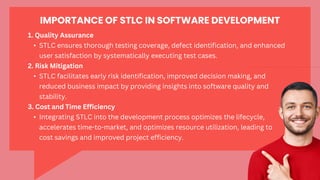
1. Quality Assurance
• STLC ensures thorough testing coverage, defect identification, and enhanced
user satisfaction by systematically executing test cases.
2. Risk Mitigation
• STLC facilitates early risk identification, improved decision making, and
reduced business impact by providing insights into software quality and
stability.
3. Cost and Time Efficiency
• Integrating STLC into the development process optimizes the lifecycle,
accelerates time-to-market, and optimizes resource utilization, leading to
cost savings and improved project efficiency.
IMPORTANCE OF STLC IN SOFTWARE DEVELOPMENT
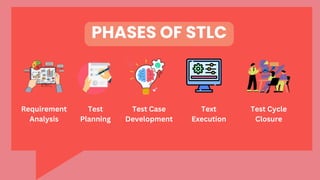
PHASES OF STLC
Requirement
Analysis
Test
Planning
Test Case
Development
Text
Execution
Test Cycle
Closure
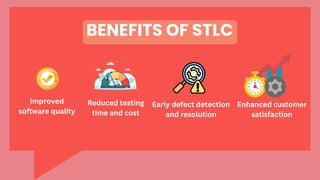
BENEFITS OF STLC
Improved
software quality
Reduced testing
time and cost
Early defect detection
and resolution
Enhanced customer
satisfaction
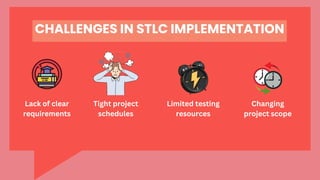
CHALLENGES IN STLC IMPLEMENTATION
Lack of clear
requirements
Tight project
schedules
Limited testing
resources
Changing
project scope
• Start testing early in the development lifecycle
• Use automation tools for repetitive tasks
• Conduct regular reviews and inspections
• Maintain clear communication among team members
BEST PRACTICES FOR STLC
Software Testing Life Cycle (STLC) plays a pivotal role in ensuring the quality,
reliability, and success of software applications. By embracing STLC,
development teams can unlock a multitude of benefits, including enhanced
product quality, reduced risks, and improved resource efficiency. Embracing
STLC not only fosters a culture of quality assurance but also empowers teams
to deliver high-performing software that meets and exceeds user
expectations. As the landscape of software development continues to evolve,
exploring and adopting STLC methodologies can serve as a catalyst for
innovation, growth, and competitive advantage in today's dynamic market.
CONCLUSION

Software Testing life cycle (STLC) Importance, Phases, Benefits...

  • 1.
    SOFTWARE TESTING LIFE CYCLE(STLC) The Software Development Life Cycle (SDLC) involves phases such as requirement analysis, design, implementation, testing, deployment, and maintenance, ensuring structured development and delivery of high- quality software. Various methodologies like Waterfall, Agile, Scrum, and DevOps are employed to manage and iterate through these phases efficiently.
  • 2.
    1. Quality Assurance •STLC ensures thorough testing coverage, defect identification, and enhanced user satisfaction by systematically executing test cases. 2. Risk Mitigation • STLC facilitates early risk identification, improved decision making, and reduced business impact by providing insights into software quality and stability. 3. Cost and Time Efficiency • Integrating STLC into the development process optimizes the lifecycle, accelerates time-to-market, and optimizes resource utilization, leading to cost savings and improved project efficiency. IMPORTANCE OF STLC IN SOFTWARE DEVELOPMENT
  • 3.
    PHASES OF STLC Requirement Analysis Test Planning TestCase Development Text Execution Test Cycle Closure
  • 4.
    BENEFITS OF STLC Improved softwarequality Reduced testing time and cost Early defect detection and resolution Enhanced customer satisfaction
  • 5.
    CHALLENGES IN STLCIMPLEMENTATION Lack of clear requirements Tight project schedules Limited testing resources Changing project scope
  • 6.
    • Start testingearly in the development lifecycle • Use automation tools for repetitive tasks • Conduct regular reviews and inspections • Maintain clear communication among team members BEST PRACTICES FOR STLC
  • 7.
    Software Testing LifeCycle (STLC) plays a pivotal role in ensuring the quality, reliability, and success of software applications. By embracing STLC, development teams can unlock a multitude of benefits, including enhanced product quality, reduced risks, and improved resource efficiency. Embracing STLC not only fosters a culture of quality assurance but also empowers teams to deliver high-performing software that meets and exceeds user expectations. As the landscape of software development continues to evolve, exploring and adopting STLC methodologies can serve as a catalyst for innovation, growth, and competitive advantage in today's dynamic market. CONCLUSION