Software Engineering: 21
Integration Testing
Prof Neeraj Bhargava
Vaibhav Khanna
Department of Computer Science
School of Engineering and Systems Sciences
Maharshi Dayanand Saraswati University Ajmer
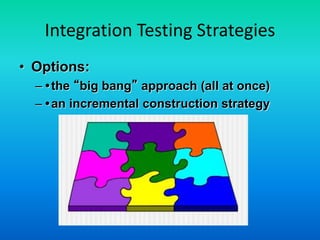
Integration Testing Strategies
• Options:
– •the “big bang” approach (all at once)
– •an incremental construction strategy
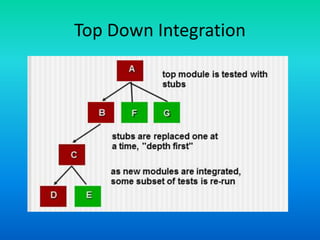
Top Down Integration
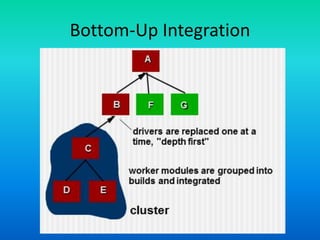
Bottom-Up Integration
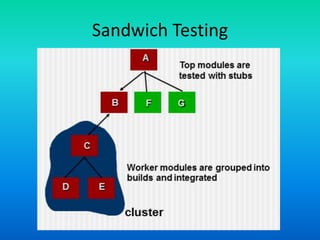
Sandwich Testing
Regression Testing
 Regression testing is the re-execution of some subset of tests
that have already been conducted to ensure that changes
have not propagated unintended side effects
 Whenever software is corrected, some aspect of the software
configuration (the program, its documentation, or the data that
support it) is changed.
 Regression testing helps to ensure that changes (due to
testing or for other reasons) do not introduce unintended
behavior or additional errors.
 Regression testing may be conducted manually, by re-
executing a subset of all test cases or using automated
capture/playback tools
Smoke Testing
• A common approach for creating “daily builds” for product software
• Smoke testing steps:
– Software components that have been translated into code are
integrated into a “build.”
• A build includes all data files, libraries, reusable modules, and
engineered components that are required to implement one or
more product functions.
– A series of tests is designed to expose errors that will keep the build
from properly performing its function.
• The intent should be to uncover “show stopper” errors that have
the highest likelihood of throwing the software project behind
schedule.
– The build is integrated with other builds and the entire product (in its
current form) is smoke tested daily.
• The integration approach may be top down or bottom up.
Object-Oriented Testing
• begins by evaluating the correctness and
consistency of the analysis and design models
• testing strategy changes
– the concept of the ‘unit’ broadens due to
encapsulation
– integration focuses on classes and their execution
across a ‘thread’ or in the context of a usage scenario
– validation uses conventional black box methods
• test case design draws on conventional methods,
but also encompasses special features
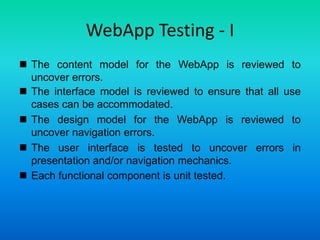
WebApp Testing - I
 The content model for the WebApp is reviewed to
uncover errors.
 The interface model is reviewed to ensure that all use
cases can be accommodated.
 The design model for the WebApp is reviewed to
uncover navigation errors.
 The user interface is tested to uncover errors in
presentation and/or navigation mechanics.
 Each functional component is unit tested.
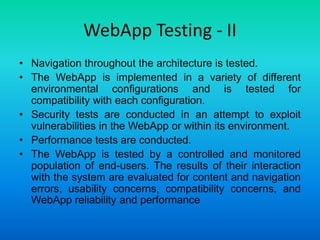
WebApp Testing - II
• Navigation throughout the architecture is tested.
• The WebApp is implemented in a variety of different
environmental configurations and is tested for
compatibility with each configuration.
• Security tests are conducted in an attempt to exploit
vulnerabilities in the WebApp or within its environment.
• Performance tests are conducted.
• The WebApp is tested by a controlled and monitored
population of end-users. The results of their interaction
with the system are evaluated for content and navigation
errors, usability concerns, compatibility concerns, and
WebApp reliability and performance
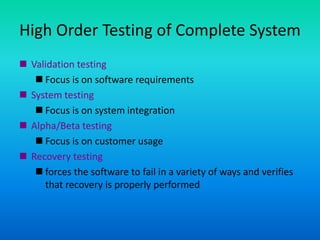
High Order Testing of Complete System
 Validation testing
 Focus is on software requirements
 System testing
 Focus is on system integration
 Alpha/Beta testing
 Focus is on customer usage
 Recovery testing
 forces the software to fail in a variety of ways and verifies
that recovery is properly performed
High Order Testing of Complete System
 Security testing
 verifies that protection mechanisms built into a system
will, in fact, protect it from improper penetration
 Stress testing
 executes a system in a manner that demands resources in
abnormal quantity, frequency, or volume
 Performance Testing
 test the run-time performance of software within the
context of an integrated system
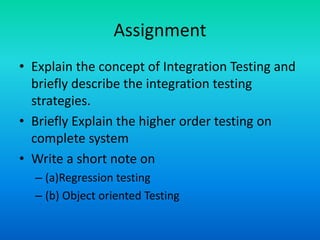
Assignment
• Explain the concept of Integration Testing and
briefly describe the integration testing
strategies.
• Briefly Explain the higher order testing on
complete system
• Write a short note on
– (a)Regression testing
– (b) Object oriented Testing

Software engineering 21 integration testing

  • 1.
    Software Engineering: 21 IntegrationTesting Prof Neeraj Bhargava Vaibhav Khanna Department of Computer Science School of Engineering and Systems Sciences Maharshi Dayanand Saraswati University Ajmer
  • 2.
    Integration Testing Strategies •Options: – •the “big bang” approach (all at once) – •an incremental construction strategy
  • 3.
  • 4.
  • 5.
  • 6.
    Regression Testing  Regressiontesting is the re-execution of some subset of tests that have already been conducted to ensure that changes have not propagated unintended side effects  Whenever software is corrected, some aspect of the software configuration (the program, its documentation, or the data that support it) is changed.  Regression testing helps to ensure that changes (due to testing or for other reasons) do not introduce unintended behavior or additional errors.  Regression testing may be conducted manually, by re- executing a subset of all test cases or using automated capture/playback tools
  • 7.
    Smoke Testing • Acommon approach for creating “daily builds” for product software • Smoke testing steps: – Software components that have been translated into code are integrated into a “build.” • A build includes all data files, libraries, reusable modules, and engineered components that are required to implement one or more product functions. – A series of tests is designed to expose errors that will keep the build from properly performing its function. • The intent should be to uncover “show stopper” errors that have the highest likelihood of throwing the software project behind schedule. – The build is integrated with other builds and the entire product (in its current form) is smoke tested daily. • The integration approach may be top down or bottom up.
  • 8.
    Object-Oriented Testing • beginsby evaluating the correctness and consistency of the analysis and design models • testing strategy changes – the concept of the ‘unit’ broadens due to encapsulation – integration focuses on classes and their execution across a ‘thread’ or in the context of a usage scenario – validation uses conventional black box methods • test case design draws on conventional methods, but also encompasses special features
  • 9.
    WebApp Testing -I  The content model for the WebApp is reviewed to uncover errors.  The interface model is reviewed to ensure that all use cases can be accommodated.  The design model for the WebApp is reviewed to uncover navigation errors.  The user interface is tested to uncover errors in presentation and/or navigation mechanics.  Each functional component is unit tested.
  • 10.
    WebApp Testing -II • Navigation throughout the architecture is tested. • The WebApp is implemented in a variety of different environmental configurations and is tested for compatibility with each configuration. • Security tests are conducted in an attempt to exploit vulnerabilities in the WebApp or within its environment. • Performance tests are conducted. • The WebApp is tested by a controlled and monitored population of end-users. The results of their interaction with the system are evaluated for content and navigation errors, usability concerns, compatibility concerns, and WebApp reliability and performance
  • 11.
    High Order Testingof Complete System  Validation testing  Focus is on software requirements  System testing  Focus is on system integration  Alpha/Beta testing  Focus is on customer usage  Recovery testing  forces the software to fail in a variety of ways and verifies that recovery is properly performed
  • 12.
    High Order Testingof Complete System  Security testing  verifies that protection mechanisms built into a system will, in fact, protect it from improper penetration  Stress testing  executes a system in a manner that demands resources in abnormal quantity, frequency, or volume  Performance Testing  test the run-time performance of software within the context of an integrated system
  • 13.
    Assignment • Explain theconcept of Integration Testing and briefly describe the integration testing strategies. • Briefly Explain the higher order testing on complete system • Write a short note on – (a)Regression testing – (b) Object oriented Testing