S
SOFTWARE
OFTWARE
DEVELOPMENT
DEVELOPMENT
LIFE
LIFE
CYCLE
CYCLE
(SDLC)
(SDLC)
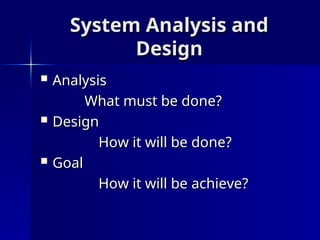
System Analysis and
System Analysis and
Design
Design
 Analysis
Analysis
What must be done?
What must be done?
 Design
Design
How it will be done?
 Goal
Goal
How it will be
How it will be achieve
achieve?
?
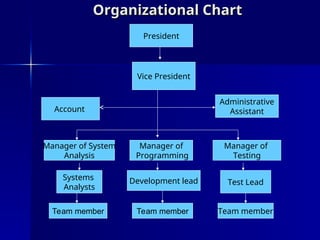
Vice President
Manager of System
Analysis
Administrative
Assistant
Manager of
Programming
Systems
Analysts
Development lead Test Lead
Manager of
Testing
Organizational Chart
President
Account
Team member
Team member
Team member
S
Software
oftware Development Life
Development Life
Cycle
Cycle
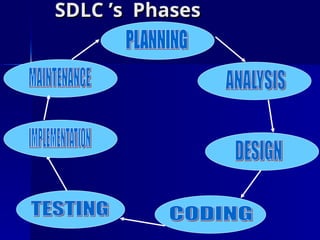
SDLC ’s Phases
SDLC ’s Phases
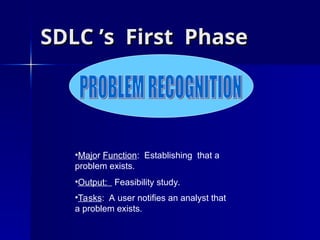
SDLC ’s First Phase
SDLC ’s First Phase
•Major Function: Establishing that a
problem exists.
•Output: Feasibility study.
•Tasks: A user notifies an analyst that
a problem exists.
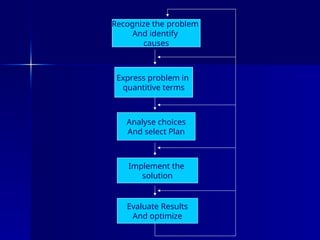
Recognize the problem
And identify
causes
Express problem in
quantitive terms
Analyse choices
And select Plan
Implement the
solution
Evaluate Results
And optimize
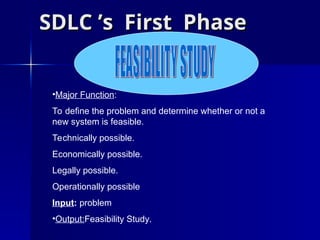
•Major Function:
To define the problem and determine whether or not a
new system is feasible.
Technically possible.
Economically possible.
Legally possible.
Operationally possible
Input: problem
•Output:Feasibility Study.
SDLC ’s First Phase
SDLC ’s First Phase
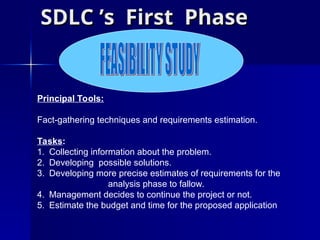
Principal Tools:
Fact-gathering techniques and requirements estimation.
Tasks:
1. Collecting information about the problem.
2. Developing possible solutions.
3. Developing more precise estimates of requirements for the
analysis phase to fallow.
4. Management decides to continue the project or not.
5. Estimate the budget and time for the proposed application
SDLC ’s First Phase
SDLC ’s First Phase
SDLC ’s Secon
SDLC ’s Second Phase
d Phase
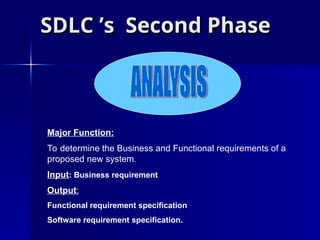
Major Function:
To determine the Business and Functional requirements of a
proposed new system.
Input: Business requirement
Output:
Functional requirement specification
Software requirement specification.
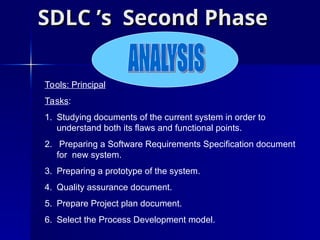
Tools: Principal
Tasks:
1. Studying documents of the current system in order to
understand both its flaws and functional points.
2. Preparing a Software Requirements Specification document
for new system.
3. Preparing a prototype of the system.
4. Quality assurance document.
5. Prepare Project plan document.
6. Select the Process Development model.
SDLC ’s Secon
SDLC ’s Second Phase
d Phase
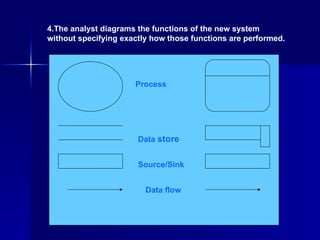
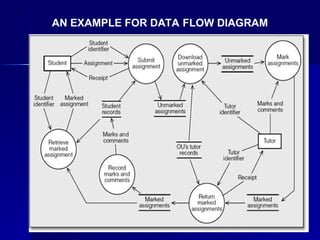
Process
Data store
Source/Sink
Data flow
4.The analyst diagrams the functions of the new system
without specifying exactly how those functions are performed.
AN EXAMPLE FOR DATA FLOW DIAGRAM
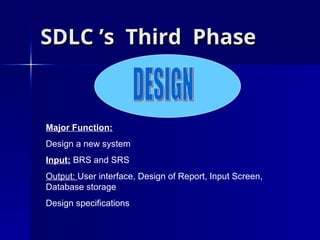
SDLC ’s Third Phase
SDLC ’s Third Phase
Major Function:
Design a new system
Input: BRS and SRS
Output: User interface, Design of Report, Input Screen,
Database storage
Design specifications
SDLC ’s Third Phase
SDLC ’s Third Phase
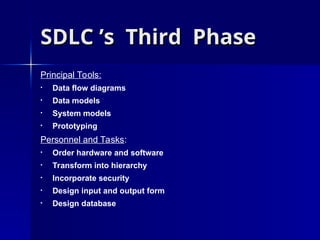
Principal Tools:
• Data flow diagrams
• Data models
• System models
• Prototyping
Personnel and Tasks:
• Order hardware and software
• Transform into hierarchy
• Incorporate security
• Design input and output form
• Design database
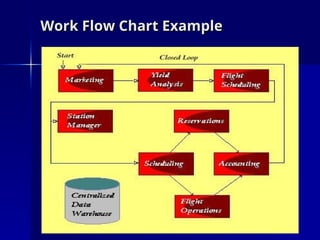
Work Flow Chart Example
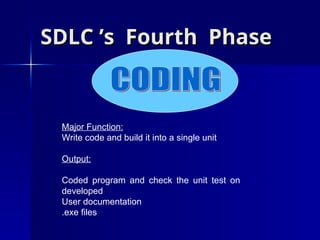
SDLC ’s Fourth Phase
Major Function:
Write code and build it into a single unit
Output:
Coded program and check the unit test on
developed
User documentation
.exe files
SDLC ’s
SDLC ’s Fourth
Fourth Phase
Phase
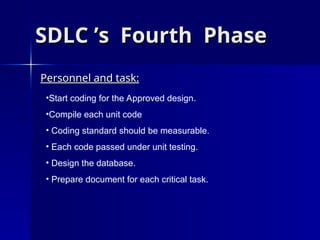
Personnel and task:
Personnel and task:
•Start coding for the Approved design.
•Compile each unit code
• Coding standard should be measurable.
• Each code passed under unit testing.
• Design the database.
• Prepare document for each critical task.
SDLC ’s
SDLC ’s Fifth
Fifth Phase
Phase
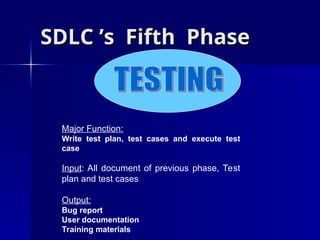
Major Function:
Write test plan, test cases and execute test
case
Input: All document of previous phase, Test
plan and test cases
Output:
Bug report
User documentation
Training materials
SDLC ’s
SDLC ’s Fifth
Fifth Phase
Phase
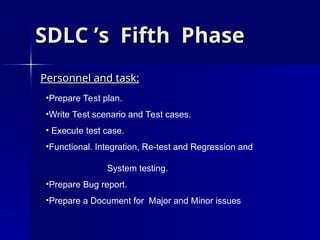
Personnel and task:
Personnel and task:
•Prepare Test plan.
•Write Test scenario and Test cases.
• Execute test case.
•Functional. Integration, Re-test and Regression and
System testing.
•Prepare Bug report.
•Prepare a Document for Major and Minor issues
SDLC ’s
SDLC ’s Sixth
Sixth Phase
Phase
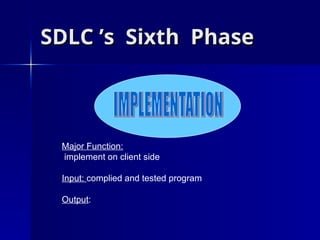
Major Function:
implement on client side
Input: complied and tested program
Output:
SDLC ’s
SDLC ’s Sixth
Sixth Phase
Phase
Personnel and task:
Personnel and task:
•Prepare site
•Write programs
• Setup the program at end user
location
•Prepare documentation and training
•Enter new data
SDLC ’s
SDLC ’s Seventh
Seventh Phase
Phase
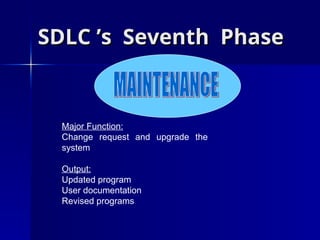
Major Function:
Change request and upgrade the
system
Output:
Updated program
User documentation
Revised programs
SDLC ’s
SDLC ’s Seventh
Seventh Phase
Phase
Personnel and Task:
• Recognize problem
• Prepare incremental model
• Decide whether to implement
• Change request document
• Update programs
• Test programs
• Use new updated system
Managing the
Managing the Web Based
Web Based
and Desktop Application
Project
Project
 Project
Project
 Deliverable
Deliverable
 Project Management
Project Management
 Project Initiation
Project Initiation
 Project Planning
Project Planning
 Quality Assurance and Testing
Quality Assurance and Testing
 Implementation
Implementation
 Maintenance
Maintenance
Prepared By
Avinash Kumar Sachan

Software development and life cycle.ppt

  • 1.
  • 2.
    System Analysis and SystemAnalysis and Design Design  Analysis Analysis What must be done? What must be done?  Design Design How it will be done? How it will be done?  Goal Goal How it will be How it will be achieve achieve? ?
  • 3.
    Vice President Manager ofSystem Analysis Administrative Assistant Manager of Programming Systems Analysts Development lead Test Lead Manager of Testing Organizational Chart Organizational Chart President Account Team member Team member Team member
  • 4.
  • 5.
  • 6.
    SDLC ’s FirstPhase SDLC ’s First Phase •Major Function: Establishing that a problem exists. •Output: Feasibility study. •Tasks: A user notifies an analyst that a problem exists.
  • 7.
    Recognize the problem Andidentify causes Express problem in quantitive terms Analyse choices And select Plan Implement the solution Evaluate Results And optimize
  • 8.
    •Major Function: To definethe problem and determine whether or not a new system is feasible. Technically possible. Economically possible. Legally possible. Operationally possible Input: problem •Output:Feasibility Study. SDLC ’s First Phase SDLC ’s First Phase
  • 9.
    Principal Tools: Fact-gathering techniquesand requirements estimation. Tasks: 1. Collecting information about the problem. 2. Developing possible solutions. 3. Developing more precise estimates of requirements for the analysis phase to fallow. 4. Management decides to continue the project or not. 5. Estimate the budget and time for the proposed application SDLC ’s First Phase SDLC ’s First Phase
  • 10.
    SDLC ’s Secon SDLC’s Second Phase d Phase Major Function: To determine the Business and Functional requirements of a proposed new system. Input: Business requirement Output: Functional requirement specification Software requirement specification.
  • 11.
    Tools: Principal Tasks: 1. Studyingdocuments of the current system in order to understand both its flaws and functional points. 2. Preparing a Software Requirements Specification document for new system. 3. Preparing a prototype of the system. 4. Quality assurance document. 5. Prepare Project plan document. 6. Select the Process Development model. SDLC ’s Secon SDLC ’s Second Phase d Phase
  • 12.
    Process Data store Source/Sink Data flow 4.Theanalyst diagrams the functions of the new system without specifying exactly how those functions are performed.
  • 13.
    AN EXAMPLE FORDATA FLOW DIAGRAM
  • 14.
    SDLC ’s ThirdPhase SDLC ’s Third Phase Major Function: Design a new system Input: BRS and SRS Output: User interface, Design of Report, Input Screen, Database storage Design specifications
  • 15.
    SDLC ’s ThirdPhase SDLC ’s Third Phase Principal Tools: • Data flow diagrams • Data models • System models • Prototyping Personnel and Tasks: • Order hardware and software • Transform into hierarchy • Incorporate security • Design input and output form • Design database
  • 16.
    Work Flow ChartExample Work Flow Chart Example
  • 17.
    SDLC ’s FourthPhase SDLC ’s Fourth Phase Major Function: Write code and build it into a single unit Output: Coded program and check the unit test on developed User documentation .exe files
  • 18.
    SDLC ’s SDLC ’sFourth Fourth Phase Phase Personnel and task: Personnel and task: •Start coding for the Approved design. •Compile each unit code • Coding standard should be measurable. • Each code passed under unit testing. • Design the database. • Prepare document for each critical task.
  • 19.
    SDLC ’s SDLC ’sFifth Fifth Phase Phase Major Function: Write test plan, test cases and execute test case Input: All document of previous phase, Test plan and test cases Output: Bug report User documentation Training materials
  • 20.
    SDLC ’s SDLC ’sFifth Fifth Phase Phase Personnel and task: Personnel and task: •Prepare Test plan. •Write Test scenario and Test cases. • Execute test case. •Functional. Integration, Re-test and Regression and System testing. •Prepare Bug report. •Prepare a Document for Major and Minor issues
  • 21.
    SDLC ’s SDLC ’sSixth Sixth Phase Phase Major Function: implement on client side Input: complied and tested program Output:
  • 22.
    SDLC ’s SDLC ’sSixth Sixth Phase Phase Personnel and task: Personnel and task: •Prepare site •Write programs • Setup the program at end user location •Prepare documentation and training •Enter new data
  • 23.
    SDLC ’s SDLC ’sSeventh Seventh Phase Phase Major Function: Change request and upgrade the system Output: Updated program User documentation Revised programs
  • 24.
    SDLC ’s SDLC ’sSeventh Seventh Phase Phase Personnel and Task: • Recognize problem • Prepare incremental model • Decide whether to implement • Change request document • Update programs • Test programs • Use new updated system
  • 25.
    Managing the Managing theWeb Based Web Based and Desktop Application and Desktop Application Project Project  Project Project  Deliverable Deliverable  Project Management Project Management  Project Initiation Project Initiation  Project Planning Project Planning  Quality Assurance and Testing Quality Assurance and Testing  Implementation Implementation  Maintenance Maintenance
  • 26.