Better Change Estimation with
Crosscode Panoptics
INDUSTRY’S ONLY FULLY AUTOMATED DISCOVERY,
ANALYTICS AND GOVERNANCE SOLUTION
© 2018 Crosscode Inc | All Rights Reserved | 2
.
Your custom software is the glue that holds your organization
together and the face that you show your customers.
© 2018 Crosscode Inc | All Rights Reserved | 3
.
 Containers & Microservices
 Cloud & Multicloud
 Agile Development Methods
 Multiple Development
Languages
 Third Party and Open Source
Code
 Distributed DevOps Teams
© 2018 Crosscode Inc | All Rights Reserved | 4
Helping organizations manage
today’s complex application
environments.
Giving managers, developers,
security professionals and others
across the organization the deep
insights they need to reduce the
risk and uncertainty of application
changes.
© 2018 Crosscode Inc | All Rights Reserved | 5
Across the board, software
projects struggle to achieve their
objectives.
Less than 30% of projects come in
on-time and on-budget.
A full 19% of projects are cancelled
altogether.
Source: The Standish Group 2018 Chaos Report
Successful
29%
Failed
19%
Challenged
52%
Software Project Outcomes
Successful Failed Challenged
Challenged software projects divert resources from other
activities and drain morale across the organization.
© 2018 Crosscode Inc | All Rights Reserved | 6
Bad Estimate
Project Starts “Behind
Schedule”
Efforts to get back on
schedule only make things
worse
Project comes in late and
over budget
© 2018 Crosscode Inc | All Rights Reserved | 7
Lacking documentation we have no
way to understand the impact of our
plan:
 How many changes to applications
and databases will need to be
made?
 How many methods will be
affected?
Without a comprehensive understanding of our applications,
a reliable impact assessment is impossible.
© 2018 Crosscode Inc | All Rights Reserved | 8
Good estimates need hard data
Without hard data we fill in the gaps with
subjective analysis
Subjective analysis skews toward optimism
“One way that subjectivity
creeps into estimates is that
project managers or
estimators look at a new
project, compare it with an
old project, observe the
numerous differences
between the two projects,
and then conclude that the
new project will go better
than the old one did.”
Steve McConnell
Software Estimation: Demystifying
the Black Art
© 2018 Crosscode Inc | All Rights Reserved | 9
Larger applications are more complex:
 More modules of code
 More interactions among modules
More connections to other
applications
 Larger databases
 More overlapping data
dependencies
© 2018 Crosscode Inc | All Rights Reserved |
PANOPTICS AND IMPACT ANALYSIS
10
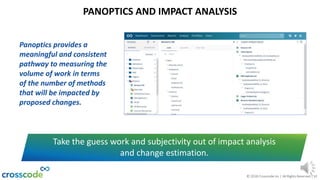
Panoptics provides a
meaningful and consistent
pathway to measuring the
volume of work in terms
of the number of methods
that will be impacted by
proposed changes.
Take the guess work and subjectivity out of impact analysis
and change estimation.
© 2018 Crosscode Inc | All Rights Reserved |11
…
© 2018 Crosscode Inc | All Rights Reserved |12
A fully automated solution
Crosscode discovers all the applications and databases running in your
enterprise, analyzes them, and generates a detailed map of their dependencies.
Deep mapping down to code level
Crosscode can interpret byte code for many languages as well as binary code,
mapping your applications down to the method level, and your databases down
to the column level.
Analysis you can use
Instant impact analysis of even the most complex scopes of work. Mitigate the
risk of costly disruptions to business systems before new code is even planned.
Real-time governance
Custom alerts send notifications the moment a system change violates one of
your governance rules or creates a security vulnerability.
Fast hassle-free installation
Crosscode can be deployed in minutes via the internet. It can also be baked into
the server image.
Unique algorithms
We are the metadata experts. No other solution maps the application layer as
thoroughly and deeply.
Crosscode stands apart – no
solution is easier – no solution
is more comprehensive.

Software Change estimation

  • 1.
    Better Change Estimationwith Crosscode Panoptics INDUSTRY’S ONLY FULLY AUTOMATED DISCOVERY, ANALYTICS AND GOVERNANCE SOLUTION
  • 2.
    © 2018 CrosscodeInc | All Rights Reserved | 2 . Your custom software is the glue that holds your organization together and the face that you show your customers.
  • 3.
    © 2018 CrosscodeInc | All Rights Reserved | 3 .  Containers & Microservices  Cloud & Multicloud  Agile Development Methods  Multiple Development Languages  Third Party and Open Source Code  Distributed DevOps Teams
  • 4.
    © 2018 CrosscodeInc | All Rights Reserved | 4 Helping organizations manage today’s complex application environments. Giving managers, developers, security professionals and others across the organization the deep insights they need to reduce the risk and uncertainty of application changes.
  • 5.
    © 2018 CrosscodeInc | All Rights Reserved | 5 Across the board, software projects struggle to achieve their objectives. Less than 30% of projects come in on-time and on-budget. A full 19% of projects are cancelled altogether. Source: The Standish Group 2018 Chaos Report Successful 29% Failed 19% Challenged 52% Software Project Outcomes Successful Failed Challenged Challenged software projects divert resources from other activities and drain morale across the organization.
  • 6.
    © 2018 CrosscodeInc | All Rights Reserved | 6 Bad Estimate Project Starts “Behind Schedule” Efforts to get back on schedule only make things worse Project comes in late and over budget
  • 7.
    © 2018 CrosscodeInc | All Rights Reserved | 7 Lacking documentation we have no way to understand the impact of our plan:  How many changes to applications and databases will need to be made?  How many methods will be affected? Without a comprehensive understanding of our applications, a reliable impact assessment is impossible.
  • 8.
    © 2018 CrosscodeInc | All Rights Reserved | 8 Good estimates need hard data Without hard data we fill in the gaps with subjective analysis Subjective analysis skews toward optimism “One way that subjectivity creeps into estimates is that project managers or estimators look at a new project, compare it with an old project, observe the numerous differences between the two projects, and then conclude that the new project will go better than the old one did.” Steve McConnell Software Estimation: Demystifying the Black Art
  • 9.
    © 2018 CrosscodeInc | All Rights Reserved | 9 Larger applications are more complex:  More modules of code  More interactions among modules More connections to other applications  Larger databases  More overlapping data dependencies
  • 10.
    © 2018 CrosscodeInc | All Rights Reserved | PANOPTICS AND IMPACT ANALYSIS 10 Panoptics provides a meaningful and consistent pathway to measuring the volume of work in terms of the number of methods that will be impacted by proposed changes. Take the guess work and subjectivity out of impact analysis and change estimation.
  • 11.
    © 2018 CrosscodeInc | All Rights Reserved |11 …
  • 12.
    © 2018 CrosscodeInc | All Rights Reserved |12 A fully automated solution Crosscode discovers all the applications and databases running in your enterprise, analyzes them, and generates a detailed map of their dependencies. Deep mapping down to code level Crosscode can interpret byte code for many languages as well as binary code, mapping your applications down to the method level, and your databases down to the column level. Analysis you can use Instant impact analysis of even the most complex scopes of work. Mitigate the risk of costly disruptions to business systems before new code is even planned. Real-time governance Custom alerts send notifications the moment a system change violates one of your governance rules or creates a security vulnerability. Fast hassle-free installation Crosscode can be deployed in minutes via the internet. It can also be baked into the server image. Unique algorithms We are the metadata experts. No other solution maps the application layer as thoroughly and deeply. Crosscode stands apart – no solution is easier – no solution is more comprehensive.

Editor's Notes

  • #3 The modern organization is defined by its software. This is true whether your business sells laundry detergent, professional services or software. Software ties our organizations together – it dictates how we communicate, how we keep records and how we develop and execute our strategies. Software is also our face to world. The elegance, or more importantly the lack of elegance, of our public facing applications leaves an indelible mark on our clients, customers and business partners.
  • #4 At the same time that software has risen to such a high level of importance in every aspect of our organizations, our application stacks have become profoundly complicated. Our application infrastructures are made up of millions of lines of code, encapsulated in microservices, maintained by siloed DevOps teams and spread across multiple clouds. They include custom development work intertwined with third party and open source code.
  • #5 At Crosscode we are experts in software change. We understand the things that make change hard and what is needed to overcome those challenges. The Crosscode Panoptics Platform is our only product. Is was engineered to give you the insight and control you need to execute change in the most complex modern environments. In this webinar we explore the many facets of software change and the things that make change so hard in the modern environment. We present the Crosscode Panoptics Platform and discuss how our support for impact analysis and change estimation can help you achieve more accurate schedules and budgets and deliver higher quality software projects.
  • #6 Overall, we in the software industry are not very good at creating estimates. As we’ll discuss, there are many factors beyond our control that make estimation hard, but those factors don’t change the reality of our poor estimation performance. According to the Standish Group’s Chaos Report (an annual compendium of data on software project performance): Only 29% of projects are reported as successful. More than 50% of projects are reported as being “challenged,” meaning that they are over budget, behind schedule, or both. A full 19% of projects are cancelled altogether, generally because the schedule and cost issues have squeezed the life out of the project to the point where management loses faith in the ability of the team and decides to cut its losses. The impacts of these challenged and cancelled projects are far-reaching. Some of these impacts are quite tangible and obvious – such as the need for the organization to absorb the unbudgeted cost – which can run 10 times the original budget or higher. Other impacts are harder to quantify but just as harmful. Challenged software projects can be a drag on the entire organization. They divert time and energy that could be better spent on activities that make an organization more competitive, and they drain the morale of the challenged project’s team members.
  • #7  There is an insidious for-loop behind the statistics on software project success. For the great majority of challenged and cancelled projects, the root cause of their troubles is not related to poor team performance or poor project management. The root cause is that the project started with a bad estimate. When a project starts with a bad estimate, it is challenged from day one. It will usually only be a few weeks (or perhaps months) before the project is officially “behind schedule.” Once the project is late, a predicable cascade of misery unfolds. The project team starts holding extra meetings (the dreaded “daily stand-up”) for members to report on progress. Project managers are tasked with tracking additional metrics and generating more reports. Requirements are revisited and new priorities set. New developers with no knowledge of the project are brought on board. If things get really bad, the project manager will be replaced. Not only do these various activities do little to improve project success, they frequently make things worse. If we want to improve our project success, we have to improve our ability to make accurate estimates.
  • #8 Estimating software projects is hard because we seldom have even a fraction of the data we need. In today’s fast-paced development environment, robust documentation and other governance best practices take a back seat to agility and time to market. Manual impact assessment activities under these conditions can take months to complete and the results are unreliable at best. Without good documentation – and faced with increasing complex application infrastructures – conducting a comprehensive impact assessment is impossible. We don’t know with any certainty what applications and services we have deployed in our systems and the many dependencies within and among our applications. We therefore have no way to understand the impact of our plan: – how many methods will be affected by the proposed changes? – how many additional changes to applications and databases will need to be made as a result of the proposed changes?
  • #9 Lacking hard data we are left to fill in the gaps with subjective analysis. In this subjective world view, the largest single component of most project estimates is the project manager’s (or project management team’s) cocktail-napkin assessment of the project scope and recollection of similar projects from their past experience. In addition to the inherent inaccuracies of such rough order of magnitude analysis, subjective software project estimation has another fatal flaw – it is hopelessly vulnerable to excessive optimism. Developers and project managers have a natural, understandable tendency to underestimate how long it will take to complete a task. There are also frequently business drivers, like an upcoming trade show, that compel teams to want to focus on a target date. Without hard data to guide the estimate, it is all-to-easy to optimistically agree to an arbitrary deadline, substituting a “target” in the place of a carefully calculated, realistic estimate.
  • #10 Software projects suffer from a tendency toward diseconomy of scale – the exact opposite of the classic economy of scale where organizations are able to leverage certain efficiencies to drive down the cost per unit of output as the scale of production increases. With software projects, the unit of output (often “lines of code”) actually becomes more expensive as the project grows larger. Larger applications are fundamentally more complex than smaller applications. They are made up of more modules of code, with more interactions among the modules, more touch points to other applications, larger databases and more overlapping data dependencies. When complexity is measured in terms of application interactions and data dependencies, it is fairly straightforward to see that complexity growth is exponential in terms of lines of code. As LOC counts go from tens of thousands, to hundreds of thousands, to millions, the complexity of the software explodes. As the complexity grows the accuracy of cost and schedule estimates plummets. There are more and more unknowns in the project, meaning that there are more and more opportunities for subjectivity to skew the results of any analysis. The increased complexity also has the effect of compounding all of the errors we’ve introduced – we draw optimistic conclusions from optimistic premises. Soon our estimates have little basis in reality. This is how we come to see large, enterprise projects that are years behind schedule with no end in sight.
  • #11 With our automated discovery and analysis capabilities, Crosscode Panoptics gives you the hard data you need to transform your organization’s estimation process. Crosscode’s impact assessment is built on top of the dependency graphs produced by our application discovery and dependency mapping features. Our unique, proprietary discovery and decomposition algorithms provide a deeper, more thorough analysis than any other solution. Applications are mapped down to the method level and databases are mapped down to the column level. Our proprietary algorithms capture applications and processes that other methods miss – including processes that run infrequently and even dormant applications that are no longer in use. Plus, our language agnostic approach lets you view your application stack through a single pane of glass across multiple languages and vendors, unifying code, APIs, databases and message queues. Using the extracted application and database metadata, the impact assessment engine shows instantly all the methods and columns that will be impacted by any proposed change. Crosscode takes the guess work and subjectivity out of impact analysis and change estimation. It provides a meaningful and consistent pathway to measuring the volume of work in terms of the number of methods that will be impacted by proposed changes. Using Crosscode you can develop more accurate estimates of cost and schedule – and you can create those estimates in a fraction of the time needed using traditional, manual analytic methods. Crosscode operates in the most complex, distributed environments. It can decompose software at any scale and make sense of the layered dependencies among microservices. Crosscode was designed to help organizations manage today’s complex application environments and give managers the deep insights they need to reduce the risk and uncertainty of application changes. Stay tuned now for a demonstration of Crosscode Panoptics and see how we can help you start driving subjectivity out of the estimation process to develop more accurate estimates and execute successful on-time, on-budget projects.
  • #13 Our Crosscode Panaoptics Platform is the modern solution that revolutionizes the way organizations govern their distributed IT architectures. It provides a centralized framework that encompasses people, processes and tools, automating critical elements of your IT architecture management and governance activities. Crosscode draws on the experience of leaders from different backgrounds, locations, and industries to create one revolutionary product. We’ve seen the challenges you face first hand and are committed to bringing forth tools to modernize IT architecture management. Crosscode President and CEO Aditya Sharma founded the company in 2015. He conceptualized the Crosscode platform after spending over 25 years working for large enterprise companies like HP, Cisco, IBM, and UHG and personally experiencing the challenges that prevent companies from quickly making changes to their technology due to the complexity of their enterprise. We appreciate your participation in this webinar. Please contact us today to discuss how Crosscode can help you manage IT change projects and maintain your competitive advantage.