SOFTBALL
Brief History of Softball
George Hancock
invented the softball. It was
introduced in 1887 during the
Thanks giving Day Celebration,
where Harvard University
students played a game of
football against Yale University
in Chicago. It was played as
an indoor variation of baseball.
It barrowed of elements of
boxing and football.
Facilities and Equipment
A BAT used for softball must not
exceed 893 grams (31.5 ounces). Its
length should not exceed 0.86 m (34
inches), and its diameter should not be
more than 0.06 m (2.5 inches) along the
barrel. Metal cleats on the soles of turf
sneakers of the players are not allowed.
Only hard rubber cleats are prescribed.
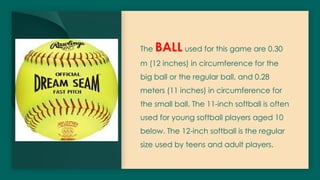
The BALL used for this game are 0.30
m (12 inches) in circumference for the
big ball or the regular ball, and 0.28
meters (11 inches) in circumference for
the small ball. The 11-inch softball is often
used for young softball players aged 10
below. The 12-inch softball is the regular
size used by teens and adult players.
The GLOVES used for softball
depend on many factors, including
the function of the player, their age,
and the type of softball pitch to be
played (fast or slow).
Important terms to remember in softball
• Point - The offensive team makes a point or score if the
runner passes through the three bases and reaches the
home plate.
• Strikeout - A player commits this when the batter fails to hit a
strike ball on the third throw.
• Out - A runner is "out" when the hit ball is caught by the first
baseman before the offensive player dashes toward the
plate; when a runner from the first base is tagged by the
second baseman before he touches the plate; or when the
batter makes a flying ball and it is caught by any of the
defenders.
• Home run - A home run occurs when the batter or runner
passes the bases continuously and reaches the home plate.
• Fly ball - This happens when the ball soars
up high on a trajectory after getting hit.
• Groundball - This happens when the ball
falls and rolls on the ground.
• Foul ball - This happens when the ball goes
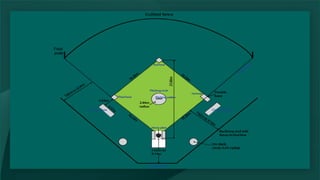
out of bounds or outside the diamond field.
• Strike zone - This is the area where the
batter can hit the ball. This should be the
imaginary line from the shoulder or the
armpit of the batter up to the knee level.
BASIC SKILLS IN SOFTBALL
• Striking or Batting - To execute this
skill, grip the handle of the bat with both hands.
Your dominant hand should be at the end portion,
while the other hand holds it to support. The body
stance is one foot (opposite your dominant hand)
forward. It should face the side where your
dominant hand is (e.g. right side if you are right-
handed). Position your bat slightly about your
shoulder. Watch the ball, especially when it is
about to be thrown by the pitcher, and always be
ready. After its release, hit the ball and execute a
follow-through movement.
• Throwing - There are two basic throws:
overhand and underhand. To execute the
overhand, with your dominant (e.g., right) hand,
hold the ball tightly. With your opposite foot (left)
forward, your other (left) arm and (left) hand must
be stretched forward, pointing at your target. Put
the ball at the rear of your neck and throw it
toward a teammate. Make a follow-through. To
execute the underhand throw, put your foot
(opposite to your dominant hand) forward. Hold
the ball at the rear of your hip level. Swing back
your arm and throw the ball. Make a follow-
through.
BASIC SKILLS IN SOFTBALL
• Pitching - This is one of the
defensive skills in softball. To
execute this skill, grip the ball using
three fingers: thumb, index, and
middle finger. You may use four
fingers so that the ring finger
serves as support for the release of
the ball. How to hold the ball while
pitching
• Catching - This is one of the most
important defensive skills. Without this, the offensive
team could score easily. To do this, execute a
ready stance: feet apart, at shoulder width, and
with knees bent. Put your hands in front. Make sure
your palms are open and facing the front. This
stance is appropriate for a fly ball. Make sure your
ungloved hand is positioned at the edge of the
other hand. Focus on the ball intently for you to
know its direction. If it is a ground ball, be sure that
your hands are positioned at the proper place.
Wait and catch the ball and hold it tight.
Product launch
• Currently gearing up for
a ground-breaking launch
• Our new offerings will
captivate the market
• Our marketing campaign
will generate anticipation
Q3
Market
research
Q4
Product
development
Q1
User testing
Q2
Product launch
c
Marketing strategies
Implement personalized engagement
strategies
Tailor campaigns to resonate with specific
demographics, fostering a sense of
relevance and connection
Collaborate with influencers and thought
leaders to amplify our brand message
Financial
overview
• Our financial overview reflects a robust and resilient
fiscal performance.
• Key indicators show consistent revenue growth
over the past quarter, attributed to strategic cost
management and successful marketing.
• Operating margins have improved, signaling
operational efficiency, while strengthening our
reserves.
• This underscores our commitment to financial
stability, positioning us for sustained growth.
Quarterly
targets
Quarter
Revenue
growth (%)
Market
share
increase
(%)
Customer
acquisition
Q1 12 2 500
Q2 15 3 600
Q3 18 4 700
Q4 20 5 800
• Market expansion
• Product innovation
• Customer retention
• Operational efficiency
Financial snapshot
Metric Current value Previous quarter Change (%)
Revenue $2,500,000 $2,200,000 +14%
Operating expenses $1,200,000 $1,400,000 -14%
Net profit $1,000,000 $800,000 +25%
Operating margin 40% 36% +4%
Cash reserves $5,000,000 $4,500,000 +11%
Innovative solutions
Thank You
Mirjam Nilsson
mirjam@contoso.com
www.contoso.com

SOFTBALL.pptxsdcedcscaecascedfascsvsdcewc

  • 1.
  • 2.
  • 3.
    George Hancock invented thesoftball. It was introduced in 1887 during the Thanks giving Day Celebration, where Harvard University students played a game of football against Yale University in Chicago. It was played as an indoor variation of baseball. It barrowed of elements of boxing and football.
  • 4.
  • 5.
    A BAT usedfor softball must not exceed 893 grams (31.5 ounces). Its length should not exceed 0.86 m (34 inches), and its diameter should not be more than 0.06 m (2.5 inches) along the barrel. Metal cleats on the soles of turf sneakers of the players are not allowed. Only hard rubber cleats are prescribed.
  • 6.
    The BALL usedfor this game are 0.30 m (12 inches) in circumference for the big ball or the regular ball, and 0.28 meters (11 inches) in circumference for the small ball. The 11-inch softball is often used for young softball players aged 10 below. The 12-inch softball is the regular size used by teens and adult players.
  • 7.
    The GLOVES usedfor softball depend on many factors, including the function of the player, their age, and the type of softball pitch to be played (fast or slow).
  • 9.
    Important terms toremember in softball • Point - The offensive team makes a point or score if the runner passes through the three bases and reaches the home plate. • Strikeout - A player commits this when the batter fails to hit a strike ball on the third throw. • Out - A runner is "out" when the hit ball is caught by the first baseman before the offensive player dashes toward the plate; when a runner from the first base is tagged by the second baseman before he touches the plate; or when the batter makes a flying ball and it is caught by any of the defenders. • Home run - A home run occurs when the batter or runner passes the bases continuously and reaches the home plate. • Fly ball - This happens when the ball soars up high on a trajectory after getting hit. • Groundball - This happens when the ball falls and rolls on the ground. • Foul ball - This happens when the ball goes out of bounds or outside the diamond field. • Strike zone - This is the area where the batter can hit the ball. This should be the imaginary line from the shoulder or the armpit of the batter up to the knee level.
  • 10.
    BASIC SKILLS INSOFTBALL • Striking or Batting - To execute this skill, grip the handle of the bat with both hands. Your dominant hand should be at the end portion, while the other hand holds it to support. The body stance is one foot (opposite your dominant hand) forward. It should face the side where your dominant hand is (e.g. right side if you are right- handed). Position your bat slightly about your shoulder. Watch the ball, especially when it is about to be thrown by the pitcher, and always be ready. After its release, hit the ball and execute a follow-through movement. • Throwing - There are two basic throws: overhand and underhand. To execute the overhand, with your dominant (e.g., right) hand, hold the ball tightly. With your opposite foot (left) forward, your other (left) arm and (left) hand must be stretched forward, pointing at your target. Put the ball at the rear of your neck and throw it toward a teammate. Make a follow-through. To execute the underhand throw, put your foot (opposite to your dominant hand) forward. Hold the ball at the rear of your hip level. Swing back your arm and throw the ball. Make a follow- through.
  • 11.
    BASIC SKILLS INSOFTBALL • Pitching - This is one of the defensive skills in softball. To execute this skill, grip the ball using three fingers: thumb, index, and middle finger. You may use four fingers so that the ring finger serves as support for the release of the ball. How to hold the ball while pitching • Catching - This is one of the most important defensive skills. Without this, the offensive team could score easily. To do this, execute a ready stance: feet apart, at shoulder width, and with knees bent. Put your hands in front. Make sure your palms are open and facing the front. This stance is appropriate for a fly ball. Make sure your ungloved hand is positioned at the edge of the other hand. Focus on the ball intently for you to know its direction. If it is a ground ball, be sure that your hands are positioned at the proper place. Wait and catch the ball and hold it tight.
  • 14.
    Product launch • Currentlygearing up for a ground-breaking launch • Our new offerings will captivate the market • Our marketing campaign will generate anticipation Q3 Market research Q4 Product development Q1 User testing Q2 Product launch
  • 15.
    c Marketing strategies Implement personalizedengagement strategies Tailor campaigns to resonate with specific demographics, fostering a sense of relevance and connection Collaborate with influencers and thought leaders to amplify our brand message
  • 16.
    Financial overview • Our financialoverview reflects a robust and resilient fiscal performance. • Key indicators show consistent revenue growth over the past quarter, attributed to strategic cost management and successful marketing. • Operating margins have improved, signaling operational efficiency, while strengthening our reserves. • This underscores our commitment to financial stability, positioning us for sustained growth.
  • 17.
    Quarterly targets Quarter Revenue growth (%) Market share increase (%) Customer acquisition Q1 122 500 Q2 15 3 600 Q3 18 4 700 Q4 20 5 800 • Market expansion • Product innovation • Customer retention • Operational efficiency
  • 18.
    Financial snapshot Metric Currentvalue Previous quarter Change (%) Revenue $2,500,000 $2,200,000 +14% Operating expenses $1,200,000 $1,400,000 -14% Net profit $1,000,000 $800,000 +25% Operating margin 40% 36% +4% Cash reserves $5,000,000 $4,500,000 +11%
  • 19.
  • 20.