• WELCOME TO INDIVIDUAL SEMINAR
PRESENTATION
TOPIC NAME : PLACE AND RELEVANCE OF
SOCIAL SCIENCE IN SCHOOL CURRICULUM
PRESENTED BY : SAYANTI PANJA
COURSE : 1.1.5
(PRACTICUM)
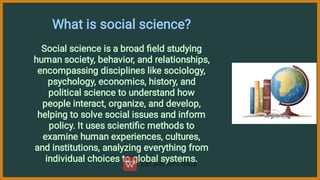
What is social science?
Social science is a broad field studying
human society, behavior, and relationships,
encompassing disciplines like sociology,
psychology, economics, history, and
political science to understand how
people interact, organize, and develop,
helping to solve social issues and inform
policy. It uses scientific methods to
examine human experiences, cultures,
and institutions, analyzing everything from
individual choices to global systems.
INTRODUCTION
Social Science holds a vital place in school
curricula as it studies human society, teaching
students history, geography, politics, and
economics to develop critical thinking, active
citizenship, cultural awareness, and problem-
solving skills for understanding and improving
their world.
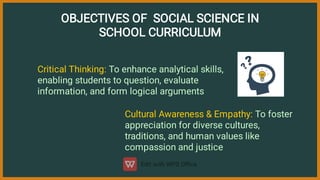
OBJECTIVES OF SOCIAL SCIENCE IN
SCHOOL CURRICULUM
Critical Thinking: To enhance analytical skills,
enabling students to question, evaluate
information, and form logical arguments
Cultural Awareness & Empathy: To foster
appreciation for diverse cultures,
traditions, and human values like
compassion and justice
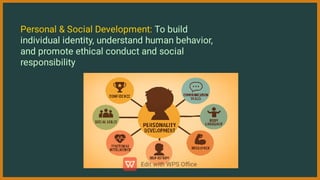
Personal & Social Development: To build
individual identity, understand human behavior,
and promote ethical conduct and social
responsibility
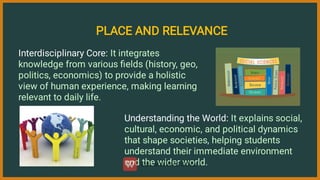
PLACE AND RELEVANCE
Interdisciplinary Core: It integrates
knowledge from various fields (history, geo,
politics, economics) to provide a holistic
view of human experience, making learning
relevant to daily life.
Understanding the World: It explains social,
cultural, economic, and political dynamics
that shape societies, helping students
understand their immediate environment
and the wider world.
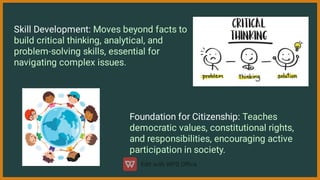
Skill Development: Moves beyond facts to
build critical thinking, analytical, and
problem-solving skills, essential for
navigating complex issues.
Foundation for Citizenship: Teaches
democratic values, constitutional rights,
and responsibilities, encouraging active
participation in society.
CONCLUSION
In 2025, social science remains a cornerstone of a well-rounded
school curriculum, serving as the primary vehicle for cultivating
informed, ethical, and active citizens in an increasingly complex
and digital world. Its place in the curriculum has evolved from
mere memorization of dates and facts to an interdisciplinary
inquiry that bridges history, geography, economics, and political
science to address modern challenges like climate change, social
justice, and global peace.
BIBLIOGRAPHY
•
Gyancharchar Chetra o Bisaysamuher Dharna (Bengali
Version) by Dr. Khagendranath Chattopadhyay & Dr.
Chandan Adhikari.
•
B.Ed. Practicum Ruprekha - 1st Semester by Dr. Bijon
Sarkar (available in Bengali and English).
Click here to add content of the text,
Click here to add text content ,Click
here to add content of the text,Click
here to add text content ,Click here to
add content of the text,Click here to
add text content ,
Enter title
Click here to add content of the text,
Click here to add text content ,Click
here to add content of the text,Click
here to add text content ,Click here to
add content of the text,Click here to
add text content ,
Enter title
Click here to add content of the text,
Click here to add text content ,Click
here to add content of the text,Click
here to add text content ,Click here to
add content of the text,Click here to
add text content ,
Enter title
Enter a headline
F O R S T U D E N T S
04
Click here to add content of the text,Click
here to add content of the text,Click here
to add text content ,
Enter title
Click here to add content of the text,Click
here to add content of the text,Click here
to add text content ,
Enter title
Click here to add content of the text,Click
here to add content of the text,Click here
to add text content ,
Enter title
T H A N K Y O U
F O R Y O U R A T T E N T I O N

Socialscienceisabroadfieldstudying humansociety,behavior,andrelationships.pdf

  • 1.
    • WELCOME TOINDIVIDUAL SEMINAR PRESENTATION
  • 2.
    TOPIC NAME :PLACE AND RELEVANCE OF SOCIAL SCIENCE IN SCHOOL CURRICULUM PRESENTED BY : SAYANTI PANJA COURSE : 1.1.5 (PRACTICUM)
  • 3.
    What is socialscience? Social science is a broad field studying human society, behavior, and relationships, encompassing disciplines like sociology, psychology, economics, history, and political science to understand how people interact, organize, and develop, helping to solve social issues and inform policy. It uses scientific methods to examine human experiences, cultures, and institutions, analyzing everything from individual choices to global systems.
  • 4.
    INTRODUCTION Social Science holdsa vital place in school curricula as it studies human society, teaching students history, geography, politics, and economics to develop critical thinking, active citizenship, cultural awareness, and problem- solving skills for understanding and improving their world.
  • 5.
    OBJECTIVES OF SOCIALSCIENCE IN SCHOOL CURRICULUM Critical Thinking: To enhance analytical skills, enabling students to question, evaluate information, and form logical arguments Cultural Awareness & Empathy: To foster appreciation for diverse cultures, traditions, and human values like compassion and justice
  • 6.
    Personal & SocialDevelopment: To build individual identity, understand human behavior, and promote ethical conduct and social responsibility
  • 7.
    PLACE AND RELEVANCE InterdisciplinaryCore: It integrates knowledge from various fields (history, geo, politics, economics) to provide a holistic view of human experience, making learning relevant to daily life. Understanding the World: It explains social, cultural, economic, and political dynamics that shape societies, helping students understand their immediate environment and the wider world.
  • 8.
    Skill Development: Movesbeyond facts to build critical thinking, analytical, and problem-solving skills, essential for navigating complex issues. Foundation for Citizenship: Teaches democratic values, constitutional rights, and responsibilities, encouraging active participation in society.
  • 9.
    CONCLUSION In 2025, socialscience remains a cornerstone of a well-rounded school curriculum, serving as the primary vehicle for cultivating informed, ethical, and active citizens in an increasingly complex and digital world. Its place in the curriculum has evolved from mere memorization of dates and facts to an interdisciplinary inquiry that bridges history, geography, economics, and political science to address modern challenges like climate change, social justice, and global peace.
  • 10.
    BIBLIOGRAPHY • Gyancharchar Chetra oBisaysamuher Dharna (Bengali Version) by Dr. Khagendranath Chattopadhyay & Dr. Chandan Adhikari. • B.Ed. Practicum Ruprekha - 1st Semester by Dr. Bijon Sarkar (available in Bengali and English).
  • 14.
    Click here toadd content of the text, Click here to add content of the text, Click here to add text content ,Click here to add content of the text,Click here to add content of the text,Click here to add text content ,Click here to add content of the text,Click here to add content of the text,Click here to add text content , Enter title Click here to add content of the text, Click here to add content of the text, Click here to add text content ,Click here to add content of the text,Click here to add content of the text,Click here to add text content ,Click here to add content of the text,Click here to add content of the text,Click here to add text content , Enter title Click here to add content of the text, Click here to add content of the text, Click here to add text content ,Click here to add content of the text,Click here to add content of the text,Click here to add text content ,Click here to add content of the text,Click here to add content of the text,Click here to add text content , Enter title
  • 15.
    Enter a headline FO R S T U D E N T S 04
  • 16.
    Click here toadd content of the text,Click here to add content of the text,Click here to add text content , Enter title Click here to add content of the text,Click here to add content of the text,Click here to add text content , Enter title Click here to add content of the text,Click here to add content of the text,Click here to add text content , Enter title
  • 17.
    T H AN K Y O U F O R Y O U R A T T E N T I O N