National Academy of Social Insurance • www.nasi.org
August 2020
 
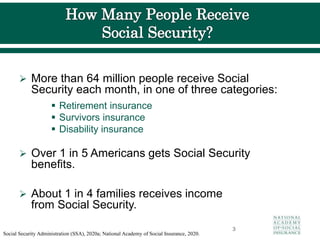
 More than 64 million people receive Social
Security each month, in one of three categories:
 Retirement insurance
 Survivors insurance
 Disability insurance
 Over 1 in 5 Americans gets Social Security
benefits.
 About 1 in 4 families receives income
from Social Security.
3
Social Security Administration (SSA), 2020a; National Academy of Social Insurance, 2020.
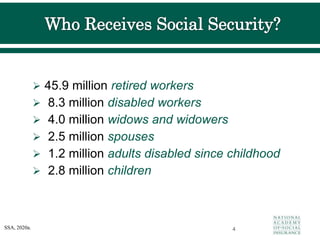
 45.9 million retired workers
 8.3 million disabled workers
 4.0 million widows and widowers
 2.5 million spouses
 1.2 million adults disabled since childhood
 2.8 million children
4
SSA, 2020a.
5
SSA, 2020a. SSA, 2020b.
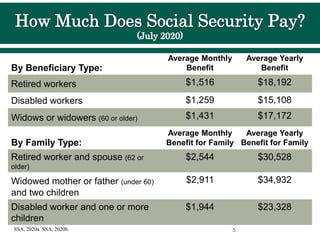
By Beneficiary Type:
Average Monthly
Benefit
Average Yearly
Benefit
Retired workers $1,516 $18,192
Disabled workers $1,259 $15,108
Widows or widowers (60 or older) $1,431 $17,172
By Family Type:
Average Monthly
Benefit for Family
Average Yearly
Benefit for Family
Retired worker and spouse (62 or
older)
$2,544 $30,528
Widowed mother or father (under 60)
and two children
$2,911 $34,932
Disabled worker and one or more
children
$1,944 $23,328
6
SSA, 2020c.
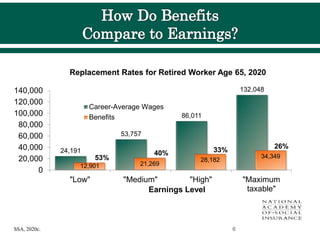
24,191
53,757
86,011
132,048
12,901 21,269
28,182
34,349
0
20,000
40,000
60,000
80,000
100,000
120,000
140,000
"Low" "Medium" "High" "Maximum
taxable"
Earnings Level
Replacement Rates for Retired Worker Age 65, 2020
Career-Average Wages
Benefits
53%
40%
26%
33%
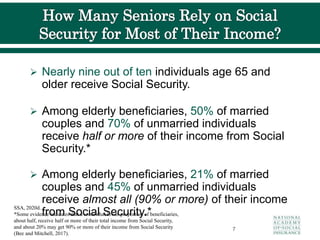
 Nearly nine out of ten individuals age 65 and
older receive Social Security.
 Among elderly beneficiaries, 50% of married
couples and 70% of unmarried individuals
receive half or more of their income from Social
Security.*
 Among elderly beneficiaries, 21% of married
couples and 45% of unmarried individuals
receive almost all (90% or more) of their income
from Social Security.*
7
SSA, 2020d.
*Some evidence indicates that a somewhat lower proportion of beneficiaries,
about half, receive half or more of their total income from Social Security,
and about 20% may get 90% or more of their income from Social Security
(Bee and Mitchell, 2017).
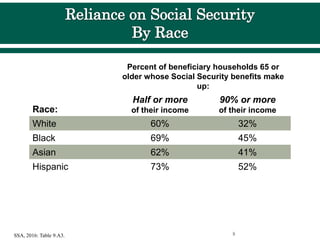
Percent of beneficiary households 65 or
older whose Social Security benefits make
up:
Race:
Half or more
of their income
90% or more
of their income
White 60% 32%
Black 69% 45%
Asian 62% 41%
Hispanic 73% 52%
8
SSA, 2016: Table 9.A3.
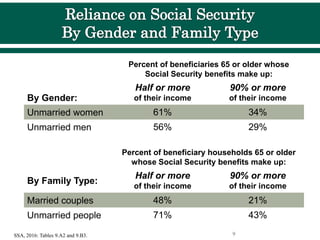
Percent of beneficiaries 65 or older whose
Social Security benefits make up:
By Gender:
Half or more
of their income
90% or more
of their income
Unmarried women 61% 34%
Unmarried men 56% 29%
Percent of beneficiary households 65 or older
whose Social Security benefits make up:
By Family Type:
Half or more
of their income
90% or more
of their income
Married couples 48% 21%
Unmarried people 71% 43%
9
SSA, 2016: Tables 9.A2 and 9.B3.
10
Gregory et al., 2010.
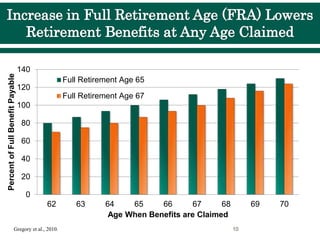
0
20
40
60
80
100
120
140
62 63 64 65 66 67 68 69 70
Percent
of
Full
Benefit
Payable
Age When Benefits are Claimed
Full Retirement Age 65
Full Retirement Age 67
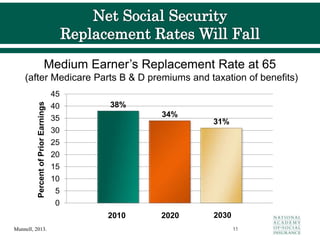
Munnell, 2013.
Medium Earner’s Replacement Rate at 65
(after Medicare Parts B & D premiums and taxation of benefits)
11
38%
34%
31%
0
5
10
15
20
25
30
35
40
45
Percent
of
Prior
Earnings
2010 2020 2030
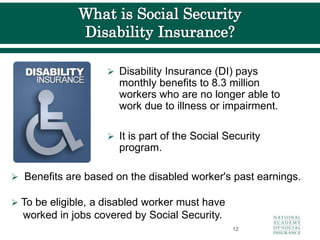
 Disability Insurance (DI) pays
monthly benefits to 8.3 million
workers who are no longer able to
work due to illness or impairment.
 It is part of the Social Security
program.
 Benefits are based on the disabled worker's past earnings.
 To be eligible, a disabled worker must have
worked in jobs covered by Social Security.
12
SSA, 2019: Table 21. 13
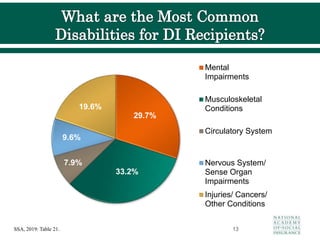
29.7%
33.2%
7.9%
9.6%
19.6%
Mental
Impairments
Musculoskeletal
Conditions
Circulatory System
Nervous System/
Sense Organ
Impairments
Injuries/ Cancers/
Other Conditions
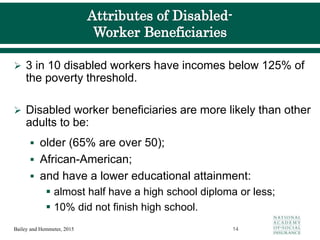
 3 in 10 disabled workers have incomes below 125% of
the poverty threshold.
 Disabled worker beneficiaries are more likely than other
adults to be:
 older (65% are over 50);
 African-American;
 and have a lower educational attainment:
 almost half have a high school diploma or less;
 10% did not finish high school.
14
Bailey and Hemmeter, 2015
 Workers and their
employers pay with
Social Security
contributions under the
Federal Insurance
Contributions Act
(FICA).
15
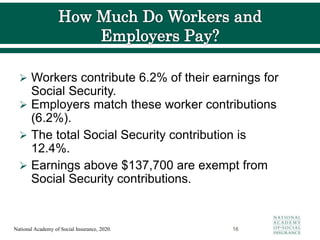
 Workers contribute 6.2% of their earnings for
Social Security.
 Employers match these worker contributions
(6.2%).
 The total Social Security contribution is
12.4%.
 Earnings above $137,700 are exempt from
Social Security contributions.
16
National Academy of Social Insurance, 2020.
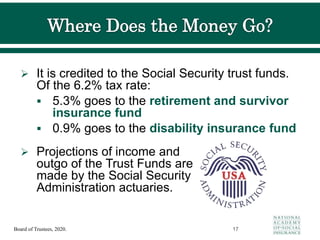
 It is credited to the Social Security trust funds.
Of the 6.2% tax rate:
 5.3% goes to the retirement and survivor
insurance fund
 0.9% goes to the disability insurance fund
 Projections of income and
outgo of the Trust Funds are
made by the Social Security
Administration actuaries.
17
Board of Trustees, 2020.
 
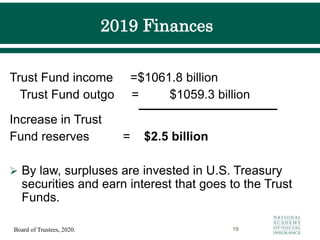
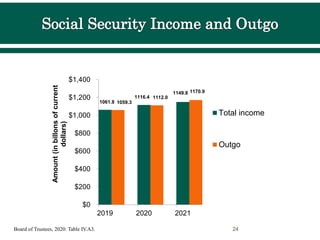
Trust Fund income =$1061.8 billion
Trust Fund outgo = $1059.3 billion
Increase in Trust
Fund reserves = $2.5 billion
 By law, surpluses are invested in U.S. Treasury
securities and earn interest that goes to the Trust
Funds.
19
Board of Trustees, 2020.
20
Board of Trustees, 2020: Table IV.A3.
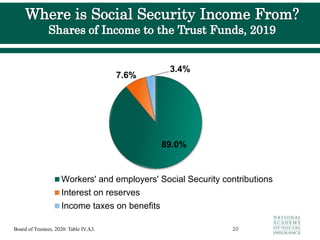
89.0%
7.6%
3.4%
Workers' and employers' Social Security contributions
Interest on reserves
Income taxes on benefits
 Social Security income that is not used
immediately to pay benefits and costs is invested
in special-issue Treasury securities (or bonds).
 The bonds earn interest that is credited to the
trust funds.
 The accumulated surpluses held in Treasury
securities are called Social Security reserves, or
trust fund assets.
 The Treasury securities are secure investments
that are backed by the full faith and credit of the
United States government.
21
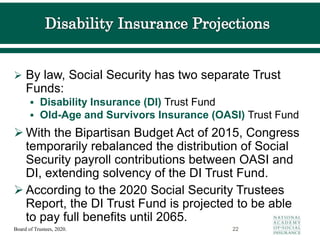
 By law, Social Security has two separate Trust
Funds:
 Disability Insurance (DI) Trust Fund
 Old-Age and Survivors Insurance (OASI) Trust Fund
 With the Bipartisan Budget Act of 2015, Congress
temporarily rebalanced the distribution of Social
Security payroll contributions between OASI and
DI, extending solvency of the DI Trust Fund.
 According to the 2020 Social Security Trustees
Report, the DI Trust Fund is projected to be able
to pay full benefits until 2065.
22
Board of Trustees, 2020.
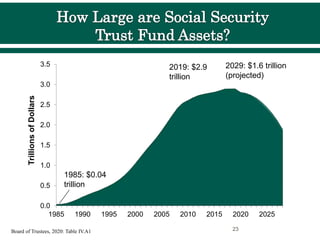
Board of Trustees, 2020: Table IV.A1 23
0.0
0.5
1.0
1.5
2.0
2.5
3.0
3.5
1985 1990 1995 2000 2005 2010 2015 2020 2025
Trillions
of
Dollars
2019: $2.9
trillion
2029: $1.6 trillion
(projected)
1985: $0.04
trillion
Board of Trustees, 2020: Table IV.A3. 24
1059.3
1112.0
1170.9
1061.8
1116.4
1149.8
$0
$200
$400
$600
$800
$1,000
$1,200
$1,400
2019 2020 2021
Amount
(in
billons
of
current
dollars)
Total income
Outgo
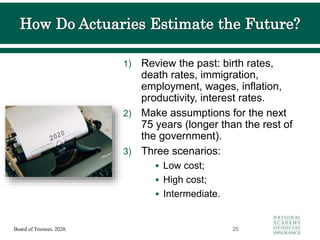
1) Review the past: birth rates,
death rates, immigration,
employment, wages, inflation,
productivity, interest rates.
2) Make assumptions for the next
75 years (longer than the rest of
the government).
3) Three scenarios:
 Low cost;
 High cost;
 Intermediate.
25
Board of Trustees, 2020.
 In 2021, revenue from payroll contributions, interest
on reserves, and taxation of benefits is expected to
be less than total outgo for the year. If action is not
taken in the near future, reserves will start to be
drawn down to pay benefits next year.
 In 2035, Trust Fund reserves are projected to be
depleted. Income is projected to cover 79% of
benefits due then.
 By 2094, assuming no change in taxes, benefits
or assumptions, revenue would cover about 73%
of benefits due in that year.
26
Board of Trustees, 2020.
27
Board of Trustees, 2020.
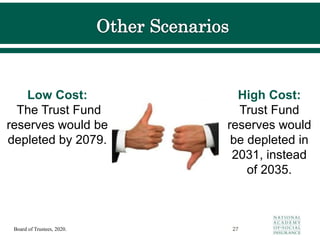
High Cost:
Trust Fund
reserves would
be depleted in
2031, instead
of 2035.
Low Cost:
The Trust Fund
reserves would be
depleted by 2079.
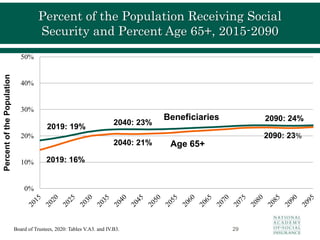
 The share of Americans over age 65 will grow
because:
 Boomers are reaching age 65
 People are living longer after age 65
 Birth rates are projected to remain at
replacement levels.
 People 65 and older will increase from
16% to 23% of all Americans by 2095.
28
Board of Trustees, 2020: Table V.A3.
Board of Trustees, 2020: Tables V.A3. and IV.B3.
Percent of the Population Receiving Social
Security and Percent Age 65+, 2015-2090
29
0%
10%
20%
30%
40%
50%
Percent
of
the
Population
Beneficiaries
Age 65+
2019: 19%
2019: 16%
2040: 21%
2090: 24%
2090: 23%
2040: 23%
Beneficiaries
Age 65+
2019: 19%
2019: 16%
2040: 21%
2090: 24%
2090: 23%
2040: 23%
 
Board of Trustees, 2020: Table VI.G4. 31
0%
1%
2%
3%
4%
5%
6%
7%
8%
9%
10%
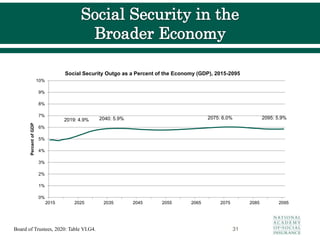
2015 2025 2035 2045 2055 2065 2075 2085 2095
Percent
of
GDP
Social Security Outgo as a Percent of the Economy (GDP), 2015-2095
2075: 6.0%
2019: 4.9% 2095: 5.9%
2040: 5.9%
Board of Trustees, 2020: Tables VI.G4 and VI.G5. 32
0%
5%
10%
15%
20%
25%
30%
35%
40%
2015 2025 2035 2045 2055 2065 2075 2085 2095
Percent
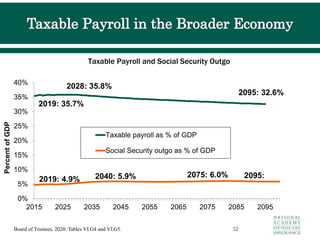
of
GDP
Taxable payroll as % of GDP
Social Security outgo as % of GDP
2095:
Taxable Payroll and Social Security Outgo
2019: 4.9% 2040: 5.9%
2028: 35.8%
2019: 35.7%
2095: 32.6%
2075: 6.0%
 
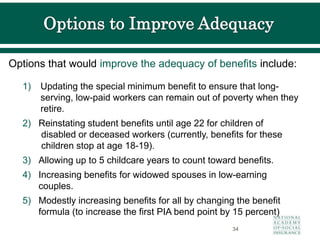
Options that would improve the adequacy of benefits include:
1) Updating the special minimum benefit to ensure that long-
serving, low-paid workers can remain out of poverty when they
retire.
2) Reinstating student benefits until age 22 for children of
disabled or deceased workers (currently, benefits for these
children stop at age 18-19).
3) Allowing up to 5 childcare years to count toward benefits.
4) Increasing benefits for widowed spouses in low-earning
couples.
5) Modestly increasing benefits for all by changing the benefit
formula (to increase the first PIA bend point by 15 percent)
34
Options that would help raise revenues include:
1) Lifting or eliminating the cap (now $137,700) on the earnings on
which workers and their employers pay Social Security
contributions.
2) Gradually increasing the Social Security contribution rate from
its current level of 6.2%.
3) Subjecting income from investments to Social Security
contributions.
4) Treating all salary reduction plans like 401(k)s (subjecting
income paid into them to Social Security contributions).
5) Restoring estate tax to 2000 level and dedicating to Social
Security. 35
Some proposals would reduce benefits for some or all
beneficiaries in order to extend solvency.
 For example, raising the retirement age amounts to
an across-the-board cut in benefits, and hence
reduces the program’s cost.
 Switching to the chained CPI as the basis for Social
Security’s cost-of-living adjustments (COLAs) would
reduce benefits and hence program cost as well.
36
Reno and Lavery, 2009.
 
 In 2014, the Academy conducted a multigenerational
study to understand Americans’ perspectives on Social
Security.
 In focus groups, Americans expressed concern about
benefits being too low.
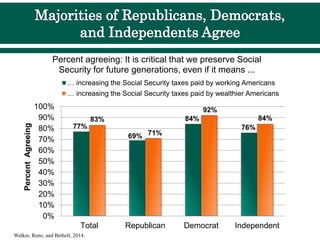
 77% said it is critical to preserve Social Security benefits,
even if it means raising taxes on working Americans.
38
Walker, Reno, and Bethell, 2014.
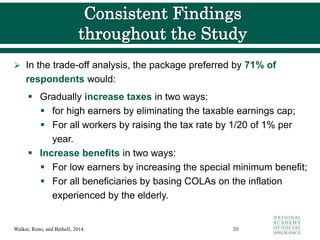
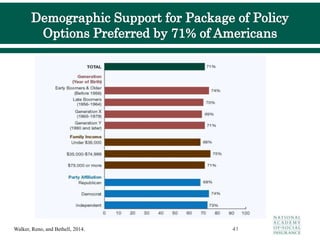
 In the trade-off analysis, the package preferred by 71% of
respondents would:
 Gradually increase taxes in two ways:
 for high earners by eliminating the taxable earnings cap;
 For all workers by raising the tax rate by 1/20 of 1% per
year.
 Increase benefits in two ways:
 For low earners by increasing the special minimum benefit;
 For all beneficiaries by basing COLAs on the inflation
experienced by the elderly.
39
Walker, Reno, and Bethell, 2014.
77%
69%
84%
76%
83%
71%
92%
84%
0%
10%
20%
30%
40%
50%
60%
70%
80%
90%
100%
Total Republican Democrat Independent
Percent
Agreeing
Percent agreeing: It is critical that we preserve Social
Security for future generations, even if it means ...
… increasing the Social Security taxes paid by working Americans
… increasing the Social Security taxes paid by wealthier Americans
Walker, Reno, and Bethell, 2014.
Walker, Reno, and Bethell, 2014. 41
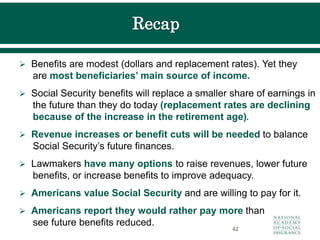
 Benefits are modest (dollars and replacement rates). Yet they
are most beneficiaries’ main source of income.
 Social Security benefits will replace a smaller share of earnings in
the future than they do today (replacement rates are declining
because of the increase in the retirement age).
 Revenue increases or benefit cuts will be needed to balance
Social Security’s future finances.
 Lawmakers have many options to raise revenues, lower future
benefits, or increase benefits to improve adequacy.
 Americans value Social Security and are willing to pay for it.
 Americans report they would rather pay more than
see future benefits reduced.
42
• Bailey, Michelle Stegman and Jeffrey Hemmeter. 2015. “Characteristics of Noninstitutionalized DI
and SSI Program Participants, 2013 Update.” Research and Statistics Note No. 2015-02.
Washington, DC: Social Security Administration. http://www.ssa.gov/policy/docs/rsnotes/rsn2015-
02.html
• Bee, Adam and Joshua Mitchell, 2017. “Do Older Americans Have More Income Than We Think?”
U.S. Census Bureau Social, Economic, and Housing Statistics Division Working Paper #2017-39,
https://www.census.gov/content/dam/Census/library/working-papers/2017/demo/SEHSD-
WP2017-39.pdf.
• Board of Trustees. 2020. The 2020 Annual Report of the Board of Trustees of the Federal Old-Age
and Survivors Insurance and Federal Disability Insurance Trust Funds. Washington, DC: Social
Security Administration.
• Gregory, Janice M., Thomas N. Bethell, Virginia P. Reno, and Benjamin W. Veghte. 2010.
“Strengthening Social Security for the Long Run.” Social Security Brief No. 35. Washington, DC:
National Academy of Social Insurance.
• Munnell, Alicia H. 2013. “Social Security’s Real Retirement Age is 70.” Brief No. 13-15. Chesnut
Hill, MA: Center for Retirement Research at Boston College.
• National Academy of Social Insurance. 2020. “Social Security Finances: Findings of the 2020
Trustees Report.” Washington, DC: National Academy of Social Insurance.
https://www.nasi.org/research/2020/social-security-finances-findings-2020-trustees-report
• Reno, Virginia P. and Joni Lavery. 2009. Fixing Social Security: Adequate Benefits, Adequate
Financing. Washington, DC: National Academy of Social Insurance.
• Reno, Virginia P., Elisa A. Walker, and Thomas N. Bethell. 2013. “Social Security Disability
Insurance: Action Needed to Address Finances.” Social Security Brief No. 41. Washington, DC:
National Academy of Social Insurance.
• Social Security Administration. 2020a. “Beneficiary Data: Number of Social Security beneficiaries
at the end of July of 2020.” Baltimore, MD: Social Security Administration, Office of the Chief
Actuary. www.ssa.gov/cgi-bin/currentpay.cgi
• Social Security Administration. 2020b. “Beneficiary Data: Benefits Paid by Type of Family.” Data
for July of 2020. Baltimore, MD: Social Security Administration, Office of the Chief Actuary.
www.ssa.gov/OACT/ProgData/famben.html
• Social Security Administration. 2020c. “Replacement Rates For Hypothetical Retired Workers.”
Actuarial Note #2020.9. Baltimore, MD: Social Security Administration, Office of the Chief Actuary.
https://www.ssa.gov/OACT/NOTES/ran9/index.html
• Social Security Administration. 2020d. “Fact Sheet: Social Security”. Data for December 2019.
Baltimore, MD: Social Security Administration, Office of the Chief Actuary.
https://www.ssa.gov/news/press/factsheets/basicfact-alt.pdf
• Social Security Administration. 2019. Annual Statistical Report on the Social Security Disability
Insurance Program, 2018. Washington, DC: Social Security Administration, Office of Research,
Evaluation, and Statistics. https://www.ssa.gov/policy/docs/statcomps/di_asr/index.html
• Social Security Administration. 2016. Income of the Population 55 or Older, 2014. Washington,
DC: Social Security Administration, Office of Research, Evaluation, and Statistics.
• Walker, Elisa A., Virginia P. Reno, and Thomas N. Bethell. 2014. Americans Make Hard Choices
on Social Security: A Survey with Trade-Off Analysis. Washington, DC: National Academy of
Social Insurance.

Social Security-Primer.pptx

  • 1.
    National Academy ofSocial Insurance • www.nasi.org August 2020
  • 2.
  • 3.
     More than64 million people receive Social Security each month, in one of three categories:  Retirement insurance  Survivors insurance  Disability insurance  Over 1 in 5 Americans gets Social Security benefits.  About 1 in 4 families receives income from Social Security. 3 Social Security Administration (SSA), 2020a; National Academy of Social Insurance, 2020.
  • 4.
     45.9 millionretired workers  8.3 million disabled workers  4.0 million widows and widowers  2.5 million spouses  1.2 million adults disabled since childhood  2.8 million children 4 SSA, 2020a.
  • 5.
    5 SSA, 2020a. SSA,2020b. By Beneficiary Type: Average Monthly Benefit Average Yearly Benefit Retired workers $1,516 $18,192 Disabled workers $1,259 $15,108 Widows or widowers (60 or older) $1,431 $17,172 By Family Type: Average Monthly Benefit for Family Average Yearly Benefit for Family Retired worker and spouse (62 or older) $2,544 $30,528 Widowed mother or father (under 60) and two children $2,911 $34,932 Disabled worker and one or more children $1,944 $23,328
  • 6.
    6 SSA, 2020c. 24,191 53,757 86,011 132,048 12,901 21,269 28,182 34,349 0 20,000 40,000 60,000 80,000 100,000 120,000 140,000 "Low""Medium" "High" "Maximum taxable" Earnings Level Replacement Rates for Retired Worker Age 65, 2020 Career-Average Wages Benefits 53% 40% 26% 33%
  • 7.
     Nearly nineout of ten individuals age 65 and older receive Social Security.  Among elderly beneficiaries, 50% of married couples and 70% of unmarried individuals receive half or more of their income from Social Security.*  Among elderly beneficiaries, 21% of married couples and 45% of unmarried individuals receive almost all (90% or more) of their income from Social Security.* 7 SSA, 2020d. *Some evidence indicates that a somewhat lower proportion of beneficiaries, about half, receive half or more of their total income from Social Security, and about 20% may get 90% or more of their income from Social Security (Bee and Mitchell, 2017).
  • 8.
    Percent of beneficiaryhouseholds 65 or older whose Social Security benefits make up: Race: Half or more of their income 90% or more of their income White 60% 32% Black 69% 45% Asian 62% 41% Hispanic 73% 52% 8 SSA, 2016: Table 9.A3.
  • 9.
    Percent of beneficiaries65 or older whose Social Security benefits make up: By Gender: Half or more of their income 90% or more of their income Unmarried women 61% 34% Unmarried men 56% 29% Percent of beneficiary households 65 or older whose Social Security benefits make up: By Family Type: Half or more of their income 90% or more of their income Married couples 48% 21% Unmarried people 71% 43% 9 SSA, 2016: Tables 9.A2 and 9.B3.
  • 10.
    10 Gregory et al.,2010. 0 20 40 60 80 100 120 140 62 63 64 65 66 67 68 69 70 Percent of Full Benefit Payable Age When Benefits are Claimed Full Retirement Age 65 Full Retirement Age 67
  • 11.
    Munnell, 2013. Medium Earner’sReplacement Rate at 65 (after Medicare Parts B & D premiums and taxation of benefits) 11 38% 34% 31% 0 5 10 15 20 25 30 35 40 45 Percent of Prior Earnings 2010 2020 2030
  • 12.
     Disability Insurance(DI) pays monthly benefits to 8.3 million workers who are no longer able to work due to illness or impairment.  It is part of the Social Security program.  Benefits are based on the disabled worker's past earnings.  To be eligible, a disabled worker must have worked in jobs covered by Social Security. 12
  • 13.
    SSA, 2019: Table21. 13 29.7% 33.2% 7.9% 9.6% 19.6% Mental Impairments Musculoskeletal Conditions Circulatory System Nervous System/ Sense Organ Impairments Injuries/ Cancers/ Other Conditions
  • 14.
     3 in10 disabled workers have incomes below 125% of the poverty threshold.  Disabled worker beneficiaries are more likely than other adults to be:  older (65% are over 50);  African-American;  and have a lower educational attainment:  almost half have a high school diploma or less;  10% did not finish high school. 14 Bailey and Hemmeter, 2015
  • 15.
     Workers andtheir employers pay with Social Security contributions under the Federal Insurance Contributions Act (FICA). 15
  • 16.
     Workers contribute6.2% of their earnings for Social Security.  Employers match these worker contributions (6.2%).  The total Social Security contribution is 12.4%.  Earnings above $137,700 are exempt from Social Security contributions. 16 National Academy of Social Insurance, 2020.
  • 17.
     It iscredited to the Social Security trust funds. Of the 6.2% tax rate:  5.3% goes to the retirement and survivor insurance fund  0.9% goes to the disability insurance fund  Projections of income and outgo of the Trust Funds are made by the Social Security Administration actuaries. 17 Board of Trustees, 2020.
  • 18.
  • 19.
    Trust Fund income=$1061.8 billion Trust Fund outgo = $1059.3 billion Increase in Trust Fund reserves = $2.5 billion  By law, surpluses are invested in U.S. Treasury securities and earn interest that goes to the Trust Funds. 19 Board of Trustees, 2020.
  • 20.
    20 Board of Trustees,2020: Table IV.A3. 89.0% 7.6% 3.4% Workers' and employers' Social Security contributions Interest on reserves Income taxes on benefits
  • 21.
     Social Securityincome that is not used immediately to pay benefits and costs is invested in special-issue Treasury securities (or bonds).  The bonds earn interest that is credited to the trust funds.  The accumulated surpluses held in Treasury securities are called Social Security reserves, or trust fund assets.  The Treasury securities are secure investments that are backed by the full faith and credit of the United States government. 21
  • 22.
     By law,Social Security has two separate Trust Funds:  Disability Insurance (DI) Trust Fund  Old-Age and Survivors Insurance (OASI) Trust Fund  With the Bipartisan Budget Act of 2015, Congress temporarily rebalanced the distribution of Social Security payroll contributions between OASI and DI, extending solvency of the DI Trust Fund.  According to the 2020 Social Security Trustees Report, the DI Trust Fund is projected to be able to pay full benefits until 2065. 22 Board of Trustees, 2020.
  • 23.
    Board of Trustees,2020: Table IV.A1 23 0.0 0.5 1.0 1.5 2.0 2.5 3.0 3.5 1985 1990 1995 2000 2005 2010 2015 2020 2025 Trillions of Dollars 2019: $2.9 trillion 2029: $1.6 trillion (projected) 1985: $0.04 trillion
  • 24.
    Board of Trustees,2020: Table IV.A3. 24 1059.3 1112.0 1170.9 1061.8 1116.4 1149.8 $0 $200 $400 $600 $800 $1,000 $1,200 $1,400 2019 2020 2021 Amount (in billons of current dollars) Total income Outgo
  • 25.
    1) Review thepast: birth rates, death rates, immigration, employment, wages, inflation, productivity, interest rates. 2) Make assumptions for the next 75 years (longer than the rest of the government). 3) Three scenarios:  Low cost;  High cost;  Intermediate. 25 Board of Trustees, 2020.

  • 26.
     In 2021,revenue from payroll contributions, interest on reserves, and taxation of benefits is expected to be less than total outgo for the year. If action is not taken in the near future, reserves will start to be drawn down to pay benefits next year.  In 2035, Trust Fund reserves are projected to be depleted. Income is projected to cover 79% of benefits due then.  By 2094, assuming no change in taxes, benefits or assumptions, revenue would cover about 73% of benefits due in that year. 26 Board of Trustees, 2020.
  • 27.
    27 Board of Trustees,2020. High Cost: Trust Fund reserves would be depleted in 2031, instead of 2035. Low Cost: The Trust Fund reserves would be depleted by 2079.
  • 28.
     The shareof Americans over age 65 will grow because:  Boomers are reaching age 65  People are living longer after age 65  Birth rates are projected to remain at replacement levels.  People 65 and older will increase from 16% to 23% of all Americans by 2095. 28 Board of Trustees, 2020: Table V.A3.
  • 29.
    Board of Trustees,2020: Tables V.A3. and IV.B3. Percent of the Population Receiving Social Security and Percent Age 65+, 2015-2090 29 0% 10% 20% 30% 40% 50% Percent of the Population Beneficiaries Age 65+ 2019: 19% 2019: 16% 2040: 21% 2090: 24% 2090: 23% 2040: 23% Beneficiaries Age 65+ 2019: 19% 2019: 16% 2040: 21% 2090: 24% 2090: 23% 2040: 23%
  • 30.
  • 31.
    Board of Trustees,2020: Table VI.G4. 31 0% 1% 2% 3% 4% 5% 6% 7% 8% 9% 10% 2015 2025 2035 2045 2055 2065 2075 2085 2095 Percent of GDP Social Security Outgo as a Percent of the Economy (GDP), 2015-2095 2075: 6.0% 2019: 4.9% 2095: 5.9% 2040: 5.9%
  • 32.
    Board of Trustees,2020: Tables VI.G4 and VI.G5. 32 0% 5% 10% 15% 20% 25% 30% 35% 40% 2015 2025 2035 2045 2055 2065 2075 2085 2095 Percent of GDP Taxable payroll as % of GDP Social Security outgo as % of GDP 2095: Taxable Payroll and Social Security Outgo 2019: 4.9% 2040: 5.9% 2028: 35.8% 2019: 35.7% 2095: 32.6% 2075: 6.0%
  • 33.
  • 34.
    Options that wouldimprove the adequacy of benefits include: 1) Updating the special minimum benefit to ensure that long- serving, low-paid workers can remain out of poverty when they retire. 2) Reinstating student benefits until age 22 for children of disabled or deceased workers (currently, benefits for these children stop at age 18-19). 3) Allowing up to 5 childcare years to count toward benefits. 4) Increasing benefits for widowed spouses in low-earning couples. 5) Modestly increasing benefits for all by changing the benefit formula (to increase the first PIA bend point by 15 percent) 34
  • 35.
    Options that wouldhelp raise revenues include: 1) Lifting or eliminating the cap (now $137,700) on the earnings on which workers and their employers pay Social Security contributions. 2) Gradually increasing the Social Security contribution rate from its current level of 6.2%. 3) Subjecting income from investments to Social Security contributions. 4) Treating all salary reduction plans like 401(k)s (subjecting income paid into them to Social Security contributions). 5) Restoring estate tax to 2000 level and dedicating to Social Security. 35

  • 36.
    Some proposals wouldreduce benefits for some or all beneficiaries in order to extend solvency.  For example, raising the retirement age amounts to an across-the-board cut in benefits, and hence reduces the program’s cost.  Switching to the chained CPI as the basis for Social Security’s cost-of-living adjustments (COLAs) would reduce benefits and hence program cost as well. 36 Reno and Lavery, 2009.
  • 37.
  • 38.
     In 2014,the Academy conducted a multigenerational study to understand Americans’ perspectives on Social Security.  In focus groups, Americans expressed concern about benefits being too low.  77% said it is critical to preserve Social Security benefits, even if it means raising taxes on working Americans. 38 Walker, Reno, and Bethell, 2014.
  • 39.
     In thetrade-off analysis, the package preferred by 71% of respondents would:  Gradually increase taxes in two ways:  for high earners by eliminating the taxable earnings cap;  For all workers by raising the tax rate by 1/20 of 1% per year.  Increase benefits in two ways:  For low earners by increasing the special minimum benefit;  For all beneficiaries by basing COLAs on the inflation experienced by the elderly. 39 Walker, Reno, and Bethell, 2014.
  • 40.
    77% 69% 84% 76% 83% 71% 92% 84% 0% 10% 20% 30% 40% 50% 60% 70% 80% 90% 100% Total Republican DemocratIndependent Percent Agreeing Percent agreeing: It is critical that we preserve Social Security for future generations, even if it means ... … increasing the Social Security taxes paid by working Americans … increasing the Social Security taxes paid by wealthier Americans Walker, Reno, and Bethell, 2014.
  • 41.
    Walker, Reno, andBethell, 2014. 41
  • 42.
     Benefits aremodest (dollars and replacement rates). Yet they are most beneficiaries’ main source of income.  Social Security benefits will replace a smaller share of earnings in the future than they do today (replacement rates are declining because of the increase in the retirement age).  Revenue increases or benefit cuts will be needed to balance Social Security’s future finances.  Lawmakers have many options to raise revenues, lower future benefits, or increase benefits to improve adequacy.  Americans value Social Security and are willing to pay for it.  Americans report they would rather pay more than see future benefits reduced. 42
  • 43.
    • Bailey, MichelleStegman and Jeffrey Hemmeter. 2015. “Characteristics of Noninstitutionalized DI and SSI Program Participants, 2013 Update.” Research and Statistics Note No. 2015-02. Washington, DC: Social Security Administration. http://www.ssa.gov/policy/docs/rsnotes/rsn2015- 02.html • Bee, Adam and Joshua Mitchell, 2017. “Do Older Americans Have More Income Than We Think?” U.S. Census Bureau Social, Economic, and Housing Statistics Division Working Paper #2017-39, https://www.census.gov/content/dam/Census/library/working-papers/2017/demo/SEHSD- WP2017-39.pdf. • Board of Trustees. 2020. The 2020 Annual Report of the Board of Trustees of the Federal Old-Age and Survivors Insurance and Federal Disability Insurance Trust Funds. Washington, DC: Social Security Administration. • Gregory, Janice M., Thomas N. Bethell, Virginia P. Reno, and Benjamin W. Veghte. 2010. “Strengthening Social Security for the Long Run.” Social Security Brief No. 35. Washington, DC: National Academy of Social Insurance. • Munnell, Alicia H. 2013. “Social Security’s Real Retirement Age is 70.” Brief No. 13-15. Chesnut Hill, MA: Center for Retirement Research at Boston College. • National Academy of Social Insurance. 2020. “Social Security Finances: Findings of the 2020 Trustees Report.” Washington, DC: National Academy of Social Insurance. https://www.nasi.org/research/2020/social-security-finances-findings-2020-trustees-report • Reno, Virginia P. and Joni Lavery. 2009. Fixing Social Security: Adequate Benefits, Adequate Financing. Washington, DC: National Academy of Social Insurance.
  • 44.
    • Reno, VirginiaP., Elisa A. Walker, and Thomas N. Bethell. 2013. “Social Security Disability Insurance: Action Needed to Address Finances.” Social Security Brief No. 41. Washington, DC: National Academy of Social Insurance. • Social Security Administration. 2020a. “Beneficiary Data: Number of Social Security beneficiaries at the end of July of 2020.” Baltimore, MD: Social Security Administration, Office of the Chief Actuary. www.ssa.gov/cgi-bin/currentpay.cgi • Social Security Administration. 2020b. “Beneficiary Data: Benefits Paid by Type of Family.” Data for July of 2020. Baltimore, MD: Social Security Administration, Office of the Chief Actuary. www.ssa.gov/OACT/ProgData/famben.html • Social Security Administration. 2020c. “Replacement Rates For Hypothetical Retired Workers.” Actuarial Note #2020.9. Baltimore, MD: Social Security Administration, Office of the Chief Actuary. https://www.ssa.gov/OACT/NOTES/ran9/index.html • Social Security Administration. 2020d. “Fact Sheet: Social Security”. Data for December 2019. Baltimore, MD: Social Security Administration, Office of the Chief Actuary. https://www.ssa.gov/news/press/factsheets/basicfact-alt.pdf • Social Security Administration. 2019. Annual Statistical Report on the Social Security Disability Insurance Program, 2018. Washington, DC: Social Security Administration, Office of Research, Evaluation, and Statistics. https://www.ssa.gov/policy/docs/statcomps/di_asr/index.html • Social Security Administration. 2016. Income of the Population 55 or Older, 2014. Washington, DC: Social Security Administration, Office of Research, Evaluation, and Statistics. • Walker, Elisa A., Virginia P. Reno, and Thomas N. Bethell. 2014. Americans Make Hard Choices on Social Security: A Survey with Trade-Off Analysis. Washington, DC: National Academy of Social Insurance.