Master: Marketing and Commercial Action
2012-2013

“communication yesterday
and social networks today”
Introduction

2
The objectives of the
presentation:

3
Plan:
Definition of “communication” ;
The evolution of communication;
What becomes the communication today?

-

Definition;

The appearance of the social networking sites :

-

Types;

-

Its several uses.

What are the dangers of social networks;
Its effects on : students and children/teenagers;
How to deal with the threats of social networking
sites?
Conclusion.

4
Definition of
“communication”
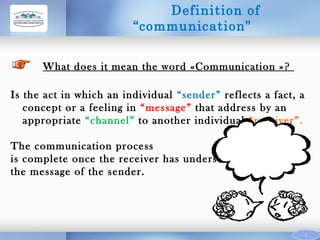
What does it mean the word «Communication »?
Is the act in which an individual “sender” reflects a fact, a
concept or a feeling in “message” that address by an
appropriate “channel” to another individual “receiver”.
The communication process
is complete once the receiver has understand
the message of the sender.

5
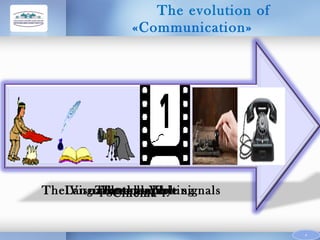
The evolution of
«Communication»

TheLanguage telegraph signals
Visual andphone
The and Writing
photography
The audible
Cinema

6
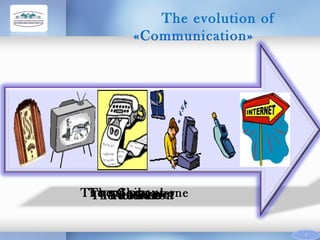
The evolution of
«Communication»

The mobile phone
TheThe Fax
Internet
The Computer
The Radio
television

7
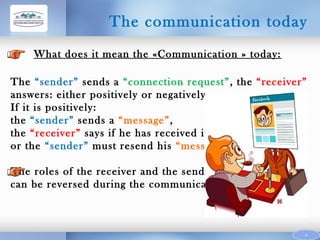
The communication today
What does it mean the «Communication » today:
The “sender” sends a “connection request” , the “receiver”
answers: either positively or negatively.
If it is positively:
the “sender” sends a “message”,
the “receiver” says if he has received it,
or the “sender” must resend his “message”.
The roles of the receiver and the sender
can be reversed during the communication.

8
The emergence of social
Networks:

what the word “social networks” means?
We define the social networks as a webbased service that allow individuals to construct
a public profile within a bounded system,
articulate a list of other users with whom they
share a connection, view and traverse their list
of connections.

9
Types of social Networking
sites

10
Why we use it?
Bu

sin

al
on

ess

ers
– Cp
crue l y o n n n s
u s t oe a s oe c
P
r me ting
rs

iness –
Bus
Enter

wit

h

orking
Netw
tainm

ent
11
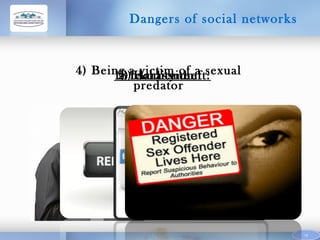
Dangers of social networks

4) Being aHarassment sexual
2) Addiction
3) victim theft:
1) Identity of a
predator

12
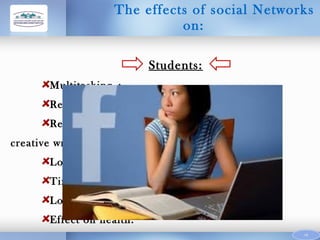
The effects of social Networks
on:
Students:
Multitasking ;
Reduction in real human contact;
Reduces command over language use age and
creative writing skills;
Low grades;
Time wastage;
Loss of motivation in students;
Effect on health.
13
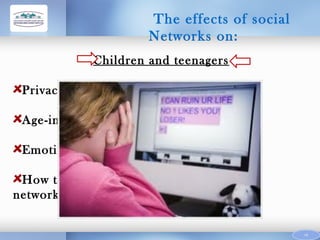
The effects of social
Networks on:
Children and teenagers
Privacy;
Age-inappropriate content;
Emotional implications;
How to deal with the dangers of social
networking.

14
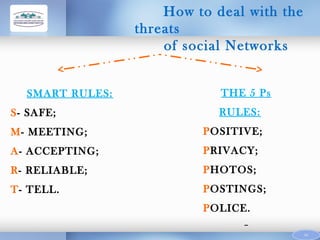
How to deal with the
threats
of social Networks
SMART RULES:
S- SAFE;

THE 5 Ps
RULES:

M- MEETING;

POSITIVE;

A- ACCEPTING;

PRIVACY;

R- RELIABLE;

PHOTOS;

T- TELL.

POSTINGS;
POLICE.
15
Conclusion
16
Thank you
for your
attention
17
Bibliography
 Abenaty, Francis K. 2003. “Family and Social Networks among St Lucian
Migrants in Britain: The Birmingham Connection.” Community, Work & Family
6(1):17-27.
Ainsworth, David M. 2003. “Capacity Building in Civil Society: NGO
Networks in the Regions of Mexico.” United States.
Agnitsch, Kerry A. 2003. “Locating Community Social Capital: A Study of
Social Networks and Community Action.” Dissertation Abstracts International, A:
The Humanities and Social Sciences 64(3):1083-A.
Ahmed OH, Sullivan SJ, Schneiders AG, and McCrory P. (2010). 
Disab  Ahn, June. (2011).  Journal of Educational Computing Research,
45(2), 147-163. ility and Rehabilitation, 32(22), 1877-1883.
18

Social networks

  • 1.
    Master: Marketing andCommercial Action 2012-2013 “communication yesterday and social networks today”
  • 2.
  • 3.
    The objectives ofthe presentation: 3
  • 4.
    Plan: Definition of “communication”; The evolution of communication; What becomes the communication today? - Definition; The appearance of the social networking sites : - Types; - Its several uses. What are the dangers of social networks; Its effects on : students and children/teenagers; How to deal with the threats of social networking sites? Conclusion. 4
  • 5.
    Definition of “communication” What doesit mean the word «Communication »? Is the act in which an individual “sender” reflects a fact, a concept or a feeling in “message” that address by an appropriate “channel” to another individual “receiver”. The communication process is complete once the receiver has understand the message of the sender. 5
  • 6.
    The evolution of «Communication» TheLanguagetelegraph signals Visual andphone The and Writing photography The audible Cinema 6
  • 7.
    The evolution of «Communication» Themobile phone TheThe Fax Internet The Computer The Radio television 7
  • 8.
    The communication today Whatdoes it mean the «Communication » today: The “sender” sends a “connection request” , the “receiver” answers: either positively or negatively. If it is positively: the “sender” sends a “message”, the “receiver” says if he has received it, or the “sender” must resend his “message”. The roles of the receiver and the sender can be reversed during the communication. 8
  • 9.
    The emergence ofsocial Networks: what the word “social networks” means? We define the social networks as a webbased service that allow individuals to construct a public profile within a bounded system, articulate a list of other users with whom they share a connection, view and traverse their list of connections. 9
  • 10.
    Types of socialNetworking sites 10
  • 11.
    Why we useit? Bu sin al on ess ers – Cp crue l y o n n n s u s t oe a s oe c P r me ting rs iness – Bus Enter wit h orking Netw tainm ent 11
  • 12.
    Dangers of socialnetworks 4) Being aHarassment sexual 2) Addiction 3) victim theft: 1) Identity of a predator 12
  • 13.
    The effects ofsocial Networks on: Students: Multitasking ; Reduction in real human contact; Reduces command over language use age and creative writing skills; Low grades; Time wastage; Loss of motivation in students; Effect on health. 13
  • 14.
    The effects ofsocial Networks on: Children and teenagers Privacy; Age-inappropriate content; Emotional implications; How to deal with the dangers of social networking. 14
  • 15.
    How to dealwith the threats of social Networks SMART RULES: S- SAFE; THE 5 Ps RULES: M- MEETING; POSITIVE; A- ACCEPTING; PRIVACY; R- RELIABLE; PHOTOS; T- TELL. POSTINGS; POLICE. 15
  • 16.
  • 17.
  • 18.
    Bibliography  Abenaty, FrancisK. 2003. “Family and Social Networks among St Lucian Migrants in Britain: The Birmingham Connection.” Community, Work & Family 6(1):17-27. Ainsworth, David M. 2003. “Capacity Building in Civil Society: NGO Networks in the Regions of Mexico.” United States. Agnitsch, Kerry A. 2003. “Locating Community Social Capital: A Study of Social Networks and Community Action.” Dissertation Abstracts International, A: The Humanities and Social Sciences 64(3):1083-A. Ahmed OH, Sullivan SJ, Schneiders AG, and McCrory P. (2010).  Disab  Ahn, June. (2011).  Journal of Educational Computing Research, 45(2), 147-163. ility and Rehabilitation, 32(22), 1877-1883. 18