SOCIA L MEDIA SUMMIT
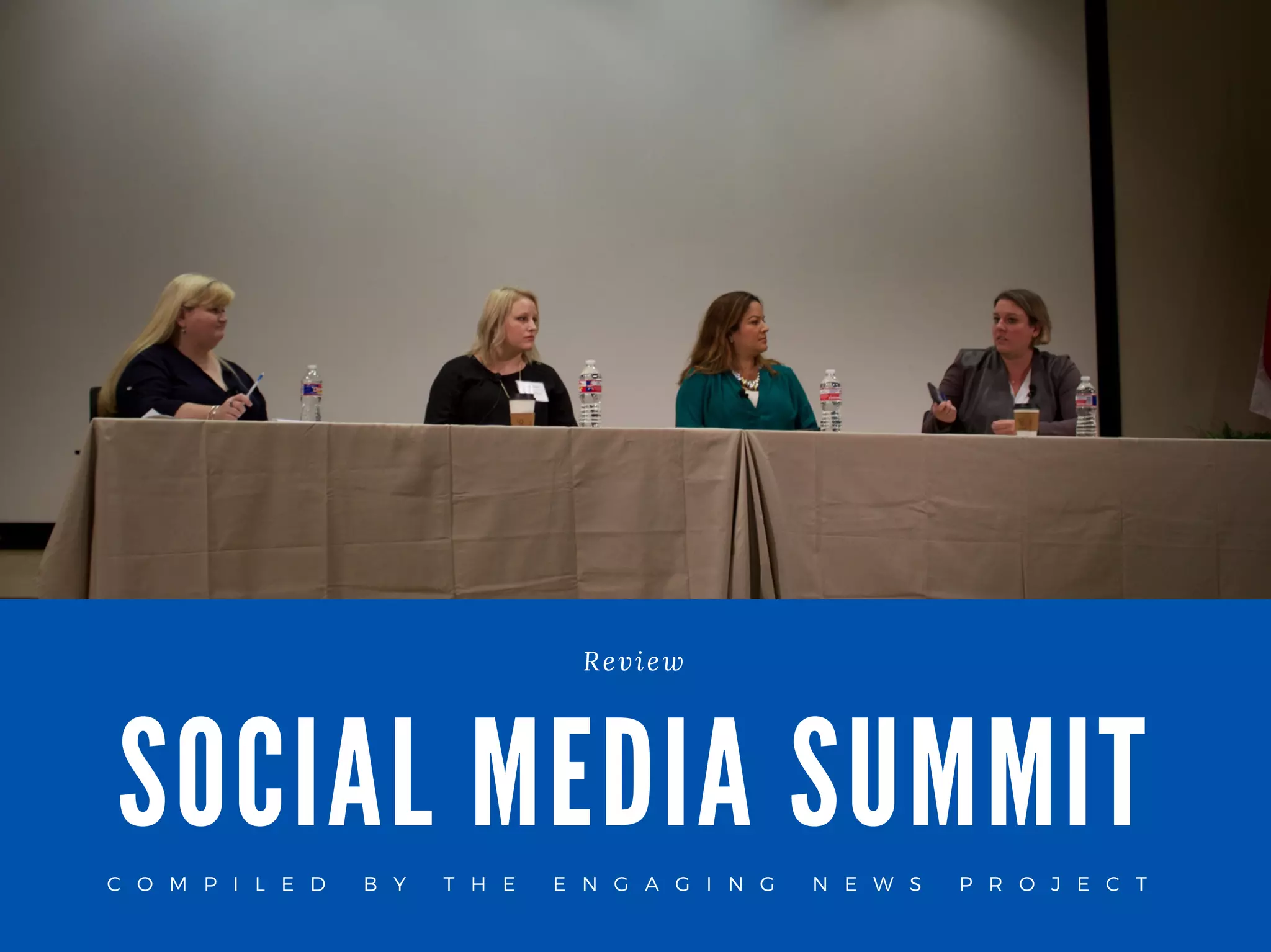
Review
C O M P I L E D B Y T H E E N G A G I N G N E W S P R O J E C T
N0V. 11, 2016
Sponsored by the Engaging News Project & the
University of Texas School of Journalism
The first Social Media Summit sought to answer these questions:
Has social media helped or harmed news organizations?
What social media platforms most benefit news sites? Which
platforms present the most challenges?
What’ s in it for social media companies to get involved with
news organizations, such as through Facebook’ s Instant
Articles?
How did news sites use social media during the 2016 election?
Thank You to our Funders
The Dallas Morning News Innovation Fund, Democracy Fund,
Hewlett Foundation and Rita Allen Foundation
COVERING THE 2016 ELECTION THROUGH SOCIA L MEDIA
Livestreaming was a big success this election
cycle. It provided access to candidates,
campaigns, and events in ways that traditional
news programming couldn't (e.g. when the TV-
feed goes to commercial, the livestream can
catch events behind-the-scenes.)
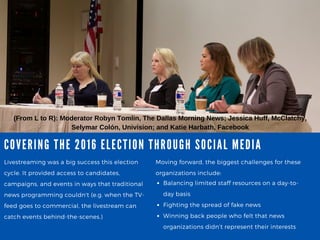
(From L to R): Moderator Robyn Tomlin, The Dallas Morning News; Jessica Huff, McClatchy,
Selymar Colón, Univision; and Katie Harbath, Facebook
Moving forward, the biggest challenges for these
organizations include:
Balancing limited staff resources on a day-to-
day basis
Fighting the spread of fake news
Winning back people who felt that news
organizations didn’t represent their interests
FA CEBOOK LIVE DISCUSSION
Newsrooms are experimenting with
Facebook Live, often for sharing
breaking news
Benefits
Can answer audience questions in real
time
Can increase page likes
Shows people that you have a reporter at
the scene
Challenges
No monetization right now ( although may
be coming soon)
Ethical questions about showing some
things live ( e. g. a dead body during a
shooting)
Poor quality of video captured “ on the
fly”
Tips
Think about the first image – it is the one
that will show up on Facebook
Look to answer audience questions
A reporter taking the initiative might
jumpstart interest from the newsroom
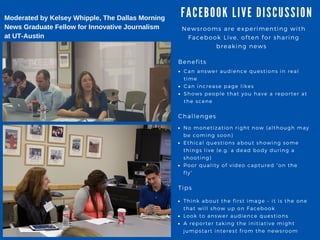
Moderated by Kelsey Whipple, The Dallas Morning
News Graduate Fellow for Innovative Journalism
at UT­Austin
LESSONS FROM # ELECTIONLA ND
Electionland is a nationwide project that tracked and covered voting problems during the 2016
election. Partners included ProPublica, the Google News Lab, WNYC News, Univision, the First Draft
Coalition, and the CUNY Graduate School of Journalism. Thirteen universities participated
With the proper tools (TinEye, Dataminr, Google, etc.) and nationwide coordination, social
media could provide an accurate assessment of Election Day problems
Electionland came together in just a few months before Election Day. With the lessons learned this
time around, it could be an important force for improving elections and voter access in the future
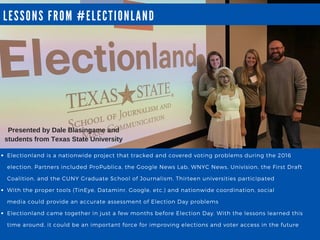
Presented by Dale Blasingame and
students from Texas State University
DA RE TO BE SQUA RE: WHY INSTA GRA M IS
CRITICA L IN NEW MEDIA STORYTELLING
When using user- generated content, you must ask for permission and give appropriate
photo credit by including their Instagram handle.
Instagram allows you to pull from the community.
When posting on Instagram as a newsroom, be open- minded with what you post. Mix
it up and post hard news, but also include a selfie or a picture of your dog. The key is
to add something personal or different to connect with your audience.
When possible, put other people’ s handles in your
caption. This will help generate new followers.
This also shows that you are part of the community.
Presented by Addie Broyles of the Austin American­Statesman
A / B TESTING IN
THE DIGITA L A GE
A/ B testing can help with business
outcomes ( e. g. page views, return
visitors, time on site) and
democratic outcomes ( e. g.
learning, civility)
Tips for A/ B testing
Ask what you want to learn before
starting
Test one change at a time
Test many times
Make sure that your sample size is
adequate to see differences
Evaluate why version A did better
than version B
Many A/ B testing programs
available:
Try engagingnewsproject. org/ quiz-
creator for A/ B testing quizzes
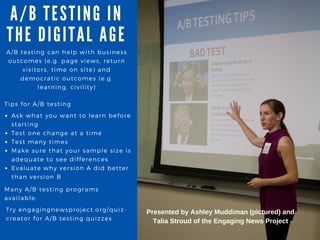
Presented by Ashley Muddiman (pictured) and
Talia Stroud of the Engaging News Project
DOES TONE ON
SOCIA L REA LLY
MA TTER?
Text overlay, inspiring quotes, and
faces all work to personalize the
message and grab the reader’ s
attention
Three rules of posting news articles
to Facebook:
Shorter is better
Express some kind of relatable
emotion
Include something in the “ share”
text ( like a caption)
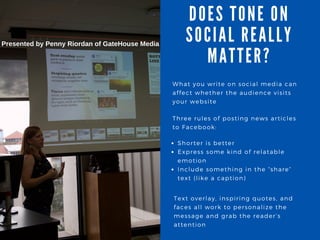
Presented by Penny Riordan of
GateHouse Media
Presented by Penny Riordan of GateHouse Media
What you write on social media can
affect whether the audience visits
your website
ENGA GING PLA TFORMS DISCUSSION
Outlets worry about the small payoff when it comes to day- to- day news
on Twitter
With so many platforms, it’ s hard to distribute resources toward things
like Snapchat and Instagram ( these platforms are difficult to monetize
so it might feel like a waste of team resources)
Some news organizations struggle with balancing sending readers
important push notifications and the concern that they' re violating
their personal privacy
Moderated by Amanda Wilkins of The Dallas Morning News 
A few platforms that newsrooms use for data analysis include Share
Rocket, CrowdTangle and Chartbeat
FROM PA PER ROUTES TO PUSH A LERTS: HOW WE’ RE SA VING
OUR LEGA CY NEWSPA PER
In the digital age, math and analytics
play a huge role in the newsroom with
real- time metrics
The role of “ Web Producer” is rapidly
changing; focus on writing, ability to
produce strong content, and social
media skills
What' s next?
Austin- American Statesman confident they are going in the right direction
They are dedicated to growth in the digital field, and are looking to hire
people who are also dedicated
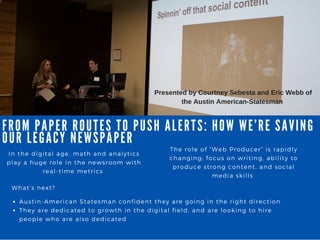
Presented by Courtney Sebesta and Eric Webb of
the Austin American­Statesman 
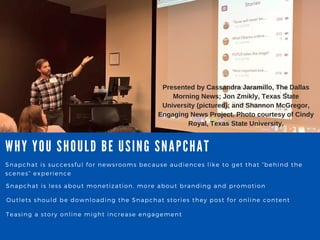
WHY YOU SHOULD BE USING SNA PCHA T
Snapchat is successful for newsrooms because audiences like to get that “ behind the
scenes” experience
Snapchat is less about monetization, more about branding and promotion
Outlets should be downloading the Snapchat stories they post for online content
Teasing a story online might increase engagement
Presented by Cassandra Jaramillo, The Dallas
Morning News; Jon Zmikly, Texas State
University (pictured); and Shannon McGregor,
Engaging News Project. Photo courtesy of Cindy
Royal, Texas State University.
NA STY TA LK ONLINE: WHA T' S A JOURNA LIST TO DO
Study # 1: Interviewed 34 journalists ranging in gender, work experience, and
medium to ask how they handle comments
All journalists interviewed read comments
Most feel overwhelmed by number of comments
Split on whether to answer back - majority said journalists should respond in
comments, but not when the comments become uncivil
Presented by Gina Chen of the Engaging News Project
Main findings:
Study # 2: Interviewed 38 female journalists on how they handle harrassment
Extent of harassment:
100% faced some type of uncivil comments
81. 5% experienced gendered harassment
TV journalists faced the most
Harassment worse if cover " male" topics
Strategies for dealing:
Call out the commenters or block them
Pre- moderate on professional Facebook page
Delete offending comments quickly
" Ignore it and do my job"
Hide page from family
SUMMA RY
Livestreaming platforms, like Facebook Live, offer opportunities that other
platforms can' t provide, such as connecting with the audience in real time. But
there are challenges to livestreaming, including the ethical issues that come from
sharing live, unedited video.
There are a number of ways for news organizations to use social media to cover an
election cycle, including as a way to connect with audiences and track voting
issues on Election Day.
Although news organizations may not think they can devote the resources needed
to manage non- Facebook or Twitter accounts, there are benefits to using
Snapchat and Instagram. Both platforms provide a way to give the audience
" behind the scenes" access, and they can help news organizations build
community.
CONNECT WITH ENGA GING NEWS PROJECT
@ engagingnews
/ engagingnewsproject
engagingnewsproject. org

Social Media Summit

  • 1.
    SOCIA L MEDIASUMMIT Review C O M P I L E D B Y T H E E N G A G I N G N E W S P R O J E C T
  • 2.
    N0V. 11, 2016 Sponsoredby the Engaging News Project & the University of Texas School of Journalism The first Social Media Summit sought to answer these questions: Has social media helped or harmed news organizations? What social media platforms most benefit news sites? Which platforms present the most challenges? What’ s in it for social media companies to get involved with news organizations, such as through Facebook’ s Instant Articles? How did news sites use social media during the 2016 election? Thank You to our Funders The Dallas Morning News Innovation Fund, Democracy Fund, Hewlett Foundation and Rita Allen Foundation
  • 3.
    COVERING THE 2016ELECTION THROUGH SOCIA L MEDIA Livestreaming was a big success this election cycle. It provided access to candidates, campaigns, and events in ways that traditional news programming couldn't (e.g. when the TV- feed goes to commercial, the livestream can catch events behind-the-scenes.) (From L to R): Moderator Robyn Tomlin, The Dallas Morning News; Jessica Huff, McClatchy, Selymar Colón, Univision; and Katie Harbath, Facebook Moving forward, the biggest challenges for these organizations include: Balancing limited staff resources on a day-to- day basis Fighting the spread of fake news Winning back people who felt that news organizations didn’t represent their interests
  • 4.
    FA CEBOOK LIVEDISCUSSION Newsrooms are experimenting with Facebook Live, often for sharing breaking news Benefits Can answer audience questions in real time Can increase page likes Shows people that you have a reporter at the scene Challenges No monetization right now ( although may be coming soon) Ethical questions about showing some things live ( e. g. a dead body during a shooting) Poor quality of video captured “ on the fly” Tips Think about the first image – it is the one that will show up on Facebook Look to answer audience questions A reporter taking the initiative might jumpstart interest from the newsroom Moderated by Kelsey Whipple, The Dallas Morning News Graduate Fellow for Innovative Journalism at UT­Austin
  • 5.
    LESSONS FROM #ELECTIONLA ND Electionland is a nationwide project that tracked and covered voting problems during the 2016 election. Partners included ProPublica, the Google News Lab, WNYC News, Univision, the First Draft Coalition, and the CUNY Graduate School of Journalism. Thirteen universities participated With the proper tools (TinEye, Dataminr, Google, etc.) and nationwide coordination, social media could provide an accurate assessment of Election Day problems Electionland came together in just a few months before Election Day. With the lessons learned this time around, it could be an important force for improving elections and voter access in the future Presented by Dale Blasingame and students from Texas State University
  • 6.
    DA RE TOBE SQUA RE: WHY INSTA GRA M IS CRITICA L IN NEW MEDIA STORYTELLING When using user- generated content, you must ask for permission and give appropriate photo credit by including their Instagram handle. Instagram allows you to pull from the community. When posting on Instagram as a newsroom, be open- minded with what you post. Mix it up and post hard news, but also include a selfie or a picture of your dog. The key is to add something personal or different to connect with your audience. When possible, put other people’ s handles in your caption. This will help generate new followers. This also shows that you are part of the community. Presented by Addie Broyles of the Austin American­Statesman
  • 7.
    A / BTESTING IN THE DIGITA L A GE A/ B testing can help with business outcomes ( e. g. page views, return visitors, time on site) and democratic outcomes ( e. g. learning, civility) Tips for A/ B testing Ask what you want to learn before starting Test one change at a time Test many times Make sure that your sample size is adequate to see differences Evaluate why version A did better than version B Many A/ B testing programs available: Try engagingnewsproject. org/ quiz- creator for A/ B testing quizzes Presented by Ashley Muddiman (pictured) and Talia Stroud of the Engaging News Project
  • 8.
    DOES TONE ON SOCIAL REA LLY MA TTER? Text overlay, inspiring quotes, and faces all work to personalize the message and grab the reader’ s attention Three rules of posting news articles to Facebook: Shorter is better Express some kind of relatable emotion Include something in the “ share” text ( like a caption) Presented by Penny Riordan of GateHouse Media Presented by Penny Riordan of GateHouse Media What you write on social media can affect whether the audience visits your website
  • 9.
    ENGA GING PLATFORMS DISCUSSION Outlets worry about the small payoff when it comes to day- to- day news on Twitter With so many platforms, it’ s hard to distribute resources toward things like Snapchat and Instagram ( these platforms are difficult to monetize so it might feel like a waste of team resources) Some news organizations struggle with balancing sending readers important push notifications and the concern that they' re violating their personal privacy Moderated by Amanda Wilkins of The Dallas Morning News  A few platforms that newsrooms use for data analysis include Share Rocket, CrowdTangle and Chartbeat
  • 10.
    FROM PA PERROUTES TO PUSH A LERTS: HOW WE’ RE SA VING OUR LEGA CY NEWSPA PER In the digital age, math and analytics play a huge role in the newsroom with real- time metrics The role of “ Web Producer” is rapidly changing; focus on writing, ability to produce strong content, and social media skills What' s next? Austin- American Statesman confident they are going in the right direction They are dedicated to growth in the digital field, and are looking to hire people who are also dedicated Presented by Courtney Sebesta and Eric Webb of the Austin American­Statesman 
  • 11.
    WHY YOU SHOULDBE USING SNA PCHA T Snapchat is successful for newsrooms because audiences like to get that “ behind the scenes” experience Snapchat is less about monetization, more about branding and promotion Outlets should be downloading the Snapchat stories they post for online content Teasing a story online might increase engagement Presented by Cassandra Jaramillo, The Dallas Morning News; Jon Zmikly, Texas State University (pictured); and Shannon McGregor, Engaging News Project. Photo courtesy of Cindy Royal, Texas State University.
  • 12.
    NA STY TALK ONLINE: WHA T' S A JOURNA LIST TO DO Study # 1: Interviewed 34 journalists ranging in gender, work experience, and medium to ask how they handle comments All journalists interviewed read comments Most feel overwhelmed by number of comments Split on whether to answer back - majority said journalists should respond in comments, but not when the comments become uncivil Presented by Gina Chen of the Engaging News Project Main findings: Study # 2: Interviewed 38 female journalists on how they handle harrassment Extent of harassment: 100% faced some type of uncivil comments 81. 5% experienced gendered harassment TV journalists faced the most Harassment worse if cover " male" topics Strategies for dealing: Call out the commenters or block them Pre- moderate on professional Facebook page Delete offending comments quickly " Ignore it and do my job" Hide page from family
  • 13.
    SUMMA RY Livestreaming platforms,like Facebook Live, offer opportunities that other platforms can' t provide, such as connecting with the audience in real time. But there are challenges to livestreaming, including the ethical issues that come from sharing live, unedited video. There are a number of ways for news organizations to use social media to cover an election cycle, including as a way to connect with audiences and track voting issues on Election Day. Although news organizations may not think they can devote the resources needed to manage non- Facebook or Twitter accounts, there are benefits to using Snapchat and Instagram. Both platforms provide a way to give the audience " behind the scenes" access, and they can help news organizations build community.
  • 14.
    CONNECT WITH ENGAGING NEWS PROJECT @ engagingnews / engagingnewsproject engagingnewsproject. org