Everyone wants to be young… no
one wants to be 13 again.
Education’s new big bad wolf…middle school. What middle school needs to change.
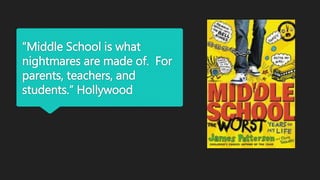
“Middle School is what
nightmares are made of. For
parents, teachers, and
students.” Hollywood
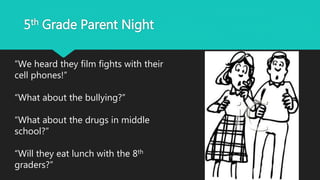
5th Grade Parent Night
”We heard they film fights with their
cell phones!”
“What about the bullying?”
“What about the drugs in middle
school?”
“Will they eat lunch with the 8th
graders?”
Parents are correct, and we should be
concerned and called to action! Let’s take a
look at the research.
RAND reports that U.S. middle school students
manifest depression, disengagement, fear for
physical safety, a desire to drop out, and
boredom with schoolwork at rates that exceed
those of every industrial nation except Israel
(RAND, 2004)
Middle schools are overrepresented on
the list of failing schools as defined by
the No Child Left Behind Act: In 2004-
05, they comprised only 14 percent of
all Title I schools, but 37 percent of Title
I schools identified for improvement.
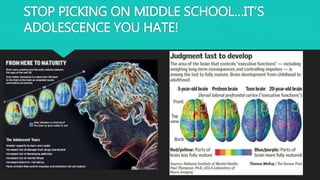
STOP PICKING ON MIDDLE SCHOOL…IT’S
ADOLESCENCE YOU HATE!
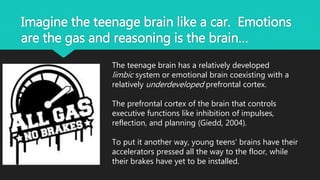
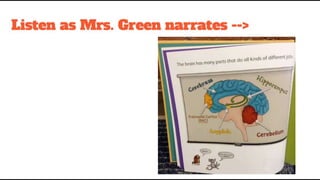
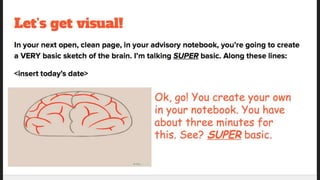
Imagine the teenage brain like a car. Emotions
are the gas and reasoning is the brain…
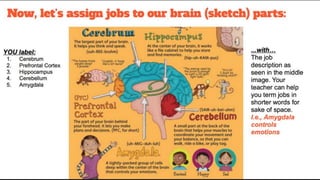
The teenage brain has a relatively developed
limbic system or emotional brain coexisting with a
relatively underdeveloped prefrontal cortex.
The prefrontal cortex of the brain that controls
executive functions like inhibition of impulses,
reflection, and planning (Giedd, 2004).
To put it another way, young teens' brains have their
accelerators pressed all the way to the floor, while
their brakes have yet to be installed.
We need to understand the brain
development of the tumultuous time
known as adolescence. We must design
our schools and the learning around the
neurological, social, emotional, and
metacognitive needs of being a teenager.
https://www.youtube.c
om/watch?v=MHs7vlcw
RXY
We need to understand the brain
development of the tumultuous time known
as adolescence. We must design our schools
and the learning around the neurological,
social, emotional, and metacognitive needs of
being a teenager.
O
L
D
S
O
L
U
T
I
O
N
 Large, Impersonal schools
 that look just like high schools.
 do not address SEL needs
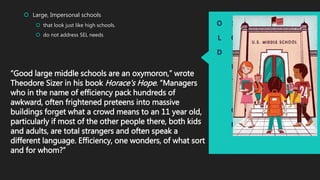
“Good large middle schools are an oxymoron,” wrote
Theodore Sizer in his book Horace's Hope. “Managers
who in the name of efficiency pack hundreds of
awkward, often frightened preteens into massive
buildings forget what a crowd means to an 11 year old,
particularly if most of the other people there, both kids
and adults, are total strangers and often speak a
different language. Efficiency, one wonders, of what sort
and for whom?”
O
L
D
S
O
L
U
T
I
O
N
 A fragmented curriculum that is too broad, emotionally flat,
and solely focused on test scores.
“Individuals going through early adolescence
are particularly sensitive to the presence or
absence of emotion in their classroom learning
experiences. If they are required to learn in
classrooms that largely emphasize lecture,
textbooks, written assignments, and tests, their
own motivation is likely to wane. And yet, as
noted above, NCLB and other pressures to
conform to Academic Achievement Discourse
are making these kinds of environments far
more common in middle schools.”
- Thomas Armstrong
N
E
W
S
O
L
U
T
I
O
N
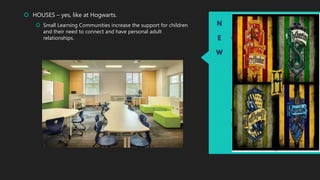
 HOUSES – yes, like at Hogwarts.
 Small Learning Communities increase the support for children
and their need to connect and have personal adult
relationships.
N
E
W
S
O
L
U
T
I
O
N
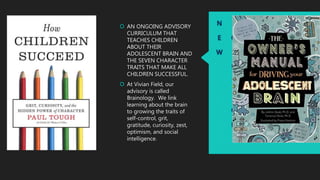
 AN ONGOING ADVISORY
CURRICULUM THAT
TEACHES CHILDREN
ABOUT THEIR
ADOLESCENT BRAIN AND
THE SEVEN CHARACTER
TRAITS THAT MAKE ALL
CHILDREN SUCCESSFUL.
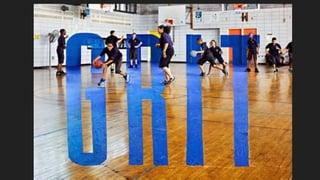
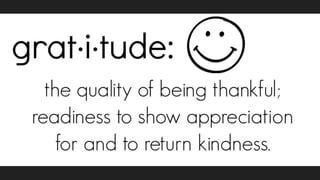
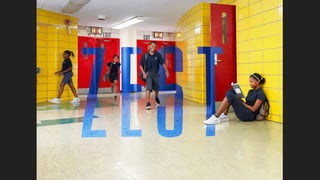
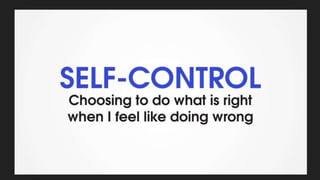
 At Vivian Field, our
advisory is called
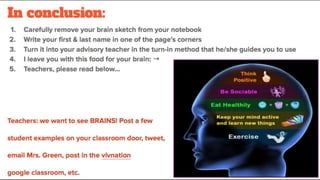
Brainology. We link
learning about the brain
to growing the traits of
self-control, grit,
gratitude, curiosity, zest,
optimism, and social
intelligence.
We use a google classroom called #vivnation. All teachers are class members. It
serves as both our delivery and accountability tool.
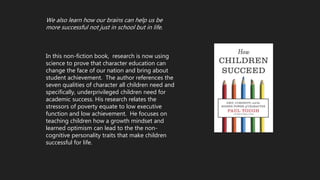
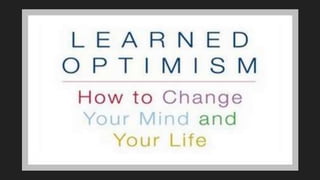
We also learn how our brains can help us be
more successful not just in school but in life.
In this non-fiction book, research is now using
science to prove that character education can
change the face of our nation and bring about
student achievement. The author references the
seven qualities of character all children need and
specifically, underprivileged children need for
academic success. His research relates the
stressors of poverty equate to low executive
function and low achievement. He focuses on
teaching children how a growth mindset and
learned optimism can lead to the the non-
cognitive personality traits that make children
successful for life.
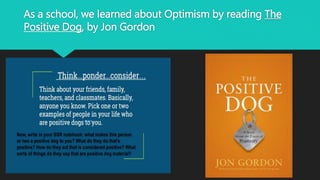
As a school, we learned about Optimism by reading The
Positive Dog, by Jon Gordon
Accountability
 https://drive.google.com/file/d/
0Bz5VczMXdyKtV0VNdVhsNlBS
RnM/view?usp=sharing
This means ”Middle Schoolism” must end.
 It is mission critical for public schools to help course correct the mental health of our nation
through character education. We can make the largest impact on our country by taking part in
teaching students from all socio-economic backgrounds the power of optimism, grit, self-
control, and other mindfulness traits. These are the non-cognitive prices of admission into an
emotionally stable and bright future which in turn will create a successful and
safe society. Cognitive skills are crucial, but, character is more important than intellect because
character alone can both bring about intellect and protect us from it. Adolescence demands SEL,
Character Education, and learning about the brain to produce successful citizens.

SMU Final Dr. Dawson Orr - S. Jimenez

  • 1.
    Everyone wants tobe young… no one wants to be 13 again. Education’s new big bad wolf…middle school. What middle school needs to change.
  • 2.
    “Middle School iswhat nightmares are made of. For parents, teachers, and students.” Hollywood
  • 4.
    5th Grade ParentNight ”We heard they film fights with their cell phones!” “What about the bullying?” “What about the drugs in middle school?” “Will they eat lunch with the 8th graders?”
  • 5.
    Parents are correct,and we should be concerned and called to action! Let’s take a look at the research. RAND reports that U.S. middle school students manifest depression, disengagement, fear for physical safety, a desire to drop out, and boredom with schoolwork at rates that exceed those of every industrial nation except Israel (RAND, 2004)
  • 6.
    Middle schools areoverrepresented on the list of failing schools as defined by the No Child Left Behind Act: In 2004- 05, they comprised only 14 percent of all Title I schools, but 37 percent of Title I schools identified for improvement.
  • 7.
    STOP PICKING ONMIDDLE SCHOOL…IT’S ADOLESCENCE YOU HATE!
  • 8.
    Imagine the teenagebrain like a car. Emotions are the gas and reasoning is the brain… The teenage brain has a relatively developed limbic system or emotional brain coexisting with a relatively underdeveloped prefrontal cortex. The prefrontal cortex of the brain that controls executive functions like inhibition of impulses, reflection, and planning (Giedd, 2004). To put it another way, young teens' brains have their accelerators pressed all the way to the floor, while their brakes have yet to be installed.
  • 9.
    We need tounderstand the brain development of the tumultuous time known as adolescence. We must design our schools and the learning around the neurological, social, emotional, and metacognitive needs of being a teenager.
  • 10.
    https://www.youtube.c om/watch?v=MHs7vlcw RXY We need tounderstand the brain development of the tumultuous time known as adolescence. We must design our schools and the learning around the neurological, social, emotional, and metacognitive needs of being a teenager.
  • 11.
    O L D S O L U T I O N  Large, Impersonalschools  that look just like high schools.  do not address SEL needs “Good large middle schools are an oxymoron,” wrote Theodore Sizer in his book Horace's Hope. “Managers who in the name of efficiency pack hundreds of awkward, often frightened preteens into massive buildings forget what a crowd means to an 11 year old, particularly if most of the other people there, both kids and adults, are total strangers and often speak a different language. Efficiency, one wonders, of what sort and for whom?”
  • 12.
    O L D S O L U T I O N  A fragmentedcurriculum that is too broad, emotionally flat, and solely focused on test scores. “Individuals going through early adolescence are particularly sensitive to the presence or absence of emotion in their classroom learning experiences. If they are required to learn in classrooms that largely emphasize lecture, textbooks, written assignments, and tests, their own motivation is likely to wane. And yet, as noted above, NCLB and other pressures to conform to Academic Achievement Discourse are making these kinds of environments far more common in middle schools.” - Thomas Armstrong
  • 13.
    N E W S O L U T I O N  HOUSES –yes, like at Hogwarts.  Small Learning Communities increase the support for children and their need to connect and have personal adult relationships.
  • 14.
    N E W S O L U T I O N  AN ONGOINGADVISORY CURRICULUM THAT TEACHES CHILDREN ABOUT THEIR ADOLESCENT BRAIN AND THE SEVEN CHARACTER TRAITS THAT MAKE ALL CHILDREN SUCCESSFUL.  At Vivian Field, our advisory is called Brainology. We link learning about the brain to growing the traits of self-control, grit, gratitude, curiosity, zest, optimism, and social intelligence.
  • 15.
    We use agoogle classroom called #vivnation. All teachers are class members. It serves as both our delivery and accountability tool.
  • 24.
    We also learnhow our brains can help us be more successful not just in school but in life. In this non-fiction book, research is now using science to prove that character education can change the face of our nation and bring about student achievement. The author references the seven qualities of character all children need and specifically, underprivileged children need for academic success. His research relates the stressors of poverty equate to low executive function and low achievement. He focuses on teaching children how a growth mindset and learned optimism can lead to the the non- cognitive personality traits that make children successful for life.
  • 32.
    As a school,we learned about Optimism by reading The Positive Dog, by Jon Gordon
  • 33.
  • 34.
    This means ”MiddleSchoolism” must end.  It is mission critical for public schools to help course correct the mental health of our nation through character education. We can make the largest impact on our country by taking part in teaching students from all socio-economic backgrounds the power of optimism, grit, self- control, and other mindfulness traits. These are the non-cognitive prices of admission into an emotionally stable and bright future which in turn will create a successful and safe society. Cognitive skills are crucial, but, character is more important than intellect because character alone can both bring about intellect and protect us from it. Adolescence demands SEL, Character Education, and learning about the brain to produce successful citizens.

Editor's Notes

  • #14 Unsafe School Climates where bullying and drugs exist, but because kids go class to class and do not begin and end with the same teacher every day, there is a sense of isolation and no accountability when these events occur.
  • #15 Unsafe School Climates where bullying and drugs exist, but because kids go class to class and do not begin and end with the same teacher every day, there is a sense of isolation and no accountability when these events occur.