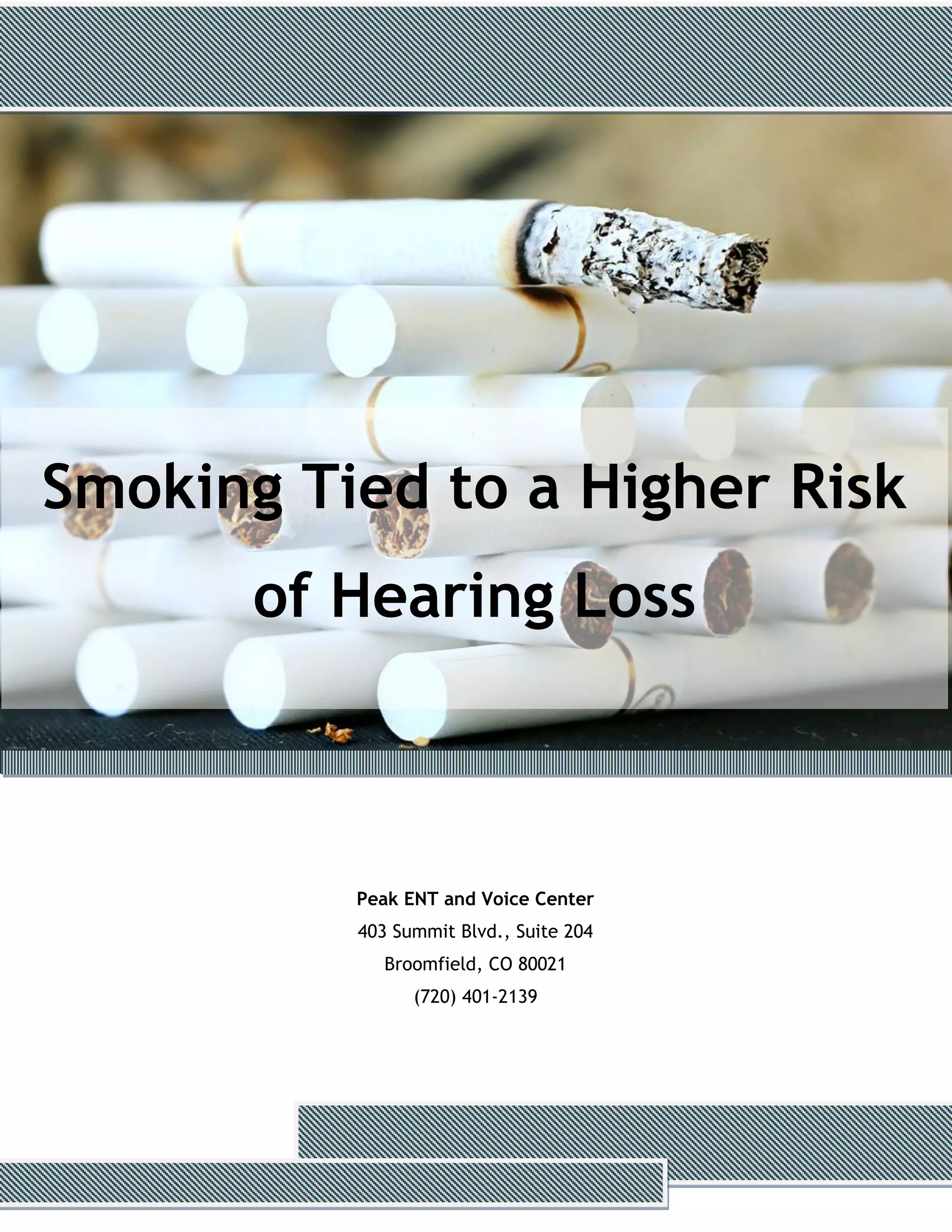
Smoking Tied to a Higher Risk
of Hearing Loss
Peak ENT and Voice Center
403 Summit Blvd., Suite 204
Broomfield, CO 80021
(720) 401-2139
Cigarette smoking is a vice that is not just bad for the heart and lungs. It could also negatively impair
a person’s hearing. A study published in the journal Nicotine and Tobacco Research revealed that
smokers have an increased risk of hearing loss.
Smoking, an Independent Risk Factor for Hearing Loss
Scientists observed over 50,000 people aged 20 to 64 who did not have hearing loss at the beginning
of the study. They evaluated the yearly health check-ups of the participants, which include details
concerning their lifestyle, habits, and hearing tests for eight years. On top of that, they looked at
the effects of smoking for former and current smokers, as well as the duration of smoking and the
number of cigarettes smoked in a day.
Researchers discovered that smokers had a higher risk of hearing loss compared to non-smokers.
Current smokers were 20 percent likely to have low-frequency hearing loss. This condition makes
detecting deep voices difficult. On top of that, they were 60 percent likely to have high-frequency
hearing loss. This problem gives the individual a tough time understanding speech in a noisy
environment.
Scientists also found that the likelihood of loss of hearing increases with the number of sticks smoked
per day. On the other hand, the risk of hearing loss declines within five years of quitting the habit.
With an objective assessment of hearing loss, long follow-up period, and a huge sample size, study
author Huanhuan Hu said that the study offers solid evidence that smoking is an independent risk
factor for loss of hearing.
Curbing the Smoking Habit
Smokers who want to kick their cigarette habit for good to decrease their risk of hearing loss can
follow the Stop Smoking plan made by HelpGuide, a trusted resource website for mental health and
wellness. This plan consists of the acronym START, which stands for:
 S – Set a quit date.
 T – Tell friends, family, and co-workers of the plan to quit.
 A – Anticipate the difficulties of quitting.
 R – Remove cigarettes and tobacco-related products at work, in the car, and at home.
 T – Talk to a doctor about getting assistance in quitting.
While the exact connection between smoking and hearing loss remains unclear, the authors of the
study hope to do further research to highlight the need for tobacco control.
Sources:
https://peakentandvoicecenter.com/
https://academic.oup.com/ntr/advance-article-
abstract/doi/10.1093/ntr/nty026/4925604?redirectedFrom=fulltext
https://www.helpguide.org/articles/addictions/how-to-quit-smoking.htm
https://www.ajc.com/news/world/smokers-have-increased-risk-hearing-loss-study-
says/uvy5OXWY4dYGtcg1ymQUmO/
https://www.sciencedaily.com/releases/2018/03/180314092317.htm

Smoking, Hearing Loss, Cigarette Smoking

  • 1.
    Smoking Tied toa Higher Risk of Hearing Loss Peak ENT and Voice Center 403 Summit Blvd., Suite 204 Broomfield, CO 80021 (720) 401-2139
  • 2.
    Cigarette smoking isa vice that is not just bad for the heart and lungs. It could also negatively impair a person’s hearing. A study published in the journal Nicotine and Tobacco Research revealed that smokers have an increased risk of hearing loss. Smoking, an Independent Risk Factor for Hearing Loss Scientists observed over 50,000 people aged 20 to 64 who did not have hearing loss at the beginning of the study. They evaluated the yearly health check-ups of the participants, which include details concerning their lifestyle, habits, and hearing tests for eight years. On top of that, they looked at the effects of smoking for former and current smokers, as well as the duration of smoking and the number of cigarettes smoked in a day. Researchers discovered that smokers had a higher risk of hearing loss compared to non-smokers. Current smokers were 20 percent likely to have low-frequency hearing loss. This condition makes detecting deep voices difficult. On top of that, they were 60 percent likely to have high-frequency hearing loss. This problem gives the individual a tough time understanding speech in a noisy environment. Scientists also found that the likelihood of loss of hearing increases with the number of sticks smoked per day. On the other hand, the risk of hearing loss declines within five years of quitting the habit.
  • 3.
    With an objectiveassessment of hearing loss, long follow-up period, and a huge sample size, study author Huanhuan Hu said that the study offers solid evidence that smoking is an independent risk factor for loss of hearing. Curbing the Smoking Habit Smokers who want to kick their cigarette habit for good to decrease their risk of hearing loss can follow the Stop Smoking plan made by HelpGuide, a trusted resource website for mental health and wellness. This plan consists of the acronym START, which stands for:  S – Set a quit date.  T – Tell friends, family, and co-workers of the plan to quit.  A – Anticipate the difficulties of quitting.  R – Remove cigarettes and tobacco-related products at work, in the car, and at home.  T – Talk to a doctor about getting assistance in quitting. While the exact connection between smoking and hearing loss remains unclear, the authors of the study hope to do further research to highlight the need for tobacco control.
  • 4.