SMBNH9: Tracking SuccessFinding, measuring & analyzing economic data online
OverviewCompany/personal backgroundKey economic dataEasy & free online data sourcesBasic database, trends, growthHelpful hints
BackgroundCEO of e-forecasting.comEconomic research and consulting firm based in Durham, NHSpecialize in unique economic data and company demand forecastsClients/industries: manufacturing, hospitality, government, consulting, academic, media
Data, data, data …With internet and current technology, age of free data is nowIssue is knowing where to find it, how to update it, accurately analyzing it
Important Economic DataGDP: measures the value of all goods and services in a country, state, city, industryEmployment : measures jobs as gains or losses in the marketProduction : measures output and levels of productivity  or technological change in industriesStocks : measures expectations of future economic activity
Easy steps to find data & build simple spreadsheetDetermine the scope and what data will suit your needsResearch possible sources and choose most reliable, with high frequency of updatesKeep solid record of directions, including link, steps to extract data and release schedule if possibleOrganize database in system that works for you
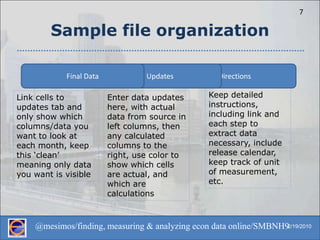
Sample file organizationDirectionsUpdatesFinal DataKeep detailed instructions, including link and each step to extract data necessary, include release calendar, keep track of unit of measurement, etc.Enter data updates here, with actual data from source in left columns, then any calculated columns to the right, use color to show which cells are actual, and which are calculationsLink cells to updates tab and only show which columns/data you want to look at each month, keep this ‘clean’ meaning only data you want is visible
Easy-ish, free online econ dataBureau of Labor Statistics http://www.bls.gov/Inflation, prices, employment, pay, productivity, regionalBEA – Bureau of Economic Analysis http://www.bea.gov/industry/GDP data by industry, state, city, personal income, employmentFederal Reserve http://www.federalreserve.gov/Industrial production, interest rates, exchange rates, quantity of money, consumer creditUS Census http://www.census.gov/econ/Manufacturing, trade (inventories and sales), monthly sales retail and food, wholesale trade, manufacturers shipments, inventories and orders, housing vacancies, construction spending, new home sales, housing starts/building permits, retail tradeIMF – International Monetary Fund http://www.imf.org/external/index.htmData by country: GDP, consumer prices, producer prices, employment, industrial production, debt, interest rates, share prices, business and consumer confidence, oil prices, exchange ratesOECD – Organization of Co-Operation and Economic Development http://www.oecd.orgData by country: agriculture, fisheries, demography, population, development, projections, education, environment, finance, globalization, prices, welfare statistics
Ways to analyze trendsTrack month over month change: m/mTrack year over year change: y/y% change=(new_value/original_value)-1
Ways to analyze trendsMake a simple time series of the data to visualize trends, such as the peaks and troughs of the business cycleLong term growth: measures average growth over specified period of timeEx. Average GDP of US is 3.3%, can use this as a baseline to make comparisons
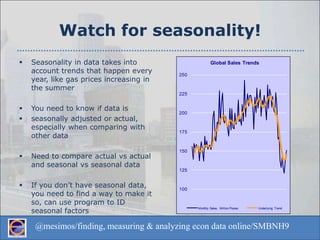
Watch for seasonality!Seasonality in data takes into account trends that happen every year, like gas prices increasing in the summerYou need to know if data is seasonally adjusted or actual, especially when comparing with other dataNeed to compare actual vs actual and seasonal vs seasonal dataIf you don’t have seasonal data, you need to find a way to make it so, can use program to ID seasonal factors
Helpful TipsAlways keep a record of data source, may have to check back, double check values, numbers may be questioned by clients, etcBest to re-arrange data into time series format if possibleCheck for updates to previous month, quarter, year, data sources continually make revisions, keep your database up to dateRun quality tests to make sure data makes sense, even the source can have data wrong, good idea is to make simple graphCarefully note measurement, is data measured in hundreds, dollars, percent?Don’t get discouraged by first-time set up effort, after initial set up, time to update data will be much less and you will have strong data to back up your research and analysis

Smbnh9 Tracking Success Presentation

  • 1.
    SMBNH9: Tracking SuccessFinding,measuring & analyzing economic data online
  • 2.
    OverviewCompany/personal backgroundKey economicdataEasy & free online data sourcesBasic database, trends, growthHelpful hints
  • 3.
    BackgroundCEO of e-forecasting.comEconomicresearch and consulting firm based in Durham, NHSpecialize in unique economic data and company demand forecastsClients/industries: manufacturing, hospitality, government, consulting, academic, media
  • 4.
    Data, data, data…With internet and current technology, age of free data is nowIssue is knowing where to find it, how to update it, accurately analyzing it
  • 5.
    Important Economic DataGDP:measures the value of all goods and services in a country, state, city, industryEmployment : measures jobs as gains or losses in the marketProduction : measures output and levels of productivity or technological change in industriesStocks : measures expectations of future economic activity
  • 6.
    Easy steps tofind data & build simple spreadsheetDetermine the scope and what data will suit your needsResearch possible sources and choose most reliable, with high frequency of updatesKeep solid record of directions, including link, steps to extract data and release schedule if possibleOrganize database in system that works for you
  • 7.
    Sample file organizationDirectionsUpdatesFinalDataKeep detailed instructions, including link and each step to extract data necessary, include release calendar, keep track of unit of measurement, etc.Enter data updates here, with actual data from source in left columns, then any calculated columns to the right, use color to show which cells are actual, and which are calculationsLink cells to updates tab and only show which columns/data you want to look at each month, keep this ‘clean’ meaning only data you want is visible
  • 8.
    Easy-ish, free onlineecon dataBureau of Labor Statistics http://www.bls.gov/Inflation, prices, employment, pay, productivity, regionalBEA – Bureau of Economic Analysis http://www.bea.gov/industry/GDP data by industry, state, city, personal income, employmentFederal Reserve http://www.federalreserve.gov/Industrial production, interest rates, exchange rates, quantity of money, consumer creditUS Census http://www.census.gov/econ/Manufacturing, trade (inventories and sales), monthly sales retail and food, wholesale trade, manufacturers shipments, inventories and orders, housing vacancies, construction spending, new home sales, housing starts/building permits, retail tradeIMF – International Monetary Fund http://www.imf.org/external/index.htmData by country: GDP, consumer prices, producer prices, employment, industrial production, debt, interest rates, share prices, business and consumer confidence, oil prices, exchange ratesOECD – Organization of Co-Operation and Economic Development http://www.oecd.orgData by country: agriculture, fisheries, demography, population, development, projections, education, environment, finance, globalization, prices, welfare statistics
  • 9.
    Ways to analyzetrendsTrack month over month change: m/mTrack year over year change: y/y% change=(new_value/original_value)-1
  • 10.
    Ways to analyzetrendsMake a simple time series of the data to visualize trends, such as the peaks and troughs of the business cycleLong term growth: measures average growth over specified period of timeEx. Average GDP of US is 3.3%, can use this as a baseline to make comparisons
  • 11.
    Watch for seasonality!Seasonalityin data takes into account trends that happen every year, like gas prices increasing in the summerYou need to know if data is seasonally adjusted or actual, especially when comparing with other dataNeed to compare actual vs actual and seasonal vs seasonal dataIf you don’t have seasonal data, you need to find a way to make it so, can use program to ID seasonal factors
  • 12.
    Helpful TipsAlways keepa record of data source, may have to check back, double check values, numbers may be questioned by clients, etcBest to re-arrange data into time series format if possibleCheck for updates to previous month, quarter, year, data sources continually make revisions, keep your database up to dateRun quality tests to make sure data makes sense, even the source can have data wrong, good idea is to make simple graphCarefully note measurement, is data measured in hundreds, dollars, percent?Don’t get discouraged by first-time set up effort, after initial set up, time to update data will be much less and you will have strong data to back up your research and analysis