Page 1
Outlook – September 2015
Today I want to give readers some tools they can use to take a closer look at their electricity bills,
understand where the prices come from and how much they pay versus how much the power
stations get paid. We like to keep a close eye on what the power stations pay as this is an important
benchmark for our procurement group.
If you visit our website you can pull up a page giving the forecast prices for the next 48 hours,
separating the kWh (variable) charges. The most common connection levels are contained here
(check your bill for your connection level);
400V less than 525 Maximum Import Capacity - www.smartpower.ie/LV-LT-525.cfm
400V greater than 525 Maximum Import Capacity - www.smartpower.ie/LV-GT-525.cfm
10/20kV less than 525 Maximum Import Capacity - www.smartpower.ie/MV-LT-525.cfm
10/20kV greater than 525 Maximum Import Capacity - www.smartpower.ie/MV-GT-525.cfm
Page 2
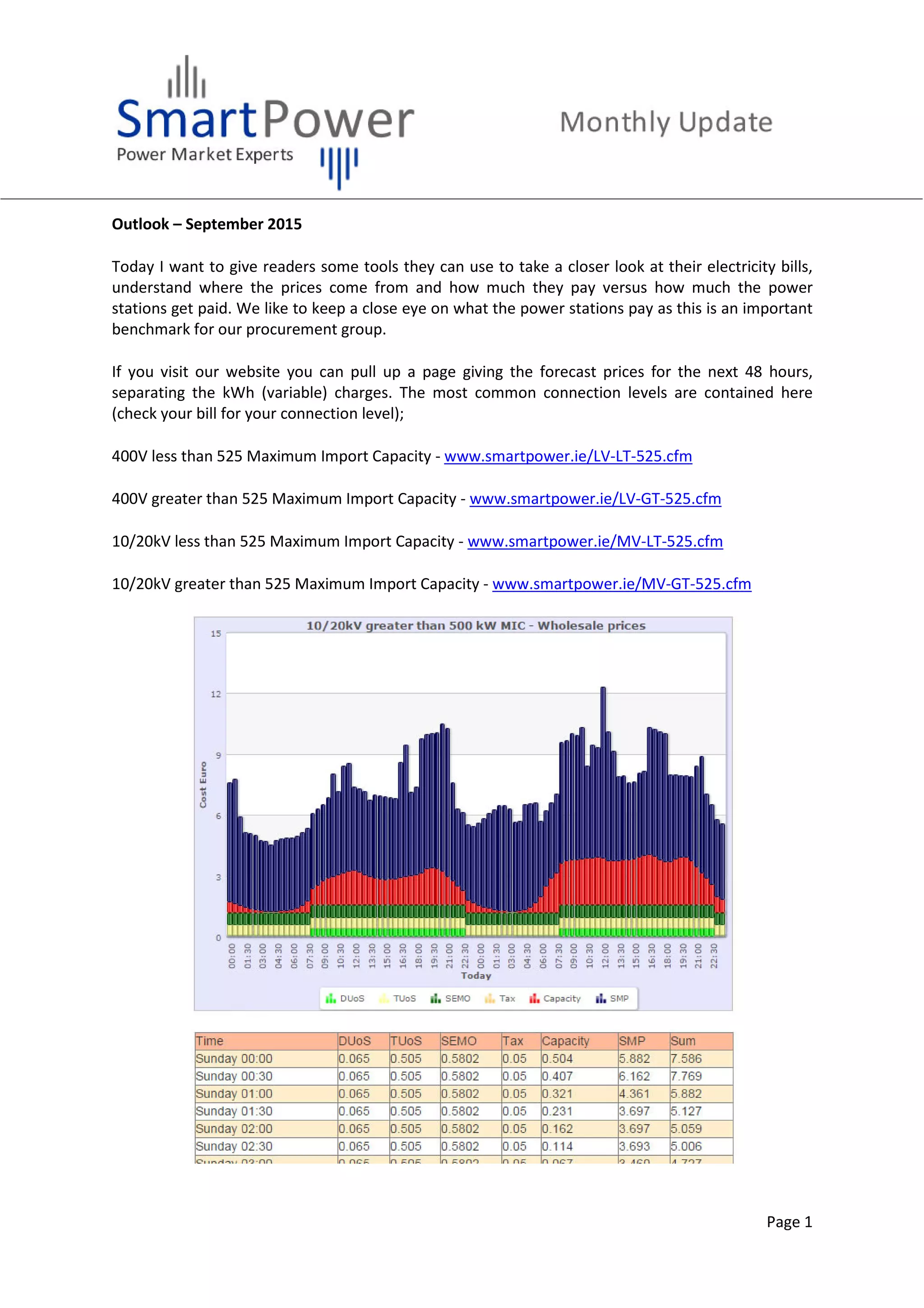
The Irish Electricity Market is based on a central pool system where power stations all bid into a
central market. The energy price that power stations are paid changes ½ hour by ½ hour and a
forecast is published by the market operator 24 hours in advance. This is known as the System
Marginal Price (SMP) and is shown in Blue on the graph.
The other significant cost relates to Capacity Costs - Power stations are paid for providing a backup
called a reserve (both spinning & static) in case demand is higher than forecast or another power
station trips and power is needed urgently. This is shown in the Red part of the graph above and
averages out at about 1.8c/kWh. It can vary between 0.0 c/kWh during summer nights up to about
3.5c/kWh during the winter peak.
The other parameters on the bill such as TUOS, DUOS etc are fixed charges from ESB networks to
pay for the grid infrastructure and its maintenance costs. These charges and associated taxes such as
the PSO level are reviewed in October every year by the market operator so although they are fixed
charges they will change around this time of year.
These charges have risen by about 5% a year from 2011 to 2015. We should point out that these
fixed charges do not have any bearing on whether you should choose a fixed or a floating price
contract as you pay the same either way.
One common error when choosing suppliers is to compare the energy rates quoted at face value.
This does not really work well as the various different suppliers use different components to make
up the rate and this can vary from client to client even from the same supplier. When choosing
suppliers for our procurement group we strip out the complexity to ensure that we compare 'like
with like'.
Given the complexity, the obscure tariff choices and the conflicting advice out there choosing the
best electricity contract for you business is not straightforward. The easiest way to ensure that you
make the best choice for your business is to join our procurement group. It is free to join and you
can relax knowing you have an expert watching the market on your behalf. Email us for more details.
Next Year’s PSO Levy
We were disappointed to read that the CER has backtracked from their initial position for the
2015/2016 PSO levy. Despite minimum price obligations to Tynagh, Aughinish and Edenderry
running their course in 2016, we only see a 3% reduction in the PSO levy from the eye-watering €
2.58 level. This may be a case of a temporary tax morphing into a permanent one.
Upward pressure to maintain this prices has been caused by
• Lower wholesale electricity prices than expected, CfDs (Contract for difference), CfDs
payments are higher to peat and wind.
• Lower capacity payments to power stations, (however this will have a positive impact
elsewhere on the customer bill).
• 11% more PSO supported wind on the grid.
Page 3
In our view charging PSO as a fixed cost is a very inefficient way to pay for supported
infrastructure/generation. It providing an amplified signal to businesses to reduce kVA levels, which
impacts ESB Networks in a negative way. If it was at least changed from a fixed cost per kVA of
capacity to a kWh cost, it would at least help encourage more investment in energy efficiency.
It is our strong view, that the ongoing support for carbon intensive peat fired generation (€121.9
million- 37.5% from a total of €325 million) is both uneconomic and unjustifiable. The EPA among
others point out that drained and cut bogland goes from being a carbon sink to a very large carbon
source.
Energy Markets Outlook
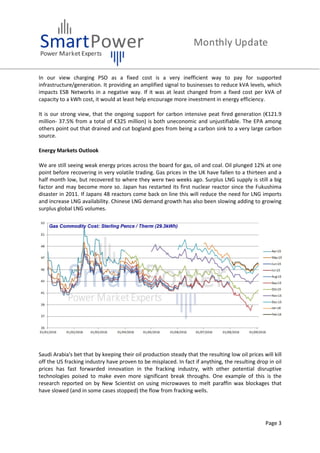
We are still seeing weak energy prices across the board for gas, oil and coal. Oil plunged 12% at one
point before recovering in very volatile trading. Gas prices in the UK have fallen to a thirteen and a
half month low, but recovered to where they were two weeks ago. Surplus LNG supply is still a big
factor and may become more so. Japan has restarted its first nuclear reactor since the Fukushima
disaster in 2011. If Japans 48 reactors come back on line this will reduce the need for LNG imports
and increase LNG availability. Chinese LNG demand growth has also been slowing adding to growing
surplus global LNG volumes.
Saudi Arabia's bet that by keeping their oil production steady that the resulting low oil prices will kill
off the US fracking industry have proven to be misplaced. In fact if anything, the resulting drop in oil
prices has fast forwarded innovation in the fracking industry, with other potential disruptive
technologies poised to make even more significant break throughs. One example of this is the
research reported on by New Scientist on using microwaves to melt paraffin wax blockages that
have slowed (and in some cases stopped) the flow from fracking wells.
Page 4
OPECs grip on the oil supply chain has considerably weakened, expanding investment in energy
efficiency and renewables are also making real inroads and destroying fossil fuel demand, and as a
result we remain bearish on the long term prospects for energy prices.
Irish Wholesale Electricity prices.
Irish prices are continuing to trade in a stable range, with no real change seen over the past months.
This summer has been exceptionally windy helping to push us up to that 25% figure of demand met
by wind energy, resulting in record low prices.
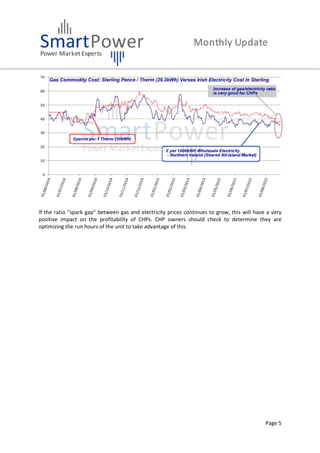
However, recently electricity price drops are not quite keeping up with gas price drops (see graph
next page)
Page 5
If the ratio "spark gap" between gas and electricity prices continues to grow, this will have a very
positive impact on the profitability of CHPs. CHP owners should check to determine they are
optimizing the run hours of the unit to take advantage of this.
Page 6
Euro / Sterling Trend.
This August was the most volatile month for currencies since the height of the financial crisis in
2008. From a traders perspective, high volatility is a clue that prices may break out soon and start
trending as the market likes to blow traders out of their positions before it starts to trend. EURUSD
recently rallied strongly as too many traders where short in 'Carry' trades and they got heavily
squeezed. However, now that the squeeze has played out, the risks are probably to the downside.
In line with the euro squeeze EURGBP pushed all the way up to 0.74 and topped out there. Our
directional bias is still euro negative but we remain flexible.
About SmartPower
Our range of activities include;
Review current contracts to make sure your business is tied into the lowest cost connection level
agreement.
Making comparisons between tracker and fixed electricity tariffs more transparent, so better
procurement decisions are made.
Providing daily/hour gas price updates on the forward markets, so that gas & electricity prices can be
hedged forward at competitive rates.
Scheduling load to use lowest priced times and switch off non-critical load during high cost periods.
Allowing a (non-critical) portion of the electricity profile to be switched off or an on-site generator
started remotely by the National Grid (via an aggregator known as a Demand Side Unit) allowing you
Page 7
to receive capacity payments in compensation. This is also applicable to sites with a Diesel
Generator.
Providing an independent expert review and paybacks of energy saving capital projects, including
wind turbines, led lighting retrofits and solar photovoltaic panels.
For CHP owners, access market information to optimise run hours so that power is imported
(purchased) when the import cost is lower than the running costs of the generator, and if there is an
export potential, then better returns can be invariably be obtained using a time of day tariff model.
See www.smartpower.ie for more details. If you have any questions please contact me at
mailto:<peter.brennan@SmartPower.ie>or direct dial at 01 482 4551 or my mobile 086 8402190.
Naturally, please feel free to forward on the newsletter (in full – without editing) to anybody who
has an interest. Sign-up is also free on our website (We only look for the email address where we
need to send the newsletter).
This newsletter contains proprietary material and is subject to copyright.

SmartPower-September 2015-Newsletter (1)

  • 1.
    Page 1 Outlook –September 2015 Today I want to give readers some tools they can use to take a closer look at their electricity bills, understand where the prices come from and how much they pay versus how much the power stations get paid. We like to keep a close eye on what the power stations pay as this is an important benchmark for our procurement group. If you visit our website you can pull up a page giving the forecast prices for the next 48 hours, separating the kWh (variable) charges. The most common connection levels are contained here (check your bill for your connection level); 400V less than 525 Maximum Import Capacity - www.smartpower.ie/LV-LT-525.cfm 400V greater than 525 Maximum Import Capacity - www.smartpower.ie/LV-GT-525.cfm 10/20kV less than 525 Maximum Import Capacity - www.smartpower.ie/MV-LT-525.cfm 10/20kV greater than 525 Maximum Import Capacity - www.smartpower.ie/MV-GT-525.cfm
  • 2.
    Page 2 The IrishElectricity Market is based on a central pool system where power stations all bid into a central market. The energy price that power stations are paid changes ½ hour by ½ hour and a forecast is published by the market operator 24 hours in advance. This is known as the System Marginal Price (SMP) and is shown in Blue on the graph. The other significant cost relates to Capacity Costs - Power stations are paid for providing a backup called a reserve (both spinning & static) in case demand is higher than forecast or another power station trips and power is needed urgently. This is shown in the Red part of the graph above and averages out at about 1.8c/kWh. It can vary between 0.0 c/kWh during summer nights up to about 3.5c/kWh during the winter peak. The other parameters on the bill such as TUOS, DUOS etc are fixed charges from ESB networks to pay for the grid infrastructure and its maintenance costs. These charges and associated taxes such as the PSO level are reviewed in October every year by the market operator so although they are fixed charges they will change around this time of year. These charges have risen by about 5% a year from 2011 to 2015. We should point out that these fixed charges do not have any bearing on whether you should choose a fixed or a floating price contract as you pay the same either way. One common error when choosing suppliers is to compare the energy rates quoted at face value. This does not really work well as the various different suppliers use different components to make up the rate and this can vary from client to client even from the same supplier. When choosing suppliers for our procurement group we strip out the complexity to ensure that we compare 'like with like'. Given the complexity, the obscure tariff choices and the conflicting advice out there choosing the best electricity contract for you business is not straightforward. The easiest way to ensure that you make the best choice for your business is to join our procurement group. It is free to join and you can relax knowing you have an expert watching the market on your behalf. Email us for more details. Next Year’s PSO Levy We were disappointed to read that the CER has backtracked from their initial position for the 2015/2016 PSO levy. Despite minimum price obligations to Tynagh, Aughinish and Edenderry running their course in 2016, we only see a 3% reduction in the PSO levy from the eye-watering € 2.58 level. This may be a case of a temporary tax morphing into a permanent one. Upward pressure to maintain this prices has been caused by • Lower wholesale electricity prices than expected, CfDs (Contract for difference), CfDs payments are higher to peat and wind. • Lower capacity payments to power stations, (however this will have a positive impact elsewhere on the customer bill). • 11% more PSO supported wind on the grid.
  • 3.
    Page 3 In ourview charging PSO as a fixed cost is a very inefficient way to pay for supported infrastructure/generation. It providing an amplified signal to businesses to reduce kVA levels, which impacts ESB Networks in a negative way. If it was at least changed from a fixed cost per kVA of capacity to a kWh cost, it would at least help encourage more investment in energy efficiency. It is our strong view, that the ongoing support for carbon intensive peat fired generation (€121.9 million- 37.5% from a total of €325 million) is both uneconomic and unjustifiable. The EPA among others point out that drained and cut bogland goes from being a carbon sink to a very large carbon source. Energy Markets Outlook We are still seeing weak energy prices across the board for gas, oil and coal. Oil plunged 12% at one point before recovering in very volatile trading. Gas prices in the UK have fallen to a thirteen and a half month low, but recovered to where they were two weeks ago. Surplus LNG supply is still a big factor and may become more so. Japan has restarted its first nuclear reactor since the Fukushima disaster in 2011. If Japans 48 reactors come back on line this will reduce the need for LNG imports and increase LNG availability. Chinese LNG demand growth has also been slowing adding to growing surplus global LNG volumes. Saudi Arabia's bet that by keeping their oil production steady that the resulting low oil prices will kill off the US fracking industry have proven to be misplaced. In fact if anything, the resulting drop in oil prices has fast forwarded innovation in the fracking industry, with other potential disruptive technologies poised to make even more significant break throughs. One example of this is the research reported on by New Scientist on using microwaves to melt paraffin wax blockages that have slowed (and in some cases stopped) the flow from fracking wells.
  • 4.
    Page 4 OPECs gripon the oil supply chain has considerably weakened, expanding investment in energy efficiency and renewables are also making real inroads and destroying fossil fuel demand, and as a result we remain bearish on the long term prospects for energy prices. Irish Wholesale Electricity prices. Irish prices are continuing to trade in a stable range, with no real change seen over the past months. This summer has been exceptionally windy helping to push us up to that 25% figure of demand met by wind energy, resulting in record low prices. However, recently electricity price drops are not quite keeping up with gas price drops (see graph next page)
  • 5.
    Page 5 If theratio "spark gap" between gas and electricity prices continues to grow, this will have a very positive impact on the profitability of CHPs. CHP owners should check to determine they are optimizing the run hours of the unit to take advantage of this.
  • 6.
    Page 6 Euro /Sterling Trend. This August was the most volatile month for currencies since the height of the financial crisis in 2008. From a traders perspective, high volatility is a clue that prices may break out soon and start trending as the market likes to blow traders out of their positions before it starts to trend. EURUSD recently rallied strongly as too many traders where short in 'Carry' trades and they got heavily squeezed. However, now that the squeeze has played out, the risks are probably to the downside. In line with the euro squeeze EURGBP pushed all the way up to 0.74 and topped out there. Our directional bias is still euro negative but we remain flexible. About SmartPower Our range of activities include; Review current contracts to make sure your business is tied into the lowest cost connection level agreement. Making comparisons between tracker and fixed electricity tariffs more transparent, so better procurement decisions are made. Providing daily/hour gas price updates on the forward markets, so that gas & electricity prices can be hedged forward at competitive rates. Scheduling load to use lowest priced times and switch off non-critical load during high cost periods. Allowing a (non-critical) portion of the electricity profile to be switched off or an on-site generator started remotely by the National Grid (via an aggregator known as a Demand Side Unit) allowing you
  • 7.
    Page 7 to receivecapacity payments in compensation. This is also applicable to sites with a Diesel Generator. Providing an independent expert review and paybacks of energy saving capital projects, including wind turbines, led lighting retrofits and solar photovoltaic panels. For CHP owners, access market information to optimise run hours so that power is imported (purchased) when the import cost is lower than the running costs of the generator, and if there is an export potential, then better returns can be invariably be obtained using a time of day tariff model. See www.smartpower.ie for more details. If you have any questions please contact me at mailto:<peter.brennan@SmartPower.ie>or direct dial at 01 482 4551 or my mobile 086 8402190. Naturally, please feel free to forward on the newsletter (in full – without editing) to anybody who has an interest. Sign-up is also free on our website (We only look for the email address where we need to send the newsletter). This newsletter contains proprietary material and is subject to copyright.