15/10/2024 1
Smart AUtomation System
SRI RAMAKRISHNA ENGINEERING COLLEGE
[Educational Service: SNR Sons Charitable Trust]
[Autonomous Institution, Reaccredited by NAAC with ‘A+’ Grade]
[Approved by AICTE and Permanently Affiliated to Anna University, Chennai]
[ISO 9001:2015 Certified and all eligible programmes Accredited by NBA]
Vattamalaipalayam, N.G.G.O. Colony Post, Coimbatore – 641 022.
Course Instructors:
Dr.K.Balamurugan, Asso. Prof/EEE
No. of Credits: 3
Department of Electrical and Electronics Engineering
20EE2E24 – SMART AUTOMATION SYSTEM
On successful completion of the course, students will
be able to
15/10/2024 2
Smart AUtomation System
COURSE OUTCOMES
CO 1 Understand the concepts of smart system design and its
present developments.
CO 2 Illustrate different embedded open-source and cost-effective
techniques for developing solution for real time applications.
CO 3
Acquire knowledge on different platforms and Infrastructure
for Smart system design.
CO 4 Infer about smart appliances and energy management
concepts.
CO 5
Improve Employability and entrepreneurship capacity due to
knowledge upgradation on embedded system technologies.
Module-1
INTRODUCTION 09
Overview of a smart system - Hardware and software selection -
Smart sensors and Actuators - Communication protocols used for
smart systems - Design and implementation of a smart home system
Module-2
HOME AUTOMATION 09
Home Automation - System Architecture - Essential Components -
Design Considerations: Control Unit, Sensing Requirements,
Communication, Data Security - Bluetooth Based Home Automation -
GSM Based Home Devices Control
15/10/2024 3
Smart AUtomation System
COURSE CONTENT
Module-3
SMART APPLIANCES AND ENERGY MANAGEMENT 09
Significance of smart appliances for energy management - Smart Meters:
Significance, Architecture & Energy - Measurement Technique - Security
Considerations.
Module-4
SMART WEARABLE DEVICES 08
Body Area Networks – Sensors - communication protocol for Wearable
devices - Application of Smart Wearable in Healthcare &Activity Monitoring.
Module-5
EMBEDDED SYSTEMS AND ROBOTICS 10
Fundamental concepts in Robotics - Robots and Controllers components -
Embedded processor based: pick and place robot- Mobile Robot Design –
UAV.
15/10/2024 4
Smart AUtomation System
COURSE CONTENT
TEXT BOOKS
1. Grimm, Christoph, Neumann, Peter, Mahlknech and Stefan, Embedded Systems for
Smart Appliances and Energy Management, Springer 2013, 1st Edition.
2. KazemSohraby, Daniel Minoli and TaiebZnati, Wireless Sensor Networks Technology,
Protocols, and Applications, John Wiley & Sons, 2007, 1st Edition.
3. NilanjanDey, Amartya Mukherjee, Embedded Systems and Robotics with Open-Source
Tools, CRC press, 2016, 1st Edition.
REFERENCES
4. Thomas Bräunl, Embedded Robotics, Springer, 2003.
5. Raj Kamal, Embedded Systems - Architecture, Programming and Design, McGraw-
Hill, 2008.
6. Karim Yaghmour, Embedded Android, O'Reilly, 2013.
7. Steven Goodwin, Smart Home Automation with Linux and Raspberry Pi, Apress , 2013
15/10/2024 5
Smart AUtomation System
TEXT BOOKS & PREREQUISITE
1. https://microcontrollerslab.com/home-
automation-projects-ideas/
2. https://www.learnrobotics.org/blog/simple-
robot/
3. https://robolabor.ee/homelab/en/iot
15/10/2024 6
Smart AUtomation System
WEB REFERENCES
15/10/2024 7
Smart AUtomation System
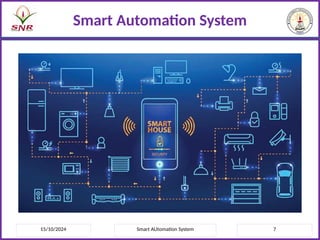
Smart Automation System
MODULE 1
Introduction
• CO1: Understand the concepts of smart system
design and its present developments.
15/10/2024 8
Smart AUtomation System
SMART SYSTEM
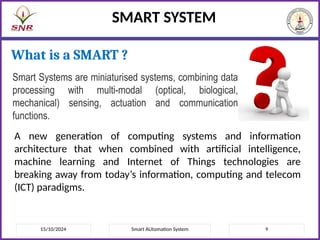
What is a SMART ?
15/10/2024 Smart AUtomation System 9
Smart Systems are miniaturised systems, combining data
processing with multi-modal (optical, biological,
mechanical) sensing, actuation and communication
functions.
A new generation of computing systems and information
architecture that when combined with artificial intelligence,
machine learning and Internet of Things technologies are
breaking away from today’s information, computing and telecom
(ICT) paradigms.
15/10/2024 Smart AUtomation System 10
SMART SYSTEM
Smart Systems are a key driving force for a range of rapidly emerging
intelligent and autonomous systems and objects such as self-driving
cars, artificial pancreas, Internet of Things (IoT), M2M-enabled
advanced manufacturing robots or wearable health monitors. State
of the art integrated smart systems upgrade the capabilities of
existing hardware by Machine Learning (ML) and Artificial
Intelligence (AI) algorithms, tackle big data interpretation, and
enable augmented or enhanced decisions on their own or
collaboratively. In industrial usage, integrated smart system solutions
are fundamental building blocks of Industry 4.0 ecosystems. Design
aspects of modern smart systems also reflect actual socio-economic
challenges such as sustainable electronics design, life-cycle analysis
or design for reliability.
15/10/2024 Smart AUtomation System 11
Technology Innovations Are Reinforcing One Another and
Accelerating Exponentially
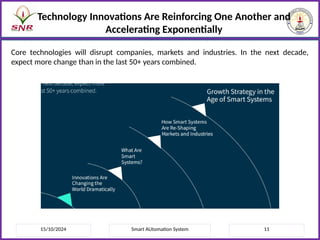
Core technologies will disrupt companies, markets and industries. In the next decade,
expect more change than in the last 50+ years combined.
15/10/2024 Smart AUtomation System 12
Technology Innovations Are Setting the Stage for The Next
Big Thing
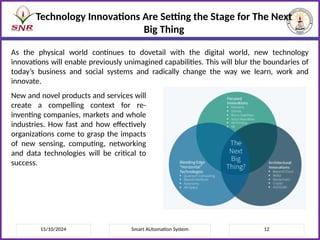
As the physical world continues to dovetail with the digital world, new technology
innovations will enable previously unimagined capabilities. This will blur the boundaries of
today’s business and social systems and radically change the way we learn, work and
innovate.
New and novel products and services will
create a compelling context for re-
inventing companies, markets and whole
industries. How fast and how effectively
organizations come to grasp the impacts
of new sensing, computing, networking
and data technologies will be critical to
success.
15/10/2024 Smart AUtomation System 13
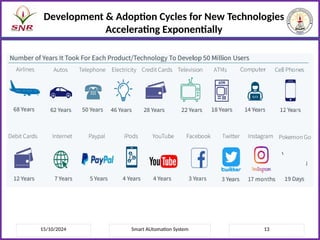
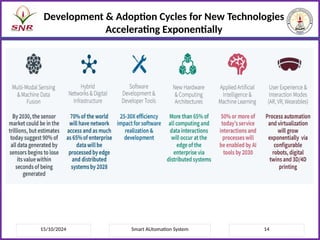
Development & Adoption Cycles for New Technologies
Accelerating Exponentially
15/10/2024 Smart AUtomation System 14
Development & Adoption Cycles for New Technologies
Accelerating Exponentially
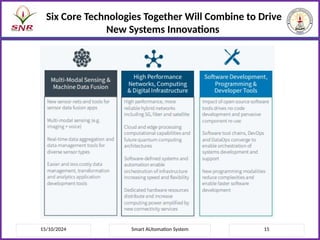
15/10/2024 Smart AUtomation System 15
Six Core Technologies Together Will Combine to Drive
New Systems Innovations
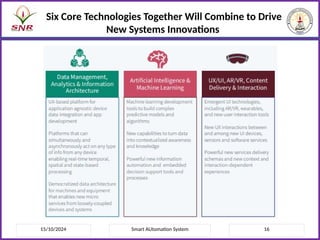
15/10/2024 Smart AUtomation System 16
Six Core Technologies Together Will Combine to Drive
New Systems Innovations
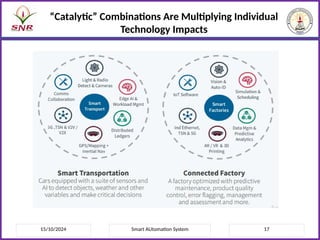
15/10/2024 Smart AUtomation System 17
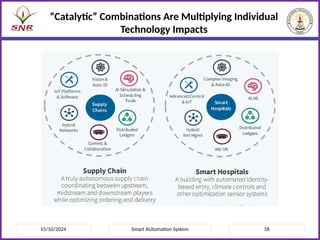
“Catalytic” Combinations Are Multiplying Individual
Technology Impacts
15/10/2024 Smart AUtomation System 18
“Catalytic” Combinations Are Multiplying Individual
Technology Impacts
15/10/2024 Smart AUtomation System 19
Hardware and Software Selection
Hardware Selection:
Processing Power: The hardware must have enough processing
power to handle large data sets and complex data mining
algorithms.
Storage Capacity: The system must have adequate storage to hold
the data warehouse and the data mining models.
Scalability: The hardware must be able to scale up or down
according to the organization’s changing data needs.
Network Speed: The hardware should support high-speed network
connectivity to ensure that data transfer between the data
warehouse and data mining algorithms is seamless.
15/10/2024 Smart AUtomation System 20
Hardware and Software Selection
Software Selection:
Data Mining Algorithms: The software must support a wide range of
data mining algorithms to ensure that the organization can extract
insights from its data.
Data Warehousing: The software should support the creation of a
robust and scalable data warehouse.
Data Visualization: The software should provide interactive and
easy-to-use data visualization tools to help users make sense of the
data.
Integration: The software must be compatible with the
organization’s existing IT infrastructure, including databases and data
sources.
15/10/2024 Smart AUtomation System 21
Smart Sensors and Actuators
https://medium.com/@muflorentine3/smart-sensors-and-actuators-3e5c0d37fde6
https://www.electricaltechnology.org/2018/11/types-sensors-applications.html
SENSORS
Sensors are the devices which convert physical properties to
electrical signals. E.g. temperature sensor, humidity sensor,
Presence detector sensor and so on. Sensors acquires the
information from the real world.
The output is generally a signal that is converted to human
readable display at the sensor location or transmitted
electronically over a network for reading or further processing
15/10/2024 Smart AUtomation System 22
Features to be considered when choosing a sensor.
Accuracy: The agreement between the actual value and the measured value.
Resolution: The change in measured variable to which the sensor will respond.
Repeatability: Variation of sensor measurements when the same quantity is
measured several times.
Range: Upper and lower limits of the variable that can be measured.
Sensitivity: The minimum input of physical parameter that will create a detectable
output change. In some sensors, the sensitivity is defined as the input parameter
change required producing standardized output change.
Linearity: The linearity of the sensor is an expression of the extent to which the
actual measured curve of a sensor departs from the ideal curve.
15/10/2024 Smart AUtomation System 23
Features to be considered when choosing a sensor.
Nowadays is very easy to find several types of sensors in the
markets. But one of the most important things is selects the right
sensor and it supposes a critical part of the design cycle. It requires
taking in mind and understanding of many features, such us:
• Type of motion
• Precision of motion
• Magnitude of motion
• Operation conditions
15/10/2024 Smart AUtomation System 24
Types of Sensors
Temperature sensor
Temperature sensor is a device which is used to measure the amount of
heat energy that allows to detect a physical change in temperature and
can be used in a wide range of applications.
Humidity sensor
Humidity sensor is the amount of water vapor in an atmosphere of air
or other gases.
Presence detector sensor
Presence detector sensor is a device which is used to detect physical
presence or absence. It monitors the detection zone for occupancy
based on infrared, if a person is sensed, the detector will automatically
trigger an action such as turning the lighting on.
15/10/2024 Smart AUtomation System 25
Types of Sensors
Active sensors: require an external source of power that provides
the majority of the output power of the signal. e.g radar, GPS, X-ray,
infrared, seismic
Passive sensors: the output is almost entirely provided by the
measured signal without an excitation voltage. Photographic,
thermal, electric field sensing, chemical, infrared and seismic
Digital sensors: the signal produced or reflected by the sensor is
binary. They are used for conversion and transmission. Eg:
temperature, gas flow, ultrasonic. These digital sensors are replacing
analog sensors as they are capable of overcoming the drawbacks of
analog sensors. In digital sensors, the signal measured is directly
converted into digital signal output inside the digital sensor itself.
15/10/2024 Smart AUtomation System 26
Types of Sensors
Digital Temperature sensor
DS1620 is a digital temperature sensor that provides temperature of device
with 9-bit temperature readings. It acts a thermostat with its three thermal
alarm outputs. If the temperature of device is greater than or equal to user
defined temperature TH, then THIGH is driven high. If the temperature of
the device is less than or equal to user defined temperature TL, then the
TLOW is driven high. If the temperature of the device exceeds TH and
remains high until it falls below that of TL, then the TCOM is driven high.
Digital Accelerometers
The method of generation of variable frequency square wave output by
the digital accelerometer is called as pulse-width modulation. The output
PWM signal, pulse width or duty cycle is proportional to the acceleration
value.
15/10/2024 Smart AUtomation System 27
Types of Sensors
Analog sensors: produce continuous analog output signal. Eg.
Accelerometers, temperature sensors, pressure sensors, sound sensors.
Accelerometers
Analog sensors that detect changes in position, velocity, orientation, shock,
vibration, and tilt by sensing motion are called as accelerometers.
These accelerometers are available as analog and digital sensors, based on
the output signal. Analog accelerometer produces a constant variable
voltage based on the amount of acceleration applied to the accelerometer.
Light sensor
Analog sensors that are used for detecting the amount of light striking the
sensors are called as light sensors. These analog light sensors are again
classified into various types such as photo-resistor, Cadmium Sulfide (CdS),
and, photocell.
15/10/2024 Smart AUtomation System 28
Types of Sensors
Pressure Sensor
The analog sensors that are used to measure the amount of pressure
applied to a sensor are called as analog pressure sensors. Pressure sensor
will produce an analog output signal that is proportional to the amount of
applied pressure. These piezoelectric sensors are used for the generation
of electric charge.
Contact sensor: requires physical contacts with the stimulus. e.g. strain
gauge, temperature sensors.
Non-contact sensor: requires non-physical contact.eg. Magnetic sensors,
infrared sensors, thermometers.
Absolute sensor: reacts to a stimulus on an absolute scale. Eg. Thermistors,
strain gauge.
Relative sensors: the stimulus is sensed relative to a fixed or variable
reference. Eg. Thermocouple.
15/10/2024 Smart AUtomation System 29
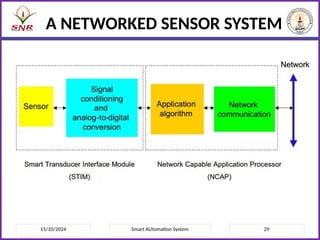
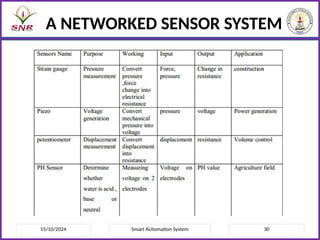
A NETWORKED SENSOR SYSTEM
15/10/2024 Smart AUtomation System 30
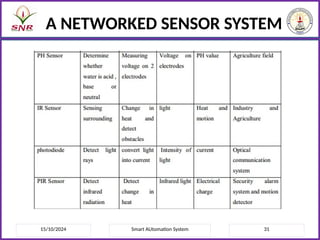
A NETWORKED SENSOR SYSTEM
15/10/2024 Smart AUtomation System 31
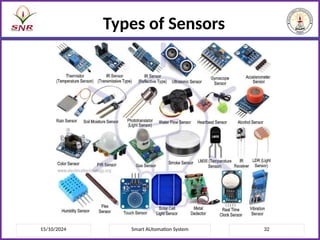
A NETWORKED SENSOR SYSTEM
15/10/2024 Smart AUtomation System 32
Types of Sensors
15/10/2024 Smart AUtomation System 33
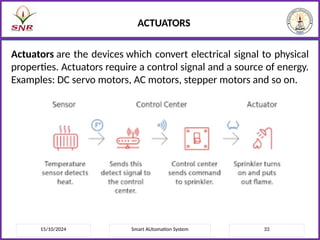
ACTUATORS
Actuators are the devices which convert electrical signal to physical
properties. Actuators require a control signal and a source of energy.
Examples: DC servo motors, AC motors, stepper motors and so on.
15/10/2024 Smart AUtomation System 34
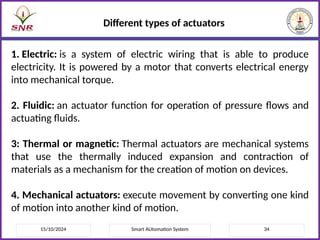
Different types of actuators
1. Electric: is a system of electric wiring that is able to produce
electricity. It is powered by a motor that converts electrical energy
into mechanical torque.
2. Fluidic: an actuator function for operation of pressure flows and
actuating fluids.
3: Thermal or magnetic: Thermal actuators are mechanical systems
that use the thermally induced expansion and contraction of
materials as a mechanism for the creation of motion on devices.
4. Mechanical actuators: execute movement by converting one kind
of motion into another kind of motion.
15/10/2024 Smart AUtomation System 35
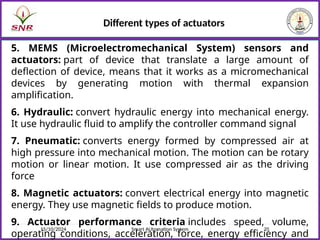
Different types of actuators
5. MEMS (Microelectromechanical System) sensors and
actuators: part of device that translate a large amount of
deflection of device, means that it works as a micromechanical
devices by generating motion with thermal expansion
amplification.
6. Hydraulic: convert hydraulic energy into mechanical energy.
It use hydraulic fluid to amplify the controller command signal
7. Pneumatic: converts energy formed by compressed air at
high pressure into mechanical motion. The motion can be rotary
motion or linear motion. It use compressed air as the driving
force
8. Magnetic actuators: convert electrical energy into magnetic
energy. They use magnetic fields to produce motion.
9. Actuator performance criteria includes speed, volume,
operating conditions, acceleration, force, energy efficiency and
15/10/2024 Smart AUtomation System 36
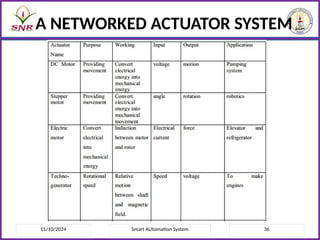
A NETWORKED ACTUATOR SYSTEM
15/10/2024 Smart AUtomation System 37
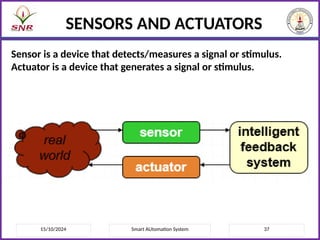
SENSORS AND ACTUATORS
Sensor is a device that detects/measures a signal or stimulus.
Actuator is a device that generates a signal or stimulus.
15/10/2024 Smart AUtomation System 38
Communication Protocols used for Smart Systems
https://instrumentationblog.com/communication-protocols/
https://www.elprocus.com/communication-protocols/
What are communication protocols?
A communication protocol is a system of rules that allows two or
more entities of a communications system to transmit information
via any variation of a physical quantity. The protocol defines the
rules, syntax, semantics, and synchronization of communication and
possible error recovery methods. Protocols may be implemented
by hardware, software, or a combination of both.
15/10/2024 Smart AUtomation System 39
Types of communication protocols
Communication protocols are of two types. They are:
Inter System Protocol
Intra System Protocol
Inter System Protocol
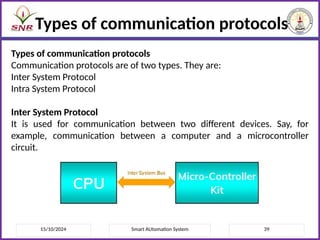
It is used for communication between two different devices. Say, for
example, communication between a computer and a microcontroller
circuit.
15/10/2024 Smart AUtomation System 40
Types of communication protocols
Different categories of Inter System protocols are:
1. UART Protocol – Universal Asynchronous Transmitter and
Receiver
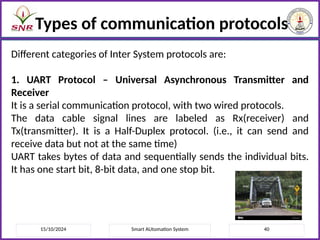
It is a serial communication protocol, with two wired protocols.
The data cable signal lines are labeled as Rx(receiver) and
Tx(transmitter). It is a Half-Duplex protocol. (i.e., it can send and
receive data but not at the same time)
UART takes bytes of data and sequentially sends the individual bits.
It has one start bit, 8-bit data, and one stop bit.
15/10/2024 Smart AUtomation System 41
Types of communication protocols
2. USART Protocol – Universal Synchronous and Asynchronous
Transmitter and Receiver
It is a serial communication protocol, with two wired protocols.
The data cable signal lines are labeled as Rx(receiver) and Tx(transmitter).
It is a Full-Duplex protocol. (i.e., it can send and receive data at the same
time by different baud rates)
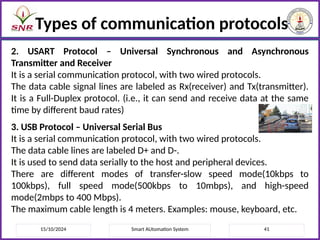
3. USB Protocol – Universal Serial Bus
It is a serial communication protocol, with two wired protocols.
The data cable lines are labeled D+ and D-.
It is used to send data serially to the host and peripheral devices.
There are different modes of transfer-slow speed mode(10kbps to
100kbps), full speed mode(500kbps to 10mbps), and high-speed
mode(2mbps to 400 Mbps).
The maximum cable length is 4 meters. Examples: mouse, keyboard, etc.
15/10/2024 Smart AUtomation System 42
Types of communication protocols
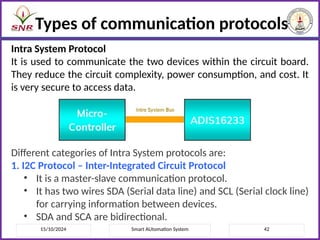
Intra System Protocol
It is used to communicate the two devices within the circuit board.
They reduce the circuit complexity, power consumption, and cost. It
is very secure to access data.
Different categories of Intra System protocols are:
1. I2C Protocol – Inter-Integrated Circuit Protocol
• It is a master-slave communication protocol.
• It has two wires SDA (Serial data line) and SCL (Serial clock line)
for carrying information between devices.
• SDA and SCA are bidirectional.
15/10/2024 Smart AUtomation System 43
Types of communication protocols
2. SPI Protocol – Serial Peripheral Interface Protocol
• It is a serial communication protocol developed by Motorola.
• It is also called a 4-wire protocol. It has four wires-MOSI, MISO,
SS, and SCLK.
• It is used to communicate master-slave devices.
• It is a full duplex communication protocol. It is not limited to 8-
bit words in data transferring.
3. CAN Protocol – Controller Area Network Protocol
• It is a serial communication protocol.
• It has two wires Can High (H+) and CAN Low (H-).
• It is based on a network-oriented transmission protocol.
15/10/2024 Smart AUtomation System 44
Types of communication protocols
2. SPI Protocol – Serial Peripheral Interface Protocol
• It is a serial communication protocol developed by Motorola.
• It is also called a 4-wire protocol. It has four wires-MOSI, MISO,
SS, and SCLK.
• It is used to communicate master-slave devices.
• It is a full duplex communication protocol. It is not limited to 8-
bit words in data transferring.
3. CAN Protocol – Controller Area Network Protocol
• It is a serial communication protocol.
• It has two wires Can High (H+) and CAN Low (H-).
• It is based on a network-oriented transmission protocol.
15/10/2024 Smart AUtomation System 45
Types of communication protocols
Industrial Instrumentation Protocols
In the field of process automation, the following are the most
commonly used communication protocols:
1. RS-232 Communication Protocol
• RS-232 is an asynchronous communication method.
• It uses a binary system to transmit data in ASCII format.
• PLCs serial port is used for transmission/reception of data. It
works by sending/ receiving voltage.
• Normally 1 bit (a high bit) is represented by a voltage -12 V.
And the 0 bit(low bit) is represented by a voltage +12 V.
15/10/2024 Smart AUtomation System 46
Types of communication protocols
2. RS-485 Communication Protocol
• RS-485 is a multi-drop and two-wire type of communication
that allows us to communicate with multiple devices at the
same time.
• The number of devices that can be connected: 32 devices.
• Maximum distance: 1200 meters(end to end)
• Many PLCs allow connecting up to 128 slave nodes. By using
repeaters number of devices and nodes can be extended.
• It can be used as a 2-wire or 4-wire network. The 4-wire
network would be bidirectional and a 2-wire network would be
unidirectional.
15/10/2024 Smart AUtomation System 47
Types of communication protocols
3. Ethernet(TCP/IP) Communication Protocol
• Ethernet is the local area network and devices that were
defined under IEEE.
• TCP/IP stands for Transfer Control Protocol/Internet Protocol.
• The network nodes are of two types: Data Terminal Equipment
(DTE) and Data Communication Equipment (DCE).
• DTE are devices that generate/ are a destination of data.
Examples: PCs, workstations, print servers, etc.
• DCEs are intermediate devices that receive and retransmit
frames within a network. Examples: routers, switches,
repeaters, etc.
• It uses IP(Inter-Network or internet protocol) for routing.
• Baud rate: 100 Mbps.
• Length: Few km, Nodes: 255
15/10/2024 Smart AUtomation System 48
Types of communication protocols
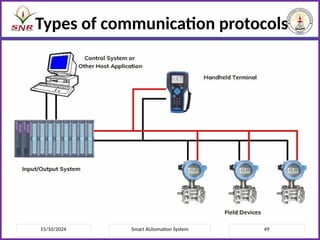
4. HART(Highway Addressable Remote Transducer) Protocol
• HART is a master-slave protocol.
• It can be used in many modes like point-to-point or multidrop
for communicating information to/from smart field instruments
and central control/monitoring systems.
• It provides up to two maters-primary and secondary. So,
secondary masters like handheld communicators are to be used
without interfering with communications with the primary
master, i.e., control/monitoring system.
• Maximum devices: 15 in multidrop
• Network Topology: point-to-point, multidrop, wireless mesh
• There are two simultaneous communication channels: 4-20mA
analog signal and a digital signal.
• The signal frequencies of bit values 0 and 1 are 2200 and 1200Hz
respectively.
15/10/2024 Smart AUtomation System 49
Types of communication protocols
15/10/2024 Smart AUtomation System 50
Types of communication protocols
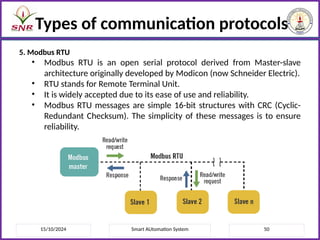
5. Modbus RTU
• Modbus RTU is an open serial protocol derived from Master-slave
architecture originally developed by Modicon (now Schneider Electric).
• RTU stands for Remote Terminal Unit.
• It is widely accepted due to its ease of use and reliability.
• Modbus RTU messages are simple 16-bit structures with CRC (Cyclic-
Redundant Checksum). The simplicity of these messages is to ensure
reliability.
15/10/2024 Smart AUtomation System 51
Types of communication protocols
6. Profibus
• Profibus makes use of three separate layers of an OSI model.
• It first describes the Application Layer. Here, multiple versions of
Profibus handle different types of messaging at the application layer.
• Type of messaging supported by PROFIBUS- cyclic and acyclic data
exchange, diagnosis, alarm handling, and isochronous messaging.
• It does not define layers three to six.
• It then defines Data Link Layer and Physical Layer(i.e., layers 1 and 2).
The data link layer is completed by a Field Bus Data Link(FDL). FDL
combines, master-slave and token passing.
• In the physical Layer, PROFIBUS systems can have three types of media.
The first one is a standard twisted pair wiring system(RS485). Secondly,
a fiber optic transmission, and thirdly, a safety-enhanced system called
Manchester Bus Power (MBP) for situations where the chemical
environment is prone to explosion.
15/10/2024 Smart AUtomation System 52
Types of communication protocols
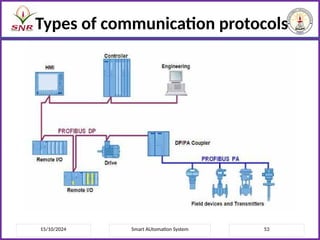
6. Profibus
• Network Topology: It uses the Bus Topology. In this, a central line, or
bus, is wired throughout the system. Devices will be attached to the
main bus.
• Profibus DP(Decentralized Periphery) device is any peripheral device
that has information and sends its output to the master. The DP device
forms a passive station on the network and can only acknowledge
received messages or send response messages to the master upon
request.
• All DP devices have the same priority and all network communication
originates from a master, Maximum Frame Size: 244 bytes
• A maximum number of nodes: 126 with 32 maximum per slave.
• Baud rate: 5-12 Mbps, Length: 15 km.
15/10/2024 Smart AUtomation System 53
Types of communication protocols
15/10/2024 Smart AUtomation System 54
Types of communication protocols
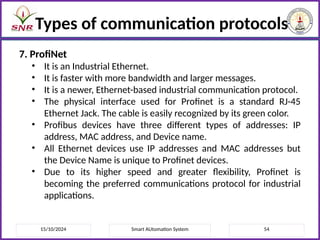
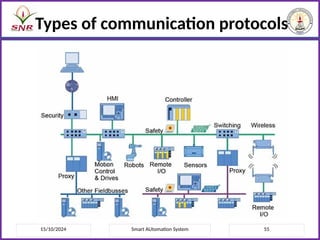
7. ProfiNet
• It is an Industrial Ethernet.
• It is faster with more bandwidth and larger messages.
• It is a newer, Ethernet-based industrial communication protocol.
• The physical interface used for Profinet is a standard RJ-45
Ethernet Jack. The cable is easily recognized by its green color.
• Profibus devices have three different types of addresses: IP
address, MAC address, and Device name.
• All Ethernet devices use IP addresses and MAC addresses but
the Device Name is unique to Profinet devices.
• Due to its higher speed and greater flexibility, Profinet is
becoming the preferred communications protocol for industrial
applications.
15/10/2024 Smart AUtomation System 55
Types of communication protocols
15/10/2024 Smart AUtomation System 56
Types of communication protocols
8. Interbus
• It is a serial bus system that transmits data between
control systems like PLCs, PCs, Robot controllers, etc.
• It is one of the leading field bus systems in the automation
industry and is fully standardized according to European
Standard.
• They have spatially distributed I/O module that is
connected to sensors and actuators. Example-
temperature sensors, etc.
• Network Topology: Ring Topology(all devices are actively
integrated into a closed transmission path)
15/10/2024 Smart AUtomation System 57
Smart Home Protocols
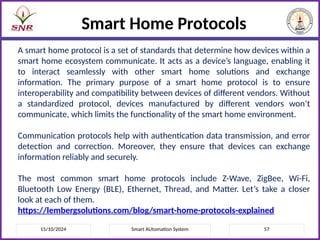
A smart home protocol is a set of standards that determine how devices within a
smart home ecosystem communicate. It acts as a device’s language, enabling it
to interact seamlessly with other smart home solutions and exchange
information. The primary purpose of a smart home protocol is to ensure
interoperability and compatibility between devices of different vendors. Without
a standardized protocol, devices manufactured by different vendors won’t
communicate, which limits the functionality of the smart home environment.
Communication protocols help with authentication data transmission, and error
detection and correction. Moreover, they ensure that devices can exchange
information reliably and securely.
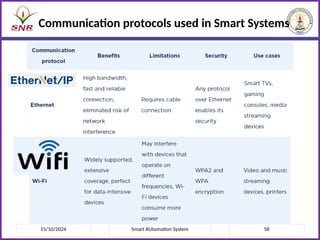
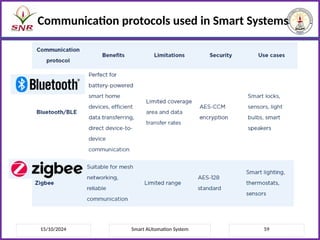
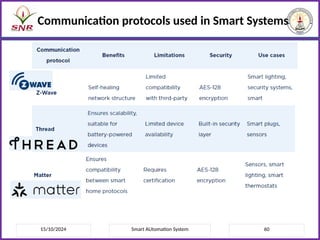
The most common smart home protocols include Z-Wave, ZigBee, Wi-Fi,
Bluetooth Low Energy (BLE), Ethernet, Thread, and Matter. Let’s take a closer
look at each of them.
https://lembergsolutions.com/blog/smart-home-protocols-explained
15/10/2024 Smart AUtomation System 58
Communication protocols used in Smart Systems
15/10/2024 Smart AUtomation System 59
Communication protocols used in Smart Systems
15/10/2024 Smart AUtomation System 60
Communication protocols used in Smart Systems
15/10/2024 Smart AUtomation System 61
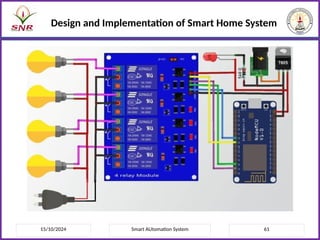
Design and Implementation of Smart Home System
15/10/2024 Smart AUtomation System 62
Design and Implementation of Smart Home System

Smart Automation System Module - 1.pptx

  • 1.
    15/10/2024 1 Smart AUtomationSystem SRI RAMAKRISHNA ENGINEERING COLLEGE [Educational Service: SNR Sons Charitable Trust] [Autonomous Institution, Reaccredited by NAAC with ‘A+’ Grade] [Approved by AICTE and Permanently Affiliated to Anna University, Chennai] [ISO 9001:2015 Certified and all eligible programmes Accredited by NBA] Vattamalaipalayam, N.G.G.O. Colony Post, Coimbatore – 641 022. Course Instructors: Dr.K.Balamurugan, Asso. Prof/EEE No. of Credits: 3 Department of Electrical and Electronics Engineering 20EE2E24 – SMART AUTOMATION SYSTEM
  • 2.
    On successful completionof the course, students will be able to 15/10/2024 2 Smart AUtomation System COURSE OUTCOMES CO 1 Understand the concepts of smart system design and its present developments. CO 2 Illustrate different embedded open-source and cost-effective techniques for developing solution for real time applications. CO 3 Acquire knowledge on different platforms and Infrastructure for Smart system design. CO 4 Infer about smart appliances and energy management concepts. CO 5 Improve Employability and entrepreneurship capacity due to knowledge upgradation on embedded system technologies.
  • 3.
    Module-1 INTRODUCTION 09 Overview ofa smart system - Hardware and software selection - Smart sensors and Actuators - Communication protocols used for smart systems - Design and implementation of a smart home system Module-2 HOME AUTOMATION 09 Home Automation - System Architecture - Essential Components - Design Considerations: Control Unit, Sensing Requirements, Communication, Data Security - Bluetooth Based Home Automation - GSM Based Home Devices Control 15/10/2024 3 Smart AUtomation System COURSE CONTENT
  • 4.
    Module-3 SMART APPLIANCES ANDENERGY MANAGEMENT 09 Significance of smart appliances for energy management - Smart Meters: Significance, Architecture & Energy - Measurement Technique - Security Considerations. Module-4 SMART WEARABLE DEVICES 08 Body Area Networks – Sensors - communication protocol for Wearable devices - Application of Smart Wearable in Healthcare &Activity Monitoring. Module-5 EMBEDDED SYSTEMS AND ROBOTICS 10 Fundamental concepts in Robotics - Robots and Controllers components - Embedded processor based: pick and place robot- Mobile Robot Design – UAV. 15/10/2024 4 Smart AUtomation System COURSE CONTENT
  • 5.
    TEXT BOOKS 1. Grimm,Christoph, Neumann, Peter, Mahlknech and Stefan, Embedded Systems for Smart Appliances and Energy Management, Springer 2013, 1st Edition. 2. KazemSohraby, Daniel Minoli and TaiebZnati, Wireless Sensor Networks Technology, Protocols, and Applications, John Wiley & Sons, 2007, 1st Edition. 3. NilanjanDey, Amartya Mukherjee, Embedded Systems and Robotics with Open-Source Tools, CRC press, 2016, 1st Edition. REFERENCES 4. Thomas Bräunl, Embedded Robotics, Springer, 2003. 5. Raj Kamal, Embedded Systems - Architecture, Programming and Design, McGraw- Hill, 2008. 6. Karim Yaghmour, Embedded Android, O'Reilly, 2013. 7. Steven Goodwin, Smart Home Automation with Linux and Raspberry Pi, Apress , 2013 15/10/2024 5 Smart AUtomation System TEXT BOOKS & PREREQUISITE
  • 6.
    1. https://microcontrollerslab.com/home- automation-projects-ideas/ 2. https://www.learnrobotics.org/blog/simple- robot/ 3.https://robolabor.ee/homelab/en/iot 15/10/2024 6 Smart AUtomation System WEB REFERENCES
  • 7.
    15/10/2024 7 Smart AUtomationSystem Smart Automation System
  • 8.
    MODULE 1 Introduction • CO1:Understand the concepts of smart system design and its present developments. 15/10/2024 8 Smart AUtomation System
  • 9.
    SMART SYSTEM What isa SMART ? 15/10/2024 Smart AUtomation System 9 Smart Systems are miniaturised systems, combining data processing with multi-modal (optical, biological, mechanical) sensing, actuation and communication functions. A new generation of computing systems and information architecture that when combined with artificial intelligence, machine learning and Internet of Things technologies are breaking away from today’s information, computing and telecom (ICT) paradigms.
  • 10.
    15/10/2024 Smart AUtomationSystem 10 SMART SYSTEM Smart Systems are a key driving force for a range of rapidly emerging intelligent and autonomous systems and objects such as self-driving cars, artificial pancreas, Internet of Things (IoT), M2M-enabled advanced manufacturing robots or wearable health monitors. State of the art integrated smart systems upgrade the capabilities of existing hardware by Machine Learning (ML) and Artificial Intelligence (AI) algorithms, tackle big data interpretation, and enable augmented or enhanced decisions on their own or collaboratively. In industrial usage, integrated smart system solutions are fundamental building blocks of Industry 4.0 ecosystems. Design aspects of modern smart systems also reflect actual socio-economic challenges such as sustainable electronics design, life-cycle analysis or design for reliability.
  • 11.
    15/10/2024 Smart AUtomationSystem 11 Technology Innovations Are Reinforcing One Another and Accelerating Exponentially Core technologies will disrupt companies, markets and industries. In the next decade, expect more change than in the last 50+ years combined.
  • 12.
    15/10/2024 Smart AUtomationSystem 12 Technology Innovations Are Setting the Stage for The Next Big Thing As the physical world continues to dovetail with the digital world, new technology innovations will enable previously unimagined capabilities. This will blur the boundaries of today’s business and social systems and radically change the way we learn, work and innovate. New and novel products and services will create a compelling context for re- inventing companies, markets and whole industries. How fast and how effectively organizations come to grasp the impacts of new sensing, computing, networking and data technologies will be critical to success.
  • 13.
    15/10/2024 Smart AUtomationSystem 13 Development & Adoption Cycles for New Technologies Accelerating Exponentially
  • 14.
    15/10/2024 Smart AUtomationSystem 14 Development & Adoption Cycles for New Technologies Accelerating Exponentially
  • 15.
    15/10/2024 Smart AUtomationSystem 15 Six Core Technologies Together Will Combine to Drive New Systems Innovations
  • 16.
    15/10/2024 Smart AUtomationSystem 16 Six Core Technologies Together Will Combine to Drive New Systems Innovations
  • 17.
    15/10/2024 Smart AUtomationSystem 17 “Catalytic” Combinations Are Multiplying Individual Technology Impacts
  • 18.
    15/10/2024 Smart AUtomationSystem 18 “Catalytic” Combinations Are Multiplying Individual Technology Impacts
  • 19.
    15/10/2024 Smart AUtomationSystem 19 Hardware and Software Selection Hardware Selection: Processing Power: The hardware must have enough processing power to handle large data sets and complex data mining algorithms. Storage Capacity: The system must have adequate storage to hold the data warehouse and the data mining models. Scalability: The hardware must be able to scale up or down according to the organization’s changing data needs. Network Speed: The hardware should support high-speed network connectivity to ensure that data transfer between the data warehouse and data mining algorithms is seamless.
  • 20.
    15/10/2024 Smart AUtomationSystem 20 Hardware and Software Selection Software Selection: Data Mining Algorithms: The software must support a wide range of data mining algorithms to ensure that the organization can extract insights from its data. Data Warehousing: The software should support the creation of a robust and scalable data warehouse. Data Visualization: The software should provide interactive and easy-to-use data visualization tools to help users make sense of the data. Integration: The software must be compatible with the organization’s existing IT infrastructure, including databases and data sources.
  • 21.
    15/10/2024 Smart AUtomationSystem 21 Smart Sensors and Actuators https://medium.com/@muflorentine3/smart-sensors-and-actuators-3e5c0d37fde6 https://www.electricaltechnology.org/2018/11/types-sensors-applications.html SENSORS Sensors are the devices which convert physical properties to electrical signals. E.g. temperature sensor, humidity sensor, Presence detector sensor and so on. Sensors acquires the information from the real world. The output is generally a signal that is converted to human readable display at the sensor location or transmitted electronically over a network for reading or further processing
  • 22.
    15/10/2024 Smart AUtomationSystem 22 Features to be considered when choosing a sensor. Accuracy: The agreement between the actual value and the measured value. Resolution: The change in measured variable to which the sensor will respond. Repeatability: Variation of sensor measurements when the same quantity is measured several times. Range: Upper and lower limits of the variable that can be measured. Sensitivity: The minimum input of physical parameter that will create a detectable output change. In some sensors, the sensitivity is defined as the input parameter change required producing standardized output change. Linearity: The linearity of the sensor is an expression of the extent to which the actual measured curve of a sensor departs from the ideal curve.
  • 23.
    15/10/2024 Smart AUtomationSystem 23 Features to be considered when choosing a sensor. Nowadays is very easy to find several types of sensors in the markets. But one of the most important things is selects the right sensor and it supposes a critical part of the design cycle. It requires taking in mind and understanding of many features, such us: • Type of motion • Precision of motion • Magnitude of motion • Operation conditions
  • 24.
    15/10/2024 Smart AUtomationSystem 24 Types of Sensors Temperature sensor Temperature sensor is a device which is used to measure the amount of heat energy that allows to detect a physical change in temperature and can be used in a wide range of applications. Humidity sensor Humidity sensor is the amount of water vapor in an atmosphere of air or other gases. Presence detector sensor Presence detector sensor is a device which is used to detect physical presence or absence. It monitors the detection zone for occupancy based on infrared, if a person is sensed, the detector will automatically trigger an action such as turning the lighting on.
  • 25.
    15/10/2024 Smart AUtomationSystem 25 Types of Sensors Active sensors: require an external source of power that provides the majority of the output power of the signal. e.g radar, GPS, X-ray, infrared, seismic Passive sensors: the output is almost entirely provided by the measured signal without an excitation voltage. Photographic, thermal, electric field sensing, chemical, infrared and seismic Digital sensors: the signal produced or reflected by the sensor is binary. They are used for conversion and transmission. Eg: temperature, gas flow, ultrasonic. These digital sensors are replacing analog sensors as they are capable of overcoming the drawbacks of analog sensors. In digital sensors, the signal measured is directly converted into digital signal output inside the digital sensor itself.
  • 26.
    15/10/2024 Smart AUtomationSystem 26 Types of Sensors Digital Temperature sensor DS1620 is a digital temperature sensor that provides temperature of device with 9-bit temperature readings. It acts a thermostat with its three thermal alarm outputs. If the temperature of device is greater than or equal to user defined temperature TH, then THIGH is driven high. If the temperature of the device is less than or equal to user defined temperature TL, then the TLOW is driven high. If the temperature of the device exceeds TH and remains high until it falls below that of TL, then the TCOM is driven high. Digital Accelerometers The method of generation of variable frequency square wave output by the digital accelerometer is called as pulse-width modulation. The output PWM signal, pulse width or duty cycle is proportional to the acceleration value.
  • 27.
    15/10/2024 Smart AUtomationSystem 27 Types of Sensors Analog sensors: produce continuous analog output signal. Eg. Accelerometers, temperature sensors, pressure sensors, sound sensors. Accelerometers Analog sensors that detect changes in position, velocity, orientation, shock, vibration, and tilt by sensing motion are called as accelerometers. These accelerometers are available as analog and digital sensors, based on the output signal. Analog accelerometer produces a constant variable voltage based on the amount of acceleration applied to the accelerometer. Light sensor Analog sensors that are used for detecting the amount of light striking the sensors are called as light sensors. These analog light sensors are again classified into various types such as photo-resistor, Cadmium Sulfide (CdS), and, photocell.
  • 28.
    15/10/2024 Smart AUtomationSystem 28 Types of Sensors Pressure Sensor The analog sensors that are used to measure the amount of pressure applied to a sensor are called as analog pressure sensors. Pressure sensor will produce an analog output signal that is proportional to the amount of applied pressure. These piezoelectric sensors are used for the generation of electric charge. Contact sensor: requires physical contacts with the stimulus. e.g. strain gauge, temperature sensors. Non-contact sensor: requires non-physical contact.eg. Magnetic sensors, infrared sensors, thermometers. Absolute sensor: reacts to a stimulus on an absolute scale. Eg. Thermistors, strain gauge. Relative sensors: the stimulus is sensed relative to a fixed or variable reference. Eg. Thermocouple.
  • 29.
    15/10/2024 Smart AUtomationSystem 29 A NETWORKED SENSOR SYSTEM
  • 30.
    15/10/2024 Smart AUtomationSystem 30 A NETWORKED SENSOR SYSTEM
  • 31.
    15/10/2024 Smart AUtomationSystem 31 A NETWORKED SENSOR SYSTEM
  • 32.
    15/10/2024 Smart AUtomationSystem 32 Types of Sensors
  • 33.
    15/10/2024 Smart AUtomationSystem 33 ACTUATORS Actuators are the devices which convert electrical signal to physical properties. Actuators require a control signal and a source of energy. Examples: DC servo motors, AC motors, stepper motors and so on.
  • 34.
    15/10/2024 Smart AUtomationSystem 34 Different types of actuators 1. Electric: is a system of electric wiring that is able to produce electricity. It is powered by a motor that converts electrical energy into mechanical torque. 2. Fluidic: an actuator function for operation of pressure flows and actuating fluids. 3: Thermal or magnetic: Thermal actuators are mechanical systems that use the thermally induced expansion and contraction of materials as a mechanism for the creation of motion on devices. 4. Mechanical actuators: execute movement by converting one kind of motion into another kind of motion.
  • 35.
    15/10/2024 Smart AUtomationSystem 35 Different types of actuators 5. MEMS (Microelectromechanical System) sensors and actuators: part of device that translate a large amount of deflection of device, means that it works as a micromechanical devices by generating motion with thermal expansion amplification. 6. Hydraulic: convert hydraulic energy into mechanical energy. It use hydraulic fluid to amplify the controller command signal 7. Pneumatic: converts energy formed by compressed air at high pressure into mechanical motion. The motion can be rotary motion or linear motion. It use compressed air as the driving force 8. Magnetic actuators: convert electrical energy into magnetic energy. They use magnetic fields to produce motion. 9. Actuator performance criteria includes speed, volume, operating conditions, acceleration, force, energy efficiency and
  • 36.
    15/10/2024 Smart AUtomationSystem 36 A NETWORKED ACTUATOR SYSTEM
  • 37.
    15/10/2024 Smart AUtomationSystem 37 SENSORS AND ACTUATORS Sensor is a device that detects/measures a signal or stimulus. Actuator is a device that generates a signal or stimulus.
  • 38.
    15/10/2024 Smart AUtomationSystem 38 Communication Protocols used for Smart Systems https://instrumentationblog.com/communication-protocols/ https://www.elprocus.com/communication-protocols/ What are communication protocols? A communication protocol is a system of rules that allows two or more entities of a communications system to transmit information via any variation of a physical quantity. The protocol defines the rules, syntax, semantics, and synchronization of communication and possible error recovery methods. Protocols may be implemented by hardware, software, or a combination of both.
  • 39.
    15/10/2024 Smart AUtomationSystem 39 Types of communication protocols Types of communication protocols Communication protocols are of two types. They are: Inter System Protocol Intra System Protocol Inter System Protocol It is used for communication between two different devices. Say, for example, communication between a computer and a microcontroller circuit.
  • 40.
    15/10/2024 Smart AUtomationSystem 40 Types of communication protocols Different categories of Inter System protocols are: 1. UART Protocol – Universal Asynchronous Transmitter and Receiver It is a serial communication protocol, with two wired protocols. The data cable signal lines are labeled as Rx(receiver) and Tx(transmitter). It is a Half-Duplex protocol. (i.e., it can send and receive data but not at the same time) UART takes bytes of data and sequentially sends the individual bits. It has one start bit, 8-bit data, and one stop bit.
  • 41.
    15/10/2024 Smart AUtomationSystem 41 Types of communication protocols 2. USART Protocol – Universal Synchronous and Asynchronous Transmitter and Receiver It is a serial communication protocol, with two wired protocols. The data cable signal lines are labeled as Rx(receiver) and Tx(transmitter). It is a Full-Duplex protocol. (i.e., it can send and receive data at the same time by different baud rates) 3. USB Protocol – Universal Serial Bus It is a serial communication protocol, with two wired protocols. The data cable lines are labeled D+ and D-. It is used to send data serially to the host and peripheral devices. There are different modes of transfer-slow speed mode(10kbps to 100kbps), full speed mode(500kbps to 10mbps), and high-speed mode(2mbps to 400 Mbps). The maximum cable length is 4 meters. Examples: mouse, keyboard, etc.
  • 42.
    15/10/2024 Smart AUtomationSystem 42 Types of communication protocols Intra System Protocol It is used to communicate the two devices within the circuit board. They reduce the circuit complexity, power consumption, and cost. It is very secure to access data. Different categories of Intra System protocols are: 1. I2C Protocol – Inter-Integrated Circuit Protocol • It is a master-slave communication protocol. • It has two wires SDA (Serial data line) and SCL (Serial clock line) for carrying information between devices. • SDA and SCA are bidirectional.
  • 43.
    15/10/2024 Smart AUtomationSystem 43 Types of communication protocols 2. SPI Protocol – Serial Peripheral Interface Protocol • It is a serial communication protocol developed by Motorola. • It is also called a 4-wire protocol. It has four wires-MOSI, MISO, SS, and SCLK. • It is used to communicate master-slave devices. • It is a full duplex communication protocol. It is not limited to 8- bit words in data transferring. 3. CAN Protocol – Controller Area Network Protocol • It is a serial communication protocol. • It has two wires Can High (H+) and CAN Low (H-). • It is based on a network-oriented transmission protocol.
  • 44.
    15/10/2024 Smart AUtomationSystem 44 Types of communication protocols 2. SPI Protocol – Serial Peripheral Interface Protocol • It is a serial communication protocol developed by Motorola. • It is also called a 4-wire protocol. It has four wires-MOSI, MISO, SS, and SCLK. • It is used to communicate master-slave devices. • It is a full duplex communication protocol. It is not limited to 8- bit words in data transferring. 3. CAN Protocol – Controller Area Network Protocol • It is a serial communication protocol. • It has two wires Can High (H+) and CAN Low (H-). • It is based on a network-oriented transmission protocol.
  • 45.
    15/10/2024 Smart AUtomationSystem 45 Types of communication protocols Industrial Instrumentation Protocols In the field of process automation, the following are the most commonly used communication protocols: 1. RS-232 Communication Protocol • RS-232 is an asynchronous communication method. • It uses a binary system to transmit data in ASCII format. • PLCs serial port is used for transmission/reception of data. It works by sending/ receiving voltage. • Normally 1 bit (a high bit) is represented by a voltage -12 V. And the 0 bit(low bit) is represented by a voltage +12 V.
  • 46.
    15/10/2024 Smart AUtomationSystem 46 Types of communication protocols 2. RS-485 Communication Protocol • RS-485 is a multi-drop and two-wire type of communication that allows us to communicate with multiple devices at the same time. • The number of devices that can be connected: 32 devices. • Maximum distance: 1200 meters(end to end) • Many PLCs allow connecting up to 128 slave nodes. By using repeaters number of devices and nodes can be extended. • It can be used as a 2-wire or 4-wire network. The 4-wire network would be bidirectional and a 2-wire network would be unidirectional.
  • 47.
    15/10/2024 Smart AUtomationSystem 47 Types of communication protocols 3. Ethernet(TCP/IP) Communication Protocol • Ethernet is the local area network and devices that were defined under IEEE. • TCP/IP stands for Transfer Control Protocol/Internet Protocol. • The network nodes are of two types: Data Terminal Equipment (DTE) and Data Communication Equipment (DCE). • DTE are devices that generate/ are a destination of data. Examples: PCs, workstations, print servers, etc. • DCEs are intermediate devices that receive and retransmit frames within a network. Examples: routers, switches, repeaters, etc. • It uses IP(Inter-Network or internet protocol) for routing. • Baud rate: 100 Mbps. • Length: Few km, Nodes: 255
  • 48.
    15/10/2024 Smart AUtomationSystem 48 Types of communication protocols 4. HART(Highway Addressable Remote Transducer) Protocol • HART is a master-slave protocol. • It can be used in many modes like point-to-point or multidrop for communicating information to/from smart field instruments and central control/monitoring systems. • It provides up to two maters-primary and secondary. So, secondary masters like handheld communicators are to be used without interfering with communications with the primary master, i.e., control/monitoring system. • Maximum devices: 15 in multidrop • Network Topology: point-to-point, multidrop, wireless mesh • There are two simultaneous communication channels: 4-20mA analog signal and a digital signal. • The signal frequencies of bit values 0 and 1 are 2200 and 1200Hz respectively.
  • 49.
    15/10/2024 Smart AUtomationSystem 49 Types of communication protocols
  • 50.
    15/10/2024 Smart AUtomationSystem 50 Types of communication protocols 5. Modbus RTU • Modbus RTU is an open serial protocol derived from Master-slave architecture originally developed by Modicon (now Schneider Electric). • RTU stands for Remote Terminal Unit. • It is widely accepted due to its ease of use and reliability. • Modbus RTU messages are simple 16-bit structures with CRC (Cyclic- Redundant Checksum). The simplicity of these messages is to ensure reliability.
  • 51.
    15/10/2024 Smart AUtomationSystem 51 Types of communication protocols 6. Profibus • Profibus makes use of three separate layers of an OSI model. • It first describes the Application Layer. Here, multiple versions of Profibus handle different types of messaging at the application layer. • Type of messaging supported by PROFIBUS- cyclic and acyclic data exchange, diagnosis, alarm handling, and isochronous messaging. • It does not define layers three to six. • It then defines Data Link Layer and Physical Layer(i.e., layers 1 and 2). The data link layer is completed by a Field Bus Data Link(FDL). FDL combines, master-slave and token passing. • In the physical Layer, PROFIBUS systems can have three types of media. The first one is a standard twisted pair wiring system(RS485). Secondly, a fiber optic transmission, and thirdly, a safety-enhanced system called Manchester Bus Power (MBP) for situations where the chemical environment is prone to explosion.
  • 52.
    15/10/2024 Smart AUtomationSystem 52 Types of communication protocols 6. Profibus • Network Topology: It uses the Bus Topology. In this, a central line, or bus, is wired throughout the system. Devices will be attached to the main bus. • Profibus DP(Decentralized Periphery) device is any peripheral device that has information and sends its output to the master. The DP device forms a passive station on the network and can only acknowledge received messages or send response messages to the master upon request. • All DP devices have the same priority and all network communication originates from a master, Maximum Frame Size: 244 bytes • A maximum number of nodes: 126 with 32 maximum per slave. • Baud rate: 5-12 Mbps, Length: 15 km.
  • 53.
    15/10/2024 Smart AUtomationSystem 53 Types of communication protocols
  • 54.
    15/10/2024 Smart AUtomationSystem 54 Types of communication protocols 7. ProfiNet • It is an Industrial Ethernet. • It is faster with more bandwidth and larger messages. • It is a newer, Ethernet-based industrial communication protocol. • The physical interface used for Profinet is a standard RJ-45 Ethernet Jack. The cable is easily recognized by its green color. • Profibus devices have three different types of addresses: IP address, MAC address, and Device name. • All Ethernet devices use IP addresses and MAC addresses but the Device Name is unique to Profinet devices. • Due to its higher speed and greater flexibility, Profinet is becoming the preferred communications protocol for industrial applications.
  • 55.
    15/10/2024 Smart AUtomationSystem 55 Types of communication protocols
  • 56.
    15/10/2024 Smart AUtomationSystem 56 Types of communication protocols 8. Interbus • It is a serial bus system that transmits data between control systems like PLCs, PCs, Robot controllers, etc. • It is one of the leading field bus systems in the automation industry and is fully standardized according to European Standard. • They have spatially distributed I/O module that is connected to sensors and actuators. Example- temperature sensors, etc. • Network Topology: Ring Topology(all devices are actively integrated into a closed transmission path)
  • 57.
    15/10/2024 Smart AUtomationSystem 57 Smart Home Protocols A smart home protocol is a set of standards that determine how devices within a smart home ecosystem communicate. It acts as a device’s language, enabling it to interact seamlessly with other smart home solutions and exchange information. The primary purpose of a smart home protocol is to ensure interoperability and compatibility between devices of different vendors. Without a standardized protocol, devices manufactured by different vendors won’t communicate, which limits the functionality of the smart home environment. Communication protocols help with authentication data transmission, and error detection and correction. Moreover, they ensure that devices can exchange information reliably and securely. The most common smart home protocols include Z-Wave, ZigBee, Wi-Fi, Bluetooth Low Energy (BLE), Ethernet, Thread, and Matter. Let’s take a closer look at each of them. https://lembergsolutions.com/blog/smart-home-protocols-explained
  • 58.
    15/10/2024 Smart AUtomationSystem 58 Communication protocols used in Smart Systems
  • 59.
    15/10/2024 Smart AUtomationSystem 59 Communication protocols used in Smart Systems
  • 60.
    15/10/2024 Smart AUtomationSystem 60 Communication protocols used in Smart Systems
  • 61.
    15/10/2024 Smart AUtomationSystem 61 Design and Implementation of Smart Home System
  • 62.
    15/10/2024 Smart AUtomationSystem 62 Design and Implementation of Smart Home System