A Gentle Introduction to
Azure AI
Speaker 1: __
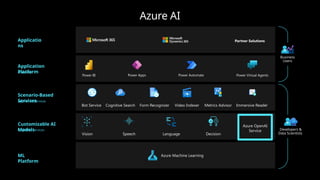
Speaker 2: __
Think back to November 2021
1
General guidance is to start with Davinci and then go down to see if a less sophisticated model can repeat the same results
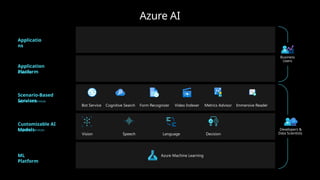
ML
Platform
Customizable AI
Models
Cognitive Services
Scenario-Based
Services
Applied AI Services
Application
Platform
AI Builder
Applicatio
ns
Azure AI
Partner Solutions
Power BI Power Apps Power Automate Power Virtual Agents
Azure Machine Learning
Vision Speech Language Decision
Azure OpenAI
Service
Immersive Reader
Form Recognizer
Bot Service Video Indexer Metrics Advisor
Cognitive Search
Developers &
Data Scientists
Business
Users
What is all the hype about?
1
General guidance is to start with Davinci and then go down to see if a less sophisticated model can repeat the same results
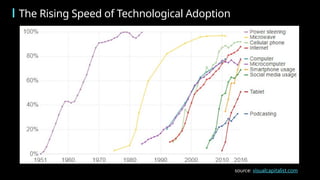
The Rising Speed of Technological Adoption
source: visualcapitalist.com
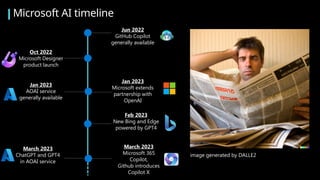
Microsoft AI timeline
Jun 2022
GitHub Copilot
generally available
Oct 2022
Microsoft Designer
product launch
Jan 2023
Microsoft extends
partnership with
OpenAI
Jan 2023
AOAI service
generally available
Feb 2023
New Bing and Edge
powered by GPT4
March 2023
ChatGPT and GPT4
in AOAI service
March 2023
Microsoft 365
Copilot,
Github introduces
Copilot X
image generated by DALLE2
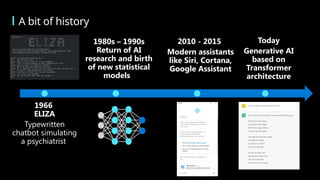
A bit of history
1966
ELIZA
Typewritten
chatbot simulating
a psychiatrist
1980s – 1990s
Return of AI
research and birth
of new statistical
models
2010 - 2015
Modern assistants
like Siri, Cortana,
Google Assistant
Today
Generative AI
based on
Transformer
architecture
Language Models Progression
1
General guidance is to start with Davinci and then go down to see if a less sophisticated model can repeat the same results
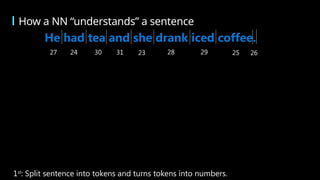
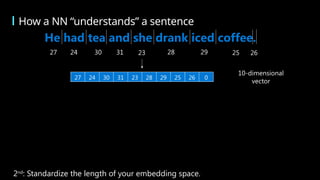
How a NN “understands” a sentence
He had tea and she drank iced coffee.
27 24 30 31 23 28 29 25
1st
: Split sentence into tokens and turns tokens into numbers.
26
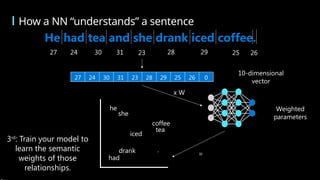
How a NN “understands” a sentence
He had tea and she drank iced coffee.
27 24 30 31 23 28 29 25
2nd
: Standardize the length of your embedding space.
27 24 30 31 23 28 29 25 26 0
26
10-dimensional
vector
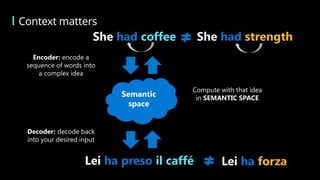
How a NN “understands” a sentence
He had tea and she drank iced coffee.
27 24 30 31 23 28 29 25
3rd
: Train your model to
learn the semantic
weights of those
relationships.
.
27 24 30 31 23 28 29 25 26 0
26
10-dimensional
vector
Weighted
parameters
x W
he
she
iced
coffee
tea
had
drank .
=
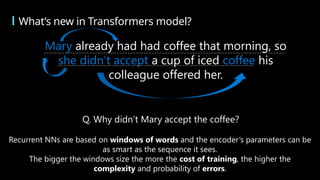
Context matters
She had coffee She had strength
Semantic
space
Encoder: encode a
sequence of words into
a complex idea
Compute with that idea
in SEMANTIC SPACE
Decoder: decode back
into your desired input
Lei ha preso il caffé Lei ha forza
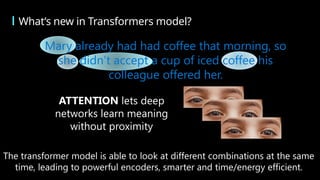
What’s new in Transformers model?
Mary already had had coffee that morning, so
she didn’t accept a cup of iced coffee his
colleague offered her.
Q. Why didn’t Mary accept the coffee?
Recurrent NNs are based on windows of words and the encoder’s parameters can be
as smart as the sequence it sees.
The bigger the windows size the more the cost of training, the higher the
complexity and probability of errors.
What’s new in Transformers model?
Mary already had had coffee that morning, so
she didn’t accept a cup of iced coffee his
colleague offered her.
ATTENTION lets deep
networks learn meaning
without proximity
The transformer model is able to look at different combinations at the same
time, leading to powerful encoders, smarter and time/energy efficient.
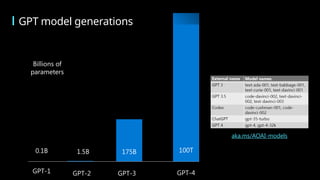
GPT model generations
aka.ms/AOAI-models
GPT-1 GPT-2 GPT-3 GPT-4
Billions of
parameters
0.1B 1.5B 175B 100T
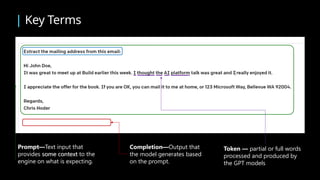
| Key Terms
Prompt—Text input that
provides some context to the
engine on what is expecting.
Completion—Output that
the model generates based
on the prompt.
some context
Token — partial or full words
processed and produced by
the GPT models
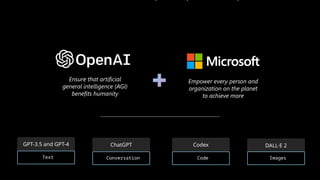
OpenAI + Microsoft
1
General guidance is to start with Davinci and then go down to see if a less sophisticated model can repeat the same results
Ensure that artificial
general intelligence (AGI)
benefits humanity
Empower every person and
organization on the planet
to achieve more
GPT-3.5 and GPT-4
Text
ChatGPT
Conversation
Codex
Code
DALL·E 2
Images
Prompt
Write a tagline for
an ice cream shop.
Prompt
Table customers, columns =
[CustomerId, FirstName,
LastName, Company, Address,
City, State, Country,
PostalCode]
Create a SQL query for all
customers in Texas named Jane
query =
Prompt
A ball of fire with vibrant
colors to show the speed of
innovation at our media and
entertainment company
Response
We serve up smiles
with every scoop!
Response
SELECT *
FROM customers
WHERE State = 'TX' AND
FirstName = 'Jane'
Response
Prompt
I’m having trouble getting
my Xbox to turn on.
Response
There are a few things you
can try to troubleshoot this
issue … …
Prompt
Thanks! That worked. What
games do you recommend for
my 14-year-old?
Response
Here are a few games that you
might consider: …
GPT-3.5 and GPT-4
Text
ChatGPT
Conversation
Codex
Code
DALL·E 2
Images
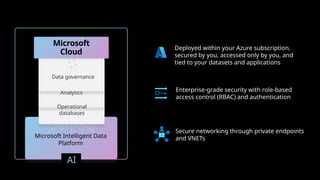
Enterprise-grade security with role-based
access control (RBAC) and authentication
Deployed within your Azure subscription,
secured by you, accessed only by you, and
tied to your datasets and applications
2
Microsoft Intelligent Data
Platform
1
2
Analytics
3
Data governance
Operational
databases
2
Microsoft
Cloud
AI
Secure networking through private endpoints
and VNETs
Azure AI Azure Open AI Service
1
General guidance is to start with Davinci and then go down to see if a less sophisticated model can repeat the same results
ML
Platform
Customizable AI
Models
Cognitive Services
Scenario-Based
Services
Applied AI Services
Application
Platform
AI Builder
Applicatio
ns
Azure AI
Partner Solutions
Power BI Power Apps Power Automate Power Virtual Agents
Azure Machine Learning
Vision Speech Language Decision
Azure OpenAI
Service
Immersive Reader
Form Recognizer
Bot Service Video Indexer Metrics Advisor
Cognitive Search
Developers &
Data Scientists
Business
Users
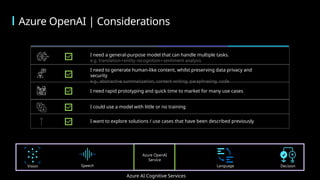
Azure OpenAI | Considerations
Vision Speech Language Decision
Azure OpenAI
Service
I need a general-purpose model that can handle multiple tasks.
e.g. translation+entity recognition+sentiment analysis
I need to generate human-like content, whilst preserving data privacy and
security
e.g., abstractive summarization, content writing, paraphrasing, code
I could use a model with little or no training
I need rapid prototyping and quick time to market for many use cases
I want to explore solutions / use cases that have been described previously
Azure AI Cognitive Services
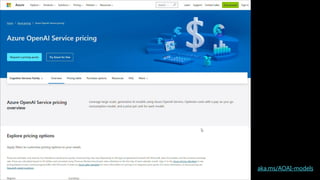
aka.ms/AOAI-models
Demo
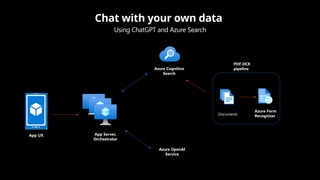
Chat with your data using
ChatGPT and Azure Search
1
General guidance is to start with Davinci and then go down to see if a less sophisticated model can repeat the same results
​
https://aka.ms/ChatGPT/Blog
PDF OCR
pipeline
Azure Cognitive
Search
Azure OpenAI
Service
Azure Form
Recognizer
Documents
App Server,
Orchestrator
App UX
Chat with your own data
Using ChatGPT and Azure Search
Using AI responsibly:
social implications
1
General guidance is to start with Davinci and then go down to see if a less sophisticated model can repeat the same results
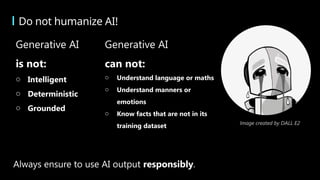
Do not humanize AI!
Always ensure to use AI output responsibly.
Image created by DALL E2
Generative AI
is not:
o Intelligent
o Deterministic
o Grounded
Generative AI
can not:
o Understand language or maths
o Understand manners or
emotions
o Know facts that are not in its
training dataset
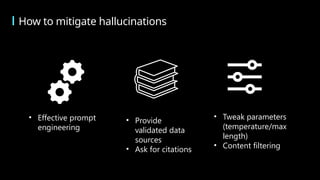
How to mitigate hallucinations
• Effective prompt
engineering
• Tweak parameters
(temperature/max
length)
• Content filtering
• Provide
validated data
sources
• Ask for citations
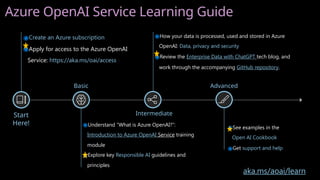
Azure OpenAI Service Learning Guide
◉See examples in the
Open AI Cookbook
◉Get support and help
Advanced
◉How your data is processed, used and stored in Azure
OpenAI: Data, privacy and security
◉Review the Enterprise Data with ChatGPT tech blog, and
work through the accompanying GitHub repository.
Intermediate
◉Understand “What is Azure OpenAI?”:
Introduction to Azure OpenAI Service training
module
◉Explore key Responsible AI guidelines and
principles
Basic
◉Create an Azure subscription
◉Apply for access to the Azure OpenAI
Service: https://aka.ms/oai/access )
Start
Here!
aka.ms/aoai/learn
Thank you

slidesfor_introducation to mondodb .pptx

  • 1.
    A Gentle Introductionto Azure AI Speaker 1: __ Speaker 2: __
  • 2.
    Think back toNovember 2021 1 General guidance is to start with Davinci and then go down to see if a less sophisticated model can repeat the same results
  • 3.
    ML Platform Customizable AI Models Cognitive Services Scenario-Based Services AppliedAI Services Application Platform AI Builder Applicatio ns Azure AI Partner Solutions Power BI Power Apps Power Automate Power Virtual Agents Azure Machine Learning Vision Speech Language Decision Azure OpenAI Service Immersive Reader Form Recognizer Bot Service Video Indexer Metrics Advisor Cognitive Search Developers & Data Scientists Business Users
  • 4.
    What is allthe hype about? 1 General guidance is to start with Davinci and then go down to see if a less sophisticated model can repeat the same results
  • 5.
    The Rising Speedof Technological Adoption source: visualcapitalist.com
  • 6.
    Microsoft AI timeline Jun2022 GitHub Copilot generally available Oct 2022 Microsoft Designer product launch Jan 2023 Microsoft extends partnership with OpenAI Jan 2023 AOAI service generally available Feb 2023 New Bing and Edge powered by GPT4 March 2023 ChatGPT and GPT4 in AOAI service March 2023 Microsoft 365 Copilot, Github introduces Copilot X image generated by DALLE2
  • 7.
    A bit ofhistory 1966 ELIZA Typewritten chatbot simulating a psychiatrist 1980s – 1990s Return of AI research and birth of new statistical models 2010 - 2015 Modern assistants like Siri, Cortana, Google Assistant Today Generative AI based on Transformer architecture
  • 8.
    Language Models Progression 1 Generalguidance is to start with Davinci and then go down to see if a less sophisticated model can repeat the same results
  • 9.
    How a NN“understands” a sentence He had tea and she drank iced coffee. 27 24 30 31 23 28 29 25 1st : Split sentence into tokens and turns tokens into numbers. 26
  • 10.
    How a NN“understands” a sentence He had tea and she drank iced coffee. 27 24 30 31 23 28 29 25 2nd : Standardize the length of your embedding space. 27 24 30 31 23 28 29 25 26 0 26 10-dimensional vector
  • 11.
    How a NN“understands” a sentence He had tea and she drank iced coffee. 27 24 30 31 23 28 29 25 3rd : Train your model to learn the semantic weights of those relationships. . 27 24 30 31 23 28 29 25 26 0 26 10-dimensional vector Weighted parameters x W he she iced coffee tea had drank . =
  • 12.
    Context matters She hadcoffee She had strength Semantic space Encoder: encode a sequence of words into a complex idea Compute with that idea in SEMANTIC SPACE Decoder: decode back into your desired input Lei ha preso il caffé Lei ha forza
  • 13.
    What’s new inTransformers model? Mary already had had coffee that morning, so she didn’t accept a cup of iced coffee his colleague offered her. Q. Why didn’t Mary accept the coffee? Recurrent NNs are based on windows of words and the encoder’s parameters can be as smart as the sequence it sees. The bigger the windows size the more the cost of training, the higher the complexity and probability of errors.
  • 14.
    What’s new inTransformers model? Mary already had had coffee that morning, so she didn’t accept a cup of iced coffee his colleague offered her. ATTENTION lets deep networks learn meaning without proximity The transformer model is able to look at different combinations at the same time, leading to powerful encoders, smarter and time/energy efficient.
  • 15.
    GPT model generations aka.ms/AOAI-models GPT-1GPT-2 GPT-3 GPT-4 Billions of parameters 0.1B 1.5B 175B 100T
  • 16.
    | Key Terms Prompt—Textinput that provides some context to the engine on what is expecting. Completion—Output that the model generates based on the prompt. some context Token — partial or full words processed and produced by the GPT models
  • 17.
    OpenAI + Microsoft 1 Generalguidance is to start with Davinci and then go down to see if a less sophisticated model can repeat the same results
  • 18.
    Ensure that artificial generalintelligence (AGI) benefits humanity Empower every person and organization on the planet to achieve more GPT-3.5 and GPT-4 Text ChatGPT Conversation Codex Code DALL·E 2 Images
  • 19.
    Prompt Write a taglinefor an ice cream shop. Prompt Table customers, columns = [CustomerId, FirstName, LastName, Company, Address, City, State, Country, PostalCode] Create a SQL query for all customers in Texas named Jane query = Prompt A ball of fire with vibrant colors to show the speed of innovation at our media and entertainment company Response We serve up smiles with every scoop! Response SELECT * FROM customers WHERE State = 'TX' AND FirstName = 'Jane' Response Prompt I’m having trouble getting my Xbox to turn on. Response There are a few things you can try to troubleshoot this issue … … Prompt Thanks! That worked. What games do you recommend for my 14-year-old? Response Here are a few games that you might consider: … GPT-3.5 and GPT-4 Text ChatGPT Conversation Codex Code DALL·E 2 Images
  • 20.
    Enterprise-grade security withrole-based access control (RBAC) and authentication Deployed within your Azure subscription, secured by you, accessed only by you, and tied to your datasets and applications 2 Microsoft Intelligent Data Platform 1 2 Analytics 3 Data governance Operational databases 2 Microsoft Cloud AI Secure networking through private endpoints and VNETs
  • 22.
    Azure AI AzureOpen AI Service 1 General guidance is to start with Davinci and then go down to see if a less sophisticated model can repeat the same results
  • 23.
    ML Platform Customizable AI Models Cognitive Services Scenario-Based Services AppliedAI Services Application Platform AI Builder Applicatio ns Azure AI Partner Solutions Power BI Power Apps Power Automate Power Virtual Agents Azure Machine Learning Vision Speech Language Decision Azure OpenAI Service Immersive Reader Form Recognizer Bot Service Video Indexer Metrics Advisor Cognitive Search Developers & Data Scientists Business Users
  • 24.
    Azure OpenAI |Considerations Vision Speech Language Decision Azure OpenAI Service I need a general-purpose model that can handle multiple tasks. e.g. translation+entity recognition+sentiment analysis I need to generate human-like content, whilst preserving data privacy and security e.g., abstractive summarization, content writing, paraphrasing, code I could use a model with little or no training I need rapid prototyping and quick time to market for many use cases I want to explore solutions / use cases that have been described previously Azure AI Cognitive Services
  • 25.
  • 26.
    Demo Chat with yourdata using ChatGPT and Azure Search 1 General guidance is to start with Davinci and then go down to see if a less sophisticated model can repeat the same results ​ https://aka.ms/ChatGPT/Blog
  • 27.
    PDF OCR pipeline Azure Cognitive Search AzureOpenAI Service Azure Form Recognizer Documents App Server, Orchestrator App UX Chat with your own data Using ChatGPT and Azure Search
  • 28.
    Using AI responsibly: socialimplications 1 General guidance is to start with Davinci and then go down to see if a less sophisticated model can repeat the same results
  • 29.
    Do not humanizeAI! Always ensure to use AI output responsibly. Image created by DALL E2 Generative AI is not: o Intelligent o Deterministic o Grounded Generative AI can not: o Understand language or maths o Understand manners or emotions o Know facts that are not in its training dataset
  • 30.
    How to mitigatehallucinations • Effective prompt engineering • Tweak parameters (temperature/max length) • Content filtering • Provide validated data sources • Ask for citations
  • 31.
    Azure OpenAI ServiceLearning Guide ◉See examples in the Open AI Cookbook ◉Get support and help Advanced ◉How your data is processed, used and stored in Azure OpenAI: Data, privacy and security ◉Review the Enterprise Data with ChatGPT tech blog, and work through the accompanying GitHub repository. Intermediate ◉Understand “What is Azure OpenAI?”: Introduction to Azure OpenAI Service training module ◉Explore key Responsible AI guidelines and principles Basic ◉Create an Azure subscription ◉Apply for access to the Azure OpenAI Service: https://aka.ms/oai/access ) Start Here! aka.ms/aoai/learn
  • 32.

Editor's Notes

  • #1 Customize with speaker(s) name(s)
  • #2 Let me take you back in time to pre November 2022
  • #3  The Azure AI platform looked like this … a great set of service to target both data scientists and AI developers across all industries Starting at the bottom of the screen we have Azure machine learning Moving up the platform levels we have cognitive services Finally at Build 2021 a new category was formed Applied AI services – from customer feedback We had a good AI platform that served customer at different levels using cloud AI technologies Then in November 2021 Microsoft introduced Azure Open AI Service – these capabilities behind the scenes are being built into Microsoft first party products January 2023 – Open AI Generally available with Chat GPT release quickly afterwards
  • #5 Why is everyone talking about generative AI today? We probably haven’t seen a similar media phenomenon since the birth of Social Networks or the smartphones market launch or even before, with the birth of Internet. All those mediatic booms have a common factor: they have the power to revolutionize our society and our day-to-day lives – which means they don’t have only an impact in the technology domain but also in the social one. However, today that the majority of people on the globe has access to Internet, to smartphones and to social media, the speed with which the AI market progresses, and the news reach the users is infinitely greater. As always visualization helps a lot to makes things clearer, with this graph is easier to grasp the reason behind the media hype, since we can see how faster becomes the technology adoption for technologies born after year 2005, like social media, smartphones and tablets, with respect to older technologies like Power Steering and Microwaves. Even looking at more recent technologies – invented in the last decade of the old century or in the early years of the new one, like Internet and MicroComputer, the adoption curves are way more gentle and less steep than today. Looking around, we can easily predict how this trend will be confirmed by technologies powered by Generative AI, whose speed of adoption could be the highest we’ve ever seen.
  • #6 Let’s go over just a few of the updates that have been announced in the last few months: Jun 22: GitHub Copilot, an AI-empowered pair programmer has been unleashed for all developers and available on the most common IDEs; Oct 22: the birth of Microsoft designer, enabling content creator to generate high quality graphics and illustrations using AI; Jan 2023: Azure OpenAI service, enabling the access of Azure customers to OpenAI models, is generally available and a reinforced partnership between OpenAI and Microsoft is announced, with all the workloads running on Azure Feb 2023: The new Microsoft Bing, with search capabilities empowered by generative AI, has become available March 2023: ChatGPt and GPT4 families of models have been added to the AOAI service offering; Microsoft 365 suite included some preview AI-empowered features (called Copilot) able to revolutionize the way of working and interacting with office tools; GitHub Copilot introduced new preview features, including a chat experience powered by chatgpt We can expect lots of new incredible updates in the following months. Good blog link for release details: General availability of Azure OpenAI Service expands access to large, advanced AI models with added enterprise benefits | Azure Blog and Updates | Microsoft Azure
  • #7 To understand what has changed and what all this hype is about, let’s do a step back and let’s try to define some basic pre-learnings about AI and natural language processing. If enlarge the time window, we can observe how things weren’t always so fast. The first projects in the AI domain date back to 60s, when the first researchers began to explore the possibility to create machines able to replicate some of the human cognitive capabilities, like the conversation. Initially, symbolic reasoning was a prevalent approach, and it led to a number of important successes, such as Eliza, the 1st type written chatbot acting as a psychiatrist. However, it soon became clear that such approach does not scale well. Extracting the knowledge from an expert, representing it in a computer, and keeping that knowledgebase accurate turns out to be a very complex task, and too expensive to be practical in many cases. This led to so-called AI Winter in the 1970s. A turning point arrives during 90s, with the technological evolution of the hw (cheaper and most capable to handle large amount of data), together with the creation of new algorithms, classified as machine learning, able to learn patterns from data, without being explicitly programmed with specific instructions. In particular, new statistical models, called neural networks – inspired by the biological structure of the brain, made up of inter-connected neurons – gave a boost to the AI research development, being able to work well also with more complex inputs (not only categories or numbers) like images and audio. This statistical models, belonging to a subgroup of ML called DL, benefited also of the availability of more powerful type of elaboration unit, GPUs. The modern virtual assistants born in 2010s, like Siri, Cortana and Google Assistant, are also built upon language models based on NNs. They are very proficient in a subdomain of AI known as Natural Language processing, the capability of a machine of processing and interpreting the human language; identified a specific need in the input request from the user they are also able to pair it with a suitable answer (retrieved via web search or in a list of pre-defined answers). Generative AI is the cutting-edge technology in this field nowadays, and it is able to generate examples starting from a huge amount of data used to train a model (and when I say huge, I think about all the data publicly accessible on Internet). There’s why we talk about large models, because of the amount of data used for their training and because of the number of calculations they are able to handle at the same time. The examples those models are able to create could be of different type, and we will see it in more details, from text to code, to images. In the image you see the output of a large language model when asking if it can write a poetry.
  • #8 Let’s cover a bit what’s behind the scenes of a language model.
  • #9 Let’s start by explaining how a neural network processes a sentence. First of all, let me say that we are talking about statistical models, so it could be intuitive as those models work better with numbers more than words. So the 1st challenge to face is: how to convert words in numbers? There are 3 fundamental step to do that: 1st one – starting from a text, split it into smaller pieces – know as tokens. Now a token has a dimension which vary from a language to another, but that usually is between a character and a word. But to make things simple in this explanation we will be using the terms token and word interchangeably. Once the text is split into tokens, we can build a dictionary such that every word is mapped with a number. There are multiple algorithms that do this kind of embeddings, a very popular one is called bag of words and create those mappings by taking into account the frequency of each word within the text.
  • #10 The 2nd step is defining a standard length for the embedding space, which means defining a standard size of the vector which represents my text. In our very simple example, we can set this dimension to 10, that means we build an array of 10 numbers , collecting the numbers mapped to the tokens, in the order they appear. If the input text is shorter than the pre-defined standard dimension, the rest of the array is populated using a place-holder, for example 0.
  • #11 Once my text has been converted to standard-length array of numbers, I can use this as input for the training of a neural network. The way this works –in simple terms - is that each node making up the network is activated (or not) by an activation function, calculated as a weighted sum of the inputs to a neuron. In the NLP domain, the weights embeds the semantic value. The output of a node is the input of the following one, in a chain – called forward propagation – from the input layers to the ouput layers of the network, passing through the hidden layers where the computations happen and that define how deep the network is. From this training process I will get a space of dimension 10 where the tokens of my input text are represented grouped into clusters of similarity, such that words with similar meanings are closest one to another in the semantic space (e.g. he with she, coffee with tea). In this deck you can see the resulting space represented as a 2dimensional space, since it’s the most intuitive way for us to represent and understand the reality.
  • #12 Now, it’s easy to grasp as representing words in a semantic space in a way that similar words are in proximity one to another is not enough to represent the whole meaning of a sentence or a text. The reason is that context matters, i.e. the same word can assume a different meaning according to the context in which is used. And this is especially true for the English language. Let’s take this example (she had coffee vs she had strength): the term ‘had’ has a very different meaning in the 2 sentences , and so it is true that in Italian for example you would use 2 different verbs. But how are we able to tell that the 2 terms ‘had’ have a different meaning in the 2 sentences: based on the context, which in this case means based on the word following the term ‘had’, coffee in one case, strength in the other case. This means that we need to convert the words into ideas, such that the 2 ‘had’ are represented in the semantic space as two different items and the semantic proximity is computed on the idea, taking into account the context. This is exactly how the recurrent neural networks –commonly used in the NLP domain – work they process collection of words included into a pre-defined linear window, shifting throughout the text as the model reads and analyzes it. Once we encoded my collection of words into a more complex idea inside the semantic space , it’s also possible to decode it into into the desired output, which varies according to the domain of application, and in the case of the translation will be the translated sentence in Italian. And the cool thing is that once you have the encoder and the decoder to translate from En to IT , you can apply them in the opposite direction and translate from Italian to En. CNN – commonly used in computer vision kind of scenarios - work in a similar way: the pictures, split into a collection of pixels, are represented in the semantic space and then decoded into a textual output, like the description of what is shown in the image.
  • #13 At this point you can argue that RNNs are not so new, if those models were already able to do those type of computations, why the newest LLMs are so revolutionary? Well, the main limit of RNNs is indeed the concept at the basis of how they work. A RNN uses the so-called “immediate context”, which are a few words around the term in analysis. Where’s the issue? Let’s imagine that we have this sentence and we wish our model being able to answer the question “ why didn’t Mary accept the coffee?” To answer to a question like this, our model should be able to correlate the expression “didn’t accept the coffee” with “she“, and then “she” with “Mary”, covering a quite long window of word. And greater is the dimension of the window, greater is the complexity of the model, the cost of its training and the probability of error.
  • #14 The invention enabling the revolution in the deep networks domain has been the mechanism of attention. Again, inspired by the cognitive capability of the human brain of giving a different weight to the input we receive, such that we can focus for example on a voice speaking to us and isolate it from noisy background, similarly the basic idea of the deep network attention mechanism is that each time the model tries to predict an output word, it only uses parts of an input where the most relevant information is concentrated instead of an entire sentence. A new neural network architecture has been built upon attention mechanism – called Transformer ; this architecture uses what is called multi-head attention, combining multiple heads (as they were multiple intelligences) in a way that the model can attend to different parts of the input sequence simultaneously, analyzing multiple possible combinations of words relations. This allows to overcome the linear and fixed-size window of word of the RNNs., empowering deep networks to learn semantic meaning without proximity. A transformer architecture is always made up of an encoder and a decoder; in the example of the translation, the encoder has as input the sentence to translate, while the encoder has as input the hidden state (which means the part of sentence already translated); the output of the decoder is the next translated token, chosen from a list of possible next tokens according to its probability. In the case of the most recent LLMs as GPT-3 not always the next token with the highest probability is chosen, but a degree of randomness is added in this choice, in a way that the model is not deterministic (we do not have always the same output for the same input). This degree of randomness is added to simulate the process of creative thinking and it can be tuned using a parameter called temperature (> temp, > degree of randomness).
  • #15 So that is what the term transformer stands for in the name GPT. GPT generations of models include models trained with a vast amount of unsupervised data from various sources – including books, articles, websites and more- such that the model can learn a general representation of the language, which can then be fine-tuned for specific tasks – like ChatGPT which has been built from GPT-3.5 and fine tuned for the conversation domain or InstructGPT, optimized to execute user instructions – written in natural language – throught prompts. We can observe a progression throughout the years from the very first GPT model (GPT-1), born in 2018, trained with hundreds of million of parameters up to the very new GPT-4 model,much larger, trained on hundreds of trillions of parameters, 500 times bigger than GPT-3. The size of parameters increased more and more from one version to the next one, together with the dimension of the semantic space, resulting in better performance and efficiency of the model – in simpler terms the more parameters mean more knowledge. However, the size of the model is not the only criterion to consider in terms of evolution of the models; the model has evolved also in terms of the variety of different domains or modalities that can handle and its capacity to apply knowledge and skills across different contexts or disciplines. For example, GPT4 demonstrate a high level proficiency not only in conversation or literature, but also mathematics, music, medicine and accepts both text and visual inputs. Also, as those models had evolved and have been used by more and more users, it is also possible to analyze prompts and corresponding behaviors and use those insights to continuously improve and refine the next generation of the model, mitigating the risk of unsafe and undesired outputs. In addition to different generation of the models, you might have heard about different families of models per generation – you can see the mapping in the table in the right side of this slide. Those families (like ada, Babbage, curie or davinci) identify the relative capability and cost; their names are ordered in alphabetical order in a way to more easily identify a more capable model (curie is more performant then ada, davinci is more capable than curie). However, all those model generations share the same operating principle: being pre-trained models (on huge corpus of data) they are able to “apply” their knowledge on tasks they were not explicitly trained for.
  • #16 Let’s look in more details at the key terms and concepts shared by all those models. The prompt is generally a natural language textual input to the model. According to the different use cases, it can simply contain the incipit of a sentence to complete or an additional context providing guidance about the task to execute and/or few examples of the desired output. Completion: it is the model output, generated starting from the given prompt (and of course starting from the data on which the model has been trained). The output is generated one token at a time, according to its probability of completing the current text. Token: it’s the smallest unit in which language models split the text to process it. Another concept that you might have heard of is prompt engineering. It’s the accurate design of a prompt to optimize and customize the output for our needs.
  • #18  Microsoft have a very public partnership with OpenAI Open AI trying to build systems that build general intelligence – a real shift in what can be done with machine learning Normally very specific models solving specific problems Partnered about 4 years ago in 2019 – worlds most advanced supercomputing infrastructure that they train the models on, in turn we get to use those models to build the platform In our own platforms as well as packaging up for customers to build their platforms on GPT4 build on Azure using specialized hardware
  • #19 GPT3 – GPT3.5 AND GPT 4 now - can understand and generate text. providing a prompt this model will generate an answer with natural language (image inputs coming in the future) Codex – translates natural language to code, powers Github Co-Pilot, proficient in a dozen programming languages, a descendant of GPT3 model DALLE – created original and realistic art from a text description ChatGPT – interacts in a conversational way, conversation allows for follow up questions that hold context
  • #23 Azure Open AI Service is not the only service available to you - considering the use case is key Do you need to manage the service yourself or is this built into another Microsoft product you could leverage such as power platform (AI builder) Our scenario-based services are built from understand strong use cases that our customers need across sectors. By already combining cognitive services together for an easier building experience you may find them a better fit Open AI Service is fantastic for natural language processing/text input – processing text, conversation or creating text based of images. However, analyzing images, videos etc is another area of machine learning Azure Machine Learning for your bespoke models, full management and deployment of those models Narrative/talk track: Azure AI is a collection of artificial intelligence services offered by Microsoft as part of its Azure cloud platform. The Azure AI services are designed to make it easy for developers and organizations to add AI capabilities to their applications, without the need for extensive expertise in AI. Azure AI includes a wide range of services, such as: Azure Cognitive Services: A collection of pre-built APIs that allow developers to add capabilities such as natural language understanding, computer vision, and speech recognition to their applications. Azure Machine Learning: A cloud-based platform that allows developers to build, deploy, and manage machine learning models, as well as to create custom machine learning algorithms. Azure Applied AI Services: A suite of scenarios-based services that enable organizations to accelerate adoption such as Azure Cognitive Search which provides search capabilities over structured and unstructured data by using machine learning models. These services are integrated with Azure platform, which provides capabilities such as scalability, security, and compliance, as well as a number of other tools and services that can be used to build and deploy AI-enabled applications. The Azure AI services are designed to make it easy for developers and organizations to add AI capabilities to their applications, without the need for extensive expertise in AI. Microsoft's Azure AI services allow developers to quickly build, deploy, and scale AI-enabled applications, and to take advantage of the scalability, security, and compliance capabilities of Azure. Azure AI integration in AI Builder within the Microsoft Power Platform allows businesses and developers to quickly and easily build and deploy custom AI models, and to integrate them with Power Apps, Power Automate and Power Virtual Agents, in order to add advanced capabilities and improve data management and security. It also allows to easily scale up and improve performance of the models, as well as easily integrating with other Azure services. Microsoft has adopted Azure AI across a wide range of its products and services, in order to improve the functionality, performance and user experience. Some examples of where Microsoft has adopted Azure AI at scale include: Office 365: Microsoft has integrated Azure AI capabilities into Office 365, such as natural language processing, computer vision, and text analytics, to improve the functionality of products such as Outlook and Word. This allows users to perform tasks such as automatically summarizing long documents, or automatically tagging images in email attachments. Dynamics 365: Dynamics 365 is a collection of business applications that enable organizations to manage customer data and interactions, as well as automate business processes. With Azure AI integration, Dynamics 365 offers features like predictive lead scoring, sentiment analysis, and chatbots to help businesses better understand and interact with their customers. Bing: Bing, Microsoft's search engine, uses Azure AI to analyze large amounts of data and improve search results for users. For example, Bing uses natural language processing to understand users' queries and generate more relevant search results. LinkedIn: Microsoft's professional networking site, LinkedIn, uses Azure AI to help users find job opportunities, connect with others in their field, and improve the performance of its recruiting tools. For example, LinkedIn uses natural language processing to match job seekers with relevant job opportunities, and uses machine learning to help recruiters find the best candidates. Xbox and Gaming: Microsoft uses Azure AI to power its Xbox gaming console. Azure AI allows Xbox to learn a gamer's preferences and automatically adjust the gaming experience. Additionally, it allows to improve the performance of the games and to offer more personalized gaming experiences. These are just a few examples of how Microsoft has adopted Azure AI at scale within its products and services. Overall, Microsoft has been using Azure AI across its various products and services, to improve user experience and to offer more personalized, efficient and automated experiences to its customers.
  • #24 Breaking down the custom AI models section … When to prefer Azure OpenAI upon other Azure AI services: Here are typical consideration points that we ask our customers to ask themselves. If you have said yes to all of the above, then OpenAI may be the right cognitive service to go with. If you haven't checked yes to all of the above or due to any other factors we may come across when doing a deep dive on your use case, we have our other cog services which may cater better to the scenario that we are working with you on. We could also have situations where one of the other cog services may be needed as a complementary service with OpenAI for your particular scenario. Complexity needed – one service only Specific language used in domain – LUIS may be a better fit for more control right now Natural Language processing scenarios
  • #25 Pricing is a little more complex than other cognitive services currently Choosing your models If you fine tune consider the extra compute hours needed to process and host Regional availability – still a new service, if data needs to stay in a region other cognitive services may still be more appropriate
  • #26 When we’ve defined what is a prompt and how LLMs work, we mentioned that we can add an additional context to your prompt, to generate an output tailored to your use-case. Another thing you can add to your prompt is including your own source data – like an extract from a research paper or an article, sales data or call centers transcripts. This allows you to have customized (and more grounded) answers from the model, without fine-tuning or retraining it. However, there’s another thing to keep in mind – which is the limited size of the tokens we can inject in the prompt (much higher with GPT4, but still limited) along with the fact that adding contextual data to each and every prompt may result impractical and expensive with the increasing of the volume of data. This demo will show an alternative solution – consisting of combining AOAI service with other Azure services, to host the data into an external knowledge base and leverage a service able to easily retrieve the portion of data useful for a specific prompt – i.e. cognitive search.
  • #27 Before showing you how this works, let me briefly introduce the solution architecture, which emphasizes how it is possible to efficiently integrate different cognitive services into a single solution. Now, as we’ve mentioned the cognitive search service enable us to index the input documents (hosted into a db) e to make them accessible through specific queries. The web app is built of a graphical interface – enabling the user to chat with the data in natural language- by asking questions. The app backend act as an orchestrator, converting the user input into a query for the Azure cog search and uses on its turn the output of the search as a meta-context injected into the AOAI prompt. Finally, AOAI generates an answer in natural language for the final user, specifying the sources on which the answer is based. Moreover, the solution leverage also another cog service called form recognizer, used to “cracks” documents to read handwriting, text, tables, and process language to extract entities.
  • #28 This is a placeholder for the demo. You can choose either to play the video and comment or replicate the demo live. This graphic interface you see here, allows us to chat with our own private data. This data are contained in pdf files, indexed by Azure search and containing information around Contoso employees benefits. Contoso is a fictional company which we takes as example and we imagine it wishes to provide to its employees a ChatGPT-like experience to get clarifications on their healthcare plan and general information contained in the employee handbook. As first question, let’s use one of those the app suggests to us as example. “What is included in my Northwind Health Plus plan that is not in standard?” Right now AOAI service and cog search are interacting through the orchestrator (app backend) to build the search query, extract from the documents the information related to the question of the user and generate an answer based on this. As you can see the answer includes also the sources used to provide the output message. Also, by clicking the doc link, the original document is accessible through the ‘Citation’ tab. But let’s deep dive into what’s happening behind the scenes, through another functionality of the app, tracking and printing out the search query and the prompt that has being used for ChatGPT. The prompt includes markup language, which is special tokens defining different sections of the prompt. For e.g. <|im_start|>system introduces the meta-context and/or the instructions for the model. <|im_start|>user precedes the user message, while . <|im_start|>assistant precedes the answer of the virtual assistant. The <|im_end|> tag identify the end of each section. For assistant section we don't have the tag. Let's look at how the prompt is built (…) Does my plan cover eyes exams? In this second question I’ve not repeated the name of my plan. So how does it know what it is? Because my app append to the end of the next prompt for the model the history of the conversation. Let’s try now with a question that cannot be answered with the sources provided, to double check that the model answers properly. What is the daily job of a Cloud Advocate at Microsoft? As per our instructions, the model is not try to guess an answer for this question, because it cannot retrieve anything related in the validated sources.
  • #30 The output of a generative AI model is not perfect and sometimes the creativity of the model can work against it can, resulting in an output which is a combination of words that the human user can interpret as a mystification of reality or it can be offensive. In those cases we talk about model’s hallucinations. We’ve covered how a large language model works to highlight that behind what looks like magic that’s no more than a statistical model. Generative AI is not intelligent (at least in the more comprehensive definition of intelligence, including critical and creative reasoning or emotional intelligence); it is not deterministic, since as we explained beforehand it adds a certain degree of randomness when selecting the next token to output; it is not trustworthy, since hallucinations, such as erroneous references, content, and statements, may be combined with correct information, and presented in a persuasive and confident manner, making their identification difficult without close inspection and effortful fact-checking. It is not able to understand language or math and it doesn’t know fact that are not in its training dataset (for example GPT-3 doesn’t know about Queen Elizabeth’s death). When we work with those kind of technologies, it’s very important to know not only the power and the capabilities but also the limitations. Especially because those limitations might have significant social impacts when this technology is applied in sensitive scenarios.
  • #31 We have a few tools to mitigate the impact of hallucinations: Designing effective prompt, as the ones used in the demo, enabling the model to customize the answers for our scenario and our users Providing (through the prompt) validated data sources and ask the model to cite them in the answer, in a way that the users can double check the correctness of the information on their own Tweaking parameters – like temperature which handles the degree of randomness or max length of the output); Applying content-filtering: AOAI service includes a content management system based on an ensemble of classification models aimed at detecting misuse on the prompt and on the output of the model. Applying those filters into your application that uses the model, you can reduce the risk of harmful use of it.