Download free for 30 days
Sign in
Upload
Language (EN)
Support
Business
Mobile
Social Media
Marketing
Technology
Art & Photos
Career
Design
Education
Presentations & Public Speaking
Government & Nonprofit
Healthcare
Internet
Law
Leadership & Management
Automotive
Engineering
Software
Recruiting & HR
Retail
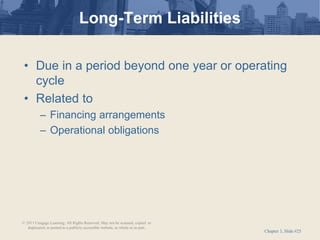
Sales
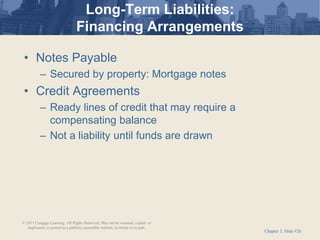
Services
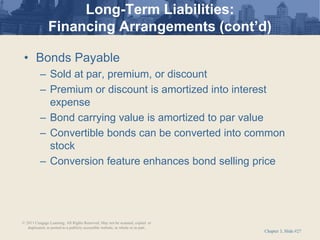
Science
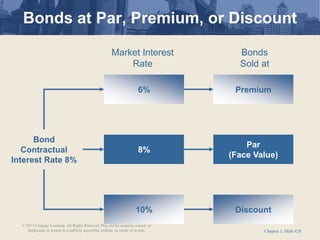
Small Business & Entrepreneurship
Food
Environment
Economy & Finance
Data & Analytics
Investor Relations
Sports
Spiritual
News & Politics
Travel
Self Improvement
Real Estate
Entertainment & Humor
Health & Medicine
Devices & Hardware
Lifestyle
Change Language
Language
English
Español
Português
Français
Deutsche
Cancel
Save
Submit search
EN
Uploaded by
huongquynhstudy
7 views
Slide_Chapter 3.pdf BALANCE SHEET UFM GOOD
PT TCDN CHAPTER 3
Business
◦
Read more
0
Save
Share
Embed
Embed presentation
Download
Download to read offline
1
/ 41
2
/ 41
3
/ 41
4
/ 41
5
/ 41
6
/ 41
7
/ 41
8
/ 41
9
/ 41
10
/ 41
11
/ 41
12
/ 41
13
/ 41
14
/ 41
15
/ 41
16
/ 41
17
/ 41
18
/ 41
19
/ 41
20
/ 41
21
/ 41
22
/ 41
23
/ 41
24
/ 41
25
/ 41
26
/ 41
27
/ 41
28
/ 41
29
/ 41
30
/ 41
31
/ 41
32
/ 41
33
/ 41
34
/ 41
35
/ 41
36
/ 41
37
/ 41
38
/ 41
39
/ 41
40
/ 41
41
/ 41
More Related Content
PPTX
IFR_ch03_Balance sheet.pptx
by
Habibullah Qayumi
PPTX
WRD 27e_SE PPT_Ch10_ADA (Accounting Long Term Assets: fixed and intangible).pptx
by
zeniatulnurk
PPTX
WRD-27e-SE-PPT-Ch10 (1) FIXED AND TANGIBLE.pptx
by
gowrikcom
PPT
Ch09 wrd12e instructor_final
by
fsuttonnnu
DOCX
Due WednesdayDiscussion Requirements Your weekly discussion p.docx
by
infantkimber
PPTX
Balance Sheet Presentation
by
Cameron Fen
PPTX
chapter_2.pptx__________________________relevatn documents
by
phdfinance
PPT
Depreciation and Accounting Concern.ppt
by
AliHadi319773
IFR_ch03_Balance sheet.pptx
by
Habibullah Qayumi
WRD 27e_SE PPT_Ch10_ADA (Accounting Long Term Assets: fixed and intangible).pptx
by
zeniatulnurk
WRD-27e-SE-PPT-Ch10 (1) FIXED AND TANGIBLE.pptx
by
gowrikcom
Ch09 wrd12e instructor_final
by
fsuttonnnu
Due WednesdayDiscussion Requirements Your weekly discussion p.docx
by
infantkimber
Balance Sheet Presentation
by
Cameron Fen
chapter_2.pptx__________________________relevatn documents
by
phdfinance
Depreciation and Accounting Concern.ppt
by
AliHadi319773
Similar to Slide_Chapter 3.pdf BALANCE SHEET UFM GOOD
PPTX
Balance Sheet
by
Alhya Khalid
PPT
Chap equity of business organizations3.ppt
by
Haider Ali
PPTX
accounting information system process for
by
support346674
PPTX
Final Accounts Lecture Notes For Business Mgmt
by
Julius Dennis Estavillo
PDF
Financial Accounting Information for Decisions 9th Edition Wild Solutions Manual
by
jsjumgkaza066
PDF
Financial Accounting Information for Decisions 9th Edition Wild Solutions Manual
by
izukuwadday
PDF
Financial Accounting Information for Decisions 9th Edition Wild Solutions Manual
by
mllanevah
PPT
02_Copy_of_Presentation_Title.ppt
by
Abeer Fouad Agami
PPSX
Credit training in English
by
Dejan Jeremic
PPTX
A4_Tangible non current assets class.pptx
by
srineshrrao
PPT
acctg MBA slide
by
koko20115
PPTX
Economic feasibility study Chapter 7
by
Abd ELRahman ALFar
PPT
Depreciation
by
Rabea Jamal
PPTX
Fixed Asset Process
by
Satish Narayan
PDF
IE 445 Chapter Lecture 8-Finance 2024.pdf
by
lincolnjames244
PPT
Financial Statement Analysis I Session 2
by
Credit Management Association
PPSX
Credit Training[Finall]
by
Dejan Jeremic
PDF
S2-3 (Ch2-4) - Accounting.pdf
by
ZahraHADDAOUI1
PPT
Financial accounting mgt101 power point slides lecture 17
by
Abdul Wadood Ansary
PPTX
AnF 1 _ Basics of Financial Statements (1).pptx
by
tapesh0702
Balance Sheet
by
Alhya Khalid
Chap equity of business organizations3.ppt
by
Haider Ali
accounting information system process for
by
support346674
Final Accounts Lecture Notes For Business Mgmt
by
Julius Dennis Estavillo
Financial Accounting Information for Decisions 9th Edition Wild Solutions Manual
by
jsjumgkaza066
Financial Accounting Information for Decisions 9th Edition Wild Solutions Manual
by
izukuwadday
Financial Accounting Information for Decisions 9th Edition Wild Solutions Manual
by
mllanevah
02_Copy_of_Presentation_Title.ppt
by
Abeer Fouad Agami
Credit training in English
by
Dejan Jeremic
A4_Tangible non current assets class.pptx
by
srineshrrao
acctg MBA slide
by
koko20115
Economic feasibility study Chapter 7
by
Abd ELRahman ALFar
Depreciation
by
Rabea Jamal
Fixed Asset Process
by
Satish Narayan
IE 445 Chapter Lecture 8-Finance 2024.pdf
by
lincolnjames244
Financial Statement Analysis I Session 2
by
Credit Management Association
Credit Training[Finall]
by
Dejan Jeremic
S2-3 (Ch2-4) - Accounting.pdf
by
ZahraHADDAOUI1
Financial accounting mgt101 power point slides lecture 17
by
Abdul Wadood Ansary
AnF 1 _ Basics of Financial Statements (1).pptx
by
tapesh0702
Recently uploaded
DOCX
How to Buy Verified OnlyFans Accounts Work in 2026.docx
by
https://pvaisback.com/product/buy-old-gmail-accounts/
PDF
apidays Australia 2025 | Value Dynamics Mapping - Making Value Visible
by
apidays
PDF
Equinox Gold - Corporate Presentation - Jan 2026
by
Equinox Gold Corp.
PDF
The threat to financial insitutions of quantum computing breaking all encrypt...
by
Chris Skinner
PDF
Camil Institutional Presentation_Dez25.pdf
by
CAMILRI
PDF
Jim Bologa - The CEO Of Porter And Chester Institute
by
Jim Bologa
PPTX
Keynote: The Modern CMO: Architect of Growth. Guardian of Credibility.
by
Armis Inc
DOCX
Podcast Promotion Schedule for Turntable News
by
slpalakovich
PDF
BendelPuertoRicoCubaGuyanaVenezuelaPetroleumRefineryPetrochemicalPetroAgroInd...
by
OsaJOkundayeODMDFAAO
PPTX
REVIEWER-3rd-quarter-exam-mathematics.pptx
by
dominicdaltoncaling2
PDF
17 Guide to Buying Verified Binance Accounts in the US.pdf
by
https://pvaisback.com/product/buy-old-gmail-accounts/
PDF
Top 5 Trusted Websites to Buy Verified PayPal Accounts Safely in 2026
by
Usaservicepoint
PDF
Best Top 3 Sites to Buy Google Reviews (5-Star & Non-Drop).pdf
by
https://pvaallit.com/product/buy-google-5-star-reviews/
PDF
PuertoRicoCubaGuyanaVenezuelaPetroleumRefineryPetrochemicalPetroAgroIndustria...
by
OsaJOkundayeODMDFAAO
PDF
Using-pension-savings-to-support-home-ownership.pdf
by
Henry Tapper
DOCX
How to Buy a Verified PayPal Account_ Step-by-Step Instructions.docx
by
https://pvaallit.com/product/buy-verified-apple-pay-accounts/
PDF
Top 1 0 Websites to Buy Verified Transfer Remitly Accounts ....pdf
by
Business
DOCX
Fast Delivery of Real Buy Twitter Accounts Available in 2026.docx
by
Business
PDF
OIL CHECK 500 Portable - Air Quality Monitoring System
by
CS Instruments
PDF
Kirill Klip GEM Royalty TNR Gold Lithium Presentation
by
Kirill Klip
How to Buy Verified OnlyFans Accounts Work in 2026.docx
by
https://pvaisback.com/product/buy-old-gmail-accounts/
apidays Australia 2025 | Value Dynamics Mapping - Making Value Visible
by
apidays
Equinox Gold - Corporate Presentation - Jan 2026
by
Equinox Gold Corp.
The threat to financial insitutions of quantum computing breaking all encrypt...
by
Chris Skinner
Camil Institutional Presentation_Dez25.pdf
by
CAMILRI
Jim Bologa - The CEO Of Porter And Chester Institute
by
Jim Bologa
Keynote: The Modern CMO: Architect of Growth. Guardian of Credibility.
by
Armis Inc
Podcast Promotion Schedule for Turntable News
by
slpalakovich
BendelPuertoRicoCubaGuyanaVenezuelaPetroleumRefineryPetrochemicalPetroAgroInd...
by
OsaJOkundayeODMDFAAO
REVIEWER-3rd-quarter-exam-mathematics.pptx
by
dominicdaltoncaling2
17 Guide to Buying Verified Binance Accounts in the US.pdf
by
https://pvaisback.com/product/buy-old-gmail-accounts/
Top 5 Trusted Websites to Buy Verified PayPal Accounts Safely in 2026
by
Usaservicepoint
Best Top 3 Sites to Buy Google Reviews (5-Star & Non-Drop).pdf
by
https://pvaallit.com/product/buy-google-5-star-reviews/
PuertoRicoCubaGuyanaVenezuelaPetroleumRefineryPetrochemicalPetroAgroIndustria...
by
OsaJOkundayeODMDFAAO
Using-pension-savings-to-support-home-ownership.pdf
by
Henry Tapper
How to Buy a Verified PayPal Account_ Step-by-Step Instructions.docx
by
https://pvaallit.com/product/buy-verified-apple-pay-accounts/
Top 1 0 Websites to Buy Verified Transfer Remitly Accounts ....pdf
by
Business
Fast Delivery of Real Buy Twitter Accounts Available in 2026.docx
by
Business
OIL CHECK 500 Portable - Air Quality Monitoring System
by
CS Instruments
Kirill Klip GEM Royalty TNR Gold Lithium Presentation
by
Kirill Klip
Slide_Chapter 3.pdf BALANCE SHEET UFM GOOD
1.
Chapter 3 Balance Sheet ©
2011 Cengage Learning. All Rights Reserved. May not be scanned, copied or duplicated, or posted to a publicly accessible website, in whole or in part.
2.
Chapter 3, Slide
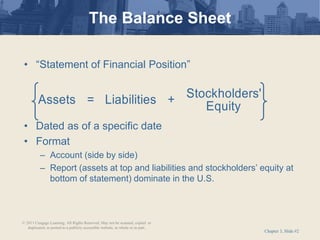
#2 • “Statement of Financial Position” • Dated as of a specific date • Format – Account (side by side) – Report (assets at top and liabilities and stockholders’ equity at bottom of statement) dominate in the U.S. Stockholders' Assets = Liabilities + Equity The Balance Sheet © 2011 Cengage Learning. All Rights Reserved. May not be scanned, copied or duplicated, or posted to a publicly accessible website, in whole or in part.
3.
Chapter 3, Slide
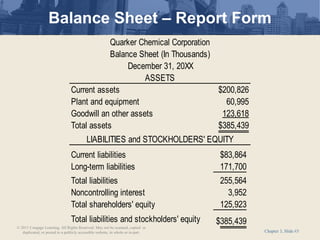
#3 Balance Sheet – Report Form Current assets $200,826 Plant and equipment 60,995 Goodwill an other assets 123,618 Total assets $385,439 Current liabilities $83,864 Long-term liabilities 171,700 Total liabilities 255,564 Noncontrolling interest 3,952 Total shareholders' equity 125,923 Total liabilities and stockholders' equity $385,439 LIABILITIES and STOCKHOLDERS' EQUITY Quarker Chemical Corporation Balance Sheet (In Thousands) December 31, 20XX ASSETS © 2011 Cengage Learning. All Rights Reserved. May not be scanned, copied or duplicated, or posted to a publicly accessible website, in whole or in part.
4.
Chapter 3, Slide
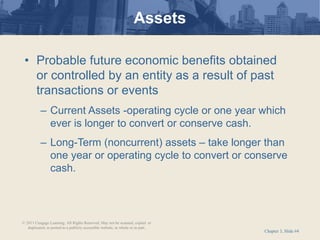
#4 • Probable future economic benefits obtained or controlled by an entity as a result of past transactions or events – Current Assets -operating cycle or one year which ever is longer to convert or conserve cash. – Long-Term (noncurrent) assets – take longer than one year or operating cycle to convert or conserve cash. Assets © 2011 Cengage Learning. All Rights Reserved. May not be scanned, copied or duplicated, or posted to a publicly accessible website, in whole or in part.
5.
Chapter 3, Slide
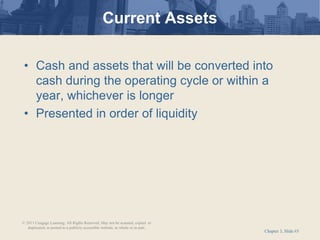
#5 • Cash and assets that will be converted into cash during the operating cycle or within a year, whichever is longer • Presented in order of liquidity Current Assets © 2011 Cengage Learning. All Rights Reserved. May not be scanned, copied or duplicated, or posted to a publicly accessible website, in whole or in part.
6.
Chapter 3, Slide
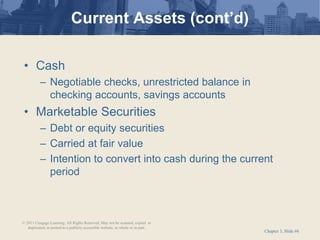
#6 • Cash – Negotiable checks, unrestricted balance in checking accounts, savings accounts • Marketable Securities – Debt or equity securities – Carried at fair value – Intention to convert into cash during the current period Current Assets (cont’d) © 2011 Cengage Learning. All Rights Reserved. May not be scanned, copied or duplicated, or posted to a publicly accessible website, in whole or in part.
7.
Chapter 3, Slide
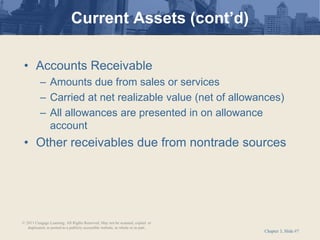
#7 • Accounts Receivable – Amounts due from sales or services – Carried at net realizable value (net of allowances) – All allowances are presented in on allowance account • Other receivables due from nontrade sources Current Assets (cont’d) © 2011 Cengage Learning. All Rights Reserved. May not be scanned, copied or duplicated, or posted to a publicly accessible website, in whole or in part.
8.
Chapter 3, Slide
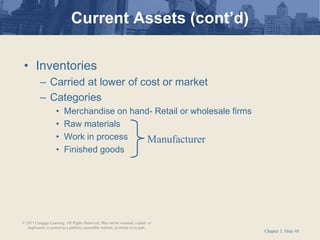
#8 • Inventories – Carried at lower of cost or market – Categories • Merchandise on hand- Retail or wholesale firms • Raw materials • Work in process • Finished goods Manufacturer Current Assets (cont’d) © 2011 Cengage Learning. All Rights Reserved. May not be scanned, copied or duplicated, or posted to a publicly accessible website, in whole or in part.
9.
Chapter 3, Slide
#9 • Prepaids – Expenditures made in advance of the use of the service or goods. – Examples • Insurance • Advertising Current Assets (cont’d) © 2011 Cengage Learning. All Rights Reserved. May not be scanned, copied or duplicated, or posted to a publicly accessible website, in whole or in part.
10.
Chapter 3, Slide
#10 • Land – Carried at acquisition cost – Not subject to depreciation – Natural resources are depleted • Buildings – Cost plus permanent improvements – Depreciated ( expensed ) over the estimated useful life Long-Term Assets: Tangible © 2011 Cengage Learning. All Rights Reserved. May not be scanned, copied or duplicated, or posted to a publicly accessible website, in whole or in part.
11.
Chapter 3, Slide
#11 • Machinery – Acquisition cost plus costs of delivery, installation, and permanent improvements – Depreciated over the useful life • Construction in Progress – Assets under construction – Transferred to permanent asset account upon completion Long-Term Assets: Tangible (cont’d) © 2011 Cengage Learning. All Rights Reserved. May not be scanned, copied or duplicated, or posted to a publicly accessible website, in whole or in part.
12.
Chapter 3, Slide
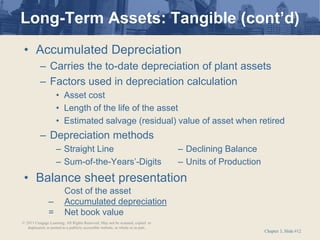
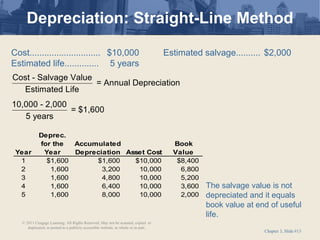
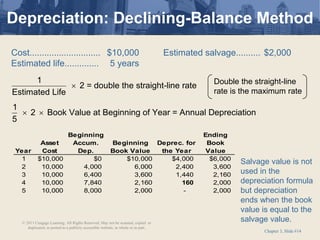
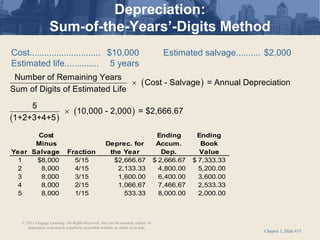
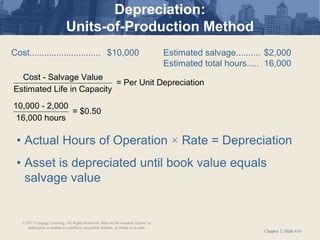
#12 • Accumulated Depreciation – Carries the to-date depreciation of plant assets – Factors used in depreciation calculation • Asset cost • Length of the life of the asset • Estimated salvage (residual) value of asset when retired – Depreciation methods – Straight Line – Declining Balance – Sum-of-the-Years’-Digits – Units of Production • Balance sheet presentation Cost of the asset – Accumulated depreciation = Net book value Long-Term Assets: Tangible (cont’d) © 2011 Cengage Learning. All Rights Reserved. May not be scanned, copied or duplicated, or posted to a publicly accessible website, in whole or in part.
13.
Chapter 3, Slide
#13 Depreciation: Straight-Line Method Cost - Salvage Value = Annual Depreciation Estimated Life 10,000 - 2,000 = $1,600 5 years Cost............................. $10,000 Estimated salvage.......... $2,000 Estimated life.............. 5 years Year Deprec. for the Year Accumulated Depreciation Asset Cost Book Value 1 $1,600 $1,600 $10,000 $8,400 2 1,600 3,200 10,000 6,800 3 1,600 4,800 10,000 5,200 4 1,600 6,400 10,000 3,600 5 1,600 8,000 10,000 2,000 The salvage value is not depreciated and it equals book value at end of useful life. © 2011 Cengage Learning. All Rights Reserved. May not be scanned, copied or duplicated, or posted to a publicly accessible website, in whole or in part.
14.
Chapter 3, Slide
#14 Depreciation: Declining-Balance Method 1 2 = double the straight-line rate Estimated Life 1 2 Book Value at Beginning of Year = Annual Depreciation 5 Year Asset Cost Beginning Accum. Dep. Beginning Book Value Deprec. for the Year Ending Book Value 1 $10,000 $0 $10,000 $4,000 $6,000 2 10,000 4,000 6,000 2,400 3,600 3 10,000 6,400 3,600 1,440 2,160 4 10,000 7,840 2,160 160 2,000 5 10,000 8,000 2,000 - 2,000 Salvage value is not used in the depreciation formula but depreciation ends when the book value is equal to the salvage value. Cost............................. $10,000 Estimated salvage.......... $2,000 Estimated life.............. 5 years Double the straight-line rate is the maximum rate © 2011 Cengage Learning. All Rights Reserved. May not be scanned, copied or duplicated, or posted to a publicly accessible website, in whole or in part.
15.
Chapter 3, Slide
#15 Depreciation: Sum-of-the-Years’-Digits Method Cost............................. $10,000 Estimated salvage.......... $2,000 Estimated life.............. 5 years ( ) ( ) ( ) Number of Remaining Years Cost - Salvage = Annual Depreciation Sum of Digits of Estimated Life 5 10,000 - 2,000 = $2,666.67 1+2+3+4+5 Year Cost Minus Salvage Fraction Deprec. for the Year Ending Accum. Dep. Ending Book Value 1 $8,000 5/15 $2,666.67 2,666.67 $ 7,333.33 $ 2 8,000 4/15 2,133.33 4,800.00 5,200.00 3 8,000 3/15 1,600.00 6,400.00 3,600.00 4 8,000 2/15 1,066.67 7,466.67 2,533.33 5 8,000 1/15 533.33 8,000.00 2,000.00 © 2011 Cengage Learning. All Rights Reserved. May not be scanned, copied or duplicated, or posted to a publicly accessible website, in whole or in part.
16.
Chapter 3, Slide
#16 Depreciation: Units-of-Production Method Cost - Salvage Value = Per Unit Depreciation Estimated Life in Capacity 10,000 - 2,000 = $0.50 16,000 hours Cost............................. $10,000 Estimated salvage.......... $2,000 Estimated total hours..... 16,000 • Actual Hours of Operation × Rate = Depreciation • Asset is depreciated until book value equals salvage value © 2011 Cengage Learning. All Rights Reserved. May not be scanned, copied or duplicated, or posted to a publicly accessible website, in whole or in part.
17.
Chapter 3, Slide
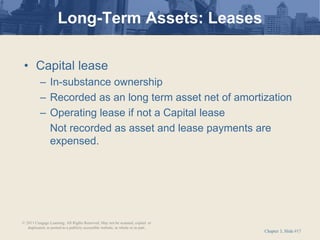
#17 Long-Term Assets: Leases • Capital lease – In-substance ownership – Recorded as an long term asset net of amortization – Operating lease if not a Capital lease Not recorded as asset and lease payments are expensed. © 2011 Cengage Learning. All Rights Reserved. May not be scanned, copied or duplicated, or posted to a publicly accessible website, in whole or in part.
18.
Chapter 3, Slide
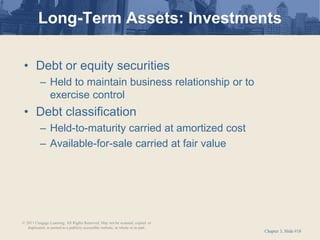
#18 • Debt or equity securities – Held to maintain business relationship or to exercise control • Debt classification – Held-to-maturity carried at amortized cost – Available-for-sale carried at fair value Long-Term Assets: Investments © 2011 Cengage Learning. All Rights Reserved. May not be scanned, copied or duplicated, or posted to a publicly accessible website, in whole or in part.
19.
Chapter 3, Slide
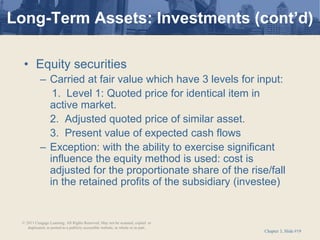
#19 Long-Term Assets: Investments (cont’d) • Equity securities – Carried at fair value which have 3 levels for input: 1. Level 1: Quoted price for identical item in active market. 2. Adjusted quoted price of similar asset. 3. Present value of expected cash flows – Exception: with the ability to exercise significant influence the equity method is used: cost is adjusted for the proportionate share of the rise/fall in the retained profits of the subsidiary (investee) © 2011 Cengage Learning. All Rights Reserved. May not be scanned, copied or duplicated, or posted to a publicly accessible website, in whole or in part.
20.
Chapter 3, Slide
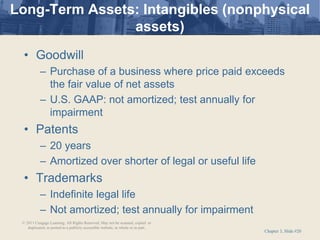
#20 • Goodwill – Purchase of a business where price paid exceeds the fair value of net assets – U.S. GAAP: not amortized; test annually for impairment • Patents – 20 years – Amortized over shorter of legal or useful life • Trademarks – Indefinite legal life – Not amortized; test annually for impairment Long-Term Assets: Intangibles (nonphysical assets) © 2011 Cengage Learning. All Rights Reserved. May not be scanned, copied or duplicated, or posted to a publicly accessible website, in whole or in part.
21.
Chapter 3, Slide
#21 Long-Term Assets: Intangibles (cont’d) • Franchises – Life based on contract – Amortize over shorter of legal or useful life • Copyrights – Life of the creator plus 70 years – Amortize over shorter of legal or useful life © 2011 Cengage Learning. All Rights Reserved. May not be scanned, copied or duplicated, or posted to a publicly accessible website, in whole or in part.
22.
Chapter 3, Slide
#22 • Probable future sacrifices of economic benefits arising from present obligations of a particular entity to transfer assets or provide services to other entities in the futures as a result of past transactions or events – Current Liabilities – Long-Term Liabilities Liabilities © 2011 Cengage Learning. All Rights Reserved. May not be scanned, copied or duplicated, or posted to a publicly accessible website, in whole or in part.
23.
Chapter 3, Slide
#23 Current Liabilities • Obligations whose liquidation is reasonably expected to • Require the use of – Existing current assets – Creation of other current liabilities • Within one year or the operating cycle, whichever is longer © 2011 Cengage Learning. All Rights Reserved. May not be scanned, copied or duplicated, or posted to a publicly accessible website, in whole or in part.
24.
Chapter 3, Slide
#24 Current Liabilities (cont’d) • Payables – Short-term obligations created by the acquisition of goods or services • Unearned Income – Payments collected in advance of the performance of services or delivery of goods • Other current liabilities – As circumstances warrant © 2011 Cengage Learning. All Rights Reserved. May not be scanned, copied or duplicated, or posted to a publicly accessible website, in whole or in part.
25.
Chapter 3, Slide
#25 Long-Term Liabilities • Due in a period beyond one year or operating cycle • Related to – Financing arrangements – Operational obligations © 2011 Cengage Learning. All Rights Reserved. May not be scanned, copied or duplicated, or posted to a publicly accessible website, in whole or in part.
26.
Chapter 3, Slide
#26 Long-Term Liabilities: Financing Arrangements • Notes Payable – Secured by property: Mortgage notes • Credit Agreements – Ready lines of credit that may require a compensating balance – Not a liability until funds are drawn © 2011 Cengage Learning. All Rights Reserved. May not be scanned, copied or duplicated, or posted to a publicly accessible website, in whole or in part.
27.
Chapter 3, Slide
#27 Long-Term Liabilities: Financing Arrangements (cont’d) • Bonds Payable – Sold at par, premium, or discount – Premium or discount is amortized into interest expense – Bond carrying value is amortized to par value – Convertible bonds can be converted into common stock – Conversion feature enhances bond selling price © 2011 Cengage Learning. All Rights Reserved. May not be scanned, copied or duplicated, or posted to a publicly accessible website, in whole or in part.
28.
Chapter 3, Slide
#28 Bonds at Par, Premium, or Discount Bond Contractual Interest Rate 8% 6% 8% 10% Premium Par (Face Value) Discount Market Interest Rate Bonds Sold at © 2011 Cengage Learning. All Rights Reserved. May not be scanned, copied or duplicated, or posted to a publicly accessible website, in whole or in part.
29.
Chapter 3, Slide
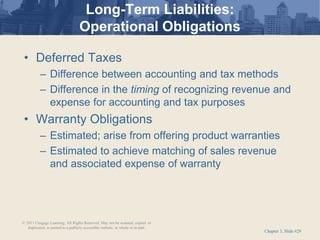
#29 Long-Term Liabilities: Operational Obligations • Deferred Taxes – Difference between accounting and tax methods – Difference in the timing of recognizing revenue and expense for accounting and tax purposes • Warranty Obligations – Estimated; arise from offering product warranties – Estimated to achieve matching of sales revenue and associated expense of warranty © 2011 Cengage Learning. All Rights Reserved. May not be scanned, copied or duplicated, or posted to a publicly accessible website, in whole or in part.
30.
Chapter 3, Slide
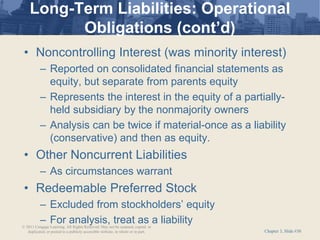
#30 Long-Term Liabilities: Operational Obligations (cont’d) • Noncontrolling Interest (was minority interest) – Reported on consolidated financial statements as equity, but separate from parents equity – Represents the interest in the equity of a partially- held subsidiary by the nonmajority owners – Analysis can be twice if material-once as a liability (conservative) and then as equity. • Other Noncurrent Liabilities – As circumstances warrant • Redeemable Preferred Stock – Excluded from stockholders’ equity – For analysis, treat as a liability © 2011 Cengage Learning. All Rights Reserved. May not be scanned, copied or duplicated, or posted to a publicly accessible website, in whole or in part.
31.
Chapter 3, Slide
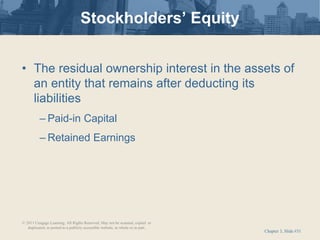
#31 • The residual ownership interest in the assets of an entity that remains after deducting its liabilities – Paid-in Capital – Retained Earnings Stockholders’ Equity © 2011 Cengage Learning. All Rights Reserved. May not be scanned, copied or duplicated, or posted to a publicly accessible website, in whole or in part.
32.
Chapter 3, Slide
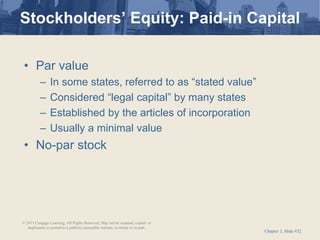
#32 Stockholders’ Equity: Paid-in Capital • Par value – In some states, referred to as “stated value” – Considered “legal capital” by many states – Established by the articles of incorporation – Usually a minimal value • No-par stock © 2011 Cengage Learning. All Rights Reserved. May not be scanned, copied or duplicated, or posted to a publicly accessible website, in whole or in part.
33.
Chapter 3, Slide
#33 Stockholders’ Equity: Paid-in Capital (cont’d) • Additional paid-in capital – Issue price in excess of par (stated) value – Other sources • Treasury stock transactions • Stock dividend transactions • Donated capital © 2011 Cengage Learning. All Rights Reserved. May not be scanned, copied or duplicated, or posted to a publicly accessible website, in whole or in part.
34.
Chapter 3, Slide
#34 Stockholders’ Equity: Paid-in Capital (cont’d) • Common Stock – Shareholder ownership – Voting rights • Election of board of directors • Major corporate decisions – Liquidation rights secondary to • Creditors • Preferred stock © 2011 Cengage Learning. All Rights Reserved. May not be scanned, copied or duplicated, or posted to a publicly accessible website, in whole or in part.
35.
Chapter 3, Slide
#35 Stockholders’ Equity: Paid-in Capital (cont’d) • Preferred Stock – Does not normally convey voting rights – May carry any or all of these features: • Preference as to dividends • Accumulation of dividends • Participation in dividend beyond stated dividend rate • Convertibility into common stock at holder’s discretion • Preference in liquidation secondary to creditors • Callable at issuer discretion • Redemption at future maturity value • Donated Capital – Donated by outside entities – Shareholder surrender of stock © 2011 Cengage Learning. All Rights Reserved. May not be scanned, copied or duplicated, or posted to a publicly accessible website, in whole or in part.
36.
Chapter 3, Slide
#36 Stockholders’ Equity: Retained Earnings • Undistributed earnings of the corporation – Net income for all prior periods – Less dividends declared to shareholders for all prior periods © 2011 Cengage Learning. All Rights Reserved. May not be scanned, copied or duplicated, or posted to a publicly accessible website, in whole or in part.
37.
Chapter 3, Slide
#37 Stockholders’ Equity: Other • Quasi-Reorganization – Eliminates a deficit balance of retained earnings – Retained earnings are dated for 5-10 years • Accumulated Other Comprehensive Income - Represents retained earnings for other comprehensive income as a separate component on the face of the balance sheet. © 2011 Cengage Learning. All Rights Reserved. May not be scanned, copied or duplicated, or posted to a publicly accessible website, in whole or in part.
38.
Chapter 3, Slide
#38 Stockholders’ Equity: Other (cont’d) • Employee Stock Ownership Plans (ESOPs) – A qualified pension plan – Tax benefits for the employer and employee – Unearned compensation reduces stockholders’ equity • Treasury Stock – Stock purchased and held by the issuing corporation – Recording and disclosure • Record at par value; deduct from paid-in capital • Record at cost; deduct from total stockholders’ equity © 2011 Cengage Learning. All Rights Reserved. May not be scanned, copied or duplicated, or posted to a publicly accessible website, in whole or in part.
39.
Chapter 3, Slide
#39 • Reconciles the beginning and ending balances of all components of stockholders’ equity • Account changes indicate – Issuance of stock: paid-in capital increase – Acquisition of treasury stock: treasury stock increase – Net income: retained earnings increase – Dividends: retained earnings decrease – Changes in accumulated other comprehensive income. Statement of Stockholders’ Equity © 2011 Cengage Learning. All Rights Reserved. May not be scanned, copied or duplicated, or posted to a publicly accessible website, in whole or in part.
40.
Chapter 3, Slide
#40 • Financial analysis is complicated by – Many assets recorded at cost rather than fair (replacement) value – Varying valuation methods • Within a firm from item to item • Within an industry from company to company – Not all items of value are listed as assets – Certain contingent liabilities may be excluded Balance Sheet Presentation Issues © 2011 Cengage Learning. All Rights Reserved. May not be scanned, copied or duplicated, or posted to a publicly accessible website, in whole or in part.
41.
Chapter 3, Slide
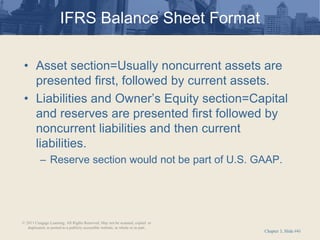
#41 IFRS Balance Sheet Format • Asset section=Usually noncurrent assets are presented first, followed by current assets. • Liabilities and Owner’s Equity section=Capital and reserves are presented first followed by noncurrent liabilities and then current liabilities. – Reserve section would not be part of U.S. GAAP. © 2011 Cengage Learning. All Rights Reserved. May not be scanned, copied or duplicated, or posted to a publicly accessible website, in whole or in part.
Download


![Credit Training[Finall]](https://cdn.slidesharecdn.com/ss_thumbnails/credittrainingfinall-091227073414-phpapp02-thumbnail.jpg?width=640&height=640&fit=bounds)


