Muhammad Bakri | FTIK | Universitas Teknokrat Indonesia © 2019
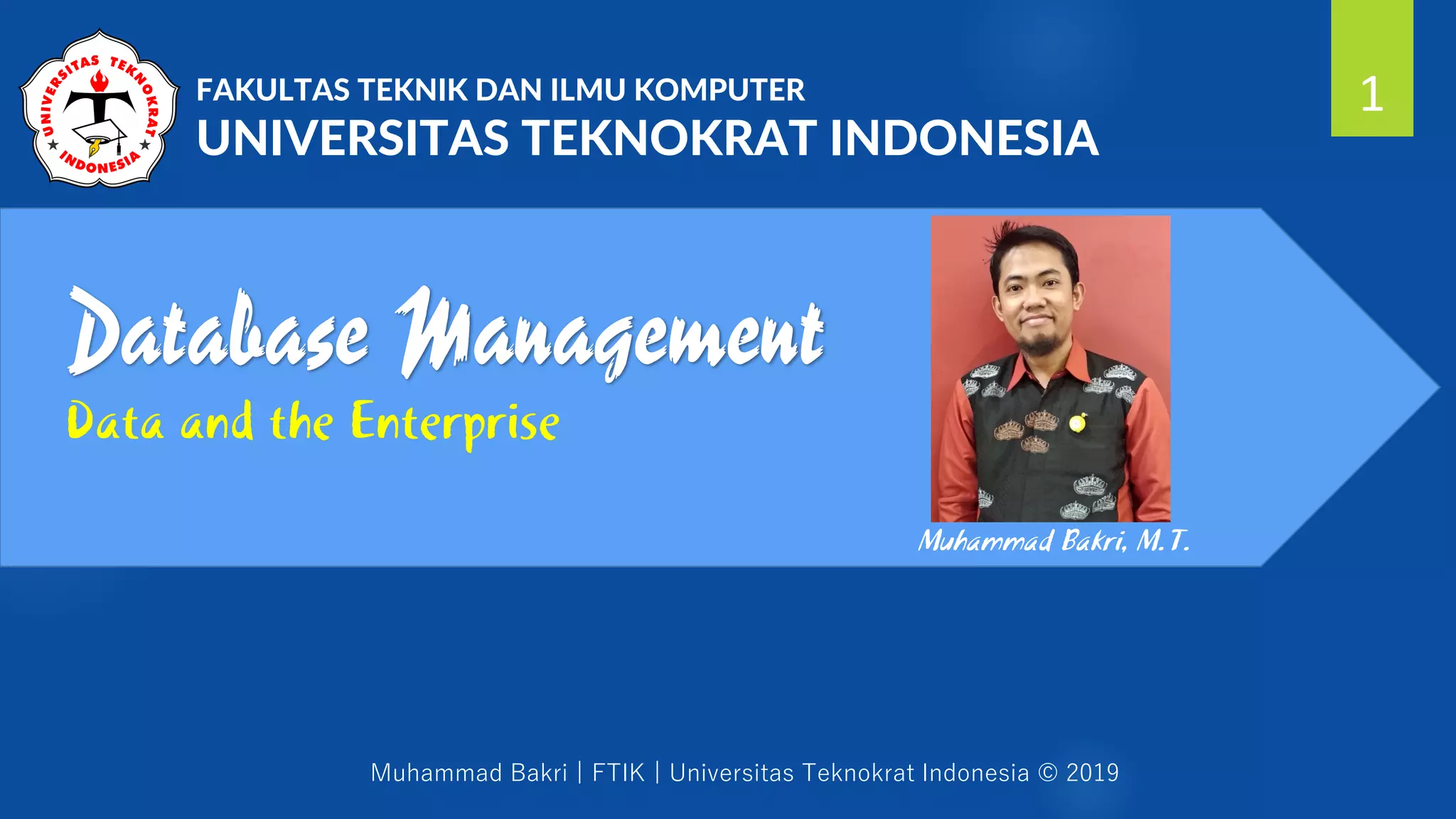
Database Management
Data and the Enterprise
1FAKULTAS TEKNIK DAN ILMU KOMPUTER
UNIVERSITAS TEKNOKRAT INDONESIA
Muhammad Bakri, M.T.
Muhammad Bakri | FTIK | Universitas Teknokrat Indonesia © 2019
Learned about data
modelling concepts
2
Muhammad Bakri | FTIK | Universitas Teknokrat Indonesia © 2019
Data and the
Enterprise
3
Muhammad Bakri | FTIK | Universitas Teknokrat Indonesia © 2019
Learn the concepts of
information and data and
discusses why they are
important business resources
within the enterprise
4
Learning Objectives
Muhammad Bakri | FTIK | Universitas Teknokrat Indonesia © 2019
5
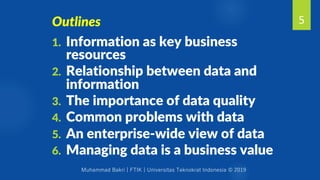
1. Information as key business
resources
2. Relationship between data and
information
3. The importance of data quality
4. Common problems with data
5. An enterprise-wide view of data
6. Managing data is a business value
Outlines
Muhammad Bakri | FTIK | Universitas Teknokrat Indonesia © 2019
Try to identify
business key
resources
6
Muhammad Bakri | FTIK | Universitas Teknokrat Indonesia © 2019
People will say:
money, people,
buildings and
equipment
7
Muhammad Bakri | FTIK | Universitas Teknokrat Indonesia © 2019
All about that is
important but
missing one thing
8
Muhammad Bakri | FTIK | Universitas Teknokrat Indonesia © 2019
It’s information
9
Muhammad Bakri | FTIK | Universitas Teknokrat Indonesia © 2019
Without
information, the
business cannot
function
10
Muhammad Bakri | FTIK | Universitas Teknokrat Indonesia © 2019
Information is a business resource that is
used in every aspect of a business:
• supports the day-to-day operational
tasks and activities
• enables the routine administration and
management of the business
• supports strategic decision making and
future planning
11
Muhammad Bakri | FTIK | Universitas Teknokrat Indonesia © 2019
Information in various
forms is routinely used
by managers to monitor
the efficiency and
effectiveness of the
business
12
Muhammad Bakri | FTIK | Universitas Teknokrat Indonesia © 2019
The Relationship
Between
Information And
Data
13
Muhammad Bakri | FTIK | Universitas Teknokrat Indonesia © 2019
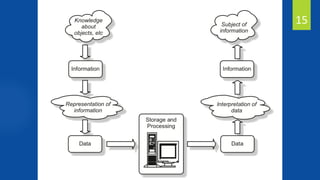
The idea that data is a
set of recorded facts is
found in many books
on computing
14
Muhammad Bakri | FTIK | Universitas Teknokrat Indonesia © 2019
15
Muhammad Bakri | FTIK | Universitas Teknokrat Indonesia © 2019
The Importance Of
The Quality Of Data
16
Muhammad Bakri | FTIK | Universitas Teknokrat Indonesia © 2019
The information must be
• up to date,
• complete,
• sufficiently accurate for the
purpose it is required,
• unambiguously understood,
• consistent and available when it is
required.
17
Muhammad Bakri | FTIK | Universitas Teknokrat Indonesia © 2019
Information is
derived from the
processing of data
18
Muhammad Bakri | FTIK | Universitas Teknokrat Indonesia © 2019
The Common
Problems With Data
19
Muhammad Bakri | FTIK | Universitas Teknokrat Indonesia © 2019
These problems are generally caused by
• a combination of the proliferation of
duplicate, and often inconsistent,
• occurrences of data and the
misinterpretation and misunderstanding
of the data caused by the lack of a
cohesive,
• enterprise-wide regime of data
definition.
20
Muhammad Bakri | FTIK | Universitas Teknokrat Indonesia © 2019
Effective management
of data also requires
an understanding of
the problems that
relate to data.
21
Muhammad Bakri | FTIK | Universitas Teknokrat Indonesia © 2019
These problems often
cross departmental
boundaries and their
solutions consist of both
technical and
organisational aspects
22
Muhammad Bakri | FTIK | Universitas Teknokrat Indonesia © 2019
Managing Data is a
Business Issue
23
Muhammad Bakri | FTIK | Universitas Teknokrat Indonesia © 2019
Responsibilities exist
within the
organisation
24
Muhammad Bakri | FTIK | Universitas Teknokrat Indonesia © 2019
The finance department has
special responsibilities for
managing the organisation’s
money including the allocation
of budgets, managing
investments and accounting
25
1
Muhammad Bakri | FTIK | Universitas Teknokrat Indonesia © 2019
The personnel department has
special responsibilities for
managing the organisation’s
employee base including the
provision of advice on legislation
affecting personnel issues and the
recruitment of staff
26
2
Muhammad Bakri | FTIK | Universitas Teknokrat Indonesia © 2019
The estates department has special
responsibilities for managing the buildings
used by the organisation including ensuring
that the buildings meet legal requirements in
respect of health and safety issues, buying,
selling and leasing of buildings and ensuring
that the estate is adequately insured
27
3
Muhammad Bakri | FTIK | Universitas Teknokrat Indonesia © 2019
The stores and maintenance
department has special
responsibilities for managing the
organisation’s equipment including
the provision of a central purchasing
function, the accounting for
equipment in use and the storage of
equipment until it is required for use
28
4
Muhammad Bakri | FTIK | Universitas Teknokrat Indonesia © 2019
The IT or IS department has
special responsibility for data
and information including the
physical storage, distribution,
security, backup and archiving
of data
29
5
Muhammad Bakri | FTIK | Universitas Teknokrat Indonesia © 2019
Summary
30
Muhammad Bakri | FTIK | Universitas Teknokrat Indonesia © 2019
In this chapter we have seen that
information, an often neglected key business
resource that needs to be shared across an
enterprise, is developed from data. To
provide quality information, data has to be
properly managed. There has to be an
enterprise-wide view of data, and the
business, not the IT or IS function, has to
take the lead in the management of data.
31
Muhammad Bakri | FTIK | Universitas Teknokrat Indonesia © 2019
Thank You
32

Slide 01-Data and the Enterprise

  • 1.
    Muhammad Bakri |FTIK | Universitas Teknokrat Indonesia © 2019 Database Management Data and the Enterprise 1FAKULTAS TEKNIK DAN ILMU KOMPUTER UNIVERSITAS TEKNOKRAT INDONESIA Muhammad Bakri, M.T.
  • 2.
    Muhammad Bakri |FTIK | Universitas Teknokrat Indonesia © 2019 Learned about data modelling concepts 2
  • 3.
    Muhammad Bakri |FTIK | Universitas Teknokrat Indonesia © 2019 Data and the Enterprise 3
  • 4.
    Muhammad Bakri |FTIK | Universitas Teknokrat Indonesia © 2019 Learn the concepts of information and data and discusses why they are important business resources within the enterprise 4 Learning Objectives
  • 5.
    Muhammad Bakri |FTIK | Universitas Teknokrat Indonesia © 2019 5 1. Information as key business resources 2. Relationship between data and information 3. The importance of data quality 4. Common problems with data 5. An enterprise-wide view of data 6. Managing data is a business value Outlines
  • 6.
    Muhammad Bakri |FTIK | Universitas Teknokrat Indonesia © 2019 Try to identify business key resources 6
  • 7.
    Muhammad Bakri |FTIK | Universitas Teknokrat Indonesia © 2019 People will say: money, people, buildings and equipment 7
  • 8.
    Muhammad Bakri |FTIK | Universitas Teknokrat Indonesia © 2019 All about that is important but missing one thing 8
  • 9.
    Muhammad Bakri |FTIK | Universitas Teknokrat Indonesia © 2019 It’s information 9
  • 10.
    Muhammad Bakri |FTIK | Universitas Teknokrat Indonesia © 2019 Without information, the business cannot function 10
  • 11.
    Muhammad Bakri |FTIK | Universitas Teknokrat Indonesia © 2019 Information is a business resource that is used in every aspect of a business: • supports the day-to-day operational tasks and activities • enables the routine administration and management of the business • supports strategic decision making and future planning 11
  • 12.
    Muhammad Bakri |FTIK | Universitas Teknokrat Indonesia © 2019 Information in various forms is routinely used by managers to monitor the efficiency and effectiveness of the business 12
  • 13.
    Muhammad Bakri |FTIK | Universitas Teknokrat Indonesia © 2019 The Relationship Between Information And Data 13
  • 14.
    Muhammad Bakri |FTIK | Universitas Teknokrat Indonesia © 2019 The idea that data is a set of recorded facts is found in many books on computing 14
  • 15.
    Muhammad Bakri |FTIK | Universitas Teknokrat Indonesia © 2019 15
  • 16.
    Muhammad Bakri |FTIK | Universitas Teknokrat Indonesia © 2019 The Importance Of The Quality Of Data 16
  • 17.
    Muhammad Bakri |FTIK | Universitas Teknokrat Indonesia © 2019 The information must be • up to date, • complete, • sufficiently accurate for the purpose it is required, • unambiguously understood, • consistent and available when it is required. 17
  • 18.
    Muhammad Bakri |FTIK | Universitas Teknokrat Indonesia © 2019 Information is derived from the processing of data 18
  • 19.
    Muhammad Bakri |FTIK | Universitas Teknokrat Indonesia © 2019 The Common Problems With Data 19
  • 20.
    Muhammad Bakri |FTIK | Universitas Teknokrat Indonesia © 2019 These problems are generally caused by • a combination of the proliferation of duplicate, and often inconsistent, • occurrences of data and the misinterpretation and misunderstanding of the data caused by the lack of a cohesive, • enterprise-wide regime of data definition. 20
  • 21.
    Muhammad Bakri |FTIK | Universitas Teknokrat Indonesia © 2019 Effective management of data also requires an understanding of the problems that relate to data. 21
  • 22.
    Muhammad Bakri |FTIK | Universitas Teknokrat Indonesia © 2019 These problems often cross departmental boundaries and their solutions consist of both technical and organisational aspects 22
  • 23.
    Muhammad Bakri |FTIK | Universitas Teknokrat Indonesia © 2019 Managing Data is a Business Issue 23
  • 24.
    Muhammad Bakri |FTIK | Universitas Teknokrat Indonesia © 2019 Responsibilities exist within the organisation 24
  • 25.
    Muhammad Bakri |FTIK | Universitas Teknokrat Indonesia © 2019 The finance department has special responsibilities for managing the organisation’s money including the allocation of budgets, managing investments and accounting 25 1
  • 26.
    Muhammad Bakri |FTIK | Universitas Teknokrat Indonesia © 2019 The personnel department has special responsibilities for managing the organisation’s employee base including the provision of advice on legislation affecting personnel issues and the recruitment of staff 26 2
  • 27.
    Muhammad Bakri |FTIK | Universitas Teknokrat Indonesia © 2019 The estates department has special responsibilities for managing the buildings used by the organisation including ensuring that the buildings meet legal requirements in respect of health and safety issues, buying, selling and leasing of buildings and ensuring that the estate is adequately insured 27 3
  • 28.
    Muhammad Bakri |FTIK | Universitas Teknokrat Indonesia © 2019 The stores and maintenance department has special responsibilities for managing the organisation’s equipment including the provision of a central purchasing function, the accounting for equipment in use and the storage of equipment until it is required for use 28 4
  • 29.
    Muhammad Bakri |FTIK | Universitas Teknokrat Indonesia © 2019 The IT or IS department has special responsibility for data and information including the physical storage, distribution, security, backup and archiving of data 29 5
  • 30.
    Muhammad Bakri |FTIK | Universitas Teknokrat Indonesia © 2019 Summary 30
  • 31.
    Muhammad Bakri |FTIK | Universitas Teknokrat Indonesia © 2019 In this chapter we have seen that information, an often neglected key business resource that needs to be shared across an enterprise, is developed from data. To provide quality information, data has to be properly managed. There has to be an enterprise-wide view of data, and the business, not the IT or IS function, has to take the lead in the management of data. 31
  • 32.
    Muhammad Bakri |FTIK | Universitas Teknokrat Indonesia © 2019 Thank You 32