Training support material for:
TLILIC0014
Licence to operate a slewing mobile crane
(up to 100 tonnes)
Produced by:
SLEWING MOBILE CRANE (100T)
SAFETY AND LICENCE GUIDE
© Easy Guides Australia Pty. Ltd. May not be reproduced
5
Introduction to
Slewing Mobile Crane
(up to 100 tonnes)
© Easy Guides Australia Pty. Ltd. May not be reproduced
6
INTRODUCTION TO SLEWING MOBILE CRANE (up to 100 tonnes)
What is a slewing mobile crane
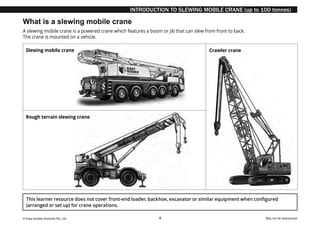
A slewing mobile crane is a powered crane which features a boom or jib that can slew from front to back.
The crane is mounted on a vehicle.
This learner resource does not cover front-end loader, backhoe, excavator or similar equipment when configured
(arranged or set up) for crane operations.
Rough terrain slewing crane
Crawler crane
Slewing mobile crane
© Easy Guides Australia Pty. Ltd. May not be reproduced
7
INTRODUCTION TO SLEWING MOBILE CRANE (up to 100 tonnes)
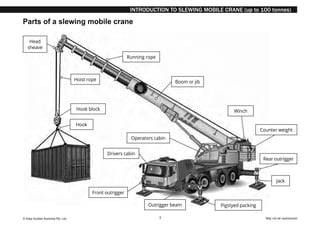
Parts of a slewing mobile crane
Running rope
Counter weight
Pigstyed packing
Boom or jib
Head
sheave
Hook
Hook block
Rear outrigger
Front outrigger
Outrigger beam
Jack
Hoist rope
Winch
Operators cabin
Drivers cabin
© Easy Guides Australia Pty. Ltd. May not be reproduced
23
Element 1 –
Plan work /task
© Easy Guides Australia Pty. Ltd. May not be reproduced
24
ELEMENT 1 — PLAN WORK/TASK
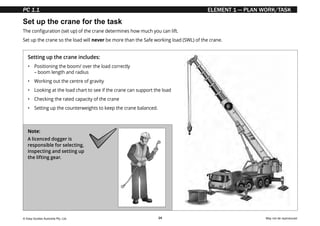
Set up the crane for the task
The configuration (set up) of the crane determines how much you can lift.
Set up the crane so the load will never be more than the Safe working load (SWL) of the crane.
Setting up the crane includes:
• Positioning the boom/ over the load correctly
– boom length and radius
• Working out the centre of gravity
• Looking at the load chart to see if the crane can support the load
• Checking the rated capacity of the crane
• Setting up the counterweights to keep the crane balanced.
Note:
A licenced dogger is
responsible for selecting,
inspecting and setting up
the lifting gear.
PC 1.1
© Easy Guides Australia Pty. Ltd. May not be reproduced
27
ELEMENT 1 — PLAN WORK/TASK
Outriggers and packing (continued)
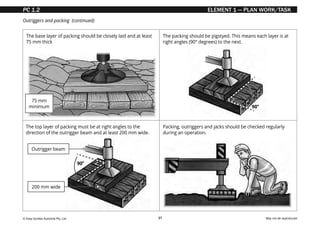
The top layer of packing must be at right angles to the
direction of the outrigger beam and at least 200 mm wide.
The packing should be pigstyed. This means each layer is at
right angles (90° degrees) to the next.
Packing, outriggers and jacks should be checked regularly
during an operation.
The base layer of packing should be closely laid and at least
75 mm thick
90o
90o
200 mm wide
Outrigger beam
75 mm
minimum
PC 1.2
© Easy Guides Australia Pty. Ltd. May not be reproduced
30
ELEMENT 1 — PLAN WORK/TASK
Packing formula
To calculate the area of packing needed in square metres you must know:
• The cranes mass (Cm) • The loads mass (L) • The bearing pressure of the soil (PMAX).
Remembering this formula
It is much easier to understand this
formula if you know what each part of
the formula does.
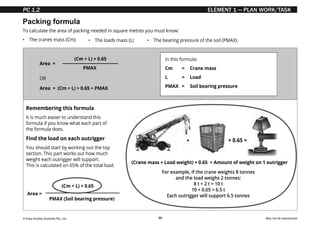
Find the load on each outrigger
You should start by working out the top
section. This part works out how much
weight each outrigger will support.
This is calculated on 65% of the total load.
(Cm + L) × 0.65
PMAX
Area =
Area = (Cm + L) × 0.65 ÷ PMAX
OR
In this formula:
Cm = Crane mass
L = Load
PMAX = Soil bearing pressure
(Cm + L) × 0.65
PMAX (Soil bearing pressure)
Area =
For example, if the crane weights 8 tonnes
and the load weighs 2 tonnes:
8 t + 2 t = 10 t
10 × 0.65 = 6.5 t
Each outrigger will support 6.5 tonnes
(Crane mass + Load weight) × 0.65 = Amount of weight on 1 outrigger
× 0.65 =
+
PC 1.2
© Easy Guides Australia Pty. Ltd. May not be reproduced
32
ELEMENT 1 — PLAN WORK/TASK
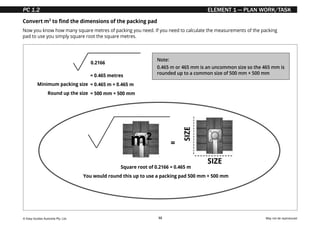
Convert m2
to find the dimensions of the packing pad
Now you know how many square metres of packing you need. If you need to calculate the measurements of the packing
pad to use you simply square root the square metres.
= 0.465 metres
= 0.465 m × 0.465 m
= 500 mm × 500 mm
0.2166
Minimum packing size
Round up the size
Square root of 0.2166 = 0.465 m
You would round this up to use a packing pad 500 mm × 500 mm
=
m2
SIZE
SIZE
Note:
0.465 m or 465 mm is an uncommon size so the 465 mm is
rounded up to a common size of 500 mm × 500 mm
PC 1.2
© Easy Guides Australia Pty. Ltd. May not be reproduced
33
ELEMENT 1 — PLAN WORK/TASK
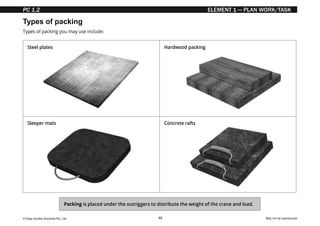
Sleeper mats Concrete rafts
Steel plates Hardwood packing
Types of packing
Types of packing you may use include:
Packing is placed under the outriggers to distribute the weight of the crane and load.
PC 1.2
© Easy Guides Australia Pty. Ltd. May not be reproduced
34
ELEMENT 1 — PLAN WORK/TASK
How to calculate the weight of a load
Following are two examples of how to calculate loads.
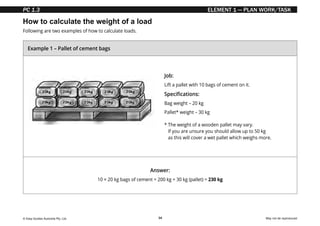
Example 1 – Pallet of cement bags
Job:
Lift a pallet with 10 bags of cement on it.
Specifications:
Bag weight – 20 kg
Pallet* weight – 30 kg
* 
The weight of a wooden pallet may vary.
If you are unsure you should allow up to 50 kg
as this will cover a wet pallet which weighs more.
Answer:
10 × 20 kg bags of cement = 200 kg + 30 kg (pallet) = 230 kg
PC 1.3
© Easy Guides Australia Pty. Ltd. May not be reproduced
42
ELEMENT 1 — PLAN WORK/TASK
CHAPTER 1 – PLAN WORK/TASK
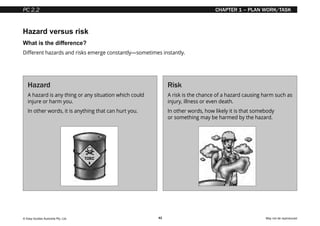
Hazard versus risk
What is the difference?
Different hazards and risks emerge constantly—sometimes instantly.
Hazard
A hazard is any thing or any situation which could
injure or harm you.
In other words, it is anything that can hurt you.
Risk
A risk is the chance of a hazard causing harm such as
injury, illness or even death.
In other words, how likely it is that somebody
or something may be harmed by the hazard.
PC 2.2
© Easy Guides Australia Pty. Ltd. May not be reproduced
48
ELEMENT 1 — PLAN WORK/TASK
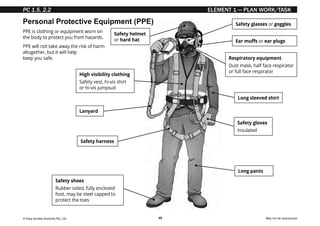
Personal Protective Equipment (PPE)
PPE is clothing or equipment worn on
the body to protect you from hazards.
PPE will not take away the risk of harm
altogether, but it will help
keep you safe.
Safety gloves
Insulated
Long pants
Long sleeved shirt
Safety shoes
Rubber soled, fully enclosed
foot, may be steel capped to
protect the toes
Safety helmet
or hard hat Ear muffs or ear plugs
Respiratory equipment
Dust mask, half face respirator
or full face respirator
Safety glasses or goggles
High visibility clothing
Safety vest, hi-vis shirt
or hi-vis jumpsuit
Safety harness
Lanyard
PC 1.5, 2.2
© Easy Guides Australia Pty. Ltd. May not be reproduced
49
ELEMENT 1 — PLAN WORK/TASK
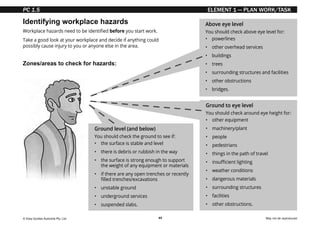
Identifying workplace hazards
Zones/areas to check for hazards:
Workplace hazards need to be identified before you start work.
Take a good look at your workplace and decide if anything could
possibly cause injury to you or anyone else in the area.
Ground to eye level
You should check around eye height for:
• other equipment
• machinery/plant
• people
• pedestrians
• things in the path of travel
• insufficient lighting
• weather conditions
• dangerous materials
• surrounding structures
• facilities
• other obstructions.
Above eye level
You should check above eye level for:
• powerlines
• other overhead services
• buildings
• trees
• surrounding structures and facilities
• other obstructions
• bridges.
Ground level (and below)
You should check the ground to see if:
• the surface is stable and level
• 
there is debris or rubbish in the way
• 
the surface is strong enough to support
the weight of any equipment or materials
• if there are any open trenches or recently
filled trenches/excavations
• unstable ground
• underground services
• suspended slabs.
PC 1.5
© Easy Guides Australia Pty. Ltd. May not be reproduced
60
ELEMENT 1 — PLAN WORK/TASK
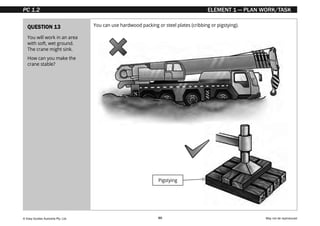
QUESTION 13 You can use hardwood packing or steel plates (cribbing or pigstying).
You will work in an area
with soft, wet ground.
The crane might sink.
How can you make the
crane stable?
Pigstying
PC 1.2
© Easy Guides Australia Pty. Ltd. May not be reproduced
61
ELEMENT 1 — PLAN WORK/TASK
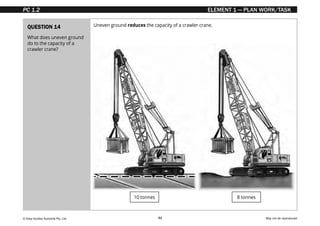
Uneven ground reduces the capacity of a crawler crane.
QUESTION 14
What does uneven ground
do to the capacity of a
crawler crane?
8 tonnes
10 tonnes
PC 1.2
© Easy Guides Australia Pty. Ltd. May not be reproduced
103
Element 2 –
Prepare for work /task
© Easy Guides Australia Pty. Ltd. May not be reproduced
108
ELEMENT 2 – PREPARE FOR WORK/TASK
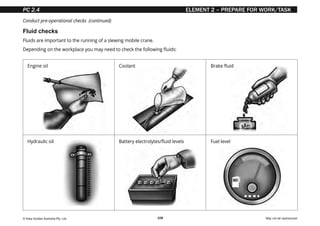
Fluid checks
Fluids are important to the running of a slewing mobile crane.
Depending on the workplace you may need to check the following fluids:
Engine oil Coolant Brake fluid
Hydraulic oil Battery electrolytes/fluid levels Fuel level
Conduct pre-operational checks (continued)
PC 2.4

Slewing-Mobile-Crane-Up-to-100T_SLG_TLILIC0014_SAMPLE.pdf

  • 1.
    Training support materialfor: TLILIC0014 Licence to operate a slewing mobile crane (up to 100 tonnes) Produced by: SLEWING MOBILE CRANE (100T) SAFETY AND LICENCE GUIDE
  • 2.
    © Easy GuidesAustralia Pty. Ltd. May not be reproduced 5 Introduction to Slewing Mobile Crane (up to 100 tonnes)
  • 3.
    © Easy GuidesAustralia Pty. Ltd. May not be reproduced 6 INTRODUCTION TO SLEWING MOBILE CRANE (up to 100 tonnes) What is a slewing mobile crane A slewing mobile crane is a powered crane which features a boom or jib that can slew from front to back. The crane is mounted on a vehicle. This learner resource does not cover front-end loader, backhoe, excavator or similar equipment when configured (arranged or set up) for crane operations. Rough terrain slewing crane Crawler crane Slewing mobile crane
  • 4.
    © Easy GuidesAustralia Pty. Ltd. May not be reproduced 7 INTRODUCTION TO SLEWING MOBILE CRANE (up to 100 tonnes) Parts of a slewing mobile crane Running rope Counter weight Pigstyed packing Boom or jib Head sheave Hook Hook block Rear outrigger Front outrigger Outrigger beam Jack Hoist rope Winch Operators cabin Drivers cabin
  • 5.
    © Easy GuidesAustralia Pty. Ltd. May not be reproduced 23 Element 1 – Plan work /task
  • 6.
    © Easy GuidesAustralia Pty. Ltd. May not be reproduced 24 ELEMENT 1 — PLAN WORK/TASK Set up the crane for the task The configuration (set up) of the crane determines how much you can lift. Set up the crane so the load will never be more than the Safe working load (SWL) of the crane. Setting up the crane includes: • Positioning the boom/ over the load correctly – boom length and radius • Working out the centre of gravity • Looking at the load chart to see if the crane can support the load • Checking the rated capacity of the crane • Setting up the counterweights to keep the crane balanced. Note: A licenced dogger is responsible for selecting, inspecting and setting up the lifting gear. PC 1.1
  • 7.
    © Easy GuidesAustralia Pty. Ltd. May not be reproduced 27 ELEMENT 1 — PLAN WORK/TASK Outriggers and packing (continued) The top layer of packing must be at right angles to the direction of the outrigger beam and at least 200 mm wide. The packing should be pigstyed. This means each layer is at right angles (90° degrees) to the next. Packing, outriggers and jacks should be checked regularly during an operation. The base layer of packing should be closely laid and at least 75 mm thick 90o 90o 200 mm wide Outrigger beam 75 mm minimum PC 1.2
  • 8.
    © Easy GuidesAustralia Pty. Ltd. May not be reproduced 30 ELEMENT 1 — PLAN WORK/TASK Packing formula To calculate the area of packing needed in square metres you must know: • The cranes mass (Cm) • The loads mass (L) • The bearing pressure of the soil (PMAX). Remembering this formula It is much easier to understand this formula if you know what each part of the formula does. Find the load on each outrigger You should start by working out the top section. This part works out how much weight each outrigger will support. This is calculated on 65% of the total load. (Cm + L) × 0.65 PMAX Area = Area = (Cm + L) × 0.65 ÷ PMAX OR In this formula: Cm = Crane mass L = Load PMAX = Soil bearing pressure (Cm + L) × 0.65 PMAX (Soil bearing pressure) Area = For example, if the crane weights 8 tonnes and the load weighs 2 tonnes: 8 t + 2 t = 10 t 10 × 0.65 = 6.5 t Each outrigger will support 6.5 tonnes (Crane mass + Load weight) × 0.65 = Amount of weight on 1 outrigger × 0.65 = + PC 1.2
  • 9.
    © Easy GuidesAustralia Pty. Ltd. May not be reproduced 32 ELEMENT 1 — PLAN WORK/TASK Convert m2 to find the dimensions of the packing pad Now you know how many square metres of packing you need. If you need to calculate the measurements of the packing pad to use you simply square root the square metres. = 0.465 metres = 0.465 m × 0.465 m = 500 mm × 500 mm 0.2166 Minimum packing size Round up the size Square root of 0.2166 = 0.465 m You would round this up to use a packing pad 500 mm × 500 mm = m2 SIZE SIZE Note: 0.465 m or 465 mm is an uncommon size so the 465 mm is rounded up to a common size of 500 mm × 500 mm PC 1.2
  • 10.
    © Easy GuidesAustralia Pty. Ltd. May not be reproduced 33 ELEMENT 1 — PLAN WORK/TASK Sleeper mats Concrete rafts Steel plates Hardwood packing Types of packing Types of packing you may use include: Packing is placed under the outriggers to distribute the weight of the crane and load. PC 1.2
  • 11.
    © Easy GuidesAustralia Pty. Ltd. May not be reproduced 34 ELEMENT 1 — PLAN WORK/TASK How to calculate the weight of a load Following are two examples of how to calculate loads. Example 1 – Pallet of cement bags Job: Lift a pallet with 10 bags of cement on it. Specifications: Bag weight – 20 kg Pallet* weight – 30 kg * The weight of a wooden pallet may vary. If you are unsure you should allow up to 50 kg as this will cover a wet pallet which weighs more. Answer: 10 × 20 kg bags of cement = 200 kg + 30 kg (pallet) = 230 kg PC 1.3
  • 12.
    © Easy GuidesAustralia Pty. Ltd. May not be reproduced 42 ELEMENT 1 — PLAN WORK/TASK CHAPTER 1 – PLAN WORK/TASK Hazard versus risk What is the difference? Different hazards and risks emerge constantly—sometimes instantly. Hazard A hazard is any thing or any situation which could injure or harm you. In other words, it is anything that can hurt you. Risk A risk is the chance of a hazard causing harm such as injury, illness or even death. In other words, how likely it is that somebody or something may be harmed by the hazard. PC 2.2
  • 13.
    © Easy GuidesAustralia Pty. Ltd. May not be reproduced 48 ELEMENT 1 — PLAN WORK/TASK Personal Protective Equipment (PPE) PPE is clothing or equipment worn on the body to protect you from hazards. PPE will not take away the risk of harm altogether, but it will help keep you safe. Safety gloves Insulated Long pants Long sleeved shirt Safety shoes Rubber soled, fully enclosed foot, may be steel capped to protect the toes Safety helmet or hard hat Ear muffs or ear plugs Respiratory equipment Dust mask, half face respirator or full face respirator Safety glasses or goggles High visibility clothing Safety vest, hi-vis shirt or hi-vis jumpsuit Safety harness Lanyard PC 1.5, 2.2
  • 14.
    © Easy GuidesAustralia Pty. Ltd. May not be reproduced 49 ELEMENT 1 — PLAN WORK/TASK Identifying workplace hazards Zones/areas to check for hazards: Workplace hazards need to be identified before you start work. Take a good look at your workplace and decide if anything could possibly cause injury to you or anyone else in the area. Ground to eye level You should check around eye height for: • other equipment • machinery/plant • people • pedestrians • things in the path of travel • insufficient lighting • weather conditions • dangerous materials • surrounding structures • facilities • other obstructions. Above eye level You should check above eye level for: • powerlines • other overhead services • buildings • trees • surrounding structures and facilities • other obstructions • bridges. Ground level (and below) You should check the ground to see if: • the surface is stable and level • there is debris or rubbish in the way • the surface is strong enough to support the weight of any equipment or materials • if there are any open trenches or recently filled trenches/excavations • unstable ground • underground services • suspended slabs. PC 1.5
  • 15.
    © Easy GuidesAustralia Pty. Ltd. May not be reproduced 60 ELEMENT 1 — PLAN WORK/TASK QUESTION 13 You can use hardwood packing or steel plates (cribbing or pigstying). You will work in an area with soft, wet ground. The crane might sink. How can you make the crane stable? Pigstying PC 1.2
  • 16.
    © Easy GuidesAustralia Pty. Ltd. May not be reproduced 61 ELEMENT 1 — PLAN WORK/TASK Uneven ground reduces the capacity of a crawler crane. QUESTION 14 What does uneven ground do to the capacity of a crawler crane? 8 tonnes 10 tonnes PC 1.2
  • 17.
    © Easy GuidesAustralia Pty. Ltd. May not be reproduced 103 Element 2 – Prepare for work /task
  • 18.
    © Easy GuidesAustralia Pty. Ltd. May not be reproduced 108 ELEMENT 2 – PREPARE FOR WORK/TASK Fluid checks Fluids are important to the running of a slewing mobile crane. Depending on the workplace you may need to check the following fluids: Engine oil Coolant Brake fluid Hydraulic oil Battery electrolytes/fluid levels Fuel level Conduct pre-operational checks (continued) PC 2.4