SIZE
REDUCTION
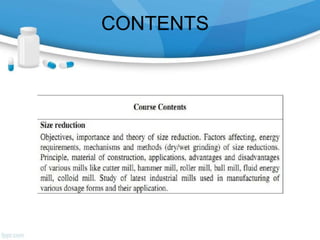
CONTENTS
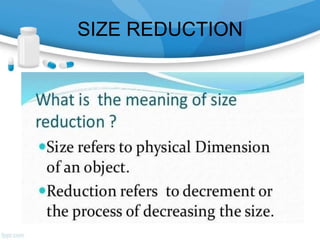
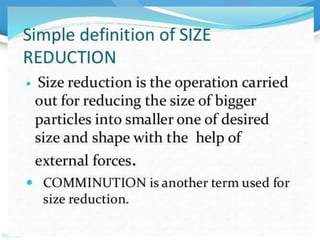
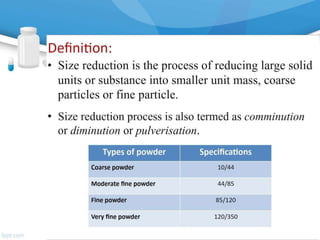
SIZE REDUCTION
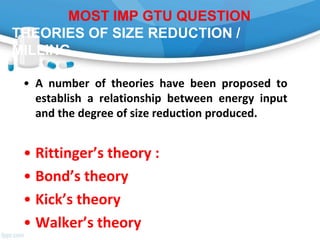
MOST IMP GTU QUESTION
THEORIES OF SIZE REDUCTION /
MILLING
• A number of theories have been proposed to
establish a relationship between energy input
and the degree of size reduction produced.
• Rittinger’s theory :
• Bond’s theory
• Kick’s theory
• Walker’s theory
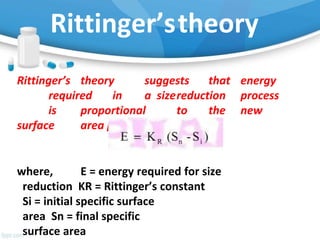
Rittinger’stheory
Rittinger’s theory suggests that energy
required in a sizereduction process
is proportional to the new
surface area produced.
where, E = energy required for size
reduction KR = Rittinger’s constant
Si = initial specific surface
area Sn = final specific
surface area
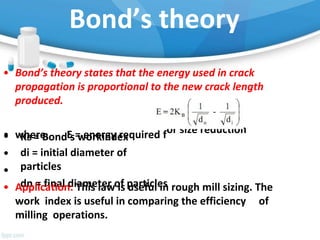
Bond’s theory
• Bond’s theory states that the energy used in crack
propagation is proportional to the new crack length
produced.
• where, E = energy required for size reduction
•
•
•
KB = Bond’s workindex
di = initial diameter of
particles
dn = final diameter of particles
• Application: This law is useful in rough mill sizing. The
work index is useful in comparing the efficiency of
milling operations.
Kick’s
theory
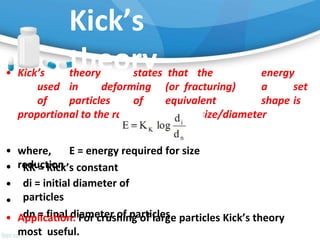
• Kick’s theory states that the energy
used in deforming (or fracturing) a set
of particles of equivalent shape is
proportional to the ratio of change of size/diameter
• where, E = energy required for size
reduction
•
•
•
KK = Kick’s constant
di = initial diameter of
particles
dn = final diameter of particles
• Application: For crushing of large particles Kick’s theory
most useful.
Walker’s
theory
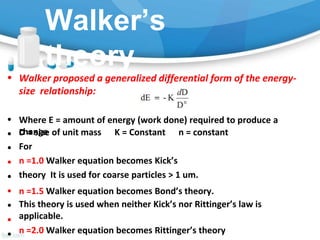
• Walker proposed a generalized differential form of the energy-
size relationship:
Where E = amount of energy (work done) required to produce a
change
D = size of unit mass K = Constant n = constant
For
•
•
•
•
•
•
•
•
•
n =1.0 Walker equation becomes Kick’s
theory It is used for coarse particles > 1 um.
n =1.5 Walker equation becomes Bond’s theory.
This theory is used when neither Kick’s nor Rittinger’s law is
applicable.
n =2.0 Walker equation becomes Rittinger’s theory
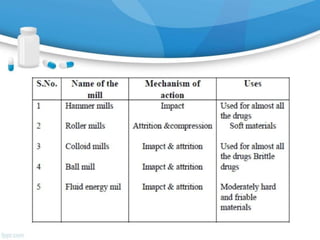
VARIOUS
EQUIPMENTS USE
IN SIZE
REDUCTION
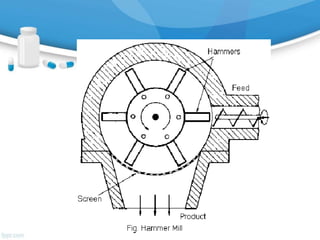
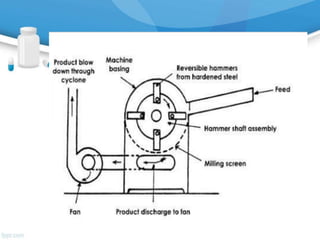
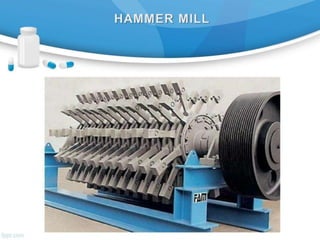
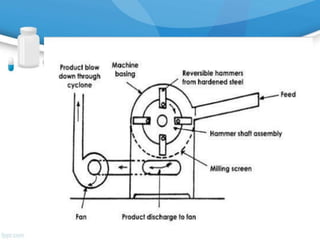
ADVANTAGES OF HAMMER
MILL
• It is rapid in action, and is capable of grinding many
different types of materials.
• They are easy to install and operate, the operation
is continuous.
• There is little contamination of the product with
metal abraded from the mill as no surface move
against each other.
• The particle size of the material to be reduced can
be easily controlled by changing the speed of the
rotor, hammer type, shape and size of the screen.
DISADVANTAGES
• Heat buildup during milling is
more, therefore, product degradation is
possible.
• Hammer mills cannot be employed
to mill sticky, fibrous and hard materials.
• The screens may get clogged. Wearing of
mill and screen is more with abrasive
materials.
BALL
MILL
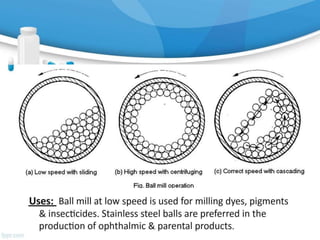
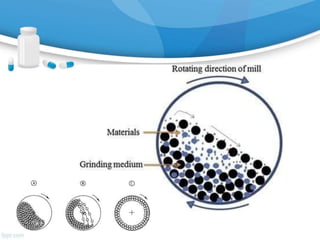
• These are also knows as tumbling mills.
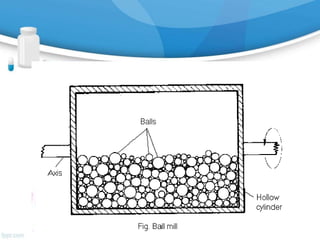
• Principle: The ball mill works on the principle of
impact between the rapidly moving balls and the
powder material, both enclosed in a hollow cylinder.
• At low speeds, the ball roll over each other and
attrition (rubbing action) will be the predominate
mode of action. Thus, in the ball mill, impact or
attrition or both are responsible for the size
reduction.
Advantages
:
• It can produce very fine powder.
• Ball mill is used for both wet and dry
grinding processes.
• Toxic substances can be ground, as the cylinder
is closed system.
• Rod or bars can also be used as grinding media.
• (example: Sticky material are size reduced) In ball
mill,
• installation, operation and labour costs are low.
Disadvantages:
• The ball mill is a very noisy machine.
• Ball mill is a slow process.
• Soft, tacky, fibrous material cannot be
milled by ball mill.
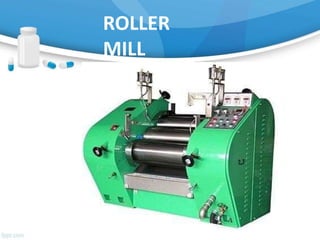
ROLLER
MILL
ROLLER
MILL
ROLLER
MILL
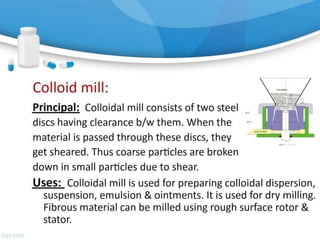
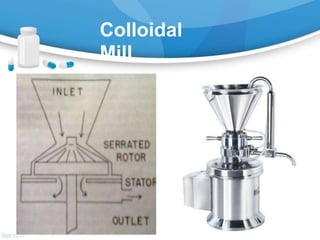
Colloidal
Mill
Size reduction.pptx
Size reduction.pptx
Size reduction.pptx

Size reduction.pptx

  • 1.
  • 2.
  • 3.
  • 24.
    MOST IMP GTUQUESTION THEORIES OF SIZE REDUCTION / MILLING • A number of theories have been proposed to establish a relationship between energy input and the degree of size reduction produced. • Rittinger’s theory : • Bond’s theory • Kick’s theory • Walker’s theory
  • 25.
    Rittinger’stheory Rittinger’s theory suggeststhat energy required in a sizereduction process is proportional to the new surface area produced. where, E = energy required for size reduction KR = Rittinger’s constant Si = initial specific surface area Sn = final specific surface area
  • 26.
    Bond’s theory • Bond’stheory states that the energy used in crack propagation is proportional to the new crack length produced. • where, E = energy required for size reduction • • • KB = Bond’s workindex di = initial diameter of particles dn = final diameter of particles • Application: This law is useful in rough mill sizing. The work index is useful in comparing the efficiency of milling operations.
  • 27.
    Kick’s theory • Kick’s theorystates that the energy used in deforming (or fracturing) a set of particles of equivalent shape is proportional to the ratio of change of size/diameter • where, E = energy required for size reduction • • • KK = Kick’s constant di = initial diameter of particles dn = final diameter of particles • Application: For crushing of large particles Kick’s theory most useful.
  • 28.
    Walker’s theory • Walker proposeda generalized differential form of the energy- size relationship: Where E = amount of energy (work done) required to produce a change D = size of unit mass K = Constant n = constant For • • • • • • • • • n =1.0 Walker equation becomes Kick’s theory It is used for coarse particles > 1 um. n =1.5 Walker equation becomes Bond’s theory. This theory is used when neither Kick’s nor Rittinger’s law is applicable. n =2.0 Walker equation becomes Rittinger’s theory
  • 29.
  • 35.
    ADVANTAGES OF HAMMER MILL •It is rapid in action, and is capable of grinding many different types of materials. • They are easy to install and operate, the operation is continuous. • There is little contamination of the product with metal abraded from the mill as no surface move against each other. • The particle size of the material to be reduced can be easily controlled by changing the speed of the rotor, hammer type, shape and size of the screen.
  • 36.
    DISADVANTAGES • Heat buildupduring milling is more, therefore, product degradation is possible. • Hammer mills cannot be employed to mill sticky, fibrous and hard materials. • The screens may get clogged. Wearing of mill and screen is more with abrasive materials.
  • 37.
    BALL MILL • These arealso knows as tumbling mills. • Principle: The ball mill works on the principle of impact between the rapidly moving balls and the powder material, both enclosed in a hollow cylinder. • At low speeds, the ball roll over each other and attrition (rubbing action) will be the predominate mode of action. Thus, in the ball mill, impact or attrition or both are responsible for the size reduction.
  • 41.
    Advantages : • It canproduce very fine powder. • Ball mill is used for both wet and dry grinding processes. • Toxic substances can be ground, as the cylinder is closed system. • Rod or bars can also be used as grinding media. • (example: Sticky material are size reduced) In ball mill, • installation, operation and labour costs are low.
  • 42.
    Disadvantages: • The ballmill is a very noisy machine. • Ball mill is a slow process. • Soft, tacky, fibrous material cannot be milled by ball mill.
  • 48.
  • 49.
  • 50.
  • 52.