SIRIM QAS International Sdn Bhd
TESTING AND CERTIFICATION ON
ELECTRICAL CABLE TESTING
28th Aug 2018
Presentation Outline
1. Introduction
2. Our roles & services
3. Procedure & standard requirement for electrical cable testing
4. Product Certification Scheme
Presentation Outline
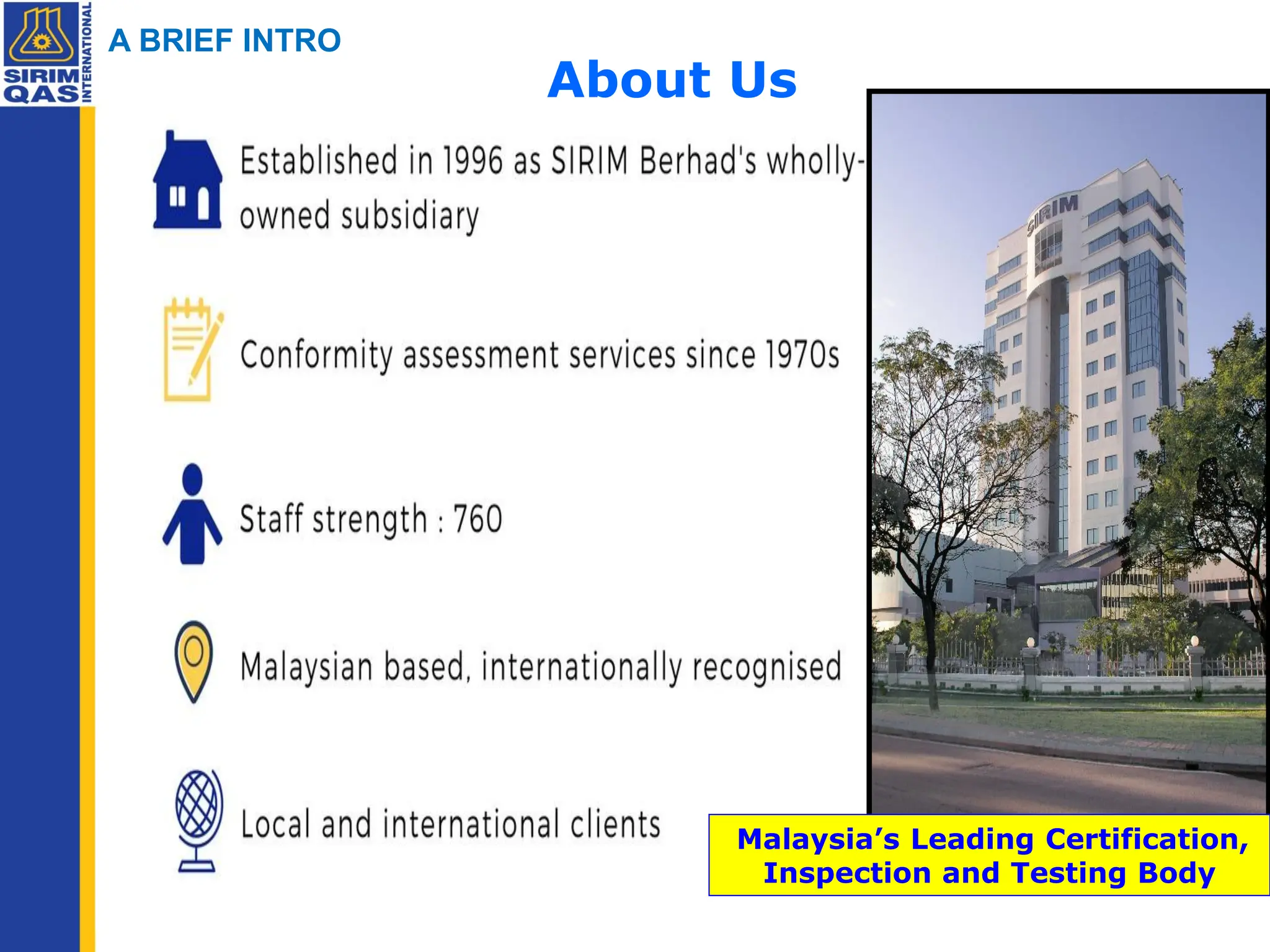
A BRIEF INTRO
About Us
Malaysia’s Leading Certification,
Inspection and Testing Body
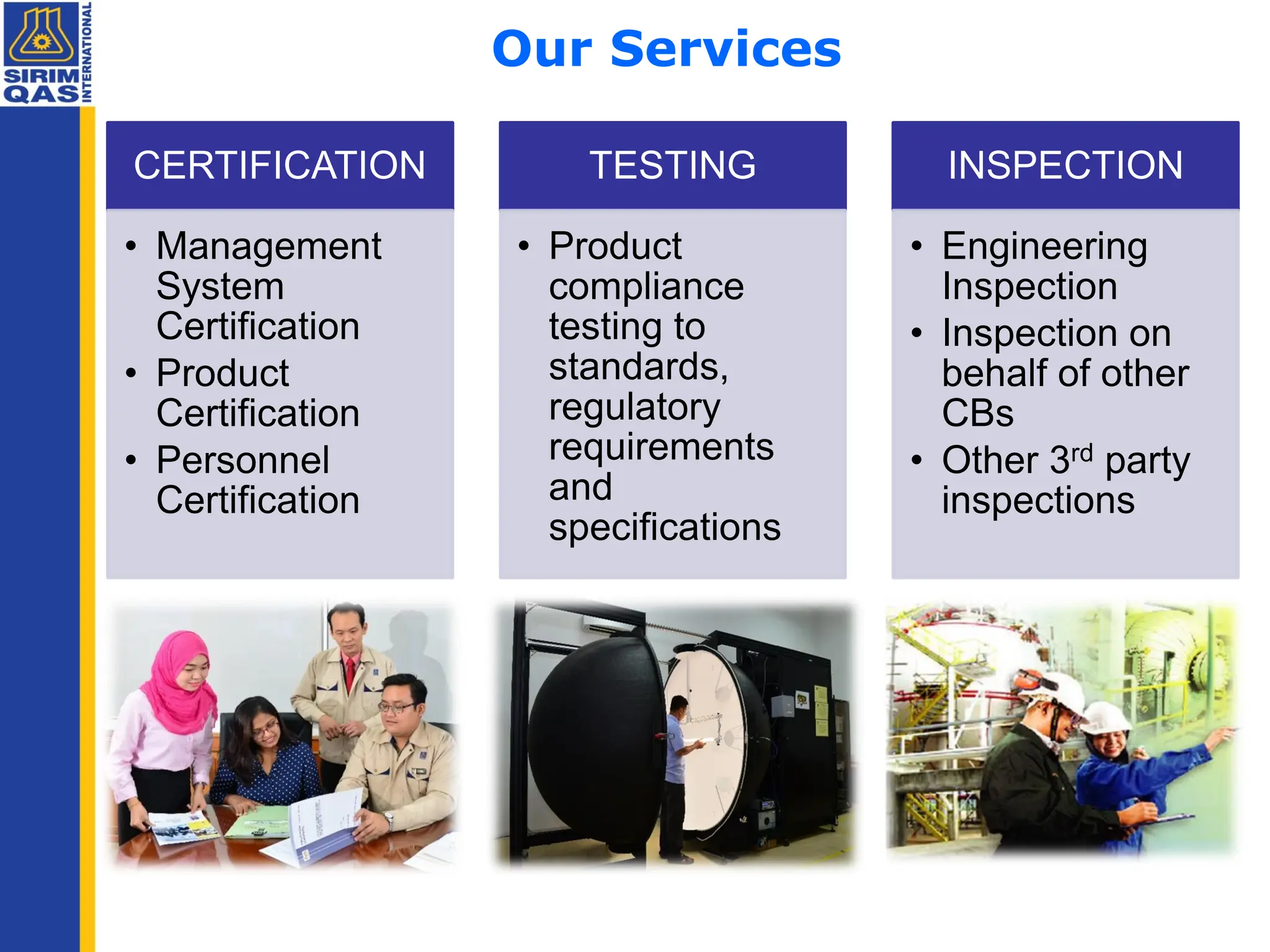
Our Services
CERTIFICATION
• Management
System
Certification
• Product
Certification
• Personnel
Certification
TESTING
• Product
compliance
testing to
standards,
regulatory
requirements
and
specifications
INSPECTION
• Engineering
Inspection
• Inspection on
behalf of other
CBs
• Other 3rd party
inspections
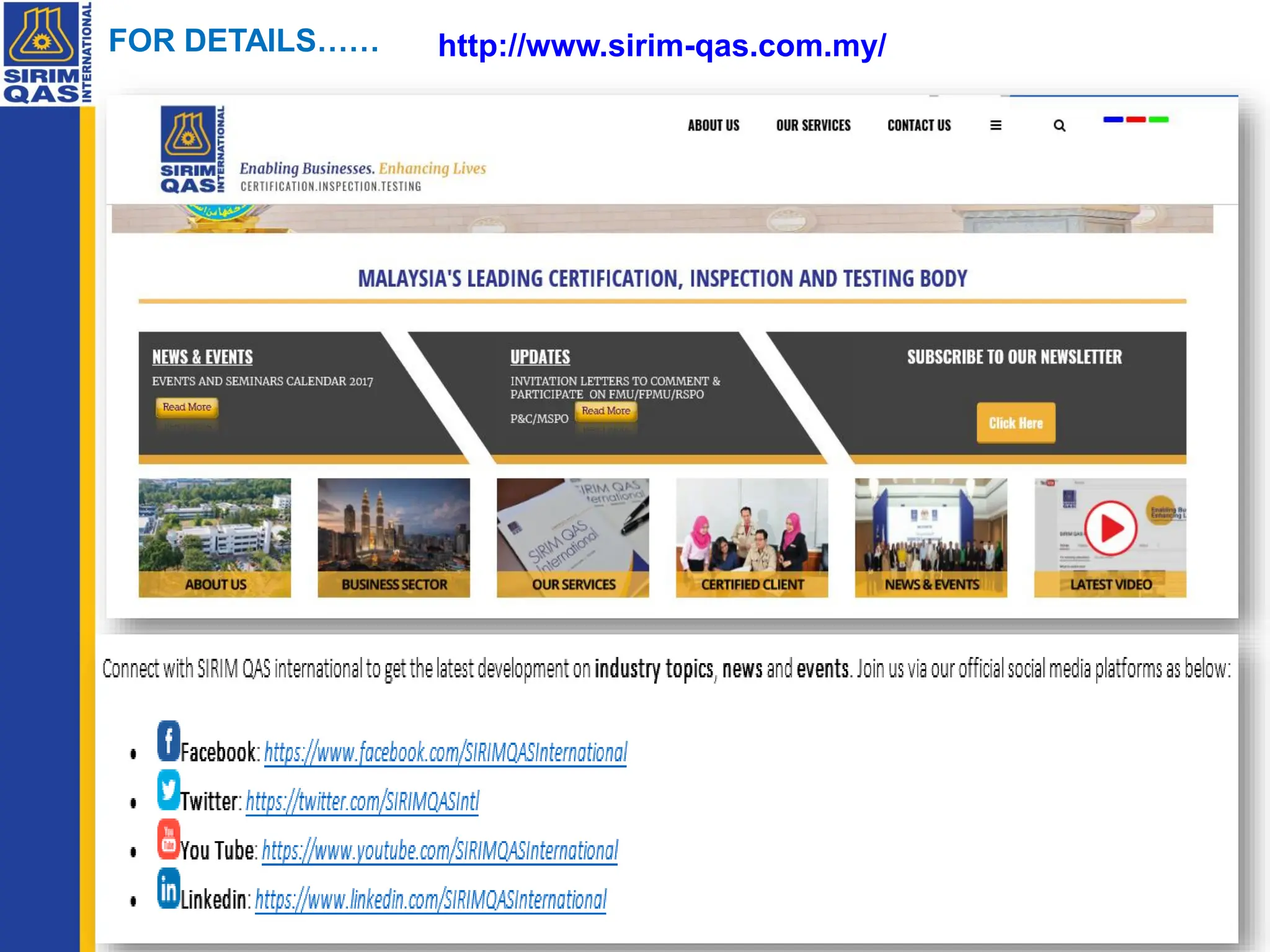
http://www.sirim-qas.com.my/
FOR DETAILS……
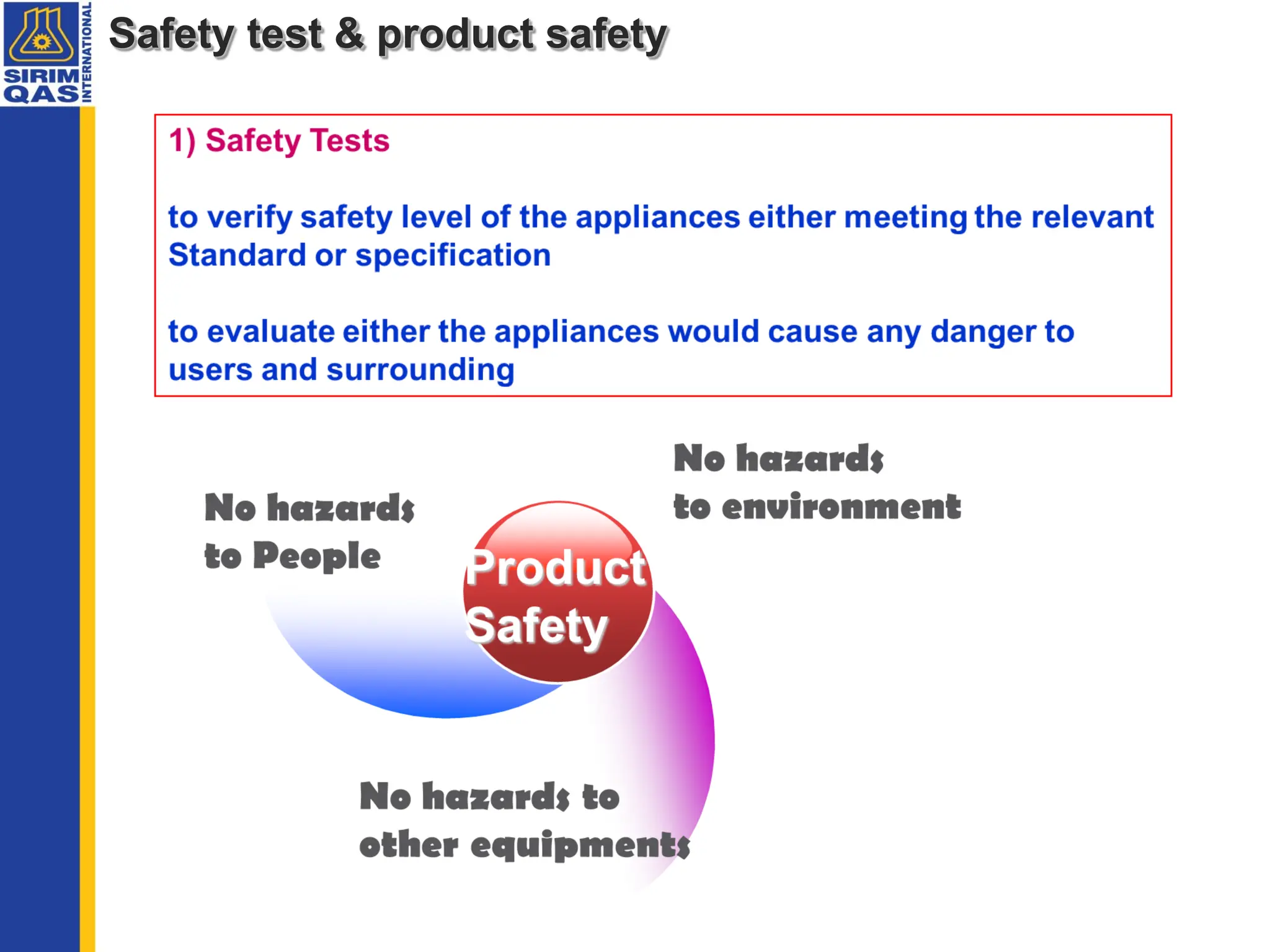
Safety test & product safety
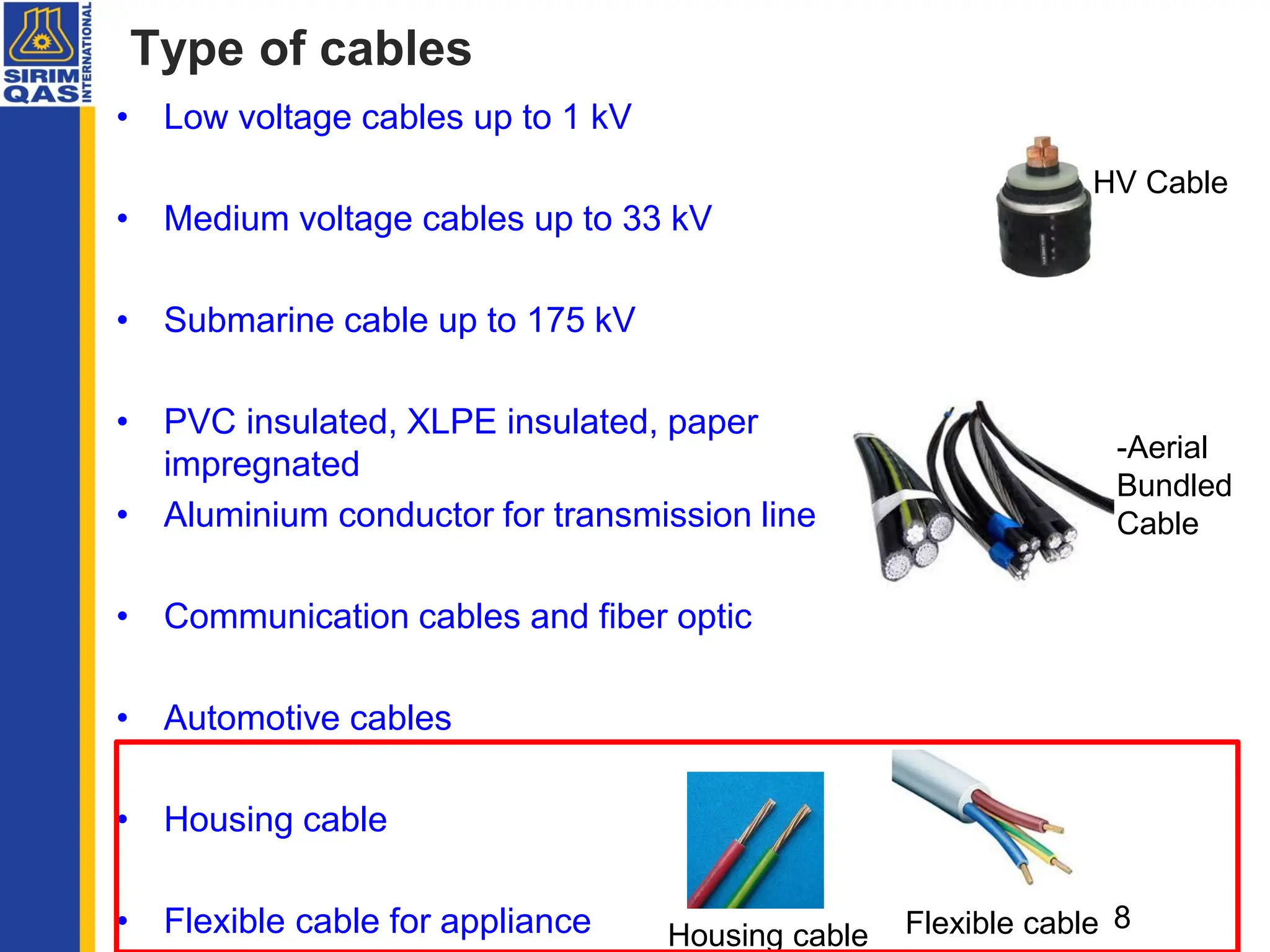
Type of cables
• Low voltage cables up to 1 kV
• Medium voltage cables up to 33 kV
• Submarine cable up to 175 kV
• PVC insulated, XLPE insulated, paper
impregnated
• Aluminium conductor for transmission line
• Communication cables and fiber optic
• Automotive cables
• Housing cable
• Flexible cable for appliance 8
HV Cable
-Aerial
Bundled
Cable
Flexible cable
Housing cable
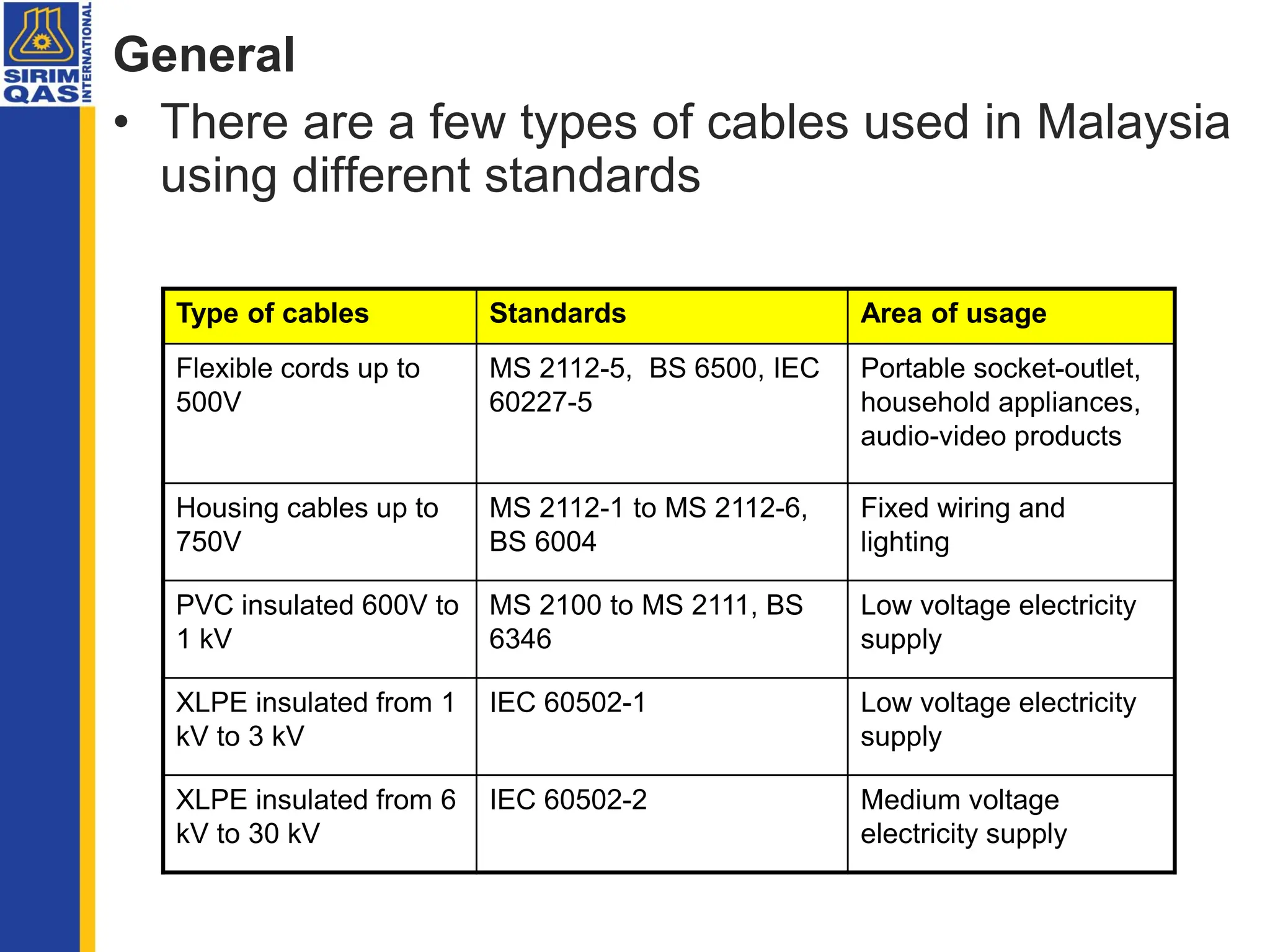
General
Type of cables Standards Area of usage
Flexible cords up to
500V
MS 2112-5, BS 6500, IEC
60227-5
Portable socket-outlet,
household appliances,
audio-video products
Housing cables up to
750V
MS 2112-1 to MS 2112-6,
BS 6004
Fixed wiring and
lighting
PVC insulated 600V to
1 kV
MS 2100 to MS 2111, BS
6346
Low voltage electricity
supply
XLPE insulated from 1
kV to 3 kV
IEC 60502-1 Low voltage electricity
supply
XLPE insulated from 6
kV to 30 kV
IEC 60502-2 Medium voltage
electricity supply
• There are a few types of cables used in Malaysia
using different standards
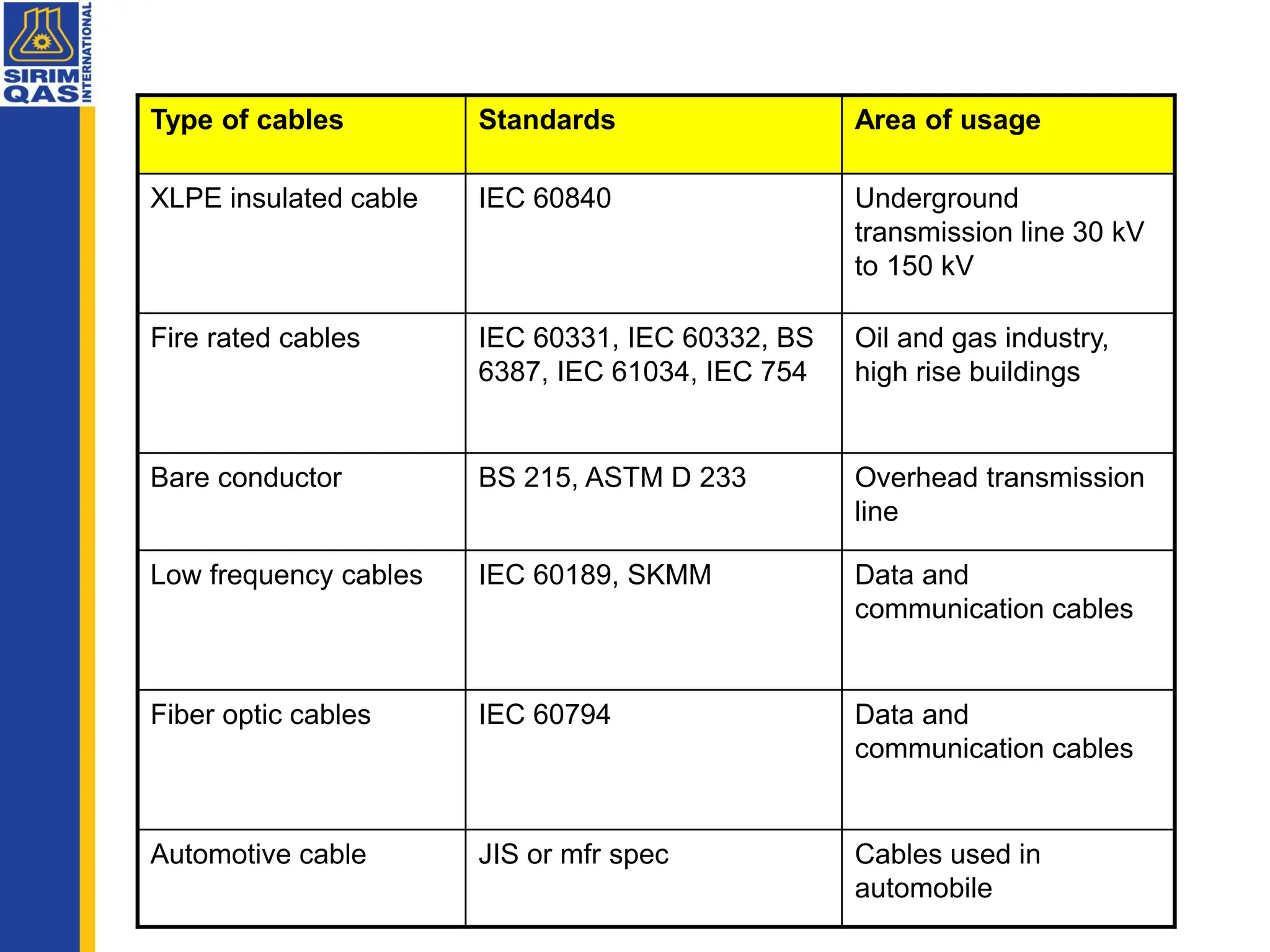
Type of cables Standards Area of usage
XLPE insulated cable IEC 60840 Underground
transmission line 30 kV
to 150 kV
Fire rated cables IEC 60331, IEC 60332, BS
6387, IEC 61034, IEC 754
Oil and gas industry,
high rise buildings
Bare conductor BS 215, ASTM D 233 Overhead transmission
line
Low frequency cables IEC 60189, SKMM Data and
communication cables
Fiber optic cables IEC 60794 Data and
communication cables
Automotive cable JIS or mfr spec Cables used in
automobile
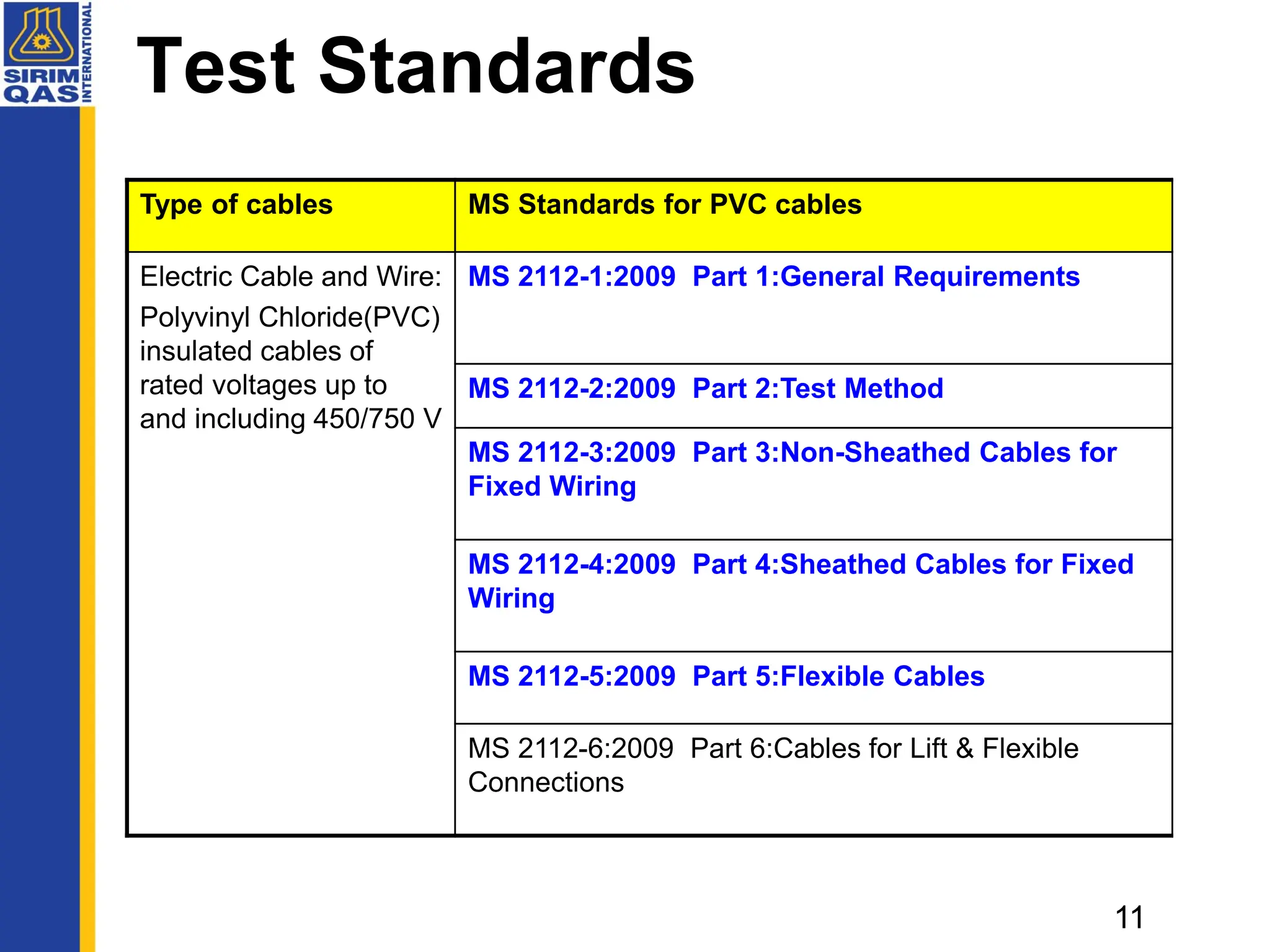
Test Standards
11
Type of cables MS Standards for PVC cables
Electric Cable and Wire:
Polyvinyl Chloride(PVC)
insulated cables of
rated voltages up to
and including 450/750 V
MS 2112-1:2009 Part 1:General Requirements
MS 2112-2:2009 Part 2:Test Method
MS 2112-3:2009 Part 3:Non-Sheathed Cables for
Fixed Wiring
MS 2112-4:2009 Part 4:Sheathed Cables for Fixed
Wiring
MS 2112-5:2009 Part 5:Flexible Cables
MS 2112-6:2009 Part 6:Cables for Lift & Flexible
Connections
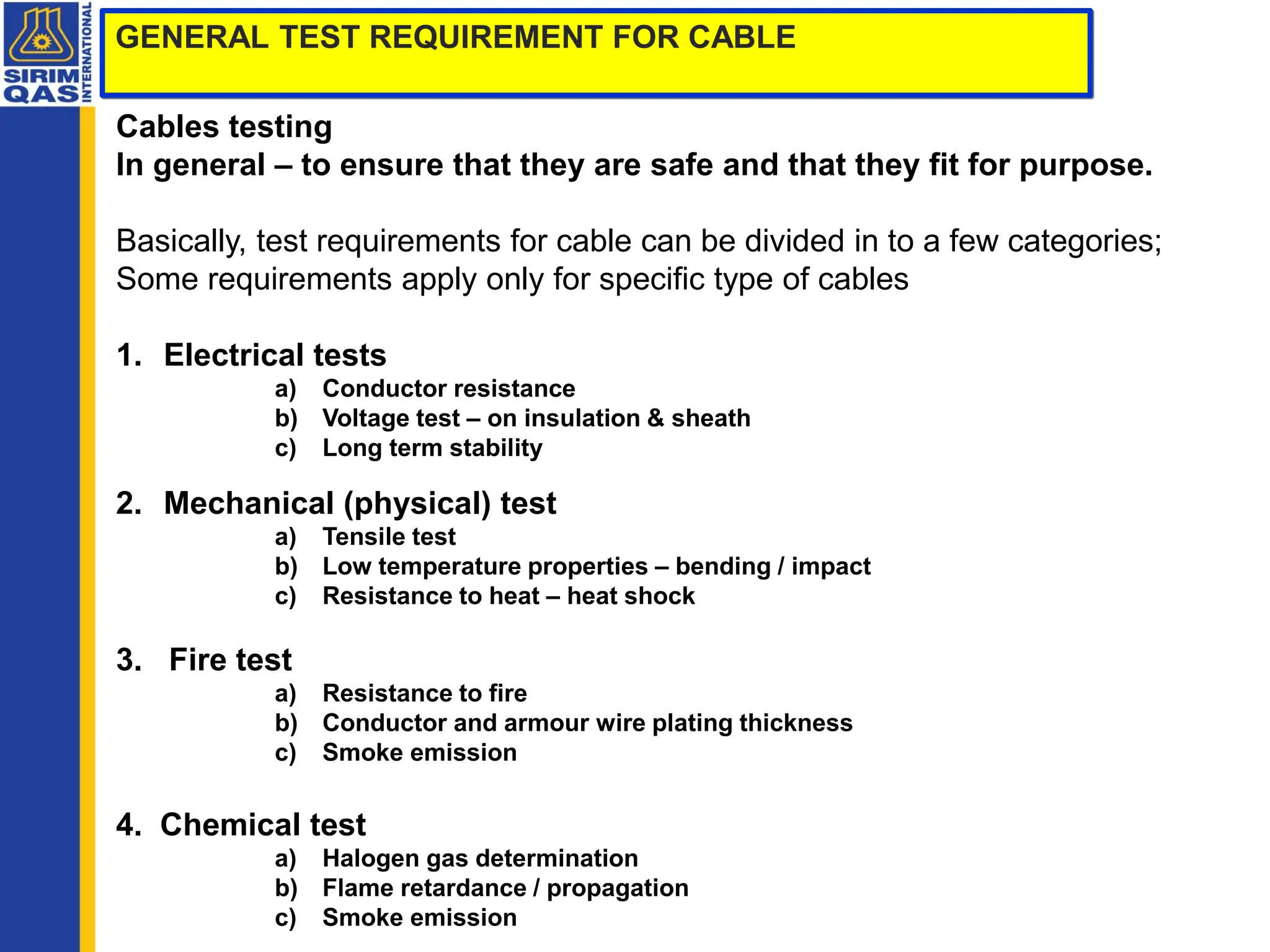
GENERAL TEST REQUIREMENT FOR CABLE
Cables testing
In general – to ensure that they are safe and that they fit for purpose.
Basically, test requirements for cable can be divided in to a few categories;
Some requirements apply only for specific type of cables
1. Electrical tests
a) Conductor resistance
b) Voltage test – on insulation & sheath
c) Long term stability
2. Mechanical (physical) test
a) Tensile test
b) Low temperature properties – bending / impact
c) Resistance to heat – heat shock
3. Fire test
a) Resistance to fire
b) Conductor and armour wire plating thickness
c) Smoke emission
4. Chemical test
a) Halogen gas determination
b) Flame retardance / propagation
c) Smoke emission
GENERAL TEST REQUIREMENT FOR CABLE (LV)
1. ELECTRICAL TESTS
a) Resistance of conductors
b) High Voltage at 1000V / 1500V / 2500V
c) Insulation Resistance at 70°C
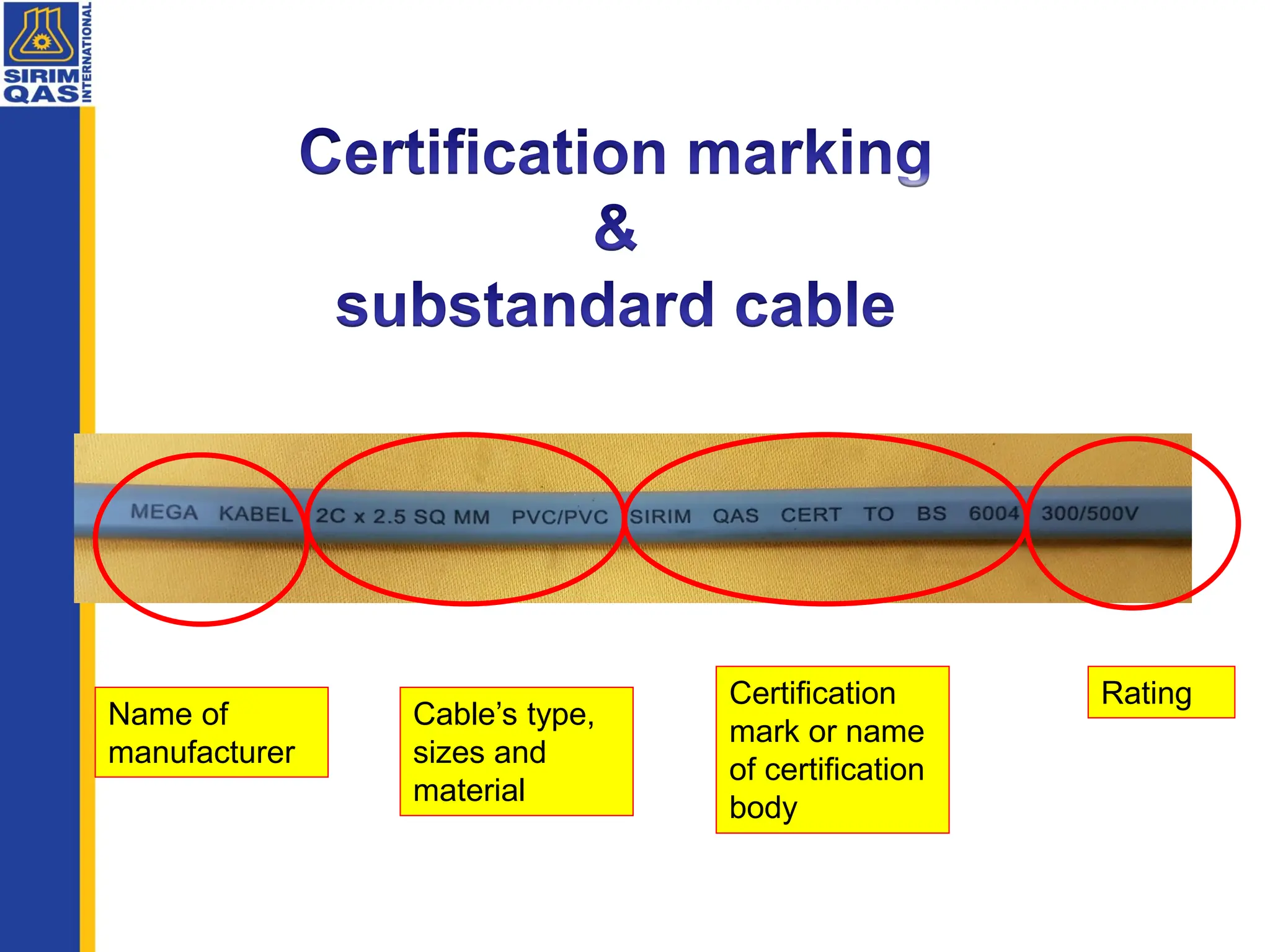
Name of
manufacturer
Cable’s type,
sizes and
material
Certification
mark or name
of certification
body
Rating
Sub-Standard Cables
• Cables which are not designed, constructed, test approved,
installed or used in accordance their prescribed safety
standards and specifications.
• Identity /Characteristics of a substandard cable;
1. Undersized
a) conductor construction not in accordance to prescribed
standards on dimensions such as;
» size & number of wires,
» thickness
» Length
b) conductor does not meet the minimum cross-sectional
area as determined by its specific resistance.
c) reduced size of copper resistance
2. Mixed content
Instead of pure copper – ‘they’ use mixed content or other
metal
Sub-Standard Cables
3. Reduced in insulation properties
a) insulation & protective layers construction not in
accordance to prescribed standards on size, thickness or
dimensions
b) Insulation & protective layers type does not meet the
required mechanical properties for long term ageing and
environmental tests
4. No identification / certification marking
Completed cables are not identified by markings as
stipulated by the standards.
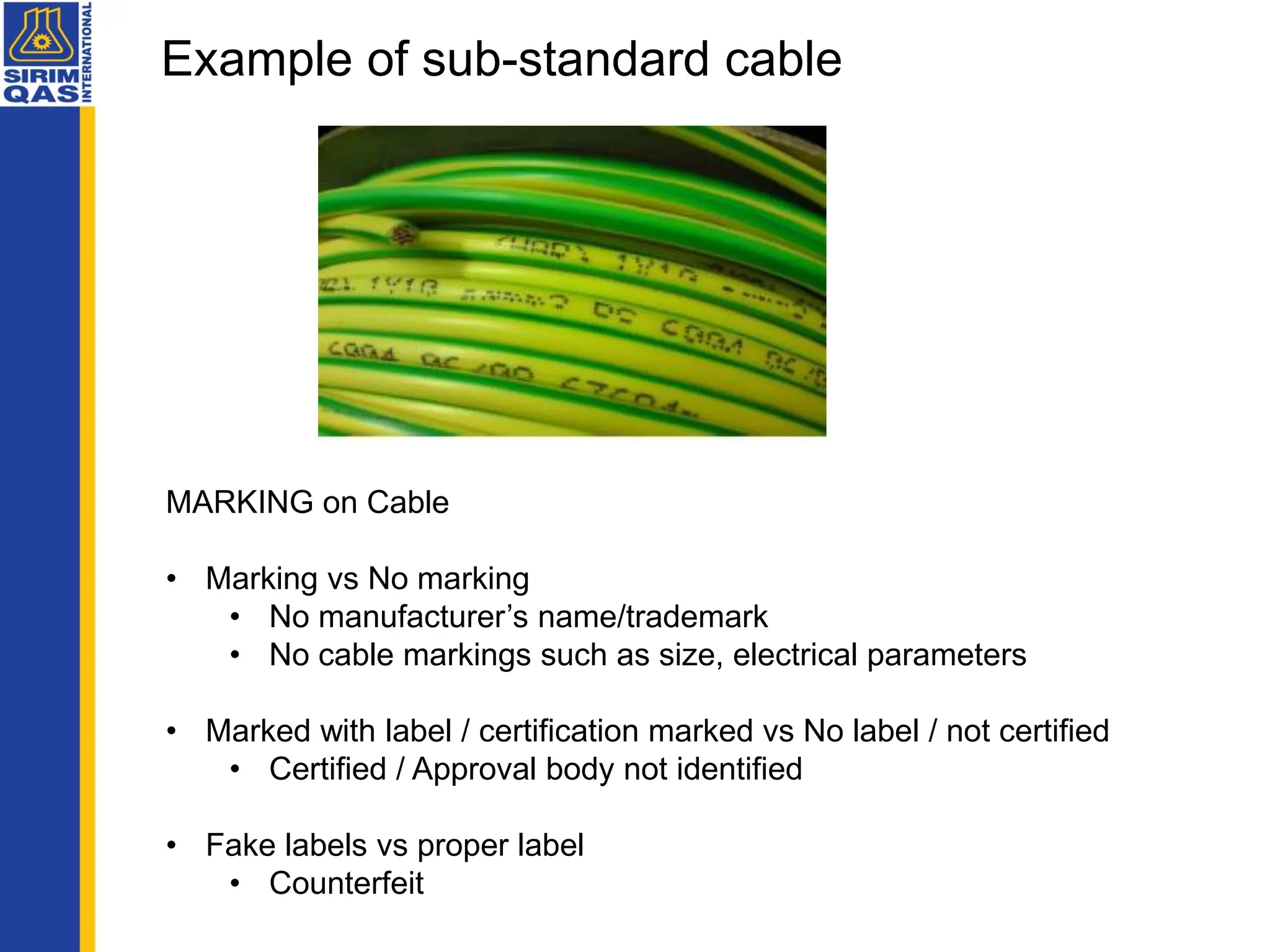
Example of sub-standard cable
MARKING on Cable
• Marking vs No marking
• No manufacturer’s name/trademark
• No cable markings such as size, electrical parameters
• Marked with label / certification marked vs No label / not certified
• Certified / Approval body not identified
• Fake labels vs proper label
• Counterfeit
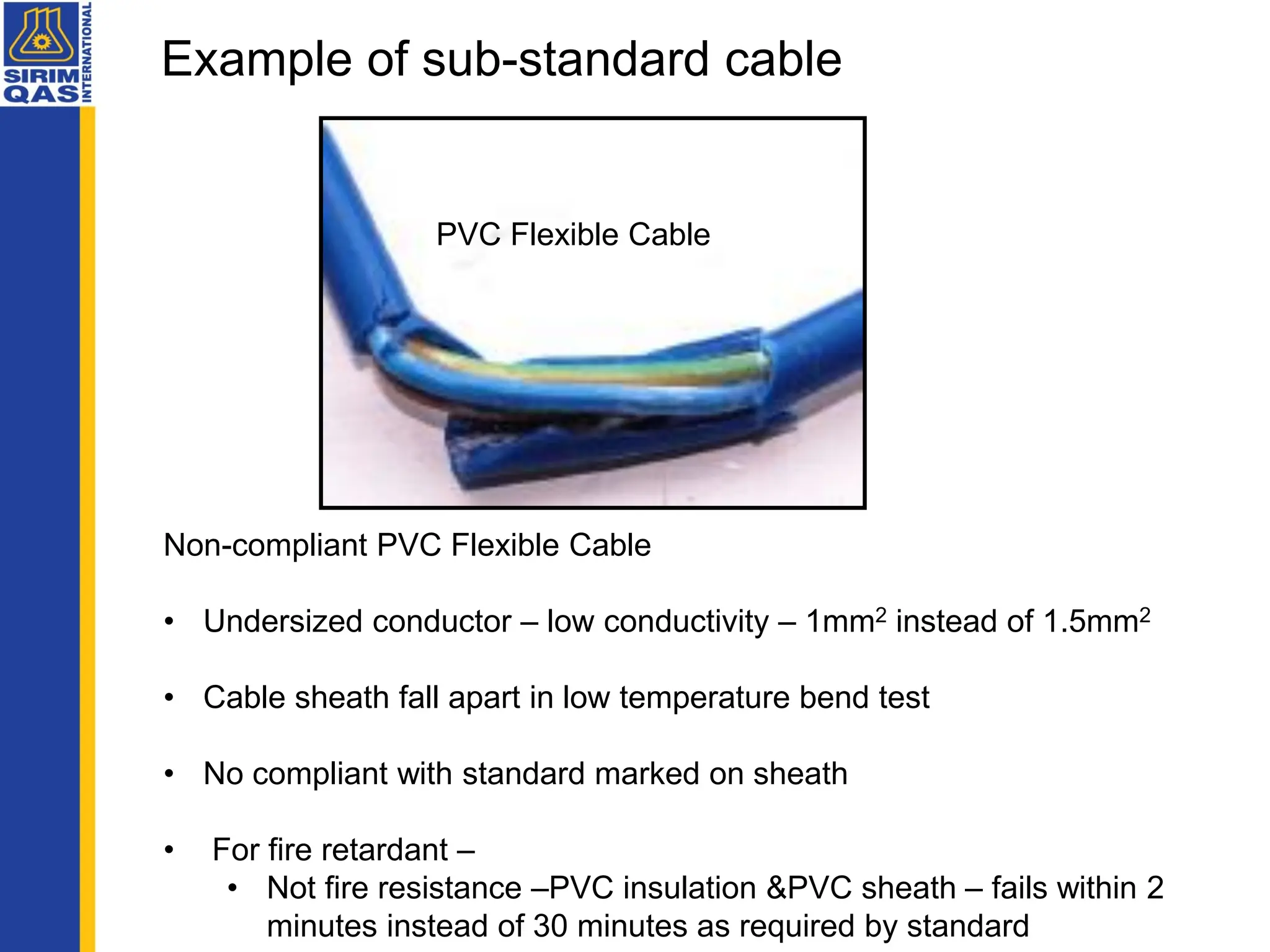
Non-compliant PVC Flexible Cable
• Undersized conductor – low conductivity – 1mm2 instead of 1.5mm2
• Cable sheath fall apart in low temperature bend test
• No compliant with standard marked on sheath
• For fire retardant –
• Not fire resistance –PVC insulation &PVC sheath – fails within 2
minutes instead of 30 minutes as required by standard
PVC Flexible Cable
Example of sub-standard cable
How to identify a sub-standard cable
1) Check and verify MARKINGS on Cable
– shall be as per standard requirement
2) Check and verify APPROVAL / CERTIFICATION Mark/Label
3) Measure conductor resistance ( need to have a proper meter)
4) Measure size(s)
• conductor
• each strand ( and no of strands)
5) Check and verify copper content
• normally by conductor resistance
• weight the sample
• Sometimes –by weighing the sample, with some
experience, we can identify if the samples /
weight of sample due to copper content or
sheath of insulation
SIRIM will always playing it’s roles in providing assistance to industry
& regulator in fighting issue of sub standard cable
How can we do that?–
a) through compliance testing
b) through our product certification scheme
c) through SIRIM’s market surveillance activities
d) by carrying out verification testing on samples picked up from
market - through enforcement & market surveillance –by
Suruhanjaya Tenaga
e) by providing a support to ST & MCMA initiatives to raise the
issue of sub-standard cable to the widest audience possible
How can SIRIM assist?
Problems / Challenges
• The ability to buy cable from anywhere in the world means there
remains a need for better market surveillance as some imported
cable – of which are not in compliance with standard requirement
• Contractors have little interest in standards while some distributors
encourage the manufacturer of `undersized cable’
• Inferior cable product is sold unmarked - making it untraceable and
misuse of trade marks is common place
• No follow-up market surveillance (though is essential) to ensure
future compliance.
CONCLUSION
• We all want safer cables and this can only be achieved with;
– acceptance of the problem,
– better monitoring and enforcement at every level of the supply
chain
Moving forward
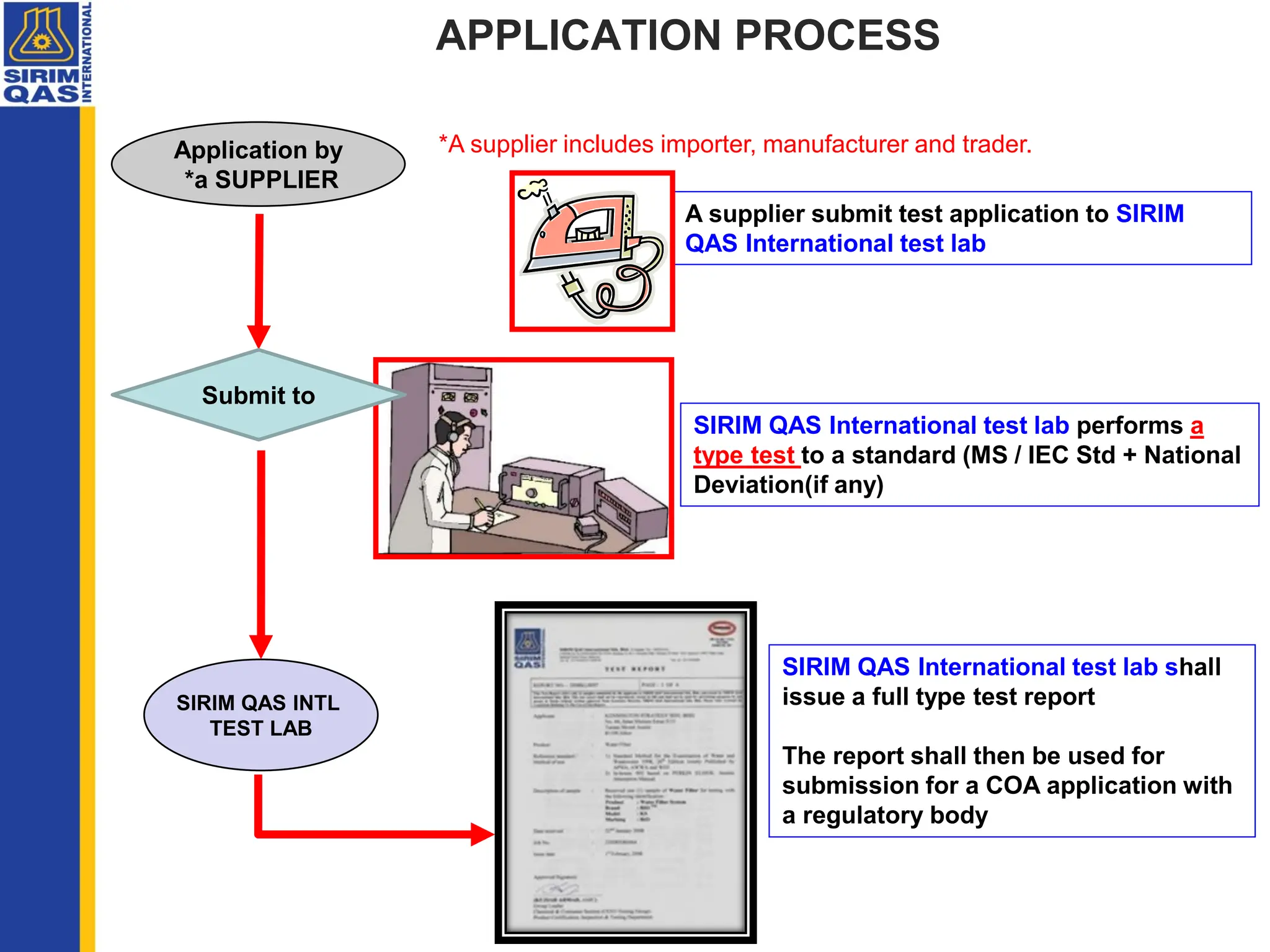
APPLICATION PROCESS
Application by
*a SUPPLIER
A supplier submit test application to SIRIM
QAS International test lab
SIRIM QAS INTL
TEST LAB
SIRIM QAS International test lab performs a
type test to a standard (MS / IEC Std + National
Deviation(if any)
Submit to
SIRIM QAS International test lab shall
issue a full type test report
The report shall then be used for
submission for a COA application with
a regulatory body
*A supplier includes importer, manufacturer and trader.
PRODUCT
CERTIFICATION
SCHEME
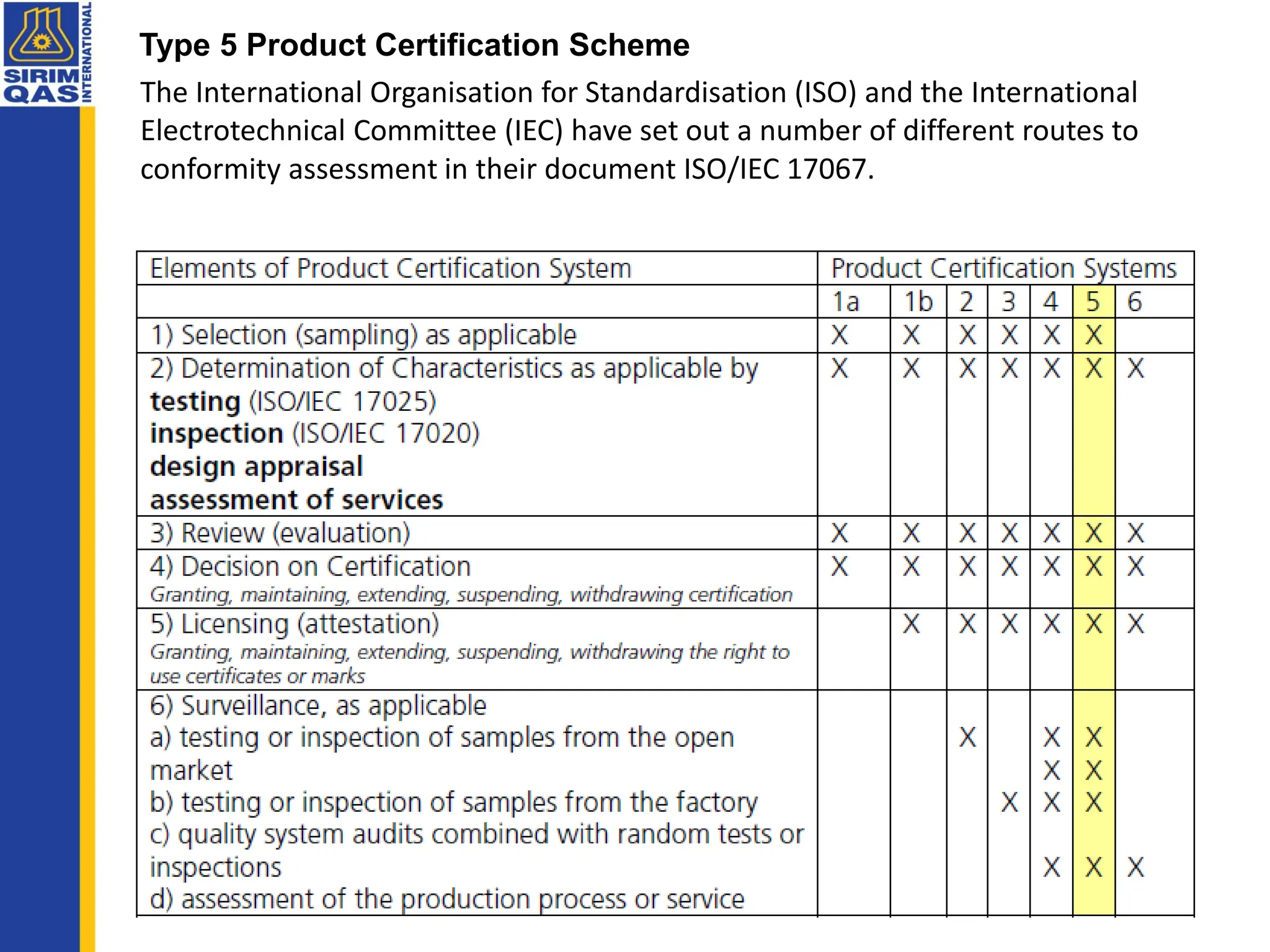
The International Organisation for Standardisation (ISO) and the International
Electrotechnical Committee (IEC) have set out a number of different routes to
conformity assessment in their document ISO/IEC 17067.
Type 5 Product Certification Scheme
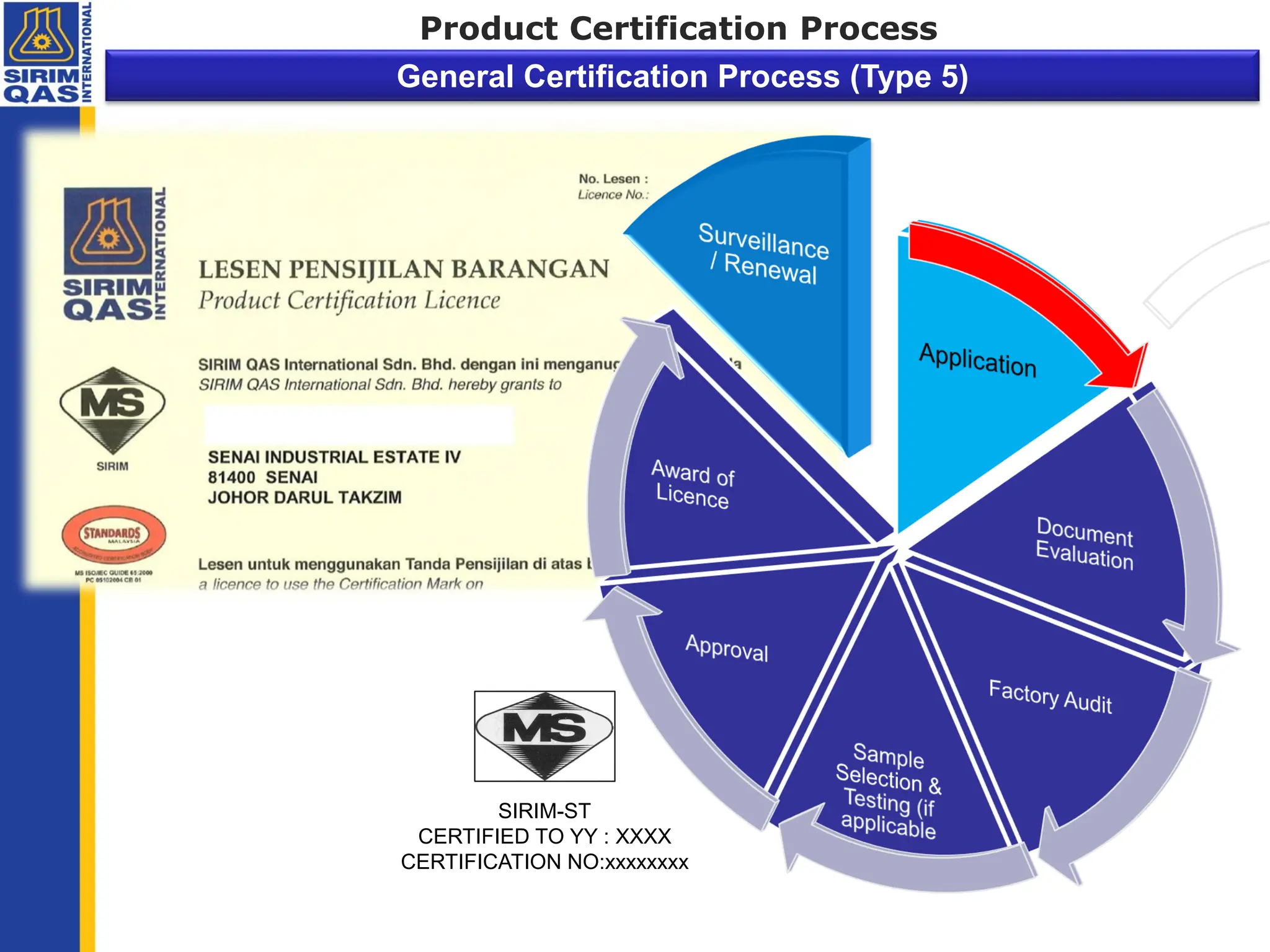
Product Certification Process
General Certification Process (Type 5)
SIRIM-ST
CERTIFIED TO YY : XXXX
CERTIFICATION NO:xxxxxxxx
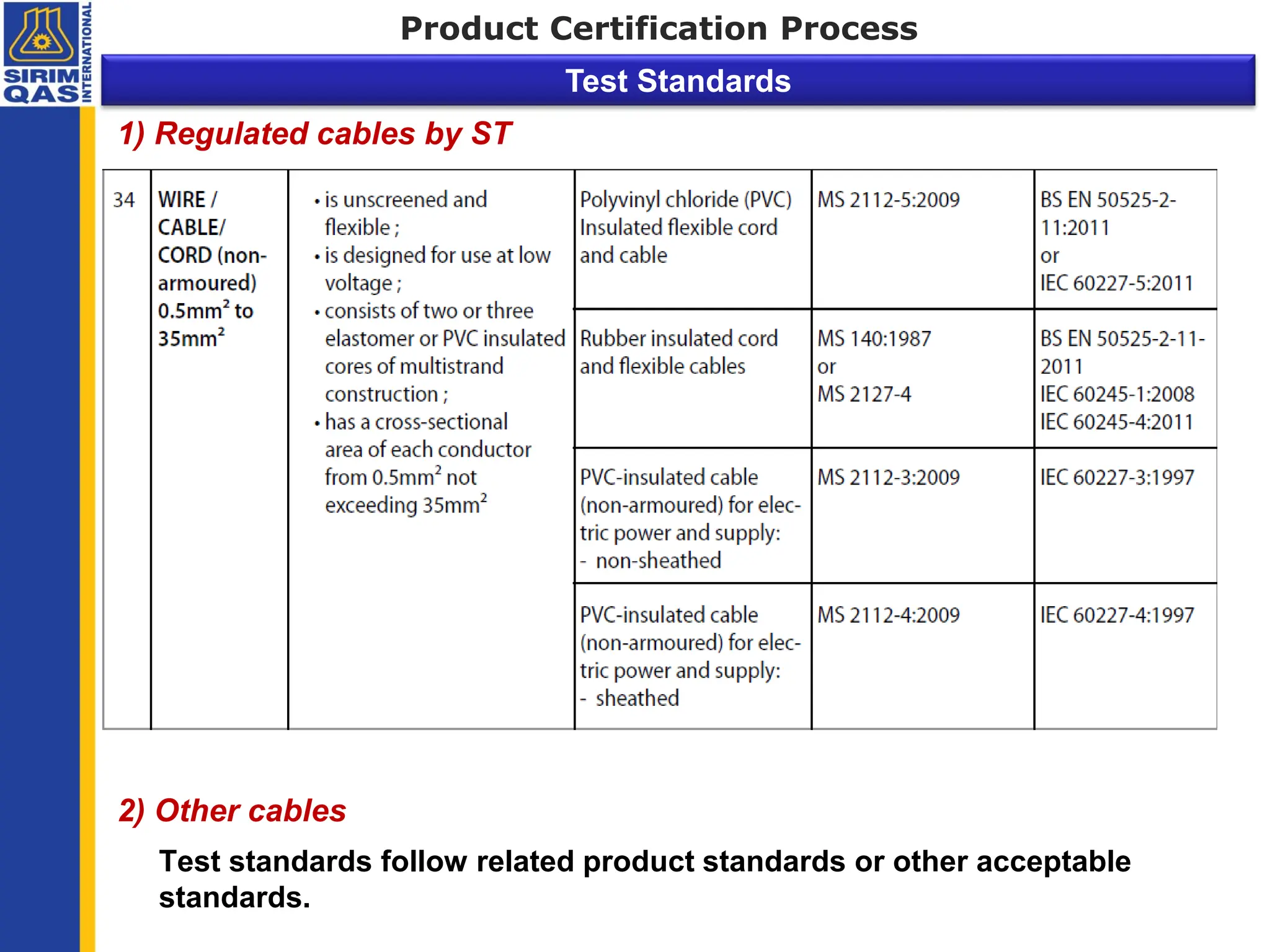
1) Regulated cables by ST
2) Other cables
Test standards follow related product standards or other acceptable
standards.
Product Certification Process
Test Standards
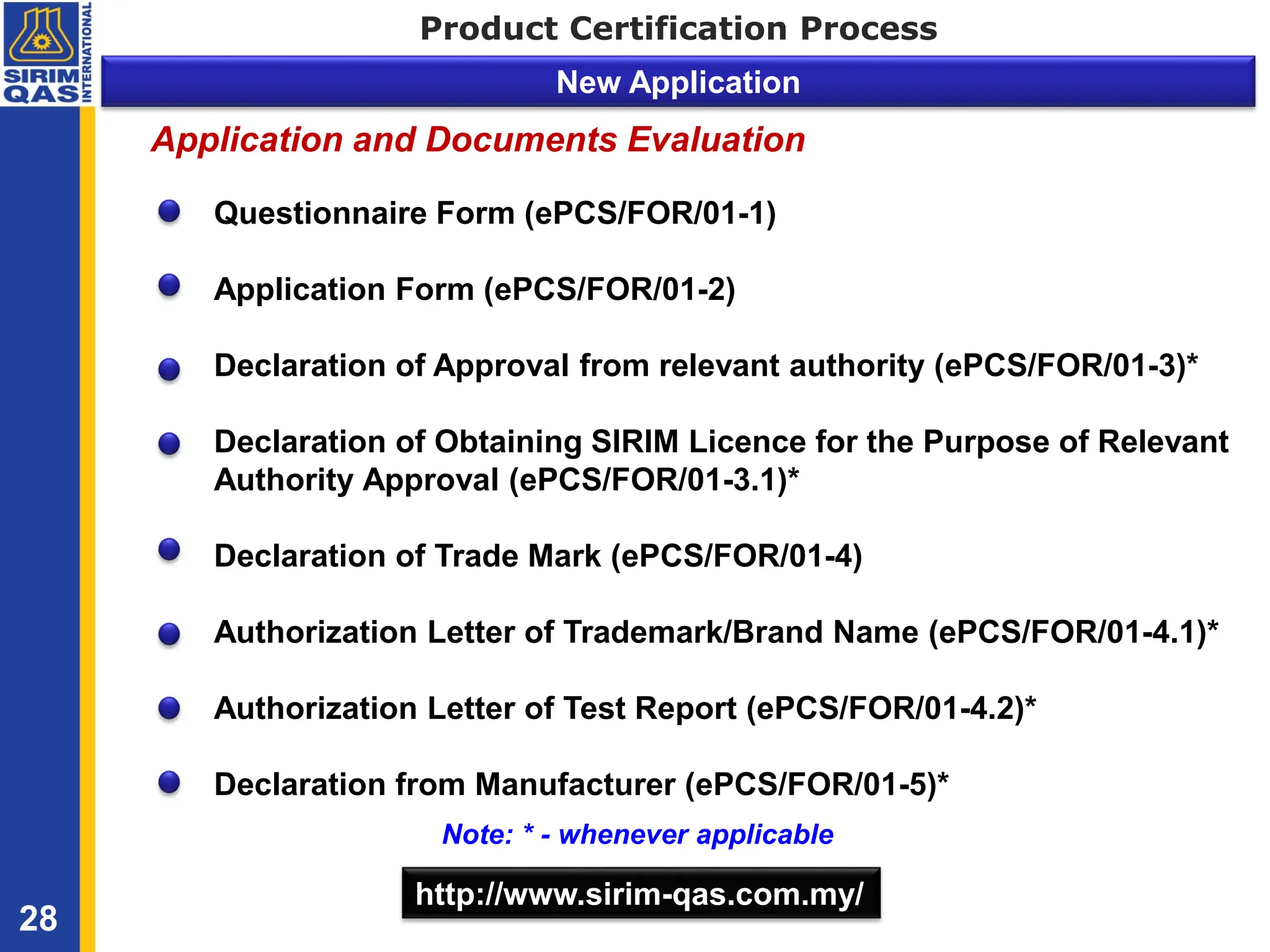
Product Certification Process
New Application
Questionnaire Form (ePCS/FOR/01-1)
Application Form (ePCS/FOR/01-2)
Declaration of Approval from relevant authority (ePCS/FOR/01-3)*
Declaration of Obtaining SIRIM Licence for the Purpose of Relevant
Authority Approval (ePCS/FOR/01-3.1)*
Declaration of Trade Mark (ePCS/FOR/01-4)
Authorization Letter of Trademark/Brand Name (ePCS/FOR/01-4.1)*
Authorization Letter of Test Report (ePCS/FOR/01-4.2)*
Declaration from Manufacturer (ePCS/FOR/01-5)*
http://www.sirim-qas.com.my/
28
Note: * - whenever applicable
Application and Documents Evaluation
Product Certification Process
New Application
29
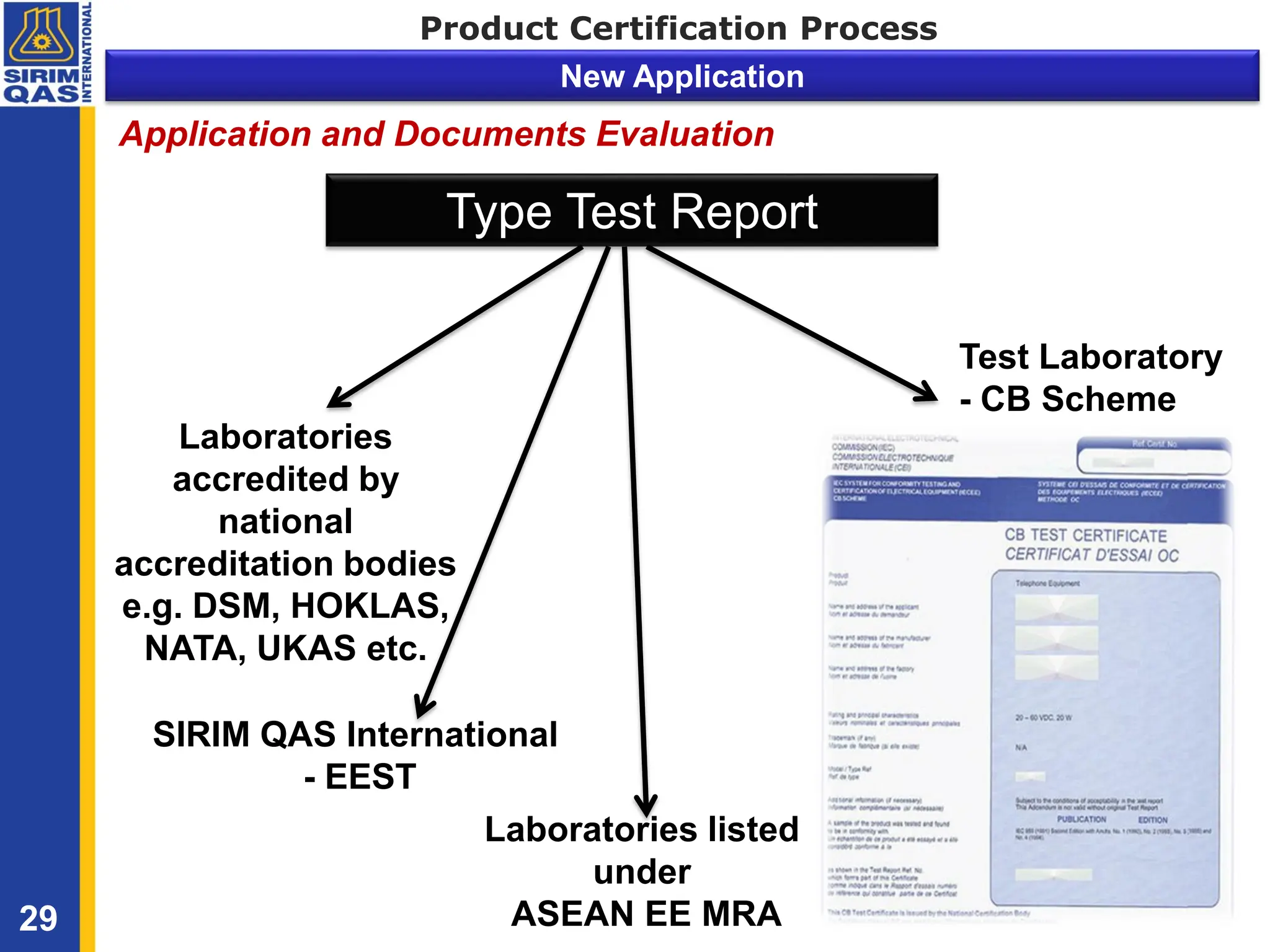
Type Test Report
Laboratories
accredited by
national
accreditation bodies
e.g. DSM, HOKLAS,
NATA, UKAS etc.
Test Laboratory
- CB Scheme
SIRIM QAS International
- EEST
Application and Documents Evaluation
Laboratories listed
under
ASEAN EE MRA
Product Certification Process
New Application
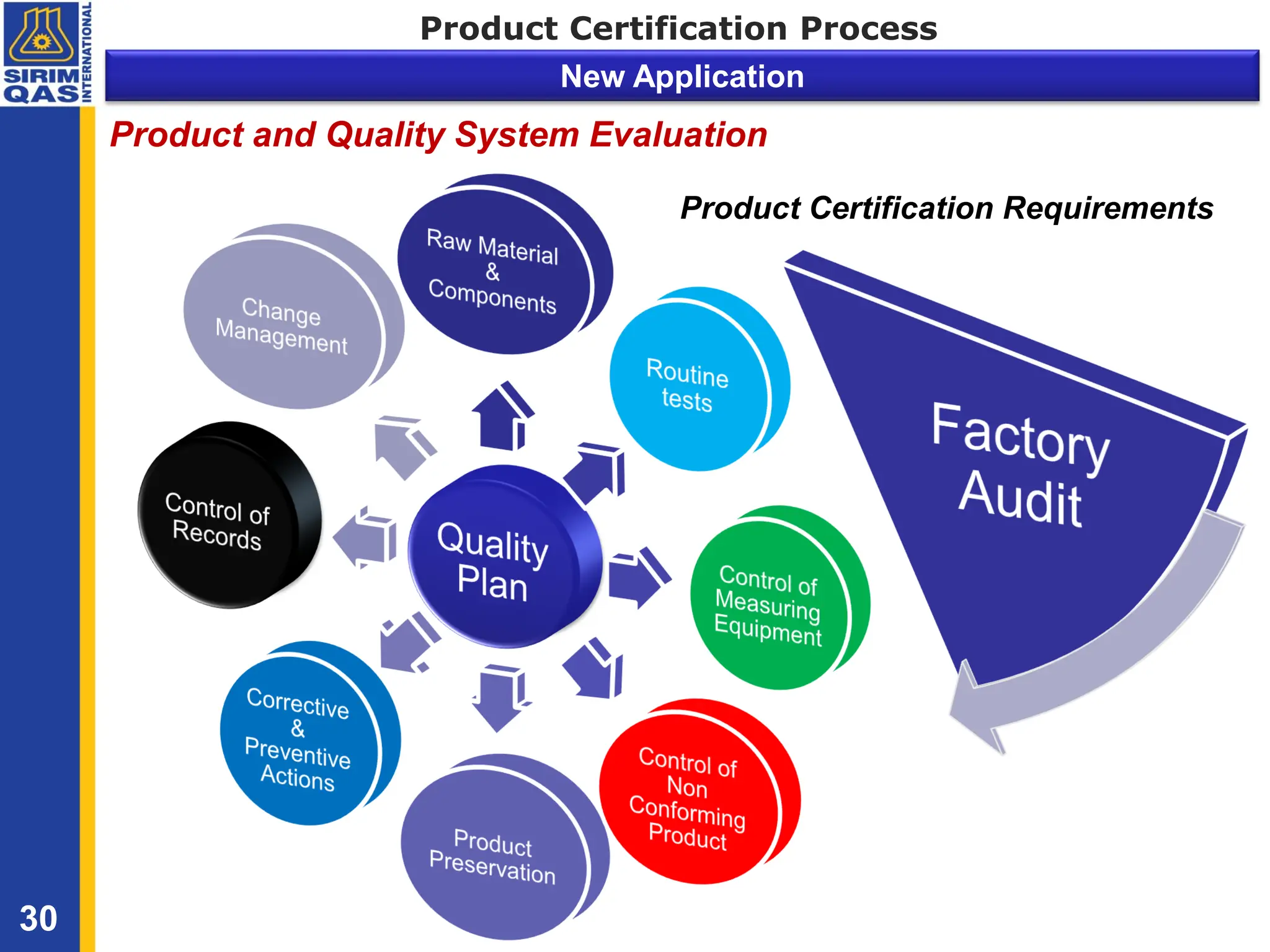
Product Certification Requirements
30
Product and Quality System Evaluation
Product Certification Process
Critical Components and Raw Materials
31
New Application
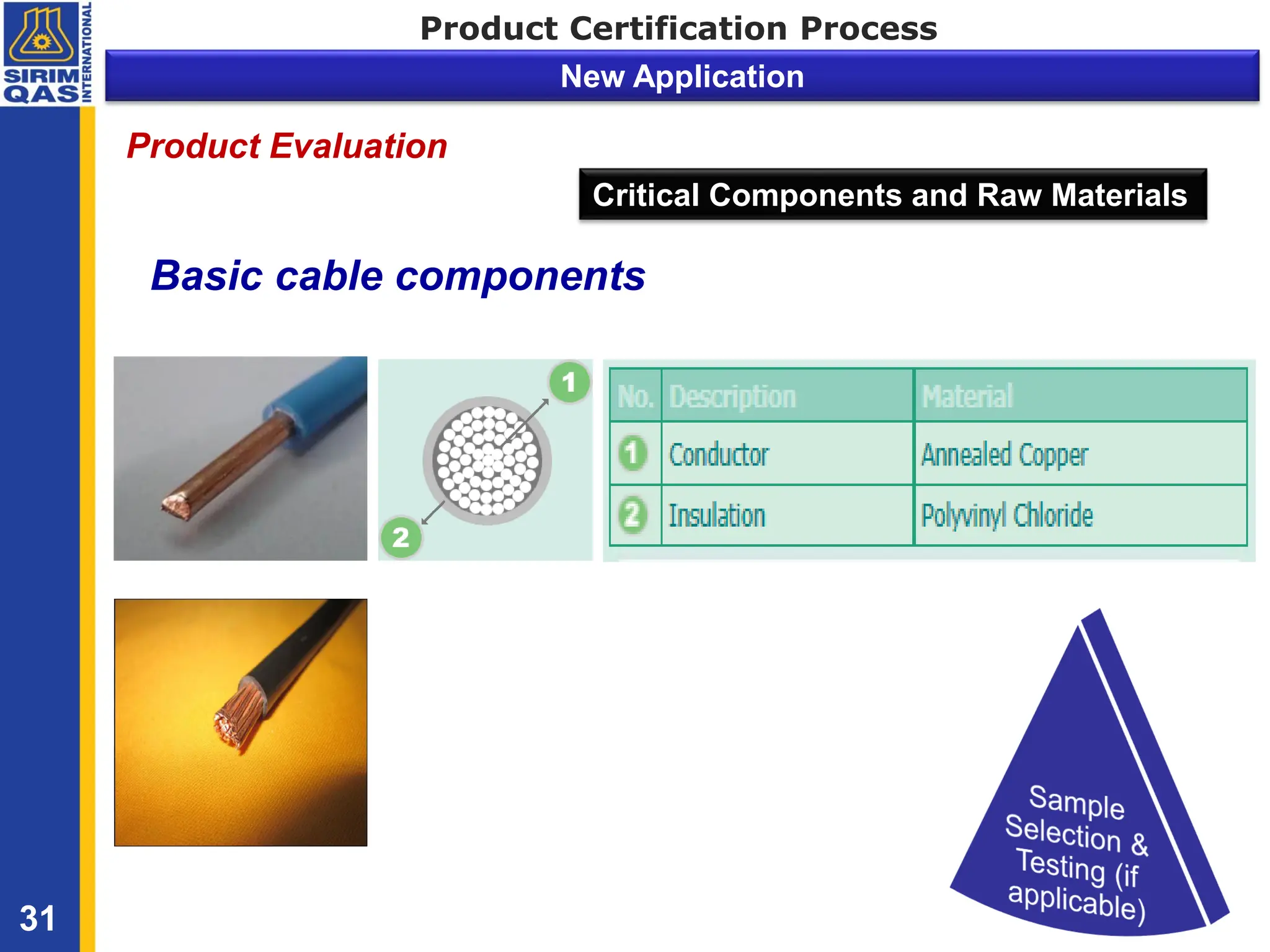
Product Evaluation
Basic cable components
Product Certification Process
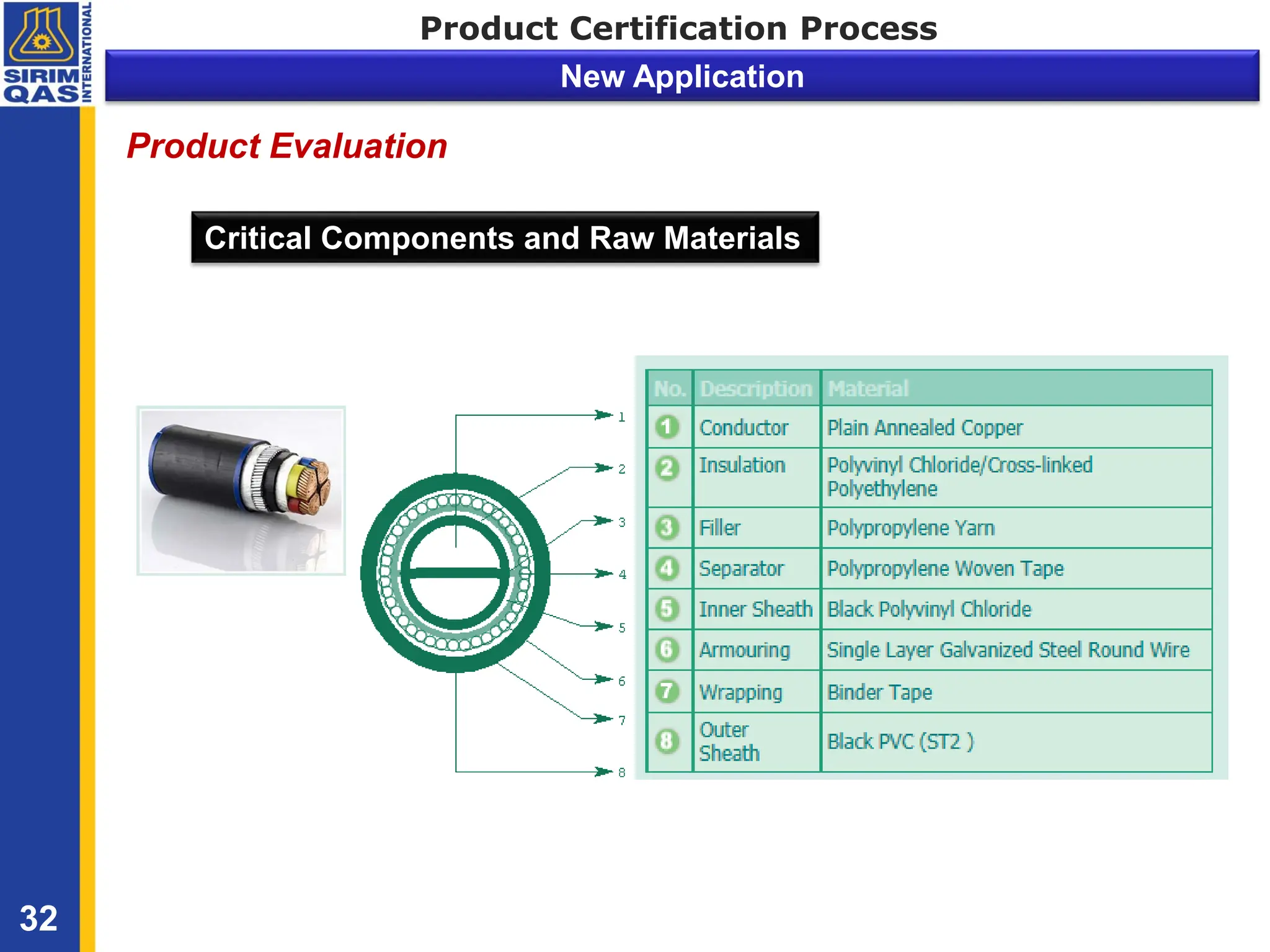
Critical Components and Raw Materials
32
New Application
Product Evaluation
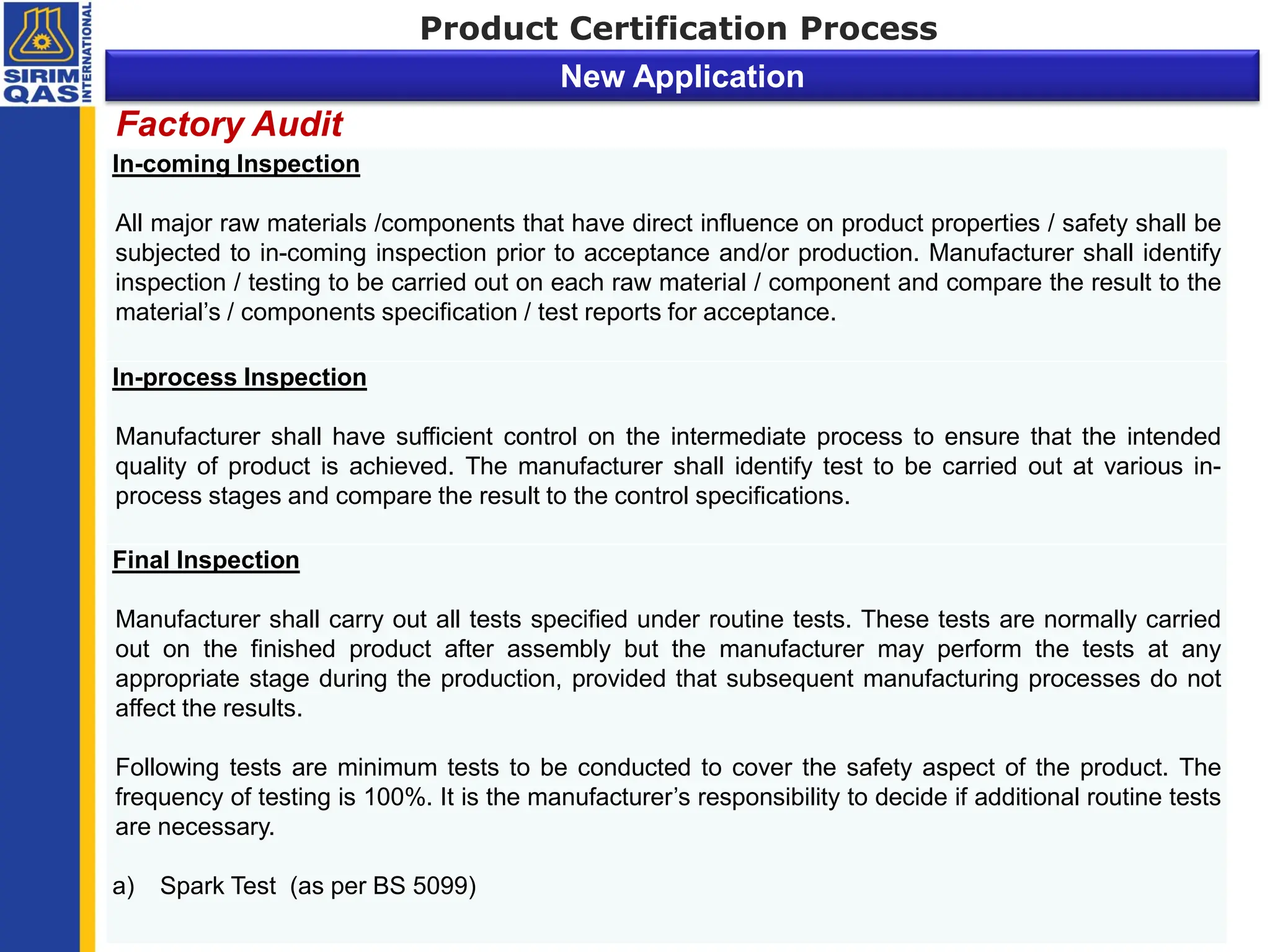
In-coming Inspection
All major raw materials /components that have direct influence on product properties / safety shall be
subjected to in-coming inspection prior to acceptance and/or production. Manufacturer shall identify
inspection / testing to be carried out on each raw material / component and compare the result to the
material’s / components specification / test reports for acceptance.
In-process Inspection
Manufacturer shall have sufficient control on the intermediate process to ensure that the intended
quality of product is achieved. The manufacturer shall identify test to be carried out at various in-
process stages and compare the result to the control specifications.
Final Inspection
Manufacturer shall carry out all tests specified under routine tests. These tests are normally carried
out on the finished product after assembly but the manufacturer may perform the tests at any
appropriate stage during the production, provided that subsequent manufacturing processes do not
affect the results.
Following tests are minimum tests to be conducted to cover the safety aspect of the product. The
frequency of testing is 100%. It is the manufacturer’s responsibility to decide if additional routine tests
are necessary.
a) Spark Test (as per BS 5099)
Factory Audit
Product Certification Process
New Application
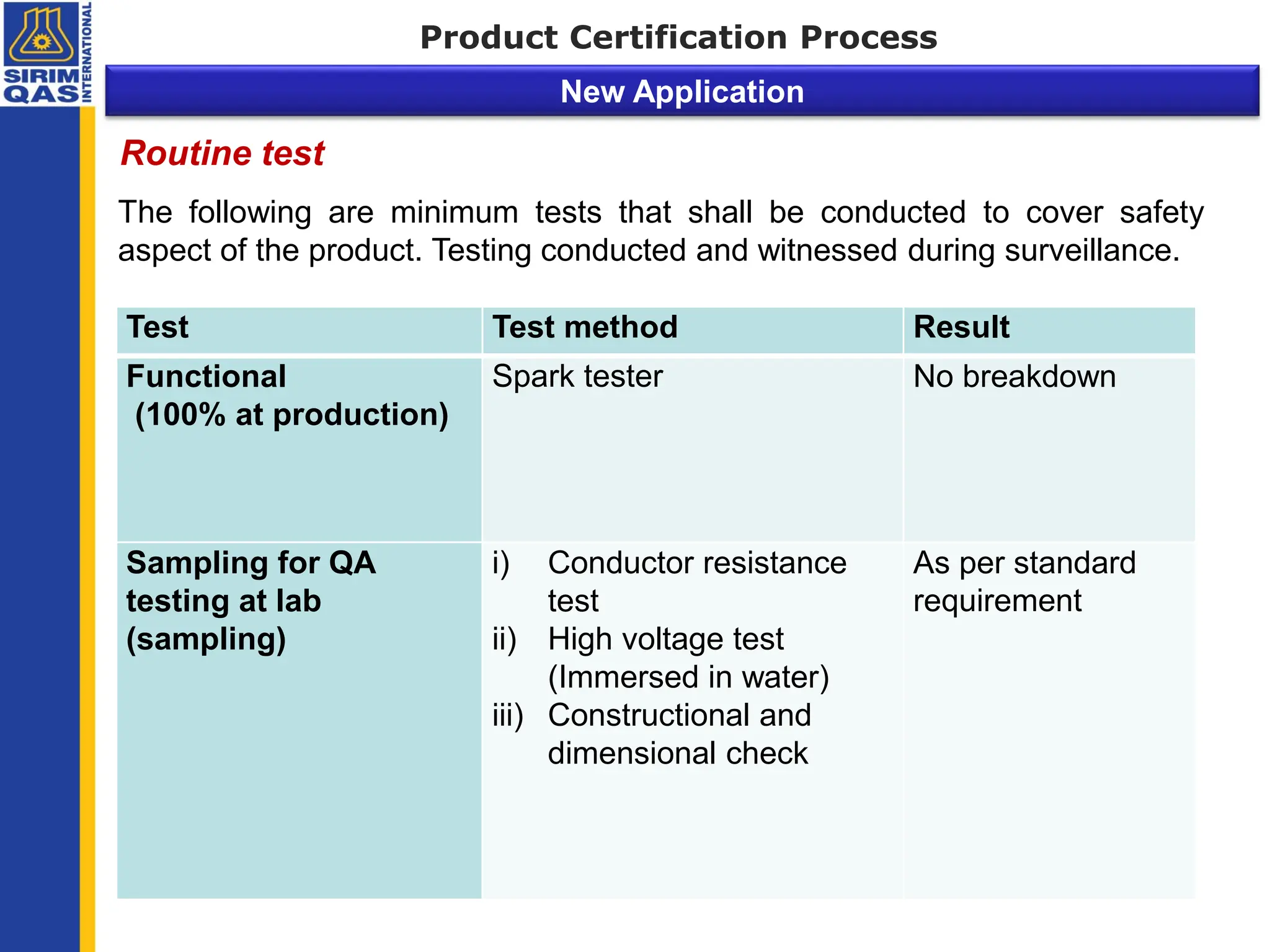
Routine test
Test Test method Result
Functional
(100% at production)
Spark tester No breakdown
Sampling for QA
testing at lab
(sampling)
i) Conductor resistance
test
ii) High voltage test
(Immersed in water)
iii) Constructional and
dimensional check
As per standard
requirement
The following are minimum tests that shall be conducted to cover safety
aspect of the product. Testing conducted and witnessed during surveillance.
Product Certification Process
New Application
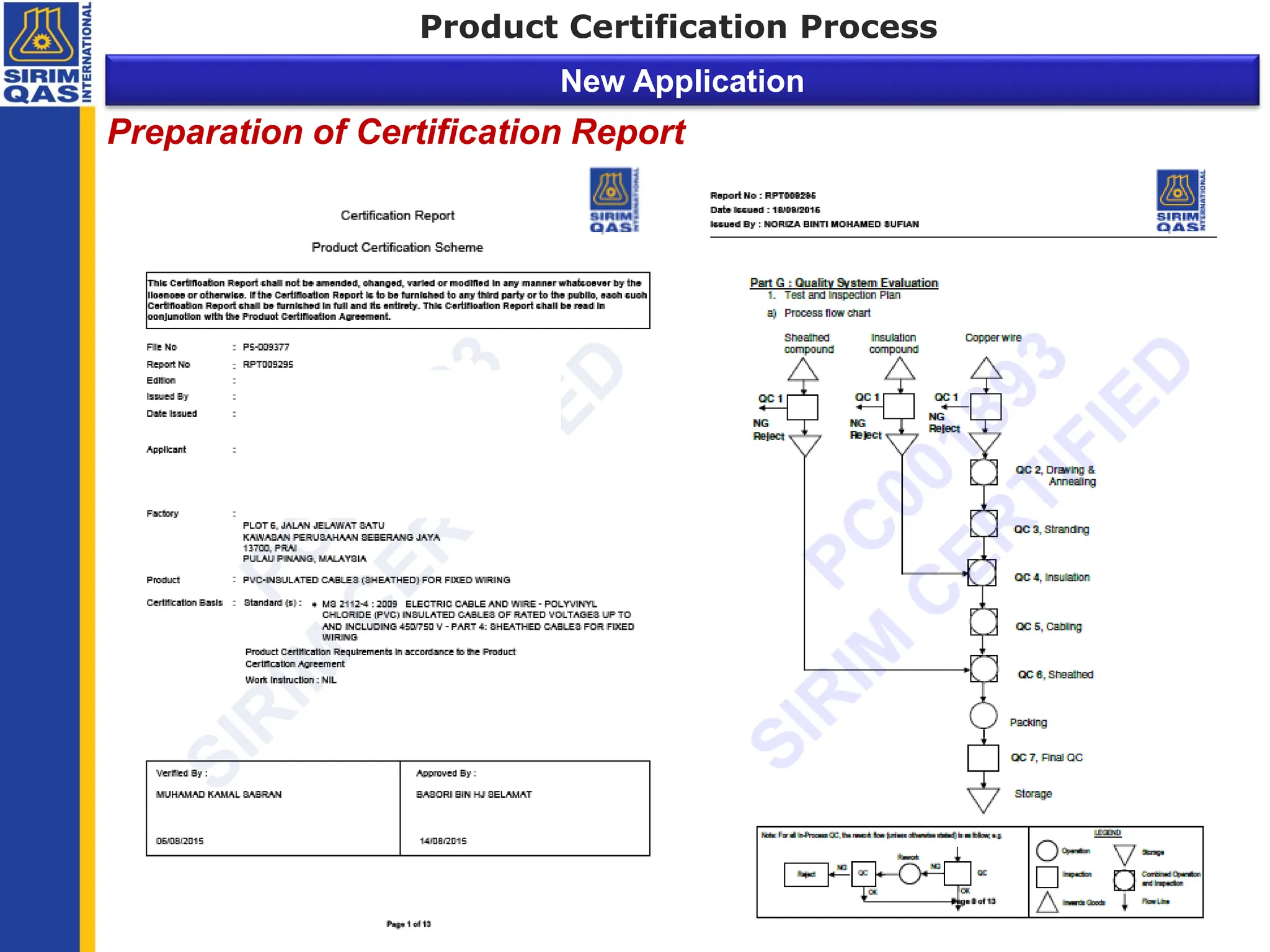
Preparation of Certification Report
Product Certification Process
New Application
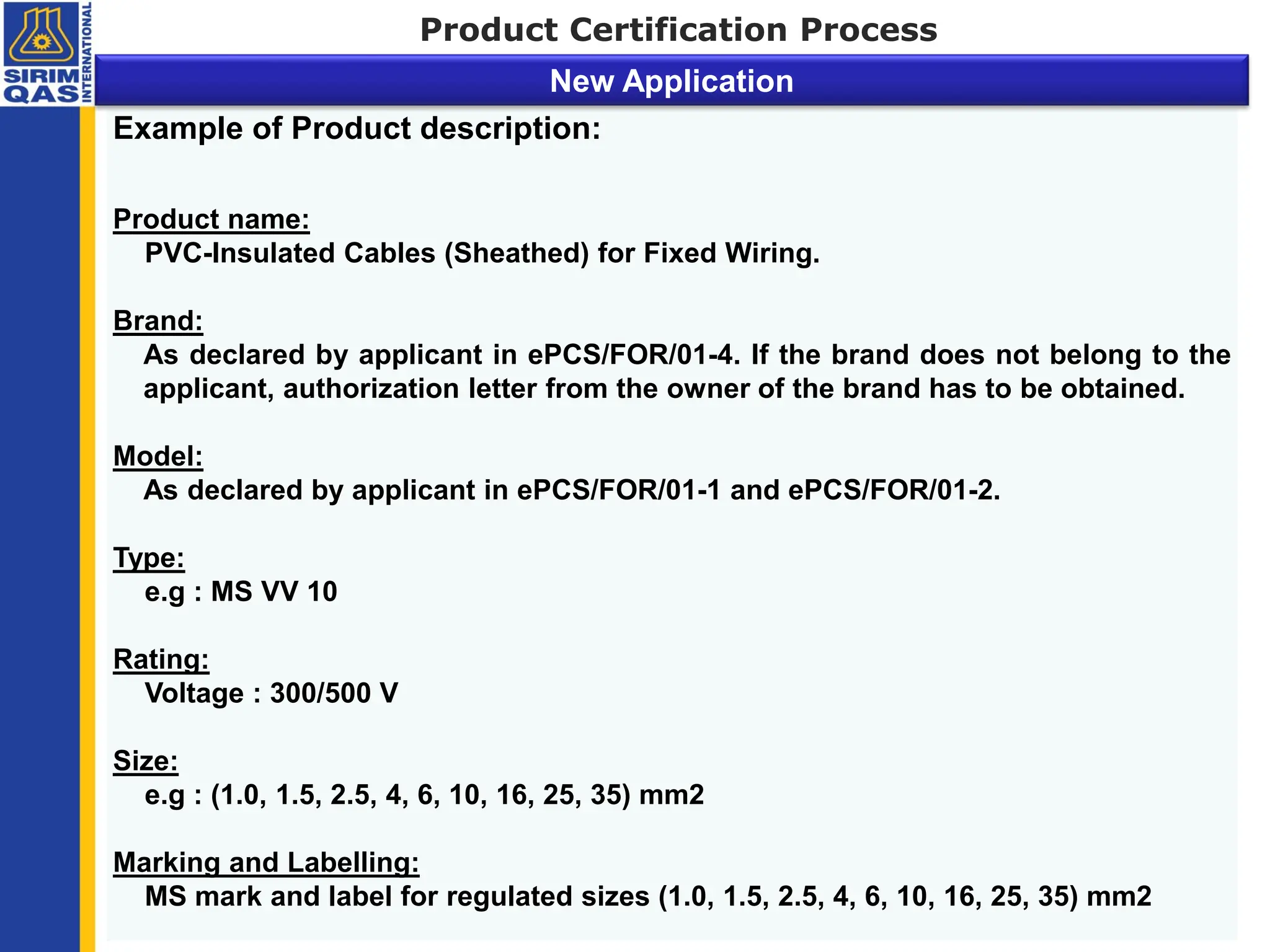
Example of Product description:
Product name:
PVC-Insulated Cables (Sheathed) for Fixed Wiring.
Brand:
As declared by applicant in ePCS/FOR/01-4. If the brand does not belong to the
applicant, authorization letter from the owner of the brand has to be obtained.
Model:
As declared by applicant in ePCS/FOR/01-1 and ePCS/FOR/01-2.
Type:
e.g : MS VV 10
Rating:
Voltage : 300/500 V
Size:
e.g : (1.0, 1.5, 2.5, 4, 6, 10, 16, 25, 35) mm2
Marking and Labelling:
MS mark and label for regulated sizes (1.0, 1.5, 2.5, 4, 6, 10, 16, 25, 35) mm2
Product Certification Process
New Application
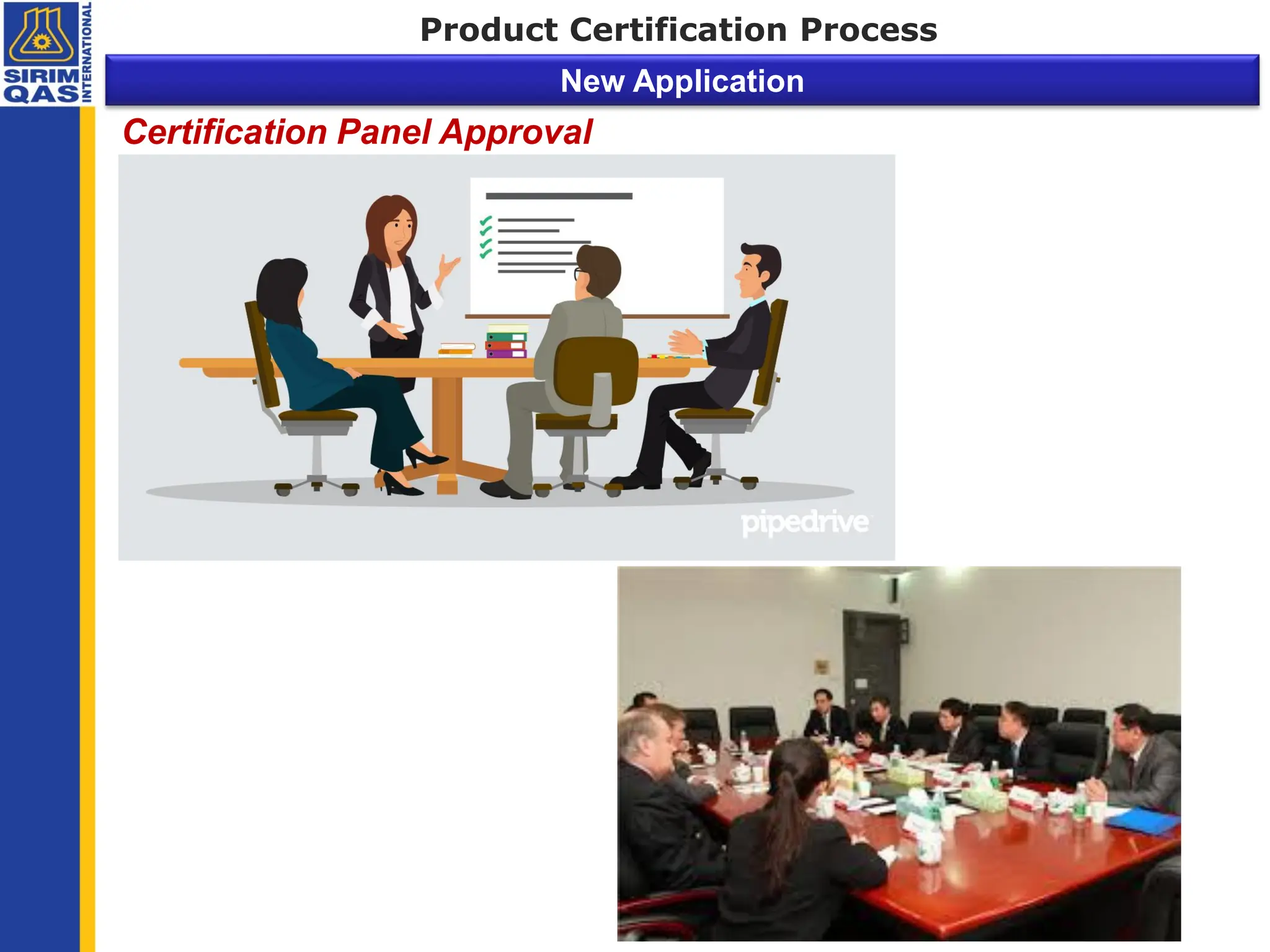
Certification Panel Approval
Product Certification Process
New Application
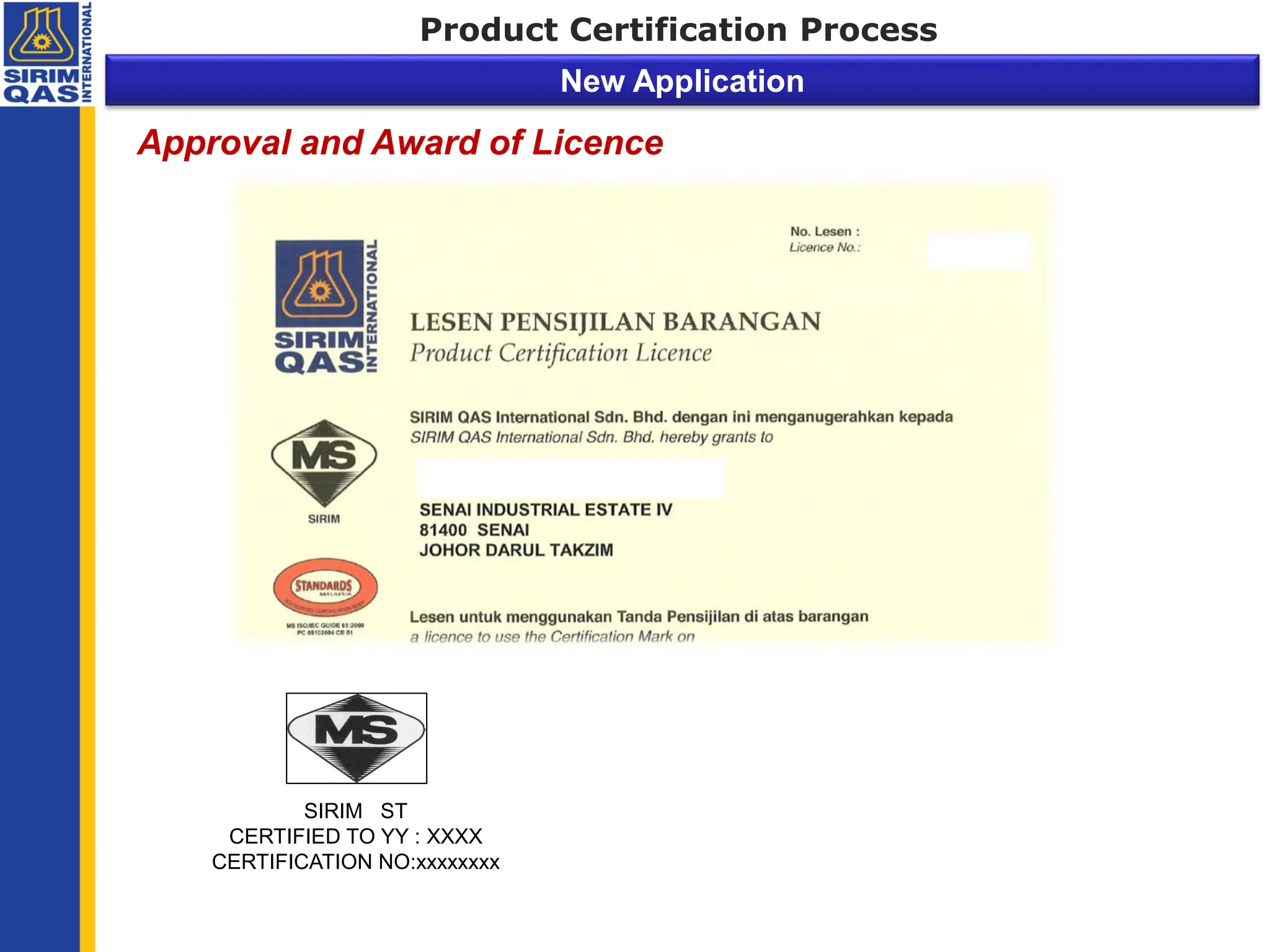
Approval and Award of Licence
SIRIM ST
CERTIFIED TO YY : XXXX
CERTIFICATION NO:xxxxxxxx
Product Certification Process
New Application
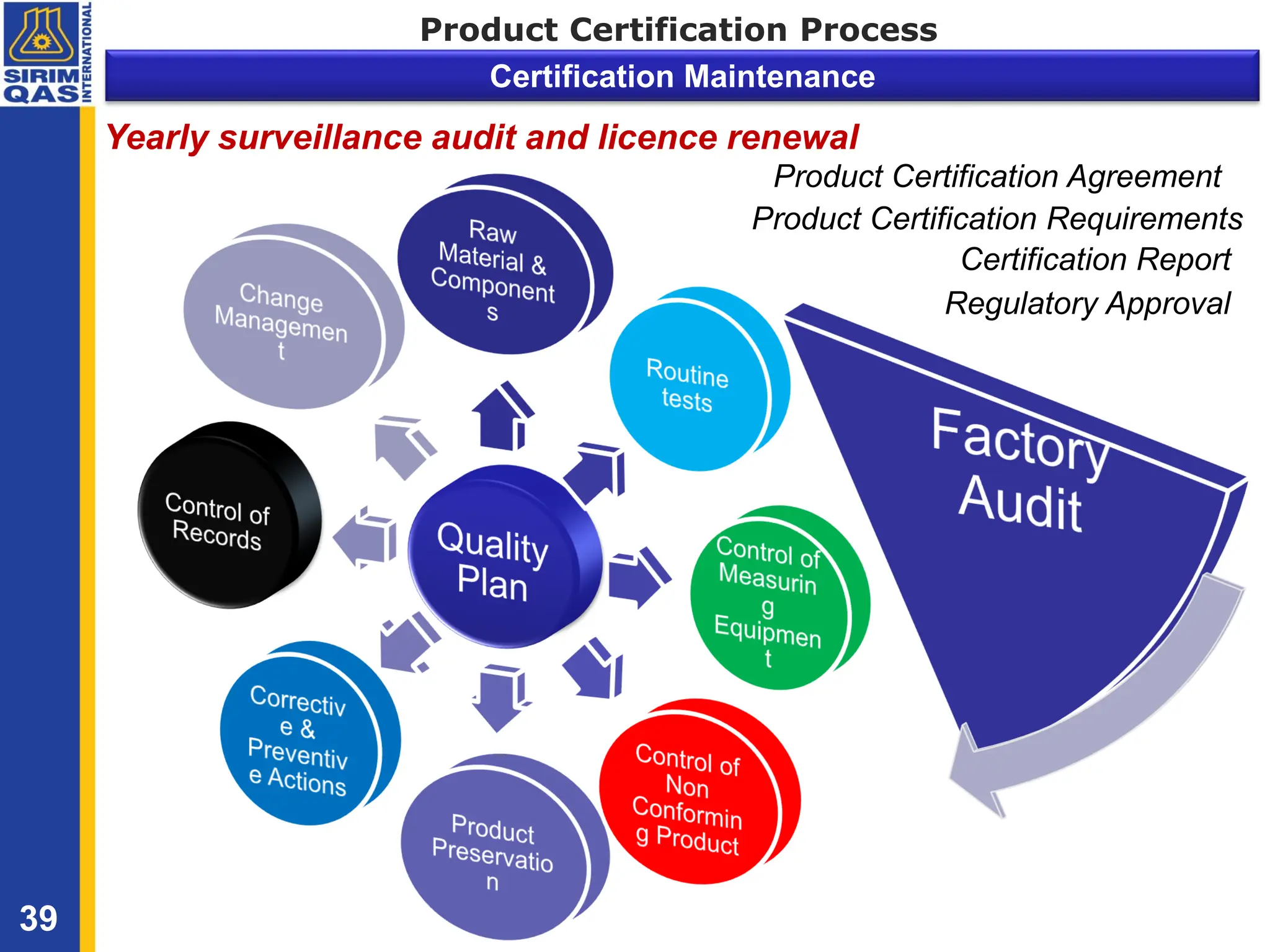
Certification Maintenance
Product Certification Requirements
Product Certification Agreement
Certification Report
39
Yearly surveillance audit and licence renewal
Regulatory Approval
Product Certification Process
Renewal
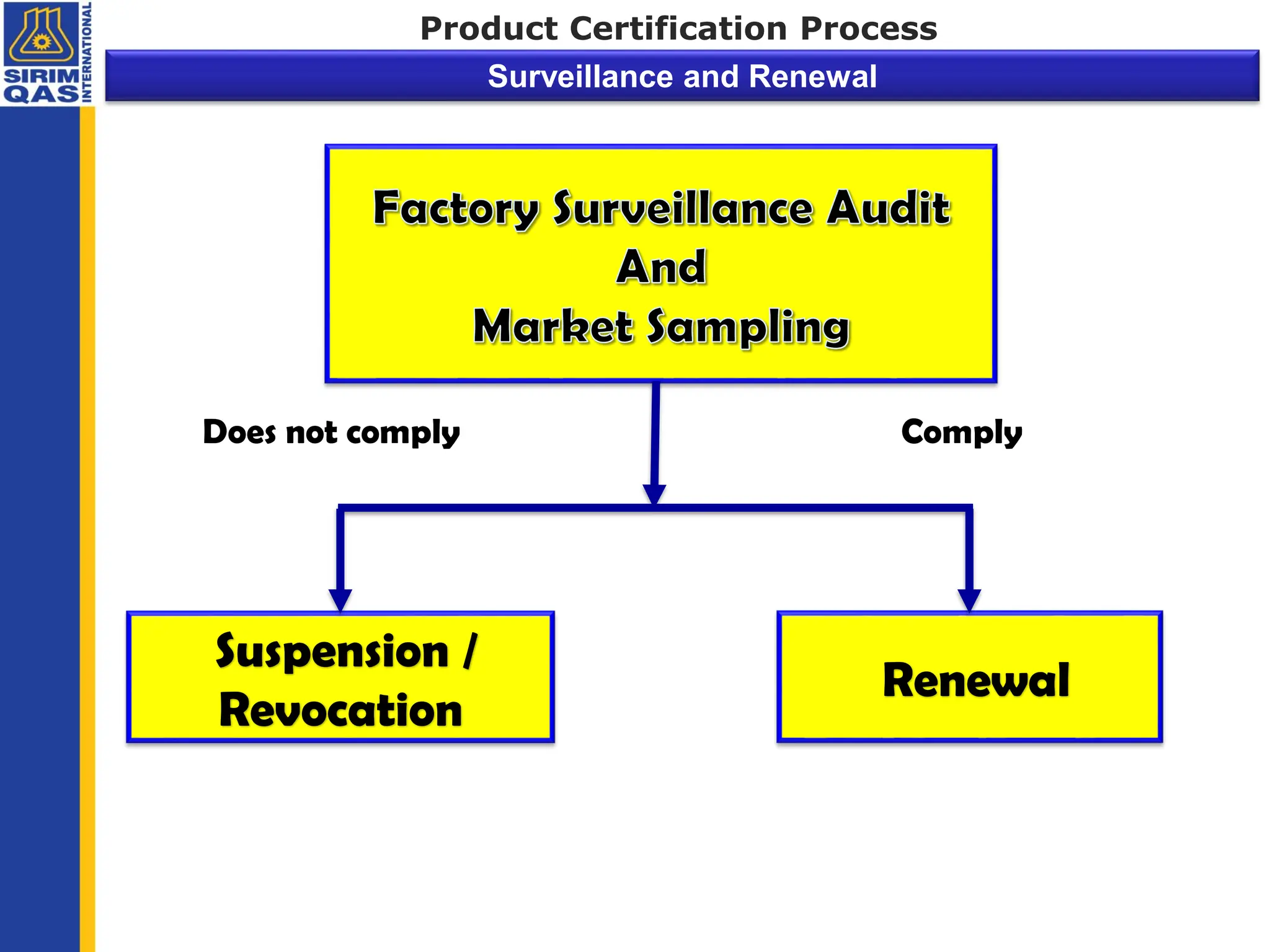
Suspension /
Revocation
Comply
Does not comply
Product Certification Process
Surveillance and Renewal
Contact Information
Mr. M. Zamri Bin Mustaffa
Head
Electrical and Electronic Testing Section 1
Tel : +603-55446251
Fax : + 603-55446272
email: zamri@sirim.my
Ms Norzaila Jalaludin
Testing Executive
Cable Testing Lab
Electrical and Electronic Testing Section 1
Tel : +603-55446167
Fax : + 603-55446272
email: zaila@sirim.my
Mr. Mohamad Asnan bin Ahmad
Group Leader
Wiring Accessories Group
Electrical and Electronic Testing Section 1
Tel : +603-55446256
Fax : + 603-55446272
email: asnan@sirim.my
Mrs. Ariza bt Mohd. Yusof
Head
Electrical & Electronic Certification &
Insection Section (ECIS)
Tel : +603-55446418
Fax : + 603-55446272
email: arizamy@sirim.my
THANK YOU FOR YOUR KIND
ATTENTION
www.sirim-qas.com.my

SIRIM Testing and Certification on Electrical Cable Testing

  • 1.
    SIRIM QAS InternationalSdn Bhd TESTING AND CERTIFICATION ON ELECTRICAL CABLE TESTING 28th Aug 2018
  • 2.
    Presentation Outline 1. Introduction 2.Our roles & services 3. Procedure & standard requirement for electrical cable testing 4. Product Certification Scheme Presentation Outline
  • 3.
    A BRIEF INTRO AboutUs Malaysia’s Leading Certification, Inspection and Testing Body
  • 4.
    Our Services CERTIFICATION • Management System Certification •Product Certification • Personnel Certification TESTING • Product compliance testing to standards, regulatory requirements and specifications INSPECTION • Engineering Inspection • Inspection on behalf of other CBs • Other 3rd party inspections
  • 5.
  • 6.
    Safety test &product safety
  • 8.
    Type of cables •Low voltage cables up to 1 kV • Medium voltage cables up to 33 kV • Submarine cable up to 175 kV • PVC insulated, XLPE insulated, paper impregnated • Aluminium conductor for transmission line • Communication cables and fiber optic • Automotive cables • Housing cable • Flexible cable for appliance 8 HV Cable -Aerial Bundled Cable Flexible cable Housing cable
  • 9.
    General Type of cablesStandards Area of usage Flexible cords up to 500V MS 2112-5, BS 6500, IEC 60227-5 Portable socket-outlet, household appliances, audio-video products Housing cables up to 750V MS 2112-1 to MS 2112-6, BS 6004 Fixed wiring and lighting PVC insulated 600V to 1 kV MS 2100 to MS 2111, BS 6346 Low voltage electricity supply XLPE insulated from 1 kV to 3 kV IEC 60502-1 Low voltage electricity supply XLPE insulated from 6 kV to 30 kV IEC 60502-2 Medium voltage electricity supply • There are a few types of cables used in Malaysia using different standards
  • 10.
    Type of cablesStandards Area of usage XLPE insulated cable IEC 60840 Underground transmission line 30 kV to 150 kV Fire rated cables IEC 60331, IEC 60332, BS 6387, IEC 61034, IEC 754 Oil and gas industry, high rise buildings Bare conductor BS 215, ASTM D 233 Overhead transmission line Low frequency cables IEC 60189, SKMM Data and communication cables Fiber optic cables IEC 60794 Data and communication cables Automotive cable JIS or mfr spec Cables used in automobile
  • 11.
    Test Standards 11 Type ofcables MS Standards for PVC cables Electric Cable and Wire: Polyvinyl Chloride(PVC) insulated cables of rated voltages up to and including 450/750 V MS 2112-1:2009 Part 1:General Requirements MS 2112-2:2009 Part 2:Test Method MS 2112-3:2009 Part 3:Non-Sheathed Cables for Fixed Wiring MS 2112-4:2009 Part 4:Sheathed Cables for Fixed Wiring MS 2112-5:2009 Part 5:Flexible Cables MS 2112-6:2009 Part 6:Cables for Lift & Flexible Connections
  • 12.
    GENERAL TEST REQUIREMENTFOR CABLE Cables testing In general – to ensure that they are safe and that they fit for purpose. Basically, test requirements for cable can be divided in to a few categories; Some requirements apply only for specific type of cables 1. Electrical tests a) Conductor resistance b) Voltage test – on insulation & sheath c) Long term stability 2. Mechanical (physical) test a) Tensile test b) Low temperature properties – bending / impact c) Resistance to heat – heat shock 3. Fire test a) Resistance to fire b) Conductor and armour wire plating thickness c) Smoke emission 4. Chemical test a) Halogen gas determination b) Flame retardance / propagation c) Smoke emission
  • 13.
    GENERAL TEST REQUIREMENTFOR CABLE (LV) 1. ELECTRICAL TESTS a) Resistance of conductors b) High Voltage at 1000V / 1500V / 2500V c) Insulation Resistance at 70°C
  • 14.
    Name of manufacturer Cable’s type, sizesand material Certification mark or name of certification body Rating
  • 15.
    Sub-Standard Cables • Cableswhich are not designed, constructed, test approved, installed or used in accordance their prescribed safety standards and specifications. • Identity /Characteristics of a substandard cable; 1. Undersized a) conductor construction not in accordance to prescribed standards on dimensions such as; » size & number of wires, » thickness » Length b) conductor does not meet the minimum cross-sectional area as determined by its specific resistance. c) reduced size of copper resistance 2. Mixed content Instead of pure copper – ‘they’ use mixed content or other metal
  • 16.
    Sub-Standard Cables 3. Reducedin insulation properties a) insulation & protective layers construction not in accordance to prescribed standards on size, thickness or dimensions b) Insulation & protective layers type does not meet the required mechanical properties for long term ageing and environmental tests 4. No identification / certification marking Completed cables are not identified by markings as stipulated by the standards.
  • 17.
    Example of sub-standardcable MARKING on Cable • Marking vs No marking • No manufacturer’s name/trademark • No cable markings such as size, electrical parameters • Marked with label / certification marked vs No label / not certified • Certified / Approval body not identified • Fake labels vs proper label • Counterfeit
  • 18.
    Non-compliant PVC FlexibleCable • Undersized conductor – low conductivity – 1mm2 instead of 1.5mm2 • Cable sheath fall apart in low temperature bend test • No compliant with standard marked on sheath • For fire retardant – • Not fire resistance –PVC insulation &PVC sheath – fails within 2 minutes instead of 30 minutes as required by standard PVC Flexible Cable Example of sub-standard cable
  • 19.
    How to identifya sub-standard cable 1) Check and verify MARKINGS on Cable – shall be as per standard requirement 2) Check and verify APPROVAL / CERTIFICATION Mark/Label 3) Measure conductor resistance ( need to have a proper meter) 4) Measure size(s) • conductor • each strand ( and no of strands) 5) Check and verify copper content • normally by conductor resistance • weight the sample • Sometimes –by weighing the sample, with some experience, we can identify if the samples / weight of sample due to copper content or sheath of insulation
  • 20.
    SIRIM will alwaysplaying it’s roles in providing assistance to industry & regulator in fighting issue of sub standard cable How can we do that?– a) through compliance testing b) through our product certification scheme c) through SIRIM’s market surveillance activities d) by carrying out verification testing on samples picked up from market - through enforcement & market surveillance –by Suruhanjaya Tenaga e) by providing a support to ST & MCMA initiatives to raise the issue of sub-standard cable to the widest audience possible How can SIRIM assist?
  • 21.
    Problems / Challenges •The ability to buy cable from anywhere in the world means there remains a need for better market surveillance as some imported cable – of which are not in compliance with standard requirement • Contractors have little interest in standards while some distributors encourage the manufacturer of `undersized cable’ • Inferior cable product is sold unmarked - making it untraceable and misuse of trade marks is common place • No follow-up market surveillance (though is essential) to ensure future compliance.
  • 22.
    CONCLUSION • We allwant safer cables and this can only be achieved with; – acceptance of the problem, – better monitoring and enforcement at every level of the supply chain Moving forward
  • 23.
    APPLICATION PROCESS Application by *aSUPPLIER A supplier submit test application to SIRIM QAS International test lab SIRIM QAS INTL TEST LAB SIRIM QAS International test lab performs a type test to a standard (MS / IEC Std + National Deviation(if any) Submit to SIRIM QAS International test lab shall issue a full type test report The report shall then be used for submission for a COA application with a regulatory body *A supplier includes importer, manufacturer and trader.
  • 24.
  • 25.
    The International Organisationfor Standardisation (ISO) and the International Electrotechnical Committee (IEC) have set out a number of different routes to conformity assessment in their document ISO/IEC 17067. Type 5 Product Certification Scheme
  • 26.
    Product Certification Process GeneralCertification Process (Type 5) SIRIM-ST CERTIFIED TO YY : XXXX CERTIFICATION NO:xxxxxxxx
  • 27.
    1) Regulated cablesby ST 2) Other cables Test standards follow related product standards or other acceptable standards. Product Certification Process Test Standards
  • 28.
    Product Certification Process NewApplication Questionnaire Form (ePCS/FOR/01-1) Application Form (ePCS/FOR/01-2) Declaration of Approval from relevant authority (ePCS/FOR/01-3)* Declaration of Obtaining SIRIM Licence for the Purpose of Relevant Authority Approval (ePCS/FOR/01-3.1)* Declaration of Trade Mark (ePCS/FOR/01-4) Authorization Letter of Trademark/Brand Name (ePCS/FOR/01-4.1)* Authorization Letter of Test Report (ePCS/FOR/01-4.2)* Declaration from Manufacturer (ePCS/FOR/01-5)* http://www.sirim-qas.com.my/ 28 Note: * - whenever applicable Application and Documents Evaluation
  • 29.
    Product Certification Process NewApplication 29 Type Test Report Laboratories accredited by national accreditation bodies e.g. DSM, HOKLAS, NATA, UKAS etc. Test Laboratory - CB Scheme SIRIM QAS International - EEST Application and Documents Evaluation Laboratories listed under ASEAN EE MRA
  • 30.
    Product Certification Process NewApplication Product Certification Requirements 30 Product and Quality System Evaluation
  • 31.
    Product Certification Process CriticalComponents and Raw Materials 31 New Application Product Evaluation Basic cable components
  • 32.
    Product Certification Process CriticalComponents and Raw Materials 32 New Application Product Evaluation
  • 33.
    In-coming Inspection All majorraw materials /components that have direct influence on product properties / safety shall be subjected to in-coming inspection prior to acceptance and/or production. Manufacturer shall identify inspection / testing to be carried out on each raw material / component and compare the result to the material’s / components specification / test reports for acceptance. In-process Inspection Manufacturer shall have sufficient control on the intermediate process to ensure that the intended quality of product is achieved. The manufacturer shall identify test to be carried out at various in- process stages and compare the result to the control specifications. Final Inspection Manufacturer shall carry out all tests specified under routine tests. These tests are normally carried out on the finished product after assembly but the manufacturer may perform the tests at any appropriate stage during the production, provided that subsequent manufacturing processes do not affect the results. Following tests are minimum tests to be conducted to cover the safety aspect of the product. The frequency of testing is 100%. It is the manufacturer’s responsibility to decide if additional routine tests are necessary. a) Spark Test (as per BS 5099) Factory Audit Product Certification Process New Application
  • 34.
    Routine test Test Testmethod Result Functional (100% at production) Spark tester No breakdown Sampling for QA testing at lab (sampling) i) Conductor resistance test ii) High voltage test (Immersed in water) iii) Constructional and dimensional check As per standard requirement The following are minimum tests that shall be conducted to cover safety aspect of the product. Testing conducted and witnessed during surveillance. Product Certification Process New Application
  • 35.
    Preparation of CertificationReport Product Certification Process New Application
  • 36.
    Example of Productdescription: Product name: PVC-Insulated Cables (Sheathed) for Fixed Wiring. Brand: As declared by applicant in ePCS/FOR/01-4. If the brand does not belong to the applicant, authorization letter from the owner of the brand has to be obtained. Model: As declared by applicant in ePCS/FOR/01-1 and ePCS/FOR/01-2. Type: e.g : MS VV 10 Rating: Voltage : 300/500 V Size: e.g : (1.0, 1.5, 2.5, 4, 6, 10, 16, 25, 35) mm2 Marking and Labelling: MS mark and label for regulated sizes (1.0, 1.5, 2.5, 4, 6, 10, 16, 25, 35) mm2 Product Certification Process New Application
  • 37.
    Certification Panel Approval ProductCertification Process New Application
  • 38.
    Approval and Awardof Licence SIRIM ST CERTIFIED TO YY : XXXX CERTIFICATION NO:xxxxxxxx Product Certification Process New Application
  • 39.
    Certification Maintenance Product CertificationRequirements Product Certification Agreement Certification Report 39 Yearly surveillance audit and licence renewal Regulatory Approval Product Certification Process
  • 40.
    Renewal Suspension / Revocation Comply Does notcomply Product Certification Process Surveillance and Renewal
  • 41.
    Contact Information Mr. M.Zamri Bin Mustaffa Head Electrical and Electronic Testing Section 1 Tel : +603-55446251 Fax : + 603-55446272 email: zamri@sirim.my Ms Norzaila Jalaludin Testing Executive Cable Testing Lab Electrical and Electronic Testing Section 1 Tel : +603-55446167 Fax : + 603-55446272 email: zaila@sirim.my Mr. Mohamad Asnan bin Ahmad Group Leader Wiring Accessories Group Electrical and Electronic Testing Section 1 Tel : +603-55446256 Fax : + 603-55446272 email: asnan@sirim.my Mrs. Ariza bt Mohd. Yusof Head Electrical & Electronic Certification & Insection Section (ECIS) Tel : +603-55446418 Fax : + 603-55446272 email: arizamy@sirim.my
  • 42.
    THANK YOU FORYOUR KIND ATTENTION www.sirim-qas.com.my