SINISTER SHADOWS
CC
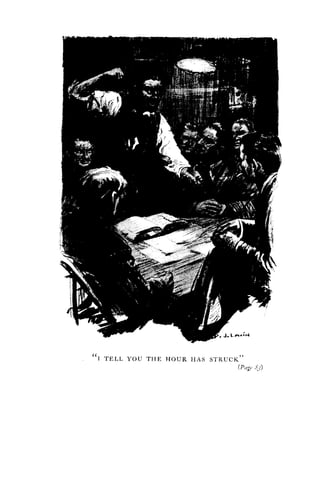
1 TELL YOU THE HOUR HAS STRUCK"
(Pugs S3 )
Sinister
Shadows
By
Edwin Marshall Hadley
k
CHICAGO
THE TOWER PRESS, INC.
180 North Michigan Avenue
1929
COPYRIGHT, 1929, BY
EDWIN MARSHALL HADLEY
All Rights Reserved
PRINTED IN THE UNITED STATES OF AMERICA
TO THE
WORTHY PROFESSORS
OF MY YOUTH
As a debt of gratitude this book
is dedicated, with the hope that,
in a humble way, it may aid them
and their worthy successors in
purging their ranks o f those who
are bringing discredit upon one
of the noblest of professions .
PREFACE AND PROPHECY
Wce
EN this book takes wing for its initial flight,
rtain wild eyed hunters will foregather with sling-
shots, cross bows, blunderbusses and poisoned arrows,
frantically endeavoring to bring it down.
Among the number of the hunters will be a certain
writer in Kansas-a woman novelist in Wisconsin-a
rabbi in New York-a columnist discharged from a New
York newspaper-a professor discharged from Columbia
-a notorious criminal lawyer in Illinois-a discredited
radical minister of the gospel in New York City-a smug
social worker in Chicago-a discharged professor of an
old college in the East, now professor in a Mid-West
university-a professor in a fashionable Eastern school
for girls-a certain dean of an eastern law school, etc.,
etc., etc., etc.
An aggregation of critics who clamor, in season and out,
for a free speech that would go to the length of advocat-
ing violence, are going to read in "Sinister Shadows,"
Free Speech,* not the kind they are striving for, but Free
Speech, that advocates construction and not destruction.
The object of this book will be accomplished if it suc-
ceeds in driving such critics into the open where Americans
can see them under a bright sunlight .
The writer of this story suggests to the defamers of
those who love our country, that the time has passed for
defensive only, on the part of those against whom ridicule
*See Chapter XIX, page 2 54, for U. S. Supreme Court definition and decision .
Vii
Viii
	
PREFACE AND PROPHECY
has been levelled on account of their love for their country .
In our military hospitals are gallant men. For ten years
they have been there . They paid the price for our se-
curity.
The royalties of this book will be turned over to the
Advertising Men's Post Number 38 of the American
Legion which will administer the funds through the "Vet-
eran's Welfare Committee and the Board of Directors
for the relief of the wounded and incapacitated veterans
of the World War."
It is for these boys and for the fathers and mothers of
the coming generation, this book has been written with
the eager and earnest desire that the teaching in our in-
stitutions of learning may be sound and sane .
* * *
The Communist and Socialist reviewers and critics
march under exact orders . Here are the orders :
"We must take care that our writers be well
puffed and that the reviewers do not depreciate
them; therefore we must endeavor by every means
to gain over the reviewers and journalists ; and we
must also try to gain the booksellers, who in time
will see it is to their interest to side with us ."
(Professor John Robison, professor of Natural Philosophy, Edin-
burgh, in "Proofs of a Conspiracy," page 191 .)
"If a writer publishes anything that attracts
notice and is in itself just, but does not accord with
our plan, we must endeavor to win him over or
decry him."
(Professor John Robison, professor of Natural Philosophy, Edin-
burgh, in "Proofs of a Conspiracy," page 194 .)
PREFACE AND PROPHECY
	
ix
There is the program-the plan of Professor Weishaupt,
the founder of "Illuminism" from which came the Marxian
Serpent that is leaving its slimy trail across our literature
of today.
That is why the author of "Sinister Shadows" knows
the Book will be decried. The order will go out "decry it."
America, however, has a way of making up its own
mind when facts are in her possession . She does not need
the assistance of critics who "decry" everything not lend-
ing itself to destructive propaganda .
Let the writer of this book suggest that in the duel of
pens, the button on the end of his pen is easily removed .
Whether it remains on or is taken off depends upon the
actions of the critics who seek to tear down our American
Institutions .
THE AUTHOR.
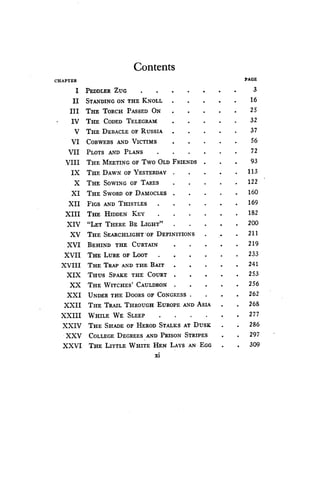
Contents
xi
CHAPTER PAGE
I PEDDLER ZUG 3
II STANDING ON THE KNOLL 16
III THE TORCH PASSED ON 25
IV THE CODED TELEGRAM 32
V THE DEBACLE OF RUSSIA 37
VI COBWEBS AND VICTIMS 56
VII PLOTS AND PLANS 72
VIII THE MEETING OF Two OLD FRIENDS 93
IX THE DAWN OF YESTERDAY 113
X THE SOWING OF TARES 122
XI THE SWORD or DAMOCLES 160
XII FIGS AND THISTLES 169
XIII THE HIDDEN KEY 182
XIV "LET THERE BE LIGHT" 200
XV THE SEARCHLIGHT -OF DEFINITIONS 211
XVI BEHIND THE CURTAIN 219
XVII THE LURE OF LOOT 233
XVIII THE TRAP AND THE BAIT 241
XIX THUS SPAKE THE COURT 253
XX THE WITCHES' CAULDRON
	
. 256
XXI UNDER THE DOORS OF CONGRESS 262
XXII THE TRAIL THROUGH EUROPE AND ASIA 268
XXIII WHILE WE SLEEP 277
XXIV THE SHADE OF HEROD STALKS AT DUSK 286
XXV COLLEGE DEGREES AND PRISON STRIPES 297
XXVI THE LITTLE WHITE HEN LAYS AN EGG 309
xu
	
CONTENTS
CHAPTER PAGE
XXVII THE COLLEGE PRESIDENT AND THE GANGSTER 314
XXVIII THE QUICKSANDS OF RAGE 324
XXIX EXAMINATION TIME
	
. 333
XXX THE REVENGE THAT BANISHED REASON 336
XXXI THE WOMAN SPURNED
	
. 339
XXXII THE THIRD DOWN, Two MINUTES TO PLAY 346
XXXIII THE HOUR OF DECISION 356
XXXIV DRASTIC REMEDIES 369
XXXV THE PEDDLER COMPLETES THE CIRCLE 376
AN AFTERWORD 383
SINISTER SHADOWS
Chapter I
PEDDLER ZUG
"Rags an' old iron,
Rags an' old iron ."
Long before the old bay horse poked his white nose
into the alley, the voice of old Zug, sing-song and
monotonous, came floating around the corner-"Rags an'
old iron."
A pathetic figure of a man was old Zug, the Russian
Jew, huddled on the seat of the dilapidated, weather-
beaten wagon piled high with the pick-up of the day . His
old felt hat, through long association, had fallen into typ-
ical curves and creases . It would have been difficult to
have pictured Zug in any hat other than that old nonde-
script felt. His eyes, slitted by many summer suns and
many winters' driving snows, seemed to mirror in their
depths the woes of far away Russia. They told of a long
line of Zugs scourged with the whip of Autocracy and
symbolized, at one and the same time, the cringing of the
ruled and the undying hatred of the oppressed ; but, with
it all the faint but unquenchable spark of hope .
No razor had ever profaned his face . His eyes looked
out upon the world through a veritable jungle growth of
whiskers. His forehead, high and seamed, however, was
that of a thinker and redeemed his face from mediocrity .
From time to time he clacked mechanically to his old
horse and at times he made great show of waving his whip
menacingly; but, through long experience, the old bay had
3
4
	
SINISTER SHADOWS
learned that these demonstrations always subsided with-
out damage, and he accepted the outbursts as part and
parcel of his daily routine.
On top of the load sat Zug's only son, Izzy, belying his
youthful age of twelve years by the hard scheming lines
of his little face, making one think indistinctly of a weasel.
On down the alley went the groaning and protesting
wagon and the bay horse with ears flopping grotesquely.
On a back fence sat the youthful heir of Conover . The
two boys, one on the back fence, the other on the wagon,
looked into one another's eyes . Hard would it have been
to have imagined a greater contrast than these two boys
afforded, one the son of a Russian Jew, the other the off-
spring of a long line of Nordic ancestors ; the one a part
of the flotsam and jetsam thrown on our shores by the
careless tides of immigration, the other, one whose an-
cestors carved an empire from the American wilderness
decades ago.
Hate and envy glared from little Zug's eyes, surprise
and wonderment from young Conover's. In the meeting
of two people ofttimes antipathy quickens in a flash . It
was so written in the book of life before their little hands
thumbed its pages. The shrill voice of Izzy hurling de-
nunciations at his hereditary foe caused Zug to turn
around.
His memory sped back to the hatreds and raucous quar-
reling voices of barbaric Russia .
For a few seconds he seemed powerless to speak . Ac-
customed as he was to violent scenes, he was unprepared
for the realization that in the person of his own small son
had been distilled a venom so malignant, so diabolical that
PEDDLER ZUG
	
5
all human traits had been changed in the twinkling of an
eye to the instincts of a ferocious beast . The wolfish glare
in his eyes, lips drawn back from grinding teeth, the tense-
ness of impatient fingers, all combined to paralyze the
father.
Suddenly the dam of surprise and indecision gave way
and from Zug's lips came a torrent of Yiddish that rose
and fell like the waves of an angry sea, submerging by
its swirling volume, the little throwback whose anger had
precipitated the flood of words that were now engulfing
him.
Rose and fell that volume of words . Now and then
came a snarling interlocution until snarls faded to mut-
terings and mutterings finally dwindled to silence .
With a final admonition Zug shrugged his shoulders
and again took up his task, but into the cry of "Rags an'
old iron" there crept a new note, one of bewilderment and
apprehension.
Memory carried him back to a Russian hovel. On the
bare ground with a few rags under her lay his wife in
child labor. Around her, defying the pleadings of the
husband, stood half-drunken Cossacks singing ribald
songs and polluting the air with obscene remarks.
In such an atmosphere was ushered into the world
Izzy, inheriting the prejudices, the animosities and the
hatred of his class.
Then arrived the day when the great resolution was
made. Groping to find a way out, the dazzling thought
possessed him-why not put it all behind him and go to
America?
So came about the Great Adventure and Zug, his wife
6
	
SINISTER SHADOWS
and the small boy, Izzy, found themselves in the steerage
of a great ocean liner plowing through the waves towards
the land of promise.
The discomforts of the steerage did not exist for the
Zugs. It was better than they had ever known in Russia .
The quagmires and nightmares of oppressive Russia
were back there in the wake of the steamer .
The swish of the knout of the Cossacks, he heard no
longer. Whisperings and plots were a thing of the past
in his new land of freedom.
It seemed as if he could never fill his lungs enough with
the glorious air of emancipation .
His goings and his comings were his own affair.
He was old-too old, maybe, to avail himself of all its
opportunities ; but, he dreamed dreams for his only son .
Dreams that dazzled-but-could he make over this
were-wolf son of his?
Could he change the natural product of the hatreds of
his class?
Long after the old wagon turned the corner of the alley,
young Conover remained sitting on the fence thinking
over the strange incident, and in his boyish way recon-
structing the scene .
*
	
*
	
*
	
*
	
*
A few years later the two boys entered the Freshman
class of a local High School .
Although young Zug was possessed of a bright mind,
the natural venom in his makeup dominated all his actions.
He established no companionships, was known as a morose
boy incapable of friendships, but credited with an oddly
balanced brilliancy.
PEDDLER ZUG
	
7
He was gloomy and taciturn, leaning towards mysticism
with the odd and bizarre appealing to him-a mind filled
with phantasmagoria .
After school hours he haunted the bookshops and the
libraries. His very oddness, feeding upon itself, produced
a mental jaundice.
He was familiar with the books written by tainted
geniuses. He developed a taste for literature that was
"high" and was drawn irresistibly to the "odor of decay
emanating from unbalanced brains ."
What, then, was more natural than that such a one
should gravitate to Rousseau, Weishaupt, Marx, Engels,
Bakunin, Babeuf, Nietzsche and similar twisted mental-
ities?
One day in the Senior year of the High School in a
history class, Conover, who had made special preparation
on the American Constitution, was telling the class of his
findings, when young Zug sprang to his feet and with
flashing eyes sought to tear down everything that loyalty
and nationalism and patriotism had built up.
On and on his fanaticism carried him . Hate motivated
him and back of that, envy and greed.
The professor and the class sat dumfounded . It was
elemental and tempestuous .
"I know these things," he shouted, "I am a dialectician,
the superior of you all ."
That night his path and Conover's crossed as they were
leaving the schoolhouse . A group of Seniors was standing
in front of the school discussing the affair . Young Zug
came out the door. Immediately the cry was started and
taken up by all : "Make way for the Dialectician!"
8
	
SINISTER SHADOWS
When he approached the group, his egotism did not
permit going around it, but he sought to force his way
through.
Someone pushed Conover towards him . Instantly Zug's
face became distorted with rage, and he spat full in Con-
over's face.
For a second, the group froze into living statues .
"Will you wipe that off?" came the low, even voice of
Conover.
The answer came in a repetition, accompanied with a
torrent of invectives.
Then started a fight that became a classic in that school,
a story that classes told succeeding classes .
A crowd quickly formed . Angry murmurs swelled as
Zug repeatedly tried foul tactics . Fuel was added to the
intense flame of his anger by the cool tactics of Conover.
And as the fight went on, the coolness of the one drove
the other to desperation .
Now Zug was fighting with hands, feet, finger nails
and teeth. His head he sought to use as a battering ram .
But Conover took what he couldn't avoid and awaited
his time. Zug was weakening . Conover feinted him into
an opening and then with all his weight behind a short
blow, drove into the solar plexus and, when Zug doubled
over, shot in a right upper cut to the chin, following by a
left to the nose.
A battered youngster was on the ground, gory and dis-
gusting.
Not a hand went to his assistance .
"Will someone please get me a basin of water?" asked
Conover.
PEDDLER ZUG
	
9
When it was brought to him, he turned to the whimper-
ing boy on the ground, merely saying "Don't go away"
and proceeded hastily to wash his hands and to tidy his
clothing. His face he didn't touch.
Finishing, he turned to Zug who was now on his feet .
Taking out his own handkerchief, he handed it to Zug and
commanded him with a voice that cracked like a whip,
"Now wash away your insult from my face ."
For a second Zug hesitated, but the fight had gone out
of him and he complied.
"Now go," said Conover . "Take the handkerchief
with you; you have touched it ; I can't use it again ."
Next day the two boys were back in their classes.
Their educational paths parted at graduation day .
Young Zug disappeared ; but, having no contacts out-
side of his family, his disappearance created no special
stir.
Young Conover went to Paxton College from which his
father had graduated, and in due time graduated and
entered business life where his talents and popularity
speedily gave him the standing of a substantial citizen in
his community.
Busy as he was, his activities did not prevent him from
maintaining a very active interest in his old college and its
activities.
A June day in 19- found him again in the old college
town. His affection for the old college quickened, because
in a few years his own son was to enter ; and here he was
again in the old town of Paxton in the heart of which was
the famous college with its campus studded with the
great oaks, and with the winding avenue arched over with
10
	
SINISTER SHADOWS
the stately elms, leading up to those venerable doors upon
which generation after generation had knocked for ad-
mission.
Wonderful doors those, the gift of the class of 1850 ; the
class of 1831 had given the chimes in the stately tower .
Year after year, the classes had left behind them some-
thing for their memory to cover lovingly, much as the ivy
caresses the ancient tower from which the chimes ring
out.
For decades had gone from its portals men who had
made their mark.
At every commencement had come her alumni from the
four corners of the world, for the old foster mother
beckoned to them lovingly.
Back to the old shrine they came yearly to gather new
inspiration at its fount, but in recent years when they
returned, the old "grads" felt a subtle change . They were
filled with a vague unrest, a sense of something impending,
intangible, elusive .
For one thing, most of the old professors had answered
to the last roll call. Very precious to the memory was
that old guard that had sacrificed creature comforts and
luxuries to the call of teaching . Yes, maybe that was it,
the call, the mission that had been theirs, the putting of
the cultural side of things before those other things which
were proving so enticing to some of the younger professors .
True it was that there were many who gave promise of
becoming worthy successors to the distinguished teachers
of former years; but, here and there was a swaggering,
blatant. self-seeker who sought to achieve prominence by
running amuck through sane traditions, and seeking noto-
PEDDLER ZUG
	
1 1
riety, felt well repaid by newspaper publicity, even if
achieved at the expense of sober and sound sense .
The higher educational system, the old "grads" sensed,
was becoming a huge, unwieldy thing. Often the charge
was made that our colleges and universities were becoming
graduate factories, "fordizing" the minds . The fetish
was size.
In former days, the enrollment was spoken of in terms
of hundreds, now by thousands . The old personal touch
between teacher and pupil was missing. It was mass
against man, quantity production. More and more one
heard the expression "Sold" on this and "Sold" on that .
The increased tempo of modern life had drawn into its
vortex the former peaceful calmness of academic life.
Where formerly there had been an atmosphere that had
lent itself so delightfully to the earnest pursuit of scholarly
attainments, now there existed a disquieting spirit born
of excessive activities.
Education for education's sake was relegated to the
store room of outgrown things . "How could one be so
naive as to think that learning for the sake of learning was
anything other than archaic?"
Much more important, it seemed to the student body,
was leadership in the multitudinous college activities .
Raw nerves were spurred to new interests by new
stimuli. It was a case of restlessness tortured to new
lengths by newness .
And in turn when the yeasty ferment of such a condi-
tion came to an appointment to a professor's chair, it was
not surprising that a few, losing a sense of proportion, and
having been taught a smattering of everything except how
1 2
	
SINISTER SHADOWS
to think, chose the short cut to publicity by promulgat-
ing the sensational and untried things that history and re-
search would have shown them were the rejections of our
wise forefathers, who had sought to avoid those things
that had within them the elements that had destroyed
former civilizations.
In former days these undesirable teachers would have
been weeded out ; but, now, in the crowd, they were
allowed to swagger along, strutting to the tune of noto-
riety and bringing discredit upon the great army of
teachers who were devoted to their calling, but whose pro-
fession was in danger of being discredited by the misfits .
Such a misfit was Professor Benedict Covet, a man of
warped mentality, a superlative egotist, an eager oppor-
tunist ; envious, supercilious and exercising a most per-
nicious influence upon the minds of the students.
On this same June day Professor Covet sat pondering
in his study. An accomplished actor, he never put aside
his role. Even when his study door was closed, he played
the part, for always with him was an audience of one, his
alter ego ; a most appreciative audience, and enthusiastic
claque. Altogether he was a most interesting type to
pathologists.
Over his desk, ornately framed, was a smugly patroniz-
ing photograph, extravagantly over-autographed with
mawkish expressions, extolling the great learning of the all
wise professor by "Your friend in the cause, Jeannette
Meddle"-a worker in a settlement house whose halls
were thrown open to meetings of anarchists .
To have made the thing complete she might have added
"Social Worker identified with nearly every unpatriotic
PEDDLER ZUG
	
13
society in the United States and many whose ramifications
run through various foreign countries ."
There was a time when many women had been carried
away by this theorist, when her prominence had appealed
to them as the one who was leading her sex into the
promised land of public life .
Years ago when she appeared before a certain group of
women, they would stand up in rapt adoration until she
took her seat on the platform. This was at a period when
her charitable acts were many-with other people's money .
And then came the day of all days to a woman of a
certain age, a day cataclysmic and to be dreaded . A day
from which- almost all women emerge safely ; a few,
broken and bent.
From that day dated the wanderings of that distorted
brain in the labyrinths of radicalism .
And the eyes of the women were opened . No longer
could she lead them blindly .
When that day came, the iron entered her soul and she
plunged from one activity into another, often adroitly,
always with an uncanny stealthiness, hiding her bitter-
ness under a mask of saccharine placidness .
This, then, was the Patron Saint of the learned Pro-
fessor Covet, who on this particular June day was sitting
in his study in what he was pleased to call profound
meditation. He was in a vicious temper because he had
been thrown from his usual stride . The same thing had
happened in the month of June for so many years .
His mind went back to a certain spring day many years
before. He saw again an old dilapidated wagon, an old
bay horse, with flapping ears ; saw again, huddled on the
14
	
SINISTER SHADOWS
seat, a bewhiskered Russian Jew ; saw himself, a small
boy seated on the load ; saw again the Nordic boy, whom
he had thenceforth hated with stupendous hatred . Men-
tally retracing the intervening years he remembered leav-
ing the old town hated and friendless ; he recalled the day
he discarded his past, throwing away the name of Zug
forever ; he revisualized the days and nights of intensive
study, he found himself prominent with collegiate dis-
tinction, for now he was the Professor Covet, Head of
Economics.
The metamorphosis had happened-Izzy Zug had be-
come Professor Benedict Covet . The past was buried .
A heavy shock of hair, a -carefully trimmed VanDyke beard
and a moustache completed the transformation . Rumor
had it that he came from a very distinguished family.
When this was hinted at in his presence, he assumed a
mysterious smile, giving the impression that one would be
surprised indeed if he was at liberty to tell .
His study window looked out upon the campus with its
wonderful shading of greens, with its elms and oaks and
maples casting dancing shadows on the grass .
From the trees came the songs of myriad birds. Over-
head wheeled and darted the martins . Thrushes and
robins, bluebirds and noisy bluejays added note and color
to the scene. On the other side of the campus could be
seen the placid little river, the mirror that Mother Earth
held up shyly to catch therein the grace of the turquoise
sky.
It was a scene of serenity and peace, a sanctuary for
tired and buffeted humanity.
But Professor Covet saw nothing of the panorama,
PEDDLER ZUG
	
15
heard none of the songs, reacted not in the least to the
inspiration.
The fly in his ointment was the presence in that sur-
rounding of his former class mate of high school days, for
Conover had come back for commencement and was
walking across the campus, unconscious of the baleful
gaze following his steps and unaware of the drama so soon
to take place, in which he was to be so vitally interested.
Chapter II
STANDING ON THE KNOLL
Conover threw back his head and filled his lungs to the
full with the glorious air . The years slid off his shoulders,
his step grew lighter, a new luster came into his eyes. It
was good to be alive.
He smiled whimsically at what the world called success .
What were his wealth or honors or position in life com-
pared to the joy of living he was experiencing now?
It was the eternal boy within him that fascinated his
friends and acquaintances .
His word was law to over three thousand employees .
He ruled with firmness and fairness . "Lucky" his com-
petitors called him because strikes, walkouts and grievance
committees were unknown in his factory .
He had built an organization that had caught from him
enthusiasm and whole-souled co-operation.
He had a way of looking into a man's eye and talking
himself straight into the other man's heart .
His outlook on life was broad, his enthusiasm -bound-
less, his activities many .
His path through the campus was taking him to the
walk winding its way through the trees towards the main
building. From the ivy-covered tower came the music of
the chimes mingling their notes with the songs of the
countless birds .
Conover paused and removed his hat . Wave after wave
of emotion swept over him. The last note of the chimes
16
STANDING ON THE KNOLL
	
1 7
had scarcely melted into silence when the bent, gray-clad
form of President Potter framed itself for a moment
in the doorway of the stately towered hall and like a monk
from his cloister slowly came down the steps .
As the hatless figure came towards him, Conover stood
still. An odd lump arose in his throat and a suspicious
moisture filled his eyes. What a tremendous toll the last
year had taken ! A day is a month, a month is a year at
eighty.
The sun filtering through the trees touched, with gentle
fingers, the beautiful white hair that, worn long, caressed
his coat collar .
Under his arm he carried a book as tenderly as a mother
carries her babe.
His was an aura of contemplation and serenity . Wis-
dom, charity and understanding had etched their blessings
on that wonderful face, smooth shaven and like old parch-
ment, ivory colored.
His features were strong and rugged, toned to mellow-
ness by high resolve and lofty purposes, and radiated
kindliness.
Looking up, he recognized Conover and hurrying his
steps put out both hands as he advanced .
"Why, bless my heart, William Conover ." And as the
two clasped hands and looked into each other's eyes, the
sea blue eyes of "Prexy" twinkled . Age had snowed his
hair and slowed his steps and dimmed his eye, but the
brain of "Prexy" was young .
For a moment or two no other word was spoken . They
stood and searched and understood .
Here was the man who, next to his parents, had exerted
18
	
SINISTER SHADOWS
the greatest influence in his youthful days. A genuine
and mutual love and admiration shone in the eyes of each.
Conover put his arm lightly around those bending shoul-
ders and together, without discussing it and apparently
with one inclination, directed their steps towards a rustic
bench.
"Well, well, William, I am glad indeed to see you. It
warms my old heart to talk to you again ."
In former days when the two met, always there had been
a delightful little cross fire of questions and answers.
What golden ingots of thoughts had Prexy 1 How he
could coin those ingots into sparkling words . Word pic-
tures 1 He possessed the dramatist's instinct in being able
to pick up apparently trivial things and embellish them
with the wealth of his imagination and the pure gold of his
heart.
Such had been his custom in the past. But today he
plunged, precipitously, into a subject that he had been
waiting, impatiently, to discuss with this clear eyed man
before him.
"William, I am disturbed over the subtle change that is
coming over our educational institutions . I am filled with
alarm when I encounter the attitude of mind of. some of
our young professors. I feel like a trainer in a cage of
lions. The trainer must keep his eye upon them constantly
lest they spring upon him. He is not deceived by the
fawning and prated docility . Occasionally there comes to
my ears reports of their activities off the campus .
"When I discuss these things with them, invariably I
am told they have been misquoted . Maybe so, but mis-
quotations today must be the rule, not the exception. You
STANDING ON THE KNOLL
	
1 9
have no idea of the difficulty we are experiencing in secur-
ing high grade teachers, those who have a broad culture
and with a personality measuring up to the requirements .
It is getting more difficult every year.
"You remember the type we had in your day-how
broad their vision-how eager most of them were to guide
and assisthow friendly and kind they were-how under
their real dignity was an earnest and eager desire to talk
over intimately various problems with the individual
student."
"Yes, Prexy, I remember a talk you and I had just
twenty-five years ago this month . I was at a cross road
then. I recall it as if it was only yesterday, your sage
advice, your charity of analysis, your wonderful presen-
tation of facts that simplified many things for me. What
patience you displayed! That talk alone is the thing I
remember best of all in my college course . It oriented me
and has been with me all my life."
"William, what a reward is mine! There is no greater
profession in the world than teaching . Think of the joy
of directing youth along the lines of straight thinking and
patriotism, developing the youthful ., minds towards the
endof making their possessors better Americans .
"Ianidistressed when I see a tendency to cut loose from
old and accepted moorings, when I see a readiness to throw
overboard the anchors, when I see experimenters playing
roughly with the compass. There are eternal truths . To
juggle with them is to court disaster .
"Sometimes I close my eyes and visualize a figure of the
dissolute King Louis XV in a luxurious and degenerate
court. I seem to see that figure after all the intervening
20
	
SINISTER SHADOWS
centuries, strutting again across the stage of today. He
is in all his foppery-lace and ermine and showy baubles .
He pauses and with airy grace and ceremony draws forth
an ornate and bejewelled snuff box . Slowly and daintily he
presses a, pinch of snuff to the jaded royal nostrils-a
cynical smile and again he says : `Apres moi, le deluge!'
"Sycophantic courtiers take up the cry : `Apres moi, le
deluge!'
"Is a cynical civilization today saying, parrot like,
`After me, the deluge'?
"God forbid!"
The earnestness of "Prexy" held Conover breathless .
He felt that he was in the presence of one of the patriarchs,
one whose eye had pierced the veil and had looked with
reverence into the mysteries of life. The simplicity of
greatness was his . Yet he had as many facets as a dia-
mond, each with a dazzling brilliance .
For a moment or two "Prexy" paused. His eye roved
over the ivy covered tower . He received the benediction
of sunbeams, shadows, songs of birds and shade of trees .
Here and there were groups of students on which his eyes
rested lovingly.
Slowly he went on : "William, years ago a great man sat
on the banks of Lake Geneva in Switzerland and wrote
his heart into an intimate little diary. The man was
Henri Frederic Amiel and after the gentle soul embarked
on the last great adventure, his friends gave to the world
this precious record of his microscopic analyses of his
feelings. Amiel's `Journal Intime' is a book, the
heart throb of which is felt when it is opened with un-
derstanding.
STANDING ON THE KNOLL
	
21
"On September 6th, 1851, he wrote in his intimate little
diary these lines :
" `The age of great men is going ; the epoch of the ant-
hill, of life in multiplicity is beginning . The century of
individualism, if abstract quality triumphs, runs a great
risk of seeing no more true individuals . By continual
leveling and division of labor, society will become every-
thing and man nothing .
" `As the floor of valleys is raised by the denudation
and washing down of the mountains, what is average will
rise at the expense of what is great . The exception will
disappear. A plateau with fewer and fewer undulations
without contrasts and without oppositions, such will be
the aspect of society.
" `The statistician will register a growing progress and
the moralist a gradual decline ; on the one hand the prog-
ress of things ; on the other a decline of souls . The useful
will take the place of the beautiful ; industry, of art ;
political economy of religion ; and arithmetic, of poetry.
"'The spleen will become the malady of a leveling age .
" `Is this indeed the fate reserved for the democratic
era? May not the general well being be purchased too
dearly at such a price?'
"William, a seer and a prophet uttered these words and
voiced that question over seventy long years ago. Was he
right?"
For several minutes the two men sat silent, each rapt
in his own thoughts . Then old "Prexy," he of the white
hair, he who entertained "visits from the Muse Urania,
who traces around the foreheads of those she loves the
phosphorescent nimbus of contemplative power" spoke
2 2
	
SINISTER SHADOWS
again with the modulated voice that had all the charm of
music.
Conover glanced at his face, spellbound .
"William, I too have had a vision.
"It seemed to me that I saw in the distance the three
crosses. On the right and on the left were the thieves, in
the center the figure of the Nazarene .
"And as I looked, the cross on the right and the cross
on the left slowly faded from view, while the cross in the
center grew to mammoth proportions.
"The figure also changed . It was no longer that of the
Nazarene. It was a figure of a strong, virile youth of
gigantic stature, symmetrical as a Greek God . Around
the cross I saw a mob and heard the music of the jungle .
`The Internationale' mingled with `The Volga Boatman .'
I heard jeers and growls .
"The figure was that of Civilization .
"Men and women and children of all nations milled
around.
"Now passed before that cross upon which civilization
was being crucified, men who bore aloft, with cynical
smirks, statues grotesque, illy proportioned, like replicas
of Totem Poles, the conception of ultra modernists who
called themselves sculptors.
"And on a knoll near by stood the shades of Phidias,
Praxiteles, Michelangelo and Saint Gaudens wringing
their hands in despair in witnessing the desecration of their
art.
"Now came men who jeered and held aloft to that suffer-
ing patient figure canvasses on which were depicted things
that offended the taste, conceptions that seemed to be the
STANDING ON THE KNOLL
	
23
product of the orgies of drug addicts, violating all the rules
of the Masters-things that reeked of garbage and sewage.
"And on the knoll stood Raphael, Leonardo da Vinci,
Titian, Rembrandt and Rubens, wide eyed and in de-
spair.
"Now came the pseudo, self-styled Philosophers holding
on high their weird works and dangerous theories of the
jungle.
"And on the knoll stood Socrates, Plato, Aristotle,
Bacon, and Spencer with poignant pain stabbing their
hearts and with looks of helplessness and despair .
"Following came a group, strutting and high voiced
holding aloft books, polluting the air with so-called realism,
as if realism did not also include decency and things of
beauty-books filled with the mouthings of gossip
mongers, espousing filth and catering to morons-books
that sought to tear down everything the labnrful years had
slowly built, glorifying things that had plunged other
civilizations into chaos .
"And on the knoll stood Homer, Dante, Goethe, Cer-
vantes and Shakespeare with drooping heads and eyes in
which there was a great misery .
"Came a dancing, weaving tribe, jangling the nerves
with musical instruments from which came sounds from
which melody was missing. Sounds that summoned to the
feast of death all baser impulses ; the call of abandon.
"And on the knoll stood Bach, Mozart, Beethoven,
Wagner, Schumann and Verdi, with hands over ears and
their faces, on which were sinking ever deeper the lines
of agony, upturned in mute appeal to the heavens.
"As the motley crowd passed the figure of Civilization
24 SINISTER SHADOWS
on the cross, they spat upon it and saluted it with obscene
gestures.
"And wonder of wonders, joining hands with the Com-
munists, the degenerates and the outlaws, with the reds,
the pinks and the yellows, were paid pacifists who would
disarm America so as to make it an easier prey for the
powers of darkness-preachers who grasped for secular
power, unmindful of the fact that the union of State and
Church was always baptized in blood-politicians who
would sell their birthright for a mess of votes-professors
who played with the dynamite of unbridled license in
governmental and private affairs, ridiculing Church and
State and marriage .
"Around and around circled the wild eyed, shrieking,
gesticulating mob, lifting high their caricatures of art and
their subversive works.
"They stamped and leaped to the music of the jungle .
"It was a prancing of pigmies."
Chapter III
THE TORCH PASSED ON .
"William, my race is nearly run . I am an old man .
Maybe my mental eyes see clearer than my dimming
bodily ones.
"It would be difficult to overemphasize the seriousness
of the situation in our schools today . The `dreams of
honest visionaries, the schemes of fanatics, and ambitious
egotists-the undigested thoughts of unbalanced brains,
the greed of gold or of power' are working with feverish
haste at the foundations of civilization.
"When their plans are exposed and thwarted, they hurl
the old cry `You are standing in the way of progress,' as
if they knew what progress was. What they mean is
`You are standing in the way of change.'
"Progress must not be confused with change . Progress
implies change, but change does not necessarily imply
progress. The words are not synonymous .
"There are both change and progress in the process
of graduation from greenness to ripeness in fruit .
"From ripeness to decay there is change but not prog-
ress.
"Change in the one is progress ; change in the other is
disintegration. It is easier to make a change for the worse
than for the better . It is easier to tear down than to build
up.
25
26
	
srNisma SHADOWS
"Edmund Burke comforts me when I read his lines:
`Better be despised for too anxious apprehensions than
ruined by too confident security .'
_ "Then there comes to my mind these words of St . Augus-
tine :
" `Let them laugh at me for speaking of things which
they do not understand and I must pity them while they
laugh at me.'
"William, I am not an alarmist-I have maintained a
judicial attitude. There is a well organized movement
seeking to convert the youths of our land to the doctrines
and policies of Socialism, Bolshevism, pacifism, commu-
nism, atheism, and other equally vicious 'isms .' In various
colleges and schools there are liberal clubs, directed, by
central groups of subversive master minds . Before these
clubs there appear from time to time men, some of whom
have served sentences in penitentiaries, men who seek to
tear down everything that our wise forefathers have
created, men who are trying to Sovietize our America, men
who seek to instill into the minds of students germs which
they hope will destroy everything the ages have slowly
built up.
"In 1912, in the Metropolitan Magazine, a New York
Socialist, Misca Hilkowicz, alias Morris Hillquit, a Rus-
sian-born Jew, boasted: `The American Schools and
Colleges, as well as the press and the church are honey-
combed with Socialist sympathizers .'
"This same exultant note rings in his book ."
Prexy fumbled among his pockets and finally produced
a newspaper clipping review of a book from which he
read:
THE TORCH PASSED ON
	
2 7
" `In Russia, the Socialists are in full possession of
the power of government, and it is their immediate
political task to maintain themselves in power . In
Russia the revolution has been accomplished . In
other countries it is yet to come . In the Western
countries the Bourgeoisie is in political control and
the immediate task of the workers is to wrest the
power from the hands of their opponents-The Rus-
sian revolution is beyond doubt the greatest event
in the history of Socialism.
11 'The Russian Revolution has suddenly ushered in
a new era in the Socialist movement in the world-the
era of direct efforts for the practical realization of the
Socialist program . To the masses of the workers
and non-workers, Soviet Russia is and always will be
a practical demonstration o f Socialism at work and the
prototype of all Socialist Governments .'
"There is the acknowledgment that Socialism is only
Communism, better groomed for its appearance in college
circles. Communism is Socialism in its working clothes .
"Bear with me, William, for a word or two more and I
will finish.
"So clever are these people that they are leaving no
stone unturned . Skilled tacticians they are, with the canni.
ness of prowling foxes. In their gross materialism they
seek to remove from their paths all opposition .
"They would slap the very face of the Creator Himself .
"I have in my pocket a clipping from the Springfield
Daily Republican. It illustrates my contention."
28
	
SINISTER SHADOWS
Prexy handed Conover the clipping . He read:
"Oust Theology, Help World, Labor Told.
"Prof. Frank H. Hankins of Smith College speaks at
Holyoke.
"Holyoke, November 14-`If we could wipe out the
theological notions of the world,' said Professor Frank
H. Hankins of Smith College, speaking at the opening
of the 7th annual Holyoke Labor College tonight at
Dynamiter's Hall, `we would banish forever all
hindrances of mankind such as wars and pestilence.'
He would, in its stead, substitute the methods of
science `which would make us healthier and happier .'
"Hardly a professor in any of the Connecticut
Valley Colleges will publicly deny the existence of
God, but when they talk with you in private where
their views will not be proclaimed, then it is a different
story,' Professor Hankins said ."
"William," said Prexy," "I wonder what Sophia Smith,
the founder of Smith College would say if she were alive .
Her will states that the institution is to be founded on the
principles of the Christian Church.
"Do you know that chapters have been organized in
various colleges by an Atheistic Society?
"Here is the Atheistic boast :
"'The beauty of it is that we have so many Atheists in
the college faculties of America . But of course they can't
say much about it as they would be thrown out and then
where would their living come from? But they encourage
the students all they can in Atheistic thought .
THE TORCH PASSED ON
	
29
"'As the movement grows, the professors will become
more and more open in their private beliefs .'
"Another leader in this group states
"'We are going to undermine the churches of America
as certainly as time comes .
"Still another says :
" `We can do it, for the churches are already slipping ;
and when we show the reason to the people who have been
humbugged by preachers and priests they accept it. We
have found putting over Atheism in America much easier
than we had anticipated .'
"Now, William, go back to that Socialist's boast in 1912
that `The American schools and colleges . . . are honey-
combed with socialistic sympathizers.'
"They are making good their claims.
"This menace is inside our colleges today .
"God grant that we_ Americans will wake up before it
is too late! ~~
"William, to use the words of Mr . Hughes, formerly
Secretary of State, `We must build our redoubts and man
them with patriots of peace equipped with common sense
and the teachings of past struggles and fired with as un-
quenchable a zeal as that of heroes in arms .' "
"Prexy" ceased speaking. On his face was a glow of
earnestness that held Conover breathless. A few minutes
passed, then in a voice that came from his very soul,
"Prexy" leaned towards Conover and, placing his arm
around William's shoulder, continued :
"William, I love you as a father loves his son . I
know you. My hands are getting feeble . Some day my
fingers will relax and the torch will fall from my hands .
30
	
SINISTER SHADOWS
"You-you-you, William, must carry on . Make haste
-study this thing-investigate-get at its foundation .
"It is a long, long study. I will aid you to the limit of
my ability and my endurance.
"Take upon you this burden-consecrate your life to
this great adventure . You have the talent-you can find
the time.
"The best thing you can leave your son is . a decent
world in which to live. It is the most important mission I
know of today ."
"Prexy" paused. For a few seconds the two men sat
silently looking into one another's eyes . Then Conover
clasped President Potter's hand solemnly and firmly .
It was typical of Conover to pack super-resourcefulness,
determination and confidence into his answer, ringing
with earnestness and conviction .
"I will."
Scarcely were the words uttered when an approaching
footstep was heard, and looking up President Potter and
Conover saw Professor Covet walking towards them .
"Pardon the intrusion, President Potter, but you wished
a conference with me this afternoon, I believe. Shall I
wait for you in your office?"
It is a singular thing, the wide variance of effect the
same words can summon. Commonplace as were his
words, yet there was an intangible something about them
unpleasant and repellent. It was as if a veiled challenge
had been delivered . These were lip words, not heart
words. It is the price that insincerity cannot dodge .
Maybe it is the uncontrollable rattle, nature's precaution
and wise provision.
THE TORCH PASSED ON _
	
31
"Yes, Professor Covet, if you will be so kind as to meet
me there in half an hour, shall we say? By the way, I
would like to have you know my dear friend and former
pupil, William Conover, Class of '98-Professor Covet,
head of Economics."
The two bowed and shook hands . Into Conover's grasp
slid a clammy talon-like hand that signalled immediately
a message that neither artifice nor words could belie .
Conover caught the flutter of an eyelid quickly trying to
screen the thoughts behind it .
"I am indeed delighted to meet you, Sir, especially a
friend of our great President," came from Professor Covet.
Conover smiled gravely, an enigmatical smile .
"I am very glad to have made your acquaintance, Sir,"
to Conover, and to "Prexy," "I will have the pleasure of
seeing you then in half an hour."
With a smirk which he was pleased to think was a
scholarly smile and a low bow he resumed his walk .
That evening when Conover was alone in his room, he
gave himself up to the puzzle . There was something
strangely reminiscent about those eyes . What was this
thing he was searching for? Where in the past had he
encountered this sector of an incomplete circle? The
solution evaded him.
In the meanwhile, Covet, at the other end of the campus,
was smiling in disdain thinking :
"I know him but he has no idea who I am."
Chapter IV
THE CODED TELEGRAM
We must now turn back the clock of time to a certain
night a few years before that saw Professor Covet en
route to the East .
Singular it is that so many who rebel against the existing
order of things, professing lofty superiority to luxury,
avail themselves with such remarkable alacrity of the
thing they profess to abhor when the opportunity presents
itself 1
To have been thoroughly consistent, Professor Covet
should have spurned the luxury of the finest train running
between the middle west and New York City.
A certain night five years before saw him seated in the
dining car. The Professor had ordered carelessly as be-
fitting one whose mind was above mundane absurdities ;
but, by a very singular coincidence, the result of his order-
ing was a masterpiece of epicurean selection .
And now the waiter, suave and expectant, presented the
bill on a little silver platter.
With a bored expression, the Professor looked at the
amount.
Immediately the seven devils of hostility danced in his
eyes. You see, his great mind never permitted him to
count the costs .
Counting out the money, he pushed it and the bill far
from him and stalked from the car, scowling viciously-
just another little example of not counting the cost.
32
THE CODED TELEGRAM
	
33
He antagonized the gray haired train conductor with the
insignia on his sleeves showing thirty years' service . He
made the Pullman conductor feel resentful . Towards the
porter his attitude was that of master and slave.
It wasn't so much what he said as it was his manner
of saying it-his assumed superiority.
Yet, when the occasion demanded, he could hold in
leash the traits that gave offence. At such times he was a
master in ingratiating himself. Many people responded
to his flashes of brilliancy. He talked glibly of the brother-
hood of man, yet deep in his heart, he harbored contempt
for others. His own aggrandizement was ever uppermost
in his thoughts . His subconsciousness, trained to efface-
ment, always stood on guard in dark corners subtly
insinuating revenge for the years when he and his parents
calloused the knees in bending to the will of those who
taught the present rulers of Russia their lessons of atavis-
tic cruelty.
He was positivism personified . Intrigue and duplicity
came naturally to him-they were part of his flesh, blood
and bone.
As he sat in the sleeper, he studied his fellow passengers
with illy-concealed scorn . Across the aisle from him sat
a young farmer and his wife evidently unaccustomed to
travel and to whom everything was a matter of surprising
interest. They were neat and clean and wholesome . The
man was tall, big boned and muscular . His face was
strong and made one think of hills . There was a great
deal about his appearance and manner that made one
think of Lincoln.
His drawling comment, pithy and full of shrewd com-
34
	
SINISTER SHADOWS
mon sense had the charm of Kentucky, the state from
which he came. Of schooling he had had very little . He
took audacious and unconscious liberties with grammar,
but the charm of his southern accent and the meat of his
thought and observations made the rules of grammar sink
into a relatively unimportant place.
The difference between the young Kentuckian and the
supercilious Covet across the aisle was that the young
farmer expressed common sense in bad grammar while the
other expressed twisted thoughts in good English .
Here was the ironical comedy of the situation . The
graduate of the steerage, the one who had lived in squalor,
in whose recollection often ran the words "Rags an' old
iron," the tainted genius whose colossal egotism fepudiated
the guidance of precept and precedence was registering
disdain and contempt for an American whose ancestors
were making an empire from a wilderness, when Covet's
forebears were steeped in mental darkness and physical
cowardice. The Russian Jew was holding the American
in contempt because the farmer said "I done it" and "her
and me was." So judicial and calm and profound were the
deductions of this lofty intellect .
The train slowed down and stopped at a station . The
farmer leaned towards Covet and said, "Stranger, life just
seems full of comings and goings, ain't it?" He received
a curt nod for an answer.
. "Why am I annoyed with such vapid nonsense?"
thought Covet. Shrugging his shoulders he left his seat,
going to the club car . Arriving there, he secured a maga-
zine and settled himself in a chair . With studied calmness
he turned to an article on "Pragmatism" by Sherwood
THE CODED TELEGRAM
	
35
Cage. He felt quite a glow in thinking how few people
knew that Sherwood Cage was the nom de plume of Bene-
dict Covet. It had its drawbacks, this thing of writing
under a pen name, because there was no food to his vanity
in not having the name Covet blazed across the page ; yet,
there were compensations because it made quite a machine
gun nest of invulnerability for him . It had its compensa-
tions. The time had not yet come for open field work.
It was coming ; but, for the present, ambuscades and in-
direction must serve.
He settled back in his chair with finger tips pressed to-
gether and gave himself up to the puzzling telegram, the
receipt of which was responsible for his trip . Though he
could repeat the words from memory, he produced the
message from his pocket to reread it much as one would
read a message for the first time. True it was, the words
"manuscript, publishers, illustrations" were the agreed
code words around which could be built a blind message,
but the whole telegram had too much of a peremptory ring
to suit one of his overmastering egotism. "Come to New
York at once. Bring duplicate manuscript. We have
prepared illustrations. Will have representative meet you
at train. Wire time arrival . Publishers."
Grim lines settled around his mouth . The thing was
moving faster than he had anticipated. But he was too far
involved now to hold back . He decided that he would
counsel a somewhat slower development on the grounds
of expediency and felt convinced that his judgment would
be followed.
While the Professor is making his plans for his New
York conference and the train is speeding eastward, let us
3 6
	
SINISTER SHADOWS
leave him to his meditations while we spend a few minutes
in making an estimate of the congenial co-workers await-
ing him.
Surprised, indeed, would have been his acquaintances
had they peeped behind the scenes .
Chapter V
THE DEBACLE OF RUSSIA
With a bold stroke geographers drew a line from the
Arctic Ocean down the length of the Ural Mountains and
proclaimed the decree-this on the west is Europe-this
on the east is Asia.
Like a huge clothes pin the Russian Empire straddled
this line. Her European lands are dwarfed in size in com-
parison to her Asiatic holdings .
The center of her ethnographic gravity ever moved east-
ward towards the loadstone of Asia, her natural affinity .
Richer by far and a greater storehouse of natural wealth
than European Russia are those vast lands of Siberia.
Russia has turned her back to Europe and faces east .
The Slav stock of the Carpathians has nearly lost all
original distinctiveness by the dilution of Asiatic elements .
To every drop of Slav blood has been added thousands
derived from oriental sources . Thus has come the pre-
ponderance of the Asiatic in the Russian character .
The Anarchistic fanatics with their bloody hands at the
throat of Russia have now dragged their victim away from
the civilization of Europe .
On the ground writhing in her agony, mutilated and
ravished she lies . The Barbarians who ruined her glare
and crouch with gnarled fingers while the malignancy of
their hatred for humanity distills more poison in their
brains to spur them to greater atrocities .
In the first five years of the Soviet rule in Russia,
37
38
	
SINISTER SHADOWS
millions were killed in Russian prisons-millions of voices
stilled because they would not pledge allegiance to the
murderers who sat in the seats of the mighty .
The Detroit Free Press under date of November 7th,
1927, states :
"As the decade closes Russia is to the civilized
world a dreadful example of doctrinaire madness let
loose on the complex, economic and political fabric
of a huge country. The fanatics have not yet fin-
ished tearing up institutions, laws and customs ;
with the zeal of witch burners and the hooliganism
of bullies, they put the happiness of scores of mil-
lions of terrorized peoples on the roulette wheel of
their crazy experiments, with nothing to offer as a
substitute for the past except a set of formulas
which never have been tested in the crucible of
history, or have been tried, only to be rejected as
nonsense. But if Russia must be permitted every
freedom to play with suicidal revolutions on her
own ground, what about her position after these
ten years in the field of international relations?
"The Red rulers of Moscow have been at every
trick, every desperate, mean and shameful in-
trigue, to force their way into the society of self-
respecting and honorable nations .
"But they sought hospitality for the sole purpose
of betraying and destroying their well meaning
hosts . . . In England and China they have been
caught red handed at their plotting-and shown the
door.
"Today they are the only government which can-
THE DEBACLE OF RUSSIA
	
39
not be treated with the usual courtesies and con-
fidence of diplomacy, but must be required to show
that it has clean hands before being admitted into
the presence of decent statesmanship ."
The shameless effrontery of the present unscrupulous
rulers of Russia was demonstrated at the recent Geneva
conference when the Soviet delegate raised his voice in that
assembly and outlined his insincere plan for disarmament .
The Soviet delegate was known to the delegates of the
other nations as Maxim Litvinoff . He was none other than
Meyer Moisevitch Vallakh, alias Finkelstein, alias Buck-
man, alias Graf, alias Harrison, alias Litvinoff .
He was assistant Commissar of Foreign Affairs under
Georges Tchitcherin.l His letter on "Revolutionary In-
structions" to Soviet agents in Great Britain resulted in
the "Arcos Raid" terminating in the severance of
diplomatic relations between Great Britain and Russia .
Laughing in his sleeve was Stalin, the head of Russia, in
thinking of the joke he was playing upon "the brains of the
world," by foisting an outlaw upon them as a delegate-
why, not? Who was Stalin to criticize a little thing like
murder and robbery?
'In October, 1926, Georges Tchitcherin, Commissar of Foreign Affairs for
the Union Soviet Socialist Republic, who was then in Berlin, Germany, stated:
"I rely on American business and banking interests, together with
the influence of Senator William E . Borah, Chairman of the Senate
Foreign Relations Committee, to change the attitude of the United
States government towards the Soviets ."
The Chicago Daily News on October 22, 1926, contained this interesting
item:
"The bureau for Cultural Relations, in refusing to assist Edwin S .
Vail, a student of Stanford University, to continue his research work
in Moscow, explained that Americans desiring to enter Russia must
first secure a letter either from Eddy or Borah." (Sherwood Eddy, a
Y.M.C.A. Worker .)
40
	
SINISTER SHADOWS
At noon June 13, 1907, a bank in Tiflis was robbed .
The robbery was planned by two of the Red Rulers of
Russia. What? Do jungle monsters presume to stand
in the assembly of world diplomats and speak for one
hundred and forty million people? Here is Stalin's record .
His real name is Josef Vissarionovich Dzhugashvili, alias
Koba, alias Nischeradse, alias Tschischikov, alias Ivan-
ovitsch, alias Josef Stalin, the present real head of what
was Russia.
On the outskirts of Baku he made his headquarters in
a low saloon frequented by criminals, morons and the
dregs of the gutter-degraded Georgians, Ossets, In-
guschs, Armenians and the outcasts of society gathered
here and took for their leader a ruffian of many aliases,
the last one Stalin.
Stalin and his gang planned the Tiflis bank robbery in
1907 . Fifty victims were murdered in cold blood for gold.
The gallows and the cell were not for them . Instead they
sit in power and a timid world listens to their suggestions .
Probably never in all history has such a desperate crew
of pirates and cutthroats wielded such power as do the
present rulers of Soviet Russia.
To desolated Russia with arch criminals in power, a
shambles, with religion banished, education stifled, the
arts throttled, industry smashed, with a record of four
divorces to five weddings, with hordes of fatherless and
motherless children running wild in packs like animals,
to this country, sunk by unscrupulous usurpers in degrada-
tion and sensuality and bestiality, in the year of our Lord,
1928, went in a body nearly two score American College
Presidents and Professors to study the educational system.
THE DEBACLE OF RUSSIA
	
4 1
1 Why? Were these men of learning so naive as to think
Russia, desired to change its so-called educational system
sponsored by leaders to whom culture is a sign of weak-
ness, a system that teaches that the family is to be dis-
banded, that children should be taken from parents and
raised by the State, a system that teaches "religion is the
opium of the people"? Their apparent creed is "Better
to reign in hell than serve in Heaven ."
Russia wants no interference in its deformed educa-
tional system. Her leaders would not permit a change .
Do these American educators think they could gain any-
thing from the educational system of a country sunk in
barbarism to transplant to American education? Or was
the thought in mind that these educators might be hood-
winked, flattered and cajoled into drafting a whitewash
report lulling the awakening world into another period
of apathy while America disarms and Russia arms to the
teeth?
The Commissar of Education in Red Russia is L. V.
Lunatcharsky. He it was who entertained and exerted high
pressure salesmanship upon the visiting American edu-
cators.
A despatch was sent to the New York Times, extracts
from which were printed in the book, "Red War on the
Family."
The following facts taken from the despatch will stand
as impregnable fortresses against which Red Russia sym-
pathizers will break their puny arrows of propaganda in
vain. The despatch reads :
"Anyone reading the decrees and articles issued
by Lunatcharsky, Commissariat of public instruc-
42
	
SINISTER SHADOWS
Lion, would suppose that Russia has been trans-
formed into a children's paradise, but the truth is
altogether different . . . . In some cases extremely
illiterate supporters of the Bolshevistic regime have
been appointed instructors .
"There being no schedule of lessons, the scholars
of the four higher classes decide themselves every
day what they shall be taught. Side by side with
the teachers, in the school councils, sit delegates of
the scholars' committee, children from the age of
12 and upward, and the decisions o f the children
are obligatory upon the teachers.
"Religious instruction, of course, is strictly pro-
hibited. This prohibition is particularly fiendish,
because co-education in `absolute liberty' in a
primitive country like Russia, must inevitably lead
to revolting conditions, if moral guidance is com-
pletely lacking. But it is a deliberate part of the
Bolshevik plan to corrupt and deprave the youth
o f the land, in order to obtain a lasting hold over
them, and to train them as future propagandists of
Lenin's materialistic and criminal doctrines .
"With tears in their eyes the mothers of Russia
will tell you : `There are no longer any children in
Russia today, only vicious little brutes whose chief
talk is of money and pleasure .'
"The atmosphere of the Bolshevik schools is
impregnated with precocious criminal instincts, and
bestial jealousy. . . . In the state boarding school
boys and girls are quartered together in the same
dormitories . . . ."
THE DEBACLE OF RUSSIA
	
43
"It is evident that there will be a generation of
men and women morally and physically corrupted
in Russia, these victims of the Bolshevik schools,
who will be a future menace not only to Russia but
to the entire civilized world."
Professor Karlgren, professor of Slav at the University
of Copenhagen, has studied Russia's educational system
for years in contrast to the week end trips made by some
American professors with a flair for meddling. In his
book, "Bolshevist Russia," Professor Karlgren states :
"We meet the same picture everywhere throughout the
Russian educational system. Culture and scholarship are
crushed by the bear's pawss of Bolshevism."
He quotes Lunatcharsky, the head of education in Rus-
sia, as saying :
"People who are cogs in the state educational mecha-
nism, but who do harm to the Communistic propaganda
must be removed remorselessly from the state apparatus ."
Dr. Arthur Shadwell, M.A., M.D., LL.D., in his book,
"The Breakdown of Socialism," on page 76 states :
"Education is in a truly desperate condition, on
the authority of Lunatcharsky, Commissary of
Public Instruction, Madame Lenin, and the Con-
gress of Teachers. In 1914 there were 120,000
primary schools, giving instruction to 8 million
children. In 1924, according to Lunatcharsky,
there are 40,000 schools with 3 million scholars and
they were threatened with the necessity of closing
20 per cent, or one in five,-one book to four chil-
dren-teachers' salaries are below the pay of wage
44
	
SINISTER SHADOWS
earners. They have, in addition, to perform other
public services and carry on propaganda . . .
Wherever inquiry was held the same fact stood
forth-yet personally conducted visitors to Russia
have selected the `educational system' for special
praise, and held it up to the admiration of more
benighted countries."
On page 78 of the same book appears these lines re-
ferring to the children blessed by the Russian school
system so admired by some of our American professors
who are entertained by the Russian Communists .
"The poor little things, ragged, famished, shak-
ing with fever, sleep under the braziers for boiling
asphalt, in the public lavatories, on the dung heaps .
They are driven away, struck and beaten . Their
cheeks are eaten with lumps and sores ; they have
scurvy and their gums bleed . Many are in such a
state of prostration that they can no longer beg."
Madame Lenin herself says it is a "picture of night-
mare and horror."
These are the truths regarding Red Russia's miscalled
educational system . One of the visiting American Pro-
fessors, in 1928, poured out his reactions to the Soviet
entertainment by writing a letter to L. V. Lunatcharsky,
People's Commissar of Education of Union Soviet So-
cialist Republics. The letter was published in "Isvestia,"
a Soviet paper. All papers in Russia are Soviet owned
and censored. The letter reads :
"Dear Sir :
"Preparing to leave and on the eve of my de-
THE DEBACLE OF RUSSIA
	
45
parture from the U.S.S .R., I first of all wish to ex-
press my gratitude for the generous hospitality
. . . The delegation does not intend to prepare
a combined report because we did not have at our
disposal the time requisite for a thorough-going
all around study of the subject in its entirety . . .
I am convinced, however, that the individual mem-
bers (of the delegation) will acquaint their circles
with the result of their observations . . . Thus
we hope to do something and to share with others
our sentiments to your great country . . . I shall
be glad to do everything within my power for this
end."
It will be noted that this letter signed by an American
professor was addressed to Lunatcharsky, People's Com-
missar of Education of the Soviets . This head of education
in Soviet Russia has said :
"We hate Christianity and Christians . Even the best]
of them must be regarded as our worst enemies . . .I
Down with the love of one's neighbors ;- what we want is
hatred. We must know how to hate, for only at this
price can we conquer the universe . . . The anti-religious
campaign must not be restricted to Russia ; it should be
carried on through the world."
Does the press agent made American professor who
led his American educators into Soviet Land subscribe
to the theories of the Communist educator to whom he
wrote his letter in which he states : "Thus we hope to do
something and to share with others our sentiments to
your great country"?
The Soviets in Moscow have baited their traps . They
46
	
SINISTER SHADOWS
have built a few "exhibit" factories, a few "exhibit" hos-
pitals and a few "exhibit" schools as scenery to delude
the gullible. This is the same coating of gold that con-
fidence men put, on their goldbricks in order to sell them
to the credulous . To the Soviets the cost of the goldbricks,
the cost of lavish entertaining, is a bagatelle, if they can
wheedle from visiting educators a report that conditions
are better than might be expected .
Several years ago some hand picked guests . were invited
to visit Russia . They were "wined and dined" lavishly
and shown the "goldbricks" the Soviets wished them to
see. They were taken in automobiles past factories, at
which they did not stop, but from whose chimneys belched
forth dense clouds of smoke . They would have been sur-
prised had they stepped inside . They would have found .
working only the men feeding the furnaces with hay to
create the smoke, a typical case of Soviet deception . „~-
Ivan Ifoolemalwaysavitch, looking out the dusty win-
dow of the deserted factory at the speeding automobiles
filled with prospective promoters for his Soviet comrades
must have winked craftily at his sweating comrade stok-
ing hay in the abandoned furnace and murmured, "Is it
that the foreign jackass eats hay with his eye?"
Interpreters, themselves Communists, hired by a Com-
munist Government, can be depended upon to interpret
as Moscow dictates even if those interviewed dare attempt
to tell the truth. Russia is spy mad. Every interpreter in
Russia is a Communist.
The London Times in June, 1923, stated :
"No qualification is strong enough to describe
the horrors of this diabolical system . Men are also
THE DEBACLE OF RUSSIA
	
4 7
victimized. They suddenly disappear for a few
days, then come back with white faces, pretending,
as a rule, that they have been ill. Sometimes the
truth escapes from them with tears, and supplica-
tions that their revelations may be kept secret . . .
It is this which divides the enemies of Bolshevism
in Russia, and makes all union among them im-
possible."
A man on the street is apprehended. After a few days
in prison the Tcheka speaks . "You have friends ; you
must spy upon them; if not, your wife or your daughters,
or your fiancee will come here, or your mother or your
father."
Russia is a bedlam of spies . Thus are kept in power
the monsters who have set brother to spying upon blood
brother.
Honor and truth have been ground to destruction under
the ruthless heels of the present rulers of Russia .
Children are given candy to spy upon their parents-
friends, for a piece of bread, betray friends-starvation
converted cultured people into animals .
Waiters, janitors, drivers, the women of the street in
Russia are spies of the dreadeded "Tcheka," the secret
police.
Letters and telegrams are opened by the G . P. U.2
whose headquarters is in the Lubianka . At the edge of
Moscow stands a huge red prison, the Butyrky.
' The Inquisition of Red Russia is known as the Tcheka, which is a shorten-
ing of the words Tchresvytchainaja Kommissija meaning Extraordinary Com-
mission, the political secret police. The Tcheka today functions under the
name Gosudarstvennoe Polititcheskoe Upravelenie meaning the State Political
Division. This sinister body is commonly known as the G. P. U. and is the
most diabolical inquisition of all history.
48 SINISTER SHADOWS
"The condemned prisoner is ordered to leave his
cell and as he walks down the ill-lighted corridor,
the executioner steps up to him from behind,
presses the muzzle of the revolver behind his ear,
and fires."
If Soviet Russia has nothing to conceal, why has it
abolished the freedom of the press? Not a paper is pub-
lished in all Russia that is not minutely censored. Why
does it censor all news? Why does it resort to its present
underhanded methods of publicity?
Who is the master mind behind these trips to Russia?
What is the real motive? Gregory Zinoviev, alias Apfel-
baum, one of the leaders of Red Russia, says
"We hope that the party will step by step con-
quer the proletarian forces of America and in the
not distant future raise the Red Flag over the
White House." From Zinoviev, alias Apfelbaum,
comes this prophecy:
"I can share with you the information that our
comrades at the head of the Soviet Union are
awaiting calmly and with absolute assurance the
day when America will recede from its nonsensical
position and will recognize Russia ."'
Russian gold has been poured into our United States
and other countries in tremendous volumes to accom-
plish their propaganda purposes. (See page 58).
Paid secretaries of subversive societies, in one and the
' Senate Resolution 44 introduced in the United States Senate, December 12,
1927, by Senator William E . Borah, Chairman of the Committee on Foreign
Relations, reads : "Resolved, That the Senate of the United States favors the
recognition of the present Soviet Government of Russia ."
THE DEBACLE OF RUSSIA
	
49
same breath, are clamoring for American disarmament and
advocating the recognition of Soviet Russia . Russia has
the largest standing army in the world, yet they wish to
recognize Russia with its enormous army and to disarm
America. The soil of Russia trembles under the footsteps
of more than a million marching Lettish, Tartar and Mon-
golian soldiers trained and armed, waiting the zero hour
to spring at Western civilization when Soviet Russia's
adepts and dupes in other countries disarm the people for
the slaughter .
In spite of all her precautions, in spite of censorship and
terror the truth comes out regularly . From a Russian
prison came a petition to the world . It is dated Russia,
May, 1927 ; it reads :
"We appeal to you, writers of the world . How is
it, that . , . you take no heed of us Russians,
whose free speech is utterly suppressed? . . .Don't
you know about the communist censorship of
`socialist' Russia? . . .
"It pains us to think that the clinking of glasses
filled with government champagne to which foreign
writers were treated in Russia deadened the clank-
ing of the chains with which our literature and the
whole Russian people are fettered .
" . . . Modern writers suspected of idealism have
no chance of ever seeing their works in print . They
are treated as enemies and destroyers of the present
social order, are dismissed from every post and de-
prived of the means of earning their living . . .
"Nothing can be published without the approval
So
	
SINISTER SHADOWS
of the censor, not even works on chemistry, as-
tronomy, and mathematics .
	
.
"Under the conditions, only that which is certain
to be approved by the communist censor is accepted
for publication, and only that is published which
does not deviate from the universally binding com-
munist doctrines. No other works, however tal-
ented or remarkable, can be published; they have
indeed to be concealed. Their discovery during
a domiciliary search may lead to the banishment or
even the execution of their author . Professor Lazar-
evsky, one of the best Russian authorities on juris-
prudence, was shot solely because a draft scheme
of a Russian constitution was found in his flat .
"Do you know all this? Do you realize the hor-
ror of our position? If you do know, why are you
silent? We have all heard your loud protest against
the execution of Sacco and Vanzetti. . . . But
the death penalty and the persecution of the best
of the Russian people who do not even try to spread
their ideas, knowing that propaganda is impossible,
seems to leave you cold . In our gloomy prison we
have never heard your voice raised in protest or
indignation or any appeal on your part to the moral
feelings of the peoples! Why.?
"Writers, you who are the ear, eye, and con-
science of the nations, respond! . . .
"We are perishing . The coming dawn of libera-
tion is not yet in sight . Many of us are no longer
capable of passing on to posterity the terrible ex-
periences we have lived through. Learn the truth
THE DEBACLE OF RUSSIA
	
5 1
about us, write of it, you who are free, that the eyes
of the present and coming generations may be
opened. Do this-and it will be easier for us to die.
"We .are sending this letter as from a subter-
ranean dungeon . At great risk we are writing it ;
it will be carried across the border at the risk of
life. We do not know whether it will ever reach
the free press. But if it does, if our voice from
beyond the grave is heard by you, we bid you listen,
read, think of what we say."
Yet in spite of all proofs to the contrary, professional
propagandists attempt to convince the American public
that America should clasp in friendship the hand of Rus-
sia ruled by gangsters whose hands are red with the blood
of slaughtered millions.
The Vice-President of the American Federation of La-
bor and President, International Labor Press of America,
in an article printed in the International Labor Press of
America states :
"The appearance of Professor John Dewey as an
apologist for the Soviets has become a much more
serious matter than it seemed to be when I first
called public attention to it at the New Orleans
convention of the American Federation of Labor .
At that time I was struck by the menace to our
schools that lay in the speeches of this eminent edu-
cator presenting the Soviet schools as models for
this country.
"Professor Dewey had gone to Russia for an in-
ternational propagandist body founded and fos-
tered by the Soviets. He has returned, like nearly
52
	
SINISTER SHADOWS
all the others invited by this body to tour Russia
and officially guided through that country, a thor-
ough-going apologist for the Soviets . . . .
"Professor Dewey's return was hailed by the
communists as well as the non-communist support-
ers and defenders of the Soviets as a great event
for the Soviet dictatorship-especially in view of
the latest campaign for official recognition by the
government of the United States. Professor Dewey
had been back only a few weeks when a meeting
was held in which, . . . he defended the Soviets
from a `cultural' standpoint, . . .
"As an example of the propaganda efficiency of
this body I am reliably informed that one of the
Soviet agents directly connected with the organ-
ization has openly said that Professor Dewey is
doing more for the Soviet cause than all the avowed
communists the country has ever sheltered or pro-
duced.
"While Professor Dewey was insisting that the
Soviet-Communist regime is mainly constructive,
the Communist International-in session when
Dewey was in Russia-was declaring once more
for `the overthrow by force of the whole of the
existing social order,' . . ."
In the group of American professors visiting Soviet
Russia in 1928, there was one who was not deceived by
the red propaganda. Professor Robert H . Gault of the
psychology department at Northwestern University, in
the N. U. Alumni News of April, 1929, in referring to the
Dewey excursion states :
THE DEBACLE OF RUSSIA
	
53
"The leaders of Soviet Russia profess an ab-
sorbing interest in the elevation of the common level
of culture. Incidentally one cannot escape the feel-
ing that this abundant activity is one form of
propaganda ; . . .
"The one great aim of education in Soviet Rus-
sia is to rear men and women who will be support-
ers of the political and economic doctrines that
underlie the present regime. Everything is bent to
the straining point in this direction. Not even
science and politics are divorced . These statements
have been made by ardent friends of the regime .
It is one central authority-the Commissariat of
Education-that determines for the realm not only
what educational policies shall prevail, but what
doctrines shall be taught in the schools. Woe to
the violator! . . . The land and the universities
-student body and all-are filled with spies to
seek out violations. Autocracy is on the other
foot. The over-bold and independent are being
transported to prison and to Siberia, as of old .
" . . . One result of it is that the visitor can
hardly avoid feeling an atmosphere of dread among
these people who, we have always believed, have,
for a generation, been struggling for freedom from
just this sort of situation . We of the West cannot
conceive of a great civilization arising upon such
a foundation as is in Russia today .
"On the whole, the atmosphere of Soviet Russia,
as I felt it last summer, made an unfavorable im-
pression upon me. . . . Soviet Russia will have
54
	
SINISTER SHADOWS
to change her line of advance in order to get very
far ahead. . . ."
Even Professor Dewey himself, in discussing the so-
called educational system of Red Russia, blows hot and
cold in his book.
He states :
"The main effort is nobly heroic, evidencing a
faith in human nature which is democratic beyond
the ambitions of the democracies of the past."
Yet this same author continues by saying :
"Apart, however, from the effects of the oft-
recited Bolshevist modifications of marriage and
divorce, the institution of the family is being
sapped indirectly rather than by frontal attack ."
On another page, Dewey states :
"In consequence, propaganda is education and
education is propaganda . They are more than con-
founded; they are identified-Marxian theories-
there is plenty of that in the schools ."
"Education is propaganda!" "Nobly heroic!" Lunat-
charsky, the head of Red Russia's distorted educational
system, states
"Down with the love of one's neighbors ; what we
want is hatred ."
"Nobly heroic!"
From a newspaper correspondent who escaped from
Red Russia after months of horror comes the carefully
tested fact.
"In the schools and universities the Tcheka has
its special watchers among the scholars and stu-
THE DEBACLE OF RUSSIA
	
5 5
dents who have to test the `Communist purity' of
their own comrades . This tragedy of the Russian
students was the work of the Tcheka. Every stu-
dent was tested . As a result 60,000 students were
expelled from the universities and their careers
ruined. Hundreds and thousands of the unhappy
students committed suicide ."
"Nobly heroic!"
Yet the little Red Riding Hoods from American col-
leges visiting Red Russia say, "What big teeth you have,
grandmal" to the jungle beast that wrinkles its nose de-
risively at the colossal gullibility of those who return to
our country disseminating the "Soviet made" schemes .
Chapter VI
COBWEBS AND VICTIMS
Prior to the Russian Proletarian Revolution in 1917
hordes of Social Revolutionists and Social Democrats
had flocked to America, swarming in a Russian colony in
New York City.
Working in close contact with exiles in other countries
and with those who remained in Russia, the conspiracy
was hatched, not only to overthrow the Czar, but to wage
an intensive propaganda campaign among the American
workers to recruit them for the International Revolution-
ary cause. The fountain head of this conspiracy was
the Russian Socialist Federation, a branch of the Social-
ist Party of America .
At this time there was started in New York a news-
paper called "Novy Mir," published in the Russian lan-
guage. Its editor was Nicholas Ivanovich Bucharin, the
"literary mouthpiece and program maker of Vladimir
Ulianov, alias Nikolai Lenin, and the leader in the Soviet
Educational System."
In an article titled "Church and School in the Soviet
Republic" published in the "Class Struggle," he aid
"One of the instruments for the obscuring of the
consciousness of the people is belief in God . . .
God so to speak is a really rich, powerful master,
a slave-holder, one who rules the heavens, a judge
-in a word, a precise counterfeit . . . . It is of
course clear that these fairy tales are a hindrance
56
COBWEBS 'AND VICTIMS
	
57
in the path of human progress . . . the priests may
continue to exist, but let them be supported by
those who wish to purchase their poison, or who
may have some other interest in their continued ex-
istence. Another poison of this type is opium .
Those who have smoked it behold all sorts of lovely
visions, are at once transported to paradise . -But
the use of opium later results in a complete under-
mining of the health and the user gradually be-
comes a complete idiot. It is the same with
religion. . . . "
Associated with this Atheistic Bolshevist on the "Novy
Mir" was one who resided at 1522 Vyse Ave ., the Bronx,
New York City, known as Leo Davidovitch, alias Leon
Bronstein, alias Leon Trotsky, destined to swagger across
the bloody pages of Russian history .
Another worker in this group was Ludwig C . A. K .
Martens, who at a later date showed his hatred of luxury
by ruling over extensive headquarters in the World Tower
Building, 110 West 40th Street, New York, having an-
nounced himself as the Representative in our United
States of the Union Soviet Socialist Republics. Born in
Russia of German parents, he was registered as a German .
He became affiliated with a revolutionary organization
while in Russia, in which organization was Ulianov, alias
Lenin. After serving a prison term he was deported to
Germany. From that country he went to London, later
entering the United States with a German passport .
In his forced testimony before a legislative committee
of the state of New York, he stated he was a member of
the Communist party of Russia. He admitted to the Com-
58
	
SINISTER SHADOWS
mittee and also before a sub-committee of the Foreign
Relations of the United States Senate that the Russian
Soviet regime had appropriated moneys to carry out a
propaganda for a world wide revolution .
In this same group was Santeri Nuorteva, and Gregory
Weinstein, who was connected with the "Novy Mir ." At
a meeting held at the Central Opera House, Weinstein,
turning from his audience and facing Martens, shrieked:
"We have come here to tell Comrade Martens
that we have come prepared to take over this coun-
try, just as the working class is taking over
Russia."
Like a huge hairy spider, his web being spun, sitting in
a dark corner with eyes gleaming with hate and intrigue
there sat Ulianov, alias Lenin, the master mind, an exile,
in Zurich, Switzerland. In later years he became a raving
maniac, dying in confinement. He it was who, with Mach-
iavellian adroitness, winked at the separation of the
-Russian Socialist Party into Bolsheviki and Mensheviki,
a measure that the world at large considered a weakness ;
but the spider knew, in the conspiracy in which he was en-
gaged, a small compact group was more effective than
a large unwieldy one .
Here in Zurich, he talked, conspired, corresponded, and
wrote works, all milling around his creed :
"We set ourselves as our final aim the task of destruc-
tion of the State."
He wrote with caution using the "Aesopian" methods
of the Reds.
The method designed by the word "Aesopian" consisted
COBWEBS AND VICTIMS
	
5 9
in circumlocution ; for instance, in referring to "Social
Democrats" the term used was "Consistent Marxist ." Key
words were used, each with its own particular significance .
Snowden said: "These fanatics are destructive maniacs
without an atom of constructive capacity."
Poliakoff, a White Russian, after his life long study of
the Russian Bear in reviewing the despoilers of Russia,
states :
"It is worse than useless to judge them by our
standards or try to impress them with our moral
arguments. A compromise in the conflict waged by
the Soviets against civilization is impossible .
Whilst we are losing time in an interminable dem-
onstration of the falsity of Bolshevik principles,
Moscow is undermining the position in which our
principles are founded. We are inclined to treat
the issue as one for public disputation, but the Bol-
sheviks look upon us as enemies and treat us as
such. The instinct of self preservation and what-
ever there is left of pride suggest the necessity of
treating them likewise together with those who
sympathize with them, for the worst enemy of
civilization is not Moscow but the parlour Bol-
shevik intoxicated by a novel doctrine ."
From Russia came an edict to the conspirators :
"The International Bureau insists on the junction
of all groups that stand on the Soviet platform .
The work of the party must be done in co-operation
with the work of the Soviets .
"Anarchists, former Menshevists and Social
60
	
SINISTER SHADOWS
Revolutionaries, Intelligentsia, etc., who express
the wish to co-operate with the Soviets must not be
rejected."
Intelligentsia !
Quick to perceive, lightning fast to act, the Russians
developed the plan to make use of the weapon thrust
into their hands by the Socialists of various countries .
They rolled under their tongues the sweet morsel.
"The American schools and colleges are honeycombed
with Socialistic sympathizers ."
With their uncanny understanding of organization, they
clearly perceived the necessary step that must be taken in
order to weld this scholastic influence to their cause .
Intelligentsia !
The time had come to departmentalize this branch of
their activities in the United States . A leader must be
selected. No false move to' be made here-the task was
of colossal size. The decision might either make or break
this angle of their plan .
A few years before these events were taking place, there
had come to the attention of the inner group the name of
Professor Covet. In a public speech Covet had used the
magical expressions "production for use rather than for
profit" and "there is too much civilization, too much means
of subsistence, too much industry, too much commerce ."
When the inner group read this speech in a daily paper,
there was great elation, for these were exact quotations
from the Communist's Manifesto-the exact words of
their dead leader, Mordechia, alias Karl Marx, a German
Jew, whose false doctrines have spread contagion around
a world.
COBWEBS AND VICTIMS
	
6 1
Little by little, Covet gravitated to the inner circle, first
as a dupe, then as an adept .
He smarted under the thought that as yet he had not
been admitted into full confidence . Under the long noviti-
ate, he became restless . The skilled tacticians were per-
mitting him to "season ." They were leading him from one
commitment to another against the time when their hold
upon him would be such that no order could be disobeyed ;
their hold upon him would be too secure for him to attempt
anything other than strict and immediate compliance .
The time of test had come . The telegram calling him
East had been sent. He was speeding to New York to
come into his own.
On their part, against his arrival, their plans called for
greater fire under the witch's caldron in which was brew-
ing their revolt against civilization .
In the jungles of Africa the natives beat huge hollow
logs, telegraphing thereby from mile to mile their messages
and warnings with a despatch and efficiency truly remark-
able.
By word of mouth, by apparently innocent blind ad-
vertisements in the daily papers, by "aesopian" editorials
in radical newspapers, the word was spread to "stand by"
and wait. There was much whispering in out-of-the-way
places by those on the outer edge .
Socialist groups met at various halls in New York, on
84th Street, on 127th Street, on 5th Street, where the
tom-toms of radicalism were beaten to bring to a white
heat the wild-eyed mob that Roosevelt designated as the
"lunatic fringe."
Shouted one of the speakers with the veins of his fore-
62
	
SINISTER SHADOWS
head standing out like whipcords, with eyes flashing with
the light of insanity, and with saliva dribbling from purple
lips
"Comrades, Capitalism is tottering-the Revolutionary
spirit is spreading throughout the world . No more tem-
porizing and hesitating. Long live anarchy! The world
is ours! Kill the vermin who stand in your way."
At another meeting a speaker shrieked :
"We will take over the factory, the store, the farm, the
warehouse and every other necessity for life and happiness
without having any profiteer government or church para-
site to profit by our labor."
Most of the labor this speaker had ever done had been
behind prison walls when a convict . He didn't mention
this feature . However, if he had, he would not have lost
caste in this choice assemblage, because a great percentage
of his audience were alumni from similar institutions.
In another hall before an audience of greater selection,
a gentleman with gold rimmed glasses from which de-
scended a wide black ribbon climaxed his talk with :
"Oh, America! When will you, too, join the great
procession? When will you unfurl red banners and pro-
claim yourselves the rightful owners of the world?"
Before the largest group stood an Eastern college gradu-
ate who had been granted one more opportunity by the
inner circle after incessant requests.
At thirty-five years of age, he was still an "allowance
man." Against him there had been leveled the charge by
his comrades that he spent all the allowance on himself
and gave nothing to the cause . Some day though, the
comrades thought, they might manage to get their
COBWEBS AND VICTIMS
	
63
fingers on that allowance and then the cause would prosper.
With broad a's and with marked evidence of a veneered
culture, he said :
"There's inspiration in knowing that thousands are do-
ing what you are doing for the same cause you are labor-
ing for. You are invited to join the thousands, to work
with them, a little every -day, to get into the hands of the
thirty million wage workers the message of communism.
The task before us is the substitution of worker's control
for capitalist control in industry .
"There they are, 30,000,000 of them waiting to be edu-
cated, 30,000,000 of them, most of whom are literally
murdering themselves in the capitalist's shambles .
"We are going to destroy the upper classes . We will
laugh to scorn their sweet ideals and dear moralities.
"We intend to scrap their silly patriotism . No quarter I
No quarter ! Death to them! Exile for their God ! "
The night of ravings wore to a close-the audiences filed
out, wild-eyed, gesticulating, sharpened to razor edge . The
last light in the halls of treason went out . Gleefully did
the leaders rub their hands-"Well done, Comrade, well
done."
Late that night in a den, improvised from a coal cellar,
after much reconnoitering and with the stealth of prowl-
ing things, came singly eight men . • The first man took his
position as guard outside the coal cellar door . As each
man sought admission he placed his mouth close to the ear
of the guard, who ran his fingers under the coat collar of
the whispering one till he found the crossed pins . Another
whispered word and he passed within while the lone guard
took up his lonely vigil .
64
	
SINISTER SHADOWS
The persecution of Czarist police had schooled the plot-
ters into a caution that much exceeded ordinary vigilance.
Outside, the city was stretching and brushing the sleep
from its eyes. Came the heavy rumbling of early trucks
on the cobblestone pavements . Came the shrill cry of
newsboys, the calls of street peddlers, the noise of an early
morning in a city .
One by one, unobtrusively as possible, the men left the
place, mingling' quickly with the passing throng .
Their work of the night was done . The details had
been worked out. They were ready for Professor Covet .
On time to the minute the train pulled into the station.
The engineer swung down from his cab, stretched him-
self, flexed and reflexed tired fingers and called "hello"
to a fellow engineer on the next track .
Back of him came his passengers pouring from the cars
-little cries of joy when the waiting ones espied the
friend, the wife, the husband, the son or the daughter,
happy faces ; sad faces, all the gamut of life ; kaleido-
scopic, the world in microcosm.
At the exit gate from the train platform stood a "Com-
rade," alert, his eyes darting from passenger to passenger,
scanning the faces rapidly. To him had been assigned the
task of meeting Professor Covet at the train.
Though he had never seen him, he was sure he would
recognize him from the photograph that he had scruti-
nized carefully before he had set out upon his errand.
Among the comrades he was known as the "Disinherited
One," because his family had disowned him after years of
patient attempts at reclamation . His family name was a
thing to conjure with. In his line were illustrious names
COBWEBS AND VICTIMS
	
65
of ancestors who had played great parts in American His-
tory. Educated at one of the leading eastern colleges,
reared in a home of culture and broad understanding,
advised by parents who judged, with remarkable clearness,
the relative importance of the things of life, nevertheless,
some queer kink in his character caused him to gravitate
to a profligacy and debauchery that was a wonder even to
the underworld where surprise is not registered easily.
He became enamored with a girl working in a cigar
factory on the east side of New York City . Russian born,
gifted with not a little brilliancy, endowed with Amazonian
voluptuousness and possessed of a dynamic personality,
she had made a name for herself in Communistic circles
by dint of inborn leadership .
To a native wit, she had added a meager smattering of
elemental education, garnered at odd times in various
night schools. A barbarian, living thousands of years after
her era, the civilization of the day was beyond her ken.
She was a true throw-back to the time of club and fang .
A dyed-in-the-wool Communist, she outran her male com-
rades in the vehemence of her radicalism . Constantly she
hurled her challenges to her audiences . Her taunts of their
softness spurred them and shamed them if they lagged
behind her steps in violence . Her face in repose gave little
hint of the maniacal fury that played over it when she
was in full swing, haranguing the mob .
Many times she had been arrested . The police came to
dread this biting, fighting Amazon from whose lips poured
out a stream of filth that caused even those familiar with
handling the dregs of humanity to wonder.
There was a certain feline gracefulness in her move-
66
	
SINISTER SHADOWS
ments that fascinated. In her lighter moments, when her
claws were sheathed, she could purr softly and make her
glances as languishing and as enticing as any of the sister-
hood who hunted. There was no mirth in her laughter that
rang out in a rich contralto . Glistening-white, perfectly-
formed teeth behind naturally red lips were magnets that
drew to them her victims .
There were Kornsky and Rottenberg who had fought
for her. In a dingy alley Rottenberg had been found with
his head beaten to a pulp. Kornsky came to her weeks
afterward, a shadow of a man, a physical wreck, crippled
for life, deformed and ghastly .
Back and forth in a chair she rocked, filling the room
with laughter, laughter that singed and burnt. With it
ringing in his ears, the pitiful wreck of the former cave
man dragged himself from the room .
Next came surly Borodon, who sat silent and morose,
following her with eyes of jealousy when she spoke to
anyone else. It was he who was found in a hallway with
protruding eyes and with hands tied behind him .
Around his neck, eating its way into his flesh, was a wet
rawhide strap, that, in drying, became ever tighter .
"Where was Rosika?" asked the police .
The alibi was perfect. The police filed down the stairs
baffled. From upstairs came wild laughter while Rosika
clinked glasses with another. Came Brakehoff who was
reclaimed from a watery grave, a bloated derelict .
In course of time came the "Disinherited One" who
asked, "Why doesn't someone tame this wild cat?" He
laughed and she laughed and the attempt at taming
started.
COBWEBS AND VICTIMS
	
67
Word flew around the quarter . It reached the ears of
"Number One," who sent for her . Their meeting was a
stormy one.
"This thing has got to stop, Rosika ; you are raising the
devil with the Comrades. They are walking stiff legged
around each other snarling and snapping at each other and
forgetting our cause. Remember, our cause comes first.
Time for all that when we get the world into our own
hands, when we drive capitalism before us . That's all ;
don't let me hear about these things again," and he turned
from her, signifying the interview was over .
Across the room, bounding like a tigress, with eyes like
balls of fire, came Rosika till her face was only a few
inches from that of "Number One." Was it possible?
Did not this tigress know that "Number One" had tamed
more than one jungle creature of their tribe? If she knew
it, her actions gave no evidence of it .
"Is that so?" shrieked Rosika. "Haven't you told me
a thousand times that to build up internationalism, na-
tionalism must first be broken down-to break up nation-
alism the family group must be broken down-to break
up the family group, the individual must do as he wants,
feel as he wants, take what he wants-well, old Turn-All-
The-Way-Around, that is just what I am doing--do you
hear-that-is-what-I-intend-to-do ."
It was unanswerable . "Number One" was a tactician .
He held his position by his adroitness . He gave no indica-
tion that he had heard her . His face was frozen into an
idol-like expressionless mask, hiding the rage he always
felt when crossed.
The alliance of the "Disinherited One" and Rosika was
68
	
SINISTER SHADOWS
an angle that "Number One" had not taken, previously,
into consideration. He was obliged to change his plans
quickly.
Victor Hugo wisely observed, "It is the masterpiece of
powerful minds to save themselves by what has ruined
them."
"Number One," with a lightning flash of intuition, per-
ceived a way out of the dilemma . No little of his strength
was due to his quick decisions and his ability to act
promptly. He rarely divulged more of his plans to his
subordinates than he deemed necessary for their consum-
mation.
"Listen, Rosika, here is the plan . After next April
nobody will call Baldridge the `Disinherited One .' Why?
Because next April he comes into one million dollars left
in trust to him, till that time, by his grandfather . All
strings are cut loose from it then. It will be his to do with
as he wants.
"We are going to keep him in our front show case with
the sweet little label on him marked `Parlor Socialist .'
That will fool our customers .
"When we get the unthinking fools inside our store we
will sell them Socialism, Communism, Sovietism, Anarchy.
What is the difference? They all are cut from the same
piece.
"Baldridge, with his stuck-up family reputation, with
his education and money, will look good in our show case
and will bring to us new customers, the parlor pinks .
"We can use their rotten money."
Rosika's brain had stopped working when she heard
"Number One" mention the sum one million dollars.
COBWEBS AND VICTIMS
	
69
"That stiff-one million dollars-my God!"
The man continued, "Yes, a million . As soon as he gets
it, we will make him start a Foundation with it . I know
his vanity. We will stick a wisp of hay in front of the
jackass's nose and call it the Baldridge Foundation and
then we Comrades will plunge our hands into it up to the
arm pits-up to our arm pits, I tell you .
"Here is where you come in-lead him on-enmesh
him-fan his family troubles and then when the boob
is eating out of your hand, get him drunk and listen to
this-marry him! Do you get it? Marry him!" Rosika
threw back her head while peals of cold laughter rang
out.
"You," she said, "you say marry!" Again came the
laughter, to sub ide quickly as a cold, calculating light
came into her eyes.
"Of course, if you can't, I won't say any more about
it," murmured the crafty tempter .
He knew her ; hence the insinuating challenge . He
guessed her aright.
"Who says I can't?" flashed back the Amazon . "One
million dollars" mused "Number One," slowly.
Less than a week afterwards Rosika glided into "Num-
ber One's" presence with her sinuous tigress-like move-
ments and sprang, like her prototype, to a high table where
she sat, swinging her legs and unconsciously creating the
atmosphere favorable to the announcement she was about
to make.
Silently they eyed one another.
"Well, drag out your damn preacher man tomorrow
and we will pull off your sweet little marriage .
70 SINISTER SHADOWS
"He called me his 'Wildcat' l Well, I will be his 'Kittie'
-`Kittie'-`Kittie' all right, but he will have to have a
hell of a lot of milk dished out for me ."
The next evening the travesty of a wedding occurred .
The services were enlisted of a renegade preacher, one
Dr. Jay May Haas, whose name was anathema to the
honest and sincere clergy.4
A hall was rented. The Comrades decorated it with
flaming red bunting. At one end of the room had been
erected a gallows, with two nooses . As the hour ap-
proached, the Comrades filled the hall to suffocation .
Suddenly the band broke forth with the Internationale .
Pandemonium broke loose. They stamped and yelled till
throats were sore .
Now from a side door, to take his place behind the gal-
lows, came the minister who shamed his fellow clergymen .
In his hand he carried an immense book . Suddenly the
band crashed into an ear piercing, nerve racking jazz and
to its strains came up the aisle, "Shimmying," the precious
pair who were making a sacrilege of one of the most age-
honored of ceremonies .
In flaming red, the bride wore as a corsage an enormous
bunch of red flowers..
"Who gives this woman away?"
The roar from the mob rose and fell.
"We can, but we won't ." The ceremony was interrupted
while a shrieking woman, like a cheer leader, led the crowd
in their yell, repeated over and over .
4 In a public speech, delivered in a large auditorium in Chicago, a poltroon
minister stated : "Were ravishers to enter my home and attack my family,
I would still not raise a hand to kill, for if I did, I would not be an
absolute Pacifist."
COBWEBS AND VICTIMS
	
7 1
"We can, but we won't."
The ceremony went on. "I pronounce you man and
wife." A sweating band leader waved a sickle and ham-
mer. Again the band crashed into the Internationale while
men and women pushed and mauled their way to the two
standing under the gallows with the noose around their
necks.
And thus were married the scion of a distinguished
family and one from the dregs of the gutter. L. C ,
The tigress became the tamer; the man became the
tamed. From her he absorbed some little of her positiv-
ism ; from him she acquired an addition to her vocabulary
and, by imitating his mannerisms, found that she could
pass current in groups that hitherto she had not been able
to meet on a plane of equality. She became known in the
Borderland Zone as "the brilliant and eccentric Russian."
Not a whit had she changed basically . She had merely
schooled herself to repression when that would serve her
purpose better .
0
Chapter VII
PLOTS AND PLANS
Baldridge came into his money-a sum that had grown
to more than one million dollars, part of the fortune made
by his grandfather, Stephen Baldridge, a pioneer in rail-
road development, who started his life in railroading as a
telegrapher in a small station . He had worked late into
the nights. Sundays saw him toiling . He outgrew one
position after another. He learned his job and the one
just ahead.
Years afterward, he found many of his former associates
in the same positions, albeit on other roads, they had held
when they were laughing at "the glutton for work who
didn't know when to quit."
He became president of an old, worn-out railroad that
"didn't start or end anywhere ." No one gave it serious
consideration. He turned it into one of the great systems .
The great adventure of helping to build an empire ap-
pealed to his imagination . His greatest satisfaction came
when he saw towns and industries and producing areas
where had been only endless prairies and waste spaces .
His personal wants were few . He was a Spartan in his
hatred of luxuries for himself . Few of his clerks dressed
as economically as did he .
From this source came the money that the executors
of the Estate of Stephen Baldridge turned over to the
Communist Baldridge who was seeking to tear down that
which his grandfather had built .
72
PLOTS AND PLANS
	
73
Then events happened so rapidly that, looking back to
this time, Baldridge was always bewildered.
The Baldridge Foundation was now an established fact .
It was legally incorporated by a lawyer of national reputa-
tion who, one time, had raised his right hand and solemnly
sworn to defend the Constitution of the United States.
His fee for organizing was fifty thousand dollars . It was
about this time that his name blazed across the front pages
of a metropolitan paper as a donor of ten thousand dollars
for "The Home for Crippled Children."
Much more to the point it would have been had his
bribe gone to a home for mental cripples . That it was not
so given was probably due to a peculiar sensitiveness
which shrunk from laying himself open to a slanderous
charge that in giving it to mental cripples he aimed to keep
the money in the family.
He prostituted his brains for pay. The sisterhood that
preys for pay murmured, "Hail, brother, hail ."
He knew the plague he was helping to spread but con-
soled himself with the thought, "If I don't incorporate
this Foundation, someone else will . I might just as well
get the fee as anyone ."
He built such a clever structure that in after years his
practice was doubled and trebled, but his former acquaint-
ances left him alone, and he became identified more and
more with the enemies of society .
Baldridge and his wife occupied an apartment in the
borderland of Greenwich Village . They rented it fur-
nished. The former occupant, a painter, had departed be-
tween sundown and sunup, leaving behind him an artistic
studio with the "atmosphere" of the quarter .
74
	
SINISTER SHADOWS
Baldridge revelled in the surroundings . As for Rosika,
housekeeping and surroundings were matters of superb
indifference, so it fell to the lot of the man to hypnotize
himself into the belief that a latent artistic trend in his
make-up was superior to the indignities of being a he-
housekeeper.
He purchased an artist's smock and a tam-o-shanter
and cultivated the technique of a dilettante . He organized
a "Cucumber Club" that met every week in the studio .
At first Rosika protested, but soon recognized the oppor-
tunity the club afforded to indoctrinate the members who
were half converted before they came.
There had been much discussion the day previous.
"Number One" had decreed that Baldridge should meet
Professor Covet and entertain him in the studio while
the Comrades were preparing for the important meeting of
the evening. Consequently, Rosika was now awaiting their
arrival.
From the train came the Professor to be met at the gate
by Baldridge, whose early training asserted itself in his
very gracious handling of the situation. A quick estima-
tion of each flowed immediately into a superficial cor-
diality.
A waiting taxi whisked them in a short time to their
destination.
Through the open door of the studio the two men saw
the cause of the din that greeted their ears . Rosika was
pounding the punching bag with the skill of a professional.
A vicious punch knocked it loose from its heavy cord, and
it sailed across the room, narrowly missing the surprised
Covet. After it came Rosika with both hands outstretched,
PLOTS AND PLANS
	
75
greeting Covet with a whirlwind boisterousness that left
him somewhat breathless but not altogether displeased.
Baldridge stood by with his habitual cynical expression,
thinking, "There isn't a rule made that fits her ."
Some chance remark of Covet recalled to Rosika a night
of violence at an I. W. W. riot. She painted the picture
with great splashes of color, picturesque, vivid and grip-
ping. On and on, in a mad torrent of words she plunged
with a natural instinct for the dramatic, unconsciously
acting every part, every emotion. She held the professor
by the flashing of her eyes, the swaying of her body and
those powerful flying hands that helped to paint the pic-
ture before his eyes.
Back through the years raced Covet's thoughts . As he
listened he reverted to type-his eyes flashed with hers-
his body swayed with her body-his hatreds answered
hers-Russian was speaking to Russian . The veneer of
education disappeared-"commerce, education, culture,
civilization, the arts. Silly things!" The untutored one
was despising the things she couldn't comprehend-the
educated one was hating the mirror of civilization that
reflected back to him his own twisted hatreds. The un-
tutored and the super-educated met as equals on the field
of megalomania .
In this strange group the husband became the hyphen .
Baldridge's first step in radicalism was taken in college .
A socialist professor had skillfully inoculated him with
the fatal virus .
He responded quickly . To his immature brain there
was fascinating adventure and intrigue in aligning himself
with the undertaking.
76
	
SINISTER SHADOWS
He was unable to distinguish between an unworkable
theory and a workable fact.
In those days of adolescence he fancied himself an al-
truist. He pictured himself as a knight in shining armor
giving battle to the ogre that enslaved the millions . Know-
ing nothing of life, having no orientation of civilization
and its long, long travail, it flattered his youthful vanity
to think that he might have a part, an important one
maybe, in the miracle that was to change the motivating
traits of human beings-to transform impossible theories
into established facts.
His enthusiasm was deftly fanned by the teacher who
led him from one hypothesis to another, until the bewil-
dered lad, rather than admit incapacity, as he thought, to
grasp the theory, succumbed to the proselyting and be-
came a convert to the poisonous doctrines of Mordechia,
alias Karl Marx, a German Jew-doctrines that would
plunge civilization into anarchy and chaos-doctrines that
have made shambles of barbaric Russia.
After graduation and when he found that the promul-
gating of his ideas was segregating him from his family
and friends, a strange obstinacy took possession of him
and he elected to throw reason to the winds, espousing the
cause with greater intensity, in proportion to the resistance
he met. The day came when he admitted to himself that
the theory was unworkable but to change was impossible .
A deep rooted stubbornness would not permit .
From that time on, he played the game, hating the
world for the position he was in, ascribing it to every
source but the right one-himself ; vowing vengeance upon
others for the injuries he had inflicted upon himself .
PLOTS AND PLANS
	
7 7
One thing that he lacked was force .
Rosika, in this, was his complement . She furnished
what he lacked-together they rounded into a disillusioned
weaver of theory plus a driving, blinded, unreasoning
force.
Covet correctly estimated the situation . The back-
ground of Baldridge appealed to him, but Rosika quick-
ened in him his days on the refuse wagon when Old Zug
called "Rags an' old iron," when was born within him
the hatred that flamed when he saw Conover years ago
and, envying him, sought ease from envy in hatred .
He saw in the woman the primitive, himself, before he
was glossed with an education.
Lunch time arrived .
Baldridge threw a bright red cloth over a table and
brought out, from underneath a couch, the inevitable cans,
the badges of Rosika's disinclination for housekeeping .
As the day wore on, Covet felt a glow of satisfaction
permeating his being. He and .Baldridge took long flights
in academic skies, each elaborating the other's theme.
Back each time would come the conversation to the domi-
nate idea around which each had centralized himself .
Much of it was over Rosika's head . At such times she
yawned prodigiously and stretched her magnificent body,
much as do wild animals in captivity .
Nine o'clock found Baldridge and Covet many miles
from the studio . They turned into an obscure street ; and,
when they reached a bungalow situated in the middle of
a sizable lot, after a careful glance up and down the street,
they unlatched the gate of the high fence and entered.
Scarcely had they set foot within, when a Comrade
78
	
SINISTER SHADOWS
stepped out from behind a large tree that had sheltered
him. It was fortunate that his action had been prompt,
because two fierce dogs in full speed were coming from the
back of the yard.
At a word of command, they accepted the two arrivals
and at another order from the Comrade, gave evidence of
their perfect training by again taking up the patrol in
which they had been so well drilled .
The men approached the door of the bungalow where
another Comrade sat smoking.
A series of knocks, answers, replies, and a low whispered
word gained admission for them . The door slowly opened
to absolute darkness within . They entered hastily to find
themselves taken by the hands, as the guide conducted
them through another door.
They heard bolts drawn . They heard clanking of door
chains, the noise of bolts released.
A door was swung open disclosing a dimly lighted stair-
way leading down into a basement .
Seven men sat smoking in the room . The atmosphere
was heavy with smoke and reeked with the odors of sweat-
ing bodies. There were no windows, no ventilation, the
only visible exit or entrance, the door through which they
came and a trap door in the floor . Overhead swung two
incandescent lights around which had been wrapped some
material through which the light struggled. A long table
occupied one end of the room. Behind this sat "Number
One," with gimlet eyes, the irises of which were rimmed
in their entire circumferences by the white of eyeballs-
hypnotic eyes that pierced and compelled.
"Number One" and Covet had become acquainted some
PLOTS AND PLANS
	
79
time before. They greeted one another and soon Covet
had made the acquaintance of all the Comrades . Bald-
ridge, though he had served a prison term, was the only
man in the room who did not have an alias . Even Covet
had changed his name from Zug.
"Number One" resumed his place behind the table . A
Comrade sat at each end. In front the others drew up their
chairs. Laughed to scorn would have been the prophet
who hazarded the prophecy that within a few short years,
one sitting in that room would be seated in a chair of
power-would hold in those hands the destiny of one hun-
dred and forty million people-would have his commands
received in deference by the dreaded secret police, the
Tcheka of Russia-would stable his body in the Kremlin
Palace-would wake from his troubled sleep haunted by
the staring eyes of hundreds of thousands-yes, millions
--- murdered victims .
Laughed to scorn would have been such a prophet . Yet,
had such a prophecy been made, the years would have
seen its fulfillment.
Those hands now spread on that long table were to be-
come literally drenched in blood. Strong hands they were,
ruthless hands, cunning enough, big enough to hold in a
few years within their bloody grasp a country of vast re-
sources-big enough to encompass one-sixth o f the earth's
surface . This vast area came under the control of exiles,
one, the exiled panther in New York, another, the exiled
spider in Switzerland.
Some little premonition of his coming power must have
stolen into that cunning brain, for lightning flashes played
from his eyes when he slowly bent his glance first on
80
	
SINISTER SHADOWS
one and then on another of the Comrades, who were
strangely charged by the human dynamo before them.
Covet felt the play of nerves up and . down his spine.
Like the rest, he reacted to the superhuman power ema-
nating from that malignant force .
The will of Covet bowed before its recognized master,
the man who in a few years was to become one of the Red
dictators of Russia.
Covet had come to New York obsessed with the idea
that he would dominate the situation-that is his educa-
tional prominence would secure for him, automatically,
a pre-eminence before which the others would bend the
knee.
Sitting there under the spell of "Number One," his
house of cards crumbled. There was born the conviction
that his mental equipment lagged behind that of the man
whose personality was dominating the comrades around
him.
Wave after wave darted from those broadcasting eyes .
Frantically the Comrades turned the dials of their imagi-
nation seeking to synchronize receiver with sender . First
one and then another caught the message .
Covet in profuse perspiration, swaying in his chair,
fought against this thing that, in yielding to, he was fully
aware meant subordination of a will that hitherto had
brooked no resistance. Here was a force infinitely greater
than any he could summon-greater than any he had en-
countered before.
Those gimlet eyes bored through his last defense, and
the message drove home. A strange metamorphosis took
place. Nevermore would his megalomania rise to the point
PLOTS AND PLANS
	
8 1
where it would not yield precedence to that one agency .
However, his yielding might carry him far, possibly up to
the right'hand of that compelling master himself. It was
a dazzling thought, bringing a strange comfort to him and
fully compensating his vanity .
He was not conscious of any orderly procedure of
thought. The last one in the room to yield, he became
the most charged with that irresistible current.
In that strange figure before him, a figure now that
consisted of only two huge eyes, he recognized a power
that would aid him to climb the heights of his own ag-
grandizement.
Now came, from seemingly an immeasurable distance,
a voice, slow and clear ; a voice that seemed to float around
the room like smoke, weaving a spell not so much from the
thought as from its graduation from a whisper, growing
ever stronger as "Number One" lashed his spirit to a
frenzy.
Now came the words like the staccato of a machine gun .
Breathless, the Comrades hung on his words . He
painted the picture of Russia, of Siberia . He carried them
through his days in exile, days spent in filling his entire
being with revenge-his nights of exile packed to the cover
with hideous dreams, when the creaking of floor boards,
an unusual noise of the night, even a shadow, drove his
keyed-up brain to apprehensions that ate into him like a
cancerous growth-his days after his escape when he sub-
sisted on crusts and looked out, from squalid garret win-
dows, upon a stratum of society which, having more than
he, became, to his heated brain, his implacable enemy .
Had he been honest in analyzing his thoughts, he would
82
	
SINISTER SHADOWS
have realized that it was not autocracy he was hating .
That which awoke his hatred was not power ; it was the
temporary holder of that power. He sought to wrest that
power from the present holders to transfer it to his own
group.
The autocracy of the Czars was changed to the worst
autocracy of all-the autocracy of the mob. Vicious as
was the former autocracy, still it had its limitations .
To that, there succeeded a Soviet Autocracy, the hide-
ous rule of atavistic monsters who stamped out the last
vestige of culture, and changed overnight a nation into
jungle tribes.
The rule of one brutal tyranny was merely changed for
one far more brutal .
With eyes flashing fire and a mighty voice he thun-
dered : "We communists and socialists will haul down the
dirty American rag and fly our Red Flag over the White
House.
"That will come-not now-later . Think of it 1 Nearly
all the American Labor Unions fight our cause. The
American Federation of Labor think themselves aristo-
cratic, privileged workers . They won't listen to us now-
but wait-we will bore from within . We will crush them,
the patriotic fools . We will strip them of their luxuries .
Why should they lord it over us? We will pluck their lousy
dollars from them . To hell with their prosperity) They
even own shares of stock in companies they are working
for.
"Down with America l
"We intend to bore from within the Labor Unions-
penetrate pacifist organizations, organize student clubs
PLOTS AND PLANS
	
83
and plant our workers in cultural clubs of women . We will
organize groups to fight the Boy Scouts, the rotten breed-
ing place of patriotism . We will infiltrate into the Ameri-
can army and navy and stamp the men with our cause.
Don't think we can't do it .
"We will drive them like sheep before us . We will put
into legislatures, into Congress, into the Senate those who
will do our work for us.
"Think these things over-get America ready for its
fall.
"As for me, Russia is ready for the plucking . I can't
tell you more now-look at me-I say, look at me ."
He leaned forward, whispering, "I tell you the hour
has struck." His voice boomed out, "Russia will be ours
-it is only a matter of months. Do you hear? A matter
of months only.
"The Baldridge Foundation is ready-money-money
-money-we have enough to finance the Russian Revo-
lution. All the gold and treasure of Russia, all its mines,
all its industries will be ours.
"Then when it is ours-then for the World Revolution)
"Let this sink in. A Soviet rule in Russia can not last
unless we plunge the leading nations of the world into,
Communism.
"They must go down or ourselves.
"Get America ready for the day l
"Wait till our Comrades own Russia-we will take her
riches and pour them into propaganda to overthrow all
other countries .
"We will subsidize our groups in every nation in the
world.
84 SINISTER SHADOWS
"World Revolution is our aim. Here is the plan :
" `In the first place, acting on the saying of Lenin, that
"It is not the people who prepare revolution; one has to
prepare the people for revolt," the mind of the people has to
be corrupted and charged with hatred against the existing
system of government . The workers are to be told how they
are exploited, that they are the slaves of the employers, that
those who do not work with their hands are parasites and
blood-suckers ; that property is theft ; that patriotism only
profits the possessing class ; that religion is an opiate for
the people and charity also a drug to prevent the people
from claiming their just rights. Governments are to be
discredited.
"'They must be accused of being class governments ; they
must be pushed to extravagant expenditures ; the armed
forces must be disorganized and corrupted so that they
will be unavailable when the time comes to isolate the
authorities and paralyze their action .
"'Having thus prepared the way by sowing unrest and
discontent among the workers, the armed forces and the
police, the plans for the actual execution of the revolution
are then laid down.
"'Fighting detachments of workers of extreme views and
of the dregs of the population are formed, armed and ex-
ercised in secret.
" `These bodies are specially trained for street fighting,
especially night fighting and surprise actions .
" `The rules recommend the creation for these troops of
secret arms depots, which are to be as small as possible in
case of discovery.
"'Explosives are to be stolen from mines and yards and
bombs made from them in small clandestine workshops
which can later be transformed for mass production .
" `Bands of `terrorists' are to be formed for the special
purpose of assassinating at the outbreak of the revolution
all dangerous opponents.
`Plan outlined by Communist International, contained in their manual
"World Rules for Civil War." In the United States, in Great Britian in France
-in Germany, in nearly every country in the world part of this plan is
rehearsed every year on May first.
PLOTS AND PLANS
	
85
"'When the revolution has actually begun, the following
detailed programme is to be carried out .
" `1. Action against the bourgeoisie-terrify the bour-
geoisie by mass descent into the streets . Posts, patrols,
machine guns, armoured cars .
"'Suppress the newspapers so that he will know nothing,
and deprive him of money by closing the hanks ; deprive him
of means of transport-motor cars-and prevent him from
organizing-control of meetings .
" `Nationalize banks, factories, private houses .
"'Assure the necessary money by seizing the banks and
by levies on public and private funds.
"'Establish a popular police and justice, regulate traffic by
requiring an "identity card ."
"'From this moment the bourgeoisie should have no
chance of escape.
" `Control of private arms-a pretext for searches and
fines .
" `2. Action against the authorities . Isolate the central
power by seizing the communications ; posts, telephone,
telegraphs, transport .
"'Isolate in the same way the subordinate organs ; the
provinces ; the military commands ; suppress troublesome
persons.
"'Set up a soviet power in opposition to the formed
power wherever the movement has obvious superiority, and
only then overthrow the former authorities.
"'From the point of view of the army, do not seek
conflicts. Isolate the commands, isolate the barracks, pre-
vent the chiefs from reaching their posts so as to paralyze
the whole.
"Try to obtain defections ; first isolate them in constituted
groups, and regroup them at once to show that the revolu-
tion is supported by the army-make use of these to entice
other units.' "
"Number One" paused dramatically.
On the edges of their chairs sat the brothers with mus-
cles tensed. Like hungry dogs they were literally licking
their chops.
86
	
SINISTER SHADOWS
"Let this sink in," continued the speaker, "preach dis-
armament-it will be easy to deceive well meaning people,
especially women. Lull all other nations to sleep . Russia
will have the biggest army in the world .
"Then when she elects to strike, the sheep will be ready
for us."
Again "Number One," the consummate actor, paused.
His whole manner changed. The fiery and forceful orator,
by the magical wand of his talent, changed before their
very eyes into a simple, guileless maker. of verses. With
his head on one side, with an expression of guileless trust,
he lisped :
"What is true is true .
We admit without hypocrisy,
We carry on ; and we will carry on agitation,
And we will prevail-rest assured!
In having all the world bury `civilization,'
Which is conceiving-Wars!
I do not envy, Mister, your situation,
You have come to a fateful syllogism,
Communism leads to disarmament
Disarmament-to Communism!"
Roars of laughter greeted his efforts .
The doggerel produced the result "Number One" de-
sired. The tension was broken . The skilled speaker was
almost uncanny in correctly gauging mental fatigue . He
knew, to a nicety, when relaxation was necessary . That
the need was apparent was evidenced by the hysterical
laughter that rose from the Comrades .
So might have laughed the Neanderthal man .
PLOTS AND PLANS
	
8 7
With a quick gesture he herded them back to serious-
ness. His facial expression of intensity was sufficient .
Covet's scholastic attainments had sloughed from him .
Again he was running with the pack . His actions and re-
actions ran concurrent with theirs .
Again came that marvelous voice as "Number One"
wove his spell.
"Comrades-the key! Memorize this-let it be your
bible.
"Twelve apostles are needed when the idea begins to
grip.
"1 . One on the idea forming groups.
"2 . One on research to keep feeding the idea with
f acts.
"3 . One for women.
"4. One for students.
"5 . One for ministers, churches and the religious
community.
"6 . One to give beef, iron and port to tired radicals .
"7. One teacher for teachers.
"8. One for the social worker.
"9. One to insert the idea and direction o f goal into
Liberals and Liberal weeklies .
"10. One social engineer.
"11 . One farmer.
"12 . One labor leader.
"Let me repeat it-get this 1 It is the A B C of our
plan. The whole structure here in America will be based
on it."
Like a flash Covet comprehended the plan . He could
scarcely restrain his eagerness .
88
	
SINISTER SHADOWS
From "Number One" to Covet flashed understanding .
"Number One" paused. Into his eyes came again that
light that had charged them so weirdly at the beginning of
the meeting.
Before their eyes he seemed to grow in stature until his
presence filled the room . His voice became more intense.
It penetrated like a sharp knife . His eyes bulged in a
steady gaze.
Slowly his right hand came up . It darted forth with
pointing finger, like the head of an adder, straight, at
shoulder height, towards Covet.
Never did a six shooter with slitted eye behind it hold.
equal power.
Slowly came the words, with a pause between each one .
"You, Professor Benedict Covet, will be the apostle for
students!
"Under you and subordinate to you will be the apostle
for teachers!
"Rise and receive the charge .
"You have received the most important post. We have
now completed the list. You will work in close harmony
with Fisher in labor matters and with Rotberg, the social
engineer.
"We have delayed until today in selecting the important
worker among teachers and students .
"You have served a long novitiate . You have been
tested when you were least aware .
"The pitiless light of investigation has searched out the
most obscure parts of your life.
"We know your antecedents in Russia. We know when
you came to America, the name of the boat, the date upon
PLOTS AND PLANS
	
89
which you sailed, the date of your arrival, the schools you
attended in America and Europe ."
Still pointing his finger at Covet, "Number One" con-
tinued. "On a certain date you changed your name from
Izzy Zug to Benedict Covet ."
During this surprising expose, Covet stood as one in
a trance. At the mention of the name Zug, he was
thunder-struck, so secret had he thought was the knowl-
edge of his early days .
"Number One" proceeded in that voice of fate, "Your
history ties us together all the closer . Your secret is safe
with the Comrades. I tell these things to you to convince
you that the position hasn't been tendered to you lightly .
"You measure up to our requirements . We expect great
things of you . Your ability and great pre-eminence quali-
fied you. Through your instrumentality our ideas will
infiltrate through students, teachers, and even to the heads
of schools.
"The task is before you .
"You will create cells and nuclei in the guise of liberal
clubs or forums in colleges under the leadership of a cen-
tral controlling body which will spread the Marxian theory
throughout the college body .
"Do you accept the charge?"
The eyes of Covet were shining as his quick brain vis-
ualized the influence he might wield.
Came rushing his answer, "I do." Deafening applause
from the Comrades greeted his decision .
"Number One" and he clasped hands in-an exuberance
of fanaticism, while the Comrades embraced him with
fervor.
90
	
SINISTER SHADOWS
The enthusiasm was boundless .
"Speech-Speech," cried the Comrades .
To this request, however, Covet replied that he had
often thought of the necessity for more concerted actions
in that direction, stating that heretofore the work of
spreading the Marxian theory had been more or less spo-
radic and lacked united action. If the Comrades would
be patient, he would draw up a plan for discussion with
"Number One" with the end in view of submitting it to
the inner circle for discussion and adoption . He felt quite
sure that the plan, only the bare outlines of which were
in his mind, would be workable and productive of the re-
sults desired. More he would like to have said, but the
evening's excitement had sadly drained his vitality and he
contented himself with creating the impression that when
he bent his intellect to the question, there would come
forth a worth while plan .
The Comrades accepted him at his own valuation and
were elated to think that their cause was espoused by one
whose name was so prominent in academic circles .
Immediately after the meeting Covet and Baldridge and
"Number One" discussed till early in the morning the vari-
ous angles of the undertaking. Covet succeeded in es-
tablishing himself and before the conference was over,
gained repeated words of praise from "Number One ."
Whatever he lacked in certain ways, he was not deficient
in executive ability. He would have gone far, had he
elected to fight for society instead of against it, but the
twig had been bent and the tree was such as it was .
Covet and Baldridge, heavy-eyed and worn by the
night's work, left the house early in the morning . On the
PLOTS AND PLANS
	
9 1
door steps sat a Comrade playing with the watch dogs
that gave the departing ones fleeting glances, knowing
that their task was in the keeping of the Comrade who
vouched for them by his greeting .
"Number One" himself escorted the professor to the
train.
The milling crowds of passengers at the station would
have paused in wonder and shuddered in apprehension
had they known that these two, the silent figure in the
train shed and the one standing on the platform of the
observation car waving farewells, were to become in a few
years such commanding figures in the plan that threatened
their liberties, their pursuit of happiness and aimed at
destroying all that past sacrifices and denials and hard-
ships had created slowly through the ages.
Professor Covet waved final farewell and stalked ma-
jestically into the club car where he sat with finger tips
pressed together and a look of profound concentration
that lost its depths from time to time as he took notice of
the glances bestowed upon him by fellow passengers .
The afternoon of the next day saw the train pulling into
the town of Paxton . Professor Covet elected to walk, so
consigning his hand luggage, with the exception of a care-
fully guarded brief case, to an express man, he pursued
his way up the main street at the end of which could be
seen the ivy-covered tower of the main building of Paxton
College.
A strange elation was his. The events in New York had
given to his twisted mentality a direction and objective that
were to last to his last breath . He carried himself with a
Jovian solemnity, for was he not the one who would for-
92
	
SINISTER SHADOWS
mulate the great plan of uniting the various streams of
education into a volume of irresistible force that would
generate a power equal to the task of lighting a world with
socialism?
The key to all that power was to be in his hands ! In-
stinctively his fingers tightened to a grasp of the invisible
sceptre. He envisioned himself as a dominating influence
of education in America and his imagination soared to
inconceivable heights .
Down past the shops he walked . His preoccupation was
too profound to acknowledge the greeting of the butcher
who bore his patronizing with equanimity, merely fining
him, with a delicious conviction of justification, small
amounts now and then, placed in inconspicuous places in
his monthly bills. East the grocery he went, curtly nodding
to the white-aproned owner who bowed with pleasing
servility until Covet's back was turned, only to take re-
venge for obsequiousness, by tapping his forehead sol-
emnly, much to the elation of his clerk .
Before the Professor loomed the main college building .
His eyes darted here and there as he walked across the
campus. Into his tread had crept the anticipating strut of
coming dictatorship . When he encountered groups of stu-
dents, his gaze was dispassionate and impersonal, his in-
terest in them centering around the fact that he considered
them only in the light of clinical subjects that were to
lend themselves to his great experiment.
Reaching his house, he entered his study where soon he
plunged into the plans he had formulated on the train .
Chapter VIII
THE MEETING OF TWO OLD FRIENDS
It will be recalled that Professor Covet's appointment
by the New York conspirators to be the disciple in charge
of students and teachers took place several years before
the memorable meeting of "Prexy" Potter and his former
student, William Conover . At this meeting Conover had
assured the venerable President that he would take upon
his shoulders the task of aiding in the restitution of the old
ideals in education .
Conover's promise to "Prexy" Potter had not been given
lightly. For several years Conover had been disturbed by
a subtle influence that had permeated many of our insti-
tutions of learning. To him the educational air seemed to
be surcharged with sinister disturbances much the same
as occur at the approach of violent storms . At first he con-
sidered these disturbances as sporadic, but gradually there
was forced to his mind the fact that the various move-
ments-each of which constituted a grave menace to our
institutions-were not isolated movements, but each was
part and parcel of a plan that would plunge a world into
a quagmire of anarchy, in which individualism, genius and
leadership would be obliterated by the levelling process
that mediocrity has sought through the ages to impose
on those upon whose shoulders rests, by natural attain-
ments, the task of leading humanity from the miasmic
swamps of mobocracy .
The day after the memorable one on which Conover
93
94
	
SINISTER SHADOWS
justified the confidence given him by his beloved Presi-
dent, Conover bade goodbye to the old campus and took
the morning train east-bound, in response to a telegram of
his eastern associates .
Having transacted his business in New York with
greater dispatch than he had anticipated, he returned to
the hotel at which he was stopping and was making for
the desk on the other side of the lobby when he came
face to face with an old classmate, Jim Morrow, whom he
had not seen in years.
Paxton College had possessed many famous football
teams, but at no time in all its history had it boasted of
two halfbacks equal to "Bill" Conover and "Jim" Morrow.
Around these two had grown a glamour in the years that
followed, amounting almost to idolatry . Their feats had
become challenges to succeeding players to whom no
higher praise could be given than to be told that they ap-
proached in their play the brilliancy of these two famous
half-backs.
No public dining room for these two! Dinner was
served in Conover's room where, undisturbed, these two
old pals crowded into a few hours the recital of events
running over the period of years since their graduation .
The Golden West had lured Jim Morrow years ago .
He had settled in a western state, big in area and small
in population . He became a large ranch owner. His brand,
the 0 Bar X, was known by every cattleman in the West.
Jim Morrow was probably more surprised than any
other resident of his state when he was waited upon by a
committee of the leading men of the state and importuned
by them to permit his name to go before the next conven-
THE MEETING OF TWO OLD FRIENDS
	
95
tion as candidate for United States Senator. His first re-
action to the idea was one of boisterous, good-natured
mirth, laughing until the tears coursed down his cheeks,
an infectious laughter that was irresistible.
"Just a case of the old branding irons being hot, boys,
and needing a maverick to practice on ."
The spokesman of the committee waited until the laugh-
ter, called forth by Morrow's apt reply, had subsided and
said :
"Yes, Jim, that's just it . You are a maverick. You don't
carry the brand of any faction. You are right. The irons
are hot, because the convention is going to be held in less
than three months. Here is the situation . You know it
as well as we do. The last time we gave Sam Taylor a try-
out. He had a pretty good reputation as a smart lawyer .
He played his cards slick, I'll say that for him. He laid
low and kept his mouth shut and played into both factions .
It looked to us as though Sam was the man to break the
stranglehold Senator Bull has had on this state for years.
While Sam did not come out in so many words and say
so, he led us to believe that he was just itching to do this
very thing. Well, Sam got his chance . We put him in .
As soon as he got down to Washington, back came the
news of his playing with our senior Senator and acting the
errand boy for him . Bull got to the point where he didn't
even pretend to consult him. He just told Sam where he
headed in and Sam `headed.'
"And here we were, out on the range like a stampeded
herd and them two a-setting down in Washington and
laughing at how they fooled us! That is why, Jim, we have
picked on you for the maverick . We can count on you,
96
	
SINISTER SHADOWS
and you shoot square ; and, somehow or other, we just can't
see you taking any orders from Bull . Why, Jim, as you
know, Bull polled less than a hundred thousand votes the
last time and yet he has nearly as much influence regarding
our affairs as a Secretary of State!"
While this explanation was being made to him, "Big
Jim" Morrow's face became grave . Only too well did he
know the bitter resentment the thinking people of his state
felt toward the demagogue who was misrepresenting them
in the Senate.
An adroit politician, Senator Bull, succeeded year after
year in driving the wedge into the opposition. He had
become a past master in intrigue. The opposition to him
met with the same fate that always awaits the amateur
contending against the professional.
At the time of the meeting of the committee with Jim
Morrow, Senator Bull, by length of service in the Senate,
had become chairman of one of the most important com-
mittees and had astonished the country by his vociferous"
demands of recognition of Soviet Russia. When a moving
picture film, which was part of the propaganda Russian
gold was paying for, was foisted upon the American pub-
lic-a propaganda that was a tissue of misrepresentation
-the people of Senator Bull's commonwealth were sur-
prised and dumbfounded when they learned that the cap-
tions of the pictures were quotations of Senator Bull .
From one end of the country to another the question
was asked : "What is the motivating reason lying behind
such strenuous advocacy of recognition of a power that
has abused ambassadorial privileges whenever such priv-
ileges were extended to them by other countries?" An
THE MEETING OF TWO OLD FRIENDS
	
97
abuse that ran so far as to use Russian embassies for their
propagandists, who sought to overthrow the countries
whose hospitality they enjoyed?
When the Russian spy nest was raided in England, there
was discovered absolute proof of the world-wide conspira-
cies, and the doors of England were locked to the piratical '
crew to whom honor was a joke and decency a trait oU i
weakness.
All these things were discussed by Morrow and the com-
mittee, and as the interview progressed, the committee,
encountered less and less resistance on Morrow's part
until Morrow had given his promise that he would accede
to their wishes and make the fight .
As usual, Senator Bull entered the convention with a
dummy picked out for his candidate for the junior Senator.
Morrow's friends rallied around him in the campaign,
and he was elected by one of the greatest majorities the
state had ever known ; but, none of these things gained
the attention of either Morrow or Conover in the early
stages of their reunion. It was college life and football
that they discussed, and as the years slid off their shoul-
ders, they lived the old college days over again.
Game after game they played over again in memory.
Incident after incident was recalled .
"I wonder how 'Prexy' is, God bless him 1 " remarked
Senator Morrow .
To Conover, in a flash, came back his last meeting with
"Prexy" on the campus, and after a quick answer to the
question, told Morrow the details of their last conversa-
tion, finishing by telling his pal the promise he had given
"Pre ."xy
98
	
SINISTER SHADOWS
"Jim, I told him I would make a study of the Sub-
versive Activities that are undermining our schools, our
churches and our government . I am on my way now to
set my house in order so that I may have time to go into
this thing. What do you think about it?"
Morrow left his chair with a bound and grasped Con-
over by the shoulders.
"Thank God for that, Bill . You are the very man . You
can be a power in this thing . Even 'Prexy' has no idea
of the extent of this menace . This insidious thing has left
a slimy trail up the steps of the Capitol itself and has
wormed its way under the inner doors of the two Houses.
Under the shadow itself of the White House there are sub-
versive societies flaunting their banners of treason to the
same breezes that caress Old Glory on the White House.
"You would be dumbfounded if you sat in my office in
the Senate Building and saw the mass of propaganda com-
ing to every Senator and Congressman on the eve of any
important legislation .
"It is getting to be `Government by propaganda .' Gov-
ernment by blocs headed by blockheads.
"All the letters are of the same type . A button is pressed
and into Washington comes a mass of correspondence .
"We are asked to take down the bars of immigration .
We are asked to join in protesting against the just exe-
cution of two thieves and murderers, Sacco and Vanzetti,
justly sentenced for a dastardly murder . Dying, they
screamed, `Long live anarchy!' Here is proof of the Com-
munist activity in this case . Moscow states in secret re-
ports : `The campaign against the execution of Sacco and
Vanzetti was conducted under the leadership of the party'
THE MEETING OF TWO OLD FRIENDS
	
99
(Communist) .' Not a word of protest, however, comes
from these very same people against the daily murdering
of thousands in Soviet Russia.' These two murderers were
members of an international gang of anarchists . The Reds
around the world seek to martyrize them. Undoubtedly
other Reds will attempt in books, by associations and by
lectures to defend the `Comrades.' The rule of gangland
will be carried on .8
"We are asked to recognize Soviet Russia ; for the pur-
pose of bartering with Russia to gain a few dollars, we are
importuned to sell our souls ; we are asked to cut down
the appropriations for the army and navy ; it seems we
are importuned to do everything except to remember we
have taken our oaths to uphold the Constitution of the
United States of America.
"I throw these propaganda letters in the waste basket-
, Here is direct proof . The "International Communist Review" of October
Ist, 1927, felicitates itself in these terms on the results of that movement .
"Bloody battles mark the route of this movement, not only in Boston and
New York, but also at Paris, at Leipzig, at Geneva, at Cherbourg, in London .
In the course of the Sacco-Vanzetti movement the first barricades were con-
structed such as were seen in Paris during the Commune. . . it is a great
victory for the Communist International that the Communist Parties, both in
America and in Europe, showed themselves equal to their task in the course of
the Sacco-Vanzetti campaign and that they unhesitatingly took the direction of
the movement of the masses ."
'Professor Charles Sarolea, D .Jur., LL.D., Belgian Consul in Edinburgh,
Professor of French literature in the University of Edinburgh, states in his
book, "Impressions of Soviet Russia" (1924) page 81, "A Russian statistical
investigation estimates that the Dictators killed 28 bishops, 1,219 priests,
6,000 professors and teachers, 9,000 doctors, 12,950 landowners, 54,000
officers, 70,000 policemen, 193,290 workingmen, 260,000 soldiers, 355,200
intellectuals and professional men, and 815,000 peasants," a total of 1,776,687 .
8
John H. Wigmore, Dean of the Law School, Northwestern University,
states: "The two accused (Sacco and Vanzetti) appear to be valuable members
of a powerful international fraternity or cabal or gang who have, since the
trial and conviction, sought to give aid to their convicted associates by the
most extensive system of international terrorism that the world has known
for a century past. Ever since the trial, in 1921, this terrorism has been
carried on . If it had succeeded, justice in the United States would be at its
mercy ."
100
	
SINISTER SHADOWS
that is the value I place on the efforts of paid secretaries
of unpatriotic societies, but unfortunately we have weak-
lings in Congress who have the characteristics of aspen
leaves. Such ones are sometimes impressed by the propa-
ganda, and it makes our work difficult .
"Congressman Maas of Minnesota stated in a speech :
"'There is at least one organization in Washington,
within the shadow of the White House that boasts it has
2,500 trusted agents throughout the country that can, on
a day's notice, organize a campaign to Congress of from
50,000 to 250,000 letters . It is commonly charged that
there are organizations participating in these campaigns
that are run for profit and not for patriotism. It is com-
monly charged that these organizations are dominated and
inspired, if not actually financed and directed, by foreign
interests for the purpose of rendering the United States
defenseless.'
"At first I was somewhat bewildered. Then I made a
study of the thing.
"I tell you, Bill, our fellow Americans are such a good-
natured lot and play the game so square, that they can't
believe there are some who are planning day and night
to overthrow this government of ours. The situation is
serious. Our very future is at stake .
"It is time we Americans woke up to this world menace
whose long tentacles have reached out for this rich prize,
our country.
"At first when you study it, it will seem incredible to
you. It will be unbelievable, at first, that a world-wide
conspiracy exists . Such doubts are a credit to the heart
but an indictment against the head.
THE MEETING OF TWO OLD FRIENDS
	
1 01
"My advice to you is to hurry home . Get your affairs
in shape-talk it over with your wife ; let her know the
seeming sacrifices you must make if you enter whole-
souled into the fight-then wire me when you are free, and
I will meet you, and we will have a solid week of intensive
study."
"Speaking of study," interrupted Conover, "how far
has the subversive work gone into our schools? It is here
and there, isn't it? Isn't it a thing that flares up at random
and not an organized effort?"
Morrow replied, "I am sorry to tell you it is one of the
best movements the Socialists and Communists have, be-
cause they recognize that the student, with his lack of
experience, is particularly susceptible to subversive the-
ories if carefully clothed in altruistic garments . The harm
is done before the lovers of their country are aware .
"That is a chapter in itself ; I will tell you the whole
story when we have our next meeting ."
Conover and Morrow were on their feet. It was Morrow
speaking. "Bill, out there on the field of America is our
new gridiron. You and I will go in training for it, put on
the old fighting rags again and by the Lord Harry we are
going to carry the ball over the line again ."
The evening of the next day saw Conover in the living
room of his own home . Dinner with his wife had passed
by without mention of the important matter on his mind,
for the Conovers at meal times banished care and seasoned
their food with the almost lost art of real conversation .
After dinner Conover started his story . He went over
the matter, step by step, with his wife, herself a graduate
of a prominent Massachusetts college for girls.
102
	
SINISTER SHADOWS
"Bess, here it is in a nut shell . I have learned enough
about this menace to be convinced that it is going to be a
fight.
"I can't go into it half-heartedly. What do you say if
I get out of active business and arrange my affairs to
throw myself whole-souled into it? 'Prexy' sees clearly .
Senator Morrow confirms everything 'Prexy' says . I think
I have put my finger on a thing that has been worrying
me some time. Frankly, until .I talked with President
Potter and Jim, I had no idea of either the nearness of
the peril or of the wonderfully efficient organizations de-
veloped by those who are seeking to tear down our insti-
tutions.
"Don't belittle the sacrifices we will be obliged to make.
"Fortunately, I haven't any political aspirations . If I
had, they would go glimmering . Too many politicians
nowadays are followers, not leaders.
"They sit on the fence and watch to see which way the
crowd is going, then jump down and run ahead until they
are out in front and yell, `Come on .' They are leaders
merely because they have run faster in order to reach the
head of the crowd.
"It makes no difference to them whether or not the
crowd is headed for the abyss, so long as they can gain
temporary leadership .
"Threaten them with the loss of a handful of votes, and
their convictions stretch like a rubber band .
"There was a time when leadership implied capacity and
technical knowledge.
"That time will come again .
"Socrates was right when he said, `If in the minor arts
THE MEETING OF TWO OLD FRIENDS
	
103
great achievement is impossible without competent mas-
ters, surely it is absurd to imagine that the art of states-
manship, the greatest of all accomplishments, comes to a
man of its own accord .'
"As you know, I aspire to no political office, so the shut-
ting of the political door means nothing to me.
"But here is a thing I want you to weigh carefully. You
will have to make up your mind not to be disturbed when
the radicals on certain papers, the radicals in our colleges
and universities, and the radical writers hurl their denun-
ciations at me. I will be called an alarmist, a conservative,
and a peddler of perils.
"I know the crowd against whom I fight .
"What do you say, Bess ; I am going into it; will you
help me?"
"Just a moment, Will," replied his wife, as she arose
and went to her desk, an heirloom that had come down to
her from her great grandfather Walter Wilson, within
which she kept all her priceless little treasures-her
mother's engagement ring, a little scuffed shoe worn by
her boy, another little shoe, a daintier little one, not so
much worn because the little wearer had closed her eyes in
the last long sleep before her steps were many .
It was her little shrine and work desk combined .
She found some papers she was looking for and, with
them in her hand, she resumed her seat.
"Will, it is a coincidence that this matter has come up
just at this time. You know how much I love my Alma
Mater. You know how much my college and all its mem-
ories have meant to me . I am going to tell you something
that a mistaken loyalty on my part for my old school has
104
	
SINISTER SHADOWS
prevented me discussing before now . A few years ago,
shortly after the installation of the present head of the
school, I became conscious of a subtle change that was
taking place there . Each time I went back for commence-
ment, I could sense an undercurrent of insincerity and
cheapness. It seemed to me as if the values formerly
placed on the real things of life had been removed .
"It takes a woman to read a man . The new President
had too much of a theatrical smirk. His words were cold
words in spite of his gentle effeminate poise. My intuition
warned me that the man was crafty ; but, I kept my own
counsel, because I felt I might be wrong, and I didn't want
to do or say anything that might injure the old school that
I loved so much.
"He made many changes in the faculty. When I met
the new appointees, especially the male ones, I felt heart-
sick. I can't begin to describe some of them . All I can say
is that they were about the last type one would expect to
see in charge of girls.
"I can see now where I made my mistake . A mistaken
sense of loyalty kept me quiet, thinking that time would
correct the situation ; but, I find now that the plague has
spread; and, Will, my dear old school is sinking ; her
standard is being trailed in the mud ."
Tears were in her eyes and her lips trembled as she
continued bravely.
She was thinking evidently of that dainty little baby
shoe among her treasures-the little shoe that was put
away when her eyes were so blinded by tears that she could
scarcely see it. She was thinking of the time when the
big house was quiet and she sat there with her head on
THE MEETING OF TWO OLD FRIENDS
	
105
her arms late that night when her little one slept alone for
the first night under the stars, out there alone, her baby
girl with the laughing blue eyes, now stilled forever, and
the silken curls she used to twine around her fingers .
"Will, I was thinking of our baby girl. What if she had
lived and had come under the influence of a professor who
was capable of permitting things to be discussed in open
class room, things that mothers mention timidly at most
sacred moments when alone with their daughters .
"It is almost unbelievable to think that male professors,
flippantly and brazenly, discuss and make light of these
things.
"Here in my hand is the thing that is going to make me
fight to the finish to purge my school of the blight brought
upon it by these misfits in the faculty .
"Here is the thing that a male professor discussed in
class with the girls, and our little one might have been
in that class if she had lived. It is called a `Questionnaire.'
She handed the papers to her husband, who read them
with surprise and bewilderment .
THE QUESTIONNAIRE
1. Which do you aspire to : (a) Home? (b) Home and
career? (c) Career?
2. Do you wish to marry?
3. Which do you prefer for yourself
(a) A companionate without marriage?
(b) A companionate with marriage?
(c) Marriage with children?
(d) Children without marriage?
4. Do you place love above duty or duty above love as the
basis for entering marriage? For continuing the
marriage relations?
106
	
SINISTER SHADOWS
5. Do you wish to have children? How many boys, or
girls?
6. If you marry do you desire to subordinate your own
personality to that of husband and children?
7. Would you enter marriage?
(a) Only as a permanent relationship?
(b) As one to be dissolved under severe provocation?
(c) As one to be dissolved at the will of either party?
8. Do you desire to carry on some practical activity out-
side the home immediately after marriage? If so, what?
9. If your husband's income were limited would you earn
money after marriage?
10. Do you think women who are able to support them-
selves should be permitted to have children without
marriage?
11 . Rate the following in their appeal to you : wealth,
fame, beauty, happiness, talent, service, goodness .
12. Would you under favorable circumstances indulge in
extra-marital sex relations after marriage?
(a) Would you approve same for your husband?
13. Are you engaged?
14. Would you indulge in promiscuous petting? Would
you indulge in moderate petting? Are you opposed to
all petting?
15. Do you favor the same standard of morality for both
sexes before marriage? After marriage?
16. Do you think it an advantage or a disadvantage for a
man to have sex experience before marriage?
17. Would knowledge of such relationship affect your
attitude toward a personal suitor?
18. Do you think it an advantage or a disadvantage for a
woman to have sex experience before marriage?
19. Should girls have more freedom to seek sex experience
before marriage than is now generally approvel?
(a) Would you use this freedom under favorable cir-
cumstances?
(b) Have you had such experience? Once? ' Occa-
sionally? Frequently?
THE MEETING OF TWO OLD FRIENDS
	
107
20. Have your years at college affected your attitude favor-
ably or unfavorably
(a) Toward your desire to marry .
(b) Toward the desire for a career.
(c) Freedom of sex experience for men.
(d) Freedom of sex experience for women .
"My God 1 " whispered Conover. "Are panderers and
procurers trying to recruit in college class rooms?"
"You may well ask that, Will ; here is the next appalling
thing. The President firmly refuses to dismiss the
professor!
"I find some of the faculty boast of immunity from dis-
missal, stating that as long as the present President is at
the head of the school, the radical teachers have nothing
to worry about."
For a few moments they sat silently looking into one
another's eyes.
Had Conover overheard the angry discussion that had
taken place between Rosika and "Number One" at the
time when "Number One" had undertaken to discipline
her, not for promiscuousness, but for the damage to the
cause her promiscuous philandering was generating by
creating strife between the Comrades ; had Conover heard
Rosika's tirade, he would have seen that, in the jig-saw
puzzle, the piece he had just found fitted perfectly into
the piece displayed then, for Rosika's words at that time
hurled at "Number One" were
"Haven't you told me a thousand times that to build up
Internationalism, Nationalism must be broken down-to
break up Nationalism, the family group must be broken
down-to break up the family group, the individual must
do as he wants, feel as he wants, take what he wants?"
108
	
SINISTER SHADOWS
That was the part of the puzzle that Conover had not
as yet found.
The expression on both Conover's and his wife's faces
was the expression of those standing too near a chasm
whose edges were crumbling.
"Will, do you remember the last game you played in
college? Just before you trotted out into the field, I whis-
pered to you-'Fight, Will, fight'?
"I am repeating these words to you today-Fight, Will,
fight. I will aid you to the limit of my ability . I will try
to take from your shoulders all petty little annoyances."
Wistfully, she added, "Please, Will, help me in my ef-
forts to restore the old ideals in my own college, so that
I can regain the love and loyalty I had for her ."
And thus was signed the pact between Conover and his
wife.
The next few months were the busiest Conover had ex-
perienced in years . He drove himself to the limit of en-
durance. In his football days his playing was noted for
its dash, its brilliancy and its originality. Senator Mor-
row's words, "We are going to carry the ball over the line
again," awoke in Conover the old football instinct . He
carried his business deals over in the same way . And
what other men would have taken long months and maybe
years to accomplish, he worked out in less than sixty days .
He sold his business, resigned from various boards of di-
rectors, arranged his affairs so that they required the mini-
mum amount of time to handle and soon found himself
free to turn almost his entire attention to the high endeavor
he was about to undertake .
About this time Senator Morrow had sent him a "report
THE MEETING OF TWO OLD FRIENDS
	
109
of the joint Legislative Committee investigating seditious
activities, filed April 24, 1920, in the Senate of the State
of New York."
The Committee was a joint legislative one comprised of
both Republicans and Democrats .
The report is made from documents fully authenticated
and original sworn evidence, all of which are on file at
the Capitol Building in Albany, New York .
In time the report came to be known as the Lusk Re-
port, taking its name from Senator Lusk, the chairman .
Not one bit of the mass of documentary evidence in the
report has been disproved . It stands today unassailed-
a rock against which "Reds" and subversives have broken
their teeth in vain.
The night Conover started reading it found him still
fascinated with it when daybreak came into the room .
Chapter X, page 1112, headed "Academic and Scholastic
Socialist Activities" opened his eyes to a condition that
appalled him. Here were sworn testimony and authenti-
cated documents mentioning professors by name and a list
of colleges in which Socialistic Chapters flourished.
Fourteen hours a day for four days he spent upon this
veritable gold mine of information .
His studies took him back to a day in March, 1785,
when the Commissioners of Virginia and Maryland met
in Washington's home at Mount Vernon . At this meeting
the thought was sown that developed into the Constitu-
tional Convention, from which came on September 17,
1787, that august document, the American Constitution,
due to which our country became the greatest land of op-
portunity upon earth.
1 10
	
SINISTER SHADOWS
He became absorbed in the fascinating study of the
progress made possible by that noble document .
He saw orderly representative government established
where only a few short months before had been chaos,
confusion, and despair.
He purchased "The Federalist," comprising eighty-five
articles written by Hamilton, Madison and Jay, explain-
ing why certain things were put in the Constitution and
why certain things were left out . Regarding "The Federal-
ist" it has been said, "It is quite generally come to be re-
garded as the greatest governmental discussion in the li-
braries of the world."
He found "The Federalist" to be the very key of the
Constitution and felt ashamed to think that he had been
voting for years without really knowing the fundamentals
of our government.
Finally one day came a telegram from Senator Morrow :
"Can you meet me, Williams, Arizona, on the seventh
instant? Arrange to stay a week or ten days at the Grand
Canyon. Important ."
Conover passed the telegram to his wife . "What do you
suppose Jim is up to?" he asked.
She urged him to go . She knew that he had been driving
himself hard and needed the rest, so the upshot of it was
that in due time Conover packed his grip, including among
its contents the "Lusk Report," and took a train west-
bound.
Conover had been obliged to take a compartment, for
he found when he called up to make his reservation, that
every berth had been engaged.
The porter had brought him a table . His door was shut
THE MEETING OF TWO OLD FRIENDS
	
1 1 1
and he sat poring over the "Lusk Report," too absorbed
to take note at first of the hum of voices coming from the
adjacent compartment.
The train pulled into a little town . Came the shrieking
of brakes and the stop . On the platform were the usual
scenes incidental to a train's arrival . He put down his
book and good naturedly looked out the window.
Suddenly he became aware of the conversation in the
next compartment. What had been merely a hum when
the train was in motion became clear cut words when the
train stopped.
In a woman's voice came the words : "All I can say is
damn Senator Morrow . If it hadn't been for him, the
dirty whelp, we would have put the thing over. You know
as well as I do if it hadn't been for that sharp-eyed fool,
the rest of them would never have seen through it . We
didn't show in it at all . We had a lot of the high-toned
boobs, who like to see their names in print, on the board .
We had ministers falling for it . We Reds were so far in
the background that no one saw through it except Morrow,
damn him.
"Then he commenced to bore in and one of our respect-
able fronts spilled the beans.
"'At whose request did you go on the board' Morrow
asked, and before anyone could stop him the poor fish
blurted out your name and the game was up ."
The train started and the voices dwindled to a thin
indistinguishable note .
Conover had sat dumbfounded . He had stumbled, ac-
cidentally, upon something that he knew the Senator could
piece together when he saw him.
1 12
	
SINISTER SHADOWS
All that day he kept his eyes open for the people next
door but found they were taking their meals in the com-
partment, and it wasn't until the next afternoon in passing
the room that he caught a glimpse of the occupants as the
porter came out.
The woman was of striking appearance and possessed
a certain fascination, due to an unusual oriental type .
He made a mental note of traits that would easily lend
themselves to identification.
One of her companions had his head turned, but Con-
over noted that he was bearded and saw a heavy ribbon
attached, evidently, to his glasses .
The other man was a colorless type, one that always re-
called some one else to the mind .
The next morning their compartment was empty . They
had left the train sometime during the night .
Conover felt dismayed when he passed the open door
and noticed the room was vacant .
Later in the day a little ingenious questioning of the
porter elicited the information that all the porter knew
about them was that both men called her "Rosika" and
she called one of the men "Prof."
"What did she call the other?" asked Conover.
"Him," said the porter. "Say, boss, she didn't call that
worm nothing. Guess he was just her husband maybe."
So Conover tabulated the incident in his mind, determin-
ing to tell the Senator and let him work on the puzzle .
"I wonder why the Senator selected the Grand Canyon
for our meeting place," thought Conover as the train sped
on its way.
Chapter IX
THE DAWN OF YESTERDAY
One of the most sublime spectacles in all the world is
the Grand Canyon of Arizona .
It dwarfs description . Words beat their frail and help-
less wings in vain against the dazzling impressions that
surge riotously through the bewildered spectator . Triviali-
ties and conventionalities slough from one's brain; there
is left only a sensation of awe too deep for mere words .
The wise man, tuning his being to infinity, loiters on the
edge, powerless and unwilling to attempt definitions, con-
tent to let mystery have its place in him, content if he can
escape the "involuntary anguish" of eternity-the "mys-
terious terror" of infinity.
A turn in the walk and there comes into view this chasm
of stupendous magnitude.
It is a poem, a song of the spheres, an epic. It is the
greatest book of history with an upper cover, the heavens
-its leaves the Archxn, Algonkian, Cambrian and car-
boniferous rocks. Its first chapters were written aeons
and aeons ago . It is the diary of geology, hand tooled by
glaciers, cut by earthquakes and bound by master workers
these millions of years past.
The Supreme Architect of the Universe in aeons past
dreamed a dream of vastness . The snows and the rains
of thousands of years made the Colorado River, that
mighty stream that yet from the upper edge looks like a
little silver ribbon.
113
1 14
	
SINISTER SHADOWS
Year by year the Rocky Mountains sent her rain chil-
dren to swell the volume of this river which was to become
the tool the Architect was to use in engraving ever deeper
his masterpiece . For three hundred miles stretches the
chasm, in places five to twelve miles wide . The deliberate
glaciers and the roaring river hurled from mountain tops
with inconceivable velocity have sculptured in this huge
gash towers and turrets, temples and pinnacles, from the
stratified rocks, all gorgeously splashed with the colors
of the rainbow. Mingled are the greens and the reds of
sandstones, the dazzling marble whiteness of others, the
brilliant reds of iron oxide, weathered to indescribable
loveliness, gorgeous and breath-taking .
So vast is its depth that Mount Washington could be
plucked up by its roots at sea level and, being tumbled into
the canyon would scarcely be noticeable amid its surround-
ings.
"But the colors, the living, rejoicing colors, changing
morning and evening, in chorus to heaven 1 "
Its greatness makes us part of its immensity . It pulsates
and breathes with us. No longer do we fret ourselves with
interpretations and questioning. Like a tired child we
slip our little hands into this great force and link our little
span of life to, and become part of, that vast impenetrable
enigma.
Let us study the stone pages of this gigantic geological
diary. When,was the first wordd written therein?
An approximation, only, can be made. One clue lies
in the estimation of erosion.
Before the solidification of the earliest sediments had
been accomplished, crystallization had taken place, due
THE DAWN OF YESTERDAY
	
1 1 5
to the movements of the earth's crust, so no trace remains
in fossil form of animal structures simpler than Crusta-
ceans that are found in the Cambrian formations close to
the base of sedimentary rock formation.
Living things existed before the rocks were ready for
their tasks of affording protection . for the prospective
fossil.
The Crustacean had sight, touch, digestive tract, nerv-
ous system and circulation. It was tens of thousands of
years in advance of life in simple unicellularism, yet the
earliest fossils the rocks open to us are the Crustaceans
with their well developed anatomy.
The answer is not found in fossil form of plant or of
life.
Uranium and thorium, through molecular disintegra-
tion, produce lead. The rate of change has been deter-
mined. The evaluation of time consumed in chemical
changes-the deduction of the scientisthis estimate of
the aeons consumed in the making of coral reefs-the
astronomer's compilation of light years before the solidifi-
cation of gaseous drifts-the geologist's log of the heated
and grinding rocks preceding the making of granite, once
of the constituency of putty-the evolution of all these
factors presents an estimate of the earth's age of millions
upon millions of years.
Who can gainsay if the estimate of the age of the world
is given as 1490 million years?
The curtain is drawn on the great drama of former ages .
Who can compute the endless years that passed before the
prototype of man crawled upon the earth?
It is safe to say that civilization is a matter of only ten
1 16
	
SINISTER SHADOWS
thousand years. Grasp if we can the blinding fact that
the ratio between civilization and the years preceding it
is as 1490 million to ten thousand .
Let us paint on the earth's surface a black line 149,000
feet long (nearly 29 miles) . At the end of this black line
let us paint a white line only one foot long .
Were we to hover over this line in an airship, this tiny
white line could not be seen ; yet, this white line one foot
long represents the span of civilization compared to the
millions of years preceding it .
Before civilization came barbarism ; before barbarism
came savagery; and before savagery came bestiality . Be-
fore that, chaos and the void.
The dawn of civilization is a thing of yesterday. Christ
walked the earth the minute before last .
There are Redwood trees now standing on our Western
shores in California that were growing and living sanctu-
aries for birds when Hosea, the last king of Israel, was
on the throne .
They reared proud heads to heaven when Aristotle was
kindling the youthful imagination of Alexander the Great,
when Athens was in flower and Socrates and the great
spirits of Greece walked upon the earth .
Multiply the age of these living trees by only two, and
the result is the entire period of civilization .
Short as is the trail, it is sufficiently long to be strewn
with the bones of civilizations that perished because of
failure to insure against those things that had plunged
older races into the abyss .
Is the world only a proving ground in which only fail-
ures of civilizations are demonstrated?
THE DAWN OF YESTERDAY
	
1 1 7
Is it the fate of every civilization to perish before it
comes to flower? Is some future civilization to be afforded
immunity to the rising waters that seek its destruction only
by standing on the foundation of perished civilizations that
have formed a base like the accretions of coral reefs?
May we have perception! May we be granted the boon
of patient understanding, so that even in our blindness,
even with the shackles of our limitations proscribing us
we may grope towards the light, avoiding those things
that have sealed the fate of older and as wise generations!
The motivating power of human kind is basic . It can
not be changed in a day .
Yet some there are who are so unfamiliar with history
or so incapable of grasping the lessons of history, that
they blatantly shout in the market place that they, and
they alone, they, the infallible, can lead struggling human-
ity through the poppy fields of wishes to a Fool's Paradise
where human nature will change in the twinkling of an
eye.
Civilization is formed like the birth of granite; it does
not grow like a mushroom.
We must "learn to judge our own epoch from the point
of view of universal history, history from the point of
view of geological periods, geology from the point of view
of astronomy."
In Greek Mythology, Prometheus was chained to a
rock, and for ages a vulture preyed upon his liver . To
gain surcease from pain, he had but to bend his head in
treasonable subjection .
This wonderful old myth goes on to tell us the vulture
preyed upon him incessantly but could not break his will .
SINISTER SHADOWS
~ther torment, taunt or traducer could change the fiber
of his high resolve .
Civilization, like Prometheus, has its enemies preying
upon its vitals incessantly . It was one of the tasks of
Hercules to free him from his agony by killing the vul-
ture.
The vultures are hovering over our Promethean civiliza-
tion today. Civilization will be saved when the sons and
daughters of strong men drive away the vultures preying
on our country.
The Hedonists, thinking pleasure the chief end of life,
in endless thousands pass the rock on Mount Caucasus
on which civilization is chained, and neither see nor hear
nor understand.
From Greek Mythology comes another lesson .
Daedalus fashioned wings for himself and his son
Icarus, wings of feathers, which he fastened on with wax .
In the ears of Icarus rang the warning he had received,
"Do not approach too near the sun ." On and on he flew,
past Samos, past Delos and Lebynthos .
The world below him was inconceivably small . He flew
through space with laughter of god-like joy. Forgotten
were the days of his limitations on the earth .
In a mad rush of ecstasy he approached too near the
sun, whose torrid rays softened the wax . Off dropped the
wings.
From the azure hurled a body, earthward . A splash in
the Icarian Sea-a few subsiding ripples,, and the now
placid sea again mirrored the sun on its surface .
Here is food for thought.
Is it the fate of civilization to be forever flung up into
THE DAWN OF YESTERDAY
	
119
the clouds with waxened wings fashioned to it by those
who are incapable of squaring theory to practice?
Will capacity for correct use ever run concurrent with
constructive ingenuity?
Professor Stoddard, in his "Revolt Against Civiliza-
tion," points out that prior to one hundred years ago,
man's progress had been "gradual-a very gradual-evo-
lution."
"In the year 1800, there was no system of high-
ways which equalled the Roman Roads, no posting
service as quick as Caesar's, no method of signalling
which could compare with the semaphore `teleg-
raphy' of the Persians, and probably no ship which
could not have been overhauled by a Phoenician
galley in a moderate sea .
"Suddenly, astoundingly, all was changed . The
hidden forces of nature yielded themselves whole-
sale, as though at the wave of a magician's wand.
Steam, electricity, petrol, and a whole series of
mysterious `rays' and `waves' gave man powers of
which he had not even dreamed . These powers
were promptly harnessed to innumerable machines
which soon transformed every phase of human ex-
istence. Production and transportation were alike
revolutionized, distance was well-nigh abolished,
and the very planet shrunk to the measure of the
human hand."
In less than the span of one lifetime has come the tele-
phone. In half that time has come the phonograph, the
movie, the radio, the automobile and the airplane .
120
	
SINISTER SHADOWS
Quick transportation and instantaneous communication
have annihilated distance and time.
The planet has "shrunk to the measure of the human
hand."
No longer do oceans and mountains constitute natural
barriers.
The mighty oceans have been tamed by steam and elec-
tricity. Months have been compressed to weeks and weeks
have changed to days . The mastery of the airplane has
dried the oceans to the size of rivers, and the crossing of
these natural barriers of former days is now a matter of
hours.
The compactness of the world is freighted with tre-
mendous possibilities . It is also surcharged with unlimited
possibilities for the spreading of contagious and pestilen-
tial ideas, emanating from members of society who, in-
capable of adapting themselves to civilization, seek its
destruction.
"In every form of government on earth is some trace of
human weakness, some germ of corruption and degener-
acy which cunning will discover and wickedness insensibly
open, cultivate and improve."
No less guilty than the vicious who plan anarchy are
the visionary who lend themselves either knowingly or
ignorantly to the ultimate aims of the violent .
There are no short cuts to the millennium .
A recognition of the few brief seconds passed since
civilization has emerged from jungle days would give the
proper perspective that it is absolutely essential to possess
if we are to gain a proper orientation .
Doubling back on our trail we come to a period only
THE DAWN OF YESTERDAY
	
121
one hundred centuries before Christ and find the pahe-
olithic man, a cave dweller, an eater of raw meat, crawling
from darkness in a travail of centuries, before there flashed
on that sluggish mentality the thought, that centuries af-
terwards, developed in a feeble effort towards idealism .
History shows us that, repeatedly in the past whole
nations, at times, have turned berserker and reverted to
the instincts of the jungle. At times have come saturnalias
of blood lust that have plunged civilization into despair,
from which it returned on hands and knees when the light
of sanity broke through the dark clouds .
The appalling peril of today is that our vaunted inven-
tions which promised amelioration, inventions that seemed
to be the means for advancement, are being used by the
enemies of society for its destruction as well as by those
who earnestly seek its advancement.
Capacity for correct use does not run concurrent with
constructive ability.
That which was invented and created to advance the
welfare of society is being used by the enemies of society
for its destruction.
Well may we give earnest. consideration to this peril .
Chapter X
THE SOWING OF TARES
The train with Conover aboard pulled into the station .
Awaiting him on the platform was his friend, Senator
Morrow.
"Ever been here before, Bill?"
"First time, Jim. How did you happen to select this
place for our meeting?" knowing that the clear-visioned
man before him made no impulsive decisions .
"I will tell you why, Bill. Every mental cobweb is
brushed away, every triviality disappears in these sur-
roundings. Here we are going to gain a perspective not
obtainable elsewhere. This is my suggestion. See if it
meets with your approval. For two whole days let us
taboo all reference to a discussion of the plan that brought
us here. It is too late tonight to do any sight seeing ; sup-
pose we `turn in' early and get a good night's sleep so that
we can start out early tomorrow morning . Put on the
oldest things you have. If you haven't a riding outfit,
wear some of mine. I brought an extra supply. For two
days we will be kids again . After that we will get busy
with the great adventure that brought us here. If I am
not mistaken, the two days will not be wasted . Don't be
disappointed, Old Timer, I am just as impatient to have
you oriented as you are . By waiting these two days we
will gain time in the end. What do you say?"
"Good idea, Jim. It suits me."
Bright and early next morning the two came downstairs
122
THE SOWING OF TARES
	
123
and were obliged to wait a few minutes for the dining
room door to open .
They stood in the lobby with hands on each other's
shoulders, grinning at one another like school boys.
"Jim, real friends are like radium . To get a speck of
that material, tons and tons of pitchblende are combed be-
fore an infinitesimal gramme of radium is found. I am
talking about friends, not mere acquaintances, friends
that stick through thick and thin. Well, Old Radium, how
are you this morning?"
"Never felt better, Bill ."
The doors were thrown open and soon breakfast was
over.
Together they went to the rim of the canyon . Telling
about the experience afterwards, Conover stated that he
had no idea whether they stood there minutes or hours .
"My recollection is we stood there without saying a
word, unconsciously charging our spirits with a power
that shook me to the depth of my being ."
The joy of their friendship was that neither was "on
guard." They talked their thoughts out loud . First one
and then the other gave voice to longings, strivings, and
aspirations. For a long time, though, no word was spoken.
For two days these two were blood brothers of past
and present, of rock and river, of sky and cloud, of sun
and moon. They would sit for hours looking at the pano-
rama, too vast and magnificent for description .
They would start out in the morning after breakfast with
a few sandwiches in their pockets, for they begrudged
the noontime spent away from the canyon that called
them.
124
	
SINISTER SHADOWS,
The morning of the third day found them mounted on
their horses at five o'clock . Beside the two horses they
were astride, was a pack mule loaded with a tent, sleeping
bags, a supply of food, ropes, pans, camping accessories,
and a large duffle bag that Morrow had filled with books
and records.
These two friends had one priceless gift in common .
They knew when to talk and when to keep silent together .
For the first few miles, not a word was uttered . When they
spoke, it was as if there was mutual continuity of thought .
By n-oon they were twenty-five miles away from the last
vestige of civilization . The practised eye of the Westerner
had picked out the ideal camping site . Saddles and packs
were taken off the animals, whose first reaction to freedom
found expression in enthusiastic rollings, ending with la-
borious efforts to regain their feet, followed by shakings
and snorts and sneezes.
Soon camp was pitched .
"You can always tell a tenderfoot by the size of his fire,"
said Morrow. "It took me some time to learn that a few
little sticks were sufficient."
It was a liberal education in camping to watch the
Senator, with the minimum of effort and fire, prepare the
meal. To Conover came the tantalizing smell of coffee and
frying bacon and the sound that eggs make when dropped
in the sizzling bacon fat.
From the fire came a thin little column of smoke that
twisted and turned as it lost itself in the upper air .
Back of them were the hobbled horses, cropping the
wild grasses.
"Jim, I wonder if this isn't the very thing that has kept
THE SOWING OF TARES
	
125
you so clear-eyed and your feet on the ground . I know
any number of pavement-pressing individuals who would
look askance at a United States Senator dressed like you
are now, squatting on his haunches cooking a meal in the
open.
"Amiel, in his diary, bemoans the fact that `the epoch
of the ant hill, of life in multiplicity, is beginning .'
"He is right. We moderns have lost capacity for soli-
tude. It has become `the epoch of the ant hill.' We don't
think things out for ourselves .
"Zimmerman elaborated a brilliant truth when he
stated :
"'Solitude is the only school in which the char-
acters of men can be properly developed ; but it
must be recollected that although the materials of
this study must be amassed in Society, it is in Soli-
tude alone that we can apply them to their proper
use. The first . . . advantage of Solitude . . .
is, it accustoms the mind to think .'
"Jim, I wondered why you selected this place for our
meeting. It was plain stupidity on my part not to have
guessed it. I understand . The answer has slowly formed
itself in the last few days .
"My next surmise is that you are going to rest awhile
after lunch and then we will open that duffle bag that
looks to me as if it was packed with trouble for the Reds
and Pinks and Yellows and Greens ."
The Senator's eyes twinkled with a look of confirmation
as he sat with his back to a huge tree . In his hand was
his favorite pipe, a short English briar that had lulled
12 6
	
SINISTER SHADOWS
many of his fretful moments to calmness . He proceeded
to fill it with the care and precision that a thoughtful man
gives to such a task when he presses into the bowl thought
and calmness with the tobacco .
He packed the last fleck home and, with his thumb,
evened the rebellious mound . Now the match burnt tan-
talizingly near . It was a pleasure that he didn't consum-
mate quickly.
When the flame was strong, nearer and nearer it ap-
proached the expectant leaf, quivering for life, in the
bowl.
A few gentle puffs and Morrow, with his rare smile,
looked up at Conover .
"That is a formidable looking duffle bag, Bill . It is filled
with court documents, pamphlets, books, and photostat
letters. Don't worry. We aren't going to make drudgery
of it.
"I may have to refer to some of them . I am going to
loan you the entire lot. All have been briefed and indexed
at the expense of endless labor . All the pioneer work has
been done and you will get the benefit of it. Suppose we
start at it in half an hour . I always like a quiet smoke,
especially after a meal out of doors."
"All right, Jim, while we are waiting I want to tell you
about an incident on the train that the last few wonderful
days here absolutely banished from my mind until this
second."
In a few words he related the conversation in the com-
partment next to his on the train, finishing by sketching
for his friend his interview with the train porter who had
caught the names Rosika and "Prof ." He drew a quick pic-
Eleven Labor Men
Buried Alive in Prison
From Twenty-five
I9Z9 to Forty Tears =91+7
UNION MEN: They Fought the Battle for You!
Will You Let Them Die in There?
COME TO A
Paul Miller
L W. W. Org iwr
	
L v. A. a mw
AUSPICES:
Centraria Def. Commm of the !. W. W.
	
Come en masse and
Chairman: JOHN t. TURNER,
	
~~ Bring..	Friends!c r 5...N., T L W. v.	g. Your
AN INTERESTING HAND BILL "EXHIBIT"
Showing that HULL HOUSE, Chicago, at whose head is Jane Addams,
throws open its doors to anarchistic I. W. W. speakers, among whose number
was an ex-prison inmate .
It will be noted that the name of a college professor is also on the pro-
gram of this anarchistic meeting held under the auspices of the Defense Com-
mittee of the I. W. W.
127
1 28
	
SINISTER SHADOWS
ture of the woman who was easily described on account
of a rather unique personality.
When he finished, Senator Morrow continued the de-
scription with such minute accuracy as to leave no doubt
whatever in Conover's mind that his friend knew them.
"Yes, Bill, I know them." And he told his friend her
record. He outlined the antecedents of her husband, re-
ferring to him as "that poor worm ."
"Now for the 'Prof,' " said Senator Morrow. "Will you
be surprised if I tell you that the precious third of that
triangle is the well known Professor Covet, head of Eco-
nomics in your and my college?"
"What," said Conover, "a member of a college faculty
fraternizing with communists?"
"Bill, you are due for many disappointments before you
come to the end of the trail. You have too good a fighting
heart to be easily discouraged, but you will need every
bit of it. Deliberately and slowly I tell you that you will
be amazed and dumbfounded when you find that there
is scarcely a grade school, high school, college or univer-
sity in this country which has not either a socialist among
the teachers or is not the object of intensive missionary
work with the end in view of ultimately getting a convert
among those now teaching or, failing in that, of putting
a tested comrade in.
"Here is one of their methods." The Senator reached
for Volume I of the New York State or Lusk Report and,
turning to page 1112, handed the book to Conover who, in
amazement, read:
"It is a commentary on the increasing prevalence
of revolutionary Socialist ideas among university
THE SOWING OF TARES
	
1 29
men that in 1917 and 1918 there did not exist in
the United States a single purely literary weekly
review that was not of this character. The Nation
and the New Republic were its exponents .
So was The Dial. The situation called for immedi-
ate remedy. A group of patriotic university men
planned a new weekly, the Review, to present to
the public the patriotic view of every current issue
and event. In connection with this question it is
interesting to publish a letter written by a professor
of Sociology at the Ohio State University, Arthur
W. Calhoun, written July 29, 1919, to an instructor
in Sociology at the University of Minnesota, named
Zeuch, who since then has gone as instructor in
Sociology to Cornell University and who also lec-
tures at the Rand School .
"The letter reads
"'Dear Zeuch:
" `I think I accept all you say about the con-
dition of the proletariat and the impossibility of
the immediate revolution. But I am less interested
in the verbiage of the Left Wing than in the idea
of keeping ultimates everlastingly in the center of
attention to the exclusion of mere muttering re-
forms. One of the things that will hasten the revo-
lution is to spread the notion that it can come
soon. If the left wing adopt impossible methods of
campaign, I shall stand aloof, but if they push for
confiscation, equality of economic status, and the
speedy elimination of class privilege, and keep
130
	
SINISTER SHADOWS
their heads, I shall go with them rather than the
yellows. If Gras is doing what he says and I am
doing what he says, he is right in saying that he is
doing the better job. I wonder, however, how many
of his students draw the "necessary" conclusions ;
and, I wonder whether I do all my students' think-
ing for them.
" `Ellery is feeling at Columbus and also at Illi-
nois . I had a letter from Hayes about him .
" `I have accepted the professorship of Sociology
at DePauw University . The job pays $2,200 this
year with assurance of $2,400 if I stay the second
year. The president has been here three times and
had long interviews with me . Besides, we have
written a lot. I told him I belong to the Radical
Socialists. I expounded my general principles on
all important points . He knows also of the circum-
stances of my leaving Clark and Kentucky . He'
says he is in substantial agreement with most of
what I have said and that he sees no reason why I
cannot get along at DePauw . He says he feels con-
fident it will be a permanency . Ross had some hand
in the game . President Grose interviewed him at,
Madison last week and Ross wrote encouraging me
to take the place. I did not make any great effort .
Grose knows that I do not care much one way or
the other. He took the initiative almost from the
start and I sat back and waited. I am afraid Green-
castle is too small to do much with the Co-op . Pop-
ulation 4,000-30 miles north of Bloomington,
800 students, mostly in college, a few in school of
I HE SOWING OF TARES
	
13 1
music, a few graduate students. Hudson is profes-
sor of Ec. (economics) there .
"'Beals was here last week . He is pushing the
Nation. Says the circulation has quadrupled
since they became Bolshevists.
" `As ever
(Signed) A. W. C."
The report continued :
"There are many things in this letter that make
it more than the expression of one man's opinions .
In the first place, the president of De Pauw Uni-
versity at Greencastle, Indiana, offers the professor-
ship of Sociology to a man whom he knows to be
a radical Socialist, a teacher of revolutionary
Socialism and a member of the left wing . The Gras
who is mentioned in the letter is Professor N . S.
B . Gras of the University of Minnesota, who evi-
dently is teaching revolutionary Socialism as well,
if not better than Calhoun, and leaving his students
to draw the `necessary' conclusions. Professor El-
lery evidently belongs to the same group, as he is
feeling at Columbus and Illinois universities ;
and E. C . Hayes also is professor of Sociology at
Illinois University. Another member (if the group
is Professor E. A. Ross, a professor of Sociology at
the University of Wisconsin and advisory editor of
the American Journal o f Sociology. The Beals who
is mentioned as pushing the Nation was previ-
ously a university professor and an open Bolshe-
vist. One of the side activities of Professor Cal-
132
	
SINISTER SHADOWS
houn, which explains his reference to the 'Co-ops .'
in his letter, is his position with the Tri-State Co-
operation Society of Pittsburgh, which promotes
the production and distribution of Red propa-
ganda . It would seem that there was a wide circle
of revolutionary Socialist professors in Western
faculties. How deeply rooted the teaching is in the
minds of the phalanxes of students who pass year
after year under the instruction of these men,
would be impossible to calculate but it goes even
further back in certain sections into the school
system."
When Mr. Conover finished reading this startling ex-
pose, he handed the book back to the Senator .
He made no attempt to hide his surprise . His eyes were
those of a man whose fatal step had plunged him into
an abyss.
"Before we go any further," said the Senator, "I want
you to read a few paragraphs of a letter written by ex-
President Roosevelt, a Harvard Graduate, to Professor
Felix Frankfurter of Harvard, taken from page 60 in
Whitney's `Reds in America.'"
"I thank you for your frank letter . I answer at
length because you have taken and are taking an
attitude which seems to me to be fundamentally
that of Trotsky and the other Boisheviki leaders in
Russia ; an attitude which may be fraught with
mischief to this country.
" . . . The reactionaries have in the past been
a great menace to this Republic, but at this moment
THE SOWING OF TARES
	
133
it is the I . W. W., the Germanized Socialists, the
anarchists, the foolish creatures who always protest
against the suppression of crime . the Bolshe-
viki of America, and the Bolsheviki are just as bad
as the Romanoffs, and are at the moment a greater
menace to orderly freedom . . . .
"I have just received your report on the Bisbee
deportation . . . . Your report is as thoroughly
misleading a document as could be written on the
subject. No official writing on behalf of the Presi-
dent is to be excused for failure to know, and
clearly to set forth that the I. W. W. is a criminal
organization . . . .
"Here again you are engaged in excusing men
precisely like the Bolsheviki in Russia, who are
murderers and encouragers of murder, who are
traitors to their allies, to democracy and to civiliza-
tion, as well as to the United States, and whose acts
are nevertheless apologized for on grounds, my
dear Mr. Frankfurter, substantially like those
which you allege. In time of danger nothing is more
common and nothing more dangerous to the Re-
public than for men to avoid condemning the crim-
inals who are really public enemies by making their
entire assault on the shortcomings of the good
citizens who have been the victims or opponents
of the criminals. . . . It is not the kind of thing
I care to see well meaning men do in this country .
"Sincerely yours,
"THEODORE ROOSEVELT"
134
	
SINISTER SHADOWS
"Bill, a letter like that hitting straight from the shoulder
may well make one pause and do some serious thinking.
It was the righteous outcry of a man who was not afraid
to express his opinion of such things .
"In the Atlantic Monthly, March, 1927, appeared an
article written by this same Professor Felix Frankfurter
of Harvard, a committeeman of the American Civil Liber-
ties Union, regarding the Sacco-Vanzetti case. On April
25, 1927, in the Boston Evening Transcript, appeared an
exposure of the Frankfurter article by Dean John H .
Wigmore, the former president of the American Institute
of Criminal Law and Criminology . He is Dean of the
Northwestern University Law School .
"In the Transcript article Dean Wigmore, also a gradu-
ate of Harvard, referring to the Frankfurter plea, stated :
" `I propose to show you that the article is neither
fair nor accurate nor complete, both in vital details
of the trial and in the "international concern" of
the trial, and that the decision of the Supreme Judi-
cial Court amply refutes its basic charge . . . and
finally why should he (Frankfurter), in that popu-
lar article, make errors and misstatements which if
discovered in a brief of counsel filed in the case
would qualify him for proceedings of disbarment?'
"Now recall ex-President Roosevelt's denunciation of
this same Professor Frankfurter of Harvard :
" `Your report is as thoroughly misleading a
document as could be written on the subject .'"
Senator Morrow continued, "I could show you a great
many similar instances . This is not an exception ; it is
THE SOWING OF TARES
	
135
only one of many. Here is another from the `General
Magazine and Historical Chronicle,' published by the
General Alumni Society, University of Pennsylvania ."
"The following letter by Professor William Al-
bertson, of Pittsburgh, Pa ., was circulated by
`The Communist,' an official organ of the Workers'
(Communist) Party of America, to advertise that
publication. In `How The Communist has helped
me in High School Work,' by William Albertson,
Pittsburgh, Pa ., he says :
" `It is to be understood, of course, that material
that I used in connection with my High School
work, did not emanate solely from "The Commu-
nist," but from other publications as well, among
which were "The Daily Worker," "The Workers'
Monthly," and a very little bit, ever so little, from
the "New Masses."
"'In school I happened to be one of the few who
upheld the Soviet Union . I was pressed from all
sides to bring proof of my convictions, especially
since I maintained that production in the U . S. S. R.
was as efficient, if not more efficient than under
the Czar. The article which helped me clinch my
point was "The Soviet Economy of the 9th Anni-
versary" (Workers' Monthly, Jan . 1927, p. 701) .
In this article may be found the relationship be-
tween socialized co-operative and private industry
in the U. S. S. R.
" `Also in the same issue I used Bertram D .
Wolfe's "Towards Leninism" as proof that the U .S.
was not such a well stabilized capitalistic country
136
	
SINISTER SHADOWS
as it seems to be on the surface. Both these in-
stances came up in my class in Elementary Eco-
nomics. Incidentally, we were using Thomas Carv-
er's textbook in this course. It is not worth the
paper it is printed on. In my course in American
History, Jay Lovestone did a lot of work with his
"More . About the First American Revolution"
(same issue) and his "Government Strikebreaker,"
although he does not know it .
"'In the February issue of the same magazine,
"Mexico and Nicaragua" by Ella G. Wolfe ;
"American Imperialism, and the Fight for the Pa-
cific," by N. Manuilsky ; "Apprentice Training in
the User," by C . A. Hathaway, and "The Relation
of the Workers Party to Religion," by Lenin, came
in hand in the above mentioned classes . The article
by Lenin was discussed privately with my econom-
ics teacher. Since Imperialism, social and economic
reform, the U. S . S. R. and student suicides have
been the predominant subjects for discussion in my
various classes lately, it is not hard to see why I
said "The Communist" has been invaluable in my
school work."'
"The last paragraph should be sufficient to open the
eyes of the blindest unless they themselves are Commu-
nists or Socialists. And the man is a teacher in an Ameri-
can public school."
"Steady, Bill, steady," said Morrow . "Here comes
another surprise for you . See how their reinforcements
are creeping through the underbrush . I tell you, Bill,
America sleeps and takes its pleasure while this thing is
THE SOWING OF TARES
	
13 7
digging in and bringing up its reinforcements and am-
munition."
Morrow rummaged around in his duffle bag, producing a
red colored book put out by the "Rand School of Social
Science."
"On page 165 in their 1927 year book appears this
statement:
"'League for Industrial Democracy
'"Object-The League for Industrial Democ-
racy, with headquarters in New York, was formed
in 1921 as the successor to the Intercollegiate So-
cialist Society (Founded in 1905)
" `The object of the League is "Education for a
new social order based on production for use and
not for profit." 9
" 'Lectures-Paul Blanshard, field secretary of
the League, visited sixty-six colleges and universi-
ties from January to August, 1926, and spoke be-
fore 38,500 students . He addressed more than 13 ;
000 others in fifty-eight city meetings.
"'Norman Thomas, one of the two executive di-
rectors, delivered 79 speeches in twenty-five col-
legiate institutions before audiences totalling 6,700 .
He visited seven college conferences, and spoke at
more than one hundred other meetings, including
scores of speeches at strike meetings and during
political campaigns. Harry W. Laidler addressed
groups in 17 colleges with 2,600 attendance and
spoke at numerous other gatherings .
'Karl Mordechia alias Karl Marx .
1 38
	
SINISTER SHADOWS
"'During the fall Kennith Lindsay . . . toured
the New England and Pennsylvania colleges, speak-
ing in 23 colleges before 4,250 students and 1,500
others. Paxton Hibben, Nellie Marguerite Seeds,
William Pickens, and others spoke in about ten
colleges before 3,000 students .
"'Conferences-The league held a June Con-
ference on "Newer Defenses of Capitalism in the
United States" at Camp Tammient, Pennsylvania,
on June 24-27, 1926, attended by 270 guests . An
Intercollegiate Conference was held in New York
City, December 28-30, at which about 100 dele-
gates were present from 30 colleges . This Confer-
ence was devoted to what students can do for de-
mocracy during and after college days, radicalism
in the United States, Soviet Russia, and the future
of Capitalism and Socialism in America . . . .
The Officers of the League elected in April, 1926,
are Robert Morss Lovett, President ; John Haynes
Holmes, Vladimer Karapetoff, James H . Maurer,
and Vida D. Scudder, Vice-Presidents ; Stuart
Chase, Treasurer ; Harry W. Laidler, and Nor-
man Thomas, Executive Directors ; and Paul Blan-
shard, Field Secretary .' "
While Senator Morrow was reading this report, Mr .
Conover had sat dumbfounded .
"Mind you, Bill, this isn't our report . It is theirs.
"Now, Bill, go back to their statement that the `League
for Industrial Democracy' was formed as the successor
to the 'Inter-collegiate Socialist Society,"' Senator Mor-
row continued .
THE SOWING OF TARES
	
1 39
"The first president of the Intercollegiate Socialist So-
ciety was Jack London. I wonder how many of the read-
ing public in our country know that before his feverish
brain drove him to suicide that London was an inmate of
the Erie County Penitentiary, a convict with cropped head
and a number. He swore an oath :
" `I shall do no more hard work and may God
strike me dead if I do another day's hard work
with my body more than I absolutely have to do .'
"He was a self-confessed robber . Here is his con-
fession.
"'One night I went on a raid amongst the Chi-
nese fishermen . Ropes and nets were worth dollars
and cents. It was robbery, I grant, but it was pre-
cisely the spirit of Capitalism .' "
Morrow paused. "The twisted brain that made that
confession unconsciously made simpler the explanation of
his suicide.
"One of London's books published by the `Vanguard
Press, Inc.' is put out with a paper covering on which is
printed :
"'The present volume is composed of the best of
his Socialist writings and in view of the fact that
like George Bernard Shaw he valued his Socialism
even more than his literary eminence, it is indis-
pensable to the understanding of his genius .'
"This man, Bill," continued Morrow slowly, "this man
whose fanaticism drove him to suicide, this self-confessed
140
	
SINISTER SHADOWS
robber, this inmate of Erie County Penitentiary, was the
first president of the Intercollegiate Socialist Society.
Let us dig into some of his writings, not the innocent books
of adventure the public is familiar with, but his books
written for the selected circle of his Comrades . In his
essay on Revolution he comes out in his true colors. What
that color is, I will leave it to you to judge ."
Senator Morrow brought forth from his duffle bag
London's book and read from it .
"Here, Bill, are London's words .
" `I received a letter the other day . It was from
a man in Arizona . It began, "Dear Comrade." It
ended, "Yours for the Revolution ." I replied to the
letter and my letter began "Dear Comrade ." It
ended, "Yours for the Revolution ." In the United
States there are 400,000 men, of men and women
nearly 1,000,000, who begin their letters "Dear
Comrade," and end them "Yours for the Revolu-
tion." In Germany there are 3,000,000 men who
begin their letters "Dear Comrade" and end them
"Yours for the Revolution" ; in France, 1,000,000
men ; in Austria, 800,000 men ; in Belgium, 300,-
000 men; in Italy, 250,000 men; in England,
100,000 men ; in Switzerland, 100,000 men ; in Den-
mark, 55,000 men ; in Sweden, 50,000 men; in
Holland, 40,000 men ; in Spain, 30,000 men-
Comrades all, and revolutionists.
"'These are numbers which dwarf the grand
armies of Napoleon and Xerxes . But they are
numbers not of conquest and maintenance of the
THE SOWING OF TARES
	
14 1
established order, but of conquest and revolution . J
They compose, when the roll is called, an army of 1`
7,000,000 men, who in accordance with the con- `
ditions of to-day, are fighting with all their might ,i
for the conquest o f the wealth o f the world and for t
the complete overthrow of existing society.
" `There has never been anything like this revo-
lution in the history of the world . . . .
" `This revolution is unlike all other revolutions
in many respects. It is not sporadic. It is not a
flame of popular discontent, arising in a day and
dying down in a day. It is older than the present
generation . . . .
`In January, 1905, throughout the United
States the Socialists held mass-meetings to express
their sympathy for their struggling Comrades, the
revolutionists of Russia, and, more to the point,
to furnish the sinews of war by collecting money
and cabling it to the Russian leaders.
" `The fact of this call for money, and the ready
response, and the very wording of the call, make
a striking and practical demonstration of the inter-
national solidarity of this world revolution: "What-
ever may be the immediate results of the present re-
volt in Russia, the socialist propaganda in that
country has received from it an impetus unparal-
leled in the history of modern class wars . . . . "
" ` . . . To the bourgeois mind their unbelief in
the dominant conventions of the established order
is startling . They laugh to scorn the sweet ideals
and dear moralities o f bourgeois society . They in-
142
	
SINISTER SHADOWS
tend to destroy bourgeois society with most of its
sweet ideals and dear moralities, and chiefest
among these are those that group themselves under
such heads as private ownership of capital, survival
of the fittest, and patriotism-even patriotism.
" `Such an army of revolution, 7,000,000 strong,
is a thing to make rulers and ruling classes pause
and consider. The cry of this army is, "No quarter 1
We want all that you possess . We will be content
with nothing less than all that you possess. We
want in our hands the reins of power and the des-
tiny of mankind. Here are our hands. They are
strong hands. We are going to take your govern-
ments,ments, your palaces, and all your purpled ease
away from you, and in that day you shall work for
your bread even as the peasant in the field or the
starved and runty clerk in your metropolises . Here
are our hands . They are strong hands. . . . "
" ` . . . Vastly more significant is the fact that
of all the countries the revolution has fastened
upon, on not one has it relaxed its grip. On the con-
trary, on every country its grip closes tighter year
by year. As an active movement it began obscurely
over a generation ago . In 1867, its voting strength
in the world was 30,000 . By 1871, its vote had in-
creased to 100,000 . . . and in the year of our
Lord 1905 it passed the seven-million mark . . . .
" ` . The so-called great middle class is a
growing anomaly in the social struggle . It is a
perishing class . . . .
"`The Revolution is here, now . Stop it who can ."'
THE SOWING OF TARES
	
143
Morrow had scarcely finished reading, when Conover
broke in, saying, "Jim, how is it that I, with thousands
of others, did not know these things? I am amazed to
think that I never knew that Jack London was one who
believed such things. What a price is being exacted from
us Americans because of our apathy!
"Did London start the society of which he was first
president?"
"Here are the facts, Bill. You will find them in a book-
let, titled `20 Years of Social Pioneering' published by
the League of Industrial Democracy, 70 Fifth Avenue,
New York.
"In 1905 Upton Sinclair talked with George Strobell
one day. The result was the formulation of plans `pro-
moting an intelligent interest in Socialism among college
men and women .'
"Shortly afterwards came this call for an Intercollegiate
Socialist Society .
" `In the opinion of the undersigned the recent
remarkable increase in the Socialist vote in America
should serve as an indication to the educated men
and women in the country that Socialism is a thing
concerning which it is no longer wise to be indif-
ferent.
" `The undersigned, regarding its aims and fun-
damental principles with sympathy and believing
that in them will, ultimately be found the remedy
for many far-reaching economic evils, propose or-
ganizing an association to be known as the Inter-
Collegiate Socialist Society for the purpose of pro-
144
	
SINISTER SHADOWS
moting an intelligent interest in Socialism among
college men and women, graduate and undergradu-
ate, through the formation of study clubs in colleges
and universities, and the encouraging of the legiti-
mate endeavors to awaken an interest in Socialism
among the educated men and women of the
country.
"'Oscar Lovell Twiggs
Thomas Wentworth Higginson
Charlotte Perkins Gilman
Clarence Darrow
William English Walling
J. G. Phelps Stokes
B. O. Flower
Leonard D. Abbott
Jack London
Upton Sinclair'
"The meeting was held at 140 Fulton Street, New York,
in Peck's Restaurant, and Jack London was elected Presi-
dent.
"It was re-organized in 1921 as the League of In-
dustrial Democracy, having for its new president Profes-
sor Robert Morss Lovett of the University of Chicago.
"On December 30, 1925, was held the 20th Anniversary
dinner. Greetings were received, according to their printed
booklet, from
"Oscar Garrison Villard, Editor, The Nation
John Haynes Holmes, Pastor, Community Church, New
York
THE SOWING OF TARES
	
145
John R. Commons, Professor of Economics, University
of Wisconsin
Edwin R. A. Seligman, Professor of Economics, Co-
lumbia
David Felmley, President, Illinois State Normal
Ellen Hayes, Professor Emeritus, Astronomy, Wellesley
College
A. N. Holcombe, Professor of Government, Harvard
Jerome Davis, Department of Social Service, Yale Di-
vinity School
George A. Coe, Professor of Education, Teachers Col-
lege, Columbia
Vida D. Scudder, Professor of English Literature, Wel-
lesley College
Josiah Morse, Professor of Psychology and Philosophy,
University of South Carolina
Gordon S . Watkins, Professor of Economics, Southern
Branch, University of California
Harry J. Carman, Department of History, Columbia
Stuart A. Rice, Department of Sociology, Dartmouth
College
Jeannette Marks, Professor of English, Mt . Holyoke
College
Philips Bradley, Department of Political Science, Am-
herst
George S. Counts, Assistant Professor of Education,
Yale
A. P. R. Drucker, Professor of Sociology, Colorado
College
Seba Eldridge, Assistant Professor of Sociology, Uni-
versity of Kansas
146
	
SINISTER SHADOWS
Gorham W. Harris, Professor of Chemistry, Simmons
College
Frank H . Hankins, Professor of Economics and Soci-
ology, Smith
Vladimir Karapetoff, Professor Electrical Engineering,
Cornell
Arnold Dresden, Assistant Professor of Mathematics,
University of Wisconsin
S. Perlman, Assistant Professor of Economics, Uni-
versity of Wisconsin
I. W. Howerth, Professor of Sociology, Colorado State
Teachers College
Robert C. Brooks, Professor of Political Economy,
Swarthmore
S. Ralph Harlow, Professor of Biblical Literature, Smith
"Their
following
(New York)
"According to their pamphlet, the following greeting
was received from Professor S . Perlman, Associate Pro-
fessor of Economics, University of Wisconsin :
"'When I first came to Wisconsin, six-
recent report shows - that from 1910 to 1917 the
chapters were established :
Berkeley Divinity Michigan
Amherst
Stanford Harvard Pennsylvania
Oberlin Johns Hopkins Washington
Wisconsin Illinois Pittsburgh
Vassar Princeton Yale
Marietta Cornell Adelphi
City College Barnard Columbia
THE SOWING OF TARES
	
147
teen years ago, I immediately joined the
socialist club and I found that the intel-
lectual intercourse in that club was a direct
continuation of my experience with similar
socialist study circles, to which I belonged
when a student in Russia.'
"Roger Baldwin from the floor at the 20th Anniversary
dinner stated :
" `To many of us interlocking directors
and to many of us interlocking contributors,
it is pretty difficult to tell from whom to
bring the greetings and to whom to give the
greetings.
" `It is sometimes difficult for me to tell
whether I am in a meeting of the League for
Industrial Democracy or at a meeting of the
American Civil Liberty Union . There are
few of us but we cover a long fighting front .'
"This is the same Baldwin that figures in the Report of
the Joint Legislation Committee of the State of New
York, known as the Lusk Report .
"On page 1088 this quotation appears :
" `The moving spirit of the organizing activities
of the National Civil Liberties Bureau was Di-
rector Roger N . Baldwin; and there can be no
better example of his type of mind than to quote
again from his advisory letter of August 1917 to
Louis Lockner in reference to organizing the Peo-
ple's Council Committee :
148
	
SINISTER SHADOWS
" ` "Do steer away from making it look like a
Socialist enterprise . Too many people have already
gotten the idea that it is nine-tenths a Socialist
movement. You can, of course, avoid this by bring-
ing to the front people like Senator Works and
Miss Addams and others, who are known as sub-
stantial democrats . . . . I think it would be an
error to get the public thinking that we are launch-
ing a political party in Minneapolis . To be sure, we
are launching a political movement but that is quite
a different matter from a political point . . . .
" ` "We want also to look like patriots in every-
thing we do . We want to get a good lot of flags,
1 talk a good deal about the constitution and what
i our forefathers wanted to make o f this country,
and to show that we are really the folks that really
stand for the spirit of our institutions ."'
"The Lusk Report on page 1021 states that Baldwin,
who graduated from Harvard, `served a year in jail for
violating the draft law .'
"Now, Bill, one thing more. I want to show you a list
of colleges and universities within whose walls were found
chapters of the Intercollegiate Socialist Society as far back
as 1916.
"On page 1120 of the Lusk Report is found the fol-
lowing list :
"Albion
	
Beloit
	
Carnegie Institute
Amherst
	
Berkeley Divinity
	
of Technology
Barnard
	
Brown, California
	
Chicago
Bates
	
Cincinnati
City College, New
York
Clark
Colorado
Columbia
Cornell
Dartmouth
East Tennessee
Normal
Emory and Henry
George Washing-
ton
Grinnell
Hamline
Harvard
Howard
Illinois
Indiana
Iowa
Iowa. State
Johns Hopkins
John Marshall
Law
THE SOWING OF TARES
	
149
Kansas Agricul-
tural
La Crosse Normal
Los Angeles Oste-
opathic
Macon
Miami
Michigan
Middle Tennessee
Normal
Minnesota
Nast Technology
Nevada
New York
New York Dental
New York Law
North Carolina
North Dakota
Oberlin
Ohio State
Ohio Wesleyan
Pennsylvania
Pittsburgh
Princeton
Radcliffe
Randolph
Richmond
Rutgers
Simmons
Simpson
South Carolina
Springfield
Syracuse
Temple
Trinity
Union Theological
Utah
Valparaiso
Vassar
Virginia
Washington
Washington-
Jefferson
Washington and
Lee
Wisconsin
Yale"
Senator Morrow ceased speaking. Glancing at his
friend, he saw on his face the same tense muscle lines he
remembered seeing so many times in the old football days
when Conover braced himself for the deciding play.
"There is a list of Liberal Clubs, Bill," continued Sen-
ator Morrow, "to ponder over . Think of the thousands
150
	
SINISTER SHADOWS
of our young men and women marching under this brand
of leadership."
The Senator reached for a paper bearing the name
Princeton Alumni Weekly, published by the Princeton
University Press, and read aloud from one of its pages .
" `Of late there has been a growing interest
among undergraduates for international affairs .
The Liberal Club has arisen on the surface of this
movement, a Princeton delegation attended the
mock League of Nations, and F. Scott Nearing,
famous advocate of Communism, recently lectured
to a large, appreciative, and possibly sympathetic
audience. . . . Dean Wicks is organizing a world
relations group, which will discuss international co-
operation as opposed to nationalism . The indefin-
able atmosphere that produced Norman Thomas
'05 seems to be more powerful than ever ."'
When the Senator ceased reading he glanced at Con-
over, who appeared stunned by the fact that communism
was raising its head so brazenly on a college campus .
For a few minutes both men were silent . Presently the
Senator said :
"You may be interested in an article that appeared in
the Chicago Daily Journal under date of April 13, 192 7 ."
"R. M. Lovett, Midway Teacher Backs College
Liberals' Fight
"West Chester, Pa., April 13 .-AP-The upris-
ing of the Liberal Club at the West Chester Normal
school over the `principle of free speech' is regarded
by Samuel Wesley Long, commander of the local
THE SOWING OF TARES
	
15 1
American Legion post, as `part of an organized
seditious movement linked directly with soviet
Russia.'
"The Legion took exception to an alleged un-
patriotic utterance made in the Liberal Club . This
remark is reported to have been the cause of the
dismissal of two members of the school faculty .
" `Soviet Spreading Sedition'
"'There is an organized seditious movement
that is spreading through the colleges and schools
of this country,' asserted Commander Long . `This
movement is linked directly to soviet Russia, and
the report of the Legion investigating committee
will prove that this assertion is no exaggeration of
the facts. The Legion proposes to do everything
within its power to expose this condition .'
"Reports were circulated that members of the
Liberal Club who have held two meetings in defi-
ance of Dr. Smith's orders, would be expelled, but
Dr. Smith said :
"'I am unwilling to make martyrs of these chil-
dren, egged on by misguided leadership within the
school and by the public press.'
" `Midway Teacher Takes Hand
"'Whether the club will be permitted to continue
its meetings with official approval depends on the
findings in a report which I understand is being
drawn up now by an official investigating body .
Politics has nothing to do with the dismissal of the
152
	
SINISTER SHADOWS
two professors . Nor has the right of free speech .'
"Dr. Robert Morss Lovett, professor of English
at the University of Chicago and an executive com-
mitteeman of the Civil Liberties Union, who came
here to `study the situation,' announced that the
union would align itself solidly behind the Liberal
Club and the dismissed teachers ."
"Incidentally," said the Senator, "I note that Professor
Robert Morss Lovett of the American Civil Liberties
Union who is `behind the dismissed teachers' is a mem-
ber of `The American Association of University Profes-
sors.' "
Conover, without saying a word, reached for the books
and documents from which Morrow had been reading and
buried himself in their contents .
"Go ahead, Bill, get those facts set in your mind while
I get supper ready."
When Morrow noticed that Conover had finished, he
said, "You are learning many things today, Bill, that will
explain to you a condition that you are aware of but to
which you had not found the key. Only a word or two
more and we will postpone our study till tomorrow .
"Think this over-there are two great instruments in
our country-the church and the school. The church is
tax exempt-the school is tax supported.
"These two great powers, one tax exempt, the other
tax supported, should be the two most dependable agencies
for the support of our Constitution . They owe it to the
one thing that makes their existence possible . When either
one departs from patriotism, loyalty, and correct teaching,
it is no longer an ally to that which supports it.
THE SOWING OF TARES
	
1 53
"Here in our broad land are fathers and mothers who
pinch and slave and deny themselves in order to give their
boy or girl advantages which, maybe, they themselves
had not received. They are humbly grateful that they live
in a land where it is possible for them to give their children
such rich opportunities-a land where the washerwoman's
son may aspire to anything his capacity permits .
"Saving, denying themselves, going without things they
need, they send their children to schools . Is it fair to them
to have their children taught in the very institutions their
saving and taxes made possible, things that would blot
out the very institutions and our country itself, by teach-
ers who disregard the lessons of history and, having no
capacity for leadership, yet seek to commit the younger
generation to theories that would plunge civilization into
chaos?
"A man remarked to me the other day, `If you let this
thing alone it will die a natural death. You keep it alive
by agitation. They thrive on publicity.'
"No statement was ever more wrong . Do doctors say
`Let a plague alone ; it will wear itself out?' No; they
placard the place where the contagion is, so that the in-
nocent will avoid the contact . They work on the victim
and take measures to prevent it from spreading .
"Do firemen say, when a big building, surrounded
by inflammable homes, is a sheet of flames, `Leave it
alone; the fire will die out?'
"No, Bill, the doctor isolates the patients afflicted with
a contagious disease and a general alarm is turned in
when the flames threaten .
"Now, let us put our records away. The sun is just
154
	
SINISTER SHADOWS
about slipping over the opposite rim of the canyon . Let
us get its last benediction ."
Silently they watched the sunset . Reluctantly they re-
traced their steps to the camp .
"Jim, with patriotic and right thinking educators in the
majority why can't the educational institutions correct
this situation?"
"Bill, that is the paramount question . One thing you
can depend upon is this. If this matter cannot be handled
within the college walls, corrective measures will come
from without .
"The situation is too critical to permit of longer delay .
"The teaching profession recognizes the crisis but holds
back from taking corrective measures.
"At the 13th Annual meeting of the Association of
American Colleges held in Chicago, there were present
professors whose calling in America numbers over 60,000,
whose influence spreads over three-quarters of a million
students of college age.
"One speaker declared :
" `The undergraduate is scattered ; also scrambled.'
"The thought arises-who scrambled him?
"A great metropolitan daily paper in reporting the pro-
ceedings of the convention stated :
" `The drift of the opening hours . . . was that
the American College has got out of hand, and
the gist of those opening hours was the question,
"Who is running the American College, anyway"?'
"The condition today in our schools parallels the con-
THE SOWING OF TARES
	
155
dition that existed in the banking field before pressure
was exerted from without.
"There was a time when anyone could rent a store,
place over it the word Bank, install fixtures and open the
door for deposits, subject to no regulation whatever .
"The inevitable happened. Abuses crept in, banks
failed, depositors lost their money, and the banking busi-
ness became an object of suspicion. The business fell to
the point where solicitation to use the banks did not ap-
peal to the public.
"Unfit and dangerous bankers brought discredit upon
the skilled and trustworthy ones .
"The solution was regulation . Today before any bank
can start taking deposits, the men behind it must invest
sufficient capital and comply with banking regulations
devised for the protection of the depositor .
, "The law requires frequent publication of the bank's
financial statement .
"Frequent checks of its condition are made by Bank
Examiners.
"Worthless money and worthless notes are thrown out .
"Will counterfeit and worthless teaching in our insti-
tutions of learning reach the point, as did wildcat and
dangerous banking, where a tired public will demand
regulation and supervision?
"Will the time come when America will demand edu-
cational examiners?
"In many states barbers, plumbers and other workers
are not permitted to ply their trades without examinations
and licenses. Are these trades more important than teach-
ing?
1 56
	
SINISTER SHADOWS
"Will the public in self-defense insist that teachers in
our colleges and universities must pass a national or state
examination, regardless of diplomas and degrees?
"The answer rests almost entirely with the profession
itself. If abuses cannot be corrected from within, the ref-
ormation will be forced from without .
"Probably the forced regulation will be more drastic
than would have been the self-imposed supervision .
"Before the adoption of the banking laws, when the
need of supervision was being discussed, there came
strenuous protests from the private bankers, especially
those who knew their methods would not stand the light
of day.
"However, regulation came . Today the bankers of
America are the first to praise and declare that the regula-
tion lifted their calling to a high level .
"When the discussion comes up for the examination
and regulation of our educational institutions, the same
old protests will arise from the very ones for whom regula-
tion is necessary .
"Yet, worthless commercial paper is of infinitely more
worth than debased and counterfeit mental currency.
"Why should teachers in our tax exempt and tax sup-
ported schools be allowed to teach things that would de-
stroy the government that makes possible the schools .
"Before . a graduate lawyer can practise, he must raise
his right hand and take and subscribe an oath substanti-
ally in the following form :
"'I do solemnly swear (or affirm as the case may
be) that I will support the Constitution of the
United States and the Constitution of the State of
THE SOWING OF TARES
	
1 57
. . . and that I will faithfully discharge the duties
of the office of attorney and counsellor at law to the
best of my ability .'
"Why should,not the instructor be required to take a
similar oath?
"Why hire an incendiary to work in the fire depart-
ment? Why hire a kleptomaniac to work in a bank?
"Why hire one to work in the very institution he seeks
to destroy?
"Bankers' freedom of the past!
"Academic freedom of the present! What blunders
were and are committed in the name?
"Bill, the rumblings of dissatisfaction with some of the
present day teachings are growing louder . The protests
are becoming vocal.
"The Chicago Daily Tribune in a recent editorial states :
"'Members of the Princeton faculty have made
a statement of approval of the Columbia University
recommendation for a revision of the debt settle-
ments with America's allies . . . .
"'The reasoning of the Columbia professors was
not good in either morals or economics . The signers
were obviously groggy with emotionalism . . . .
" `Just what is the trouble with the professorial
mind along the Atlantic coast line may only be
guessed at and yet the guesses may be good . What-
ever the trouble is it is much . . . .
it (
* i '
. American professors persistently teach
that this episode in high pressure militarism and
imperialistic diplomacy constitutes a grave re-
1 58
	
SINISTER SHADOWS
proach to the American people and that they can
win a return of favor only by buying it and thus
sweetening their soured souls . . . .
" `The United States has made debt settlements
with very careful study not of the amounts due
but of the equities . The debtors who are paying
are not now complaining. They complained to get
terms. They got them. The British rather
pointedly have asked just such Americans as these
professors to shut up . They only annoy the tax
payers . . . .
"'There is a philandering altruism in the At-
lantic seaboard universities which apparently gains
its life from whiffs of incense abroad . When it
hasn't its nose in the air it has its feet there . . . .'
"The Detroit Free Press recently stated in an editorial:
" `Since the second Russian revolution, faculties
of colleges throughout America have been fertile
breeding places for the cult of bolshevism . . . .
Why a man who is hired to teach, let us say French,
should therefore consider himself privileged to ex-
pound bolshevism to students is beyond ordinary
human understanding .
" `Yet, unless accounts are misleading, that sort
of thing is often done. And we fear it sometimes is
done in a way that savors of direct dishonesty
. . . Unless kept in check, it will, in time, bring
institutions of higher learning into a measure of
disrepute, make them objects of public suspicion
and hostility and destroy much of their usefulness
in the world.'
THE SOWING OF TARES
	
1 59
"Bill, all over our country is swelling this lack of con-
fidence.
"In this land of ours are 975 colleges, universities, and
professional schools, having an investment of more than
two billion 300 million dollars in land, buildings, and
equipment. Our high schools represent an investment of
one billion 100 millions of dollars .
"Add to these two items the investment in grammar
schools, and we find a total that staggers the imagination .
"The total attendance in all our American schools is
28,296,484. In our high schools are more than three mil-
lion 300 thousand pupils taught by 163 thousand teachers .
"In our universities and colleges are 767,141 students
with 60,000 professors .
"No wonder the socialists concentrate their greatest
efforts in this field .
"Here is the rich prize they seek to capture .
"Here is the key to the world of tomorrow!"
"Jim, why don't our fellow Americans recognize that
the school can make or mar our country in a single genera-
tion? Why don't we take corrective measures?"
The Senator replied, "I will give you a Yankee answer .
I will answer your question by asking another question .
"Are we growing soft? Has a false toleration betrayed
us?"
Chapter XI
THE SWORD OF DAMOCLES
Conover turned over in his sleeping bag . What the
Arabs call the Wolf-Tail, the false dawn, had swept the
East only to turn to a deeper gloom as if to prepare a
background for the magnificent pageantry of the sun god
and his retinue in the glorious procession from the gates
of the mysterious East.
Overhead in the trees thousands of feathered minstrels
sang their songs of jubilation . The earth had bejeweled
itself with countless diamonds glistening on the grasses .
Conover slept . It seemed as if he was swimming upward
through endless miles of ether.
At last he made it and sat bolt upright to find Senator
Morrow standing like a statue with his face to the East .
"Bill, I think I can understand the feeling of a Zoro-
astrian, centuries ago when he faced East and knelt .
"What a luxurious life! I recall the words of Jeffries
in his `Pageant of Summer.'
" `The endless grass, the endless leaves, the im-
mense strength of the oak expanding, . . . from
all of them I receive a little . . . . Feeling with
them, I receive some, at least, of their fullness of
life. Never could I have enough ; never stay long
enough.' "
Conover, looking at Morrow and responding to the
beauty and the wonder of daybreak in such superlatively,
160
THE SWORD OF DAMOCLES
	
1 6 1
wonderful surroundings, thought, "Here is a side to Jim
Morrow that the public little imagines . What an unusual
combination he is with a legal head and the heart of a
poet. Why aren't there more like him?"
Soon coffee was ready and they were sitting cross-
legged, eating breakfast .
Dishes were cleaned and put away. Camp was tidied
up. Senator Morrow struck a tin basin several times with
a stone, saying, "There goes the school bell again .
"This morning, Bill, we are going to take a quick trip
to the other side of the world.
"Visualize Russia and China, separated only by an
imaginary line, a frontier of 6,000 miles .
"Are you seeing the picture now? What about the Gobi
Desert? Contrary to the generally accepted statement
that the Gobi Desert is a vast stretch of sand, so deep
and churned by wind that travel by motor fleets is im-
possible, the Gobi Desert is a huge gravel peneplain . The
underlying rock crops out and makes a floor to the desert
upon which it is possible for loaded motor fleets to attain
a speed of forty miles per hour ; the route can be varied.
`Bear this fact in mind . It has a vital bearing on what
I am about to tell you.
"From Moscow to Kalgan within the Great Wall of
China the distance is 4,783 miles . From Kalgan to Pekin
the distance is less than one hundred miles .
"The Gobi Desert has been mastered by the soviets .
"From Moscow down past Kiakhta, past Urga to Kal-
gan, within the Great Wall, by rail, barge, oxcart, camel
and motor goes a steady stream of traffic from Russia to
China.
1 62
	
SINISTER SHADOWS
"During one short period, the Red Rulers of Russia
in the furtherance of their plans to organize the Orient
with themselves as the dominating masters, preparatory
to their war against Western civilization, have sent to
their allies in China by this route through the Gobi
Desert:
5,000 machine guns
9,000 pistols
15,000 rifles
30,000 grenades
1,000 intrenching tools
105,075,000 rounds of ammunition
40,000 carbines
12 artillery guns
"Five hundred fleets of eighty cars each for months
streamed between these points .
"Bill, are you beginning to see that this menace is real ;
yet we have Americans-let me change that-we have
those living in America who clamor for the recognition
of Red Russia in spite of the experience England had
with it before she showed Russia the door . Always there
comes to my mind in this connection the old fable of
lEsop, the `Wolf in Sheep's Clothing.' The animal is on
the prowl in our country today. It is deceiving some on
account of the sheep's clothing. Too often do well-mean-
ing people permit themselves to be used as covering for
the wolf that in time will destroy their neighbors.
"Bill, Red Russia today has mental leprosy. Why
should we open the door of our country and our homes
to it? If Russia will not submit voluntarily to the isolation
THE SWORD OF DAMOCLES
	
163
of a contagion hospital (the confines of her own borders)
until a cure is effected, she must be forced to remain
therein.
"If she will not submit to treatment, let her wander
within the wilderness of her own borders like the lepers of
old crying `Unclean, unclean .'
"If she will not cry `Unclean,' let others take up the
word and give the warning, lest the innocent catch the
plague from her or her infected propaganda .
"Knowingly or unknowingly we have within our own
borders those who are furthering her cause-socialists,
communists, I. W. W.'s, certain deluded pacifists, and to
our shame `Intellectuals' in some of our institutions of
learning and even in our Congress itself .
"Picture in your mind's eye, Bill, the vast country
Russia, land-locked on the south directly to China that
in turn is directly joined on the south to India.
"In these three countries live more than half of the
one billion nine hundred million people of the entire
world .
"Soviet Russia sees in this fact what she considers her
opportunity.
"If she can gather China and India into her sphere of
influence, if she can infiltrate Persia and Arabia, she
will create more grievances in the mind of Egypt and
then exploit her. Already the soviet Russian bear has
reached out for Africa.
"Let only a part of this fantastic nightmare come true
and western civilization in Europe will be in the paws of
the beast that knows no mercy .
"Do you think this plan is one of my imagination?
1 64
	
SINISTER SHADOWS
"Know, then, that the first Congress of the Nations of
the Orient has already taken its place in history .
"The Russian delegate was Apfelbaum, alias Zinoviev .
"His message to the Congress of the Nations of the
Orient which soviet Russia sought to dominate was :
"'Now, however, having for the first time met
in a Congress o f the nations o f the Orient, you must
proclaim a holy war against these robbers, the
Anglo-French capitalists .
" `The hour has struck when the workers of the
entire world will be able to arouse and bring into
motion tens and hundreds of millions of peasants,
when they will be able in the Orient, too, to create
a Red Army, will be able to throw the firebrands
among these robbers . . . . The Communist In-
ternationale today addresses itself to the nations
of the Orient and says to them Brothers! We call
you, first of all, to a Holy War . . . .' "
Conover's eyes flashed with his hatred for hypocrisy as
he said, "Holy war, indeed! Think of the hypocritical
use .of the word holy by one whose cities flaunt signs pasted
to their walls `Religion is the opium of the people .' Holy
war, indeed ! "
When Conover ceased speaking, Morrow continued .
"We Americans think of the Russian menace as being
thousands of miles from our shores .
"We are so much in the habit of looking East that we
forget to look West .
"Russia is only sixty miles, mind you, only sixty miles
away from America's Western shores .
THE SWORD OF DAMOCLES
	
165
"Turn to your Atlas-find Bering Strait-one hour's
flight of an airplane will carry you from Siberia to Alaska .
"Russia is almost within voice distance-just a few
miles away."
Morrow continued, "Out of the jungle of ignorance
has come this menace.
"The wraiths of Genghis Khan and of Attila must
chuckle and gloat in seeing their murderous plans car-
ried on.
"I said this menace has come out of the jungle of ig-
norance.
"In Russia 79 per cent of the people are illiterate.
"In China 80 per cent are without learning .
"In India 93 per cent are densely ignorant.
"Yet, with all the assurance of ignorance, Soviet Rus-
sia seeks to dominate a world with her jungle theories .
"She is pointed out to the world as an example of prac-
tical Socialism.
"There is a Sanskrit proverb that runs
"'The man who is entirely ignorant is easily
guided; the wise man is still more easily led ; but
even the Supreme Being himself cannot influence
the smatterer.'
"Smatterer! there is the trouble, Bill . Unfortunately
we have a few professors who are smatterers teaching
our young people, and it is almost impossible to change
a smatterer once he takes the wrong road .
"Do you know that there are American Histories used
as textbooks in our schools wherein is found this state-
ment:
166 SINISTER SHADOWS
" `We can afford to laugh at our forefathers' "?
Morrow dug into his duffle bag and produced the Penn-
sylvania Manufacturers journal, from which he read :
" `In the school histories of Van Tyne, Hart,
Barnes, Nickolay, O'Hara, et al ., the children are
told that the war of the Revolution was totally
unjustifiable ; that the American Colonists were not
oppressed ; that the twenty-seven indictments in
the Declaration against the foreign tyrant and what
he symbolized are but explosions of Jeffersonian
rhetoric ; that the American soldiers who "fired
the shot heard around the world" were only cring-
ing cowards ; that the leaders of the Revolution, for
a century and a half regarded by patriotic Ameri-
cans as self-sacrificing patriots, were nothing but
a pack of self-seeking demagogues, grafters, smug-
glers and low politicians ; that Benedict Arnold was
a wonderfully fine gentleman who was not appreci-
ated by the American yokels ; that George Wash-
ington was a person Without talent, who possessed
coarse manners, who would feel offended to be
called an American ; that his military and admin-
istrative ability have been greatly exagger-
ated. . . .' "
Morrow paused . He continued, "Bill, when American
fathers and mothers learn what is going on in schools
right under their own noses, something is going to hap-
pen. Whatever may be the motives of some of the de-
tractors of our forefathers, one thing is certain ; their
THE SWORD OF DAMOCLES
	
167
efforts coincide precisely with the aims of socialism, the
tearing down of the great to the lower level . It is the
maggot of Marxism eating its way into our schools with
deliberate planning .
"There will be a house cleaning such as American
schools have never experienced .
"Take only one little instance of the `new thought' in
history, the case of John Hancock, on whom these so-
called `advanced thinkers' attempt to fasten to the term
`smuggler.'
"That great patriot brought foreign goods to our shores
in defiance of the infamous Stamp Act that a foreign
government three thousand miles away tried tyrannically
to impose upon his people without the consent of any
representatives of theirs .
"Not a word of praise do they give him for his patriot-
ism, but seek to besmear his name by omitting the reasons
why he defied an oppressor .
"Bill, if it wasn't so tragic it would be comical to see
the pigmies foregather in a circle like the Banderlog of
Kipling's story, taking pages to describe with glee the
wart on Washington's nose and failing to realize the ever-
lasting debt of gratitude we Americans owe to one who
made possible a land of opportunity such as ours, the pa-
triot who refused a kingship in order that a Republic
might live.
"Daniel Webster's words should be part of our national
creed.
"'I shall know but one country. The ends I aim
at shall be my country's, my God's and truth's . I
169
	
SINISTER SHADOWS
was born an American ; I live an American ; I shall
die an American ; and I intend to perform the du-
ties incumbent upon me in that character to the
end of. my career.'
"It was Webster who said:
"'America has furnished to the world the char-
acter of Washington, and if our American Institu-
tions had done nothing else, that alone would have
entitled them to the respect of mankind.'
"The distinguished Englishman, William Pitt, said :
"'I rejoice that America has resisted.'
"At a later date he said:
" `I contend, not for indulgence, but for justice
to America. The Americans are a brave, generous
and united people, with arms in their hands and
courage in their hearts .'
"Here, Bill, is praise from a generous and chivalrous
foe. Under what classification, then, will you place an
American historian who calls Hancock a smuggler and
decries those who made our country great?"
"Jim, how do you account for the radicalism of some
teachers?"
Morrow replied, "That is a big order . Let me develop
the answer as I go along . This little thought of mine may
give you a clue ; here it is.
"When the mind is too big for little things, too little
for big things, and abhors mediocrity, there is nothing
much left for it except vacuity or radicalism ."
Chapter XII
FIGS AND THISTLES
After a hasty noon meal, at the urgent request of
Conover, Morrow continued .
"Bill, America is waking up . Some of the brains that
made her commercially great are commencing to realize
it is high time to scrutinize more carefully the institutions
of learning, which in the past have received their colossal
donations, without a sufficient investigation of the in-
dividual members of its faculty, its curriculum, its text-
books, and its trend of education .
"I know a recent case where one of our leading Western
universities was obliged to drop its drive for millions be-
cause it found to its amazement that the public was apa-
thetic to the drive. The reason for the apathy could have
been traced directly to the newspaper notoriety of some
of its professors, along anti-American ideas, creating a
condition that had alienated the sympathies of prospec-
tive contributors .
"It was as if the request had been made somewhat like
this.
"'Please, Mr. Business Brains, give us some money so
that we may sharpen the knife to cut your business throat .'
"Some of the teachings of Economics in our colleges
and universities today would do precisely that thing if
adopted.
"It is a deplorable condition . Don't misunderstand me,
Bill. I am not condemning the entire barrel of apples.
169
170
	
SINISTER SHADOWS
"Taking the faculties at large throughout our country,
only a minority percentage of the members are infected.
But, returning to our simile of the apples, let me ask you
this question :
"What happens to the good apples in a barrel if even
a minority of bad apples are allowed to remain therein?
"Experienced apple growers remove bad apples im-
mediately lest the whole barrel becomes worthless .
"The giants in education are busy in their studies, in
research, in writings. Unfortunately, a noble profession,
within whose ranks are hundreds and thousands of gifted,
talented, and loyal men, is losing prestige on account of
the misfit, mediocre teachers who espouse untried and un-
workable and dangerous theories . Maybe there is a cue
in that word mediocre.
"Gillilan may have put his finger on the truth when he
said : `Egotism is the opiate nature administers to deaden
the pain of mediocrity .'
"Maybe that explains the egotism of those bringing dis-
credit to their calling ."
That evening as they sat around the camp fire indulg-
ing in haphazard conversation, Conover suddenly saw back
in the darkness of the shrubbery two shining yellow eyes.
Under his breath he whispered directions to Senator
Morrow, who slowly turned until he caught the reflec-
tion of the flame in wild eyes that reflected back to the
men a living fire.
"No danger, Bill. Don't move . Our camp fire is as
good as a gun . It won't come near it . Besides, I am such
a good `pacifist' that I believe in preparation . I have my
`court of last resort' in my hand.
FIGS AND THISTLES
	
171
"Let us keep perfectly still and study a little natural
history."
After a few minutes of watching the creature disap-
peared.
"The height of the eyes from the ground leads me to
think it was a bear, Jim . Do you think it was?"
"Can't say," replied the Senator. "Speaking of bears,
Bill, the other day I reread Kipling's `The Truce of the
Bear' written thirty years ago . It is a most remarkable
prophecy.
"Before you read it, recall the statement of the Social-
ists that `The Russian Revolution has suddenly ushered
in a new era in the socialist movement in the world.'"
From his duffle bag, Morrow produced Kipling's work,
"The Five Nations," and opening the book to the place,
passed it over to Conover.
"Bill, read that out loud ; read it slowly and thought-
fully. It was Kipling's warning thirty years ago, written
at a time of treaty between England and Russia . Kipling,
knowing the treachery inherent in the Russian Bear,
sounded the note of warning."
Mr. Conover read with interest the lines :
"THE TRUCE OF THE BEAR.
"Yearly, with tent and rifle, our careless white men go
By the pass called Muttianee, to shoot in the vale below .
Yearly by Muttianee, he follows our white men in-
Matun, the old blind beggar, bandaged from brow to chin .
"Eyeless, noseless and lipless-toothless, broken of
speech,
1 72
	
SINISTER SHADOWS
Seeking a dole at the doorway he mumbles his tale to
each ;
Over and over the story, ending as he began :
`Make ye no truce with Adam-zad-the Bear that walks
like a man !'
*
	
*
	
*
	
*
"'Horrible, hairy, human, with paws like hands in prayer,
Making his supplication rose Adam-zad the Bear!
I looked at the swaying shoulders, at the paunch's swag
and swing,
And my heart was touched with pity for the monstrous,
pleading thing.
"'Touched with pity and wonder, I did not fire then . . .
I have looked no more on women-I have walked no more
with men.
Nearer he tottered and nearer, with paws like hands that
pray-
From brow to jaw that steel-shod paw, it ripped my face
away!
*
	
*
	
*
	
*
	
*
" `But (pay and I put back the bandage) this is the time
to fear,
When he stands up like a tired man, tottering near and
near;
When he stands up as pleading, in wavering, man-brute
guise,
When he veils the hate and cunning of the little, swinish
eyes ;
" `When he shows as seeking quarter, with paws like hands
in prayer,
FIGS AND THISTLES
	
1 73
That is the time of peril-the time of the Truce of the
Bear 1'
*
	
*
	
*
	
*
	
*
"Over and over the story, ending as he began:-
'There is no truce with Adam-zad, the Bear that looks like
a man!' "
When Conover had finished, Morrow repeated the lines
" `Nearer he tottered and nearer, with paws like hands
that pray-
From brow to jaw that steel-shod paw, it ripped my face
away 1'
"Bill, it is coming nearer and nearer . Is a soft civiliza-
tion waiting for `it ripped my face away'? Are they wait-
ing for the last act?
"Referring to the Creed of Nihilism in Russia, Profes-
sor Robert Flint of the University of Edinburgh 'in 1914
stated in his book, `Socialism' :
"'Use all your strength and energy to level down
the whole edifice of society which has been built
up by the labor of ages ; sweep away all extant
institutions so as to produce "perfect amorphism,"
for if any of them are spared they will become the
germs out of which the old social iniquities will
spring up again ; break up the nation and the fam-
ily, and get rid of the bondage which they involve ;
destroy all States and Churches, with all their regu-
lations and offices, all their obligations and sanc-
tions ; work towards confusion and chaos, in the
faith that out of them will emerge a future in which
all will breathe with absolute freedom ; yet take no
1 74
	
SINISTER SHADOWS
anxious thought as to the organization of the fu-
ture, for all such thought is evil, as it hinders de-
struction pure and simple and impedes the progress
of the revolution. Such was the Creed of Bakunin,
the apostle of Nihilism, a creed which he was able
to spread not only over Russia, but throughout
Southern and Western Europe, and for which many
men and women have shown themselves willing to
die and ready to murder .'
"Professor Flint continues with the following signifi-
cant statement :
"'I have said this much about Nihilism, because it is
generally regarded as Socialism."'
Morrow continued: "A comparison of this creed of the
past to the creed of those who are abetting the movement
today will convince the most skeptical that the enemies of
society are marching towards their aims . Today they
control one-sixth of the habitable globe.
"Why has there come all of a sudden such attacks on
things American from those enjoying the privileges of
our land of opportunity? What is the real objective in the
minds of these denouncers of our country?
"A brilliant American writer aptly sums up the situa-
tion in these words :
"'Considering the vast amount of un-American
and anti-American propaganda supplied the people
every day through the press, magazines, the the-
atres and movies, one is forced to ask, in order to
establish a premise, "Is there some agency, force or
FIGS AND THISTLES
	
175
movement seeking to take the eyes of the American
people off the real good they enjoy, and induce them
to intensify evils, which evils where they exist at all
save in the imagination of some persons, are suf-
fered but in a minor way? . . . "
"'Here more people own their own homes, more
people have bank accounts ; more people ride in
their own automobiles ; more people enjoy a liberal
education ; more people are steadily employed at
good wages, and there are fewer empty stomachs
than in any other country. . . . We must turn our
attention, for the moment, to another country .
" `That country is Russia. Once rich and pros-
perous, her children-for the great majority of her
people have never risen above the mentality of a
child-well fed and warmly clothed, are now deso-
late and in despair ; . . .
" ` . . . Russia is the best illustration of what
will happen to the United States, unless the people
stop their foolish habit of accepting as reliable
the vast amount of propaganda presented them
daily, yes, hourly, through the press, the magazines,
books and novels, the theatres and the movies . . . .
"'Those who would destroy all we have built in
the United States by toil, energy, ability and in-
itiative, do not come frankly into the open and
express their true purpose. . . .' "
Conover said, "Jim, I am commencing to piece together
this intricate jig-saw puzzle .
"Russia is Exhibit `A' in the Socialist-Communist plan.
1 76
	
SINISTER SHADOWS
"The Soviet scheme in Russia falls if she fails to over-
throw other governments ; it cannot exist by itself .
"Russia has succeeded in gaining the support in other
countries of some so-called intellectuals who are aiding
her.
"The Socialists have recruited professors in all depart-
ments but mostly in Economics, Philosophy, 'Sociology,
Ethics, History, and English .
"One piece of the puzzle, though, has escaped me. Who
is behind Russia?"
Morrow smiled as he said, "Bill, you are getting the
picture. Tomorrow we will find that missing piece of the
puzzle.
"If I make no mistake, tomorrow you will hear some-
thing that will open your eyes wider than they have ever
been opened before . You will have the greatest surprise of
your life.
"In the meanwhile, I will tell you this . The plan of
those who seek to overthrow the existing order of society,
centers around the plan, first of smashing all ideals . With
an uncanny instinct for intrigue, they are trying to smash
the ideals of the younger generation .
"In the Literary Digest of March 10, 1928, appears
this very illuminating article.
" `Exit the Ideals
" `An age of cynicism is upon some of our
schools, concludes an editorial writer in the new
magazine, The Nation's Schools (Chicago) . Ideals
are regarded, he says, as "mush," and our animal
inheritance is studied rather than the human addi-
FIGS AND THISTLES
	
1 7 7
tions to it that we have been struggling for ages to
acquire. He writes:.
" ` "Recently a certain high school was being
looked over by a committee of university men with
a view to deciding whether ,it should be placed on
their accredited list. Classes in history, English lit-
erature, biology, and psychology, among other
classes, were inspected. One group of students was
discussing the colonial period in American history.
The whole hour was devoted to what might be
called an expose of the seamy side of the life of two
of our national idols. These two one-time digni-
taries were painted in pretty dark colors . They had
very little character left after the teacher got
through with them . . . .
"A group of senior students was discussing
the `unconscious' in a class in psychology . The
teacher was what is known as a Freudian . The
class had for several days been discussing the sub-
ject of the hour. The pupils had been led by the
teacher to take the point of view that all of us are
dominated by impulses and passions which have
to be given considerable rein or else they will make
life intolerable for us . The teacher cited supposed
cases of nervous and mental break-up because the
great urges of life were utterly repressed. `In
order to keep balanced and sane,' he said, `we have
to unclamp. Those who hold in everlastingly get
to be freaks or nervous wrecks.' The pupils
seemed quite ready to agree with their in-
structor . . . .
1 78
	
SINISTER SHADOWS
" ` "The visitors didn't hear a word spoken in
that school during the entire day which suggested
in the slightest degree anything Idealistic. It would
not have been fashionable to have talked about
ideals in any class, because that school is strictly
`modern.' One expects this sort of thing in most of
the universities these days, but he can not help but
be disappointed when he finds that cynicism of the
times is getting into the high schools too . Is it pos-
sible that we are incessantly hunting for the worst
in human nature and playing it up in the colleges
and high schools? . . .
" ` "We are certainly entering, if we are not al-
ready in, an age of cynicism regarding idealistic
conceptions of human nature and the objectives of
human life."'
"Bill, plowing comes before sowing . Before the radicals
sow their seeds they plow the ground. Their plowing calls
first for the smashing of ideals .
"It is getting late, but we will have time to read an
article that brings out very clearly a modern trend
in teaching. I want you to read this article published in
`The Sojourner.' You will find that this article hits from
the shoulder and doesn't mince words ."
" `Perhaps few of us sense the extent to which
sound social, moral and economic beliefs are being
undermined in many American institutions of
higher learning by destructive influences . These
come in part from communistic propaganda among
students ; in part from sensational literature and
FIGS AND THISTLES
	
179
objectionable films ; but also-and most effectively
-from the teachings of radical and "modernistic"
professors in the field of economics, philosophy,
psychology and ethics.
" `We urge those who are trustees of educational
institutions or who have children attending high
schools or colleges, to do their utmost to see that
a sound and orthodox viewpoint on these subjects,
fundamental to our institutions and our civilization,
shall be presented by the strongest teaching talent
obtainable.
"'Any educational institution that is unwilling
to make this provision should be publicly labelled
and advertised, as destructive of character-and
thereafter avoided by intelligent people as unfit to
train our youth.'
"Prof. Paul Shorey, for 30 years a famous teacher of
classics in our largest universities, recently delivered in
Denver an address on `Literature and Modern Life,' which
has been published in the Atlantic Monthly for May. It
is most unusual for such a splendid protest against literary
shallowness and indecency to appear in any American
magazine. The following quotations will give an idea of
Prof. Shorey's viewpoint:
"'I preach conservatism mainly because, though
the ordinary Main Street American does not yet
vote red, all intellectual America reads and talks
pink. The cliches and commonplaces of modern
radicalism are inculcated weekly in all the literary
reviews without exception, and in at least 99 out of
180
	
SINISTER SHADOWS
100 of all university lectures and addresses. We
never hear anything else . It can do us no harm
to listen for once to a few qualifications of them .
" `This is not the first or the second time that
fashion has tried to banish decency from literature,
and the effects on literature have never been en-
couraging. . . . Anybody can talk or write sex.
It is the line of least resistance .
" ` . the banning of one indecent or anti-
patriotic or irreligious book raises a hue and cry
throughout the land. But nobody pays any atten-
tion to the fact that the reading commended to the
attention of the young, by libraries, university re-
ference shelves and book reviews is in a steadily
increasing proportion erotic, revolutionary, anti-
national, socialistic, amoral or immoral-radical,
in short, in its suggestions when not in its direct
teachings.
" `The insanity of a nation is, I suppose, a figure
of speech, and there are many causes of the Russian
madness besides the books which the literate classes
of Russia wrote and read . Yet there must be some
connection of cause and effect between the doom
that overtook educated Russians and the thoughts,
the images, the formulas in which their literature
had been steeping their minds for fifty years .' "
"Bill, before I made a study of this thing I was mysti-
fied and bewildered . Like many others I smiled in a
superior way at those who were shouting their warnings.
I thought they were obsessed with contra-radical ideas.
FIGS AND THISTLES
	
18 1
"Many a day have I ridden the range puzzling over this
thing. After I got down to Washington, I delved into the
situation and finally saw the light.
"It is doubtful if any socialist will agree to the defini-
tion of Socialism given by any one other than himself .
"In his `Political Economy,' J . S. Mill states `the word
originated among the English Communists .' M. Leroux
laid claim to the origin of the name . He defined its
meaning as :
"'A political organization in which the individual
is sacrificed to society .'
"We have had a long session today ; suppose we call
for a recess until tomorrow ."
"Just one question," said Conover . "Have you ever
worked out your own definition of Socialism?"
Senator Morrow pulled away on his pipe for several
minutes before answering :
"In a way I have, Bill ; here it is : Socialism is the
refuge o f the incompetents, the haven o f the failures and
the mirage of those who, having wasted, seek to wrest the
fruits of their accomplishments from those who have
planned and saved and created ."
Chapter XIII
THE HIDDEN KEY
Morrow and Conover had a unique shower bath
Anchored to a limb of a tree was a bucket of water that
tipped over in answer to a pull of a rope . Up with the sun
the next morning, the two danced and jumped and yowled
under a deluge of ice-cold water . Towels snapped and
cracked like whips under vigorous manipulation .
Conover made the fire, put on the coffee, sliced the
bacon and fried the eggs while the battle of the gastric
juices was going on .
One may write panegyrics, odes and epics to great
events, to my lady's eye-brow, to sunsets, but who can do
justice in mere words to the delectable aroma of steaming
coffee mingling with the intriguing odor of bacon, pre-
pared on the altar of nature under the trees of an early
morning?
It is not for mere words. It dances blithely and un-
blushingly into the realms of intoxicating music . Grinning
like kids the two men did full justice to the meal.
Together they walked to the rim of the canyon .
"Look, Jim," said Bill, pointing to a rocky platform
jutting over the abyss, a slender shelf beneath which were
two thousand feet of space .
On the shelf astride a pinto pony minus saddle and with
only the single guiding rope sat an Indian. Motionless
were the pair save for the former's fluttering mane and
tail as the breezes rippled over them .
182
THE HIDDEN KEY
	
183
It might have been a statue by the hand of a master
sculptor.
Motionless the Brave sat, as he stared across that
sublime chasm.
Immediately below him rose a pinnacle, on the apex of
which was a thing of sticks. As an eagle scooped to the
nest, the eaglets scrambled to the edges with open beaks
for the coming morsel.
Under his breath, Conover whispered, "What a picture!"
Below them, like a tiny ribbon of silver, flowed the
mighty Colorado River, winding its way through that
tremendous gorge.
"The animate brooding over the inanimate," murmured
Conover.
They stood there giving full rein to imagination until
the Indian backed his pinto from the shelf and disap-
peared.
"Life, life, pulsating, throbbing life! What a boon con-
ferred on puny mortals ! " said Senator Morrow as the two
drank their fill of the panorama .
They took something away and they left something
behind as they retraced their steps to camp .
"Jim, where does the urge come from that always
abides in the breasts of real men, the call to duty? When
we were on the rim my heart said `stay awhile .' My head
said `listen to the tocsin of duty'-duty? Doesn't that
presuppose an urge coming from outside to which we
mortals must synchronize ourselves, if we are to live a
worth while life?
"It is your urge and my urge to play a part, a minor
part, in the great adventure of trying to leave our children
184
	
SINISTER SHADOWS
a decent world in which to live. It is our urge to enlist
in the great cause to which our forefathers paid the `last
full measure of their devotion .' "
"You remind me, Bill, of those eaglets in the nest we
saw a few minutes ago . You are as eager to get facts as
they were to get food . My care has been not to overload
you. I didn't want you to get mental indigestion . I have
tried to show you that your country's first line of defense,
our . schools, are being assailed-that Socialism and com-
munism are working incessantly to indoctrinate the
younger generation with theories that would destroy our
civilization .
.
"Next I have tried to picture the den in which lives the
Red Russian Bear that is pointed to as `Exhibit A' of
Socialism at work .
"Today before I come to the big surprise I promised
you yesterday, it would be well if we put our finger on the
reason why there is a fertile field in our country for such
impossible theories.
"It can be summed up in one word, Immigration .
"Professor William Starr Myers of Princeton points out :
" `According to the reports of the United States
Commissioner of Immigration, this country has ad-
mitted a total of 35,267,807 alien immigrants in the
years 1820 to 1923 inclusive . Moreover, since
1895 there has been a shift in the source of immi-
grants from northern and western to Southern and
Eastern Europe.
"'Thus in the year 1914, immediately preceding
the war, we admitted 1,218,480 foreigners, of whom
THE HIDDEN KEY
	
185
about 817,550 were from Austria, Hungary, Italy
and Russia, and over 331,000 illiterate.
"'This means that in one year we admitted a
number of illiterates almost equal to the then popu-
lation of our Capital City, Washington, D . C.'
"Bill, let that sink in. In one year an influx of
illiterates of nearly a third o f a million and every illiterate
ripe and ready for the soap box orator ! "
Senator Morrow continued, "More than one-fourth o f
all our population is either foreign born or of foreign born
parentage.
"The foreign born men alone in our country are more
than the total population of Australia.
"Since 1890 this foreign born stream has come to our
shores in such a deluge, such a tidal wave that their
numbers are greater than the combined population of the
entire states of New York, Illinois and Ohio .
"Let us take a quick survey of only four states .
"Less than 1/3 of the population of New York state
are native born Americans-in Massachusetts less than
1/3-in Connecticut about 1/3-in New Jersey less than
1/2 .
"Now let us look at New York City . These figures will
make you gasp. Only one out of every five is a native
born American of native born parents .
"Fourteen out of every hundred in New York City
remains an Alien.
"Do not misunderstand me . Among this number of
foreign born are many who become desirable and patri-
186
	
SINISTER SHADOWS
otic American citizens. Many of them are the highest
types America possesses, but the great majority cannot
be assimilated.
"From 1776 to 1820 less than one-quarter of a million
came to our hospitable shores . From 1820 to 1846 came
one and one-quarter million.
"In the first seventy years of our national existence
came one and a half million .
"In one year, 1914, the volume of immigrants nearly
equalled the volume of the entire seventy year period be-
tween 1776 and 1846. Never in all the history of the
world has any nation admitted such hordes .
"Some of those coming to our shores came with the
idea that this land of opportunity beckoned to them ; they.
came ; prepared to adopt our culture and enjoy the privi-
leges America offers .
"Others came imbued with the idea they would take
what we had to offer and remain hyphenated . Others
came, dumbly and blindly.
"This situation is dangerous in the extreme. Here on
our hospitable shores where they enjoy the `blessings of
liberty,' the illiterates lend willing ears to agitators and
tasting freedom, become intoxicated with license .
"Here is the paradoxical situation . Too many times do
these strangers to our history and to our institutions seek
to incorporate into our government the very things that
have made their native country such an undesirable place
for them that they left it.
"If America closed its doors for twenty-five years, she
still would have her hands full in endeavoring to Ameri-
canize those now within her borders.
THE HIDDEN KEY
	
1 8 7
"Judgment dictates a minimum of immigrants; pru-
dence pleads for it.
"This situation, Bill, is one of the keys to the present
unrest. It answers your inquiry should you ask `Why
does this generation seem to love their country less than
did our fathers?'
"Among these foreign born are many whom we are
exceedingly proud to call fellow countrymen, but the vast,
majority will remain America's problem for decades to
come. Our national stomach is heavy with indigestible
meals. Yet we are urged to load it still further . Are we
deliberately ignoring all laws of nature and courting the
inevitable national apoplexy and its prophecy of death?
"Bill, investigate this question of immigration care-
fully. It is vital. And here is where your timid politician
in Congress comes in . Many having no capacity for
leadership, though recognizing the peril to any country in
opening the doors to unrestricted immigration, yet fear to
lift their voices in protest lest they give offense to some
hyphenated group for whose votes they are fishing .
"This condition then will explain to you the change that
has come over the thought o f America during the last
quarter o f a century.
"Bill, suppose we take a little time off for lunch . This
afternoon I will show you the center piece of this jig-saw
puzzle around which these other pieces fit precisely . We
have seen the school piece, the Russian Socialist-
Communist piece and the immigration piece . Next we
will examine the key piece, the mysterious member that
will enable you to put the puzzle together.
"Probably," said Senator Morrow, "you have taken
188 SINISTER SHADOWS
refuge in the word `coincident' many times when you have
observed similar events transpiring in a similar way at
different times in different places. You have observed
what seemed to be spontaneous outbursts in various ac-
tivities.
"This afternoon you are going to get a sketchy outline
of an international conspiracy that has been brewing in
,its latest intensity over one hundred and fifty years.
Hate and intrigue have been boiling furiously in this
Witches' Cauldron .
"You will have to make an intensive study of this angle
by yourself, because our time here will permit only the
briefest outline. But I will give you enough to start your
investigation. You will find the reference books in our
duffle bag.
"The plan is based on the rules for revolutions.
"First: `It is not the people who prepare Rev-
olution. One has to prepare the people
for revolt.'
"Second: `Systematic attempt to create grievances
in order to exploit them .'
"Third: `Not however to accelerate reforms, but
to arrest them in order the increase
popular discontent and bring themselves
(the conspirators) into power.'
"In the year 1185 there was formed in France a society
called 'Confrererie de la Paix.'
"Its ostensible object was to put an end to wars. But
like many peace societies, the adepts started out with an
appeal to humanitarianism only to lead their dupes into
THE HIDDEN KEY
	
189
a blind alley of Communism, for it wasn't very long before
the plea for peace was shunted into the background and
the real object, the establishing of Community of land,
dragged to the foreground .
From 1185 to 1712 is a jump of more than five hundred
years, but the two dates are strangely interwoven by the
fact that in 1712 was born a tainted genius who, promul-
gating nothing new, proclaimed anew the doctrine of 1185 .
"Jean Jacques Rousseau, a French Jew, poisoned the
mental wells of his day with diabolical cunning and
thoroughness. He was a self-confessed thief . His five
illegitimate children he sent to a foundlings' home with
sneers and epigrams .
"Professor Stoddard ably describes him : `He was
born of unsound stock . He was neurotic, mentally un-
stable, morally weak, sexually perverted, and during the
latter part of his life was undoubtedly insane. Together
with all this however he possessed great literary talents,
his. style, persuasiveness and charm captivating and con-
vincing multitudes. He accordingly exerted upon the
world a profound-and in the main a baneful-influence,
which is working indirectly but powerfully even today .'
"Back to the teachings of 1185 like a homing pigeon
went this diseased brain for his philosophy that has within
it the germ of today's communism .
"Boil down the entire creed of Rousseau and there is
left only this one mandate, `Destroy Civilization ; what-
ever is, is w	'
"N. H. Webster, the distinguished authority in England,
points out, 'Destro civilization in its entirety and the
human race sinks to the level of the jungle inwhich the
1 90
	
SINISTER SHADOWS
only law is that of the strong over the weak, the only
incentive, the struggle for material need .
	
or although
ousseau s injunction, "-Go bac1 into tie woods and be-
come men!" may be excellent advice if interpreted as a
temporary measure, "go back into the woods and remain
there" is a counsel for anthropoid apes!'
"Bill, notice again these two dates, 1185 and 1712 . We
are going to add to these another and this one you will
recognize a little later as the one that will fit into the school
piece, the Socialist-Communist piece and the Red Russian
piece. The third date is 1748, for in that year was born
Adam Weishaupt, the foundre of the Illuminati that came
into existence ay 1, 1776.
"Had this monster poisoned the drinking waters of the
world of his day, his sins would have been less than in
turning loose upon the world pestilential ideas that have
undermined the body politic and against which the sav-
iors of mankind can administer only one serum, real
.education-one prophylactic, dissemination of truth.
"Bill, when you study this thing, you will find the
direct connection from 1185 through Rousseau to Weis-
haupt's Illuminati down through Marx, who merely codi-
fied the ravings of Weishaupt and others, through the
Communist Manifesto almost line and line to the so-called
`Constitution of the Russia Socialist Federated Soviet
t Republic.' Bear in mind that Red Russia has been called
! Socialism at work.
"You must master the Illuminati in order to understand
this menace that today is threatening the overthrow of
Society. It is the sinister shadow from which sprang
Marxism.
"The Elector of Bavaria knowing the danger to the
state issued an edict banishing the 'Illuminati .'
"Four disgruntled members of the Society in April,
1785, were summoned before a Court of Inquiry . These
four, Cossandey, Griinberger, Renner and Utschneider, all
professors of the Marianen Academy, testified :
`All religion, all love of country and loyalty
were to be annihilated. Moreover, every effort
was to be made to create discord
	
'
J
"Professor Robinson in his masterpiece, the `Proof of a
Conspiracy,' says in reference to the Illuminati :
" ` . . . patriotism and loyalty were called narrow-
minded prejudices . . . they meant to abolish the
laws which protected property accumulated by
long-continued and successful industry ; and to
prevent for the future any such accumulation . . .
they intended to root out all religion and ordinary
morality, and even to break the bonds o f domestic
life, by destroying the veneration for marriage
vows, and by taking the education of children out
of the hands of the parents.'
"The six points of the Illuminati,
"1 . Abolition of all ordered Governments.
"2 . Abolition of private property .
"3 . Abolition of inheritance .
{ "4. Abolition of patriotism.
"5. Abolition of family.
"6. Abolition of all religion .
"Bill, compare these points with Marx's Socialism and
THE HIDDEN KEY
	
19 1
192
	
SINISTER SHADOWS
the Soviet . Creed. They are the same. N. H. Webster,
one of the oustanding authorities on Illuminism, states :
"'Moreover, when, as we shall see, the plan of Illumi-
nism as codified by the above six points has continued up
to the present day to form the exact programme of the
World Revolution, how can we doubt that the whole move-
ment originated with the Itluminati, or with the secret
influences at work behind them?
"'With regard to the philanthropic nature of Illumi-
nism it is only necessary to consult the original writings
of Weishaupt to realize the hollowness of this assurance .
Amongst the whole correspondence which passed between
Weishaupt and his adepts laid bare by the Government of
Bavaria, we find no word of sympathy with the poor or
suffering, no hint of social reform, nothing but the desire
either for Domination, for World Power, or Sheer Love o f
Destruction, and throughout all the insatiable spirit of
intrigue. For this purpose every method was held to be
justifiable, since the fundamental doctrine of the sect
was that "The End Sanctifies the Means ."'
"Weishaupt decried and denied the evidence of the four
professors.
"However, more than one year afterwards, on October
11, 1786, the Bavarian authorities raided the house of one
Zwach and there found letters from Weishaupt and docu-
ments verifying all that the professors had testified to in
Court."
Driving in his proofs, Senator Morrow continued .
"Let us take only a glance at this creature Weishaupt
in passing.
"In 1783 he wrote to a fellow conspirator confessing
THE HIDDEN KEY
	
193
that he had seduced his sister-in-law. `I am therefore in
danger of losing my honour and that reputation which gave 1
me so much authority over our world .'
"To Massenhausen and Prince von Salm he wrote
`These good people swell our number and fill our money
box ; set yourselves to work-these gentlemen must be ;
made to nibble at the bait.'
"The code of the Illuminati reads :
"'It is also necessary to gain the common
people to our order . The great means to that
end is influence in the schools.'
"Bill, engrave these words on your brain . It is the plan
of the common enemy, their exact words .
`We must acquire the direction of educa-
if Lion, o f church management, o f the profes-
sorial chair and of the pulpit.' (Robison, page
171 .)
"Professor Renner at the trial in Bavaria testified, `The
Illuminati fear nothing so much as being recognized under
this name.'
"That is why, Bill, you were not familiar with the name .
The society went underground and, with Machiavellian
adroitness, sits in a darkened corner like a preying spider,
having spun its webs here and there around a world that
fails to see in the innocuous name of this and that group,
the arch villain of the play .
"When you return home, Bill, make a study of the
Illuminati. You will trace it almost word for' word to
Marx's Communist Manifesto and through that to the
194 SINISTER SHADOWS
Soviet plan, all strung together on the thread of the
Socialist-Communist activities of today .
"Their great objective today is to gain control . of
AmericanscbooTs: -~
"We have had a long session today, but it has been worth
while.
"Only one thing more and we will call it a day's work .
"Professor F. J. C. Hearnshaw, M.A., LL.D., of the
University of London, has written a most comprehensive
and remarkable book, `A Survey of Socialism.'
"Here are a few extracts from it . You will find it sums
up most ably the fallacy of Socialism ."
Conover eagerly read :
"For nearly forty years I have been interested
in Socialism. I first felt its fascination in the early
nineties. . . . If at that period I had been called a
Socialist I should not-at that period-have felt
myself insulted . . . . The effect of my forty or so
years of study, observation, and reflection has been
radically to alter my view of Socialism. . . . I have
reluctantly but decidedly been compelled to come
to the conclusion that its diagnosis of the diseases
of the body politic is so entirely wrong, and the
remedies which it proposes so dangerously per-
nicious, that it is necessary to denounce it as a
public peril.
"The difference at the present moment between
Communism and what still calls itself Socialism is
almost wholly one of methodand of pace. . . . The
Communist method -is direct action. . .
	
Direct
THE HIDDEN KEY
	
195
action is the first stage in the process which is in-
tended to lead to the social revolution, the sudden '
extermination of capitalism, the dictatorship of the I
proletariat, and the equalitarian Elysium . Social-
istic democracy hopes to achieve the same end by j
slower and less sanguinary means-by using the t
voting power of the proletarian majority in order t
to secure control of the machinery of Government
. . . and then extinguish capitalism and place the
proletariat permanently in possession of power.
"A favorite theme of older Socialistic writers was
the so-called Communism of primitive man . . . .
In their opinion, civilization marked a decline from
. . . primeval felicity. . . . Needless to say, no such
condition of primeval felicity ever existed. . . . In
so far as there was Communism, it was a Com-
munism of terror and hatred, poverty and anxiety,
brief life and painful death .
"Communism . . . is possible only in a Capital-
istic World, on the resources of which it can draw,
whether by means of endowment, as in the Middle
Ages, or by means of Spoliation, as in the present
day. Communists who would destroy capitalism
are like idiots sawing away at the branch of a tree
on which not only are they sitting, but from which
they derive their sole nutriment .
"The Socialism and the Communism of the early
modern period (sixteenth century) . . . were in
essence the products of the same appetites and
passions as manifested themselves on the high seas
in piracy, and everywhere in profligacy . They were
1 96
	
SINISTER SHADOWS
the fruits of diseased minds, defective education,
and depraved morals .
"There is a genuine difference in form between
the `Declaration of the Rights of Man' and the
`Communist Manifesto.' But it is merely a dif-
ference in camouflage . Both the one and the other
conceal rather than reveal the motive power behind
the idealism of two revolutions, which was one and
the same-viz ., the hunger of the peasantry for
land, the desire of the demoralized for doles, and
the passion o f the criminal for loot . . . . The
Russian-Revolution's Communism was simply a
screen of Marxian verbiage which barely veiled
the naked hideousness of predatory individualism
-the perverted and antisocial individualism of the
burglar and the assassin.
"The Communism of Marxian Socialists is noth-
ing else than the massed individualisms of a horde
of primitive cave-men. . . . It is not the next step in
a progressive evolution ; it is a reversion to a pre-
historic stage o f barbarism and savagery. Marxian
Socialism is potent . . . just because of its appeal
to the primitive individualism of the subnormal
man. It excites his passion for plunder ; it stimu-
lates his love of fighting ; it bemuses his rudimen-
tary conscience, making him believe he is out for
justice and not for loot ; it muddles his immature
mind with ineffable nonsense concerning the com-
plicated economic theories of value and surplus-
value.
"In England (Karl) Marx continued to exist for
THE HIDDEN KEY
	
197
thirty-four years (1849-1883 )-more than half of
his life. Entirely lacking business capacity and
practical common sense, incapable of rendering any
useful service to society, he lived in extreme desti-
tution and misery . . . . He was entirely lacking
in the scientific spirit, totally incapable of dispas-
sionate argument. . . . It is difficult to avoid the
conclusion that he knew the fallacy and even the
absurdity of the economic theories which he pro-
pounded in his leading works, and that he deliber-
ately involved them in such a maze of ambiguous
verbiage that it is impossible wholly to unravel
them. . . . Marx's eminence is that of the agitator,
not that of the thinker.
"The lure o f Marxism is the lure of loot; and
everywhere Marxism in practice means the dicta-
toship of the criminal class .
"T e'ocialistic mental tiy is the mentality of the
underman. . . . Socialism is the cult of incom-
petence. . . .
"Socialism propounds fallacious and misleading /f
economic theories .
"Besides being ethically unsound, Socialism is
socially pernicious ; for it creates and fosters . . .
a decadent and demoralized proletariat . . . . So- 1
cialism is politically perilous. . . . It is generally
closely bound up with pacifism, defeatism, con-
scientious objectionableness, cosmopolitanism,
anti-patriotism, anti-nationalism, . . . Socialism
seems to possess an irresistible fascination for
cranks and eccentrics o f all sorts ."
1 98
	
SINISTER SHADOWS
Around the camp fire that evening sat two very serious
men. Even a novice in reading human nature might have
read the story of the two men's thoughts by the smoking
of their pipes, now slowly with the smoke wreathing itself
upward in lazy spirals, now furiously projected with force-
ful puffs. For the better part of an hour very little con-
versation was indulged in . Conover was arranging
methodically in his mind the conversation of the day . His
orderly mind was pigeon-holing the data in sequence .
His amazement had been boundless when Senator Mor-
row had shown him the concrete, master plan behind which
were marching in solid, phalanx the Socialist-Communist
hordes that were seeking to overthrow our existing in-
stitutions and that were concentrating their attacks on
our institutions of learning .
For Conover it had been a day of enlightenment . He had
found the centerpiece of the jig-saw puzzle around which
the other pieces fitted .
Suddenly he turned to the Senator with the question,
"Jim, why do these malcontents fly in the face of human
nature, ignore all the lessons of history, waive aside the
great ac~uevements of ya -civilization that has lifted itself
'from-savag'ery' within the short span of less than ten
t ousand year? .,Why do they seek the overthrow of ali
that has been built by blood and toil and inspiration?"
The Senator smilecj as a rep ie
	
ill, I havebeen
waiting for that question . Let me explain it this way .
"Austin Hopkinson states `Socialism, once the dream of
kindly but foolish men, has become a monstrous tyrant,
spreading abroad envy, greed and hatred, holding man-
kind from the path of true progress, and even striving to
THE HIDDEN KEY
	
1 99
drag the human race back to the beasts from which it
sprang.' "
Morrow continued, "It appeals to fanatical brains by
its promise of a change . It intrigues the interest of the
malcontent who, hating the game at which he lost on
account of insufficient skill, seeks to change the rules to
new and strange ones under, which one ,of his mediocre
talents might humble the one whom nature has endowed
with a better equipment for supremacy .
"It is the age-old wail of the loser who seeks to change
the rules of the game at which he has proved himself a
failure to rules under which a weakling might slip through
to a cheap victory."
Chapter XIV
LET THERE BE LIGHT
Early next morning the two men saddled their horses
for a ride along the canyon's rim. The vacation of several
days had put the horses on edge . The Senator's roan had
submitted quietly to saddling ; but, for all the apparent
docility, the Senator was too much of a horseman to be
deceived. The roan advertised the coming contest by the
rolling of the eye that flashed its message to the westerner .
"The old boy has turned Bolshevist, Bill ."
Quickly the Senator sprang to the saddle. That instant
the roan started a series of "bucks" that displayed a
versatility and expertness that bespoke a long apprentice-
ship.
"Ride him, cowboy, ride him!" yelled Conover .
Up the roan plunged to come down stiff-legged with a
force that promised to telescope the Senator's backbone .
In mid-air the horse changed directions, coming down
for a purchase to enable him to rear on his hind legs till
it seemed he would go over backwards.
Conover was lost in admiration of the Senator's horse-
manship.
Finally the bewildering fact drove home to the roan's
brain that his efforts were useless, that he had met his
master. His bucking ceased and he stood still, with a
look in his eyes that seemed to say, "I have done my daily
dozen ; let us go about the day's work ."
Morrow sat the saddle, while Conover vaulted his mount
200
LET THERE BE LIGHT
	
201
that, beyond a little plunging and prancing, settled down
to routine without very much ado .
Together they rode until the sun was bathing the re-
cesses of the canyon with its morning rays .
Then, turning their horses, they raced back to camp .
There the Senator spread a blanket on the ground and
upon it emptied the contents of his duffle bag .
The morning was spent in a review of the various items
discussed during the preceding days . Reference books
were consulted and pages marked and identified for further
study.
Subversive societies were studied with their interlocking
directors. Morrow showed Conover the activities of the
heads of the various societies, their past records and af-
filiations. Conover learned of the adroitness of paid
agitators in getting the names, as "fronts," of eminently
respectable Americans who had no idea of the real pur-
pose behind the movement . He learned that behind these
innocent "fronts" the adepts pulled the wires and directed
the seemly meritorious agencies to the goal towards which
those in the outer circle had no conception .
He was amazed at the duplicity and deception practiced
by the adepts and told Morrow that it seemed to him
that deception was the most prevalent symptom of the
disease.
Senator Morrow said, "One of the most glaring cases
of this deception is seen in the propaganda put out by a
society that is appealing for funds to prevent wars.
"The charge of insincerity against them is best sub-
stantiated by distortion of facts on their part . When any
group resorts to distortion of facts and figures, that thing
202
	
SINISTER SHADOWS
alone indicates the weakness of their so-called cause-that
fact alone proves the insincerity of the movement and
condemns it before honest and fair-minded men .
"Truth does not seek to bolster its cause with -false-
hood.
-`Bill, you have seen the plan that calls for no national
defense. The real reason is not the prated humanitarism
some of the deluded think. The real reason, the one that
the adepts keep concealed, is the same one that criminals
have in wishing for disarmament of policemen .
"The real reason for unpreparedness is to create a con-
dition where the enemies of society can ply their nefarious
calling unmolested.
"The Greatest Peace Society in America is the American
Army and Navy. The army does not declare war .
Civilians declare war and then the army declares peace.
"I started out to tell you of a so-called Peace Society
that still broadcasts a falsehood in furtherance of its plan
to disarm America.
"This Society appeals to the populace with the statement
at eighty-five per cent (85%) of the American budget
is expended for military purposes .
t..
"Their attention has been directed repeatedly to the
error, but the same assertion continues .
"When an erroneous statement is reiterated in the face
of corrective advice it ceases to be a mistake and becomes
something else.
"It deserves the short and ugly word. Let those in-
terested in facts write to the `Bureau of the Budget' in
Washington.
"Why leave it in the realms of disputation when it is a
LET THERE BE LIGHT
	
203
simple thing to get the facts from the U . S. Government
itself ?
"The facts are that Thirteen and one-half per cent
(13 / %) is spent for National Defense-quite a difference
from the erroneous statement by which the Society seeks
to bolster its cause.
"Nineteen and two-tenths per cent (19 2/10 %) is paid
out in Pensions, etc. directly due to the work of these self
same pacifists and those whom they succeeded, for besides
being the direct contributary cause for the literal murder-
ing of tens of thousands of young Americans on account of
lack of preparation, they caused the minor tragedy of the
payment of billions of dollars in. pensions.
"Will the dupes ever see the terrible blunder they are
making by their stupidity? I am in favor of outlawing
war, if I can be shown it is feasible. I am also in favor
of outlawing fire, crime, and disease, if, such action can be
proved workable.
"When fire, crime, and disease are banished and out-
lawed by resolution or law, when we reach the time when -~-
we can dispense with firemen, policemen, and doctors, then
I will concede the arrival of the millennium and agree that
the time has come to disarm our national forces ; but,
until such time, I feel safer when I realize the fireman is
there to put out the fire, the policeman is there to fight
outlawry, the doctor is there to fight disease, the soldier is
there to guard us .
"When the various nations of the world reach a Uniform
level o f Civilization-when we have no longer within our
own borders those who are waiting like wild animals to
spring upon their keepers, I will give earnest consideration
204
	
SINISTER SHADOWS
to further reductions of armaments but, until such time, I
will fight with every ounce of strength I possess to prevent
the awful cataclysm that would result from a defenseless
America.
"Why, Bill, our army today is only a corporal's guard .
We could march every man in Uncle Sam's army into
Soldiers Field in Chicago and give every man a seat in the
Stadium. I mean precisely that.
"Such is the size of the little handful in our army today,
and yet the members and the paid secretaries of various
peace societies are clamoring day and night for a still
further reduction . Why? You know the real reason of
the adepts behind such a clamor .
"I know the fallacious arguments that appeal to some of
the honest dupes of the master minds in the organizations .
One of the typical arguments is-America should disarm
to set a good example to the rest of the world, thereby
proving our confidence in the right, etc . etc. etc.
"I always believe in experimenting on a small scale first
before commitment to a policy that might destroy us .
"Suppose one of our big cities should dispense with all
its policemen, the sheriff, and deputies .
"Suppose it should say to its criminal class, `We are
going to set you a good example . We are doing away with
the armed police force. We are going to take the bolts
from our doors and the locks from our windows. We
do not believe in preparedness . We believe that our
disarmament will be matched by your voluntary disarma-
ment.'
"Beautiful theory, isn't it, Bill? Well, no matter which
city we might choose for our experiment, you know what
LET THERE BE LIGHT
	
205
the result would be. In twenty-four hours' time there
would be a saturnalia of crime that would convince even
our visionary friends that the world still contains bar-
barians, that within our cities are those whom society can
never assimilate or civilize .
"In 1923 our American Penal Institutions held 357,493
prisoners, fighting enemies of our civilization-prisoners of
war, they might be called, in the perpetual war waged be-
tween our own civilization and its domestic enemies .
"And our city is only a microcosm of the world .
`Bill, we are going to look at the Budget again and the
13/% spent for national defense.
"The United States spends considerably less than a two
cent stamp per day per capita for the army and navy
combined.
"Isn't it a singular thing that the cost of our army is
considered by the public at large as entirely an expense?
"The American Army made possible the development of
the West. The early settlers located in the wake of our
armies marching from East to West.
"The Lewis and Clark Expedition was an army enter-
prise, resulting in the opening of the Golden West .
"The army engineers years ago constructed the :
"Baltimore & Ohio R. R.
"Northern Central R . R.
"Erie R. R.
"New York, New Haven & Hartford R . R.
"Boston & Albany and others .
"Army engineers projected the old Chesapeake & Ohio
Canal. They built the Erie Canal.
Z06
	
SINISTER SHADOWS
"Under military administration the Panama Canal was
built.
"The American Army has built railroads, canals, and
harbors. It has charge of all navigable streams . Today
the American Army engineers are doing invaluable work
on hundreds of waterways throughout our land.
"Army engineers built the Washington Monument, the
wings and dome of the Capitol, the old Post Office, the new
municipal building, the government printing office, the
War College, the Agricultural Building, and the Library
of Congress.
"They supervised the Lincoln Memorial and the park
system of Washington .
"The army operates 600 miles of inland telegraph lines
in Alaska. The Alaska cable was constructed and operated
by our signal corps.
"The American Army organized the Weather Bureau .
"American Army doctors banished yellow fever from
Panama and have all but banished typhoid in the army.
"In every civil disaster and emergency the army has
been a powerful agency for rescue and rehabilitation .
"During the fiscal year 1928 the Air Corps photo-
graphed 35,000 square miles of areas throughout the
United States.
"In Northern Maine, New Hampshire, Vermont, and
Illinois the Air Corps made a survey of approximately
5,000 square miles.
"The saving of aerial survey over the old method of
ground survey saved the United States Government nearly
one hundred thousand dollars .
"The American Army an expense? No! It is a profit
LET THERE BE LIGHT
	
207
sharing institution for Americans, paying dividends of
service.
"All the work is done by a little handful that could be
seated at one time in' the Stadium in Chicago ; yet, our
uninformed members of peace societies clamor for a still
greater reduction in size.
"We are a peaceful country ; yet, in our existence of
153 years have come eight wars, not counting innumerable
wars with the Indians.
The Revolutionary War	1775-1783
War with France	1798-1799
War with Tripoli	1801-1805
War of 1812	1812-1815
Mexican War	1846-1848
Civil War	 1861-1865
War with Spain	1898
World War	 1914-1918
"We have averaged a war every twenty years and
America has never been adequately prepared for a single
one.
"Our lack of preparation has cost hundreds of thou-
sands of lives and millions of dollars .
"We have blundered through our wars . A kindly provi-
dence has smiled upon us in the past-that is, it has
smiled upon us as far as the successful termination was
concerned; but, how about the valuable lives we might
have saved and the treasure lavishly spent because we
weren't prepared?
"I heard a man, prominent in public life, wave the ques-
tion of preparedness lightly aside with the remark that
208
	
SINISTER SHADOWS
in case of trouble, `A million men would spring to arms .'
"Let us look into the `springing' idea . In 1814 the
British fleet with 3,000 men aboard hovered about in the
Chesapeake Bay for nearly a year .
"During this time the United States created the 10th
Military District with a potential strength of 15,000 men.
After seemingly interminable delays, there were as-
sembled 5,401 men. These 5,401 `sprang' to arms .,
"The British landed . They were seasoned troops,
trained over a period of years.
"They left half their force in camp, knowing they didn't
need them because they were to be confronted not by reg-
ulars but by green troops . It was the old story, the trained
professional contesting with the untrained amateur .
"The President of our United States and his cabinet
came out to see a rout.
"In their minds there could be only one result ; -the
difference in numbers would permit of only one result ;
for was not the little British force of 1,500 to be opposed
by 5,401 who had `sprung' to arms?
"The Battle of Bladensburg was on . A rout, that the
President and the cabinet came out to see, took place ;
but not such a one as they had expected .
"The seasoned British Regulars pursued our untrained
troops and burned what later became known as the White
House, getting its name from the_ fact that it became
necessarytb paint the marble and stone buildingto,_ ide
the _mar of_ks of the fire . Next time you see the White House,
think the price we paid that day for lack of preparation.
"In the Mexican War of 1846, 5,000 trained Americans
put to rout 20,000 untrained Mexicans.
LET THERE BE LIGHT
	
209
"History is replete with event after event proving the
fallacy of unpreparedness.
"Strong National Defense minimizes the chances of
war. Weak National Defense invites bloodshed and de-
struction.
"Give honor to those who `sprang .'
"Give shame to the thoughtless who made their 'spring-
ing' futile.
"Americans who love peace can best secure peace by
adequate National Defense and not by a military weakness
wit out an aw essness romthat invites invasion rom
w„3. I,..n..
When the Senator ceased speaking, Conover rose to
his feet. "Jim, I have been puzzled over the agitation in
some of our colleges in respect to the R . O. T. C.
"Your talk has cleared the situation . It seems to me
that the opposition to military training in our colleges
may be tied up in the same bundle with certain activities
in Socialist groups on the campus ."
"Bill, you are on the right trail. As you go along you
will find how nicely some of these things dovetail into
one another.
"We have a great country . It is worth fighting for
day and night. But you are in for a lot of fighting if we
are to circumvent the insidious workings of those who
sneer at patriotism and the American Constitution, that
in a Century and a half made from a wilderness the great-
est country for opportunity on earth.
"We are told, as were our forefathers, `there will be
no more wars.' Much of this pacifistic advice is about as
valuable as was that of Professor David Starr Jordan,
210
	
SINISTER SHADOWS
who stated in 1913, the year before the greatest war in
history :
"'What shall we say o f the great war o f
Europe, ever threatening, ever impending
and which never comes? We shall say that
it will never come.'
"Yet, the ink was scarcely dry on the paper on which
was written this prophecy before the world was in flames .
"What a comfort to the boys in the trenches was this
sweet assurance of Professor David Starr Jordan, com-
mitteeman of the American Civil Liberties Union-
Treasurer of the Peoples Council of America-organizer
of the League to Limit Armaments!"
Chapter XV
THE SEARCHLIGHT OF DEFINITIONS
After breakfast next morning the two friends stood
looking at one another meditatively .
The noise of dislodged stones in the direction of the
canyon's rim caused them to turn in that direction .
Standing on the edge of the chasm, with a sheer drop
of more than four thousand feet, stood the pack mule .
A sprig of grass about two feet below the level had
caught its eye and the animal was standing with its feet
bunched and its neck stretched out and down into the
dizzy depths. Seemingly inch by inch its neck stretched.
The men could sense the delicate balance now disturbed
by loosened stones, now regained by contracted muscles.
Its lips worked convulsively as it tried to gain the coveted
morsel.
Slowly the idea drove home that that particular tid-bit
was unobtainable. Inch by inch it balanced itself back
to safety until it regained firmer footing . The disappointed
mule turned from the canyon's edge and resumed its
cropping of more easily obtained grasses . Not a whit
better was the unobtainable and dangerous sprig on the
canyon side, but from time to time the sad eyes of the ani-
mal wandered to the edge where the sprig still raised its
seductive head .
Conover's eyes sought Morrow's .
"That incident offers a text for some of the radical
teachers, Jim. The mule might have secured the thing
211
212
	
SINISTER SHADOWS
he went after, but he would have lost his life in getting it ."
Morrow laughed at the appropriate application .
"This morning, Bill, I am going to let you read a pam-
phlet that will crystallize some definitions for you while
I work on a speech I am preparing to deliver before the
Daughters of the American Revolution .
"No more loyal, patriotic, or far-sighted women ever
grouped themselves in one organization than the D . A. R .
It is a privilege to appear before them .
"Recently they have been attacked because they
wouldn't open the doors of their homes, their halls,
and provide seats at their tables for any radical swag-
gerer who wished to enter their portals without an invita-
tion.
"The work they are doing for the preservation of
America will go down in history as priceless . Thank God,
Bill, the spirit of our forefathers broods over their temple .
Future generations will remember with grateful hearts
the great work they are accomplishing ."
The Senator handed his friend a manual from which he
read.
"SOME FACTS ABOUT THE `RED' MOVEMENT
AND WHAT IT MEANS TO AMERICA
"WHAT IS A `RED'?
"A `Red' is a member or agent of any revolutionary
organization having for its object the violent over-
throw of existing governments and the destruction
of the established laws and institutions of man-
kind.
THE SEARCHLIGHT OF DEFINITIONS
	
213
"WHAT IS BOLSHEVISM?
"Bolshevism is an organized revolutionary move-
ment based on force, violence and deception which
has for its purpose the conquest of the world and
the subjugation of the nations of the earth under
a Bolshevist Despotism .
"WHAT IS THE THIRD INTERNATIONAL?
"The Third International is the central organiza-
tion and guiding power of the `Red' movement .
It is the source of communist propaganda now be-
ing spread in the United States and other countries .
This propaganda is at all times disguised under
misleading names or by concealment of its real
purpose. The Headquarters of the Third Inter-
national is at Moscow, in Russia . Its members are
those who direct the Communist organizations
in Russia and other countries . The Third Inter-
national is controlled by a few men. They are the
`master minds' of the world-wide Bolshevist move-
ment and the direct successors to the Anarchist and
Communist leaders of the last century . They are
the same men who now rule over Russia .
"DOES THE THIRD INTERNATIONAL SEEK THE OVERTHROW
OF THE GOVERNMENT OF THE UNITED STATES?
"Yes. Former President Coolidge and former
Secretary of State Hughes have warned the people
of this intent in their recent official messages op-
posing recognition of the Soviet government of
2 14
	
SINISTER SHADOWS
Russia by the United States while that govern-
ment continues to spread the propaganda of the
Third International in this country.
"WHY DO THE 'REDS' WANT TO DESTROY THE CHURCH?
"It is their purpose to abolish religion from the
world. Although the Communists are carrying on
religious propaganda under the misleading name
of `Christian Socialism' in common with the Social-
ists, they do not believe in religion and term it a
`superstition' and an `opium for the people.' The
Communists have led some church leaders to look
upon Communism as an humanitarian movement
and to regard Socialism as a religious movement .
Communism, in reality, is an anti-Christian move-
ment which accomplishes its ends through fraud
and deception. In some parts of the world the
`Reds' seek to gain their ends by exploiting racial
and religious prejudices and hatreds . They take
this means of inflaming the minds of large numbers
of people and causing them to commit acts of law-
lessness. This breeds disorder, undermines the pub-
lic confidence, and weakens the government, which
is the aim of the `Red' leaders .
"WHY IS THE THIRD INTERNATIONAL SPREADING PACIFIST
PROPAGANDA IN THE UNITED STATES?
"The Communists realize that they shall never
be able to muster enough strength in the United
States to overthrow the government by force while
we are adequately protected against attack by our
THE SEARCHLIGHT OF DEFINITIONS
	
2 1 5
Army and Navy . The pacifist propaganda of the
`Reds' is intended to create a spirit of disloyalty by
the forming of groups of men and women who
pledge themselves not to fight for their country or
participate in any way in warfare, even in the event
of invasion. It is further urged that we abolish the
Army, Navy, and National Guard, or greatly re-
duce their strength and effectiveness . The country
would thus be rendered defenseless, or greatly
weakened, in the event of a national emergency .
The `Reds,' according to their own statements,
would take advantage of our weakness to incite in-
surrection and revolution. The fact that the United
States is the most prosperous and wealthy nation
makes it an especially desirable prize in the eyes of
the `Red' leaders .
"WHAT FORM DOES COMMUNIST PROPAGANDA ASSUME IN
SCHOOLS AND COLLEGES?
"The same organizations that are now promoting
Pacifism and the Class Struggle in the United
States are carrying on propaganda in schools and
colleges under the guise of idealism and liberalism .
Agitation is being carried on in some schools in
favor of student control of the school . Protest
meetings,, are organized and the students urged to
resist the school authorities in matters of discipline
and authority. Here and there strikes have been or-
ganized among the student body in defiance of the
school heads. Under the plea of `free speech' at-
tempts are made to precipitate all manner of aca-
2 1 6
	
SINISTER SHADOWS
demic controversy in the class room and thus dis-
rupt the quiet and order of the school .
"Some of the same organizations which circulate
the Pacifist pledge in America are also conducting
a campaign for revision of history text books . This
is part o f the Pacifist movement . The purpose of
the Pacifist leaders in changing history books is to
destroy the spirit of loyalty and patriotism. They
declare that we should exclude from the history
books some of the, vital facts about wars of the past
and that military leaders and military heroes should
be assigned a subordinate place in history. They
assert we should omit from the histories all ref-
erences to foreign nations that might displease or
offend another country, because such statements
might tend to breed hatred and scorn . The real
effect of thus altering the facts of history, however,
would be to shield any guilty nation or nations
from the just responsibility and blame for the
wrong deeds and acts of aggression of their rulers .
School children taught from such books would have
no real understanding of history . If we exclude
from text books the facts about our past wars and
make the great military leaders and statesmen of
the War of Independence and the Civil War sub-
ordinate to lesser leaders, we sacrifice many of the
vital truths about the American government . Boys
and girls instructed according to this plan would
grow up without an understanding of the events,
the men and the ideals that have made and sus-
tained the United States . There would be little
THE SEARCHLIGHT OF DEFINITIONS
	
217
sense of loyalty in the minds and hearts of boys
and girls so trained. With the spirit of loyalty and
patriotism blighted or lacking, a generation of citi-
zens raised up in this negative state of mind would
be ripe for the illusions of Pacifism ."
Scarcely had Mr. Conover finished reading when Sena-
tor Morrow exclaimed : "Look at that Indian, Bill . He
is certainly disturbing the atmosphere with his speed ."
Mr. Conover glanced in the direction Senator Morrow
pointed and saw a pinto pony running "belly to ground."
On his back sat a lean Indian hugging the sides of his horse
with long and sinewy legs .
Straight as the flight of an arrow towards their camp he
came, the horse's head stretched to its full length, the
clinging Indian leaning far forward with his face in
the mane of his mount .
The horse slid to a stop . The Indian jumped off . With
grave face he handed a telegram to the Senator .
After reading it, Senator Morrow handed it to Mr.
Conover, who read: "Stockyards bearmeat ignition back-
fire Washington. Mentioned first table ."
While Mr. Conover was reading the cryptic message,
the Senator had given the Indian a bill, the size of which
broke the rule of the Indian's poker face . With a grin
the Indian vaulted his pony, brought down his quirt, and
the last that the two men saw of him was his returning
at full speed waving a bill in his hand .
"I will have to decode that little message for you, Bill.
It means that we must return . 'I am glad it didn't come
sooner. As it is, you have a fair start. We will keep in
2 1 8
	
SINISTER SHADOWS
touch with one another. For some time though you will
be busy with the material in my duffle bag. Wire me when
you get through and we will have another session . In
the meanwhile, I will see that you make the right contacts
and are supplied with all the information necessary to
get a grasp of this thing that is threatening the overthrow
of our institutions .
"Now for the message . It means that Senator Bull
is laying again the foundations for the recognition of
Soviet Russia-that it is important that I return to
Washington at once to organize the opposition . He aspires
to a position that will make him second in power only
to the head."
Chapter XVI
BEHIND THE CURTAIN
We must now retrace our steps to the Campus of Pax-
ton College and return to the time when Professor Covet
came back from his conference with his Eastern comrades,
having been appointed by "Number One" as the "Apostle
for Students and Teachers."
He moved to a larger house, some little distance from
the campus. One day there appeared from out-of-town,
workmen who started remodeling the room he had selected
as his study. His associates received the explanation that
the room was to be made over to conform to his ideas of
Italian architecture. The workmen lived on the premises
while the work was going on and 'did not mingle with the
townspeople .
The report spread that the Professor had been the re-
cipient of a sizable legacy and this explanation sufficed .
An ingenious arrangement permitted a section of the
built-in book shelves to revolve, disclosing a closet lined
with sheet steel in which there were shelves and drawers
and compact filing cases.
When the bookcase came back to place, no indication
of the room behind it was in evidence .
Hand wrought iron work at the windows lent a charm
to the room in establishing the Italian influence.
The arrangement at the windows by its artistic appeal
cleverly concealed the underlying desire for security
against entrance.
219
220 SINISTER SHADOWS
Alternating blocks of white and of black covered the
floor.
From a distant city came the furniture . The period
desk in the center of the room intrigued interest . A few
years later a stranger to that room, when investigating
it, noticed discrepancies in the length of various drawers
leading to the discovery of secret compartments in which
were found numerous intensely interesting documents
and lists, whose contents, when deciphered, explained to
credulous college trustees that the warnings which they
had received, only to dismiss lightly as ridiculous and un-
warranted apprehensions, were based on facts.
But as usual, warnings fell upon deaf ears. It required
the bursting forth of fire before the complacent ones
realized that the smouldering embers held a threat .
In the meanwhile trustees here and there met in solemn
conclave. Motions were made, seconded and carried .
Platitudes danced with epigrams . Long reports were made .
The few active ones took care of the machinery of the
meetings.
The trustees of Paxton College had concluded their
formal meeting. Adjournment took place. The members
still lingered, indulging in reminiscences.
It was the same day that saw the completion of the
Italian study in Professor Covet's house .
In a high back chair before the desk with the secret
drawers, the professor sat in solitary grandeur . His mega-
lomania had tempered his egotism to a degree that made
every goal seem obtainable .
In the period between the receipt of the mandate from
"Number One" to the present moment he had succeeded
BEHIND THE CURTAIN
	
22 1
in establishing numerous contacts . As an executive he
rated high. Power flowed to him. His associates conceded
voluntarily his gift of leadership.
One of his first moves was to call together a tried few.
He possessed an uncanny instinct in finding channels for
the promulgation of subversive ideas.
At the first conference of the chosen few he seized a
blank piece of paper, hastily drew a line from top to
bottom, dividing the paper in two parts .
On one side he entered the "exact" studies such as :
Mathematics Physics
Chemistry Zoology
Astronomy
	
Biology
On the other side he entered with feverish intensity :
Economics
	
Literature
Psychology
	
English
Philosophy
	
Political Science
Ethics
	
Sociology
History
When he had written the last word he turned to his
associates and, with the burning eyes of a fanatic, darted
his words at them.
"Here on this list are the studies we must use.
"Leave the `exact sciences' alone. They cannot be
twisted to our purposes .
"But the cultural studies in this list we can turn and
twist to the thought that we are going to drive home in the
brains of those we teach.
"Our plan of attack will center around Economics .
That will be the base of our Socialism .
2 2 2 SINISTER SHADOWS
"If we work diligently in this matter in our colleges and
universities," continued Professor Covet, "we can upset
the Republic and usher in our form of government and
then the absence of government in a few years .
"Leave the `exact sciences' alone . Concentrate upon the
list I have outlined. Analyze that list . Every study in it
will lend itself to our purpose.
"While infiltering our ideas into these subjects we must
avoid the appearance of bias .
"We must stress openness of mind . Our approach
must be along the lines of apparently scientific inves-
tigation.
"Stress these words often-'both sides of the question .'
So shape college lectures that unavoidably the student
can draw only our conclusion, yet think that it is his . That
method is-the lasting one . It requires patience and skill .
"It must be extremely subtle at first. As time goes . on,
we can come out into the open more and more.
"Attacks on us will be made by patriotic fools . Our
defense will be `Free Speech.'
"We can turn the tables upon them and ask them if
they are trying to suppress freedom of thought ." Fine
smoke screen, that l
Before the day was over plans were formulated and an
intensive campaign begun .
Professor Covet developed his technique . His Russian
blood with its love for intrigue flowed fast and furiously .
He received an appointment to the editorial staff of a
pink review, an appointment that gave him a welcome
avenue of approach to the lay mind .
His name commenced to appear on various boards of
BEHIND THE CURTAIN
	
223
societies, innocently named, but organized to further the
Marxian plan.
He cast longing eyes on a group that had within its
membership the names of many of the most brilliant
American educators . Its membership of 6,077 fascinated
him.
Over and over again he read its constitution-always
with the thought in mind of how he could bore from within
preparatory to the time when he might make use of it .
He read Article I-Name and Object .
"1 . The name of this Association shall be the
American Association o f University Professors.
"2 . Its object shall be to facilitate a more ef-
fective cooperation among teachers and investiga-
tors in universities and colleges and in professional
schools of similar grade for the promotion of the
interests of higher education and research, and in
general to increase the usefulness and advance the
standards and ideals of the profession."
Long he pondered over it. Its lofty purpose seemed to
preclude its worth to him.
Finally his mind turned from its central controlling
body to the examination of its . component parts-its
campus groups.
"Whenever the members in a given institution number
seven or eight, they shall constitute a chapter of the As-
sociation."
With his uncanny instinct he decided that the possi-
bility of infiltration would be worth the effort and im-
mediately decided that he would direct his associates to
224
	
SINISTER SHADOWS
start quietly at the task of ingratiating themselves to
positions of trust against the time when their number or
cells of influence would gain ascendancy .
As he read and reread their meritorious purpose, his
lips curled back in sardonic humor as he thought of the
time when he might hide behind it.
"If I can't do anything else with it," he thought, "I
may be able to use it in tying the hands of a president if
he discharges a radical professor who is doing our work.
Time will tell. It is worth the effort . I will sound our
group and see what the reaction is . If I decide that I
can count upon their active efforts, I will try it. I may
be able to build up a protective wall for our comrades
that college presidents will not be able to step over if
they are urged to dismiss the Radicals ."
In his work on the review he stumbled across an idea
that fascinated him.
After he had taken charge of the movement, his first
efforts were directed towards the coordination of various
groups with the objective in mind of directing the focused
efforts towards the Achilles heel of our body politic, the
schools. He recognized the fact that if the Socialists and
Communists could direct the thought of the young genera-
tion the comrades might gain their objective with a ra-
pidity that would sweep all opposition before it .
He was too skilled a strategist, however, to overlook
any means that might gain converts for his theories among
the adults, though the central fire was to be directed
against the easier and more promising objective, the in-
stitutions of learning.
The idea that flashed before him, dazzling him with its
BEHIND THE CURTAIN
	
2 25
possibilities, was the one of indoctrinating the unsuspicious
reading public .
He organized a "Make-up-your-mind-for-you-once-a-
week-Book-Club."
This avenue made possible the dissemination of books
written by those who were seeking to convert American
opinion to the theories distilled by the twisted mentalities
of his group.
Too clever were Professor Covet and his comrades to
alarm the public at large by a too obvious drive . The
books distributed covered a wide range of subjects. Skill-
fully the propaganda favorites were dropped into the lists
in apparently haphazard manner, deceiving the uninitiated
by its seeming judicial fairness of mind that offered all
things to all people.
Covet's Editorial Board bore the names of advisory
editors whose basic thoughts paralleled his . He, himself,
was the dominating influence among his Socialistic Staff .
In time, by dint of clever advertising, his book club
made great headway and the apathetic public was skill-
fully led into the paths staked out in advance by those who
had become past masters in Machiavellianism.
His various associates in the different groups lent them-
selves to prompt obedience of his requests .
To one he assigned the task of writing a book stressing
the fact that the Red movement in America was negligible
and that the Socialist program was not to be taken seri-
ously on account of its small numbers . The book per-
formed its mission in a small measure and lulled to sleep
some who were commencing to be disturbed.
The underlying psychology in the book was to stress
2 26
	
SINISTER SHADOWS
the small numbers as if small numbers held no threat.
Yet only 79,174 people turned Russia into a shambles.
That was the number behind Lenin and Trotsky. Yet
by terror this insignificant handful mastered 140 million
others. Less than six fanatics out o f every ten thousand
of inhabitants turned Russia into a mad house. Yet we
are told not to be disturbed because there are only a
few fanatics in our American colleges.
Those who were conversant with the various activities
going on behind the scene recognized in the attempt to
belittle the very movement Professor Covet was espousing,
a desperate attempt to stem the tide that was commencing
to beat against their doors.
Most significant, however, was the task delegated to a
comrade to write articles on Philosophy for the magazines
-a series of articles that terminated in a flare of climactic
words, extolling the Socialist Bertrand Russell .
Let us examine the record of this individual placed on a
pedestal of philosophical greatness by a fellow Socialist .
Bertrand Russell was born in England of a distinguished
family.
During the World's War he was convicted in London
of "treasonable acts tending to the aid of our bitter
enemy."
He was fined 100 pounds and sentenced to six months
imprisonment.
Thus we see him classed as a traitor to his country.
"The Council of Trinity College, Cambridge, removed
him from his lectureship in logic and the principles of
mathematics in the college in consequence of his con-
viction under the Defense of the Realm Act .
BEHIND THE CURTAIN
	
2 27
"In his book, `Why I Am Not a Christian,' on page
28 he states :
" `I say quite deliberately that the Christian re-
ligion, as organized in its churches, has been and t
still is the principal enemy of moral progress in the ~~
world.' "
In his book, "Marriage and the Population Question,"
on page 185, he states :
"There is no reason to demand or expect a life-
long stability, or to exact any ground for divorce
beyond mutual consent. This would make it pos-
sible for the women who at present must remain
unmarried to have children if they wish it."
The Boston Transcript of December 7, 192"7, contains
this interesting item :
"Bertrand Russell says, `My view is that the
State and the Law should take no notice of sexual
relations apart from children, and that no marriage
ceremony should be valid unless accompanied by a
medical certificate of the woman's pregnancy ."'
This, then, is the high minded philosopher put in the
Socialist Show Case with the label "one of our finest speci-
mens."
Why handle such a one with kid gloves? The sterilized
rubber gloves of a surgeon, in such a case, are preferable .
It is interesting to note that in a book proclaimed by its
title to be "The Story of Philosophy" written by one Will
Durant, appears this statement regarding Russell :
2 2 8
	
SINISTER SHADOWS
"Who knows but the next decade will see him grow out
of disillusionment into wisdom and write his name among
the highest in `the serene brotherhood of philosophs'?"
Here is Russell, the champion of companionate mar-
riages standing in his muckey barn yard, braying at the
world in these phallic words taken from his book, "What I
Believe:"
"Boys and girls should be taught that nothing
can justify sexual intercourse unless there is
mutual inclination.
"Certain forms of sex which do not lead to
children are at present punished by the criminal
law ; this is purely superstitious, since the matter
is one which affects no one except the parties di-
rectly concerned."
A lecturer in rebuttal to the above ravings has aptly
said :
"Monkeys live in companionate marriage, free to depart
from their mates at any time, and so do dogs and pigs ."
'And yet this so-called philosopher whose theories run
parallel with monkeys, dogs and pigs is feted and enter-
tained by some of our "best people" when he tours Amer-
ica, speaking before our students in colleges .
Quite a busy agitator is this ex-inmate of the English
jail. Rodney Gilbert in his book, "What's Wrong With
China," says
."China's future has been much more seriously
prejudiced by the ideas imported and peddled by
such persons as Bertrand Russell, John Dewey,
Tagore and Karakhan than all the opium, morphia,
l heroin, cocaine and hashish imported or produced
in China during the past three centuries."
Professor Bertrand Russell and Professor Dewey of
Columbia a few years agoo lectured in Pekin . Professor
Dewey has been active both in China and Russia and
has interested himself in the Mexican situation.
American fathers and mothers may well gasp in amaze-
ment and consternation in learning that Russell has
traveled the length and breadth of our country attempting
to instill his ideas in our sons and daughters attending,
various colleges.
And yet we sit ill smug complacency with folded hands
and with eyes shut!
Isn't it worth the sacrifice of a few golf games, a few
afternoons of bridge, to investigate and to take preventive
steps?
Professor Covet rubbed his hands in glee when he re-
viewed the book the comrade wrote, developing the idea
that there was no serious "Red" movement in America.
When he read the articles on Philosophy terminating in
fulsome praise of Russell, he wrote the author-comrade an
eulogistic letter that stimulated the writer to further
efforts.
He gloated over the fact that his pot of intrigue was
boiling furiously . Came a wave of pacifistic preaching
inspired by propaganda from some of the pulpits. Pro-
essor ovet sat back in his chair and permitted himself
the rare treat of sardonic smiles in thinking of a Russia
with an enormous seven figure army intensifying its com-
pulsory military trainingthat_ included even women in the
BEHIND THE CURTAIN
	
229
230 SINISTER SHADOWS
marching ranks,_ while he had succeeded in stirring up
agitation that was resulting in a isarmed America.
He saw his scheme making headway in the institutions
of learning. He saw the reading public nibbling at the bait
his author-comrades dangled before their eyes .
He displayed to the inner circle a report from which
they drank long draughts of satisfaction.
The report covered the session_of the National Student
Conference held at, Milwaukee, Wisconsin, in 1926, at-
tended b.v about _one thousand students.
He showed his comrades a Marxian discussion that took
place in that student conference . Eight hundred students
in that conference voted in favor of this statement : '
"We believe that the present competitive economic
~~order based on production for profit rather than produc-
tiontion for use is wrong ."
Notice the words carefully. They are traceable word
for word to Weishaupt's Illuminism, through that to Karl
Marx, and through that to the present Soviet "Screed ."
We are told that Russia is Socialism at work .
There was much elation on the part of those to whom
Covet read the report.
The thing was working even better than they had ex-
pected.
Their plans had as many layers as an onion . Always
underneath one skin was another . The heart of the
onion contained only the few time-tested and disciplined
ones.
Some of the other layers had no conception of the
master-plan of those who formed the center, but all had
the onion smell.
BEHIND THE CURTAIN
	
23 1 • w
They pointed with pride to the Socialism of George
Bernard haw, the intellectual mid-wife of contemporary
literature, whose obstetrical obsessions had led to repeated
self-inflicted Cxsarian operations on his cranium, thereby
producing mental quadruplets, three monstrosities and one
passing fair, which the four black dwarfs of Erebus dis-
played to the audience in the reception chamber, adjacent
to the small darkened room in which the bewhiskered one
labored and wailed in a maze of twilight sleep .
Of Shaw, James Huneker in his "Iconoclasts" on page
235, states :
"He is still the preacher, Fabian debater, social-
ist, vegetarian, lycanthrope, and normally abnormal
man of the early days, though he prides himself
on his abnormal normality. Finding that the essay
did not reach a wide enough audience, the wily
Celt mounts the rostrum and blarneys his listeners.
something after this manner:
" `Here's my hustings ; from here will I teach,
preach and curse the conventions of society . Come
all ye who are tired of the property fallacy! There
is but one Karl Marx, and I am his living prophet .
" `Shakespeare must go, Ibsen is to rule, Wagner
was a Fabianite ; the Ring proves it. Come all ye
who are heavy-laden with the moralities! I am
the living witness for Nietzsche .
" `I will teach children to renounce the love of
parents ; parents to despise their offspring; hus-
bands to hate their wives ; wives to loathe their
husbands ; and brothers and sisters will raise war-
232
	
SINISTER SHADOWS
ring hands after my words have entered their souls .
" `Whatever is, is wrong-to alter Pope. The
prostitute classes-I do not balk at the ugly word-
clergymen, doctors, lawyers, statesmen, journalists,
are deceiving you.
"'They speak in divers and lying tongues.
"'I alone possess the prophylactic against the
evils of life. Here it is ; Plays, Pleasant and Un-
pleasant ; and three Plays for Puritans."'
Chapter XVII
THE LURE OF LOOT
All was grist that came to Professor Covet's mill .
He impressed upon his inner circle the fact that he
could operate to better advantage from the corner of his
web where he would not be seen ; consequently very few
people realized that in the hands of a professor was
centered such tremendous power.
True it was, his name figured in many interlocking
boards of directors and that he functioned as a public
lecturer of various abstruse subjects wherein his deduc-
tions were so vague as to prevent any charge of direct
action being levelled against him . He was a past master
in instilling, in a most adroit and subtle manner, ideas that
were more dangerous than direct lies-ideas that con-
tained half truths . He possessed an uncanny talent in
predicating a plea on a half truth and then leading his
hearers, before they were aware of it, up the wrong path
where truth and falsehood parted .
His greatest drawback was an ungovernable temper
that amounted at times almost to raving insanity .
A morning's mail, that had now grown to huge propor-
tions, brought him a book.
It was lying unwrapped on his desk . His thoughts were
miles away at a certain conference in the East that was to
take place that day. He would have liked to have at-
tended, but he felt he could not afford to take a chance
because of the certainty of too much publicity. He had
233
234
	
SINISTER SHADOWS
skillfully placed his puppets at points of importance and
felt that the conference would proceed along the lines he
had laid down .
Absent-mindedly he picked up the book and carelessly
turned the pages . Suddenly he became rigid-his face
went white-his eyes glared with maniacal fury.
The book was "A Survey of Socialism," written by
Professor F. J. C. Hearnshaw of the University of London.
He read, with a fury and a hatred that mounted to a
paroxysm, words that threatened to offset all his sub-
versive actions .
"The difference at the present moment between
Communism and what still calls itself Socialism is
almost wholly one of method and o f pace . . . .
The six essentials are :
1. Exaltation of the Community above the Indi-
vidual.
2. Equalization of Human Conditions .
3. Elimination of the Capitalist .
4. Expropriation of the Landlord .
5. Extinction of Private Enterprise.
6. Eradication of Competition . . . .
"The last two are economic follies which attract
the mad. The middle two are ethical iniquities
which allure the criminal . . . . Just as the concep-
tion of the exaltation of the community above the
individual . . . has been degraded by Marx and
his followers into a hateful and horrible principle of
class ascendancy, social war, and proletarian dic-
tatorship, so has the idea of the equalization of
THE LURE OF LOOT
	
23 5
human conditions-which is entirely commendable
in so far as it connotes a desire to elevate the posi-
tion of the poor-been corrupted by Marxian /
ferocity into a mere insensate passion to despoil the
prosperous and divide up their goods . The
whole Marxian theory of value and surplus value I
is a huge and crazy structure of economic error
expressly erected for the purpose of supporting i
the Socialist fabrication that capital in private
hands is `loot' filched from labour, and that interest
on such capital is `tribute' levied by lazy parasites
on diligent workers without any moral justification .
. . . Modern Socialists, in respect of land as in
respect of capital . . . call the smaller proprie-
tors (especially the peasants) to their aid in order
to expropriate the larger .
"The lure . . . is, frankly and unashamedly, r
loot. . . . The elimination of the capitalist and the J '
expropriation of the landlord necessarily imply the/
extinction of private enterprise . . The extinc-
tion of competition, except within the limits of a
civil service . . . . The cry for the eradication of 4
competition is seen to be, at any rate among the
Bolshevists of Russia, a mere excuse for the un-i`
principled seizure, appropriation, and exploitation)
of every successful industry . . . ."
Covet hurled the book from him and, bounding from
his chair, stamped upon it. Up and down the room he
raged.
In his tempestual rage there beat into his brain with
236
	
SINISTER SHADOWS
blows that threatened the complete unseating of any trace
of reason that might remain, the thought that this book
would undo the plan of many of his activities or at least
retard them.
In a frenzy he seized the telephone and put in a long
distance call to New York.
"Hello-hello-Is this Professor Fox?" His voice now
was cold and cut like a knife . "This is Professor Covet."
In a voice coming from dry lips he told of the book . "I
want you to start the machinery going at once; see that
all the reviews are adverse . Endeavor to keep it from the
public.
"Have Professor Faring and Professor Beardoff start at
once a campaign belittling all its ideas, but don't mention
the book by name anywhere . You remember I have an-
ticipated such a plan in event of such a thing, but this book
is more dangerous to us than I had anticipated . Lose no
time. If it is on the way to publicity, use the second part
of the old plan . Decry it.
"Don't let any mistake be made . Write me at once.
Send by air mail, usual procedure, addresses, and method.
Goodby."
Covet sank back in his chair, exhausted by his passion .
He shook as if with a chill .
Finally he arose and walked to the bookcase and after
manipulation of springs entered his secret room when the
bookcase swung open.
He drew from his pockets his keys and unlocked a
drawer from which he took the plan to decry those who
promulgated ideas in opposition to the cause to which he
was committed.
THE LURE OF LOOT
	
23 7
The next hour he spent in reviewing the various
methods. At last he locked the drawer, the section of the
bookcase swung back to place and he took his place at his
desk and, in a cooler frame of mind, proceeded to build
up his defenses and outline the campaign against the book
that had shaken him so profoundly from his smug sure-
ness.
He produced a list from one of his secret drawers. In
it there were entered the names of Revolutionary Socialists
in various colleges and universities. He scanned it care-
fully. These were the "pivot" men upon whom the inner
ring could count.
He pressed a button on his desk. Soon came a knock
on his door . His foot reached out for a disk beneath
the rug under his desk . A pressure of his foot released the
catch on the door . At his call "Come in," the door swung
open and there entered with a noiseless glide his secretary,
Warberg, as strange and as unwholesome an individual
as could be imagined.
It was one of Professor Covet's peculiarities that he
never permitted a shorthand book to leave the room . It
was a precaution from which he made no exceptions. As
a rule he preferred to dictate direct to the machine .
The morning was spent in writing to the "Pivots ." By
noon the letters were ready. The secretary stamped the
envelopes, leaving them on the desk . Covet himself took
care of the mailing of this special lot .
The trusty secretary withdrew from the august presence .
In his eyes was admiration for the technique Covet pos-
sessed for intrigue .
Several years before, the secretary had gained Covet's
238
	
SINISTER SHADOWS
confidence. From the Ghetto in New York had come a
weird individual who in time had acquired prominence in
the gatherings of the radicals . Fiery, with an excess of
animal magnetism, dynamic when his passions were
aroused, with a strange dual nature, alternating between a
fawning obsequiousness that almost effaced his individual-
ism at times, to peaks of tempestual rage that carried his
comrades before him at other times, he had squirmed and
smashed his way through to the front ranks of the com-
rades. Russian born, creature of plots and dangerous
adventures, at nineteen years of age, he defied any estima-
tion of his years.
He became the boon companion of Baldridge and Rosika
in New York.
A letter came from Covet to Rosika explaining the
difficulty Covet was experiencing in getting a trustworthy
secretary.
Rosika and Warberg had a long conversation . The re-
sult was that Warberg took a train west and, arriving at
his destination, with unerring instinct made directly for
a settlement house that had become a hotbed of radicalism
and where he was sure to meet a composite group of com-
rades. Here he succeeded in finding a local comrade who
had worked in the "cause" with him in New York and who,
fortunately, was identified with Professor Covet in several
of the local branches .
From the settlement house he went to Covet's after
arranging for the meeting on the phone. Immediately
upon his departure came in a call from Covet for the local
comrade who held a long telephone conversation with the
Professor.
THE LURE OF LOOT
	
239
Warberg presented the necessary identification and after
tests, outlined to Covet the conversation he had had with
Rosika.
The long and short of it was that in a few days he was
entered in the University as a special student in Economics
and took up the task of helping Covet in his underground
activities.
Professor Covet had telephoned Rosika in New York,
and she had emphasized the importance of securing War-
berg's services.
His inclination and judgment balanced in indecision
when Rosika suggested that she might visit him . He en-
visioned the difficulties he would experience with his wife
were the volcanic ingredient of Rosika introduced into
his household, so he placated Rosika with the promise that
he would see her soon in New York.
Professor Covet's final instruction to Warberg before
enrolling him as a special student was, "I want you to
master Economics, so that you can turn it upon the cap-
italistic order."
Nature had not smiled when Warberg had been ushered
into the world.
An undeveloped puny body had been finished with an
enormous head, bulging oddly over his ears. When his
spirit was lashed to a frenzy, he became an emotional
hurricane. He had slipped over the line of sanity but re-
tained a craftiness that enabled him to pass, when away
from comrades, as a colorless creature, inoffensive in ap-
pearance, and an object of no particular force.
He was an admirable aid to Covet . His Russian
training had made him singularly secretive . As time
240
	
SINISTER SHADOWS
went on, Covet entrusted to him more and more detail .
Professor Covet had dipped his hands into the money
barrel. Some of the huge sums of Russian money sent
to this country to work its destruction were available for
his purposes.
Thecampus people spoke to one another of the good
fortune that had come to the professor in inheriting a
legacy that had permitted expenditures denied those less
fortunate. Occasionally this was mentioned in his pres-
ence, but invariably he dismissed the subject lightly with
the statement that "really, money has very little interest
for me," a remark that was received in some quarters with
quite a little eyebrow-lifting . Fortunately for the pro-
fessor and his cause the source of his money supply was
not investigated.
Chapter XVIII
THE TRAP AND THE BAIT
His faculty associates would have been surprised had
they known of the professor's secret files . Amazement
would have been theirs had they known that the history,
antecedents and financial condition of each member of
the faculty were at Professor Covet's finger tips in his
card index system.
It was an amazing and comprehensive collection of data .
Seemingly the individual must have been subjected to
microscopic investigation . There were registered on the
cards notations showing the individual's taste in books,
extracts from important conversations, recreations, traits,
ratings indicating capacity. Seemingly nothing salient
was omitted.
For some few weeks a certain card had come often to
Covet's attention . It was evident that the name it bore
was of unusual interest to the Professor .
Again Covet read it. He noticed the salary, $2,400 .
Dependents-Wife and four children .
Means-Salary only-parents poor.
Commitments-Home purchased on long time
payments.
Financial condition-Behind in his home pay-
ments.
Remarks-Wife invalid, major operation, Feb . 19.
Evidently pressed for money . Commencing to look
shabby.
241
242
	
SINISTER SHADOWS
Buys cheapest foods. Piano taken for non-pay-
ment of installments.
For some time Professor Covet had been following this
case. The man was an Assistant Professor, a graduate of
one of our leading colleges. He had graduated with hon-
ors and had annexed most of the letters of the alphabet
after his name. The prophecy of a brilliant career had
dulled almost to the extinguishing point during the last
year.
Covet was aware of the cause, sickness and overwork .
He was following the case till it reached its climax . He
decided the psychological moment had arrived to enlist
a new worker, one who gave promise by his brilliancy of
being of worth to the comrades.
Covet replaced the card in his desk file . Warberg
helped him slide into his well-tailored silk lined overcoat .
In a theatrical manner he gave his hat a careless pat and
sauntered down the street.
Reaching the young professor's home, he opened the
rustic gate and entered the yard that at one time had
been a profusion of flowers but was now overrun with
weeds.
He followed the flagstone walk winding its way past
former flower beds to the house, commencing to look
shabby in its peeling white paint.
It was a cottage to inspire imagination. At the side
of the house had been built an old fashioned circular
well wall with its shingle covered roof and long arm on
one end of which was the chain and old bucket .
On every tree was a bird house. The heavy thatch
THE TRAP AND THE BAIT
	
243
effect roof of the cottage was weather tinted and added
the last touch of picturesqueness .
Professor Covet had an eye only for the shabby decay
in evidence everywhere .
He searched for the bell and found it out of repair .
After a few minutes of waiting he left the doorway and
took the little flagstone walk that led around the side of
the cottage.
This suited his purpose, for it gave him the excuse
to enter the stage under the spot light of his own ar-
ranging.
As he passed a basement window he looked down and
saw what the diligent Warberg had told him he would
find.
Standing before the wash tubs with his sleeves rolled
up and with an apron on was the young professor doing
the family washing.
After nodding Covet passed on to the side door where
the chagrined professor, drying his hands with a towel,
met him.
Professor Covet immediately took command of the
situation. "Pray, don't let me disturb you," he said, and
proceeded down the stairs to the laundry followed by the
bewildered junior professor. It was the distilled essence
of cruelty to lead his victim back to that torture chamber,
but Covet figured in his cunning way that it would serve
his purpose best.
Apparently Covet took it for granted that there was
nothing extraordinary in witnessing a family washing
being done by a doctor of philosophy .
As for the younger professor, his face was peony red.
244
	
SINISTER SHADOWS
He stammered incoherent remarks and brought forth an
hysterical laugh.
"You have caught me at it, Professor Covet," he said .
"I might just as well be perfectly frank with you . I spent
almost my last dollar on doctor bills, nurses and hospital
charges when my wife was in the hospital two months
ago. Thank God, she is better and will be herself again
soon, though the doctor is urging me to send her to a
warmer climate where she can get out of doors and in
the sunshine. He tells me thirty days out there would
work wonders and hasten her complete recovery, but I
am afraid we can't make it.
"As a matter of fact, we were disappointed in securing
a laundress, so I pitched in."
His statement about the disappointment was correct,
but didn't go far enough . His disappointment consisted
in not having the money to pay her charges.
Covet felt a glow of voluptuous pleasure in watching
his victim squirm . A cat in the corner was watching a
mouse hole. It was the • final touch to a scene that would
have delighted a stage manager in its faithful carrying
out of details.
Not a particle of sympathy or admiration did Covet
register for the gallant man who was doing his bit .
Down deep in his make up he gloated over the other's
embarrassment. He did not miss a single reaction.
He gave himself over to the demon of destruction that
ruled him for a few rare seconds while he summoned to
his face the expression that was to aid him in the con-
summation of his plan .
Covet cleared his throat in his most impressive manner,
THE TRAP AND THE BAIT
	
245
wiped his eye-glass with a studied, theatrical manner .
and beaming upon the younger professor said, "My dear
professor, how commendable! I have always entertained
a high-yes-I may say a very high opinion of your
ability.
"You majored in English, I believe. I called today to
ascertain if you would write an article for the Magazine
with which I have the honor to be associated .
"They will pay one hundred dollars for it . It is really
a very simple performance. You could dash it off in a few
hours. We want a new viewpoint . You are just the man.
I will be very glad indeed to furnish you all the necessary
data. As a matter of fact, being one of the Associated
Editors, I feel warranted in saying that the magazine would
publish a series of articles from your pen . Does it inter-
est you?"
The young professor swallowed hard several times . The
back of his knees felt strange and weak .
From out the blue had come the miracle . With tears
streaming down his cheeks, he groped blindly for Covet's
hand as he stammered his acceptance and thanks .
He saw in the opportunity the means of helping his
convalescing wife to a quicker recovery ; he saw his chil-
dren better fed and clothed . It was typical of him that
always they came first .
From half closed lids, Covet noted all the reactions and
fought with himself to keep the jeering devils far back
from the windows towards which he sensed they were
scrambling. He had no wish to have them peep from his
eyes where the younger professor might see them.
He labored until he produced the right expression .
246
	
SINISTER SHADOWS
"If everything goes well," commenced Covet, "it may
lead ultimately, maybe in a year's time, to greater re-
muneration . You may be able to command higher prices .
From the start, however, it will be worth $1,200 a year
extra to you."
"Half of my present salary," thought the younger pro-
fessor.
Then for the first time came to him a thought that in
his eagerness he had not taken into consideration, and
he voiced his inquiry .
"Along what lines do they wish me to write?"
Covet produced a smile while he said :
"The next issue will be an `International Edition' and
your article will be on special features of Internation-
alism."
In dismay the younger man declared that he was wholly
unprepared to cope with it, a statement that Covet waived
aside with a careless gesture, saying :
"Come over to my house tonight and I will give you all
the necessary data . As a matter of fact, I haven't any-
thing in particular engaging my attention this evening.
Suppose we start tonight. You can type it there . It
shouldn't take more than two evenings ." .
Securing his acceptance of his proffer, after a few
minutes, Covet bade goodby and strolled across the
campus. Upon entering his study, he drew out again the
card that bore the young professor's name, and after mak-
ing new notations upon it, transferred it to another file.
This time the jeering devils were permitted to scramble
to the windows unrebuked . So looked Mephistopheles
when he watched Marguerite playing with the jewels .
THE TRAP AND THE BAIT
	
247
Often the stunning effect of joy parallels very closely
the reaction to sorrow .
After Professor Covet had left the little cottage, young
Professor Sleeper stood as one in a trance for several
moments.
He had become so accustomed to the pressure of worry
that its removal found him unprepared for immediate re-
adjustment.
His engine of worriment was idling to a stop, though
the car was still running under its momentum . Finally,
with a smile that had not been on his face for months, he
rushed into the room where his wife was in her sick bed
and, dropping on his knees beside the bed, told her the
story.
The wan hand of the wife stroked his hair as he poured
out the story of his Aladdin lamp.
Too well did she know the strain under which he had
been. Womanlike, she became the mother, soothing him
and sharing with him his new hopes.
Evening found him in Professor Covet's study .
He threw himself into his task and after Covet had
outlined to him the theme and had read to him various
tracts, he grasped the idea and for the next few hours
the typewriter clicked incessantly.
The evening of the second day saw the article com-
pleted. Covet sat at his desk, reading the finished article .
The author of it stood in the shadows of the room.
To him came a new dread . What if it didn't meet 'the
views of the one who was giving it such careful perusal?
The reading of it ceased . Professor Covet opened a
drawer and, without a word, drew out a check book and
248
	
SINISTER SHADOWS
started writing. Even then Professor Sleeper did not grasp
the situation.
The writing ceased . The check was tom out and for
the first time Covet looked up.
"Maybe this will come in handy . The company will
reimburse me. Your article is very much worth while."
Slowly Professor Sleeper accepted the proffered check .
It seemed to him that he was the spectator in a play
watching others. It must be a play . It couldn't be real
life.
As for the article, it was a fair presentation of facts
based on idealism .
When he left, Covet reviewed it with a wry face . It
didn't have the punch that the radical editors sought for,
but it would serve their purpose nicely for a smoke screen
and would impress a casual reader who might take alarm
if the color of red was too noticeable.
Covet collaborated with him in the articles of the next
few months. In one article, Covet had suggested the in-
sertion of several hundred words. Adroit words they were,
with double meaning, stressing the fact that nationalism
was obsolete. He emphasized that the dawn of a better
day called for the obliteration of national boundaries .
Gradually there crept into his articles, always at the
suggestion of the crafty Covet, vague hints and tints of
Socialism.
The little cottage now shone in a resplendent coat of
white paint. Again the flowers blossomed in well weeded
beds. The real estate man again was cordial ; the pay-
ments were up-to-date. The piano was back in its ac-
customed place . Back of the house in the chicken yard
THE TRAP AND THE BAIT
	
249
came the clucking of the white hens. Overhead, circling
the loft, were the pigeons .
The gate opened and the young professor, drinking
his fill of the wonders of his home, came up the flagstone
walk . From out the window came the strains of his fa-
vorite opera. He smiled as he envisioned his wife, restored
to health, at her piano . Around the corner of the house
came running pell mell his children to pounce upon him
and overwhelm him with the affections of childhood.
The playing of the piano ceased and his wife came to
the open door, smiling at the avalanche that was bearing
down upon her.
Today he had more good news . The magazine had noti-
fied him that his checks in the future would be $200 .00
per month.
Long that night, after the children were in bed, the
two sat out on the vine covered porch with the moon bath-
ing the lawn in its silver light .
"I don't understand it all, Arthur . It seems too good
to be true. I wonder why Professor Covet has opened
all this to you?"
So engrossed with his good fortune had he been, that
the question came to him with an abrupt suddenness.
"Come to think about it," he replied, "I wonder why."
That night he went to sleep baffled by a question for
which he found no answer.
Upon awakening the next morning, the question still
persisted. He ate his breakfast absent-mindedly. As he
went about his daily tasks, even when in the class room,
the question would not down.
Professor Sleeper like a monk in his secluded cloister
2 50
	
SINISTER SHADOWS
dreamed of a world wherein by waving a wand of wishes,
human nature would change over night, making possible
what, he did not realize, was the impossible .
In his theories, the human equation was never taken
into account.
Incapable of deliberately deceiving others, it never oc-
curred to him that others might attempt to deceive him .
As he walked through the campus he encountered Pro-
fessor Covet, who greeted him with his habitual delicate
touch of condescension blending with an attempt at cor-
diality.
"My wife and I were talking about you last night,"
Professor Sleeper said . "She was wondering why you
singled me out for this opportunity."
Professor Covet had been waiting several weeks for
this question. He knew he would encounter it some day
and, knowing the answer that Sleeper would react to best,
was ready.
Covet replied, spacing his words with impressive de-
liberation.
"Professor Sleeper, I wanted to be associated with you
in the great adventure of making over a world into one
wherein human instincts will be ' guided and controlled
by the Intelligentsia."
Sleeper's doubts disappeared like a mist before the
sun. The vague answer satisfied him .
After a few minutes' conversation, the men parted .
On Covet's face was the grim smile of the counterfeiter
who fingers in his pockets the real money received from
the exchange of the counterfeit.
As time went on Covet indoctrinated Professor Sleeper
THE TRAP AND THE BAIT
	
2 5 1
more and more. He secured for Sleeper speaking en-
gagements and helped him prepare his speeches, always
injecting more and more red propaganda until the day
came when Professor Sleeper was running with the pack,
unaware of the thirty pieces of silver, bearing the thumb
prints of Judas, with which Covet had bribed him .
The inquiry naturally arises-would Professor Sleeper
have fallen a victim to the cunning of Covet had he not
been in such dire straits? Let us imagine him the pos-
sessor of sufficient salary to maintain his standing as an
educator, immune to the ever present worries of an inade-
quate wage.
Had he been in such a position, Professor Covet would
not have found such a well prepared avenue for his ap-
proach.
If he had been in position to spend his time in original
research in the preparation of his class room work, in-
stead of being obliged to do the household work, not
only he and his family but his students would have bene-
fited.
He was a victim of the public's short sightedness .
Two prize fighters maul and pummel one another for
thirty minutes for a million dollar purse . Ex-clowns of
the circus become stars of the stage and play before six
dollar seats. A baseball player with a reputation of knock-
ing home runs commands a salary of $50,000 per year .
A jockey with the knack of hand is given a single fee of
$2,000 for a winning race of seconds . A football coach re-
ceives a salary double the remuneration of some pro-
fessors.
Strange it is that those who take care of our horses, our
2 52
	
SINISTER SHADOWS
dogs and our games are well paid, yet the educator who
has in his hands the delicate task of instructing the young
generation is begrudged a reasonable recompense .
At least twenty years must be spent in apprenticeship
before he has a chance to earn . Figure the investment in
money and time he must make before he comes into
earning.
There is no nobler profession than that of teaching.
No profession is called upon to make-greater monetary
sacrices.
If our professors were better paid, the profession would
attract many who have the talents and inclination to teach
but who now seek other fields promising greater re-
muneration.
It is time America addresses itself to this most important
issue. The future of the young men and women of our
country is at stake. America can not ignore the problem
any longer. We are paying too much for our blindness.
Chapter XIX
THUS SPAKE THE COURT
No one could deny the fact that Covet possessed a real
gift of leadership.
Had he selected a just cause, he might have gone far .
During the World's War there had come into existence
a society created to defend and protect slackers and trai-
tors. As usual, it attracted to its board eccentrics and
cranks of all sorts. When the war was over the sugges-
tion was advanced to keep the organization intact and
direct its functioning towards the protection of peace-
time radicals . Steps were taken to reorganize the society
so that it could operate as a clearing house for various
subversive societies and become a legal bureau . . Covet
grasped its possibilities.
It laid great stress upon Free Speech, seeking to have
the term cover the advocacy of violence . In fact, it
sought to do away with all reasonable safeguards .
In time there came to power in the society one calling
himself Adams Jackson VanBuren, an assumed name
taken not from Presidents but from cross streets in Chi-
cago.
From this individual one day came a letter to Professor
Covet asking his assistance in starting agitation against
a Supreme Court decision that had driven the radicals to
despair and promised to interfere with their pleasant
pastime of tearing down America .
The decision that caused them to lose sleep was rendered
253
2 54
	
SINISTER SHADOWS
by the Supreme Court o f the United States in the Ben-
jamin Gitlow case, June 8, 1925 :
"It is a fundamental principle, long established, that the
freedom of speech and of the press which is secured by the
Constitution, does not confer an absolute right to speak or
publish, without responsibility, whatever one may choose,
or an unrestricted and unbridled license that gives immunity
for every possible use of language and prevents the punish-
ment of those who abuse this freedom . . . . Reasonably lim-
ited, it was said by Story in the passage cited, this freedom
is an inestimable privilege in a free government ; without
such limitation, it might become the scourge of the republic .
"That a State in the exercise of its police power may pun-
ish those who abuse this freedom by utterances inimical to
the public welfare tending to corrupt public morals, incite to
crime, or disturb the public peace, is not open to question . . .
"And, for yet more imperative reasons, a State may
punish utterances endangering the foundations of organized
government and threatening its overthrow by unlawful
means. These imperil its own existence as a constitutional
State. Freedom of speech and press, said Story, does not
protect disturbances to the public peace or the attempt to
subvert the government . It does not protect publications
or teachings which tend to subvert or imperil the govern-
ment or to impede or hinder it in the performance of its
governmental duties. . . . It does not protect publications
prompting the overthrow of government by force; the
punishment of those who publish articles which tend to de-
stroy organized society being essential to the security of
freedom and the stability of the state . . . . And a State
may penalize utterances which openly advocate the over-
throw of the representative and constitutional form of
government of the United States and the several States, by
violence or other unlawful means. . . . In short, this free-
dom does not deprive a State of the primary and essential
right of self preservation, which, so long as human govern-
ments endure, they cannot be denied. . . .
" . . . The immediate danger is none the less real and
substantial, because the effect of a given utterance cannot
THUS SPAKE THE COURT
	
255
be accurately foreseen. The State cannot reasonably be re-
quired to measure the danger from every such utterance in
the nice balance of a jeweler's scale. A single revolutionary
spark may kindle a fire that, smouldering for a time, may
burst into a sweeping and destructive conflagration . It can-
not be said that the State is acting arbitrarily or unreason-
ably when in the exercise of its judgment as to the measures
necessary to protect the public peace and safety, it seeks to
extinguish the spark without waiting until it has enkindled
the flame or blazed into the conflagration. It cannot reason-
ably be required to defer the adoption of measures for its
own peace and safety until the revolutionary utterances lead
to actual disturbances of the public peace or imminent and
immediate danger of its own destruction; but it may, in the
exercise of its judgment, suppress the threatened danger in
its incipiency. . . .
"It is not necessary, within the meaning of the statute
(N. Y. criminal anarchy law), that the defendant should
have advocated `some definite or immediate act or acts' of
force, violence or unlawfulness . It was sufficient if such
acts were advocated in general terms ; and it was not essen-
tial that their immediate execution should have been ad-
vocated. Nor was it necessary that the language should
have been `reasonably and ordinarily calculated to incite
uncertain persons' to acts of force, violence or unlawfulness .
The advocacy need not be addressed to specific persons .
Thus, the publication and circulation of a newspaper article
may be an encouragement or endeavor to persuade to
murder, although not addressed to any person in'particular ."
When Professor Covet read this decision he fell into
his customary rage of passion.
Here was a power that was in the way of his comrades .
For once his ingenuity failed him ; he had no immediate
suggestions to make. His answer to the letter was one of
the weakest he ever wrote . ".Even Professor `Infallible'
has no answer," commented Adams Jackson VanBuren
when he showed the letter to his comrades in New York .
Chapter XX
THE WITCHES' CAULDRON
There came times when Professor Covet had his in-
genuity taxed to its limits. He was sadly handicapped by
the necessity of sitting as far back in his darkened corner
as he could while his dupes were dispatched to gather
in the flies that had become enmeshed in the web .
He felt that wisdom dictated discretion and that time
was fighting on his side.
Always before his eyes danced a certain will-o'-the-
wisp that fascinated him in his allurements .
He realized that "Prexy" Potter was bending under
the weight of years and that the time might come at any
day when the chair of the president of Paxton College
would be vacant.
He addressed himself constantly to the task of in-
gratiating himself with the complacent trustees of the
College. Past master in the art of estimating reactions,
he read the trustees aright.
To some he assumed a false dignity, the cloak worn by
fools to hide their mental nakedness ; to others he became
the genial golf companion. If a close check had been
made of his golf games, it would have been noticed that
his brilliant play always faltered in a crisis for he never
succeeded in turning in a better score than his trustee op-
ponent. The games were always sufficiently close to bring
a glow of victory to the trustee whose chaffings were borne
by the defeated professor with suggestions that next
256
THE WITCHES' CAULDRON
	
2 57
time might tell another and maybe a different story .
A few trustees there were who did not react to any of
his adroit advances . Apparently to them there was
no avenue of approach . Upon these he concentrated
his schemes for removal . His audacious plans brought
fruit.
The time came when many of the trustees became ob-
sessed with the idea that Professor Covet was an outstand-
ing figure in the educational world and that their chief
interest centered in retaining such a brilliant professor
for whom other colleges "might break through and steal."
Consequently at one of the meetings of trustees Professor
Covet was made "Dean of Men."
That night there sat in a certain library of Italian set-
ting an individual with a sardonic smile who tapped the
desk with idle fingers while he dreamed of the rung of
the ladder next above him .
When the appointment was tendered to the Professor,
no actor on the stage ever played his part better. The
anxious committee was greeted by the picture of a man
weighted down by the impending responsibility .
A pompous individual in the hide and leather business
cleared decks for action . "Really, Professor," he said,
"we are counting upon you. By your eminent attainments
and scholarly reputation you owe it to Paxton College
to take upon your shoulders this great task."
Reluctantly the Professor permitted his staged op-
position to be beaten down. Slowly he yielded and with
consummate skill.
"Gentlemen," he said, "I will accede to your wishes
though my inclination is otherwise . It necessitates a sac-
2 58
	
SINISTER SHADOWS
rifice, yet I feel I owe it to the great cause of education,
to say nothing of my very earnest desire to lend myself to
your wishes ."
He stabbed his egotism with poignant pain when he
added, "I fear you overrate me. However, if this is your
decision, I will bow my head to your wishes with one very
important provision. I will accept the burden if I can
depend upon your whole-hearted support ."
A clamor of voices, anxious and convincing, arose .
From out the babble came the voice of the Committee's
spokesman.
"Professor Covet, I am confident that I voice the
unanimous pledge of our committee, and I might add that
of the entire body of the trustees, when I say that you
will have our undivided support."
When the Committee filed out of the house and as they
made their way down the street, one young exuberant
committeeman turned to the hide and leather member
and with a voice filled with awe and admiration expressed
to him the debt that Paxton College owed to its per-
suasive chairman.
In the Italian library sat Professor Covet. At his side
was his secretary, Warberg . On the desk were two glasses
of moonshine whiskey.
Covet raised his glass. "Here is to damn fools in
general," said Covet .
"Drink hearty," said Russian Warberg.
On forgotten book shelves are ancient tomes written
by brains that long since have reverted to the dust from
whence they came. The careful fingers that wrote the lines
have themselves become a dust in which the finger of
THE WITCHES' CAULDRON
	
2 5 9
destiny traces lessons, too seldom studied by the living .
In these ancient tomes appears often the term "gentle
reader," an intimate little touch of confidence and friend-
ship happily assumed .
From the storehouse of almost forgotten things, let the
old term make its winsome courtesy.
Gentle Reader then !
Does it seem incongruous to have Professor Covet lift
his glass of moonshine whiskey and propose the toast,
"Here is to damn fools in general"?
Recently in a class room in the city of Chicago a pro-
fessor was lecturing. He stood before his desk. Be-
coming tired, he threw one leg over its corner and sat on
the edge.
Hanging from his thick lips was a cigarette that in-
solently danced up and down as he talked.
"Have you -prepared your paper?" he inquired of a
young girl, addressing her by her family name, omitting
the Miss.
"No sir ! "
"Well, why in the hell haven't you?" snarled the pro-
fessor.
Too often have the manners of the gutter been turned
loose in our class rooms .
Too often have inarticulate nonentities been converted
by academic necromancy into noisy, incompetent and
radical teachers.
If the fathers and mothers of students investigated
conditions and asked their sons and daughters about
some of these things in our institutions today, American
parenthood would have an awakening . It is safe to hazard
260
	
SINISTER SHADOWS
the prophecy, if parents visited class rooms and sat
through some of the lectures and analyzed the undercur-
rent, that the enrollment would decrease before the next
day dawned.
In the state of Florida to the State Board of Control
in April, 1926, came a protest .
Prior to that meeting matter had been brought to the
attention of the president of the Florida State College for
Women.
No action. The next step was to acquaint the Board
of Control.
The protest centered around certain books used in the
college.
A paper in Jacksonville, Florida, treated the matter in
the following words :
"The wonder of it all appears from the fact that Mr . Tatum
claims to have brought this matter to the attention of the
president and the board of control, and that his protest was
not only treated with indifference, but with manifest hos-
tility. We are wondering further just how such books can
escape censorship and how they can be sent through the
mails. But the wonder of it all is that men and women can
be found in the teaching profession who would even handle
such books, much less teach them. One would readily
conclude that any gentleman after reading them would ques-
tion his own respectability, at least until at such time he
could take a bath . It goes without saying that no lady with
any of the pure instincts of her sex would suffer her eyes to
feast upon such putrid stuff, much less pass it on to those
of her sex whose minds are supposed to be pure and free
from such things. Well may we ask, whither are we
tending?
"If such matters are to be taught to our girls, our civiliza-
tion is doomed ."
THE WITCHES' CAULDRON
	
26 1
From north and south, from east and west is coming
the rumbling of dissatisfaction of much of the teaching of
the day.
America is long suffering. She has a way, however, of
correcting conditions when she becomes sufficiently
aroused.
America had a banking scandal, out of the muck of
which came a banking system that today is the admiration
of the world.
America had her insurance scandal . Out of it came a
calling clothed in respectability and responsibility, con-
ferring its blessings upon untold thousands .
America is on the verge of an educational scandal, the
colossal size of which will dwarf all former scandals.
Let us fervently hope that from it will arise a system
purged of the undesirables-a system that will hold fast
to the basic thought that made America great, that will
make her sons and daughters worthy of the heritage of
the ages.
Chapter XXI
UNDER THE DOORS OF CONGRESS
Senator Morrow and William Conover were seated
around a table in the Senator's office in Washington . So
much had transpired since their days at the Grand Canyon
that the camping trip seemed an event of long ago.
When Conover returned to his home from that never
to be forgotten trip, he addressed himself assiduously to
his task. He made many valuable contacts . He became
identified with organizations that helped him very ma-
terially in preparing himself. He became familiar with
the names and methods of those whose activities were aid-
ing the forces of destruction.
The loyalty and sincerity of the unpaid officials who
were giving their time and their money generously for
the cause of preserving our institutions he contrasted with
the flippant attitude of the paid officials of the subversive
societies whose lavish expenditures indicated that a hidden
vein of wealth had been unearthed .
Conover became a living interrogation point . He wanted
to know why and generally found out .
He and Senator Morrow were in constant communica-
tion. His visit to Washington this time was due to the
fact that he wished to discuss with his friend an idea
that had shaped itself to urgency .
He explained to the Senator that his only son, Jack,
expected to enter the freshman class at their old college
in the fall .
262
UNDER THE DOORS OF CONGRESS
	
263
"Here is the point, Jim . When Jack is settled, his
mother and I are thinking of closing our home and going
to Europe for a few months . By the way, Jack is going
to have the same old room down there that you and I
had.
"Tell me frankly, Jim, if I have the right idea . I want
to make a study of the Red menace at close range . It will
save time in the long run ."
The idea in all its ramifications was discussed by the
two, the result being that the Senator gave his enthusiastic
approval of the plan.
"Bill," said the Senator, "your methodical and pains-
taking preparation puts a new heart into me. We will be
carrying the old ball again for a ,touchdown before many
months."
The rest of the day was spent in outlining the itinerary .
The Senator wrote many letters of introduction .
From Conover came a letter written on shipboard to
the Senator in Washington .
"Dear Jim :
"This morning I was standing on the upper deck towards
the prow. No one was near me. Yet the spirit of the sea
seemed to brood there . No sail in sight-just an endless
expanse of turquoise water, pulsating gently and blending
itself into the horizon.
"The wonderful, clear, salty air blew away all mental
cobwebs.
"An ocean voyage re-establishes old lost perspectives .
"And here is 'the thing, Jim, that confirms me . When
I leave my sandals of conventionality at the door and
enter my temple of solitude I come back from my pil-
2 64
	
SINISTER SHADOWS
grimage fired with a greater zeal to do my part in the
great drama of life . To keep America on the right track
where its example will challenge other countries to emula-
tion, what a magnificent adventure l
"At night we plow through phosphorescent waters-
the stars come out-the sea as smooth as glass save
where our prow plows high white crests of foam .
"The lounge is crowded-the decks are deserted. The
solitude of the decks with the call of the sea with its
romance and history allures only a few .
"Jim, I love human beings. I enjoy contacts, but I
must have my breathing moments of solitude in which I
can arrange my thoughts in orderly procedure ."
The Senator was on his way to the Senate when Con-
over's letter came. He was pressed for time, so he put the
unopened letter in his pocket until he reached his seat .
He opened the letter and read it slowly . He understood.
Suddenly he was aware of a raucous voice disturbing him.
He studied the face of the Senator who had the floor.
His mind went back to a meeting held in July, 1921,
when Socialist party leaders passed a resolution :
"Be it resolved: That the incoming national
executive committee be instructed to make a care-
ful survey of all radical and labor organizations
in this country with a view of ascertaining their
strength, disposition and readiness to cooperate
with the Socialist movement on a platform not in-
consistent with that of the party."
The Senator recalled a meeting in Chicago on Saturday,
February 18, 1922, at which a pronounced Socialist was
UNDER THE DOORS OF CONGRESS
	
26 5
made president of the group. He saw emerging from that
meeting an organization with the name
"The Conference for Progressive Political Action ."
In Whitney's "Reds in America," published in 1924
by The Beckwith Press, New York City, the following
appears on page 49 :
"In the two years of its existence, the Con-
ference for Progressive Political Action, with
frankly communistic connections and with a pro-
gram which parallels in many respects that of the
Communist party of America, has succeeded in
accomplishing this
"It has crystallized the small amount of radi-
cal sentiment to be found in the national legis-
lature at all times ; furnished this nucleus with
aid and comfort; given it a standing by forcing
upon it a positive program ; disciplined it, thereby
giving it advantages which are to accrue from such
measures.
"It has backed this element in its home dis-
tricts and secured re-elections ; added to its
strength by influencing the election of other radi-
cals and brought the whole group to a point where
by voting en bloc on certain matters, it exercises
the function of a majority party notwithstanding
the fact that its members were elected (with
two exceptions) on regular party tickets.
"In 1922 the Conference for Progressive Po-
litical Action endorsed among others for Senator-
ships the following
26 6
	
SINISTER SHADOWS
McKellar of Tennessee Ralston of Indiana
Frazier of North
	
Swanson of Virginia
Dakota
	
Howell of Nebraska
Kendrick of Wyoming
"In 1923 the Conference endorsed :
Dill of Washington
	
Brookhart of Iowa
Wheeler of Montana
	
Norris of Nebraska
Ashhurst of Arizona
	
Shipstead of Minnesota
LaFollette of Wisconsin Johnson of Minnesota .
"All the above were elected ."
Senator Morrow sat silently studying the twisting fea-
tures of the Senator with the raucous voice, the Senator
who had received the endorsement and the active support
of "The Conference for Progressive Political Action."
Senator Morrow half closed his eyes . It was bad
enough having to listen to that strident voice, to say
nothing about the torture of watching the grimaces . It
seemed to Senator Morrow that through his half-closed
eyelids he could see filing past him disgusted Senators
of other days, the giants who had given distinction to
the Senate.
The monotonous voice droned in mediocrity . And as
Senator Morrow studied the one whose capacity he was
gauging, he thought of this blatant pigmy's mental twin
in the lower house of Congress.
He asked himself the question : "Does America sleep
that she permits, to serve her as Congressman, a man who
is guilty of addressing the Socialist Party in the words of
anarchy?" The Senator recalled the words .
UNDER THE DOORS OF CONGRESS
	
267
"Comrade Chairman and Comrades
"There is a growing tendency, not only in this
country, but in other countries to depreciate po-
litical action. That tendency you can see in Italy
and France, even in Germany to some extent, al-
though less there than anywhere else, and in this
country. The Syndicalists in Italy fight political
action. They call themselves Socialists and are
members of the Socialist Party .
"There is a strong element or was at least in
this country doing the same thing, and I have
heard it pleaded many a time right in our own
meetings by speakers that come to our meetings,
that the only salvation of the proletariat of America
is direct 'action; that the ballot box is simply a
humbug. Now I don't doubt that in the last anal-
ysis we must shoot and when it comes to shooting
Wisconsin will be there . We always make good."
The following year this man who sat in Congress and
helped make the laws of the United States of America
said :
"Therefore I say, each of the 500,000 Social-
ist voters and of the 2,000,000 workingmen who
instinctively incline our way, should, beside doing
much reading and still more thinking, also have a
good rifle and the necessary rounds of ammunition
in his home and be prepared to back up his ballot
with bullets if necessary."
Senator Morrow's thoughts went to Conover who was
preparing himself to counteract just such subversive
agents.
Chapter XXII
THE TRAIL THROUGH EUROPE AND ASIA
The great ocean liner was nosing its way towards the
coast of Ireland. Word was passed along that passengers
for Queenstown would receive an early call in the morning.
A dense fog enveloped the boat as it crept slowly for-
ward foot by foot with all bells ringing and the fog horn
sounding its dismal note. It was like a game of blind-
man's buff. Out there somewhere in that dense fog was
the pilot trying to locate the liner by sound and somewhere
else out there were the lighters to take the passengers
ashore.
Mr. and Mrs. Conover stood at the rail, interested
watchers. Finally the tiny lighters drew near and the
passengers were transferred .
For the next few months, no student ever applied him-
self more diligently than did Conover . He made a close
study of the Socialist movement in England, France,
Belgium, Holland, Scandinavia, Switzerland, Czecho-
slovakia, the Balkans, Spain, Italy, Germany, Hungary,
and Austria.
In Italy he studied the defeat of anarchy after it had
fastened its teeth upon 240 Italian cities,_ among them
Genoa and Florence, before reason drove the scurrying
red rats before it .
He studied the Soviet rule in Hungary after Count
Karolyi, the president, in despair, turned over the Hun-
garian government to the Communists Bohm and Garbai.
268
THE TRAIL THROUGH EUROPE AND ASIA
	
2 69
With Russian bribe money in his pocket came to
Budapest one Cohen, alias Bela Kun, making. it possible
for the plotters to Sovietize Hungary and hold supreme
power for several months .
In Bavaria, Conover made a study of the Russian con-
spiracy, that resulted in a short-lived Soviet government
on Bavarian soil.
In Germany he studied the manifesto calling for revolu-
tion in Germany in 1919 when Zetkin, Luzemburg, Lieb-
knecht and Mehring and their Socialist revolutionary
followers sought to create a Sovietized Socialistic Ger-
many.
In every trap he saw and smelt the same old Russian
bait of German Cheese .
Soon he noticed that each bait bore a thumb print,
and that the thumb prints were identical in every case .
The thumb prints were those of Weishaupt, Marx and
Lassalle, German Jews . In his investigations he came to
look for the slogan "Made in Germany," knowing that he
would find it somewhere . Bebel and Liebknecht, the
leaders of the early Socialist movement in Germany, had
been disciples of Marx and had been his intimates.
Conover traced the "Made in Germany" theory, from
Germany to France, and found that the seeds in French
soil had been sown by Jules Guesde who had studied in
Germany.
Conover studied the various Utopian theories of Saint
Simon, Fourier, Cobet, Owen and many others . He found
that all the various Utopian plans were patterned from
that of Phaleas of Chalcedon, six centuries before the
Christian era. He saw the disastrous failures of the ab-
2 70
	
SINISTER SHADOWS
surdities when the attempt was made to put them into
practice.
He regarded them as well meaning but impracticable
plans-the dreams of visionaries, well meaning dreams
that sought to lift the lowly but did not seek to tear down
the competents. The appeal was not directed towards the
baser passions.
Conover, with unerring instinct, placed his finger on
the document that twisted Utopian theories into a plan
that appealed only to the passion for theft .
~ Marx in his "Communist Manifesto" supplied to Social-
ism ism the deadly ingredient of class hatred and spoliation . ~'
r He sought "to legislate unsuccessful men into success
by legislating successful men out of it ."
Whereas the Utopians sought to aid the submerged to
climb, Marx shamelessly boasted that his interest lay
not so much in the advancement of the incompetents as it
did in the dragging down of the competents . He figured it
was easier for the many to pull down the few than it was
for the few to pull up the many.
Standing on the ancient mountain top, the crafty Marx
dangled before the dulled eyes of his dupes the bribe of
a stolen world .
The Communist Manifesto more than any other one
instrument in the world today is responsible for the cancer
that is eating its way into the body politic.
"The fascination of the Manifesto consisted in
the facts that (1) it diverted socialism from the
policy of creating ideal communities by its own
exertions to the more attractive task of seizing
THE TRAIL THROUGH EUROPE AND ASIA
	
2 71
property and appropriating institutions already in
existence; (2) it abandoned the method of secret
conspiracy and subterranean operation hitherto
practised by communistic coteries-humorously
camouflaged as `Leagues of the just,' or `Societies
of the Seasons'-and openly proclaimed war upon
all established creeds and organizations ; (3) it
formulated a philosophy of history which filled the
credulous with hope and confidence, for it told
them that communism was the next predestined
and inevitable phase in social evolution, and that
so far from having to fear such failure as had over-
whelmed the Utopians, they had only to sit still
and watch the predetermined development of com-
munism out of capitalism ; (4) in order that they
might assist the fore-ordained and hasten the in-
evitable, it provided. them with a practical pro--
g ramme of great allurement, the keynote of which
was `abolish, confiscate, appropriate' ; (5) it held
out a prospect of revenge, destruction, and sangui-
nary devastation-the overthrow and humiliation
of thrones, aristocracies, and above all the hated
bourgeoisie-that appealed with irresistible attrac-
tion to the passions of envy, hatred, and malice
which filled Marx and his associates with fanatical
and truly diabolical fury . The energy and vigor
of the Communist Manifesto is the demoniac en-
ergy of the madman, possessed by the evil spirits
of jealousy, greed, lust of power, and insane hunger
for revenge in respect of imaginary wrongs." to
"Professor Hearnshaw's "A Survey of Socialism," page 221.
272
	
SINISTER SHADOWS
From Germany to Russia-from Russia to Germany,
back and forth, Conover followed the trail of the Franken-
stein monster, the exponent of crass materialism that
sneered at all the finer impulses.
In England Conover found that the movement had
proceeded from the top downward . Here the "intellectu-
als" were the first to nibble at the bait . The Fabian So-
ciety in England in the eighties lent willing ears to its'
abstractions.
Engels, the patron of Marx, in writing of the Fabians
said :
"Their tactics are to fight the liberals not as de-
cided opponents but to drive them on to Social-
istic consequences ; therefore to trick them, to per-
meate liberalism into Socialism and not to oppose
Socialistic candidates to liberal ones but to palm
them off, to thrust them on, under some pretext ."
Conover found that George Bernard Shaw and Sidney
Webb were the outstanding figures in the Society .
Conover puzzled over the name Fabian for some time
until he recalled his Roman history and found that the
Society was named from Fabius Cunator whose "Fabian
policy" in the wars against Hannibal was one of delay,
of harassment and attrition, a policy that coincides pre-
cisely with that of the present society bearing the name .
In his research Conover found many peculiar coinci-
dences.
The use of classical names in the various Societies
was too frequent to be classed as only accidental happen-
ings.
THE TRAIL THROUGH EUROPE AND ASIA
	
2 73
When Weishaupt, the German, founded "Illuminism,"
the wanton that gave birth to Marxism, his associates
adopted classical names for purposes of concealment and
of safety. Zwach became Cato-Massenhausen, Ajax-
Hertel, Marius.
Weishaupt took the name Spartacus . When Conover
identified Weishaupt under his ancient name Spartacus,
his mind raced forward from Weishaupt's day to the time
when
"The Revolutionary Communist Labor Party of the
German Spartacus League" on January 5, 1919, caused
the streets of Berlin to run red with blood . Joffe, the
Bolshevik Ambassador in Germany, manipulated the
propaganda behind the German massacre of 1919.
"So Weishaupt adopted the name Spartacus. The
Revolutionary party in Germany was the Spartacus
League," reflected Conover.
Back and forth, Conover studied the trail with the pe-
culiar readings . Always the trail led back to two coun-
tries, Germany and Russia. On these two countries, he
determined, must be concentrated his investigation.
With unerring instinct he realized that the vehicle had
come from Germany, yet it seemed that Russia had seized
the reins and was driving. Yet he was reluctant to think
that Russia possessed any dialecticians superior in plot-
ting to the German Reds.
He had his answer when he deducted that the apparent
supremacy came from one fact alone and that was that
Germany still mulled over theories while Russia had pre-
cipitated the crisis by attempting to put the theories into
practice.
274
	
SINISTER SHADOWS
So again his trail doubled back to the Germany of
Weishaupt and Marx .
His study took him back to August, 1914, when the first
shots were exchanged between Germany and Russia .
He uncovered the rumors that the Russian minister of
war, General Souhomlinoff, was the paid agent of Germany
at the time. It was an undisputed fact that Russia at the
time was totally unprepared. In her army were entire
regiments without guns or ammunition .
A record of the time stated :
"The appointment of Stuermer in Russia, an avowed
pro-German, as premier, and the consequent ghastly be-
trayal of Roumania to Germany, increased the feeling
of desperation."
Conover commenced to see light. He found that in
1917 a certain group of international bankers transferred
a huge sum of money from Germany to Lenin and Trotsky
in Petrograd. When he unearthed the fact that the Imperial
German government issued a pass to Lenin to cross Ger-
man territory in a sealed car with eighteen other Reds in
his journey from Zimmerwald, Switzerland, to Russia in
order to meet Trotsky coming from New York, Conover
saw the German plan in all its boldness . Russia fell into
the hands of the Reds. The armies of Russia that had
held the Germans to the Eastern front melted away ; and
the millions of Germans on the Russian front were hastily
transferred to the Western front, where the Germans
augmented by the masses released from the Eastern front
nearly swept to victory.
The first part of the plan succeeded . Germany's
strength was massed, but victory eluded her.
THE TRAIL THROUGH EUROPE AND ASIA
	
2 75
She had created a Frankenstein monster of Socialism
that, after her defeat, turned upon the maker .
When the Exile of Doorn fled from the German throne
and the Princes of the various Federal States had either
abdicated or been deposed, the first national assembly to
be called thereafter had within it 165 Majority Socialists
and 22 Independent Socialists, a total of 187 out of 423
members.
In 1924 the Reichstag consisted of 493 members . Of
this number there were 131 Socialist Democrats, 14 Na-
tional Socialists and 45 Communists, or a total of 190 out
of 493.
The one thing that Germany did not count on was de-
feat. The Frankenstein monster she created was sup-
posed to march forward, not to turn about and trample
upon the one who had made it.
Conover reviewed his findings . He weighed and meas-
ured the Soviet thrusts at the various countries of Europe .
He saw the Russian bear dragging its broken chain on
whose links were the words "Made in Germany ." He
heard the Russian bear grunting and growling, and saw it
fighting with jaw and paw as slowly it went back to its
den.
The leaders had developed a new plan . Europe, they
recognized, must season awhile longer before the idea
would take hold. In the meanwhile the consolidation of
Asia under the Red flag would be a matter promising
quicker consummation . That accomplished, there would
come a more serious threat for Europe. Again would Asia
threaten Europe.
How craftily the Red Rulers of Russia manipulated
276
	
SINISTER SHADOWS
the Kuo-Ming-Tang party and the first President of the
Chinese Republic, Sun-Yat-Sen, is shown by the letter
dated March 11, 1925, written by the misguided and
Red-influenced Sun-Yat-Sen to the Central Executive
Committee of the Soviets in Moscow.
"Dear Comrades:
"While I lie here in a malady against
which men are powerless, my thoughts are
turned towards you and towards the fates of
my Party and my country . . . . There-
fore I charge the Kuo-Ming-Tang to con-
tinue the work of the Revolutionary Na-
tionalist Movement . . . . With this object
I have instructed the Party to be in constant
contact with you. I firmly believe in the
continuance of the support which you have
hitherto accorded to my country . . . .
"With fraternal greetings
"SUN-YAT-SEN"
The campaign of propaganda started against China
with the Russian agent, Borodin, sitting in China with
his hands encircling her throat .
In the meanwhile the idea was developed to direct more
intensive Socialist efforts against institutions o f learning
in all countries, indoctrinating the coming generations
against the time when the dupe within will open the gate
to the enemy without .
Conover grasped the fact that this was the explanation
of the intensive Socialistic campaign taking place today
in American schools .
Chapter XXIII
WHILE WE SLEEP
Again Mr. and Mrs . Conover were on the Atlantic.
The days melted into one another . For most of the pas-
sengers the voyage was one of lazy lounging in deck chairs
and conversations that seized eagerly upon the sail in
the distance, the spouting of a whale or the playing of the
dolphins about the ship .
Around and around the deck paced a restless individual
whose eagerness to get to work chafed under the strain
of enforced idleness .
What he had uncovered in Europe had sharpened Con-
over's resolution to a razor edge . He had laid the founda-
tion carefully and deliberately and was waiting somewhat
impatiently to reach his America and to start upon his
undertaking.
The cry was raised, "The Statue of Liberty."
Conover and his wife stood on the top deck, straining
their eyes to see the symbol of their country that they loved
with a devotion that filmed their eyes with tears .
His hand closed over hers on the rail. "Our country,
Will," she whispered. "Yes, our country," he replied, as
he quoted:
"'Breathes there a man with soul so dead
Who never to himself hath said
This is my own, my native land?"'
Then from the very depths of his soul came the words,
277
2 78
	
SINISTER SHADOWS
"God grant me understanding and power to open the eyes
of my countrymen before it is too late."
The gang planks were down . Below .them on the piers
was a sea of upturned faces-came cries of joy when
friend espied friend came the fluttering of thousands of
handkerchiefs .
The following evening in a living room in Washington,
D . C., four friends foregathered .
The eyes of Mrs . Morrow and Mrs. Conover melted
with understanding when Senator Morrow and Will Con-
over patted and slapped one another while their right
hands were gripped in a bone-crushing clasp .
Long into the night sat the Senator and his friend.
Master of condensation, Mr . Conover sketched his find-
ings. The nods of approval and confirmation from the
Senator became more and more frequent. Conover de-
veloped his subject with consummate skill . His grasp
of the subject, his sane deductions, his orientation in world
affairs drew forth the admiration of the Senator.
"Bill," said the Senator, "your conclusions are sound .
Your deduction is correct that the `Communist Manifesto'
is responsible for the loose thinking of many of our college
professors. Professor Shadewell in his book, `The Socialist
Movement,' referring to the Marxian plague states that
it is `the most poisonous doctrine ever poured into the
ears of Ien ; a doctrine involving the deliberate cultivation
of hatred and universal strife .' "
The Senator continued, "I have been waiting for this
visit. Tomorrow you will meet a group that is in sympathy
with our efforts yet have no conception of the immediate
WHILE WE SLEEP
	
279
danger surrounding them, nor of the world wide ramifica-
tions of this foreign imposed menace ."
The next afternoon in a banquet hall in a Washington
hotel, there gathered a representative group of people .
Mr. Conover was called upon to make an address. Some-
what reluctantly he consented, his reluctance coming from
the thought that he was not duly prepared .
Slowly he started speaking . As he went on his earnest-
ness met with close attention. Suddenly there came to
blossom that which his days of intensive study had been
preparing.
Always a forceful speaker, he now added to his ex-
traordinary eloquence the inspiration of a self-sacrificing
mission. Rose and fell that wonderful, melodious voice,
shaking at times with the fervor of his convictions, now
and then falling to a whisper as he leant forward etching
his thought with the delicate touch of a master . He
gathered his hearers to his heart and held them gently
by the hand as he walked with them in his garden . and
talked his thoughts out loud .
Even the Senator who thought he knew his friend sat
spellbound by the matchless eloquence, by the rugged face
shining with a glow of inspiration and conviction .
Then in a bursting climax that carried his hearers to
the heights of courage and resolve, Mr . Conover ceased
speaking.
For a moment or two he stood silent, as though he were
summoning from the silence an answer to his spirit .
Then came deafening applause as men and women
jumped to their feet, their hearts filled with the spirit of
crusaders.
280 SINISTER SHADOWS
In surprise, Conover looked around . He had so lost
himself in his speech that he failed to recognize immedi-
ately that the ovation was for him.
Humbly he bent his head as he slowly regained his seat .
That evening as the two men and their wives sat around
the dinner table, the Senator still under the spell of the
speech told about the meeting .
In Mrs. Conover's eyes there was a light that was good
to see. It was almost like the light in a woman's eyes
when for the first time she looks at the tiny first-born by
her side.
The next morning Conover was sitting in the Senator's
office in the Senate office building. At his desk sat the
Senator going over his mail.
On a table near the desk were thousands of letters
received in the morning's mail .
"Bill," said the Senator, "nearly every one in that pile
is a propaganda letter . The wording is exactly the same
though the letters come from different corners of our
country. In Washington there are 300 organizations
spending about five millions of dollars every year from
( their Washington offices. Their total expenditure is over
ten millions of dollars yearly . It is the `invisible govern-
ment.' Fifty organizations spending $3,000,000 annually
are centering their fire against preparedness."
"Of course, I knew a little about this thing, Jim,"
replied Conover, "but I had no idea of the magnitude
of it."
"That is the best part of it, the increasing size, Bill .
It has reached such stupendous proportions that its size
will work its own defeat . The reaction is setting in-the
WHILE WE SLEEP
	
281
Senators and Congressmen are becoming extremely ir-
ritated by the domineering commands. I wonder how long
a lawyer or a surgeon or an engineer would handle a case
if he were annoyed constantly by amateurish demands
coming from uninformed meddlers .
"Some of these meddlers who know nothing of state-
craft, or, for that matter, anything about the technical
subject which they glibly discuss with all the assurance
of ignorance, remind me of the satire that Socrates put
in the mouth of Euthydemus :
" `Men of Athens, I have never yet studied
medicine nor sought to find a teacher among our
physicians; for I have constantly avoided learn-
ing anything from the physicians and even the ap-
pearance of having studied the art .
"'Nevertheless, I ask you to appoint me to the
office of a physician and I will endeavor to learn
by experimenting on you .'
"Bill, the other day we were discussing these propa-
ganda letters in the cloak room. One of the wits of the
Senate suggested that each Senator install a large platform
scale in his office and weigh the letters . Each Senator
would report a certain number of pounds of letters in
favor and a certain number of pounds of letters against
the bill. By totaling the poundage of letters received by
all the Senators, the presiding officer of the Senate would
report that the bill passed, 48237/ pounds of letters in
its favor against 48237Y8 pounds in opposition .
"Each mental pigmy propagandist has his own little
rocking horse-up he jumps on it, whipping it violently
282
	
SINISTER SHADOWS
as he digs into its side with his heel . Back and forth he
rocks, getting nowhere, but by furious efforts manages
to face in every direction before he runs out of breath or
falls off."
The Senator turned to his desk and again plunged into
his work.
Suddenly he straightened in his chair.
The Senator was reading a voluminous letter to which
were attached many papers .
Conover with his premonitive mind sensed the impor-
tance of the document to which the Senator was addressing
himself with such intense concentration .
The minutes passed . Still the Senator read on, absorbed
with the contents. He detached a newspaper clipping
from the papers and without ceasing his reading or look-
ing up, passed it to Conover who saw that the clipping
was from the Cardinal, published at the University of
Wisconsin.
"Zona Gale pleas Gordon release
"Donor o f Scholarship Concurs with Prof . O'Skea in
Message"
Conover recalled the early history of this flagrant case .
David Goronefski, alias David Gordon, an 18-year-old
Communist, published in The Daily Worker one of the
vilest, most obscene poems that the brain of a moron ever
conceived. It reeked with filth and pollution .
So utterly vile was it that the state and United States
Government took cognizance of it . He was convicted and
sentenced to serve three years in the New York State
Reformatory.
WHILE WE SLEEP
	
283
Immediately following his confinement in prison, . agita-
tion was started for his release .
The Daily Worker came out with an editorial pro-
testing his sentence. Many of the same people who ran
with the pack of Sacco-Vanzetti sympathizers joined with
the rabble clamoring for the release of the convict .
The Worker editorial stated:
"David Gordon, the 18 year old member of the
Young Workers (Communist) League and former
scholarship student at the University of Wisconsin
is now serving an indeterminate term of three years
in the New York Reformatory for having written
a satirical poem `America' which annoyed the
judges of the Court of Special Sessions .
"The immediate and unconditional release of
David Gordon, 18 year old member of the Young
Workers (Communist) League, now serving a three
year sentence in the City Reformatory at New
Hampton was demanded yesterday by the Ex-
ecutive Committee of the Youth's Committee for
Minors' Relief, representing 52 youth organizations
of this city . . . . Gordon was attending the
University of Wisconsin last April where he was
an honor student, having won the Zona Gale schol-
arship, when the Court of Appeals ruled that he
must immediately begin serving this sentence . Re-
turning to New York, Gordon was immediately
thrown into prison where he has been for the last
four weeks. The Young Workers (Communist)
League, of which Gordon is a leading member, is
284
	
SINISTER SHADOWS
planning a nation-wide campaign to secure his re-
lease, it was announced last night . Many liberals
have also joined the liberation campaign, numerous
appeals being made to the parole commission,
which has announced that it sees `no reason for giv-
ing special attention to Gordon.' "
Conover was familiar with the case so far, but he was
not wholly prepared for this sequel .
He read the clipping from the Cardinal published by
the University of Wisconsin students, which the Senator
had handed to him.
" `Professor O'Shea's statement expresses my
own sentiments with regard to David Gordon's
case,' Regent Zona Gale told the Daily Cardinal
yesterday over the long distance telephone .
"Defense of Gordon as a recipient of a Zona
Gale Scholarship was made by Professor M . V.
O'Shea in the Cardinal of April 29. The sentiment
was expressed that further university training
rather than a reformatory sentence would go fur-
ther to change Gordon's cynical attitude .
"According to a despatch from New York in a
local paper yesterday, Miss Gale has written the
New York parole board asking for Gordon's re-
lease. The letter follows:
"'I am interested in the future of David Gordon .
Mr. Gordon was the winner of a scholarship in
competition with many other applicants, a scholar-
ship which he held at the time of his conviction for
WHILE WE SLEEP
	
2 85
an offense committed before he entered the Uni .
versity of Wisconsin .
" `As the donor of this scholarship, I want to let
you know that with the approval of the president
the scholarship will continue to belong to Mr.
Gordon upon his release from the reformatory .
" `May this release be after as short a sentence
as is consistent, because I feel that a reformatory
can not prove so desirable for the correction or the
direction of this young man as would the surround-
ings and influence of a university ."'
When he finished reading it, Conover sprang to his feet
and with flashing eyes said :
"Jim, it is unbelievable. Is it coming to the point that
a prison record is a requirement for admission to a uni-
versity?"
Conover reread the article in the Cardinal, reading
aloud the closing lines, "I feel that a reformatory can not
prove so desirable for the correction or the direction of
this young man as would the surroundings and influence
of a university ."
"Since when," exclaimed Conover, "have our universi-
ties taken on the role of reformatories? How do the fathers
and mothers of young girls attending this university take
to the idea of having their daughters associate with a pur-
veyor of filth and obscenity, a jail bird?"
Chapter XXIV
THE SHADE OF HEROD STALKS AT DUSK
Late that afternoon two men were walking on Pennsyl-
vania Avenue. Behind them was the wonderful dome
arising majestically from the halls of Congress . Before
them came into view the White House .
"Bill, this walk is a very familiar one to me . I take it
often, but it is always new to me. It is now and always
will be inspirational. Washington is the heart of America .
I can feel the throbs of it . From the bottom of my own
heart I pity the jaded and supersophisticated one who
does not respond to its enchantment ."
The two men fell into a period of silence as they con-
tinued their swinging walk .
Two small boys scampering by sung out "Good evening,
Senator."
"Why hello, hello," boomed the Senator . "Senate
pages," he explained to his friend .
Over to the University Club, went the two, where they
spent the next half hour. From there they took a taxi to
the Senator's home .
Mrs. Morrow and Mrs. Conover were in the living
room.
When the men entered, Conover sensed something un-
usual. Quickly he glanced at his wife . Her eyes met his
bravely, but he noticed a fleeting glance of pain . In her
hand she had a letter with several papers . On Mrs. Mor-
row's face he noticed an expression of bewilderment.
286
THE SHADE OF HEROD STALKS AT DUSK
	
287
The four sat down .
"Busy day, Jim?" asked Mrs. Morrow.
"The usual day," he replied. "Here is a piece of news,
though," and he told the women about the University of
Wisconsin and how its president and regent had thrown
open its doors to a Communist convict who wrote obscene
and filthy things.
"Thank God, I haven't a daughter in school today,"
he said.
When he finished, Mrs. Conover's eyes were suffused
with tears.
"Unusual," thought the Senator.
For several moments she strove to obtain mastery of
her voice. She felt that it was coming from a great dis-
tance.
Turning to her husband she said, "Will, listen to the
closing lines of this letter .
" `You are at liberty to use these letters in any way
you wish, keeping my name out of it as much as pos-
sible, using it if it will help .'
"Will, that is the conclusion of one of the most loyal
women that Smith College has graduated . It was her
loyalty for her old college that prompted her to investigate
conditions there.
"She had been filled with indignation when she en-
countered the charges directed against the school which
she loved with such intense devotion, charges that the
institution was a hot bed of `radicalism and atheism.'
"And it was because she had encountered such accusa-
tions that she sought to learn the actual condition so she
might do her bit in counteracting such things .
2 88
	
SINISTER SHADOWS
"With that thought in mind, she wrote to the President,
honestly asking for information so that intelligently she
might aid her beloved school with voice and pen in right-
ing what she hoped she would find to be only malicious
rumors."
Mrs. Conover's voice broke with emotion as she con-
tinued.
"I will read to you the questions she asked and the
answer she received.
"HER FIRST QUESTION .
"'Do you believe in nationalism, as opposed to inter-
nationalism?'
"THE COLLEGE PRESIDENT'S ANSWER .
" `I do not think it wise to send you replies to the
questions.'
"HER SECOND QUESTION.
"'Would you support our country if it should become
involved in war?'
''THE COLLEGE PRESIDENT'S ANSWER .
" `I do not think it wise to send you replies to the
questions.'
"HER THIRD QUESTION .
" `Do you believe in teaching patriotism?'
"THE COLLEGE PRESIDENT'S ANSWER .
" `I do not think it wise to send you replies to the
questions.'
"HER FOURTH QUESTION .
"'Do you believe in our form of government, a re-
public?'
THE SHADE OF HEROD STALKS AT DUSK
	
2 89
"THE COLLEGE PRESIDENT'S ANSWER .
" `I do not think it wise to send you replies to the
questions.'
"HER FIFTH QUESTION.
"'Do you believe in Christianity?'
"THE COLLEGE PRESIDENT'S ANSWER .
" `I do not think it wise to send you replies to the
questions.'
"HER SIXTH QUESTION.
"'Do you believe in the American home, based on
the established rules of matrimony?'
"THE COLLEGE PRESIDENT'S ANSWER .
94
'1 do not think it wise to send you replies to the
questions.'
"HER SEVENTH QUESTION.
"'Are there any members of the Smith faculty whose
teachings or convictions would lead you to believe
they could not answer these questions in the affirma-
tive?'
"THE COLLEGE PRESIDENT'S ANSWER .
" `I do not think it wise to send you replies to the
questions.' "
With her eyes shining with tears, she handed both let-
ters to her husband, who read them aloud in detail .
"'President William Allan Neilson,
Smith College,
Northampton, Mass .
"'My dear President Neilson:
"'As a graduate of Smith College in the class of 1910
2 90
	
SINISTER SHADOWS
and as one who loves the College and its high standards,
I have been very much interested and disturbed by the
recent unpleasant notoriety of Smith College. Here in
Washington, where I am the wife of . . . I am frequently
called upon to defend Smith College, its president, and
faculty. In doing this I wish to be intelligent and accurate,
so I shall be very happy if you will be good enough to
answer the following questions, if possible either by `yes'
or `no.'
"'I. Do you believe in nationalism, as opposed to in-
ternationalism?
"'2 . Would you support our country if it should be-
come involved in war?
"'3 . Do you believe in teaching patriotism?
" `4. Do you believe in our form of government, a
republic?
"'5 . Do you believe in Christianity?
"'6. Do you believe in the American home, based on
the established rules of Matrimony?
" `7. Are there any members of the Smith faculty whose
teachings or convictions would lead you to believe they
could not answer these questions in the affirmative?
" `Your answers to these questions will aid me materially
in the defence of our college which means so very, very
much to us all.
"'I am very sincerely yours
. . . . . . . . . . . . . . . . . .
THE SHADE OF HEROD STALKS AT DUSK
	
291
THE ANSWER
SMITH COLLEGE
NORT fAMPTON MASSACROSETla
OFFICE Or TM PRESIDENT
xuCh 6, l9Q8
Mrs .
The
_ Street, N.W.
Washington, D . C .
My dear Mrs.
Your letter of February 12th reached
me on the eve of the meeting of the Trustees and the
Alumnae Council, and as it required a good deal of thought
I have postponed replying until now . I may say that I
have also read your letter to Pies Snow and the officers
of the Alumnae Association . From the former of these
I gather that the answers are to be used by two organizations,
the names of which you do not give . It is not difficult
however to conjecture from the nature of the questions and
the contents of your letter to the officers of the Alumna*
Association that these organizations belong to a type which
has given us a good deal of trouble through fragmentary and
inaccurate quotation from utterances attributed to members
of the college . Under these circumstances I do not think
it wise to send you replies to the questions .
I am
Sincerely yours,
292 SINISTER SHADOWS
When Mr . Conover ceased reading, the Senator glanc-
ing at the astonished group, said : "I wonder if you know
that President Neilson is a director with Professor John
Dewey of Columbia and Professor Ross of Wisconsin and
others on the board of the `American Society for Cultural
Relations with Russia.' I wonder if you know that the
names of Newton Arvin, professor of English, S . Ralph
Harlow, professor of religion, Granville Hicks, department
of English, all of Smith College, appear as committeemen
in the circular letter signed by Professor Paul Douglas
of the University of Chicago, in which the plea is made to
bolt the old parties and vote the Socialist ticket?
"An Associated Press article under date of August 24th
in the Chicago, Tribune listed these Smith College names
and others in the Socialist plea . Afterwards this list was
published in the Shanghai Times in China.
"I wonder if you know that in a class under Professor
Hankins was prepared the Smith Questionnaire in which
the third question was :
" `Which do you prefer for yourself?
94
'a. A companionate without marriage?
"'b. A companionate with marriage?
(I
'c. Marriage with children?
"'d. Children without marriage?'
"Do you know that the Chicago Daily Tribune quotes
Professor Harry Elmer Barnes of Smith College as say-
ing :
" `The bible deserves no reverential awe,
the ten commandments no obedience except
insofar as they conform to modern science .'
THE SHADE OF HEROD STALKS AT DUSK
	
293
"Do you know that the same paper under date of No-
vember 26th quotes Professor H . E. Barnes of Smith
College as saying :
" `There is no such thing as sin scientifi-
cally speaking, and hence it disappears into
the limbo of ancient superstitions .'
"Do you know that Professor Hankins of Smith College,
speaking in Dynamiters Hall in Holyoke, stated according
to the reports in the Springfield Daily Republican that
`If we could wipe out the theological notions of the world
we would banish forever all hindrances of mankind'?
"Do you subscribe to this statement of Professor Han-
kins of Smith College made on page 375 of his book :
"'This is not a question of preserving the
Anglo-Saxon stock. Much of that stock is
utterly worthless and should be sterilized at
the earliest possible date.'
"Do you know that this same teacher of girls in Smith
College in his book on page 349 states :
" `In fact it seems obvious that large num-
bers of mulattoes have latterly crossed the
line into white stock . One cannot see that
there should be the slightest objection to
this from the standpoint of race biology .'
"What a sweet assurance this statement would be to
a white girl graduate married to one who crossed the line
and whose issue was a throw-back, a child as black as the
ace of spades! I am also a friend of the colored people,
294
	
SINISTER SHADOWS
and I hate to have them misled by theories that will injure
them."
Mrs. Conover with tears in her eyes and with trembling
lips said, "Senator, how would you feel if you were stand-
ing in my place? I love the school . It means so much to
me. Surely others who love it the same as I do-others
who think as I do, will seek to bring it back to the school
we knew and loved.
"Why, oh, why, couldn't at least some of the questions
in that letter have been answered with a yes?
"Just one `yes' would have helped us cling to our old
school. We would have had a little happiness, a little
hope if only one question had been answered yes l We
`asked for bread and they gave us a stone .'
"We asked `Do you believe in the American home, based
on the established rules of matrimony?' The answer `Yes'
should have been shouted from the house tops in no un-
certain tones. Yet all we received were the words `I do
not think it wise to send you replies, etc .'
"We merely wanted a little assurance so that we could
fight for our old school.
"The evasive letter proves that help will not come from
within but must come from without .
"May God give me strength for the task! I am going
to fight for the old school that was so dear to me ."
"Bess," said Senator Morrow, turning to Mrs . Con-
over, "I think I know how you feel . I know what it all
means to you. I wish all the parents of young people in
our schools today had the grasp of this thing that you
have. You are amazed at the sweep of atheistic teaching
in the school. There is a reason for it . The plan calls for
THE SHADE OF HEROD STALKS AT DUSK
	
295
it. There is a well defined tie between Socialism and a
hatred towards religion on the part of Socialist teachers.
"The Socialists figure that they must break down re-
ligion before Socialism can take hold.
"The high priest of Socialism in all its unmasked
viciousness, Karl Marx, said :
"'RELIGION IS THE OPIUM OF THE PEOPLE'
"Engels,'the right hand of Marx, said :
" NOWADAYS, IN OUR REVOLUTIONARY CONCEPTION OF
THE UNIVERSE THERE IS ABSOLUTELY NO ROOM EITHER
FOR A CREATOR OR A RULER.'
"Rebel, the Red leader of the German Social Democrats,
said
" CHRISTIANITY AND SOCIALISM STAND TOWARDS EACH
OTHER AS FIRE AND WATER .'
Bukharin, the Russian Communist agitator, said :
" RELIGION AND COMMUNISM ARE INCOMPATIBLE ."
JP
The Senator continued, "Socialism and atheism are
Siamese twins. Socialism can advance only by keeping
step with Atheism .
"It is time American fathers and mothers investigate
conditions before it is too late.
"You and others like you must hang the lantern aloft
and give warning.
"Well do I know the heartburns that will be yours when
in your crusade you will meet with indifference and lack
of interest . What warning hands will be raised to persuade
you to remain silent! What loving fingers will beckon you
from your mission! You will be attacked as one who is
injuring her Alma Mater . Every conceivable agency will
be enlisted to make you mute. You will be accused of
296
	
SINISTER SHADOWS
maligning the institution you should love with such in-
tensity as to make one blind to her faults .
"That is the side that will hurt you to the quick . The
other side is one of glorious adventure in seeking to re-
habilitate your beloved institution .
"From the fire will arise the Phoenix to bear on its soft
wings your old loyalty that will come to you again, if
your mission of awaking the right-thinking people is
successful, as I know it will be ."
Chapter XXV
COLLEGE DEGREES AND PRISON STRIPES
The great wheels of the locomotive were spinning rap-
idly, each time taking hold a little more, as the long train
got into motion. On the rear platform were standing Mr .
and Mrs. Conover waving goodby to the Senator and his
wife. Out into the sunshine rolled the train. The Wash-
ington monument, like a huge finger of stone, seemed to
be pointing a way to the serene sky in contrast to the
swirl of clashing interests near its base .
The last glimpse of Washington soon faded from view .
The Conovers were looking forward eagerly to their
approaching visit with their only son who had the same
room that his Dad had lived in many years ago in old
Paxton College.
The train was running through the country filled with
recollections for Conover. How many times had he passed
that row of elms, with the old oak rail snake fence.
Every landmark seemed to greet him kindly. The
train pulled into the station, not the old frame one he
had known as a student, but a new stone one . On the
platform was standing Jack whose greetings to his mother
left her with eyes swimming with tears of aching joy.
Father and son clasped hands with quick glances of satis-
fied appraisal while they laughed and slapped one another's
shoulders with disguised caresses.
Through the old familiar campus they walked-past
the halls the elder Conover held in memory with a per-
297
298
	
SINISTER SHADOWS
sistency that defied the years and the diverting activities .
On the other side of the campus stood the old fraternity
house with its wandering porches on which were grouped
the younger generation of Conover's fraternity brothers.
Father and son glanced at one another with the same
thought in mind. They were thinking how much it meant
to father and son to have this new bond of fraternity
brotherhood.
"How is everything going, jack?"
"Fine, Dad. After you register at the hotel and get
settled, supposed we run over to the fraternity house."
Turning to his mother, he added, "I want you to meet the
fellows too."
For years Mrs. Conover treasured the recollection of
that evening when father and son sat as brothers in the
circle in the living room of the fraternity house singing
the old fraternity songs, talking the old fraternity lore.
The father lived his youth over again in listening to
Jack's enthusiastic talk about the old college .
During jack's high school days, he had been the out-
standing football player of his school . The papers de-
scribed him as the "flashing half-back ." As captain, he
had brought his team through his last year of high school
playing without a defeat. Old timers in watching the
play would forget the passing years and imagine they
saw "Bill" Conover again plunging through the line,
so much did jack look and play like his father before
him.
In his Senior year in high school jack had been captain
of the football team, editor of the school paper, and had
graduated with the highest scholastic standing of his
I
COLLEGE DEGREES AND PRISON STRIPES
	
299
class, an altogether unique personality-one that flashes
across a school's horizon only once in many years .
Through all the honors that were showered upon him, he
kept his sanity and modesty. It was a grueling test for
youth, but he came through it unscathed with no other
visible results from it than a judgment that had matured
somewhat faster than in his companions of equal age .
"Dad, what do you think the fellows have done? I
hope I can make good . They elected me captain of the
Freshman team. I think Trueblood should have had it ."
The father inquired, "Jack, can you handle it without
interfering, with your studies?"
"Yes, Dad. I have been getting A's and B's and feel
sure I can keep it up ."
"All right, Jack. Go ahead, but don't let your studies
suffer. I am depending upon your good sense ."
Mr. and Mrs. Conover paid their respects to "Prexy"
Potter. They found the old gentleman in his study in his
home. How familiar that old library was to ConoverI
He was the same delightful lovable character, but the
years were bending him slowly . As Conover and his
wife retraced their steps to the hotel, each felt that the
gentle soul with whom they had parted was setting his
house in order against the journey that awaits each
traveller.
"How he will be missed when that time comes! " thought
Conover to banish the premonition quickly as the pain of
it drove in.
Two wonderful days passed as so many hours. The
last goodby was said as the train hurried Mr . Conover and
his wife homeward .
300
	
SINISTER SHADOWS
For quite some time the two had been sitting silently
in the club car looking out the windows . Each without
the knowledge of the other was reviewing the interval of
time between the day when "Prexy" Potter had exacted
a promise from Conover to help preserve the schools, to
the interesting days in Europe where conditions were
studied at close range. Conover's mind went back to the
days at the Grand Canyon with his friend, the Senator-
days that would forever loom large in his recollection . He
felt somewhat amazed at the distance he had covered, the
distance along the mental trail . His eyes had been opened,
as had been the eyes of Saul of Tarsus .
All his thoughts focused to one inquiry. "Would his
complacent fellow Americans take the time from their ab-
sorbing activities to listen to the warnings?"
Excessive luxury is the brocaded lining in the casket
awaiting a dying civilization . Conover asked himself
"Has excessive luxury so enervated us that our sterling
qualities have atrophied? No! By the Eternal God, No!
It is only the few who cry `After me the deluge .' When
America gets the facts, she will react as she always has
to truth. Nothing can shake my abiding faith in the good
sense of my fellow countrymen, careless though they be
at times."
Turning to his wife whom he found looking at him in-
tently as if she was fathoming his thoughts, he said as
she nodded in approval now and then at his words, "Bess,
we both are in this fight-don't have any illusions about
it-it isn't all going to be clear sailing-there will be
many squalls. At times the very heart of you will be sick .
You are going to be hurt as other patriots have been hurt.
COLLEGE DEGREES AND PRISON STRIPES
	
301
You will be thwarted in places that you had most counted
on for help. You are going to meet with ingratitude that
even in times of victory will yield to you only silence or
worse than that, begrudging approval.
"You will wince under the meanness of those who
`having eyes see not, and having ears, hear not' yet assume
a superiority that makes them immune to patent facts.
Lies will block your way . Self-interest will make many of
those whom you hope to interest deaf and dumb to your
appeal.
"But our path is before us . Our feet are on it . We will
take the long trail that our conscience has mapped out .
No other course is thinkable ."
With a smile of understanding she sought his hand. " I
know, Will. I will pay the price. Our country and our
boy are worth it."
The details, always incidental to the return home from
a long absence, engrossed their attention for a few weeks
while both were endeavoring to gather up the loose ends .
One morning Conover was sitting at his desk . Before
him was his file on the "War Registers International ."
He found affiliated with this group the "Fellowship of
Reconciliation," as well as the "League of Youth for Peace
(or Fellowship of Youth for Peace) ."
To become enrolled in the "War Registers League,"
the applicant must sign a pledge .
The pledge is the notorious "Slacker's oath ." It reads :
"I declare it to be my intention never to
take part in war, offensive or defensive, in-
ternational or civil, whether it be by bearing
302
	
SINISTER SHADOWS
arms, making or handling ammunitions,
voluntarily subscribing to war loans or
using my labor for the purpose of setting
others free for war service."
"Wait a minute," thought Conover . "Seems to me I
remember, the radicals have declared they would fight
against but not for our country ." He searched through
his files until he found many statements to the effect that
the radicals objected to bearing arms for but not against
the country.
From his files he took a clipping from the Chicago
Daily News, dated July 30, 1925.
"A lecture given at the University of Chicago
by a Communist newspaper man, in which the over-
throw of the government was said to be the proper
goal of radical organizations of the country, was
simply part of the University's policy of allowing
the student body to hear all sides of a question,
the acting president said to-day . He said the policy
of not muzzling the students had given people at-
tending the university a healthy habit of mind .
"The lecture was given by Carl Haessler, for-
merly an instructor at the University of Illinois,
who was imprisoned as a conscientious objector
during the war . He is now managing editor of the
Federated Press, a communist labor news service .
He talked to members of the Liberal Club, an
organization of students interested in political and
social movements . . . .
"Haessler, who served twenty-six months in
COLLEGE DEGREES AND PRISON STRIPES
	
303
Leavenworth and Alcatraz Military Prisons, from
June, 1918, to August, 1920, said he would never
go to war for the United States, but that he would
take up arms against it if he thought there was a
chance for a revolution to succeed . He would go to
war for a workers' government, he said, but would
never join in a war for what he called `capitalist
tyranny.' The subject of the lecture was 'Dissent-
ing Youth in War Time."'
"Why," thought Conover, "should an ex-inmate of a
penitentiary, advocating such doctrines, be allowed to
speak before a group of students on a university campus?"
While Conover was busying himself in his various ac-
tivities his wife had plunged into her mission with an ab-
sorbing interest.
At first, she was surprised at the complacency she
encountered. In many instances, her intuition told her
that her statements were received with only an assumed
interest. However, in various Alumnae groups her words
were listened to with rapt attention . Committees of in-
vestigation were formed . Constantly she pleaded, "Don't
take my deductions-investigate-prove to me that I
am wrong-my prayer was that I might be wrong, but I
found otherwise-let a committee make a thorough in-
vestigation-a fair and impartial one-isn't it worth at
least that little effort?"
Investigations confirmed her warnings, and she made
headway with Alumnae groups.
In his contacts with acquaintances, Conover was amazed
at the absence of knowledge displayed regarding the trend
3 04
	
SINISTER SHADOWS
of instruction in the schools their sons and daughters
attended.
For the most part the parents merely assumed the
teaching was correct . They registered surprise that such
a matter was even questioned . Certainly they "didn't
countenance such things!"
"I don't think there is any such thing where my son
is attending," was a remark he encountered so many times
that he awaited it. Invariably, when pressed, refuge was
taken in the statement, "It has always been a wonderful
school."
To which Mr. Conover would reply, "Yes, it has been
a wonderful institution. Is it now? Do you personally
know the president or anything about his outside affilia-
tions ; have you taken the trouble to find out what the
members of the faculty stand for, who are moulding your
son today? Have you investigated their records as care-
fully as you investigated the treasurer in your business
who is handling your money?"
"Why, no!" would come the prompt answer .
"Don't you think," Conover would continue, "it is more
important to know who is handling your son than who is
handling your dollars?"
Months afterwards he would encounter a dismayed
parent who would berate himself for his former blindness
and after relating what he had found, would plead with
Conover for advice and remedy.
The Conovers had accepted an invitation to a dinner
party at the home of a friend in the neighborhood .
"By the way, Will," said Mrs . Conover to her husband
COLLEGE DEGREES AND PRISON STRIPES
	
305
who was struggling with a necktie, "Mrs . Walker called
up this afternoon and told me that Professor Wise of
Columbine College will be at the dinner tonight ."
"The evening promises to be quite an interesting one,"
remarked Conover.
Around the table that evening were seated five couples
and the Professor who sat in the seat of honor .
Mr. Conover found himself studying the professor .
He saw the wolf eyes that kept their steel when the lips
were smiling.
"True to his subversive type," he mused . Very adroitly
the professor gathered together the casual remarks till he
headed them for his own pasture, where the loco weeds
grew in profusion . Pompously he declaimed, "Parochial
America has passed . We have a plague of inherited prej-
udices. Chauvinism is another term for Americanism ."
On and on he talked. The hostess smiled with suppressed
amusement.
Conover and his wife exchanged glances with their
hostess. Most of the guests seemed quite willing to sub-
scribe to the professorial chastisement America was re-
ceiving.
The professor ceased and flashed his glance around the
table. Sensing hostility on the part of the quiet, steady-
eyed man opposite him, his egotism drove him to the
challenge, "You agree with me?"
For a moment or two Mr. Conover paused. He was
a guest. For that matter, so was the other, he thought .
.. He couldn't acquiesce in the vapid nonsense . Neither
did he feel that it was the time or the place to discuss
differences.
306
	
SINISTER SHADOWS
His hesitation was taken as a weakness by the pro-
fessor, who made his second strategical mistake by say-
ing, "I hope you are not a nationalist."
"Let me suggest, sir," replied Conover with a courteous
bow to his hostess, "that we defer the discussion till
later."
The hostess with a smile exclaimed, "0, Mr. Conover,
we all want to hear what you have to say."
Her wish was championed by the others . It was like
the cry "fight! fight!" at recess in school days .
"Very well, then," said Mr . Conover, who remained
silent for a moment or two as he marshalled his thoughts .
In the meanwhile the ardor of the professor across the
table was cooling as he estimated his adversary who, in
his calmness, was becoming wholly different from the
one whom he had tried to browbeat .
Slowly Conover started speaking. "The statement was
made, I think, that `Chauvinism is Americanism .'
"Let us examine the word Chauvinism . If my memory
serves me correctly, it came from Chauvin, a soldier under
Napoleon the first, whose admiration for his leader was
boundless. In time Chauvinism came to mean exaggerated
patriotism. Now mark this well ; it came also to mean'
`unreasonable devotion to any cause .'
"Let us start with clearness .
"A moment ago the professor was pleading the opposite
of exaggerated patriotism with a vehemence that warrants
me in calling it his cause . Now go back to the second
definition, `unreasonable devotion to any cause .' An un-
reasonable devotion to his cause of internationalism drove
him to the length of waiving aside the amenities of a
COLLEGE DEGREES AND PRISON STRIPES
	
307
social evening and forcing me into a position where I
would stultify myself by apparent acquiesence by my
silence or be forced to make the same social error he
committed in disregarding a courtesy we owe as guests .
It is true, however, in, my case I was urged by my hostess
to enter the discussion."
Then followed a talk that those at the table remembered
for many years. Repeatedly he sought to stop . Each
time he was urged to continue.
He closed his talk with, "Yes, let us strive for under-
standing; let us get a world vision. But it is arrant
nonsense to say if I love my family less, I will love my
country more-if I love my country less, I will love my
world more. Such a sequence is wrong-the right se-
quence is-the more I love my family, the more I love
my country-the more I love my country, the more I
love the world. All other deductions are but idle dreams
or, worse than that, a scheming for something that does
not permit frank explanation.
"It is a reasonable deduction and one in which you
all will concur, that those who are espousing international-
ism are the aggressors . For instance, this evening the
professor introduced this subject and plead the cause with
extreme vehemence. I think the second definition of
Chauvinism might aptly 'be applied to the gentleman .
The professor applies to those who think as I do the term
Chauvinists ; yet, I think it is a fair inference that he
and his fellow workers rather than myself are entitled to
the term. They are the aggressors . It is they who
exercise `unreasonable devotion to a cause .'
"As for myself, in the interest of our hostess, I am
3 08
	
SINISTER SHADOWS
perfectly willing to accept the term exaggerated patriot-
ism, providing our friend accepts the second definition as
applying to himself. As fellow Chauvinists together we
can bow to our very gracious and patient hostess and
mutually say it is always an honor to be numbered among
her guests."
"Nicely said," laughed the host, as the others clapped
hands in delight, while the routed professor drew about
him his mantle of tattered dignity and silence.
Chapter XXVI
THE LITTLE WHITE HEN LAYS AN EGG
As time went on Conover received many requests to
speak before various, groups. One day an invitation
came to address a Business Executives Organization.
When he reached the banquet hall, the Chairman asked
him if he had any objection to trading places with Pro-
fessor Duglost, explaining to Mr . Conover that the pro-
fessor had suggested that he be permitted to appear first
on the program . The request amused Conover, but he
smiled indulgently as he told the Chairman that he was
not temperamental and would be perfectly satisfied with
anything the Chairman might do .
In due time the Chairman arose to his feet . His intro-
duction of Professor Duglost was fulsome and flattering .
As the introduction proceeded, Conover recalled the three
excursions into the business world the professor had at-
tempted, each one terminating in disastrous failure . Yet,
the one who had encountered disaster in practice still
posed as an expert in theory .
"We will now have the great honor of hearing from one
of the foremost authorities in Economics in the United
States, the distinguished Professor Duglost ." He might
have added, "one of the most radical ones also," but
probably the Chairman didn't know.
A half hour passed-three quarters-an hour-an hour
and a quarter. Still droned that voice in uninteresting
definitions and commonplace data . A resigned hearer
309
310
	
SINISTER SHADOWS
would straighten in his chair, light a fresh cigar, and sink
back with a martyrized expression.
The speaker gathered his scattered papers before him .
A look of hopefulness came into many eyes only to die
out as the papers were put down again .
At the end of an hour and a half the speech was
finished.
During the professor's talk Conover sat up many times
in expectation of hearing the speaker swing into the
socialistic thought that permeated all his books . To-
night he was "on guard." He contented himself with
sly references in order not to alarm his audience by too
pronounced radicalism.
The Chairman had finished his "paid in full' .' words to
the last speaker and now was introducing Mr . Conover.
The audience had had its vitality sapped . Conover
correctly estimated the situation .
"Gentlemen-My talk will take me exactly five min-
utes." Gratitude shone in the eyes of the audience, now
alert and receptive .
"I am going to tell you a story about a little white
hen."
The reaction had set in and the audience applauded good
naturedly.
"This particular little white hen flew into an open
window of a Socialist professor's house and in the absence
of the teacher took possession of his study.
"A letter basket on the desk attracted her . She appro-
priated it for a nest. As she was advertising to the world
the age-old miracle of the egg, the door opened and the
professor entered.
THE LITTLE WHITE HEN LAYS AN EGG
	
3 1 1
"Now it happened that the professor had the gift of
tongues and could talk with man and beast and fish and
fowl.
" `Ah! an egg,' said he .
" `Yes, an egg,' quoth the little hen.
CC '
All life starts with an egg,' said the professor.
"No reply from the little white hen, yet in her eyes
shone a look of suppressed amusement and acquiescence
as her thoughts turned to addled eggs .
"The learned one proceeded. `I wonder if you know
the component parts of your handiwork?'
"'My handiwork? 0, very well then. It has a shell
and inside of that is white and yellow stuff .'
"'How ridiculous your explanation is . Know then
that the word egg is derived from the Latin word ovum.
Egg producing animals are oviparous . The pyriform egg
before us weighs approximately 1,000 grains . The white
weighs 600 grains, the yolk 300 grains, the shell 100
grains. The glair is a strong solution of albumen in water
and whilst readily miscible with water in its ordinary
state, it becomes insoluble when heat is applied . Its
chemical parts are C02, albumen and salts . The yolk is
composed of ingredients through which multitudes of
minute globules of oil are suspended which render it
essentially an emulsion ."
"'Cluck-cluck,' exclaimed the amazed hen, an ex-
pression which as everyone versed in hen lore, as was the
professor, would readily interpret as `Indeed!'
" `Reverting to the shell,' continued the professor, it is
well known that its component parts are carbonate of
lime and magnesia . The shell is made up of three or more
3 1 2
	
SINISTER SHADOWS
crystalline layers, transversed by vertical canals making
the shell porous, it having been deduced by nature that
the free passage of air was necessary for the embryonic
chick in its development.'
"'Cluck-cluck,' meaning `Do tell!' in the idiom of
henology.
" `As to the color predominating on the outer surface
of, the shell,' explained the learned theorist, `it is derived
from the haemoglobin or red coloring matter of the blood
stream.'
"For a second the two, the professor and the little white
hen, eyed one another across the gulf between them .
"Piercing the little hen with his eye of disapproval, he
said, `It is astonishing to contemplate such mental dark-
ness .'
"With drooping head and discouraged tread the little
hen slowly walked towards the window. She jumped to
the sill. Outside the world was flooded with sunshine .
The gentle winds of spring were caressing the newly
awakened flowers .
"'Come again, any time,' spoke-the erudite one, who
had failed three times in business, `for without possessing
my theory, your attempts at practice are absolutely ab-
surd and doomed to failure .'
"Her back was towards the room, so the little white
hen was obliged to turn her head towards the one who had
put her to shame.
"Back and forth swung her tail feathers . One not
seriously minded might have thought there was blas-
phemous derision in the motion.
" `I am only a little white hen-a layer of eggs . I and
THE LITTLE WHITE HEN LAYS AN EGG
	
3 1 3
my ancestors have layed eggs all our lives . You have
opened my eyes by your words . May I ask you one little
question?'
" `Certainly,' replied the one who had turned the light
of his overmastering knowledge upon the benighted one.
"The little white hen stretched her wings for flight as
she asked:
"'Did you ever lay an egg?'
" 'Cluck-cluck,' went the little hen, as she raced to the
chicken yard where the other hens joined her in joyous
cluckings of praise for those who claim to know theories
but who always fail in practice-for those who tell how
and why but can't lay eggs."
Chapter XXVII
THE COLLEGE PRESIDENT AND THE GANGSTER
Jack Conover had occasion many times to remember
his father's parting talk before the third generation of
Conovers matriculated at old Paxton College .
"Jack," said his father, "you are going to the college
from which graduated your grandfather and your father .
I remember my father's words . `Will, you are going to
a wonderful institution. You will find there professors,
eminent in their calling and men of unusual culture . Lend
yourself gracefully to their teachings .' Jack, I wish I
might repeat those words to you, but I can't . The
times have changed and the caliber of some of the
teachers has changed. Some are espousing dangerous
theories.
"You have been grounded far beyond the average in the
American Constitution and the growth of governments .
Fortunately you are governmentally and legally minded .
You have studiedd with me the trend of modern subversive
teaching. You have learned to distinguish between funda-
mental truths and visionary and unworkable theories .
You are immune to the unsound doctrines promulgated
by some teachers."
During his college career, many times these words of his
father would flash across his memory.
By a strange prank of fate, Jack came to be enrolled
in the class in Economics under Professor Covet .
From the start, Jack and his fellow students sensed
314
THE COLLEGE PRESIDENT AND THE GANGSTER 315
the poorly concealed hostility manifested by the Professor
whenever Jack was called upon to recite .
As time went on, it seemed that the teacher's exaspera-
tion fed on his inability to "unhorse" the student whose
thoroughness in preparation estopped him from the ex-
pressed disapproval that Jack felt was impatiently await-
ing its opportunity.
Realizing that there was no hope in placating the
professor, Jack took refuge in asking questions in a bland
voice and an artless way, questions that drove the pro-
fessor to the limits of his short patience .
Covet's hatred of Jack grew with the months . It be-
came an obsession. He saw Jack becoming an outstand-
ing figure on the campus, and knowing the young man's
imnpunity to the socialistic teaching and sensing the im-
possibility of changing him, he became seized with the
premonition that sooner or later this young man would
make it difficult for the professor to make headway in
molding his class to the socialistic plan .
There was only one name, Jack Conover, mentioned
on the campus for Captain of the College football team.
When he heard of it, Covet's inner rage was boundless .
It was doubly torturous to him on account of the necessity
for repression . He chafed under the necessity of ac-
knowledging to himself his inability to interfere. He
recognized that his task would be made more difficult now
that Jack had become a campus character .
Father and Son! What a damnable turn of fate,
thought Covet, that these two had crossed his path . His
mind went back to the High School day when the elder
Conover had thrashed him soundly in the fight he had
3 16 SINISTER SHADOWS
never forgotten. How he hated him and all the others
who had applauded his humiliation! He worked himself
into a frenzy of rage as his mind reverted to the days of
his youth when he drove through alleys, listening to the
cry of his father, "Rags an' old iron ." He thought of
that patient old man, his father, as "the old fool who was
half asleep all his life."
Into his memory flashed again that High School fight .
Over Jack's head he poured the vials of his hatred . It
was an accumulated hatred, fermenting during the years
till it had become the very essence of fury .
*
	
*
The class in Economics had assembled . Professor
Covet had removed his heavy-rimmed eyeglasses with
the broad ribbons and was twirling them theatrically
around his finger, as was his custom when he sought to
create the atmosphere so dear to his pedagogic imitations.
For a few seconds he stood before his class motionless
with his eyes rolled up to the ceiling.
Always he overdid his attempted effects . He had a
way of saying "young men" in a tone of voice that pro-
duced the same effect as if he had said "you congenital
idiots."
"Young men, today I wish to direct your attention to
the goal of personal investigation . Accept nothing as a
fact till you subject it to test and confirmation .
"How do you know that somewhere in your line was not
an addle-pated ancestor who has given his posterity an
absolutely wrong point of view . You must not accept
opinions without subjecting them to strict investigation
in the light of current thought . Inherited deductions are
THE COLLEGE PRESIDENT AND THE GANGSTER 317
absolutely unworthy to stand under the light of science .
"So, when anyone, even your own father, gives you his
point of view, insist upon him submitting to you proofs
so that you can analyze the question ."
Before he was aware of it, Jack Conover was on his
feet saying :
"Pardon me, Professor, may I add a word or two?"
The suddenness of the question startled Covet, and the
Covet fear of the Conover drove him to a consent before
he had recovered from his surprise .
In Jack's mind was the thought of his long line of
ancestors. Back his mind raced to those who played big
parts under Washington-to those who had landed on
Plymouth Rock-to his forebears who had wrested the
Magna Charta from the reluctant hands of King John-
to his ancestor, Charles Martel, who at Tours thrust back
the Saracen threat to western civilization .
It seemed to Jack that the heritage that was his had
been challenged. His thoughts raced to his father who
had always talked to him like a brother and who had
always sought to wake up rather than to make up the
son's mind.
With lightning perception he put the proper value on
the weasel words he had just heard . He recognized the
true intent-to discredit early home influence no matter
how excellent it might have been .
Slowly Jack started speaking.
"It seems to me, Professor, that it is ill-advised to
single out one's father alone to take the witness stand .
I subscribe to the idea of investigation, but why mention
fathers only? Are we to understand that we must reject
3 18
	
SINISTER SHADOWS
a father's counsel till our investigation and younger judg-
ment weighs it-that we are to accept class room mandates
in blind faith? Or is it assumed that we will test the
professors' conclusions also?
"Possibly every ancestral line may have within it some
`addle-pated' ancestor as you state . My puzzle is what
made that particular ancestor 'addle-pated'?
"Do you think it was an inherited addle-patedness or
do you think it probable that the condition arose from
receiving 'addle-pated' instruction maybe in a class room?"
Jack sat down in a deep silence, broken soon by gales
of laughter as the thought drove into his fellow students.
As for Professor Covet, his face was twisting in
demoniacal rage. "Leave my class room at once," he
hurled at Jack, who slowly proceeded to the door with a
look of grim determination on his face .
Rumors of the "run in," as it was called, flew around
the campus. Each repetition would have added to Covet's
discomfiture, had he heard the universal verdict.
The physical beating the father had inflicted upon him
in his youth now took second place in Covet's mind to the
mental chastisement the son had administered.
"Singular," thought Jack, "that he singles me out every
time." He could not understand the animosity . Had he
known that Professor Benedict Covet was the Izzy Zug
of his father's boyhood, the solution would have been
simple; but neither Jack nor his father knew that the
feud was of long standing .
Jack fully expected to hear from the college office, but
the days went on and no word came . Evidently Covet had
decided to take no formal steps . The professor appar-
THE COLLEGE PRESIDENT AND THE GANGSTER 3 1 9
ently ignored the occurrence. Jack continued in the
class and, though his classmates realized that between
Covet and Jack there was an armed neutrality, they
noticed that the professor became more guarded in his
talks and called upon Jack less frequently.
At first Jack decided to write to his father in detail,
but finally decided that it was impossible to cover the
matter in a letter, so contented himself in merely stating
in a letter that he had had a "run in" with Covet.
"Will tell you all about it when I see you, Dad . Don't
be disturbed about it. I didn't hear from the school
about it, so I guess it has blown over ."
Jack saw his father much sooner than he had expected .
Senator Morrow and Mr. Conover received identically
worded telegrams on the same day .
"President Potter passed away today . Funeral serv-
ices Tuesday in Paxton."
William Conover sat in his home looking out a window
with the telegram in his hand . It had not been unexpected .
Ever since his last visit with old "Prexy" he had expected
such a message, but even so, he was not prepared for it .
The tears coursed down his cheeks-quiet tears-a man's
tears.
Mrs. Conover found him that way and understood,
without the spoken word. She packed his grip and tele-
phoned for railroad reservation and then came and sat by
him, the silent man whose heart was too full to talk .
Senator Morrow and William Conover met in the old
inn the day of the funeral . It was held on the old campus
under the big elms he loved, nearby the old ivy covered
tower. The simple casket was banked with flowers that
320
	
SINISTER SHADOWS
grew in the home gardens of the campus folk . From
every walk in life came those who stood under the trees
and mourned for one who had drawn their hearts toward
him.
Unashamed and with no thought of concealment stood
men blinded with their tears.
As the last word was spoken, the chimes in the old
tower rang out, the chimes that for years had brought that
gentle smile to the face now stilled in majestic and gentle
sleep.
The services were over. The two friends had returned
to their room in the hotel. Silently they sat looking out
the window. On the Senator's lap was a metropolitan
paper with the last page uppermost.
He hadn't glanced at it but held it absent-mindedly.
Glancing down, he noticed an article of a few lines
which he read to Conover . It announced the passing of
President Potter and summed up his life in less than
forty lines. Evidently there wasn't much news value in
the passing of that gentle soul who had influenced so many
other lives.
The Senator turned the paper over . Shrieking head-
lines running across the entire front page announced the
funeral of an assassinated gangster .
The Senator read :
" `Six thousand persons, among them high public
officials and gangland overlords, today participated
in the funeral service .
"'A $5,000 bronze casket was covered with a
blanket of white roses . Two airplanes flying ahead
THE COLLEGE PRESIDENT AND THE GANGSTER 321
showered the route with 10,000 roses, over which
the hearse proceeded. Assistant State's attorneys,
assistant corporation counsels, acted as pallbearers .
" `Politics, crime, factional strife and family
feud hovered back of the stage.
" `Judges, Congressmen, State Senators, and
prosecuting attorneys rubbed shoulders and ex-
changed greetings with racketeers, bootleggers,
panderers, gunmen, and vagrants .
"'Fifty uniformed policemen, twenty motor-
cycle officers cleared the way for the tremendous
procession. Twenty-five automobiles were loaded
with flowers.
" `And leading them all was the murdered de-
generate gangster whom the police had implicated
in murders, bootlegging, and blackmail ."'
When he finished reading, the two men sat looking at
one another. Conover reached for the paper and spread
it before him . On the back was the tiny, three-inch item,
telling of the passing of a great soul-on the front was the
main portion of the page shrieking to the world the
funeral of a gangster at which law enforcers and law
makers rubbed elbows with the law breakers, the crooks
and the outlaws.
"What a commentary upon our vaunted civilization!"
said the Senator. "These are the things that make one
pause and wonder and ask, `What has happened to our
civilization that makes possible such false toleration?'
"Other civilizations have perished by the same cause .
Is the same cancer eating into our civilization of today?"
3 2 2
	
SINISTER SHADOWS
"Jim," said Conover, "these things have this value .
They goad my determination to fight all the greater .
"Jim, we are going to fight this thing to a finish . We
are going to carry on for 'Prexy .' Here in this paper
is one of the best examples that could be found of the
result America is getting from some o f its radical teach-
ing."
That evening Jack told his father and the Senator the
details of his affair in the class of Economics . When he
finished, the two older men exchanged significant glances.
When Jack left them, the Senator turned to his friend
and said :
"Bill, there is something behind this that I can't put my
finger on. I can understand some things about it, but why
should Covet evidence such a pronounced antipathy for
Jack? It evidently started upon sight . What is it, do
you suppose?"
"Jim, I have no idea. Professor Covet prides himself
upon being an ultra-modernist. I have unearthed quite
a bit about him, but he is very canny . I don't like his
outside affiliations . His name figures in too many sub-
versive societies.
"From this time on, I am going to run this thing to
earth. In the first place, Covet has a strange hold upon
the board of trustees . As a matter of fact, our house
cleaning must start with the trustees themselves . For
the most part I think it is . sheer carelessness on the part
of many.
"Check them over and you will find that there isn't a
strong man on the board. Most of them are there for the
THE COLLEGE PRESIDENT AND THE GANGSTER 323
honor and are content to let the few do the work, and it
so happens in our case the few are not the right sort ."
"Well, Bill," replied the Senator, "there is no better
time to start than right now. A meeting of trustees has
been called for tomorrow evening . You and I must see
some of them before the meeting. There is a rumor going
around that Covet is aspiring to the presidency of the
College."
It was fortunate that the Senator and Conover in-
terested themselves in time . They found many of the
trustees in favor of tendering the office at once to Covet.
The board invited the two old "grads to appear before
them with the result that definite action was postponed
and a compromise was effected by having one of the older
professors function as acting president pending the selec-
tion of a new president.
Later that evening the president of the Board of
Trustees -wended his way to Covet's house and related in
detail the proceedings of the meeting, winding up by
assuring the disappointed Covet that it was merely a
matter of a few months before he could swing the majority
around to his point of view.
However, as the months went on, the assurance of a
quick decision given to Professor Covet by the trustee
did not materialize . There was developing an opposition
that the dominant trustee could not understand. Some of
the trustees, whom he had been convinced he could wind
around his fingers, were displaying a strange obstinacy .
"Senator Morrow and William Conover are determined
to block your appointment," he told Covet, "but I will put
them in their places."
Chapter XXVIII
THE QUICKSANDS OF RAGE
The summer vacation had passed. Again the campus
was alive with students.
Still the college was functioning under the leadership
of an acting president.
The protracted disappointment of Covet was telling
upon his temperament .
"If Conover's son was not in school, maybe he wouldn't
take such an intensive interest in its affairs," thought
Covet.
The idea possessed him; he could not let it go . For
months he had held himself in leash with his subversive
activities deciding that the temporary neglect might
strengthen his hands to obtain possession of the presi-
dency and then he could make up for lost time .
As a matter of fact, this course was urged upon him
repeatedly by the radical professors who met in his study
and counseled the temporary "soft pedal" against the time
when they would dominate the school and instill their
teachings without the fear of dismissal that would be
theirs were a president of another type at the head .
Covet did not discuss with them the thought that per-
sisted. "If Jack Conover wasn't here, maybe the father
would not be so keen to interfere ."
Professor Covet's great weakness was his ungovernable
temper. It is difficult to see the white light of reason
through the red of anger .
324
THE QUICKSANDS OF RAGE
	
325
The rush of red overflowed every trace of white one
day when he picked up the college paper and read an
article that shouted to him the name of Jack Conover,
though the article was not signed. There was no need
for him to inquire the name of the writer, though his
secretary, Warberg, had obtained it from the editor and
had told him.
The article read:
"Professor Covet read to his class last week an
extract taken from the book of Robert Owen, the
Socialist. The article was headed `Private Prop-
erty.'
" `In this new state of existence all private prop-
erty, in persons and things, that is in opposition to
the fixed laws of human nature, will cease ; and, in
consequence, selfishness and jealousy will termi-
nate, and poverty will be unknown.
" `Instead of submitting to the innumerable evils
arising from private property, arrangements will be
formed to secure to every one, from birth to death,
a full supply of everything that is best for the
human nature ; taking, also, into consideration the
minor differences formed b y nature, in the organ-
ization o f each individual.
"'As soon as all unnecessary private property
shall be abolished, it will no longer be, or appear to
be, for the interest of anyone, that anything inferior
in quality shall be produced for the use of man .
"'There will be no inferior cultivation ; no in-
ferior houses or buildings of any kind ; no inferior
326
	
SINISTER SHADOWS
roads, bridges, canals, aqueducts, vessels for navi-
gation, or machinery for any purpose . All of them
will be constructed of the best materials that can be
produced.' "
The article continued :
"It would seem that little Robbie Owen passed
away with mental colic before he could finish his
Ode to the Poppy, so we have taken pains to finish
the thing for him, preserving as much as possible
his style and absence of thought .
"All countries are to be of the same size as well
as all oceans . There will be no trees higher than
other trees and no trees higher than any other form
of vegetation.
"Everything that grows from the earth shall be
of the same size, quality and quantity.
"No river shall be longer than any other river .
All hills and protrusions on the earth's surface
shall be of the same height . All hollow places will
be turned upside down to gain a levelling aspect-
equal in all ways with surroundings .
"The lion and the lamb will be mated, thereby
producing a species with the best qualities of each .
By so doing, the lion and the lamb will lie down
together because each will be both.
"There will' be no more distinction between land
and water-only one will remain, to be decided by
a world wide referendum, excluding from the vot-
ing only those who live on the water and those who
reside on the land.
THE QUICKSANDS OF RAGE
	
327
"All factories, stores, office buildings and homes,
if any, shall be of the same height, width and
breadth.
"All locks shall be the same kind and the same
size so that one key only will be necessary.
"There will be no differences in individuals as to
age, height or weight . Everyone shall be born
precisely at the same moment, somewhat like spon-
taneous combustion. Everyone will be exactly the
same as the other . No person shall have more hair
than another for it is rank injustice for one to be
endowed with a shock of hair while his neighbor is
so destitute that the upper part of his head lays
itself open to the charge of gross immodesty .
There will be no more differences in the color of
eyes. All eyes shall be of a composite neutral
color, each eye to have all the properties of the
microscope, the telescope and the X-ray . All
brains, if any, are to be of the same weight and
material.
"The functions of the brain and the wish bone to
be transferable at will.
"There is to be only one sex so that future gen-
erations will have more time in which to study the
grand law of mediocrity ."
The reading of the article ceased.
The professor's face was mottled with anger. Warberg
gave him one hurried glance and sought to leave the study.
"Stay here," yelled Covet .
"Does this young fool think he can frustrate me?" he
32 8
	
SINISTER SHADOWS
exploded. Rushing to the bewildered Warberg, he shook
the magazine with Jack's article under his nose in a
delirium of passion, as if Warberg had been the instigator.
"Does this insane stripling think he can cross me and
spoil our plans? I tell you he will pay-he will pay ; do
you hear? Answer me, you fooll His silly American-
ism! Damnable rot! Who is this upstart who thinks he
can undo all that I and the other comrades have done?
Warberg, I tell you in another five years we will have
our fingers around the throats of American colleges. Let
the patriotic fools get in our way at their own peril! I
will push them from my path."
The last thread of reason snapped as he dashed a chair
with inconceivable fury against the wall . "Like that,
I tell you. Like that l"
Great as was Covet's anger, it would have reached even
higher peaks had he heard the student body's comments
regarding Jack's editorial . Hardly a week passed by in
Covet's class without references to the Utopian theories
of Saint Simon, Fourier, Cobet or Owen, a favorite ap-
proach for Covet to his Marxian theories . There are few
weapons as effective as ridicule, and Jack's Owenistic
addenda with its biting sarcasm took from one of Covet's
references its last vestige of influence . Owenism stood out
in all its naked absurdity .
Those in the faculty who stood shoulder to shoulder in
the movement with Covet were filled with apprehensions .
Not having his Tartar blood, their reactions were less
violent.
THE QUICKSANDS OF RAGE
	
329
But as a unit, they recognized that a damage had been
done that it would require considerable time to repair .
Most of the members of the faculty, however, indulged
in chuckles and weren't at all displeased at witnessing
Professor Covet's discomfiture, which they thought he had
brought down upon himself .
The campus atmosphere seemed to be surcharged with
premonitions of a fast approaching climax .
Whisperings increased. There were some who hinted
that Mrs. Covet's prolonged absence from home was queer .
For six months or more the professor had told his asso-
ciates that his wife was traveling in Europe . Casual in-
quiries developed the fact that no one had heard from
her-no letter had been received by her most intimate
friends. At first the absence of advice direct from her
caused no special wonderment, for her acquaintances
knew that she had suffered a nervous breakdown and had
left her home in a weakened condition . The situation was
accepted at its face value, but as the months went on and
no word came the whisperings increased .
When asked how his wife was, Professor Covet in-
variably replied that she was much better ; and, such is
the innate sympathy one has for misfortune, the professor
escaped with. a perfunctory answer that gave no details .
The whisperings subsided until new ones arose, this
time regarding the wife of a professor in a college in an
adjoining state . She had moved to Paxton and rented a
house directly back of the one in which the Covets lived .
Her husband remained behind. She lived alone and be-
came an interesting problem for the neighborhood . Covet
gave out the information that she was writing a book on
330
	
SINISTER SHADOWS
Egyptian Civilization and possessed one of the keenest
minds he had encountered .
It seemed that the professor must have been interested
also in Egyptian Civilization, for as time went on con-
ferences between the two became more and more frequent .
If his thoughts ever dwelt upon his absent wife, it was
only with an intense compassion for himself that he was
yoked with one whose mentality had taken another path
than his. The idea that she was his superior in every way
never entered his blinded mind . His neglect of her had
slowly sapped her ability to carry on .
The tragedy of his radicalism growing with the years
and feeding upon itself until he had become more and more
morose left her with no hopes for an understanding .
Valiantly did she swim against the breakers. Every art
at her command she used in vain . The coming of the
woman across the alley was the last straw ; the last vestige
of her hope for betterment disappeared. Evening after
evening she sat alone with only the sad joy of the memory
of her boy who died "over there" doing his bit for his
country; her boy who was cursed and reviled by his
father for donning the uniform of a United States soldier .
When the boy had left his home for the last time, Covet
had locked himself in his study deaf to all knockings .
But the courage of the mother had mounted to its sublime
peak as she kissed her boy goodby and sent him from
her with the smile of an angel on her face.
Now her boy was gone. Only memory lived . Nor would
the father permit the name of his son to be mentioned in
his presence.
Covet's wife was away, so he dismissed her from his
THE QUICKSANDS OF RAGE
	
331
mind. He regarded his affair with Rosika as only a
temporary and unavoidable escapade . The muck of Ber-
trand Russell's so-called philosophy with its driveling
about inhibitions had become his creed . The writer on
Egyptian Civilization, of which in truth she knew little,
intrigued the professor.
She affected Egyptian costumes when at home . Many
times when Professor Covet called he found her reclining
on her couch in the indolent ease of the Oriental . She
would be dressed in a very full pair of silk trousers, pink,
stockings and a tight vest with hanging sleeves . Her
person was adorned with bizarre ornaments of the East .
Her eyes were treated with black oriental powder, while
her hands were stained delicately with henna. She and
her lover, Covet, were reincarnations, she would explain
to him; reincarnations of this one or that one who lived
on the Nile many centuries ago when King Den was on
the throne of Egypt. They would try to recall unfinished
conversations in which they had engaged in that long ago .
As their houses stood back to back, it simplified matters
greatly to use the rear gates .
The professor's calls became more frequent .
In his conversations with the lady of his later choice it
came to be understood that the word "she" referred to
his wife.
"I have it all planned," he said . "You will get your
divorce in Reno. I have made inquiries and find that I
will be obliged to go West for my divorce . You know she
is in a sanitarium. I have seen to it that she is under
restraint. In the state I have in mind the grounds of in-
sanity will answer. It will be very easy to give out the
33 2
	
SINISTER SHADOWS
impression here that I obtained the divorce on the grounds
of desertion. No one will be the wiser . As a matter of
fact, I think the sympathy of the puritanical public will
be with me on those grounds ; not that I care, but it will
be more expedient maybe not to arouse animosity ."
As he strutted back to his house, Warberg, who was
peeping out the window, murmured, "Why doesn't he
leave women alone? Rosika and he stirred up a mess in
New York and now this `Pig head' is doing the same thing
here. Wait till Rosika hears about this other woman.
That wild cat will scratch out his eyes ."
With a shrug of his shoulders and a rolling of his eyes
he made haste to leave the window before the professor's
arrival, for he had no desire to cross this man who domi-
nated him and whose fanatical eyes of hatred, when
aroused, made him tremble .
Warberg hurried his departure from the professor's
study, but before going he hastily rearranged the papers
in the letter basket marked "Unfinished business," taking
pains to place on top the article in the college magazine
written by Jack Conover.
"Maybe," thought Warberg, "this will take his mind
off his affair across the alley . Women! Bah!"
And like a magnet, the letter basket with the opened
college magazine drew Covet's eyes immediately upon
his entrance.
His thoughts were as chips of wood in a whirlpool . His
native cunning was exiled . In its place was sitting the
usurper, Uncontrollable Rage, that had already banished
from its presence all that counseled caution.
Chapter XXIX
EXAMINATION TIME,
The football squad was in the dressing room of the
"Gym" in various stages of dressing and undressing . In
half an hour they would be on the field for practice . What
magnificent specimens of manhood they were . How. their
muscles rippled . An exuberance of vitality radiated from
those clean bodies. What an inspiration for the quickened
brain of a master sculptor!
As they trotted out to the field, the big center and
Jack jogged along together.
"How do you stand in Economics, Jack? Some of the
fellows tell me Professor Covet has it in for you . No
chance of his getting nasty, is there, Jack?"
"Not a chance," replied Jack, "if you mean that he
may `flunk' me. He has been handing me the lowest marks
I have ever received in my life . I expected that, but he
wouldn't go to the length of a 'flunk .'"
The team was rounding into condition in preparation
for the great game of the year. So far it had come through
the season without a single defeat . The team it was to
meet on the coming Saturday was its oldest rival. A
victory over that particular team meant more to the stu-
dent body than one over any other team in the conference.
An examination in Economics came the Thursday be-
fore the game. Jack Conover was in the class room bend-
ing over his papers. Several questions caused him to puzzle
for some time. They were adroitly worded. Jack realized
333
334
	
SINISTER SHADOWS
at once the- "catch" questions. He answered them, ex-
plaining the deduction in the textbook from which the
questions were formulated but continued his answers with
the statements that other authorities took issue with the
solutions therein expressed .
Jack felt that the professor had prepared the dilemma
especially for him . Either he had to concur with the text-
book's deductions and thereby outrage his inherent hon-
esty of conviction or he was obliged to answer according
to the textbook and elaborate the answer with his findings
from more dependable and trustworthy authorities .
He felt intuitively that the professor was ready to run
him through with either one or the other of the two horns
of the dilemma.
Jack turned in his papers after reviewing them care-
fully as was his habit and strolled across the campus .
"About a `C' is the worst I can get," he thought .
The team was trained to the minute . There had been
no scrimmage for several days . Friday's work consisted
in running a few signals, followed by blackboard work .
Said the coach to his assistant, "I never saw a bunch
so confident in my life . Jack Conover fights best when he
is coming from behind and he has shot his fighting spirit
into every man on that team . Without Jack in the game
tomorrow, if I was optimistic, I would say our chances-
at the very best are about even ; with Jack in, my guess is
our edge will be about six, maybe seven points ."
*
	
*
	
*
	
*
While the team is preparing for the big game, and while
across the campus before his desk in his library sits
Professor Covet bending his mighty intellect upon the task
EXAMINATION TIME
	
335
of marking the examination papers, a train was speeding
westward due in Paxton early Saturday morning .
Rather an important train it was, for one of its pas-
sengers, unknowingly had within her hands the destiny
of Paxton College.
It is an interesting study to trace important events
back to the apparently inconsequential incident that set
in motion the climactic agent.
The pawn of destiny in this case was Rosika, the
throwback to the time of club and fang, the unregenerated
barbarian who ran with the pack, hating the restraints that
civilization had attempted to impose.
It was a better dressed Rosika than in her basement
days. She was attired in a flare of rioting colors . No other
type of woman would have attempted such a combination .
Upon her, however, the result was undeniably striking .
and exotic. Her raven black hair in great quantities was
dressed with oriental effectiveness. No line on her face
proclaimed her abandoned life. Nature had played one
of its rare jokes in covering a depraved mind with a face
of striking beauty.
As the train sped westward, her restlessness increased .
Back and forth, from club car to observation car, she
walked with the fascinating glide of a tigress . Everything
she did exuded excess of vitality.
"All passengers out for Paxton," sang out the brake-
man.
Rosika settled herself in a taxi . She gave the address
of Professor Covet to the driver .
Chapter XXX
THE REVENGE THAT BANISHED REASON
It will be recalled that on Friday afternoon Professor
Covet was engaged in marking the examination papers .
He was far from being in a judicial frame of mind when
he sat down to the task . His subversive activities, his
domestic complications, either one alone would have been
a sufficient reason for his nervousness, but on top of all
that had come an incident that had shaken the dictatorial
one more than he cared to acknowledge even to himself .
As he was walking across the campus, he met Mrs .
Sleeper, one of his wife's best friends . Immediately he
sensed the strained greeting .
Hitherto when they had met, always had come the
solicitous inquiry regarding Mrs . Covet. Today a decided
restraint was noticeable . The absence of the usual in-
quiry disturbed him; it hinted of knowledge .
"Isn't it a beautiful day?" he declaimed in a tone of
voice that rang with the lofty deduction .
"Professor Covet, I have just received a letter from
your wife."
Had he received a blow in the face, his reaction would
not have been greater. He struggled to regain his com-
posure while his mind raced for a solution . Never was
his need greater for skillful handling of the unexpected .
It was the last thing he had expected to encounter. The
needed inspiration did not fail him. There came to him a
glow of satisfaction as there flashed across his mind a
336
THE REVENGE THAT BANISHED REASON
	
33 7
method of handling the situation that would solve every-
thing and redound to his credit. Always himself I
But had he known human nature better, he would have
realized that a pair of eyes made shrewd by friendship
were appraising his efforts and correctly weighing them
on the delicate scales of intuition .
He fancied he had himself in hand . Actor that he was,
he summoned to his assistance a look of profound grief .
Not a step of the process escaped the watching eyes of
his wife's friend.
With a voice choked with emotion the professor said,
"What a relief it is to be able to talk freely with youl
The silence of the months have driven me to distraction .
To shield her, I have been obliged to resort to expediencies
that have galled me . I took her to Europe ; the specialists
there gave no hope of a recovery . Back we came. What
could I do? There was only one thing left-a sanitarium
-the best obtainable.
"It is driving me to distraction . Tell me what to do?"
Covet was quite pleased with himself at his climax .
By flinging himself upon her advice, he had hoped to
disarm her.
Was it possible that he had not worked his will upon
this woman whom in other days he had always considered
as being rather colorless?
The wide open blue eyes before him were reading him
like a book. Why didn't she say something?
And then this gentle little soul before him experienced
one of her first touches of subtlety when she replied :
"Professor Covet, we must bend all our efforts toward
doing the best thing for her ."
338
	
SINISTER SHADOWS
The cryptic answer disturbed him . He had it on the
tip of his tongue to ask her to treat the matter as confiden-
tial while the husband and the friend worked for a solu-
tion, but before he could frame his request they were
joined by the wife of another professor who bore away
her friend, leaving Covet puzzled and filled with alarm .
"Why didn't she show me the letter? The situation is
absolutely absurd . I was in the dark completely . Damn
the luck. Why did it come up at this time?"
Great as was his agitation, it would have been still
greater had he read the contents of the letter with the pa-
thetic plea for release from a confinement that was not
only illegal but full of threat for the darkening future .
As Covet sat at his desk marking the examination
papers, he was in a frame of mind that clamored for a
sacrifice ; his temper demanded a scapegoat . He reached
for another examination paper . A caprice of chance-it
was Jack's . He read Jack's answer true to textbook,
then followed the elaboration taken from other sources .
Sardonic smiles played over his face . "The fool has
gone a step too far ."
His red pencil marked an "E" at the top and the thing
was done.
Late that afternoon word flew around the campus that
Jack had "flunked" and that he was ineligible for the
big game of the year on Saturday .
Chapter XXXI
THE WOMAN SPURNED
When Rosika arrived at Professor Covet's house on
that memorable Saturday morning and had received no
answer to the repeated ringing of the bell, she opened
the door and walked in. Covet and Warberg had gone
up town for breakfast. By chance the door of the Italian
study was unlocked and Rosika entered. She heard the
professor_ open the front door. Hurriedly she concealed
herself as the professor and his Communist secretary,
Warberg, entered the study.
Warberg was in a paroxysm of excitement . "The stu-
dents are wild. They are crazy mad . They say they
will turn the buildings upside down if Captain Conover
doesn't play," he jabbered . "Never did I see anything
like it."
"That is all," replied Professor Covet . "I have made the
decision. I `flunked' him regardless of his marks, and
that will not be changed . The students' anger will turn
upon him when he doesn't play. My next step will be to
remove him from the campus . I will not have him up-
setting my plans ."
Covet and Warberg jumped to attention upon hearing
a noise across the room . Turning they saw Rosika, who
glided towards them in her sinuous walk .
"And how is the Prof . this morning and my little
playmate?" she said, chucking the bewildered Warberg
under the chin.
339
340
	
SINISTER SHADOWS
"What are you doing here, Rosika?" blurted the sur-
prised professor.
"Seems I'm not wanted," replied Rosika, who hurried
out of the room, making for the front door . Her hand was
on the knob. Her oriental craftiness came to her aid . She
opened the door, slammed it in front of her, and silently
ran upstairs.
"Where has she gone?" frantically asked the professor .
Warberg hurried to the door, opened it, peered out and
returned to the professor with the advice that she had
rushed out of the house and wasn't in sight.
"There will be the devil to pay if you don't get hold
of that wild cat and cut her claws," he told Covet .
Scarcely had the excitement of Rosika's arrival and
disappearance died down before another caller had an-
nounced her arrival .
Covet went to the door expecting to see Rosika and
found instead his "soul mate" from across the alley.
"Benedict, Mrs . Sleeper called on me at seven o'clock
this morning. The indignity of the thing! She presumed
to question me about your wife . She tried to appeal to my
`better nature.' She made me sick . Think of it. She tried
to make me think I was a culprit . I stood it, as long as I
could. I told her your wife had deserted you-that my
husband had left me-that we both were of age and knew
our own minds and that nothing in this world was go-
ing to keep us apart ."
Yesterday Mrs. Sleeper had told him about receiving
a letter from his wife . Today she called upon the woman .
"Did she say anything about a letter?" the professor
inquired.
THE WOMAN SPURNED
	
341
"No, she didn't ; .what letter?" the woman replied .
The significance of the omission was not lost on Covet .
Covet grabbed her into his arms and hastily attempted
to calm her. "Don't be disturbed. Everything will come
out all right. Now run home and I will come over in a
little while. We will get this thing straightened out ."
She hung on his neck while he showered her with the
rough caresses of a mating wolf in whose eyes tenderness
never shines.
The door shut and she was gone. It was fortunate for
Covet that he had not glanced upstairs, for if he had he
would have seen Rosika hanging over the banisters, dig-
ging her finger nails into her palms until they were lacer-
ated.
So great a mastery had her need for revenge achieved
that she had succeeded in holding herself in leash against
her passionate lust for immediate destruction .
Again were Covet and Warberg in the study behind
closed doors.
Rosika came silently down the stairs . Quietly she
opened the front door and noiselessly followed the path
to the campus. Her mind was in a whirl . Mastering every
other impulse was the dominating thought of revenge, an
urge that would give her no rest short of its accomplish-
ment., It was the elemental rage of a thwarted tigress .
Coming from the other direction were two figures.
Rosika in her blind anger . at first took no recognition of
them. The two had just come from the train together
with a host of alumni who were returning to the old school
to witness the great game of the year .
Having just arrived, they had not heard the news of
342
	
SINISTER SHADOWS
the captain's ineligibility . As was their wont, Senator
Morrow and William Conover were walking through the
old campus, though the distance was greater, to the Inn .
Rosika glanced at the passing men and recognized the
Senator. She knew William Conover by name but had
never seen him.
Here was her chance . She confronted the Senator . For
several minutes the two men failed to grasp the informa-
tion she was pouring out incoherently.
"I tell you I was in Covet's study and heard him say
he `flunked' the captain purposely and that he intended
to drive him from the school," she screamed .
Conover spoke up. "Do I understand you to say that
Jack Conover was `flunked' in spite?"
"That is what I am trying to tell you," she snapped
back at him.
Covet had opened his front door . He saw the three
deep in conversation .
He called quickly for Warberg and when that surprised
individual appeared, Covet grabbed him by the arm with
fingers of steel that tore into his flesh.
"Hurry, hurry, Warberg, run over there . Get that
wild cat away from those men . Take her away, anywhere,
hurry. Get them apart."
.As he shot his words at Warberg he pushed him as if
he would aid his speed.
Warberg's appearance on the scene took Rosika by
surprise, but before Warberg's denouement could take
place, the Senator and Will Conover had recovered from
their surprise and had become masters of the situation .
In a frenzy of rage, Covet saw the four proceed across
THE WOMAN SPURNED
	
343
the campus. He stumbled to his front gate and stood there
swaying as a man deep in drink while he watched them
enter the Inn.
Quickly Conover arranged for the suite of rooms, re-
served for him from the year before .
In surprise the room clerk followed the four with his
glance as they ascended the stairs .
"Rosika, this is Jack Conover's father," said the Sen-
ator. Turning to Warberg, he smiled as he said, "And
your name is . . . ?"
Quickly and before Warberg could reply she supplied
the missing name, adding, "He is Covet's secretary ."
Then followed the cross-examination of Rosika, who
again outlined, and this time in the presence of Warberg,
the conversation she had overheard in Covet's study .
Warberg's mouth sagged open. His keen mind signalled
that behind Rosika's words was a motive that so far had
escaped him. His mind refused to function . Only one
thing was uppermost . Some way out must be found. Some
reasonable excuse must be given .
But it was the Senator who first thought of a plan to
utilize the squirming of the trapped animal.
Turning to Warberg, he said, "Evidently some mistake
has taken place. Run over to Professor Covet and ask
him to review the papers . Come back in half an hour.
Time is the essence of this matter . Don't let there be any
delay."
Warberg hurried to the door, but before he could de-
part Rosika went to him and whispered, "You might tell
him for me that I was upstairs and heard him talk with
that `baby doll' of his this morning."
344
	
SINISTER SHADOWS
Bursting into Covet's study, Warberg found the agitated
professor pacing up and down the room, plunging his
hands through his hair .
"Listen and listen fast. Rosika has spilled. She told
them that you had `flunked' Jack Conover on purpose .
Don't know how much more she told them . She is with
them now. I couldn't get her away. They have given me
just half an hour to get back. When I left she came over
and whispered to me to tell you that she heard you and
your `baby doll' talk this morning . She was upstairs when
we thought she had gone out."
Covet's nervous system had gone to pieces . The events
of the day had left him incapable of attempting a solution.
Warberg gave him a quick glance and took the situation
into his own hands .
"Here is the only way out," said Warberg . "I will be
the goat. Tell them Jack's first page became loose and by
mistake it was pinned to the last six pages of mine-
that I discovered the mistake and that I `flunked' but
Conover's own pages gave him a `C.' You have got to
come through this time . It is the best lie I can work up .
It isn't so good, but it will have to answer .
"You just went crazy. I want to see him kicked out, but
you didn't do it right. You will have everyone around here
about your ears if you don't watch your step."
The glazed eyes of Covet stared at him as the thought
drove home that there was no other way out . He knew
Rosika would stop at nothing. Maybe she had not told
about the woman. That was her trump card .
Back to the Inn rushed Warberg to find that Rosika
and William Conover had disappeared .
THE WOMAN SPURNED
	
34 5
Very ingeniously Warberg made his explanation . The
door opened. Jack and his father and Rosika entered .
The Senator requested Warberg to repeat his explana-
tion, which he did to the amused glances that passed be-
tween Jack and his father .
The next hour was crowded with events . Warberg se-
cured Covet's written advice that Jack had passed . Over
to the college office rushed the elder Conover with Pro-
fessor Covet's letter. Hurriedly was put in motion the
necessary steps. Details were brushed aside and Jack's
record cleared .
At one o'clock the last obstacle had been surmounted
and Jack was eligible to play in the great game of the
year.
As the elder Conover slapped Jack on the back, the
boy looked away lest his "Dads' might see his tears of
joy. If Jack had looked at his father, he would have
seen that the eyes of his father were somewhat misty also .
4
Chapter XXXII
THE THIRD DOWN, TWO MINUTES TO PLAY
A somber crowd filed into the grandstands. As yet the
student body was not aware of the surprise in store for
them.
The band of Paxton College played, not as of old, but
in a listless manner .
The cheer leaders in a perfunctory manner sought to
stir enthusiasm .
Suddenly the crowd sat up. Out on the field came run-
ning the team. Here was not a team subdued by the ab-
sence of a leader who was not only personally popular
but credited with being the best "half" in the conference .
It was a team charged to the full with an exuberance and
spirit that in its dynamic power passed its excess spirit
to the student body .
A cry went up. "Conover ! Conover ! Conover ! " He
waved his hand to the hysterical crowd whose yells rose
and fell with a force that sent the blood tingling through
the veins in a mad race.
Amid the yells, the team ran signals-up and down the
field where throats were becoming raw and where men
hugged one another in a delirium of joy.
The whistle blew. Came the kick-off. What need is
there to portray the game? By the end of the first half
the score stood 14 to 0. The rival team tried the center,
the ends, forward passes-always they failed to overcome
the superhuman team before them .
346
THE THIRD DOWN, TWO MINUTES TO PLAY 347
"If I could have a thing like this happen before every
game," thought the coach, "there isn't a team in the coun-
try that could beat us."
As he sent them out to the field for the third quarter,
the coach said, "When you tackle, just figure you are
tackling Covet."
It was nearing the end of the fourth quarter . The
score stood 20 to 0 . Two minutes more to play . Came a
quick formation . The ball is snapped. Jack receives it .
The line holds. He circles the right end . The interference
is superb and the field lies before him . Those legs of
steel are carrying the ball in leaps and bounds and gather-
ing momentum with every spring . Here comes a rival
"half" crouching with hands extended . Jack's change of
speed bewilders him. Jack swerves but not enough. The
hands of the tackler have caught him around a knee .
One could fairly feel the intake of breaths from the
grandstands. The hands slid off . Jack had kicked him-
self free.
His interference takes care of the last opposing man and
Jack falls over the line with the last touchdown of the
game. He gained his feet and stood there with that good-
natured smile of his playing over his face .
From ten thousand throats roared the age old cry-the
cry that has come down through the ages and swells a
thousand-fold in recognition of deeds of daring .
As long as red blood flows there will always be some-
thing Homeric in games that prove valor and ask for no
reward other than the laurel.
At the previous games of the season, the grandstands
emptied rapidly after the games . The shot from the pistol
348
	
SINISTER SHADOWS
announcing the finish of the game today found the stu-
dent body reluctant to depart.
Jack had played, notwithstanding the advice current
on the campus that he was ineligible.
That was the mystery that held them rooted to the
seats. The air was surcharged with the unusual .
The players had not jogged to the "Gym" after the
game, but had gone to the benches where trainers and
helpers were throwing the blankets around their shoulders .
"Van," the big center, seemed to be taking things into
his own hands. Whatever his plans were, it was apparent
to the crowd that the rest of the squad was in hearty
consent. He walked towards the band and came back with
a cornet player . He secured four cheer leaders with their
huge megaphones and the six together walked to the center
of the field .
The cornet player blew a few shrill notes . The mega-
phone men took their places in front of the grandstands .
"There will be a mass meeting at the gymnasium to-
morrow afternoon at three o'clock . Every man on the
team will be there . If you love your school, don't stay
away. Tomorrow afternoon at three o'clock-the gym-
nasium."
Again the team was in the dressing room. The boys
rushed themselves through the showers with no time lost .
The rubbers had caught the spirit of haste and hurried
the massages. A grim look of determination was on every
face.
When dressed, the men assembled in a small adjoining
room. Plans for the evening meeting were quickly made .
THE THIRD DOWN, TWO MINUTES TO PLAY 349
Spoke one of the ends, "Why wasn't the meeting called
for tonight?"
The center replied, "It will take us the better part of
the night to work out the plan the committee has under
way. It would be a mistake to hurry it too much. All
you fellows know the facts . Don't dodge them. Answer
inquiries about everything except the program tomorrow .
"Graham here is in charge of publicity. See that every
fraternity house, every `dorm,' has a notice on the bulle-
tin boards of the meeting .
"Get the band out, have some banners made, and gather
the crowd on our way down to the `Gym' tomorrow . We
want every student there."
So quickly were the plans formulated that by eight
o'clock that evening there was assembled a special com-
mittee of seventy-six men. In after years it came to be
known under the name of the Committee of '76.
In their rooms in the Inn were seated Senator Morrow
and William Conover deep in conversation . The door
opened and Jack entered.
"Jack," said his father, "what sort of a turn do you
think the meeting tomorrow will take?
"Can't say, Dad, the fellows are up in arms . It was
such a childish thing for Covet to do . He hates me, but
why should he let his hatred for me take the turn of in-
juring the team?"
"Well, Jack, it is only natural that the fellows should
be indignant . It was a contemptible trick. The Senator
and I have been discussing it . There is something behind
it all that we haven't uncovered. Keep the fellows in hand .
We are going to get at the bottom of this thing."
350
	
SINISTER SHADOWS
When Jack left them to hurry back to the committee
meeting, he found that three of his friends had departed
upon an errand and had left word for Jack that they would
call for him at his room early the next morning.
Had anyone followed the three committeemen, they
would have seen them enter Covet's yard and proceed to
the front door. Deliberation and patience marked their
attitude. The push button was pressed and after a short
wait the door was opened by the very one they were
seeking, Warberg .
For several seconds no word was spoken . Warberg's
tongue and mouth were dry. He grimaced in his attempts
at speech.
"Professor Covet is out . He won't be in till very late,"
he stammered at last.
"In that case we will come in," said the center, who en-
tered 'the hallway and proceeded into the professor's
study, where a dim light was burning, followed by the
bewildered Warberg and after him the two guards, "Joe"
and "Harry."
The big center helped himself to a comfortable chair
and proceeded to pack his pipe with a deliberation that
threatened to take from Warberg his last bit of control .
"Let me see," he opened, "you are Russian born, aren't
you, Warberg?"
Came nods that threatened to continue for some time .
"How is it, then," the center continued, "you have no
passport?"
A sigh of relief came from Warberg this time .
"But I have one . It is all straight."
"Suppose you let me see it," drawled the center .
THE THIRD DOWN, TWO MINUTES TO PLAY 351
"Professor Covet has it in safe keeping for me," re-
plied the confused Warberg.
"All right, tomorrow will do," replied the center, who
arose to his feet. "By the way, Warberg, I have never been
honored by a call from you. Suppose we go over to my
room."
Warberg started to protest but caught a glint of cold
steel in the center's eye that stayed his coming protest
while he struggled with his word of reluctant consent .
Reaching the room, the center made great ado in getting
Warberg comfortably seated. Cigarettes were passed .
Warberg jumped back in alarm when a lighted match was
proffered him.
The center's friends excused themselves and left the
room.
"Do you think you did the wise thing, Warberg," com-
menced the center, "when you gave Professor Covet your
passport for safe keeping?"
"He asked me for it," whined Warberg .
"0, I see," replied the center, "he asked you for it .
You gave it to him . What a comfort you must be to him,
Warberg."
The center bounded to his feet . An accusing finger
darted towards Warberg as he recoiled in fear from the
words.
"What name was on that passport with your picture?"
Like a trapped animal, Warberg's eyes darted here and
there about the room.
Before he attempted an answer, the big center realized
that his guess had been correct .
The sweating man before him was taking refuge in
352
	
SINISTER SHADOWS
silence. The door opened and the two guards walked in.
Ignoring Warberg's presence, the three indulged in a well
rehearsed conversation, at the termination of which "Van"
bolted from the room after telling the guards to entertain
Warberg until he returned .
The two guards subjected Warberg to a rapid fire cross-
examination . A great fear grew in Warberg .
The hours dragged by. First one and then the other of
the guards nodded. It was sufficiently good acting to
deceive the watching man . A crafty look came into War-
berg's eyes as he quickly made his plans to escape .
Quietly he tested the floor under his feet . With a tech-
nique that proclaimed long apprenticeship he crept to-
wards the door . Slowly and with infinite patience he
turned the knob and disappeared.
The two guards grinned at one another . Not a move had
they missed . The lower hall doors were wide open . As
Warberg crept down the stairs he made a quick estimate
of those open doors.
"Better be safe," he decided, so he went down one more
flight and found himself in the basement . At the end of
the hall, he saw a small door and on tip toes hurriedly
reached it. It opened. He shut it behind him and heard
the lock snap. Up the outer stairs he crept.
Then the stillness of the night was shattered by a pistol
shot, the noise of pounding feet, and smothered words of
command.
From out the shadows came a figure to grasp Warberg
by the arm.
"Hurry, you fool, do you want to be killed?" said the
man from the shadows .
THE THIRD DOWN, TWO MINUTES TO PLAY 353
From the windows of` the room from which he had
escaped came a rain of torpedoes . The half-crazed War-
berg thought he was running through a barrage of pistol
shots .
Half carrying, half dragging, the center succeeded in
"rescuing" Warberg. Across the campus they sprinted .
The "Gym" lay before them. "Quick," spoke "Van," "in
the window."
"Van" and Warberg were sitting in the coach's office .
"What happened, Warberg? What did you do? What
started the trouble?"
Warberg shrugged his shoulders. "Me? I didn't do
anything." From time to time the voices of the pursuers
faded away, only to strike the hidden man with more alarm
when again they drew nearer . It was nearly morning
before the center figured the craven one was ready for the
last pressure.
The pursuers, acting their parts with great gusto, could
be heard searching downstairs in the "Gym ."
"Come, Warberg, I am through . You can get out of
this mess the best way you can . Why should I help you?
What did.you come to the school for in the first place?"
"Covet wanted me ; he wanted me to act as his secre-
tary."
"Yes, I understand that, but how did you happen to
pay so much attention to Economics?"
"He arranged it," whimpered Warberg. The center let
come the question "Why" as he walked away.
"Wait, please." Came a momentary struggle as War-
berg weighed his problem . So great was his fear of the
searchers, no price seemed too high .
354
	
SINISTER SHADOWS
"He told me something I ne'er forget . Exactly he told
me, `I want you to master Economics, so that you can
turn it upon the Capitalistic order .' "
"Now one thing more, Warberg ; how would you like to
be sent back to Russia?"
Slowly Warberg's resistance was broken down . When
daylight broke, "Van" telephoned Mr . Conover, who ar-
ranged for a stenographer and soon Warberg in a torrent
of words was dictating a statement covering the faked
name on his passport, the details of his secretaryship,
Covet's conspiracy in entering him as a special student
and the falsity of Covet's explanation regarding Jack's
examination papers. It was a most amazing confession
that poured itself out in a torrent of words .
When the last word was written, Warberg affixed his
name. The witnesses signed it. A notary public took the
deposition.
"Mr. Conover," said the center, "I honestly feel sorry
for this chap. Dangerous, of course, he is . Anyone with
such a twisted mentality is dangerous . But how about a
man like Professor Covet who has not hesitated to bend
this weakling to his purposes? Dangerous as Warberg
is, a thousand times more dangerous is Professor Covet,
who is trying to make more Warbergs from his stu-
dents."
"Warberg," spoke up Mr . Conover, "the confession
you have signed makes amends for many things . You
must keep out of sight of the students for several days at
least. I will rent an extra room here in the Inn . You are
welcome to remain here. Do you wish to?"
Warberg swallowed hard . He looked into Mr. Con-
THE THIRD .DOWN, TWO MINUTES TO PLAY 355
over's eyes trying to fathom his purpose . What he saw
there reassured him .
His emotional temperament reacted, and he broke into
tears.
"Mr. Conover, my head is going around . What a life I
have had. I suspect everyone . But you-I feel you are
friendly. I will do what you say."
Chapter XXXIII
THE HOUR OF DECISION
In newspaper vernacular, the inside story "had not
broke." The Sunday editions in the sporting sections con-
tained dramatic stories of the game itself, replete with
sensational plays . There was considerable discussion re-
garding the sensational removal of the prohibition against
Jack's playing in the game. Many reasons were assigned
to it.
The Alumni in different parts of the country in reading
the accounts of the game were bewildered in attempting
to find the right solution .
The little telegraph station in Paxton had the busiest
day in its existence the day after the game.
When Senator Morrow and William Conover came into
the telegraph office with a telegram to be sent to over
one hundred Alumni, the man at the key threw up his
hands, saying, "I will do my best, but I am swamped ."
*
	
*
	
*
	
*
Senator Morrow and William Conover were getting to-
gether their forces. The hour had struck for house clean-
ing in Paxton College. The regular monthly meeting of
the trustees was to take place on the coming Monday .
The two men recognized that the stage was set for action .
Had they themselves selected a date for a trustees' meet-
ing, a better one than Monday could not have been se-
lected.
"Well, Bill, suppose we go down to the students' meet-
356
THE. HOUR OF DECISION
	
357
ing. It is called for three o'clock, and it is nearly that
now."
Out on the street the band was playing . Big placards
announced the meeting . After the band came an orderly
procession of students . Past Professor Covet's house the
parade marched. From behind the drawn shades the pro-
fessor, with his Egyptian reincarnation at his side,
watched them. Her inability to devise suggestions mad-
dened him and drove him to answer her inane questionings
with curt rejoinders.
Warberg's continued absence seemed to hold a threat
of the unknown to him. He loaded the thought of his ab-
sence with hundreds of possibilities, each one pointing a
finger of danger towards him.
The crowd filled the "Gym" to overflowing. As the
Senator and Conover walked by the home of Professor
Sleeper, the door opened and Professor Sleeper came out .
"Gentlemen," said Professor Sleeper, "will you come in
for a minute? Mrs . Sleeper would like to see you ."
The men entered the house and exchanged glances of
inquiry as the professor hurried away to get his wife .
Soon she entered and plunged immediately into the sub-
ject too big to permit the usual amenities .
She recited to them the receipt of the letter from Mrs .
Covet and her piteous appeal for help . "When I received
the letter, I called upon the woman in the case. I can't
describe her-just a nonentity-unwholesome in every
way-a flaccid vampire. Incense so thick throughout the
house as to be nauseating. I found no avenue of approach
to her through the wall of her exotic mannerisms and her
inordinate selfishness.
i
3 58
	
SINISTER SHADOWS
"I recognized that it would be useless to spend any
time in that quarter, so early Saturday I took the train .
Arriving at the sanitarium, I brushed aside formalities
and saw the much enduring wife of Professor Covet .
"Some day I will tell you the plan I adopted to get
results. Enough now for you to know I secured her re-
lease. An auto was awaiting me at the gates . The engine
was running and the chauffeur drilled .
"Casually we walked around the grounds till we came
to the gates.
"At last we made it. She is upstairs in bed resting .
Never will I forget that ride . There is no hell too deep for
that man. I' am going to keep her here and nurse her
back to health. I tell you her mind is just as clear as
yours or mine .
	
'
"He drove her to a nervous breakdown and then with
diabolical viciousness put her away while he could con-
summate his insane wishes .
"And now, Arthur," she continued, turning to her hus-
band, "tell your side of the story . Tell them how this
man hoodwinked you and drew you into his circle by his
indirect bribes ."
For a moment or two the shame-faced professor hesi-
tated. "Gentlemen, maybe Covet's subtlety would have
overpowered minds greater than mine . I don't know . As
I look back upon it now I fail to reconstruct the conversion
in its entirety . Anyway, it resolves itself into this . His
sheer mentality overmastered mine. I was like a novice
sitting at the feet of the master .
"It is very easy for one to charge against the world his
own failure. I recall the day when he found me doing the
THE HOUR OF DECISION
	
359
family wash in the laundry. I was in a rebellious mood .
I am making no excuses for myself . I maintain though
that I was honest . Weak? Yes! To me, in my mood of
that day, society was wrong. Well, he indoctrinated me
with what seemed to me, in my dire extremity, plausible
reasons for following the path along which he led me .
"Later I commenced to have misgivings . My first de-
flection from his cause came, I think, one day when I
detected a ring of insincerity in a statement he made .
When I attempted to define our argument, he dismissed it
impatiently with the phrase, `What is the difference?'
"Then I commenced to analyze him and his methods.
I studied both sides with diligence and my eyes were
opened. Marxism is only disguised looting . The man is
a sham and is full of deceit . My wife here was right. I
had been wrong. There is the story, gentlemen, in a
nutshell.
"Upstairs in bed is a little woman, his wife, whose story
would make you weep."
When the Senator and Mr. Conover left Professor
Sleeper's house, they carried with them the assurance
that both the Professor and his wife would stand behind
them in the fight that they had determined they would
make at the trustees' meeting the next day.
Before they left, Professor Sleeper handed Senator
Morrow a list in which were entered the names of all the
radical professors of Paxton College who were working
under Covet's guidance. As the Senator and Mr . Conover
walked towards the "Gym" the Senator said, "Bill, this
list is correct. Every professor entered thereon is a dan-
gerous radical. I have their full records in my office."
360
	
SINISTER SHADOWS
When they reached the "Gym," they found it packed
to the doors. They managed to squeeze in. Two students
gave them their seats in the last row .
The big center had already called the meeting to order .
-To the amazement of the two men they noticed Warberg
in an inconspicuous seat on the stage among the football
squad.
So silent was the room, it might have been empty .
Slowly the center started speaking. Soon the words
came tumbling out. He told of the incidents leading up
to Jack's ineligibility . He carried the audience breathless
through the days immediately preceding the big game.
Dramatically he paused. "Now, fellows, I am going to
have a man speak to you. He has come through clean.
Treat him right. Listen carefully to what he says ." He
walked over to where Warberg was sitting, and the two
came to the front of the platform together.
"Fellows, you are going to hear the truth from Covet's
secretary, Warberg."
In a deathly silence Warberg with "Van" standing be-
side him started speaking. As he proceeded, his voice rose
in volume as he told his story that gripped his audience
in such intensity that they held their breaths lest they miss
any word of it.
When he finished, "Van" took him by the elbow and led
him back to his chair .
"Now, fellows, I want three cheers for Warberg . Let's
go "
Like a dumb animal released from abuse, Warberg's
eyes, filled with tears, followed "Van" as the big center
again walked to the front of the platform .
THE HOUR OF DECISION
	
361
"You have heard the story. I am not going to add any-
thing to it. What is your wish?"
Up sprang men in all parts of the "Gym ." A bedlam
of voices were yelling "Mr. Chairman ."
"Van" recognized one and the others sat down .
"Mr. Chairman, I move that a committee of five be
appointed by the chair to draw up resolutions to be sub-
mitted to the Board of Trustees tomorrow demanding
Professor Covet's resignation."
Hundreds of voices shouted "I second the motion ."
"All in favor of the motion please rise," shouted "Van ."
Every man in the "Gym" was on his feet.
As the crowd left the "Gym," William Conover turned
to the Senator and said, "Jim, things are moving fast .
The trustees' meeting is called for three o'clock tomorrow .
By tomorrow morning a good many of the old crowd who
weren't at the game will be in town in response to our
telegrams. I have seen to it that most of the Saturday
crowd will wait over till after the trustees' meeting . By
ten o'clock tomorrow morning there will be placards
posted all over the town announcing another mass meeting
in the `Gym' at one o'clock . That will give us two hours
before the trustees meet, and we ought to accomplish a
lot in that time."
Again every seat in the "Gym" was occupied . The most
distinguished Alumni of the college were present, as well
as those whose endowments played such a large part in
the perpetuation of the old school.
On the platform were Senator Morrow, William Con-
over, Professor Hamilton, acting head of the college, fac-
ulty members, trustees, and Alumniof national importance .
362
	
SINISTER SHADOWS
The old college song was sung, the song that had the
grand marching swing, the song that these grey-haired
men sang years ago when glorious youth was theirs .
Higher and louder the volume of that song swelled till it
turned back the years. .
As the singing ceased, Senator Morrow arose to his
feet. He glanced around the room and took heart at the
sight of the earnest faces .
He had prepared no speech ; it wasn't necessary. All
he had to do was to talk straight from his heart .
"Fellow Alumni :
"The singing of that old song has shaken me
to the depths of my being. You and I love this old
school with a love that passeth understanding .
You and I have reached the time of life when we
can place the proper estimate on the things of life .
As we journey along the road of life, the wise man
dispenses with needless things and learns to hold
fast to those things that will bring joy to his de-
clining years. The great law of selectivity works in-
cessantly. The memories of childhood and early
family associations are carried close to our hearts
to the journey's end, and mingled with them come
our college days. When I step on the campus it
seems to me that I have entered for worship into a
vast cathedral. Every building, every tree, every
boulder, beckons to me like a tried friend of my
youth.
"Some time ago we stood on the same old friendly
campus looking upon the last earthly couch of one
of the greatest souls I ever knew. His gentle eyes
THE HOUR OF DECISION
	
3 63
were closed in their last sleep . As long as memory
lasts there will be etched on our minds that won-
derful, kindly, yet forcible face of President Potter .
We who knew and loved him for more than a quar-
ter of a century know that he still lives. An
influence like his can never perish. This day we
are doing his work for him. Could those mute
lips open, you know and I know what he would ask
us to do.
"That brave, true soul would say, `Make no com-
promise with eternal truths. Preserve our college
from taint. Keep its feet on the path of loyalty
and devotion to our country and to its Consti-
tution. Let no sinister shadows be cast upon its
students.'
"But you and I must charge ourselves with neg-
lect.
"While we slept, the enemy crept in and the voice
of treason has whispered into the ear of inexperi-
ence. While we slept, the enemy sowed tares .
"I don't believe that the courage that was our
forefathers' has disappeared . That heritage is still
ours.
"Today we have an unpleasant task to accom-
plish. I am firmly convinced we will not shirk it .
The time has passed for soft words and disputa-
tions.
"Whenever a- nation loses its capacity for right-
eous indignation and commences to wallow in smug
complacency and the toleration of ideas inimical
to its best traditions, it is headed -for the same ob-
364
	
SINISTER SHADOWS
livion that has engulfed every other nation of the
past that has gone similarly soft ."
The Senator paused and with a low voice that was heavy
with significance continued :
"Our action today will determine once for all,
whether our school survives or perishes .
"There can be no halfway measures . Either we
take drastic action and cut down to the healthy
flesh or let the cancer alone to eat its way to the
death.
"I am told not to be disturbed-that there are
only a few radicals in the faculty .
"My friends, one decayed apple in a barrel in
time will contaminate the rest .
"Small numbers insignificant, you say l
"Let this sink deep in your mind . Only six
radicals out of every 10,000 of well-meaning,
thoughtless people in Russia turned that country
into a mad house and a shambles .
"Make no mistake about small numbers, nor
think the peril is not at our door.
"Today there are 60,000 instructors in our col-
leges and universities . There are 163,000 instruc-
tors in our high schools. Nearly one quarter of a
million instructors, all told, directing the thought
of our young people.
"And in this vast number are those who plan
night and day to undo all that the great maj-
ority of the loyal teachers are striving to accom-
plish.
THE HOUR OF DECISION
	
365
"This serpent has entered our own Eden here in
Paxton College.
"The time has passed for false toleration. I
hold in my hand a list of professors who are known
as radicals. I will read them."
Slowly he read the names. Each name he read twice.
"I am going to ask the professor who handed me this list
to tell you his experience . Give him your close attention .
Paxton College owes a debt of gratitude to Professor
Sleeper."
Silently the tall professor stood before them. In labored
words, he commenced his talk in a nervous, high-pitched
voice. As he went on, he found himself . His voice took
on more tone. He caught the eye of his wife and was re-
assured. In simple words he told his story, not sparing
himself nor seeking excuses, but talked as one neighbor
would to another.
No more intimate talk could have been made . He car-
ried his hearers through incident after incident . He un-
burdened his soul before them . Every sentence seemed to
lighten the burden he had been. carrying. He closed by
saying: "When I realized the error to which I had com-
mitted myself, I knew no rest until I sought to find a
method whereby I might make amends for my honest
blunders. In throwing open my heart to you today and
exposing this thing, I feel that you and I together can
purge our school of this menace ."
He regained his seat amid tremendous applause. He
held his head high, and as he smiled to his wife, there was
a light in his eyes she had not seen for months .
366
	
SINISTER SHADOWS
Mrs. Sleeper, who had never spoken before any group
before, now was ushered to the front of the platform by
Senator Morrow, who said :
"Mrs. Sleeper has consented to tell you about Mrs.
Covet." In simple words of conversation, the little woman
told her story. Eloquent was the recital in its simplicity .
It rang with truth.
"Now, my friends," said the Senator, "I will read you
a confession made by Covet's secretary ."
When he finished reading, he carefully folded the paper
and returned it to his pocket.
"There are the facts. That is why I say, the fate of
Paxton College is hanging in the balance today . Yester-
day the student body drew up a resolution petitioning the
trustees to ask for Professor Covet's resignation . Today
we must go one step further . Paxton College must rid
itself not only of Covet, but of every other radical teacher
also. If we are too timid to take such a step, we are
unworthy of our rich heritage. A small group discussed
this matter in every angle last evening .
"The consensus of opinion then was that we should
demand that the trustees secure the resignation of every
professor who is identified with Professor Covet in his
subversive activities .
"That we should not permit anyone to teach in Paxton
College who is not a native born or naturalized American .
"That we should demand that the trustees require every
teacher to take the following oath :
"'I do solemnly swear I will support the Con-
stitution of the United States and that I will faith-
THE HOUR OF DECISION
	
36 7
fully discharge the duties of an instructor in Paxton
College according to the laws of the United States
of America. I believe in our Republic. I believe
nationalism is paramount to internationalism . I
believe in the American home based on the estab-
lished rules of matrimony. This oath I take with-
out any equivocation, mental reservation, or se-
cret evasion of any sort.' "
Scarcely had the Senator finished before shouts came
from all corners of the room . The philanthropist whose
yearly contributions were the greatest arose and said :
"I have contributed my last dollar to Paxton College
without such a stipulation being attached to my con-
tributions. I therefore make that as a resolution ."
"One minute, please," pleaded the Senator . "Let me
read that again, so that there will be no chance of anyone
not understanding . If you will permit me, let me suggest
we break the suggestion into three parts and act upon
each one separately."
Slowly he reread the part calling for resignations . The
motion was carried with every one on his feet .
He read the second and third parts, and each was
unanimously passed.
"And now," said the Senator, "permit me to suggest
that such trustees as are present meet in the main office
of the `Gym.' We have half an hour before the meeting
of the trustees in the main hall . Will the trustees kindly
meet me there at once?"
The Senator turned the gavel over to William Conover,
and while he was winding up the meeting, the trustees and
the Senator were assembling in the room downstairs .
368
	
SINISTER SHADOWS
The Board of Trustees of Paxton College consisted of
seventeen men, twelve of whom were now in the room with
the Senator.
The trustees pledged themselves one to the other to the
agreed upon program. It was fortunate that the plans of
the twelve were well made, because on the campus at that
very hour were assembled five other trustees who were
planning to perpetuate the arbitrary control that in the
past had been theirs.
The President of the Board had decided that he would
help Professor Covet weather the storm . "Rule or ruin"
had always been his motto. He mistook obstinacy for
firmness. Beside, he was tinctured with a pinkish brand
of Socialism and was given overmuch to mental food that
was a trifle "high."
"Remember," said the dominant one, "we will take
no action today under any circumstances regarding Pro-
fessor Covet," a statement to which the other four heartily
subscribed.
"If it is brought up," he continued, "I will make the
statement that if he is discharged or his resignation ac-
cepted that I will resign immediately from the Board ."
Came protests from the others, but the dominant one
was adamant and repeated the promise to his dismayed
associates.
"And now, gentlemen, it is time for the meeting. Let
us proceed to the room."
Chapter XXXIV
DRASTIC REMEDIES
At the students' mass meeting on Sunday when "Van"
called for cheers for Warberg, he had opened a window
through which the poor creature of plots and intrigues had
never previously peered. It was a window looking out into
a garden of friendship and good will, an oasis that the
sun-scorched one had never envisaged . It left him breath-
less. His was the sensation of one inured to darkness
suddenly thrust into dazzling light.
The habits of a lifetime do not change in minutes. It
must be a trick, he thought. As he walked through the
campus he was conscious of the difference in the greetings
he received compared to those of other days .
Slowly the thought drove home to that trap-shy mind
that this was a different world than the one he had con-
structed in his warped thoughts of the past.
"Van," he felt, was his friend ; he knew he could trust
Mr. Conover. He ceased envying Jack and commenced to
admire him. Now that Warberg had escaped from Pro-
fessor Covet's influence, he was reconstructing things in
his mind and found his enmity dwindling, the closer he
came into contact with those whom, as a class, he had
hated with such intensity .
As he thought of Professor Covet, slowly there grew
within him a hatred of the man who had tricked him. His
was no halfway nature . The hatred grew with the hours .
In some dispositions, thought is comparable to the sput-
369
370
	
SINISTER SHADOWS
tering fuse whose sparks rapidly approach the explosive .
Such was Warberg's emotional nature . The trail of his
meditations forced him to a sudden decision. An idea
flashed into his mind which drove him to prompt action .
He headed for Professor Covet's house, running. He
slammed the gate and rushed into the house to find the
professor in his study.
Panting for breath, he stood before the desk .
"Where have you been, Warberg, the past three days?"
"Please, they captured me . Never did they let me out
of their sight. Sleep! I could sleep standing up . Eat? I
am starved," he replied as he stood there, the picture of
dejection.
He was relishing the situation. It appealed to the guile
that was part of his flesh and bone .
"But, I hear many things . They are going to fire you.
Trick them you must . Beat them to it. Send the trustees
your resignation quick . Then they back down maybe ."
"That will be enough, Warberg," replied Professor
Covet. "When I want your advice, I will ask for it."
Counterfeiting dejection, Warberg dragged himself from
the room, shaking his head in feigned uncertainty .
Warberg's intrusion had come at the very minute that
Professor Covet had made his decision . Even at this crisis
in his affairs he was disturbed to think that he had not
acted before one, whom he considered his inferior, had
introduced the subject .
Hastily he turned to his typewriter and wrote his resig-
nation. He was vastly pleased with himself. It put him
in good humor with himself, for he felt that again he was
master of the situation.
DRASTIC REMEDIES
	
371
He knew the trustees were in session, and while he had
felt apprehensive, he was inclined to think that the Presi-
dent of the Board would control the others. He had
hypnotized himself into the belief that the affair would
blow over.
Such was his overwhelming egotism that he had com-
menced to feel that he was indispensable to the school .
By no stretch of the imagination could he reach any other
copclusion.
He pressed the button for Warberg, who entered.
"Warberg," he said, "take this letter at once to the
President of the Board of Trustees. They are in session
now. Hurry."
Out of the house darted Warberg . As he entered the
door of the building in which the meeting was being held,
he encountered Senator Morrow and Mr . Conover.
The letter had not been sealed. Quickly he took itt out
of the envelope and handed it to the Senator, who, as-
suming it was for him, read it in amazement.
"This is not for me, Warberg."
"No, no," replied the crafty Warberg . "See, here is
the envelope . It is for the President of the Board."
The Senator's eyes twinkled as he realized that Warberg
had taken the only method available to let him see the
letter before its delivery.
"Come with me," the Senator said to Warberg . "I will
help you deliver it ."
The three approached the inner door . It was opened .
The meeting was proceeding in its usual manner. The
big moment had not arrived. Routine matters were being
disposed of first.
3 72
	
SINISTER SHADOWS
The Senator and Mr. Conover were invited to enter as
the door slammed to, leaving Warberg shaking hands
with himself as he strutted away in imitation of the pro-
fessor's walk.
The Senator handed the letter to one of the faithful few
with the request that the trustee hand the letter to the
President, with the statement that it was Professor Co-
vet's resignation, so that there would be no chance of the
President not knowing that its contents were public . ,
The time the President spent in reading it was suffi-
ciently long to have permitted the reading of a dozen
letters.
"Gentlemen, I have just received a communication from
Professor Covet in which he tenders his resignation . I
will ask the Secretary to read it aloud."
Immediately after the reading of the letter the President
arose to his feet.
"Gentlemen, I feel sure I express the sentiment of every
trustee when I say that this is very unfortunate. We must
leave no stone unturned in trying to persuade the pro-
fessor to reconsider the matter and to withdraw the letter .
He is the one outstanding figure on our campus . He has
become known throughout the length and breadth of the
country and has advertised Paxton College more than all
the rest of the faculty combined . Scarcely a day passes
without newspaper' publicity due to his activities .
"I know you feel as I do, so I will entertain a motion
to table the matter until our next meeting."
The four henchmen clamored for recognition . From
one came the statement, "I make such a motion ." An-
other seconded it.
DRASTIC REMEDIES
	
373
"Are you ready for the question?" said the president,
who was already congratulating himself for the ease in
which the matter was being handled.
"Question! Question!" came the voices .
"All in favor say `Aye,"' said the President .
Lustily did the four boom forth "Aye ." Quite a volume
'of noise they made.
"Those opposed signify it in the usual way," he droned.
Came a thunder of "No's." For a moment or two the
President stood bewildered.
From the back of the room came a voice .
"I call for a standing vote." It was taken, and the
Secretary recorded the motion as lost, twelve to four .
The President was on his feet . He glared at the trustees
whom in other days he had dominated with such ease .
"I fear that the motion was not understood. If, how-
ever, it was, I think this is an opportune time for me to
say that I cannot be a party to any action that will de-
prive Paxton: College of thee services of its most distin-
guished professor. It is inconceivable to me that such
action should have been taken. It would have been the
part of wisdom to have deferred the matter. But before
we proceed, I wish to make my position in the matter
very clear. If the Board accepts his resignation today,
my resignation, not only as President but as Board mem-
ber also, to take effect at once, will immediately -follow ."
He settled himself in his chair, convinced that he had
mastered those upon whom he had always worked his will
in the past.
A soft spoken trustee was on his feet . Without lifting
his voice or evidencing any tenseness he said :
374
	
SINISTER SHADOWS
"Mr. President, I move that Professor Covet's resig-
nation be accepted, to take effect at once ."
Another trustee slowly arose and said, "I second the
motion."
The motion carried twelve to four .
Another trustee arose. "Mr. President, I move that the
resignation of the President of the Board, as outlined by
himself, be accepted." Came a hasty second. And before
the dazed President grasped the situation, he had been
taken at his word and was out of office.
There quickly followed the immediate resignations of
the indignant four who gathered around the President.
"You men can run this institution into the ground,
as I know you will," the President hurled at the victo-
rious members as the five ex-trustees stamped from the
room with as good grace as their lacerated feelings would
permit.
Within the next few minutes Senator Morrow and
William Conover had been elected trustees .
Three other names were proposed for the other three
vacancies, and they were duly elected .
Then the real house cleaning started, and before the
next hour had passed, motions were carried dismissing the
radical teachers who had been associated with Professor
Covet.
Fortunately, their contracts expired with the school
year. It was voted to pay them their salaries in full to
the end of the term, but to demand their immediate with-
drawal from the faculty.
Never in the history of the school had such a thorough
piece of work been done . The trustees were master sur-
DRASTIC REMEDIES
	
375
geons performing an emergency operation. While the cut
was open, all diseased parts were taken out .
Finally the thing was done and the trustees, rather
breathless, sat back for their deserved rest .
Senator Morrow was speaking. "Gentlemen, I would
call that a major operation, probably the biggest one that
has ever taken place in an American college . When the
history of this case becomes public, I expect to see similar
operations performed in other colleges .
"The day of compromising with principles has passed in
our institutions of learning.
"It is now nearly six o'clock . If agreeable to the mem-
bers, I will entertain a motion to adjourn till eight o'clock
this evening."
Adjournment was taken . As soon as the trustees ap-
peared they were greeted by newspaper men who realized
that from Paxton College had come news that would be
front page material throughout the country.
Chapter XXXV
THE PEDDLER COMPLETES THE CIRCLE
As the 'trustees were walking across the campus for
their dinners, one of them called the attention of the
others to a swarming of students behind the "Gym ."
A big bonfire was throwing out high tongues of flame.
They noticed a main group around the outside of which
milled the students who sought places of vantage . By
the light of the fire they saw students hanging out the
"Gym" windows, seated in the low branches of nearby
trees and standing on boxes . Evidently in the center of the
group was taking place something that was a matter' to
observe rather than a call for cooperation .
"That is a singular performance," said one. "Suppose
we walk over."
When the trustees reached the spot, whatever the ob-
jective had been, it was evident that accomplishment had
taken place. The crowd was less compact, so the Senator
and Mr. Conover experienced no difficulty in worming
their way to the inner circle.
On the ground was a mass of hair . Two students with
clippers in their hands had finished their tasks . The one
upon whom they had operated turned around squarely in
front of William Conover.
"Izzy Zug," exclaimed Mr . Conover in amazement .
"Yes, Izzy Zug," said the one denuded of hair . "Damn
you and that hell hound son of yours 1 May you both rot
in hell."
376
THE PEDDLER COMPLETES THE CIRCLE
	
377 .
Mr. Conover had not bridged, even now, the two per-
sonalities. He had come in too late for the first act .
One of the students spoke up. "Mr. Conover, what does
he mean by saying 'Zug .' We thought Professor Covet
would look better with his hair and beard cut off, so we
made an offering to Delilah. He tried to trim us Saturday,
so we thought it was only fair to trim him today ."
Mr. Conover received the flash. Professor Covet was
Izzy Zug! Now he read the riddle that had so long baffled
him. Everything cleared. He understood Covet's enmity
at sight for Jack .
He felt dazed. The unexpected event left him bewil-
dered. Suddenly he realized he had a duty to perform. He
raised his hand and said :
"Young men, you should not have taken matters into
your own hands . Let the professor go at once. Give him
an escort and see that he reaches home safely ." He watched
the slinking figure charged with venomous hatred enter
his house. He saw a disturbance at the door step . The
next moment the professor had entered and slammed the
door shut as the men sought to reach him .
His mind went back to his fight with Covet in high
school days, when he had received a similar insult, when
the escort told him that just before Covet entered his
house he had turned around and spat full in the face of
one of the party and had hurled at them unprintable
names.
"The same now as he was then," mused Mr . Conover as
he walked to the Inn.
As soon as Mr. Conover stepped into the Inn, he was
surrounded by a crowd of trustees, alumni, and students,
378
	
SINISTER SHADOWS
impatient to learn the details of the sensational news that
had travelled like wild fire around the campus.
He was helped up on a chair where he stood . He painted
the picture of old Zug huddled on the refuse wagon piled
high with rags and old iron, drawn by the old bay with
flopping ears . Before their eyes he drew the picture with
little Izzy Zug sitting amid the litter yelling "Rags
an' Old Iron," as the wagon made its way down the
alleys.
He carried his hearers through the high school days . He
told them of the provocation that started the fight in their
boyhood days.
On and on he carried them to the climax which his
hearers had so recently witnessed.
"And now, I must get a bite and hurry back to the
adjourned meeting," he said as he stepped down and
hurried away.
The little town of Paxton had suddenly become a
magnet, drawing to it the attention of the entire country.
Its streets swarmed with representatives of the press . In
every train came "feature writers" and photographers .
It was recognized that here in Paxton College the tocsin
had been sounded. That here had taken place 'a house
cleaning which would be followed in other colleges . That
here were men in authority who did not flinch from taking
necessary and drastic action.
The newspaper men turned the search-light of their
investigation into every nook and crevice of the school .
They traced radicalism to its college lair and, experienced
as they were, they were surprised at its ramifications in
our- institutions of learning. The veteran writers, the
THE PEDDLER COMPLETES THE CIRCLE
	
379
deans of their profession, properly evaluated the tre-
mendous news interest the case offered .
Eagerly they seized upon the sensational episode of
the hair and whisker cutting whereby Professor Covet
had been reconverted into Izzy Zug . Big headlines told
of William Conover's amazement when he stood face to
face with the one who had reached a professor's chair
under an assumed name .
While the typewriters are busy with their stories, let
us return to the Inn and listen to a conversation between
the inner group of the "Committee of '76 ."
"Van," the big center, was talking . "Fellows, there is
one thing I can't understand and that is a downright
'rotter.' You know I was against the hair cutting propo-
sition when it was discussed . I am glad now we did it .
If we hadn't done it, we would never have known about
this 'Zug' angle.
"I was ready to let the thing drop after that, but when
he vilely insulted the fellows who were seeing him home
safely, well, all I can say is I have started boiling again .
"Mr. Conover's talk gave me an idea ." "Van" outlined
his plan amid the roars of his schoolmates .
"Great, we are for it," they shouted . Quickly the plans
were formulated. Each squad received definite instruc-
tions.
The campus was filled with students . The electric lights
threw fantastic shadows on the ground . Past the old tow-
ers came a strange equipment . An old bay horse with
flopping ears was pulling a dilapidated old wagon with
wobbling wheels. Piled high in the wagon was a motley
380
	
SINISTER SHADOWS
collection of "Rags an' Old Iron." On the back sat
"Van" lustily yelling at the top of his lungs, "Rags an'
Old Iron."
On the seat, with a great fear in his heart, sat the
now smooth-faced Professor Covet with an old felt hat
drawn down in a vain attempt to hide his shame. In
listless hands he held the reins .
Past the buildings he drove blindly, casting Sinister
Shadows.
A figure that had been standing behind one of the trees
rushed towards the wagon. With a foot on the hub, Rosika
sprang to the seat beside Covet .
"Drive on. Cheer up. You can get a job with other dis-
charged radical 'profs' in the `Foundation' at twice the
money you get here. It is all set. The comrades fixed it
for me over the telephone today."
The dull brain of the man started working. Here was
the ladder that would enable him to climb out the pit
of despondency. Rosika noted the glance of acquiescence .
Springing to her feet, she mounted the pile of refuse .
She stood with feet wide apart, balancing herself as she
faced the crowd, yelling loud and often "Rags an' Old
Iron." Casting Sinister Shadows, they drove off the campus
with the calls of "Rags an' Old Iron" ringing in Pro-
fessor Covet's ears, proclaiming anew that which he
started life peddling and that which he had peddled during
all his days'in the professorial chair .
The
Q. E. D.
of
SINISTER SHADOWS
AN AFTERWORD
The question naturally arises, why are some educators
so prone to espouse radical and communistic theories?
An explanation is found in "The Degeneration of
Classes and Peoples" by Dr . Max Nordau who states :
"Besides the extreme forms of degeneracy
there are milder forms, more or less incon-
spicuous, not to be diagnosed at a first
glance. These, however, are the most dan-
gerous for the community, because their
destructive influence only gradually makes
itself felt; we are not on our guard against
it; indeed, in many cases, we do not recog-
nize it as the real cause of the evils it con-
jures up-evils whose serious importance
no one can doubt.
"A mattoid or half-fool, who is full of
organic feelings of dislike, generalizes his
subjective state into a system of pessimism,
of 'Weltschmertz'-weariness of life. An-
other, in whom a loveless egoism dominates
all thought and feeling, so that the whole
exterior world seems to him hostile, or-
ganizes his antisocial instincts into the
theory of anarchism. A third, who suffers
from moral insensibility, so that no bond of
sympathy links him with his fellow man or
with any living thing, and who is obsessed
by vanity amounting to megalomania,
preaches a doctrine of the Superman, who is
383
384
	
SINISTER SHADOWS
to know no consideration and no compas-
sion, be bound by no moral principle, but
`live his own life' without regard for others .
When these half-fools, as often happens,
speak an excited language-when their im-
agination, unbridled by logic or understand-
ing, supplies them with odd, startling fancies
and surprising associations and images-
their writings make a strong impression on
unwary readers, and readily gain a decisive
influence on thought in the cultivated cir-
cles of their time ."
Professor Lothrop Stoddard supplies another key in
his statement:
". . . we must never forget that it is the
`high-grade' defectives who are most dan-
gerous to the social order . It is the 'near-
genius,' ,the man with the fatal taint which
perverts his talents, who oftenest rouses and
leads the mob . The levelling social revo-
lutionary doctrines of our own day, like
Syndicalism, Anarchism, and Bolshevism,
superficially` alluring yet basically false and
destructive, are essentially the product of
unsound thinkingby unsound brains."
The keen analysis made by Dr. Nordau explains the
mystery of the tainted type of professor boring from
within many of our institutions of learning .
AN AFTERWORD
	
385
This condition was foreseen more than a century ago
by the great historian Macaulay, who stated :
"Your Republic will be pillaged and rav-
aged in the 20th Century, just as the Roman
Empire was by the barbarians of the fifth
century, with this difference, that the dev-
astators of the Roman Empire came from
abroad, while your barbarians will be the
people of your own country and the product
o f your own institutions."
America sleeps while the cohorts of destruction are
working day and night. The apex of their attack is against
our schools. If that line of defense crumbles, civilization
will go down under the ruthless heel of this hydra-headed
monster, Anarchy.
It behooves America to investigate her educational
institutions before it is too late .
George Washington's famous order should be shouted
from the housetops .
"PLACE NONE BUT AMERICANS ON GUARD
TONIGHT."
THE END

Sinister shadows edwin-marshall_hadley-1929-393pgs-pol-com-soc

  • 1.
  • 2.
    CC 1 TELL YOUTHE HOUR HAS STRUCK" (Pugs S3 )
  • 3.
    Sinister Shadows By Edwin Marshall Hadley k CHICAGO THETOWER PRESS, INC. 180 North Michigan Avenue 1929
  • 4.
    COPYRIGHT, 1929, BY EDWINMARSHALL HADLEY All Rights Reserved PRINTED IN THE UNITED STATES OF AMERICA
  • 5.
    TO THE WORTHY PROFESSORS OFMY YOUTH As a debt of gratitude this book is dedicated, with the hope that, in a humble way, it may aid them and their worthy successors in purging their ranks o f those who are bringing discredit upon one of the noblest of professions .
  • 6.
    PREFACE AND PROPHECY Wce ENthis book takes wing for its initial flight, rtain wild eyed hunters will foregather with sling- shots, cross bows, blunderbusses and poisoned arrows, frantically endeavoring to bring it down. Among the number of the hunters will be a certain writer in Kansas-a woman novelist in Wisconsin-a rabbi in New York-a columnist discharged from a New York newspaper-a professor discharged from Columbia -a notorious criminal lawyer in Illinois-a discredited radical minister of the gospel in New York City-a smug social worker in Chicago-a discharged professor of an old college in the East, now professor in a Mid-West university-a professor in a fashionable Eastern school for girls-a certain dean of an eastern law school, etc., etc., etc., etc. An aggregation of critics who clamor, in season and out, for a free speech that would go to the length of advocat- ing violence, are going to read in "Sinister Shadows," Free Speech,* not the kind they are striving for, but Free Speech, that advocates construction and not destruction. The object of this book will be accomplished if it suc- ceeds in driving such critics into the open where Americans can see them under a bright sunlight . The writer of this story suggests to the defamers of those who love our country, that the time has passed for defensive only, on the part of those against whom ridicule *See Chapter XIX, page 2 54, for U. S. Supreme Court definition and decision . Vii
  • 7.
    Viii PREFACE AND PROPHECY hasbeen levelled on account of their love for their country . In our military hospitals are gallant men. For ten years they have been there . They paid the price for our se- curity. The royalties of this book will be turned over to the Advertising Men's Post Number 38 of the American Legion which will administer the funds through the "Vet- eran's Welfare Committee and the Board of Directors for the relief of the wounded and incapacitated veterans of the World War." It is for these boys and for the fathers and mothers of the coming generation, this book has been written with the eager and earnest desire that the teaching in our in- stitutions of learning may be sound and sane . * * * The Communist and Socialist reviewers and critics march under exact orders . Here are the orders : "We must take care that our writers be well puffed and that the reviewers do not depreciate them; therefore we must endeavor by every means to gain over the reviewers and journalists ; and we must also try to gain the booksellers, who in time will see it is to their interest to side with us ." (Professor John Robison, professor of Natural Philosophy, Edin- burgh, in "Proofs of a Conspiracy," page 191 .) "If a writer publishes anything that attracts notice and is in itself just, but does not accord with our plan, we must endeavor to win him over or decry him." (Professor John Robison, professor of Natural Philosophy, Edin- burgh, in "Proofs of a Conspiracy," page 194 .)
  • 8.
    PREFACE AND PROPHECY ix Thereis the program-the plan of Professor Weishaupt, the founder of "Illuminism" from which came the Marxian Serpent that is leaving its slimy trail across our literature of today. That is why the author of "Sinister Shadows" knows the Book will be decried. The order will go out "decry it." America, however, has a way of making up its own mind when facts are in her possession . She does not need the assistance of critics who "decry" everything not lend- ing itself to destructive propaganda . Let the writer of this book suggest that in the duel of pens, the button on the end of his pen is easily removed . Whether it remains on or is taken off depends upon the actions of the critics who seek to tear down our American Institutions . THE AUTHOR.
  • 9.
    Contents xi CHAPTER PAGE I PEDDLERZUG 3 II STANDING ON THE KNOLL 16 III THE TORCH PASSED ON 25 IV THE CODED TELEGRAM 32 V THE DEBACLE OF RUSSIA 37 VI COBWEBS AND VICTIMS 56 VII PLOTS AND PLANS 72 VIII THE MEETING OF Two OLD FRIENDS 93 IX THE DAWN OF YESTERDAY 113 X THE SOWING OF TARES 122 XI THE SWORD or DAMOCLES 160 XII FIGS AND THISTLES 169 XIII THE HIDDEN KEY 182 XIV "LET THERE BE LIGHT" 200 XV THE SEARCHLIGHT -OF DEFINITIONS 211 XVI BEHIND THE CURTAIN 219 XVII THE LURE OF LOOT 233 XVIII THE TRAP AND THE BAIT 241 XIX THUS SPAKE THE COURT 253 XX THE WITCHES' CAULDRON . 256 XXI UNDER THE DOORS OF CONGRESS 262 XXII THE TRAIL THROUGH EUROPE AND ASIA 268 XXIII WHILE WE SLEEP 277 XXIV THE SHADE OF HEROD STALKS AT DUSK 286 XXV COLLEGE DEGREES AND PRISON STRIPES 297 XXVI THE LITTLE WHITE HEN LAYS AN EGG 309
  • 10.
    xu CONTENTS CHAPTER PAGE XXVII THECOLLEGE PRESIDENT AND THE GANGSTER 314 XXVIII THE QUICKSANDS OF RAGE 324 XXIX EXAMINATION TIME . 333 XXX THE REVENGE THAT BANISHED REASON 336 XXXI THE WOMAN SPURNED . 339 XXXII THE THIRD DOWN, Two MINUTES TO PLAY 346 XXXIII THE HOUR OF DECISION 356 XXXIV DRASTIC REMEDIES 369 XXXV THE PEDDLER COMPLETES THE CIRCLE 376 AN AFTERWORD 383
  • 11.
  • 12.
    Chapter I PEDDLER ZUG "Ragsan' old iron, Rags an' old iron ." Long before the old bay horse poked his white nose into the alley, the voice of old Zug, sing-song and monotonous, came floating around the corner-"Rags an' old iron." A pathetic figure of a man was old Zug, the Russian Jew, huddled on the seat of the dilapidated, weather- beaten wagon piled high with the pick-up of the day . His old felt hat, through long association, had fallen into typ- ical curves and creases . It would have been difficult to have pictured Zug in any hat other than that old nonde- script felt. His eyes, slitted by many summer suns and many winters' driving snows, seemed to mirror in their depths the woes of far away Russia. They told of a long line of Zugs scourged with the whip of Autocracy and symbolized, at one and the same time, the cringing of the ruled and the undying hatred of the oppressed ; but, with it all the faint but unquenchable spark of hope . No razor had ever profaned his face . His eyes looked out upon the world through a veritable jungle growth of whiskers. His forehead, high and seamed, however, was that of a thinker and redeemed his face from mediocrity . From time to time he clacked mechanically to his old horse and at times he made great show of waving his whip menacingly; but, through long experience, the old bay had 3
  • 13.
    4 SINISTER SHADOWS learned thatthese demonstrations always subsided with- out damage, and he accepted the outbursts as part and parcel of his daily routine. On top of the load sat Zug's only son, Izzy, belying his youthful age of twelve years by the hard scheming lines of his little face, making one think indistinctly of a weasel. On down the alley went the groaning and protesting wagon and the bay horse with ears flopping grotesquely. On a back fence sat the youthful heir of Conover . The two boys, one on the back fence, the other on the wagon, looked into one another's eyes . Hard would it have been to have imagined a greater contrast than these two boys afforded, one the son of a Russian Jew, the other the off- spring of a long line of Nordic ancestors ; the one a part of the flotsam and jetsam thrown on our shores by the careless tides of immigration, the other, one whose an- cestors carved an empire from the American wilderness decades ago. Hate and envy glared from little Zug's eyes, surprise and wonderment from young Conover's. In the meeting of two people ofttimes antipathy quickens in a flash . It was so written in the book of life before their little hands thumbed its pages. The shrill voice of Izzy hurling de- nunciations at his hereditary foe caused Zug to turn around. His memory sped back to the hatreds and raucous quar- reling voices of barbaric Russia . For a few seconds he seemed powerless to speak . Ac- customed as he was to violent scenes, he was unprepared for the realization that in the person of his own small son had been distilled a venom so malignant, so diabolical that
  • 14.
    PEDDLER ZUG 5 all humantraits had been changed in the twinkling of an eye to the instincts of a ferocious beast . The wolfish glare in his eyes, lips drawn back from grinding teeth, the tense- ness of impatient fingers, all combined to paralyze the father. Suddenly the dam of surprise and indecision gave way and from Zug's lips came a torrent of Yiddish that rose and fell like the waves of an angry sea, submerging by its swirling volume, the little throwback whose anger had precipitated the flood of words that were now engulfing him. Rose and fell that volume of words . Now and then came a snarling interlocution until snarls faded to mut- terings and mutterings finally dwindled to silence . With a final admonition Zug shrugged his shoulders and again took up his task, but into the cry of "Rags an' old iron" there crept a new note, one of bewilderment and apprehension. Memory carried him back to a Russian hovel. On the bare ground with a few rags under her lay his wife in child labor. Around her, defying the pleadings of the husband, stood half-drunken Cossacks singing ribald songs and polluting the air with obscene remarks. In such an atmosphere was ushered into the world Izzy, inheriting the prejudices, the animosities and the hatred of his class. Then arrived the day when the great resolution was made. Groping to find a way out, the dazzling thought possessed him-why not put it all behind him and go to America? So came about the Great Adventure and Zug, his wife
  • 15.
    6 SINISTER SHADOWS and thesmall boy, Izzy, found themselves in the steerage of a great ocean liner plowing through the waves towards the land of promise. The discomforts of the steerage did not exist for the Zugs. It was better than they had ever known in Russia . The quagmires and nightmares of oppressive Russia were back there in the wake of the steamer . The swish of the knout of the Cossacks, he heard no longer. Whisperings and plots were a thing of the past in his new land of freedom. It seemed as if he could never fill his lungs enough with the glorious air of emancipation . His goings and his comings were his own affair. He was old-too old, maybe, to avail himself of all its opportunities ; but, he dreamed dreams for his only son . Dreams that dazzled-but-could he make over this were-wolf son of his? Could he change the natural product of the hatreds of his class? Long after the old wagon turned the corner of the alley, young Conover remained sitting on the fence thinking over the strange incident, and in his boyish way recon- structing the scene . * * * * * A few years later the two boys entered the Freshman class of a local High School . Although young Zug was possessed of a bright mind, the natural venom in his makeup dominated all his actions. He established no companionships, was known as a morose boy incapable of friendships, but credited with an oddly balanced brilliancy.
  • 16.
    PEDDLER ZUG 7 He wasgloomy and taciturn, leaning towards mysticism with the odd and bizarre appealing to him-a mind filled with phantasmagoria . After school hours he haunted the bookshops and the libraries. His very oddness, feeding upon itself, produced a mental jaundice. He was familiar with the books written by tainted geniuses. He developed a taste for literature that was "high" and was drawn irresistibly to the "odor of decay emanating from unbalanced brains ." What, then, was more natural than that such a one should gravitate to Rousseau, Weishaupt, Marx, Engels, Bakunin, Babeuf, Nietzsche and similar twisted mental- ities? One day in the Senior year of the High School in a history class, Conover, who had made special preparation on the American Constitution, was telling the class of his findings, when young Zug sprang to his feet and with flashing eyes sought to tear down everything that loyalty and nationalism and patriotism had built up. On and on his fanaticism carried him . Hate motivated him and back of that, envy and greed. The professor and the class sat dumfounded . It was elemental and tempestuous . "I know these things," he shouted, "I am a dialectician, the superior of you all ." That night his path and Conover's crossed as they were leaving the schoolhouse . A group of Seniors was standing in front of the school discussing the affair . Young Zug came out the door. Immediately the cry was started and taken up by all : "Make way for the Dialectician!"
  • 17.
    8 SINISTER SHADOWS When heapproached the group, his egotism did not permit going around it, but he sought to force his way through. Someone pushed Conover towards him . Instantly Zug's face became distorted with rage, and he spat full in Con- over's face. For a second, the group froze into living statues . "Will you wipe that off?" came the low, even voice of Conover. The answer came in a repetition, accompanied with a torrent of invectives. Then started a fight that became a classic in that school, a story that classes told succeeding classes . A crowd quickly formed . Angry murmurs swelled as Zug repeatedly tried foul tactics . Fuel was added to the intense flame of his anger by the cool tactics of Conover. And as the fight went on, the coolness of the one drove the other to desperation . Now Zug was fighting with hands, feet, finger nails and teeth. His head he sought to use as a battering ram . But Conover took what he couldn't avoid and awaited his time. Zug was weakening . Conover feinted him into an opening and then with all his weight behind a short blow, drove into the solar plexus and, when Zug doubled over, shot in a right upper cut to the chin, following by a left to the nose. A battered youngster was on the ground, gory and dis- gusting. Not a hand went to his assistance . "Will someone please get me a basin of water?" asked Conover.
  • 18.
    PEDDLER ZUG 9 When itwas brought to him, he turned to the whimper- ing boy on the ground, merely saying "Don't go away" and proceeded hastily to wash his hands and to tidy his clothing. His face he didn't touch. Finishing, he turned to Zug who was now on his feet . Taking out his own handkerchief, he handed it to Zug and commanded him with a voice that cracked like a whip, "Now wash away your insult from my face ." For a second Zug hesitated, but the fight had gone out of him and he complied. "Now go," said Conover . "Take the handkerchief with you; you have touched it ; I can't use it again ." Next day the two boys were back in their classes. Their educational paths parted at graduation day . Young Zug disappeared ; but, having no contacts out- side of his family, his disappearance created no special stir. Young Conover went to Paxton College from which his father had graduated, and in due time graduated and entered business life where his talents and popularity speedily gave him the standing of a substantial citizen in his community. Busy as he was, his activities did not prevent him from maintaining a very active interest in his old college and its activities. A June day in 19- found him again in the old college town. His affection for the old college quickened, because in a few years his own son was to enter ; and here he was again in the old town of Paxton in the heart of which was the famous college with its campus studded with the great oaks, and with the winding avenue arched over with
  • 19.
    10 SINISTER SHADOWS the statelyelms, leading up to those venerable doors upon which generation after generation had knocked for ad- mission. Wonderful doors those, the gift of the class of 1850 ; the class of 1831 had given the chimes in the stately tower . Year after year, the classes had left behind them some- thing for their memory to cover lovingly, much as the ivy caresses the ancient tower from which the chimes ring out. For decades had gone from its portals men who had made their mark. At every commencement had come her alumni from the four corners of the world, for the old foster mother beckoned to them lovingly. Back to the old shrine they came yearly to gather new inspiration at its fount, but in recent years when they returned, the old "grads" felt a subtle change . They were filled with a vague unrest, a sense of something impending, intangible, elusive . For one thing, most of the old professors had answered to the last roll call. Very precious to the memory was that old guard that had sacrificed creature comforts and luxuries to the call of teaching . Yes, maybe that was it, the call, the mission that had been theirs, the putting of the cultural side of things before those other things which were proving so enticing to some of the younger professors . True it was that there were many who gave promise of becoming worthy successors to the distinguished teachers of former years; but, here and there was a swaggering, blatant. self-seeker who sought to achieve prominence by running amuck through sane traditions, and seeking noto-
  • 20.
    PEDDLER ZUG 1 1 riety,felt well repaid by newspaper publicity, even if achieved at the expense of sober and sound sense . The higher educational system, the old "grads" sensed, was becoming a huge, unwieldy thing. Often the charge was made that our colleges and universities were becoming graduate factories, "fordizing" the minds . The fetish was size. In former days, the enrollment was spoken of in terms of hundreds, now by thousands . The old personal touch between teacher and pupil was missing. It was mass against man, quantity production. More and more one heard the expression "Sold" on this and "Sold" on that . The increased tempo of modern life had drawn into its vortex the former peaceful calmness of academic life. Where formerly there had been an atmosphere that had lent itself so delightfully to the earnest pursuit of scholarly attainments, now there existed a disquieting spirit born of excessive activities. Education for education's sake was relegated to the store room of outgrown things . "How could one be so naive as to think that learning for the sake of learning was anything other than archaic?" Much more important, it seemed to the student body, was leadership in the multitudinous college activities . Raw nerves were spurred to new interests by new stimuli. It was a case of restlessness tortured to new lengths by newness . And in turn when the yeasty ferment of such a condi- tion came to an appointment to a professor's chair, it was not surprising that a few, losing a sense of proportion, and having been taught a smattering of everything except how
  • 21.
    1 2 SINISTER SHADOWS tothink, chose the short cut to publicity by promulgat- ing the sensational and untried things that history and re- search would have shown them were the rejections of our wise forefathers, who had sought to avoid those things that had within them the elements that had destroyed former civilizations. In former days these undesirable teachers would have been weeded out ; but, now, in the crowd, they were allowed to swagger along, strutting to the tune of noto- riety and bringing discredit upon the great army of teachers who were devoted to their calling, but whose pro- fession was in danger of being discredited by the misfits . Such a misfit was Professor Benedict Covet, a man of warped mentality, a superlative egotist, an eager oppor- tunist ; envious, supercilious and exercising a most per- nicious influence upon the minds of the students. On this same June day Professor Covet sat pondering in his study. An accomplished actor, he never put aside his role. Even when his study door was closed, he played the part, for always with him was an audience of one, his alter ego ; a most appreciative audience, and enthusiastic claque. Altogether he was a most interesting type to pathologists. Over his desk, ornately framed, was a smugly patroniz- ing photograph, extravagantly over-autographed with mawkish expressions, extolling the great learning of the all wise professor by "Your friend in the cause, Jeannette Meddle"-a worker in a settlement house whose halls were thrown open to meetings of anarchists . To have made the thing complete she might have added "Social Worker identified with nearly every unpatriotic
  • 22.
    PEDDLER ZUG 13 society inthe United States and many whose ramifications run through various foreign countries ." There was a time when many women had been carried away by this theorist, when her prominence had appealed to them as the one who was leading her sex into the promised land of public life . Years ago when she appeared before a certain group of women, they would stand up in rapt adoration until she took her seat on the platform. This was at a period when her charitable acts were many-with other people's money . And then came the day of all days to a woman of a certain age, a day cataclysmic and to be dreaded . A day from which- almost all women emerge safely ; a few, broken and bent. From that day dated the wanderings of that distorted brain in the labyrinths of radicalism . And the eyes of the women were opened . No longer could she lead them blindly . When that day came, the iron entered her soul and she plunged from one activity into another, often adroitly, always with an uncanny stealthiness, hiding her bitter- ness under a mask of saccharine placidness . This, then, was the Patron Saint of the learned Pro- fessor Covet, who on this particular June day was sitting in his study in what he was pleased to call profound meditation. He was in a vicious temper because he had been thrown from his usual stride . The same thing had happened in the month of June for so many years . His mind went back to a certain spring day many years before. He saw again an old dilapidated wagon, an old bay horse, with flapping ears ; saw again, huddled on the
  • 23.
    14 SINISTER SHADOWS seat, abewhiskered Russian Jew ; saw himself, a small boy seated on the load ; saw again the Nordic boy, whom he had thenceforth hated with stupendous hatred . Men- tally retracing the intervening years he remembered leav- ing the old town hated and friendless ; he recalled the day he discarded his past, throwing away the name of Zug forever ; he revisualized the days and nights of intensive study, he found himself prominent with collegiate dis- tinction, for now he was the Professor Covet, Head of Economics. The metamorphosis had happened-Izzy Zug had be- come Professor Benedict Covet . The past was buried . A heavy shock of hair, a -carefully trimmed VanDyke beard and a moustache completed the transformation . Rumor had it that he came from a very distinguished family. When this was hinted at in his presence, he assumed a mysterious smile, giving the impression that one would be surprised indeed if he was at liberty to tell . His study window looked out upon the campus with its wonderful shading of greens, with its elms and oaks and maples casting dancing shadows on the grass . From the trees came the songs of myriad birds. Over- head wheeled and darted the martins . Thrushes and robins, bluebirds and noisy bluejays added note and color to the scene. On the other side of the campus could be seen the placid little river, the mirror that Mother Earth held up shyly to catch therein the grace of the turquoise sky. It was a scene of serenity and peace, a sanctuary for tired and buffeted humanity. But Professor Covet saw nothing of the panorama,
  • 24.
    PEDDLER ZUG 15 heard noneof the songs, reacted not in the least to the inspiration. The fly in his ointment was the presence in that sur- rounding of his former class mate of high school days, for Conover had come back for commencement and was walking across the campus, unconscious of the baleful gaze following his steps and unaware of the drama so soon to take place, in which he was to be so vitally interested.
  • 25.
    Chapter II STANDING ONTHE KNOLL Conover threw back his head and filled his lungs to the full with the glorious air . The years slid off his shoulders, his step grew lighter, a new luster came into his eyes. It was good to be alive. He smiled whimsically at what the world called success . What were his wealth or honors or position in life com- pared to the joy of living he was experiencing now? It was the eternal boy within him that fascinated his friends and acquaintances . His word was law to over three thousand employees . He ruled with firmness and fairness . "Lucky" his com- petitors called him because strikes, walkouts and grievance committees were unknown in his factory . He had built an organization that had caught from him enthusiasm and whole-souled co-operation. He had a way of looking into a man's eye and talking himself straight into the other man's heart . His outlook on life was broad, his enthusiasm -bound- less, his activities many . His path through the campus was taking him to the walk winding its way through the trees towards the main building. From the ivy-covered tower came the music of the chimes mingling their notes with the songs of the countless birds . Conover paused and removed his hat . Wave after wave of emotion swept over him. The last note of the chimes 16
  • 26.
    STANDING ON THEKNOLL 1 7 had scarcely melted into silence when the bent, gray-clad form of President Potter framed itself for a moment in the doorway of the stately towered hall and like a monk from his cloister slowly came down the steps . As the hatless figure came towards him, Conover stood still. An odd lump arose in his throat and a suspicious moisture filled his eyes. What a tremendous toll the last year had taken ! A day is a month, a month is a year at eighty. The sun filtering through the trees touched, with gentle fingers, the beautiful white hair that, worn long, caressed his coat collar . Under his arm he carried a book as tenderly as a mother carries her babe. His was an aura of contemplation and serenity . Wis- dom, charity and understanding had etched their blessings on that wonderful face, smooth shaven and like old parch- ment, ivory colored. His features were strong and rugged, toned to mellow- ness by high resolve and lofty purposes, and radiated kindliness. Looking up, he recognized Conover and hurrying his steps put out both hands as he advanced . "Why, bless my heart, William Conover ." And as the two clasped hands and looked into each other's eyes, the sea blue eyes of "Prexy" twinkled . Age had snowed his hair and slowed his steps and dimmed his eye, but the brain of "Prexy" was young . For a moment or two no other word was spoken . They stood and searched and understood . Here was the man who, next to his parents, had exerted
  • 27.
    18 SINISTER SHADOWS the greatestinfluence in his youthful days. A genuine and mutual love and admiration shone in the eyes of each. Conover put his arm lightly around those bending shoul- ders and together, without discussing it and apparently with one inclination, directed their steps towards a rustic bench. "Well, well, William, I am glad indeed to see you. It warms my old heart to talk to you again ." In former days when the two met, always there had been a delightful little cross fire of questions and answers. What golden ingots of thoughts had Prexy 1 How he could coin those ingots into sparkling words . Word pic- tures 1 He possessed the dramatist's instinct in being able to pick up apparently trivial things and embellish them with the wealth of his imagination and the pure gold of his heart. Such had been his custom in the past. But today he plunged, precipitously, into a subject that he had been waiting, impatiently, to discuss with this clear eyed man before him. "William, I am disturbed over the subtle change that is coming over our educational institutions . I am filled with alarm when I encounter the attitude of mind of. some of our young professors. I feel like a trainer in a cage of lions. The trainer must keep his eye upon them constantly lest they spring upon him. He is not deceived by the fawning and prated docility . Occasionally there comes to my ears reports of their activities off the campus . "When I discuss these things with them, invariably I am told they have been misquoted . Maybe so, but mis- quotations today must be the rule, not the exception. You
  • 28.
    STANDING ON THEKNOLL 1 9 have no idea of the difficulty we are experiencing in secur- ing high grade teachers, those who have a broad culture and with a personality measuring up to the requirements . It is getting more difficult every year. "You remember the type we had in your day-how broad their vision-how eager most of them were to guide and assisthow friendly and kind they were-how under their real dignity was an earnest and eager desire to talk over intimately various problems with the individual student." "Yes, Prexy, I remember a talk you and I had just twenty-five years ago this month . I was at a cross road then. I recall it as if it was only yesterday, your sage advice, your charity of analysis, your wonderful presen- tation of facts that simplified many things for me. What patience you displayed! That talk alone is the thing I remember best of all in my college course . It oriented me and has been with me all my life." "William, what a reward is mine! There is no greater profession in the world than teaching . Think of the joy of directing youth along the lines of straight thinking and patriotism, developing the youthful ., minds towards the endof making their possessors better Americans . "Ianidistressed when I see a tendency to cut loose from old and accepted moorings, when I see a readiness to throw overboard the anchors, when I see experimenters playing roughly with the compass. There are eternal truths . To juggle with them is to court disaster . "Sometimes I close my eyes and visualize a figure of the dissolute King Louis XV in a luxurious and degenerate court. I seem to see that figure after all the intervening
  • 29.
    20 SINISTER SHADOWS centuries, struttingagain across the stage of today. He is in all his foppery-lace and ermine and showy baubles . He pauses and with airy grace and ceremony draws forth an ornate and bejewelled snuff box . Slowly and daintily he presses a, pinch of snuff to the jaded royal nostrils-a cynical smile and again he says : `Apres moi, le deluge!' "Sycophantic courtiers take up the cry : `Apres moi, le deluge!' "Is a cynical civilization today saying, parrot like, `After me, the deluge'? "God forbid!" The earnestness of "Prexy" held Conover breathless . He felt that he was in the presence of one of the patriarchs, one whose eye had pierced the veil and had looked with reverence into the mysteries of life. The simplicity of greatness was his . Yet he had as many facets as a dia- mond, each with a dazzling brilliance . For a moment or two "Prexy" paused. His eye roved over the ivy covered tower . He received the benediction of sunbeams, shadows, songs of birds and shade of trees . Here and there were groups of students on which his eyes rested lovingly. Slowly he went on : "William, years ago a great man sat on the banks of Lake Geneva in Switzerland and wrote his heart into an intimate little diary. The man was Henri Frederic Amiel and after the gentle soul embarked on the last great adventure, his friends gave to the world this precious record of his microscopic analyses of his feelings. Amiel's `Journal Intime' is a book, the heart throb of which is felt when it is opened with un- derstanding.
  • 30.
    STANDING ON THEKNOLL 21 "On September 6th, 1851, he wrote in his intimate little diary these lines : " `The age of great men is going ; the epoch of the ant- hill, of life in multiplicity is beginning . The century of individualism, if abstract quality triumphs, runs a great risk of seeing no more true individuals . By continual leveling and division of labor, society will become every- thing and man nothing . " `As the floor of valleys is raised by the denudation and washing down of the mountains, what is average will rise at the expense of what is great . The exception will disappear. A plateau with fewer and fewer undulations without contrasts and without oppositions, such will be the aspect of society. " `The statistician will register a growing progress and the moralist a gradual decline ; on the one hand the prog- ress of things ; on the other a decline of souls . The useful will take the place of the beautiful ; industry, of art ; political economy of religion ; and arithmetic, of poetry. "'The spleen will become the malady of a leveling age . " `Is this indeed the fate reserved for the democratic era? May not the general well being be purchased too dearly at such a price?' "William, a seer and a prophet uttered these words and voiced that question over seventy long years ago. Was he right?" For several minutes the two men sat silent, each rapt in his own thoughts . Then old "Prexy," he of the white hair, he who entertained "visits from the Muse Urania, who traces around the foreheads of those she loves the phosphorescent nimbus of contemplative power" spoke
  • 31.
    2 2 SINISTER SHADOWS againwith the modulated voice that had all the charm of music. Conover glanced at his face, spellbound . "William, I too have had a vision. "It seemed to me that I saw in the distance the three crosses. On the right and on the left were the thieves, in the center the figure of the Nazarene . "And as I looked, the cross on the right and the cross on the left slowly faded from view, while the cross in the center grew to mammoth proportions. "The figure also changed . It was no longer that of the Nazarene. It was a figure of a strong, virile youth of gigantic stature, symmetrical as a Greek God . Around the cross I saw a mob and heard the music of the jungle . `The Internationale' mingled with `The Volga Boatman .' I heard jeers and growls . "The figure was that of Civilization . "Men and women and children of all nations milled around. "Now passed before that cross upon which civilization was being crucified, men who bore aloft, with cynical smirks, statues grotesque, illy proportioned, like replicas of Totem Poles, the conception of ultra modernists who called themselves sculptors. "And on a knoll near by stood the shades of Phidias, Praxiteles, Michelangelo and Saint Gaudens wringing their hands in despair in witnessing the desecration of their art. "Now came men who jeered and held aloft to that suffer- ing patient figure canvasses on which were depicted things that offended the taste, conceptions that seemed to be the
  • 32.
    STANDING ON THEKNOLL 23 product of the orgies of drug addicts, violating all the rules of the Masters-things that reeked of garbage and sewage. "And on the knoll stood Raphael, Leonardo da Vinci, Titian, Rembrandt and Rubens, wide eyed and in de- spair. "Now came the pseudo, self-styled Philosophers holding on high their weird works and dangerous theories of the jungle. "And on the knoll stood Socrates, Plato, Aristotle, Bacon, and Spencer with poignant pain stabbing their hearts and with looks of helplessness and despair . "Following came a group, strutting and high voiced holding aloft books, polluting the air with so-called realism, as if realism did not also include decency and things of beauty-books filled with the mouthings of gossip mongers, espousing filth and catering to morons-books that sought to tear down everything the labnrful years had slowly built, glorifying things that had plunged other civilizations into chaos . "And on the knoll stood Homer, Dante, Goethe, Cer- vantes and Shakespeare with drooping heads and eyes in which there was a great misery . "Came a dancing, weaving tribe, jangling the nerves with musical instruments from which came sounds from which melody was missing. Sounds that summoned to the feast of death all baser impulses ; the call of abandon. "And on the knoll stood Bach, Mozart, Beethoven, Wagner, Schumann and Verdi, with hands over ears and their faces, on which were sinking ever deeper the lines of agony, upturned in mute appeal to the heavens. "As the motley crowd passed the figure of Civilization
  • 33.
    24 SINISTER SHADOWS onthe cross, they spat upon it and saluted it with obscene gestures. "And wonder of wonders, joining hands with the Com- munists, the degenerates and the outlaws, with the reds, the pinks and the yellows, were paid pacifists who would disarm America so as to make it an easier prey for the powers of darkness-preachers who grasped for secular power, unmindful of the fact that the union of State and Church was always baptized in blood-politicians who would sell their birthright for a mess of votes-professors who played with the dynamite of unbridled license in governmental and private affairs, ridiculing Church and State and marriage . "Around and around circled the wild eyed, shrieking, gesticulating mob, lifting high their caricatures of art and their subversive works. "They stamped and leaped to the music of the jungle . "It was a prancing of pigmies."
  • 34.
    Chapter III THE TORCHPASSED ON . "William, my race is nearly run . I am an old man . Maybe my mental eyes see clearer than my dimming bodily ones. "It would be difficult to overemphasize the seriousness of the situation in our schools today . The `dreams of honest visionaries, the schemes of fanatics, and ambitious egotists-the undigested thoughts of unbalanced brains, the greed of gold or of power' are working with feverish haste at the foundations of civilization. "When their plans are exposed and thwarted, they hurl the old cry `You are standing in the way of progress,' as if they knew what progress was. What they mean is `You are standing in the way of change.' "Progress must not be confused with change . Progress implies change, but change does not necessarily imply progress. The words are not synonymous . "There are both change and progress in the process of graduation from greenness to ripeness in fruit . "From ripeness to decay there is change but not prog- ress. "Change in the one is progress ; change in the other is disintegration. It is easier to make a change for the worse than for the better . It is easier to tear down than to build up. 25
  • 35.
    26 srNisma SHADOWS "Edmund Burkecomforts me when I read his lines: `Better be despised for too anxious apprehensions than ruined by too confident security .' _ "Then there comes to my mind these words of St . Augus- tine : " `Let them laugh at me for speaking of things which they do not understand and I must pity them while they laugh at me.' "William, I am not an alarmist-I have maintained a judicial attitude. There is a well organized movement seeking to convert the youths of our land to the doctrines and policies of Socialism, Bolshevism, pacifism, commu- nism, atheism, and other equally vicious 'isms .' In various colleges and schools there are liberal clubs, directed, by central groups of subversive master minds . Before these clubs there appear from time to time men, some of whom have served sentences in penitentiaries, men who seek to tear down everything that our wise forefathers have created, men who are trying to Sovietize our America, men who seek to instill into the minds of students germs which they hope will destroy everything the ages have slowly built up. "In 1912, in the Metropolitan Magazine, a New York Socialist, Misca Hilkowicz, alias Morris Hillquit, a Rus- sian-born Jew, boasted: `The American Schools and Colleges, as well as the press and the church are honey- combed with Socialist sympathizers .' "This same exultant note rings in his book ." Prexy fumbled among his pockets and finally produced a newspaper clipping review of a book from which he read:
  • 36.
    THE TORCH PASSEDON 2 7 " `In Russia, the Socialists are in full possession of the power of government, and it is their immediate political task to maintain themselves in power . In Russia the revolution has been accomplished . In other countries it is yet to come . In the Western countries the Bourgeoisie is in political control and the immediate task of the workers is to wrest the power from the hands of their opponents-The Rus- sian revolution is beyond doubt the greatest event in the history of Socialism. 11 'The Russian Revolution has suddenly ushered in a new era in the Socialist movement in the world-the era of direct efforts for the practical realization of the Socialist program . To the masses of the workers and non-workers, Soviet Russia is and always will be a practical demonstration o f Socialism at work and the prototype of all Socialist Governments .' "There is the acknowledgment that Socialism is only Communism, better groomed for its appearance in college circles. Communism is Socialism in its working clothes . "Bear with me, William, for a word or two more and I will finish. "So clever are these people that they are leaving no stone unturned . Skilled tacticians they are, with the canni. ness of prowling foxes. In their gross materialism they seek to remove from their paths all opposition . "They would slap the very face of the Creator Himself . "I have in my pocket a clipping from the Springfield Daily Republican. It illustrates my contention."
  • 37.
    28 SINISTER SHADOWS Prexy handedConover the clipping . He read: "Oust Theology, Help World, Labor Told. "Prof. Frank H. Hankins of Smith College speaks at Holyoke. "Holyoke, November 14-`If we could wipe out the theological notions of the world,' said Professor Frank H. Hankins of Smith College, speaking at the opening of the 7th annual Holyoke Labor College tonight at Dynamiter's Hall, `we would banish forever all hindrances of mankind such as wars and pestilence.' He would, in its stead, substitute the methods of science `which would make us healthier and happier .' "Hardly a professor in any of the Connecticut Valley Colleges will publicly deny the existence of God, but when they talk with you in private where their views will not be proclaimed, then it is a different story,' Professor Hankins said ." "William," said Prexy," "I wonder what Sophia Smith, the founder of Smith College would say if she were alive . Her will states that the institution is to be founded on the principles of the Christian Church. "Do you know that chapters have been organized in various colleges by an Atheistic Society? "Here is the Atheistic boast : "'The beauty of it is that we have so many Atheists in the college faculties of America . But of course they can't say much about it as they would be thrown out and then where would their living come from? But they encourage the students all they can in Atheistic thought .
  • 38.
    THE TORCH PASSEDON 29 "'As the movement grows, the professors will become more and more open in their private beliefs .' "Another leader in this group states "'We are going to undermine the churches of America as certainly as time comes . "Still another says : " `We can do it, for the churches are already slipping ; and when we show the reason to the people who have been humbugged by preachers and priests they accept it. We have found putting over Atheism in America much easier than we had anticipated .' "Now, William, go back to that Socialist's boast in 1912 that `The American schools and colleges . . . are honey- combed with socialistic sympathizers.' "They are making good their claims. "This menace is inside our colleges today . "God grant that we_ Americans will wake up before it is too late! ~~ "William, to use the words of Mr . Hughes, formerly Secretary of State, `We must build our redoubts and man them with patriots of peace equipped with common sense and the teachings of past struggles and fired with as un- quenchable a zeal as that of heroes in arms .' " "Prexy" ceased speaking. On his face was a glow of earnestness that held Conover breathless. A few minutes passed, then in a voice that came from his very soul, "Prexy" leaned towards Conover and, placing his arm around William's shoulder, continued : "William, I love you as a father loves his son . I know you. My hands are getting feeble . Some day my fingers will relax and the torch will fall from my hands .
  • 39.
    30 SINISTER SHADOWS "You-you-you, William,must carry on . Make haste -study this thing-investigate-get at its foundation . "It is a long, long study. I will aid you to the limit of my ability and my endurance. "Take upon you this burden-consecrate your life to this great adventure . You have the talent-you can find the time. "The best thing you can leave your son is . a decent world in which to live. It is the most important mission I know of today ." "Prexy" paused. For a few seconds the two men sat silently looking into one another's eyes . Then Conover clasped President Potter's hand solemnly and firmly . It was typical of Conover to pack super-resourcefulness, determination and confidence into his answer, ringing with earnestness and conviction . "I will." Scarcely were the words uttered when an approaching footstep was heard, and looking up President Potter and Conover saw Professor Covet walking towards them . "Pardon the intrusion, President Potter, but you wished a conference with me this afternoon, I believe. Shall I wait for you in your office?" It is a singular thing, the wide variance of effect the same words can summon. Commonplace as were his words, yet there was an intangible something about them unpleasant and repellent. It was as if a veiled challenge had been delivered . These were lip words, not heart words. It is the price that insincerity cannot dodge . Maybe it is the uncontrollable rattle, nature's precaution and wise provision.
  • 40.
    THE TORCH PASSEDON _ 31 "Yes, Professor Covet, if you will be so kind as to meet me there in half an hour, shall we say? By the way, I would like to have you know my dear friend and former pupil, William Conover, Class of '98-Professor Covet, head of Economics." The two bowed and shook hands . Into Conover's grasp slid a clammy talon-like hand that signalled immediately a message that neither artifice nor words could belie . Conover caught the flutter of an eyelid quickly trying to screen the thoughts behind it . "I am indeed delighted to meet you, Sir, especially a friend of our great President," came from Professor Covet. Conover smiled gravely, an enigmatical smile . "I am very glad to have made your acquaintance, Sir," to Conover, and to "Prexy," "I will have the pleasure of seeing you then in half an hour." With a smirk which he was pleased to think was a scholarly smile and a low bow he resumed his walk . That evening when Conover was alone in his room, he gave himself up to the puzzle . There was something strangely reminiscent about those eyes . What was this thing he was searching for? Where in the past had he encountered this sector of an incomplete circle? The solution evaded him. In the meanwhile, Covet, at the other end of the campus, was smiling in disdain thinking : "I know him but he has no idea who I am."
  • 41.
    Chapter IV THE CODEDTELEGRAM We must now turn back the clock of time to a certain night a few years before that saw Professor Covet en route to the East . Singular it is that so many who rebel against the existing order of things, professing lofty superiority to luxury, avail themselves with such remarkable alacrity of the thing they profess to abhor when the opportunity presents itself 1 To have been thoroughly consistent, Professor Covet should have spurned the luxury of the finest train running between the middle west and New York City. A certain night five years before saw him seated in the dining car. The Professor had ordered carelessly as be- fitting one whose mind was above mundane absurdities ; but, by a very singular coincidence, the result of his order- ing was a masterpiece of epicurean selection . And now the waiter, suave and expectant, presented the bill on a little silver platter. With a bored expression, the Professor looked at the amount. Immediately the seven devils of hostility danced in his eyes. You see, his great mind never permitted him to count the costs . Counting out the money, he pushed it and the bill far from him and stalked from the car, scowling viciously- just another little example of not counting the cost. 32
  • 42.
    THE CODED TELEGRAM 33 Heantagonized the gray haired train conductor with the insignia on his sleeves showing thirty years' service . He made the Pullman conductor feel resentful . Towards the porter his attitude was that of master and slave. It wasn't so much what he said as it was his manner of saying it-his assumed superiority. Yet, when the occasion demanded, he could hold in leash the traits that gave offence. At such times he was a master in ingratiating himself. Many people responded to his flashes of brilliancy. He talked glibly of the brother- hood of man, yet deep in his heart, he harbored contempt for others. His own aggrandizement was ever uppermost in his thoughts . His subconsciousness, trained to efface- ment, always stood on guard in dark corners subtly insinuating revenge for the years when he and his parents calloused the knees in bending to the will of those who taught the present rulers of Russia their lessons of atavis- tic cruelty. He was positivism personified . Intrigue and duplicity came naturally to him-they were part of his flesh, blood and bone. As he sat in the sleeper, he studied his fellow passengers with illy-concealed scorn . Across the aisle from him sat a young farmer and his wife evidently unaccustomed to travel and to whom everything was a matter of surprising interest. They were neat and clean and wholesome . The man was tall, big boned and muscular . His face was strong and made one think of hills . There was a great deal about his appearance and manner that made one think of Lincoln. His drawling comment, pithy and full of shrewd com-
  • 43.
    34 SINISTER SHADOWS mon sensehad the charm of Kentucky, the state from which he came. Of schooling he had had very little . He took audacious and unconscious liberties with grammar, but the charm of his southern accent and the meat of his thought and observations made the rules of grammar sink into a relatively unimportant place. The difference between the young Kentuckian and the supercilious Covet across the aisle was that the young farmer expressed common sense in bad grammar while the other expressed twisted thoughts in good English . Here was the ironical comedy of the situation . The graduate of the steerage, the one who had lived in squalor, in whose recollection often ran the words "Rags an' old iron," the tainted genius whose colossal egotism fepudiated the guidance of precept and precedence was registering disdain and contempt for an American whose ancestors were making an empire from a wilderness, when Covet's forebears were steeped in mental darkness and physical cowardice. The Russian Jew was holding the American in contempt because the farmer said "I done it" and "her and me was." So judicial and calm and profound were the deductions of this lofty intellect . The train slowed down and stopped at a station . The farmer leaned towards Covet and said, "Stranger, life just seems full of comings and goings, ain't it?" He received a curt nod for an answer. . "Why am I annoyed with such vapid nonsense?" thought Covet. Shrugging his shoulders he left his seat, going to the club car . Arriving there, he secured a maga- zine and settled himself in a chair . With studied calmness he turned to an article on "Pragmatism" by Sherwood
  • 44.
    THE CODED TELEGRAM 35 Cage.He felt quite a glow in thinking how few people knew that Sherwood Cage was the nom de plume of Bene- dict Covet. It had its drawbacks, this thing of writing under a pen name, because there was no food to his vanity in not having the name Covet blazed across the page ; yet, there were compensations because it made quite a machine gun nest of invulnerability for him . It had its compensa- tions. The time had not yet come for open field work. It was coming ; but, for the present, ambuscades and in- direction must serve. He settled back in his chair with finger tips pressed to- gether and gave himself up to the puzzling telegram, the receipt of which was responsible for his trip . Though he could repeat the words from memory, he produced the message from his pocket to reread it much as one would read a message for the first time. True it was, the words "manuscript, publishers, illustrations" were the agreed code words around which could be built a blind message, but the whole telegram had too much of a peremptory ring to suit one of his overmastering egotism. "Come to New York at once. Bring duplicate manuscript. We have prepared illustrations. Will have representative meet you at train. Wire time arrival . Publishers." Grim lines settled around his mouth . The thing was moving faster than he had anticipated. But he was too far involved now to hold back . He decided that he would counsel a somewhat slower development on the grounds of expediency and felt convinced that his judgment would be followed. While the Professor is making his plans for his New York conference and the train is speeding eastward, let us
  • 45.
    3 6 SINISTER SHADOWS leavehim to his meditations while we spend a few minutes in making an estimate of the congenial co-workers await- ing him. Surprised, indeed, would have been his acquaintances had they peeped behind the scenes .
  • 46.
    Chapter V THE DEBACLEOF RUSSIA With a bold stroke geographers drew a line from the Arctic Ocean down the length of the Ural Mountains and proclaimed the decree-this on the west is Europe-this on the east is Asia. Like a huge clothes pin the Russian Empire straddled this line. Her European lands are dwarfed in size in com- parison to her Asiatic holdings . The center of her ethnographic gravity ever moved east- ward towards the loadstone of Asia, her natural affinity . Richer by far and a greater storehouse of natural wealth than European Russia are those vast lands of Siberia. Russia has turned her back to Europe and faces east . The Slav stock of the Carpathians has nearly lost all original distinctiveness by the dilution of Asiatic elements . To every drop of Slav blood has been added thousands derived from oriental sources . Thus has come the pre- ponderance of the Asiatic in the Russian character . The Anarchistic fanatics with their bloody hands at the throat of Russia have now dragged their victim away from the civilization of Europe . On the ground writhing in her agony, mutilated and ravished she lies . The Barbarians who ruined her glare and crouch with gnarled fingers while the malignancy of their hatred for humanity distills more poison in their brains to spur them to greater atrocities . In the first five years of the Soviet rule in Russia, 37
  • 47.
    38 SINISTER SHADOWS millions werekilled in Russian prisons-millions of voices stilled because they would not pledge allegiance to the murderers who sat in the seats of the mighty . The Detroit Free Press under date of November 7th, 1927, states : "As the decade closes Russia is to the civilized world a dreadful example of doctrinaire madness let loose on the complex, economic and political fabric of a huge country. The fanatics have not yet fin- ished tearing up institutions, laws and customs ; with the zeal of witch burners and the hooliganism of bullies, they put the happiness of scores of mil- lions of terrorized peoples on the roulette wheel of their crazy experiments, with nothing to offer as a substitute for the past except a set of formulas which never have been tested in the crucible of history, or have been tried, only to be rejected as nonsense. But if Russia must be permitted every freedom to play with suicidal revolutions on her own ground, what about her position after these ten years in the field of international relations? "The Red rulers of Moscow have been at every trick, every desperate, mean and shameful in- trigue, to force their way into the society of self- respecting and honorable nations . "But they sought hospitality for the sole purpose of betraying and destroying their well meaning hosts . . . In England and China they have been caught red handed at their plotting-and shown the door. "Today they are the only government which can-
  • 48.
    THE DEBACLE OFRUSSIA 39 not be treated with the usual courtesies and con- fidence of diplomacy, but must be required to show that it has clean hands before being admitted into the presence of decent statesmanship ." The shameless effrontery of the present unscrupulous rulers of Russia was demonstrated at the recent Geneva conference when the Soviet delegate raised his voice in that assembly and outlined his insincere plan for disarmament . The Soviet delegate was known to the delegates of the other nations as Maxim Litvinoff . He was none other than Meyer Moisevitch Vallakh, alias Finkelstein, alias Buck- man, alias Graf, alias Harrison, alias Litvinoff . He was assistant Commissar of Foreign Affairs under Georges Tchitcherin.l His letter on "Revolutionary In- structions" to Soviet agents in Great Britain resulted in the "Arcos Raid" terminating in the severance of diplomatic relations between Great Britain and Russia . Laughing in his sleeve was Stalin, the head of Russia, in thinking of the joke he was playing upon "the brains of the world," by foisting an outlaw upon them as a delegate- why, not? Who was Stalin to criticize a little thing like murder and robbery? 'In October, 1926, Georges Tchitcherin, Commissar of Foreign Affairs for the Union Soviet Socialist Republic, who was then in Berlin, Germany, stated: "I rely on American business and banking interests, together with the influence of Senator William E . Borah, Chairman of the Senate Foreign Relations Committee, to change the attitude of the United States government towards the Soviets ." The Chicago Daily News on October 22, 1926, contained this interesting item: "The bureau for Cultural Relations, in refusing to assist Edwin S . Vail, a student of Stanford University, to continue his research work in Moscow, explained that Americans desiring to enter Russia must first secure a letter either from Eddy or Borah." (Sherwood Eddy, a Y.M.C.A. Worker .)
  • 49.
    40 SINISTER SHADOWS At noonJune 13, 1907, a bank in Tiflis was robbed . The robbery was planned by two of the Red Rulers of Russia. What? Do jungle monsters presume to stand in the assembly of world diplomats and speak for one hundred and forty million people? Here is Stalin's record . His real name is Josef Vissarionovich Dzhugashvili, alias Koba, alias Nischeradse, alias Tschischikov, alias Ivan- ovitsch, alias Josef Stalin, the present real head of what was Russia. On the outskirts of Baku he made his headquarters in a low saloon frequented by criminals, morons and the dregs of the gutter-degraded Georgians, Ossets, In- guschs, Armenians and the outcasts of society gathered here and took for their leader a ruffian of many aliases, the last one Stalin. Stalin and his gang planned the Tiflis bank robbery in 1907 . Fifty victims were murdered in cold blood for gold. The gallows and the cell were not for them . Instead they sit in power and a timid world listens to their suggestions . Probably never in all history has such a desperate crew of pirates and cutthroats wielded such power as do the present rulers of Soviet Russia. To desolated Russia with arch criminals in power, a shambles, with religion banished, education stifled, the arts throttled, industry smashed, with a record of four divorces to five weddings, with hordes of fatherless and motherless children running wild in packs like animals, to this country, sunk by unscrupulous usurpers in degrada- tion and sensuality and bestiality, in the year of our Lord, 1928, went in a body nearly two score American College Presidents and Professors to study the educational system.
  • 50.
    THE DEBACLE OFRUSSIA 4 1 1 Why? Were these men of learning so naive as to think Russia, desired to change its so-called educational system sponsored by leaders to whom culture is a sign of weak- ness, a system that teaches that the family is to be dis- banded, that children should be taken from parents and raised by the State, a system that teaches "religion is the opium of the people"? Their apparent creed is "Better to reign in hell than serve in Heaven ." Russia wants no interference in its deformed educa- tional system. Her leaders would not permit a change . Do these American educators think they could gain any- thing from the educational system of a country sunk in barbarism to transplant to American education? Or was the thought in mind that these educators might be hood- winked, flattered and cajoled into drafting a whitewash report lulling the awakening world into another period of apathy while America disarms and Russia arms to the teeth? The Commissar of Education in Red Russia is L. V. Lunatcharsky. He it was who entertained and exerted high pressure salesmanship upon the visiting American edu- cators. A despatch was sent to the New York Times, extracts from which were printed in the book, "Red War on the Family." The following facts taken from the despatch will stand as impregnable fortresses against which Red Russia sym- pathizers will break their puny arrows of propaganda in vain. The despatch reads : "Anyone reading the decrees and articles issued by Lunatcharsky, Commissariat of public instruc-
  • 51.
    42 SINISTER SHADOWS Lion, wouldsuppose that Russia has been trans- formed into a children's paradise, but the truth is altogether different . . . . In some cases extremely illiterate supporters of the Bolshevistic regime have been appointed instructors . "There being no schedule of lessons, the scholars of the four higher classes decide themselves every day what they shall be taught. Side by side with the teachers, in the school councils, sit delegates of the scholars' committee, children from the age of 12 and upward, and the decisions o f the children are obligatory upon the teachers. "Religious instruction, of course, is strictly pro- hibited. This prohibition is particularly fiendish, because co-education in `absolute liberty' in a primitive country like Russia, must inevitably lead to revolting conditions, if moral guidance is com- pletely lacking. But it is a deliberate part of the Bolshevik plan to corrupt and deprave the youth o f the land, in order to obtain a lasting hold over them, and to train them as future propagandists of Lenin's materialistic and criminal doctrines . "With tears in their eyes the mothers of Russia will tell you : `There are no longer any children in Russia today, only vicious little brutes whose chief talk is of money and pleasure .' "The atmosphere of the Bolshevik schools is impregnated with precocious criminal instincts, and bestial jealousy. . . . In the state boarding school boys and girls are quartered together in the same dormitories . . . ."
  • 52.
    THE DEBACLE OFRUSSIA 43 "It is evident that there will be a generation of men and women morally and physically corrupted in Russia, these victims of the Bolshevik schools, who will be a future menace not only to Russia but to the entire civilized world." Professor Karlgren, professor of Slav at the University of Copenhagen, has studied Russia's educational system for years in contrast to the week end trips made by some American professors with a flair for meddling. In his book, "Bolshevist Russia," Professor Karlgren states : "We meet the same picture everywhere throughout the Russian educational system. Culture and scholarship are crushed by the bear's pawss of Bolshevism." He quotes Lunatcharsky, the head of education in Rus- sia, as saying : "People who are cogs in the state educational mecha- nism, but who do harm to the Communistic propaganda must be removed remorselessly from the state apparatus ." Dr. Arthur Shadwell, M.A., M.D., LL.D., in his book, "The Breakdown of Socialism," on page 76 states : "Education is in a truly desperate condition, on the authority of Lunatcharsky, Commissary of Public Instruction, Madame Lenin, and the Con- gress of Teachers. In 1914 there were 120,000 primary schools, giving instruction to 8 million children. In 1924, according to Lunatcharsky, there are 40,000 schools with 3 million scholars and they were threatened with the necessity of closing 20 per cent, or one in five,-one book to four chil- dren-teachers' salaries are below the pay of wage
  • 53.
    44 SINISTER SHADOWS earners. Theyhave, in addition, to perform other public services and carry on propaganda . . . Wherever inquiry was held the same fact stood forth-yet personally conducted visitors to Russia have selected the `educational system' for special praise, and held it up to the admiration of more benighted countries." On page 78 of the same book appears these lines re- ferring to the children blessed by the Russian school system so admired by some of our American professors who are entertained by the Russian Communists . "The poor little things, ragged, famished, shak- ing with fever, sleep under the braziers for boiling asphalt, in the public lavatories, on the dung heaps . They are driven away, struck and beaten . Their cheeks are eaten with lumps and sores ; they have scurvy and their gums bleed . Many are in such a state of prostration that they can no longer beg." Madame Lenin herself says it is a "picture of night- mare and horror." These are the truths regarding Red Russia's miscalled educational system . One of the visiting American Pro- fessors, in 1928, poured out his reactions to the Soviet entertainment by writing a letter to L. V. Lunatcharsky, People's Commissar of Education of Union Soviet So- cialist Republics. The letter was published in "Isvestia," a Soviet paper. All papers in Russia are Soviet owned and censored. The letter reads : "Dear Sir : "Preparing to leave and on the eve of my de-
  • 54.
    THE DEBACLE OFRUSSIA 45 parture from the U.S.S .R., I first of all wish to ex- press my gratitude for the generous hospitality . . . The delegation does not intend to prepare a combined report because we did not have at our disposal the time requisite for a thorough-going all around study of the subject in its entirety . . . I am convinced, however, that the individual mem- bers (of the delegation) will acquaint their circles with the result of their observations . . . Thus we hope to do something and to share with others our sentiments to your great country . . . I shall be glad to do everything within my power for this end." It will be noted that this letter signed by an American professor was addressed to Lunatcharsky, People's Com- missar of Education of the Soviets . This head of education in Soviet Russia has said : "We hate Christianity and Christians . Even the best] of them must be regarded as our worst enemies . . .I Down with the love of one's neighbors ;- what we want is hatred. We must know how to hate, for only at this price can we conquer the universe . . . The anti-religious campaign must not be restricted to Russia ; it should be carried on through the world." Does the press agent made American professor who led his American educators into Soviet Land subscribe to the theories of the Communist educator to whom he wrote his letter in which he states : "Thus we hope to do something and to share with others our sentiments to your great country"? The Soviets in Moscow have baited their traps . They
  • 55.
    46 SINISTER SHADOWS have builta few "exhibit" factories, a few "exhibit" hos- pitals and a few "exhibit" schools as scenery to delude the gullible. This is the same coating of gold that con- fidence men put, on their goldbricks in order to sell them to the credulous . To the Soviets the cost of the goldbricks, the cost of lavish entertaining, is a bagatelle, if they can wheedle from visiting educators a report that conditions are better than might be expected . Several years ago some hand picked guests . were invited to visit Russia . They were "wined and dined" lavishly and shown the "goldbricks" the Soviets wished them to see. They were taken in automobiles past factories, at which they did not stop, but from whose chimneys belched forth dense clouds of smoke . They would have been sur- prised had they stepped inside . They would have found . working only the men feeding the furnaces with hay to create the smoke, a typical case of Soviet deception . „~- Ivan Ifoolemalwaysavitch, looking out the dusty win- dow of the deserted factory at the speeding automobiles filled with prospective promoters for his Soviet comrades must have winked craftily at his sweating comrade stok- ing hay in the abandoned furnace and murmured, "Is it that the foreign jackass eats hay with his eye?" Interpreters, themselves Communists, hired by a Com- munist Government, can be depended upon to interpret as Moscow dictates even if those interviewed dare attempt to tell the truth. Russia is spy mad. Every interpreter in Russia is a Communist. The London Times in June, 1923, stated : "No qualification is strong enough to describe the horrors of this diabolical system . Men are also
  • 56.
    THE DEBACLE OFRUSSIA 4 7 victimized. They suddenly disappear for a few days, then come back with white faces, pretending, as a rule, that they have been ill. Sometimes the truth escapes from them with tears, and supplica- tions that their revelations may be kept secret . . . It is this which divides the enemies of Bolshevism in Russia, and makes all union among them im- possible." A man on the street is apprehended. After a few days in prison the Tcheka speaks . "You have friends ; you must spy upon them; if not, your wife or your daughters, or your fiancee will come here, or your mother or your father." Russia is a bedlam of spies . Thus are kept in power the monsters who have set brother to spying upon blood brother. Honor and truth have been ground to destruction under the ruthless heels of the present rulers of Russia . Children are given candy to spy upon their parents- friends, for a piece of bread, betray friends-starvation converted cultured people into animals . Waiters, janitors, drivers, the women of the street in Russia are spies of the dreadeded "Tcheka," the secret police. Letters and telegrams are opened by the G . P. U.2 whose headquarters is in the Lubianka . At the edge of Moscow stands a huge red prison, the Butyrky. ' The Inquisition of Red Russia is known as the Tcheka, which is a shorten- ing of the words Tchresvytchainaja Kommissija meaning Extraordinary Com- mission, the political secret police. The Tcheka today functions under the name Gosudarstvennoe Polititcheskoe Upravelenie meaning the State Political Division. This sinister body is commonly known as the G. P. U. and is the most diabolical inquisition of all history.
  • 57.
    48 SINISTER SHADOWS "Thecondemned prisoner is ordered to leave his cell and as he walks down the ill-lighted corridor, the executioner steps up to him from behind, presses the muzzle of the revolver behind his ear, and fires." If Soviet Russia has nothing to conceal, why has it abolished the freedom of the press? Not a paper is pub- lished in all Russia that is not minutely censored. Why does it censor all news? Why does it resort to its present underhanded methods of publicity? Who is the master mind behind these trips to Russia? What is the real motive? Gregory Zinoviev, alias Apfel- baum, one of the leaders of Red Russia, says "We hope that the party will step by step con- quer the proletarian forces of America and in the not distant future raise the Red Flag over the White House." From Zinoviev, alias Apfelbaum, comes this prophecy: "I can share with you the information that our comrades at the head of the Soviet Union are awaiting calmly and with absolute assurance the day when America will recede from its nonsensical position and will recognize Russia ."' Russian gold has been poured into our United States and other countries in tremendous volumes to accom- plish their propaganda purposes. (See page 58). Paid secretaries of subversive societies, in one and the ' Senate Resolution 44 introduced in the United States Senate, December 12, 1927, by Senator William E . Borah, Chairman of the Committee on Foreign Relations, reads : "Resolved, That the Senate of the United States favors the recognition of the present Soviet Government of Russia ."
  • 58.
    THE DEBACLE OFRUSSIA 49 same breath, are clamoring for American disarmament and advocating the recognition of Soviet Russia . Russia has the largest standing army in the world, yet they wish to recognize Russia with its enormous army and to disarm America. The soil of Russia trembles under the footsteps of more than a million marching Lettish, Tartar and Mon- golian soldiers trained and armed, waiting the zero hour to spring at Western civilization when Soviet Russia's adepts and dupes in other countries disarm the people for the slaughter . In spite of all her precautions, in spite of censorship and terror the truth comes out regularly . From a Russian prison came a petition to the world . It is dated Russia, May, 1927 ; it reads : "We appeal to you, writers of the world . How is it, that . , . you take no heed of us Russians, whose free speech is utterly suppressed? . . .Don't you know about the communist censorship of `socialist' Russia? . . . "It pains us to think that the clinking of glasses filled with government champagne to which foreign writers were treated in Russia deadened the clank- ing of the chains with which our literature and the whole Russian people are fettered . " . . . Modern writers suspected of idealism have no chance of ever seeing their works in print . They are treated as enemies and destroyers of the present social order, are dismissed from every post and de- prived of the means of earning their living . . . "Nothing can be published without the approval
  • 59.
    So SINISTER SHADOWS of thecensor, not even works on chemistry, as- tronomy, and mathematics . . "Under the conditions, only that which is certain to be approved by the communist censor is accepted for publication, and only that is published which does not deviate from the universally binding com- munist doctrines. No other works, however tal- ented or remarkable, can be published; they have indeed to be concealed. Their discovery during a domiciliary search may lead to the banishment or even the execution of their author . Professor Lazar- evsky, one of the best Russian authorities on juris- prudence, was shot solely because a draft scheme of a Russian constitution was found in his flat . "Do you know all this? Do you realize the hor- ror of our position? If you do know, why are you silent? We have all heard your loud protest against the execution of Sacco and Vanzetti. . . . But the death penalty and the persecution of the best of the Russian people who do not even try to spread their ideas, knowing that propaganda is impossible, seems to leave you cold . In our gloomy prison we have never heard your voice raised in protest or indignation or any appeal on your part to the moral feelings of the peoples! Why.? "Writers, you who are the ear, eye, and con- science of the nations, respond! . . . "We are perishing . The coming dawn of libera- tion is not yet in sight . Many of us are no longer capable of passing on to posterity the terrible ex- periences we have lived through. Learn the truth
  • 60.
    THE DEBACLE OFRUSSIA 5 1 about us, write of it, you who are free, that the eyes of the present and coming generations may be opened. Do this-and it will be easier for us to die. "We .are sending this letter as from a subter- ranean dungeon . At great risk we are writing it ; it will be carried across the border at the risk of life. We do not know whether it will ever reach the free press. But if it does, if our voice from beyond the grave is heard by you, we bid you listen, read, think of what we say." Yet in spite of all proofs to the contrary, professional propagandists attempt to convince the American public that America should clasp in friendship the hand of Rus- sia ruled by gangsters whose hands are red with the blood of slaughtered millions. The Vice-President of the American Federation of La- bor and President, International Labor Press of America, in an article printed in the International Labor Press of America states : "The appearance of Professor John Dewey as an apologist for the Soviets has become a much more serious matter than it seemed to be when I first called public attention to it at the New Orleans convention of the American Federation of Labor . At that time I was struck by the menace to our schools that lay in the speeches of this eminent edu- cator presenting the Soviet schools as models for this country. "Professor Dewey had gone to Russia for an in- ternational propagandist body founded and fos- tered by the Soviets. He has returned, like nearly
  • 61.
    52 SINISTER SHADOWS all theothers invited by this body to tour Russia and officially guided through that country, a thor- ough-going apologist for the Soviets . . . . "Professor Dewey's return was hailed by the communists as well as the non-communist support- ers and defenders of the Soviets as a great event for the Soviet dictatorship-especially in view of the latest campaign for official recognition by the government of the United States. Professor Dewey had been back only a few weeks when a meeting was held in which, . . . he defended the Soviets from a `cultural' standpoint, . . . "As an example of the propaganda efficiency of this body I am reliably informed that one of the Soviet agents directly connected with the organ- ization has openly said that Professor Dewey is doing more for the Soviet cause than all the avowed communists the country has ever sheltered or pro- duced. "While Professor Dewey was insisting that the Soviet-Communist regime is mainly constructive, the Communist International-in session when Dewey was in Russia-was declaring once more for `the overthrow by force of the whole of the existing social order,' . . ." In the group of American professors visiting Soviet Russia in 1928, there was one who was not deceived by the red propaganda. Professor Robert H . Gault of the psychology department at Northwestern University, in the N. U. Alumni News of April, 1929, in referring to the Dewey excursion states :
  • 62.
    THE DEBACLE OFRUSSIA 53 "The leaders of Soviet Russia profess an ab- sorbing interest in the elevation of the common level of culture. Incidentally one cannot escape the feel- ing that this abundant activity is one form of propaganda ; . . . "The one great aim of education in Soviet Rus- sia is to rear men and women who will be support- ers of the political and economic doctrines that underlie the present regime. Everything is bent to the straining point in this direction. Not even science and politics are divorced . These statements have been made by ardent friends of the regime . It is one central authority-the Commissariat of Education-that determines for the realm not only what educational policies shall prevail, but what doctrines shall be taught in the schools. Woe to the violator! . . . The land and the universities -student body and all-are filled with spies to seek out violations. Autocracy is on the other foot. The over-bold and independent are being transported to prison and to Siberia, as of old . " . . . One result of it is that the visitor can hardly avoid feeling an atmosphere of dread among these people who, we have always believed, have, for a generation, been struggling for freedom from just this sort of situation . We of the West cannot conceive of a great civilization arising upon such a foundation as is in Russia today . "On the whole, the atmosphere of Soviet Russia, as I felt it last summer, made an unfavorable im- pression upon me. . . . Soviet Russia will have
  • 63.
    54 SINISTER SHADOWS to changeher line of advance in order to get very far ahead. . . ." Even Professor Dewey himself, in discussing the so- called educational system of Red Russia, blows hot and cold in his book. He states : "The main effort is nobly heroic, evidencing a faith in human nature which is democratic beyond the ambitions of the democracies of the past." Yet this same author continues by saying : "Apart, however, from the effects of the oft- recited Bolshevist modifications of marriage and divorce, the institution of the family is being sapped indirectly rather than by frontal attack ." On another page, Dewey states : "In consequence, propaganda is education and education is propaganda . They are more than con- founded; they are identified-Marxian theories- there is plenty of that in the schools ." "Education is propaganda!" "Nobly heroic!" Lunat- charsky, the head of Red Russia's distorted educational system, states "Down with the love of one's neighbors ; what we want is hatred ." "Nobly heroic!" From a newspaper correspondent who escaped from Red Russia after months of horror comes the carefully tested fact. "In the schools and universities the Tcheka has its special watchers among the scholars and stu-
  • 64.
    THE DEBACLE OFRUSSIA 5 5 dents who have to test the `Communist purity' of their own comrades . This tragedy of the Russian students was the work of the Tcheka. Every stu- dent was tested . As a result 60,000 students were expelled from the universities and their careers ruined. Hundreds and thousands of the unhappy students committed suicide ." "Nobly heroic!" Yet the little Red Riding Hoods from American col- leges visiting Red Russia say, "What big teeth you have, grandmal" to the jungle beast that wrinkles its nose de- risively at the colossal gullibility of those who return to our country disseminating the "Soviet made" schemes .
  • 65.
    Chapter VI COBWEBS ANDVICTIMS Prior to the Russian Proletarian Revolution in 1917 hordes of Social Revolutionists and Social Democrats had flocked to America, swarming in a Russian colony in New York City. Working in close contact with exiles in other countries and with those who remained in Russia, the conspiracy was hatched, not only to overthrow the Czar, but to wage an intensive propaganda campaign among the American workers to recruit them for the International Revolution- ary cause. The fountain head of this conspiracy was the Russian Socialist Federation, a branch of the Social- ist Party of America . At this time there was started in New York a news- paper called "Novy Mir," published in the Russian lan- guage. Its editor was Nicholas Ivanovich Bucharin, the "literary mouthpiece and program maker of Vladimir Ulianov, alias Nikolai Lenin, and the leader in the Soviet Educational System." In an article titled "Church and School in the Soviet Republic" published in the "Class Struggle," he aid "One of the instruments for the obscuring of the consciousness of the people is belief in God . . . God so to speak is a really rich, powerful master, a slave-holder, one who rules the heavens, a judge -in a word, a precise counterfeit . . . . It is of course clear that these fairy tales are a hindrance 56
  • 66.
    COBWEBS 'AND VICTIMS 57 inthe path of human progress . . . the priests may continue to exist, but let them be supported by those who wish to purchase their poison, or who may have some other interest in their continued ex- istence. Another poison of this type is opium . Those who have smoked it behold all sorts of lovely visions, are at once transported to paradise . -But the use of opium later results in a complete under- mining of the health and the user gradually be- comes a complete idiot. It is the same with religion. . . . " Associated with this Atheistic Bolshevist on the "Novy Mir" was one who resided at 1522 Vyse Ave ., the Bronx, New York City, known as Leo Davidovitch, alias Leon Bronstein, alias Leon Trotsky, destined to swagger across the bloody pages of Russian history . Another worker in this group was Ludwig C . A. K . Martens, who at a later date showed his hatred of luxury by ruling over extensive headquarters in the World Tower Building, 110 West 40th Street, New York, having an- nounced himself as the Representative in our United States of the Union Soviet Socialist Republics. Born in Russia of German parents, he was registered as a German . He became affiliated with a revolutionary organization while in Russia, in which organization was Ulianov, alias Lenin. After serving a prison term he was deported to Germany. From that country he went to London, later entering the United States with a German passport . In his forced testimony before a legislative committee of the state of New York, he stated he was a member of the Communist party of Russia. He admitted to the Com-
  • 67.
    58 SINISTER SHADOWS mittee andalso before a sub-committee of the Foreign Relations of the United States Senate that the Russian Soviet regime had appropriated moneys to carry out a propaganda for a world wide revolution . In this same group was Santeri Nuorteva, and Gregory Weinstein, who was connected with the "Novy Mir ." At a meeting held at the Central Opera House, Weinstein, turning from his audience and facing Martens, shrieked: "We have come here to tell Comrade Martens that we have come prepared to take over this coun- try, just as the working class is taking over Russia." Like a huge hairy spider, his web being spun, sitting in a dark corner with eyes gleaming with hate and intrigue there sat Ulianov, alias Lenin, the master mind, an exile, in Zurich, Switzerland. In later years he became a raving maniac, dying in confinement. He it was who, with Mach- iavellian adroitness, winked at the separation of the -Russian Socialist Party into Bolsheviki and Mensheviki, a measure that the world at large considered a weakness ; but the spider knew, in the conspiracy in which he was en- gaged, a small compact group was more effective than a large unwieldy one . Here in Zurich, he talked, conspired, corresponded, and wrote works, all milling around his creed : "We set ourselves as our final aim the task of destruc- tion of the State." He wrote with caution using the "Aesopian" methods of the Reds. The method designed by the word "Aesopian" consisted
  • 68.
    COBWEBS AND VICTIMS 59 in circumlocution ; for instance, in referring to "Social Democrats" the term used was "Consistent Marxist ." Key words were used, each with its own particular significance . Snowden said: "These fanatics are destructive maniacs without an atom of constructive capacity." Poliakoff, a White Russian, after his life long study of the Russian Bear in reviewing the despoilers of Russia, states : "It is worse than useless to judge them by our standards or try to impress them with our moral arguments. A compromise in the conflict waged by the Soviets against civilization is impossible . Whilst we are losing time in an interminable dem- onstration of the falsity of Bolshevik principles, Moscow is undermining the position in which our principles are founded. We are inclined to treat the issue as one for public disputation, but the Bol- sheviks look upon us as enemies and treat us as such. The instinct of self preservation and what- ever there is left of pride suggest the necessity of treating them likewise together with those who sympathize with them, for the worst enemy of civilization is not Moscow but the parlour Bol- shevik intoxicated by a novel doctrine ." From Russia came an edict to the conspirators : "The International Bureau insists on the junction of all groups that stand on the Soviet platform . The work of the party must be done in co-operation with the work of the Soviets . "Anarchists, former Menshevists and Social
  • 69.
    60 SINISTER SHADOWS Revolutionaries, Intelligentsia,etc., who express the wish to co-operate with the Soviets must not be rejected." Intelligentsia ! Quick to perceive, lightning fast to act, the Russians developed the plan to make use of the weapon thrust into their hands by the Socialists of various countries . They rolled under their tongues the sweet morsel. "The American schools and colleges are honeycombed with Socialistic sympathizers ." With their uncanny understanding of organization, they clearly perceived the necessary step that must be taken in order to weld this scholastic influence to their cause . Intelligentsia ! The time had come to departmentalize this branch of their activities in the United States . A leader must be selected. No false move to' be made here-the task was of colossal size. The decision might either make or break this angle of their plan . A few years before these events were taking place, there had come to the attention of the inner group the name of Professor Covet. In a public speech Covet had used the magical expressions "production for use rather than for profit" and "there is too much civilization, too much means of subsistence, too much industry, too much commerce ." When the inner group read this speech in a daily paper, there was great elation, for these were exact quotations from the Communist's Manifesto-the exact words of their dead leader, Mordechia, alias Karl Marx, a German Jew, whose false doctrines have spread contagion around a world.
  • 70.
    COBWEBS AND VICTIMS 61 Little by little, Covet gravitated to the inner circle, first as a dupe, then as an adept . He smarted under the thought that as yet he had not been admitted into full confidence . Under the long noviti- ate, he became restless . The skilled tacticians were per- mitting him to "season ." They were leading him from one commitment to another against the time when their hold upon him would be such that no order could be disobeyed ; their hold upon him would be too secure for him to attempt anything other than strict and immediate compliance . The time of test had come . The telegram calling him East had been sent. He was speeding to New York to come into his own. On their part, against his arrival, their plans called for greater fire under the witch's caldron in which was brew- ing their revolt against civilization . In the jungles of Africa the natives beat huge hollow logs, telegraphing thereby from mile to mile their messages and warnings with a despatch and efficiency truly remark- able. By word of mouth, by apparently innocent blind ad- vertisements in the daily papers, by "aesopian" editorials in radical newspapers, the word was spread to "stand by" and wait. There was much whispering in out-of-the-way places by those on the outer edge . Socialist groups met at various halls in New York, on 84th Street, on 127th Street, on 5th Street, where the tom-toms of radicalism were beaten to bring to a white heat the wild-eyed mob that Roosevelt designated as the "lunatic fringe." Shouted one of the speakers with the veins of his fore-
  • 71.
    62 SINISTER SHADOWS head standingout like whipcords, with eyes flashing with the light of insanity, and with saliva dribbling from purple lips "Comrades, Capitalism is tottering-the Revolutionary spirit is spreading throughout the world . No more tem- porizing and hesitating. Long live anarchy! The world is ours! Kill the vermin who stand in your way." At another meeting a speaker shrieked : "We will take over the factory, the store, the farm, the warehouse and every other necessity for life and happiness without having any profiteer government or church para- site to profit by our labor." Most of the labor this speaker had ever done had been behind prison walls when a convict . He didn't mention this feature . However, if he had, he would not have lost caste in this choice assemblage, because a great percentage of his audience were alumni from similar institutions. In another hall before an audience of greater selection, a gentleman with gold rimmed glasses from which de- scended a wide black ribbon climaxed his talk with : "Oh, America! When will you, too, join the great procession? When will you unfurl red banners and pro- claim yourselves the rightful owners of the world?" Before the largest group stood an Eastern college gradu- ate who had been granted one more opportunity by the inner circle after incessant requests. At thirty-five years of age, he was still an "allowance man." Against him there had been leveled the charge by his comrades that he spent all the allowance on himself and gave nothing to the cause . Some day though, the comrades thought, they might manage to get their
  • 72.
    COBWEBS AND VICTIMS 63 fingerson that allowance and then the cause would prosper. With broad a's and with marked evidence of a veneered culture, he said : "There's inspiration in knowing that thousands are do- ing what you are doing for the same cause you are labor- ing for. You are invited to join the thousands, to work with them, a little every -day, to get into the hands of the thirty million wage workers the message of communism. The task before us is the substitution of worker's control for capitalist control in industry . "There they are, 30,000,000 of them waiting to be edu- cated, 30,000,000 of them, most of whom are literally murdering themselves in the capitalist's shambles . "We are going to destroy the upper classes . We will laugh to scorn their sweet ideals and dear moralities. "We intend to scrap their silly patriotism . No quarter I No quarter ! Death to them! Exile for their God ! " The night of ravings wore to a close-the audiences filed out, wild-eyed, gesticulating, sharpened to razor edge . The last light in the halls of treason went out . Gleefully did the leaders rub their hands-"Well done, Comrade, well done." Late that night in a den, improvised from a coal cellar, after much reconnoitering and with the stealth of prowl- ing things, came singly eight men . • The first man took his position as guard outside the coal cellar door . As each man sought admission he placed his mouth close to the ear of the guard, who ran his fingers under the coat collar of the whispering one till he found the crossed pins . Another whispered word and he passed within while the lone guard took up his lonely vigil .
  • 73.
    64 SINISTER SHADOWS The persecutionof Czarist police had schooled the plot- ters into a caution that much exceeded ordinary vigilance. Outside, the city was stretching and brushing the sleep from its eyes. Came the heavy rumbling of early trucks on the cobblestone pavements . Came the shrill cry of newsboys, the calls of street peddlers, the noise of an early morning in a city . One by one, unobtrusively as possible, the men left the place, mingling' quickly with the passing throng . Their work of the night was done . The details had been worked out. They were ready for Professor Covet . On time to the minute the train pulled into the station. The engineer swung down from his cab, stretched him- self, flexed and reflexed tired fingers and called "hello" to a fellow engineer on the next track . Back of him came his passengers pouring from the cars -little cries of joy when the waiting ones espied the friend, the wife, the husband, the son or the daughter, happy faces ; sad faces, all the gamut of life ; kaleido- scopic, the world in microcosm. At the exit gate from the train platform stood a "Com- rade," alert, his eyes darting from passenger to passenger, scanning the faces rapidly. To him had been assigned the task of meeting Professor Covet at the train. Though he had never seen him, he was sure he would recognize him from the photograph that he had scruti- nized carefully before he had set out upon his errand. Among the comrades he was known as the "Disinherited One," because his family had disowned him after years of patient attempts at reclamation . His family name was a thing to conjure with. In his line were illustrious names
  • 74.
    COBWEBS AND VICTIMS 65 ofancestors who had played great parts in American His- tory. Educated at one of the leading eastern colleges, reared in a home of culture and broad understanding, advised by parents who judged, with remarkable clearness, the relative importance of the things of life, nevertheless, some queer kink in his character caused him to gravitate to a profligacy and debauchery that was a wonder even to the underworld where surprise is not registered easily. He became enamored with a girl working in a cigar factory on the east side of New York City . Russian born, gifted with not a little brilliancy, endowed with Amazonian voluptuousness and possessed of a dynamic personality, she had made a name for herself in Communistic circles by dint of inborn leadership . To a native wit, she had added a meager smattering of elemental education, garnered at odd times in various night schools. A barbarian, living thousands of years after her era, the civilization of the day was beyond her ken. She was a true throw-back to the time of club and fang . A dyed-in-the-wool Communist, she outran her male com- rades in the vehemence of her radicalism . Constantly she hurled her challenges to her audiences . Her taunts of their softness spurred them and shamed them if they lagged behind her steps in violence . Her face in repose gave little hint of the maniacal fury that played over it when she was in full swing, haranguing the mob . Many times she had been arrested . The police came to dread this biting, fighting Amazon from whose lips poured out a stream of filth that caused even those familiar with handling the dregs of humanity to wonder. There was a certain feline gracefulness in her move-
  • 75.
    66 SINISTER SHADOWS ments thatfascinated. In her lighter moments, when her claws were sheathed, she could purr softly and make her glances as languishing and as enticing as any of the sister- hood who hunted. There was no mirth in her laughter that rang out in a rich contralto . Glistening-white, perfectly- formed teeth behind naturally red lips were magnets that drew to them her victims . There were Kornsky and Rottenberg who had fought for her. In a dingy alley Rottenberg had been found with his head beaten to a pulp. Kornsky came to her weeks afterward, a shadow of a man, a physical wreck, crippled for life, deformed and ghastly . Back and forth in a chair she rocked, filling the room with laughter, laughter that singed and burnt. With it ringing in his ears, the pitiful wreck of the former cave man dragged himself from the room . Next came surly Borodon, who sat silent and morose, following her with eyes of jealousy when she spoke to anyone else. It was he who was found in a hallway with protruding eyes and with hands tied behind him . Around his neck, eating its way into his flesh, was a wet rawhide strap, that, in drying, became ever tighter . "Where was Rosika?" asked the police . The alibi was perfect. The police filed down the stairs baffled. From upstairs came wild laughter while Rosika clinked glasses with another. Came Brakehoff who was reclaimed from a watery grave, a bloated derelict . In course of time came the "Disinherited One" who asked, "Why doesn't someone tame this wild cat?" He laughed and she laughed and the attempt at taming started.
  • 76.
    COBWEBS AND VICTIMS 67 Wordflew around the quarter . It reached the ears of "Number One," who sent for her . Their meeting was a stormy one. "This thing has got to stop, Rosika ; you are raising the devil with the Comrades. They are walking stiff legged around each other snarling and snapping at each other and forgetting our cause. Remember, our cause comes first. Time for all that when we get the world into our own hands, when we drive capitalism before us . That's all ; don't let me hear about these things again," and he turned from her, signifying the interview was over . Across the room, bounding like a tigress, with eyes like balls of fire, came Rosika till her face was only a few inches from that of "Number One." Was it possible? Did not this tigress know that "Number One" had tamed more than one jungle creature of their tribe? If she knew it, her actions gave no evidence of it . "Is that so?" shrieked Rosika. "Haven't you told me a thousand times that to build up internationalism, na- tionalism must first be broken down-to break up nation- alism the family group must be broken down-to break up the family group, the individual must do as he wants, feel as he wants, take what he wants-well, old Turn-All- The-Way-Around, that is just what I am doing--do you hear-that-is-what-I-intend-to-do ." It was unanswerable . "Number One" was a tactician . He held his position by his adroitness . He gave no indica- tion that he had heard her . His face was frozen into an idol-like expressionless mask, hiding the rage he always felt when crossed. The alliance of the "Disinherited One" and Rosika was
  • 77.
    68 SINISTER SHADOWS an anglethat "Number One" had not taken, previously, into consideration. He was obliged to change his plans quickly. Victor Hugo wisely observed, "It is the masterpiece of powerful minds to save themselves by what has ruined them." "Number One," with a lightning flash of intuition, per- ceived a way out of the dilemma . No little of his strength was due to his quick decisions and his ability to act promptly. He rarely divulged more of his plans to his subordinates than he deemed necessary for their consum- mation. "Listen, Rosika, here is the plan . After next April nobody will call Baldridge the `Disinherited One .' Why? Because next April he comes into one million dollars left in trust to him, till that time, by his grandfather . All strings are cut loose from it then. It will be his to do with as he wants. "We are going to keep him in our front show case with the sweet little label on him marked `Parlor Socialist .' That will fool our customers . "When we get the unthinking fools inside our store we will sell them Socialism, Communism, Sovietism, Anarchy. What is the difference? They all are cut from the same piece. "Baldridge, with his stuck-up family reputation, with his education and money, will look good in our show case and will bring to us new customers, the parlor pinks . "We can use their rotten money." Rosika's brain had stopped working when she heard "Number One" mention the sum one million dollars.
  • 78.
    COBWEBS AND VICTIMS 69 "Thatstiff-one million dollars-my God!" The man continued, "Yes, a million . As soon as he gets it, we will make him start a Foundation with it . I know his vanity. We will stick a wisp of hay in front of the jackass's nose and call it the Baldridge Foundation and then we Comrades will plunge our hands into it up to the arm pits-up to our arm pits, I tell you . "Here is where you come in-lead him on-enmesh him-fan his family troubles and then when the boob is eating out of your hand, get him drunk and listen to this-marry him! Do you get it? Marry him!" Rosika threw back her head while peals of cold laughter rang out. "You," she said, "you say marry!" Again came the laughter, to sub ide quickly as a cold, calculating light came into her eyes. "Of course, if you can't, I won't say any more about it," murmured the crafty tempter . He knew her ; hence the insinuating challenge . He guessed her aright. "Who says I can't?" flashed back the Amazon . "One million dollars" mused "Number One," slowly. Less than a week afterwards Rosika glided into "Num- ber One's" presence with her sinuous tigress-like move- ments and sprang, like her prototype, to a high table where she sat, swinging her legs and unconsciously creating the atmosphere favorable to the announcement she was about to make. Silently they eyed one another. "Well, drag out your damn preacher man tomorrow and we will pull off your sweet little marriage .
  • 79.
    70 SINISTER SHADOWS "Hecalled me his 'Wildcat' l Well, I will be his 'Kittie' -`Kittie'-`Kittie' all right, but he will have to have a hell of a lot of milk dished out for me ." The next evening the travesty of a wedding occurred . The services were enlisted of a renegade preacher, one Dr. Jay May Haas, whose name was anathema to the honest and sincere clergy.4 A hall was rented. The Comrades decorated it with flaming red bunting. At one end of the room had been erected a gallows, with two nooses . As the hour ap- proached, the Comrades filled the hall to suffocation . Suddenly the band broke forth with the Internationale . Pandemonium broke loose. They stamped and yelled till throats were sore . Now from a side door, to take his place behind the gal- lows, came the minister who shamed his fellow clergymen . In his hand he carried an immense book . Suddenly the band crashed into an ear piercing, nerve racking jazz and to its strains came up the aisle, "Shimmying," the precious pair who were making a sacrilege of one of the most age- honored of ceremonies . In flaming red, the bride wore as a corsage an enormous bunch of red flowers.. "Who gives this woman away?" The roar from the mob rose and fell. "We can, but we won't ." The ceremony was interrupted while a shrieking woman, like a cheer leader, led the crowd in their yell, repeated over and over . 4 In a public speech, delivered in a large auditorium in Chicago, a poltroon minister stated : "Were ravishers to enter my home and attack my family, I would still not raise a hand to kill, for if I did, I would not be an absolute Pacifist."
  • 80.
    COBWEBS AND VICTIMS 71 "We can, but we won't." The ceremony went on. "I pronounce you man and wife." A sweating band leader waved a sickle and ham- mer. Again the band crashed into the Internationale while men and women pushed and mauled their way to the two standing under the gallows with the noose around their necks. And thus were married the scion of a distinguished family and one from the dregs of the gutter. L. C , The tigress became the tamer; the man became the tamed. From her he absorbed some little of her positiv- ism ; from him she acquired an addition to her vocabulary and, by imitating his mannerisms, found that she could pass current in groups that hitherto she had not been able to meet on a plane of equality. She became known in the Borderland Zone as "the brilliant and eccentric Russian." Not a whit had she changed basically . She had merely schooled herself to repression when that would serve her purpose better . 0
  • 81.
    Chapter VII PLOTS ANDPLANS Baldridge came into his money-a sum that had grown to more than one million dollars, part of the fortune made by his grandfather, Stephen Baldridge, a pioneer in rail- road development, who started his life in railroading as a telegrapher in a small station . He had worked late into the nights. Sundays saw him toiling . He outgrew one position after another. He learned his job and the one just ahead. Years afterward, he found many of his former associates in the same positions, albeit on other roads, they had held when they were laughing at "the glutton for work who didn't know when to quit." He became president of an old, worn-out railroad that "didn't start or end anywhere ." No one gave it serious consideration. He turned it into one of the great systems . The great adventure of helping to build an empire ap- pealed to his imagination . His greatest satisfaction came when he saw towns and industries and producing areas where had been only endless prairies and waste spaces . His personal wants were few . He was a Spartan in his hatred of luxuries for himself . Few of his clerks dressed as economically as did he . From this source came the money that the executors of the Estate of Stephen Baldridge turned over to the Communist Baldridge who was seeking to tear down that which his grandfather had built . 72
  • 82.
    PLOTS AND PLANS 73 Thenevents happened so rapidly that, looking back to this time, Baldridge was always bewildered. The Baldridge Foundation was now an established fact . It was legally incorporated by a lawyer of national reputa- tion who, one time, had raised his right hand and solemnly sworn to defend the Constitution of the United States. His fee for organizing was fifty thousand dollars . It was about this time that his name blazed across the front pages of a metropolitan paper as a donor of ten thousand dollars for "The Home for Crippled Children." Much more to the point it would have been had his bribe gone to a home for mental cripples . That it was not so given was probably due to a peculiar sensitiveness which shrunk from laying himself open to a slanderous charge that in giving it to mental cripples he aimed to keep the money in the family. He prostituted his brains for pay. The sisterhood that preys for pay murmured, "Hail, brother, hail ." He knew the plague he was helping to spread but con- soled himself with the thought, "If I don't incorporate this Foundation, someone else will . I might just as well get the fee as anyone ." He built such a clever structure that in after years his practice was doubled and trebled, but his former acquaint- ances left him alone, and he became identified more and more with the enemies of society . Baldridge and his wife occupied an apartment in the borderland of Greenwich Village . They rented it fur- nished. The former occupant, a painter, had departed be- tween sundown and sunup, leaving behind him an artistic studio with the "atmosphere" of the quarter .
  • 83.
    74 SINISTER SHADOWS Baldridge revelledin the surroundings . As for Rosika, housekeeping and surroundings were matters of superb indifference, so it fell to the lot of the man to hypnotize himself into the belief that a latent artistic trend in his make-up was superior to the indignities of being a he- housekeeper. He purchased an artist's smock and a tam-o-shanter and cultivated the technique of a dilettante . He organized a "Cucumber Club" that met every week in the studio . At first Rosika protested, but soon recognized the oppor- tunity the club afforded to indoctrinate the members who were half converted before they came. There had been much discussion the day previous. "Number One" had decreed that Baldridge should meet Professor Covet and entertain him in the studio while the Comrades were preparing for the important meeting of the evening. Consequently, Rosika was now awaiting their arrival. From the train came the Professor to be met at the gate by Baldridge, whose early training asserted itself in his very gracious handling of the situation. A quick estima- tion of each flowed immediately into a superficial cor- diality. A waiting taxi whisked them in a short time to their destination. Through the open door of the studio the two men saw the cause of the din that greeted their ears . Rosika was pounding the punching bag with the skill of a professional. A vicious punch knocked it loose from its heavy cord, and it sailed across the room, narrowly missing the surprised Covet. After it came Rosika with both hands outstretched,
  • 84.
    PLOTS AND PLANS 75 greetingCovet with a whirlwind boisterousness that left him somewhat breathless but not altogether displeased. Baldridge stood by with his habitual cynical expression, thinking, "There isn't a rule made that fits her ." Some chance remark of Covet recalled to Rosika a night of violence at an I. W. W. riot. She painted the picture with great splashes of color, picturesque, vivid and grip- ping. On and on, in a mad torrent of words she plunged with a natural instinct for the dramatic, unconsciously acting every part, every emotion. She held the professor by the flashing of her eyes, the swaying of her body and those powerful flying hands that helped to paint the pic- ture before his eyes. Back through the years raced Covet's thoughts . As he listened he reverted to type-his eyes flashed with hers- his body swayed with her body-his hatreds answered hers-Russian was speaking to Russian . The veneer of education disappeared-"commerce, education, culture, civilization, the arts. Silly things!" The untutored one was despising the things she couldn't comprehend-the educated one was hating the mirror of civilization that reflected back to him his own twisted hatreds. The un- tutored and the super-educated met as equals on the field of megalomania . In this strange group the husband became the hyphen . Baldridge's first step in radicalism was taken in college . A socialist professor had skillfully inoculated him with the fatal virus . He responded quickly . To his immature brain there was fascinating adventure and intrigue in aligning himself with the undertaking.
  • 85.
    76 SINISTER SHADOWS He wasunable to distinguish between an unworkable theory and a workable fact. In those days of adolescence he fancied himself an al- truist. He pictured himself as a knight in shining armor giving battle to the ogre that enslaved the millions . Know- ing nothing of life, having no orientation of civilization and its long, long travail, it flattered his youthful vanity to think that he might have a part, an important one maybe, in the miracle that was to change the motivating traits of human beings-to transform impossible theories into established facts. His enthusiasm was deftly fanned by the teacher who led him from one hypothesis to another, until the bewil- dered lad, rather than admit incapacity, as he thought, to grasp the theory, succumbed to the proselyting and be- came a convert to the poisonous doctrines of Mordechia, alias Karl Marx, a German Jew-doctrines that would plunge civilization into anarchy and chaos-doctrines that have made shambles of barbaric Russia. After graduation and when he found that the promul- gating of his ideas was segregating him from his family and friends, a strange obstinacy took possession of him and he elected to throw reason to the winds, espousing the cause with greater intensity, in proportion to the resistance he met. The day came when he admitted to himself that the theory was unworkable but to change was impossible . A deep rooted stubbornness would not permit . From that time on, he played the game, hating the world for the position he was in, ascribing it to every source but the right one-himself ; vowing vengeance upon others for the injuries he had inflicted upon himself .
  • 86.
    PLOTS AND PLANS 77 One thing that he lacked was force . Rosika, in this, was his complement . She furnished what he lacked-together they rounded into a disillusioned weaver of theory plus a driving, blinded, unreasoning force. Covet correctly estimated the situation . The back- ground of Baldridge appealed to him, but Rosika quick- ened in him his days on the refuse wagon when Old Zug called "Rags an' old iron," when was born within him the hatred that flamed when he saw Conover years ago and, envying him, sought ease from envy in hatred . He saw in the woman the primitive, himself, before he was glossed with an education. Lunch time arrived . Baldridge threw a bright red cloth over a table and brought out, from underneath a couch, the inevitable cans, the badges of Rosika's disinclination for housekeeping . As the day wore on, Covet felt a glow of satisfaction permeating his being. He and .Baldridge took long flights in academic skies, each elaborating the other's theme. Back each time would come the conversation to the domi- nate idea around which each had centralized himself . Much of it was over Rosika's head . At such times she yawned prodigiously and stretched her magnificent body, much as do wild animals in captivity . Nine o'clock found Baldridge and Covet many miles from the studio . They turned into an obscure street ; and, when they reached a bungalow situated in the middle of a sizable lot, after a careful glance up and down the street, they unlatched the gate of the high fence and entered. Scarcely had they set foot within, when a Comrade
  • 87.
    78 SINISTER SHADOWS stepped outfrom behind a large tree that had sheltered him. It was fortunate that his action had been prompt, because two fierce dogs in full speed were coming from the back of the yard. At a word of command, they accepted the two arrivals and at another order from the Comrade, gave evidence of their perfect training by again taking up the patrol in which they had been so well drilled . The men approached the door of the bungalow where another Comrade sat smoking. A series of knocks, answers, replies, and a low whispered word gained admission for them . The door slowly opened to absolute darkness within . They entered hastily to find themselves taken by the hands, as the guide conducted them through another door. They heard bolts drawn . They heard clanking of door chains, the noise of bolts released. A door was swung open disclosing a dimly lighted stair- way leading down into a basement . Seven men sat smoking in the room . The atmosphere was heavy with smoke and reeked with the odors of sweat- ing bodies. There were no windows, no ventilation, the only visible exit or entrance, the door through which they came and a trap door in the floor . Overhead swung two incandescent lights around which had been wrapped some material through which the light struggled. A long table occupied one end of the room. Behind this sat "Number One," with gimlet eyes, the irises of which were rimmed in their entire circumferences by the white of eyeballs- hypnotic eyes that pierced and compelled. "Number One" and Covet had become acquainted some
  • 88.
    PLOTS AND PLANS 79 timebefore. They greeted one another and soon Covet had made the acquaintance of all the Comrades . Bald- ridge, though he had served a prison term, was the only man in the room who did not have an alias . Even Covet had changed his name from Zug. "Number One" resumed his place behind the table . A Comrade sat at each end. In front the others drew up their chairs. Laughed to scorn would have been the prophet who hazarded the prophecy that within a few short years, one sitting in that room would be seated in a chair of power-would hold in those hands the destiny of one hun- dred and forty million people-would have his commands received in deference by the dreaded secret police, the Tcheka of Russia-would stable his body in the Kremlin Palace-would wake from his troubled sleep haunted by the staring eyes of hundreds of thousands-yes, millions --- murdered victims . Laughed to scorn would have been such a prophet . Yet, had such a prophecy been made, the years would have seen its fulfillment. Those hands now spread on that long table were to be- come literally drenched in blood. Strong hands they were, ruthless hands, cunning enough, big enough to hold in a few years within their bloody grasp a country of vast re- sources-big enough to encompass one-sixth o f the earth's surface . This vast area came under the control of exiles, one, the exiled panther in New York, another, the exiled spider in Switzerland. Some little premonition of his coming power must have stolen into that cunning brain, for lightning flashes played from his eyes when he slowly bent his glance first on
  • 89.
    80 SINISTER SHADOWS one andthen on another of the Comrades, who were strangely charged by the human dynamo before them. Covet felt the play of nerves up and . down his spine. Like the rest, he reacted to the superhuman power ema- nating from that malignant force . The will of Covet bowed before its recognized master, the man who in a few years was to become one of the Red dictators of Russia. Covet had come to New York obsessed with the idea that he would dominate the situation-that is his educa- tional prominence would secure for him, automatically, a pre-eminence before which the others would bend the knee. Sitting there under the spell of "Number One," his house of cards crumbled. There was born the conviction that his mental equipment lagged behind that of the man whose personality was dominating the comrades around him. Wave after wave darted from those broadcasting eyes . Frantically the Comrades turned the dials of their imagi- nation seeking to synchronize receiver with sender . First one and then another caught the message . Covet in profuse perspiration, swaying in his chair, fought against this thing that, in yielding to, he was fully aware meant subordination of a will that hitherto had brooked no resistance. Here was a force infinitely greater than any he could summon-greater than any he had en- countered before. Those gimlet eyes bored through his last defense, and the message drove home. A strange metamorphosis took place. Nevermore would his megalomania rise to the point
  • 90.
    PLOTS AND PLANS 81 where it would not yield precedence to that one agency . However, his yielding might carry him far, possibly up to the right'hand of that compelling master himself. It was a dazzling thought, bringing a strange comfort to him and fully compensating his vanity . He was not conscious of any orderly procedure of thought. The last one in the room to yield, he became the most charged with that irresistible current. In that strange figure before him, a figure now that consisted of only two huge eyes, he recognized a power that would aid him to climb the heights of his own ag- grandizement. Now came, from seemingly an immeasurable distance, a voice, slow and clear ; a voice that seemed to float around the room like smoke, weaving a spell not so much from the thought as from its graduation from a whisper, growing ever stronger as "Number One" lashed his spirit to a frenzy. Now came the words like the staccato of a machine gun . Breathless, the Comrades hung on his words . He painted the picture of Russia, of Siberia . He carried them through his days in exile, days spent in filling his entire being with revenge-his nights of exile packed to the cover with hideous dreams, when the creaking of floor boards, an unusual noise of the night, even a shadow, drove his keyed-up brain to apprehensions that ate into him like a cancerous growth-his days after his escape when he sub- sisted on crusts and looked out, from squalid garret win- dows, upon a stratum of society which, having more than he, became, to his heated brain, his implacable enemy . Had he been honest in analyzing his thoughts, he would
  • 91.
    82 SINISTER SHADOWS have realizedthat it was not autocracy he was hating . That which awoke his hatred was not power ; it was the temporary holder of that power. He sought to wrest that power from the present holders to transfer it to his own group. The autocracy of the Czars was changed to the worst autocracy of all-the autocracy of the mob. Vicious as was the former autocracy, still it had its limitations . To that, there succeeded a Soviet Autocracy, the hide- ous rule of atavistic monsters who stamped out the last vestige of culture, and changed overnight a nation into jungle tribes. The rule of one brutal tyranny was merely changed for one far more brutal . With eyes flashing fire and a mighty voice he thun- dered : "We communists and socialists will haul down the dirty American rag and fly our Red Flag over the White House. "That will come-not now-later . Think of it 1 Nearly all the American Labor Unions fight our cause. The American Federation of Labor think themselves aristo- cratic, privileged workers . They won't listen to us now- but wait-we will bore from within . We will crush them, the patriotic fools . We will strip them of their luxuries . Why should they lord it over us? We will pluck their lousy dollars from them . To hell with their prosperity) They even own shares of stock in companies they are working for. "Down with America l "We intend to bore from within the Labor Unions- penetrate pacifist organizations, organize student clubs
  • 92.
    PLOTS AND PLANS 83 andplant our workers in cultural clubs of women . We will organize groups to fight the Boy Scouts, the rotten breed- ing place of patriotism . We will infiltrate into the Ameri- can army and navy and stamp the men with our cause. Don't think we can't do it . "We will drive them like sheep before us . We will put into legislatures, into Congress, into the Senate those who will do our work for us. "Think these things over-get America ready for its fall. "As for me, Russia is ready for the plucking . I can't tell you more now-look at me-I say, look at me ." He leaned forward, whispering, "I tell you the hour has struck." His voice boomed out, "Russia will be ours -it is only a matter of months. Do you hear? A matter of months only. "The Baldridge Foundation is ready-money-money -money-we have enough to finance the Russian Revo- lution. All the gold and treasure of Russia, all its mines, all its industries will be ours. "Then when it is ours-then for the World Revolution) "Let this sink in. A Soviet rule in Russia can not last unless we plunge the leading nations of the world into, Communism. "They must go down or ourselves. "Get America ready for the day l "Wait till our Comrades own Russia-we will take her riches and pour them into propaganda to overthrow all other countries . "We will subsidize our groups in every nation in the world.
  • 93.
    84 SINISTER SHADOWS "WorldRevolution is our aim. Here is the plan : " `In the first place, acting on the saying of Lenin, that "It is not the people who prepare revolution; one has to prepare the people for revolt," the mind of the people has to be corrupted and charged with hatred against the existing system of government . The workers are to be told how they are exploited, that they are the slaves of the employers, that those who do not work with their hands are parasites and blood-suckers ; that property is theft ; that patriotism only profits the possessing class ; that religion is an opiate for the people and charity also a drug to prevent the people from claiming their just rights. Governments are to be discredited. "'They must be accused of being class governments ; they must be pushed to extravagant expenditures ; the armed forces must be disorganized and corrupted so that they will be unavailable when the time comes to isolate the authorities and paralyze their action . "'Having thus prepared the way by sowing unrest and discontent among the workers, the armed forces and the police, the plans for the actual execution of the revolution are then laid down. "'Fighting detachments of workers of extreme views and of the dregs of the population are formed, armed and ex- ercised in secret. " `These bodies are specially trained for street fighting, especially night fighting and surprise actions . " `The rules recommend the creation for these troops of secret arms depots, which are to be as small as possible in case of discovery. "'Explosives are to be stolen from mines and yards and bombs made from them in small clandestine workshops which can later be transformed for mass production . " `Bands of `terrorists' are to be formed for the special purpose of assassinating at the outbreak of the revolution all dangerous opponents. `Plan outlined by Communist International, contained in their manual "World Rules for Civil War." In the United States, in Great Britian in France -in Germany, in nearly every country in the world part of this plan is rehearsed every year on May first.
  • 94.
    PLOTS AND PLANS 85 "'Whenthe revolution has actually begun, the following detailed programme is to be carried out . " `1. Action against the bourgeoisie-terrify the bour- geoisie by mass descent into the streets . Posts, patrols, machine guns, armoured cars . "'Suppress the newspapers so that he will know nothing, and deprive him of money by closing the hanks ; deprive him of means of transport-motor cars-and prevent him from organizing-control of meetings . " `Nationalize banks, factories, private houses . "'Assure the necessary money by seizing the banks and by levies on public and private funds. "'Establish a popular police and justice, regulate traffic by requiring an "identity card ." "'From this moment the bourgeoisie should have no chance of escape. " `Control of private arms-a pretext for searches and fines . " `2. Action against the authorities . Isolate the central power by seizing the communications ; posts, telephone, telegraphs, transport . "'Isolate in the same way the subordinate organs ; the provinces ; the military commands ; suppress troublesome persons. "'Set up a soviet power in opposition to the formed power wherever the movement has obvious superiority, and only then overthrow the former authorities. "'From the point of view of the army, do not seek conflicts. Isolate the commands, isolate the barracks, pre- vent the chiefs from reaching their posts so as to paralyze the whole. "Try to obtain defections ; first isolate them in constituted groups, and regroup them at once to show that the revolu- tion is supported by the army-make use of these to entice other units.' " "Number One" paused dramatically. On the edges of their chairs sat the brothers with mus- cles tensed. Like hungry dogs they were literally licking their chops.
  • 95.
    86 SINISTER SHADOWS "Let thissink in," continued the speaker, "preach dis- armament-it will be easy to deceive well meaning people, especially women. Lull all other nations to sleep . Russia will have the biggest army in the world . "Then when she elects to strike, the sheep will be ready for us." Again "Number One," the consummate actor, paused. His whole manner changed. The fiery and forceful orator, by the magical wand of his talent, changed before their very eyes into a simple, guileless maker. of verses. With his head on one side, with an expression of guileless trust, he lisped : "What is true is true . We admit without hypocrisy, We carry on ; and we will carry on agitation, And we will prevail-rest assured! In having all the world bury `civilization,' Which is conceiving-Wars! I do not envy, Mister, your situation, You have come to a fateful syllogism, Communism leads to disarmament Disarmament-to Communism!" Roars of laughter greeted his efforts . The doggerel produced the result "Number One" de- sired. The tension was broken . The skilled speaker was almost uncanny in correctly gauging mental fatigue . He knew, to a nicety, when relaxation was necessary . That the need was apparent was evidenced by the hysterical laughter that rose from the Comrades . So might have laughed the Neanderthal man .
  • 96.
    PLOTS AND PLANS 87 With a quick gesture he herded them back to serious- ness. His facial expression of intensity was sufficient . Covet's scholastic attainments had sloughed from him . Again he was running with the pack . His actions and re- actions ran concurrent with theirs . Again came that marvelous voice as "Number One" wove his spell. "Comrades-the key! Memorize this-let it be your bible. "Twelve apostles are needed when the idea begins to grip. "1 . One on the idea forming groups. "2 . One on research to keep feeding the idea with f acts. "3 . One for women. "4. One for students. "5 . One for ministers, churches and the religious community. "6 . One to give beef, iron and port to tired radicals . "7. One teacher for teachers. "8. One for the social worker. "9. One to insert the idea and direction o f goal into Liberals and Liberal weeklies . "10. One social engineer. "11 . One farmer. "12 . One labor leader. "Let me repeat it-get this 1 It is the A B C of our plan. The whole structure here in America will be based on it." Like a flash Covet comprehended the plan . He could scarcely restrain his eagerness .
  • 97.
    88 SINISTER SHADOWS From "NumberOne" to Covet flashed understanding . "Number One" paused. Into his eyes came again that light that had charged them so weirdly at the beginning of the meeting. Before their eyes he seemed to grow in stature until his presence filled the room . His voice became more intense. It penetrated like a sharp knife . His eyes bulged in a steady gaze. Slowly his right hand came up . It darted forth with pointing finger, like the head of an adder, straight, at shoulder height, towards Covet. Never did a six shooter with slitted eye behind it hold. equal power. Slowly came the words, with a pause between each one . "You, Professor Benedict Covet, will be the apostle for students! "Under you and subordinate to you will be the apostle for teachers! "Rise and receive the charge . "You have received the most important post. We have now completed the list. You will work in close harmony with Fisher in labor matters and with Rotberg, the social engineer. "We have delayed until today in selecting the important worker among teachers and students . "You have served a long novitiate . You have been tested when you were least aware . "The pitiless light of investigation has searched out the most obscure parts of your life. "We know your antecedents in Russia. We know when you came to America, the name of the boat, the date upon
  • 98.
    PLOTS AND PLANS 89 whichyou sailed, the date of your arrival, the schools you attended in America and Europe ." Still pointing his finger at Covet, "Number One" con- tinued. "On a certain date you changed your name from Izzy Zug to Benedict Covet ." During this surprising expose, Covet stood as one in a trance. At the mention of the name Zug, he was thunder-struck, so secret had he thought was the knowl- edge of his early days . "Number One" proceeded in that voice of fate, "Your history ties us together all the closer . Your secret is safe with the Comrades. I tell these things to you to convince you that the position hasn't been tendered to you lightly . "You measure up to our requirements . We expect great things of you . Your ability and great pre-eminence quali- fied you. Through your instrumentality our ideas will infiltrate through students, teachers, and even to the heads of schools. "The task is before you . "You will create cells and nuclei in the guise of liberal clubs or forums in colleges under the leadership of a cen- tral controlling body which will spread the Marxian theory throughout the college body . "Do you accept the charge?" The eyes of Covet were shining as his quick brain vis- ualized the influence he might wield. Came rushing his answer, "I do." Deafening applause from the Comrades greeted his decision . "Number One" and he clasped hands in-an exuberance of fanaticism, while the Comrades embraced him with fervor.
  • 99.
    90 SINISTER SHADOWS The enthusiasmwas boundless . "Speech-Speech," cried the Comrades . To this request, however, Covet replied that he had often thought of the necessity for more concerted actions in that direction, stating that heretofore the work of spreading the Marxian theory had been more or less spo- radic and lacked united action. If the Comrades would be patient, he would draw up a plan for discussion with "Number One" with the end in view of submitting it to the inner circle for discussion and adoption . He felt quite sure that the plan, only the bare outlines of which were in his mind, would be workable and productive of the re- sults desired. More he would like to have said, but the evening's excitement had sadly drained his vitality and he contented himself with creating the impression that when he bent his intellect to the question, there would come forth a worth while plan . The Comrades accepted him at his own valuation and were elated to think that their cause was espoused by one whose name was so prominent in academic circles . Immediately after the meeting Covet and Baldridge and "Number One" discussed till early in the morning the vari- ous angles of the undertaking. Covet succeeded in es- tablishing himself and before the conference was over, gained repeated words of praise from "Number One ." Whatever he lacked in certain ways, he was not deficient in executive ability. He would have gone far, had he elected to fight for society instead of against it, but the twig had been bent and the tree was such as it was . Covet and Baldridge, heavy-eyed and worn by the night's work, left the house early in the morning . On the
  • 100.
    PLOTS AND PLANS 91 door steps sat a Comrade playing with the watch dogs that gave the departing ones fleeting glances, knowing that their task was in the keeping of the Comrade who vouched for them by his greeting . "Number One" himself escorted the professor to the train. The milling crowds of passengers at the station would have paused in wonder and shuddered in apprehension had they known that these two, the silent figure in the train shed and the one standing on the platform of the observation car waving farewells, were to become in a few years such commanding figures in the plan that threatened their liberties, their pursuit of happiness and aimed at destroying all that past sacrifices and denials and hard- ships had created slowly through the ages. Professor Covet waved final farewell and stalked ma- jestically into the club car where he sat with finger tips pressed together and a look of profound concentration that lost its depths from time to time as he took notice of the glances bestowed upon him by fellow passengers . The afternoon of the next day saw the train pulling into the town of Paxton . Professor Covet elected to walk, so consigning his hand luggage, with the exception of a care- fully guarded brief case, to an express man, he pursued his way up the main street at the end of which could be seen the ivy-covered tower of the main building of Paxton College. A strange elation was his. The events in New York had given to his twisted mentality a direction and objective that were to last to his last breath . He carried himself with a Jovian solemnity, for was he not the one who would for-
  • 101.
    92 SINISTER SHADOWS mulate thegreat plan of uniting the various streams of education into a volume of irresistible force that would generate a power equal to the task of lighting a world with socialism? The key to all that power was to be in his hands ! In- stinctively his fingers tightened to a grasp of the invisible sceptre. He envisioned himself as a dominating influence of education in America and his imagination soared to inconceivable heights . Down past the shops he walked . His preoccupation was too profound to acknowledge the greeting of the butcher who bore his patronizing with equanimity, merely fining him, with a delicious conviction of justification, small amounts now and then, placed in inconspicuous places in his monthly bills. East the grocery he went, curtly nodding to the white-aproned owner who bowed with pleasing servility until Covet's back was turned, only to take re- venge for obsequiousness, by tapping his forehead sol- emnly, much to the elation of his clerk . Before the Professor loomed the main college building . His eyes darted here and there as he walked across the campus. Into his tread had crept the anticipating strut of coming dictatorship . When he encountered groups of stu- dents, his gaze was dispassionate and impersonal, his in- terest in them centering around the fact that he considered them only in the light of clinical subjects that were to lend themselves to his great experiment. Reaching his house, he entered his study where soon he plunged into the plans he had formulated on the train .
  • 102.
    Chapter VIII THE MEETINGOF TWO OLD FRIENDS It will be recalled that Professor Covet's appointment by the New York conspirators to be the disciple in charge of students and teachers took place several years before the memorable meeting of "Prexy" Potter and his former student, William Conover . At this meeting Conover had assured the venerable President that he would take upon his shoulders the task of aiding in the restitution of the old ideals in education . Conover's promise to "Prexy" Potter had not been given lightly. For several years Conover had been disturbed by a subtle influence that had permeated many of our insti- tutions of learning. To him the educational air seemed to be surcharged with sinister disturbances much the same as occur at the approach of violent storms . At first he con- sidered these disturbances as sporadic, but gradually there was forced to his mind the fact that the various move- ments-each of which constituted a grave menace to our institutions-were not isolated movements, but each was part and parcel of a plan that would plunge a world into a quagmire of anarchy, in which individualism, genius and leadership would be obliterated by the levelling process that mediocrity has sought through the ages to impose on those upon whose shoulders rests, by natural attain- ments, the task of leading humanity from the miasmic swamps of mobocracy . The day after the memorable one on which Conover 93
  • 103.
    94 SINISTER SHADOWS justified theconfidence given him by his beloved Presi- dent, Conover bade goodbye to the old campus and took the morning train east-bound, in response to a telegram of his eastern associates . Having transacted his business in New York with greater dispatch than he had anticipated, he returned to the hotel at which he was stopping and was making for the desk on the other side of the lobby when he came face to face with an old classmate, Jim Morrow, whom he had not seen in years. Paxton College had possessed many famous football teams, but at no time in all its history had it boasted of two halfbacks equal to "Bill" Conover and "Jim" Morrow. Around these two had grown a glamour in the years that followed, amounting almost to idolatry . Their feats had become challenges to succeeding players to whom no higher praise could be given than to be told that they ap- proached in their play the brilliancy of these two famous half-backs. No public dining room for these two! Dinner was served in Conover's room where, undisturbed, these two old pals crowded into a few hours the recital of events running over the period of years since their graduation . The Golden West had lured Jim Morrow years ago . He had settled in a western state, big in area and small in population . He became a large ranch owner. His brand, the 0 Bar X, was known by every cattleman in the West. Jim Morrow was probably more surprised than any other resident of his state when he was waited upon by a committee of the leading men of the state and importuned by them to permit his name to go before the next conven-
  • 104.
    THE MEETING OFTWO OLD FRIENDS 95 tion as candidate for United States Senator. His first re- action to the idea was one of boisterous, good-natured mirth, laughing until the tears coursed down his cheeks, an infectious laughter that was irresistible. "Just a case of the old branding irons being hot, boys, and needing a maverick to practice on ." The spokesman of the committee waited until the laugh- ter, called forth by Morrow's apt reply, had subsided and said : "Yes, Jim, that's just it . You are a maverick. You don't carry the brand of any faction. You are right. The irons are hot, because the convention is going to be held in less than three months. Here is the situation . You know it as well as we do. The last time we gave Sam Taylor a try- out. He had a pretty good reputation as a smart lawyer . He played his cards slick, I'll say that for him. He laid low and kept his mouth shut and played into both factions . It looked to us as though Sam was the man to break the stranglehold Senator Bull has had on this state for years. While Sam did not come out in so many words and say so, he led us to believe that he was just itching to do this very thing. Well, Sam got his chance . We put him in . As soon as he got down to Washington, back came the news of his playing with our senior Senator and acting the errand boy for him . Bull got to the point where he didn't even pretend to consult him. He just told Sam where he headed in and Sam `headed.' "And here we were, out on the range like a stampeded herd and them two a-setting down in Washington and laughing at how they fooled us! That is why, Jim, we have picked on you for the maverick . We can count on you,
  • 105.
    96 SINISTER SHADOWS and youshoot square ; and, somehow or other, we just can't see you taking any orders from Bull . Why, Jim, as you know, Bull polled less than a hundred thousand votes the last time and yet he has nearly as much influence regarding our affairs as a Secretary of State!" While this explanation was being made to him, "Big Jim" Morrow's face became grave . Only too well did he know the bitter resentment the thinking people of his state felt toward the demagogue who was misrepresenting them in the Senate. An adroit politician, Senator Bull, succeeded year after year in driving the wedge into the opposition. He had become a past master in intrigue. The opposition to him met with the same fate that always awaits the amateur contending against the professional. At the time of the meeting of the committee with Jim Morrow, Senator Bull, by length of service in the Senate, had become chairman of one of the most important com- mittees and had astonished the country by his vociferous" demands of recognition of Soviet Russia. When a moving picture film, which was part of the propaganda Russian gold was paying for, was foisted upon the American pub- lic-a propaganda that was a tissue of misrepresentation -the people of Senator Bull's commonwealth were sur- prised and dumbfounded when they learned that the cap- tions of the pictures were quotations of Senator Bull . From one end of the country to another the question was asked : "What is the motivating reason lying behind such strenuous advocacy of recognition of a power that has abused ambassadorial privileges whenever such priv- ileges were extended to them by other countries?" An
  • 106.
    THE MEETING OFTWO OLD FRIENDS 97 abuse that ran so far as to use Russian embassies for their propagandists, who sought to overthrow the countries whose hospitality they enjoyed? When the Russian spy nest was raided in England, there was discovered absolute proof of the world-wide conspira- cies, and the doors of England were locked to the piratical ' crew to whom honor was a joke and decency a trait oU i weakness. All these things were discussed by Morrow and the com- mittee, and as the interview progressed, the committee, encountered less and less resistance on Morrow's part until Morrow had given his promise that he would accede to their wishes and make the fight . As usual, Senator Bull entered the convention with a dummy picked out for his candidate for the junior Senator. Morrow's friends rallied around him in the campaign, and he was elected by one of the greatest majorities the state had ever known ; but, none of these things gained the attention of either Morrow or Conover in the early stages of their reunion. It was college life and football that they discussed, and as the years slid off their shoul- ders, they lived the old college days over again. Game after game they played over again in memory. Incident after incident was recalled . "I wonder how 'Prexy' is, God bless him 1 " remarked Senator Morrow . To Conover, in a flash, came back his last meeting with "Prexy" on the campus, and after a quick answer to the question, told Morrow the details of their last conversa- tion, finishing by telling his pal the promise he had given "Pre ."xy
  • 107.
    98 SINISTER SHADOWS "Jim, Itold him I would make a study of the Sub- versive Activities that are undermining our schools, our churches and our government . I am on my way now to set my house in order so that I may have time to go into this thing. What do you think about it?" Morrow left his chair with a bound and grasped Con- over by the shoulders. "Thank God for that, Bill . You are the very man . You can be a power in this thing . Even 'Prexy' has no idea of the extent of this menace . This insidious thing has left a slimy trail up the steps of the Capitol itself and has wormed its way under the inner doors of the two Houses. Under the shadow itself of the White House there are sub- versive societies flaunting their banners of treason to the same breezes that caress Old Glory on the White House. "You would be dumbfounded if you sat in my office in the Senate Building and saw the mass of propaganda com- ing to every Senator and Congressman on the eve of any important legislation . "It is getting to be `Government by propaganda .' Gov- ernment by blocs headed by blockheads. "All the letters are of the same type . A button is pressed and into Washington comes a mass of correspondence . "We are asked to take down the bars of immigration . We are asked to join in protesting against the just exe- cution of two thieves and murderers, Sacco and Vanzetti, justly sentenced for a dastardly murder . Dying, they screamed, `Long live anarchy!' Here is proof of the Com- munist activity in this case . Moscow states in secret re- ports : `The campaign against the execution of Sacco and Vanzetti was conducted under the leadership of the party'
  • 108.
    THE MEETING OFTWO OLD FRIENDS 99 (Communist) .' Not a word of protest, however, comes from these very same people against the daily murdering of thousands in Soviet Russia.' These two murderers were members of an international gang of anarchists . The Reds around the world seek to martyrize them. Undoubtedly other Reds will attempt in books, by associations and by lectures to defend the `Comrades.' The rule of gangland will be carried on .8 "We are asked to recognize Soviet Russia ; for the pur- pose of bartering with Russia to gain a few dollars, we are importuned to sell our souls ; we are asked to cut down the appropriations for the army and navy ; it seems we are importuned to do everything except to remember we have taken our oaths to uphold the Constitution of the United States of America. "I throw these propaganda letters in the waste basket- , Here is direct proof . The "International Communist Review" of October Ist, 1927, felicitates itself in these terms on the results of that movement . "Bloody battles mark the route of this movement, not only in Boston and New York, but also at Paris, at Leipzig, at Geneva, at Cherbourg, in London . In the course of the Sacco-Vanzetti movement the first barricades were con- structed such as were seen in Paris during the Commune. . . it is a great victory for the Communist International that the Communist Parties, both in America and in Europe, showed themselves equal to their task in the course of the Sacco-Vanzetti campaign and that they unhesitatingly took the direction of the movement of the masses ." 'Professor Charles Sarolea, D .Jur., LL.D., Belgian Consul in Edinburgh, Professor of French literature in the University of Edinburgh, states in his book, "Impressions of Soviet Russia" (1924) page 81, "A Russian statistical investigation estimates that the Dictators killed 28 bishops, 1,219 priests, 6,000 professors and teachers, 9,000 doctors, 12,950 landowners, 54,000 officers, 70,000 policemen, 193,290 workingmen, 260,000 soldiers, 355,200 intellectuals and professional men, and 815,000 peasants," a total of 1,776,687 . 8 John H. Wigmore, Dean of the Law School, Northwestern University, states: "The two accused (Sacco and Vanzetti) appear to be valuable members of a powerful international fraternity or cabal or gang who have, since the trial and conviction, sought to give aid to their convicted associates by the most extensive system of international terrorism that the world has known for a century past. Ever since the trial, in 1921, this terrorism has been carried on . If it had succeeded, justice in the United States would be at its mercy ."
  • 109.
    100 SINISTER SHADOWS that isthe value I place on the efforts of paid secretaries of unpatriotic societies, but unfortunately we have weak- lings in Congress who have the characteristics of aspen leaves. Such ones are sometimes impressed by the propa- ganda, and it makes our work difficult . "Congressman Maas of Minnesota stated in a speech : "'There is at least one organization in Washington, within the shadow of the White House that boasts it has 2,500 trusted agents throughout the country that can, on a day's notice, organize a campaign to Congress of from 50,000 to 250,000 letters . It is commonly charged that there are organizations participating in these campaigns that are run for profit and not for patriotism. It is com- monly charged that these organizations are dominated and inspired, if not actually financed and directed, by foreign interests for the purpose of rendering the United States defenseless.' "At first I was somewhat bewildered. Then I made a study of the thing. "I tell you, Bill, our fellow Americans are such a good- natured lot and play the game so square, that they can't believe there are some who are planning day and night to overthrow this government of ours. The situation is serious. Our very future is at stake . "It is time we Americans woke up to this world menace whose long tentacles have reached out for this rich prize, our country. "At first when you study it, it will seem incredible to you. It will be unbelievable, at first, that a world-wide conspiracy exists . Such doubts are a credit to the heart but an indictment against the head.
  • 110.
    THE MEETING OFTWO OLD FRIENDS 1 01 "My advice to you is to hurry home . Get your affairs in shape-talk it over with your wife ; let her know the seeming sacrifices you must make if you enter whole- souled into the fight-then wire me when you are free, and I will meet you, and we will have a solid week of intensive study." "Speaking of study," interrupted Conover, "how far has the subversive work gone into our schools? It is here and there, isn't it? Isn't it a thing that flares up at random and not an organized effort?" Morrow replied, "I am sorry to tell you it is one of the best movements the Socialists and Communists have, be- cause they recognize that the student, with his lack of experience, is particularly susceptible to subversive the- ories if carefully clothed in altruistic garments . The harm is done before the lovers of their country are aware . "That is a chapter in itself ; I will tell you the whole story when we have our next meeting ." Conover and Morrow were on their feet. It was Morrow speaking. "Bill, out there on the field of America is our new gridiron. You and I will go in training for it, put on the old fighting rags again and by the Lord Harry we are going to carry the ball over the line again ." The evening of the next day saw Conover in the living room of his own home . Dinner with his wife had passed by without mention of the important matter on his mind, for the Conovers at meal times banished care and seasoned their food with the almost lost art of real conversation . After dinner Conover started his story . He went over the matter, step by step, with his wife, herself a graduate of a prominent Massachusetts college for girls.
  • 111.
    102 SINISTER SHADOWS "Bess, hereit is in a nut shell . I have learned enough about this menace to be convinced that it is going to be a fight. "I can't go into it half-heartedly. What do you say if I get out of active business and arrange my affairs to throw myself whole-souled into it? 'Prexy' sees clearly . Senator Morrow confirms everything 'Prexy' says . I think I have put my finger on a thing that has been worrying me some time. Frankly, until .I talked with President Potter and Jim, I had no idea of either the nearness of the peril or of the wonderfully efficient organizations de- veloped by those who are seeking to tear down our insti- tutions. "Don't belittle the sacrifices we will be obliged to make. "Fortunately, I haven't any political aspirations . If I had, they would go glimmering . Too many politicians nowadays are followers, not leaders. "They sit on the fence and watch to see which way the crowd is going, then jump down and run ahead until they are out in front and yell, `Come on .' They are leaders merely because they have run faster in order to reach the head of the crowd. "It makes no difference to them whether or not the crowd is headed for the abyss, so long as they can gain temporary leadership . "Threaten them with the loss of a handful of votes, and their convictions stretch like a rubber band . "There was a time when leadership implied capacity and technical knowledge. "That time will come again . "Socrates was right when he said, `If in the minor arts
  • 112.
    THE MEETING OFTWO OLD FRIENDS 103 great achievement is impossible without competent mas- ters, surely it is absurd to imagine that the art of states- manship, the greatest of all accomplishments, comes to a man of its own accord .' "As you know, I aspire to no political office, so the shut- ting of the political door means nothing to me. "But here is a thing I want you to weigh carefully. You will have to make up your mind not to be disturbed when the radicals on certain papers, the radicals in our colleges and universities, and the radical writers hurl their denun- ciations at me. I will be called an alarmist, a conservative, and a peddler of perils. "I know the crowd against whom I fight . "What do you say, Bess ; I am going into it; will you help me?" "Just a moment, Will," replied his wife, as she arose and went to her desk, an heirloom that had come down to her from her great grandfather Walter Wilson, within which she kept all her priceless little treasures-her mother's engagement ring, a little scuffed shoe worn by her boy, another little shoe, a daintier little one, not so much worn because the little wearer had closed her eyes in the last long sleep before her steps were many . It was her little shrine and work desk combined . She found some papers she was looking for and, with them in her hand, she resumed her seat. "Will, it is a coincidence that this matter has come up just at this time. You know how much I love my Alma Mater. You know how much my college and all its mem- ories have meant to me . I am going to tell you something that a mistaken loyalty on my part for my old school has
  • 113.
    104 SINISTER SHADOWS prevented mediscussing before now . A few years ago, shortly after the installation of the present head of the school, I became conscious of a subtle change that was taking place there . Each time I went back for commence- ment, I could sense an undercurrent of insincerity and cheapness. It seemed to me as if the values formerly placed on the real things of life had been removed . "It takes a woman to read a man . The new President had too much of a theatrical smirk. His words were cold words in spite of his gentle effeminate poise. My intuition warned me that the man was crafty ; but, I kept my own counsel, because I felt I might be wrong, and I didn't want to do or say anything that might injure the old school that I loved so much. "He made many changes in the faculty. When I met the new appointees, especially the male ones, I felt heart- sick. I can't begin to describe some of them . All I can say is that they were about the last type one would expect to see in charge of girls. "I can see now where I made my mistake . A mistaken sense of loyalty kept me quiet, thinking that time would correct the situation ; but, I find now that the plague has spread; and, Will, my dear old school is sinking ; her standard is being trailed in the mud ." Tears were in her eyes and her lips trembled as she continued bravely. She was thinking evidently of that dainty little baby shoe among her treasures-the little shoe that was put away when her eyes were so blinded by tears that she could scarcely see it. She was thinking of the time when the big house was quiet and she sat there with her head on
  • 114.
    THE MEETING OFTWO OLD FRIENDS 105 her arms late that night when her little one slept alone for the first night under the stars, out there alone, her baby girl with the laughing blue eyes, now stilled forever, and the silken curls she used to twine around her fingers . "Will, I was thinking of our baby girl. What if she had lived and had come under the influence of a professor who was capable of permitting things to be discussed in open class room, things that mothers mention timidly at most sacred moments when alone with their daughters . "It is almost unbelievable to think that male professors, flippantly and brazenly, discuss and make light of these things. "Here in my hand is the thing that is going to make me fight to the finish to purge my school of the blight brought upon it by these misfits in the faculty . "Here is the thing that a male professor discussed in class with the girls, and our little one might have been in that class if she had lived. It is called a `Questionnaire.' She handed the papers to her husband, who read them with surprise and bewilderment . THE QUESTIONNAIRE 1. Which do you aspire to : (a) Home? (b) Home and career? (c) Career? 2. Do you wish to marry? 3. Which do you prefer for yourself (a) A companionate without marriage? (b) A companionate with marriage? (c) Marriage with children? (d) Children without marriage? 4. Do you place love above duty or duty above love as the basis for entering marriage? For continuing the marriage relations?
  • 115.
    106 SINISTER SHADOWS 5. Doyou wish to have children? How many boys, or girls? 6. If you marry do you desire to subordinate your own personality to that of husband and children? 7. Would you enter marriage? (a) Only as a permanent relationship? (b) As one to be dissolved under severe provocation? (c) As one to be dissolved at the will of either party? 8. Do you desire to carry on some practical activity out- side the home immediately after marriage? If so, what? 9. If your husband's income were limited would you earn money after marriage? 10. Do you think women who are able to support them- selves should be permitted to have children without marriage? 11 . Rate the following in their appeal to you : wealth, fame, beauty, happiness, talent, service, goodness . 12. Would you under favorable circumstances indulge in extra-marital sex relations after marriage? (a) Would you approve same for your husband? 13. Are you engaged? 14. Would you indulge in promiscuous petting? Would you indulge in moderate petting? Are you opposed to all petting? 15. Do you favor the same standard of morality for both sexes before marriage? After marriage? 16. Do you think it an advantage or a disadvantage for a man to have sex experience before marriage? 17. Would knowledge of such relationship affect your attitude toward a personal suitor? 18. Do you think it an advantage or a disadvantage for a woman to have sex experience before marriage? 19. Should girls have more freedom to seek sex experience before marriage than is now generally approvel? (a) Would you use this freedom under favorable cir- cumstances? (b) Have you had such experience? Once? ' Occa- sionally? Frequently?
  • 116.
    THE MEETING OFTWO OLD FRIENDS 107 20. Have your years at college affected your attitude favor- ably or unfavorably (a) Toward your desire to marry . (b) Toward the desire for a career. (c) Freedom of sex experience for men. (d) Freedom of sex experience for women . "My God 1 " whispered Conover. "Are panderers and procurers trying to recruit in college class rooms?" "You may well ask that, Will ; here is the next appalling thing. The President firmly refuses to dismiss the professor! "I find some of the faculty boast of immunity from dis- missal, stating that as long as the present President is at the head of the school, the radical teachers have nothing to worry about." For a few moments they sat silently looking into one another's eyes. Had Conover overheard the angry discussion that had taken place between Rosika and "Number One" at the time when "Number One" had undertaken to discipline her, not for promiscuousness, but for the damage to the cause her promiscuous philandering was generating by creating strife between the Comrades ; had Conover heard Rosika's tirade, he would have seen that, in the jig-saw puzzle, the piece he had just found fitted perfectly into the piece displayed then, for Rosika's words at that time hurled at "Number One" were "Haven't you told me a thousand times that to build up Internationalism, Nationalism must be broken down-to break up Nationalism, the family group must be broken down-to break up the family group, the individual must do as he wants, feel as he wants, take what he wants?"
  • 117.
    108 SINISTER SHADOWS That wasthe part of the puzzle that Conover had not as yet found. The expression on both Conover's and his wife's faces was the expression of those standing too near a chasm whose edges were crumbling. "Will, do you remember the last game you played in college? Just before you trotted out into the field, I whis- pered to you-'Fight, Will, fight'? "I am repeating these words to you today-Fight, Will, fight. I will aid you to the limit of my ability . I will try to take from your shoulders all petty little annoyances." Wistfully, she added, "Please, Will, help me in my ef- forts to restore the old ideals in my own college, so that I can regain the love and loyalty I had for her ." And thus was signed the pact between Conover and his wife. The next few months were the busiest Conover had ex- perienced in years . He drove himself to the limit of en- durance. In his football days his playing was noted for its dash, its brilliancy and its originality. Senator Mor- row's words, "We are going to carry the ball over the line again," awoke in Conover the old football instinct . He carried his business deals over in the same way . And what other men would have taken long months and maybe years to accomplish, he worked out in less than sixty days . He sold his business, resigned from various boards of di- rectors, arranged his affairs so that they required the mini- mum amount of time to handle and soon found himself free to turn almost his entire attention to the high endeavor he was about to undertake . About this time Senator Morrow had sent him a "report
  • 118.
    THE MEETING OFTWO OLD FRIENDS 109 of the joint Legislative Committee investigating seditious activities, filed April 24, 1920, in the Senate of the State of New York." The Committee was a joint legislative one comprised of both Republicans and Democrats . The report is made from documents fully authenticated and original sworn evidence, all of which are on file at the Capitol Building in Albany, New York . In time the report came to be known as the Lusk Re- port, taking its name from Senator Lusk, the chairman . Not one bit of the mass of documentary evidence in the report has been disproved . It stands today unassailed- a rock against which "Reds" and subversives have broken their teeth in vain. The night Conover started reading it found him still fascinated with it when daybreak came into the room . Chapter X, page 1112, headed "Academic and Scholastic Socialist Activities" opened his eyes to a condition that appalled him. Here were sworn testimony and authenti- cated documents mentioning professors by name and a list of colleges in which Socialistic Chapters flourished. Fourteen hours a day for four days he spent upon this veritable gold mine of information . His studies took him back to a day in March, 1785, when the Commissioners of Virginia and Maryland met in Washington's home at Mount Vernon . At this meeting the thought was sown that developed into the Constitu- tional Convention, from which came on September 17, 1787, that august document, the American Constitution, due to which our country became the greatest land of op- portunity upon earth.
  • 119.
    1 10 SINISTER SHADOWS Hebecame absorbed in the fascinating study of the progress made possible by that noble document . He saw orderly representative government established where only a few short months before had been chaos, confusion, and despair. He purchased "The Federalist," comprising eighty-five articles written by Hamilton, Madison and Jay, explain- ing why certain things were put in the Constitution and why certain things were left out . Regarding "The Federal- ist" it has been said, "It is quite generally come to be re- garded as the greatest governmental discussion in the li- braries of the world." He found "The Federalist" to be the very key of the Constitution and felt ashamed to think that he had been voting for years without really knowing the fundamentals of our government. Finally one day came a telegram from Senator Morrow : "Can you meet me, Williams, Arizona, on the seventh instant? Arrange to stay a week or ten days at the Grand Canyon. Important ." Conover passed the telegram to his wife . "What do you suppose Jim is up to?" he asked. She urged him to go . She knew that he had been driving himself hard and needed the rest, so the upshot of it was that in due time Conover packed his grip, including among its contents the "Lusk Report," and took a train west- bound. Conover had been obliged to take a compartment, for he found when he called up to make his reservation, that every berth had been engaged. The porter had brought him a table . His door was shut
  • 120.
    THE MEETING OFTWO OLD FRIENDS 1 1 1 and he sat poring over the "Lusk Report," too absorbed to take note at first of the hum of voices coming from the adjacent compartment. The train pulled into a little town . Came the shrieking of brakes and the stop . On the platform were the usual scenes incidental to a train's arrival . He put down his book and good naturedly looked out the window. Suddenly he became aware of the conversation in the next compartment. What had been merely a hum when the train was in motion became clear cut words when the train stopped. In a woman's voice came the words : "All I can say is damn Senator Morrow . If it hadn't been for him, the dirty whelp, we would have put the thing over. You know as well as I do if it hadn't been for that sharp-eyed fool, the rest of them would never have seen through it . We didn't show in it at all . We had a lot of the high-toned boobs, who like to see their names in print, on the board . We had ministers falling for it . We Reds were so far in the background that no one saw through it except Morrow, damn him. "Then he commenced to bore in and one of our respect- able fronts spilled the beans. "'At whose request did you go on the board' Morrow asked, and before anyone could stop him the poor fish blurted out your name and the game was up ." The train started and the voices dwindled to a thin indistinguishable note . Conover had sat dumbfounded . He had stumbled, ac- cidentally, upon something that he knew the Senator could piece together when he saw him.
  • 121.
    1 12 SINISTER SHADOWS Allthat day he kept his eyes open for the people next door but found they were taking their meals in the com- partment, and it wasn't until the next afternoon in passing the room that he caught a glimpse of the occupants as the porter came out. The woman was of striking appearance and possessed a certain fascination, due to an unusual oriental type . He made a mental note of traits that would easily lend themselves to identification. One of her companions had his head turned, but Con- over noted that he was bearded and saw a heavy ribbon attached, evidently, to his glasses . The other man was a colorless type, one that always re- called some one else to the mind . The next morning their compartment was empty . They had left the train sometime during the night . Conover felt dismayed when he passed the open door and noticed the room was vacant . Later in the day a little ingenious questioning of the porter elicited the information that all the porter knew about them was that both men called her "Rosika" and she called one of the men "Prof." "What did she call the other?" asked Conover. "Him," said the porter. "Say, boss, she didn't call that worm nothing. Guess he was just her husband maybe." So Conover tabulated the incident in his mind, determin- ing to tell the Senator and let him work on the puzzle . "I wonder why the Senator selected the Grand Canyon for our meeting place," thought Conover as the train sped on its way.
  • 122.
    Chapter IX THE DAWNOF YESTERDAY One of the most sublime spectacles in all the world is the Grand Canyon of Arizona . It dwarfs description . Words beat their frail and help- less wings in vain against the dazzling impressions that surge riotously through the bewildered spectator . Triviali- ties and conventionalities slough from one's brain; there is left only a sensation of awe too deep for mere words . The wise man, tuning his being to infinity, loiters on the edge, powerless and unwilling to attempt definitions, con- tent to let mystery have its place in him, content if he can escape the "involuntary anguish" of eternity-the "mys- terious terror" of infinity. A turn in the walk and there comes into view this chasm of stupendous magnitude. It is a poem, a song of the spheres, an epic. It is the greatest book of history with an upper cover, the heavens -its leaves the Archxn, Algonkian, Cambrian and car- boniferous rocks. Its first chapters were written aeons and aeons ago . It is the diary of geology, hand tooled by glaciers, cut by earthquakes and bound by master workers these millions of years past. The Supreme Architect of the Universe in aeons past dreamed a dream of vastness . The snows and the rains of thousands of years made the Colorado River, that mighty stream that yet from the upper edge looks like a little silver ribbon. 113
  • 123.
    1 14 SINISTER SHADOWS Yearby year the Rocky Mountains sent her rain chil- dren to swell the volume of this river which was to become the tool the Architect was to use in engraving ever deeper his masterpiece . For three hundred miles stretches the chasm, in places five to twelve miles wide . The deliberate glaciers and the roaring river hurled from mountain tops with inconceivable velocity have sculptured in this huge gash towers and turrets, temples and pinnacles, from the stratified rocks, all gorgeously splashed with the colors of the rainbow. Mingled are the greens and the reds of sandstones, the dazzling marble whiteness of others, the brilliant reds of iron oxide, weathered to indescribable loveliness, gorgeous and breath-taking . So vast is its depth that Mount Washington could be plucked up by its roots at sea level and, being tumbled into the canyon would scarcely be noticeable amid its surround- ings. "But the colors, the living, rejoicing colors, changing morning and evening, in chorus to heaven 1 " Its greatness makes us part of its immensity . It pulsates and breathes with us. No longer do we fret ourselves with interpretations and questioning. Like a tired child we slip our little hands into this great force and link our little span of life to, and become part of, that vast impenetrable enigma. Let us study the stone pages of this gigantic geological diary. When,was the first wordd written therein? An approximation, only, can be made. One clue lies in the estimation of erosion. Before the solidification of the earliest sediments had been accomplished, crystallization had taken place, due
  • 124.
    THE DAWN OFYESTERDAY 1 1 5 to the movements of the earth's crust, so no trace remains in fossil form of animal structures simpler than Crusta- ceans that are found in the Cambrian formations close to the base of sedimentary rock formation. Living things existed before the rocks were ready for their tasks of affording protection . for the prospective fossil. The Crustacean had sight, touch, digestive tract, nerv- ous system and circulation. It was tens of thousands of years in advance of life in simple unicellularism, yet the earliest fossils the rocks open to us are the Crustaceans with their well developed anatomy. The answer is not found in fossil form of plant or of life. Uranium and thorium, through molecular disintegra- tion, produce lead. The rate of change has been deter- mined. The evaluation of time consumed in chemical changes-the deduction of the scientisthis estimate of the aeons consumed in the making of coral reefs-the astronomer's compilation of light years before the solidifi- cation of gaseous drifts-the geologist's log of the heated and grinding rocks preceding the making of granite, once of the constituency of putty-the evolution of all these factors presents an estimate of the earth's age of millions upon millions of years. Who can gainsay if the estimate of the age of the world is given as 1490 million years? The curtain is drawn on the great drama of former ages . Who can compute the endless years that passed before the prototype of man crawled upon the earth? It is safe to say that civilization is a matter of only ten
  • 125.
    1 16 SINISTER SHADOWS thousandyears. Grasp if we can the blinding fact that the ratio between civilization and the years preceding it is as 1490 million to ten thousand . Let us paint on the earth's surface a black line 149,000 feet long (nearly 29 miles) . At the end of this black line let us paint a white line only one foot long . Were we to hover over this line in an airship, this tiny white line could not be seen ; yet, this white line one foot long represents the span of civilization compared to the millions of years preceding it . Before civilization came barbarism ; before barbarism came savagery; and before savagery came bestiality . Be- fore that, chaos and the void. The dawn of civilization is a thing of yesterday. Christ walked the earth the minute before last . There are Redwood trees now standing on our Western shores in California that were growing and living sanctu- aries for birds when Hosea, the last king of Israel, was on the throne . They reared proud heads to heaven when Aristotle was kindling the youthful imagination of Alexander the Great, when Athens was in flower and Socrates and the great spirits of Greece walked upon the earth . Multiply the age of these living trees by only two, and the result is the entire period of civilization . Short as is the trail, it is sufficiently long to be strewn with the bones of civilizations that perished because of failure to insure against those things that had plunged older races into the abyss . Is the world only a proving ground in which only fail- ures of civilizations are demonstrated?
  • 126.
    THE DAWN OFYESTERDAY 1 1 7 Is it the fate of every civilization to perish before it comes to flower? Is some future civilization to be afforded immunity to the rising waters that seek its destruction only by standing on the foundation of perished civilizations that have formed a base like the accretions of coral reefs? May we have perception! May we be granted the boon of patient understanding, so that even in our blindness, even with the shackles of our limitations proscribing us we may grope towards the light, avoiding those things that have sealed the fate of older and as wise generations! The motivating power of human kind is basic . It can not be changed in a day . Yet some there are who are so unfamiliar with history or so incapable of grasping the lessons of history, that they blatantly shout in the market place that they, and they alone, they, the infallible, can lead struggling human- ity through the poppy fields of wishes to a Fool's Paradise where human nature will change in the twinkling of an eye. Civilization is formed like the birth of granite; it does not grow like a mushroom. We must "learn to judge our own epoch from the point of view of universal history, history from the point of view of geological periods, geology from the point of view of astronomy." In Greek Mythology, Prometheus was chained to a rock, and for ages a vulture preyed upon his liver . To gain surcease from pain, he had but to bend his head in treasonable subjection . This wonderful old myth goes on to tell us the vulture preyed upon him incessantly but could not break his will .
  • 127.
    SINISTER SHADOWS ~ther torment,taunt or traducer could change the fiber of his high resolve . Civilization, like Prometheus, has its enemies preying upon its vitals incessantly . It was one of the tasks of Hercules to free him from his agony by killing the vul- ture. The vultures are hovering over our Promethean civiliza- tion today. Civilization will be saved when the sons and daughters of strong men drive away the vultures preying on our country. The Hedonists, thinking pleasure the chief end of life, in endless thousands pass the rock on Mount Caucasus on which civilization is chained, and neither see nor hear nor understand. From Greek Mythology comes another lesson . Daedalus fashioned wings for himself and his son Icarus, wings of feathers, which he fastened on with wax . In the ears of Icarus rang the warning he had received, "Do not approach too near the sun ." On and on he flew, past Samos, past Delos and Lebynthos . The world below him was inconceivably small . He flew through space with laughter of god-like joy. Forgotten were the days of his limitations on the earth . In a mad rush of ecstasy he approached too near the sun, whose torrid rays softened the wax . Off dropped the wings. From the azure hurled a body, earthward . A splash in the Icarian Sea-a few subsiding ripples,, and the now placid sea again mirrored the sun on its surface . Here is food for thought. Is it the fate of civilization to be forever flung up into
  • 128.
    THE DAWN OFYESTERDAY 119 the clouds with waxened wings fashioned to it by those who are incapable of squaring theory to practice? Will capacity for correct use ever run concurrent with constructive ingenuity? Professor Stoddard, in his "Revolt Against Civiliza- tion," points out that prior to one hundred years ago, man's progress had been "gradual-a very gradual-evo- lution." "In the year 1800, there was no system of high- ways which equalled the Roman Roads, no posting service as quick as Caesar's, no method of signalling which could compare with the semaphore `teleg- raphy' of the Persians, and probably no ship which could not have been overhauled by a Phoenician galley in a moderate sea . "Suddenly, astoundingly, all was changed . The hidden forces of nature yielded themselves whole- sale, as though at the wave of a magician's wand. Steam, electricity, petrol, and a whole series of mysterious `rays' and `waves' gave man powers of which he had not even dreamed . These powers were promptly harnessed to innumerable machines which soon transformed every phase of human ex- istence. Production and transportation were alike revolutionized, distance was well-nigh abolished, and the very planet shrunk to the measure of the human hand." In less than the span of one lifetime has come the tele- phone. In half that time has come the phonograph, the movie, the radio, the automobile and the airplane .
  • 129.
    120 SINISTER SHADOWS Quick transportationand instantaneous communication have annihilated distance and time. The planet has "shrunk to the measure of the human hand." No longer do oceans and mountains constitute natural barriers. The mighty oceans have been tamed by steam and elec- tricity. Months have been compressed to weeks and weeks have changed to days . The mastery of the airplane has dried the oceans to the size of rivers, and the crossing of these natural barriers of former days is now a matter of hours. The compactness of the world is freighted with tre- mendous possibilities . It is also surcharged with unlimited possibilities for the spreading of contagious and pestilen- tial ideas, emanating from members of society who, in- capable of adapting themselves to civilization, seek its destruction. "In every form of government on earth is some trace of human weakness, some germ of corruption and degener- acy which cunning will discover and wickedness insensibly open, cultivate and improve." No less guilty than the vicious who plan anarchy are the visionary who lend themselves either knowingly or ignorantly to the ultimate aims of the violent . There are no short cuts to the millennium . A recognition of the few brief seconds passed since civilization has emerged from jungle days would give the proper perspective that it is absolutely essential to possess if we are to gain a proper orientation . Doubling back on our trail we come to a period only
  • 130.
    THE DAWN OFYESTERDAY 121 one hundred centuries before Christ and find the pahe- olithic man, a cave dweller, an eater of raw meat, crawling from darkness in a travail of centuries, before there flashed on that sluggish mentality the thought, that centuries af- terwards, developed in a feeble effort towards idealism . History shows us that, repeatedly in the past whole nations, at times, have turned berserker and reverted to the instincts of the jungle. At times have come saturnalias of blood lust that have plunged civilization into despair, from which it returned on hands and knees when the light of sanity broke through the dark clouds . The appalling peril of today is that our vaunted inven- tions which promised amelioration, inventions that seemed to be the means for advancement, are being used by the enemies of society for its destruction as well as by those who earnestly seek its advancement. Capacity for correct use does not run concurrent with constructive ability. That which was invented and created to advance the welfare of society is being used by the enemies of society for its destruction. Well may we give earnest. consideration to this peril .
  • 131.
    Chapter X THE SOWINGOF TARES The train with Conover aboard pulled into the station . Awaiting him on the platform was his friend, Senator Morrow. "Ever been here before, Bill?" "First time, Jim. How did you happen to select this place for our meeting?" knowing that the clear-visioned man before him made no impulsive decisions . "I will tell you why, Bill. Every mental cobweb is brushed away, every triviality disappears in these sur- roundings. Here we are going to gain a perspective not obtainable elsewhere. This is my suggestion. See if it meets with your approval. For two whole days let us taboo all reference to a discussion of the plan that brought us here. It is too late tonight to do any sight seeing ; sup- pose we `turn in' early and get a good night's sleep so that we can start out early tomorrow morning . Put on the oldest things you have. If you haven't a riding outfit, wear some of mine. I brought an extra supply. For two days we will be kids again . After that we will get busy with the great adventure that brought us here. If I am not mistaken, the two days will not be wasted . Don't be disappointed, Old Timer, I am just as impatient to have you oriented as you are . By waiting these two days we will gain time in the end. What do you say?" "Good idea, Jim. It suits me." Bright and early next morning the two came downstairs 122
  • 132.
    THE SOWING OFTARES 123 and were obliged to wait a few minutes for the dining room door to open . They stood in the lobby with hands on each other's shoulders, grinning at one another like school boys. "Jim, real friends are like radium . To get a speck of that material, tons and tons of pitchblende are combed be- fore an infinitesimal gramme of radium is found. I am talking about friends, not mere acquaintances, friends that stick through thick and thin. Well, Old Radium, how are you this morning?" "Never felt better, Bill ." The doors were thrown open and soon breakfast was over. Together they went to the rim of the canyon . Telling about the experience afterwards, Conover stated that he had no idea whether they stood there minutes or hours . "My recollection is we stood there without saying a word, unconsciously charging our spirits with a power that shook me to the depth of my being ." The joy of their friendship was that neither was "on guard." They talked their thoughts out loud . First one and then the other gave voice to longings, strivings, and aspirations. For a long time, though, no word was spoken. For two days these two were blood brothers of past and present, of rock and river, of sky and cloud, of sun and moon. They would sit for hours looking at the pano- rama, too vast and magnificent for description . They would start out in the morning after breakfast with a few sandwiches in their pockets, for they begrudged the noontime spent away from the canyon that called them.
  • 133.
    124 SINISTER SHADOWS, The morningof the third day found them mounted on their horses at five o'clock . Beside the two horses they were astride, was a pack mule loaded with a tent, sleeping bags, a supply of food, ropes, pans, camping accessories, and a large duffle bag that Morrow had filled with books and records. These two friends had one priceless gift in common . They knew when to talk and when to keep silent together . For the first few miles, not a word was uttered . When they spoke, it was as if there was mutual continuity of thought . By n-oon they were twenty-five miles away from the last vestige of civilization . The practised eye of the Westerner had picked out the ideal camping site . Saddles and packs were taken off the animals, whose first reaction to freedom found expression in enthusiastic rollings, ending with la- borious efforts to regain their feet, followed by shakings and snorts and sneezes. Soon camp was pitched . "You can always tell a tenderfoot by the size of his fire," said Morrow. "It took me some time to learn that a few little sticks were sufficient." It was a liberal education in camping to watch the Senator, with the minimum of effort and fire, prepare the meal. To Conover came the tantalizing smell of coffee and frying bacon and the sound that eggs make when dropped in the sizzling bacon fat. From the fire came a thin little column of smoke that twisted and turned as it lost itself in the upper air . Back of them were the hobbled horses, cropping the wild grasses. "Jim, I wonder if this isn't the very thing that has kept
  • 134.
    THE SOWING OFTARES 125 you so clear-eyed and your feet on the ground . I know any number of pavement-pressing individuals who would look askance at a United States Senator dressed like you are now, squatting on his haunches cooking a meal in the open. "Amiel, in his diary, bemoans the fact that `the epoch of the ant hill, of life in multiplicity, is beginning .' "He is right. We moderns have lost capacity for soli- tude. It has become `the epoch of the ant hill.' We don't think things out for ourselves . "Zimmerman elaborated a brilliant truth when he stated : "'Solitude is the only school in which the char- acters of men can be properly developed ; but it must be recollected that although the materials of this study must be amassed in Society, it is in Soli- tude alone that we can apply them to their proper use. The first . . . advantage of Solitude . . . is, it accustoms the mind to think .' "Jim, I wondered why you selected this place for our meeting. It was plain stupidity on my part not to have guessed it. I understand . The answer has slowly formed itself in the last few days . "My next surmise is that you are going to rest awhile after lunch and then we will open that duffle bag that looks to me as if it was packed with trouble for the Reds and Pinks and Yellows and Greens ." The Senator's eyes twinkled with a look of confirmation as he sat with his back to a huge tree . In his hand was his favorite pipe, a short English briar that had lulled
  • 135.
    12 6 SINISTER SHADOWS manyof his fretful moments to calmness . He proceeded to fill it with the care and precision that a thoughtful man gives to such a task when he presses into the bowl thought and calmness with the tobacco . He packed the last fleck home and, with his thumb, evened the rebellious mound . Now the match burnt tan- talizingly near . It was a pleasure that he didn't consum- mate quickly. When the flame was strong, nearer and nearer it ap- proached the expectant leaf, quivering for life, in the bowl. A few gentle puffs and Morrow, with his rare smile, looked up at Conover . "That is a formidable looking duffle bag, Bill . It is filled with court documents, pamphlets, books, and photostat letters. Don't worry. We aren't going to make drudgery of it. "I may have to refer to some of them . I am going to loan you the entire lot. All have been briefed and indexed at the expense of endless labor . All the pioneer work has been done and you will get the benefit of it. Suppose we start at it in half an hour . I always like a quiet smoke, especially after a meal out of doors." "All right, Jim, while we are waiting I want to tell you about an incident on the train that the last few wonderful days here absolutely banished from my mind until this second." In a few words he related the conversation in the com- partment next to his on the train, finishing by sketching for his friend his interview with the train porter who had caught the names Rosika and "Prof ." He drew a quick pic-
  • 136.
    Eleven Labor Men BuriedAlive in Prison From Twenty-five I9Z9 to Forty Tears =91+7 UNION MEN: They Fought the Battle for You! Will You Let Them Die in There? COME TO A Paul Miller L W. W. Org iwr L v. A. a mw AUSPICES: Centraria Def. Commm of the !. W. W. Come en masse and Chairman: JOHN t. TURNER, ~~ Bring.. Friends!c r 5...N., T L W. v. g. Your AN INTERESTING HAND BILL "EXHIBIT" Showing that HULL HOUSE, Chicago, at whose head is Jane Addams, throws open its doors to anarchistic I. W. W. speakers, among whose number was an ex-prison inmate . It will be noted that the name of a college professor is also on the pro- gram of this anarchistic meeting held under the auspices of the Defense Com- mittee of the I. W. W. 127
  • 137.
    1 28 SINISTER SHADOWS tureof the woman who was easily described on account of a rather unique personality. When he finished, Senator Morrow continued the de- scription with such minute accuracy as to leave no doubt whatever in Conover's mind that his friend knew them. "Yes, Bill, I know them." And he told his friend her record. He outlined the antecedents of her husband, re- ferring to him as "that poor worm ." "Now for the 'Prof,' " said Senator Morrow. "Will you be surprised if I tell you that the precious third of that triangle is the well known Professor Covet, head of Eco- nomics in your and my college?" "What," said Conover, "a member of a college faculty fraternizing with communists?" "Bill, you are due for many disappointments before you come to the end of the trail. You have too good a fighting heart to be easily discouraged, but you will need every bit of it. Deliberately and slowly I tell you that you will be amazed and dumbfounded when you find that there is scarcely a grade school, high school, college or univer- sity in this country which has not either a socialist among the teachers or is not the object of intensive missionary work with the end in view of ultimately getting a convert among those now teaching or, failing in that, of putting a tested comrade in. "Here is one of their methods." The Senator reached for Volume I of the New York State or Lusk Report and, turning to page 1112, handed the book to Conover who, in amazement, read: "It is a commentary on the increasing prevalence of revolutionary Socialist ideas among university
  • 138.
    THE SOWING OFTARES 1 29 men that in 1917 and 1918 there did not exist in the United States a single purely literary weekly review that was not of this character. The Nation and the New Republic were its exponents . So was The Dial. The situation called for immedi- ate remedy. A group of patriotic university men planned a new weekly, the Review, to present to the public the patriotic view of every current issue and event. In connection with this question it is interesting to publish a letter written by a professor of Sociology at the Ohio State University, Arthur W. Calhoun, written July 29, 1919, to an instructor in Sociology at the University of Minnesota, named Zeuch, who since then has gone as instructor in Sociology to Cornell University and who also lec- tures at the Rand School . "The letter reads "'Dear Zeuch: " `I think I accept all you say about the con- dition of the proletariat and the impossibility of the immediate revolution. But I am less interested in the verbiage of the Left Wing than in the idea of keeping ultimates everlastingly in the center of attention to the exclusion of mere muttering re- forms. One of the things that will hasten the revo- lution is to spread the notion that it can come soon. If the left wing adopt impossible methods of campaign, I shall stand aloof, but if they push for confiscation, equality of economic status, and the speedy elimination of class privilege, and keep
  • 139.
    130 SINISTER SHADOWS their heads,I shall go with them rather than the yellows. If Gras is doing what he says and I am doing what he says, he is right in saying that he is doing the better job. I wonder, however, how many of his students draw the "necessary" conclusions ; and, I wonder whether I do all my students' think- ing for them. " `Ellery is feeling at Columbus and also at Illi- nois . I had a letter from Hayes about him . " `I have accepted the professorship of Sociology at DePauw University . The job pays $2,200 this year with assurance of $2,400 if I stay the second year. The president has been here three times and had long interviews with me . Besides, we have written a lot. I told him I belong to the Radical Socialists. I expounded my general principles on all important points . He knows also of the circum- stances of my leaving Clark and Kentucky . He' says he is in substantial agreement with most of what I have said and that he sees no reason why I cannot get along at DePauw . He says he feels con- fident it will be a permanency . Ross had some hand in the game . President Grose interviewed him at, Madison last week and Ross wrote encouraging me to take the place. I did not make any great effort . Grose knows that I do not care much one way or the other. He took the initiative almost from the start and I sat back and waited. I am afraid Green- castle is too small to do much with the Co-op . Pop- ulation 4,000-30 miles north of Bloomington, 800 students, mostly in college, a few in school of
  • 140.
    I HE SOWINGOF TARES 13 1 music, a few graduate students. Hudson is profes- sor of Ec. (economics) there . "'Beals was here last week . He is pushing the Nation. Says the circulation has quadrupled since they became Bolshevists. " `As ever (Signed) A. W. C." The report continued : "There are many things in this letter that make it more than the expression of one man's opinions . In the first place, the president of De Pauw Uni- versity at Greencastle, Indiana, offers the professor- ship of Sociology to a man whom he knows to be a radical Socialist, a teacher of revolutionary Socialism and a member of the left wing . The Gras who is mentioned in the letter is Professor N . S. B . Gras of the University of Minnesota, who evi- dently is teaching revolutionary Socialism as well, if not better than Calhoun, and leaving his students to draw the `necessary' conclusions. Professor El- lery evidently belongs to the same group, as he is feeling at Columbus and Illinois universities ; and E. C . Hayes also is professor of Sociology at Illinois University. Another member (if the group is Professor E. A. Ross, a professor of Sociology at the University of Wisconsin and advisory editor of the American Journal o f Sociology. The Beals who is mentioned as pushing the Nation was previ- ously a university professor and an open Bolshe- vist. One of the side activities of Professor Cal-
  • 141.
    132 SINISTER SHADOWS houn, whichexplains his reference to the 'Co-ops .' in his letter, is his position with the Tri-State Co- operation Society of Pittsburgh, which promotes the production and distribution of Red propa- ganda . It would seem that there was a wide circle of revolutionary Socialist professors in Western faculties. How deeply rooted the teaching is in the minds of the phalanxes of students who pass year after year under the instruction of these men, would be impossible to calculate but it goes even further back in certain sections into the school system." When Mr. Conover finished reading this startling ex- pose, he handed the book back to the Senator . He made no attempt to hide his surprise . His eyes were those of a man whose fatal step had plunged him into an abyss. "Before we go any further," said the Senator, "I want you to read a few paragraphs of a letter written by ex- President Roosevelt, a Harvard Graduate, to Professor Felix Frankfurter of Harvard, taken from page 60 in Whitney's `Reds in America.'" "I thank you for your frank letter . I answer at length because you have taken and are taking an attitude which seems to me to be fundamentally that of Trotsky and the other Boisheviki leaders in Russia ; an attitude which may be fraught with mischief to this country. " . . . The reactionaries have in the past been a great menace to this Republic, but at this moment
  • 142.
    THE SOWING OFTARES 133 it is the I . W. W., the Germanized Socialists, the anarchists, the foolish creatures who always protest against the suppression of crime . the Bolshe- viki of America, and the Bolsheviki are just as bad as the Romanoffs, and are at the moment a greater menace to orderly freedom . . . . "I have just received your report on the Bisbee deportation . . . . Your report is as thoroughly misleading a document as could be written on the subject. No official writing on behalf of the Presi- dent is to be excused for failure to know, and clearly to set forth that the I. W. W. is a criminal organization . . . . "Here again you are engaged in excusing men precisely like the Bolsheviki in Russia, who are murderers and encouragers of murder, who are traitors to their allies, to democracy and to civiliza- tion, as well as to the United States, and whose acts are nevertheless apologized for on grounds, my dear Mr. Frankfurter, substantially like those which you allege. In time of danger nothing is more common and nothing more dangerous to the Re- public than for men to avoid condemning the crim- inals who are really public enemies by making their entire assault on the shortcomings of the good citizens who have been the victims or opponents of the criminals. . . . It is not the kind of thing I care to see well meaning men do in this country . "Sincerely yours, "THEODORE ROOSEVELT"
  • 143.
    134 SINISTER SHADOWS "Bill, aletter like that hitting straight from the shoulder may well make one pause and do some serious thinking. It was the righteous outcry of a man who was not afraid to express his opinion of such things . "In the Atlantic Monthly, March, 1927, appeared an article written by this same Professor Felix Frankfurter of Harvard, a committeeman of the American Civil Liber- ties Union, regarding the Sacco-Vanzetti case. On April 25, 1927, in the Boston Evening Transcript, appeared an exposure of the Frankfurter article by Dean John H . Wigmore, the former president of the American Institute of Criminal Law and Criminology . He is Dean of the Northwestern University Law School . "In the Transcript article Dean Wigmore, also a gradu- ate of Harvard, referring to the Frankfurter plea, stated : " `I propose to show you that the article is neither fair nor accurate nor complete, both in vital details of the trial and in the "international concern" of the trial, and that the decision of the Supreme Judi- cial Court amply refutes its basic charge . . . and finally why should he (Frankfurter), in that popu- lar article, make errors and misstatements which if discovered in a brief of counsel filed in the case would qualify him for proceedings of disbarment?' "Now recall ex-President Roosevelt's denunciation of this same Professor Frankfurter of Harvard : " `Your report is as thoroughly misleading a document as could be written on the subject .'" Senator Morrow continued, "I could show you a great many similar instances . This is not an exception ; it is
  • 144.
    THE SOWING OFTARES 135 only one of many. Here is another from the `General Magazine and Historical Chronicle,' published by the General Alumni Society, University of Pennsylvania ." "The following letter by Professor William Al- bertson, of Pittsburgh, Pa ., was circulated by `The Communist,' an official organ of the Workers' (Communist) Party of America, to advertise that publication. In `How The Communist has helped me in High School Work,' by William Albertson, Pittsburgh, Pa ., he says : " `It is to be understood, of course, that material that I used in connection with my High School work, did not emanate solely from "The Commu- nist," but from other publications as well, among which were "The Daily Worker," "The Workers' Monthly," and a very little bit, ever so little, from the "New Masses." "'In school I happened to be one of the few who upheld the Soviet Union . I was pressed from all sides to bring proof of my convictions, especially since I maintained that production in the U . S. S. R. was as efficient, if not more efficient than under the Czar. The article which helped me clinch my point was "The Soviet Economy of the 9th Anni- versary" (Workers' Monthly, Jan . 1927, p. 701) . In this article may be found the relationship be- tween socialized co-operative and private industry in the U. S. S. R. " `Also in the same issue I used Bertram D . Wolfe's "Towards Leninism" as proof that the U .S. was not such a well stabilized capitalistic country
  • 145.
    136 SINISTER SHADOWS as itseems to be on the surface. Both these in- stances came up in my class in Elementary Eco- nomics. Incidentally, we were using Thomas Carv- er's textbook in this course. It is not worth the paper it is printed on. In my course in American History, Jay Lovestone did a lot of work with his "More . About the First American Revolution" (same issue) and his "Government Strikebreaker," although he does not know it . "'In the February issue of the same magazine, "Mexico and Nicaragua" by Ella G. Wolfe ; "American Imperialism, and the Fight for the Pa- cific," by N. Manuilsky ; "Apprentice Training in the User," by C . A. Hathaway, and "The Relation of the Workers Party to Religion," by Lenin, came in hand in the above mentioned classes . The article by Lenin was discussed privately with my econom- ics teacher. Since Imperialism, social and economic reform, the U. S . S. R. and student suicides have been the predominant subjects for discussion in my various classes lately, it is not hard to see why I said "The Communist" has been invaluable in my school work."' "The last paragraph should be sufficient to open the eyes of the blindest unless they themselves are Commu- nists or Socialists. And the man is a teacher in an Ameri- can public school." "Steady, Bill, steady," said Morrow . "Here comes another surprise for you . See how their reinforcements are creeping through the underbrush . I tell you, Bill, America sleeps and takes its pleasure while this thing is
  • 146.
    THE SOWING OFTARES 13 7 digging in and bringing up its reinforcements and am- munition." Morrow rummaged around in his duffle bag, producing a red colored book put out by the "Rand School of Social Science." "On page 165 in their 1927 year book appears this statement: "'League for Industrial Democracy '"Object-The League for Industrial Democ- racy, with headquarters in New York, was formed in 1921 as the successor to the Intercollegiate So- cialist Society (Founded in 1905) " `The object of the League is "Education for a new social order based on production for use and not for profit." 9 " 'Lectures-Paul Blanshard, field secretary of the League, visited sixty-six colleges and universi- ties from January to August, 1926, and spoke be- fore 38,500 students . He addressed more than 13 ; 000 others in fifty-eight city meetings. "'Norman Thomas, one of the two executive di- rectors, delivered 79 speeches in twenty-five col- legiate institutions before audiences totalling 6,700 . He visited seven college conferences, and spoke at more than one hundred other meetings, including scores of speeches at strike meetings and during political campaigns. Harry W. Laidler addressed groups in 17 colleges with 2,600 attendance and spoke at numerous other gatherings . 'Karl Mordechia alias Karl Marx .
  • 147.
    1 38 SINISTER SHADOWS "'Duringthe fall Kennith Lindsay . . . toured the New England and Pennsylvania colleges, speak- ing in 23 colleges before 4,250 students and 1,500 others. Paxton Hibben, Nellie Marguerite Seeds, William Pickens, and others spoke in about ten colleges before 3,000 students . "'Conferences-The league held a June Con- ference on "Newer Defenses of Capitalism in the United States" at Camp Tammient, Pennsylvania, on June 24-27, 1926, attended by 270 guests . An Intercollegiate Conference was held in New York City, December 28-30, at which about 100 dele- gates were present from 30 colleges . This Confer- ence was devoted to what students can do for de- mocracy during and after college days, radicalism in the United States, Soviet Russia, and the future of Capitalism and Socialism in America . . . . The Officers of the League elected in April, 1926, are Robert Morss Lovett, President ; John Haynes Holmes, Vladimer Karapetoff, James H . Maurer, and Vida D. Scudder, Vice-Presidents ; Stuart Chase, Treasurer ; Harry W. Laidler, and Nor- man Thomas, Executive Directors ; and Paul Blan- shard, Field Secretary .' " While Senator Morrow was reading this report, Mr . Conover had sat dumbfounded . "Mind you, Bill, this isn't our report . It is theirs. "Now, Bill, go back to their statement that the `League for Industrial Democracy' was formed as the successor to the 'Inter-collegiate Socialist Society,"' Senator Mor- row continued .
  • 148.
    THE SOWING OFTARES 1 39 "The first president of the Intercollegiate Socialist So- ciety was Jack London. I wonder how many of the read- ing public in our country know that before his feverish brain drove him to suicide that London was an inmate of the Erie County Penitentiary, a convict with cropped head and a number. He swore an oath : " `I shall do no more hard work and may God strike me dead if I do another day's hard work with my body more than I absolutely have to do .' "He was a self-confessed robber . Here is his con- fession. "'One night I went on a raid amongst the Chi- nese fishermen . Ropes and nets were worth dollars and cents. It was robbery, I grant, but it was pre- cisely the spirit of Capitalism .' " Morrow paused. "The twisted brain that made that confession unconsciously made simpler the explanation of his suicide. "One of London's books published by the `Vanguard Press, Inc.' is put out with a paper covering on which is printed : "'The present volume is composed of the best of his Socialist writings and in view of the fact that like George Bernard Shaw he valued his Socialism even more than his literary eminence, it is indis- pensable to the understanding of his genius .' "This man, Bill," continued Morrow slowly, "this man whose fanaticism drove him to suicide, this self-confessed
  • 149.
    140 SINISTER SHADOWS robber, thisinmate of Erie County Penitentiary, was the first president of the Intercollegiate Socialist Society. Let us dig into some of his writings, not the innocent books of adventure the public is familiar with, but his books written for the selected circle of his Comrades . In his essay on Revolution he comes out in his true colors. What that color is, I will leave it to you to judge ." Senator Morrow brought forth from his duffle bag London's book and read from it . "Here, Bill, are London's words . " `I received a letter the other day . It was from a man in Arizona . It began, "Dear Comrade." It ended, "Yours for the Revolution ." I replied to the letter and my letter began "Dear Comrade ." It ended, "Yours for the Revolution ." In the United States there are 400,000 men, of men and women nearly 1,000,000, who begin their letters "Dear Comrade," and end them "Yours for the Revolu- tion." In Germany there are 3,000,000 men who begin their letters "Dear Comrade" and end them "Yours for the Revolution" ; in France, 1,000,000 men ; in Austria, 800,000 men ; in Belgium, 300,- 000 men; in Italy, 250,000 men; in England, 100,000 men ; in Switzerland, 100,000 men ; in Den- mark, 55,000 men ; in Sweden, 50,000 men; in Holland, 40,000 men ; in Spain, 30,000 men- Comrades all, and revolutionists. "'These are numbers which dwarf the grand armies of Napoleon and Xerxes . But they are numbers not of conquest and maintenance of the
  • 150.
    THE SOWING OFTARES 14 1 established order, but of conquest and revolution . J They compose, when the roll is called, an army of 1` 7,000,000 men, who in accordance with the con- ` ditions of to-day, are fighting with all their might ,i for the conquest o f the wealth o f the world and for t the complete overthrow of existing society. " `There has never been anything like this revo- lution in the history of the world . . . . " `This revolution is unlike all other revolutions in many respects. It is not sporadic. It is not a flame of popular discontent, arising in a day and dying down in a day. It is older than the present generation . . . . `In January, 1905, throughout the United States the Socialists held mass-meetings to express their sympathy for their struggling Comrades, the revolutionists of Russia, and, more to the point, to furnish the sinews of war by collecting money and cabling it to the Russian leaders. " `The fact of this call for money, and the ready response, and the very wording of the call, make a striking and practical demonstration of the inter- national solidarity of this world revolution: "What- ever may be the immediate results of the present re- volt in Russia, the socialist propaganda in that country has received from it an impetus unparal- leled in the history of modern class wars . . . . " " ` . . . To the bourgeois mind their unbelief in the dominant conventions of the established order is startling . They laugh to scorn the sweet ideals and dear moralities o f bourgeois society . They in-
  • 151.
    142 SINISTER SHADOWS tend todestroy bourgeois society with most of its sweet ideals and dear moralities, and chiefest among these are those that group themselves under such heads as private ownership of capital, survival of the fittest, and patriotism-even patriotism. " `Such an army of revolution, 7,000,000 strong, is a thing to make rulers and ruling classes pause and consider. The cry of this army is, "No quarter 1 We want all that you possess . We will be content with nothing less than all that you possess. We want in our hands the reins of power and the des- tiny of mankind. Here are our hands. They are strong hands. We are going to take your govern- ments,ments, your palaces, and all your purpled ease away from you, and in that day you shall work for your bread even as the peasant in the field or the starved and runty clerk in your metropolises . Here are our hands . They are strong hands. . . . " " ` . . . Vastly more significant is the fact that of all the countries the revolution has fastened upon, on not one has it relaxed its grip. On the con- trary, on every country its grip closes tighter year by year. As an active movement it began obscurely over a generation ago . In 1867, its voting strength in the world was 30,000 . By 1871, its vote had in- creased to 100,000 . . . and in the year of our Lord 1905 it passed the seven-million mark . . . . " ` . The so-called great middle class is a growing anomaly in the social struggle . It is a perishing class . . . . "`The Revolution is here, now . Stop it who can ."'
  • 152.
    THE SOWING OFTARES 143 Morrow had scarcely finished reading, when Conover broke in, saying, "Jim, how is it that I, with thousands of others, did not know these things? I am amazed to think that I never knew that Jack London was one who believed such things. What a price is being exacted from us Americans because of our apathy! "Did London start the society of which he was first president?" "Here are the facts, Bill. You will find them in a book- let, titled `20 Years of Social Pioneering' published by the League of Industrial Democracy, 70 Fifth Avenue, New York. "In 1905 Upton Sinclair talked with George Strobell one day. The result was the formulation of plans `pro- moting an intelligent interest in Socialism among college men and women .' "Shortly afterwards came this call for an Intercollegiate Socialist Society . " `In the opinion of the undersigned the recent remarkable increase in the Socialist vote in America should serve as an indication to the educated men and women in the country that Socialism is a thing concerning which it is no longer wise to be indif- ferent. " `The undersigned, regarding its aims and fun- damental principles with sympathy and believing that in them will, ultimately be found the remedy for many far-reaching economic evils, propose or- ganizing an association to be known as the Inter- Collegiate Socialist Society for the purpose of pro-
  • 153.
    144 SINISTER SHADOWS moting anintelligent interest in Socialism among college men and women, graduate and undergradu- ate, through the formation of study clubs in colleges and universities, and the encouraging of the legiti- mate endeavors to awaken an interest in Socialism among the educated men and women of the country. "'Oscar Lovell Twiggs Thomas Wentworth Higginson Charlotte Perkins Gilman Clarence Darrow William English Walling J. G. Phelps Stokes B. O. Flower Leonard D. Abbott Jack London Upton Sinclair' "The meeting was held at 140 Fulton Street, New York, in Peck's Restaurant, and Jack London was elected Presi- dent. "It was re-organized in 1921 as the League of In- dustrial Democracy, having for its new president Profes- sor Robert Morss Lovett of the University of Chicago. "On December 30, 1925, was held the 20th Anniversary dinner. Greetings were received, according to their printed booklet, from "Oscar Garrison Villard, Editor, The Nation John Haynes Holmes, Pastor, Community Church, New York
  • 154.
    THE SOWING OFTARES 145 John R. Commons, Professor of Economics, University of Wisconsin Edwin R. A. Seligman, Professor of Economics, Co- lumbia David Felmley, President, Illinois State Normal Ellen Hayes, Professor Emeritus, Astronomy, Wellesley College A. N. Holcombe, Professor of Government, Harvard Jerome Davis, Department of Social Service, Yale Di- vinity School George A. Coe, Professor of Education, Teachers Col- lege, Columbia Vida D. Scudder, Professor of English Literature, Wel- lesley College Josiah Morse, Professor of Psychology and Philosophy, University of South Carolina Gordon S . Watkins, Professor of Economics, Southern Branch, University of California Harry J. Carman, Department of History, Columbia Stuart A. Rice, Department of Sociology, Dartmouth College Jeannette Marks, Professor of English, Mt . Holyoke College Philips Bradley, Department of Political Science, Am- herst George S. Counts, Assistant Professor of Education, Yale A. P. R. Drucker, Professor of Sociology, Colorado College Seba Eldridge, Assistant Professor of Sociology, Uni- versity of Kansas
  • 155.
    146 SINISTER SHADOWS Gorham W.Harris, Professor of Chemistry, Simmons College Frank H . Hankins, Professor of Economics and Soci- ology, Smith Vladimir Karapetoff, Professor Electrical Engineering, Cornell Arnold Dresden, Assistant Professor of Mathematics, University of Wisconsin S. Perlman, Assistant Professor of Economics, Uni- versity of Wisconsin I. W. Howerth, Professor of Sociology, Colorado State Teachers College Robert C. Brooks, Professor of Political Economy, Swarthmore S. Ralph Harlow, Professor of Biblical Literature, Smith "Their following (New York) "According to their pamphlet, the following greeting was received from Professor S . Perlman, Associate Pro- fessor of Economics, University of Wisconsin : "'When I first came to Wisconsin, six- recent report shows - that from 1910 to 1917 the chapters were established : Berkeley Divinity Michigan Amherst Stanford Harvard Pennsylvania Oberlin Johns Hopkins Washington Wisconsin Illinois Pittsburgh Vassar Princeton Yale Marietta Cornell Adelphi City College Barnard Columbia
  • 156.
    THE SOWING OFTARES 147 teen years ago, I immediately joined the socialist club and I found that the intel- lectual intercourse in that club was a direct continuation of my experience with similar socialist study circles, to which I belonged when a student in Russia.' "Roger Baldwin from the floor at the 20th Anniversary dinner stated : " `To many of us interlocking directors and to many of us interlocking contributors, it is pretty difficult to tell from whom to bring the greetings and to whom to give the greetings. " `It is sometimes difficult for me to tell whether I am in a meeting of the League for Industrial Democracy or at a meeting of the American Civil Liberty Union . There are few of us but we cover a long fighting front .' "This is the same Baldwin that figures in the Report of the Joint Legislation Committee of the State of New York, known as the Lusk Report . "On page 1088 this quotation appears : " `The moving spirit of the organizing activities of the National Civil Liberties Bureau was Di- rector Roger N . Baldwin; and there can be no better example of his type of mind than to quote again from his advisory letter of August 1917 to Louis Lockner in reference to organizing the Peo- ple's Council Committee :
  • 157.
    148 SINISTER SHADOWS " `"Do steer away from making it look like a Socialist enterprise . Too many people have already gotten the idea that it is nine-tenths a Socialist movement. You can, of course, avoid this by bring- ing to the front people like Senator Works and Miss Addams and others, who are known as sub- stantial democrats . . . . I think it would be an error to get the public thinking that we are launch- ing a political party in Minneapolis . To be sure, we are launching a political movement but that is quite a different matter from a political point . . . . " ` "We want also to look like patriots in every- thing we do . We want to get a good lot of flags, 1 talk a good deal about the constitution and what i our forefathers wanted to make o f this country, and to show that we are really the folks that really stand for the spirit of our institutions ."' "The Lusk Report on page 1021 states that Baldwin, who graduated from Harvard, `served a year in jail for violating the draft law .' "Now, Bill, one thing more. I want to show you a list of colleges and universities within whose walls were found chapters of the Intercollegiate Socialist Society as far back as 1916. "On page 1120 of the Lusk Report is found the fol- lowing list : "Albion Beloit Carnegie Institute Amherst Berkeley Divinity of Technology Barnard Brown, California Chicago Bates Cincinnati
  • 158.
    City College, New York Clark Colorado Columbia Cornell Dartmouth EastTennessee Normal Emory and Henry George Washing- ton Grinnell Hamline Harvard Howard Illinois Indiana Iowa Iowa. State Johns Hopkins John Marshall Law THE SOWING OF TARES 149 Kansas Agricul- tural La Crosse Normal Los Angeles Oste- opathic Macon Miami Michigan Middle Tennessee Normal Minnesota Nast Technology Nevada New York New York Dental New York Law North Carolina North Dakota Oberlin Ohio State Ohio Wesleyan Pennsylvania Pittsburgh Princeton Radcliffe Randolph Richmond Rutgers Simmons Simpson South Carolina Springfield Syracuse Temple Trinity Union Theological Utah Valparaiso Vassar Virginia Washington Washington- Jefferson Washington and Lee Wisconsin Yale" Senator Morrow ceased speaking. Glancing at his friend, he saw on his face the same tense muscle lines he remembered seeing so many times in the old football days when Conover braced himself for the deciding play. "There is a list of Liberal Clubs, Bill," continued Sen- ator Morrow, "to ponder over . Think of the thousands
  • 159.
    150 SINISTER SHADOWS of ouryoung men and women marching under this brand of leadership." The Senator reached for a paper bearing the name Princeton Alumni Weekly, published by the Princeton University Press, and read aloud from one of its pages . " `Of late there has been a growing interest among undergraduates for international affairs . The Liberal Club has arisen on the surface of this movement, a Princeton delegation attended the mock League of Nations, and F. Scott Nearing, famous advocate of Communism, recently lectured to a large, appreciative, and possibly sympathetic audience. . . . Dean Wicks is organizing a world relations group, which will discuss international co- operation as opposed to nationalism . The indefin- able atmosphere that produced Norman Thomas '05 seems to be more powerful than ever ."' When the Senator ceased reading he glanced at Con- over, who appeared stunned by the fact that communism was raising its head so brazenly on a college campus . For a few minutes both men were silent . Presently the Senator said : "You may be interested in an article that appeared in the Chicago Daily Journal under date of April 13, 192 7 ." "R. M. Lovett, Midway Teacher Backs College Liberals' Fight "West Chester, Pa., April 13 .-AP-The upris- ing of the Liberal Club at the West Chester Normal school over the `principle of free speech' is regarded by Samuel Wesley Long, commander of the local
  • 160.
    THE SOWING OFTARES 15 1 American Legion post, as `part of an organized seditious movement linked directly with soviet Russia.' "The Legion took exception to an alleged un- patriotic utterance made in the Liberal Club . This remark is reported to have been the cause of the dismissal of two members of the school faculty . " `Soviet Spreading Sedition' "'There is an organized seditious movement that is spreading through the colleges and schools of this country,' asserted Commander Long . `This movement is linked directly to soviet Russia, and the report of the Legion investigating committee will prove that this assertion is no exaggeration of the facts. The Legion proposes to do everything within its power to expose this condition .' "Reports were circulated that members of the Liberal Club who have held two meetings in defi- ance of Dr. Smith's orders, would be expelled, but Dr. Smith said : "'I am unwilling to make martyrs of these chil- dren, egged on by misguided leadership within the school and by the public press.' " `Midway Teacher Takes Hand "'Whether the club will be permitted to continue its meetings with official approval depends on the findings in a report which I understand is being drawn up now by an official investigating body . Politics has nothing to do with the dismissal of the
  • 161.
    152 SINISTER SHADOWS two professors. Nor has the right of free speech .' "Dr. Robert Morss Lovett, professor of English at the University of Chicago and an executive com- mitteeman of the Civil Liberties Union, who came here to `study the situation,' announced that the union would align itself solidly behind the Liberal Club and the dismissed teachers ." "Incidentally," said the Senator, "I note that Professor Robert Morss Lovett of the American Civil Liberties Union who is `behind the dismissed teachers' is a mem- ber of `The American Association of University Profes- sors.' " Conover, without saying a word, reached for the books and documents from which Morrow had been reading and buried himself in their contents . "Go ahead, Bill, get those facts set in your mind while I get supper ready." When Morrow noticed that Conover had finished, he said, "You are learning many things today, Bill, that will explain to you a condition that you are aware of but to which you had not found the key. Only a word or two more and we will postpone our study till tomorrow . "Think this over-there are two great instruments in our country-the church and the school. The church is tax exempt-the school is tax supported. "These two great powers, one tax exempt, the other tax supported, should be the two most dependable agencies for the support of our Constitution . They owe it to the one thing that makes their existence possible . When either one departs from patriotism, loyalty, and correct teaching, it is no longer an ally to that which supports it.
  • 162.
    THE SOWING OFTARES 1 53 "Here in our broad land are fathers and mothers who pinch and slave and deny themselves in order to give their boy or girl advantages which, maybe, they themselves had not received. They are humbly grateful that they live in a land where it is possible for them to give their children such rich opportunities-a land where the washerwoman's son may aspire to anything his capacity permits . "Saving, denying themselves, going without things they need, they send their children to schools . Is it fair to them to have their children taught in the very institutions their saving and taxes made possible, things that would blot out the very institutions and our country itself, by teach- ers who disregard the lessons of history and, having no capacity for leadership, yet seek to commit the younger generation to theories that would plunge civilization into chaos? "A man remarked to me the other day, `If you let this thing alone it will die a natural death. You keep it alive by agitation. They thrive on publicity.' "No statement was ever more wrong . Do doctors say `Let a plague alone ; it will wear itself out?' No; they placard the place where the contagion is, so that the in- nocent will avoid the contact . They work on the victim and take measures to prevent it from spreading . "Do firemen say, when a big building, surrounded by inflammable homes, is a sheet of flames, `Leave it alone; the fire will die out?' "No, Bill, the doctor isolates the patients afflicted with a contagious disease and a general alarm is turned in when the flames threaten . "Now, let us put our records away. The sun is just
  • 163.
    154 SINISTER SHADOWS about slippingover the opposite rim of the canyon . Let us get its last benediction ." Silently they watched the sunset . Reluctantly they re- traced their steps to the camp . "Jim, with patriotic and right thinking educators in the majority why can't the educational institutions correct this situation?" "Bill, that is the paramount question . One thing you can depend upon is this. If this matter cannot be handled within the college walls, corrective measures will come from without . "The situation is too critical to permit of longer delay . "The teaching profession recognizes the crisis but holds back from taking corrective measures. "At the 13th Annual meeting of the Association of American Colleges held in Chicago, there were present professors whose calling in America numbers over 60,000, whose influence spreads over three-quarters of a million students of college age. "One speaker declared : " `The undergraduate is scattered ; also scrambled.' "The thought arises-who scrambled him? "A great metropolitan daily paper in reporting the pro- ceedings of the convention stated : " `The drift of the opening hours . . . was that the American College has got out of hand, and the gist of those opening hours was the question, "Who is running the American College, anyway"?' "The condition today in our schools parallels the con-
  • 164.
    THE SOWING OFTARES 155 dition that existed in the banking field before pressure was exerted from without. "There was a time when anyone could rent a store, place over it the word Bank, install fixtures and open the door for deposits, subject to no regulation whatever . "The inevitable happened. Abuses crept in, banks failed, depositors lost their money, and the banking busi- ness became an object of suspicion. The business fell to the point where solicitation to use the banks did not ap- peal to the public. "Unfit and dangerous bankers brought discredit upon the skilled and trustworthy ones . "The solution was regulation . Today before any bank can start taking deposits, the men behind it must invest sufficient capital and comply with banking regulations devised for the protection of the depositor . , "The law requires frequent publication of the bank's financial statement . "Frequent checks of its condition are made by Bank Examiners. "Worthless money and worthless notes are thrown out . "Will counterfeit and worthless teaching in our insti- tutions of learning reach the point, as did wildcat and dangerous banking, where a tired public will demand regulation and supervision? "Will the time come when America will demand edu- cational examiners? "In many states barbers, plumbers and other workers are not permitted to ply their trades without examinations and licenses. Are these trades more important than teach- ing?
  • 165.
    1 56 SINISTER SHADOWS "Willthe public in self-defense insist that teachers in our colleges and universities must pass a national or state examination, regardless of diplomas and degrees? "The answer rests almost entirely with the profession itself. If abuses cannot be corrected from within, the ref- ormation will be forced from without . "Probably the forced regulation will be more drastic than would have been the self-imposed supervision . "Before the adoption of the banking laws, when the need of supervision was being discussed, there came strenuous protests from the private bankers, especially those who knew their methods would not stand the light of day. "However, regulation came . Today the bankers of America are the first to praise and declare that the regula- tion lifted their calling to a high level . "When the discussion comes up for the examination and regulation of our educational institutions, the same old protests will arise from the very ones for whom regula- tion is necessary . "Yet, worthless commercial paper is of infinitely more worth than debased and counterfeit mental currency. "Why should teachers in our tax exempt and tax sup- ported schools be allowed to teach things that would de- stroy the government that makes possible the schools . "Before . a graduate lawyer can practise, he must raise his right hand and take and subscribe an oath substanti- ally in the following form : "'I do solemnly swear (or affirm as the case may be) that I will support the Constitution of the United States and the Constitution of the State of
  • 166.
    THE SOWING OFTARES 1 57 . . . and that I will faithfully discharge the duties of the office of attorney and counsellor at law to the best of my ability .' "Why should,not the instructor be required to take a similar oath? "Why hire an incendiary to work in the fire depart- ment? Why hire a kleptomaniac to work in a bank? "Why hire one to work in the very institution he seeks to destroy? "Bankers' freedom of the past! "Academic freedom of the present! What blunders were and are committed in the name? "Bill, the rumblings of dissatisfaction with some of the present day teachings are growing louder . The protests are becoming vocal. "The Chicago Daily Tribune in a recent editorial states : "'Members of the Princeton faculty have made a statement of approval of the Columbia University recommendation for a revision of the debt settle- ments with America's allies . . . . "'The reasoning of the Columbia professors was not good in either morals or economics . The signers were obviously groggy with emotionalism . . . . " `Just what is the trouble with the professorial mind along the Atlantic coast line may only be guessed at and yet the guesses may be good . What- ever the trouble is it is much . . . . it ( * i ' . American professors persistently teach that this episode in high pressure militarism and imperialistic diplomacy constitutes a grave re-
  • 167.
    1 58 SINISTER SHADOWS proachto the American people and that they can win a return of favor only by buying it and thus sweetening their soured souls . . . . " `The United States has made debt settlements with very careful study not of the amounts due but of the equities . The debtors who are paying are not now complaining. They complained to get terms. They got them. The British rather pointedly have asked just such Americans as these professors to shut up . They only annoy the tax payers . . . . "'There is a philandering altruism in the At- lantic seaboard universities which apparently gains its life from whiffs of incense abroad . When it hasn't its nose in the air it has its feet there . . . .' "The Detroit Free Press recently stated in an editorial: " `Since the second Russian revolution, faculties of colleges throughout America have been fertile breeding places for the cult of bolshevism . . . . Why a man who is hired to teach, let us say French, should therefore consider himself privileged to ex- pound bolshevism to students is beyond ordinary human understanding . " `Yet, unless accounts are misleading, that sort of thing is often done. And we fear it sometimes is done in a way that savors of direct dishonesty . . . Unless kept in check, it will, in time, bring institutions of higher learning into a measure of disrepute, make them objects of public suspicion and hostility and destroy much of their usefulness in the world.'
  • 168.
    THE SOWING OFTARES 1 59 "Bill, all over our country is swelling this lack of con- fidence. "In this land of ours are 975 colleges, universities, and professional schools, having an investment of more than two billion 300 million dollars in land, buildings, and equipment. Our high schools represent an investment of one billion 100 millions of dollars . "Add to these two items the investment in grammar schools, and we find a total that staggers the imagination . "The total attendance in all our American schools is 28,296,484. In our high schools are more than three mil- lion 300 thousand pupils taught by 163 thousand teachers . "In our universities and colleges are 767,141 students with 60,000 professors . "No wonder the socialists concentrate their greatest efforts in this field . "Here is the rich prize they seek to capture . "Here is the key to the world of tomorrow!" "Jim, why don't our fellow Americans recognize that the school can make or mar our country in a single genera- tion? Why don't we take corrective measures?" The Senator replied, "I will give you a Yankee answer . I will answer your question by asking another question . "Are we growing soft? Has a false toleration betrayed us?"
  • 169.
    Chapter XI THE SWORDOF DAMOCLES Conover turned over in his sleeping bag . What the Arabs call the Wolf-Tail, the false dawn, had swept the East only to turn to a deeper gloom as if to prepare a background for the magnificent pageantry of the sun god and his retinue in the glorious procession from the gates of the mysterious East. Overhead in the trees thousands of feathered minstrels sang their songs of jubilation . The earth had bejeweled itself with countless diamonds glistening on the grasses . Conover slept . It seemed as if he was swimming upward through endless miles of ether. At last he made it and sat bolt upright to find Senator Morrow standing like a statue with his face to the East . "Bill, I think I can understand the feeling of a Zoro- astrian, centuries ago when he faced East and knelt . "What a luxurious life! I recall the words of Jeffries in his `Pageant of Summer.' " `The endless grass, the endless leaves, the im- mense strength of the oak expanding, . . . from all of them I receive a little . . . . Feeling with them, I receive some, at least, of their fullness of life. Never could I have enough ; never stay long enough.' " Conover, looking at Morrow and responding to the beauty and the wonder of daybreak in such superlatively, 160
  • 170.
    THE SWORD OFDAMOCLES 1 6 1 wonderful surroundings, thought, "Here is a side to Jim Morrow that the public little imagines . What an unusual combination he is with a legal head and the heart of a poet. Why aren't there more like him?" Soon coffee was ready and they were sitting cross- legged, eating breakfast . Dishes were cleaned and put away. Camp was tidied up. Senator Morrow struck a tin basin several times with a stone, saying, "There goes the school bell again . "This morning, Bill, we are going to take a quick trip to the other side of the world. "Visualize Russia and China, separated only by an imaginary line, a frontier of 6,000 miles . "Are you seeing the picture now? What about the Gobi Desert? Contrary to the generally accepted statement that the Gobi Desert is a vast stretch of sand, so deep and churned by wind that travel by motor fleets is im- possible, the Gobi Desert is a huge gravel peneplain . The underlying rock crops out and makes a floor to the desert upon which it is possible for loaded motor fleets to attain a speed of forty miles per hour ; the route can be varied. `Bear this fact in mind . It has a vital bearing on what I am about to tell you. "From Moscow to Kalgan within the Great Wall of China the distance is 4,783 miles . From Kalgan to Pekin the distance is less than one hundred miles . "The Gobi Desert has been mastered by the soviets . "From Moscow down past Kiakhta, past Urga to Kal- gan, within the Great Wall, by rail, barge, oxcart, camel and motor goes a steady stream of traffic from Russia to China.
  • 171.
    1 62 SINISTER SHADOWS "Duringone short period, the Red Rulers of Russia in the furtherance of their plans to organize the Orient with themselves as the dominating masters, preparatory to their war against Western civilization, have sent to their allies in China by this route through the Gobi Desert: 5,000 machine guns 9,000 pistols 15,000 rifles 30,000 grenades 1,000 intrenching tools 105,075,000 rounds of ammunition 40,000 carbines 12 artillery guns "Five hundred fleets of eighty cars each for months streamed between these points . "Bill, are you beginning to see that this menace is real ; yet we have Americans-let me change that-we have those living in America who clamor for the recognition of Red Russia in spite of the experience England had with it before she showed Russia the door . Always there comes to my mind in this connection the old fable of lEsop, the `Wolf in Sheep's Clothing.' The animal is on the prowl in our country today. It is deceiving some on account of the sheep's clothing. Too often do well-mean- ing people permit themselves to be used as covering for the wolf that in time will destroy their neighbors. "Bill, Red Russia today has mental leprosy. Why should we open the door of our country and our homes to it? If Russia will not submit voluntarily to the isolation
  • 172.
    THE SWORD OFDAMOCLES 163 of a contagion hospital (the confines of her own borders) until a cure is effected, she must be forced to remain therein. "If she will not submit to treatment, let her wander within the wilderness of her own borders like the lepers of old crying `Unclean, unclean .' "If she will not cry `Unclean,' let others take up the word and give the warning, lest the innocent catch the plague from her or her infected propaganda . "Knowingly or unknowingly we have within our own borders those who are furthering her cause-socialists, communists, I. W. W.'s, certain deluded pacifists, and to our shame `Intellectuals' in some of our institutions of learning and even in our Congress itself . "Picture in your mind's eye, Bill, the vast country Russia, land-locked on the south directly to China that in turn is directly joined on the south to India. "In these three countries live more than half of the one billion nine hundred million people of the entire world . "Soviet Russia sees in this fact what she considers her opportunity. "If she can gather China and India into her sphere of influence, if she can infiltrate Persia and Arabia, she will create more grievances in the mind of Egypt and then exploit her. Already the soviet Russian bear has reached out for Africa. "Let only a part of this fantastic nightmare come true and western civilization in Europe will be in the paws of the beast that knows no mercy . "Do you think this plan is one of my imagination?
  • 173.
    1 64 SINISTER SHADOWS "Know,then, that the first Congress of the Nations of the Orient has already taken its place in history . "The Russian delegate was Apfelbaum, alias Zinoviev . "His message to the Congress of the Nations of the Orient which soviet Russia sought to dominate was : "'Now, however, having for the first time met in a Congress o f the nations o f the Orient, you must proclaim a holy war against these robbers, the Anglo-French capitalists . " `The hour has struck when the workers of the entire world will be able to arouse and bring into motion tens and hundreds of millions of peasants, when they will be able in the Orient, too, to create a Red Army, will be able to throw the firebrands among these robbers . . . . The Communist In- ternationale today addresses itself to the nations of the Orient and says to them Brothers! We call you, first of all, to a Holy War . . . .' " Conover's eyes flashed with his hatred for hypocrisy as he said, "Holy war, indeed! Think of the hypocritical use .of the word holy by one whose cities flaunt signs pasted to their walls `Religion is the opium of the people .' Holy war, indeed ! " When Conover ceased speaking, Morrow continued . "We Americans think of the Russian menace as being thousands of miles from our shores . "We are so much in the habit of looking East that we forget to look West . "Russia is only sixty miles, mind you, only sixty miles away from America's Western shores .
  • 174.
    THE SWORD OFDAMOCLES 165 "Turn to your Atlas-find Bering Strait-one hour's flight of an airplane will carry you from Siberia to Alaska . "Russia is almost within voice distance-just a few miles away." Morrow continued, "Out of the jungle of ignorance has come this menace. "The wraiths of Genghis Khan and of Attila must chuckle and gloat in seeing their murderous plans car- ried on. "I said this menace has come out of the jungle of ig- norance. "In Russia 79 per cent of the people are illiterate. "In China 80 per cent are without learning . "In India 93 per cent are densely ignorant. "Yet, with all the assurance of ignorance, Soviet Rus- sia seeks to dominate a world with her jungle theories . "She is pointed out to the world as an example of prac- tical Socialism. "There is a Sanskrit proverb that runs "'The man who is entirely ignorant is easily guided; the wise man is still more easily led ; but even the Supreme Being himself cannot influence the smatterer.' "Smatterer! there is the trouble, Bill . Unfortunately we have a few professors who are smatterers teaching our young people, and it is almost impossible to change a smatterer once he takes the wrong road . "Do you know that there are American Histories used as textbooks in our schools wherein is found this state- ment:
  • 175.
    166 SINISTER SHADOWS "`We can afford to laugh at our forefathers' "? Morrow dug into his duffle bag and produced the Penn- sylvania Manufacturers journal, from which he read : " `In the school histories of Van Tyne, Hart, Barnes, Nickolay, O'Hara, et al ., the children are told that the war of the Revolution was totally unjustifiable ; that the American Colonists were not oppressed ; that the twenty-seven indictments in the Declaration against the foreign tyrant and what he symbolized are but explosions of Jeffersonian rhetoric ; that the American soldiers who "fired the shot heard around the world" were only cring- ing cowards ; that the leaders of the Revolution, for a century and a half regarded by patriotic Ameri- cans as self-sacrificing patriots, were nothing but a pack of self-seeking demagogues, grafters, smug- glers and low politicians ; that Benedict Arnold was a wonderfully fine gentleman who was not appreci- ated by the American yokels ; that George Wash- ington was a person Without talent, who possessed coarse manners, who would feel offended to be called an American ; that his military and admin- istrative ability have been greatly exagger- ated. . . .' " Morrow paused . He continued, "Bill, when American fathers and mothers learn what is going on in schools right under their own noses, something is going to hap- pen. Whatever may be the motives of some of the de- tractors of our forefathers, one thing is certain ; their
  • 176.
    THE SWORD OFDAMOCLES 167 efforts coincide precisely with the aims of socialism, the tearing down of the great to the lower level . It is the maggot of Marxism eating its way into our schools with deliberate planning . "There will be a house cleaning such as American schools have never experienced . "Take only one little instance of the `new thought' in history, the case of John Hancock, on whom these so- called `advanced thinkers' attempt to fasten to the term `smuggler.' "That great patriot brought foreign goods to our shores in defiance of the infamous Stamp Act that a foreign government three thousand miles away tried tyrannically to impose upon his people without the consent of any representatives of theirs . "Not a word of praise do they give him for his patriot- ism, but seek to besmear his name by omitting the reasons why he defied an oppressor . "Bill, if it wasn't so tragic it would be comical to see the pigmies foregather in a circle like the Banderlog of Kipling's story, taking pages to describe with glee the wart on Washington's nose and failing to realize the ever- lasting debt of gratitude we Americans owe to one who made possible a land of opportunity such as ours, the pa- triot who refused a kingship in order that a Republic might live. "Daniel Webster's words should be part of our national creed. "'I shall know but one country. The ends I aim at shall be my country's, my God's and truth's . I
  • 177.
    169 SINISTER SHADOWS was bornan American ; I live an American ; I shall die an American ; and I intend to perform the du- ties incumbent upon me in that character to the end of. my career.' "It was Webster who said: "'America has furnished to the world the char- acter of Washington, and if our American Institu- tions had done nothing else, that alone would have entitled them to the respect of mankind.' "The distinguished Englishman, William Pitt, said : "'I rejoice that America has resisted.' "At a later date he said: " `I contend, not for indulgence, but for justice to America. The Americans are a brave, generous and united people, with arms in their hands and courage in their hearts .' "Here, Bill, is praise from a generous and chivalrous foe. Under what classification, then, will you place an American historian who calls Hancock a smuggler and decries those who made our country great?" "Jim, how do you account for the radicalism of some teachers?" Morrow replied, "That is a big order . Let me develop the answer as I go along . This little thought of mine may give you a clue ; here it is. "When the mind is too big for little things, too little for big things, and abhors mediocrity, there is nothing much left for it except vacuity or radicalism ."
  • 178.
    Chapter XII FIGS ANDTHISTLES After a hasty noon meal, at the urgent request of Conover, Morrow continued . "Bill, America is waking up . Some of the brains that made her commercially great are commencing to realize it is high time to scrutinize more carefully the institutions of learning, which in the past have received their colossal donations, without a sufficient investigation of the in- dividual members of its faculty, its curriculum, its text- books, and its trend of education . "I know a recent case where one of our leading Western universities was obliged to drop its drive for millions be- cause it found to its amazement that the public was apa- thetic to the drive. The reason for the apathy could have been traced directly to the newspaper notoriety of some of its professors, along anti-American ideas, creating a condition that had alienated the sympathies of prospec- tive contributors . "It was as if the request had been made somewhat like this. "'Please, Mr. Business Brains, give us some money so that we may sharpen the knife to cut your business throat .' "Some of the teachings of Economics in our colleges and universities today would do precisely that thing if adopted. "It is a deplorable condition . Don't misunderstand me, Bill. I am not condemning the entire barrel of apples. 169
  • 179.
    170 SINISTER SHADOWS "Taking thefaculties at large throughout our country, only a minority percentage of the members are infected. But, returning to our simile of the apples, let me ask you this question : "What happens to the good apples in a barrel if even a minority of bad apples are allowed to remain therein? "Experienced apple growers remove bad apples im- mediately lest the whole barrel becomes worthless . "The giants in education are busy in their studies, in research, in writings. Unfortunately, a noble profession, within whose ranks are hundreds and thousands of gifted, talented, and loyal men, is losing prestige on account of the misfit, mediocre teachers who espouse untried and un- workable and dangerous theories . Maybe there is a cue in that word mediocre. "Gillilan may have put his finger on the truth when he said : `Egotism is the opiate nature administers to deaden the pain of mediocrity .' "Maybe that explains the egotism of those bringing dis- credit to their calling ." That evening as they sat around the camp fire indulg- ing in haphazard conversation, Conover suddenly saw back in the darkness of the shrubbery two shining yellow eyes. Under his breath he whispered directions to Senator Morrow, who slowly turned until he caught the reflec- tion of the flame in wild eyes that reflected back to the men a living fire. "No danger, Bill. Don't move . Our camp fire is as good as a gun . It won't come near it . Besides, I am such a good `pacifist' that I believe in preparation . I have my `court of last resort' in my hand.
  • 180.
    FIGS AND THISTLES 171 "Letus keep perfectly still and study a little natural history." After a few minutes of watching the creature disap- peared. "The height of the eyes from the ground leads me to think it was a bear, Jim . Do you think it was?" "Can't say," replied the Senator. "Speaking of bears, Bill, the other day I reread Kipling's `The Truce of the Bear' written thirty years ago . It is a most remarkable prophecy. "Before you read it, recall the statement of the Social- ists that `The Russian Revolution has suddenly ushered in a new era in the socialist movement in the world.'" From his duffle bag, Morrow produced Kipling's work, "The Five Nations," and opening the book to the place, passed it over to Conover. "Bill, read that out loud ; read it slowly and thought- fully. It was Kipling's warning thirty years ago, written at a time of treaty between England and Russia . Kipling, knowing the treachery inherent in the Russian Bear, sounded the note of warning." Mr. Conover read with interest the lines : "THE TRUCE OF THE BEAR. "Yearly, with tent and rifle, our careless white men go By the pass called Muttianee, to shoot in the vale below . Yearly by Muttianee, he follows our white men in- Matun, the old blind beggar, bandaged from brow to chin . "Eyeless, noseless and lipless-toothless, broken of speech,
  • 181.
    1 72 SINISTER SHADOWS Seekinga dole at the doorway he mumbles his tale to each ; Over and over the story, ending as he began : `Make ye no truce with Adam-zad-the Bear that walks like a man !' * * * * "'Horrible, hairy, human, with paws like hands in prayer, Making his supplication rose Adam-zad the Bear! I looked at the swaying shoulders, at the paunch's swag and swing, And my heart was touched with pity for the monstrous, pleading thing. "'Touched with pity and wonder, I did not fire then . . . I have looked no more on women-I have walked no more with men. Nearer he tottered and nearer, with paws like hands that pray- From brow to jaw that steel-shod paw, it ripped my face away! * * * * * " `But (pay and I put back the bandage) this is the time to fear, When he stands up like a tired man, tottering near and near; When he stands up as pleading, in wavering, man-brute guise, When he veils the hate and cunning of the little, swinish eyes ; " `When he shows as seeking quarter, with paws like hands in prayer,
  • 182.
    FIGS AND THISTLES 173 That is the time of peril-the time of the Truce of the Bear 1' * * * * * "Over and over the story, ending as he began:- 'There is no truce with Adam-zad, the Bear that looks like a man!' " When Conover had finished, Morrow repeated the lines " `Nearer he tottered and nearer, with paws like hands that pray- From brow to jaw that steel-shod paw, it ripped my face away 1' "Bill, it is coming nearer and nearer . Is a soft civiliza- tion waiting for `it ripped my face away'? Are they wait- ing for the last act? "Referring to the Creed of Nihilism in Russia, Profes- sor Robert Flint of the University of Edinburgh 'in 1914 stated in his book, `Socialism' : "'Use all your strength and energy to level down the whole edifice of society which has been built up by the labor of ages ; sweep away all extant institutions so as to produce "perfect amorphism," for if any of them are spared they will become the germs out of which the old social iniquities will spring up again ; break up the nation and the fam- ily, and get rid of the bondage which they involve ; destroy all States and Churches, with all their regu- lations and offices, all their obligations and sanc- tions ; work towards confusion and chaos, in the faith that out of them will emerge a future in which all will breathe with absolute freedom ; yet take no
  • 183.
    1 74 SINISTER SHADOWS anxiousthought as to the organization of the fu- ture, for all such thought is evil, as it hinders de- struction pure and simple and impedes the progress of the revolution. Such was the Creed of Bakunin, the apostle of Nihilism, a creed which he was able to spread not only over Russia, but throughout Southern and Western Europe, and for which many men and women have shown themselves willing to die and ready to murder .' "Professor Flint continues with the following signifi- cant statement : "'I have said this much about Nihilism, because it is generally regarded as Socialism."' Morrow continued: "A comparison of this creed of the past to the creed of those who are abetting the movement today will convince the most skeptical that the enemies of society are marching towards their aims . Today they control one-sixth of the habitable globe. "Why has there come all of a sudden such attacks on things American from those enjoying the privileges of our land of opportunity? What is the real objective in the minds of these denouncers of our country? "A brilliant American writer aptly sums up the situa- tion in these words : "'Considering the vast amount of un-American and anti-American propaganda supplied the people every day through the press, magazines, the the- atres and movies, one is forced to ask, in order to establish a premise, "Is there some agency, force or
  • 184.
    FIGS AND THISTLES 175 movementseeking to take the eyes of the American people off the real good they enjoy, and induce them to intensify evils, which evils where they exist at all save in the imagination of some persons, are suf- fered but in a minor way? . . . " "'Here more people own their own homes, more people have bank accounts ; more people ride in their own automobiles ; more people enjoy a liberal education ; more people are steadily employed at good wages, and there are fewer empty stomachs than in any other country. . . . We must turn our attention, for the moment, to another country . " `That country is Russia. Once rich and pros- perous, her children-for the great majority of her people have never risen above the mentality of a child-well fed and warmly clothed, are now deso- late and in despair ; . . . " ` . . . Russia is the best illustration of what will happen to the United States, unless the people stop their foolish habit of accepting as reliable the vast amount of propaganda presented them daily, yes, hourly, through the press, the magazines, books and novels, the theatres and the movies . . . . "'Those who would destroy all we have built in the United States by toil, energy, ability and in- itiative, do not come frankly into the open and express their true purpose. . . .' " Conover said, "Jim, I am commencing to piece together this intricate jig-saw puzzle . "Russia is Exhibit `A' in the Socialist-Communist plan.
  • 185.
    1 76 SINISTER SHADOWS "TheSoviet scheme in Russia falls if she fails to over- throw other governments ; it cannot exist by itself . "Russia has succeeded in gaining the support in other countries of some so-called intellectuals who are aiding her. "The Socialists have recruited professors in all depart- ments but mostly in Economics, Philosophy, 'Sociology, Ethics, History, and English . "One piece of the puzzle, though, has escaped me. Who is behind Russia?" Morrow smiled as he said, "Bill, you are getting the picture. Tomorrow we will find that missing piece of the puzzle. "If I make no mistake, tomorrow you will hear some- thing that will open your eyes wider than they have ever been opened before . You will have the greatest surprise of your life. "In the meanwhile, I will tell you this . The plan of those who seek to overthrow the existing order of society, centers around the plan, first of smashing all ideals . With an uncanny instinct for intrigue, they are trying to smash the ideals of the younger generation . "In the Literary Digest of March 10, 1928, appears this very illuminating article. " `Exit the Ideals " `An age of cynicism is upon some of our schools, concludes an editorial writer in the new magazine, The Nation's Schools (Chicago) . Ideals are regarded, he says, as "mush," and our animal inheritance is studied rather than the human addi-
  • 186.
    FIGS AND THISTLES 17 7 tions to it that we have been struggling for ages to acquire. He writes:. " ` "Recently a certain high school was being looked over by a committee of university men with a view to deciding whether ,it should be placed on their accredited list. Classes in history, English lit- erature, biology, and psychology, among other classes, were inspected. One group of students was discussing the colonial period in American history. The whole hour was devoted to what might be called an expose of the seamy side of the life of two of our national idols. These two one-time digni- taries were painted in pretty dark colors . They had very little character left after the teacher got through with them . . . . "A group of senior students was discussing the `unconscious' in a class in psychology . The teacher was what is known as a Freudian . The class had for several days been discussing the sub- ject of the hour. The pupils had been led by the teacher to take the point of view that all of us are dominated by impulses and passions which have to be given considerable rein or else they will make life intolerable for us . The teacher cited supposed cases of nervous and mental break-up because the great urges of life were utterly repressed. `In order to keep balanced and sane,' he said, `we have to unclamp. Those who hold in everlastingly get to be freaks or nervous wrecks.' The pupils seemed quite ready to agree with their in- structor . . . .
  • 187.
    1 78 SINISTER SHADOWS "` "The visitors didn't hear a word spoken in that school during the entire day which suggested in the slightest degree anything Idealistic. It would not have been fashionable to have talked about ideals in any class, because that school is strictly `modern.' One expects this sort of thing in most of the universities these days, but he can not help but be disappointed when he finds that cynicism of the times is getting into the high schools too . Is it pos- sible that we are incessantly hunting for the worst in human nature and playing it up in the colleges and high schools? . . . " ` "We are certainly entering, if we are not al- ready in, an age of cynicism regarding idealistic conceptions of human nature and the objectives of human life."' "Bill, plowing comes before sowing . Before the radicals sow their seeds they plow the ground. Their plowing calls first for the smashing of ideals . "It is getting late, but we will have time to read an article that brings out very clearly a modern trend in teaching. I want you to read this article published in `The Sojourner.' You will find that this article hits from the shoulder and doesn't mince words ." " `Perhaps few of us sense the extent to which sound social, moral and economic beliefs are being undermined in many American institutions of higher learning by destructive influences . These come in part from communistic propaganda among students ; in part from sensational literature and
  • 188.
    FIGS AND THISTLES 179 objectionablefilms ; but also-and most effectively -from the teachings of radical and "modernistic" professors in the field of economics, philosophy, psychology and ethics. " `We urge those who are trustees of educational institutions or who have children attending high schools or colleges, to do their utmost to see that a sound and orthodox viewpoint on these subjects, fundamental to our institutions and our civilization, shall be presented by the strongest teaching talent obtainable. "'Any educational institution that is unwilling to make this provision should be publicly labelled and advertised, as destructive of character-and thereafter avoided by intelligent people as unfit to train our youth.' "Prof. Paul Shorey, for 30 years a famous teacher of classics in our largest universities, recently delivered in Denver an address on `Literature and Modern Life,' which has been published in the Atlantic Monthly for May. It is most unusual for such a splendid protest against literary shallowness and indecency to appear in any American magazine. The following quotations will give an idea of Prof. Shorey's viewpoint: "'I preach conservatism mainly because, though the ordinary Main Street American does not yet vote red, all intellectual America reads and talks pink. The cliches and commonplaces of modern radicalism are inculcated weekly in all the literary reviews without exception, and in at least 99 out of
  • 189.
    180 SINISTER SHADOWS 100 ofall university lectures and addresses. We never hear anything else . It can do us no harm to listen for once to a few qualifications of them . " `This is not the first or the second time that fashion has tried to banish decency from literature, and the effects on literature have never been en- couraging. . . . Anybody can talk or write sex. It is the line of least resistance . " ` . the banning of one indecent or anti- patriotic or irreligious book raises a hue and cry throughout the land. But nobody pays any atten- tion to the fact that the reading commended to the attention of the young, by libraries, university re- ference shelves and book reviews is in a steadily increasing proportion erotic, revolutionary, anti- national, socialistic, amoral or immoral-radical, in short, in its suggestions when not in its direct teachings. " `The insanity of a nation is, I suppose, a figure of speech, and there are many causes of the Russian madness besides the books which the literate classes of Russia wrote and read . Yet there must be some connection of cause and effect between the doom that overtook educated Russians and the thoughts, the images, the formulas in which their literature had been steeping their minds for fifty years .' " "Bill, before I made a study of this thing I was mysti- fied and bewildered . Like many others I smiled in a superior way at those who were shouting their warnings. I thought they were obsessed with contra-radical ideas.
  • 190.
    FIGS AND THISTLES 181 "Many a day have I ridden the range puzzling over this thing. After I got down to Washington, I delved into the situation and finally saw the light. "It is doubtful if any socialist will agree to the defini- tion of Socialism given by any one other than himself . "In his `Political Economy,' J . S. Mill states `the word originated among the English Communists .' M. Leroux laid claim to the origin of the name . He defined its meaning as : "'A political organization in which the individual is sacrificed to society .' "We have had a long session today ; suppose we call for a recess until tomorrow ." "Just one question," said Conover . "Have you ever worked out your own definition of Socialism?" Senator Morrow pulled away on his pipe for several minutes before answering : "In a way I have, Bill ; here it is : Socialism is the refuge o f the incompetents, the haven o f the failures and the mirage of those who, having wasted, seek to wrest the fruits of their accomplishments from those who have planned and saved and created ."
  • 191.
    Chapter XIII THE HIDDENKEY Morrow and Conover had a unique shower bath Anchored to a limb of a tree was a bucket of water that tipped over in answer to a pull of a rope . Up with the sun the next morning, the two danced and jumped and yowled under a deluge of ice-cold water . Towels snapped and cracked like whips under vigorous manipulation . Conover made the fire, put on the coffee, sliced the bacon and fried the eggs while the battle of the gastric juices was going on . One may write panegyrics, odes and epics to great events, to my lady's eye-brow, to sunsets, but who can do justice in mere words to the delectable aroma of steaming coffee mingling with the intriguing odor of bacon, pre- pared on the altar of nature under the trees of an early morning? It is not for mere words. It dances blithely and un- blushingly into the realms of intoxicating music . Grinning like kids the two men did full justice to the meal. Together they walked to the rim of the canyon . "Look, Jim," said Bill, pointing to a rocky platform jutting over the abyss, a slender shelf beneath which were two thousand feet of space . On the shelf astride a pinto pony minus saddle and with only the single guiding rope sat an Indian. Motionless were the pair save for the former's fluttering mane and tail as the breezes rippled over them . 182
  • 192.
    THE HIDDEN KEY 183 Itmight have been a statue by the hand of a master sculptor. Motionless the Brave sat, as he stared across that sublime chasm. Immediately below him rose a pinnacle, on the apex of which was a thing of sticks. As an eagle scooped to the nest, the eaglets scrambled to the edges with open beaks for the coming morsel. Under his breath, Conover whispered, "What a picture!" Below them, like a tiny ribbon of silver, flowed the mighty Colorado River, winding its way through that tremendous gorge. "The animate brooding over the inanimate," murmured Conover. They stood there giving full rein to imagination until the Indian backed his pinto from the shelf and disap- peared. "Life, life, pulsating, throbbing life! What a boon con- ferred on puny mortals ! " said Senator Morrow as the two drank their fill of the panorama . They took something away and they left something behind as they retraced their steps to camp . "Jim, where does the urge come from that always abides in the breasts of real men, the call to duty? When we were on the rim my heart said `stay awhile .' My head said `listen to the tocsin of duty'-duty? Doesn't that presuppose an urge coming from outside to which we mortals must synchronize ourselves, if we are to live a worth while life? "It is your urge and my urge to play a part, a minor part, in the great adventure of trying to leave our children
  • 193.
    184 SINISTER SHADOWS a decentworld in which to live. It is our urge to enlist in the great cause to which our forefathers paid the `last full measure of their devotion .' " "You remind me, Bill, of those eaglets in the nest we saw a few minutes ago . You are as eager to get facts as they were to get food . My care has been not to overload you. I didn't want you to get mental indigestion . I have tried to show you that your country's first line of defense, our . schools, are being assailed-that Socialism and com- munism are working incessantly to indoctrinate the younger generation with theories that would destroy our civilization . . "Next I have tried to picture the den in which lives the Red Russian Bear that is pointed to as `Exhibit A' of Socialism at work . "Today before I come to the big surprise I promised you yesterday, it would be well if we put our finger on the reason why there is a fertile field in our country for such impossible theories. "It can be summed up in one word, Immigration . "Professor William Starr Myers of Princeton points out : " `According to the reports of the United States Commissioner of Immigration, this country has ad- mitted a total of 35,267,807 alien immigrants in the years 1820 to 1923 inclusive . Moreover, since 1895 there has been a shift in the source of immi- grants from northern and western to Southern and Eastern Europe. "'Thus in the year 1914, immediately preceding the war, we admitted 1,218,480 foreigners, of whom
  • 194.
    THE HIDDEN KEY 185 about817,550 were from Austria, Hungary, Italy and Russia, and over 331,000 illiterate. "'This means that in one year we admitted a number of illiterates almost equal to the then popu- lation of our Capital City, Washington, D . C.' "Bill, let that sink in. In one year an influx of illiterates of nearly a third o f a million and every illiterate ripe and ready for the soap box orator ! " Senator Morrow continued, "More than one-fourth o f all our population is either foreign born or of foreign born parentage. "The foreign born men alone in our country are more than the total population of Australia. "Since 1890 this foreign born stream has come to our shores in such a deluge, such a tidal wave that their numbers are greater than the combined population of the entire states of New York, Illinois and Ohio . "Let us take a quick survey of only four states . "Less than 1/3 of the population of New York state are native born Americans-in Massachusetts less than 1/3-in Connecticut about 1/3-in New Jersey less than 1/2 . "Now let us look at New York City . These figures will make you gasp. Only one out of every five is a native born American of native born parents . "Fourteen out of every hundred in New York City remains an Alien. "Do not misunderstand me . Among this number of foreign born are many who become desirable and patri-
  • 195.
    186 SINISTER SHADOWS otic Americancitizens. Many of them are the highest types America possesses, but the great majority cannot be assimilated. "From 1776 to 1820 less than one-quarter of a million came to our hospitable shores . From 1820 to 1846 came one and one-quarter million. "In the first seventy years of our national existence came one and a half million . "In one year, 1914, the volume of immigrants nearly equalled the volume of the entire seventy year period be- tween 1776 and 1846. Never in all the history of the world has any nation admitted such hordes . "Some of those coming to our shores came with the idea that this land of opportunity beckoned to them ; they. came ; prepared to adopt our culture and enjoy the privi- leges America offers . "Others came imbued with the idea they would take what we had to offer and remain hyphenated . Others came, dumbly and blindly. "This situation is dangerous in the extreme. Here on our hospitable shores where they enjoy the `blessings of liberty,' the illiterates lend willing ears to agitators and tasting freedom, become intoxicated with license . "Here is the paradoxical situation . Too many times do these strangers to our history and to our institutions seek to incorporate into our government the very things that have made their native country such an undesirable place for them that they left it. "If America closed its doors for twenty-five years, she still would have her hands full in endeavoring to Ameri- canize those now within her borders.
  • 196.
    THE HIDDEN KEY 18 7 "Judgment dictates a minimum of immigrants; pru- dence pleads for it. "This situation, Bill, is one of the keys to the present unrest. It answers your inquiry should you ask `Why does this generation seem to love their country less than did our fathers?' "Among these foreign born are many whom we are exceedingly proud to call fellow countrymen, but the vast, majority will remain America's problem for decades to come. Our national stomach is heavy with indigestible meals. Yet we are urged to load it still further . Are we deliberately ignoring all laws of nature and courting the inevitable national apoplexy and its prophecy of death? "Bill, investigate this question of immigration care- fully. It is vital. And here is where your timid politician in Congress comes in . Many having no capacity for leadership, though recognizing the peril to any country in opening the doors to unrestricted immigration, yet fear to lift their voices in protest lest they give offense to some hyphenated group for whose votes they are fishing . "This condition then will explain to you the change that has come over the thought o f America during the last quarter o f a century. "Bill, suppose we take a little time off for lunch . This afternoon I will show you the center piece of this jig-saw puzzle around which these other pieces fit precisely . We have seen the school piece, the Russian Socialist- Communist piece and the immigration piece . Next we will examine the key piece, the mysterious member that will enable you to put the puzzle together. "Probably," said Senator Morrow, "you have taken
  • 197.
    188 SINISTER SHADOWS refugein the word `coincident' many times when you have observed similar events transpiring in a similar way at different times in different places. You have observed what seemed to be spontaneous outbursts in various ac- tivities. "This afternoon you are going to get a sketchy outline of an international conspiracy that has been brewing in ,its latest intensity over one hundred and fifty years. Hate and intrigue have been boiling furiously in this Witches' Cauldron . "You will have to make an intensive study of this angle by yourself, because our time here will permit only the briefest outline. But I will give you enough to start your investigation. You will find the reference books in our duffle bag. "The plan is based on the rules for revolutions. "First: `It is not the people who prepare Rev- olution. One has to prepare the people for revolt.' "Second: `Systematic attempt to create grievances in order to exploit them .' "Third: `Not however to accelerate reforms, but to arrest them in order the increase popular discontent and bring themselves (the conspirators) into power.' "In the year 1185 there was formed in France a society called 'Confrererie de la Paix.' "Its ostensible object was to put an end to wars. But like many peace societies, the adepts started out with an appeal to humanitarianism only to lead their dupes into
  • 198.
    THE HIDDEN KEY 189 ablind alley of Communism, for it wasn't very long before the plea for peace was shunted into the background and the real object, the establishing of Community of land, dragged to the foreground . From 1185 to 1712 is a jump of more than five hundred years, but the two dates are strangely interwoven by the fact that in 1712 was born a tainted genius who, promul- gating nothing new, proclaimed anew the doctrine of 1185 . "Jean Jacques Rousseau, a French Jew, poisoned the mental wells of his day with diabolical cunning and thoroughness. He was a self-confessed thief . His five illegitimate children he sent to a foundlings' home with sneers and epigrams . "Professor Stoddard ably describes him : `He was born of unsound stock . He was neurotic, mentally un- stable, morally weak, sexually perverted, and during the latter part of his life was undoubtedly insane. Together with all this however he possessed great literary talents, his. style, persuasiveness and charm captivating and con- vincing multitudes. He accordingly exerted upon the world a profound-and in the main a baneful-influence, which is working indirectly but powerfully even today .' "Back to the teachings of 1185 like a homing pigeon went this diseased brain for his philosophy that has within it the germ of today's communism . "Boil down the entire creed of Rousseau and there is left only this one mandate, `Destroy Civilization ; what- ever is, is w ' "N. H. Webster, the distinguished authority in England, points out, 'Destro civilization in its entirety and the human race sinks to the level of the jungle inwhich the
  • 199.
    1 90 SINISTER SHADOWS onlylaw is that of the strong over the weak, the only incentive, the struggle for material need . or although ousseau s injunction, "-Go bac1 into tie woods and be- come men!" may be excellent advice if interpreted as a temporary measure, "go back into the woods and remain there" is a counsel for anthropoid apes!' "Bill, notice again these two dates, 1185 and 1712 . We are going to add to these another and this one you will recognize a little later as the one that will fit into the school piece, the Socialist-Communist piece and the Red Russian piece. The third date is 1748, for in that year was born Adam Weishaupt, the foundre of the Illuminati that came into existence ay 1, 1776. "Had this monster poisoned the drinking waters of the world of his day, his sins would have been less than in turning loose upon the world pestilential ideas that have undermined the body politic and against which the sav- iors of mankind can administer only one serum, real .education-one prophylactic, dissemination of truth. "Bill, when you study this thing, you will find the direct connection from 1185 through Rousseau to Weis- haupt's Illuminati down through Marx, who merely codi- fied the ravings of Weishaupt and others, through the Communist Manifesto almost line and line to the so-called `Constitution of the Russia Socialist Federated Soviet t Republic.' Bear in mind that Red Russia has been called ! Socialism at work. "You must master the Illuminati in order to understand this menace that today is threatening the overthrow of Society. It is the sinister shadow from which sprang Marxism.
  • 200.
    "The Elector ofBavaria knowing the danger to the state issued an edict banishing the 'Illuminati .' "Four disgruntled members of the Society in April, 1785, were summoned before a Court of Inquiry . These four, Cossandey, Griinberger, Renner and Utschneider, all professors of the Marianen Academy, testified : `All religion, all love of country and loyalty were to be annihilated. Moreover, every effort was to be made to create discord ' J "Professor Robinson in his masterpiece, the `Proof of a Conspiracy,' says in reference to the Illuminati : " ` . . . patriotism and loyalty were called narrow- minded prejudices . . . they meant to abolish the laws which protected property accumulated by long-continued and successful industry ; and to prevent for the future any such accumulation . . . they intended to root out all religion and ordinary morality, and even to break the bonds o f domestic life, by destroying the veneration for marriage vows, and by taking the education of children out of the hands of the parents.' "The six points of the Illuminati, "1 . Abolition of all ordered Governments. "2 . Abolition of private property . "3 . Abolition of inheritance . { "4. Abolition of patriotism. "5. Abolition of family. "6. Abolition of all religion . "Bill, compare these points with Marx's Socialism and THE HIDDEN KEY 19 1
  • 201.
    192 SINISTER SHADOWS the Soviet. Creed. They are the same. N. H. Webster, one of the oustanding authorities on Illuminism, states : "'Moreover, when, as we shall see, the plan of Illumi- nism as codified by the above six points has continued up to the present day to form the exact programme of the World Revolution, how can we doubt that the whole move- ment originated with the Itluminati, or with the secret influences at work behind them? "'With regard to the philanthropic nature of Illumi- nism it is only necessary to consult the original writings of Weishaupt to realize the hollowness of this assurance . Amongst the whole correspondence which passed between Weishaupt and his adepts laid bare by the Government of Bavaria, we find no word of sympathy with the poor or suffering, no hint of social reform, nothing but the desire either for Domination, for World Power, or Sheer Love o f Destruction, and throughout all the insatiable spirit of intrigue. For this purpose every method was held to be justifiable, since the fundamental doctrine of the sect was that "The End Sanctifies the Means ."' "Weishaupt decried and denied the evidence of the four professors. "However, more than one year afterwards, on October 11, 1786, the Bavarian authorities raided the house of one Zwach and there found letters from Weishaupt and docu- ments verifying all that the professors had testified to in Court." Driving in his proofs, Senator Morrow continued . "Let us take only a glance at this creature Weishaupt in passing. "In 1783 he wrote to a fellow conspirator confessing
  • 202.
    THE HIDDEN KEY 193 thathe had seduced his sister-in-law. `I am therefore in danger of losing my honour and that reputation which gave 1 me so much authority over our world .' "To Massenhausen and Prince von Salm he wrote `These good people swell our number and fill our money box ; set yourselves to work-these gentlemen must be ; made to nibble at the bait.' "The code of the Illuminati reads : "'It is also necessary to gain the common people to our order . The great means to that end is influence in the schools.' "Bill, engrave these words on your brain . It is the plan of the common enemy, their exact words . `We must acquire the direction of educa- if Lion, o f church management, o f the profes- sorial chair and of the pulpit.' (Robison, page 171 .) "Professor Renner at the trial in Bavaria testified, `The Illuminati fear nothing so much as being recognized under this name.' "That is why, Bill, you were not familiar with the name . The society went underground and, with Machiavellian adroitness, sits in a darkened corner like a preying spider, having spun its webs here and there around a world that fails to see in the innocuous name of this and that group, the arch villain of the play . "When you return home, Bill, make a study of the Illuminati. You will trace it almost word for' word to Marx's Communist Manifesto and through that to the
  • 203.
    194 SINISTER SHADOWS Sovietplan, all strung together on the thread of the Socialist-Communist activities of today . "Their great objective today is to gain control . of AmericanscbooTs: -~ "We have had a long session today, but it has been worth while. "Only one thing more and we will call it a day's work . "Professor F. J. C. Hearnshaw, M.A., LL.D., of the University of London, has written a most comprehensive and remarkable book, `A Survey of Socialism.' "Here are a few extracts from it . You will find it sums up most ably the fallacy of Socialism ." Conover eagerly read : "For nearly forty years I have been interested in Socialism. I first felt its fascination in the early nineties. . . . If at that period I had been called a Socialist I should not-at that period-have felt myself insulted . . . . The effect of my forty or so years of study, observation, and reflection has been radically to alter my view of Socialism. . . . I have reluctantly but decidedly been compelled to come to the conclusion that its diagnosis of the diseases of the body politic is so entirely wrong, and the remedies which it proposes so dangerously per- nicious, that it is necessary to denounce it as a public peril. "The difference at the present moment between Communism and what still calls itself Socialism is almost wholly one of methodand of pace. . . . The Communist method -is direct action. . . Direct
  • 204.
    THE HIDDEN KEY 195 actionis the first stage in the process which is in- tended to lead to the social revolution, the sudden ' extermination of capitalism, the dictatorship of the I proletariat, and the equalitarian Elysium . Social- istic democracy hopes to achieve the same end by j slower and less sanguinary means-by using the t voting power of the proletarian majority in order t to secure control of the machinery of Government . . . and then extinguish capitalism and place the proletariat permanently in possession of power. "A favorite theme of older Socialistic writers was the so-called Communism of primitive man . . . . In their opinion, civilization marked a decline from . . . primeval felicity. . . . Needless to say, no such condition of primeval felicity ever existed. . . . In so far as there was Communism, it was a Com- munism of terror and hatred, poverty and anxiety, brief life and painful death . "Communism . . . is possible only in a Capital- istic World, on the resources of which it can draw, whether by means of endowment, as in the Middle Ages, or by means of Spoliation, as in the present day. Communists who would destroy capitalism are like idiots sawing away at the branch of a tree on which not only are they sitting, but from which they derive their sole nutriment . "The Socialism and the Communism of the early modern period (sixteenth century) . . . were in essence the products of the same appetites and passions as manifested themselves on the high seas in piracy, and everywhere in profligacy . They were
  • 205.
    1 96 SINISTER SHADOWS thefruits of diseased minds, defective education, and depraved morals . "There is a genuine difference in form between the `Declaration of the Rights of Man' and the `Communist Manifesto.' But it is merely a dif- ference in camouflage . Both the one and the other conceal rather than reveal the motive power behind the idealism of two revolutions, which was one and the same-viz ., the hunger of the peasantry for land, the desire of the demoralized for doles, and the passion o f the criminal for loot . . . . The Russian-Revolution's Communism was simply a screen of Marxian verbiage which barely veiled the naked hideousness of predatory individualism -the perverted and antisocial individualism of the burglar and the assassin. "The Communism of Marxian Socialists is noth- ing else than the massed individualisms of a horde of primitive cave-men. . . . It is not the next step in a progressive evolution ; it is a reversion to a pre- historic stage o f barbarism and savagery. Marxian Socialism is potent . . . just because of its appeal to the primitive individualism of the subnormal man. It excites his passion for plunder ; it stimu- lates his love of fighting ; it bemuses his rudimen- tary conscience, making him believe he is out for justice and not for loot ; it muddles his immature mind with ineffable nonsense concerning the com- plicated economic theories of value and surplus- value. "In England (Karl) Marx continued to exist for
  • 206.
    THE HIDDEN KEY 197 thirty-fouryears (1849-1883 )-more than half of his life. Entirely lacking business capacity and practical common sense, incapable of rendering any useful service to society, he lived in extreme desti- tution and misery . . . . He was entirely lacking in the scientific spirit, totally incapable of dispas- sionate argument. . . . It is difficult to avoid the conclusion that he knew the fallacy and even the absurdity of the economic theories which he pro- pounded in his leading works, and that he deliber- ately involved them in such a maze of ambiguous verbiage that it is impossible wholly to unravel them. . . . Marx's eminence is that of the agitator, not that of the thinker. "The lure o f Marxism is the lure of loot; and everywhere Marxism in practice means the dicta- toship of the criminal class . "T e'ocialistic mental tiy is the mentality of the underman. . . . Socialism is the cult of incom- petence. . . . "Socialism propounds fallacious and misleading /f economic theories . "Besides being ethically unsound, Socialism is socially pernicious ; for it creates and fosters . . . a decadent and demoralized proletariat . . . . So- 1 cialism is politically perilous. . . . It is generally closely bound up with pacifism, defeatism, con- scientious objectionableness, cosmopolitanism, anti-patriotism, anti-nationalism, . . . Socialism seems to possess an irresistible fascination for cranks and eccentrics o f all sorts ."
  • 207.
    1 98 SINISTER SHADOWS Aroundthe camp fire that evening sat two very serious men. Even a novice in reading human nature might have read the story of the two men's thoughts by the smoking of their pipes, now slowly with the smoke wreathing itself upward in lazy spirals, now furiously projected with force- ful puffs. For the better part of an hour very little con- versation was indulged in . Conover was arranging methodically in his mind the conversation of the day . His orderly mind was pigeon-holing the data in sequence . His amazement had been boundless when Senator Mor- row had shown him the concrete, master plan behind which were marching in solid, phalanx the Socialist-Communist hordes that were seeking to overthrow our existing in- stitutions and that were concentrating their attacks on our institutions of learning . For Conover it had been a day of enlightenment . He had found the centerpiece of the jig-saw puzzle around which the other pieces fitted . Suddenly he turned to the Senator with the question, "Jim, why do these malcontents fly in the face of human nature, ignore all the lessons of history, waive aside the great ac~uevements of ya -civilization that has lifted itself 'from-savag'ery' within the short span of less than ten t ousand year? .,Why do they seek the overthrow of ali that has been built by blood and toil and inspiration?" The Senator smilecj as a rep ie ill, I havebeen waiting for that question . Let me explain it this way . "Austin Hopkinson states `Socialism, once the dream of kindly but foolish men, has become a monstrous tyrant, spreading abroad envy, greed and hatred, holding man- kind from the path of true progress, and even striving to
  • 208.
    THE HIDDEN KEY 199 drag the human race back to the beasts from which it sprang.' " Morrow continued, "It appeals to fanatical brains by its promise of a change . It intrigues the interest of the malcontent who, hating the game at which he lost on account of insufficient skill, seeks to change the rules to new and strange ones under, which one ,of his mediocre talents might humble the one whom nature has endowed with a better equipment for supremacy . "It is the age-old wail of the loser who seeks to change the rules of the game at which he has proved himself a failure to rules under which a weakling might slip through to a cheap victory."
  • 209.
    Chapter XIV LET THEREBE LIGHT Early next morning the two men saddled their horses for a ride along the canyon's rim. The vacation of several days had put the horses on edge . The Senator's roan had submitted quietly to saddling ; but, for all the apparent docility, the Senator was too much of a horseman to be deceived. The roan advertised the coming contest by the rolling of the eye that flashed its message to the westerner . "The old boy has turned Bolshevist, Bill ." Quickly the Senator sprang to the saddle. That instant the roan started a series of "bucks" that displayed a versatility and expertness that bespoke a long apprentice- ship. "Ride him, cowboy, ride him!" yelled Conover . Up the roan plunged to come down stiff-legged with a force that promised to telescope the Senator's backbone . In mid-air the horse changed directions, coming down for a purchase to enable him to rear on his hind legs till it seemed he would go over backwards. Conover was lost in admiration of the Senator's horse- manship. Finally the bewildering fact drove home to the roan's brain that his efforts were useless, that he had met his master. His bucking ceased and he stood still, with a look in his eyes that seemed to say, "I have done my daily dozen ; let us go about the day's work ." Morrow sat the saddle, while Conover vaulted his mount 200
  • 210.
    LET THERE BELIGHT 201 that, beyond a little plunging and prancing, settled down to routine without very much ado . Together they rode until the sun was bathing the re- cesses of the canyon with its morning rays . Then, turning their horses, they raced back to camp . There the Senator spread a blanket on the ground and upon it emptied the contents of his duffle bag . The morning was spent in a review of the various items discussed during the preceding days . Reference books were consulted and pages marked and identified for further study. Subversive societies were studied with their interlocking directors. Morrow showed Conover the activities of the heads of the various societies, their past records and af- filiations. Conover learned of the adroitness of paid agitators in getting the names, as "fronts," of eminently respectable Americans who had no idea of the real pur- pose behind the movement . He learned that behind these innocent "fronts" the adepts pulled the wires and directed the seemly meritorious agencies to the goal towards which those in the outer circle had no conception . He was amazed at the duplicity and deception practiced by the adepts and told Morrow that it seemed to him that deception was the most prevalent symptom of the disease. Senator Morrow said, "One of the most glaring cases of this deception is seen in the propaganda put out by a society that is appealing for funds to prevent wars. "The charge of insincerity against them is best sub- stantiated by distortion of facts on their part . When any group resorts to distortion of facts and figures, that thing
  • 211.
    202 SINISTER SHADOWS alone indicatesthe weakness of their so-called cause-that fact alone proves the insincerity of the movement and condemns it before honest and fair-minded men . "Truth does not seek to bolster its cause with -false- hood. -`Bill, you have seen the plan that calls for no national defense. The real reason is not the prated humanitarism some of the deluded think. The real reason, the one that the adepts keep concealed, is the same one that criminals have in wishing for disarmament of policemen . "The real reason for unpreparedness is to create a con- dition where the enemies of society can ply their nefarious calling unmolested. "The Greatest Peace Society in America is the American Army and Navy. The army does not declare war . Civilians declare war and then the army declares peace. "I started out to tell you of a so-called Peace Society that still broadcasts a falsehood in furtherance of its plan to disarm America. "This Society appeals to the populace with the statement at eighty-five per cent (85%) of the American budget is expended for military purposes . t.. "Their attention has been directed repeatedly to the error, but the same assertion continues . "When an erroneous statement is reiterated in the face of corrective advice it ceases to be a mistake and becomes something else. "It deserves the short and ugly word. Let those in- terested in facts write to the `Bureau of the Budget' in Washington. "Why leave it in the realms of disputation when it is a
  • 212.
    LET THERE BELIGHT 203 simple thing to get the facts from the U . S. Government itself ? "The facts are that Thirteen and one-half per cent (13 / %) is spent for National Defense-quite a difference from the erroneous statement by which the Society seeks to bolster its cause. "Nineteen and two-tenths per cent (19 2/10 %) is paid out in Pensions, etc. directly due to the work of these self same pacifists and those whom they succeeded, for besides being the direct contributary cause for the literal murder- ing of tens of thousands of young Americans on account of lack of preparation, they caused the minor tragedy of the payment of billions of dollars in. pensions. "Will the dupes ever see the terrible blunder they are making by their stupidity? I am in favor of outlawing war, if I can be shown it is feasible. I am also in favor of outlawing fire, crime, and disease, if, such action can be proved workable. "When fire, crime, and disease are banished and out- lawed by resolution or law, when we reach the time when -~- we can dispense with firemen, policemen, and doctors, then I will concede the arrival of the millennium and agree that the time has come to disarm our national forces ; but, until such time, I feel safer when I realize the fireman is there to put out the fire, the policeman is there to fight outlawry, the doctor is there to fight disease, the soldier is there to guard us . "When the various nations of the world reach a Uniform level o f Civilization-when we have no longer within our own borders those who are waiting like wild animals to spring upon their keepers, I will give earnest consideration
  • 213.
    204 SINISTER SHADOWS to furtherreductions of armaments but, until such time, I will fight with every ounce of strength I possess to prevent the awful cataclysm that would result from a defenseless America. "Why, Bill, our army today is only a corporal's guard . We could march every man in Uncle Sam's army into Soldiers Field in Chicago and give every man a seat in the Stadium. I mean precisely that. "Such is the size of the little handful in our army today, and yet the members and the paid secretaries of various peace societies are clamoring day and night for a still further reduction . Why? You know the real reason of the adepts behind such a clamor . "I know the fallacious arguments that appeal to some of the honest dupes of the master minds in the organizations . One of the typical arguments is-America should disarm to set a good example to the rest of the world, thereby proving our confidence in the right, etc . etc. etc. "I always believe in experimenting on a small scale first before commitment to a policy that might destroy us . "Suppose one of our big cities should dispense with all its policemen, the sheriff, and deputies . "Suppose it should say to its criminal class, `We are going to set you a good example . We are doing away with the armed police force. We are going to take the bolts from our doors and the locks from our windows. We do not believe in preparedness . We believe that our disarmament will be matched by your voluntary disarma- ment.' "Beautiful theory, isn't it, Bill? Well, no matter which city we might choose for our experiment, you know what
  • 214.
    LET THERE BELIGHT 205 the result would be. In twenty-four hours' time there would be a saturnalia of crime that would convince even our visionary friends that the world still contains bar- barians, that within our cities are those whom society can never assimilate or civilize . "In 1923 our American Penal Institutions held 357,493 prisoners, fighting enemies of our civilization-prisoners of war, they might be called, in the perpetual war waged be- tween our own civilization and its domestic enemies . "And our city is only a microcosm of the world . `Bill, we are going to look at the Budget again and the 13/% spent for national defense. "The United States spends considerably less than a two cent stamp per day per capita for the army and navy combined. "Isn't it a singular thing that the cost of our army is considered by the public at large as entirely an expense? "The American Army made possible the development of the West. The early settlers located in the wake of our armies marching from East to West. "The Lewis and Clark Expedition was an army enter- prise, resulting in the opening of the Golden West . "The army engineers years ago constructed the : "Baltimore & Ohio R. R. "Northern Central R . R. "Erie R. R. "New York, New Haven & Hartford R . R. "Boston & Albany and others . "Army engineers projected the old Chesapeake & Ohio Canal. They built the Erie Canal.
  • 215.
    Z06 SINISTER SHADOWS "Under militaryadministration the Panama Canal was built. "The American Army has built railroads, canals, and harbors. It has charge of all navigable streams . Today the American Army engineers are doing invaluable work on hundreds of waterways throughout our land. "Army engineers built the Washington Monument, the wings and dome of the Capitol, the old Post Office, the new municipal building, the government printing office, the War College, the Agricultural Building, and the Library of Congress. "They supervised the Lincoln Memorial and the park system of Washington . "The army operates 600 miles of inland telegraph lines in Alaska. The Alaska cable was constructed and operated by our signal corps. "The American Army organized the Weather Bureau . "American Army doctors banished yellow fever from Panama and have all but banished typhoid in the army. "In every civil disaster and emergency the army has been a powerful agency for rescue and rehabilitation . "During the fiscal year 1928 the Air Corps photo- graphed 35,000 square miles of areas throughout the United States. "In Northern Maine, New Hampshire, Vermont, and Illinois the Air Corps made a survey of approximately 5,000 square miles. "The saving of aerial survey over the old method of ground survey saved the United States Government nearly one hundred thousand dollars . "The American Army an expense? No! It is a profit
  • 216.
    LET THERE BELIGHT 207 sharing institution for Americans, paying dividends of service. "All the work is done by a little handful that could be seated at one time in' the Stadium in Chicago ; yet, our uninformed members of peace societies clamor for a still greater reduction in size. "We are a peaceful country ; yet, in our existence of 153 years have come eight wars, not counting innumerable wars with the Indians. The Revolutionary War 1775-1783 War with France 1798-1799 War with Tripoli 1801-1805 War of 1812 1812-1815 Mexican War 1846-1848 Civil War 1861-1865 War with Spain 1898 World War 1914-1918 "We have averaged a war every twenty years and America has never been adequately prepared for a single one. "Our lack of preparation has cost hundreds of thou- sands of lives and millions of dollars . "We have blundered through our wars . A kindly provi- dence has smiled upon us in the past-that is, it has smiled upon us as far as the successful termination was concerned; but, how about the valuable lives we might have saved and the treasure lavishly spent because we weren't prepared? "I heard a man, prominent in public life, wave the ques- tion of preparedness lightly aside with the remark that
  • 217.
    208 SINISTER SHADOWS in caseof trouble, `A million men would spring to arms .' "Let us look into the `springing' idea . In 1814 the British fleet with 3,000 men aboard hovered about in the Chesapeake Bay for nearly a year . "During this time the United States created the 10th Military District with a potential strength of 15,000 men. After seemingly interminable delays, there were as- sembled 5,401 men. These 5,401 `sprang' to arms ., "The British landed . They were seasoned troops, trained over a period of years. "They left half their force in camp, knowing they didn't need them because they were to be confronted not by reg- ulars but by green troops . It was the old story, the trained professional contesting with the untrained amateur . "The President of our United States and his cabinet came out to see a rout. "In their minds there could be only one result ; -the difference in numbers would permit of only one result ; for was not the little British force of 1,500 to be opposed by 5,401 who had `sprung' to arms? "The Battle of Bladensburg was on . A rout, that the President and the cabinet came out to see, took place ; but not such a one as they had expected . "The seasoned British Regulars pursued our untrained troops and burned what later became known as the White House, getting its name from the_ fact that it became necessarytb paint the marble and stone buildingto,_ ide the _mar of_ks of the fire . Next time you see the White House, think the price we paid that day for lack of preparation. "In the Mexican War of 1846, 5,000 trained Americans put to rout 20,000 untrained Mexicans.
  • 218.
    LET THERE BELIGHT 209 "History is replete with event after event proving the fallacy of unpreparedness. "Strong National Defense minimizes the chances of war. Weak National Defense invites bloodshed and de- struction. "Give honor to those who `sprang .' "Give shame to the thoughtless who made their 'spring- ing' futile. "Americans who love peace can best secure peace by adequate National Defense and not by a military weakness wit out an aw essness romthat invites invasion rom w„3. I,..n.. When the Senator ceased speaking, Conover rose to his feet. "Jim, I have been puzzled over the agitation in some of our colleges in respect to the R . O. T. C. "Your talk has cleared the situation . It seems to me that the opposition to military training in our colleges may be tied up in the same bundle with certain activities in Socialist groups on the campus ." "Bill, you are on the right trail. As you go along you will find how nicely some of these things dovetail into one another. "We have a great country . It is worth fighting for day and night. But you are in for a lot of fighting if we are to circumvent the insidious workings of those who sneer at patriotism and the American Constitution, that in a Century and a half made from a wilderness the great- est country for opportunity on earth. "We are told, as were our forefathers, `there will be no more wars.' Much of this pacifistic advice is about as valuable as was that of Professor David Starr Jordan,
  • 219.
    210 SINISTER SHADOWS who statedin 1913, the year before the greatest war in history : "'What shall we say o f the great war o f Europe, ever threatening, ever impending and which never comes? We shall say that it will never come.' "Yet, the ink was scarcely dry on the paper on which was written this prophecy before the world was in flames . "What a comfort to the boys in the trenches was this sweet assurance of Professor David Starr Jordan, com- mitteeman of the American Civil Liberties Union- Treasurer of the Peoples Council of America-organizer of the League to Limit Armaments!"
  • 220.
    Chapter XV THE SEARCHLIGHTOF DEFINITIONS After breakfast next morning the two friends stood looking at one another meditatively . The noise of dislodged stones in the direction of the canyon's rim caused them to turn in that direction . Standing on the edge of the chasm, with a sheer drop of more than four thousand feet, stood the pack mule . A sprig of grass about two feet below the level had caught its eye and the animal was standing with its feet bunched and its neck stretched out and down into the dizzy depths. Seemingly inch by inch its neck stretched. The men could sense the delicate balance now disturbed by loosened stones, now regained by contracted muscles. Its lips worked convulsively as it tried to gain the coveted morsel. Slowly the idea drove home that that particular tid-bit was unobtainable. Inch by inch it balanced itself back to safety until it regained firmer footing . The disappointed mule turned from the canyon's edge and resumed its cropping of more easily obtained grasses . Not a whit better was the unobtainable and dangerous sprig on the canyon side, but from time to time the sad eyes of the ani- mal wandered to the edge where the sprig still raised its seductive head . Conover's eyes sought Morrow's . "That incident offers a text for some of the radical teachers, Jim. The mule might have secured the thing 211
  • 221.
    212 SINISTER SHADOWS he wentafter, but he would have lost his life in getting it ." Morrow laughed at the appropriate application . "This morning, Bill, I am going to let you read a pam- phlet that will crystallize some definitions for you while I work on a speech I am preparing to deliver before the Daughters of the American Revolution . "No more loyal, patriotic, or far-sighted women ever grouped themselves in one organization than the D . A. R . It is a privilege to appear before them . "Recently they have been attacked because they wouldn't open the doors of their homes, their halls, and provide seats at their tables for any radical swag- gerer who wished to enter their portals without an invita- tion. "The work they are doing for the preservation of America will go down in history as priceless . Thank God, Bill, the spirit of our forefathers broods over their temple . Future generations will remember with grateful hearts the great work they are accomplishing ." The Senator handed his friend a manual from which he read. "SOME FACTS ABOUT THE `RED' MOVEMENT AND WHAT IT MEANS TO AMERICA "WHAT IS A `RED'? "A `Red' is a member or agent of any revolutionary organization having for its object the violent over- throw of existing governments and the destruction of the established laws and institutions of man- kind.
  • 222.
    THE SEARCHLIGHT OFDEFINITIONS 213 "WHAT IS BOLSHEVISM? "Bolshevism is an organized revolutionary move- ment based on force, violence and deception which has for its purpose the conquest of the world and the subjugation of the nations of the earth under a Bolshevist Despotism . "WHAT IS THE THIRD INTERNATIONAL? "The Third International is the central organiza- tion and guiding power of the `Red' movement . It is the source of communist propaganda now be- ing spread in the United States and other countries . This propaganda is at all times disguised under misleading names or by concealment of its real purpose. The Headquarters of the Third Inter- national is at Moscow, in Russia . Its members are those who direct the Communist organizations in Russia and other countries . The Third Inter- national is controlled by a few men. They are the `master minds' of the world-wide Bolshevist move- ment and the direct successors to the Anarchist and Communist leaders of the last century . They are the same men who now rule over Russia . "DOES THE THIRD INTERNATIONAL SEEK THE OVERTHROW OF THE GOVERNMENT OF THE UNITED STATES? "Yes. Former President Coolidge and former Secretary of State Hughes have warned the people of this intent in their recent official messages op- posing recognition of the Soviet government of
  • 223.
    2 14 SINISTER SHADOWS Russiaby the United States while that govern- ment continues to spread the propaganda of the Third International in this country. "WHY DO THE 'REDS' WANT TO DESTROY THE CHURCH? "It is their purpose to abolish religion from the world. Although the Communists are carrying on religious propaganda under the misleading name of `Christian Socialism' in common with the Social- ists, they do not believe in religion and term it a `superstition' and an `opium for the people.' The Communists have led some church leaders to look upon Communism as an humanitarian movement and to regard Socialism as a religious movement . Communism, in reality, is an anti-Christian move- ment which accomplishes its ends through fraud and deception. In some parts of the world the `Reds' seek to gain their ends by exploiting racial and religious prejudices and hatreds . They take this means of inflaming the minds of large numbers of people and causing them to commit acts of law- lessness. This breeds disorder, undermines the pub- lic confidence, and weakens the government, which is the aim of the `Red' leaders . "WHY IS THE THIRD INTERNATIONAL SPREADING PACIFIST PROPAGANDA IN THE UNITED STATES? "The Communists realize that they shall never be able to muster enough strength in the United States to overthrow the government by force while we are adequately protected against attack by our
  • 224.
    THE SEARCHLIGHT OFDEFINITIONS 2 1 5 Army and Navy . The pacifist propaganda of the `Reds' is intended to create a spirit of disloyalty by the forming of groups of men and women who pledge themselves not to fight for their country or participate in any way in warfare, even in the event of invasion. It is further urged that we abolish the Army, Navy, and National Guard, or greatly re- duce their strength and effectiveness . The country would thus be rendered defenseless, or greatly weakened, in the event of a national emergency . The `Reds,' according to their own statements, would take advantage of our weakness to incite in- surrection and revolution. The fact that the United States is the most prosperous and wealthy nation makes it an especially desirable prize in the eyes of the `Red' leaders . "WHAT FORM DOES COMMUNIST PROPAGANDA ASSUME IN SCHOOLS AND COLLEGES? "The same organizations that are now promoting Pacifism and the Class Struggle in the United States are carrying on propaganda in schools and colleges under the guise of idealism and liberalism . Agitation is being carried on in some schools in favor of student control of the school . Protest meetings,, are organized and the students urged to resist the school authorities in matters of discipline and authority. Here and there strikes have been or- ganized among the student body in defiance of the school heads. Under the plea of `free speech' at- tempts are made to precipitate all manner of aca-
  • 225.
    2 1 6 SINISTERSHADOWS demic controversy in the class room and thus dis- rupt the quiet and order of the school . "Some of the same organizations which circulate the Pacifist pledge in America are also conducting a campaign for revision of history text books . This is part o f the Pacifist movement . The purpose of the Pacifist leaders in changing history books is to destroy the spirit of loyalty and patriotism. They declare that we should exclude from the history books some of the, vital facts about wars of the past and that military leaders and military heroes should be assigned a subordinate place in history. They assert we should omit from the histories all ref- erences to foreign nations that might displease or offend another country, because such statements might tend to breed hatred and scorn . The real effect of thus altering the facts of history, however, would be to shield any guilty nation or nations from the just responsibility and blame for the wrong deeds and acts of aggression of their rulers . School children taught from such books would have no real understanding of history . If we exclude from text books the facts about our past wars and make the great military leaders and statesmen of the War of Independence and the Civil War sub- ordinate to lesser leaders, we sacrifice many of the vital truths about the American government . Boys and girls instructed according to this plan would grow up without an understanding of the events, the men and the ideals that have made and sus- tained the United States . There would be little
  • 226.
    THE SEARCHLIGHT OFDEFINITIONS 217 sense of loyalty in the minds and hearts of boys and girls so trained. With the spirit of loyalty and patriotism blighted or lacking, a generation of citi- zens raised up in this negative state of mind would be ripe for the illusions of Pacifism ." Scarcely had Mr. Conover finished reading when Sena- tor Morrow exclaimed : "Look at that Indian, Bill . He is certainly disturbing the atmosphere with his speed ." Mr. Conover glanced in the direction Senator Morrow pointed and saw a pinto pony running "belly to ground." On his back sat a lean Indian hugging the sides of his horse with long and sinewy legs . Straight as the flight of an arrow towards their camp he came, the horse's head stretched to its full length, the clinging Indian leaning far forward with his face in the mane of his mount . The horse slid to a stop . The Indian jumped off . With grave face he handed a telegram to the Senator . After reading it, Senator Morrow handed it to Mr. Conover, who read: "Stockyards bearmeat ignition back- fire Washington. Mentioned first table ." While Mr. Conover was reading the cryptic message, the Senator had given the Indian a bill, the size of which broke the rule of the Indian's poker face . With a grin the Indian vaulted his pony, brought down his quirt, and the last that the two men saw of him was his returning at full speed waving a bill in his hand . "I will have to decode that little message for you, Bill. It means that we must return . 'I am glad it didn't come sooner. As it is, you have a fair start. We will keep in
  • 227.
    2 1 8 SINISTERSHADOWS touch with one another. For some time though you will be busy with the material in my duffle bag. Wire me when you get through and we will have another session . In the meanwhile, I will see that you make the right contacts and are supplied with all the information necessary to get a grasp of this thing that is threatening the overthrow of our institutions . "Now for the message . It means that Senator Bull is laying again the foundations for the recognition of Soviet Russia-that it is important that I return to Washington at once to organize the opposition . He aspires to a position that will make him second in power only to the head."
  • 228.
    Chapter XVI BEHIND THECURTAIN We must now retrace our steps to the Campus of Pax- ton College and return to the time when Professor Covet came back from his conference with his Eastern comrades, having been appointed by "Number One" as the "Apostle for Students and Teachers." He moved to a larger house, some little distance from the campus. One day there appeared from out-of-town, workmen who started remodeling the room he had selected as his study. His associates received the explanation that the room was to be made over to conform to his ideas of Italian architecture. The workmen lived on the premises while the work was going on and 'did not mingle with the townspeople . The report spread that the Professor had been the re- cipient of a sizable legacy and this explanation sufficed . An ingenious arrangement permitted a section of the built-in book shelves to revolve, disclosing a closet lined with sheet steel in which there were shelves and drawers and compact filing cases. When the bookcase came back to place, no indication of the room behind it was in evidence . Hand wrought iron work at the windows lent a charm to the room in establishing the Italian influence. The arrangement at the windows by its artistic appeal cleverly concealed the underlying desire for security against entrance. 219
  • 229.
    220 SINISTER SHADOWS Alternatingblocks of white and of black covered the floor. From a distant city came the furniture . The period desk in the center of the room intrigued interest . A few years later a stranger to that room, when investigating it, noticed discrepancies in the length of various drawers leading to the discovery of secret compartments in which were found numerous intensely interesting documents and lists, whose contents, when deciphered, explained to credulous college trustees that the warnings which they had received, only to dismiss lightly as ridiculous and un- warranted apprehensions, were based on facts. But as usual, warnings fell upon deaf ears. It required the bursting forth of fire before the complacent ones realized that the smouldering embers held a threat . In the meanwhile trustees here and there met in solemn conclave. Motions were made, seconded and carried . Platitudes danced with epigrams . Long reports were made . The few active ones took care of the machinery of the meetings. The trustees of Paxton College had concluded their formal meeting. Adjournment took place. The members still lingered, indulging in reminiscences. It was the same day that saw the completion of the Italian study in Professor Covet's house . In a high back chair before the desk with the secret drawers, the professor sat in solitary grandeur . His mega- lomania had tempered his egotism to a degree that made every goal seem obtainable . In the period between the receipt of the mandate from "Number One" to the present moment he had succeeded
  • 230.
    BEHIND THE CURTAIN 221 in establishing numerous contacts . As an executive he rated high. Power flowed to him. His associates conceded voluntarily his gift of leadership. One of his first moves was to call together a tried few. He possessed an uncanny instinct in finding channels for the promulgation of subversive ideas. At the first conference of the chosen few he seized a blank piece of paper, hastily drew a line from top to bottom, dividing the paper in two parts . On one side he entered the "exact" studies such as : Mathematics Physics Chemistry Zoology Astronomy Biology On the other side he entered with feverish intensity : Economics Literature Psychology English Philosophy Political Science Ethics Sociology History When he had written the last word he turned to his associates and, with the burning eyes of a fanatic, darted his words at them. "Here on this list are the studies we must use. "Leave the `exact sciences' alone. They cannot be twisted to our purposes . "But the cultural studies in this list we can turn and twist to the thought that we are going to drive home in the brains of those we teach. "Our plan of attack will center around Economics . That will be the base of our Socialism .
  • 231.
    2 2 2SINISTER SHADOWS "If we work diligently in this matter in our colleges and universities," continued Professor Covet, "we can upset the Republic and usher in our form of government and then the absence of government in a few years . "Leave the `exact sciences' alone . Concentrate upon the list I have outlined. Analyze that list . Every study in it will lend itself to our purpose. "While infiltering our ideas into these subjects we must avoid the appearance of bias . "We must stress openness of mind . Our approach must be along the lines of apparently scientific inves- tigation. "Stress these words often-'both sides of the question .' So shape college lectures that unavoidably the student can draw only our conclusion, yet think that it is his . That method is-the lasting one . It requires patience and skill . "It must be extremely subtle at first. As time goes . on, we can come out into the open more and more. "Attacks on us will be made by patriotic fools . Our defense will be `Free Speech.' "We can turn the tables upon them and ask them if they are trying to suppress freedom of thought ." Fine smoke screen, that l Before the day was over plans were formulated and an intensive campaign begun . Professor Covet developed his technique . His Russian blood with its love for intrigue flowed fast and furiously . He received an appointment to the editorial staff of a pink review, an appointment that gave him a welcome avenue of approach to the lay mind . His name commenced to appear on various boards of
  • 232.
    BEHIND THE CURTAIN 223 societies,innocently named, but organized to further the Marxian plan. He cast longing eyes on a group that had within its membership the names of many of the most brilliant American educators . Its membership of 6,077 fascinated him. Over and over again he read its constitution-always with the thought in mind of how he could bore from within preparatory to the time when he might make use of it . He read Article I-Name and Object . "1 . The name of this Association shall be the American Association o f University Professors. "2 . Its object shall be to facilitate a more ef- fective cooperation among teachers and investiga- tors in universities and colleges and in professional schools of similar grade for the promotion of the interests of higher education and research, and in general to increase the usefulness and advance the standards and ideals of the profession." Long he pondered over it. Its lofty purpose seemed to preclude its worth to him. Finally his mind turned from its central controlling body to the examination of its . component parts-its campus groups. "Whenever the members in a given institution number seven or eight, they shall constitute a chapter of the As- sociation." With his uncanny instinct he decided that the possi- bility of infiltration would be worth the effort and im- mediately decided that he would direct his associates to
  • 233.
    224 SINISTER SHADOWS start quietlyat the task of ingratiating themselves to positions of trust against the time when their number or cells of influence would gain ascendancy . As he read and reread their meritorious purpose, his lips curled back in sardonic humor as he thought of the time when he might hide behind it. "If I can't do anything else with it," he thought, "I may be able to use it in tying the hands of a president if he discharges a radical professor who is doing our work. Time will tell. It is worth the effort . I will sound our group and see what the reaction is . If I decide that I can count upon their active efforts, I will try it. I may be able to build up a protective wall for our comrades that college presidents will not be able to step over if they are urged to dismiss the Radicals ." In his work on the review he stumbled across an idea that fascinated him. After he had taken charge of the movement, his first efforts were directed towards the coordination of various groups with the objective in mind of directing the focused efforts towards the Achilles heel of our body politic, the schools. He recognized the fact that if the Socialists and Communists could direct the thought of the young genera- tion the comrades might gain their objective with a ra- pidity that would sweep all opposition before it . He was too skilled a strategist, however, to overlook any means that might gain converts for his theories among the adults, though the central fire was to be directed against the easier and more promising objective, the in- stitutions of learning. The idea that flashed before him, dazzling him with its
  • 234.
    BEHIND THE CURTAIN 225 possibilities, was the one of indoctrinating the unsuspicious reading public . He organized a "Make-up-your-mind-for-you-once-a- week-Book-Club." This avenue made possible the dissemination of books written by those who were seeking to convert American opinion to the theories distilled by the twisted mentalities of his group. Too clever were Professor Covet and his comrades to alarm the public at large by a too obvious drive . The books distributed covered a wide range of subjects. Skill- fully the propaganda favorites were dropped into the lists in apparently haphazard manner, deceiving the uninitiated by its seeming judicial fairness of mind that offered all things to all people. Covet's Editorial Board bore the names of advisory editors whose basic thoughts paralleled his . He, himself, was the dominating influence among his Socialistic Staff . In time, by dint of clever advertising, his book club made great headway and the apathetic public was skill- fully led into the paths staked out in advance by those who had become past masters in Machiavellianism. His various associates in the different groups lent them- selves to prompt obedience of his requests . To one he assigned the task of writing a book stressing the fact that the Red movement in America was negligible and that the Socialist program was not to be taken seri- ously on account of its small numbers . The book per- formed its mission in a small measure and lulled to sleep some who were commencing to be disturbed. The underlying psychology in the book was to stress
  • 235.
    2 26 SINISTER SHADOWS thesmall numbers as if small numbers held no threat. Yet only 79,174 people turned Russia into a shambles. That was the number behind Lenin and Trotsky. Yet by terror this insignificant handful mastered 140 million others. Less than six fanatics out o f every ten thousand of inhabitants turned Russia into a mad house. Yet we are told not to be disturbed because there are only a few fanatics in our American colleges. Those who were conversant with the various activities going on behind the scene recognized in the attempt to belittle the very movement Professor Covet was espousing, a desperate attempt to stem the tide that was commencing to beat against their doors. Most significant, however, was the task delegated to a comrade to write articles on Philosophy for the magazines -a series of articles that terminated in a flare of climactic words, extolling the Socialist Bertrand Russell . Let us examine the record of this individual placed on a pedestal of philosophical greatness by a fellow Socialist . Bertrand Russell was born in England of a distinguished family. During the World's War he was convicted in London of "treasonable acts tending to the aid of our bitter enemy." He was fined 100 pounds and sentenced to six months imprisonment. Thus we see him classed as a traitor to his country. "The Council of Trinity College, Cambridge, removed him from his lectureship in logic and the principles of mathematics in the college in consequence of his con- viction under the Defense of the Realm Act .
  • 236.
    BEHIND THE CURTAIN 227 "In his book, `Why I Am Not a Christian,' on page 28 he states : " `I say quite deliberately that the Christian re- ligion, as organized in its churches, has been and t still is the principal enemy of moral progress in the ~~ world.' " In his book, "Marriage and the Population Question," on page 185, he states : "There is no reason to demand or expect a life- long stability, or to exact any ground for divorce beyond mutual consent. This would make it pos- sible for the women who at present must remain unmarried to have children if they wish it." The Boston Transcript of December 7, 192"7, contains this interesting item : "Bertrand Russell says, `My view is that the State and the Law should take no notice of sexual relations apart from children, and that no marriage ceremony should be valid unless accompanied by a medical certificate of the woman's pregnancy ."' This, then, is the high minded philosopher put in the Socialist Show Case with the label "one of our finest speci- mens." Why handle such a one with kid gloves? The sterilized rubber gloves of a surgeon, in such a case, are preferable . It is interesting to note that in a book proclaimed by its title to be "The Story of Philosophy" written by one Will Durant, appears this statement regarding Russell :
  • 237.
    2 2 8 SINISTERSHADOWS "Who knows but the next decade will see him grow out of disillusionment into wisdom and write his name among the highest in `the serene brotherhood of philosophs'?" Here is Russell, the champion of companionate mar- riages standing in his muckey barn yard, braying at the world in these phallic words taken from his book, "What I Believe:" "Boys and girls should be taught that nothing can justify sexual intercourse unless there is mutual inclination. "Certain forms of sex which do not lead to children are at present punished by the criminal law ; this is purely superstitious, since the matter is one which affects no one except the parties di- rectly concerned." A lecturer in rebuttal to the above ravings has aptly said : "Monkeys live in companionate marriage, free to depart from their mates at any time, and so do dogs and pigs ." 'And yet this so-called philosopher whose theories run parallel with monkeys, dogs and pigs is feted and enter- tained by some of our "best people" when he tours Amer- ica, speaking before our students in colleges . Quite a busy agitator is this ex-inmate of the English jail. Rodney Gilbert in his book, "What's Wrong With China," says ."China's future has been much more seriously prejudiced by the ideas imported and peddled by such persons as Bertrand Russell, John Dewey, Tagore and Karakhan than all the opium, morphia,
  • 238.
    l heroin, cocaineand hashish imported or produced in China during the past three centuries." Professor Bertrand Russell and Professor Dewey of Columbia a few years agoo lectured in Pekin . Professor Dewey has been active both in China and Russia and has interested himself in the Mexican situation. American fathers and mothers may well gasp in amaze- ment and consternation in learning that Russell has traveled the length and breadth of our country attempting to instill his ideas in our sons and daughters attending, various colleges. And yet we sit ill smug complacency with folded hands and with eyes shut! Isn't it worth the sacrifice of a few golf games, a few afternoons of bridge, to investigate and to take preventive steps? Professor Covet rubbed his hands in glee when he re- viewed the book the comrade wrote, developing the idea that there was no serious "Red" movement in America. When he read the articles on Philosophy terminating in fulsome praise of Russell, he wrote the author-comrade an eulogistic letter that stimulated the writer to further efforts. He gloated over the fact that his pot of intrigue was boiling furiously . Came a wave of pacifistic preaching inspired by propaganda from some of the pulpits. Pro- essor ovet sat back in his chair and permitted himself the rare treat of sardonic smiles in thinking of a Russia with an enormous seven figure army intensifying its com- pulsory military trainingthat_ included even women in the BEHIND THE CURTAIN 229
  • 239.
    230 SINISTER SHADOWS marchingranks,_ while he had succeeded in stirring up agitation that was resulting in a isarmed America. He saw his scheme making headway in the institutions of learning. He saw the reading public nibbling at the bait his author-comrades dangled before their eyes . He displayed to the inner circle a report from which they drank long draughts of satisfaction. The report covered the session_of the National Student Conference held at, Milwaukee, Wisconsin, in 1926, at- tended b.v about _one thousand students. He showed his comrades a Marxian discussion that took place in that student conference . Eight hundred students in that conference voted in favor of this statement : ' "We believe that the present competitive economic ~~order based on production for profit rather than produc- tiontion for use is wrong ." Notice the words carefully. They are traceable word for word to Weishaupt's Illuminism, through that to Karl Marx, and through that to the present Soviet "Screed ." We are told that Russia is Socialism at work . There was much elation on the part of those to whom Covet read the report. The thing was working even better than they had ex- pected. Their plans had as many layers as an onion . Always underneath one skin was another . The heart of the onion contained only the few time-tested and disciplined ones. Some of the other layers had no conception of the master-plan of those who formed the center, but all had the onion smell.
  • 240.
    BEHIND THE CURTAIN 231 • w They pointed with pride to the Socialism of George Bernard haw, the intellectual mid-wife of contemporary literature, whose obstetrical obsessions had led to repeated self-inflicted Cxsarian operations on his cranium, thereby producing mental quadruplets, three monstrosities and one passing fair, which the four black dwarfs of Erebus dis- played to the audience in the reception chamber, adjacent to the small darkened room in which the bewhiskered one labored and wailed in a maze of twilight sleep . Of Shaw, James Huneker in his "Iconoclasts" on page 235, states : "He is still the preacher, Fabian debater, social- ist, vegetarian, lycanthrope, and normally abnormal man of the early days, though he prides himself on his abnormal normality. Finding that the essay did not reach a wide enough audience, the wily Celt mounts the rostrum and blarneys his listeners. something after this manner: " `Here's my hustings ; from here will I teach, preach and curse the conventions of society . Come all ye who are tired of the property fallacy! There is but one Karl Marx, and I am his living prophet . " `Shakespeare must go, Ibsen is to rule, Wagner was a Fabianite ; the Ring proves it. Come all ye who are heavy-laden with the moralities! I am the living witness for Nietzsche . " `I will teach children to renounce the love of parents ; parents to despise their offspring; hus- bands to hate their wives ; wives to loathe their husbands ; and brothers and sisters will raise war-
  • 241.
    232 SINISTER SHADOWS ring handsafter my words have entered their souls . " `Whatever is, is wrong-to alter Pope. The prostitute classes-I do not balk at the ugly word- clergymen, doctors, lawyers, statesmen, journalists, are deceiving you. "'They speak in divers and lying tongues. "'I alone possess the prophylactic against the evils of life. Here it is ; Plays, Pleasant and Un- pleasant ; and three Plays for Puritans."'
  • 242.
    Chapter XVII THE LUREOF LOOT All was grist that came to Professor Covet's mill . He impressed upon his inner circle the fact that he could operate to better advantage from the corner of his web where he would not be seen ; consequently very few people realized that in the hands of a professor was centered such tremendous power. True it was, his name figured in many interlocking boards of directors and that he functioned as a public lecturer of various abstruse subjects wherein his deduc- tions were so vague as to prevent any charge of direct action being levelled against him . He was a past master in instilling, in a most adroit and subtle manner, ideas that were more dangerous than direct lies-ideas that con- tained half truths . He possessed an uncanny talent in predicating a plea on a half truth and then leading his hearers, before they were aware of it, up the wrong path where truth and falsehood parted . His greatest drawback was an ungovernable temper that amounted at times almost to raving insanity . A morning's mail, that had now grown to huge propor- tions, brought him a book. It was lying unwrapped on his desk . His thoughts were miles away at a certain conference in the East that was to take place that day. He would have liked to have at- tended, but he felt he could not afford to take a chance because of the certainty of too much publicity. He had 233
  • 243.
    234 SINISTER SHADOWS skillfully placedhis puppets at points of importance and felt that the conference would proceed along the lines he had laid down . Absent-mindedly he picked up the book and carelessly turned the pages . Suddenly he became rigid-his face went white-his eyes glared with maniacal fury. The book was "A Survey of Socialism," written by Professor F. J. C. Hearnshaw of the University of London. He read, with a fury and a hatred that mounted to a paroxysm, words that threatened to offset all his sub- versive actions . "The difference at the present moment between Communism and what still calls itself Socialism is almost wholly one of method and o f pace . . . . The six essentials are : 1. Exaltation of the Community above the Indi- vidual. 2. Equalization of Human Conditions . 3. Elimination of the Capitalist . 4. Expropriation of the Landlord . 5. Extinction of Private Enterprise. 6. Eradication of Competition . . . . "The last two are economic follies which attract the mad. The middle two are ethical iniquities which allure the criminal . . . . Just as the concep- tion of the exaltation of the community above the individual . . . has been degraded by Marx and his followers into a hateful and horrible principle of class ascendancy, social war, and proletarian dic- tatorship, so has the idea of the equalization of
  • 244.
    THE LURE OFLOOT 23 5 human conditions-which is entirely commendable in so far as it connotes a desire to elevate the posi- tion of the poor-been corrupted by Marxian / ferocity into a mere insensate passion to despoil the prosperous and divide up their goods . The whole Marxian theory of value and surplus value I is a huge and crazy structure of economic error expressly erected for the purpose of supporting i the Socialist fabrication that capital in private hands is `loot' filched from labour, and that interest on such capital is `tribute' levied by lazy parasites on diligent workers without any moral justification . . . . Modern Socialists, in respect of land as in respect of capital . . . call the smaller proprie- tors (especially the peasants) to their aid in order to expropriate the larger . "The lure . . . is, frankly and unashamedly, r loot. . . . The elimination of the capitalist and the J ' expropriation of the landlord necessarily imply the/ extinction of private enterprise . . The extinc- tion of competition, except within the limits of a civil service . . . . The cry for the eradication of 4 competition is seen to be, at any rate among the Bolshevists of Russia, a mere excuse for the un-i` principled seizure, appropriation, and exploitation) of every successful industry . . . ." Covet hurled the book from him and, bounding from his chair, stamped upon it. Up and down the room he raged. In his tempestual rage there beat into his brain with
  • 245.
    236 SINISTER SHADOWS blows thatthreatened the complete unseating of any trace of reason that might remain, the thought that this book would undo the plan of many of his activities or at least retard them. In a frenzy he seized the telephone and put in a long distance call to New York. "Hello-hello-Is this Professor Fox?" His voice now was cold and cut like a knife . "This is Professor Covet." In a voice coming from dry lips he told of the book . "I want you to start the machinery going at once; see that all the reviews are adverse . Endeavor to keep it from the public. "Have Professor Faring and Professor Beardoff start at once a campaign belittling all its ideas, but don't mention the book by name anywhere . You remember I have an- ticipated such a plan in event of such a thing, but this book is more dangerous to us than I had anticipated . Lose no time. If it is on the way to publicity, use the second part of the old plan . Decry it. "Don't let any mistake be made . Write me at once. Send by air mail, usual procedure, addresses, and method. Goodby." Covet sank back in his chair, exhausted by his passion . He shook as if with a chill . Finally he arose and walked to the bookcase and after manipulation of springs entered his secret room when the bookcase swung open. He drew from his pockets his keys and unlocked a drawer from which he took the plan to decry those who promulgated ideas in opposition to the cause to which he was committed.
  • 246.
    THE LURE OFLOOT 23 7 The next hour he spent in reviewing the various methods. At last he locked the drawer, the section of the bookcase swung back to place and he took his place at his desk and, in a cooler frame of mind, proceeded to build up his defenses and outline the campaign against the book that had shaken him so profoundly from his smug sure- ness. He produced a list from one of his secret drawers. In it there were entered the names of Revolutionary Socialists in various colleges and universities. He scanned it care- fully. These were the "pivot" men upon whom the inner ring could count. He pressed a button on his desk. Soon came a knock on his door . His foot reached out for a disk beneath the rug under his desk . A pressure of his foot released the catch on the door . At his call "Come in," the door swung open and there entered with a noiseless glide his secretary, Warberg, as strange and as unwholesome an individual as could be imagined. It was one of Professor Covet's peculiarities that he never permitted a shorthand book to leave the room . It was a precaution from which he made no exceptions. As a rule he preferred to dictate direct to the machine . The morning was spent in writing to the "Pivots ." By noon the letters were ready. The secretary stamped the envelopes, leaving them on the desk . Covet himself took care of the mailing of this special lot . The trusty secretary withdrew from the august presence . In his eyes was admiration for the technique Covet pos- sessed for intrigue . Several years before, the secretary had gained Covet's
  • 247.
    238 SINISTER SHADOWS confidence. Fromthe Ghetto in New York had come a weird individual who in time had acquired prominence in the gatherings of the radicals . Fiery, with an excess of animal magnetism, dynamic when his passions were aroused, with a strange dual nature, alternating between a fawning obsequiousness that almost effaced his individual- ism at times, to peaks of tempestual rage that carried his comrades before him at other times, he had squirmed and smashed his way through to the front ranks of the com- rades. Russian born, creature of plots and dangerous adventures, at nineteen years of age, he defied any estima- tion of his years. He became the boon companion of Baldridge and Rosika in New York. A letter came from Covet to Rosika explaining the difficulty Covet was experiencing in getting a trustworthy secretary. Rosika and Warberg had a long conversation . The re- sult was that Warberg took a train west and, arriving at his destination, with unerring instinct made directly for a settlement house that had become a hotbed of radicalism and where he was sure to meet a composite group of com- rades. Here he succeeded in finding a local comrade who had worked in the "cause" with him in New York and who, fortunately, was identified with Professor Covet in several of the local branches . From the settlement house he went to Covet's after arranging for the meeting on the phone. Immediately upon his departure came in a call from Covet for the local comrade who held a long telephone conversation with the Professor.
  • 248.
    THE LURE OFLOOT 239 Warberg presented the necessary identification and after tests, outlined to Covet the conversation he had had with Rosika. The long and short of it was that in a few days he was entered in the University as a special student in Economics and took up the task of helping Covet in his underground activities. Professor Covet had telephoned Rosika in New York, and she had emphasized the importance of securing War- berg's services. His inclination and judgment balanced in indecision when Rosika suggested that she might visit him . He en- visioned the difficulties he would experience with his wife were the volcanic ingredient of Rosika introduced into his household, so he placated Rosika with the promise that he would see her soon in New York. Professor Covet's final instruction to Warberg before enrolling him as a special student was, "I want you to master Economics, so that you can turn it upon the cap- italistic order." Nature had not smiled when Warberg had been ushered into the world. An undeveloped puny body had been finished with an enormous head, bulging oddly over his ears. When his spirit was lashed to a frenzy, he became an emotional hurricane. He had slipped over the line of sanity but re- tained a craftiness that enabled him to pass, when away from comrades, as a colorless creature, inoffensive in ap- pearance, and an object of no particular force. He was an admirable aid to Covet . His Russian training had made him singularly secretive . As time
  • 249.
    240 SINISTER SHADOWS went on,Covet entrusted to him more and more detail . Professor Covet had dipped his hands into the money barrel. Some of the huge sums of Russian money sent to this country to work its destruction were available for his purposes. Thecampus people spoke to one another of the good fortune that had come to the professor in inheriting a legacy that had permitted expenditures denied those less fortunate. Occasionally this was mentioned in his pres- ence, but invariably he dismissed the subject lightly with the statement that "really, money has very little interest for me," a remark that was received in some quarters with quite a little eyebrow-lifting . Fortunately for the pro- fessor and his cause the source of his money supply was not investigated.
  • 250.
    Chapter XVIII THE TRAPAND THE BAIT His faculty associates would have been surprised had they known of the professor's secret files . Amazement would have been theirs had they known that the history, antecedents and financial condition of each member of the faculty were at Professor Covet's finger tips in his card index system. It was an amazing and comprehensive collection of data . Seemingly the individual must have been subjected to microscopic investigation . There were registered on the cards notations showing the individual's taste in books, extracts from important conversations, recreations, traits, ratings indicating capacity. Seemingly nothing salient was omitted. For some few weeks a certain card had come often to Covet's attention . It was evident that the name it bore was of unusual interest to the Professor . Again Covet read it. He noticed the salary, $2,400 . Dependents-Wife and four children . Means-Salary only-parents poor. Commitments-Home purchased on long time payments. Financial condition-Behind in his home pay- ments. Remarks-Wife invalid, major operation, Feb . 19. Evidently pressed for money . Commencing to look shabby. 241
  • 251.
    242 SINISTER SHADOWS Buys cheapestfoods. Piano taken for non-pay- ment of installments. For some time Professor Covet had been following this case. The man was an Assistant Professor, a graduate of one of our leading colleges. He had graduated with hon- ors and had annexed most of the letters of the alphabet after his name. The prophecy of a brilliant career had dulled almost to the extinguishing point during the last year. Covet was aware of the cause, sickness and overwork . He was following the case till it reached its climax . He decided the psychological moment had arrived to enlist a new worker, one who gave promise by his brilliancy of being of worth to the comrades. Covet replaced the card in his desk file . Warberg helped him slide into his well-tailored silk lined overcoat . In a theatrical manner he gave his hat a careless pat and sauntered down the street. Reaching the young professor's home, he opened the rustic gate and entered the yard that at one time had been a profusion of flowers but was now overrun with weeds. He followed the flagstone walk winding its way past former flower beds to the house, commencing to look shabby in its peeling white paint. It was a cottage to inspire imagination. At the side of the house had been built an old fashioned circular well wall with its shingle covered roof and long arm on one end of which was the chain and old bucket . On every tree was a bird house. The heavy thatch
  • 252.
    THE TRAP ANDTHE BAIT 243 effect roof of the cottage was weather tinted and added the last touch of picturesqueness . Professor Covet had an eye only for the shabby decay in evidence everywhere . He searched for the bell and found it out of repair . After a few minutes of waiting he left the doorway and took the little flagstone walk that led around the side of the cottage. This suited his purpose, for it gave him the excuse to enter the stage under the spot light of his own ar- ranging. As he passed a basement window he looked down and saw what the diligent Warberg had told him he would find. Standing before the wash tubs with his sleeves rolled up and with an apron on was the young professor doing the family washing. After nodding Covet passed on to the side door where the chagrined professor, drying his hands with a towel, met him. Professor Covet immediately took command of the situation. "Pray, don't let me disturb you," he said, and proceeded down the stairs to the laundry followed by the bewildered junior professor. It was the distilled essence of cruelty to lead his victim back to that torture chamber, but Covet figured in his cunning way that it would serve his purpose best. Apparently Covet took it for granted that there was nothing extraordinary in witnessing a family washing being done by a doctor of philosophy . As for the younger professor, his face was peony red.
  • 253.
    244 SINISTER SHADOWS He stammeredincoherent remarks and brought forth an hysterical laugh. "You have caught me at it, Professor Covet," he said . "I might just as well be perfectly frank with you . I spent almost my last dollar on doctor bills, nurses and hospital charges when my wife was in the hospital two months ago. Thank God, she is better and will be herself again soon, though the doctor is urging me to send her to a warmer climate where she can get out of doors and in the sunshine. He tells me thirty days out there would work wonders and hasten her complete recovery, but I am afraid we can't make it. "As a matter of fact, we were disappointed in securing a laundress, so I pitched in." His statement about the disappointment was correct, but didn't go far enough . His disappointment consisted in not having the money to pay her charges. Covet felt a glow of voluptuous pleasure in watching his victim squirm . A cat in the corner was watching a mouse hole. It was the • final touch to a scene that would have delighted a stage manager in its faithful carrying out of details. Not a particle of sympathy or admiration did Covet register for the gallant man who was doing his bit . Down deep in his make up he gloated over the other's embarrassment. He did not miss a single reaction. He gave himself over to the demon of destruction that ruled him for a few rare seconds while he summoned to his face the expression that was to aid him in the con- summation of his plan . Covet cleared his throat in his most impressive manner,
  • 254.
    THE TRAP ANDTHE BAIT 245 wiped his eye-glass with a studied, theatrical manner . and beaming upon the younger professor said, "My dear professor, how commendable! I have always entertained a high-yes-I may say a very high opinion of your ability. "You majored in English, I believe. I called today to ascertain if you would write an article for the Magazine with which I have the honor to be associated . "They will pay one hundred dollars for it . It is really a very simple performance. You could dash it off in a few hours. We want a new viewpoint . You are just the man. I will be very glad indeed to furnish you all the necessary data. As a matter of fact, being one of the Associated Editors, I feel warranted in saying that the magazine would publish a series of articles from your pen . Does it inter- est you?" The young professor swallowed hard several times . The back of his knees felt strange and weak . From out the blue had come the miracle . With tears streaming down his cheeks, he groped blindly for Covet's hand as he stammered his acceptance and thanks . He saw in the opportunity the means of helping his convalescing wife to a quicker recovery ; he saw his chil- dren better fed and clothed . It was typical of him that always they came first . From half closed lids, Covet noted all the reactions and fought with himself to keep the jeering devils far back from the windows towards which he sensed they were scrambling. He had no wish to have them peep from his eyes where the younger professor might see them. He labored until he produced the right expression .
  • 255.
    246 SINISTER SHADOWS "If everythinggoes well," commenced Covet, "it may lead ultimately, maybe in a year's time, to greater re- muneration . You may be able to command higher prices . From the start, however, it will be worth $1,200 a year extra to you." "Half of my present salary," thought the younger pro- fessor. Then for the first time came to him a thought that in his eagerness he had not taken into consideration, and he voiced his inquiry . "Along what lines do they wish me to write?" Covet produced a smile while he said : "The next issue will be an `International Edition' and your article will be on special features of Internation- alism." In dismay the younger man declared that he was wholly unprepared to cope with it, a statement that Covet waived aside with a careless gesture, saying : "Come over to my house tonight and I will give you all the necessary data . As a matter of fact, I haven't any- thing in particular engaging my attention this evening. Suppose we start tonight. You can type it there . It shouldn't take more than two evenings ." . Securing his acceptance of his proffer, after a few minutes, Covet bade goodby and strolled across the campus. Upon entering his study, he drew out again the card that bore the young professor's name, and after mak- ing new notations upon it, transferred it to another file. This time the jeering devils were permitted to scramble to the windows unrebuked . So looked Mephistopheles when he watched Marguerite playing with the jewels .
  • 256.
    THE TRAP ANDTHE BAIT 247 Often the stunning effect of joy parallels very closely the reaction to sorrow . After Professor Covet had left the little cottage, young Professor Sleeper stood as one in a trance for several moments. He had become so accustomed to the pressure of worry that its removal found him unprepared for immediate re- adjustment. His engine of worriment was idling to a stop, though the car was still running under its momentum . Finally, with a smile that had not been on his face for months, he rushed into the room where his wife was in her sick bed and, dropping on his knees beside the bed, told her the story. The wan hand of the wife stroked his hair as he poured out the story of his Aladdin lamp. Too well did she know the strain under which he had been. Womanlike, she became the mother, soothing him and sharing with him his new hopes. Evening found him in Professor Covet's study . He threw himself into his task and after Covet had outlined to him the theme and had read to him various tracts, he grasped the idea and for the next few hours the typewriter clicked incessantly. The evening of the second day saw the article com- pleted. Covet sat at his desk, reading the finished article . The author of it stood in the shadows of the room. To him came a new dread . What if it didn't meet 'the views of the one who was giving it such careful perusal? The reading of it ceased . Professor Covet opened a drawer and, without a word, drew out a check book and
  • 257.
    248 SINISTER SHADOWS started writing.Even then Professor Sleeper did not grasp the situation. The writing ceased . The check was tom out and for the first time Covet looked up. "Maybe this will come in handy . The company will reimburse me. Your article is very much worth while." Slowly Professor Sleeper accepted the proffered check . It seemed to him that he was the spectator in a play watching others. It must be a play . It couldn't be real life. As for the article, it was a fair presentation of facts based on idealism . When he left, Covet reviewed it with a wry face . It didn't have the punch that the radical editors sought for, but it would serve their purpose nicely for a smoke screen and would impress a casual reader who might take alarm if the color of red was too noticeable. Covet collaborated with him in the articles of the next few months. In one article, Covet had suggested the in- sertion of several hundred words. Adroit words they were, with double meaning, stressing the fact that nationalism was obsolete. He emphasized that the dawn of a better day called for the obliteration of national boundaries . Gradually there crept into his articles, always at the suggestion of the crafty Covet, vague hints and tints of Socialism. The little cottage now shone in a resplendent coat of white paint. Again the flowers blossomed in well weeded beds. The real estate man again was cordial ; the pay- ments were up-to-date. The piano was back in its ac- customed place . Back of the house in the chicken yard
  • 258.
    THE TRAP ANDTHE BAIT 249 came the clucking of the white hens. Overhead, circling the loft, were the pigeons . The gate opened and the young professor, drinking his fill of the wonders of his home, came up the flagstone walk . From out the window came the strains of his fa- vorite opera. He smiled as he envisioned his wife, restored to health, at her piano . Around the corner of the house came running pell mell his children to pounce upon him and overwhelm him with the affections of childhood. The playing of the piano ceased and his wife came to the open door, smiling at the avalanche that was bearing down upon her. Today he had more good news . The magazine had noti- fied him that his checks in the future would be $200 .00 per month. Long that night, after the children were in bed, the two sat out on the vine covered porch with the moon bath- ing the lawn in its silver light . "I don't understand it all, Arthur . It seems too good to be true. I wonder why Professor Covet has opened all this to you?" So engrossed with his good fortune had he been, that the question came to him with an abrupt suddenness. "Come to think about it," he replied, "I wonder why." That night he went to sleep baffled by a question for which he found no answer. Upon awakening the next morning, the question still persisted. He ate his breakfast absent-mindedly. As he went about his daily tasks, even when in the class room, the question would not down. Professor Sleeper like a monk in his secluded cloister
  • 259.
    2 50 SINISTER SHADOWS dreamedof a world wherein by waving a wand of wishes, human nature would change over night, making possible what, he did not realize, was the impossible . In his theories, the human equation was never taken into account. Incapable of deliberately deceiving others, it never oc- curred to him that others might attempt to deceive him . As he walked through the campus he encountered Pro- fessor Covet, who greeted him with his habitual delicate touch of condescension blending with an attempt at cor- diality. "My wife and I were talking about you last night," Professor Sleeper said . "She was wondering why you singled me out for this opportunity." Professor Covet had been waiting several weeks for this question. He knew he would encounter it some day and, knowing the answer that Sleeper would react to best, was ready. Covet replied, spacing his words with impressive de- liberation. "Professor Sleeper, I wanted to be associated with you in the great adventure of making over a world into one wherein human instincts will be ' guided and controlled by the Intelligentsia." Sleeper's doubts disappeared like a mist before the sun. The vague answer satisfied him . After a few minutes' conversation, the men parted . On Covet's face was the grim smile of the counterfeiter who fingers in his pockets the real money received from the exchange of the counterfeit. As time went on Covet indoctrinated Professor Sleeper
  • 260.
    THE TRAP ANDTHE BAIT 2 5 1 more and more. He secured for Sleeper speaking en- gagements and helped him prepare his speeches, always injecting more and more red propaganda until the day came when Professor Sleeper was running with the pack, unaware of the thirty pieces of silver, bearing the thumb prints of Judas, with which Covet had bribed him . The inquiry naturally arises-would Professor Sleeper have fallen a victim to the cunning of Covet had he not been in such dire straits? Let us imagine him the pos- sessor of sufficient salary to maintain his standing as an educator, immune to the ever present worries of an inade- quate wage. Had he been in such a position, Professor Covet would not have found such a well prepared avenue for his ap- proach. If he had been in position to spend his time in original research in the preparation of his class room work, in- stead of being obliged to do the household work, not only he and his family but his students would have bene- fited. He was a victim of the public's short sightedness . Two prize fighters maul and pummel one another for thirty minutes for a million dollar purse . Ex-clowns of the circus become stars of the stage and play before six dollar seats. A baseball player with a reputation of knock- ing home runs commands a salary of $50,000 per year . A jockey with the knack of hand is given a single fee of $2,000 for a winning race of seconds . A football coach re- ceives a salary double the remuneration of some pro- fessors. Strange it is that those who take care of our horses, our
  • 261.
    2 52 SINISTER SHADOWS dogsand our games are well paid, yet the educator who has in his hands the delicate task of instructing the young generation is begrudged a reasonable recompense . At least twenty years must be spent in apprenticeship before he has a chance to earn . Figure the investment in money and time he must make before he comes into earning. There is no nobler profession than that of teaching. No profession is called upon to make-greater monetary sacrices. If our professors were better paid, the profession would attract many who have the talents and inclination to teach but who now seek other fields promising greater re- muneration. It is time America addresses itself to this most important issue. The future of the young men and women of our country is at stake. America can not ignore the problem any longer. We are paying too much for our blindness.
  • 262.
    Chapter XIX THUS SPAKETHE COURT No one could deny the fact that Covet possessed a real gift of leadership. Had he selected a just cause, he might have gone far . During the World's War there had come into existence a society created to defend and protect slackers and trai- tors. As usual, it attracted to its board eccentrics and cranks of all sorts. When the war was over the sugges- tion was advanced to keep the organization intact and direct its functioning towards the protection of peace- time radicals . Steps were taken to reorganize the society so that it could operate as a clearing house for various subversive societies and become a legal bureau . . Covet grasped its possibilities. It laid great stress upon Free Speech, seeking to have the term cover the advocacy of violence . In fact, it sought to do away with all reasonable safeguards . In time there came to power in the society one calling himself Adams Jackson VanBuren, an assumed name taken not from Presidents but from cross streets in Chi- cago. From this individual one day came a letter to Professor Covet asking his assistance in starting agitation against a Supreme Court decision that had driven the radicals to despair and promised to interfere with their pleasant pastime of tearing down America . The decision that caused them to lose sleep was rendered 253
  • 263.
    2 54 SINISTER SHADOWS bythe Supreme Court o f the United States in the Ben- jamin Gitlow case, June 8, 1925 : "It is a fundamental principle, long established, that the freedom of speech and of the press which is secured by the Constitution, does not confer an absolute right to speak or publish, without responsibility, whatever one may choose, or an unrestricted and unbridled license that gives immunity for every possible use of language and prevents the punish- ment of those who abuse this freedom . . . . Reasonably lim- ited, it was said by Story in the passage cited, this freedom is an inestimable privilege in a free government ; without such limitation, it might become the scourge of the republic . "That a State in the exercise of its police power may pun- ish those who abuse this freedom by utterances inimical to the public welfare tending to corrupt public morals, incite to crime, or disturb the public peace, is not open to question . . . "And, for yet more imperative reasons, a State may punish utterances endangering the foundations of organized government and threatening its overthrow by unlawful means. These imperil its own existence as a constitutional State. Freedom of speech and press, said Story, does not protect disturbances to the public peace or the attempt to subvert the government . It does not protect publications or teachings which tend to subvert or imperil the govern- ment or to impede or hinder it in the performance of its governmental duties. . . . It does not protect publications prompting the overthrow of government by force; the punishment of those who publish articles which tend to de- stroy organized society being essential to the security of freedom and the stability of the state . . . . And a State may penalize utterances which openly advocate the over- throw of the representative and constitutional form of government of the United States and the several States, by violence or other unlawful means. . . . In short, this free- dom does not deprive a State of the primary and essential right of self preservation, which, so long as human govern- ments endure, they cannot be denied. . . . " . . . The immediate danger is none the less real and substantial, because the effect of a given utterance cannot
  • 264.
    THUS SPAKE THECOURT 255 be accurately foreseen. The State cannot reasonably be re- quired to measure the danger from every such utterance in the nice balance of a jeweler's scale. A single revolutionary spark may kindle a fire that, smouldering for a time, may burst into a sweeping and destructive conflagration . It can- not be said that the State is acting arbitrarily or unreason- ably when in the exercise of its judgment as to the measures necessary to protect the public peace and safety, it seeks to extinguish the spark without waiting until it has enkindled the flame or blazed into the conflagration. It cannot reason- ably be required to defer the adoption of measures for its own peace and safety until the revolutionary utterances lead to actual disturbances of the public peace or imminent and immediate danger of its own destruction; but it may, in the exercise of its judgment, suppress the threatened danger in its incipiency. . . . "It is not necessary, within the meaning of the statute (N. Y. criminal anarchy law), that the defendant should have advocated `some definite or immediate act or acts' of force, violence or unlawfulness . It was sufficient if such acts were advocated in general terms ; and it was not essen- tial that their immediate execution should have been ad- vocated. Nor was it necessary that the language should have been `reasonably and ordinarily calculated to incite uncertain persons' to acts of force, violence or unlawfulness . The advocacy need not be addressed to specific persons . Thus, the publication and circulation of a newspaper article may be an encouragement or endeavor to persuade to murder, although not addressed to any person in'particular ." When Professor Covet read this decision he fell into his customary rage of passion. Here was a power that was in the way of his comrades . For once his ingenuity failed him ; he had no immediate suggestions to make. His answer to the letter was one of the weakest he ever wrote . ".Even Professor `Infallible' has no answer," commented Adams Jackson VanBuren when he showed the letter to his comrades in New York .
  • 265.
    Chapter XX THE WITCHES'CAULDRON There came times when Professor Covet had his in- genuity taxed to its limits. He was sadly handicapped by the necessity of sitting as far back in his darkened corner as he could while his dupes were dispatched to gather in the flies that had become enmeshed in the web . He felt that wisdom dictated discretion and that time was fighting on his side. Always before his eyes danced a certain will-o'-the- wisp that fascinated him in his allurements . He realized that "Prexy" Potter was bending under the weight of years and that the time might come at any day when the chair of the president of Paxton College would be vacant. He addressed himself constantly to the task of in- gratiating himself with the complacent trustees of the College. Past master in the art of estimating reactions, he read the trustees aright. To some he assumed a false dignity, the cloak worn by fools to hide their mental nakedness ; to others he became the genial golf companion. If a close check had been made of his golf games, it would have been noticed that his brilliant play always faltered in a crisis for he never succeeded in turning in a better score than his trustee op- ponent. The games were always sufficiently close to bring a glow of victory to the trustee whose chaffings were borne by the defeated professor with suggestions that next 256
  • 266.
    THE WITCHES' CAULDRON 257 time might tell another and maybe a different story . A few trustees there were who did not react to any of his adroit advances . Apparently to them there was no avenue of approach . Upon these he concentrated his schemes for removal . His audacious plans brought fruit. The time came when many of the trustees became ob- sessed with the idea that Professor Covet was an outstand- ing figure in the educational world and that their chief interest centered in retaining such a brilliant professor for whom other colleges "might break through and steal." Consequently at one of the meetings of trustees Professor Covet was made "Dean of Men." That night there sat in a certain library of Italian set- ting an individual with a sardonic smile who tapped the desk with idle fingers while he dreamed of the rung of the ladder next above him . When the appointment was tendered to the Professor, no actor on the stage ever played his part better. The anxious committee was greeted by the picture of a man weighted down by the impending responsibility . A pompous individual in the hide and leather business cleared decks for action . "Really, Professor," he said, "we are counting upon you. By your eminent attainments and scholarly reputation you owe it to Paxton College to take upon your shoulders this great task." Reluctantly the Professor permitted his staged op- position to be beaten down. Slowly he yielded and with consummate skill. "Gentlemen," he said, "I will accede to your wishes though my inclination is otherwise . It necessitates a sac-
  • 267.
    2 58 SINISTER SHADOWS rifice,yet I feel I owe it to the great cause of education, to say nothing of my very earnest desire to lend myself to your wishes ." He stabbed his egotism with poignant pain when he added, "I fear you overrate me. However, if this is your decision, I will bow my head to your wishes with one very important provision. I will accept the burden if I can depend upon your whole-hearted support ." A clamor of voices, anxious and convincing, arose . From out the babble came the voice of the Committee's spokesman. "Professor Covet, I am confident that I voice the unanimous pledge of our committee, and I might add that of the entire body of the trustees, when I say that you will have our undivided support." When the Committee filed out of the house and as they made their way down the street, one young exuberant committeeman turned to the hide and leather member and with a voice filled with awe and admiration expressed to him the debt that Paxton College owed to its per- suasive chairman. In the Italian library sat Professor Covet. At his side was his secretary, Warberg . On the desk were two glasses of moonshine whiskey. Covet raised his glass. "Here is to damn fools in general," said Covet . "Drink hearty," said Russian Warberg. On forgotten book shelves are ancient tomes written by brains that long since have reverted to the dust from whence they came. The careful fingers that wrote the lines have themselves become a dust in which the finger of
  • 268.
    THE WITCHES' CAULDRON 25 9 destiny traces lessons, too seldom studied by the living . In these ancient tomes appears often the term "gentle reader," an intimate little touch of confidence and friend- ship happily assumed . From the storehouse of almost forgotten things, let the old term make its winsome courtesy. Gentle Reader then ! Does it seem incongruous to have Professor Covet lift his glass of moonshine whiskey and propose the toast, "Here is to damn fools in general"? Recently in a class room in the city of Chicago a pro- fessor was lecturing. He stood before his desk. Be- coming tired, he threw one leg over its corner and sat on the edge. Hanging from his thick lips was a cigarette that in- solently danced up and down as he talked. "Have you -prepared your paper?" he inquired of a young girl, addressing her by her family name, omitting the Miss. "No sir ! " "Well, why in the hell haven't you?" snarled the pro- fessor. Too often have the manners of the gutter been turned loose in our class rooms . Too often have inarticulate nonentities been converted by academic necromancy into noisy, incompetent and radical teachers. If the fathers and mothers of students investigated conditions and asked their sons and daughters about some of these things in our institutions today, American parenthood would have an awakening . It is safe to hazard
  • 269.
    260 SINISTER SHADOWS the prophecy,if parents visited class rooms and sat through some of the lectures and analyzed the undercur- rent, that the enrollment would decrease before the next day dawned. In the state of Florida to the State Board of Control in April, 1926, came a protest . Prior to that meeting matter had been brought to the attention of the president of the Florida State College for Women. No action. The next step was to acquaint the Board of Control. The protest centered around certain books used in the college. A paper in Jacksonville, Florida, treated the matter in the following words : "The wonder of it all appears from the fact that Mr . Tatum claims to have brought this matter to the attention of the president and the board of control, and that his protest was not only treated with indifference, but with manifest hos- tility. We are wondering further just how such books can escape censorship and how they can be sent through the mails. But the wonder of it all is that men and women can be found in the teaching profession who would even handle such books, much less teach them. One would readily conclude that any gentleman after reading them would ques- tion his own respectability, at least until at such time he could take a bath . It goes without saying that no lady with any of the pure instincts of her sex would suffer her eyes to feast upon such putrid stuff, much less pass it on to those of her sex whose minds are supposed to be pure and free from such things. Well may we ask, whither are we tending? "If such matters are to be taught to our girls, our civiliza- tion is doomed ."
  • 270.
    THE WITCHES' CAULDRON 261 From north and south, from east and west is coming the rumbling of dissatisfaction of much of the teaching of the day. America is long suffering. She has a way, however, of correcting conditions when she becomes sufficiently aroused. America had a banking scandal, out of the muck of which came a banking system that today is the admiration of the world. America had her insurance scandal . Out of it came a calling clothed in respectability and responsibility, con- ferring its blessings upon untold thousands . America is on the verge of an educational scandal, the colossal size of which will dwarf all former scandals. Let us fervently hope that from it will arise a system purged of the undesirables-a system that will hold fast to the basic thought that made America great, that will make her sons and daughters worthy of the heritage of the ages.
  • 271.
    Chapter XXI UNDER THEDOORS OF CONGRESS Senator Morrow and William Conover were seated around a table in the Senator's office in Washington . So much had transpired since their days at the Grand Canyon that the camping trip seemed an event of long ago. When Conover returned to his home from that never to be forgotten trip, he addressed himself assiduously to his task. He made many valuable contacts . He became identified with organizations that helped him very ma- terially in preparing himself. He became familiar with the names and methods of those whose activities were aid- ing the forces of destruction. The loyalty and sincerity of the unpaid officials who were giving their time and their money generously for the cause of preserving our institutions he contrasted with the flippant attitude of the paid officials of the subversive societies whose lavish expenditures indicated that a hidden vein of wealth had been unearthed . Conover became a living interrogation point . He wanted to know why and generally found out . He and Senator Morrow were in constant communica- tion. His visit to Washington this time was due to the fact that he wished to discuss with his friend an idea that had shaped itself to urgency . He explained to the Senator that his only son, Jack, expected to enter the freshman class at their old college in the fall . 262
  • 272.
    UNDER THE DOORSOF CONGRESS 263 "Here is the point, Jim . When Jack is settled, his mother and I are thinking of closing our home and going to Europe for a few months . By the way, Jack is going to have the same old room down there that you and I had. "Tell me frankly, Jim, if I have the right idea . I want to make a study of the Red menace at close range . It will save time in the long run ." The idea in all its ramifications was discussed by the two, the result being that the Senator gave his enthusiastic approval of the plan. "Bill," said the Senator, "your methodical and pains- taking preparation puts a new heart into me. We will be carrying the old ball again for a ,touchdown before many months." The rest of the day was spent in outlining the itinerary . The Senator wrote many letters of introduction . From Conover came a letter written on shipboard to the Senator in Washington . "Dear Jim : "This morning I was standing on the upper deck towards the prow. No one was near me. Yet the spirit of the sea seemed to brood there . No sail in sight-just an endless expanse of turquoise water, pulsating gently and blending itself into the horizon. "The wonderful, clear, salty air blew away all mental cobwebs. "An ocean voyage re-establishes old lost perspectives . "And here is 'the thing, Jim, that confirms me . When I leave my sandals of conventionality at the door and enter my temple of solitude I come back from my pil-
  • 273.
    2 64 SINISTER SHADOWS grimagefired with a greater zeal to do my part in the great drama of life . To keep America on the right track where its example will challenge other countries to emula- tion, what a magnificent adventure l "At night we plow through phosphorescent waters- the stars come out-the sea as smooth as glass save where our prow plows high white crests of foam . "The lounge is crowded-the decks are deserted. The solitude of the decks with the call of the sea with its romance and history allures only a few . "Jim, I love human beings. I enjoy contacts, but I must have my breathing moments of solitude in which I can arrange my thoughts in orderly procedure ." The Senator was on his way to the Senate when Con- over's letter came. He was pressed for time, so he put the unopened letter in his pocket until he reached his seat . He opened the letter and read it slowly . He understood. Suddenly he was aware of a raucous voice disturbing him. He studied the face of the Senator who had the floor. His mind went back to a meeting held in July, 1921, when Socialist party leaders passed a resolution : "Be it resolved: That the incoming national executive committee be instructed to make a care- ful survey of all radical and labor organizations in this country with a view of ascertaining their strength, disposition and readiness to cooperate with the Socialist movement on a platform not in- consistent with that of the party." The Senator recalled a meeting in Chicago on Saturday, February 18, 1922, at which a pronounced Socialist was
  • 274.
    UNDER THE DOORSOF CONGRESS 26 5 made president of the group. He saw emerging from that meeting an organization with the name "The Conference for Progressive Political Action ." In Whitney's "Reds in America," published in 1924 by The Beckwith Press, New York City, the following appears on page 49 : "In the two years of its existence, the Con- ference for Progressive Political Action, with frankly communistic connections and with a pro- gram which parallels in many respects that of the Communist party of America, has succeeded in accomplishing this "It has crystallized the small amount of radi- cal sentiment to be found in the national legis- lature at all times ; furnished this nucleus with aid and comfort; given it a standing by forcing upon it a positive program ; disciplined it, thereby giving it advantages which are to accrue from such measures. "It has backed this element in its home dis- tricts and secured re-elections ; added to its strength by influencing the election of other radi- cals and brought the whole group to a point where by voting en bloc on certain matters, it exercises the function of a majority party notwithstanding the fact that its members were elected (with two exceptions) on regular party tickets. "In 1922 the Conference for Progressive Po- litical Action endorsed among others for Senator- ships the following
  • 275.
    26 6 SINISTER SHADOWS McKellarof Tennessee Ralston of Indiana Frazier of North Swanson of Virginia Dakota Howell of Nebraska Kendrick of Wyoming "In 1923 the Conference endorsed : Dill of Washington Brookhart of Iowa Wheeler of Montana Norris of Nebraska Ashhurst of Arizona Shipstead of Minnesota LaFollette of Wisconsin Johnson of Minnesota . "All the above were elected ." Senator Morrow sat silently studying the twisting fea- tures of the Senator with the raucous voice, the Senator who had received the endorsement and the active support of "The Conference for Progressive Political Action." Senator Morrow half closed his eyes . It was bad enough having to listen to that strident voice, to say nothing about the torture of watching the grimaces . It seemed to Senator Morrow that through his half-closed eyelids he could see filing past him disgusted Senators of other days, the giants who had given distinction to the Senate. The monotonous voice droned in mediocrity . And as Senator Morrow studied the one whose capacity he was gauging, he thought of this blatant pigmy's mental twin in the lower house of Congress. He asked himself the question : "Does America sleep that she permits, to serve her as Congressman, a man who is guilty of addressing the Socialist Party in the words of anarchy?" The Senator recalled the words .
  • 276.
    UNDER THE DOORSOF CONGRESS 267 "Comrade Chairman and Comrades "There is a growing tendency, not only in this country, but in other countries to depreciate po- litical action. That tendency you can see in Italy and France, even in Germany to some extent, al- though less there than anywhere else, and in this country. The Syndicalists in Italy fight political action. They call themselves Socialists and are members of the Socialist Party . "There is a strong element or was at least in this country doing the same thing, and I have heard it pleaded many a time right in our own meetings by speakers that come to our meetings, that the only salvation of the proletariat of America is direct 'action; that the ballot box is simply a humbug. Now I don't doubt that in the last anal- ysis we must shoot and when it comes to shooting Wisconsin will be there . We always make good." The following year this man who sat in Congress and helped make the laws of the United States of America said : "Therefore I say, each of the 500,000 Social- ist voters and of the 2,000,000 workingmen who instinctively incline our way, should, beside doing much reading and still more thinking, also have a good rifle and the necessary rounds of ammunition in his home and be prepared to back up his ballot with bullets if necessary." Senator Morrow's thoughts went to Conover who was preparing himself to counteract just such subversive agents.
  • 277.
    Chapter XXII THE TRAILTHROUGH EUROPE AND ASIA The great ocean liner was nosing its way towards the coast of Ireland. Word was passed along that passengers for Queenstown would receive an early call in the morning. A dense fog enveloped the boat as it crept slowly for- ward foot by foot with all bells ringing and the fog horn sounding its dismal note. It was like a game of blind- man's buff. Out there somewhere in that dense fog was the pilot trying to locate the liner by sound and somewhere else out there were the lighters to take the passengers ashore. Mr. and Mrs. Conover stood at the rail, interested watchers. Finally the tiny lighters drew near and the passengers were transferred . For the next few months, no student ever applied him- self more diligently than did Conover . He made a close study of the Socialist movement in England, France, Belgium, Holland, Scandinavia, Switzerland, Czecho- slovakia, the Balkans, Spain, Italy, Germany, Hungary, and Austria. In Italy he studied the defeat of anarchy after it had fastened its teeth upon 240 Italian cities,_ among them Genoa and Florence, before reason drove the scurrying red rats before it . He studied the Soviet rule in Hungary after Count Karolyi, the president, in despair, turned over the Hun- garian government to the Communists Bohm and Garbai. 268
  • 278.
    THE TRAIL THROUGHEUROPE AND ASIA 2 69 With Russian bribe money in his pocket came to Budapest one Cohen, alias Bela Kun, making. it possible for the plotters to Sovietize Hungary and hold supreme power for several months . In Bavaria, Conover made a study of the Russian con- spiracy, that resulted in a short-lived Soviet government on Bavarian soil. In Germany he studied the manifesto calling for revolu- tion in Germany in 1919 when Zetkin, Luzemburg, Lieb- knecht and Mehring and their Socialist revolutionary followers sought to create a Sovietized Socialistic Ger- many. In every trap he saw and smelt the same old Russian bait of German Cheese . Soon he noticed that each bait bore a thumb print, and that the thumb prints were identical in every case . The thumb prints were those of Weishaupt, Marx and Lassalle, German Jews . In his investigations he came to look for the slogan "Made in Germany," knowing that he would find it somewhere . Bebel and Liebknecht, the leaders of the early Socialist movement in Germany, had been disciples of Marx and had been his intimates. Conover traced the "Made in Germany" theory, from Germany to France, and found that the seeds in French soil had been sown by Jules Guesde who had studied in Germany. Conover studied the various Utopian theories of Saint Simon, Fourier, Cobet, Owen and many others . He found that all the various Utopian plans were patterned from that of Phaleas of Chalcedon, six centuries before the Christian era. He saw the disastrous failures of the ab-
  • 279.
    2 70 SINISTER SHADOWS surditieswhen the attempt was made to put them into practice. He regarded them as well meaning but impracticable plans-the dreams of visionaries, well meaning dreams that sought to lift the lowly but did not seek to tear down the competents. The appeal was not directed towards the baser passions. Conover, with unerring instinct, placed his finger on the document that twisted Utopian theories into a plan that appealed only to the passion for theft . ~ Marx in his "Communist Manifesto" supplied to Social- ism ism the deadly ingredient of class hatred and spoliation . ~' r He sought "to legislate unsuccessful men into success by legislating successful men out of it ." Whereas the Utopians sought to aid the submerged to climb, Marx shamelessly boasted that his interest lay not so much in the advancement of the incompetents as it did in the dragging down of the competents . He figured it was easier for the many to pull down the few than it was for the few to pull up the many. Standing on the ancient mountain top, the crafty Marx dangled before the dulled eyes of his dupes the bribe of a stolen world . The Communist Manifesto more than any other one instrument in the world today is responsible for the cancer that is eating its way into the body politic. "The fascination of the Manifesto consisted in the facts that (1) it diverted socialism from the policy of creating ideal communities by its own exertions to the more attractive task of seizing
  • 280.
    THE TRAIL THROUGHEUROPE AND ASIA 2 71 property and appropriating institutions already in existence; (2) it abandoned the method of secret conspiracy and subterranean operation hitherto practised by communistic coteries-humorously camouflaged as `Leagues of the just,' or `Societies of the Seasons'-and openly proclaimed war upon all established creeds and organizations ; (3) it formulated a philosophy of history which filled the credulous with hope and confidence, for it told them that communism was the next predestined and inevitable phase in social evolution, and that so far from having to fear such failure as had over- whelmed the Utopians, they had only to sit still and watch the predetermined development of com- munism out of capitalism ; (4) in order that they might assist the fore-ordained and hasten the in- evitable, it provided. them with a practical pro-- g ramme of great allurement, the keynote of which was `abolish, confiscate, appropriate' ; (5) it held out a prospect of revenge, destruction, and sangui- nary devastation-the overthrow and humiliation of thrones, aristocracies, and above all the hated bourgeoisie-that appealed with irresistible attrac- tion to the passions of envy, hatred, and malice which filled Marx and his associates with fanatical and truly diabolical fury . The energy and vigor of the Communist Manifesto is the demoniac en- ergy of the madman, possessed by the evil spirits of jealousy, greed, lust of power, and insane hunger for revenge in respect of imaginary wrongs." to "Professor Hearnshaw's "A Survey of Socialism," page 221.
  • 281.
    272 SINISTER SHADOWS From Germanyto Russia-from Russia to Germany, back and forth, Conover followed the trail of the Franken- stein monster, the exponent of crass materialism that sneered at all the finer impulses. In England Conover found that the movement had proceeded from the top downward . Here the "intellectu- als" were the first to nibble at the bait . The Fabian So- ciety in England in the eighties lent willing ears to its' abstractions. Engels, the patron of Marx, in writing of the Fabians said : "Their tactics are to fight the liberals not as de- cided opponents but to drive them on to Social- istic consequences ; therefore to trick them, to per- meate liberalism into Socialism and not to oppose Socialistic candidates to liberal ones but to palm them off, to thrust them on, under some pretext ." Conover found that George Bernard Shaw and Sidney Webb were the outstanding figures in the Society . Conover puzzled over the name Fabian for some time until he recalled his Roman history and found that the Society was named from Fabius Cunator whose "Fabian policy" in the wars against Hannibal was one of delay, of harassment and attrition, a policy that coincides pre- cisely with that of the present society bearing the name . In his research Conover found many peculiar coinci- dences. The use of classical names in the various Societies was too frequent to be classed as only accidental happen- ings.
  • 282.
    THE TRAIL THROUGHEUROPE AND ASIA 2 73 When Weishaupt, the German, founded "Illuminism," the wanton that gave birth to Marxism, his associates adopted classical names for purposes of concealment and of safety. Zwach became Cato-Massenhausen, Ajax- Hertel, Marius. Weishaupt took the name Spartacus . When Conover identified Weishaupt under his ancient name Spartacus, his mind raced forward from Weishaupt's day to the time when "The Revolutionary Communist Labor Party of the German Spartacus League" on January 5, 1919, caused the streets of Berlin to run red with blood . Joffe, the Bolshevik Ambassador in Germany, manipulated the propaganda behind the German massacre of 1919. "So Weishaupt adopted the name Spartacus. The Revolutionary party in Germany was the Spartacus League," reflected Conover. Back and forth, Conover studied the trail with the pe- culiar readings . Always the trail led back to two coun- tries, Germany and Russia. On these two countries, he determined, must be concentrated his investigation. With unerring instinct he realized that the vehicle had come from Germany, yet it seemed that Russia had seized the reins and was driving. Yet he was reluctant to think that Russia possessed any dialecticians superior in plot- ting to the German Reds. He had his answer when he deducted that the apparent supremacy came from one fact alone and that was that Germany still mulled over theories while Russia had pre- cipitated the crisis by attempting to put the theories into practice.
  • 283.
    274 SINISTER SHADOWS So againhis trail doubled back to the Germany of Weishaupt and Marx . His study took him back to August, 1914, when the first shots were exchanged between Germany and Russia . He uncovered the rumors that the Russian minister of war, General Souhomlinoff, was the paid agent of Germany at the time. It was an undisputed fact that Russia at the time was totally unprepared. In her army were entire regiments without guns or ammunition . A record of the time stated : "The appointment of Stuermer in Russia, an avowed pro-German, as premier, and the consequent ghastly be- trayal of Roumania to Germany, increased the feeling of desperation." Conover commenced to see light. He found that in 1917 a certain group of international bankers transferred a huge sum of money from Germany to Lenin and Trotsky in Petrograd. When he unearthed the fact that the Imperial German government issued a pass to Lenin to cross Ger- man territory in a sealed car with eighteen other Reds in his journey from Zimmerwald, Switzerland, to Russia in order to meet Trotsky coming from New York, Conover saw the German plan in all its boldness . Russia fell into the hands of the Reds. The armies of Russia that had held the Germans to the Eastern front melted away ; and the millions of Germans on the Russian front were hastily transferred to the Western front, where the Germans augmented by the masses released from the Eastern front nearly swept to victory. The first part of the plan succeeded . Germany's strength was massed, but victory eluded her.
  • 284.
    THE TRAIL THROUGHEUROPE AND ASIA 2 75 She had created a Frankenstein monster of Socialism that, after her defeat, turned upon the maker . When the Exile of Doorn fled from the German throne and the Princes of the various Federal States had either abdicated or been deposed, the first national assembly to be called thereafter had within it 165 Majority Socialists and 22 Independent Socialists, a total of 187 out of 423 members. In 1924 the Reichstag consisted of 493 members . Of this number there were 131 Socialist Democrats, 14 Na- tional Socialists and 45 Communists, or a total of 190 out of 493. The one thing that Germany did not count on was de- feat. The Frankenstein monster she created was sup- posed to march forward, not to turn about and trample upon the one who had made it. Conover reviewed his findings . He weighed and meas- ured the Soviet thrusts at the various countries of Europe . He saw the Russian bear dragging its broken chain on whose links were the words "Made in Germany ." He heard the Russian bear grunting and growling, and saw it fighting with jaw and paw as slowly it went back to its den. The leaders had developed a new plan . Europe, they recognized, must season awhile longer before the idea would take hold. In the meanwhile the consolidation of Asia under the Red flag would be a matter promising quicker consummation . That accomplished, there would come a more serious threat for Europe. Again would Asia threaten Europe. How craftily the Red Rulers of Russia manipulated
  • 285.
    276 SINISTER SHADOWS the Kuo-Ming-Tangparty and the first President of the Chinese Republic, Sun-Yat-Sen, is shown by the letter dated March 11, 1925, written by the misguided and Red-influenced Sun-Yat-Sen to the Central Executive Committee of the Soviets in Moscow. "Dear Comrades: "While I lie here in a malady against which men are powerless, my thoughts are turned towards you and towards the fates of my Party and my country . . . . There- fore I charge the Kuo-Ming-Tang to con- tinue the work of the Revolutionary Na- tionalist Movement . . . . With this object I have instructed the Party to be in constant contact with you. I firmly believe in the continuance of the support which you have hitherto accorded to my country . . . . "With fraternal greetings "SUN-YAT-SEN" The campaign of propaganda started against China with the Russian agent, Borodin, sitting in China with his hands encircling her throat . In the meanwhile the idea was developed to direct more intensive Socialist efforts against institutions o f learning in all countries, indoctrinating the coming generations against the time when the dupe within will open the gate to the enemy without . Conover grasped the fact that this was the explanation of the intensive Socialistic campaign taking place today in American schools .
  • 286.
    Chapter XXIII WHILE WESLEEP Again Mr. and Mrs . Conover were on the Atlantic. The days melted into one another . For most of the pas- sengers the voyage was one of lazy lounging in deck chairs and conversations that seized eagerly upon the sail in the distance, the spouting of a whale or the playing of the dolphins about the ship . Around and around the deck paced a restless individual whose eagerness to get to work chafed under the strain of enforced idleness . What he had uncovered in Europe had sharpened Con- over's resolution to a razor edge . He had laid the founda- tion carefully and deliberately and was waiting somewhat impatiently to reach his America and to start upon his undertaking. The cry was raised, "The Statue of Liberty." Conover and his wife stood on the top deck, straining their eyes to see the symbol of their country that they loved with a devotion that filmed their eyes with tears . His hand closed over hers on the rail. "Our country, Will," she whispered. "Yes, our country," he replied, as he quoted: "'Breathes there a man with soul so dead Who never to himself hath said This is my own, my native land?"' Then from the very depths of his soul came the words, 277
  • 287.
    2 78 SINISTER SHADOWS "Godgrant me understanding and power to open the eyes of my countrymen before it is too late." The gang planks were down . Below .them on the piers was a sea of upturned faces-came cries of joy when friend espied friend came the fluttering of thousands of handkerchiefs . The following evening in a living room in Washington, D . C., four friends foregathered . The eyes of Mrs . Morrow and Mrs. Conover melted with understanding when Senator Morrow and Will Con- over patted and slapped one another while their right hands were gripped in a bone-crushing clasp . Long into the night sat the Senator and his friend. Master of condensation, Mr . Conover sketched his find- ings. The nods of approval and confirmation from the Senator became more and more frequent. Conover de- veloped his subject with consummate skill . His grasp of the subject, his sane deductions, his orientation in world affairs drew forth the admiration of the Senator. "Bill," said the Senator, "your conclusions are sound . Your deduction is correct that the `Communist Manifesto' is responsible for the loose thinking of many of our college professors. Professor Shadewell in his book, `The Socialist Movement,' referring to the Marxian plague states that it is `the most poisonous doctrine ever poured into the ears of Ien ; a doctrine involving the deliberate cultivation of hatred and universal strife .' " The Senator continued, "I have been waiting for this visit. Tomorrow you will meet a group that is in sympathy with our efforts yet have no conception of the immediate
  • 288.
    WHILE WE SLEEP 279 dangersurrounding them, nor of the world wide ramifica- tions of this foreign imposed menace ." The next afternoon in a banquet hall in a Washington hotel, there gathered a representative group of people . Mr. Conover was called upon to make an address. Some- what reluctantly he consented, his reluctance coming from the thought that he was not duly prepared . Slowly he started speaking . As he went on his earnest- ness met with close attention. Suddenly there came to blossom that which his days of intensive study had been preparing. Always a forceful speaker, he now added to his ex- traordinary eloquence the inspiration of a self-sacrificing mission. Rose and fell that wonderful, melodious voice, shaking at times with the fervor of his convictions, now and then falling to a whisper as he leant forward etching his thought with the delicate touch of a master . He gathered his hearers to his heart and held them gently by the hand as he walked with them in his garden . and talked his thoughts out loud . Even the Senator who thought he knew his friend sat spellbound by the matchless eloquence, by the rugged face shining with a glow of inspiration and conviction . Then in a bursting climax that carried his hearers to the heights of courage and resolve, Mr . Conover ceased speaking. For a moment or two he stood silent, as though he were summoning from the silence an answer to his spirit . Then came deafening applause as men and women jumped to their feet, their hearts filled with the spirit of crusaders.
  • 289.
    280 SINISTER SHADOWS Insurprise, Conover looked around . He had so lost himself in his speech that he failed to recognize immedi- ately that the ovation was for him. Humbly he bent his head as he slowly regained his seat . That evening as the two men and their wives sat around the dinner table, the Senator still under the spell of the speech told about the meeting . In Mrs. Conover's eyes there was a light that was good to see. It was almost like the light in a woman's eyes when for the first time she looks at the tiny first-born by her side. The next morning Conover was sitting in the Senator's office in the Senate office building. At his desk sat the Senator going over his mail. On a table near the desk were thousands of letters received in the morning's mail . "Bill," said the Senator, "nearly every one in that pile is a propaganda letter . The wording is exactly the same though the letters come from different corners of our country. In Washington there are 300 organizations spending about five millions of dollars every year from ( their Washington offices. Their total expenditure is over ten millions of dollars yearly . It is the `invisible govern- ment.' Fifty organizations spending $3,000,000 annually are centering their fire against preparedness." "Of course, I knew a little about this thing, Jim," replied Conover, "but I had no idea of the magnitude of it." "That is the best part of it, the increasing size, Bill . It has reached such stupendous proportions that its size will work its own defeat . The reaction is setting in-the
  • 290.
    WHILE WE SLEEP 281 Senatorsand Congressmen are becoming extremely ir- ritated by the domineering commands. I wonder how long a lawyer or a surgeon or an engineer would handle a case if he were annoyed constantly by amateurish demands coming from uninformed meddlers . "Some of these meddlers who know nothing of state- craft, or, for that matter, anything about the technical subject which they glibly discuss with all the assurance of ignorance, remind me of the satire that Socrates put in the mouth of Euthydemus : " `Men of Athens, I have never yet studied medicine nor sought to find a teacher among our physicians; for I have constantly avoided learn- ing anything from the physicians and even the ap- pearance of having studied the art . "'Nevertheless, I ask you to appoint me to the office of a physician and I will endeavor to learn by experimenting on you .' "Bill, the other day we were discussing these propa- ganda letters in the cloak room. One of the wits of the Senate suggested that each Senator install a large platform scale in his office and weigh the letters . Each Senator would report a certain number of pounds of letters in favor and a certain number of pounds of letters against the bill. By totaling the poundage of letters received by all the Senators, the presiding officer of the Senate would report that the bill passed, 48237/ pounds of letters in its favor against 48237Y8 pounds in opposition . "Each mental pigmy propagandist has his own little rocking horse-up he jumps on it, whipping it violently
  • 291.
    282 SINISTER SHADOWS as hedigs into its side with his heel . Back and forth he rocks, getting nowhere, but by furious efforts manages to face in every direction before he runs out of breath or falls off." The Senator turned to his desk and again plunged into his work. Suddenly he straightened in his chair. The Senator was reading a voluminous letter to which were attached many papers . Conover with his premonitive mind sensed the impor- tance of the document to which the Senator was addressing himself with such intense concentration . The minutes passed . Still the Senator read on, absorbed with the contents. He detached a newspaper clipping from the papers and without ceasing his reading or look- ing up, passed it to Conover who saw that the clipping was from the Cardinal, published at the University of Wisconsin. "Zona Gale pleas Gordon release "Donor o f Scholarship Concurs with Prof . O'Skea in Message" Conover recalled the early history of this flagrant case . David Goronefski, alias David Gordon, an 18-year-old Communist, published in The Daily Worker one of the vilest, most obscene poems that the brain of a moron ever conceived. It reeked with filth and pollution . So utterly vile was it that the state and United States Government took cognizance of it . He was convicted and sentenced to serve three years in the New York State Reformatory.
  • 292.
    WHILE WE SLEEP 283 Immediatelyfollowing his confinement in prison, . agita- tion was started for his release . The Daily Worker came out with an editorial pro- testing his sentence. Many of the same people who ran with the pack of Sacco-Vanzetti sympathizers joined with the rabble clamoring for the release of the convict . The Worker editorial stated: "David Gordon, the 18 year old member of the Young Workers (Communist) League and former scholarship student at the University of Wisconsin is now serving an indeterminate term of three years in the New York Reformatory for having written a satirical poem `America' which annoyed the judges of the Court of Special Sessions . "The immediate and unconditional release of David Gordon, 18 year old member of the Young Workers (Communist) League, now serving a three year sentence in the City Reformatory at New Hampton was demanded yesterday by the Ex- ecutive Committee of the Youth's Committee for Minors' Relief, representing 52 youth organizations of this city . . . . Gordon was attending the University of Wisconsin last April where he was an honor student, having won the Zona Gale schol- arship, when the Court of Appeals ruled that he must immediately begin serving this sentence . Re- turning to New York, Gordon was immediately thrown into prison where he has been for the last four weeks. The Young Workers (Communist) League, of which Gordon is a leading member, is
  • 293.
    284 SINISTER SHADOWS planning anation-wide campaign to secure his re- lease, it was announced last night . Many liberals have also joined the liberation campaign, numerous appeals being made to the parole commission, which has announced that it sees `no reason for giv- ing special attention to Gordon.' " Conover was familiar with the case so far, but he was not wholly prepared for this sequel . He read the clipping from the Cardinal published by the University of Wisconsin students, which the Senator had handed to him. " `Professor O'Shea's statement expresses my own sentiments with regard to David Gordon's case,' Regent Zona Gale told the Daily Cardinal yesterday over the long distance telephone . "Defense of Gordon as a recipient of a Zona Gale Scholarship was made by Professor M . V. O'Shea in the Cardinal of April 29. The sentiment was expressed that further university training rather than a reformatory sentence would go fur- ther to change Gordon's cynical attitude . "According to a despatch from New York in a local paper yesterday, Miss Gale has written the New York parole board asking for Gordon's re- lease. The letter follows: "'I am interested in the future of David Gordon . Mr. Gordon was the winner of a scholarship in competition with many other applicants, a scholar- ship which he held at the time of his conviction for
  • 294.
    WHILE WE SLEEP 285 an offense committed before he entered the Uni . versity of Wisconsin . " `As the donor of this scholarship, I want to let you know that with the approval of the president the scholarship will continue to belong to Mr. Gordon upon his release from the reformatory . " `May this release be after as short a sentence as is consistent, because I feel that a reformatory can not prove so desirable for the correction or the direction of this young man as would the surround- ings and influence of a university ."' When he finished reading it, Conover sprang to his feet and with flashing eyes said : "Jim, it is unbelievable. Is it coming to the point that a prison record is a requirement for admission to a uni- versity?" Conover reread the article in the Cardinal, reading aloud the closing lines, "I feel that a reformatory can not prove so desirable for the correction or the direction of this young man as would the surroundings and influence of a university ." "Since when," exclaimed Conover, "have our universi- ties taken on the role of reformatories? How do the fathers and mothers of young girls attending this university take to the idea of having their daughters associate with a pur- veyor of filth and obscenity, a jail bird?"
  • 295.
    Chapter XXIV THE SHADEOF HEROD STALKS AT DUSK Late that afternoon two men were walking on Pennsyl- vania Avenue. Behind them was the wonderful dome arising majestically from the halls of Congress . Before them came into view the White House . "Bill, this walk is a very familiar one to me . I take it often, but it is always new to me. It is now and always will be inspirational. Washington is the heart of America . I can feel the throbs of it . From the bottom of my own heart I pity the jaded and supersophisticated one who does not respond to its enchantment ." The two men fell into a period of silence as they con- tinued their swinging walk . Two small boys scampering by sung out "Good evening, Senator." "Why hello, hello," boomed the Senator . "Senate pages," he explained to his friend . Over to the University Club, went the two, where they spent the next half hour. From there they took a taxi to the Senator's home . Mrs. Morrow and Mrs. Conover were in the living room. When the men entered, Conover sensed something un- usual. Quickly he glanced at his wife . Her eyes met his bravely, but he noticed a fleeting glance of pain . In her hand she had a letter with several papers . On Mrs. Mor- row's face he noticed an expression of bewilderment. 286
  • 296.
    THE SHADE OFHEROD STALKS AT DUSK 287 The four sat down . "Busy day, Jim?" asked Mrs. Morrow. "The usual day," he replied. "Here is a piece of news, though," and he told the women about the University of Wisconsin and how its president and regent had thrown open its doors to a Communist convict who wrote obscene and filthy things. "Thank God, I haven't a daughter in school today," he said. When he finished, Mrs. Conover's eyes were suffused with tears. "Unusual," thought the Senator. For several moments she strove to obtain mastery of her voice. She felt that it was coming from a great dis- tance. Turning to her husband she said, "Will, listen to the closing lines of this letter . " `You are at liberty to use these letters in any way you wish, keeping my name out of it as much as pos- sible, using it if it will help .' "Will, that is the conclusion of one of the most loyal women that Smith College has graduated . It was her loyalty for her old college that prompted her to investigate conditions there. "She had been filled with indignation when she en- countered the charges directed against the school which she loved with such intense devotion, charges that the institution was a hot bed of `radicalism and atheism.' "And it was because she had encountered such accusa- tions that she sought to learn the actual condition so she might do her bit in counteracting such things .
  • 297.
    2 88 SINISTER SHADOWS "Withthat thought in mind, she wrote to the President, honestly asking for information so that intelligently she might aid her beloved school with voice and pen in right- ing what she hoped she would find to be only malicious rumors." Mrs. Conover's voice broke with emotion as she con- tinued. "I will read to you the questions she asked and the answer she received. "HER FIRST QUESTION . "'Do you believe in nationalism, as opposed to inter- nationalism?' "THE COLLEGE PRESIDENT'S ANSWER . " `I do not think it wise to send you replies to the questions.' "HER SECOND QUESTION. "'Would you support our country if it should become involved in war?' ''THE COLLEGE PRESIDENT'S ANSWER . " `I do not think it wise to send you replies to the questions.' "HER THIRD QUESTION . " `Do you believe in teaching patriotism?' "THE COLLEGE PRESIDENT'S ANSWER . " `I do not think it wise to send you replies to the questions.' "HER FOURTH QUESTION . "'Do you believe in our form of government, a re- public?'
  • 298.
    THE SHADE OFHEROD STALKS AT DUSK 2 89 "THE COLLEGE PRESIDENT'S ANSWER . " `I do not think it wise to send you replies to the questions.' "HER FIFTH QUESTION. "'Do you believe in Christianity?' "THE COLLEGE PRESIDENT'S ANSWER . " `I do not think it wise to send you replies to the questions.' "HER SIXTH QUESTION. "'Do you believe in the American home, based on the established rules of matrimony?' "THE COLLEGE PRESIDENT'S ANSWER . 94 '1 do not think it wise to send you replies to the questions.' "HER SEVENTH QUESTION. "'Are there any members of the Smith faculty whose teachings or convictions would lead you to believe they could not answer these questions in the affirma- tive?' "THE COLLEGE PRESIDENT'S ANSWER . " `I do not think it wise to send you replies to the questions.' " With her eyes shining with tears, she handed both let- ters to her husband, who read them aloud in detail . "'President William Allan Neilson, Smith College, Northampton, Mass . "'My dear President Neilson: "'As a graduate of Smith College in the class of 1910
  • 299.
    2 90 SINISTER SHADOWS andas one who loves the College and its high standards, I have been very much interested and disturbed by the recent unpleasant notoriety of Smith College. Here in Washington, where I am the wife of . . . I am frequently called upon to defend Smith College, its president, and faculty. In doing this I wish to be intelligent and accurate, so I shall be very happy if you will be good enough to answer the following questions, if possible either by `yes' or `no.' "'I. Do you believe in nationalism, as opposed to in- ternationalism? "'2 . Would you support our country if it should be- come involved in war? "'3 . Do you believe in teaching patriotism? " `4. Do you believe in our form of government, a republic? "'5 . Do you believe in Christianity? "'6. Do you believe in the American home, based on the established rules of Matrimony? " `7. Are there any members of the Smith faculty whose teachings or convictions would lead you to believe they could not answer these questions in the affirmative? " `Your answers to these questions will aid me materially in the defence of our college which means so very, very much to us all. "'I am very sincerely yours . . . . . . . . . . . . . . . . . .
  • 300.
    THE SHADE OFHEROD STALKS AT DUSK 291 THE ANSWER SMITH COLLEGE NORT fAMPTON MASSACROSETla OFFICE Or TM PRESIDENT xuCh 6, l9Q8 Mrs . The _ Street, N.W. Washington, D . C . My dear Mrs. Your letter of February 12th reached me on the eve of the meeting of the Trustees and the Alumnae Council, and as it required a good deal of thought I have postponed replying until now . I may say that I have also read your letter to Pies Snow and the officers of the Alumnae Association . From the former of these I gather that the answers are to be used by two organizations, the names of which you do not give . It is not difficult however to conjecture from the nature of the questions and the contents of your letter to the officers of the Alumna* Association that these organizations belong to a type which has given us a good deal of trouble through fragmentary and inaccurate quotation from utterances attributed to members of the college . Under these circumstances I do not think it wise to send you replies to the questions . I am Sincerely yours,
  • 301.
    292 SINISTER SHADOWS WhenMr . Conover ceased reading, the Senator glanc- ing at the astonished group, said : "I wonder if you know that President Neilson is a director with Professor John Dewey of Columbia and Professor Ross of Wisconsin and others on the board of the `American Society for Cultural Relations with Russia.' I wonder if you know that the names of Newton Arvin, professor of English, S . Ralph Harlow, professor of religion, Granville Hicks, department of English, all of Smith College, appear as committeemen in the circular letter signed by Professor Paul Douglas of the University of Chicago, in which the plea is made to bolt the old parties and vote the Socialist ticket? "An Associated Press article under date of August 24th in the Chicago, Tribune listed these Smith College names and others in the Socialist plea . Afterwards this list was published in the Shanghai Times in China. "I wonder if you know that in a class under Professor Hankins was prepared the Smith Questionnaire in which the third question was : " `Which do you prefer for yourself? 94 'a. A companionate without marriage? "'b. A companionate with marriage? (I 'c. Marriage with children? "'d. Children without marriage?' "Do you know that the Chicago Daily Tribune quotes Professor Harry Elmer Barnes of Smith College as say- ing : " `The bible deserves no reverential awe, the ten commandments no obedience except insofar as they conform to modern science .'
  • 302.
    THE SHADE OFHEROD STALKS AT DUSK 293 "Do you know that the same paper under date of No- vember 26th quotes Professor H . E. Barnes of Smith College as saying : " `There is no such thing as sin scientifi- cally speaking, and hence it disappears into the limbo of ancient superstitions .' "Do you know that Professor Hankins of Smith College, speaking in Dynamiters Hall in Holyoke, stated according to the reports in the Springfield Daily Republican that `If we could wipe out the theological notions of the world we would banish forever all hindrances of mankind'? "Do you subscribe to this statement of Professor Han- kins of Smith College made on page 375 of his book : "'This is not a question of preserving the Anglo-Saxon stock. Much of that stock is utterly worthless and should be sterilized at the earliest possible date.' "Do you know that this same teacher of girls in Smith College in his book on page 349 states : " `In fact it seems obvious that large num- bers of mulattoes have latterly crossed the line into white stock . One cannot see that there should be the slightest objection to this from the standpoint of race biology .' "What a sweet assurance this statement would be to a white girl graduate married to one who crossed the line and whose issue was a throw-back, a child as black as the ace of spades! I am also a friend of the colored people,
  • 303.
    294 SINISTER SHADOWS and Ihate to have them misled by theories that will injure them." Mrs. Conover with tears in her eyes and with trembling lips said, "Senator, how would you feel if you were stand- ing in my place? I love the school . It means so much to me. Surely others who love it the same as I do-others who think as I do, will seek to bring it back to the school we knew and loved. "Why, oh, why, couldn't at least some of the questions in that letter have been answered with a yes? "Just one `yes' would have helped us cling to our old school. We would have had a little happiness, a little hope if only one question had been answered yes l We `asked for bread and they gave us a stone .' "We asked `Do you believe in the American home, based on the established rules of matrimony?' The answer `Yes' should have been shouted from the house tops in no un- certain tones. Yet all we received were the words `I do not think it wise to send you replies, etc .' "We merely wanted a little assurance so that we could fight for our old school. "The evasive letter proves that help will not come from within but must come from without . "May God give me strength for the task! I am going to fight for the old school that was so dear to me ." "Bess," said Senator Morrow, turning to Mrs . Con- over, "I think I know how you feel . I know what it all means to you. I wish all the parents of young people in our schools today had the grasp of this thing that you have. You are amazed at the sweep of atheistic teaching in the school. There is a reason for it . The plan calls for
  • 304.
    THE SHADE OFHEROD STALKS AT DUSK 295 it. There is a well defined tie between Socialism and a hatred towards religion on the part of Socialist teachers. "The Socialists figure that they must break down re- ligion before Socialism can take hold. "The high priest of Socialism in all its unmasked viciousness, Karl Marx, said : "'RELIGION IS THE OPIUM OF THE PEOPLE' "Engels,'the right hand of Marx, said : " NOWADAYS, IN OUR REVOLUTIONARY CONCEPTION OF THE UNIVERSE THERE IS ABSOLUTELY NO ROOM EITHER FOR A CREATOR OR A RULER.' "Rebel, the Red leader of the German Social Democrats, said " CHRISTIANITY AND SOCIALISM STAND TOWARDS EACH OTHER AS FIRE AND WATER .' Bukharin, the Russian Communist agitator, said : " RELIGION AND COMMUNISM ARE INCOMPATIBLE ." JP The Senator continued, "Socialism and atheism are Siamese twins. Socialism can advance only by keeping step with Atheism . "It is time American fathers and mothers investigate conditions before it is too late. "You and others like you must hang the lantern aloft and give warning. "Well do I know the heartburns that will be yours when in your crusade you will meet with indifference and lack of interest . What warning hands will be raised to persuade you to remain silent! What loving fingers will beckon you from your mission! You will be attacked as one who is injuring her Alma Mater . Every conceivable agency will be enlisted to make you mute. You will be accused of
  • 305.
    296 SINISTER SHADOWS maligning theinstitution you should love with such in- tensity as to make one blind to her faults . "That is the side that will hurt you to the quick . The other side is one of glorious adventure in seeking to re- habilitate your beloved institution . "From the fire will arise the Phoenix to bear on its soft wings your old loyalty that will come to you again, if your mission of awaking the right-thinking people is successful, as I know it will be ."
  • 306.
    Chapter XXV COLLEGE DEGREESAND PRISON STRIPES The great wheels of the locomotive were spinning rap- idly, each time taking hold a little more, as the long train got into motion. On the rear platform were standing Mr . and Mrs. Conover waving goodby to the Senator and his wife. Out into the sunshine rolled the train. The Wash- ington monument, like a huge finger of stone, seemed to be pointing a way to the serene sky in contrast to the swirl of clashing interests near its base . The last glimpse of Washington soon faded from view . The Conovers were looking forward eagerly to their approaching visit with their only son who had the same room that his Dad had lived in many years ago in old Paxton College. The train was running through the country filled with recollections for Conover. How many times had he passed that row of elms, with the old oak rail snake fence. Every landmark seemed to greet him kindly. The train pulled into the station, not the old frame one he had known as a student, but a new stone one . On the platform was standing Jack whose greetings to his mother left her with eyes swimming with tears of aching joy. Father and son clasped hands with quick glances of satis- fied appraisal while they laughed and slapped one another's shoulders with disguised caresses. Through the old familiar campus they walked-past the halls the elder Conover held in memory with a per- 297
  • 307.
    298 SINISTER SHADOWS sistency thatdefied the years and the diverting activities . On the other side of the campus stood the old fraternity house with its wandering porches on which were grouped the younger generation of Conover's fraternity brothers. Father and son glanced at one another with the same thought in mind. They were thinking how much it meant to father and son to have this new bond of fraternity brotherhood. "How is everything going, jack?" "Fine, Dad. After you register at the hotel and get settled, supposed we run over to the fraternity house." Turning to his mother, he added, "I want you to meet the fellows too." For years Mrs. Conover treasured the recollection of that evening when father and son sat as brothers in the circle in the living room of the fraternity house singing the old fraternity songs, talking the old fraternity lore. The father lived his youth over again in listening to Jack's enthusiastic talk about the old college . During jack's high school days, he had been the out- standing football player of his school . The papers de- scribed him as the "flashing half-back ." As captain, he had brought his team through his last year of high school playing without a defeat. Old timers in watching the play would forget the passing years and imagine they saw "Bill" Conover again plunging through the line, so much did jack look and play like his father before him. In his Senior year in high school jack had been captain of the football team, editor of the school paper, and had graduated with the highest scholastic standing of his
  • 308.
    I COLLEGE DEGREES ANDPRISON STRIPES 299 class, an altogether unique personality-one that flashes across a school's horizon only once in many years . Through all the honors that were showered upon him, he kept his sanity and modesty. It was a grueling test for youth, but he came through it unscathed with no other visible results from it than a judgment that had matured somewhat faster than in his companions of equal age . "Dad, what do you think the fellows have done? I hope I can make good . They elected me captain of the Freshman team. I think Trueblood should have had it ." The father inquired, "Jack, can you handle it without interfering, with your studies?" "Yes, Dad. I have been getting A's and B's and feel sure I can keep it up ." "All right, Jack. Go ahead, but don't let your studies suffer. I am depending upon your good sense ." Mr. and Mrs. Conover paid their respects to "Prexy" Potter. They found the old gentleman in his study in his home. How familiar that old library was to ConoverI He was the same delightful lovable character, but the years were bending him slowly . As Conover and his wife retraced their steps to the hotel, each felt that the gentle soul with whom they had parted was setting his house in order against the journey that awaits each traveller. "How he will be missed when that time comes! " thought Conover to banish the premonition quickly as the pain of it drove in. Two wonderful days passed as so many hours. The last goodby was said as the train hurried Mr . Conover and his wife homeward .
  • 309.
    300 SINISTER SHADOWS For quitesome time the two had been sitting silently in the club car looking out the windows . Each without the knowledge of the other was reviewing the interval of time between the day when "Prexy" Potter had exacted a promise from Conover to help preserve the schools, to the interesting days in Europe where conditions were studied at close range. Conover's mind went back to the days at the Grand Canyon with his friend, the Senator- days that would forever loom large in his recollection . He felt somewhat amazed at the distance he had covered, the distance along the mental trail . His eyes had been opened, as had been the eyes of Saul of Tarsus . All his thoughts focused to one inquiry. "Would his complacent fellow Americans take the time from their ab- sorbing activities to listen to the warnings?" Excessive luxury is the brocaded lining in the casket awaiting a dying civilization . Conover asked himself "Has excessive luxury so enervated us that our sterling qualities have atrophied? No! By the Eternal God, No! It is only the few who cry `After me the deluge .' When America gets the facts, she will react as she always has to truth. Nothing can shake my abiding faith in the good sense of my fellow countrymen, careless though they be at times." Turning to his wife whom he found looking at him in- tently as if she was fathoming his thoughts, he said as she nodded in approval now and then at his words, "Bess, we both are in this fight-don't have any illusions about it-it isn't all going to be clear sailing-there will be many squalls. At times the very heart of you will be sick . You are going to be hurt as other patriots have been hurt.
  • 310.
    COLLEGE DEGREES ANDPRISON STRIPES 301 You will be thwarted in places that you had most counted on for help. You are going to meet with ingratitude that even in times of victory will yield to you only silence or worse than that, begrudging approval. "You will wince under the meanness of those who `having eyes see not, and having ears, hear not' yet assume a superiority that makes them immune to patent facts. Lies will block your way . Self-interest will make many of those whom you hope to interest deaf and dumb to your appeal. "But our path is before us . Our feet are on it . We will take the long trail that our conscience has mapped out . No other course is thinkable ." With a smile of understanding she sought his hand. " I know, Will. I will pay the price. Our country and our boy are worth it." The details, always incidental to the return home from a long absence, engrossed their attention for a few weeks while both were endeavoring to gather up the loose ends . One morning Conover was sitting at his desk . Before him was his file on the "War Registers International ." He found affiliated with this group the "Fellowship of Reconciliation," as well as the "League of Youth for Peace (or Fellowship of Youth for Peace) ." To become enrolled in the "War Registers League," the applicant must sign a pledge . The pledge is the notorious "Slacker's oath ." It reads : "I declare it to be my intention never to take part in war, offensive or defensive, in- ternational or civil, whether it be by bearing
  • 311.
    302 SINISTER SHADOWS arms, makingor handling ammunitions, voluntarily subscribing to war loans or using my labor for the purpose of setting others free for war service." "Wait a minute," thought Conover . "Seems to me I remember, the radicals have declared they would fight against but not for our country ." He searched through his files until he found many statements to the effect that the radicals objected to bearing arms for but not against the country. From his files he took a clipping from the Chicago Daily News, dated July 30, 1925. "A lecture given at the University of Chicago by a Communist newspaper man, in which the over- throw of the government was said to be the proper goal of radical organizations of the country, was simply part of the University's policy of allowing the student body to hear all sides of a question, the acting president said to-day . He said the policy of not muzzling the students had given people at- tending the university a healthy habit of mind . "The lecture was given by Carl Haessler, for- merly an instructor at the University of Illinois, who was imprisoned as a conscientious objector during the war . He is now managing editor of the Federated Press, a communist labor news service . He talked to members of the Liberal Club, an organization of students interested in political and social movements . . . . "Haessler, who served twenty-six months in
  • 312.
    COLLEGE DEGREES ANDPRISON STRIPES 303 Leavenworth and Alcatraz Military Prisons, from June, 1918, to August, 1920, said he would never go to war for the United States, but that he would take up arms against it if he thought there was a chance for a revolution to succeed . He would go to war for a workers' government, he said, but would never join in a war for what he called `capitalist tyranny.' The subject of the lecture was 'Dissent- ing Youth in War Time."' "Why," thought Conover, "should an ex-inmate of a penitentiary, advocating such doctrines, be allowed to speak before a group of students on a university campus?" While Conover was busying himself in his various ac- tivities his wife had plunged into her mission with an ab- sorbing interest. At first, she was surprised at the complacency she encountered. In many instances, her intuition told her that her statements were received with only an assumed interest. However, in various Alumnae groups her words were listened to with rapt attention . Committees of in- vestigation were formed . Constantly she pleaded, "Don't take my deductions-investigate-prove to me that I am wrong-my prayer was that I might be wrong, but I found otherwise-let a committee make a thorough in- vestigation-a fair and impartial one-isn't it worth at least that little effort?" Investigations confirmed her warnings, and she made headway with Alumnae groups. In his contacts with acquaintances, Conover was amazed at the absence of knowledge displayed regarding the trend
  • 313.
    3 04 SINISTER SHADOWS ofinstruction in the schools their sons and daughters attended. For the most part the parents merely assumed the teaching was correct . They registered surprise that such a matter was even questioned . Certainly they "didn't countenance such things!" "I don't think there is any such thing where my son is attending," was a remark he encountered so many times that he awaited it. Invariably, when pressed, refuge was taken in the statement, "It has always been a wonderful school." To which Mr. Conover would reply, "Yes, it has been a wonderful institution. Is it now? Do you personally know the president or anything about his outside affilia- tions ; have you taken the trouble to find out what the members of the faculty stand for, who are moulding your son today? Have you investigated their records as care- fully as you investigated the treasurer in your business who is handling your money?" "Why, no!" would come the prompt answer . "Don't you think," Conover would continue, "it is more important to know who is handling your son than who is handling your dollars?" Months afterwards he would encounter a dismayed parent who would berate himself for his former blindness and after relating what he had found, would plead with Conover for advice and remedy. The Conovers had accepted an invitation to a dinner party at the home of a friend in the neighborhood . "By the way, Will," said Mrs . Conover to her husband
  • 314.
    COLLEGE DEGREES ANDPRISON STRIPES 305 who was struggling with a necktie, "Mrs . Walker called up this afternoon and told me that Professor Wise of Columbine College will be at the dinner tonight ." "The evening promises to be quite an interesting one," remarked Conover. Around the table that evening were seated five couples and the Professor who sat in the seat of honor . Mr. Conover found himself studying the professor . He saw the wolf eyes that kept their steel when the lips were smiling. "True to his subversive type," he mused . Very adroitly the professor gathered together the casual remarks till he headed them for his own pasture, where the loco weeds grew in profusion . Pompously he declaimed, "Parochial America has passed . We have a plague of inherited prej- udices. Chauvinism is another term for Americanism ." On and on he talked. The hostess smiled with suppressed amusement. Conover and his wife exchanged glances with their hostess. Most of the guests seemed quite willing to sub- scribe to the professorial chastisement America was re- ceiving. The professor ceased and flashed his glance around the table. Sensing hostility on the part of the quiet, steady- eyed man opposite him, his egotism drove him to the challenge, "You agree with me?" For a moment or two Mr. Conover paused. He was a guest. For that matter, so was the other, he thought . .. He couldn't acquiesce in the vapid nonsense . Neither did he feel that it was the time or the place to discuss differences.
  • 315.
    306 SINISTER SHADOWS His hesitationwas taken as a weakness by the pro- fessor, who made his second strategical mistake by say- ing, "I hope you are not a nationalist." "Let me suggest, sir," replied Conover with a courteous bow to his hostess, "that we defer the discussion till later." The hostess with a smile exclaimed, "0, Mr. Conover, we all want to hear what you have to say." Her wish was championed by the others . It was like the cry "fight! fight!" at recess in school days . "Very well, then," said Mr . Conover, who remained silent for a moment or two as he marshalled his thoughts . In the meanwhile the ardor of the professor across the table was cooling as he estimated his adversary who, in his calmness, was becoming wholly different from the one whom he had tried to browbeat . Slowly Conover started speaking. "The statement was made, I think, that `Chauvinism is Americanism .' "Let us examine the word Chauvinism . If my memory serves me correctly, it came from Chauvin, a soldier under Napoleon the first, whose admiration for his leader was boundless. In time Chauvinism came to mean exaggerated patriotism. Now mark this well ; it came also to mean' `unreasonable devotion to any cause .' "Let us start with clearness . "A moment ago the professor was pleading the opposite of exaggerated patriotism with a vehemence that warrants me in calling it his cause . Now go back to the second definition, `unreasonable devotion to any cause .' An un- reasonable devotion to his cause of internationalism drove him to the length of waiving aside the amenities of a
  • 316.
    COLLEGE DEGREES ANDPRISON STRIPES 307 social evening and forcing me into a position where I would stultify myself by apparent acquiesence by my silence or be forced to make the same social error he committed in disregarding a courtesy we owe as guests . It is true, however, in, my case I was urged by my hostess to enter the discussion." Then followed a talk that those at the table remembered for many years. Repeatedly he sought to stop . Each time he was urged to continue. He closed his talk with, "Yes, let us strive for under- standing; let us get a world vision. But it is arrant nonsense to say if I love my family less, I will love my country more-if I love my country less, I will love my world more. Such a sequence is wrong-the right se- quence is-the more I love my family, the more I love my country-the more I love my country, the more I love the world. All other deductions are but idle dreams or, worse than that, a scheming for something that does not permit frank explanation. "It is a reasonable deduction and one in which you all will concur, that those who are espousing international- ism are the aggressors . For instance, this evening the professor introduced this subject and plead the cause with extreme vehemence. I think the second definition of Chauvinism might aptly 'be applied to the gentleman . The professor applies to those who think as I do the term Chauvinists ; yet, I think it is a fair inference that he and his fellow workers rather than myself are entitled to the term. They are the aggressors . It is they who exercise `unreasonable devotion to a cause .' "As for myself, in the interest of our hostess, I am
  • 317.
    3 08 SINISTER SHADOWS perfectlywilling to accept the term exaggerated patriot- ism, providing our friend accepts the second definition as applying to himself. As fellow Chauvinists together we can bow to our very gracious and patient hostess and mutually say it is always an honor to be numbered among her guests." "Nicely said," laughed the host, as the others clapped hands in delight, while the routed professor drew about him his mantle of tattered dignity and silence.
  • 318.
    Chapter XXVI THE LITTLEWHITE HEN LAYS AN EGG As time went on Conover received many requests to speak before various, groups. One day an invitation came to address a Business Executives Organization. When he reached the banquet hall, the Chairman asked him if he had any objection to trading places with Pro- fessor Duglost, explaining to Mr . Conover that the pro- fessor had suggested that he be permitted to appear first on the program . The request amused Conover, but he smiled indulgently as he told the Chairman that he was not temperamental and would be perfectly satisfied with anything the Chairman might do . In due time the Chairman arose to his feet . His intro- duction of Professor Duglost was fulsome and flattering . As the introduction proceeded, Conover recalled the three excursions into the business world the professor had at- tempted, each one terminating in disastrous failure . Yet, the one who had encountered disaster in practice still posed as an expert in theory . "We will now have the great honor of hearing from one of the foremost authorities in Economics in the United States, the distinguished Professor Duglost ." He might have added, "one of the most radical ones also," but probably the Chairman didn't know. A half hour passed-three quarters-an hour-an hour and a quarter. Still droned that voice in uninteresting definitions and commonplace data . A resigned hearer 309
  • 319.
    310 SINISTER SHADOWS would straightenin his chair, light a fresh cigar, and sink back with a martyrized expression. The speaker gathered his scattered papers before him . A look of hopefulness came into many eyes only to die out as the papers were put down again . At the end of an hour and a half the speech was finished. During the professor's talk Conover sat up many times in expectation of hearing the speaker swing into the socialistic thought that permeated all his books . To- night he was "on guard." He contented himself with sly references in order not to alarm his audience by too pronounced radicalism. The Chairman had finished his "paid in full' .' words to the last speaker and now was introducing Mr . Conover. The audience had had its vitality sapped . Conover correctly estimated the situation . "Gentlemen-My talk will take me exactly five min- utes." Gratitude shone in the eyes of the audience, now alert and receptive . "I am going to tell you a story about a little white hen." The reaction had set in and the audience applauded good naturedly. "This particular little white hen flew into an open window of a Socialist professor's house and in the absence of the teacher took possession of his study. "A letter basket on the desk attracted her . She appro- priated it for a nest. As she was advertising to the world the age-old miracle of the egg, the door opened and the professor entered.
  • 320.
    THE LITTLE WHITEHEN LAYS AN EGG 3 1 1 "Now it happened that the professor had the gift of tongues and could talk with man and beast and fish and fowl. " `Ah! an egg,' said he . " `Yes, an egg,' quoth the little hen. CC ' All life starts with an egg,' said the professor. "No reply from the little white hen, yet in her eyes shone a look of suppressed amusement and acquiescence as her thoughts turned to addled eggs . "The learned one proceeded. `I wonder if you know the component parts of your handiwork?' "'My handiwork? 0, very well then. It has a shell and inside of that is white and yellow stuff .' "'How ridiculous your explanation is . Know then that the word egg is derived from the Latin word ovum. Egg producing animals are oviparous . The pyriform egg before us weighs approximately 1,000 grains . The white weighs 600 grains, the yolk 300 grains, the shell 100 grains. The glair is a strong solution of albumen in water and whilst readily miscible with water in its ordinary state, it becomes insoluble when heat is applied . Its chemical parts are C02, albumen and salts . The yolk is composed of ingredients through which multitudes of minute globules of oil are suspended which render it essentially an emulsion ." "'Cluck-cluck,' exclaimed the amazed hen, an ex- pression which as everyone versed in hen lore, as was the professor, would readily interpret as `Indeed!' " `Reverting to the shell,' continued the professor, it is well known that its component parts are carbonate of lime and magnesia . The shell is made up of three or more
  • 321.
    3 1 2 SINISTERSHADOWS crystalline layers, transversed by vertical canals making the shell porous, it having been deduced by nature that the free passage of air was necessary for the embryonic chick in its development.' "'Cluck-cluck,' meaning `Do tell!' in the idiom of henology. " `As to the color predominating on the outer surface of, the shell,' explained the learned theorist, `it is derived from the haemoglobin or red coloring matter of the blood stream.' "For a second the two, the professor and the little white hen, eyed one another across the gulf between them . "Piercing the little hen with his eye of disapproval, he said, `It is astonishing to contemplate such mental dark- ness .' "With drooping head and discouraged tread the little hen slowly walked towards the window. She jumped to the sill. Outside the world was flooded with sunshine . The gentle winds of spring were caressing the newly awakened flowers . "'Come again, any time,' spoke-the erudite one, who had failed three times in business, `for without possessing my theory, your attempts at practice are absolutely ab- surd and doomed to failure .' "Her back was towards the room, so the little white hen was obliged to turn her head towards the one who had put her to shame. "Back and forth swung her tail feathers . One not seriously minded might have thought there was blas- phemous derision in the motion. " `I am only a little white hen-a layer of eggs . I and
  • 322.
    THE LITTLE WHITEHEN LAYS AN EGG 3 1 3 my ancestors have layed eggs all our lives . You have opened my eyes by your words . May I ask you one little question?' " `Certainly,' replied the one who had turned the light of his overmastering knowledge upon the benighted one. "The little white hen stretched her wings for flight as she asked: "'Did you ever lay an egg?' " 'Cluck-cluck,' went the little hen, as she raced to the chicken yard where the other hens joined her in joyous cluckings of praise for those who claim to know theories but who always fail in practice-for those who tell how and why but can't lay eggs."
  • 323.
    Chapter XXVII THE COLLEGEPRESIDENT AND THE GANGSTER Jack Conover had occasion many times to remember his father's parting talk before the third generation of Conovers matriculated at old Paxton College . "Jack," said his father, "you are going to the college from which graduated your grandfather and your father . I remember my father's words . `Will, you are going to a wonderful institution. You will find there professors, eminent in their calling and men of unusual culture . Lend yourself gracefully to their teachings .' Jack, I wish I might repeat those words to you, but I can't . The times have changed and the caliber of some of the teachers has changed. Some are espousing dangerous theories. "You have been grounded far beyond the average in the American Constitution and the growth of governments . Fortunately you are governmentally and legally minded . You have studiedd with me the trend of modern subversive teaching. You have learned to distinguish between funda- mental truths and visionary and unworkable theories . You are immune to the unsound doctrines promulgated by some teachers." During his college career, many times these words of his father would flash across his memory. By a strange prank of fate, Jack came to be enrolled in the class in Economics under Professor Covet . From the start, Jack and his fellow students sensed 314
  • 324.
    THE COLLEGE PRESIDENTAND THE GANGSTER 315 the poorly concealed hostility manifested by the Professor whenever Jack was called upon to recite . As time went on, it seemed that the teacher's exaspera- tion fed on his inability to "unhorse" the student whose thoroughness in preparation estopped him from the ex- pressed disapproval that Jack felt was impatiently await- ing its opportunity. Realizing that there was no hope in placating the professor, Jack took refuge in asking questions in a bland voice and an artless way, questions that drove the pro- fessor to the limits of his short patience . Covet's hatred of Jack grew with the months . It be- came an obsession. He saw Jack becoming an outstand- ing figure on the campus, and knowing the young man's imnpunity to the socialistic teaching and sensing the im- possibility of changing him, he became seized with the premonition that sooner or later this young man would make it difficult for the professor to make headway in molding his class to the socialistic plan . There was only one name, Jack Conover, mentioned on the campus for Captain of the College football team. When he heard of it, Covet's inner rage was boundless . It was doubly torturous to him on account of the necessity for repression . He chafed under the necessity of ac- knowledging to himself his inability to interfere. He recognized that his task would be made more difficult now that Jack had become a campus character . Father and Son! What a damnable turn of fate, thought Covet, that these two had crossed his path . His mind went back to the High School day when the elder Conover had thrashed him soundly in the fight he had
  • 325.
    3 16 SINISTERSHADOWS never forgotten. How he hated him and all the others who had applauded his humiliation! He worked himself into a frenzy of rage as his mind reverted to the days of his youth when he drove through alleys, listening to the cry of his father, "Rags an' old iron ." He thought of that patient old man, his father, as "the old fool who was half asleep all his life." Into his memory flashed again that High School fight . Over Jack's head he poured the vials of his hatred . It was an accumulated hatred, fermenting during the years till it had become the very essence of fury . * * The class in Economics had assembled . Professor Covet had removed his heavy-rimmed eyeglasses with the broad ribbons and was twirling them theatrically around his finger, as was his custom when he sought to create the atmosphere so dear to his pedagogic imitations. For a few seconds he stood before his class motionless with his eyes rolled up to the ceiling. Always he overdid his attempted effects . He had a way of saying "young men" in a tone of voice that pro- duced the same effect as if he had said "you congenital idiots." "Young men, today I wish to direct your attention to the goal of personal investigation . Accept nothing as a fact till you subject it to test and confirmation . "How do you know that somewhere in your line was not an addle-pated ancestor who has given his posterity an absolutely wrong point of view . You must not accept opinions without subjecting them to strict investigation in the light of current thought . Inherited deductions are
  • 326.
    THE COLLEGE PRESIDENTAND THE GANGSTER 317 absolutely unworthy to stand under the light of science . "So, when anyone, even your own father, gives you his point of view, insist upon him submitting to you proofs so that you can analyze the question ." Before he was aware of it, Jack Conover was on his feet saying : "Pardon me, Professor, may I add a word or two?" The suddenness of the question startled Covet, and the Covet fear of the Conover drove him to a consent before he had recovered from his surprise . In Jack's mind was the thought of his long line of ancestors. Back his mind raced to those who played big parts under Washington-to those who had landed on Plymouth Rock-to his forebears who had wrested the Magna Charta from the reluctant hands of King John- to his ancestor, Charles Martel, who at Tours thrust back the Saracen threat to western civilization . It seemed to Jack that the heritage that was his had been challenged. His thoughts raced to his father who had always talked to him like a brother and who had always sought to wake up rather than to make up the son's mind. With lightning perception he put the proper value on the weasel words he had just heard . He recognized the true intent-to discredit early home influence no matter how excellent it might have been . Slowly Jack started speaking. "It seems to me, Professor, that it is ill-advised to single out one's father alone to take the witness stand . I subscribe to the idea of investigation, but why mention fathers only? Are we to understand that we must reject
  • 327.
    3 18 SINISTER SHADOWS afather's counsel till our investigation and younger judg- ment weighs it-that we are to accept class room mandates in blind faith? Or is it assumed that we will test the professors' conclusions also? "Possibly every ancestral line may have within it some `addle-pated' ancestor as you state . My puzzle is what made that particular ancestor 'addle-pated'? "Do you think it was an inherited addle-patedness or do you think it probable that the condition arose from receiving 'addle-pated' instruction maybe in a class room?" Jack sat down in a deep silence, broken soon by gales of laughter as the thought drove into his fellow students. As for Professor Covet, his face was twisting in demoniacal rage. "Leave my class room at once," he hurled at Jack, who slowly proceeded to the door with a look of grim determination on his face . Rumors of the "run in," as it was called, flew around the campus. Each repetition would have added to Covet's discomfiture, had he heard the universal verdict. The physical beating the father had inflicted upon him in his youth now took second place in Covet's mind to the mental chastisement the son had administered. "Singular," thought Jack, "that he singles me out every time." He could not understand the animosity . Had he known that Professor Benedict Covet was the Izzy Zug of his father's boyhood, the solution would have been simple; but neither Jack nor his father knew that the feud was of long standing . Jack fully expected to hear from the college office, but the days went on and no word came . Evidently Covet had decided to take no formal steps . The professor appar-
  • 328.
    THE COLLEGE PRESIDENTAND THE GANGSTER 3 1 9 ently ignored the occurrence. Jack continued in the class and, though his classmates realized that between Covet and Jack there was an armed neutrality, they noticed that the professor became more guarded in his talks and called upon Jack less frequently. At first Jack decided to write to his father in detail, but finally decided that it was impossible to cover the matter in a letter, so contented himself in merely stating in a letter that he had had a "run in" with Covet. "Will tell you all about it when I see you, Dad . Don't be disturbed about it. I didn't hear from the school about it, so I guess it has blown over ." Jack saw his father much sooner than he had expected . Senator Morrow and Mr. Conover received identically worded telegrams on the same day . "President Potter passed away today . Funeral serv- ices Tuesday in Paxton." William Conover sat in his home looking out a window with the telegram in his hand . It had not been unexpected . Ever since his last visit with old "Prexy" he had expected such a message, but even so, he was not prepared for it . The tears coursed down his cheeks-quiet tears-a man's tears. Mrs. Conover found him that way and understood, without the spoken word. She packed his grip and tele- phoned for railroad reservation and then came and sat by him, the silent man whose heart was too full to talk . Senator Morrow and William Conover met in the old inn the day of the funeral . It was held on the old campus under the big elms he loved, nearby the old ivy covered tower. The simple casket was banked with flowers that
  • 329.
    320 SINISTER SHADOWS grew inthe home gardens of the campus folk . From every walk in life came those who stood under the trees and mourned for one who had drawn their hearts toward him. Unashamed and with no thought of concealment stood men blinded with their tears. As the last word was spoken, the chimes in the old tower rang out, the chimes that for years had brought that gentle smile to the face now stilled in majestic and gentle sleep. The services were over. The two friends had returned to their room in the hotel. Silently they sat looking out the window. On the Senator's lap was a metropolitan paper with the last page uppermost. He hadn't glanced at it but held it absent-mindedly. Glancing down, he noticed an article of a few lines which he read to Conover . It announced the passing of President Potter and summed up his life in less than forty lines. Evidently there wasn't much news value in the passing of that gentle soul who had influenced so many other lives. The Senator turned the paper over . Shrieking head- lines running across the entire front page announced the funeral of an assassinated gangster . The Senator read : " `Six thousand persons, among them high public officials and gangland overlords, today participated in the funeral service . "'A $5,000 bronze casket was covered with a blanket of white roses . Two airplanes flying ahead
  • 330.
    THE COLLEGE PRESIDENTAND THE GANGSTER 321 showered the route with 10,000 roses, over which the hearse proceeded. Assistant State's attorneys, assistant corporation counsels, acted as pallbearers . " `Politics, crime, factional strife and family feud hovered back of the stage. " `Judges, Congressmen, State Senators, and prosecuting attorneys rubbed shoulders and ex- changed greetings with racketeers, bootleggers, panderers, gunmen, and vagrants . "'Fifty uniformed policemen, twenty motor- cycle officers cleared the way for the tremendous procession. Twenty-five automobiles were loaded with flowers. " `And leading them all was the murdered de- generate gangster whom the police had implicated in murders, bootlegging, and blackmail ."' When he finished reading, the two men sat looking at one another. Conover reached for the paper and spread it before him . On the back was the tiny, three-inch item, telling of the passing of a great soul-on the front was the main portion of the page shrieking to the world the funeral of a gangster at which law enforcers and law makers rubbed elbows with the law breakers, the crooks and the outlaws. "What a commentary upon our vaunted civilization!" said the Senator. "These are the things that make one pause and wonder and ask, `What has happened to our civilization that makes possible such false toleration?' "Other civilizations have perished by the same cause . Is the same cancer eating into our civilization of today?"
  • 331.
    3 2 2 SINISTERSHADOWS "Jim," said Conover, "these things have this value . They goad my determination to fight all the greater . "Jim, we are going to fight this thing to a finish . We are going to carry on for 'Prexy .' Here in this paper is one of the best examples that could be found of the result America is getting from some o f its radical teach- ing." That evening Jack told his father and the Senator the details of his affair in the class of Economics . When he finished, the two older men exchanged significant glances. When Jack left them, the Senator turned to his friend and said : "Bill, there is something behind this that I can't put my finger on. I can understand some things about it, but why should Covet evidence such a pronounced antipathy for Jack? It evidently started upon sight . What is it, do you suppose?" "Jim, I have no idea. Professor Covet prides himself upon being an ultra-modernist. I have unearthed quite a bit about him, but he is very canny . I don't like his outside affiliations . His name figures in too many sub- versive societies. "From this time on, I am going to run this thing to earth. In the first place, Covet has a strange hold upon the board of trustees . As a matter of fact, our house cleaning must start with the trustees themselves . For the most part I think it is . sheer carelessness on the part of many. "Check them over and you will find that there isn't a strong man on the board. Most of them are there for the
  • 332.
    THE COLLEGE PRESIDENTAND THE GANGSTER 323 honor and are content to let the few do the work, and it so happens in our case the few are not the right sort ." "Well, Bill," replied the Senator, "there is no better time to start than right now. A meeting of trustees has been called for tomorrow evening . You and I must see some of them before the meeting. There is a rumor going around that Covet is aspiring to the presidency of the College." It was fortunate that the Senator and Conover in- terested themselves in time . They found many of the trustees in favor of tendering the office at once to Covet. The board invited the two old "grads to appear before them with the result that definite action was postponed and a compromise was effected by having one of the older professors function as acting president pending the selec- tion of a new president. Later that evening the president of the Board of Trustees -wended his way to Covet's house and related in detail the proceedings of the meeting, winding up by assuring the disappointed Covet that it was merely a matter of a few months before he could swing the majority around to his point of view. However, as the months went on, the assurance of a quick decision given to Professor Covet by the trustee did not materialize . There was developing an opposition that the dominant trustee could not understand. Some of the trustees, whom he had been convinced he could wind around his fingers, were displaying a strange obstinacy . "Senator Morrow and William Conover are determined to block your appointment," he told Covet, "but I will put them in their places."
  • 333.
    Chapter XXVIII THE QUICKSANDSOF RAGE The summer vacation had passed. Again the campus was alive with students. Still the college was functioning under the leadership of an acting president. The protracted disappointment of Covet was telling upon his temperament . "If Conover's son was not in school, maybe he wouldn't take such an intensive interest in its affairs," thought Covet. The idea possessed him; he could not let it go . For months he had held himself in leash with his subversive activities deciding that the temporary neglect might strengthen his hands to obtain possession of the presi- dency and then he could make up for lost time . As a matter of fact, this course was urged upon him repeatedly by the radical professors who met in his study and counseled the temporary "soft pedal" against the time when they would dominate the school and instill their teachings without the fear of dismissal that would be theirs were a president of another type at the head . Covet did not discuss with them the thought that per- sisted. "If Jack Conover wasn't here, maybe the father would not be so keen to interfere ." Professor Covet's great weakness was his ungovernable temper. It is difficult to see the white light of reason through the red of anger . 324
  • 334.
    THE QUICKSANDS OFRAGE 325 The rush of red overflowed every trace of white one day when he picked up the college paper and read an article that shouted to him the name of Jack Conover, though the article was not signed. There was no need for him to inquire the name of the writer, though his secretary, Warberg, had obtained it from the editor and had told him. The article read: "Professor Covet read to his class last week an extract taken from the book of Robert Owen, the Socialist. The article was headed `Private Prop- erty.' " `In this new state of existence all private prop- erty, in persons and things, that is in opposition to the fixed laws of human nature, will cease ; and, in consequence, selfishness and jealousy will termi- nate, and poverty will be unknown. " `Instead of submitting to the innumerable evils arising from private property, arrangements will be formed to secure to every one, from birth to death, a full supply of everything that is best for the human nature ; taking, also, into consideration the minor differences formed b y nature, in the organ- ization o f each individual. "'As soon as all unnecessary private property shall be abolished, it will no longer be, or appear to be, for the interest of anyone, that anything inferior in quality shall be produced for the use of man . "'There will be no inferior cultivation ; no in- ferior houses or buildings of any kind ; no inferior
  • 335.
    326 SINISTER SHADOWS roads, bridges,canals, aqueducts, vessels for navi- gation, or machinery for any purpose . All of them will be constructed of the best materials that can be produced.' " The article continued : "It would seem that little Robbie Owen passed away with mental colic before he could finish his Ode to the Poppy, so we have taken pains to finish the thing for him, preserving as much as possible his style and absence of thought . "All countries are to be of the same size as well as all oceans . There will be no trees higher than other trees and no trees higher than any other form of vegetation. "Everything that grows from the earth shall be of the same size, quality and quantity. "No river shall be longer than any other river . All hills and protrusions on the earth's surface shall be of the same height . All hollow places will be turned upside down to gain a levelling aspect- equal in all ways with surroundings . "The lion and the lamb will be mated, thereby producing a species with the best qualities of each . By so doing, the lion and the lamb will lie down together because each will be both. "There will' be no more distinction between land and water-only one will remain, to be decided by a world wide referendum, excluding from the vot- ing only those who live on the water and those who reside on the land.
  • 336.
    THE QUICKSANDS OFRAGE 327 "All factories, stores, office buildings and homes, if any, shall be of the same height, width and breadth. "All locks shall be the same kind and the same size so that one key only will be necessary. "There will be no differences in individuals as to age, height or weight . Everyone shall be born precisely at the same moment, somewhat like spon- taneous combustion. Everyone will be exactly the same as the other . No person shall have more hair than another for it is rank injustice for one to be endowed with a shock of hair while his neighbor is so destitute that the upper part of his head lays itself open to the charge of gross immodesty . There will be no more differences in the color of eyes. All eyes shall be of a composite neutral color, each eye to have all the properties of the microscope, the telescope and the X-ray . All brains, if any, are to be of the same weight and material. "The functions of the brain and the wish bone to be transferable at will. "There is to be only one sex so that future gen- erations will have more time in which to study the grand law of mediocrity ." The reading of the article ceased. The professor's face was mottled with anger. Warberg gave him one hurried glance and sought to leave the study. "Stay here," yelled Covet . "Does this young fool think he can frustrate me?" he
  • 337.
    32 8 SINISTER SHADOWS exploded.Rushing to the bewildered Warberg, he shook the magazine with Jack's article under his nose in a delirium of passion, as if Warberg had been the instigator. "Does this insane stripling think he can cross me and spoil our plans? I tell you he will pay-he will pay ; do you hear? Answer me, you fooll His silly American- ism! Damnable rot! Who is this upstart who thinks he can undo all that I and the other comrades have done? Warberg, I tell you in another five years we will have our fingers around the throats of American colleges. Let the patriotic fools get in our way at their own peril! I will push them from my path." The last thread of reason snapped as he dashed a chair with inconceivable fury against the wall . "Like that, I tell you. Like that l" Great as was Covet's anger, it would have reached even higher peaks had he heard the student body's comments regarding Jack's editorial . Hardly a week passed by in Covet's class without references to the Utopian theories of Saint Simon, Fourier, Cobet or Owen, a favorite ap- proach for Covet to his Marxian theories . There are few weapons as effective as ridicule, and Jack's Owenistic addenda with its biting sarcasm took from one of Covet's references its last vestige of influence . Owenism stood out in all its naked absurdity . Those in the faculty who stood shoulder to shoulder in the movement with Covet were filled with apprehensions . Not having his Tartar blood, their reactions were less violent.
  • 338.
    THE QUICKSANDS OFRAGE 329 But as a unit, they recognized that a damage had been done that it would require considerable time to repair . Most of the members of the faculty, however, indulged in chuckles and weren't at all displeased at witnessing Professor Covet's discomfiture, which they thought he had brought down upon himself . The campus atmosphere seemed to be surcharged with premonitions of a fast approaching climax . Whisperings increased. There were some who hinted that Mrs. Covet's prolonged absence from home was queer . For six months or more the professor had told his asso- ciates that his wife was traveling in Europe . Casual in- quiries developed the fact that no one had heard from her-no letter had been received by her most intimate friends. At first the absence of advice direct from her caused no special wonderment, for her acquaintances knew that she had suffered a nervous breakdown and had left her home in a weakened condition . The situation was accepted at its face value, but as the months went on and no word came the whisperings increased . When asked how his wife was, Professor Covet in- variably replied that she was much better ; and, such is the innate sympathy one has for misfortune, the professor escaped with. a perfunctory answer that gave no details . The whisperings subsided until new ones arose, this time regarding the wife of a professor in a college in an adjoining state . She had moved to Paxton and rented a house directly back of the one in which the Covets lived . Her husband remained behind. She lived alone and be- came an interesting problem for the neighborhood . Covet gave out the information that she was writing a book on
  • 339.
    330 SINISTER SHADOWS Egyptian Civilizationand possessed one of the keenest minds he had encountered . It seemed that the professor must have been interested also in Egyptian Civilization, for as time went on con- ferences between the two became more and more frequent . If his thoughts ever dwelt upon his absent wife, it was only with an intense compassion for himself that he was yoked with one whose mentality had taken another path than his. The idea that she was his superior in every way never entered his blinded mind . His neglect of her had slowly sapped her ability to carry on . The tragedy of his radicalism growing with the years and feeding upon itself until he had become more and more morose left her with no hopes for an understanding . Valiantly did she swim against the breakers. Every art at her command she used in vain . The coming of the woman across the alley was the last straw ; the last vestige of her hope for betterment disappeared. Evening after evening she sat alone with only the sad joy of the memory of her boy who died "over there" doing his bit for his country; her boy who was cursed and reviled by his father for donning the uniform of a United States soldier . When the boy had left his home for the last time, Covet had locked himself in his study deaf to all knockings . But the courage of the mother had mounted to its sublime peak as she kissed her boy goodby and sent him from her with the smile of an angel on her face. Now her boy was gone. Only memory lived . Nor would the father permit the name of his son to be mentioned in his presence. Covet's wife was away, so he dismissed her from his
  • 340.
    THE QUICKSANDS OFRAGE 331 mind. He regarded his affair with Rosika as only a temporary and unavoidable escapade . The muck of Ber- trand Russell's so-called philosophy with its driveling about inhibitions had become his creed . The writer on Egyptian Civilization, of which in truth she knew little, intrigued the professor. She affected Egyptian costumes when at home . Many times when Professor Covet called he found her reclining on her couch in the indolent ease of the Oriental . She would be dressed in a very full pair of silk trousers, pink, stockings and a tight vest with hanging sleeves . Her person was adorned with bizarre ornaments of the East . Her eyes were treated with black oriental powder, while her hands were stained delicately with henna. She and her lover, Covet, were reincarnations, she would explain to him; reincarnations of this one or that one who lived on the Nile many centuries ago when King Den was on the throne of Egypt. They would try to recall unfinished conversations in which they had engaged in that long ago . As their houses stood back to back, it simplified matters greatly to use the rear gates . The professor's calls became more frequent . In his conversations with the lady of his later choice it came to be understood that the word "she" referred to his wife. "I have it all planned," he said . "You will get your divorce in Reno. I have made inquiries and find that I will be obliged to go West for my divorce . You know she is in a sanitarium. I have seen to it that she is under restraint. In the state I have in mind the grounds of in- sanity will answer. It will be very easy to give out the
  • 341.
    33 2 SINISTER SHADOWS impressionhere that I obtained the divorce on the grounds of desertion. No one will be the wiser . As a matter of fact, I think the sympathy of the puritanical public will be with me on those grounds ; not that I care, but it will be more expedient maybe not to arouse animosity ." As he strutted back to his house, Warberg, who was peeping out the window, murmured, "Why doesn't he leave women alone? Rosika and he stirred up a mess in New York and now this `Pig head' is doing the same thing here. Wait till Rosika hears about this other woman. That wild cat will scratch out his eyes ." With a shrug of his shoulders and a rolling of his eyes he made haste to leave the window before the professor's arrival, for he had no desire to cross this man who domi- nated him and whose fanatical eyes of hatred, when aroused, made him tremble . Warberg hurried his departure from the professor's study, but before going he hastily rearranged the papers in the letter basket marked "Unfinished business," taking pains to place on top the article in the college magazine written by Jack Conover. "Maybe," thought Warberg, "this will take his mind off his affair across the alley . Women! Bah!" And like a magnet, the letter basket with the opened college magazine drew Covet's eyes immediately upon his entrance. His thoughts were as chips of wood in a whirlpool . His native cunning was exiled . In its place was sitting the usurper, Uncontrollable Rage, that had already banished from its presence all that counseled caution.
  • 342.
    Chapter XXIX EXAMINATION TIME, Thefootball squad was in the dressing room of the "Gym" in various stages of dressing and undressing . In half an hour they would be on the field for practice . What magnificent specimens of manhood they were . How. their muscles rippled . An exuberance of vitality radiated from those clean bodies. What an inspiration for the quickened brain of a master sculptor! As they trotted out to the field, the big center and Jack jogged along together. "How do you stand in Economics, Jack? Some of the fellows tell me Professor Covet has it in for you . No chance of his getting nasty, is there, Jack?" "Not a chance," replied Jack, "if you mean that he may `flunk' me. He has been handing me the lowest marks I have ever received in my life . I expected that, but he wouldn't go to the length of a 'flunk .'" The team was rounding into condition in preparation for the great game of the year. So far it had come through the season without a single defeat . The team it was to meet on the coming Saturday was its oldest rival. A victory over that particular team meant more to the stu- dent body than one over any other team in the conference. An examination in Economics came the Thursday be- fore the game. Jack Conover was in the class room bend- ing over his papers. Several questions caused him to puzzle for some time. They were adroitly worded. Jack realized 333
  • 343.
    334 SINISTER SHADOWS at oncethe- "catch" questions. He answered them, ex- plaining the deduction in the textbook from which the questions were formulated but continued his answers with the statements that other authorities took issue with the solutions therein expressed . Jack felt that the professor had prepared the dilemma especially for him . Either he had to concur with the text- book's deductions and thereby outrage his inherent hon- esty of conviction or he was obliged to answer according to the textbook and elaborate the answer with his findings from more dependable and trustworthy authorities . He felt intuitively that the professor was ready to run him through with either one or the other of the two horns of the dilemma. Jack turned in his papers after reviewing them care- fully as was his habit and strolled across the campus . "About a `C' is the worst I can get," he thought . The team was trained to the minute . There had been no scrimmage for several days . Friday's work consisted in running a few signals, followed by blackboard work . Said the coach to his assistant, "I never saw a bunch so confident in my life . Jack Conover fights best when he is coming from behind and he has shot his fighting spirit into every man on that team . Without Jack in the game tomorrow, if I was optimistic, I would say our chances- at the very best are about even ; with Jack in, my guess is our edge will be about six, maybe seven points ." * * * * While the team is preparing for the big game, and while across the campus before his desk in his library sits Professor Covet bending his mighty intellect upon the task
  • 344.
    EXAMINATION TIME 335 of markingthe examination papers, a train was speeding westward due in Paxton early Saturday morning . Rather an important train it was, for one of its pas- sengers, unknowingly had within her hands the destiny of Paxton College. It is an interesting study to trace important events back to the apparently inconsequential incident that set in motion the climactic agent. The pawn of destiny in this case was Rosika, the throwback to the time of club and fang, the unregenerated barbarian who ran with the pack, hating the restraints that civilization had attempted to impose. It was a better dressed Rosika than in her basement days. She was attired in a flare of rioting colors . No other type of woman would have attempted such a combination . Upon her, however, the result was undeniably striking . and exotic. Her raven black hair in great quantities was dressed with oriental effectiveness. No line on her face proclaimed her abandoned life. Nature had played one of its rare jokes in covering a depraved mind with a face of striking beauty. As the train sped westward, her restlessness increased . Back and forth, from club car to observation car, she walked with the fascinating glide of a tigress . Everything she did exuded excess of vitality. "All passengers out for Paxton," sang out the brake- man. Rosika settled herself in a taxi . She gave the address of Professor Covet to the driver .
  • 345.
    Chapter XXX THE REVENGETHAT BANISHED REASON It will be recalled that on Friday afternoon Professor Covet was engaged in marking the examination papers . He was far from being in a judicial frame of mind when he sat down to the task . His subversive activities, his domestic complications, either one alone would have been a sufficient reason for his nervousness, but on top of all that had come an incident that had shaken the dictatorial one more than he cared to acknowledge even to himself . As he was walking across the campus, he met Mrs . Sleeper, one of his wife's best friends . Immediately he sensed the strained greeting . Hitherto when they had met, always had come the solicitous inquiry regarding Mrs . Covet. Today a decided restraint was noticeable . The absence of the usual in- quiry disturbed him; it hinted of knowledge . "Isn't it a beautiful day?" he declaimed in a tone of voice that rang with the lofty deduction . "Professor Covet, I have just received a letter from your wife." Had he received a blow in the face, his reaction would not have been greater. He struggled to regain his com- posure while his mind raced for a solution . Never was his need greater for skillful handling of the unexpected . It was the last thing he had expected to encounter. The needed inspiration did not fail him. There came to him a glow of satisfaction as there flashed across his mind a 336
  • 346.
    THE REVENGE THATBANISHED REASON 33 7 method of handling the situation that would solve every- thing and redound to his credit. Always himself I But had he known human nature better, he would have realized that a pair of eyes made shrewd by friendship were appraising his efforts and correctly weighing them on the delicate scales of intuition . He fancied he had himself in hand . Actor that he was, he summoned to his assistance a look of profound grief . Not a step of the process escaped the watching eyes of his wife's friend. With a voice choked with emotion the professor said, "What a relief it is to be able to talk freely with youl The silence of the months have driven me to distraction . To shield her, I have been obliged to resort to expediencies that have galled me . I took her to Europe ; the specialists there gave no hope of a recovery . Back we came. What could I do? There was only one thing left-a sanitarium -the best obtainable. "It is driving me to distraction . Tell me what to do?" Covet was quite pleased with himself at his climax . By flinging himself upon her advice, he had hoped to disarm her. Was it possible that he had not worked his will upon this woman whom in other days he had always considered as being rather colorless? The wide open blue eyes before him were reading him like a book. Why didn't she say something? And then this gentle little soul before him experienced one of her first touches of subtlety when she replied : "Professor Covet, we must bend all our efforts toward doing the best thing for her ."
  • 347.
    338 SINISTER SHADOWS The crypticanswer disturbed him . He had it on the tip of his tongue to ask her to treat the matter as confiden- tial while the husband and the friend worked for a solu- tion, but before he could frame his request they were joined by the wife of another professor who bore away her friend, leaving Covet puzzled and filled with alarm . "Why didn't she show me the letter? The situation is absolutely absurd . I was in the dark completely . Damn the luck. Why did it come up at this time?" Great as was his agitation, it would have been still greater had he read the contents of the letter with the pa- thetic plea for release from a confinement that was not only illegal but full of threat for the darkening future . As Covet sat at his desk marking the examination papers, he was in a frame of mind that clamored for a sacrifice ; his temper demanded a scapegoat . He reached for another examination paper . A caprice of chance-it was Jack's . He read Jack's answer true to textbook, then followed the elaboration taken from other sources . Sardonic smiles played over his face . "The fool has gone a step too far ." His red pencil marked an "E" at the top and the thing was done. Late that afternoon word flew around the campus that Jack had "flunked" and that he was ineligible for the big game of the year on Saturday .
  • 348.
    Chapter XXXI THE WOMANSPURNED When Rosika arrived at Professor Covet's house on that memorable Saturday morning and had received no answer to the repeated ringing of the bell, she opened the door and walked in. Covet and Warberg had gone up town for breakfast. By chance the door of the Italian study was unlocked and Rosika entered. She heard the professor_ open the front door. Hurriedly she concealed herself as the professor and his Communist secretary, Warberg, entered the study. Warberg was in a paroxysm of excitement . "The stu- dents are wild. They are crazy mad . They say they will turn the buildings upside down if Captain Conover doesn't play," he jabbered . "Never did I see anything like it." "That is all," replied Professor Covet . "I have made the decision. I `flunked' him regardless of his marks, and that will not be changed . The students' anger will turn upon him when he doesn't play. My next step will be to remove him from the campus . I will not have him up- setting my plans ." Covet and Warberg jumped to attention upon hearing a noise across the room . Turning they saw Rosika, who glided towards them in her sinuous walk . "And how is the Prof . this morning and my little playmate?" she said, chucking the bewildered Warberg under the chin. 339
  • 349.
    340 SINISTER SHADOWS "What areyou doing here, Rosika?" blurted the sur- prised professor. "Seems I'm not wanted," replied Rosika, who hurried out of the room, making for the front door . Her hand was on the knob. Her oriental craftiness came to her aid . She opened the door, slammed it in front of her, and silently ran upstairs. "Where has she gone?" frantically asked the professor . Warberg hurried to the door, opened it, peered out and returned to the professor with the advice that she had rushed out of the house and wasn't in sight. "There will be the devil to pay if you don't get hold of that wild cat and cut her claws," he told Covet . Scarcely had the excitement of Rosika's arrival and disappearance died down before another caller had an- nounced her arrival . Covet went to the door expecting to see Rosika and found instead his "soul mate" from across the alley. "Benedict, Mrs . Sleeper called on me at seven o'clock this morning. The indignity of the thing! She presumed to question me about your wife . She tried to appeal to my `better nature.' She made me sick . Think of it. She tried to make me think I was a culprit . I stood it, as long as I could. I told her your wife had deserted you-that my husband had left me-that we both were of age and knew our own minds and that nothing in this world was go- ing to keep us apart ." Yesterday Mrs. Sleeper had told him about receiving a letter from his wife . Today she called upon the woman . "Did she say anything about a letter?" the professor inquired.
  • 350.
    THE WOMAN SPURNED 341 "No,she didn't ; .what letter?" the woman replied . The significance of the omission was not lost on Covet . Covet grabbed her into his arms and hastily attempted to calm her. "Don't be disturbed. Everything will come out all right. Now run home and I will come over in a little while. We will get this thing straightened out ." She hung on his neck while he showered her with the rough caresses of a mating wolf in whose eyes tenderness never shines. The door shut and she was gone. It was fortunate for Covet that he had not glanced upstairs, for if he had he would have seen Rosika hanging over the banisters, dig- ging her finger nails into her palms until they were lacer- ated. So great a mastery had her need for revenge achieved that she had succeeded in holding herself in leash against her passionate lust for immediate destruction . Again were Covet and Warberg in the study behind closed doors. Rosika came silently down the stairs . Quietly she opened the front door and noiselessly followed the path to the campus. Her mind was in a whirl . Mastering every other impulse was the dominating thought of revenge, an urge that would give her no rest short of its accomplish- ment., It was the elemental rage of a thwarted tigress . Coming from the other direction were two figures. Rosika in her blind anger . at first took no recognition of them. The two had just come from the train together with a host of alumni who were returning to the old school to witness the great game of the year . Having just arrived, they had not heard the news of
  • 351.
    342 SINISTER SHADOWS the captain'sineligibility . As was their wont, Senator Morrow and William Conover were walking through the old campus, though the distance was greater, to the Inn . Rosika glanced at the passing men and recognized the Senator. She knew William Conover by name but had never seen him. Here was her chance . She confronted the Senator . For several minutes the two men failed to grasp the informa- tion she was pouring out incoherently. "I tell you I was in Covet's study and heard him say he `flunked' the captain purposely and that he intended to drive him from the school," she screamed . Conover spoke up. "Do I understand you to say that Jack Conover was `flunked' in spite?" "That is what I am trying to tell you," she snapped back at him. Covet had opened his front door . He saw the three deep in conversation . He called quickly for Warberg and when that surprised individual appeared, Covet grabbed him by the arm with fingers of steel that tore into his flesh. "Hurry, hurry, Warberg, run over there . Get that wild cat away from those men . Take her away, anywhere, hurry. Get them apart." .As he shot his words at Warberg he pushed him as if he would aid his speed. Warberg's appearance on the scene took Rosika by surprise, but before Warberg's denouement could take place, the Senator and Will Conover had recovered from their surprise and had become masters of the situation . In a frenzy of rage, Covet saw the four proceed across
  • 352.
    THE WOMAN SPURNED 343 thecampus. He stumbled to his front gate and stood there swaying as a man deep in drink while he watched them enter the Inn. Quickly Conover arranged for the suite of rooms, re- served for him from the year before . In surprise the room clerk followed the four with his glance as they ascended the stairs . "Rosika, this is Jack Conover's father," said the Sen- ator. Turning to Warberg, he smiled as he said, "And your name is . . . ?" Quickly and before Warberg could reply she supplied the missing name, adding, "He is Covet's secretary ." Then followed the cross-examination of Rosika, who again outlined, and this time in the presence of Warberg, the conversation she had overheard in Covet's study . Warberg's mouth sagged open. His keen mind signalled that behind Rosika's words was a motive that so far had escaped him. His mind refused to function . Only one thing was uppermost . Some way out must be found. Some reasonable excuse must be given . But it was the Senator who first thought of a plan to utilize the squirming of the trapped animal. Turning to Warberg, he said, "Evidently some mistake has taken place. Run over to Professor Covet and ask him to review the papers . Come back in half an hour. Time is the essence of this matter . Don't let there be any delay." Warberg hurried to the door, but before he could de- part Rosika went to him and whispered, "You might tell him for me that I was upstairs and heard him talk with that `baby doll' of his this morning."
  • 353.
    344 SINISTER SHADOWS Bursting intoCovet's study, Warberg found the agitated professor pacing up and down the room, plunging his hands through his hair . "Listen and listen fast. Rosika has spilled. She told them that you had `flunked' Jack Conover on purpose . Don't know how much more she told them . She is with them now. I couldn't get her away. They have given me just half an hour to get back. When I left she came over and whispered to me to tell you that she heard you and your `baby doll' talk this morning . She was upstairs when we thought she had gone out." Covet's nervous system had gone to pieces . The events of the day had left him incapable of attempting a solution. Warberg gave him a quick glance and took the situation into his own hands . "Here is the only way out," said Warberg . "I will be the goat. Tell them Jack's first page became loose and by mistake it was pinned to the last six pages of mine- that I discovered the mistake and that I `flunked' but Conover's own pages gave him a `C.' You have got to come through this time . It is the best lie I can work up . It isn't so good, but it will have to answer . "You just went crazy. I want to see him kicked out, but you didn't do it right. You will have everyone around here about your ears if you don't watch your step." The glazed eyes of Covet stared at him as the thought drove home that there was no other way out . He knew Rosika would stop at nothing. Maybe she had not told about the woman. That was her trump card . Back to the Inn rushed Warberg to find that Rosika and William Conover had disappeared .
  • 354.
    THE WOMAN SPURNED 345 Very ingeniously Warberg made his explanation . The door opened. Jack and his father and Rosika entered . The Senator requested Warberg to repeat his explana- tion, which he did to the amused glances that passed be- tween Jack and his father . The next hour was crowded with events . Warberg se- cured Covet's written advice that Jack had passed . Over to the college office rushed the elder Conover with Pro- fessor Covet's letter. Hurriedly was put in motion the necessary steps. Details were brushed aside and Jack's record cleared . At one o'clock the last obstacle had been surmounted and Jack was eligible to play in the great game of the year. As the elder Conover slapped Jack on the back, the boy looked away lest his "Dads' might see his tears of joy. If Jack had looked at his father, he would have seen that the eyes of his father were somewhat misty also . 4
  • 355.
    Chapter XXXII THE THIRDDOWN, TWO MINUTES TO PLAY A somber crowd filed into the grandstands. As yet the student body was not aware of the surprise in store for them. The band of Paxton College played, not as of old, but in a listless manner . The cheer leaders in a perfunctory manner sought to stir enthusiasm . Suddenly the crowd sat up. Out on the field came run- ning the team. Here was not a team subdued by the ab- sence of a leader who was not only personally popular but credited with being the best "half" in the conference . It was a team charged to the full with an exuberance and spirit that in its dynamic power passed its excess spirit to the student body . A cry went up. "Conover ! Conover ! Conover ! " He waved his hand to the hysterical crowd whose yells rose and fell with a force that sent the blood tingling through the veins in a mad race. Amid the yells, the team ran signals-up and down the field where throats were becoming raw and where men hugged one another in a delirium of joy. The whistle blew. Came the kick-off. What need is there to portray the game? By the end of the first half the score stood 14 to 0. The rival team tried the center, the ends, forward passes-always they failed to overcome the superhuman team before them . 346
  • 356.
    THE THIRD DOWN,TWO MINUTES TO PLAY 347 "If I could have a thing like this happen before every game," thought the coach, "there isn't a team in the coun- try that could beat us." As he sent them out to the field for the third quarter, the coach said, "When you tackle, just figure you are tackling Covet." It was nearing the end of the fourth quarter . The score stood 20 to 0 . Two minutes more to play . Came a quick formation . The ball is snapped. Jack receives it . The line holds. He circles the right end . The interference is superb and the field lies before him . Those legs of steel are carrying the ball in leaps and bounds and gather- ing momentum with every spring . Here comes a rival "half" crouching with hands extended . Jack's change of speed bewilders him. Jack swerves but not enough. The hands of the tackler have caught him around a knee . One could fairly feel the intake of breaths from the grandstands. The hands slid off . Jack had kicked him- self free. His interference takes care of the last opposing man and Jack falls over the line with the last touchdown of the game. He gained his feet and stood there with that good- natured smile of his playing over his face . From ten thousand throats roared the age old cry-the cry that has come down through the ages and swells a thousand-fold in recognition of deeds of daring . As long as red blood flows there will always be some- thing Homeric in games that prove valor and ask for no reward other than the laurel. At the previous games of the season, the grandstands emptied rapidly after the games . The shot from the pistol
  • 357.
    348 SINISTER SHADOWS announcing thefinish of the game today found the stu- dent body reluctant to depart. Jack had played, notwithstanding the advice current on the campus that he was ineligible. That was the mystery that held them rooted to the seats. The air was surcharged with the unusual . The players had not jogged to the "Gym" after the game, but had gone to the benches where trainers and helpers were throwing the blankets around their shoulders . "Van," the big center, seemed to be taking things into his own hands. Whatever his plans were, it was apparent to the crowd that the rest of the squad was in hearty consent. He walked towards the band and came back with a cornet player . He secured four cheer leaders with their huge megaphones and the six together walked to the center of the field . The cornet player blew a few shrill notes . The mega- phone men took their places in front of the grandstands . "There will be a mass meeting at the gymnasium to- morrow afternoon at three o'clock . Every man on the team will be there . If you love your school, don't stay away. Tomorrow afternoon at three o'clock-the gym- nasium." Again the team was in the dressing room. The boys rushed themselves through the showers with no time lost . The rubbers had caught the spirit of haste and hurried the massages. A grim look of determination was on every face. When dressed, the men assembled in a small adjoining room. Plans for the evening meeting were quickly made .
  • 358.
    THE THIRD DOWN,TWO MINUTES TO PLAY 349 Spoke one of the ends, "Why wasn't the meeting called for tonight?" The center replied, "It will take us the better part of the night to work out the plan the committee has under way. It would be a mistake to hurry it too much. All you fellows know the facts . Don't dodge them. Answer inquiries about everything except the program tomorrow . "Graham here is in charge of publicity. See that every fraternity house, every `dorm,' has a notice on the bulle- tin boards of the meeting . "Get the band out, have some banners made, and gather the crowd on our way down to the `Gym' tomorrow . We want every student there." So quickly were the plans formulated that by eight o'clock that evening there was assembled a special com- mittee of seventy-six men. In after years it came to be known under the name of the Committee of '76. In their rooms in the Inn were seated Senator Morrow and William Conover deep in conversation . The door opened and Jack entered. "Jack," said his father, "what sort of a turn do you think the meeting tomorrow will take? "Can't say, Dad, the fellows are up in arms . It was such a childish thing for Covet to do . He hates me, but why should he let his hatred for me take the turn of in- juring the team?" "Well, Jack, it is only natural that the fellows should be indignant . It was a contemptible trick. The Senator and I have been discussing it . There is something behind it all that we haven't uncovered. Keep the fellows in hand . We are going to get at the bottom of this thing."
  • 359.
    350 SINISTER SHADOWS When Jackleft them to hurry back to the committee meeting, he found that three of his friends had departed upon an errand and had left word for Jack that they would call for him at his room early the next morning. Had anyone followed the three committeemen, they would have seen them enter Covet's yard and proceed to the front door. Deliberation and patience marked their attitude. The push button was pressed and after a short wait the door was opened by the very one they were seeking, Warberg . For several seconds no word was spoken . Warberg's tongue and mouth were dry. He grimaced in his attempts at speech. "Professor Covet is out . He won't be in till very late," he stammered at last. "In that case we will come in," said the center, who en- tered 'the hallway and proceeded into the professor's study, where a dim light was burning, followed by the bewildered Warberg and after him the two guards, "Joe" and "Harry." The big center helped himself to a comfortable chair and proceeded to pack his pipe with a deliberation that threatened to take from Warberg his last bit of control . "Let me see," he opened, "you are Russian born, aren't you, Warberg?" Came nods that threatened to continue for some time . "How is it, then," the center continued, "you have no passport?" A sigh of relief came from Warberg this time . "But I have one . It is all straight." "Suppose you let me see it," drawled the center .
  • 360.
    THE THIRD DOWN,TWO MINUTES TO PLAY 351 "Professor Covet has it in safe keeping for me," re- plied the confused Warberg. "All right, tomorrow will do," replied the center, who arose to his feet. "By the way, Warberg, I have never been honored by a call from you. Suppose we go over to my room." Warberg started to protest but caught a glint of cold steel in the center's eye that stayed his coming protest while he struggled with his word of reluctant consent . Reaching the room, the center made great ado in getting Warberg comfortably seated. Cigarettes were passed . Warberg jumped back in alarm when a lighted match was proffered him. The center's friends excused themselves and left the room. "Do you think you did the wise thing, Warberg," com- menced the center, "when you gave Professor Covet your passport for safe keeping?" "He asked me for it," whined Warberg . "0, I see," replied the center, "he asked you for it . You gave it to him . What a comfort you must be to him, Warberg." The center bounded to his feet . An accusing finger darted towards Warberg as he recoiled in fear from the words. "What name was on that passport with your picture?" Like a trapped animal, Warberg's eyes darted here and there about the room. Before he attempted an answer, the big center realized that his guess had been correct . The sweating man before him was taking refuge in
  • 361.
    352 SINISTER SHADOWS silence. Thedoor opened and the two guards walked in. Ignoring Warberg's presence, the three indulged in a well rehearsed conversation, at the termination of which "Van" bolted from the room after telling the guards to entertain Warberg until he returned . The two guards subjected Warberg to a rapid fire cross- examination . A great fear grew in Warberg . The hours dragged by. First one and then the other of the guards nodded. It was sufficiently good acting to deceive the watching man . A crafty look came into War- berg's eyes as he quickly made his plans to escape . Quietly he tested the floor under his feet . With a tech- nique that proclaimed long apprenticeship he crept to- wards the door . Slowly and with infinite patience he turned the knob and disappeared. The two guards grinned at one another . Not a move had they missed . The lower hall doors were wide open . As Warberg crept down the stairs he made a quick estimate of those open doors. "Better be safe," he decided, so he went down one more flight and found himself in the basement . At the end of the hall, he saw a small door and on tip toes hurriedly reached it. It opened. He shut it behind him and heard the lock snap. Up the outer stairs he crept. Then the stillness of the night was shattered by a pistol shot, the noise of pounding feet, and smothered words of command. From out the shadows came a figure to grasp Warberg by the arm. "Hurry, you fool, do you want to be killed?" said the man from the shadows .
  • 362.
    THE THIRD DOWN,TWO MINUTES TO PLAY 353 From the windows of` the room from which he had escaped came a rain of torpedoes . The half-crazed War- berg thought he was running through a barrage of pistol shots . Half carrying, half dragging, the center succeeded in "rescuing" Warberg. Across the campus they sprinted . The "Gym" lay before them. "Quick," spoke "Van," "in the window." "Van" and Warberg were sitting in the coach's office . "What happened, Warberg? What did you do? What started the trouble?" Warberg shrugged his shoulders. "Me? I didn't do anything." From time to time the voices of the pursuers faded away, only to strike the hidden man with more alarm when again they drew nearer . It was nearly morning before the center figured the craven one was ready for the last pressure. The pursuers, acting their parts with great gusto, could be heard searching downstairs in the "Gym ." "Come, Warberg, I am through . You can get out of this mess the best way you can . Why should I help you? What did.you come to the school for in the first place?" "Covet wanted me ; he wanted me to act as his secre- tary." "Yes, I understand that, but how did you happen to pay so much attention to Economics?" "He arranged it," whimpered Warberg. The center let come the question "Why" as he walked away. "Wait, please." Came a momentary struggle as War- berg weighed his problem . So great was his fear of the searchers, no price seemed too high .
  • 363.
    354 SINISTER SHADOWS "He toldme something I ne'er forget . Exactly he told me, `I want you to master Economics, so that you can turn it upon the Capitalistic order .' " "Now one thing more, Warberg ; how would you like to be sent back to Russia?" Slowly Warberg's resistance was broken down . When daylight broke, "Van" telephoned Mr . Conover, who ar- ranged for a stenographer and soon Warberg in a torrent of words was dictating a statement covering the faked name on his passport, the details of his secretaryship, Covet's conspiracy in entering him as a special student and the falsity of Covet's explanation regarding Jack's examination papers. It was a most amazing confession that poured itself out in a torrent of words . When the last word was written, Warberg affixed his name. The witnesses signed it. A notary public took the deposition. "Mr. Conover," said the center, "I honestly feel sorry for this chap. Dangerous, of course, he is . Anyone with such a twisted mentality is dangerous . But how about a man like Professor Covet who has not hesitated to bend this weakling to his purposes? Dangerous as Warberg is, a thousand times more dangerous is Professor Covet, who is trying to make more Warbergs from his stu- dents." "Warberg," spoke up Mr . Conover, "the confession you have signed makes amends for many things . You must keep out of sight of the students for several days at least. I will rent an extra room here in the Inn . You are welcome to remain here. Do you wish to?" Warberg swallowed hard . He looked into Mr. Con-
  • 364.
    THE THIRD .DOWN,TWO MINUTES TO PLAY 355 over's eyes trying to fathom his purpose . What he saw there reassured him . His emotional temperament reacted, and he broke into tears. "Mr. Conover, my head is going around . What a life I have had. I suspect everyone . But you-I feel you are friendly. I will do what you say."
  • 365.
    Chapter XXXIII THE HOUROF DECISION In newspaper vernacular, the inside story "had not broke." The Sunday editions in the sporting sections con- tained dramatic stories of the game itself, replete with sensational plays . There was considerable discussion re- garding the sensational removal of the prohibition against Jack's playing in the game. Many reasons were assigned to it. The Alumni in different parts of the country in reading the accounts of the game were bewildered in attempting to find the right solution . The little telegraph station in Paxton had the busiest day in its existence the day after the game. When Senator Morrow and William Conover came into the telegraph office with a telegram to be sent to over one hundred Alumni, the man at the key threw up his hands, saying, "I will do my best, but I am swamped ." * * * * Senator Morrow and William Conover were getting to- gether their forces. The hour had struck for house clean- ing in Paxton College. The regular monthly meeting of the trustees was to take place on the coming Monday . The two men recognized that the stage was set for action . Had they themselves selected a date for a trustees' meet- ing, a better one than Monday could not have been se- lected. "Well, Bill, suppose we go down to the students' meet- 356
  • 366.
    THE. HOUR OFDECISION 357 ing. It is called for three o'clock, and it is nearly that now." Out on the street the band was playing . Big placards announced the meeting . After the band came an orderly procession of students . Past Professor Covet's house the parade marched. From behind the drawn shades the pro- fessor, with his Egyptian reincarnation at his side, watched them. Her inability to devise suggestions mad- dened him and drove him to answer her inane questionings with curt rejoinders. Warberg's continued absence seemed to hold a threat of the unknown to him. He loaded the thought of his ab- sence with hundreds of possibilities, each one pointing a finger of danger towards him. The crowd filled the "Gym" to overflowing. As the Senator and Conover walked by the home of Professor Sleeper, the door opened and Professor Sleeper came out . "Gentlemen," said Professor Sleeper, "will you come in for a minute? Mrs . Sleeper would like to see you ." The men entered the house and exchanged glances of inquiry as the professor hurried away to get his wife . Soon she entered and plunged immediately into the sub- ject too big to permit the usual amenities . She recited to them the receipt of the letter from Mrs . Covet and her piteous appeal for help . "When I received the letter, I called upon the woman in the case. I can't describe her-just a nonentity-unwholesome in every way-a flaccid vampire. Incense so thick throughout the house as to be nauseating. I found no avenue of approach to her through the wall of her exotic mannerisms and her inordinate selfishness. i
  • 367.
    3 58 SINISTER SHADOWS "Irecognized that it would be useless to spend any time in that quarter, so early Saturday I took the train . Arriving at the sanitarium, I brushed aside formalities and saw the much enduring wife of Professor Covet . "Some day I will tell you the plan I adopted to get results. Enough now for you to know I secured her re- lease. An auto was awaiting me at the gates . The engine was running and the chauffeur drilled . "Casually we walked around the grounds till we came to the gates. "At last we made it. She is upstairs in bed resting . Never will I forget that ride . There is no hell too deep for that man. I' am going to keep her here and nurse her back to health. I tell you her mind is just as clear as yours or mine . ' "He drove her to a nervous breakdown and then with diabolical viciousness put her away while he could con- summate his insane wishes . "And now, Arthur," she continued, turning to her hus- band, "tell your side of the story . Tell them how this man hoodwinked you and drew you into his circle by his indirect bribes ." For a moment or two the shame-faced professor hesi- tated. "Gentlemen, maybe Covet's subtlety would have overpowered minds greater than mine . I don't know . As I look back upon it now I fail to reconstruct the conversion in its entirety . Anyway, it resolves itself into this . His sheer mentality overmastered mine. I was like a novice sitting at the feet of the master . "It is very easy for one to charge against the world his own failure. I recall the day when he found me doing the
  • 368.
    THE HOUR OFDECISION 359 family wash in the laundry. I was in a rebellious mood . I am making no excuses for myself . I maintain though that I was honest . Weak? Yes! To me, in my mood of that day, society was wrong. Well, he indoctrinated me with what seemed to me, in my dire extremity, plausible reasons for following the path along which he led me . "Later I commenced to have misgivings . My first de- flection from his cause came, I think, one day when I detected a ring of insincerity in a statement he made . When I attempted to define our argument, he dismissed it impatiently with the phrase, `What is the difference?' "Then I commenced to analyze him and his methods. I studied both sides with diligence and my eyes were opened. Marxism is only disguised looting . The man is a sham and is full of deceit . My wife here was right. I had been wrong. There is the story, gentlemen, in a nutshell. "Upstairs in bed is a little woman, his wife, whose story would make you weep." When the Senator and Mr. Conover left Professor Sleeper's house, they carried with them the assurance that both the Professor and his wife would stand behind them in the fight that they had determined they would make at the trustees' meeting the next day. Before they left, Professor Sleeper handed Senator Morrow a list in which were entered the names of all the radical professors of Paxton College who were working under Covet's guidance. As the Senator and Mr . Conover walked towards the "Gym" the Senator said, "Bill, this list is correct. Every professor entered thereon is a dan- gerous radical. I have their full records in my office."
  • 369.
    360 SINISTER SHADOWS When theyreached the "Gym," they found it packed to the doors. They managed to squeeze in. Two students gave them their seats in the last row . The big center had already called the meeting to order . -To the amazement of the two men they noticed Warberg in an inconspicuous seat on the stage among the football squad. So silent was the room, it might have been empty . Slowly the center started speaking. Soon the words came tumbling out. He told of the incidents leading up to Jack's ineligibility . He carried the audience breathless through the days immediately preceding the big game. Dramatically he paused. "Now, fellows, I am going to have a man speak to you. He has come through clean. Treat him right. Listen carefully to what he says ." He walked over to where Warberg was sitting, and the two came to the front of the platform together. "Fellows, you are going to hear the truth from Covet's secretary, Warberg." In a deathly silence Warberg with "Van" standing be- side him started speaking. As he proceeded, his voice rose in volume as he told his story that gripped his audience in such intensity that they held their breaths lest they miss any word of it. When he finished, "Van" took him by the elbow and led him back to his chair . "Now, fellows, I want three cheers for Warberg . Let's go " Like a dumb animal released from abuse, Warberg's eyes, filled with tears, followed "Van" as the big center again walked to the front of the platform .
  • 370.
    THE HOUR OFDECISION 361 "You have heard the story. I am not going to add any- thing to it. What is your wish?" Up sprang men in all parts of the "Gym ." A bedlam of voices were yelling "Mr. Chairman ." "Van" recognized one and the others sat down . "Mr. Chairman, I move that a committee of five be appointed by the chair to draw up resolutions to be sub- mitted to the Board of Trustees tomorrow demanding Professor Covet's resignation." Hundreds of voices shouted "I second the motion ." "All in favor of the motion please rise," shouted "Van ." Every man in the "Gym" was on his feet. As the crowd left the "Gym," William Conover turned to the Senator and said, "Jim, things are moving fast . The trustees' meeting is called for three o'clock tomorrow . By tomorrow morning a good many of the old crowd who weren't at the game will be in town in response to our telegrams. I have seen to it that most of the Saturday crowd will wait over till after the trustees' meeting . By ten o'clock tomorrow morning there will be placards posted all over the town announcing another mass meeting in the `Gym' at one o'clock . That will give us two hours before the trustees meet, and we ought to accomplish a lot in that time." Again every seat in the "Gym" was occupied . The most distinguished Alumni of the college were present, as well as those whose endowments played such a large part in the perpetuation of the old school. On the platform were Senator Morrow, William Con- over, Professor Hamilton, acting head of the college, fac- ulty members, trustees, and Alumniof national importance .
  • 371.
    362 SINISTER SHADOWS The oldcollege song was sung, the song that had the grand marching swing, the song that these grey-haired men sang years ago when glorious youth was theirs . Higher and louder the volume of that song swelled till it turned back the years. . As the singing ceased, Senator Morrow arose to his feet. He glanced around the room and took heart at the sight of the earnest faces . He had prepared no speech ; it wasn't necessary. All he had to do was to talk straight from his heart . "Fellow Alumni : "The singing of that old song has shaken me to the depths of my being. You and I love this old school with a love that passeth understanding . You and I have reached the time of life when we can place the proper estimate on the things of life . As we journey along the road of life, the wise man dispenses with needless things and learns to hold fast to those things that will bring joy to his de- clining years. The great law of selectivity works in- cessantly. The memories of childhood and early family associations are carried close to our hearts to the journey's end, and mingled with them come our college days. When I step on the campus it seems to me that I have entered for worship into a vast cathedral. Every building, every tree, every boulder, beckons to me like a tried friend of my youth. "Some time ago we stood on the same old friendly campus looking upon the last earthly couch of one of the greatest souls I ever knew. His gentle eyes
  • 372.
    THE HOUR OFDECISION 3 63 were closed in their last sleep . As long as memory lasts there will be etched on our minds that won- derful, kindly, yet forcible face of President Potter . We who knew and loved him for more than a quar- ter of a century know that he still lives. An influence like his can never perish. This day we are doing his work for him. Could those mute lips open, you know and I know what he would ask us to do. "That brave, true soul would say, `Make no com- promise with eternal truths. Preserve our college from taint. Keep its feet on the path of loyalty and devotion to our country and to its Consti- tution. Let no sinister shadows be cast upon its students.' "But you and I must charge ourselves with neg- lect. "While we slept, the enemy crept in and the voice of treason has whispered into the ear of inexperi- ence. While we slept, the enemy sowed tares . "I don't believe that the courage that was our forefathers' has disappeared . That heritage is still ours. "Today we have an unpleasant task to accom- plish. I am firmly convinced we will not shirk it . The time has passed for soft words and disputa- tions. "Whenever a- nation loses its capacity for right- eous indignation and commences to wallow in smug complacency and the toleration of ideas inimical to its best traditions, it is headed -for the same ob-
  • 373.
    364 SINISTER SHADOWS livion thathas engulfed every other nation of the past that has gone similarly soft ." The Senator paused and with a low voice that was heavy with significance continued : "Our action today will determine once for all, whether our school survives or perishes . "There can be no halfway measures . Either we take drastic action and cut down to the healthy flesh or let the cancer alone to eat its way to the death. "I am told not to be disturbed-that there are only a few radicals in the faculty . "My friends, one decayed apple in a barrel in time will contaminate the rest . "Small numbers insignificant, you say l "Let this sink deep in your mind . Only six radicals out of every 10,000 of well-meaning, thoughtless people in Russia turned that country into a mad house and a shambles . "Make no mistake about small numbers, nor think the peril is not at our door. "Today there are 60,000 instructors in our col- leges and universities . There are 163,000 instruc- tors in our high schools. Nearly one quarter of a million instructors, all told, directing the thought of our young people. "And in this vast number are those who plan night and day to undo all that the great maj- ority of the loyal teachers are striving to accom- plish.
  • 374.
    THE HOUR OFDECISION 365 "This serpent has entered our own Eden here in Paxton College. "The time has passed for false toleration. I hold in my hand a list of professors who are known as radicals. I will read them." Slowly he read the names. Each name he read twice. "I am going to ask the professor who handed me this list to tell you his experience . Give him your close attention . Paxton College owes a debt of gratitude to Professor Sleeper." Silently the tall professor stood before them. In labored words, he commenced his talk in a nervous, high-pitched voice. As he went on, he found himself . His voice took on more tone. He caught the eye of his wife and was re- assured. In simple words he told his story, not sparing himself nor seeking excuses, but talked as one neighbor would to another. No more intimate talk could have been made . He car- ried his hearers through incident after incident . He un- burdened his soul before them . Every sentence seemed to lighten the burden he had been. carrying. He closed by saying: "When I realized the error to which I had com- mitted myself, I knew no rest until I sought to find a method whereby I might make amends for my honest blunders. In throwing open my heart to you today and exposing this thing, I feel that you and I together can purge our school of this menace ." He regained his seat amid tremendous applause. He held his head high, and as he smiled to his wife, there was a light in his eyes she had not seen for months .
  • 375.
    366 SINISTER SHADOWS Mrs. Sleeper,who had never spoken before any group before, now was ushered to the front of the platform by Senator Morrow, who said : "Mrs. Sleeper has consented to tell you about Mrs. Covet." In simple words of conversation, the little woman told her story. Eloquent was the recital in its simplicity . It rang with truth. "Now, my friends," said the Senator, "I will read you a confession made by Covet's secretary ." When he finished reading, he carefully folded the paper and returned it to his pocket. "There are the facts. That is why I say, the fate of Paxton College is hanging in the balance today . Yester- day the student body drew up a resolution petitioning the trustees to ask for Professor Covet's resignation . Today we must go one step further . Paxton College must rid itself not only of Covet, but of every other radical teacher also. If we are too timid to take such a step, we are unworthy of our rich heritage. A small group discussed this matter in every angle last evening . "The consensus of opinion then was that we should demand that the trustees secure the resignation of every professor who is identified with Professor Covet in his subversive activities . "That we should not permit anyone to teach in Paxton College who is not a native born or naturalized American . "That we should demand that the trustees require every teacher to take the following oath : "'I do solemnly swear I will support the Con- stitution of the United States and that I will faith-
  • 376.
    THE HOUR OFDECISION 36 7 fully discharge the duties of an instructor in Paxton College according to the laws of the United States of America. I believe in our Republic. I believe nationalism is paramount to internationalism . I believe in the American home based on the estab- lished rules of matrimony. This oath I take with- out any equivocation, mental reservation, or se- cret evasion of any sort.' " Scarcely had the Senator finished before shouts came from all corners of the room . The philanthropist whose yearly contributions were the greatest arose and said : "I have contributed my last dollar to Paxton College without such a stipulation being attached to my con- tributions. I therefore make that as a resolution ." "One minute, please," pleaded the Senator . "Let me read that again, so that there will be no chance of anyone not understanding . If you will permit me, let me suggest we break the suggestion into three parts and act upon each one separately." Slowly he reread the part calling for resignations . The motion was carried with every one on his feet . He read the second and third parts, and each was unanimously passed. "And now," said the Senator, "permit me to suggest that such trustees as are present meet in the main office of the `Gym.' We have half an hour before the meeting of the trustees in the main hall . Will the trustees kindly meet me there at once?" The Senator turned the gavel over to William Conover, and while he was winding up the meeting, the trustees and the Senator were assembling in the room downstairs .
  • 377.
    368 SINISTER SHADOWS The Boardof Trustees of Paxton College consisted of seventeen men, twelve of whom were now in the room with the Senator. The trustees pledged themselves one to the other to the agreed upon program. It was fortunate that the plans of the twelve were well made, because on the campus at that very hour were assembled five other trustees who were planning to perpetuate the arbitrary control that in the past had been theirs. The President of the Board had decided that he would help Professor Covet weather the storm . "Rule or ruin" had always been his motto. He mistook obstinacy for firmness. Beside, he was tinctured with a pinkish brand of Socialism and was given overmuch to mental food that was a trifle "high." "Remember," said the dominant one, "we will take no action today under any circumstances regarding Pro- fessor Covet," a statement to which the other four heartily subscribed. "If it is brought up," he continued, "I will make the statement that if he is discharged or his resignation ac- cepted that I will resign immediately from the Board ." Came protests from the others, but the dominant one was adamant and repeated the promise to his dismayed associates. "And now, gentlemen, it is time for the meeting. Let us proceed to the room."
  • 378.
    Chapter XXXIV DRASTIC REMEDIES Atthe students' mass meeting on Sunday when "Van" called for cheers for Warberg, he had opened a window through which the poor creature of plots and intrigues had never previously peered. It was a window looking out into a garden of friendship and good will, an oasis that the sun-scorched one had never envisaged . It left him breath- less. His was the sensation of one inured to darkness suddenly thrust into dazzling light. The habits of a lifetime do not change in minutes. It must be a trick, he thought. As he walked through the campus he was conscious of the difference in the greetings he received compared to those of other days . Slowly the thought drove home to that trap-shy mind that this was a different world than the one he had con- structed in his warped thoughts of the past. "Van," he felt, was his friend ; he knew he could trust Mr. Conover. He ceased envying Jack and commenced to admire him. Now that Warberg had escaped from Pro- fessor Covet's influence, he was reconstructing things in his mind and found his enmity dwindling, the closer he came into contact with those whom, as a class, he had hated with such intensity . As he thought of Professor Covet, slowly there grew within him a hatred of the man who had tricked him. His was no halfway nature . The hatred grew with the hours . In some dispositions, thought is comparable to the sput- 369
  • 379.
    370 SINISTER SHADOWS tering fusewhose sparks rapidly approach the explosive . Such was Warberg's emotional nature . The trail of his meditations forced him to a sudden decision. An idea flashed into his mind which drove him to prompt action . He headed for Professor Covet's house, running. He slammed the gate and rushed into the house to find the professor in his study. Panting for breath, he stood before the desk . "Where have you been, Warberg, the past three days?" "Please, they captured me . Never did they let me out of their sight. Sleep! I could sleep standing up . Eat? I am starved," he replied as he stood there, the picture of dejection. He was relishing the situation. It appealed to the guile that was part of his flesh and bone . "But, I hear many things . They are going to fire you. Trick them you must . Beat them to it. Send the trustees your resignation quick . Then they back down maybe ." "That will be enough, Warberg," replied Professor Covet. "When I want your advice, I will ask for it." Counterfeiting dejection, Warberg dragged himself from the room, shaking his head in feigned uncertainty . Warberg's intrusion had come at the very minute that Professor Covet had made his decision . Even at this crisis in his affairs he was disturbed to think that he had not acted before one, whom he considered his inferior, had introduced the subject . Hastily he turned to his typewriter and wrote his resig- nation. He was vastly pleased with himself. It put him in good humor with himself, for he felt that again he was master of the situation.
  • 380.
    DRASTIC REMEDIES 371 He knewthe trustees were in session, and while he had felt apprehensive, he was inclined to think that the Presi- dent of the Board would control the others. He had hypnotized himself into the belief that the affair would blow over. Such was his overwhelming egotism that he had com- menced to feel that he was indispensable to the school . By no stretch of the imagination could he reach any other copclusion. He pressed the button for Warberg, who entered. "Warberg," he said, "take this letter at once to the President of the Board of Trustees. They are in session now. Hurry." Out of the house darted Warberg . As he entered the door of the building in which the meeting was being held, he encountered Senator Morrow and Mr . Conover. The letter had not been sealed. Quickly he took itt out of the envelope and handed it to the Senator, who, as- suming it was for him, read it in amazement. "This is not for me, Warberg." "No, no," replied the crafty Warberg . "See, here is the envelope . It is for the President of the Board." The Senator's eyes twinkled as he realized that Warberg had taken the only method available to let him see the letter before its delivery. "Come with me," the Senator said to Warberg . "I will help you deliver it ." The three approached the inner door . It was opened . The meeting was proceeding in its usual manner. The big moment had not arrived. Routine matters were being disposed of first.
  • 381.
    3 72 SINISTER SHADOWS TheSenator and Mr. Conover were invited to enter as the door slammed to, leaving Warberg shaking hands with himself as he strutted away in imitation of the pro- fessor's walk. The Senator handed the letter to one of the faithful few with the request that the trustee hand the letter to the President, with the statement that it was Professor Co- vet's resignation, so that there would be no chance of the President not knowing that its contents were public . , The time the President spent in reading it was suffi- ciently long to have permitted the reading of a dozen letters. "Gentlemen, I have just received a communication from Professor Covet in which he tenders his resignation . I will ask the Secretary to read it aloud." Immediately after the reading of the letter the President arose to his feet. "Gentlemen, I feel sure I express the sentiment of every trustee when I say that this is very unfortunate. We must leave no stone unturned in trying to persuade the pro- fessor to reconsider the matter and to withdraw the letter . He is the one outstanding figure on our campus . He has become known throughout the length and breadth of the country and has advertised Paxton College more than all the rest of the faculty combined . Scarcely a day passes without newspaper' publicity due to his activities . "I know you feel as I do, so I will entertain a motion to table the matter until our next meeting." The four henchmen clamored for recognition . From one came the statement, "I make such a motion ." An- other seconded it.
  • 382.
    DRASTIC REMEDIES 373 "Are youready for the question?" said the president, who was already congratulating himself for the ease in which the matter was being handled. "Question! Question!" came the voices . "All in favor say `Aye,"' said the President . Lustily did the four boom forth "Aye ." Quite a volume 'of noise they made. "Those opposed signify it in the usual way," he droned. Came a thunder of "No's." For a moment or two the President stood bewildered. From the back of the room came a voice . "I call for a standing vote." It was taken, and the Secretary recorded the motion as lost, twelve to four . The President was on his feet . He glared at the trustees whom in other days he had dominated with such ease . "I fear that the motion was not understood. If, how- ever, it was, I think this is an opportune time for me to say that I cannot be a party to any action that will de- prive Paxton: College of thee services of its most distin- guished professor. It is inconceivable to me that such action should have been taken. It would have been the part of wisdom to have deferred the matter. But before we proceed, I wish to make my position in the matter very clear. If the Board accepts his resignation today, my resignation, not only as President but as Board mem- ber also, to take effect at once, will immediately -follow ." He settled himself in his chair, convinced that he had mastered those upon whom he had always worked his will in the past. A soft spoken trustee was on his feet . Without lifting his voice or evidencing any tenseness he said :
  • 383.
    374 SINISTER SHADOWS "Mr. President,I move that Professor Covet's resig- nation be accepted, to take effect at once ." Another trustee slowly arose and said, "I second the motion." The motion carried twelve to four . Another trustee arose. "Mr. President, I move that the resignation of the President of the Board, as outlined by himself, be accepted." Came a hasty second. And before the dazed President grasped the situation, he had been taken at his word and was out of office. There quickly followed the immediate resignations of the indignant four who gathered around the President. "You men can run this institution into the ground, as I know you will," the President hurled at the victo- rious members as the five ex-trustees stamped from the room with as good grace as their lacerated feelings would permit. Within the next few minutes Senator Morrow and William Conover had been elected trustees . Three other names were proposed for the other three vacancies, and they were duly elected . Then the real house cleaning started, and before the next hour had passed, motions were carried dismissing the radical teachers who had been associated with Professor Covet. Fortunately, their contracts expired with the school year. It was voted to pay them their salaries in full to the end of the term, but to demand their immediate with- drawal from the faculty. Never in the history of the school had such a thorough piece of work been done . The trustees were master sur-
  • 384.
    DRASTIC REMEDIES 375 geons performingan emergency operation. While the cut was open, all diseased parts were taken out . Finally the thing was done and the trustees, rather breathless, sat back for their deserved rest . Senator Morrow was speaking. "Gentlemen, I would call that a major operation, probably the biggest one that has ever taken place in an American college . When the history of this case becomes public, I expect to see similar operations performed in other colleges . "The day of compromising with principles has passed in our institutions of learning. "It is now nearly six o'clock . If agreeable to the mem- bers, I will entertain a motion to adjourn till eight o'clock this evening." Adjournment was taken . As soon as the trustees ap- peared they were greeted by newspaper men who realized that from Paxton College had come news that would be front page material throughout the country.
  • 385.
    Chapter XXXV THE PEDDLERCOMPLETES THE CIRCLE As the 'trustees were walking across the campus for their dinners, one of them called the attention of the others to a swarming of students behind the "Gym ." A big bonfire was throwing out high tongues of flame. They noticed a main group around the outside of which milled the students who sought places of vantage . By the light of the fire they saw students hanging out the "Gym" windows, seated in the low branches of nearby trees and standing on boxes . Evidently in the center of the group was taking place something that was a matter' to observe rather than a call for cooperation . "That is a singular performance," said one. "Suppose we walk over." When the trustees reached the spot, whatever the ob- jective had been, it was evident that accomplishment had taken place. The crowd was less compact, so the Senator and Mr. Conover experienced no difficulty in worming their way to the inner circle. On the ground was a mass of hair . Two students with clippers in their hands had finished their tasks . The one upon whom they had operated turned around squarely in front of William Conover. "Izzy Zug," exclaimed Mr . Conover in amazement . "Yes, Izzy Zug," said the one denuded of hair . "Damn you and that hell hound son of yours 1 May you both rot in hell." 376
  • 386.
    THE PEDDLER COMPLETESTHE CIRCLE 377 . Mr. Conover had not bridged, even now, the two per- sonalities. He had come in too late for the first act . One of the students spoke up. "Mr. Conover, what does he mean by saying 'Zug .' We thought Professor Covet would look better with his hair and beard cut off, so we made an offering to Delilah. He tried to trim us Saturday, so we thought it was only fair to trim him today ." Mr. Conover received the flash. Professor Covet was Izzy Zug! Now he read the riddle that had so long baffled him. Everything cleared. He understood Covet's enmity at sight for Jack . He felt dazed. The unexpected event left him bewil- dered. Suddenly he realized he had a duty to perform. He raised his hand and said : "Young men, you should not have taken matters into your own hands . Let the professor go at once. Give him an escort and see that he reaches home safely ." He watched the slinking figure charged with venomous hatred enter his house. He saw a disturbance at the door step . The next moment the professor had entered and slammed the door shut as the men sought to reach him . His mind went back to his fight with Covet in high school days, when he had received a similar insult, when the escort told him that just before Covet entered his house he had turned around and spat full in the face of one of the party and had hurled at them unprintable names. "The same now as he was then," mused Mr . Conover as he walked to the Inn. As soon as Mr. Conover stepped into the Inn, he was surrounded by a crowd of trustees, alumni, and students,
  • 387.
    378 SINISTER SHADOWS impatient tolearn the details of the sensational news that had travelled like wild fire around the campus. He was helped up on a chair where he stood . He painted the picture of old Zug huddled on the refuse wagon piled high with rags and old iron, drawn by the old bay with flopping ears . Before their eyes he drew the picture with little Izzy Zug sitting amid the litter yelling "Rags an' Old Iron," as the wagon made its way down the alleys. He carried his hearers through the high school days . He told them of the provocation that started the fight in their boyhood days. On and on he carried them to the climax which his hearers had so recently witnessed. "And now, I must get a bite and hurry back to the adjourned meeting," he said as he stepped down and hurried away. The little town of Paxton had suddenly become a magnet, drawing to it the attention of the entire country. Its streets swarmed with representatives of the press . In every train came "feature writers" and photographers . It was recognized that here in Paxton College the tocsin had been sounded. That here had taken place 'a house cleaning which would be followed in other colleges . That here were men in authority who did not flinch from taking necessary and drastic action. The newspaper men turned the search-light of their investigation into every nook and crevice of the school . They traced radicalism to its college lair and, experienced as they were, they were surprised at its ramifications in our- institutions of learning. The veteran writers, the
  • 388.
    THE PEDDLER COMPLETESTHE CIRCLE 379 deans of their profession, properly evaluated the tre- mendous news interest the case offered . Eagerly they seized upon the sensational episode of the hair and whisker cutting whereby Professor Covet had been reconverted into Izzy Zug . Big headlines told of William Conover's amazement when he stood face to face with the one who had reached a professor's chair under an assumed name . While the typewriters are busy with their stories, let us return to the Inn and listen to a conversation between the inner group of the "Committee of '76 ." "Van," the big center, was talking . "Fellows, there is one thing I can't understand and that is a downright 'rotter.' You know I was against the hair cutting propo- sition when it was discussed . I am glad now we did it . If we hadn't done it, we would never have known about this 'Zug' angle. "I was ready to let the thing drop after that, but when he vilely insulted the fellows who were seeing him home safely, well, all I can say is I have started boiling again . "Mr. Conover's talk gave me an idea ." "Van" outlined his plan amid the roars of his schoolmates . "Great, we are for it," they shouted . Quickly the plans were formulated. Each squad received definite instruc- tions. The campus was filled with students . The electric lights threw fantastic shadows on the ground . Past the old tow- ers came a strange equipment . An old bay horse with flopping ears was pulling a dilapidated old wagon with wobbling wheels. Piled high in the wagon was a motley
  • 389.
    380 SINISTER SHADOWS collection of"Rags an' Old Iron." On the back sat "Van" lustily yelling at the top of his lungs, "Rags an' Old Iron." On the seat, with a great fear in his heart, sat the now smooth-faced Professor Covet with an old felt hat drawn down in a vain attempt to hide his shame. In listless hands he held the reins . Past the buildings he drove blindly, casting Sinister Shadows. A figure that had been standing behind one of the trees rushed towards the wagon. With a foot on the hub, Rosika sprang to the seat beside Covet . "Drive on. Cheer up. You can get a job with other dis- charged radical 'profs' in the `Foundation' at twice the money you get here. It is all set. The comrades fixed it for me over the telephone today." The dull brain of the man started working. Here was the ladder that would enable him to climb out the pit of despondency. Rosika noted the glance of acquiescence . Springing to her feet, she mounted the pile of refuse . She stood with feet wide apart, balancing herself as she faced the crowd, yelling loud and often "Rags an' Old Iron." Casting Sinister Shadows, they drove off the campus with the calls of "Rags an' Old Iron" ringing in Pro- fessor Covet's ears, proclaiming anew that which he started life peddling and that which he had peddled during all his days'in the professorial chair .
  • 390.
  • 391.
    AN AFTERWORD The questionnaturally arises, why are some educators so prone to espouse radical and communistic theories? An explanation is found in "The Degeneration of Classes and Peoples" by Dr . Max Nordau who states : "Besides the extreme forms of degeneracy there are milder forms, more or less incon- spicuous, not to be diagnosed at a first glance. These, however, are the most dan- gerous for the community, because their destructive influence only gradually makes itself felt; we are not on our guard against it; indeed, in many cases, we do not recog- nize it as the real cause of the evils it con- jures up-evils whose serious importance no one can doubt. "A mattoid or half-fool, who is full of organic feelings of dislike, generalizes his subjective state into a system of pessimism, of 'Weltschmertz'-weariness of life. An- other, in whom a loveless egoism dominates all thought and feeling, so that the whole exterior world seems to him hostile, or- ganizes his antisocial instincts into the theory of anarchism. A third, who suffers from moral insensibility, so that no bond of sympathy links him with his fellow man or with any living thing, and who is obsessed by vanity amounting to megalomania, preaches a doctrine of the Superman, who is 383
  • 392.
    384 SINISTER SHADOWS to knowno consideration and no compas- sion, be bound by no moral principle, but `live his own life' without regard for others . When these half-fools, as often happens, speak an excited language-when their im- agination, unbridled by logic or understand- ing, supplies them with odd, startling fancies and surprising associations and images- their writings make a strong impression on unwary readers, and readily gain a decisive influence on thought in the cultivated cir- cles of their time ." Professor Lothrop Stoddard supplies another key in his statement: ". . . we must never forget that it is the `high-grade' defectives who are most dan- gerous to the social order . It is the 'near- genius,' ,the man with the fatal taint which perverts his talents, who oftenest rouses and leads the mob . The levelling social revo- lutionary doctrines of our own day, like Syndicalism, Anarchism, and Bolshevism, superficially` alluring yet basically false and destructive, are essentially the product of unsound thinkingby unsound brains." The keen analysis made by Dr. Nordau explains the mystery of the tainted type of professor boring from within many of our institutions of learning .
  • 393.
    AN AFTERWORD 385 This conditionwas foreseen more than a century ago by the great historian Macaulay, who stated : "Your Republic will be pillaged and rav- aged in the 20th Century, just as the Roman Empire was by the barbarians of the fifth century, with this difference, that the dev- astators of the Roman Empire came from abroad, while your barbarians will be the people of your own country and the product o f your own institutions." America sleeps while the cohorts of destruction are working day and night. The apex of their attack is against our schools. If that line of defense crumbles, civilization will go down under the ruthless heel of this hydra-headed monster, Anarchy. It behooves America to investigate her educational institutions before it is too late . George Washington's famous order should be shouted from the housetops . "PLACE NONE BUT AMERICANS ON GUARD TONIGHT." THE END