Single Table
Inheritance
http://jyaasa.comCopyright 2016. Jyaasa Technologies.
Hi all,
I am Surya Prasad Siwakoti
Associate Software Engineer
Jyaasa Technologies
http://jyaasa.comCopyright 2016. Jyaasa Technologies.
Objectives
● Introduction to STI (Single Table Inheritance)
● When to use STI
● How to implement STI
● When not to use STI
● Demo
Why Single Table Inheritance
● Avoid Data Redundancy (DRY principle)
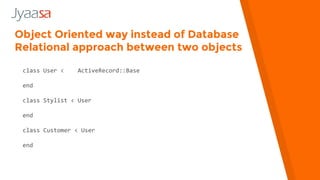
● Object Oriented way instead of Database
Relational approach between two objects
● Single table for multiple model
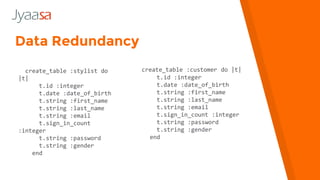
create_table :stylist do
|t|
t.id :integer
t.date :date_of_birth
t.string :first_name
t.string :last_name
t.string :email
t.sign_in_count
:integer
t.string :password
t.string :gender
end
Data Redundancy
create_table :customer do |t|
t.id :integer
t.date :date_of_birth
t.string :first_name
t.string :last_name
t.string :email
t.sign_in_count :integer
t.string :password
t.string :gender
end
class User < ActiveRecord::Base
end
class Stylist < User
end
class Customer < User
end
Object Oriented way instead of Database
Relational approach between two objects
What is Single Table Inheritance?
● STI allows you to create subclasses of a particular database
table.
● Eg: Parent class: user, Child class: stylist, customer
● Using a single table for multiple objects
When to Use STI
When there are two or more than two objects which have
same attributes but different behaviours.
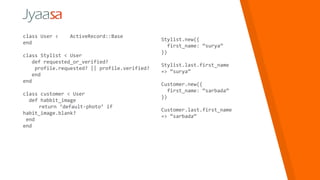
class User < ActiveRecord::Base
end
class Stylist < User
def requested_or_verified?
profile.requested? || profile.verified?
end
end
class customer < User
def habbit_image
return ‘default-photo’ if
habit_image.blank?
end
end
Stylist.new({
first_name: “surya”
})
Stylist.last.first_name
=> “surya”
Customer.new({
first_name: “sarbada”
})
Customer.last.first_name
=> “sarbada”
Benefits of STI
1. Simple approach
● Create a model class eg: stylist
● Inherit from a user
● Create a type field with string data type in user table
2. No more gems
3. OO way
4. Faster query
A single query in one table is enough for retrieving data.
3. DRY Principle
● DRY controller
● No redundant data in table
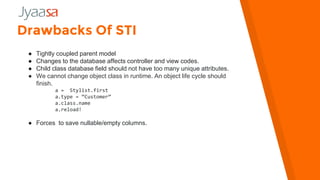
Drawbacks Of STI
● Tightly coupled parent model
● Changes to the database affects controller and view codes.
● Child class database field should not have too many unique attributes.
● We cannot change object class in runtime. An object life cycle should
finish.
a = Stylist.first
a.type = “Customer”
a.class.name
a.reload!
● Forces to save nullable/empty columns.
a.update_attributes(type:
"ShippingAddress", country: "Spain") #
=> true # but should be false
a.class.name # => "BillingAddress" #
But we wanted ShippingAddress
a.valid? # => true # but should be
false, we ship only to USA and Canada
class Address < ActiveRecord::Base
validates_presence_of :full_name,
:city, :street, :postal_code
end
class BillingAddress < Address
validates_presence_of :country
end
class ShippingAddress < Address
validates_inclusion_of :country,
in: %w(USA Canada)
end
Type Change Drawback
● Arkency Blog. 2016. Single Table Inheritance - Problems and solutions - Arkency
Blog. [ONLINE] Available at: http://blog.arkency.com/2013/07/sti/. [Accessed 20
June 2016].
● FutureLearn. 2016. Refactoring our Rails app out of single-table inheritance.
[ONLINE] Available at: https://about.futurelearn.com/blog/refactoring-rails-sti/.
[Accessed 20 June 2016].
● Eugene Wang. 2016. How (and When) to Use Single Table Inheritance in Rails -
eugenius. [ONLINE] Available at: http://eewang.github.io/blog/2013/03/12/how-and-
when-to-use-single-table-inheritance-in-rails/. [Accessed 20 June 2016].
References
Thank you

Single table inheritance

  • 1.
  • 2.
    Hi all, I amSurya Prasad Siwakoti Associate Software Engineer Jyaasa Technologies http://jyaasa.comCopyright 2016. Jyaasa Technologies.
  • 3.
    Objectives ● Introduction toSTI (Single Table Inheritance) ● When to use STI ● How to implement STI ● When not to use STI ● Demo
  • 4.
    Why Single TableInheritance ● Avoid Data Redundancy (DRY principle) ● Object Oriented way instead of Database Relational approach between two objects ● Single table for multiple model
  • 5.
    create_table :stylist do |t| t.id:integer t.date :date_of_birth t.string :first_name t.string :last_name t.string :email t.sign_in_count :integer t.string :password t.string :gender end Data Redundancy create_table :customer do |t| t.id :integer t.date :date_of_birth t.string :first_name t.string :last_name t.string :email t.sign_in_count :integer t.string :password t.string :gender end
  • 6.
    class User <ActiveRecord::Base end class Stylist < User end class Customer < User end Object Oriented way instead of Database Relational approach between two objects
  • 7.
    What is SingleTable Inheritance? ● STI allows you to create subclasses of a particular database table. ● Eg: Parent class: user, Child class: stylist, customer ● Using a single table for multiple objects
  • 8.
    When to UseSTI When there are two or more than two objects which have same attributes but different behaviours.
  • 9.
    class User <ActiveRecord::Base end class Stylist < User def requested_or_verified? profile.requested? || profile.verified? end end class customer < User def habbit_image return ‘default-photo’ if habit_image.blank? end end Stylist.new({ first_name: “surya” }) Stylist.last.first_name => “surya” Customer.new({ first_name: “sarbada” }) Customer.last.first_name => “sarbada”
  • 10.
    Benefits of STI 1.Simple approach ● Create a model class eg: stylist ● Inherit from a user ● Create a type field with string data type in user table 2. No more gems 3. OO way 4. Faster query A single query in one table is enough for retrieving data. 3. DRY Principle ● DRY controller ● No redundant data in table
  • 11.
    Drawbacks Of STI ●Tightly coupled parent model ● Changes to the database affects controller and view codes. ● Child class database field should not have too many unique attributes. ● We cannot change object class in runtime. An object life cycle should finish. a = Stylist.first a.type = “Customer” a.class.name a.reload! ● Forces to save nullable/empty columns.
  • 12.
    a.update_attributes(type: "ShippingAddress", country: "Spain")# => true # but should be false a.class.name # => "BillingAddress" # But we wanted ShippingAddress a.valid? # => true # but should be false, we ship only to USA and Canada class Address < ActiveRecord::Base validates_presence_of :full_name, :city, :street, :postal_code end class BillingAddress < Address validates_presence_of :country end class ShippingAddress < Address validates_inclusion_of :country, in: %w(USA Canada) end Type Change Drawback
  • 13.
    ● Arkency Blog.2016. Single Table Inheritance - Problems and solutions - Arkency Blog. [ONLINE] Available at: http://blog.arkency.com/2013/07/sti/. [Accessed 20 June 2016]. ● FutureLearn. 2016. Refactoring our Rails app out of single-table inheritance. [ONLINE] Available at: https://about.futurelearn.com/blog/refactoring-rails-sti/. [Accessed 20 June 2016]. ● Eugene Wang. 2016. How (and When) to Use Single Table Inheritance in Rails - eugenius. [ONLINE] Available at: http://eewang.github.io/blog/2013/03/12/how-and- when-to-use-single-table-inheritance-in-rails/. [Accessed 20 June 2016]. References
  • 15.