Singapore
“The Rise of the Southeast”
A study of:
 Inflation
 Growth
 Human Development Index (HDI)
 International Trade
 Balance of Payments
DONE BY:
ZYAD AHMED MOHAMMED
BU-2011-014
FACULTY OF BUSINESS ADMIN.
UMST-SUDAN
Singapore Economic Overview
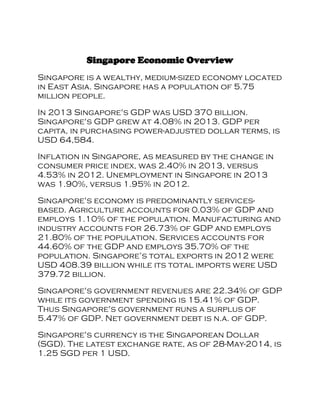
Singapore is a wealthy, medium-sized economy located
in East Asia. Singapore has a population of 5.75
million people.
In 2013 Singapore's GDP was USD 370 billion.
Singapore's GDP grew at 4.08% in 2013. GDP per
capita, in purchasing power-adjusted dollar terms, is
USD 64,584.
Inflation in Singapore, as measured by the change in
consumer price index, was 2.40% in 2013, versus
4.53% in 2012. Unemployment in Singapore in 2013
was 1.90%, versus 1.95% in 2012.
Singapore's economy is predominantly services-
based. Agriculture accounts for 0.03% of GDP and
employs 1.10% of the population. Manufacturing and
industry accounts for 26.73% of GDP and employs
21.80% of the population. Services accounts for
44.60% of the GDP and employs 35.70% of the
population. Singapore’s total exports in 2012 were
USD 408.39 billion while its total imports were USD
379.72 billion.
Singapore's government revenues are 22.34% of GDP
while its government spending is 15.41% of GDP.
Thus Singapore's government runs a surplus of
5.47% of GDP. Net government debt is n.a. of GDP.
Singapore's currency is the Singaporean Dollar
(SGD). The latest exchange rate, as of 28-May-2014, is
1.25 SGD per 1 USD.
Growth
Indicator Level Units
As
Of
1Y
Chg
~5Y
Ago
~10Y
Ago
~25Y
Ago
GDP 370
Billion
LCU
2013 n.a. 277 190 61
Real GDP Growth 4.08%
% Chg
YOY
2013 2.18% -0.60% 9.16% 10.23%
GDP Per Capita 68,541 USD 2013 2.49% 55,457 45,716 20,897
GDP Per Capita at
PPP
64,584
USD at
PPP
2013 3.95% 50,712 41,289 16,356
GDP as Share of
World GDP at PPP
0.40%
% of World
GDP
2013 0.01% 0.36% 0.32% 0.22%
Real GDP 325
Billion
LCU
2013 4.07% 251 194 75
Inflation
Indicator Level Units As Of 1Y Chg ~5Y Ago
~10Y
Ago
~25Y
Ago
Change in
Consumer
Price Index
2.40%
% Chg
YOY
2013 -2.13% 0.60% 1.66% 2.35%
GDP
Deflator
2.09%
% Chg
YOY
2012 1.52% -1.13% -1.51% 5.70%
Broad
Money M2
137.57%
% of
GDP
2012 4.87% 123.64% 116.54% 78.99%
Private
Sector
Credit
120.57%
% of
GDP
2012 10.45% 99.42% 106.63% 76.56%
Human Development Index (HDI)
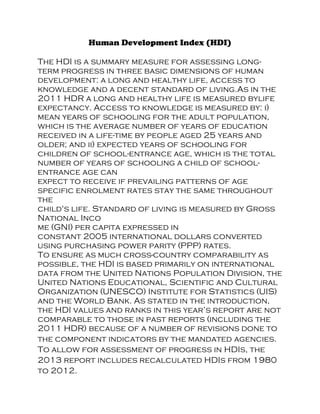
The HDI is a summary measure for assessing long-
term progress in three basic dimensions of human
development: a long and healthy life, access to
knowledge and a decent standard of living.As in the
2011 HDR a long and healthy life is measured bylife
expectancy. Access to knowledge is measured by: i)
mean years of schooling for the adult population,
which is the average number of years of education
received in a life-time by people aged 25 years and
older; and ii) expected years of schooling for
children of school-entrance age, which is the total
number of years of schooling a child of school-
entrance age can
expect to receive if prevailing patterns of age
specific enrolment rates stay the same throughout
the
child's life. Standard of living is measured by Gross
National Inco
me (GNI) per capita expressed in
constant 2005 international dollars converted
using purchasing power parity (PPP) rates.
To ensure as much cross-country comparability as
possible, the HDI is based primarily on international
data from the United Nations Population Division, the
United Nations Educational, Scientific and Cultural
Organization (UNESCO) Institute for Statistics (UIS)
and the World Bank. As stated in the introduction,
the HDI values and ranks in this year’s report are not
comparable to those in past reports (including the
2011 HDR) because of a number of revisions done to
the component indicators by the mandated agencies.
To allow for assessment of progress in HDIs, the
2013 report includes recalculated HDIs from 1980
to 2012.
International Trade
Indicator Level Units
As
Of
1Y
Chg
~5Y
Ago
~10Y
Ago
~25Y
Ago
vs
World
Imports 379.72
Billion
USD
2012 3.81% 319.78 136.26 n.a.
Exports 408.39
Billion
USD
2012 -0.27% 338.18 159.96 n.a.
Total Reserves 274.27
Billion
USD
2013 5.86% 187.59 112.37 n.a.
FDI Inbound n.a.
Billion
USD
n.a. n.a. n.a. n.a. n.a.
FDI Outbound n.a.
Billion
USD
n.a. n.a. n.a. n.a. n.a.
Imports as Share of
GDP
178.49% % of GDP 2012 -1.08% 211.23% 179.54% 175.63%
Exports as Share of
GDP
200.66% % of GDP 2012 -6.53% 232.87% 207.42% 185.22%
Balance of Payments
Indicator Level Units
As
Of
1Y
Chg
~5Y
Ago
~10Y
Ago
~25Y
Ago
vs
World
Trade Balance 60.90
Billion
USD
2012
-
10.00%
38.73 26.03 2.43
Current Account Balance 54.40
Billion
USD
2013 10.15% 32.70 19.30 2.95
External Debt n.a.
Billion
USD
n.a. n.a. n.a. n.a. n.a.
Trade Balance as Share
of GDP
22.17%
% of
GDP
2012 -5.45% 21.64% 27.88% 9.59%
Current Account Balance
as Share of GDP
18.39%
% of
GDP
2013 1.02% 17.19% 17.13% 9.38%
External Debt as Share
of GDP
n.a.
% of
GDP
n.a. n.a. n.a. n.a. n.a.
About Singapore Economic Indicators
This page shows major economic indicators for
Singapore.
Click on any indicator on this page to see a time
series of that indicator, along with options for
graphing, downloading and validating the underlying
data.
For any indicator, click on the vs World icon to see
the value of that indicator across 200+ countries.
Indicators are grouped by theme.
Bio:
1. http://www.quandl.com/singapore/singapore-
economy-data
2. The Rise of the South:
Human Progress in a Diverse World _UNDP

Singapore development

  • 1.
    Singapore “The Rise ofthe Southeast” A study of:  Inflation  Growth  Human Development Index (HDI)  International Trade  Balance of Payments DONE BY: ZYAD AHMED MOHAMMED BU-2011-014 FACULTY OF BUSINESS ADMIN. UMST-SUDAN
  • 2.
    Singapore Economic Overview Singaporeis a wealthy, medium-sized economy located in East Asia. Singapore has a population of 5.75 million people. In 2013 Singapore's GDP was USD 370 billion. Singapore's GDP grew at 4.08% in 2013. GDP per capita, in purchasing power-adjusted dollar terms, is USD 64,584. Inflation in Singapore, as measured by the change in consumer price index, was 2.40% in 2013, versus 4.53% in 2012. Unemployment in Singapore in 2013 was 1.90%, versus 1.95% in 2012. Singapore's economy is predominantly services- based. Agriculture accounts for 0.03% of GDP and employs 1.10% of the population. Manufacturing and industry accounts for 26.73% of GDP and employs 21.80% of the population. Services accounts for 44.60% of the GDP and employs 35.70% of the population. Singapore’s total exports in 2012 were USD 408.39 billion while its total imports were USD 379.72 billion. Singapore's government revenues are 22.34% of GDP while its government spending is 15.41% of GDP. Thus Singapore's government runs a surplus of 5.47% of GDP. Net government debt is n.a. of GDP. Singapore's currency is the Singaporean Dollar (SGD). The latest exchange rate, as of 28-May-2014, is 1.25 SGD per 1 USD.
  • 3.
    Growth Indicator Level Units As Of 1Y Chg ~5Y Ago ~10Y Ago ~25Y Ago GDP370 Billion LCU 2013 n.a. 277 190 61 Real GDP Growth 4.08% % Chg YOY 2013 2.18% -0.60% 9.16% 10.23% GDP Per Capita 68,541 USD 2013 2.49% 55,457 45,716 20,897 GDP Per Capita at PPP 64,584 USD at PPP 2013 3.95% 50,712 41,289 16,356 GDP as Share of World GDP at PPP 0.40% % of World GDP 2013 0.01% 0.36% 0.32% 0.22% Real GDP 325 Billion LCU 2013 4.07% 251 194 75 Inflation Indicator Level Units As Of 1Y Chg ~5Y Ago ~10Y Ago ~25Y Ago Change in Consumer Price Index 2.40% % Chg YOY 2013 -2.13% 0.60% 1.66% 2.35% GDP Deflator 2.09% % Chg YOY 2012 1.52% -1.13% -1.51% 5.70% Broad Money M2 137.57% % of GDP 2012 4.87% 123.64% 116.54% 78.99% Private Sector Credit 120.57% % of GDP 2012 10.45% 99.42% 106.63% 76.56%
  • 4.
    Human Development Index(HDI) The HDI is a summary measure for assessing long- term progress in three basic dimensions of human development: a long and healthy life, access to knowledge and a decent standard of living.As in the 2011 HDR a long and healthy life is measured bylife expectancy. Access to knowledge is measured by: i) mean years of schooling for the adult population, which is the average number of years of education received in a life-time by people aged 25 years and older; and ii) expected years of schooling for children of school-entrance age, which is the total number of years of schooling a child of school- entrance age can expect to receive if prevailing patterns of age specific enrolment rates stay the same throughout the child's life. Standard of living is measured by Gross National Inco me (GNI) per capita expressed in constant 2005 international dollars converted using purchasing power parity (PPP) rates. To ensure as much cross-country comparability as possible, the HDI is based primarily on international data from the United Nations Population Division, the United Nations Educational, Scientific and Cultural Organization (UNESCO) Institute for Statistics (UIS) and the World Bank. As stated in the introduction, the HDI values and ranks in this year’s report are not comparable to those in past reports (including the 2011 HDR) because of a number of revisions done to the component indicators by the mandated agencies. To allow for assessment of progress in HDIs, the 2013 report includes recalculated HDIs from 1980 to 2012.
  • 5.
    International Trade Indicator LevelUnits As Of 1Y Chg ~5Y Ago ~10Y Ago ~25Y Ago vs World Imports 379.72 Billion USD 2012 3.81% 319.78 136.26 n.a. Exports 408.39 Billion USD 2012 -0.27% 338.18 159.96 n.a. Total Reserves 274.27 Billion USD 2013 5.86% 187.59 112.37 n.a. FDI Inbound n.a. Billion USD n.a. n.a. n.a. n.a. n.a. FDI Outbound n.a. Billion USD n.a. n.a. n.a. n.a. n.a. Imports as Share of GDP 178.49% % of GDP 2012 -1.08% 211.23% 179.54% 175.63% Exports as Share of GDP 200.66% % of GDP 2012 -6.53% 232.87% 207.42% 185.22% Balance of Payments Indicator Level Units As Of 1Y Chg ~5Y Ago ~10Y Ago ~25Y Ago vs World Trade Balance 60.90 Billion USD 2012 - 10.00% 38.73 26.03 2.43 Current Account Balance 54.40 Billion USD 2013 10.15% 32.70 19.30 2.95 External Debt n.a. Billion USD n.a. n.a. n.a. n.a. n.a. Trade Balance as Share of GDP 22.17% % of GDP 2012 -5.45% 21.64% 27.88% 9.59% Current Account Balance as Share of GDP 18.39% % of GDP 2013 1.02% 17.19% 17.13% 9.38% External Debt as Share of GDP n.a. % of GDP n.a. n.a. n.a. n.a. n.a.
  • 6.
    About Singapore EconomicIndicators This page shows major economic indicators for Singapore. Click on any indicator on this page to see a time series of that indicator, along with options for graphing, downloading and validating the underlying data. For any indicator, click on the vs World icon to see the value of that indicator across 200+ countries. Indicators are grouped by theme. Bio: 1. http://www.quandl.com/singapore/singapore- economy-data 2. The Rise of the South: Human Progress in a Diverse World _UNDP