


CASE STUDY ON
Depreciation at
Delta Airlines and
Singapore Airlines
BY :- NAKUL DEV GAUR
CMBA5
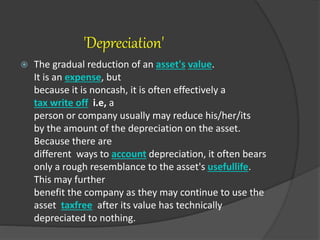
'Depreciation'
 The gradual reduction of an asset's value.
It is an expense, but
because it is noncash, it is often effectively a
tax write off i.e, a
person or company usually may reduce his/her/its
by the amount of the depreciation on the asset.
Because there are
different ways to account depreciation, it often bears
only a rough resemblance to the asset's usefullife.
This may further
benefit the company as they may continue to use the
asset taxfree after its value has technically
depreciated to nothing.
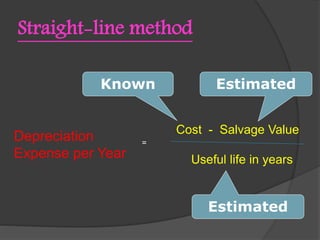
Straight-line method
Depreciation
Expense per Year
Cost - Salvage Value
Useful life in years
=
Known Estimated
Estimated
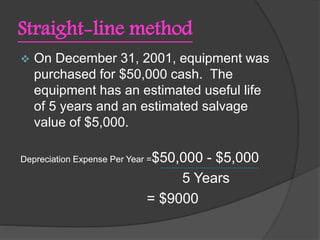
Straight-line method
 On December 31, 2001, equipment was
purchased for $50,000 cash. The
equipment has an estimated useful life
of 5 years and an estimated salvage
value of $5,000.
Depreciation Expense Per Year =$50,000 - $5,000
5 Years
= $9000
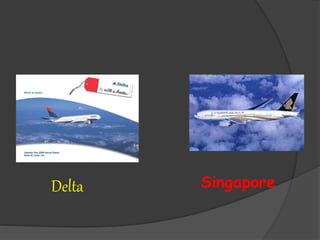
Delta Singapore
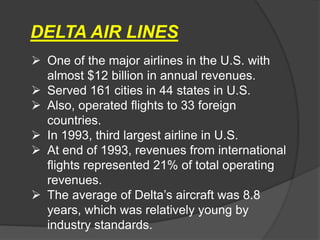
 One of the major airlines in the U.S. with
almost $12 billion in annual revenues.
 Served 161 cities in 44 states in U.S.
 Also, operated flights to 33 foreign
countries.
 In 1993, third largest airline in U.S.
 At end of 1993, revenues from international
flights represented 21% of total operating
revenues.
 The average of Delta’s aircraft was 8.8
years, which was relatively young by
industry standards.
DELTA AIR LINES
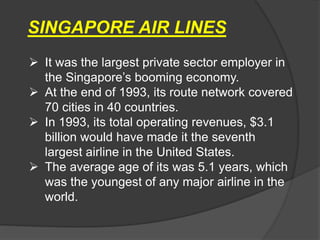
SINGAPORE AIR LINES
 It was the largest private sector employer in
the Singapore’s booming economy.
 At the end of 1993, its route network covered
70 cities in 40 countries.
 In 1993, its total operating revenues, $3.1
billion would have made it the seventh
largest airline in the United States.
 The average age of its was 5.1 years, which
was the youngest of any major airline in the
world.
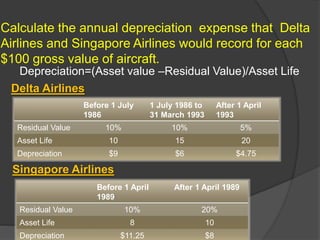
Calculate the annual depreciation expense that Delta
Airlines and Singapore Airlines would record for each
$100 gross value of aircraft.
Delta Airlines
Depreciation=(Asset value –Residual Value)/Asset Life
Before 1 July
1986
1 July 1986 to
31 March 1993
After 1 April
1993
Residual Value 10% 10% 5%
Asset Life 10 15 20
Depreciation $9 $6 $4.75
Before 1 April
1989
After 1 April 1989
Residual Value 10% 20%
Asset Life 8 10
Depreciation $11.25 $8
Singapore Airlines
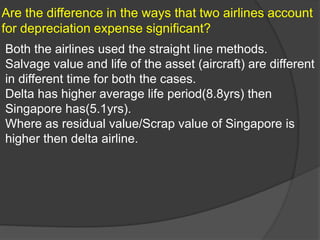
Are the difference in the ways that two airlines account
for depreciation expense significant?
Both the airlines used the straight line methods.
Salvage value and life of the asset (aircraft) are different
in different time for both the cases.
Delta has higher average life period(8.8yrs) then
Singapore has(5.1yrs).
Where as residual value/Scrap value of Singapore is
higher then delta airline.
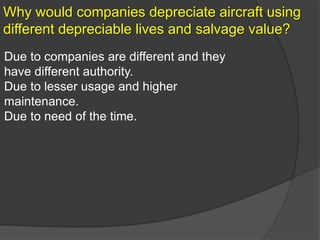
Why would companies depreciate aircraft using
different depreciable lives and salvage value?
Due to companies are different and they
have different authority.
Due to lesser usage and higher
maintenance.
Due to need of the time.
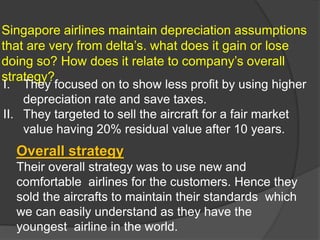
Singapore airlines maintain depreciation assumptions
that are very from delta’s. what does it gain or lose
doing so? How does it relate to company’s overall
strategy?
I. They focused on to show less profit by using higher
depreciation rate and save taxes.
II. They targeted to sell the aircraft for a fair market
value having 20% residual value after 10 years.
Overall strategy
Their overall strategy was to use new and
comfortable airlines for the customers. Hence they
sold the aircrafts to maintain their standards which
we can easily understand as they have the
youngest airline in the world.
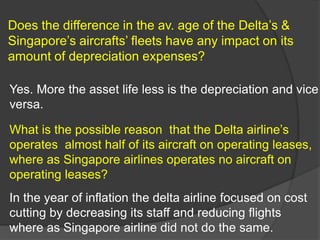
Does the difference in the av. age of the Delta’s &
Singapore’s aircrafts’ fleets have any impact on its
amount of depreciation expenses?
Yes. More the asset life less is the depreciation and vice
versa.
What is the possible reason that the Delta airline’s
operates almost half of its aircraft on operating leases,
where as Singapore airlines operates no aircraft on
operating leases?
In the year of inflation the delta airline focused on cost
cutting by decreasing its staff and reducing flights
where as Singapore airline did not do the same.
Comparable study between the 2 airlines on assets,
long term debt and depreciation expenses in the year
1993.
Delta Airline Singapore Airline
Total assets
(in $ millions)
11871 9417
Long term debt
(in $ millions)
3717 0
Depreciation expenses
(in $ millions)
679 708
Thank You

Singapore & Delta Airlines.

  • 1.
    CASE STUDY ON Depreciationat Delta Airlines and Singapore Airlines BY :- NAKUL DEV GAUR CMBA5
  • 2.
    'Depreciation'  The gradualreduction of an asset's value. It is an expense, but because it is noncash, it is often effectively a tax write off i.e, a person or company usually may reduce his/her/its by the amount of the depreciation on the asset. Because there are different ways to account depreciation, it often bears only a rough resemblance to the asset's usefullife. This may further benefit the company as they may continue to use the asset taxfree after its value has technically depreciated to nothing.
  • 3.
    Straight-line method Depreciation Expense perYear Cost - Salvage Value Useful life in years = Known Estimated Estimated
  • 4.
    Straight-line method  OnDecember 31, 2001, equipment was purchased for $50,000 cash. The equipment has an estimated useful life of 5 years and an estimated salvage value of $5,000. Depreciation Expense Per Year =$50,000 - $5,000 5 Years = $9000
  • 5.
  • 6.
     One ofthe major airlines in the U.S. with almost $12 billion in annual revenues.  Served 161 cities in 44 states in U.S.  Also, operated flights to 33 foreign countries.  In 1993, third largest airline in U.S.  At end of 1993, revenues from international flights represented 21% of total operating revenues.  The average of Delta’s aircraft was 8.8 years, which was relatively young by industry standards. DELTA AIR LINES
  • 7.
    SINGAPORE AIR LINES It was the largest private sector employer in the Singapore’s booming economy.  At the end of 1993, its route network covered 70 cities in 40 countries.  In 1993, its total operating revenues, $3.1 billion would have made it the seventh largest airline in the United States.  The average age of its was 5.1 years, which was the youngest of any major airline in the world.
  • 8.
    Calculate the annualdepreciation expense that Delta Airlines and Singapore Airlines would record for each $100 gross value of aircraft. Delta Airlines Depreciation=(Asset value –Residual Value)/Asset Life Before 1 July 1986 1 July 1986 to 31 March 1993 After 1 April 1993 Residual Value 10% 10% 5% Asset Life 10 15 20 Depreciation $9 $6 $4.75 Before 1 April 1989 After 1 April 1989 Residual Value 10% 20% Asset Life 8 10 Depreciation $11.25 $8 Singapore Airlines
  • 9.
    Are the differencein the ways that two airlines account for depreciation expense significant? Both the airlines used the straight line methods. Salvage value and life of the asset (aircraft) are different in different time for both the cases. Delta has higher average life period(8.8yrs) then Singapore has(5.1yrs). Where as residual value/Scrap value of Singapore is higher then delta airline.
  • 10.
    Why would companiesdepreciate aircraft using different depreciable lives and salvage value? Due to companies are different and they have different authority. Due to lesser usage and higher maintenance. Due to need of the time.
  • 11.
    Singapore airlines maintaindepreciation assumptions that are very from delta’s. what does it gain or lose doing so? How does it relate to company’s overall strategy? I. They focused on to show less profit by using higher depreciation rate and save taxes. II. They targeted to sell the aircraft for a fair market value having 20% residual value after 10 years. Overall strategy Their overall strategy was to use new and comfortable airlines for the customers. Hence they sold the aircrafts to maintain their standards which we can easily understand as they have the youngest airline in the world.
  • 12.
    Does the differencein the av. age of the Delta’s & Singapore’s aircrafts’ fleets have any impact on its amount of depreciation expenses? Yes. More the asset life less is the depreciation and vice versa. What is the possible reason that the Delta airline’s operates almost half of its aircraft on operating leases, where as Singapore airlines operates no aircraft on operating leases? In the year of inflation the delta airline focused on cost cutting by decreasing its staff and reducing flights where as Singapore airline did not do the same.
  • 13.
    Comparable study betweenthe 2 airlines on assets, long term debt and depreciation expenses in the year 1993. Delta Airline Singapore Airline Total assets (in $ millions) 11871 9417 Long term debt (in $ millions) 3717 0 Depreciation expenses (in $ millions) 679 708
  • 14.