sinatra,
         rack &
         middleware

This is made “soon after” railsconf, so you’ll just have to deal with the railsconf references
sinatra,
         rack &
         middleware
        Ben Schwarz
        @benschwarz
        http://github.com/benschwarz

This is made “soon after” railsconf, so you’ll just have to deal with the railsconf references
sinatra
from the top
... is fucking sweet
DSL
Built on Rack
More on that later
Blake Mizerany
  @bmizerany
Ever wondered what Blake Mizerany
looks like at 8 am after a huge
fucking bender in “old” vegas?
Eyyeaahh.
So, that DSL
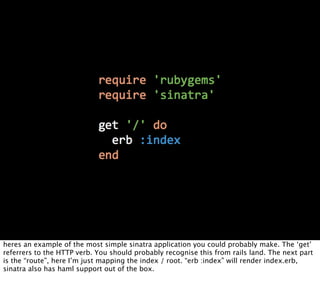
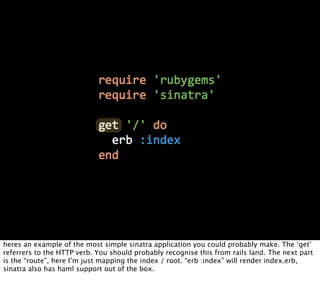
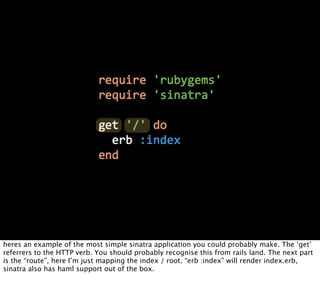
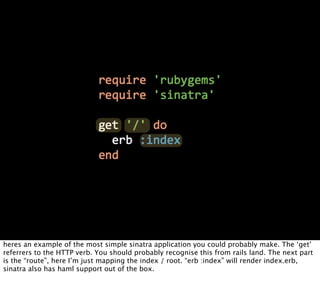
heres an example of the most simple sinatra application you could probably make. The ‘get’

referrers to the HTTP verb. You should probably recognise this from rails land. The next part

is the “route”, here I’m just mapping the index / root. “erb :index” will render index.erb,
sinatra also has haml support out of the box.
heres an example of the most simple sinatra application you could probably make. The ‘get’
referrers to the HTTP verb. You should probably recognise this from rails land. The next part
is the “route”, here I’m just mapping the index / root. “erb :index” will render index.erb,
sinatra also has haml support out of the box.
heres an example of the most simple sinatra application you could probably make. The ‘get’
referrers to the HTTP verb. You should probably recognise this from rails land. The next part
is the “route”, here I’m just mapping the index / root. “erb :index” will render index.erb,
sinatra also has haml support out of the box.
heres an example of the most simple sinatra application you could probably make. The ‘get’
referrers to the HTTP verb. You should probably recognise this from rails land. The next part
is the “route”, here I’m just mapping the index / root. “erb :index” will render index.erb,
sinatra also has haml support out of the box.
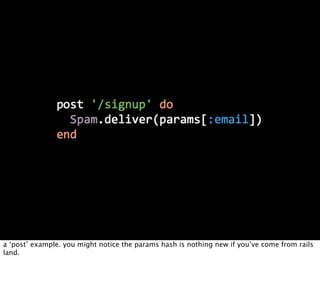
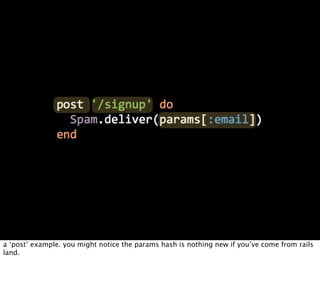
a ‘post’ example. you might notice the params hash is nothing new if you’ve come from rails
land.
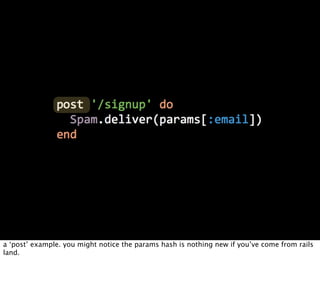
a ‘post’ example. you might notice the params hash is nothing new if you’ve come from rails
land.
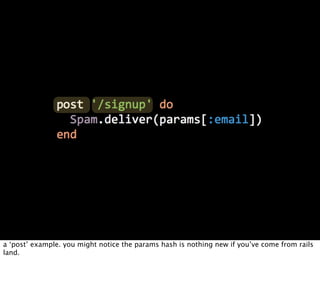
a ‘post’ example. you might notice the params hash is nothing new if you’ve come from rails
land.
a ‘post’ example. you might notice the params hash is nothing new if you’ve come from rails
land.
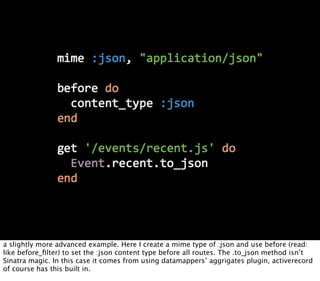
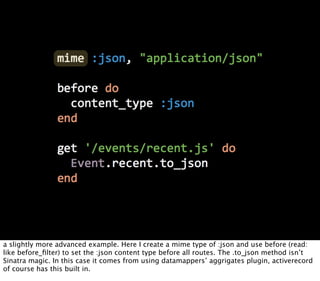
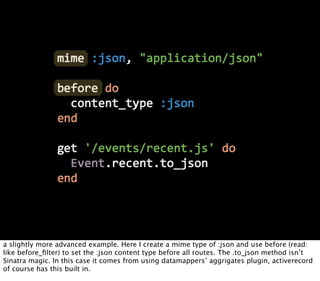
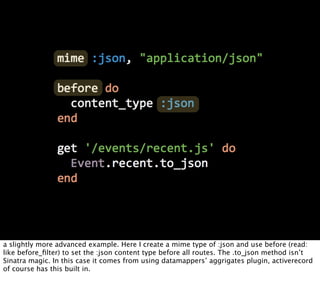
a slightly more advanced example. Here I create a mime type of :json and use before (read:
like before_filter) to set the :json content type before all routes. The .to_json method isn’t
Sinatra magic. In this case it comes from using datamappers’ aggrigates plugin, activerecord
of course has this built in.
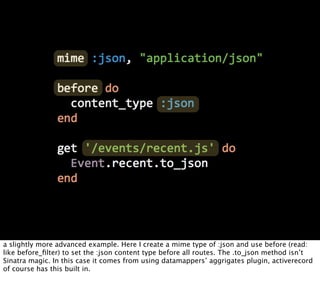
a slightly more advanced example. Here I create a mime type of :json and use before (read:
like before_filter) to set the :json content type before all routes. The .to_json method isn’t
Sinatra magic. In this case it comes from using datamappers’ aggrigates plugin, activerecord
of course has this built in.
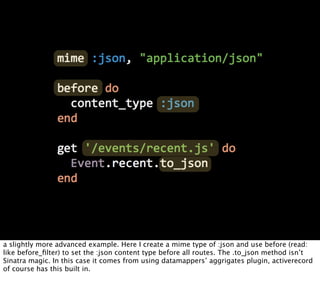
a slightly more advanced example. Here I create a mime type of :json and use before (read:
like before_filter) to set the :json content type before all routes. The .to_json method isn’t
Sinatra magic. In this case it comes from using datamappers’ aggrigates plugin, activerecord
of course has this built in.
a slightly more advanced example. Here I create a mime type of :json and use before (read:
like before_filter) to set the :json content type before all routes. The .to_json method isn’t
Sinatra magic. In this case it comes from using datamappers’ aggrigates plugin, activerecord
of course has this built in.
a slightly more advanced example. Here I create a mime type of :json and use before (read:
like before_filter) to set the :json content type before all routes. The .to_json method isn’t
Sinatra magic. In this case it comes from using datamappers’ aggrigates plugin, activerecord
of course has this built in.
a slightly more advanced example. Here I create a mime type of :json and use before (read:
like before_filter) to set the :json content type before all routes. The .to_json method isn’t
Sinatra magic. In this case it comes from using datamappers’ aggrigates plugin, activerecord
of course has this built in.
This is called “Classic”
        Sinatra application style


This means that the get and post (read: your application) is defined at the top level
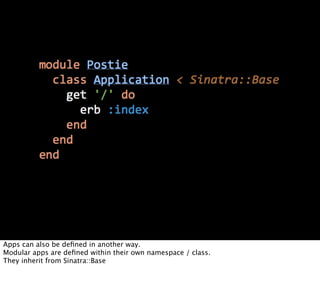
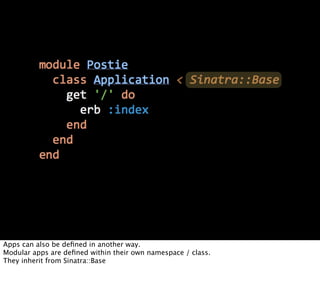
Apps can also be defined in another way.
Modular apps are defined within their own namespace / class.
They inherit from Sinatra::Base
Apps can also be defined in another way.
Modular apps are defined within their own namespace / class.
They inherit from Sinatra::Base
Thats a “Modular”
         Sinatra application


I’ll get into modular apps a little more later
Running it


So by now, if you’re unfamiliar with rack or sinatra you’ll might be thinking, “but we just got
passenger, ruby hosting has only now become ‘easy’”
Development
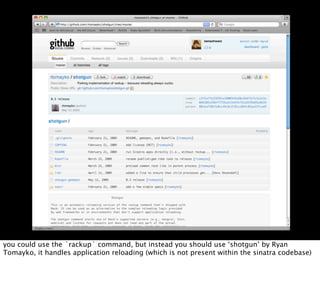
you could use the `rackup` command, but instead you should use ‘shotgun’ by Ryan
Tomayko, it handles application reloading (which is not present within the sinatra codebase)
Ryan Tomayko
  @rtomayko
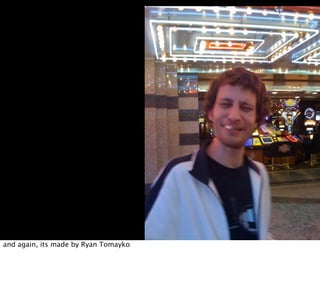
Ever wondered what Ryan Tomayko
looks like at 8 am after a huge
fucking bender in “old” vegas?
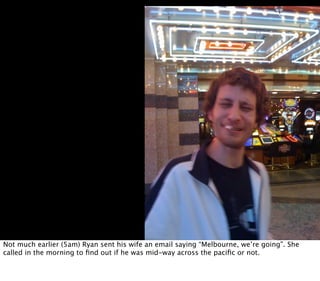
Not much earlier (5am) Ryan sent his wife an email saying “Melbourne, we’re going”. She
called in the morning to find out if he was mid-way across the pacific or not.
Production
Drop in a config.ru to
        your application root


config.Rack-Up, rack uses this to load and configure rack applications and middleware
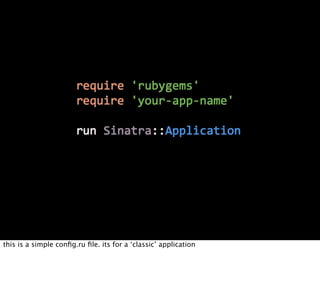
this is a simple config.ru file. its for a ‘classic’ application
For those “Modular”
applications
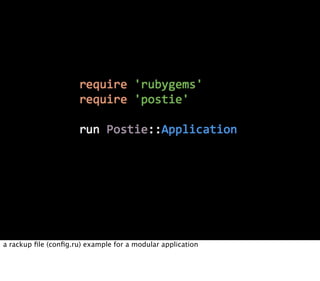
a rackup file (config.ru) example for a modular application
Then drop it under
        passenger. Done


Of course you’ll need to read some docs, but its so trivial its not even worth mentioning
Heres the part where I
        hock my own warez


Just some assorted things that I have found really fun or interesting in the last few months
Amnesia
Statistics for memcached instances
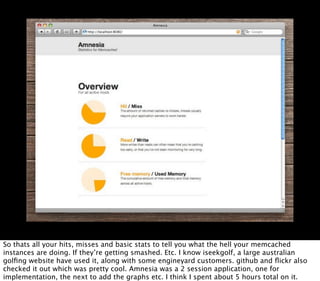
So thats all your hits, misses and basic stats to tell you what the hell your memcached
instances are doing. If they’re getting smashed. Etc. I know iseekgolf, a large australian
golfing website have used it, along with some engineyard customers. github and flickr also
checked it out which was pretty cool. Amnesia was a 2 session application, one for
implementation, the next to add the graphs etc. I think I spent about 5 hours total on it.
Munch
         Recipes from websites re-represented


I showed this last month, its pretty simple so I’ll gloss over it.
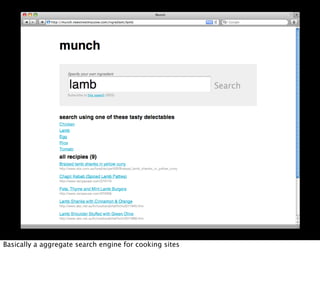
Basically a aggregate search engine for cooking sites
Postie


Postie was originally a rails app, ported to merb
Pat Allan
                       @pat


Pat allan wrote it
Postie
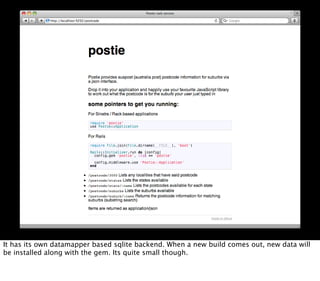
        A Rack middleware to provide postcode services


I decided to make the next natural progression and re-write it as a rack middleware
It has its own datamapper based sqlite backend. When a new build comes out, new data will
be installed along with the gem. Its quite small though.
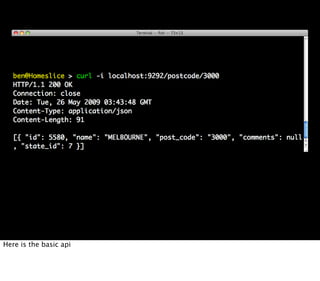
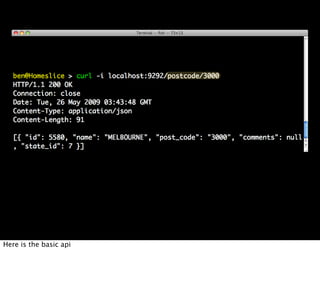
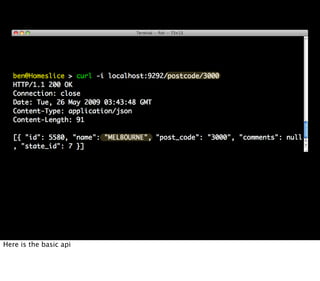
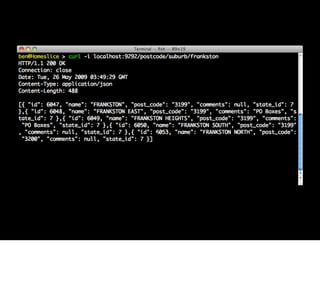
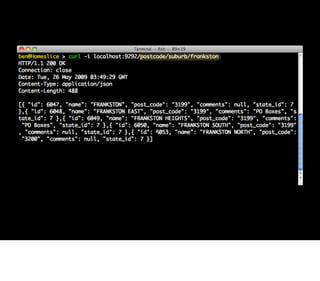
Here is the basic api
Hold on, rack
         middleware?


If you thought we were talking about sinatra, well, you’re right.
So how does that work?
Sinatra runs on Rack
Sinatra (wolf)
        Rack (sheeps clothing)


This is a strange analogy. I don’t know.
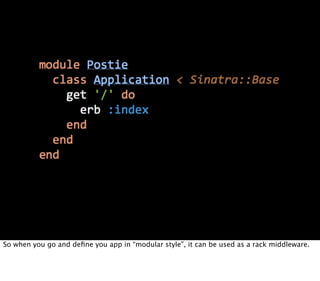
So when you go and define you app in “modular style”, it can be used as a rack middleware.
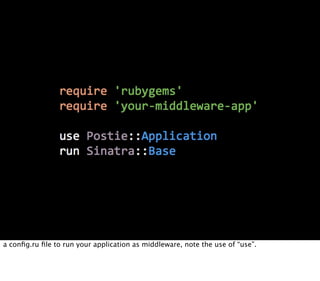
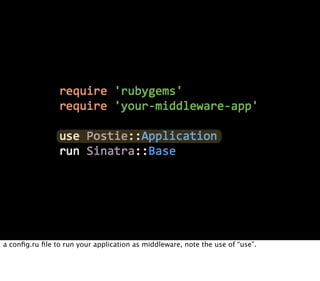
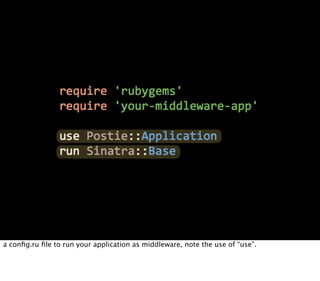
a config.ru file to run your application as middleware, note the use of “use”.
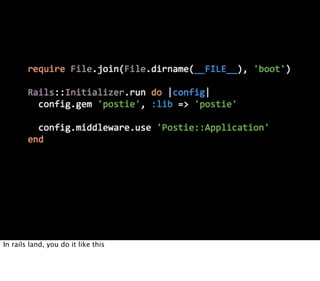
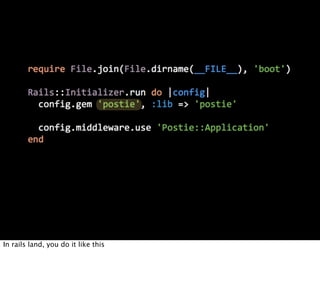
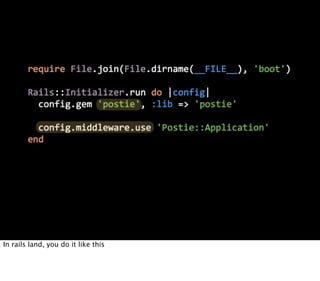
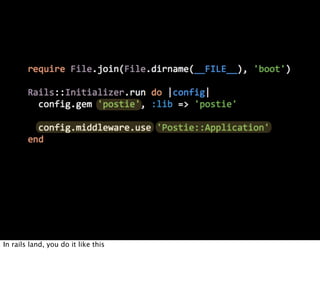
In rails land, you do it like this
Selected
middlewares
Rack::Cache
and again, its made by Ryan Tomayko
Reverse proxy
         Like Squid or Varnish, but small and simple


It’ll set correct http headers. Thats really important. The main basis of this is that your
application pages can be cached by rack::cache and stop requests from even having to hit
your ruby process.
JSON-P


Json-p is for when you want to get callbacks for your json / ajax requests from your server.
The data will be returned wrapped within a callback method. This can make writing a
javascript based interface much faster and easier to implement.
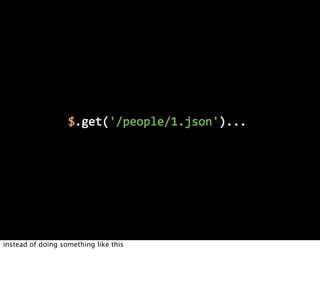
instead of doing something like this
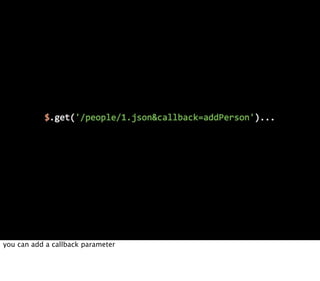
you can add a callback parameter
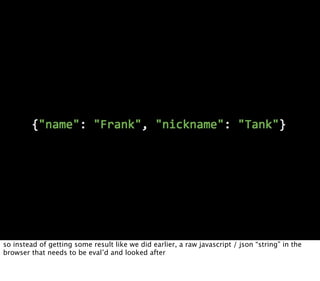
so instead of getting some result like we did earlier, a raw javascript / json “string” in the
browser that needs to be eval’d and looked after
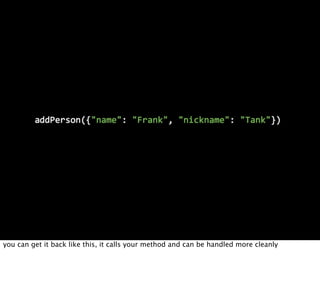
you can get it back like this, it calls your method and can be handled more cleanly
JSON-P
        part of rack-contrib


Json-p is for when you want to get callbacks for your json / ajax requests from your server.
The data will be returned wrapped within a callback method. This can make writing a
javascript based interface much faster and easier to implement.
Hancock


The last one I’ll show is “hancock”
A REAL implementation
        of single-sign-on


Engine yard are using this internally and I really suggest that you read the code. There are
some videos available online and it stands as the best example of sinatra based rack
middleware. Hancock was the only real implementation of a sinatra based rack middleware
that he sinatra committers could point me at. I used it as a basis for learning how to pack
postie together.
Thanks

Special Thanks to Blake and Ryan for being good sports.
Thanks
                     http://sinatrarb.com
                     http://twitter.com/bmizerany
                     http://twitter.com/rtomayko
                     http://github.com/benschwarz/amnesia
                     http://github.com/benschwarz/munch
                     http://github.com/benschwarz/postie
                     http://github.com/rtomayko/shotgun
                     http://github.com/rack/rack-contrib
                     http://github.com/atmos/hancock/tree/master
                     http://github.com/atmos/hancock-client/tree/master
                     http://en.wikipedia.org/wiki/Single_sign-on


Special Thanks to Blake and Ryan for being good sports.

Sinatra Rack And Middleware

  • 1.
    sinatra, rack & middleware This is made “soon after” railsconf, so you’ll just have to deal with the railsconf references
  • 2.
    sinatra, rack & middleware Ben Schwarz @benschwarz http://github.com/benschwarz This is made “soon after” railsconf, so you’ll just have to deal with the railsconf references
  • 3.
  • 4.
  • 5.
  • 6.
  • 7.
    Built on Rack Moreon that later
  • 8.
    Blake Mizerany @bmizerany
  • 9.
    Ever wondered whatBlake Mizerany looks like at 8 am after a huge fucking bender in “old” vegas?
  • 11.
  • 12.
  • 13.
    heres an exampleof the most simple sinatra application you could probably make. The ‘get’ referrers to the HTTP verb. You should probably recognise this from rails land. The next part is the “route”, here I’m just mapping the index / root. “erb :index” will render index.erb, sinatra also has haml support out of the box.
  • 14.
    heres an exampleof the most simple sinatra application you could probably make. The ‘get’ referrers to the HTTP verb. You should probably recognise this from rails land. The next part is the “route”, here I’m just mapping the index / root. “erb :index” will render index.erb, sinatra also has haml support out of the box.
  • 15.
    heres an exampleof the most simple sinatra application you could probably make. The ‘get’ referrers to the HTTP verb. You should probably recognise this from rails land. The next part is the “route”, here I’m just mapping the index / root. “erb :index” will render index.erb, sinatra also has haml support out of the box.
  • 16.
    heres an exampleof the most simple sinatra application you could probably make. The ‘get’ referrers to the HTTP verb. You should probably recognise this from rails land. The next part is the “route”, here I’m just mapping the index / root. “erb :index” will render index.erb, sinatra also has haml support out of the box.
  • 17.
    a ‘post’ example.you might notice the params hash is nothing new if you’ve come from rails land.
  • 18.
    a ‘post’ example.you might notice the params hash is nothing new if you’ve come from rails land.
  • 19.
    a ‘post’ example.you might notice the params hash is nothing new if you’ve come from rails land.
  • 20.
    a ‘post’ example.you might notice the params hash is nothing new if you’ve come from rails land.
  • 21.
    a slightly moreadvanced example. Here I create a mime type of :json and use before (read: like before_filter) to set the :json content type before all routes. The .to_json method isn’t Sinatra magic. In this case it comes from using datamappers’ aggrigates plugin, activerecord of course has this built in.
  • 22.
    a slightly moreadvanced example. Here I create a mime type of :json and use before (read: like before_filter) to set the :json content type before all routes. The .to_json method isn’t Sinatra magic. In this case it comes from using datamappers’ aggrigates plugin, activerecord of course has this built in.
  • 23.
    a slightly moreadvanced example. Here I create a mime type of :json and use before (read: like before_filter) to set the :json content type before all routes. The .to_json method isn’t Sinatra magic. In this case it comes from using datamappers’ aggrigates plugin, activerecord of course has this built in.
  • 24.
    a slightly moreadvanced example. Here I create a mime type of :json and use before (read: like before_filter) to set the :json content type before all routes. The .to_json method isn’t Sinatra magic. In this case it comes from using datamappers’ aggrigates plugin, activerecord of course has this built in.
  • 25.
    a slightly moreadvanced example. Here I create a mime type of :json and use before (read: like before_filter) to set the :json content type before all routes. The .to_json method isn’t Sinatra magic. In this case it comes from using datamappers’ aggrigates plugin, activerecord of course has this built in.
  • 26.
    a slightly moreadvanced example. Here I create a mime type of :json and use before (read: like before_filter) to set the :json content type before all routes. The .to_json method isn’t Sinatra magic. In this case it comes from using datamappers’ aggrigates plugin, activerecord of course has this built in.
  • 27.
    This is called“Classic” Sinatra application style This means that the get and post (read: your application) is defined at the top level
  • 28.
    Apps can alsobe defined in another way. Modular apps are defined within their own namespace / class. They inherit from Sinatra::Base
  • 29.
    Apps can alsobe defined in another way. Modular apps are defined within their own namespace / class. They inherit from Sinatra::Base
  • 30.
    Thats a “Modular” Sinatra application I’ll get into modular apps a little more later
  • 31.
    Running it So bynow, if you’re unfamiliar with rack or sinatra you’ll might be thinking, “but we just got passenger, ruby hosting has only now become ‘easy’”
  • 32.
  • 33.
    you could usethe `rackup` command, but instead you should use ‘shotgun’ by Ryan Tomayko, it handles application reloading (which is not present within the sinatra codebase)
  • 34.
    Ryan Tomayko @rtomayko
  • 35.
    Ever wondered whatRyan Tomayko looks like at 8 am after a huge fucking bender in “old” vegas?
  • 36.
    Not much earlier(5am) Ryan sent his wife an email saying “Melbourne, we’re going”. She called in the morning to find out if he was mid-way across the pacific or not.
  • 37.
  • 38.
    Drop in aconfig.ru to your application root config.Rack-Up, rack uses this to load and configure rack applications and middleware
  • 39.
    this is asimple config.ru file. its for a ‘classic’ application
  • 40.
  • 41.
    a rackup file(config.ru) example for a modular application
  • 42.
    Then drop itunder passenger. Done Of course you’ll need to read some docs, but its so trivial its not even worth mentioning
  • 43.
    Heres the partwhere I hock my own warez Just some assorted things that I have found really fun or interesting in the last few months
  • 44.
  • 45.
    So thats allyour hits, misses and basic stats to tell you what the hell your memcached instances are doing. If they’re getting smashed. Etc. I know iseekgolf, a large australian golfing website have used it, along with some engineyard customers. github and flickr also checked it out which was pretty cool. Amnesia was a 2 session application, one for implementation, the next to add the graphs etc. I think I spent about 5 hours total on it.
  • 46.
    Munch Recipes from websites re-represented I showed this last month, its pretty simple so I’ll gloss over it.
  • 47.
    Basically a aggregatesearch engine for cooking sites
  • 48.
    Postie Postie was originallya rails app, ported to merb
  • 49.
    Pat Allan @pat Pat allan wrote it
  • 50.
    Postie A Rack middleware to provide postcode services I decided to make the next natural progression and re-write it as a rack middleware
  • 51.
    It has itsown datamapper based sqlite backend. When a new build comes out, new data will be installed along with the gem. Its quite small though.
  • 52.
    Here is thebasic api
  • 53.
    Here is thebasic api
  • 54.
    Here is thebasic api
  • 57.
    Hold on, rack middleware? If you thought we were talking about sinatra, well, you’re right.
  • 58.
    So how doesthat work?
  • 59.
  • 60.
    Sinatra (wolf) Rack (sheeps clothing) This is a strange analogy. I don’t know.
  • 61.
    So when yougo and define you app in “modular style”, it can be used as a rack middleware.
  • 62.
    a config.ru fileto run your application as middleware, note the use of “use”.
  • 63.
    a config.ru fileto run your application as middleware, note the use of “use”.
  • 64.
    a config.ru fileto run your application as middleware, note the use of “use”.
  • 65.
    In rails land,you do it like this
  • 66.
    In rails land,you do it like this
  • 67.
    In rails land,you do it like this
  • 68.
    In rails land,you do it like this
  • 69.
  • 70.
  • 71.
    and again, itsmade by Ryan Tomayko
  • 72.
    Reverse proxy Like Squid or Varnish, but small and simple It’ll set correct http headers. Thats really important. The main basis of this is that your application pages can be cached by rack::cache and stop requests from even having to hit your ruby process.
  • 73.
    JSON-P Json-p is forwhen you want to get callbacks for your json / ajax requests from your server. The data will be returned wrapped within a callback method. This can make writing a javascript based interface much faster and easier to implement.
  • 74.
    instead of doingsomething like this
  • 75.
    you can adda callback parameter
  • 76.
    so instead ofgetting some result like we did earlier, a raw javascript / json “string” in the browser that needs to be eval’d and looked after
  • 77.
    you can getit back like this, it calls your method and can be handled more cleanly
  • 78.
    JSON-P part of rack-contrib Json-p is for when you want to get callbacks for your json / ajax requests from your server. The data will be returned wrapped within a callback method. This can make writing a javascript based interface much faster and easier to implement.
  • 79.
    Hancock The last oneI’ll show is “hancock”
  • 80.
    A REAL implementation of single-sign-on Engine yard are using this internally and I really suggest that you read the code. There are some videos available online and it stands as the best example of sinatra based rack middleware. Hancock was the only real implementation of a sinatra based rack middleware that he sinatra committers could point me at. I used it as a basis for learning how to pack postie together.
  • 81.
    Thanks Special Thanks toBlake and Ryan for being good sports.
  • 82.
    Thanks http://sinatrarb.com http://twitter.com/bmizerany http://twitter.com/rtomayko http://github.com/benschwarz/amnesia http://github.com/benschwarz/munch http://github.com/benschwarz/postie http://github.com/rtomayko/shotgun http://github.com/rack/rack-contrib http://github.com/atmos/hancock/tree/master http://github.com/atmos/hancock-client/tree/master http://en.wikipedia.org/wiki/Single_sign-on Special Thanks to Blake and Ryan for being good sports.