Simplifying Training &
Serving Deep Learning
with Big Data in Python
w/ Tensorflow, Apache Beam, and Apache Flink
+ Possible Spark bonus
@holdenkarau
Holden:
● My name is Holden Karau
● Prefered pronouns are she/her
● Developer Advocate at Google
● Apache Spark PMC, Beam contributor
● previously IBM, Alpine, Databricks, Google, Foursquare & Amazon
● co-author of Learning Spark & High Performance Spark
● Twitter: @holdenkarau
● Slide share http://www.slideshare.net/hkarau
● Code review livestreams: https://www.twitch.tv/holdenkarau /
https://www.youtube.com/user/holdenkarau
● Spark Talk Videos http://bit.ly/holdenSparkVideos
Who I think you wonderful humans are?
● Nice enough people
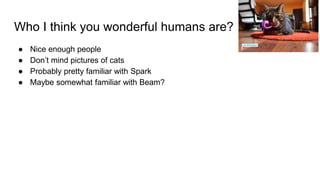
● Don’t mind pictures of cats
● Probably pretty familiar with Spark
● Maybe somewhat familiar with Beam?
Lori Erickson
What we did get to:
● TensorFlowOnSpark w/basic Apache Arrow
● Python & Go on Beam on Flink prototype (in random
github branch, not finished)
○ Everyone loves wordcount right? right?....
● New Beam architecture allowing for better portability &
handling dependencies (like Tensorflow)
● TF Transform demo on Apache Flink via Apache Beam
● DO NOT non-JVM BEAM on Flink IN PRODUCTION
Vladimir Pustovit
DO NOT USE THIS IN PRODUCTION TODAY
● I’m serious, I don’t want to die or cause the next
financial meltdown with software I’m a part of
● By Today I mean June 8 2018, but it’s probably going to
not be great for at least a “little while”
Vladimir Pustovit
PROTambako The Jaguar
What will be covered?
Most likely:
● Where we are today in non-JVM support in Beam
● And why this matters for Tensorflow
● What the rest of Big Data ecosystem looks like going outside the JVM
● A partial TF Transform demo + TFMA links + possible system crash
If there is time (e.g. demo runs quickly, wifi works, several other happy unlikely
things):
● TensorFlowOnSpark
● Apache Arrow - How this changes “everything”*
So why do I need to power DL w/Big Data?
● Deep learning is most effective with large sample sets for training
● As much as some may say that no feature prep is required even if you’re
looking at mnist.csv you probably have _some_ feature prep
● Since we need big data for training we need to to do our feature prep it
● Even if your just trying to raise some VC money it's going to go a lot better if
you add some keywords about a large proprietary dataset
TensorFlow isn’t enough on its own
● Enter TFX & friends like Kubeflow
○ Current related TFX OSS components: TF.Transform TF.Serving (with
more coming)
● Alternatives: piles of custom code re-created at serving time.
○ Yay job security?
PROJennifer C.
How do I do feature prep? (old skool)
● Write custom preparation jobs in your favourite big data tool (mine is Apache
Spark, but maybe yours is something else)
● Run it, train on the prepared data
● Rewrite your feature prep code to run at serving time
○ Error prone and sad
Enter: TF.Transform
● For pre-processing of your data
○ e.g. where you spend 90% of your dev time anyways
● Integrates into serving time :D
● OSS
● Runs on top of Apache Beam, but current release not yet outside of GCP
○ On master this can run on Flink, but probably has bugs currently.
○ Please don’t use this in production today unless your on
GCP/Dataflow
PROKathryn Yengel
Defining a Transform processing function
def preprocessing_fn(inputs):
x = inputs['x']
y = inputs['y']
s = inputs['s']
x_centered = x - tft.mean(x)
y_normalized = tft.scale_to_0_1(y)
s_int = tft.string_to_int(s)
return { 'x_centered': x_centered,
'y_normalized': y_normalized, 's_int': s_int}
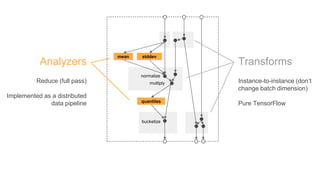
mean stddev
normalize
multiply
quantiles
bucketize
Analyzers
Reduce (full pass)
Implemented as a distributed
data pipeline
Transforms
Instance-to-instance (don’t
change batch dimension)
Pure TensorFlow
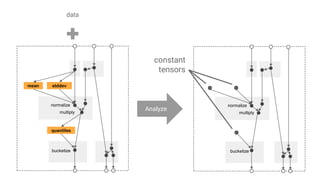
Analyze
normalize
multiply
bucketize
constant
tensors
data
mean stddev
normalize
multiply
quantiles
bucketize
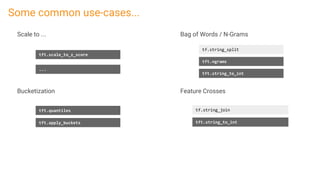
Scale to ... Bag of Words / N-Grams
Bucketization Feature Crosses
tft.ngrams
tft.string_to_int
tf.string_split
tft.scale_to_z_score
tft.apply_buckets
tft.quantiles
tft.string_to_int
tf.string_join
...
Some common use-cases...
BEAM Beyond the JVM: Current release
● Non JVM BEAM doesn’t work outside of Google’s environment yet
● tl;dr : uses grpc / protobuf
○ Similar to the common design but with more efficient representations (often)
● But exciting new plans to unify the runners and ease the support of different
languages (called SDKS)
○ See https://beam.apache.org/contribute/portability/
● If this is exciting, you can come join me on making BEAM work in Python3
○ Yes we still don’t have that :(
○ But we're getting closer & you can come join us on BEAM-2874 :D
Emma
BEAM Beyond the JVM: Master + Experiments
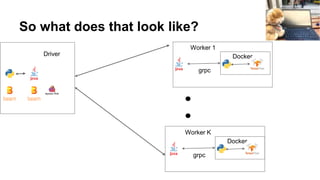
● Common interface for setting up jobs
● Portability framework allows SDK harnesses in arbitrary to be kicked off
● Runners ship in their own docker containers (goodbye dependency hell, hello
container hell)
○ Also for now rolling containers leaves something to be desired (e.g. edit docker file by hand)
● Hacked up Python SDK to sort of talk to the new interface
● Go SDK talks to the new interface, still missing some features
● Need permissions? Run on GKE or plumb through permissions file :(
Nick
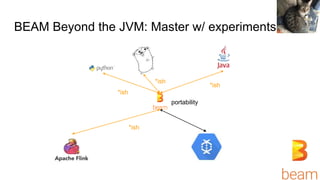
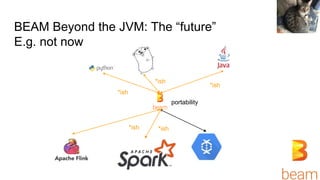
BEAM Beyond the JVM: Master w/ experiments
*ish
*ish
*ish
Nick
portability
*ish
So what does that look like?
Driver
Worker 1
Docker
grpc
Worker K
Docker
grpc
BEAM Beyond the JVM: The “future”
E.g. not now
*ish
*ish
*ish
Nick
portability
*ish
*ish
So how TF does this relate to TF?
● Tensorflow is in Python (kind of)
● Once we finish the Python SDK on Beam on Flink adventure you can use all
sorts of cool libraries (like TFT/TFX) to do your tensorflow work
○ You can use them today too if your use case is on Dataflow
○ If you don’t mind bugs you can experiment with them on Flink too
● You will be able manage your dependencies
● You will be able to (in theory) re-use dataprep code at serving time
○ 80% less copy n’ paste code with slight mistakes that get out of date!**
● No that doesn’t work today
● Or tomorrow
● But… eventually
○ Standard OSS excuse “patches welcome” (sort of if you can find the branch :p)
**Not a guarantee, see your vendor for details.
Ooor from the chicago taxi data...
for key in taxi.DENSE_FLOAT_FEATURE_KEYS:
# Preserve this feature as a dense float, setting nan's to
the mean.
outputs[key] = transform.scale_to_z_score(inputs[key])
for key in taxi.VOCAB_FEATURE_KEYS:
# Build a vocabulary for this feature.
outputs[key] = transform.string_to_int(
inputs[key], top_k=taxi.VOCAB_SIZE,
num_oov_buckets=taxi.OOV_SIZE)
for key in taxi.BUCKET_FEATURE_KEYS:
outputs[key] = transform.bucketize(inputs[key],
Beam Demo Time!!!!!
● TFT!!!!!! So amazing!!!!!!!!!
○ Want to move to SF and raise a series A? Pay attention :p
● Based on my testing on Saturday there is a 1 in 3 chance this will hard lock
my computer
○ But that’s OK, we can reboot and take questions while I bounce :)
● That’s your friendly reminder not to run any of this in production (yet)
● The demo code is forked from axelmagn/model-analysis which is forked from
tensorflow/model-analysis and runs on master of Apache Beam w/Flink
○ The example does something… possible questionable with the evaluation dataset currently,
but #todofixmelater
Ok now what?
● Integrate this into your model serving pipeline of choice
○ Don’t have one or open to change? Checkout TFMA which can directly serve it
● There’s a guide (it doesn’t show Flink because not released yet) but steps are
similar
○ But you’re not using this in production today anyways?
○ Right?
Nick Perla
(Optional) Second Beam Demo Time!!!!!
● Word count!!!!!! So amazing!!!!!!!!!
● Based on my testing on Saturday there is a 2 in 3 chance this will hard lock
my computer
● That’s your friendly reminder not to run any of this in production
● Demo shell script of fun (go only) & python + go
What do the rest of the systems do?
● Spoiler: mostly it’s not better
○ Although it tends to be more finished
○ Sometimes it's different
● Different tradeoffs, maybe better for your use case but all tradeoffs
Kate Neilan
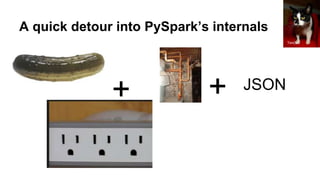
A quick detour into PySpark’s internals
+ + JSON
TimOve
PySpark
● The Python interface to Spark
● Same general technique used as the bases for the C#, R, Julia, etc.
interfaces to Spark
● Fairly mature, integrates well-ish into the ecosystem, less a Pythonrific API
● Has some serious performance hurdles from the design
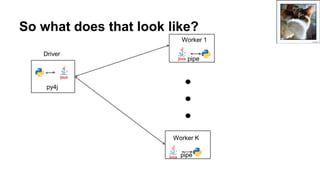
So what does that look like?
Driver
py4j
Worker 1
Worker K
pipe
pipe
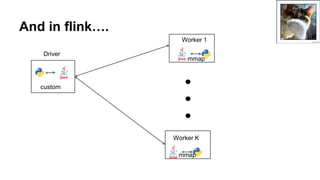
And in flink….
Driver
custom
Worker 1
Worker K
mmap
mmap
So how does that impact Py[X]
forall X in {Big Data}-{Native Python Big Data}
● Double serialization cost makes everything more
expensive
● Python worker startup takes a bit of extra time
● Python memory isn’t controlled by the JVM - easy to go
over container limits if deploying on YARN or similar
● Error messages make ~0 sense
● Dependency management makes limited sense
● features aren’t automatically exposed, but exposing
them is normally simple
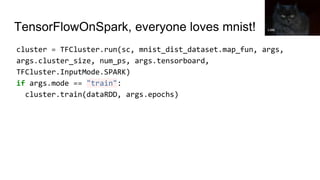
TensorFlowOnSpark, everyone loves mnist!
cluster = TFCluster.run(sc, mnist_dist_dataset.map_fun, args,
args.cluster_size, num_ps, args.tensorboard,
TFCluster.InputMode.SPARK)
if args.mode == "train":
cluster.train(dataRDD, args.epochs)
Lida
The “future”*: faster interchange
● By future I mean availability today but running it in production is “adventurous”
● Unifying our cross-language experience
○ And not just “normal” languages, CUDA counts yo
Tambako The Jaguar
Andrew Skudder
*Arrow: Spark 2.3 and beyond & GPUs & R & Python & ….
* *
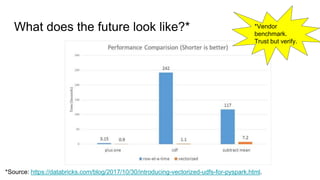
What does the future look like?*
*Source: https://databricks.com/blog/2017/10/30/introducing-vectorized-udfs-for-pyspark.html.
*Vendor
benchmark.
Trust but verify.
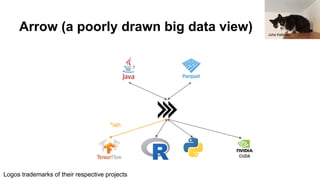
Arrow (a poorly drawn big data view)
Logos trademarks of their respective projects
Juha Kettunen
*ish
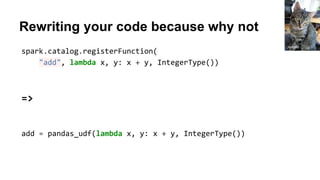
Rewriting your code because why not
spark.catalog.registerFunction(
"add", lambda x, y: x + y, IntegerType())
=>
add = pandas_udf(lambda x, y: x + y, IntegerType())
Jennifer C.
And we can do this in TFOnSpark*:
unionRDD.foreachPartition(TFSparkNode.train(self.cluster_info,
self.cluster_meta, qname))
Will Transform Into something magical (aka fast but unreliable)
on the next slide!
Delaina Haslam
Which becomes
train_func = TFSparkNode.train(self.cluster_info,
self.cluster_meta, qname)
@pandas_udf("int")
def do_train(inputSeries1, inputSeries2):
# Sad hack for now
modified_series = map(lambda x: (x[0], x[1]),
zip(inputSeries1, inputSeries2))
train_func(modified_series)
return pandas.Series([0] * len(inputSeries1))
ljmacphee
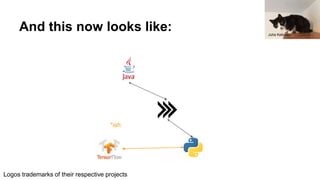
And this now looks like:
Logos trademarks of their respective projects
Juha Kettunen
*ish
TFOnSpark Possible vNext+1?
● Avoid funneling the data through Python native types
○ For now the Spark Arrow UDFS aren’t perfect for this
○ But we can (and are) improving them
● mmapped Arrow?
● Skip Python on the workers handling data entirely (idk I’m lazy so probably
not)
Renars
References
● TFMA + TFT example guide -
https://www.tensorflow.org/tfx/model_analysis/examples/chicago_taxi
● Apache Beam github repo (w/early alpha portable Flink support)-
https://beam.apache.org/
● TFMA Example fork for use w/Beam on Flink -
● TensorFlowOnSpark -https://github.com/yahoo/TensorFlowOnSpark
● Spark Deep Learning Pipelines - https://github.com/databricks/spark-deep-
learning
● flink-tensorflow - https://github.com/FlinkML/flink-tensorflow
● TF.Transform - https://github.com/tensorflow/transform
● Beam portability design: https://beam.apache.org/contribute/portability/
● Beam on Flink + portability https://issues.apache.org/jira/browse/BEAM-2889
PROR. Crap Mariner
k thnx bye :)
If you care about Spark testing and
don’t hate surveys:
http://bit.ly/holdenTestingSpark
I need to give a testing talk next
month, help a “friend” out.
Will tweet results
“eventually” @holdenkarau
Do you want more realistic
benchmarks? Share your UDFs!
http://bit.ly/pySparkUDF
Pssst: Have feedback on the presentation? Give me a
shout (holden@pigscanfly.ca) if you feel comfortable doing
so :)
Give feedback on this presentation
http://bit.ly/holdenTalkFeedback
What’s the rest of big data outside the JVM
look like?
Most of the tools are built in the JVM, so how do we play together?
● Pickling, Strings, JSON, XML, oh my!
● Unix pipes
● Sockets
What about if we don’t want to copy the data all the time?
● Or standalone “pure”* re-implementations of everything
○ Reasonable option for things like Kafka where you would have the I/O regardless.
○ Also cool projects like dask (pure python) -- but hard to talk to existing ecosystem
David Brown
Hadoop “streaming” (Python/R)
● Unix pipes!
● Involves a data copy, formats get sad
● But the overhead of a Map/Reduce task is pretty high anyways...
Lisa Larsson
Kafka: re-implement all the things
● Multiple options for connecting to Kafka from outside of the JVM (yay!)
● They implement the protocol to talk to Kafka (yay!)
● This involves duplicated client work, and sometimes the clients can be slow
(solution, FFI bindings to C instead of Java)
● Buuuut -- we can’t access all of the cool Kafka business (like Kafka Streams)
and features depend on client libraries implementing them (easy to slip below
parity)
Smokey Combs
Dask: a new beginning?
● Pure* python implementation
● Provides real enough DataFrame interface for distributed data
● Also your standard-ish distributed collections
● Multiple backends
● Primary challenge: interacting with the rest of the big data ecosystem
○ Arrow & friends might make this better with time too, buuut….
● See https://dask.pydata.org/en/latest/ &
http://dask.pydata.org/en/latest/spark.html
Lisa Zins

Simplifying training deep and serving learning models with big data in python using tensorflow - PyData Berlin

  • 1.
    Simplifying Training & ServingDeep Learning with Big Data in Python w/ Tensorflow, Apache Beam, and Apache Flink + Possible Spark bonus @holdenkarau
  • 2.
    Holden: ● My nameis Holden Karau ● Prefered pronouns are she/her ● Developer Advocate at Google ● Apache Spark PMC, Beam contributor ● previously IBM, Alpine, Databricks, Google, Foursquare & Amazon ● co-author of Learning Spark & High Performance Spark ● Twitter: @holdenkarau ● Slide share http://www.slideshare.net/hkarau ● Code review livestreams: https://www.twitch.tv/holdenkarau / https://www.youtube.com/user/holdenkarau ● Spark Talk Videos http://bit.ly/holdenSparkVideos
  • 4.
    Who I thinkyou wonderful humans are? ● Nice enough people ● Don’t mind pictures of cats ● Probably pretty familiar with Spark ● Maybe somewhat familiar with Beam? Lori Erickson
  • 5.
    What we didget to: ● TensorFlowOnSpark w/basic Apache Arrow ● Python & Go on Beam on Flink prototype (in random github branch, not finished) ○ Everyone loves wordcount right? right?.... ● New Beam architecture allowing for better portability & handling dependencies (like Tensorflow) ● TF Transform demo on Apache Flink via Apache Beam ● DO NOT non-JVM BEAM on Flink IN PRODUCTION Vladimir Pustovit
  • 6.
    DO NOT USETHIS IN PRODUCTION TODAY ● I’m serious, I don’t want to die or cause the next financial meltdown with software I’m a part of ● By Today I mean June 8 2018, but it’s probably going to not be great for at least a “little while” Vladimir Pustovit PROTambako The Jaguar
  • 7.
    What will becovered? Most likely: ● Where we are today in non-JVM support in Beam ● And why this matters for Tensorflow ● What the rest of Big Data ecosystem looks like going outside the JVM ● A partial TF Transform demo + TFMA links + possible system crash If there is time (e.g. demo runs quickly, wifi works, several other happy unlikely things): ● TensorFlowOnSpark ● Apache Arrow - How this changes “everything”*
  • 8.
    So why doI need to power DL w/Big Data? ● Deep learning is most effective with large sample sets for training ● As much as some may say that no feature prep is required even if you’re looking at mnist.csv you probably have _some_ feature prep ● Since we need big data for training we need to to do our feature prep it ● Even if your just trying to raise some VC money it's going to go a lot better if you add some keywords about a large proprietary dataset
  • 9.
    TensorFlow isn’t enoughon its own ● Enter TFX & friends like Kubeflow ○ Current related TFX OSS components: TF.Transform TF.Serving (with more coming) ● Alternatives: piles of custom code re-created at serving time. ○ Yay job security? PROJennifer C.
  • 10.
    How do Ido feature prep? (old skool) ● Write custom preparation jobs in your favourite big data tool (mine is Apache Spark, but maybe yours is something else) ● Run it, train on the prepared data ● Rewrite your feature prep code to run at serving time ○ Error prone and sad
  • 11.
    Enter: TF.Transform ● Forpre-processing of your data ○ e.g. where you spend 90% of your dev time anyways ● Integrates into serving time :D ● OSS ● Runs on top of Apache Beam, but current release not yet outside of GCP ○ On master this can run on Flink, but probably has bugs currently. ○ Please don’t use this in production today unless your on GCP/Dataflow PROKathryn Yengel
  • 12.
    Defining a Transformprocessing function def preprocessing_fn(inputs): x = inputs['x'] y = inputs['y'] s = inputs['s'] x_centered = x - tft.mean(x) y_normalized = tft.scale_to_0_1(y) s_int = tft.string_to_int(s) return { 'x_centered': x_centered, 'y_normalized': y_normalized, 's_int': s_int}
  • 13.
    mean stddev normalize multiply quantiles bucketize Analyzers Reduce (fullpass) Implemented as a distributed data pipeline Transforms Instance-to-instance (don’t change batch dimension) Pure TensorFlow
  • 14.
  • 15.
    Scale to ...Bag of Words / N-Grams Bucketization Feature Crosses tft.ngrams tft.string_to_int tf.string_split tft.scale_to_z_score tft.apply_buckets tft.quantiles tft.string_to_int tf.string_join ... Some common use-cases...
  • 16.
    BEAM Beyond theJVM: Current release ● Non JVM BEAM doesn’t work outside of Google’s environment yet ● tl;dr : uses grpc / protobuf ○ Similar to the common design but with more efficient representations (often) ● But exciting new plans to unify the runners and ease the support of different languages (called SDKS) ○ See https://beam.apache.org/contribute/portability/ ● If this is exciting, you can come join me on making BEAM work in Python3 ○ Yes we still don’t have that :( ○ But we're getting closer & you can come join us on BEAM-2874 :D Emma
  • 17.
    BEAM Beyond theJVM: Master + Experiments ● Common interface for setting up jobs ● Portability framework allows SDK harnesses in arbitrary to be kicked off ● Runners ship in their own docker containers (goodbye dependency hell, hello container hell) ○ Also for now rolling containers leaves something to be desired (e.g. edit docker file by hand) ● Hacked up Python SDK to sort of talk to the new interface ● Go SDK talks to the new interface, still missing some features ● Need permissions? Run on GKE or plumb through permissions file :( Nick
  • 18.
    BEAM Beyond theJVM: Master w/ experiments *ish *ish *ish Nick portability *ish
  • 19.
    So what doesthat look like? Driver Worker 1 Docker grpc Worker K Docker grpc
  • 20.
    BEAM Beyond theJVM: The “future” E.g. not now *ish *ish *ish Nick portability *ish *ish
  • 21.
    So how TFdoes this relate to TF? ● Tensorflow is in Python (kind of) ● Once we finish the Python SDK on Beam on Flink adventure you can use all sorts of cool libraries (like TFT/TFX) to do your tensorflow work ○ You can use them today too if your use case is on Dataflow ○ If you don’t mind bugs you can experiment with them on Flink too ● You will be able manage your dependencies ● You will be able to (in theory) re-use dataprep code at serving time ○ 80% less copy n’ paste code with slight mistakes that get out of date!** ● No that doesn’t work today ● Or tomorrow ● But… eventually ○ Standard OSS excuse “patches welcome” (sort of if you can find the branch :p) **Not a guarantee, see your vendor for details.
  • 22.
    Ooor from thechicago taxi data... for key in taxi.DENSE_FLOAT_FEATURE_KEYS: # Preserve this feature as a dense float, setting nan's to the mean. outputs[key] = transform.scale_to_z_score(inputs[key]) for key in taxi.VOCAB_FEATURE_KEYS: # Build a vocabulary for this feature. outputs[key] = transform.string_to_int( inputs[key], top_k=taxi.VOCAB_SIZE, num_oov_buckets=taxi.OOV_SIZE) for key in taxi.BUCKET_FEATURE_KEYS: outputs[key] = transform.bucketize(inputs[key],
  • 23.
    Beam Demo Time!!!!! ●TFT!!!!!! So amazing!!!!!!!!! ○ Want to move to SF and raise a series A? Pay attention :p ● Based on my testing on Saturday there is a 1 in 3 chance this will hard lock my computer ○ But that’s OK, we can reboot and take questions while I bounce :) ● That’s your friendly reminder not to run any of this in production (yet) ● The demo code is forked from axelmagn/model-analysis which is forked from tensorflow/model-analysis and runs on master of Apache Beam w/Flink ○ The example does something… possible questionable with the evaluation dataset currently, but #todofixmelater
  • 24.
    Ok now what? ●Integrate this into your model serving pipeline of choice ○ Don’t have one or open to change? Checkout TFMA which can directly serve it ● There’s a guide (it doesn’t show Flink because not released yet) but steps are similar ○ But you’re not using this in production today anyways? ○ Right? Nick Perla
  • 25.
    (Optional) Second BeamDemo Time!!!!! ● Word count!!!!!! So amazing!!!!!!!!! ● Based on my testing on Saturday there is a 2 in 3 chance this will hard lock my computer ● That’s your friendly reminder not to run any of this in production ● Demo shell script of fun (go only) & python + go
  • 26.
    What do therest of the systems do? ● Spoiler: mostly it’s not better ○ Although it tends to be more finished ○ Sometimes it's different ● Different tradeoffs, maybe better for your use case but all tradeoffs Kate Neilan
  • 27.
    A quick detourinto PySpark’s internals + + JSON TimOve
  • 28.
    PySpark ● The Pythoninterface to Spark ● Same general technique used as the bases for the C#, R, Julia, etc. interfaces to Spark ● Fairly mature, integrates well-ish into the ecosystem, less a Pythonrific API ● Has some serious performance hurdles from the design
  • 29.
    So what doesthat look like? Driver py4j Worker 1 Worker K pipe pipe
  • 30.
  • 31.
    So how doesthat impact Py[X] forall X in {Big Data}-{Native Python Big Data} ● Double serialization cost makes everything more expensive ● Python worker startup takes a bit of extra time ● Python memory isn’t controlled by the JVM - easy to go over container limits if deploying on YARN or similar ● Error messages make ~0 sense ● Dependency management makes limited sense ● features aren’t automatically exposed, but exposing them is normally simple
  • 32.
    TensorFlowOnSpark, everyone lovesmnist! cluster = TFCluster.run(sc, mnist_dist_dataset.map_fun, args, args.cluster_size, num_ps, args.tensorboard, TFCluster.InputMode.SPARK) if args.mode == "train": cluster.train(dataRDD, args.epochs) Lida
  • 33.
    The “future”*: fasterinterchange ● By future I mean availability today but running it in production is “adventurous” ● Unifying our cross-language experience ○ And not just “normal” languages, CUDA counts yo Tambako The Jaguar
  • 34.
    Andrew Skudder *Arrow: Spark2.3 and beyond & GPUs & R & Python & …. * *
  • 35.
    What does thefuture look like?* *Source: https://databricks.com/blog/2017/10/30/introducing-vectorized-udfs-for-pyspark.html. *Vendor benchmark. Trust but verify.
  • 36.
    Arrow (a poorlydrawn big data view) Logos trademarks of their respective projects Juha Kettunen *ish
  • 37.
    Rewriting your codebecause why not spark.catalog.registerFunction( "add", lambda x, y: x + y, IntegerType()) => add = pandas_udf(lambda x, y: x + y, IntegerType()) Jennifer C.
  • 38.
    And we cando this in TFOnSpark*: unionRDD.foreachPartition(TFSparkNode.train(self.cluster_info, self.cluster_meta, qname)) Will Transform Into something magical (aka fast but unreliable) on the next slide! Delaina Haslam
  • 39.
    Which becomes train_func =TFSparkNode.train(self.cluster_info, self.cluster_meta, qname) @pandas_udf("int") def do_train(inputSeries1, inputSeries2): # Sad hack for now modified_series = map(lambda x: (x[0], x[1]), zip(inputSeries1, inputSeries2)) train_func(modified_series) return pandas.Series([0] * len(inputSeries1)) ljmacphee
  • 40.
    And this nowlooks like: Logos trademarks of their respective projects Juha Kettunen *ish
  • 41.
    TFOnSpark Possible vNext+1? ●Avoid funneling the data through Python native types ○ For now the Spark Arrow UDFS aren’t perfect for this ○ But we can (and are) improving them ● mmapped Arrow? ● Skip Python on the workers handling data entirely (idk I’m lazy so probably not) Renars
  • 42.
    References ● TFMA +TFT example guide - https://www.tensorflow.org/tfx/model_analysis/examples/chicago_taxi ● Apache Beam github repo (w/early alpha portable Flink support)- https://beam.apache.org/ ● TFMA Example fork for use w/Beam on Flink - ● TensorFlowOnSpark -https://github.com/yahoo/TensorFlowOnSpark ● Spark Deep Learning Pipelines - https://github.com/databricks/spark-deep- learning ● flink-tensorflow - https://github.com/FlinkML/flink-tensorflow ● TF.Transform - https://github.com/tensorflow/transform ● Beam portability design: https://beam.apache.org/contribute/portability/ ● Beam on Flink + portability https://issues.apache.org/jira/browse/BEAM-2889 PROR. Crap Mariner
  • 43.
    k thnx bye:) If you care about Spark testing and don’t hate surveys: http://bit.ly/holdenTestingSpark I need to give a testing talk next month, help a “friend” out. Will tweet results “eventually” @holdenkarau Do you want more realistic benchmarks? Share your UDFs! http://bit.ly/pySparkUDF Pssst: Have feedback on the presentation? Give me a shout (holden@pigscanfly.ca) if you feel comfortable doing so :) Give feedback on this presentation http://bit.ly/holdenTalkFeedback
  • 44.
    What’s the restof big data outside the JVM look like? Most of the tools are built in the JVM, so how do we play together? ● Pickling, Strings, JSON, XML, oh my! ● Unix pipes ● Sockets What about if we don’t want to copy the data all the time? ● Or standalone “pure”* re-implementations of everything ○ Reasonable option for things like Kafka where you would have the I/O regardless. ○ Also cool projects like dask (pure python) -- but hard to talk to existing ecosystem David Brown
  • 45.
    Hadoop “streaming” (Python/R) ●Unix pipes! ● Involves a data copy, formats get sad ● But the overhead of a Map/Reduce task is pretty high anyways... Lisa Larsson
  • 46.
    Kafka: re-implement allthe things ● Multiple options for connecting to Kafka from outside of the JVM (yay!) ● They implement the protocol to talk to Kafka (yay!) ● This involves duplicated client work, and sometimes the clients can be slow (solution, FFI bindings to C instead of Java) ● Buuuut -- we can’t access all of the cool Kafka business (like Kafka Streams) and features depend on client libraries implementing them (easy to slip below parity) Smokey Combs
  • 47.
    Dask: a newbeginning? ● Pure* python implementation ● Provides real enough DataFrame interface for distributed data ● Also your standard-ish distributed collections ● Multiple backends ● Primary challenge: interacting with the rest of the big data ecosystem ○ Arrow & friends might make this better with time too, buuut…. ● See https://dask.pydata.org/en/latest/ & http://dask.pydata.org/en/latest/spark.html Lisa Zins

Editor's Notes

  • #5 Photo from https://www.flickr.com/photos/lorika/4148361363/in/photolist-7jzriM-9h3my2-9Qn7iD-bp55TS-7YCJ4G-4pVTXa-7AFKbm-bkBfKJ-9Qn6FH-aniTRF-9LmYvZ-HD6w6-4mBo3t-8sekvz-mgpFzD-5z6BRK-de513-8dVhBu-bBZ22n-4Vi2vS-3g13dh-e7aPKj-b6iHHi-4ThGzv-7NcFNK-aniTU6-Kzqxd-7LPmYs-4ok2qy-dLY9La-Nvhey-Kte6U-74B7Ma-6VfnBK-6VjrY7-58kAY9-7qUeDK-4eoSxM-6Vjs5A-9v5Pvb-26mja-4scwq3-GHzAL-672eVr-nFUomD-4s8u8F-5eiQmQ-bxXXCc-5P9cCT-5GX8no
  • #6 introduce spark rdds, purple blog diagrams https://www.flickr.com/photos/pustovit/15867520885/in/photolist-qbac9i-9XLrR4-74scWq-bpnxfN-qYAD3D-e6u5Ej-oztsCu-qJMG4L-7b4y4a-gu8Wa-8MzgVR-b5gHki-djzdH3-82TowY-qJc99b-pC6yth-ifAkvP-mju1Ce-3ACPG6-F9aWR2-5QQL1U-4Hav3S-dGHvJj-jxQLth-djzdgd-dL24wn-8znjgb-aZxA6H-gDkWNo-djzcZF-22NYH5r-9amo58-apqLdG-fZhoSH-cDjpEQ-nLbBuK-6EuEN2-dAN5KN-asBjbL-Vx2zFR-djzdki-SRkhd1-djzcnF-Tc9FAf-qsduzQ-djzd4P-9wCiZT-8JALTP-eqbpop-R2S2FR
  • #7 Remind people not to use this in production
  • #10 https://www.flickr.com/photos/29638108@N06/26104346281/in/photolist-66Ky9n-5nW3TP-f4xVRt-sewjsA-BVmgy-FLKAFT-89kfzb-FSBrSp-puHhfg-xrXMpL-5fjZcs-G9DjaZ-eXvwfo-oUk4hz-7gmfLB-9s2gwi-bqRAKw-4CGf6X-5o24aR-25AijkV-njSsfw-4tYMke-FsvaQq-haUJv-6S2j5f-c19gY5-rdr7va-6qoirp-666Sgs-3bcTwj-7QoFUj-ayEq5k-2yduWy-Co2uwS-NKcKBY-eXvx2d-ZHnLQj-6Kk14A-rgBNGV-EXb2PG-dGg4Mk-23dGLzS-a7EshL-85r8fq-ix6nEM-6izGaR-9MT8Ee-oqhy96-CE4Sgs-5LKLdr/
  • #12 https://www.flickr.com/photos/29638108@N06/26104346281/in/photolist-66Ky9n-5nW3TP-f4xVRt-sewjsA-BVmgy-FLKAFT-89kfzb-FSBrSp-puHhfg-xrXMpL-5fjZcs-G9DjaZ-eXvwfo-oUk4hz-7gmfLB-9s2gwi-bqRAKw-4CGf6X-5o24aR-25AijkV-njSsfw-4tYMke-FsvaQq-haUJv-6S2j5f-c19gY5-rdr7va-6qoirp-666Sgs-3bcTwj-7QoFUj-ayEq5k-2yduWy-Co2uwS-NKcKBY-eXvx2d-ZHnLQj-6Kk14A-rgBNGV-EXb2PG-dGg4Mk-23dGLzS-a7EshL-85r8fq-ix6nEM-6izGaR-9MT8Ee-oqhy96-CE4Sgs-5LKLdr/
  • #13 https://www.flickr.com/photos/29638108@N06/26104346281/in/photolist-66Ky9n-5nW3TP-f4xVRt-sewjsA-BVmgy-FLKAFT-89kfzb-FSBrSp-puHhfg-xrXMpL-5fjZcs-G9DjaZ-eXvwfo-oUk4hz-7gmfLB-9s2gwi-bqRAKw-4CGf6X-5o24aR-25AijkV-njSsfw-4tYMke-FsvaQq-haUJv-6S2j5f-c19gY5-rdr7va-6qoirp-666Sgs-3bcTwj-7QoFUj-ayEq5k-2yduWy-Co2uwS-NKcKBY-eXvx2d-ZHnLQj-6Kk14A-rgBNGV-EXb2PG-dGg4Mk-23dGLzS-a7EshL-85r8fq-ix6nEM-6izGaR-9MT8Ee-oqhy96-CE4Sgs-5LKLdr/
  • #14 As just discussed, TFT provides utility functions that run analyzers as needed. These are data processing jobs that can be run in arbitrary environments using the Beam SDK.
  • #15 What happens behind the scene is that the analyzers run as a distributed data processing graph, and the result is put into the output graph as constants.
  • #16 Some of the common use cases: Just talked about ones on left: Scale scores Bucketize Text features: apply bag of words or n grams For Feature crosses: cross strings and generate vocabs of the result of those crosses As mentioned before, tf.Tranform is powerful in that you can chain these transformations.
  • #20 SparkContext uses Py4J to launch a JVM and create a JavaSparkContext. On The executors, java subprocess launches a python subprocess via a pipe. The data is serialized using cpickle and sent ot the python subprocess
  • #23 https://www.flickr.com/photos/29638108@N06/26104346281/in/photolist-66Ky9n-5nW3TP-f4xVRt-sewjsA-BVmgy-FLKAFT-89kfzb-FSBrSp-puHhfg-xrXMpL-5fjZcs-G9DjaZ-eXvwfo-oUk4hz-7gmfLB-9s2gwi-bqRAKw-4CGf6X-5o24aR-25AijkV-njSsfw-4tYMke-FsvaQq-haUJv-6S2j5f-c19gY5-rdr7va-6qoirp-666Sgs-3bcTwj-7QoFUj-ayEq5k-2yduWy-Co2uwS-NKcKBY-eXvx2d-ZHnLQj-6Kk14A-rgBNGV-EXb2PG-dGg4Mk-23dGLzS-a7EshL-85r8fq-ix6nEM-6izGaR-9MT8Ee-oqhy96-CE4Sgs-5LKLdr/
  • #28 https://www.flickr.com/photos/timove/2873619269/in/photolist-66Ky9n-5nW3TP-f4xVRt-sewjsA-BVmgy-FLKAFT-89kfzb-FSBrSp-puHhfg-xrXMpL-5fjZcs-G9DjaZ-eXvwfo-oUk4hz-7gmfLB-9s2gwi-bqRAKw-4CGf6X-5o24aR-25AijkV-njSsfw-4tYMke-FsvaQq-haUJv-6S2j5f-c19gY5-rdr7va-6qoirp-666Sgs-3bcTwj-7QoFUj-ayEq5k-2yduWy-Co2uwS-NKcKBY-eXvx2d-ZHnLQj-6Kk14A-rgBNGV-EXb2PG-dGg4Mk-23dGLzS-a7EshL-85r8fq-ix6nEM-6izGaR-9MT8Ee-oqhy96-CE4Sgs-5LKLdr/
  • #30 SparkContext uses Py4J to launch a JVM and create a JavaSparkContext. On The executors, java subprocess launches a python subprocess via a pipe. The data is serialized using cpickle and sent ot the python subprocess
  • #32 What does python memory isn’t controlled by the JVM mean? Double serialization from lanague transform
  • #37 https://www.flickr.com/photos/juhakettunen/17218305870/in/photolist-66Ky9n-5nW3TP-f4xVRt-sewjsA-BVmgy-FLKAFT-89kfzb-FSBrSp-puHhfg-xrXMpL-5fjZcs-G9DjaZ-eXvwfo-oUk4hz-7gmfLB-9s2gwi-bqRAKw-4CGf6X-5o24aR-25AijkV-njSsfw-4tYMke-FsvaQq-haUJv-6S2j5f-c19gY5-rdr7va-6qoirp-666Sgs-3bcTwj-7QoFUj-ayEq5k-2yduWy-Co2uwS-NKcKBY-eXvx2d-ZHnLQj-6Kk14A-rgBNGV-EXb2PG-dGg4Mk-23dGLzS-a7EshL-85r8fq-ix6nEM-6izGaR-9MT8Ee-oqhy96-CE4Sgs-5LKLdr/
  • #38 https://www.flickr.com/photos/29638108@N06/26104346281/in/photolist-66Ky9n-5nW3TP-f4xVRt-sewjsA-BVmgy-FLKAFT-89kfzb-FSBrSp-puHhfg-xrXMpL-5fjZcs-G9DjaZ-eXvwfo-oUk4hz-7gmfLB-9s2gwi-bqRAKw-4CGf6X-5o24aR-25AijkV-njSsfw-4tYMke-FsvaQq-haUJv-6S2j5f-c19gY5-rdr7va-6qoirp-666Sgs-3bcTwj-7QoFUj-ayEq5k-2yduWy-Co2uwS-NKcKBY-eXvx2d-ZHnLQj-6Kk14A-rgBNGV-EXb2PG-dGg4Mk-23dGLzS-a7EshL-85r8fq-ix6nEM-6izGaR-9MT8Ee-oqhy96-CE4Sgs-5LKLdr/
  • #39 https://www.flickr.com/photos/29638108@N06/26104346281/in/photolist-66Ky9n-5nW3TP-f4xVRt-sewjsA-BVmgy-FLKAFT-89kfzb-FSBrSp-puHhfg-xrXMpL-5fjZcs-G9DjaZ-eXvwfo-oUk4hz-7gmfLB-9s2gwi-bqRAKw-4CGf6X-5o24aR-25AijkV-njSsfw-4tYMke-FsvaQq-haUJv-6S2j5f-c19gY5-rdr7va-6qoirp-666Sgs-3bcTwj-7QoFUj-ayEq5k-2yduWy-Co2uwS-NKcKBY-eXvx2d-ZHnLQj-6Kk14A-rgBNGV-EXb2PG-dGg4Mk-23dGLzS-a7EshL-85r8fq-ix6nEM-6izGaR-9MT8Ee-oqhy96-CE4Sgs-5LKLdr/
  • #41 https://www.flickr.com/photos/juhakettunen/17218305870/in/photolist-66Ky9n-5nW3TP-f4xVRt-sewjsA-BVmgy-FLKAFT-89kfzb-FSBrSp-puHhfg-xrXMpL-5fjZcs-G9DjaZ-eXvwfo-oUk4hz-7gmfLB-9s2gwi-bqRAKw-4CGf6X-5o24aR-25AijkV-njSsfw-4tYMke-FsvaQq-haUJv-6S2j5f-c19gY5-rdr7va-6qoirp-666Sgs-3bcTwj-7QoFUj-ayEq5k-2yduWy-Co2uwS-NKcKBY-eXvx2d-ZHnLQj-6Kk14A-rgBNGV-EXb2PG-dGg4Mk-23dGLzS-a7EshL-85r8fq-ix6nEM-6izGaR-9MT8Ee-oqhy96-CE4Sgs-5LKLdr/
  • #42 https://www.flickr.com/photos/29638108@N06/26104346281/in/photolist-66Ky9n-5nW3TP-f4xVRt-sewjsA-BVmgy-FLKAFT-89kfzb-FSBrSp-puHhfg-xrXMpL-5fjZcs-G9DjaZ-eXvwfo-oUk4hz-7gmfLB-9s2gwi-bqRAKw-4CGf6X-5o24aR-25AijkV-njSsfw-4tYMke-FsvaQq-haUJv-6S2j5f-c19gY5-rdr7va-6qoirp-666Sgs-3bcTwj-7QoFUj-ayEq5k-2yduWy-Co2uwS-NKcKBY-eXvx2d-ZHnLQj-6Kk14A-rgBNGV-EXb2PG-dGg4Mk-23dGLzS-a7EshL-85r8fq-ix6nEM-6izGaR-9MT8Ee-oqhy96-CE4Sgs-5LKLdr/
  • #46 Is debugging also really hard?
  • #48 Or this one … also should we put these below python part?