This PPT explains the basics of Python programming, including variables, data types, loops, functions, and real examples. A beginner-friendly guide for students and programmers
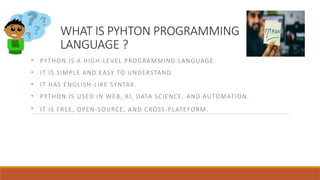
WHAT IS PYHTONPROGRAMMING
LANGUAGE ?
• PYTHON IS A HIGH-LEVEL PROGRAMMING LANGUAGE.
• IT IS SIMPLE AND EASY TO UNDERSTAND.
• IT HAS ENGLISH-LIKE SYNTAX.
• PYTHON IS USED IN WEB, AI, DATA SCIENCE, AND AUTOMATION.
• IT IS FREE, OPEN-SOURCE, AND CROSS-PLATEFORM.
3.
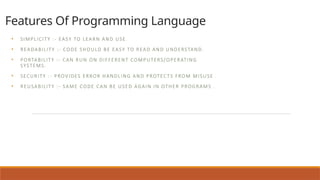
Features Of ProgrammingLanguage
• SIMPLICITY :- EASY TO LEARN AND USE.
• READABILITY :- CODE SHOULD BE EASY TO READ AND UNDERSTAND.
• PORTABILITY :- CAN RUN ON DIFFERENT COMPUTERS/OPERATING
SYSTEMS.
• SECURITY :- PROVIDES ERROR HANDLING AND PROTECTS FROM MISUSE .
• REUSABILITY :- SAME CODE CAN BE USED AGAIN IN OTHER PROGRAMS .
4.
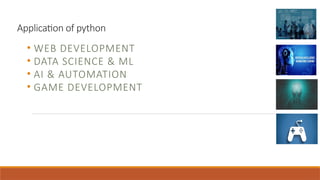
Application of python
•WEB DEVELOPMENT
• DATA SCIENCE & ML
• AI & AUTOMATION
• GAME DEVELOPMENT
5.
Data Types(Basic+ Collections)
BASIC TYPES:-
• Numeric : Int, Float, Complex
• String: Str
• Boolean: True/False
• None: None type
COLLECTION TYPES:-
• List : Odered, Changeable
• Tuple : Odered, Unchangeable
• Dictionary : Key: value pairs
A = 10 # Int
B = “Hello” # String
C = [1,2,3] # List
6.
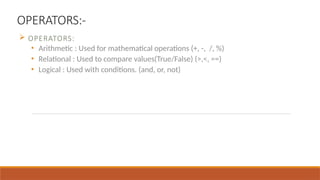
OPERATORS:-
OPERATORS:
• Arithmetic: Used for mathematical operations (+, -, /, %)
• Relational : Used to compare values(True/False) (>,<, ==)
• Logical : Used with conditions. (and, or, not)
7.
Conditional Statement:-
• If:- Used to check one condition. If it’s true: run the code.
• If-else :- Used when we want to run one block if condition is true and another block if it’s false.
• If-Elif-else :- Used when we want to check multiple conditions.
If condition example:-
x = 10
if x > 5:
print(“x is greater than 5”) [output: x is greater than 5]
If-else condition example:-
num = 4
if num % 2 == 0:
print(“Even number”)
print(“Odd number”) [Output:
Even number]
If- Elif-else example:-
marks = 75
if marks >= 90:
print(“Grade A”)
Elif marks >= 60:
print(“Grade B”)
else:
print(“Grade C”) [Output: Grade B]
8.
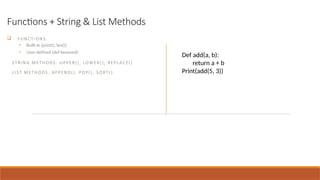
Functions + String& List Methods
FUNCTIO NS:
• Built-in (print(), len())
• User-defined (def keyword)
ST RING MET HO DS: UPPER(), LOWER(), REPLACE()
LIST METHODS: APPEND(), POP(), SO RT( )
Def add(a, b):
return a + b
Print(add(5, 3))

![Data Types(Basic+ Collections)
BASIC TYPES:-
• Numeric : Int, Float, Complex
• String: Str
• Boolean: True/False
• None: None type
COLLECTION TYPES:-
• List : Odered, Changeable
• Tuple : Odered, Unchangeable
• Dictionary : Key: value pairs
A = 10 # Int
B = “Hello” # String
C = [1,2,3] # List](https://image.slidesharecdn.com/raman-251110062053-8628fb27/85/Simple-Python-Basics-for-Beginners-Guide-5-320.jpg)
![Conditional Statement:-
• If :- Used to check one condition. If it’s true: run the code.
• If-else :- Used when we want to run one block if condition is true and another block if it’s false.
• If-Elif-else :- Used when we want to check multiple conditions.
If condition example:-
x = 10
if x > 5:
print(“x is greater than 5”) [output: x is greater than 5]
If-else condition example:-
num = 4
if num % 2 == 0:
print(“Even number”)
print(“Odd number”) [Output:
Even number]
If- Elif-else example:-
marks = 75
if marks >= 90:
print(“Grade A”)
Elif marks >= 60:
print(“Grade B”)
else:
print(“Grade C”) [Output: Grade B]](https://image.slidesharecdn.com/raman-251110062053-8628fb27/85/Simple-Python-Basics-for-Beginners-Guide-7-320.jpg)