Signals and systems analysis in biomedical engineering Second Edition Northrop
Signals and systems analysis in biomedical engineering Second Edition Northrop
Signals and systems analysis in biomedical engineering Second Edition Northrop
Signals and systems analysis in biomedical engineering Second Edition Northrop
Signals and systems analysis in biomedical engineering Second Edition Northrop
1.
Signals and systemsanalysis in biomedical
engineering Second Edition Northrop pdf download
https://ebookfinal.com/download/signals-and-systems-analysis-in-
biomedical-engineering-second-edition-northrop/
Explore and download more ebooks or textbooks
at ebookfinal.com
2.
Here are somerecommended products for you. Click the link to
download, or explore more at ebookfinal
Signals and Systems Analysis of Signals Through Linear
Systems Solution manual 1st Edition M.J. Roberts
https://ebookfinal.com/download/signals-and-systems-analysis-of-
signals-through-linear-systems-solution-manual-1st-edition-m-j-
roberts/
Schaum s Outline of Signals and Systems Second Edition
Hwei Hsu
https://ebookfinal.com/download/schaum-s-outline-of-signals-and-
systems-second-edition-hwei-hsu/
Hospital Preparation for Bioterror A Medical and
Biomedical Systems Approach Biomedical Engineering 1st
Edition Joseph H. Mcisaac
https://ebookfinal.com/download/hospital-preparation-for-bioterror-a-
medical-and-biomedical-systems-approach-biomedical-engineering-1st-
edition-joseph-h-mcisaac/
Compression of biomedical images and signals 1st Edition
Amine Nait-Ali
https://ebookfinal.com/download/compression-of-biomedical-images-and-
signals-1st-edition-amine-nait-ali/
3.
Medical Devices andSystems The Biomedical Engineering
Handbook 3rd Edition Joseph D. Bronzino
https://ebookfinal.com/download/medical-devices-and-systems-the-
biomedical-engineering-handbook-3rd-edition-joseph-d-bronzino/
Decision Making in Systems Engineering and Management
Second Edition Gregory S. Parnell
https://ebookfinal.com/download/decision-making-in-systems-
engineering-and-management-second-edition-gregory-s-parnell/
Introduction to Molecular Biology Genomics and Proteomics
for Biomedical Engineers 1st Edition Robert B. Northrop
https://ebookfinal.com/download/introduction-to-molecular-biology-
genomics-and-proteomics-for-biomedical-engineers-1st-edition-robert-b-
northrop/
Encyclopedia of Biomaterials and Biomedical Engineering
Second Edition Four Volume Set Gary E. Wnek
https://ebookfinal.com/download/encyclopedia-of-biomaterials-and-
biomedical-engineering-second-edition-four-volume-set-gary-e-wnek/
Advances in Biomedical Engineering 1st Edition Pascal
Verdonck
https://ebookfinal.com/download/advances-in-biomedical-
engineering-1st-edition-pascal-verdonck/
5.
Signals and systemsanalysis in biomedical engineering
Second Edition Northrop Digital Instant Download
Author(s): Northrop, Robert B
ISBN(s): 9781439812532, 1439812535
Edition: Second edition
File Details: PDF, 15.17 MB
Year: 2011
Language: english
Published Titles
Electromagnetic Analysisand Design in Magnetic Resonance Imaging,
Jianming Jin
Endogenous and Exogenous Regulation and Control of Physiological
Systems, Robert B. Northrop
Artificial Neural Networks in Cancer Diagnosis, Prognosis, and
Treatment, Raouf N.G. Naguib and Gajanan V. Sherbet
Medical Image Registration, Joseph V. Hajnal, Derek Hill,
and David J. Hawkes
Introduction to Dynamic Modeling of Neuro-Sensory Systems,
Robert B. Northrop
Noninvasive Instrumentation and Measurement in Medical Diagnosis,
Robert B. Northrop
Handbook of Neuroprosthetic Methods, Warren E. Finn
and Peter G. LoPresti
Angiography and Plaque Imaging: Advanced Segmentation
Techniques, Jasjit S. Suri and Swamy Laxminarayan
Analysis and Application of Analog Electronic Circuits to Biomedical
Instrumentation, Robert B. Northrop
Biomedical Image Analysis, Rangaraj M. Rangayyan
An Introduction to Biomaterials, Scott A. Guelcher
and Jeffrey O. Hollinger
Foot and Ankle Motion Analysis: Clinical Treatment and Technology,
Gerald F. Harris, Peter A. Smith, Richard M. Marks
Introduction to Molecular Biology, Genomics and Proteomic for
Biomedical Engineers, Robert B. Northrop and Anne N. Connor
Signals and Systems Analysis in Biomedical Engineering,
Second Edition, Robert B. Northrop
4PJOHLS95LTHU:LYPLZ,KP[VY
9.
Robert B. Northrop
CRCPress is an imprint of the
Taylor Francis Group, an informa business
Boca Raton London NewYork
Michael R. Neuman, Series Editor
Contents
About the Author................................................................................................................ix
1 Introduction to Biomedical Signals and Systems
1.1 General Characteristics of Biomedical Signals..............................................1-2
1.2 General Properties of PSs................................................................................1-21
1.3 Chapter Summary............................................................................................1-24
2 Review of Linear Systems Theory
2.1 Linearity, Causality, and Stationarity..............................................................2-1
2.2 Analog Systems...................................................................................................2-2
2.3 Systems Described by Sets of ODEs...............................................................2-10
2.4 Linear System Characterization.....................................................................2-21
2.5
Discrete Signals and Systems..........................................................................2-39
2.6 Stability of Systems...........................................................................................2-61
2.7 Chapter Summary............................................................................................2-63
3 The Laplace Transform and Its Applications
3.1 Introduction........................................................................................................3-1
3.2 Properties of the Laplace Transform...............................................................3-3
3.3 Some Examples of Finding Laplace Transforms...........................................3-5
3.4 The Inverse Laplace Transform........................................................................3-6
3.5 Applications of the Laplace Transform...........................................................3-7
3.6 Chapter Summary............................................................................................3-19
4 Fourier Series Analysis of Periodic Signals
4.1 Introduction........................................................................................................4-1
4.2 Properties of the FS............................................................................................4-3
4.3 FS Examples.........................................................................................................4-4
4.4 Chapter Summary..............................................................................................4-9
5 The Continuous Fourier Transform
5.1 Introduction........................................................................................................5-1
5.2 Properties of the CFT.........................................................................................5-2
12.
vi Contents
5.3 ADCand the Sampling Theorem.....................................................................5-5
5.4 The Analytical Signal and the HT...................................................................5-8
5.5 MTF in Imaging.
...............................................................................................5-18
5.6 Chapter Summary............................................................................................5-25
6 The Discrete Fourier Transform
6.1 Introduction........................................................................................................6-1
6.2 The CFT, ICFT, DFT, and IDFT.......................................................................6-2
6.3 Data Window Functions.
...................................................................................6-7
6.4 The FFT..............................................................................................................6-13
6.5 Chapter Summary............................................................................................6-21
7 Introduction to Joint Time-Frequency Analysis
of Biomedical Signals
7.1 Introduction........................................................................................................ 7-1
7.2 The Short-Term Fourier Transform.................................................................7-4
7.3 The Gabor and Adaptive Gabor Transforms..................................................7-6
7.4 The Wigner–Ville and Pseudo-Wigner Transforms.....................................7-7
7.5 Cohen’s General Class of JTF Distributions................................................. 7-11
7.6 Introduction to JTFA Using Wavelets........................................................... 7-14
7.7 Applications of JTFA to Physiological Signals............................................. 7-21
7.8 JTFA Software...................................................................................................7-32
7.9 Chapter Summary............................................................................................7-34
8 Introduction to the Analysis of Stationary Noise
and Signals Contaminated with Noise
8.1 Introduction........................................................................................................8-1
8.2 Noise Descriptors and Noise in Systems.........................................................8-2
8.3 Calculation of Noise Descriptors with Finite Discrete Data.....................8-30
8.4 Signal Averaging and Filtering for SNR Improvement..............................8-32
8.5 Introduction to the Application of Statistics and IT to Genomics.......... 8-46
8.6 Chapter Summary........................................................................................... 8-66
9 Basic Mathematical Tools Used in the Characterization
of Physiological Systems
9.1 Introduction........................................................................................................9-1
9.2 Some General Properties of PSs.......................................................................9-1
9.3 Some Properties of Nonlinear Systems...........................................................9-5
9.4 Physical Factors Determining the Dynamic Behavior of PSs.....................9-7
9.5 Means of Characterizing PSs..........................................................................9-14
9.6 Chapter Summary........................................................................................... 9-40
10 Introduction to the Mathematics of Tomographic Imaging
10.1 Introduction......................................................................................................10-1
10.2 Algebraic Reconstruction................................................................................10-5
10.3 The Radon Transform......................................................................................10-8
10.4 The Fourier Slice Theorem............................................................................10-14
13.
Contents vii
10.5 FilteredBack-Projection Algorithm...............................................................10-15
10.6 Chapter Summary.
............................................................................................10-18
11 Introduction to the Analysis of Nonlinear Biochemical
Systems and Biochemical Oscillators
11.1 Introduction: Some General Properties of Nonlinear Systems.................11-1
11.2 All Living Systems Are Nonlinear.................................................................11-8
11.3 Parametric Regulation in Nonlinear Biological Systems...........................11-8
11.4 Approaches to Nonlinear Analysis: The Phase Plane............................... 11-14
11.5 Chaos, Stability, and Limit Cycles in Nonlinear Biological Systems.
.....11-19
11.6 Chapter Summary..........................................................................................11-66
12 Introduction to Complex Systems in Biology and Medicine
12.1 Introduction to Complex Systems.................................................................12-1
12.2 When Is a System Complex?...........................................................................12-2
12.3 Some Examples.................................................................................................12-3
12.4 Properties of Complex Systems: Chaos and Tipping Points......................12-4
12.5 The Law of Unintended Consequences........................................................ 12-6
12.6 Why Study Complex Systems?.
.......................................................................12-9
12.7 Human Responses to Complexity................................................................12-10
12.8 Complex Systems Engineering.....................................................................12-13
12.9 Some Complex Physiological Regulatory Systems....................................12-15
12.10 Structure and Function: Some Examples of Complex Physiological
Regulatory Systems and Their Simplified Models.....................................12-21
12.11 Examples of When Complex Physiological Systems Fail.........................12-78
12.12 Some Approaches to Dealing with Complexity in an Organized
Manner............................................................................................................ 12-86
12.13 Chapter Summary..........................................................................................12-93
Appendix A......................................................................................................Appendix A-1
Appendix B...................................................................................................... Appendix B-1
Appendix C......................................................................................................Appendix C-1
Appendix D......................................................................................................Appendix D-1
Glossary...................................................................................................................Glossary-1
Bibliography.................................................................................................Bibliography-1
Index............................................................................................................................... Index-1
15.
ix
About the Author
RobertB. Northrop was born in White Plains, NY, in 1935. After graduating from
Staples High School in Westport, CT, he majored in electrical engineering (EE) at the
Massachusetts Institute of Technology, graduating with a bachelor’s degree in 1956. At
the University of Connecticut (UCONN), he received a master’s degree in systems engi-
neering in 1958. As the result of a long-standing interest in physiology, he entered a PhD
program at UCONN in physiology, doing research on the neuromuscular physiology of
molluskan catch muscles. He received his PhD in 1964.
In 1963, he rejoined the UCONN EE department as a lecturer, and was hired as an
assistant professor of EE in 1964. In collaboration with his PhD advisor, Dr. Edward
G. Boettiger, he secured a 5-year training grant in 1965 from the National Institute of
General Medical Sciences [National Institutes of Health (NIH)], and started one of the
first, interdisciplinary, biomedical engineering (BME) graduate training programs in
New England. UCONN currently awards MS and PhD degrees in this field of study, as
well as BS degrees in engineering under the BME area of concentration.
Throughout his career, Dr. Northrop’s research interests have been broad and inter-
disciplinary and have been centered on BME. He has conducted sponsored research on
the neurophysiology of insect and frog vision and devised theoretical models for visual
neural signal processing. He has also conducted sponsored research on electrofishing
and developed, in collaboration with Northeast Utilities, effective, working systems for
fish guidance and control in hydroelectric plant waterways on the Connecticut River at
Holyoke, MA, using underwater electric fields.
Another area of his sponsored research has been in the design and simulation of
nonlinear, adaptive, digital controllers to regulate in vivo drug concentrations or physi-
ological parameters, such as pain, blood pressure, or blood glucose in diabetics. An out-
growth of this research has led him to develop mathematical models for the dynamics
of the human immune system, which were used to investigate theoretical therapies for
autoimmune diseases, cancer, and human immunodeficiency virus infection.
Biomedical instrumentation has also been an active research area for Dr. Northrop
and his graduate students: an NIH grant–supported study on the use of the ocular pulse
to detect obstructions in the carotid arteries. Minute pulsations of the cornea from arte-
rial circulation in the eyeball were sensed using a no-touch, phase-locked, ultrasound
16.
x About theAuthor
technique. Ocular pulse waveforms were shown to be related to cerebral blood flow in
rabbits and humans.
More recently, Dr. Northrop addressed the problem of noninvasive blood glucose
measurement for diabetics. Starting with a Phase I Small Business Innovation Research
grant, he developed a means of estimating blood glucose by reflecting a beam of polar-
ized light off the front surface of the lens of the eye, and measuring the very small optical
rotation resulting from glucose in the aqueous humor, which in turn is proportional to
blood glucose. As an offshoot of techniques developed in micropolarimetry, he devel-
oped a magnetic sample chamber for glucose measurement in biotechnology applica-
tions. The water solvent was used as the Faraday optical medium.
He has written eight textbooks: Analog Electronic Circuits; Introduction to Instru
mentation and Measurements (2nd ed.); Endogenous and Exogenous Regulation and
Control of Physiological Systems; Dynamic Modeling of Neuro-Sensory Systems; Signals
and Systems Analysis in Biomedical Engineering (2nd ed.); Noninvasive Instrumentation
and Measurements in Medical Diagnosis; Analysis and Application of Analog Electronic
Circuits in Biomedical Engineering; and Introduction to Molecular Biology, Genomics
Proteomics for Biomedical Engineers (with Anne N. Connor).
His current research interest lies in complex systems.
Dr. Northrop was on the electrical and computer engineering faculty at UCONN until
his retirement in June 1997. Throughout this time, he was director of the BME graduate
program. As emeritus professor, he still teaches courses in BME, writes texts, sails, and
travels. He lives in Chaplin, CT, with his wife, and a smooth fox terrier.
MATLAB® is a registered trademark of The MathWorks, Inc. For product information,
please contact:
The MathWorks, Inc.
3 Apple Hill Drive
Natick, MA 01760-2098 USA
Tel: 508 647 7000
Fax: 508-647-7001
E-mail: info@mathworks.com
Web: www.mathworks.com
17.
1-1
1
Introduction to Biomedical
Signalsand Systems
In this second edition of Signals and Systems Analysis in Biomedical Engineering, the
author has preserved and updated Chapters 1 through 10, dealing with the powerful
mathematical tools of linear systems analysis applied to physiological and biochemical
systems. Chapter 7 deals with joint time-frequency (JTF) analysis of linear, time-variant
(nonstationary) systems and emphasizes the utility of this method in the description
and analysis of nonstationary biomedical signals. Chapter 8 is all about noise, how to
describe it, and how it propagates through linear and nonlinear systems. Chapter 8 also
describes signal averaging, the lock-in amplifier, and data “scrubbing,” and introduces
the application of statistics to genomic systems. In Chapter 9, physiological systems (PSs)
are considered as examples of nonstationary nonlinear systems, and analysis of PSs are
reviewed by describing function analysis and Gaussian noise-based techniques.
In Chapter 11, an all-new chapter, nonlinear biochemical systems, mass action equa-
tions for chemical kinetics, and parametric regulation of biochemical systems are intro-
duced. The phase plane is presented as a means of describing the dynamics of nonlinear
biochemical systems, including chemical oscillators. Transport lags are shown to be
destabilizing in both linear and nonlinear, negative- and positive-feedback systems.
Several important models for biochemical oscillators (BCOs) are presented as well as
models for the synchronization of large groups of cellular BCOs. This chapter includes
the following topics: general properties of nonlinear systems, parametric regulation in
nonlinear biological systems, approaches to nonlinear analysis, the phase plane, as well
as chaos, stability, and limit cycles in nonlinear biological systems.
Because many biochemical, physiological, and ecological systems are complex, I have
written a new Chapter 12 to introduce the reader to the analysis and modeling strategies
for complex systems. This chapter includes various topics relating to complex systems.
In addition to the 12 chapters described above, this text has extensive appendices:
Simnon® Programs Used in Chapters 11 and 12 (Appendix A), How to Use Root Locus
to Determine the Stability of SISO Linear Systems (Appendix B), Signal Flow Graphs and
Mason’s Rule (Appendix C), and Computational Tools for Biomedical Signal Processing
and Systems Analysis (Appendix D). There is also an extensive Glossary, which includes
a list of widely used acronyms in biochemical, physiological, and genomic systems, as
18.
1-2 Signals andSystems Analysis in Biomedical Engineering
well as important, defined terms in the same areas. These are supplemented by a robust
listing of sources (both bound and Internet) in the References as well as a detailed
Index.
To extract maximum information from this text, the reader should have had college
courses in algebra, calculus, and introductory differential equations, as well as basic
courses in physics and chemistry. Background courses in engineering systems analysis,
biochemistry, and introductory cell biology (or equivalent) are also important.
1.1
General Characteristics of Biomedical Signals
1.1.1 Introduction
In this chapter, we introduce key definitions and concepts about biomedical signals and
systems. The concepts of signal bandwidth (BW), stationarity, nonstationarity, and the
diversity of biomedical and physiological signal modalities are presented. In Section
1.1.6, we introduce a number of important schemes for modulation and demodulation
of signals. System is defined for our purposes in Section 1.2.1. The concepts of system lin-
earity, nonlinearity, and stationarity are set forth in Section 1.2.2. The general properties
of PSs are enumerated in Section 1.2.3, and discrete signals and systems are described in
Sections 1.1.4 and 1.2.4, respectively.
Intuitively, we think of a biomedical signal as some natural (endogenous) or man-
made (exogenous), continuous, time-varying record that carries information about the
internal functioning of a biomedical system (system is defined below). A signal can be
a system input, or a system output as the result of one or more inputs, or can carry
information about a system state variable. In PSs, a signal can be an electrical potential,
a force, a torque, a length, a pressure, a chemical concentration of ions or of molecules,
including hormones or cytokines. A signal can also be in the form of nerve impulses
that lead to the release of neurotransmitters or hormones, or the contraction of muscles
(force, length). In an optical system, a signal’s intensity can vary with position (x,y,z) as
well as with time t and the wavelength of light λ.
A biomedical signal is generally acquired by a sensor or a transducer, and is converted
to a proportional voltage or current for processing and storage, or is recorded directly
from an electrode in contact with tissues. Naturally acquired, endogenous signals are
continuous (analog) because nature viewed on a macroscale is continuous. One example
of a biomedical signal is the electrocardiogram (ECG) waveform recorded from the skin
surface; another example is the blood velocity in an artery measured by continuous wave
(CW) Doppler ultrasound using piezoelectric transducers. Biomedical signals are gen-
erally noisy because of interfering signals from the body, noise picked up from the envi-
ronment, and noise arising in electrodes and from signal conditioning amplifiers.
As noted above, hormone concentrations are a type of physiological signal; they carry
information about the health of the body. A hormone is generally quantified by its con-
centration in a compartment, such as the blood, urine, cerebrospinal fluid, or extracel-
lular fluid. Hormones are generally used physiologically as control substances as part
of natural, closed-loop regulatory systems. For example, the protein hormone insulin,
19.
Introduction to BiomedicalSignals and Systems 1-3
secreted by the pancreatic beta cells, acts on cells carrying insulin receptor molecules on
their cell membranes to increase the rate of diffusion of glucose from the blood or extra-
cellular fluid into those cells. Insulin also causes the liver to uptake glucose and store it
intracellularly as the polymer, glycogen (Northrop and Connor, 2008).
After the initial acquisition and conditioning, an analog biomedical signal may be
converted to discrete form by (periodic) analog-to-digital (A/D) conversion. In discrete
form, a signal can be more easily stored, and can be further numerically processed
by discrete filtering, or other nonlinear, discrete transforms. Discrete signals are very
important because of the ability of digital signal processing algorithms to reveal their
characteristics in the time, frequency, and JTF domains.
Both continuous and discrete signals can be characterized by a number of functions,
which will be described in later sections of this text. For example, if the signal is random
in nature, the mean, standard deviation, root-mean-square value, probability density
function, the joint probability density function, and the auto- and cross-correlation
functions can serve as descriptors. In the frequency domain, we have the auto- and
cross-power density spectra, and time-frequency spectrograms. Deterministic continu-
ous and discrete signals can be characterized by certain transforms: Fourier, Laplace,
Hilbert, Radon, Wigner, etc., which will be described in this text.
Because biomedical signals are generally contaminated with noise, their signal-to-
noise ratios (SNRs) can often be improved via filtering by analog or discrete filters, or
by signal averaging. How filtering and averaging can improve the SNRs is explored in
Section 8.4.
1.1.2
Signals from PSs
Endogenous biomedical signals from PSs are acquired for a number of reasons: for pur-
poses of diagnosis, for postsurgical/posttrauma intensive care monitoring, for neona-
tal monitoring, to guide therapy, and for research. Such signals include, but certainly
are not limited to, ECG, electroencephalogram (EEG), electromyogram (EMG), nerve
action potentials, muscle force, blood pressure, temperature, respiration, hemoglobin
psO2, blood pCO2, blood glucose concentration, the concentrations of various hormones
and ions in body fluids, the density of various blood cells and antibodies, heart sounds,
breath sounds, otoacoustic emissions, etc. Signals can also be rates or frequencies derived
from other signals (e.g., heart rate, respiratory rate).
In general, the BWs (equivalent frequency content) of endogenous physiological sig-
nals can range from nearly dc (ca. 1.2 × 10⁻⁵ Hz or 12 µHz, a period of 24 h) to sev-
eral kilohertz (Stefanovska, 2007). Many hormones, neuromodulators, and behavioral
parameters have circadian (24 h) cycles. Cardiac pumping spans 0.6–2 Hz, respiratory
effort lies in a 0.145- to 0.6-Hz BW. Other neurogenic mechanical rhythms in the diges-
tive system have even lower BWs. Bioelectric signals recorded from the skin surface
have higher BWs: these include the EEG, electrooculography, electrocorticography,
EMG, ECG, etc. Sounds emitted by organs recorded through the skin with microphones
include heart valves and blood vessel turbulence sounds, sounds from the respiratory
tract (e.g., rales), and sounds from arthritic joints. Such sounds generally require an
audio signal conditioning BW, typically from 10 Hz to 3 kHz or so. Details on the BWs
20.
1-4 Signals andSystems Analysis in Biomedical Engineering
required to condition and reproduce physiological signals and their amplitudes are
given by Northrop (2002).
Signals from PSs have another important property that we will encounter throughout
this text—they are nonstationary. This means that the physical, biochemical, and physi-
ological processes contributing to their origins change in time. Take, for example, the
arterial blood pressure (ABP), which has a waveform with the almost-periodic rhythm of
the heartbeat. However, many physiological factors affect the heart rate and the heart’s
stroke volume; the body’s vasomotor tone is under control by the autonomic nervous
system. The time of day (diurnal rhythm), emotional state, the blood concentration of
hormones such as epinephrine and norepinephrine, blood pH, exercise, respiratory rate,
diet, drugs, blood volume, and water intake all affect the ABP. Over a short interval
of several minutes, the ABP waveform is relatively invariant in shape and period, and
can be said to be short-term stationary (STS). In fact, many physiological signals can
be treated as STS; others change so rapidly that the STS assumption is not valid. For
example, certain breath sounds that change from breath to breath should be treated as
nonstationary.
1.1.3
Signals from Man-Made Instruments
In a number of instances, energy (photons, sound, radioactivity) is put into the body in
order to measure physiological parameters and structures. For example, CW Doppler
ultrasound, used to estimate blood velocity in arteries and veins, generally operates
from 3 to 10 MHz (it has a sinusoidal waveform). Thus, the transducers, filters, ampli-
fiers, mixers, etc. used in a CW Doppler system must operate in the 3- to 10-MHz range.
The blood velocity Doppler signal itself lies in the audio frequency range (Northrop,
2002).
An example of a prototype medical measurement system used angle-modulated, lin-
early polarized light (LPL) to measure the optical rotation caused by glucose in the aque-
ous humor (AH) of the eye. The typical wavelength of the LPL used is 512 nm; the angle
modulation is done by a Faraday rotator at ca. 2 kHz. The glucose concentration in the
AH follows the blood glucose concentration, which varies slowly over a 24-h period with
peaks and valleys associated with meals. I estimate its BW to be from microhertz to ca. 6
cycles/h (1.7 mHz) (Northrop, 2002). AH glucose concentration is an example of a very
important physiological signal with a very low BW. Indeed, many hormonal systems
in the body, such as that controlling the secretion rate of the hormone melatonin, have
diurnal (24 h) periods, as do parameters such as body temperature, and the concentra-
tions of certain ions in the blood, etc. Clearly, living systems have slow rhythms as well
as fast.
In certain imaging systems, the radioactive decay of radioisotopes provides the
signals that are processed to form a tomographic (slice) image. Tens of thousands of
random decay events/second can be processed to form a positron emission tomography
image over a counting period of tens of minutes. The times of individual decay events
are completely random, however, generally following a Poisson probability distribution
(Northrop, 2002).
21.
Introduction to BiomedicalSignals and Systems 1-5
In all medical imaging systems, it is appropriate to describe image resolution in
terms of the spatial frequency response of the system. The spatial frequency response
describes how an imaging system reproduces an object that is a one-dimensional (1-D),
spatial sinusoid in intensity as a 1-D spatial sinusoidal image. The normalized, 1-D, spa-
tial frequency response is called the modulation transfer function (MTF) (Spring and
Davidson, 2001). The higher the cutoff frequency of the MTF, the greater the object’s
detail that is visible in the image. (The MTF is discussed in detail in Section 5.5.)
1.1.4
Introduction to Discrete Signals
A discrete signal can be formed by periodically sampling an analog signal, x(t), and con-
verting each sample to a (digital) number, x*(kT). The sequence of numbers (samples) is
considered only to exist at the sampling instants (t = kT), and thus can be represented
by a periodic train of impulses or delta functions, each with an area equal to the value of
x(t) at the sampling instant, x(kT). Mathematically, this can be stated as:
x kT x t t kT
k
*( ) ( ) ( )
= −
=
∞
∑ δ
0
(1.1)
where T is the sampling period and δ(μ) only exists for zero argument. Note that the
sampling and A/D process is equivalent to impulse modulation, that is, multiplication
of the analog signal, x(t), by a train of unit impulses occurring at a frequency fs = 1/T.
The properties of x*(kT) in the frequency domain will be discussed in detail in Section
4.6. Note that other notations exist for the members of a sequence of sampled data, for
example, x(k) or xk (where k denotes the kth sample from a local time origin).
1.1.5
Several Ways to Describe Signals
There are many ways to characterize 1-D and 2-D signals, that is, signals that vary as a
function of time, or spatial dimensions, x and y. A signal can be described in terms of its
statistical amplitude properties, its frequency properties, and, if nonstationary, its JTF
properties. To begin this section, consider a stationary, continuous signal, u(t). In fact,
let us collect an ensemble of N signals, {uk(t)}, all recorded from the same source under
identical conditions, but at different times. The signal itself can be a voltage (e.g., an ECG
record), a chemical concentration (e.g., calcium ions in the blood), a fluid pressure (e.g.,
blood pressure), a sound pressure (e.g., the first heart sound), etc.
There are many descriptors we can apply to a signal that will characterize it quantita-
tively. For example, the signal’s expected or true mean value, E(u). E(u) can be estimated
by the finite time average ū of one, typical ensemble member
u
T
u t t
T
=
∫
1
0
( )d (1.2)
22.
1-6 Signals andSystems Analysis in Biomedical Engineering
In the limit as T → ∞, u → E(u), the “true” mean of u. Suppose the ensemble consists of
N responses to a sensory stimulus given repetitively to an animal. We can then pick a
time t1 after each stimulus, and find the sample mean of the ensemble, {uk(t1)}
u t
N
u t
k
k
N
( ) ( )
1 1
1
1
=
=
∑ (1.3)
As will be shown in Section 8.4, the ensemble average shown in Equation (1.3), with 0 ≤
t1 ≤ T, is a means of extracting a consistent evoked response signal from additive random
noise with zero mean.
Another measure of a 1-D signal is its intensity. Definitions of intensity can vary,
depending on the type of signal. For example, both sound intensity and light intensity
both have the units of power (W) per unit area (m2). The power can be instantaneous
power or average power. For sound, the average intensity is given by
I p c pu pcu
= = =
2 2
( )
ρ W/m2
(1.4)
where p is p(t), the sound pressure expressed in N/m2 (=Pa) over atmospheric pressure,
u(t) is the particle velocity (m/s), ρ is the density of the medium (kg/m3), and c is the
velocity of propagation (m/s). That is, I is proportional to the mean squared (ms) sound
pressure [note that the overbars in Equation (1.4) denote taking the time average]. When
p(t) = Posin(2πft), it is easy to show that the ms sound pressure is Po
2/2, that is, ½ the
peak pressure squared. For light, radiant intensity is also called the irradiance (W/m2)
incident on a surface.
A voltage signal, such as an EEG recording, can be described by its average power,
given by its mean squared voltage divided by R = 1
P
T
v t t
T
T
=
→∞ ∫
lim ( )
1 2
0
d W (1.5)
In Chapter 7, it will be shown that nonstationary signals can be characterized by JTF
plots. Special transforms are used to decompose a signal, u(t), into its spectral compo-
nents as a function of time. A JTF spectrogram gives signal mean squared volts (or rms
volts) as a function of time and frequency, creating a 2-D or 3-D display.
In Chapter 8, we present many statistical parameters that can be attributed to sig-
nals, in addition to their sample means. These include the signal’s probability density
function, and statistical measures such as its variance. Another important measure of
a signal is its frequency spectrum, also known as power density spectrum, with units
of mean squared volts (or ms units) per hertz. A signal’s root power spectrum is also
used to describe noisy signals; it is expressed in root mean squared volts per root hertz.
The root power spectrum is simply the square root of the power density spectrum. The
power spectrum describes the contribution to the total power of u(t) at each incremental
frequency. It implies a superposition of spectral power.
23.
Introduction to BiomedicalSignals and Systems 1-7
1.1.6
Introduction to Modulation and
Demodulation of Physiological Signals
In general, modulation is a process whereby a signal of interest is combined mathemati-
cally with a high-frequency carrier wave to form a modulated carrier suitable for trans-
mission to a receiver/demodulator where the signal is recovered by demodulation, then
processed and stored.
Recorded physiological signals are modulated for two important reasons: (1) for robust
transmission by wire or coaxial cable, fiber optic cable, or radio (telemetry by electro-
magnetic waves) from the recording site to the site where the signal will be processed
and stored; (2) for effective data storage. As an example, in biotelemetry, physiological
signals such as ECG and blood pressure modulate a carrier that is sent as a frequency
modulation (FM) radio signal to a remote receiver, where the signals are demodulated,
digitized, filtered, analyzed, and stored.
Modulation generally involves encoding a high-frequency carrier wave, which can
be a continuous sine wave or a square wave (logic signal) with the low-frequency signal
being measured, vm(t).
There are five major types of modulation involving sinusoidal carrier waves: (1) ampli-
tude modulation (AM), (2) single-sideband AM (SSBAM), (3) FM, (4) phase modu
lation
(PhM),and(5)double-sideband,suppressed-carriermodulation(DSBSCM).Modulation
can also be done using a square wave (or TTL) carrier, and can be by FM, PhM, or delta
modulation (DM), or can use pulse position modulation or pulse width modulation at
constant frequency. AM, FM, and DSBSCM are expressed mathematically below for a
sinusoidal carrier. m(t) is the normalized modulating signal in each case, whereas vm(t)
is the actual physiological signal. The maximum frequency of m(t) must be ωc, the
carrier frequency. The normalized modulating signal, m(t), is defined by
m t
v t
V
m t
( )
( )
, ( )
= ≤ ≤
m
mmax
0 Normalized modulatin
1 g
g signal. (1.6a)
Thus, we have
y t A m t t
m c AM
( ) [ ( )]cos( )
= +
1 ω (1.6b)
y t A t K m t t
t
m c f d FM
( ) cos[ ( ) ]
= +
∫
ω (1.6c)
y t A t K m t
m c p PhM
( ) cos ( )
= +
ω (1.6d)
y t Am t t
m c DSBSCM
( ) ( )cos( )
= ω (1.6e)
It is instructive to examine the frequency spectrums of modulated signals. The extent
of the spectrum of ym(t) determines the required signal processing BW. For illustrative
purposes, let m(t) be a pure cosine wave, [mocos(ωmt)], 0 mo ≤ 1. Thus, by trig identity,
the AM signal can be rewritten as
24.
1-8 Signals andSystems Analysis in Biomedical Engineering
ym(t) = Acos(ωct) + (Amo/2)[cos((ωc + ωm)t) + cos((ωc − ωm)t)] (1.7)
We see that the AM signal has a carrier component and two sidebands, each spaced
by the amount of the modulating frequency above and below the carrier frequency. In
SSBAM, a sharp cutoff filter is used to eliminate either the upper or lower sideband; the
information in both sidebands is redundant, so removing one sideband means a lower
BW is required to transmit the SSBAM signal.
FM and PhM are subsets of angle modulation. FM can be further classified as broad-
band or narrowband FM (NBFM). In FM, Kf ≡ 2πfd, where fd denotes the frequency
deviation constant. In NBFM, fd/fmmax 1; (fmmax is the highest expected frequency in
m(t), which is BW-limited. Unlike AM, the frequency spectrum of an FM carrier is more
difficult to derive. Using m(t) = mocos(ωmt), we can write the FM carrier as
y t A t K m t
m c f m o m
( ) cos ( / ) sin( )
= +
ω ω ω
α β
(1.8)
Using the trig identity, cos(α + β) = cos(α)cos(β) − sin(α)sin(β), Equation (1.8) can be
written as
y t A t K m t A t
m c f m o m c
( ) cos( )cos[( / ) sin( )] sin( )
= −
ω ω ω ω s
sin[( / ) sin( )]
K m t
f m o m
ω ω
(1.9)
Now the cos[(Kf/ωm)mosin(ωmt)] and sin[(Kf/ωm)mosin(ωmt)] terms can be expressed as
two Fourier series whose coefficients are ordinary Bessel functions of the first type and
argument β (Clarke and Hess, 1971); note that β ≡ mo2πfd/ωm
cos[ sin( )] ( ) ( )cos( )
β ω β β ω
m m
t J J n t
n
n
= +
=
∞
∑
0 2
1
2 2 (1.10a)
sin[ sin( )] ( )sin[ ( ) ]
β ω β ω
m m
t J n t
n
n
= +
+
=
∞
∑
2 2 1
2 1
0
(1.10b)
The two Bessel sum relations for cos[β sin(ωmt)] and sin[β sin(ωmt)] can be recombined
with Equation (1.9) using the trig identities, cosxcosy = ½[cos(x + y) + cos(x − y)], and
sinxsiny = ½[cos(x − y) − cos(x + y)], and we can finally write for the FM carrier spec-
trum, letting mo = 1
y t A J t J t
m c c m
( ) ( )[cos( ) ( )cos(( ) ) cos((
= + + −
0 1
β ω β ω ω ωc
c m
c m c m
−
{
+ + − −
ω
β ω ω ω ω
) )]
( )[cos(( ) ) cos(( ) )]
t
J t t
2 2 2
+
+ + − −
+
J t t
J
3
4
3 3
( )[cos(( ) ) cos(( ) )]
( )[co
β ω ω ω ω
β
c m c m
s
s(( ) ) cos(( ) )]
( )[cos((
ω ω ω ω
β ω ω
c m c m
c m
+ − −
+ +
4 4
5
5
t t
J )
) ) cos(( ) )]
t t
− − + }
ω ω
c m
5 (1.11)
25.
Introduction to BiomedicalSignals and Systems 1-9
At first inspection, this result appears quite messy. However, it is evident that the numer-
ical values of the Bessel terms tend to zero as n becomes large. For example, let β = 2πfd/
ωm = 1, then J0(1) = 0.7852, J1(1) = 0.4401, J2(1) = 0.1149, J3(1) = 0.01956, J4(1) = 0.002477,
J5(1) = 0.0002498, J6(1) = 0.00002094, etc. Bessel constants Jn(1) for n ≥ 4 contribute less
than 1% each to the ym(t) spectrum, so we can generally neglect them. Thus, the practical
BW of the FM carrier, ym(t), for β = 1 is ca. ±3ωm around the carrier frequency, ωc. In
general, as β increases, so does the effective BW of the frequency modulated ym(t). For
example, when β = 5, the BW becomes ca. ±8ωm around ωc, and when β = 10, the BW
required is ca. ±14ωm around ωc (Clarke and Hess, 1971).
In the case of NBFM, β 1. Thus the modulated carrier can be written
y t A t K t
m c f m m
( ) cos[ ( / )sin( )]
= +
↓
ω ω ω
α β
(1.12a)
y t A t t t
m c m c
( ) {cos( )cos[ sin( )] sin( )sin[ sin
= −
ω β ω ω β (
( )]}
{cos( )( ) sin( )[ sin( )]}
{c
ω
ω ω β ω
m
c c m
t
A t t t
A
≅ −
=
1
o
os( ) ( / )[cos(( ) ) cos(( ) )]}
ω β ω ω ω ω
c c m c m
t t t
− − − +
2 (1.12b)
With the exception of signs of the sideband terms, the NBFM spectrum is very similar
to the spectrum of an AM carrier (Zeimer and Tranter, 1990); sum and difference fre-
quency sidebands are produced around a central carrier.
The spectrum of a DSBSCM signal is given by
ym(t) = Amocos(ωmt) • cos(ωct) = (Amo/2)[cos((ωc + ωm)t) + cos((ωc − ωm)t)] (1.13)
that is, the information is contained in the two sidebands; there is no carrier. DSBSCM is
widely used in instrumentation and measurement systems. For example, it is the natural
result when a light beam is chopped in a photonic instrument such as a spectropho-
tometer, and also results when a Wheatstone bridge is given ac (carrier) excitation and
nulled, then one (or more) arm resistances is slowly varied in time around its null value.
DSBSCM is also present at the output of a linear variable differential transformer length
sensor as the core is moved in and out (Northrop, 1997).
Of equal importance in the discussion of modulation is the process of demodulation
or detection, in which the modulating signal, vm(t), is recovered from ym(t). There are,
in general, several ways to modulate a given type of modulated signal, and several ways
to demodulate it. In the case of AM (or SSBAM), the signal recovery process is called
detection.
There are several practical means of AM detection (Clarke and Hess, 1971, Chapter
10). One simple form of AM detection is to rectify and low-pass filter ym(t). Another
form of AM detection passes ym(t) through a square-law nonlinearity followed by a low-
pass filter. However, the square-law detector suffers from the disadvantage that it gener-
ates a second harmonic component of the recovered modulating signal. A third means
had been wellpaid, without being aware to whom he was under
obligations. As Mozart, just before he died, was to receive the
sublimest inspiration for a requiem mysteriously required, old
Porpora regained all his youthful genius to write an epithalamium the
poetic mystery of which had aroused his imagination. In the very
first passage, Consuelo remembered her old master's style, and
looking around, she sought for her adopted father among the
choristers. Among those who were its interpreters, Consuelo
recognised many friends—Frederick Von Trenck, Porporino, Young
Benda, Count Golowkin, Schubert, the Chevalier D'Eon, (whom she
had met at Berlin, but of whose sex she, like all Europe, was
ignorant,) the Count St. Germain, the Chancellor Coccei, (husband of
Barberini,) the bookseller Nicolai, Gottlieb, (whose voice
predominated above all the others,) and Marcus, whom a gesture of
Wanda pointed out to her, and whom, from some instinctive
sympathy, she had recognised in her guide, and who discharged the
functions of putative father or sponsor. All the Invisibles had opened
and thrown back on their shoulders their long melancholy robes, and
a neat white costume, which was elegant and simple, relieved by a
chain of gold, to which hung the insignia of the order, gave to the
whole scene the appearance of a festival. Their masks hung around
their wrists, ready to be replaced at the slightest signal of the
watcher, who was on the dome of the edifice.
The orator who communicated between the adepts and chief of the
order, unmasked, and came to wish the couple happiness. This was
the Duke of ****, who had consecrated his enthusiasm and
immense fortune to the undertaking of the Invisibles. He was owner
of their place of meeting, and at his house Wanda and Albert had
frequent interviews, unseen by any profane eyes. This house was
also the head-quarters of the operations of the chief of the order,
though there were other places at which there were smaller
gatherings. Initiated into all the secrets of the order, the duke acted
with and for them. He did not betray their incognito, but assumed all
the dangers of the enterprise, being himself their visible means of
contact with the members of the association.
28.
When Albert andConsuelo had exchanged the gentle evidence of joy
and affection with their brethren, all took their places, and the duke
having resumed his functions of brother orator, thus spoke, as with
crowns of flowers they knelt before the altar:—
Very dear and beloved children—In the name of the true God—all
power, love, and intelligence; and after him, in the name of the
three virtues which reflect divinity in the human soul, Activity,
Charity, and Justice, translated in effect by our formula, Liberty,
Fraternity, and Equality; finally, in the name of the tribunal of the
Invisibles, devoted to the triple duty of zeal, faith, and study—that
is, to the triple search of the three divine moral and political virtues
—Albert Podiebrad, Consuelo Porporina, I pronounce the ratification
and confirmation of the marriage already contracted before God and
your kindred, and before a priest of the Christian religion, at the
Giants' Castle, 175—. Three things however were wanting: first, the
absolute wish of the wife to live with the husband, seemingly in
extremis; second, the sanction of a moral and religious society
received and acknowledged by the husband; third, the consent of a
person here present, the name of whom I am not permitted to
mention, but who is closely bound to one of the party by the ties of
blood. If now these three conditions be fulfilled, and neither of you
have aught to object, join your hands, and, rising, call on heaven to
testify to the liberty of your act and the holiness of your love.
Wanda, who continued unknown among the brothers of the order,
took the hands of the two children. An impulse of tenderness and
enthusiasm made all three rise, as if they had been but one.
The formulæ of marriage were pronounced, and the simple and
touching rite of the new church performed quietly but fervently. This
engagement of mutual love was not an isolated part amid indifferent
strangers who were careless of what passed. Those present were
called to sanction the religious consecration of two beings bound
together by one faith. They extended their arms over the couple and
blessed them; then, taking hold of each other's hands, they made a
living circle, a chain of paternal love, swearing to protect and defend
29.
their honor andlife, to preserve them as much as possible from
seduction and persecution, on all occasions and under all
circumstances: in fine, to love them purely, cordially, and seriously,
as if they were united to them by name and blood. The handsome
Trenck pronounced this formula for all the others, in elegant and
simple terms. He then added, as he spoke to the husband—
Albert, the profane and guilty law of old society, from which we
separate ourselves, some day to lead it back to us, wills that the
husband impose fidelity on his wife by humiliation and despotic
authority. If she fail, he must kill his rival; he has even the right to
kill his wife; and this is called washing out the stain of his honor in
blood. In the blind and corrupt world, every man is the enemy of
happiness thus savagely and sternly guarded. The friend, the
brother even, arrogates to himself a right to wrest honor and
happiness from his friend or brother; or, at least, a base pleasure is
experienced in exciting his jealousy and sowing distrust and trouble
between him and the object of his love. Here, you know that we
have a better understanding of honor and family pride. We are
brothers in the sight of God; and any one who would look impurely
on the wife of his brother has in his heart already committed the
crime of incest.
All the brothers, moved and excited, then drew their swords, and
were about to swear to use their weapons on themselves, rather
than violate the oath they had just sworn at Trenck's dictation.
The sibyl—agitated by one of those enthusiastic impulses which gave
her so much influence over their imaginations, and which often
modified the opinions and decisions of the chiefs themselves—broke
the circle, and rushed into the midst. Her language, always energetic
and burning; her tall form, her floating drapery, her thin frame
trembling yet majestic, the convulsive tremor of her ever veiled
head, and withal, a grace which at once betokened the former
existence of beauty which moves the mind when it ceases to appeal
to the senses;—in fine, even her broken voice, which at once
assumed a strange expression, had conspired to make her a
30.
mysterious being, andinvested her with persuasive power and
irresistible prestige.
All were silent to hear the voice of her inspiration. Consuelo was
perhaps more moved than others, because she was aware of her
singular story. She asked herself, shuddering with strange emotion, if
this spectre, escaped from the tomb, really belonged to the world,
and if, after having spoken, she would not disappear in the air, like
the flame on the tripod, which made her appear so blue and
transparent.
Hide from the light these affirmations, said Wanda, with a shudder.
They are impious oaths when what is invoked is an instrument of
hatred and murder. I know the old world attached the sword to the
side of all reputed free, as a mark of independence and virtue. I well
know that, in obedience to the ideas you have here preserved in
spite of yourselves, the sword is the symbol of honor—that you
deem you make holy engagements when, like citizens of old Rome,
you swear on the sword. But here you would profane a solemn vow.
Swear, rather, by this flame and tripod—the symbol of life, light, and
divine love. Do you yet need emblems and visible signs? Are you yet
idolators? Do the figures around this temple represent aught but
ideas? O! swear rather by your own sentiments, by your better
instincts, by your own heart; and if you dare not swear by the living
God, the true, eternal, and holy religion, swear by pure humanity, by
the glorious promptings of your courage, by the chastity of this
young woman and her husband's love—swear by the genius and
beauty of Consuelo, that your desire, that even your thoughts will
never profane this holy arc of matrimony, this invisible and mystic
altar on which the hand of an angel engraves the vow of love.
Do you know what love is? said the sibyl, after having paused for
an instant, in a voice which every moment became more clear and
penetrating. If you did, oh! you venerable chiefs of our order and
priests of our worship, you would never suffer that formula, which
God alone can ratify, to be pronounced before you; and which,
consecrated by men, is a kind of profanation of the divinest of
31.
mysteries. What powercan you give to an engagement which in its
very nature is miraculous? Yes, the confounding of two wills in one is
in itself a miracle, for every heart is in itself free by virtue of a divine
right. Yet when two souls yield and become bound to each other,
their mutual possession becomes sacred, and as much a divine right
as individual liberty. You see this is a miracle—that God reserves its
mystery to himself, as he does that of life and death. You are about
to ask this man and woman if during their lives they will belong
respectively to each other. Their fervor is such that they will reply,
'Not only for life, but forever.' God then inspires them, by the miracle
of love, with more faith, power, virtue, than you can or dare to ask.
Away, then, with sacrilegious oaths and gross laws. Leave them their
ideal, and do not bind them to reality by chains of gold. Leave the
care of the continuation of the miracle to God. Prepare their souls
for its accomplishment; form the ideal of love in them; exhort,
instruct; extol and demonstrate the glory of fidelity, without which
there is no moral honor, no sublime love. Do not come between,
however, like Catholic priests, like magistrates, to interfere by the
imposition of an oath. I tell you again, men cannot make themselves
responsible, or be guardians of the perpetuity of a miracle. What
know you of the secrets of the Eternal? Have we already penetrated
the temple of the future, in that celestial world where, beneath
sacred groves, man will converse with God as one friend does with
another? Has a law for indissoluble marriage emanated from the
mouth of God? Have his designs been proclaimed on earth? Have
you, children of men, promulgated this law unanimously? Have the
Roman pontiffs never dissolved marriage? They call themselves
infallible! Under the pretext of the nullity of certain engagements,
have they not pronounced real divorces, the scandal of which history
has preserved in its records? The Christian societies, the reformed
sects, the Greek church, following the example of the Mosaic
dispensation, and all ancient religions, frankly introduced divorce
into modern law. What then becomes of the holiness and efficacy of
a vow to God, when it is maintained that man can release us from
it? Touch not love by the profanation of marriage. You cannot stifle it
in pure hearts. Consecrate the conjugal tie by exhortations, by
32.
prayers, by apublicity which will make it respectable, by touching
ceremonies. You should do so, if you be our priests—that is to say,
our aids, our guides, our advisers, our consolers, our lights. Prepare
souls for the sanctity of a sacrament; and, as a father of a family
seeks to establish his children in positions of prosperity, dignity, and
security, occupy yourselves—our spiritual fathers—assiduously in
fixing your sons and daughters in circumstances favorable to the
development of true love, virtue, and sublime fidelity. When you
shall have analysed them by religious ordeals, and ascertained that
in their mutual attraction there is neither cupidity, vanity, nor
frivolous intoxication, nor that sensual blindness that is without
ideality—when you have convinced yourselves that they appreciate
the grandeur of their sentiments, the holiness of their duty, and the
liberty of their choice, then permit them to endow each other with
their own inalienable liberty. Let their families, their friends, and the
vast family of the faithful, unite to ratify this sacrament. Attend to
my words! Let the sacrament be a religious permission, a paternal
and social permission, an encouragement, an exhortation to
perpetuate the engagement. Let it not be a command, an obligation,
a law, with menaces and punishments—a forced slavery, with
scandal, prisons and chains if it be violated; for in this way you
would reverse the whole miracle in all its entirety accomplished on
earth. Eternally fruitful providence—God, the indefatigable dispenser
of grace, always will conduct before you young, fervent, and
innocent couples, ready to bind themselves for time and eternity.
Your anti-religious law and your inhuman sacrament will always
abrogate the effect of grace in them. The inequality of conjugal
rights between the sexes—impiety made venerable by social laws—
the difference of duty in public opinion—all the absurd prejudices
following in the wake of bad institutions, will ever extinguish the
faith and enthusiasm of husband and wife. Those who are most
sincere, who are most inclined to fidelity, will be the first to grow
sad, and become terrified at the duration of the engagement, and
thus disenchant each other. The abjuration of individual liberty is in
effect contrary to the will of nature and the dictates of conscience
when men participate in it, for they oppress it with the yoke of
33.
ignorance and brutality.It is in conformity with the will of generous
hearts, and necessary to the religious instincts of strong minds,
when God gives us the means to contend against the various snares
man has placed around marriage, so as to make it the tomb of love,
happiness, and virtue, and a sworn prostitution, as our fathers the
Lollards, whom you know and often invoke, called it. Give to God
what is God's, and take from Cæsar what is not his.
And you, my children, said she, turning towards Albert and
Consuelo, you, who have sworn to reverence the conjugal tie, did
not, perhaps, know the true meaning of what you did. You obeyed a
generous impulse, and replied with enthusiasm to the appeal of
honor. That is worthy of you, disciples of a victorious faith! You have
performed more than an act of individual virtue—you have
consecrated a principle without which there can be neither chastity
nor conjugal fidelity.
O love! sublime flame—so powerful and so fragile, so sudden and
so fugitive! light from heaven, seemingly passing through our
existence, to die before we do, for fear of consuming and
annihilating us, we feel you are a vivifying fire, emanating from God
himself, and that whoever would fix it in his bosom and retain it to
his last hour, always ardent, always in its pristine vigor, would be the
happiest and noblest of men. Thus the disciples of the ideal will
always seek to prepare sanctuaries for you in their bosoms, that you
may not hasten to return to heaven. But alas! you whom we have
made it a virtue to honor, have declined to be renewed at the dictate
of our institutions, and have remained free as the bird of the air,
capricious as the flame on the altar. You seem to laugh at our oaths,
our contracts and our will. You fly from us in spite of all we have
invented to fix you in your manners. You no longer inhabit the
harem, guarded by the vigilant sentinels which Christian society
places between the sentence of the magistrate and the yoke of
public opinions. Whence, then, comes your inconstancy and your
ingratitude? Oh! mysterious influence! oh, love! cruelly symbolised
under the form of an infant and blind god! what tenderness and
what contempt inspire human hearts you enkindle with your blaze;
34.
and whom youdesert, leaving them to wither amid the anguish of
repentance, and, more frightful yet, of disgust! Why is it that man
kneels to you in every portion of the globe—that you are exalted and
deified—that divine poets call you the soul of the world—that
barbarous nations sacrifice human victims to you, precipitating wives
on the fire at the husband's funeral—that young hearts call you in
their gentlest dreams, and that old men curse life when you
abandon them to the horror of solitude? Whence comes that
adoration—sometimes sublime, sometimes fanatical—which has
been decreed you from the golden infancy of humanity to our age of
iron, if you be but a chimera, the dream of a moment of intoxication,
an error of the imagination, excited by the delirium of the sense. Ah!
it is not a vulgar instinct, a mere animal want. You are not the blind
child of Paganism, but the true son of God, and very essence of the
divinity. You have not yet revealed yourself to us, except through the
mist of errors; and you would not make your abode among us,
because you were unwilling to be profaned. You will return to us, as
in the days of the fabulous Astrea, as in the visions of poets, to fix
your abode in our terrestrial paradise, when we shall, by our sublime
virtues, have merited the presence of such a guest. How blessed
then will this abode be to man! and then it will be well to have been
born.
We will then be brothers and sisters, and unions, freely contracted,
will be maintained by your own power. When, in place of this terrible
contest, whose continuance is impossible—conjugal fidelity being
forced to resist infamous attempts at debauch, hypocritical seduction
or mad violence, hypocritical friendship and wise corruption—every
husband will find around him chaste sisters, himself the jealous and
delicate guardian of the happiness of a sister confided to him as a
companion; while every wife will find in other men so many brothers
of her husband, proud of her happiness and protectors of her peace;
then the faithful wife will no longer be the fragile flower that hides
herself to maintain the treasures of her chastity, often a deserted
victim, wasting in solitude and tears, unable to revive in her
husband's mind the flame she has preserved in purity in her own.
35.
The brother thenwill not be forced to avenge his sister, and slay him
she loves and regrets, in obedience to the dictates of false honor.
The mother will not tremble for her daughter, nor the child blush for
its parent. The husband then will be neither suspicious nor despotic;
and, on her part, the wife will escape the bitterness of the victim
and the rancor of the slave; atrocious suffering and abominable
injustice will cease to sully the peace of the domestic hearth. It may
be some day, that the priest and the magistrate, relying with reason
on the permanent miracle of love, will consecrate in God's name
indissoluble unions, with as much wisdom and justice as they now
ignorantly display impiety and folly.
But these glorious days are not yet come. Here, in this mysterious
temple, where we are now united in obedience to the evangelists,
three or four in the name of the Lord, we can only dream of divinest
joys. It is an oracle which then escapes from their bosoms. Eternity
is the ideal of love, as it is of faith. The human soul never comes
nearer to the apex of its power and lucidity than in the enthusiasm
of a great love. The always of lovers is an eternal revelation, a divine
manifestation, casting its sovereign light and blessed warmth over
every instant of their union. Woe to whoever profanes this sacred
formula! He falls from grace to sin—extinguishes the faith, power
and light in his heart.
Albert, said Consuelo, I receive your promise, and adjure you to
accept mine. I feel myself under the power of a miracle, and the
always of our brief lives does not resemble the eternity for which I
give myself to you.
Sublime and rash Consuelo, said Wanda, with a smile of
enthusiasm, which seemed to pass through her veil, ask God for
eternity with him you love, as a recompense of your fidelity to him in
this brief life.
Ah! yes, said Albert, lifting his wife's hand, clasped in his own, to
heaven, that is our end, hope, and reward—to love truly in this
phase of existence, to meet and unite in others. Ah! I feel that this is
not the first day of our union—that we have already loved, and loved
36.
in other lives.Such bliss is not the work of chance. The hand of God
reunites us, like two parts of one being inseparable in eternity.
After the celebration of the marriage, though the night was far
advanced, they proceeded to the final initiation of Consuelo in the
order of the Invisibles, and, then, the members of the tribunal
having dispersed amid the shadows of the holy wood, soon
reassembled at the castle of fraternal communion. The prince
(Brother Orator) presided, and took care to explain to Consuelo the
deep and touching symbols. The repast was served by faithful
domestics, affiliated with a certain grade of the order. Karl
introduced Matteus to Consuelo, and she then saw bare his gentle
and expressive face; she observed with admiration that these
respectable servants were not treated as inferiors by their brothers
of the other grades. No personal distinction separated them from the
higher grades of the order, of whatever rank. The brother servitors,
as they were called, discharged willingly the duty of waiters and
butlers. It was for them to make all arrangements for the festivity, as
being best prepared to do so; and this duty they considered a kind
of religious observance—a sort of eucharistic festival. They were
then no more degraded than the Levites of a temple who preside
over the details of sacrifice. When they arranged the table, they sat
at it themselves, not at peculiar isolated places, but in chairs
retained among the others for them. All seemed anxious to be civil
to them, and to fill their cups and plates. As at masonic banquets,
the cup was never raised to the lip without invoking some noble
idea, some generous sentiment, some august patronage. The
cadenced noises, the puerile conduct of the freemasons, the mallet,
the jargon of the toasts, and the vocabulary of tools, were excluded
from this grave yet costly entertainment. The servitors were
respectful without constraint, and modest without baseness. Karl sat
during one of the services between Albert and Consuelo. The latter
saw with emotion that besides his sobriety and good behavior, he
had made progress in healthy religious notions, by means of the
admirable education of sentiment.
37.
Ah, my friend,said she to her husband, when the deserter had
changed his place, and her husband drew near to her, this is the
slave beaten by the Prussian corporals, the savage woodman of
Boehmer-wald, and the would-be murderer of Frederick the Great.
Enlightenment and charity have in a few days converted into a
sensible, pious, and just man, a bandit, whom the precocious justice
of nations pushed to murder, and would have corrected with the lash
and gallows.
Noble sister, said the Prince, who had placed himself on Consuelo's
right, you gave at Roswald, to this mind crazed by despair, great
lessons on religion and prudence. He was gifted with instinct. His
education has since been rapid and easy; and when we've essayed
to teach him, his reply was, 'So the signora said.' Be sure the rudest
men may be enlightened more easily than is thought. To improve
their condition—to inoculate them with self-respect by esteeming
and encouraging them, requires but sincere charity and human
dignity. You see that as yet they have been initiated merely in the
inferior degrees. The reason is, we consult the extent of their minds
and progress in virtue when we admit them into our mysteries. Old
Matteus has taken two degrees more than Karl; and if he does not
pass those he now occupies, it is because his mind and heart can go
no farther. No baseness of extraction, no humility of condition, will
ever stop them. You see here Gottlieb the cobbler, son of the jailer
at Spandau, admitted to a grade equal to your own, though in my
house, from habit and inclination, he discharges his subordinate
functions. His imagination, fondness for study and enthusiasm for
virtue—in a word, the incomparable beauty of soul inhabiting that
distorted body, renders him almost fit to be treated, in the interior of
the temple, as a brother and as an equal. We had scarcely any ideas
and virtues to impart to him. On the contrary, mind and heart were
too teeming, and it became necessary to repress them and soothe
his excitement, treating at the same time the moral and physical
causes which would have led him to folly. The immorality of those
among whom he lived, and the perversity of the official world, would
have irritated without corrupting him. We alone, armed with the
38.
mind of JamesBoehm and the true explanation of his sacred
symbols, were able to undeceive and convince him, and to direct his
poetic fancy without chilling his zeal and faith. Remark how the cure
of his mind has reacted on his body, and that he has regained health
as if by magic. His strange face is already transformed.
After the repast they resumed their cloaks, and walked along the
gentle slope of the hill, which was shaded by the sacred wood. The
ruins of the old castle, reserved for ordeals, was above it; and
gradually Consuelo remembered the path she had passed so rapidly
over, on a night of storm, not long before. The plenteous stream—
which ran from a cavern rudely cut in the rock, and once reserved
for superstitious devotion—murmured amid the undergrowth
towards the valley, where it formed the brook the prisoner in the
pavilion knew so well. Alleys covered by nature with fine sand,
crossed under the luxuriant shade where the various groups met and
talked together. High barriers, but which did not intercept the river,
shut in the enclosure, the kiosque of which might be considered the
study. This was a favorite retreat of the duke, and was forbidden to
the idle and indiscreet. The servitors also walked in groups around
the barriers, watching to prevent the approach of any profane being.
Of this there was no great danger. The duke seemed merely
occupied with masonic mysteries; as was the case, in a manner. Free
masonry was then tolerated by the law and protected by the princes
who were, or thought themselves, initiated in it. No one suspected
the importance of the superior grades; which, after many degrees,
ended in the tribunal of the Invisibles.
Besides, at this moment the ostensible festival which lighted up the
façade of the palace too completely absorbed the attention of the
numerous guests of the prince, for any to think of leaving his
brilliant halls and the new gardens, for the rocks and ruins of the old
park. The young Margravine of Bareith, an intimate friend of the
duke, presided over the honors of the entertainment. To avoid
appearing, he had feigned sick, and after the banquet of the
Invisibles supped with his numerous guests in the palace. As she
saw the glare of the lights in the distance, Consuelo, who leaned on
39.
Albert's arm, rememberedAnzoleto and accused herself innocently
in presence of her husband, who charged her with having become
too ironical and stern to the companion of her childhood. Yes, it
was a guilty idea, but then I was most unhappy. I had resolved to
sacrifice myself to Count Albert, and the malicious and cruel
Invisibles again cast me into the arms of the dangerous Leverani.
Wrath was in my heart; gladly I met him from whom I was to
separate in despair, and Marcus wished to soothe my sorrow by a
glance at the handsome Anzoleto. Ah! I never expected to be so
indifferent to him. I fancied I was about to be doomed to sing with
him, and could have hated him for thus depriving me of my last
dream of happiness. Now, my friend, I could see him without
bitterness and treat him kindly; happiness makes us so merciful. May
I be useful to him some day, and inspire him with, a serious love of
art, if not virtue.
Why despair? Let us wait for him in the scene of want and misery.
Now, amid his triumphs, he would be deaf to the voice of reason.
Let him lose his voice and his beauty, and we will take possession of
his soul.
Do you take charge of this conversion, Albert?
Not without you, my Consuelo.
Then you do not fear the past?
No; I am presumptuous enough to fear nothing. I am under the
power of a miracle.
I, too, Albert, cannot doubt myself.
Day began to break, and the pure morning air to exhale a thousand
exquisite perfumes. It was the most delicious period of the summer;
the birds singing amid the trees and flying from hill to valley. Groups
formed every moment around the couple and far from being
importunate, added to the pleasure of their fraternal friendship, to
their pure happiness. All the Invisibles present were introduced to
Consuelo as members of her family. They were the most eminent in
virtue, talent, and intelligence in the order. Some were illustrious,
40.
and others obscurein the world, but were known in the temple by
their labors. The noble and the peasant mingled together in close
intimacy. Consuelo had to learn their true names, and the more
poetical titles of their fraternal association. They were Vesper, Ellops,
Peon, Hyas, Euryalus, Bellerophon, etc. Never had she around her so
many pure and noble souls, so many interesting characters. The
stories told of their conversion, the dangers they had run, and what
they had done, charmed her as poems, the tenor of which she could
not have reconciled with actual life, they appeared so touching and
moving. There was, however, no portion of the common-place
gallantry, and not the slightest approach to dangerous familiarity.
Lofty language, inspired by equality and fraternity, was realised in its
purest phase. The beautiful golden dawn rising over their souls as
over the world, was, as it were, a dream in the existence of
Consuelo and Albert. Enlaced in each other's arms, they did not
think of leaving their beloved brethren. A moral intoxication, gentle
and bland as the morning air, filled their souls. Love had expanded
their hearts too amply to make them tremble. Trenck told them the
dangers of his captivity and escape in Glatz. Like Consuelo and
Haydn in the Boehmer-wald, he had crossed Poland, but in the midst
of cold, covered with rags, with a wounded companion—the amiable
SHELLES, whom his memoirs make known to us as an affectionate
friend. To earn his bread, he had played on the violin, and, like
Consuelo on the Danube, had been a minstrel. He then spoke in a
low tone of the Princess Amelia, his love and hope. Poor Trenck! the
terrible storm which overhung him, neither he nor his happy friends
foresaw. He was doomed to pass from the midsummer's night's
dream to a life of combat, deception, and suffering.
Porporino sang beneath the cypress-trees an admirable hymn
composed by Albert, to the memory of the martyrs of their cause.
Young Benda accompanied him on the violin; Albert took the
instrument and delighted his hearers with a few notes; Consuelo
could not sing, but wept with joy and enthusiasm; Count Saint
Germain told of conversations with John Huss and Jerome of Prague,
with such warmth, eloquence, and probability, that it was impossible
41.
not to havefaith in him. In such seasons of emotion and delight,
reason does not prohibit poetry. The Chevalier d'Eon described with
refined taste the miseries and absurdities of the great tyrants of
Europe, the vices of courts, and the weakness of the scaffolding of
the social system that enthusiasm fancied so easy to break. Count
Golowkin described the great soul and strange contradictions of his
friend, Jean Jacques Rousseau.
This philosophical noble (they will to-day call him eccentric) had a
very beautiful daughter, whom he educated according to his ideas,
and who was at once Emile and Sophie, now as handsome a boy,
then as charming a girl as possible. He wished to have her initiated,
and for Consuelo to instruct her. The illustrious Zinzendorf explained
the evangelical constitution of his colony of Moravian Hernhuters.—
He consulted Albert with deference about many particulars, and
wisdom seemed to speak by Albert's mouth. He was inspired by the
presence and smile of his mistress. To Consuelo he seemed divine.
All advantages to her seemed to deck him. He was a philosopher, an
artist, a martyr, who had survived the ordeal; grave as a sage of the
Portico, beautiful as an angel, joyous and innocent as a child or
happy lover—perfect, in fine, as the one we love always is.
Consuelo, when she knocked at the door of the temple, had
expected to die of fatigue and emotion. Now she felt herself aroused
and animated as when, on the shore of the Adriatic, she used to
sport in the sands in full health beneath a bright sun moderated by
the evening breeze. It seemed that life in all its power, happiness in
all its intensity, had taken possession of her, and that she breathed
them at every pore. Why cannot the sun be stopped in the sky over
certain valleys, where we feel all the plentitude of being, and where
the dreams of imagination seem realised, or about to be?
The sky at last became purple and gold, and a silver bell warned the
Invisibles that night withdrew its protecting cloak. They sang a hymn
to the rising sun, emblematical to them of the day they dreamed of,
and prepared for the world. All then made them adieux, promising to
meet, some at Paris, others at London, Madrid, Vienna, Petersburg,
42.
Dresden, and Berlin.All promised on a year from that day to meet
again at the door of the blessed temple, either with neophytes or
with brethren now absent. They then folded their cloaks to conceal
their elegant costumes, and silently dispersed by the shadowy walks
of the park.
Albert and Consuelo, guided by Marcus, went down the ravine to the
stream. Karl received them in his closed gondola, and took them to
the door of the pavilion. There they paused for a moment to
contemplate the majesty of the orb of day which rose in the sky.
Until now, Consuelo, when she replied to Albert had called him by
his true name; when, however, she was awakened from the musing
in which she seemed delighted to lose herself, as she pressed her
burning cheek on his shoulder, she could only say:
Oh Leverani!
[15]The harmonica, when first invented, created such a sensation
in Germany, that poetical imaginations fancied they heard in it
supernatural voices, evoked by the consecrators of certain
mysteries. This instrument, which, before it became popular, was
thought to be magical, was elevated by the adepts of German
theosophy, to the same honor with the lyre among the ancients,
and many other instruments among the primitive people of
Himalaya. They made it one of the hieroglyphic figures of their
mysterious iconography. They represented it under the form of a
fantastic chimera. The neophytes of secret societies, hearing it for
the first time after the rude shocks of their terrible ordeals, were
so much impressed by it that many of them fell into ecstacies.
They fancied they heard the song of invisibile powers, for both
the instrument and the performer were concealed from them
most carefully. There are extremely curious stories told of the
employment of the harmonica in the reception of adepts of
illuminatism.
EPILOGUE
Had we been able to procure faithful documents in relation to Albert
and Consuelo after their marriage, like those which have guided us
43.
up to thispoint, we might, doubtless, have written a long history,
telling of all their adventures and journeys. But, most persevering
readers, we cannot satisfy you; and of you, weary reader, we only
ask a few moments of patience. Let neither of you reproach nor
praise us. The truth is, that the materials by means of which we
have so far been able to connect the items of this story, entirely
disappear from the dates of the romantic night which blessed and
consecrated the union of the two great characters of our story amid
the Invisibles. Whether the engagements contracted by them in the
temple prevented them from yielding to friendship in their letters; or
that their friends, being affiliated in the same mysteries, in the days
of persecution thought it proper to destroy their correspondence, we
cannot say; but henceforth we see them through the maze of a
cloud, under the veil of the temple or the mask of adepts. Without
examining the traces of their existence which we find in manuscripts,
it would often have been difficult to follow them; contradictory
evidence shows both to have been at the same time at two different
geographical points, or following different objects. However, we can
easily understand the possibility of their voluntarily creating such
errors, from the fact that they were secretly devoted to the plans of
the Invisibles, and often were forced, amid a thousand perils, to
avoid the inquisitorial policy of governments. In relation to the
existence of this one soul, with two persons, called Consuelo and
Albert, we cannot say whether love fulfilled all its promises, or if fate
contradicted those which it had seemed to make during the
intoxication of what they called The Midsummer Night's Dream.
They were not, however, ungrateful to Providence, which had
conferred this rapid happiness, in all its plentitude, and which, amid
reverses, continued the miracle of love Wanda had announced. Amid
misery, suffering and persecution, they always remembered that
happy life, which seemed to them a celestial union, and, as it were,
a bargain made with the divinity, for the enjoyment of a better
existence after many toils, ordeals, and sacrifices.
In other respects, all becomes so mysterious to us that we have
been quite unable to discover in what part of Germany this
44.
enchanted residence was,in which, protected by the tumult of the
chase and festivals, a prince unknown in documents became a
rallying point and a principal mover of the social and philosophical
conspiracy of the Invisibles. This prince had received a symbolical
name, which, after a thousand efforts to discover the cypher used by
the adepts, we presume to be Christopher, or Chrysostom, or the
Golden Mouth. The temple where Consuelo was married and
initiated was particularly called Saint Graal, and the chiefs of the
tribunal Templists. These were Romanesque emblems, renewed from
the old legends of the age of gold and chivalry. All the world knows
that in these charming fictions, Saint Graal was hidden in a
mysterious sanctuary, amid a grotto unknown to men. There the
Templists, illustrious saints of primitive Christianity, devoted even in
this world to immortality, kept the precious cup which Jesus had
used in the consecration of the Eucharist, when he kept the
passover with his disciples. This cup doubtless contained the
celestial grace, represented sometimes by blood and then by the
tears of Christ; a divine ichor or eucharistic substance, the mystic
influence of which was inexplicable, but which it was sufficient
merely to see, to be transformed, both morally and physically, so as
to be forever sheltered from death and sin. The pious paladins, who,
after terrible macerations and exploits sufficient to make the earth
tremble, devoted themselves to the career of knight-errantry, had
the idea of reaching Saint Graal at the end of their peregrinations.
They looked for it amid the ices of the north, on the shores of
Armorica, and in the depths of the forests of Germany. To realise this
sublime conquest, it was necessary to confront danger, equal to
those of the Hesperides—to overcome monsters, elements,
barbarous people, hunger, thirst, and even death. Some of these
Christian Argonauts discovered, it is said, the sanctuary, and were
regenerated by the divine cup; they never, however, betrayed the
terrible secret. Their triumph was known by the power of their
invincible arm, by the transfiguration of all their existence: few,
however, survived this glorious initiation. They disappeared from
among men as Jesus did after his resurrection, and passed from
earth to heaven without undergoing the bitter transition of death.
45.
This magical symbolwas, in fact, well adapted to the object of the
Invisibles. For many years, the new Templists hoped to make Saint
Graal accessible to all mankind. Albert toiled constantly to diffuse the
true ideas of his doctrine. He reached the highest grades of the
order, for we find the list of his titles showing that he had time
enough to reach them. Now all know that eighty-one months are
needed to pass through the twenty-three degrees of masonry, and
we think it certain that a much longer time was required for the
higher grades of Saint Graal. The number of masonic degrees are
now a mystery to no one; yet it will not be out of place here to
recount a few, as they paint the enthusiastic genius and smiling
fancy which presided over their first creation:
Apprentice and Master Mason, Secret and Perfect Master, Provost
and Judge, English and Irish Master, Master in Israel, Master Elect of
the Nine and Fifteen, Elect of the Unknown, Grand Master Architect,
Royal Arch, Grand Scotch Master of the Sublime or Master Masons,
Knight of the Sword, Prince of Jerusalem, Knight of Orient and
Occident, Rose-Cross of France, Heredom and Kilwinning, Grand
Pontiff or Sublime Scot, Architect of the Sacred Roof, Pontiff of
Jerusalem, Sovereign Prince of Masonry and Master ad vitam,
Naochite, Prince of Libon, Chief of the Tabernacle and Knight of the
Iron Serpent, Trinitarian Scot or Prince of Mercy, Grand Commander
of the Temple, Knight of the Gun, Patriarch of the Crusades, Grand
Master of Light, Knight Kadosch, Knight of the White Eagle and of
the Black Eagle, Knight of the Phœnix and Knight of the Argonauts,
Knight of the Golden Fleece, Grand-Inspector-Inquisitor-
Commander-Sublime, Prince of the Royal Secret and Sublime Master
of the Luminous King,c.[16]
These titles, or at least the majority of them, we find connected with
the name of Albert Podiebrad, in the most illegible rolls of the
freemasons. There are also many less known; such as Knight of St
John, Sublime Johannite, Master of the New Apocalypse, Doctor of
the Gospel, and Elect of the Holy Ghost, Templist, Areopagite,
Magus, and Man of the People, Man-Pontiff, Man-King, and New-
46.
man,c.[17] We havebeen surprised here to find some titles which
seemed anticipated from the illuminatism of Weishaupt: this
peculiarity, however, was explained at a later day, and will not, when
this story is concluded, need any explanation to our readers.
Amid this labyrinth of obscure facts—which, however, are profound,
and connected with the labor, success, and apparent extinction of
the Invisibles—we can with difficulty follow the adventurous story of
the young couple. Yet by supplying what we need by a prudent
imagination, the following is nearly the abridged commentary of the
chief events of their lives. The fancy of the reader will supply the
deficiency of the text, and following our experience, we doubt not
that the best dénoûements are those for which the reader and not
the narrator will be responsible.[18]
Probably, after leaving Saint Graal, Consuelo went to the little court
of Bareith, where the Margravine, sister of Frederick, had palaces,
gardens, kiosques, and cascades, in the same style as those of
Count Hoditz at Roswald, though less sumptuous and less expensive.
This intellectual princess had been married without a dower to a
very poor prince; and not long before she had worn robes with trains
of reasonable length, and had pages whose doublets were not
threadbare, her gardens, or rather her garden, to speak without
metaphor, was situated amid a beautiful country, and she indulged in
the Italian Opera in an antique temple à la Pompadour. The
margravine was fond of philosophy—that is to say, she was a disciple
of Voltaire. The young hereditary margrave, her husband, was the
zealous head of a masonic lodge. I am not sure whether Albert was
connected with him, or whether his incognito was observed by the
secresy of the brothers, or whether he remained away from this
court and joined his wife afterwards. Certainly Consuelo had some
secret mission there. Perhaps, also, for the purpose of preventing
attention from being attracted to her husband, she did not live
publicly with him for some time. Their loves, then, had all the
attraction of mystery; and if the publicity of their union, consecrated
by the fraternal sanction of the Templists, seemed gentle and
47.
edifying to them,the secrecy they maintained in a hypocritical and
licentious world, at first, was a necessary ægis and kind of mute
protestation in which they found their enthusiasm and power.
Many male and female Italian singers at that time delighted the little
court of Bareith. Corilla and Anzoleto appeared there, and the vain
prima donna again became enamored of the traitor she had
previously devoted to all the furies of hell. Anzoleto, however, while
he cajoled the tigress, sought with a secret and mysterious reserve
to find favor with Consuelo, whose talent, enhanced by such
profound revelations, now eclipsed all rivalry. Ambition had become
the dominant passion of the young tenor; love had been stifled by
mortification, and voluptuousness by satiety. He then loved neither
the chaste Consuelo nor the passionate Corilla, but kept terms with
both, ready to attach himself to either of the two, who would serve
his purpose, and make him advantageously known. Consuelo treated
him kindly, and neither spared good advice nor such instructions as
would enable him to exhibit his talent. She never, though, felt
uneasy when she was with him, and the completeness of her pardon
exhibited how completely she had mastered her passion. Anzoleto
was not re-installed, and having listened with emotion to the advice
of his friend, lost all patience when he lost all hope, and his deep
mortification and sorrow, in spite of himself, became evident in his
words.
Under these circumstances, it appears that Amelia of Rudolstadt
came to Bareith with the Princess of Culmbach, daughter of the
Countess Von Hoditz. If we may believe some exaggerating and
indiscreet witnesses, some strange scenes took place between
Consuelo, Amelia, Corilla, and Anzoleto. When she saw the
handsome tenor appear unexpectedly on the boards of the opera of
Bareith, the young baroness fainted. No one observed the
coincidence, but the lynx-eyed Corilla discovered on the brow of
Anzoleto a peculiar expression of gratified vanity. He missed his
point; the court, disturbed by the accident, did not applaud the
singer, and instead of growling between his teeth, as was his fashion
48.
on such occasions,there was an unequivocal smile of triumph on his
face.
See, said Corilla, in an angry voice to Consuelo, as she went
behind the scenes, he loves neither you nor me, but that little fool
who has been playing her part in the boxes. Do you know her? who
is she?
I do not know, said Consuelo, who had observed nothing: I can
assure you, however, neither you, nor she, nor I, occupy him.
Who then does?
Himself al solito, said Consuelo with a smile.
The story goes on to say that on the next day Consuelo was sent for
to come to a retired wood to talk with Amelia. I know all, said the
latter, angrily, before she permitted Consuelo to open her mouth; he
loves you, unfortunate scourge of my life—you, who have robbed me
of Albert's love and his.
His, madame? I do not know——
Do not pretend. Anzoleto loves you. You were his mistress at
Venice, and yet are——
It is either a base slander, or a suspicion unworthy of you.
It is the truth. I assure you; he confessed it to me last night.
Last night! What do you say, madame? said Consuelo, blushing
with shame and chagrin.
Amelia shed tears; and when the kind Consuelo had succeeded in
calming her jealousy, she obtained in spite of her diffidence, the
confession of this unfortunate passion. Amelia had heard Anzoleto
sing at Prague, and became intoxicated with his beauty and success.
Being ignorant of music, she took him for one of the first musicians
in the world. At Prague he was decidedly popular. She sent for him
as her singing-master, and while her father the old Baron Frederick,
paralysed by inactivity, slept in his chair dreaming of wild boars, she
yielded to a seducer. Ennui and vanity ruined her. Anzoleto, flattered
49.
by this illustriousconquest, and wishing to make the scandal public
in order to secure popularity, persuaded her that she might become
the greatest singer of the age, that an artist's life was a paradise on
earth, and that she could not do better than fly with him, and make
her début at the Haymarket Theatre in Handel's operas.
Amelia at first viewed with horror the idea of deserting her old
father, but when Anzoleto was about to leave Prague, feigning a
despair he did not feel, she yielded to his solicitations, and fled with
him.
The intoxication of her love for Anzoleto was but of brief duration.
His insolence and coarse manners, when he no longer played the
part of seducer, recalled her to her senses; and it was not without a
feeling of pleasure mingled with remorse at her conduct, that, three
months after her escape, she was arrested at Hamburg, and brought
back to Prussia, where, at the instance of her Saxon kin, she was
incarcerated in the fortress of Spandau. Her punishment was both
long and severe, and in a measure rendered her mind callous to the
agony she would otherwise have felt at hearing of her father's
death. At last her freedom was granted, and it was not till then that
she heard of all the misfortunes which had afflicted her family. She
did not dare to return to the canoness, and feeling utterly incapable
of leading a life of retirement and repose, she implored the
protection of the Margravine of Bareith; and the Princess of
Culmbach, who was then at Dresden, assumed the responsibility of
taking her to her kinswoman. In this frivolous yet philosophical court
she found that amiable toleration of vice which then was the only
virtue. Here she again met with Anzoleto, and again submitted to
the ascendancy which he seemed to have acquired over the fair sex,
and which the chaste Consuelo found so difficult to resist. At first
she avoided him, but gradually became again fascinated, and made
an appointment to meet him one evening in the garden, and once
more yielded to his solicitations.
She confessed to Consuelo that she yet loved him, and related all
her faults to her old singing mistress with a mixture of feminine
50.
modesty and philosophicalcoolness.
It seems certain that Consuelo by her earnest appeals found the way
to her heart, and that she made up her mind to return to the Giants'
Castle, and to shake off her dangerous passion in solitude, by
soothing her old aunt in her decline.
After this adventure Consuelo could remain at Bareith no longer. The
haughty jealousy of Corilla, who was always imprudent, yet at the
same time kind-hearted, induced the prima donna sometimes to find
fault, and then to humble herself. Anzoleto, who had fancied that he
could avenge for her disdain by casting himself at Amelia's feet,
never pardoned her for having removed the young baroness from
danger. He did her a thousand unkind offices, contriving to make her
miss the cue on the stage, preventing her from taking up the key in
a duo, and by a self-sufficient air attempting to make the unwary
audience think she was in error. If he had a stage effect to perform
with her, he went to her right instead of her left hand, and tried to
make her stumble amid the properties. All these ill-natured tricks
failed, in consequence of Consuelo's calmness. She was, however,
less stoical when he began to calumniate her, and when she knew
that there were persons, who could not believe in the chastity of an
actress, to listen to him. Hence libertines of every age were rude
towards her, refusing to believe in her innocence; and she had to
bear with Anzoleto's defamation, influenced as he was by
mortification and revenge.
This base and narrow-minded persecution was the commencement
of a long martyrdom which the unfortunate prima donna submitted
to during all her theatrical career. As often as she met Anzoleto, he
annoyed her in a thousand ways. Corilla, too, from envy and ill-
feeling, gave her trouble. Of her two rivals, the female was the least
in the way, and most capable of a kind emotion. Whatever may be
said of the misconduct and jealous vanity of actresses, Consuelo
discovered that when her male companions were influenced by the
same vices, they became even more degraded, and less worthy of
their relative position. Arrogant and dissipated nobles, managers and
51.
people of thepress, depraved by such connection, fine ladies,
curious and whimsical patronesses, ready to deceive, yet offended at
finding in an actress more virtue than they could themselves boast
of—in fact, and most unjust of all, the public rose en masse against
the wife of Leverani, and subjected her to perpetual mortification.
Persevering and faithful in her profession as she was in love, she
never yielded, but pursued the tenor of her way, always increasing in
musical knowledge, and her virtuous conduct remaining unaltered.
Sometimes she failed in the thorny path of success, yet often won a
just triumph. She became the priestess of a purer art than even
Porpora himself was acquainted with; and found immense resources
in her religious faith, and vast consolation in her ardent and devoted
love to her husband.
The career of her husband, though a parallel to her own, for he
accompanied her in her wanderings, is enwrapped in much mystery.
It may be presumed that he was not sentenced to be the slave of
her fortune and the book-keeper of her receipts and disbursements.
Consuelo's profession was not very lucrative. At that time the public
did not reward artists with as much munificence as it does now.
Then they were remunerated by the presents they received from
princes and nobles, and women who knew how to take advantage of
their position had already begun to amass large fortunes. Chastity
and disinterestedness are, however, the greatest enemies an actress
can have. Consuelo was successful, respected, and excited
enthusiasm in some, when those who were about her did not
interfere with her position before the true public. She owed no
triumph to gallantry, however, and infamy never crowned her with
diamonds or gems. Her laurels were spotless, and were not thrown
on the stage by interested hands. After ten years of toil and labor,
she was no richer than when she began her career. She had made
no speculations, for she neither could nor would do so. She had not
even saved the fruit of her labors, to get which she often had much
trouble, but had expended it in charity, or for the purposes of secret
but active propagandism, for which her own means had not always
52.
sufficed. The centralpower of the Invisibles had often provided for
her.
What may have been the real success of the ardent and tireless
pilgrimage of Albert and Consuelo, in France, Spain, England and
Italy, there is nothing to tell the world; and I think we must look
twenty years later, and then use induction, to form an idea of the
result of the secret labors of the societies of the Invisibles. Had they
a greater effect in France than in the bosom of that Germany where
they were produced? The French Revolution loudly says Yes. Yet the
European conspiracy of Illuminism, and the gigantic conceptions of
Weishaupt, prove that the divine dream of Saint Graal did not cease
to agitate the German mind for thirty years, in spite of the dispersion
and defection of the chief adepts.
Old newspapers tell us that Porporina sang with great success in
Pergolese's operas at Paris, in the oratorios and operas of Handel at
London, with Farinelli at Madrid, with La Faustina at Dresden, and
with Mergotti at Venice. At Rome and Naples she sang the church
music of Porpora and other great masters, with triumphant
applause.
Every item of Albert's career is lost. A few notes to Trenck or Wanda
prove this mysterious personage to have been full of faith,
confidence, and activity, and enjoying in the highest degree lucidity
of mind. At a certain epoch all documentary information fails. We
have heard the following story told, in a coterie of persons almost all
of whom are now dead, relative to Consuelo's last appearance on
the stage.
It was about 1760, at Vienna. The actress was then about thirty
years old, and it was said was handsomer than she had been in her
youth. A pure life, moral and calm habits, and physical prudence,
had preserved all the grace of her beauty and talent. Handsome
children accompanied her, but no one knew their father, though
common report said that she had a husband, and was irrevocably
faithful to him. Porpora having gone several times to Italy, was with
her, and was producing a new opera at the Imperial Theatre. The
53.
last twenty yearsof the maestro's works are so completely
unknown, that we have in vain sought to discover the name of his
last productions. We only know Porporina had the principal part, that
she was most successful, and wrung tears from the whole court. The
empress was satisfied. On the night after this triumph, Porporina
received from an invisible messenger news that filled her with terror
and consternation. At seven in the morning—that is to say, just at
the hour when the empress was awakened by the faithful valet
known as the sweeper[19] of her majesty, (for his duty consisted in
opening the blinds, making the fire, and cleaning the room, while
the empress was awaking,) Porporina, by eloquence or gold, passed
through every avenue of the palace, and reached the door of the
royal bed-chamber.
'My friend,' said she to the servant, 'I must throw myself at the
empress's feet. The life of an honest man is in danger. A great crime
will be committed in a few days, if I do not see her majesty at once.
I know that you cannot be bribed, but also know you to be generous
and magnanimous. Everybody says so. You have obtained favors
which the greatest courtiers dared not ask.'
'Kind heaven! my dear mistress! I will do anything for you,' said the
servant, clasping his hands and letting his duster fall.
'Karl!' said Consuelo. 'Thank God I am saved! Albert has a
protecting angel in the palace!'
'Albert! Albert!' said Karl. 'Is he in danger? Go In, madame, if I
should lose my place. God knows I shall be sorry; for I am enabled
to do some good and serve our holy cause better than I could do
anywhere else. Listen! The empress is a good soul, when she is not
a queen. Go in: you will be thought to have preceded me. Let those
scoundrels bear the burden of it, for they do not deserve to serve a
queen. They speak lies.
Consuelo went in; and when the empress opened her eyes, she saw
her kneeling at the foot of the bed.
54.
'Who is that?'said Maria Theresa, as, gathering the counterpane
over her shoulders, she rose up as proud and as haughty in her
night-dress, and on her bed, as if she sat on her throne, decked with
the Imperial crown on her brow, and the sword by her side.
'Madame,' said Consuelo, 'I am your humble subject, an
unfortunate mother, a despairing wife, who begs on her knees her
husband's life and liberty.'
Just then Karl came in, pretending to be very angry.
'Wretch,' said he, 'who bade you come hither?'
'I thank you, Karl, for your vigilance and fidelity. Never before was I
awakened with such insolence.'
'Let not your majesty say a word, and I will kill this woman at once.'
Karl knew the empress. He was aware that she liked to be merciful
before others, and that she always played the great queen and the
great woman before even her valets.
'You are too zealous,' said she, with a majestic smile. 'Go, and let
this poor weeping woman speak. I am not in danger in the company
of my subjects. What is the matter, madame? But, are you not the
beautiful Porporina? You will spoil your voice, if you weep thus.'
'Madame,' said Consuelo, 'ten years ago I was married in the
Catholic Church. I have never once disgraced myself. I have
legitimate children, whom I have educated virtuously. I dare to say
——'
'Virtuously I know you have, but not religiously. You are chaste,
they tell me, but you never go to church. Tell me, however, what has
befallen you?'
'My husband, from whom I have never been separated, is now in
Prague, and I know not by what infamous means he has been
arrested in that city on the charge of usurping a name and title not
his own, of attempting to appropriate an estate to which he had no
claim—in fine, of being a swindler, a spy, and an impostor. Perhaps
55.
even now hehas been sentenced to perpetual imprisonment, or to
death.'
'Prague? and an impostor?' said the empress. 'There is a story of
that kind in the reports of the secret police. What is your husband's
name? for you actresses do not bear them.'
'Leverani.'
'That is it! My child, I am sorry that you are married to such a
wretch. This Leverani is in fact a swindler and a madman, who,
taking advantage of a perfect resemblance, attempts to personate
the Count of Rudolstadt, who died ten years ago. The fact is proved.
He introduced himself into the home of the old Canoness of
Rudolstadt, and dared to say he was her nephew, he would have
succeeded in getting possession of her inheritance, if just then the
old lady had not been relieved of him by friends of the family. He
was arrested and very properly. I can conceive your mortification,
but do not know how I can help it. If it be shown that this man is
mad, and I hope he is, he will be placed in an hospital, where you
will be able to see and attend him. If, however, he be a scamp, as I
fear, he must be severely treated, to keep him from annoying the
true heiress of Rudolstadt, the young Baroness Amelia, who I think,
after all her past errors, is about to be married to one of my officers.
I hope, mademoiselle, that you are ignorant of your husband's
conduct, and are mistaken in relation to his character, otherwise I
would be offended at your request. I pity you too much to humiliate
you, however. You may retire.'
Consuelo saw she had nothing to expect, and that in seeking to
establish the identity of Albert and Leverani she would injure his
position. She arose and walked towards the door, pale as if she was
about to faint. Maria Theresa, however, who followed her with an
anxious eye, took pity on her, and called her back.
'You are much to be pitied,' said she, in a less dry tone. 'All this is
not your fault, I am sure. Be at ease and be calm. The affair will be
conscientiously investigated; and if your husband does not ruin
56.
himself, I willhave him treated as a kind of madman. If you can
communicate with him, have this understood. That is my advice.'
'I will follow it, and thank your majesty, without whose protection I
am quite powerless. My husband is imprisoned at Prague, and I am
engaged at the Imperial Theatre at Vienna. If your majesty will but
give me leave of absence and an order to see my husband, who is in
strict confinement——'
'You ask a great deal. I do not know whether Kaunitz will give you
leave of absence, or if your place at the theatre can be supplied. We
will see all about it in a few days.'
'A few days!' said Consuelo, boldly. 'Then, perhaps, he will be no
more. I must go now!—now!'
'That is enough,' said the empress. 'Your urgency would injure you
in the minds of judges less calm than I. Go, mademoiselle.'
Consuelo went to the old Canon ***, and entrusted her children to
his charge, at the same time saying she was about to leave for she
knew not how long a time.
'If you go for a long time,' said he, 'so much the worse for me. As
for the children, they will give me no trouble, for they are perfectly
well brought up, and will be company to Angela, who begins to be
subject to ennui.'
The good canon did not attempt to ascertain her secret. As,
however, his quiet easy mind could not conceive a sorrow without a
remedy, he attempted to console her. Finding that he did not
succeed in inspiring her with hope, he sought at least to make her
easy about her children.
'Dear Bertoni,' said he, kindly, and striving in spite of his tears to
smile, 'remember, if you do not come back, your children are mine. I
take charge of their education. I will marry the girl, and that will
diminish Angela's portion a little, and make her more industrious.
The boys, I warn you, I will make musicians.'
57.
'Joseph Haydn willshare that burden with you,' said Consuelo, 'and
old Porpora will yet be able to give them some lessons. My children
are docile and seem intellectual; so that their physical existence
does not trouble me. They will be able to support themselves
honestly. You must replace my love and advice.'
'I promise to do so,' said the canon. 'I hope to live long enough to
see them established. I am not very fat, and I can yet walk steadily.
I am not more than sixty, although Bridget insists that I should make
my will. Then have courage, my daughter, and take care of your
health. Come back soon, for God takes care of the pure-hearted.'
Consuelo, without any trouble about her leave of absence, had
horses put to her carriage. Just as she was about to set out, Porpora
came to know whither she was going. She had been unwilling to see
him, knowing as she did that he would seek to prevent her
departure. He was afraid, notwithstanding her promises, that she
would not be back in time for the opera next day.
'Who the devil dreams of going to the country in the winter time,'
said he, with a nervous tremor caused as much by fear as old age.
'If you take cold you will endanger my success. I do not understand
you. We succeeded yesterday, and you travel to-day.'
This conversation made Consuelo lose a quarter of an hour, and
enabled the directors to inform the authorities of her intention. She
was in consequence forced to submit to a picket of Hulans, who
immediately surrounded the house and stood sentinels at her door.
She was soon seized with fever caused by this sudden check on her
liberty, and frantically paced the room while she replied to the
questions of Porpora and the directors. She did not sleep that night,
but passed it in prayer. In the morning she was calm, and went to
the rehearsal as she was desired. Her voice was never more
melodious, but she was so mentally abstracted that Porpora became
alarmed.
'Cursed marriage! Cursed lovers' folly!' murmured he to the
orchestra, striking the keys of his instrument as if he would break it.
58.
Porpora was unchanged,and would have willingly said, 'Perish all
lovers and husbands in the world, so that my opera succeeds.'
At night Consuelo made her toilet as usual, and went on the stage.
She placed herself in proper attitude, and she moved her lips, but
the voice was gone—she could not speak!
The audience was amazed. The court had heard something vague
about her attempt at flight, and pronounced it an unpardonable
whim. There were cries, hisses, and applause at every effort she
made. Still she was inaudible. She stood erect not thinking of the
loss of her voice, nor feeling humiliated by the indignation of her
tyrants, but resigned and proud as a martyr condemned to an unjust
punishment; while she thanked God for having so afflicted her, that
she could leave the stage and join her husband.
It was proposed to the empress that the rebellious artist should be
imprisoned, there to recover her voice and good temper. Her majesty
was angry for a moment, and the courtiers thought to ingratiate
themselves with her by advising cruelty; but the empress did not like
unnecessary severity, though she could connive at remunerative
crime.
'Kaunitz,' said she, 'permit the poor woman to leave, and say
nothing more about it. If her loss of voice is feigned, her duty seems
to require it. Few actresses would sacrifice professional success at
the altar of conjugal affection and duty.'
Consuelo thus authorised set out. She was unwell, without being
apparently aware of it.
Here again we lose the thread of events. The cause of Albert may
have been public or secret. It is probable that it was analogous to
the suit which Trenck made and lost, after so many years' dispute.
Who in France would not know the details of this affair, had not
Trenck himself published and spread his complaints abroad for thirty
years? Albert left no documents. We must then turn to Trenck's
story, he too being one of our heroes. It is probable his troubles may
throw some light on those of Albert and Consuelo.
59.
About a monthafter the meeting at St. Graal, of which in his
memoirs Trenck says nothing, he was recaptured and imprisoned at
Magdenbourg, where he passed ten years of his life, loaded with
eighty pounds of irons. The stone to which he was bound bears the
inscription Here lies Trenck. All know his terrible fate, and the
sufferings he underwent, as also his wonderful attempts at escape,
and his incredible energy, which never left him, but which his
chivalric imprudence counteracted. His sister was subjected to the
cruelty of paying for the erection of a dungeon for him, because she
afforded him a refuge in his flight. Trenck's works of art in prison,
the wonderful engravings he made with the point of a nail on the tin
cups, which are allegories or verses of great beauty, are also well
known.[20] In fine, from his secret relations with the princess Amelia
—the despair in which she wasted away, and her care to disfigure
her face by means of a corrosive fluid, which almost destroyed her
sight—the deplorable state of health to which she reduced herself to
avoid marriage—the remarkable change effected on her character—
the ten years of agony, which made him a martyr, and her an old
woman, ugly and malicious, instead of the angelic creature she was,
and would have been had she been happy[21]—the misfortunes of
the lovers are historical; but they are generally forgotten when the
character of Frederick the Great is written. These crimes, committed
with such refined cruelty, are indelible spots on the character of that
monarch.
At length Trenck was released, as is known, by the intervention of
Maria Theresa, who claimed him as her subject. This was
accomplished by the influence of Karl, her majesty's valet. In relation
to the curious intrigues of this magnanimous man with his sovereign,
some of the strangest, most touching and pathetic pages of the
memoirs of the age have been written.
During the first part of the captivity of Trenck, his cousin, the famous
Pandour, a victim of truer though not less hateful accusations, died it
is said at Spielberg of poison. As soon as Trenck was free, the
Prussian came to ask for his cousin's vast estate; but Maria Theresa
60.
had no ideaof yielding it. She had taken advantage of the exploits of
Pandour, and profited by his death. Like Frederick and other crowned
tyrants, while the power of position dazzled the masses, she paid no
attention to the secret offences for which God will call her to account
at the day of judgment, and which will at least weigh as heavy as
her official virtues.
The avarice of the empress was exceeded by her agents, the ignoble
persons she had made curators of Pandour's estate, and the
prevaricating magistrates who decided on the rights of the heir. Each
had a share of the spoil, but the empress secured the largest. It was
in vain that, years after, she sent to prison and the galleys all her
accomplices in this fraud, as she never made complete restoration to
Trenck. Nothing describes the character of the empress better than
that portion of Trenck's book, in which he speaks of his interviews
with her. Without divesting himself of the loyalty which was then a
kind of patrician religion, he makes us feel how very avaricious and
hypocritical this deceitful woman was. He exhibits an union of
contrasts, a character at once base and sublime, innocent and false,
like all those naturally pure hearts which become captivated by the
corruption of absolute power—that great river of evil, on the
breakers of which the noblest impulses of the human heart have
been dashed to pieces. Resolved to thwart him, she yet afterwards
deigned to console and encourage him, and promise him protection
against his infamous judges;—and, finally, pretending not to have
been able to discover the truth she sought, she bestowed on him the
rank of major, and offered the hand of an ugly old woman who was
both devout and gallant. On the refusal of Trenck, the royal
matrimomaniac told him he was a presumptuous madman, that she
had no means of gratifying his ambition, and coldly turned her back
upon him. The reasons assigned for the confiscation of his estate
varied under circumstances. One court said that Pandour,
undergoing an infamous sentence, could make no will. Another, that
if there were a will, the claimant, as a Prussian, could not benefit by
it; and that the debts of the deceased absorbed everything. Incident
61.
Welcome to ourwebsite – the ideal destination for book lovers and
knowledge seekers. With a mission to inspire endlessly, we offer a
vast collection of books, ranging from classic literary works to
specialized publications, self-development books, and children's
literature. Each book is a new journey of discovery, expanding
knowledge and enriching the soul of the reade
Our website is not just a platform for buying books, but a bridge
connecting readers to the timeless values of culture and wisdom. With
an elegant, user-friendly interface and an intelligent search system,
we are committed to providing a quick and convenient shopping
experience. Additionally, our special promotions and home delivery
services ensure that you save time and fully enjoy the joy of reading.
Let us accompany you on the journey of exploring knowledge and
personal growth!
ebookfinal.com








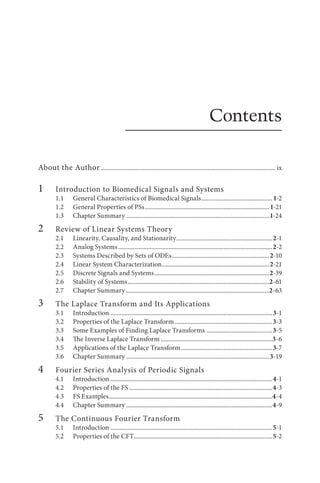
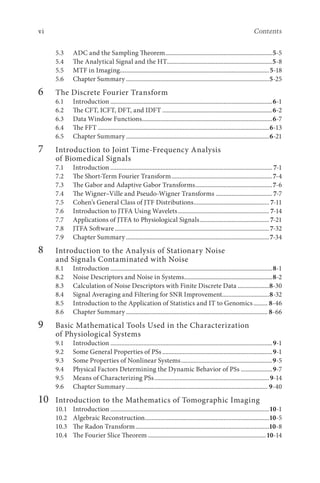
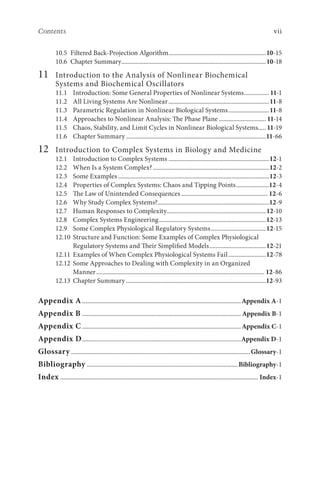

![ix
About the Author
Robert B. Northrop was born in White Plains, NY, in 1935. After graduating from
Staples High School in Westport, CT, he majored in electrical engineering (EE) at the
Massachusetts Institute of Technology, graduating with a bachelor’s degree in 1956. At
the University of Connecticut (UCONN), he received a master’s degree in systems engi-
neering in 1958. As the result of a long-standing interest in physiology, he entered a PhD
program at UCONN in physiology, doing research on the neuromuscular physiology of
molluskan catch muscles. He received his PhD in 1964.
In 1963, he rejoined the UCONN EE department as a lecturer, and was hired as an
assistant professor of EE in 1964. In collaboration with his PhD advisor, Dr. Edward
G. Boettiger, he secured a 5-year training grant in 1965 from the National Institute of
General Medical Sciences [National Institutes of Health (NIH)], and started one of the
first, interdisciplinary, biomedical engineering (BME) graduate training programs in
New England. UCONN currently awards MS and PhD degrees in this field of study, as
well as BS degrees in engineering under the BME area of concentration.
Throughout his career, Dr. Northrop’s research interests have been broad and inter-
disciplinary and have been centered on BME. He has conducted sponsored research on
the neurophysiology of insect and frog vision and devised theoretical models for visual
neural signal processing. He has also conducted sponsored research on electrofishing
and developed, in collaboration with Northeast Utilities, effective, working systems for
fish guidance and control in hydroelectric plant waterways on the Connecticut River at
Holyoke, MA, using underwater electric fields.
Another area of his sponsored research has been in the design and simulation of
nonlinear, adaptive, digital controllers to regulate in vivo drug concentrations or physi-
ological parameters, such as pain, blood pressure, or blood glucose in diabetics. An out-
growth of this research has led him to develop mathematical models for the dynamics
of the human immune system, which were used to investigate theoretical therapies for
autoimmune diseases, cancer, and human immunodeficiency virus infection.
Biomedical instrumentation has also been an active research area for Dr. Northrop
and his graduate students: an NIH grant–supported study on the use of the ocular pulse
to detect obstructions in the carotid arteries. Minute pulsations of the cornea from arte-
rial circulation in the eyeball were sensed using a no-touch, phase-locked, ultrasound](https://image.slidesharecdn.com/23897-250417043817-7dff299c/85/Signals-and-systems-analysis-in-biomedical-engineering-Second-Edition-Northrop-15-320.jpg)
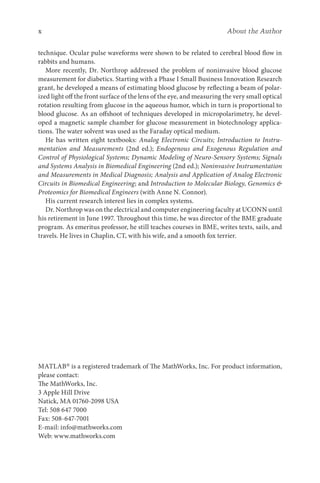
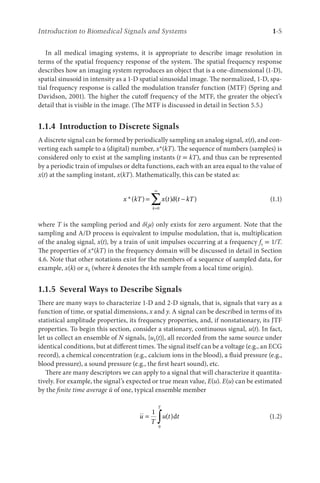
![1-6 Signals and Systems Analysis in Biomedical Engineering
In the limit as T → ∞, u → E(u), the “true” mean of u. Suppose the ensemble consists of
N responses to a sensory stimulus given repetitively to an animal. We can then pick a
time t1 after each stimulus, and find the sample mean of the ensemble, {uk(t1)}
u t
N
u t
k
k
N
( ) ( )
1 1
1
1
=
=
∑ (1.3)
As will be shown in Section 8.4, the ensemble average shown in Equation (1.3), with 0 ≤
t1 ≤ T, is a means of extracting a consistent evoked response signal from additive random
noise with zero mean.
Another measure of a 1-D signal is its intensity. Definitions of intensity can vary,
depending on the type of signal. For example, both sound intensity and light intensity
both have the units of power (W) per unit area (m2). The power can be instantaneous
power or average power. For sound, the average intensity is given by
I p c pu pcu
= = =
2 2
( )
ρ W/m2
(1.4)
where p is p(t), the sound pressure expressed in N/m2 (=Pa) over atmospheric pressure,
u(t) is the particle velocity (m/s), ρ is the density of the medium (kg/m3), and c is the
velocity of propagation (m/s). That is, I is proportional to the mean squared (ms) sound
pressure [note that the overbars in Equation (1.4) denote taking the time average]. When
p(t) = Posin(2πft), it is easy to show that the ms sound pressure is Po
2/2, that is, ½ the
peak pressure squared. For light, radiant intensity is also called the irradiance (W/m2)
incident on a surface.
A voltage signal, such as an EEG recording, can be described by its average power,
given by its mean squared voltage divided by R = 1
P
T
v t t
T
T
=
→∞ ∫
lim ( )
1 2
0
d W (1.5)
In Chapter 7, it will be shown that nonstationary signals can be characterized by JTF
plots. Special transforms are used to decompose a signal, u(t), into its spectral compo-
nents as a function of time. A JTF spectrogram gives signal mean squared volts (or rms
volts) as a function of time and frequency, creating a 2-D or 3-D display.
In Chapter 8, we present many statistical parameters that can be attributed to sig-
nals, in addition to their sample means. These include the signal’s probability density
function, and statistical measures such as its variance. Another important measure of
a signal is its frequency spectrum, also known as power density spectrum, with units
of mean squared volts (or ms units) per hertz. A signal’s root power spectrum is also
used to describe noisy signals; it is expressed in root mean squared volts per root hertz.
The root power spectrum is simply the square root of the power density spectrum. The
power spectrum describes the contribution to the total power of u(t) at each incremental
frequency. It implies a superposition of spectral power.](https://image.slidesharecdn.com/23897-250417043817-7dff299c/85/Signals-and-systems-analysis-in-biomedical-engineering-Second-Edition-Northrop-22-320.jpg)
![Introduction to Biomedical Signals and Systems 1-7
1.1.6
Introduction to Modulation and
Demodulation of Physiological Signals
In general, modulation is a process whereby a signal of interest is combined mathemati-
cally with a high-frequency carrier wave to form a modulated carrier suitable for trans-
mission to a receiver/demodulator where the signal is recovered by demodulation, then
processed and stored.
Recorded physiological signals are modulated for two important reasons: (1) for robust
transmission by wire or coaxial cable, fiber optic cable, or radio (telemetry by electro-
magnetic waves) from the recording site to the site where the signal will be processed
and stored; (2) for effective data storage. As an example, in biotelemetry, physiological
signals such as ECG and blood pressure modulate a carrier that is sent as a frequency
modulation (FM) radio signal to a remote receiver, where the signals are demodulated,
digitized, filtered, analyzed, and stored.
Modulation generally involves encoding a high-frequency carrier wave, which can
be a continuous sine wave or a square wave (logic signal) with the low-frequency signal
being measured, vm(t).
There are five major types of modulation involving sinusoidal carrier waves: (1) ampli-
tude modulation (AM), (2) single-sideband AM (SSBAM), (3) FM, (4) phase modu
lation
(PhM),and(5)double-sideband,suppressed-carriermodulation(DSBSCM).Modulation
can also be done using a square wave (or TTL) carrier, and can be by FM, PhM, or delta
modulation (DM), or can use pulse position modulation or pulse width modulation at
constant frequency. AM, FM, and DSBSCM are expressed mathematically below for a
sinusoidal carrier. m(t) is the normalized modulating signal in each case, whereas vm(t)
is the actual physiological signal. The maximum frequency of m(t) must be ωc, the
carrier frequency. The normalized modulating signal, m(t), is defined by
m t
v t
V
m t
( )
( )
, ( )
= ≤ ≤
m
mmax
0 Normalized modulatin
1 g
g signal. (1.6a)
Thus, we have
y t A m t t
m c AM
( ) [ ( )]cos( )
= +
1 ω (1.6b)
y t A t K m t t
t
m c f d FM
( ) cos[ ( ) ]
= +
∫
ω (1.6c)
y t A t K m t
m c p PhM
( ) cos ( )
= +
ω (1.6d)
y t Am t t
m c DSBSCM
( ) ( )cos( )
= ω (1.6e)
It is instructive to examine the frequency spectrums of modulated signals. The extent
of the spectrum of ym(t) determines the required signal processing BW. For illustrative
purposes, let m(t) be a pure cosine wave, [mocos(ωmt)], 0 mo ≤ 1. Thus, by trig identity,
the AM signal can be rewritten as](https://image.slidesharecdn.com/23897-250417043817-7dff299c/85/Signals-and-systems-analysis-in-biomedical-engineering-Second-Edition-Northrop-23-320.jpg)
![1-8 Signals and Systems Analysis in Biomedical Engineering
ym(t) = Acos(ωct) + (Amo/2)[cos((ωc + ωm)t) + cos((ωc − ωm)t)] (1.7)
We see that the AM signal has a carrier component and two sidebands, each spaced
by the amount of the modulating frequency above and below the carrier frequency. In
SSBAM, a sharp cutoff filter is used to eliminate either the upper or lower sideband; the
information in both sidebands is redundant, so removing one sideband means a lower
BW is required to transmit the SSBAM signal.
FM and PhM are subsets of angle modulation. FM can be further classified as broad-
band or narrowband FM (NBFM). In FM, Kf ≡ 2πfd, where fd denotes the frequency
deviation constant. In NBFM, fd/fmmax 1; (fmmax is the highest expected frequency in
m(t), which is BW-limited. Unlike AM, the frequency spectrum of an FM carrier is more
difficult to derive. Using m(t) = mocos(ωmt), we can write the FM carrier as
y t A t K m t
m c f m o m
( ) cos ( / ) sin( )
= +
ω ω ω
α β
(1.8)
Using the trig identity, cos(α + β) = cos(α)cos(β) − sin(α)sin(β), Equation (1.8) can be
written as
y t A t K m t A t
m c f m o m c
( ) cos( )cos[( / ) sin( )] sin( )
= −
ω ω ω ω s
sin[( / ) sin( )]
K m t
f m o m
ω ω
(1.9)
Now the cos[(Kf/ωm)mosin(ωmt)] and sin[(Kf/ωm)mosin(ωmt)] terms can be expressed as
two Fourier series whose coefficients are ordinary Bessel functions of the first type and
argument β (Clarke and Hess, 1971); note that β ≡ mo2πfd/ωm
cos[ sin( )] ( ) ( )cos( )
β ω β β ω
m m
t J J n t
n
n
= +
=
∞
∑
0 2
1
2 2 (1.10a)
sin[ sin( )] ( )sin[ ( ) ]
β ω β ω
m m
t J n t
n
n
= +
+
=
∞
∑
2 2 1
2 1
0
(1.10b)
The two Bessel sum relations for cos[β sin(ωmt)] and sin[β sin(ωmt)] can be recombined
with Equation (1.9) using the trig identities, cosxcosy = ½[cos(x + y) + cos(x − y)], and
sinxsiny = ½[cos(x − y) − cos(x + y)], and we can finally write for the FM carrier spec-
trum, letting mo = 1
y t A J t J t
m c c m
( ) ( )[cos( ) ( )cos(( ) ) cos((
= + + −
0 1
β ω β ω ω ωc
c m
c m c m
−
{
+ + − −
ω
β ω ω ω ω
) )]
( )[cos(( ) ) cos(( ) )]
t
J t t
2 2 2
+
+ + − −
+
J t t
J
3
4
3 3
( )[cos(( ) ) cos(( ) )]
( )[co
β ω ω ω ω
β
c m c m
s
s(( ) ) cos(( ) )]
( )[cos((
ω ω ω ω
β ω ω
c m c m
c m
+ − −
+ +
4 4
5
5
t t
J )
) ) cos(( ) )]
t t
− − + }
ω ω
c m
5 (1.11)](https://image.slidesharecdn.com/23897-250417043817-7dff299c/85/Signals-and-systems-analysis-in-biomedical-engineering-Second-Edition-Northrop-24-320.jpg)
![Introduction to Biomedical Signals and Systems 1-9
At first inspection, this result appears quite messy. However, it is evident that the numer-
ical values of the Bessel terms tend to zero as n becomes large. For example, let β = 2πfd/
ωm = 1, then J0(1) = 0.7852, J1(1) = 0.4401, J2(1) = 0.1149, J3(1) = 0.01956, J4(1) = 0.002477,
J5(1) = 0.0002498, J6(1) = 0.00002094, etc. Bessel constants Jn(1) for n ≥ 4 contribute less
than 1% each to the ym(t) spectrum, so we can generally neglect them. Thus, the practical
BW of the FM carrier, ym(t), for β = 1 is ca. ±3ωm around the carrier frequency, ωc. In
general, as β increases, so does the effective BW of the frequency modulated ym(t). For
example, when β = 5, the BW becomes ca. ±8ωm around ωc, and when β = 10, the BW
required is ca. ±14ωm around ωc (Clarke and Hess, 1971).
In the case of NBFM, β 1. Thus the modulated carrier can be written
y t A t K t
m c f m m
( ) cos[ ( / )sin( )]
= +
↓
ω ω ω
α β
(1.12a)
y t A t t t
m c m c
( ) {cos( )cos[ sin( )] sin( )sin[ sin
= −
ω β ω ω β (
( )]}
{cos( )( ) sin( )[ sin( )]}
{c
ω
ω ω β ω
m
c c m
t
A t t t
A
≅ −
=
1
o
os( ) ( / )[cos(( ) ) cos(( ) )]}
ω β ω ω ω ω
c c m c m
t t t
− − − +
2 (1.12b)
With the exception of signs of the sideband terms, the NBFM spectrum is very similar
to the spectrum of an AM carrier (Zeimer and Tranter, 1990); sum and difference fre-
quency sidebands are produced around a central carrier.
The spectrum of a DSBSCM signal is given by
ym(t) = Amocos(ωmt) • cos(ωct) = (Amo/2)[cos((ωc + ωm)t) + cos((ωc − ωm)t)] (1.13)
that is, the information is contained in the two sidebands; there is no carrier. DSBSCM is
widely used in instrumentation and measurement systems. For example, it is the natural
result when a light beam is chopped in a photonic instrument such as a spectropho-
tometer, and also results when a Wheatstone bridge is given ac (carrier) excitation and
nulled, then one (or more) arm resistances is slowly varied in time around its null value.
DSBSCM is also present at the output of a linear variable differential transformer length
sensor as the core is moved in and out (Northrop, 1997).
Of equal importance in the discussion of modulation is the process of demodulation
or detection, in which the modulating signal, vm(t), is recovered from ym(t). There are,
in general, several ways to modulate a given type of modulated signal, and several ways
to demodulate it. In the case of AM (or SSBAM), the signal recovery process is called
detection.
There are several practical means of AM detection (Clarke and Hess, 1971, Chapter
10). One simple form of AM detection is to rectify and low-pass filter ym(t). Another
form of AM detection passes ym(t) through a square-law nonlinearity followed by a low-
pass filter. However, the square-law detector suffers from the disadvantage that it gener-
ates a second harmonic component of the recovered modulating signal. A third means](https://image.slidesharecdn.com/23897-250417043817-7dff299c/85/Signals-and-systems-analysis-in-biomedical-engineering-Second-Edition-Northrop-25-320.jpg)

![Dresden, and Berlin. All promised on a year from that day to meet
again at the door of the blessed temple, either with neophytes or
with brethren now absent. They then folded their cloaks to conceal
their elegant costumes, and silently dispersed by the shadowy walks
of the park.
Albert and Consuelo, guided by Marcus, went down the ravine to the
stream. Karl received them in his closed gondola, and took them to
the door of the pavilion. There they paused for a moment to
contemplate the majesty of the orb of day which rose in the sky.
Until now, Consuelo, when she replied to Albert had called him by
his true name; when, however, she was awakened from the musing
in which she seemed delighted to lose herself, as she pressed her
burning cheek on his shoulder, she could only say:
Oh Leverani!
[15]The harmonica, when first invented, created such a sensation
in Germany, that poetical imaginations fancied they heard in it
supernatural voices, evoked by the consecrators of certain
mysteries. This instrument, which, before it became popular, was
thought to be magical, was elevated by the adepts of German
theosophy, to the same honor with the lyre among the ancients,
and many other instruments among the primitive people of
Himalaya. They made it one of the hieroglyphic figures of their
mysterious iconography. They represented it under the form of a
fantastic chimera. The neophytes of secret societies, hearing it for
the first time after the rude shocks of their terrible ordeals, were
so much impressed by it that many of them fell into ecstacies.
They fancied they heard the song of invisibile powers, for both
the instrument and the performer were concealed from them
most carefully. There are extremely curious stories told of the
employment of the harmonica in the reception of adepts of
illuminatism.
EPILOGUE
Had we been able to procure faithful documents in relation to Albert
and Consuelo after their marriage, like those which have guided us](https://image.slidesharecdn.com/23897-250417043817-7dff299c/85/Signals-and-systems-analysis-in-biomedical-engineering-Second-Edition-Northrop-42-320.jpg)
![This magical symbol was, in fact, well adapted to the object of the
Invisibles. For many years, the new Templists hoped to make Saint
Graal accessible to all mankind. Albert toiled constantly to diffuse the
true ideas of his doctrine. He reached the highest grades of the
order, for we find the list of his titles showing that he had time
enough to reach them. Now all know that eighty-one months are
needed to pass through the twenty-three degrees of masonry, and
we think it certain that a much longer time was required for the
higher grades of Saint Graal. The number of masonic degrees are
now a mystery to no one; yet it will not be out of place here to
recount a few, as they paint the enthusiastic genius and smiling
fancy which presided over their first creation:
Apprentice and Master Mason, Secret and Perfect Master, Provost
and Judge, English and Irish Master, Master in Israel, Master Elect of
the Nine and Fifteen, Elect of the Unknown, Grand Master Architect,
Royal Arch, Grand Scotch Master of the Sublime or Master Masons,
Knight of the Sword, Prince of Jerusalem, Knight of Orient and
Occident, Rose-Cross of France, Heredom and Kilwinning, Grand
Pontiff or Sublime Scot, Architect of the Sacred Roof, Pontiff of
Jerusalem, Sovereign Prince of Masonry and Master ad vitam,
Naochite, Prince of Libon, Chief of the Tabernacle and Knight of the
Iron Serpent, Trinitarian Scot or Prince of Mercy, Grand Commander
of the Temple, Knight of the Gun, Patriarch of the Crusades, Grand
Master of Light, Knight Kadosch, Knight of the White Eagle and of
the Black Eagle, Knight of the Phœnix and Knight of the Argonauts,
Knight of the Golden Fleece, Grand-Inspector-Inquisitor-
Commander-Sublime, Prince of the Royal Secret and Sublime Master
of the Luminous King,c.[16]
These titles, or at least the majority of them, we find connected with
the name of Albert Podiebrad, in the most illegible rolls of the
freemasons. There are also many less known; such as Knight of St
John, Sublime Johannite, Master of the New Apocalypse, Doctor of
the Gospel, and Elect of the Holy Ghost, Templist, Areopagite,
Magus, and Man of the People, Man-Pontiff, Man-King, and New-](https://image.slidesharecdn.com/23897-250417043817-7dff299c/85/Signals-and-systems-analysis-in-biomedical-engineering-Second-Edition-Northrop-45-320.jpg)
![man,c.[17] We have been surprised here to find some titles which
seemed anticipated from the illuminatism of Weishaupt: this
peculiarity, however, was explained at a later day, and will not, when
this story is concluded, need any explanation to our readers.
Amid this labyrinth of obscure facts—which, however, are profound,
and connected with the labor, success, and apparent extinction of
the Invisibles—we can with difficulty follow the adventurous story of
the young couple. Yet by supplying what we need by a prudent
imagination, the following is nearly the abridged commentary of the
chief events of their lives. The fancy of the reader will supply the
deficiency of the text, and following our experience, we doubt not
that the best dénoûements are those for which the reader and not
the narrator will be responsible.[18]
Probably, after leaving Saint Graal, Consuelo went to the little court
of Bareith, where the Margravine, sister of Frederick, had palaces,
gardens, kiosques, and cascades, in the same style as those of
Count Hoditz at Roswald, though less sumptuous and less expensive.
This intellectual princess had been married without a dower to a
very poor prince; and not long before she had worn robes with trains
of reasonable length, and had pages whose doublets were not
threadbare, her gardens, or rather her garden, to speak without
metaphor, was situated amid a beautiful country, and she indulged in
the Italian Opera in an antique temple à la Pompadour. The
margravine was fond of philosophy—that is to say, she was a disciple
of Voltaire. The young hereditary margrave, her husband, was the
zealous head of a masonic lodge. I am not sure whether Albert was
connected with him, or whether his incognito was observed by the
secresy of the brothers, or whether he remained away from this
court and joined his wife afterwards. Certainly Consuelo had some
secret mission there. Perhaps, also, for the purpose of preventing
attention from being attracted to her husband, she did not live
publicly with him for some time. Their loves, then, had all the
attraction of mystery; and if the publicity of their union, consecrated
by the fraternal sanction of the Templists, seemed gentle and](https://image.slidesharecdn.com/23897-250417043817-7dff299c/85/Signals-and-systems-analysis-in-biomedical-engineering-Second-Edition-Northrop-46-320.jpg)
![last twenty years of the maestro's works are so completely
unknown, that we have in vain sought to discover the name of his
last productions. We only know Porporina had the principal part, that
she was most successful, and wrung tears from the whole court. The
empress was satisfied. On the night after this triumph, Porporina
received from an invisible messenger news that filled her with terror
and consternation. At seven in the morning—that is to say, just at
the hour when the empress was awakened by the faithful valet
known as the sweeper[19] of her majesty, (for his duty consisted in
opening the blinds, making the fire, and cleaning the room, while
the empress was awaking,) Porporina, by eloquence or gold, passed
through every avenue of the palace, and reached the door of the
royal bed-chamber.
'My friend,' said she to the servant, 'I must throw myself at the
empress's feet. The life of an honest man is in danger. A great crime
will be committed in a few days, if I do not see her majesty at once.
I know that you cannot be bribed, but also know you to be generous
and magnanimous. Everybody says so. You have obtained favors
which the greatest courtiers dared not ask.'
'Kind heaven! my dear mistress! I will do anything for you,' said the
servant, clasping his hands and letting his duster fall.
'Karl!' said Consuelo. 'Thank God I am saved! Albert has a
protecting angel in the palace!'
'Albert! Albert!' said Karl. 'Is he in danger? Go In, madame, if I
should lose my place. God knows I shall be sorry; for I am enabled
to do some good and serve our holy cause better than I could do
anywhere else. Listen! The empress is a good soul, when she is not
a queen. Go in: you will be thought to have preceded me. Let those
scoundrels bear the burden of it, for they do not deserve to serve a
queen. They speak lies.
Consuelo went in; and when the empress opened her eyes, she saw
her kneeling at the foot of the bed.](https://image.slidesharecdn.com/23897-250417043817-7dff299c/85/Signals-and-systems-analysis-in-biomedical-engineering-Second-Edition-Northrop-53-320.jpg)
![About a month after the meeting at St. Graal, of which in his
memoirs Trenck says nothing, he was recaptured and imprisoned at
Magdenbourg, where he passed ten years of his life, loaded with
eighty pounds of irons. The stone to which he was bound bears the
inscription Here lies Trenck. All know his terrible fate, and the
sufferings he underwent, as also his wonderful attempts at escape,
and his incredible energy, which never left him, but which his
chivalric imprudence counteracted. His sister was subjected to the
cruelty of paying for the erection of a dungeon for him, because she
afforded him a refuge in his flight. Trenck's works of art in prison,
the wonderful engravings he made with the point of a nail on the tin
cups, which are allegories or verses of great beauty, are also well
known.[20] In fine, from his secret relations with the princess Amelia
—the despair in which she wasted away, and her care to disfigure
her face by means of a corrosive fluid, which almost destroyed her
sight—the deplorable state of health to which she reduced herself to
avoid marriage—the remarkable change effected on her character—
the ten years of agony, which made him a martyr, and her an old
woman, ugly and malicious, instead of the angelic creature she was,
and would have been had she been happy[21]—the misfortunes of
the lovers are historical; but they are generally forgotten when the
character of Frederick the Great is written. These crimes, committed
with such refined cruelty, are indelible spots on the character of that
monarch.
At length Trenck was released, as is known, by the intervention of
Maria Theresa, who claimed him as her subject. This was
accomplished by the influence of Karl, her majesty's valet. In relation
to the curious intrigues of this magnanimous man with his sovereign,
some of the strangest, most touching and pathetic pages of the
memoirs of the age have been written.
During the first part of the captivity of Trenck, his cousin, the famous
Pandour, a victim of truer though not less hateful accusations, died it
is said at Spielberg of poison. As soon as Trenck was free, the
Prussian came to ask for his cousin's vast estate; but Maria Theresa](https://image.slidesharecdn.com/23897-250417043817-7dff299c/85/Signals-and-systems-analysis-in-biomedical-engineering-Second-Edition-Northrop-59-320.jpg)