Sightseeing
     of
Azerbaijan
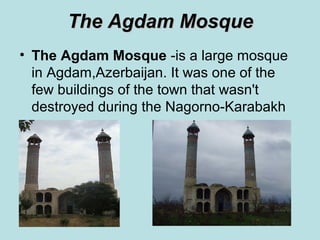
The Agdam Mosque
• The Agdam Mosque -is a large mosque
  in Agdam,Azerbaijan. It was one of the
  few buildings of the town that wasn't
  destroyed during the Nagorno-Karabakh
  war.
Construction

 The mosque was built by the architect Karbalayi
Safikhan Karabakhi from 1868 to 1870. The
mosque was built in the typical style for
mosques in Karabakh region, which included the
division of stone columns on the two-story
gallery and the use of domed ceilings. Other
mosques in this style include Barda Mosque, the
Govharaga Mosque in Shusha, a mosque
in Fizuli and one in the village of Goradiz.
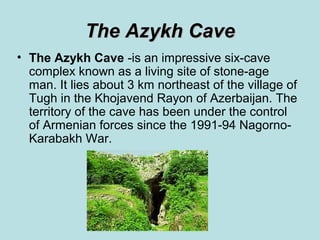
The Azykh Cave
• The Azykh Cave -is an impressive six-cave
  complex known as a living site of stone-age
  man. It lies about 3 km northeast of the village of
  Tugh in the Khojavend Rayon of Azerbaijan. The
  territory of the cave has been under the control
  of Armenian forces since the 1991-94 Nagorno-
  Karabakh War.
The Azykh Cave
• Extensively examined by archaeologists in the
  1960s, the cave is considered to be the site of
  one of the most ancient proto-human habitations
  in Eurasia. A Neanderthal-style jaw bone found
  here by Mammadali Huseynov in 1968 and now
  kept at the Academy of Sciences in Baku is
  thought to be over 300,000 years old and thus
  one of the oldest proto-human remains found in
  this part of the world. Its discovery gave rise to
  the term Azykh Man.
The Baku Ateshgah
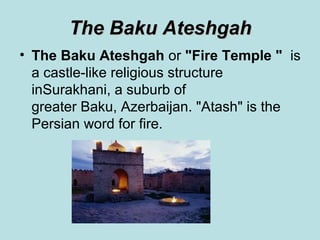
• The Baku Ateshgah or "Fire Temple "  is
  a castle-like religious structure
  inSurakhani, a suburb of
  greater Baku, Azerbaijan. "Atash" is the
  Persian word for fire.
The Baku Ateshgah
• The pentagonal complex, which has a courtyard
  surrounded by cells for monks and a tetrapillar-
  altar in the middle, was built during the 17th and
  18th centuries. It was abandoned after
  1883 when oil and gas plants were established
  in the vicinity. The complex was turned into a
  museum in 1975 and now receives 15,000
  visitors a year. It was nominated for World
  Heritage Site status in 1998 and was declared a
  state historical-architectural reserve by decree of
  the Azeri President on 19 December 2007.
The Maiden Tower
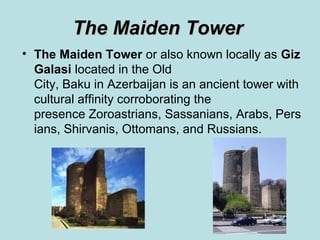
• The Maiden Tower or also known locally as Giz 
  Galasi located in the Old
  City, Baku in Azerbaijan is an ancient tower with
  cultural affinity corroborating the
  presence Zoroastrians, Sassanians, Arabs, Pers
  ians, Shirvanis, Ottomans, and Russians.
History
• There are a number of competing
  explanations for the name, the most
  prominent of which is the legend of a
  maiden who threw herself off its top to her
  death in the waves below.

                     Depiction of Maiden
                     Tower on Azerbaijani
                     manat
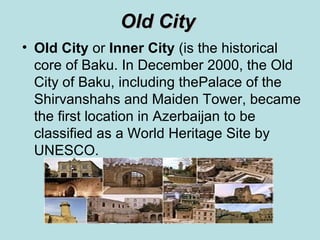
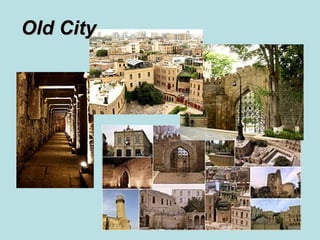
Оld City
• Оld City or Inner City (is the historical
  core of Baku. In December 2000, the Old
  City of Baku, including thePalace of the
  Shirvanshahs and Maiden Tower, became
  the first location in Azerbaijan to be
  classified as a World Heritage Site by
  UNESCO.
Оld City
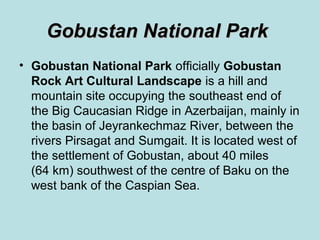
Gobustan National Park
• Gobustan National Park officially Gobustan
  Rock Art Cultural Landscape is a hill and
  mountain site occupying the southeast end of
  the Big Caucasian Ridge in Azerbaijan, mainly in
  the basin of Jeyrankechmaz River, between the
  rivers Pirsagat and Sumgait. It is located west of
  the settlement of Gobustan, about 40 miles
  (64 km) southwest of the centre of Baku on the
  west bank of the Caspian Sea.
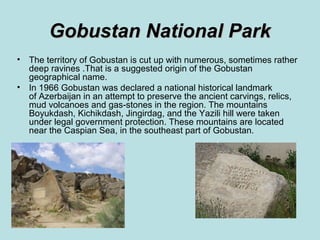
Gobustan National Park
•   The territory of Gobustan is cut up with numerous, sometimes rather
    deep ravines .Тhat is a suggested origin of the Gobustan
    geographical name.
•   In 1966 Gobustan was declared a national historical landmark
    of Azerbaijan in an attempt to preserve the ancient carvings, relics,
    mud volcanoes and gas-stones in the region. The mountains
    Boyukdash, Kichikdash, Jingirdag, and the Yazili hill were taken
    under legal government protection. These mountains are located
    near the Caspian Sea, in the southeast part of Gobustan.
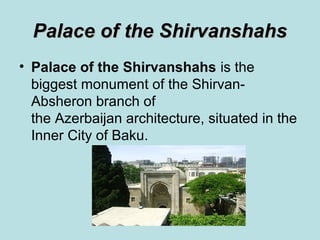
Palace of the Shirvanshahs
• Palace of the Shirvanshahs is the
  biggest monument of the Shirvan-
  Absheron branch of
  the Azerbaijan architecture, situated in the
  Inner City of Baku.
History

• In the 15th century the Shirvanshah dynasty, under Ibrahim I of
  Shirvan, transferred his country's capital from Shemakha to Baku
  following a devastating earthquake, and where he committed
  himself to the construction of the "palace". The building is believed
  to be a memorial complex built around the sacred place of
  worship and a tomb of Seyyid Yahya Bakuvi who was
  a Helwati Sufi saint. The Shirvanshahs were patrons of the Helwati
  Sufi order and Shirvanshah Khalilullah I was buried with his family in
  the grounds of the palace. Other historians argue that the building
  was used as the ruler's palace, however both theories suffer from
  the absence of evidence. It is known however, that wells inside the
  grounds of the "palace" were considered to have healing qualities
  until recent times, as was the hill where the palace was built.
• After the Safavid conquest of Baku in 1501, the Sufi order was
  expelled and over centuries the "palace" fell into ruin, and was
  known in Baku as Baku Khans palace; this toponym moved into
  Russian historiography, first cited by Bartold.
THANKS FOR ATTENTION!
         ^^

Sightseeing of azerbaijan

  • 1.
    Sightseeing of Azerbaijan
  • 2.
    The Agdam Mosque •The Agdam Mosque -is a large mosque in Agdam,Azerbaijan. It was one of the few buildings of the town that wasn't destroyed during the Nagorno-Karabakh war.
  • 3.
    Construction The mosquewas built by the architect Karbalayi Safikhan Karabakhi from 1868 to 1870. The mosque was built in the typical style for mosques in Karabakh region, which included the division of stone columns on the two-story gallery and the use of domed ceilings. Other mosques in this style include Barda Mosque, the Govharaga Mosque in Shusha, a mosque in Fizuli and one in the village of Goradiz.
  • 4.
    The Azykh Cave •The Azykh Cave -is an impressive six-cave complex known as a living site of stone-age man. It lies about 3 km northeast of the village of Tugh in the Khojavend Rayon of Azerbaijan. The territory of the cave has been under the control of Armenian forces since the 1991-94 Nagorno- Karabakh War.
  • 5.
    The Azykh Cave • Extensively examinedby archaeologists in the 1960s, the cave is considered to be the site of one of the most ancient proto-human habitations in Eurasia. A Neanderthal-style jaw bone found here by Mammadali Huseynov in 1968 and now kept at the Academy of Sciences in Baku is thought to be over 300,000 years old and thus one of the oldest proto-human remains found in this part of the world. Its discovery gave rise to the term Azykh Man.
  • 6.
    The Baku Ateshgah • The Baku Ateshgah or"Fire Temple "  is a castle-like religious structure inSurakhani, a suburb of greater Baku, Azerbaijan. "Atash" is the Persian word for fire.
  • 7.
    The Baku Ateshgah • The pentagonalcomplex, which has a courtyard surrounded by cells for monks and a tetrapillar- altar in the middle, was built during the 17th and 18th centuries. It was abandoned after 1883 when oil and gas plants were established in the vicinity. The complex was turned into a museum in 1975 and now receives 15,000 visitors a year. It was nominated for World Heritage Site status in 1998 and was declared a state historical-architectural reserve by decree of the Azeri President on 19 December 2007.
  • 8.
    The Maiden Tower • The Maiden Tower oralso known locally as Giz  Galasi located in the Old City, Baku in Azerbaijan is an ancient tower with cultural affinity corroborating the presence Zoroastrians, Sassanians, Arabs, Pers ians, Shirvanis, Ottomans, and Russians.
  • 9.
    History • There area number of competing explanations for the name, the most prominent of which is the legend of a maiden who threw herself off its top to her death in the waves below. Depiction of Maiden Tower on Azerbaijani manat
  • 10.
    Оld City • ОldCity or Inner City (is the historical core of Baku. In December 2000, the Old City of Baku, including thePalace of the Shirvanshahs and Maiden Tower, became the first location in Azerbaijan to be classified as a World Heritage Site by UNESCO.
  • 11.
  • 12.
    Gobustan National Park •Gobustan National Park officially Gobustan Rock Art Cultural Landscape is a hill and mountain site occupying the southeast end of the Big Caucasian Ridge in Azerbaijan, mainly in the basin of Jeyrankechmaz River, between the rivers Pirsagat and Sumgait. It is located west of the settlement of Gobustan, about 40 miles (64 km) southwest of the centre of Baku on the west bank of the Caspian Sea.
  • 13.
    Gobustan National Park • The territory of Gobustan is cut up with numerous, sometimes rather deep ravines .Тhat is a suggested origin of the Gobustan geographical name. • In 1966 Gobustan was declared a national historical landmark of Azerbaijan in an attempt to preserve the ancient carvings, relics, mud volcanoes and gas-stones in the region. The mountains Boyukdash, Kichikdash, Jingirdag, and the Yazili hill were taken under legal government protection. These mountains are located near the Caspian Sea, in the southeast part of Gobustan.
  • 14.
    Palace of theShirvanshahs • Palace of the Shirvanshahs is the biggest monument of the Shirvan- Absheron branch of the Azerbaijan architecture, situated in the Inner City of Baku.
  • 15.
    History • In the15th century the Shirvanshah dynasty, under Ibrahim I of Shirvan, transferred his country's capital from Shemakha to Baku following a devastating earthquake, and where he committed himself to the construction of the "palace". The building is believed to be a memorial complex built around the sacred place of worship and a tomb of Seyyid Yahya Bakuvi who was a Helwati Sufi saint. The Shirvanshahs were patrons of the Helwati Sufi order and Shirvanshah Khalilullah I was buried with his family in the grounds of the palace. Other historians argue that the building was used as the ruler's palace, however both theories suffer from the absence of evidence. It is known however, that wells inside the grounds of the "palace" were considered to have healing qualities until recent times, as was the hill where the palace was built. • After the Safavid conquest of Baku in 1501, the Sufi order was expelled and over centuries the "palace" fell into ruin, and was known in Baku as Baku Khans palace; this toponym moved into Russian historiography, first cited by Bartold.
  • 16.