Sights in Rome
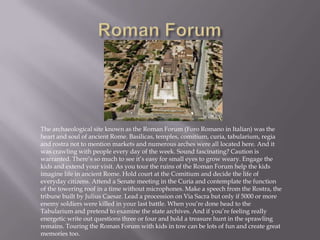
Roman Forum The archaeological site known as the Roman Forum (Foro Romano in Italian) was the heart and soul of ancient Rome. Basilicas, temples, comitium, curia, tabularium, regia and rostra not to mention markets and numerous arches were all located here. And it was crawling with people every day of the week. Sound fascinating? Caution is warranted. There’s so much to see it’s easy for small eyes to grow weary. Engage the kids and extend your visit. As you tour the ruins of the Roman Forum help the kids imagine life in ancient Rome. Hold court at the Comitium and decide the life of everyday citizens. Attend a Senate meeting in the Curia and contemplate the function of the towering roof in a time without microphones. Make a speech from the Rostra, the tribune built by Julius Caesar. Lead a procession on Via Sacra but only if 5000 or more enemy soldiers were killed in your last battle. When you’re done head to the Tabularium and pretend to examine the state archives. And if you’re feeling really energetic write out questions three or four and hold a treasure hunt in the sprawling remains. Touring the Roman Forum with kids in tow can be lots of fun and create great memories too.
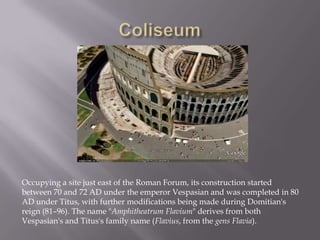
Coliseum Occupying a site just east of the Roman Forum, its construction started between 70 and 72 AD under the emperor Vespasian and was completed in 80 AD under Titus, with further modifications being made during Domitian's reign (81–96). The name "AmphitheatrumFlavium" derives from both Vespasian's and Titus's family name (Flavius, from the gens Flavia).
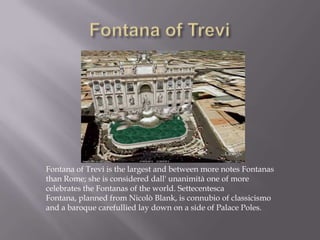
Fontana of TreviFontana of Trevi is the largest and between more notes Fontanas than Rome; she is considered dall' unanimità one of more celebrates the Fontanas of the world. Settecentesca Fontana, planned from Nicolò Blank, is connubio of classicismo and a baroque carefullied lay down on a side of Palace Poles.
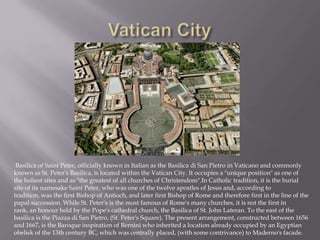
Vatican City Basilica of Saint Peter, officially known in Italian as the Basilica di San Pietro in Vaticano and commonly known as St. Peter's Basilica, is located within the Vatican City. It occupies a "unique position" as one of the holiest sites and as "the greatest of all churches of Christendom".In Catholic tradition, it is the burial site of its namesake Saint Peter, who was one of the twelve apostles of Jesus and, according to tradition, was the first Bishop of Antioch, and later first Bishop of Rome and therefore first in the line of the papal succession. While St. Peter's is the most famous of Rome's many churches, it is not the first in rank, an honour held by the Pope's cathedral church, the Basilica of St. John Lateran. To the east of the basilica is the Piazza di San Pietro, (St. Peter's Square). The present arrangement, constructed between 1656 and 1667, is the Baroque inspiration of Bernini who inherited a location already occupied by an Egyptian obelisk of the 13th century BC, which was centrally placed, (with some contrivance) to Maderno's facade.

Sights In Rome

  • 1.
  • 2.
    Roman Forum Thearchaeological site known as the Roman Forum (Foro Romano in Italian) was the heart and soul of ancient Rome. Basilicas, temples, comitium, curia, tabularium, regia and rostra not to mention markets and numerous arches were all located here. And it was crawling with people every day of the week. Sound fascinating? Caution is warranted. There’s so much to see it’s easy for small eyes to grow weary. Engage the kids and extend your visit. As you tour the ruins of the Roman Forum help the kids imagine life in ancient Rome. Hold court at the Comitium and decide the life of everyday citizens. Attend a Senate meeting in the Curia and contemplate the function of the towering roof in a time without microphones. Make a speech from the Rostra, the tribune built by Julius Caesar. Lead a procession on Via Sacra but only if 5000 or more enemy soldiers were killed in your last battle. When you’re done head to the Tabularium and pretend to examine the state archives. And if you’re feeling really energetic write out questions three or four and hold a treasure hunt in the sprawling remains. Touring the Roman Forum with kids in tow can be lots of fun and create great memories too.
  • 3.
    Coliseum Occupying asite just east of the Roman Forum, its construction started between 70 and 72 AD under the emperor Vespasian and was completed in 80 AD under Titus, with further modifications being made during Domitian's reign (81–96). The name "AmphitheatrumFlavium" derives from both Vespasian's and Titus's family name (Flavius, from the gens Flavia).
  • 4.
    Fontana of TreviFontanaof Trevi is the largest and between more notes Fontanas than Rome; she is considered dall' unanimità one of more celebrates the Fontanas of the world. Settecentesca Fontana, planned from Nicolò Blank, is connubio of classicismo and a baroque carefullied lay down on a side of Palace Poles.
  • 5.
    Vatican City Basilica ofSaint Peter, officially known in Italian as the Basilica di San Pietro in Vaticano and commonly known as St. Peter's Basilica, is located within the Vatican City. It occupies a "unique position" as one of the holiest sites and as "the greatest of all churches of Christendom".In Catholic tradition, it is the burial site of its namesake Saint Peter, who was one of the twelve apostles of Jesus and, according to tradition, was the first Bishop of Antioch, and later first Bishop of Rome and therefore first in the line of the papal succession. While St. Peter's is the most famous of Rome's many churches, it is not the first in rank, an honour held by the Pope's cathedral church, the Basilica of St. John Lateran. To the east of the basilica is the Piazza di San Pietro, (St. Peter's Square). The present arrangement, constructed between 1656 and 1667, is the Baroque inspiration of Bernini who inherited a location already occupied by an Egyptian obelisk of the 13th century BC, which was centrally placed, (with some contrivance) to Maderno's facade.