Ambassador
Friday, Nov. 20, 2015
Page 7
The Tangerine
Features
Event Information:
Location: Munson Williams Proctor Arts Institute, Museum of Art Auditorium
310 Genesee St, Utica, NY 13502 (315) 797-0000
Date: Saturday, November 21, 2015, 8 p.m.
Ticket Price: All general admission $42.50
The Magazine Writing Profile Series is a weekly series that features artists
performing in the Utica area, but not on the Utica College campus. Stories are
written in magazine style, and submitted to The Tangerine by UC students in
JLM 363—Magazine Article Writing.
Magazine Writing Profile
The
Series
“I think people want to be moved,
transported, and communicated
with on a very meaningful level as
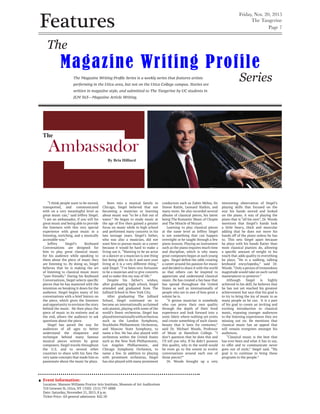
great music can,” said Jeffrey Siegel.
“I am an ambassador, if you will for
great music and being able to provide
the listeners with this very special
experience with great music in a
listening, enriching, and a musically
accessible way.”
Jeffrey Siegel’s Keyboard
Conversations are designed for
him to play great classical music
for his audience while speaking to
them about the piece of music they
are listening to. By doing so, Siegel
believes that he is making the art
of listening to classical music more
“user-friendly.” During his Keyboard
Conversations, Siegel selects specific
pieces that he has mastered with the
intention on breaking it down for the
audience. Siegel begins many of his
conversations with a brief history on
the piece, which gives the listeners
and opportunity to envision the story
behind the music. He then plays the
piece of music in its entirety and at
the end, allows the audience to ask
questions about the piece.
Siegel has paved the way for
audiences of all ages to better
understand the eloquence and
technique behind many famous
musical pieces written by great
composers. Siegel travels throughout
the U.S. and to several other
countries to share with his fans the
very same concepts that made him so
passionate about the music he plays.
Born into a musical family in
Chicago, Siegel believed that not
becoming a musician or learning
about music was “to be a fish out of
water.” He began to study music at
the age of five then gained a greater
focus on music while in high school
and performed many concerts in his
late teenage years. Siegel’s father,
who was also a musician, did not
want him to pursue music as a career
because it would be hard to make a
living out it. “Wanting to be an actor
or a dancer or a musician is one thing
but being able to do it and earn your
living at it is a very different thing,”
said Siegel. “I’ve been very fortunate
to be a musician and to give concerts
and to make this my way of life.”
Despite his father’s wishes,
after graduating high school, Siegel
attended and graduated from The
Julliard School in New York City.
After graduating The Julliard
School, Siegel continued on to
become an internationally acclaimed
solo pianist, playing with some of the
world’s finest orchestras. Siegel has
playedinternationallywithorchestras
such as the London Symphony,
Stockholm Philharmonic Orchestras,
and Moscow State Symphony, to
name a few. He has also played with
orchestras within the United States
such as the New York Philharmonic,
Los Angeles Philharmonic, and
Chicago Symphony Orchestra, to
name a few. In addition to playing
with prominent orchestras, Siegel
has also played with many prominent
conductors such as Zubin Mehta, Sir
Simon Rattle, Leonard Slatkin, and
many more. He also recorded several
albums of classical pieces, his latest
being The Romantic Music of Chopin
and The Miracle of Mozart.
Learning to play classical pieces
at the same level as Jeffrey Siegel
is not something that can happen
overnight or be taught through a few
piano lessons. Playing an instrument
such as the piano requires much time
and discipline, which is why many
great composers began at such young
ages. Siegel defied the odds creating
a career around his passion for music
and decided to share it with the world
so that others can be inspired to
appreciate and understand classical
music. He has created a fan base that
has spread throughout the United
States as well as internationally of
people who are in awe of how great a
soloist he is.
“A genius musician is somebody
who can prove their own quality
through the depth of their lived
experience and look forward into a
sonic fabric where nothing yet exists
and create something of such classic
beauty that it lasts for centuries,”
said Dr. Michael Woods, Professor
of Music at Hamilton College. “I
don’t question that he does this and
I’ll tell you why. If he didn’t possess
this quality, why in the world would
he even go to the extent to evolve
conversations around each one of
those pieces?”
Dr. Woods brought up a very
interesting observation of Siegel’s
playing skills that focused on the
way his hands moved and looked
on the piano. A way of playing the
piano that is “all his own”, Dr. Woods
mentions that Siegel’s hands look
a little heavy, thick and muscular
adding that he does not move his
hands off of the piano unless he has
to. This sets Siegel apart because
he plays with his hands flatter than
most classical pianists do, allowing
a specific amount of weight to his
touch that adds quality to everything
he plays. “He is a walking, talking
keyboard encyclopedia,” said Dr.
Woods.“Only a person of tremendous
magnitude would take on such varied
masterpieces to preserve.”
Although Siegel is highly
achieved in his skill, he believes that
he has not yet reached his greatest
achievement but says that his goal is
to try to bring the joy of music to as
many people as he can. It is a part
of his goal to create an inviting and
exciting introduction to classical
music, exposing younger audiences
to the listening experiences they are
missing out on. He mentions that
classical music has an appeal that
will remain evergreen amongst his
audiences.
“Classical music is the best that
has ever been and what it has to say,
to offer and to communicate never
goes out of style,” Siegel said. “My
goal is to continue to bring these
programs to the people.”
Ambassador
By Bria Hilliard
The

Siegel article by Bria Hilliard

  • 1.
    Ambassador Friday, Nov. 20,2015 Page 7 The Tangerine Features Event Information: Location: Munson Williams Proctor Arts Institute, Museum of Art Auditorium 310 Genesee St, Utica, NY 13502 (315) 797-0000 Date: Saturday, November 21, 2015, 8 p.m. Ticket Price: All general admission $42.50 The Magazine Writing Profile Series is a weekly series that features artists performing in the Utica area, but not on the Utica College campus. Stories are written in magazine style, and submitted to The Tangerine by UC students in JLM 363—Magazine Article Writing. Magazine Writing Profile The Series “I think people want to be moved, transported, and communicated with on a very meaningful level as great music can,” said Jeffrey Siegel. “I am an ambassador, if you will for great music and being able to provide the listeners with this very special experience with great music in a listening, enriching, and a musically accessible way.” Jeffrey Siegel’s Keyboard Conversations are designed for him to play great classical music for his audience while speaking to them about the piece of music they are listening to. By doing so, Siegel believes that he is making the art of listening to classical music more “user-friendly.” During his Keyboard Conversations, Siegel selects specific pieces that he has mastered with the intention on breaking it down for the audience. Siegel begins many of his conversations with a brief history on the piece, which gives the listeners and opportunity to envision the story behind the music. He then plays the piece of music in its entirety and at the end, allows the audience to ask questions about the piece. Siegel has paved the way for audiences of all ages to better understand the eloquence and technique behind many famous musical pieces written by great composers. Siegel travels throughout the U.S. and to several other countries to share with his fans the very same concepts that made him so passionate about the music he plays. Born into a musical family in Chicago, Siegel believed that not becoming a musician or learning about music was “to be a fish out of water.” He began to study music at the age of five then gained a greater focus on music while in high school and performed many concerts in his late teenage years. Siegel’s father, who was also a musician, did not want him to pursue music as a career because it would be hard to make a living out it. “Wanting to be an actor or a dancer or a musician is one thing but being able to do it and earn your living at it is a very different thing,” said Siegel. “I’ve been very fortunate to be a musician and to give concerts and to make this my way of life.” Despite his father’s wishes, after graduating high school, Siegel attended and graduated from The Julliard School in New York City. After graduating The Julliard School, Siegel continued on to become an internationally acclaimed solo pianist, playing with some of the world’s finest orchestras. Siegel has playedinternationallywithorchestras such as the London Symphony, Stockholm Philharmonic Orchestras, and Moscow State Symphony, to name a few. He has also played with orchestras within the United States such as the New York Philharmonic, Los Angeles Philharmonic, and Chicago Symphony Orchestra, to name a few. In addition to playing with prominent orchestras, Siegel has also played with many prominent conductors such as Zubin Mehta, Sir Simon Rattle, Leonard Slatkin, and many more. He also recorded several albums of classical pieces, his latest being The Romantic Music of Chopin and The Miracle of Mozart. Learning to play classical pieces at the same level as Jeffrey Siegel is not something that can happen overnight or be taught through a few piano lessons. Playing an instrument such as the piano requires much time and discipline, which is why many great composers began at such young ages. Siegel defied the odds creating a career around his passion for music and decided to share it with the world so that others can be inspired to appreciate and understand classical music. He has created a fan base that has spread throughout the United States as well as internationally of people who are in awe of how great a soloist he is. “A genius musician is somebody who can prove their own quality through the depth of their lived experience and look forward into a sonic fabric where nothing yet exists and create something of such classic beauty that it lasts for centuries,” said Dr. Michael Woods, Professor of Music at Hamilton College. “I don’t question that he does this and I’ll tell you why. If he didn’t possess this quality, why in the world would he even go to the extent to evolve conversations around each one of those pieces?” Dr. Woods brought up a very interesting observation of Siegel’s playing skills that focused on the way his hands moved and looked on the piano. A way of playing the piano that is “all his own”, Dr. Woods mentions that Siegel’s hands look a little heavy, thick and muscular adding that he does not move his hands off of the piano unless he has to. This sets Siegel apart because he plays with his hands flatter than most classical pianists do, allowing a specific amount of weight to his touch that adds quality to everything he plays. “He is a walking, talking keyboard encyclopedia,” said Dr. Woods.“Only a person of tremendous magnitude would take on such varied masterpieces to preserve.” Although Siegel is highly achieved in his skill, he believes that he has not yet reached his greatest achievement but says that his goal is to try to bring the joy of music to as many people as he can. It is a part of his goal to create an inviting and exciting introduction to classical music, exposing younger audiences to the listening experiences they are missing out on. He mentions that classical music has an appeal that will remain evergreen amongst his audiences. “Classical music is the best that has ever been and what it has to say, to offer and to communicate never goes out of style,” Siegel said. “My goal is to continue to bring these programs to the people.” Ambassador By Bria Hilliard The